Wednesday, February 16, 2022

The Supreme Court, Constitution and Democracy

High Court Mystique is Shattered
Nicholas Johnson
The Gazette, February 16, 2022, p. A7

Who finally decides what is “the law”? The Supreme Court.

Justice Robert Jackson once conceded, “We are not final because we are infallible, but we are infallible because we are final.”

Politicizing an impartial Court weakens our democracy.

Imagine as many as 30,000 parts, precisely engineered, manufactured, and delivered. If properly installed and maintained, they can become what you call “my car.”

Our democracy is also a creation of many parts.

At its base are what Alexis de Tocqueville [Democracy in America, 1835] called “associations.” We are volunteers in over a million non-profits and informal gatherings, from union locals and church congregations to clubs for gardening or playing bridge.

Next are the institutions I’ve called the Columns of Democracy, such as public schools and libraries to educate us; independent investigative journalism to inform us; networks from highways to broadband to promote our e pluribus unum; culminating in an expanding electorate and ever easier voting.

Of course, as Columbo might say, “There’s just one more thing.” The judiciary.

Most of our behavior is moderated not by laws but by norms, such as “Iowa nice.” There are norms for resolving most disputes. But occasionally, whether in business or in marriage, we just can’t “work it out.”

One approach used to be the challenge to a duel or some other form of homicide. Or maybe a war.

Another is like fighting siblings going to one or both parents to settle a dispute. We realize we need a resolution and agree to accept the decision of an arbitrator or judge.

And if 94 federal district and 13 appellate courts don’t agree about “the law”? We ask our “parents,” the Supreme Court, to hear our case.

Unlike the politicized executive and legislative branches, the Constitution gives justices life tenure, in part, to create a politically nonpartisan, impartial Court. In selecting which cases to hear, it may reject those turning on a “political question.”

With no access to military force, the Court needs more than finality and impartiality for public acceptance of its infallibility. It needs some mystique.

Like the building.
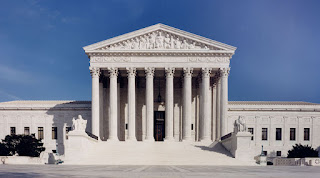
I served as Justice Hugo Black’s law clerk. My first day my wife needed the car and drove me to work. When she pulled up in front of the Supreme Court, our wide-eyed, disbelieving daughter, Julie, asked incredulously, “Daddy, you work in there?!” (Not incidentally, as I recall, there were no “partisan” conversations among clerks or justices during my year.) [Photo credit: U.S. Supreme Court.]

It’s not just the building’s exterior. There’s also the marble, high ceilings, hallway gates, black robes, the curtain dramatizing justices entrance into an imposing courtroom, the bench well above lawyers and audience, the secret justices-only “conference.”

Now politicians, journalists, public – and even justices’ behavior – are treating the Court’s justices as a third political branch (“liberal,” “conservative”). It’s as if they were throwing rocks, shattering the mystique and grand vision of the Constitution’s drafters.

Who’s left to be infallible? Only authoritarians?
____________
Nicholas Johnson clerked for Justice Hugo Black and is the author of Columns of Democracy. Contact mailbox@nicholasjohnson.org
# # #

SOURCES
Infallible because we are final. Deborah Rhode, “Ethics in Practice: Lawyers’ Roles, Responsibilities, and Regulation,” Oxford University Press, https://epdf.pub/ethics-in-practice-lawyers-roles-responsibilities-and-regulation.html (“An observation by Justice Robert Jackson applies to judges generally: ‘We are not final because we are infallible, but we are infallible because we are final.’” Brown v. Allen, 344 U.S. 443, 532, 540 (1953) (Mr. Justice Jackson, concurring). 10. See, e.g., 28 U.S.C. Sec. 455; and American Bar Association, Model Code of Judicial Ethics.”)

30,000 car parts. Nicole Wakelin, “How Many Parts Are In A Car?” NAPA Know How Blog, July 2, 2021, https://knowhow.napaonline.com/how-many-parts-are-in-a-car/ (“The exact number of parts in a car varies widely from car to car, but what’s the average? Typically, you can expect that there are about 30,000 parts in your car, from the tiniest nuts and bolts to the engine block.”)

Civic Society. Alexis de Tocqueville, Democracy in America (1835)

Steve Hoenisch, “The Relation Between Civic Society and Newspapers in the Writings of Alexis de Tocqueville and Robert Putnam,” criticism.com, https://www.criticism.com/md/putnam1.html

“Associations Matter,” The Center for Association Leadership, 2012, http://www.thepowerofa.org/wp-content/uploads/2012/03/Associations-Matter-FINAL.pdf

Columbo. Columbo, Wikipedia, https://en.wikipedia.org/wiki/Columbo (“Columbo is an American crime drama television series starring Peter Falk as Columbo, a homicide detective with the Los Angeles Police Department. … He often leaves a room only to return with the catchphrase "Just one more thing" to ask a critical question.”)

Number of federal district and circuit courts. Offices of the United States Attorneys, “Introduction To The Federal Court System,” https://www.justice.gov/usao/justice-101/federal-courts (“There are 94 district courts, 13 circuit courts, and one Supreme Court throughout the country.”)

“Political Question” Doctrine. “Political Question Doctrine,” Legal Information Institute, Cornell Law School, https://www.law.cornell.edu/wex/political_question_doctrine (“Federal courts will refuse to hear a case if they find that it presents a political question. This doctrine refers to the idea that an issue is so politically charged that federal courts, which are typically viewed as the apolitical branch of government, should not hear the issue.”)

Court as Third Political Branch. Jeffrey Rosen, “The Court Loses Its Chief Pragmatist; With the upcoming retirement of Justice Stephen Breyer, the country moves into a more ideologically divided future,” The Atlantic, January 26, 2022, https://www.theatlantic.com/ideas/archive/2022/01/stephen-breyer-retirement-supreme-court-biden/619331/

“Public’s Views of Supreme Court Turned More Negative Before News of Breyer’s Retirement; 84% say justices should not bring their political views into decisions,” Pew Research Center, Feb. 2, 2022, https://www.pewresearch.org/politics/2022/02/02/publics-views-of-supreme-court-turned-more-negative-before-news-of-breyers-retirement/ (from August 2020 to January 2022, approval of Court dropped from 70% favorable to 54%; lowest in 40 years)

# # #
Additional Related Material Not Used Directly

Today’s court justices: name, BDY, year appointed, home, law school: https://ballotpedia.org/Supreme_Court_of_the_United_States

Google search: "Supreme Court" AND (political OR politics)

Federalist No. 78 discusses the power of judicial review. It argues that the federal courts have the job of determining whether acts of Congress are constitutional and what must be done if government is faced with the things that are done on the contrary of the Constitution.

Why is Federalist 51 important? Government Must Furnish the Proper Checks and Balances Between the Different Departments.” Madison wrote Federalist 51 to explain how separation of powers with checks and balances protects liberty. Madison borrowed the concept of separation of powers from Montesquieu, a French political philosopher.Sep 6, 2011

Federalist No 81 - The Avalon Projecthttps://avalon.law.yale.edu › fed81 The Federalist Papers : No. 81 ... But the errors and usurpations of the Supreme Court of the United States will be uncontrollable and remediless.

Supreme Court of the United Stateshttps://www.supremecourt.gov › DocketPDFPDF Jan 31, 2019 — to the United States Court of Appeals for the Federal Circuit ... Madison James, Federalist 47, THE FEDERALIST. PAPERS. 25 pages

ABA’s “landmark cases” - https://www.americanbar.org/groups/public_education/programs/constitution_day/landmark-cases/

Lifetime appointments related to non-political decisions - Hamilton's main point in Federalist #78 is that a lifetime appointment will give Federal Justices the ability to work objectively on behalf of the people. If they were to seek reelection, they might act in bad faith in an effort to retain the office. May 1, 2020 Lifetime Appointments for the Court - Federalist #78 - Founder ...

Google search - "Constitutional Convention" 1787 (judges OR "judicial branch" OR judiciary OR "supreme court")

Debate from the Constitutional Convention regarding the function of the judiciary (July 21, 1787) - https://www.thirteen.org/wnet/supremecourt/democracy/sources_document5.html

See also: https://www.thirteen.org/wnet/supremecourt/democracy/sources.html

# # #


Sunday, February 06, 2022

It CAN Happen Here

Bloodlines
The Republican Party is currently split between followers of former president Donald Trump, and those rejecting Trump – who more closely resemble the Republicans of my days in Washington – men and women who put the preservation of democracy uber alles, above their own reelection and fundraising.

Some Republicans in the latter camp have come together in “The Lincoln Project.” [https://LincolnProject.us] “The Lincoln Project is an American political action committee (PAC) formed in late 2019 by former and incumbent Republicans.” [https://en.wikipedia/wiki/The_Lincoln_Project]

One of the Lincoln Project’s undertakings is the production of videos. One, “Bloodlines,” portrays how democracies have – and can again – be transformed into authoritarian states. That video is embedded below where you can watch it.

It is preceded in this blog post with the famous poem, “First They Came” – which will take on even more meaning after you have watched the video.

-- Nicholas Johnson, February 6, 2022

First They Came

German Lutheran Pastor Martin Niemöller (1892–1984)
1946

First they came for the Communists
And I did not speak out
Because I was not a Communist

Then they came for the Socialists
And I did not speak out
Because I was not a Socialist

Then they came for the trade unionists
And I did not speak out
Because I was not a trade unionist

Then they came for the Jews
And I did not speak out
Because I was not a Jew

Then they came for me
And there was no one left
To speak out for me

"Bloodlines," The Lincoln Project, January 22, 2022


January 6, 2021

# # #

Thursday, January 27, 2022

Who Pays?

Who Pays for the Losses from Our "Freedom"?

Nicholas Johnson
The Gazette, January 27, 2022, p. A4

As Dad pulled into Uncle Chet’s Iowa farmyard, the first thing I spotted was my older cousin’s shiny, new motorcycle. Would he give me a ride? He proudly obliged. We sped up the dirt farm road to the intersection and back, thankfully without incident.

Once back in Iowa City, I blurted out my overwhelming desire for a motorcycle. Dad didn’t say “no.” He just said I should talk to my friend Russ about it.

“Russ” was Dr. Russell Meyers, University of Iowa chair of neurosurgery and a pioneer of ultrasonic neurosurgery. I just knew him as a friendly guy at my folks’ parties who played boogie-woogie on our living room piano while others swayed.

Dr. Meyers’ described to me the brain surgery he provided motorcycle riders after accidents. I never again rode a motorcycle.

Years later I watched such an accident. Two students, the man navigating, the woman clutching him, without helmets or protective clothing, were speeding south on Riverside Drive. He lost control, and they went screaming down the road on bare skin.

They were exercising their “freedom,” like others today who refused COVID vaccination, and are now filling overcrowded hospitals or among the 850,000 dead.

My question, for this column, is: How should the cost of their care (or a lifetime of disability payments) be allocated?

Those causing another’s loss pay for it. Borrow your neighbor’s lawn mower, break it, and the civilized norm is what Thomas Friedman applied to the U.S. in Iraq: “the pottery store rule: You break it, you own it.” You pay for the lawnmower repairs.

This norm is also the law in many contexts. To have known, or ought to have known, that your actions could result in someone’s death can give rise to a criminal charge of manslaughter, or civil liability for wrongful death.


Why should the same principles not apply to someone who causes economic losses to others by negligently doing harm to oneself? Let’s say, motorcycling without a helmet, extreme sports like wingsuit flying and solo climbing without a safety rope – or refusing a COVID vaccination? [Photo credit: Wikimedia, Creative Commons 3.0]

For the sake of argument, let’s grant such folks the “freedom” to do these things. Most of us don’t like to hear about or see anyone suffer severe pain, injury or death. But these individuals have only themselves to blame. What harm have they done to us?

Plenty, as it turns out. The extra costs and stress on first responders and health workers at the time of the incident. If the person survives, the continuing, and perhaps lifetime, costs of treatment and disability payments. If they die, the costs of funerals and burial.

If the individual was supporting dependents, the dependents have lost her or his future earnings (a major item in wrongful death cases) and suffer emotional distress.

And all of us have lost what the person might have contributed: their skilled workmanship, start-up businesses, inventions, cures, sense of humor.

Solutions? Start by acknowledging their “freedom” isn’t free. Others are paying for it.

Nicholas Johnson is the former co-director of the Iowa Institute for Health, Behavior and Environmental Policy. Contact: mailbox@nicholasjohnson.org

SOURCES

First motorcycle ride. Recollection of personal experience; no recorded source.

Dr. Russell Meyers. Taylor J. Abel MD1, Timothy Walch PhD1, and Matthew A. Howard III MD1, “Russell Meyers (1905–1999): pioneer of functional and ultrasonic neurosurgery,” Journal of Neurosurgery, v. 125, Issue 6, pp. 1589-1595, Dec. 2016, https://thejns.org/view/journals/j-neurosurg/125/6/article-p1589.xml#affiliation0

Students’ accident. Recollection of personal experience; no recorded source found.

850,000 dead. CDC, “COVID Data Tracker,” https://covid.cdc.gov/covid-data-tracker/#datatracker-home (last visited Jan 19, 2022)

Friedman’s “pottery store rule.” Thomas L. Friedman, “Present at … What?” New York Times, Feb. 12, 2003, https://www.nytimes.com/2003/02/12/opinion/present-at-what.html (“The first rule of any Iraq invasion is the pottery store rule: You break it, you own it. We break Iraq, we own Iraq -- and we own the primary responsibility for rebuilding a country of 23 million people that has more in common with Yugoslavia than with any other Arab nation.”)

Manslaughter. “Manslaughter,” Legal Information Institute, Cornell Law School, https://www.law.cornell.edu/wex/manslaughter (“Involuntary manslaughter is negligently causing the death of another person.”)

Wrongful death. “Wrongful Death Action,” Legal Information Institute, Cornell Law School, https://www.law.cornell.edu/wex/wrongful_death_action (“A civil action against someone who can be held liable for a death.”)

Extreme sports. “Extreme Sport,” Wikipedia, https://en.wikipedia.org/wiki/Extreme_sport (“Action sports, adventure sports or extreme sports are activities perceived as involving a high degree of risk. These activities often involve speed, height, a high level of physical exertion and highly specialized gear.”)

Rachel Brown, “41 Extreme Sports Listed from Intense to INSANE!” Active Cities, no date, https://activecities.com/blog/extreme-sports-listed-from-intense-to-insane/ (40. Wingsuit Flying, 41. Solo Climbing (without safety rope))

# # #

Tuesday, January 18, 2022

Doing Well By Doing Good

Doing Well By Addressing The Poor
Nicholas Johnson
The Gazette, January 18, 2022, p. A6

I asked Senator Hubert Humphrey what he told newly elected senators. He said, “I tell ‘em they have to work four years for the Lord and then two years to get re-elected.”

There may never be another Hubert Humphrey, but there are officials who agree. Some may be responding to Jesus’ admonition we provide “the least of these” with food, water, shelter, clothing, health care – and prison visits (Matthew 25). Some acquire similar values from a different path.

Of course, others focus only on reelection -- pleasing major donors and party leadership.

Economics is not an exact science.

President Harry Truman’s assistant, Dr. John Steelman, described the President’s reaction to an economist providing “on the one hand” and “on the other hand” advice. When the economist left the oval office, Truman asked Steelman, “John, do you think you could find me a one-armed economist?”

That there are no “one-armed economists” is not because they are lacking in courage or knowledge. It is, as Harvard’s Alan Wang put it, “due to the inherently unpredictable sphere of study in which economics operates.”

“Greed – for lack of a better word – is good,” said Michael Douglas’ character, Gordon Gekko, in the movie “Wall Street.” Milton Friedman established the precedent with his assertion that “businesses serve society best when they abandon talk of ‘social responsibilities’ and solely maximize returns for shareholders.”

It’s hard to make social progress without support from the “greed is good” crowd.

Fortunately, there’s a small group who see the selfish interests for all, including billionaires, from a “rising tide that lifts all boats.” They prosper “doing well by doing good,” aware that shortsighted greed can lead to shooting oneself in the pocketbook.

To boost an economy, 70 percent of which is driven by consumer spending, consumers need money. Cutting taxes for the wealthy may increase sales of private planes and yachts but doesn’t do much for our Gross Domestic Product.

The futility of the “trickle down” theory was best explained by Harvard economist Ken Galbraith: “If you feed the horse enough oats, some will pass through to the road for the sparrows.”
• Iowa has a skilled workforce shortage. Community colleges create skilled workers. Many high school grads can’t afford tuition. Iowa’s businesses don’t want to train them. If greed is good, why don’t businesses force the legislature to provide free community college for all? They’d get their skilled workers – and shift the cost to taxpayers. [Photo credit: Kirkwood Community College, https://kirkwood.edu]

• Employee healthcare creates both hassle and huge costs for business. A universal single payer system would eliminate both – and give taxpayers the bill.

• Self-described plutocrat Nick Hanauer makes a similarly persuasive case for a $15 minimum wage, citing Seattle’s experience. That way those who work in restaurants can afford to eat in them. Everyone benefits, including the plutocrats – according to the 135 economists who agree.

Iowa legislators, how about putting in at least one year for the Lord? If greed is good, suppressing the poor makes neither dollars nor sense.
_______________
Nicholas Johnson is the author of What Do You Mean and How Do You Know? Contact: mailbox@nicholasjohnson.org

# # #

SOURCES

“Four years for the Lord.” This is my memory from a personal conversation between only the two of us that does not seem to have been recorded anywhere else.

“Matthew 25.” Bible, King James Version, Bible Gateway, https://www.biblegateway.com/passage/?search=Matthew%2025&version=KJV

President Truman, one-armed economist. “Quote Investigator,” https://quoteinvestigator.com/2019/04/10/one-handed/

Alan Wang, “unpredictable sphere of study.” Alan Y. Wang, “No, Economics Is Not a Science,” Harvard Crimson, Dec. 13, 2013, https://www.thecrimson.com/article/2013/12/13/economics-science-wang/

“Greed is good.” “The point is, ladies and gentleman, that greed – for lack of a better word – is good. Greed is right. Greed works. Greed clarifies, cuts through, and captures the essence of the evolutionary spirit. Greed, in all of its forms – greed for life, for money, for love, knowledge – has marked the upward surge of mankind.” Gordon Gekko, Wall Street (movie), 1987. https://www.youtube.com/watch?v=VVxYOQS6ggk (a 2:05 clip from the movie “Wall Street” containing this quote)

“His point . . . was that businesses serve society best when they abandon talk of ‘social responsibilities’ and solely maximize returns for shareholders.” Richard Holden, “Vital Signs: 50 years ago Milton Friedman told us greed was good. He was half right,” The Conversation, Hoover Institution, Sept. 17, 2020, https://theconversation.com/vital-signs-50-years-ago-milton-friedman-told-us-greed-was-good-he-was-half-right-146294

GDP & consumer spending. Kimberly Amadeo, “Components of GDP Explained,” The Balance, June 26, 2020, https://www.thebalance.com/components-of-gdp-explanation-formula-and-chart-3306015 (“Consumer spending comprises 70% of GDP.”)

Galbraith’s sparrows. John Kenneth Galbraith, “Recession Economics,” The New York Review, Feb. 4, 1982, https://www.nybooks.com/articles/1982/02/04/recession-economics/ (“If you feed the horse enough oats, some will pass through to the road for the sparrows.”)

Workforce. Erin Murphy and James Q. Lynch, “Iowa lawmakers agree on need for workers — but not how to get them,” The Gazette, Jan. 10, 2022, https://www.thegazette.com/article/iowa-lawmakers-agree-on-need-for-workers-but-not-how-to-get-them/

Minimum wage. Nick Hanauer. https://www.ted.com/talks/nick_hanauer_beware_fellow_plutocrats_the_pitchforks_are_coming

Molly Ball, “A Plutocrat’s Case for Raising the Minimum Wage,” The Atlantic, Jan/Feb 2016, https://www.theatlantic.com/magazine/archive/2016/01/a-plutocrats-case-for-raising-the-minimum-wage/419130/

Google search phrase: economists who believe raising minimum wage helps economy https://www.epi.org/economists-in-support-of-15-by-2024/ (“stimulate consumer demand, business activity, and job growth”) -- with list of 135 names

Minimum wage is about to rise in 21 states, 35 localities as more https://www.usatoday.com › story › money › 2021/12/20 Google search phrase: which cities or states have a $15 minimum wage

$7.25 The minimum wage in Iowa is $7.25. This is the same as the federal minimum wage, which has not changed since July 2009. Iowa is one of 21 states that follow the federal minimum wage. Mar 9, 2021 Google search: what is minimum wage iowa

What You Need to Know About Iowa's Minimum Wage – Square https://squareup.com › guide-to-iowa-minimum-wage

# # #

Wednesday, December 08, 2021

Science and Stories

Science and Stories are Different

Nicholas Johnson
The Gazette, Dec. 8, 2021, p. A6

“The good thing about science,” the bumper sticker began, “is that even if you don’t believe it, it’s still true.”

Aristotle could have written that, if there were cars with bumpers in his day (384-322 BC).

Aristotle came upon a group of men engaged in heated argument. Upon his inquiry, they reported the disagreement involved the number of teeth in a horse’s mouth. To which he replied, “Let’s go find a horse and count them.”

As Mason Williams confessed in the last line of his lyrics for “The Exciting Accident,” “this is not a true tale, but who needs truth if it’s dull.”

Like professional journalists in search of truth, scholars repeat similar versions of the story – as a parable – while disagreeing about the who, what, where and when it was first told.

I like the Aristotle version because he relied on personal observation in much of his writing, including “The History of Animals” in which he reported the number of teeth in horses.

Upon hearing Kellyanne Conway’s concept of “alternative facts,” Aristotle would have sided with Senator Daniel Patrick Moynihan, who famously said, “Everyone is entitled to their own opinion, but they're not entitled to their own facts.”


Sadly, what seemed obvious to Aristotle over 2300 years ago, and to the research scientists among us today, has not been internalized by large percentages of our Homo Sapiens species. (Photo credit: See SOURCES - Photo/Info, below.)


High school and college courses in physics, chemistry, biology, and other sciences necessarily require some awareness of the vocabulary and current knowledge base of these sciences.

Some students develop a passion for science. Some avoid these courses. Others take them but leave school singing Sam Cooke’s lyrics, “Don't know much biology/Don't know much about science book.”

But what the National Science Teaching Association headlines is, “Science classes enable students in grades 9-12 to develop the critical-thinking skills required to make informed decisions about public policy, evaluate claims made in the media, talk to their doctors, and navigate an increasingly technological world.”

Whether it’s called “the scientific method” or “critical thinking,” these are lifetime skills that can be taught in any course and utilized by all of us every day.

In 1946, James B. Conant, among many other roles a chemist and one-time president of Harvard University, spun his Yale Terry Lectures into a little book called, “On Understanding Science: An Historical Approach.” He was suggesting, in effect, to understand science first understand scientists, what they do, how and why they do it, and the language they use to talk about it.

Framing answerable questions that suggest how they might be answered. Recording observations. Revising hypotheses and theories as necessary.

Homo Sapiens have been telling each other stories for millennia – often as lessons for children – from Aesop’s Fables around 600 BC to Watty Piper’s “The Little Engine That Could” in 1930.

Nothing wrong with that – unless we’re unable to see the difference between a fact and a phony, a story and a science-derived statistic.

And what’s that difference? American COVID deaths approaching 800,000.
______________
Nicholas Johnson is former co-director of the Institute for Health, Behavior and Environmental Policy; contact: mailbox@nicholasjohnson.org

# # #

SOURCES

Bumper sticker. Google search: bumper sticker "the good thing about science"

Mason Williams (“not a true story”). Mason Williams, “The Exciting Accident” Lyrics, AZLyrics.biz, https://azlyrics.biz/m/mason-williams-lyrics/mason-williams-the-exciting-accident-lyrics/

Scholars & parable. “Q: Searching for source of “horse’s teeth” parable (No Answer, 1 Comment) Google Questions/Answers] Subject: Searching for source of "horse's teeth" parable, Category: Reference, Education and News > Teaching and Research Asked by: slblack-ga, List Price: $100.00, http://answers.google.com/answers/threadview?id=713157

Aristotle & horse’s teeth. Google, People also ask … “How many teeth does a horse have Aristotle?” The Greek philosopher Aristotle was one of the first to document the anatomy of the equine mouth in 'The History of Animals' written in 333BC 1. Aristotle correctly numbered the teeth at 44 in the adult and even described periodontal disease in the horse, which is still a common problem today. Oct 6, 2015 https://www.google.com/search?q=aristotle+horse+teeth

“Q: Searching for source of “horse’s teeth” parable (No Answer, 1 Comment); Google Questions/Answers] Subject: Searching for source of "horse's teeth" parable, Category: Reference, Education and News > Teaching and Research Asked by: slblack-ga, List Price: $100.00, http://answers.google.com/answers/threadview?id=713157

“There was once a part of Greek thinkers -- this was around the time of Aristotle -- who sat up all night having a furious argument about the number of teeth in a horse's mouth. Unable to agree, they went out and collared a passer-by -- an Arab. He listened attentively to all their arguments, and then without saying a word, he walked away. He returned in a few moments, however, and told them the correct answer. 'How did you decide?' they cried. 'Whose was the better argument, the sounder logic?' 'Logic be damned,' he says, 'I've just been round the back to the stable and counted 'em.'"
--"Chemical Plant" by Ian Williamson
CHRISTIAN ORIGINS
http://www.christianorigins.com/crossan.html

Aristotle, History of Animals.
These appear to be derived from the writing of Aristotle: History of Animals- Book 6, Part 3, By Aristotle
http://people.cornell.edu/pages/dtc24/piece/151/History-of-Animals--Book-6,-Part-3.htm

Google Search: Aristotle, "History of Animals"

Aristotle, https://en.wikipedia.org/wiki/Aristotle, 384–322 BC (62)
"His data in History of Animals (333) Generation of Animals, Movement of Animals, and Parts of Animals are assembled from his own observations,[67] statements given by people with specialized knowledge such as beekeepers and fishermen, and less accurate accounts provided by travelers from overseas.[68]"

Alternative facts.
“Alternative Facts,” https://en.wikipedia.org/wiki/Alternative_facts, “’Alternative facts’ was a phrase used by U.S. Counselor to the President, Kellyanne Conway, during a Meet the Press interview on January 22, 2017, in which she defended White House Press Secretary Sean Spicer's false statement about the attendance numbers of Donald Trump's inauguration as President of the United States. When pressed during the interview with Chuck Todd to explain why Spicer would ‘utter a provable falsehood,’ Conway stated that Spicer was giving ‘alternative facts,’ Todd responded, ‘Look, alternative facts are not facts. They're falsehoods.’”

Not entitled to own facts.
Senator Daniel Patrick Moynihan, “Everyone is entitled to their own opinion, but they're not entitled to their own facts.” Quoted in, Congressional Record Volume 154, Number 38, Thursday, March 6, 2008, House, pp. H1402-H1408. https://www.govinfo.gov/content/pkg/CREC-2008-03-06/html/CREC-2008-03-06-pt1-PgH1402-2.htm

Don’t know much.
Cooke, “Don't Know Much About History Lyrics,” http://www.songlyrics.com/sam-cooke/don-t-know-much-about-history-lyrics/

Science courses.
Google search: teaching science in high school

“Science” as “critical thinking.”
National Science Teaching Association. https://www.nsta.org/levels/high-school (“Science classes enable students in grades 9-12 to develop the critical-thinking skills required to make informed decisions about public policy, evaluate claims made in the media, talk to their doctors, and navigate an increasingly technological world.”)

James B. Conant.
“James B. Conant,” https://en.wikipedia.org/wiki/James_B._Conant

Aesop’s Fables.
“Aesop’s Fables,” (“Aesop's Fables, or the Aesopica, is a collection of fables credited to Aesop, a slave and storyteller believed to have lived in ancient Greece between 620 and 564 BCE. “ https://en.wikipedia.org/wiki/Aesop%27s_Fables

Little Engine That Could.
“The Little Engine That Could,” https://en.wikipedia.org/wiki/The_Little_Engine_That_Could (“The Little Engine That Could is an American folktale (existing in the form of several illustrated children's books and films) that became widely known in the United States after publication in 1930 by Platt & Munk. . . . The story's signature phrases such as 'I think I can' first occurred in print in a 1902 article in a Swedish journal. . . . The best known incarnation of the story The Little Engine That Could was written by 'Watty Piper,' a pen name of Arnold Munk, who was the owner of the publishing firm Platt & Munk.”)

COVID deaths.
Johns Hopkins Coronavirus Resource Center, US Deaths, https://coronavirus.jhu.edu/, Dec. 2, 2021 (782,201)

Photo Credit/Info.
"FMN Laboratory researcher in the process of assembling a neuromorphic processor based on a photonic integrated circuit that allows computations at the speed of light. To manufacture such optical devices, FMN Lab developed technological processes aimed at achieving extremely low losses. The whole cycle of creating a processor includes several stages: from preparation of the surface of a silicon wafer and deposition of multilayer thin film coatings to fabrication of nanoscale circuit topologies and automated assembly of fiber optic processor modules and components.
FMNLab; Creative Commons Attribution 4.0; FMN Lab team (2).jpg; [[File:FMN Lab team (2).jpg|FMN_Lab_team_(2)]]; 3 March 2021, 13:19:41; 6,607 × 4,405; image/jpeg

# # #

Wednesday, November 10, 2021

Taxes

Don’t Start A Discussion With Tax Cuts
Nicholas Johnson
The Gazette, November 10, 2021, p. 6A

Random thoughts about taxes.

1. Years ago I researched what political campaign donors get for their money. It turns out to be 1,000 or more to one.

An example: The Department of Agriculture sets milk prices. Imagine it refuses producers’ request for an increase. The industry makes a $200,000 “contribution” to the president. The milk price is increased. Next year Americans pay $200 million more for their milk. That’s a 1,000-to-one return on their “investment.”

You needn’t imagine. It happened. Except we paid $500-$700 million more.

Returns can include government contracts, tariffs, merger approvals, tax cuts and more.

This is an example of when increasing our taxes — to pay millions for publicly funded campaigns — could save us billions in family expenses.

2. Don’t mess with the tax code. If a business is to get taxpayer money make it a transparent appropriation on the table, not a hidden, manipulation of the tax code.

3. There are 12 or more categories of reasons why TIFs are objectionable.

For example, it’s backward. If a city or school board wants to spend tax money for legitimate public purposes, it needs voters’ approval. If it wants to distribute taxpayers’ money to for-profit private ventures, voters have no say.

We shouldn’t have different standards. But if we’re going to, aren’t taxpayers’ gifts to private businesses the ones requiring voter approval?


4. Our conversations should begin, not with taxes, but with the kind of life we want for ourselves and others. What our founders called “life, liberty and the pursuit of happiness.” Let’s pursue why the citizens of Finland and Denmark are number one and two on the worldwide happiness index while Americans are 18th. (Photo credit: Tiia Monto, Happy People road sign, Muuratsalo, Muurame, Finland, commons, wikimedia.org)

Only the most hardhearted among us will bad-mouth Jesus’ appeal for food, water, shelter, clothing, and health care for the poor (and prison visits). Matthew 25.

What to do? Economist Milton Friedman once told me, “There’s nothing wrong with poverty that money can’t cure.”

Money, yes. And taxes are one source. President Richard Nixon joined Friedman in the negative income tax idea. In 2019 Stockton tried a guaranteed basic income experiment. Forty cities followed, including Los Angeles and now Chicago.

5. But taxes aren’t the only source.

Some employers have voluntarily provided employees what Democrats are proposing: full health care, retirement packages, family leave, on-premises child care — and company housing or wages that can cover rent.

Foundations such as Bill Gates’ fund social programs. So do churches and nonprofits. And consider the economic value of volunteers’ efforts. It’s estimated to be the equivalent of all cash contributions and major philanthropy combined.

6. Public policy discussions should progress through: What do we want? What are the alternative ways of accomplishing it? What is the most efficient and effective way to do it? If personnel and funding are needed, what are the alternative sources of both? What are their pros and cons?

Fiscal responsibility? Of course. But please, no more starting off backing up with talk about “taxes.”

_______________
Nicholas Johnson, Iowa City, maintains nicholasjohnson.org. Comments: mailbox@nicholasjohnson.org

SOURCES
Nixon & Milk Producers.
See heading and three relevant pages of notes on these events below.

TIFs.
Nicholas Johnson, “TIFs: Links to Blog Essays (2006-2015), https://fromdc2iowa.blogspot.com/2014/03/tifs-links-to-blog-essays.html

Nicholas Johnson, “Talking TIF: Costs Outweigh Possible Benefits,” The Gazette, April 13, 2014, pp. A9, A12, https://fromdc2iowa.blogspot.com/2014/04/tussling-over-tifs-pros-and-cons.html

TIFs often unnecessary. Dave DeWitte, “Ft. Madison Picked for Wind Turbine Blade Plant,” The Gazette, August 18, 2006, p. 7B (Of interest to rain forest followers because it involves “Earthpark’s corporate partner” (having declared its love but offered no dowery), Siemens (from whom nothing has been reported as having been heard since the “partnership” was announced) mentioned only one factor in its selection of Iowa for manufacturing these 146-foot-long, 11 ton blades. “Siemens conducted a nationwide site search . . . [and] the Iowa site’s proximity to the more northerly year-around navigation port on the Mississippi River at Keokuk was critical to its success.” Nonetheless, $5 million was provided by the state, county, city, and a community college.

Happiness index.
“Finland ranked happiest country in the world – again,” BBC, https://www.bbc.com/news/world-europe-56457295, and “Happiness report:

“Finland is world’s ‘happiest country’ – UN,” BBC, March 15, 2018, https://www.bbc.com/news/world-43414145 (includes US at 18th place)

Nicholas Johnson, “World Happiness Index 2021; We're Number One?” April 19, 2021, https://fromdc2iowa.blogspot.com/2021/04/world-happiness-index-2021-were-number.html -- provides links to our Declaration of Independence assertion “among these (unalienable rights is) “the pursuit of happiness” and to: Thomas Jefferson wrote the Maryland Republicans, “the care of human life and happiness … is the only legitimate object of good government.”

“Why are Danish people so happy?” Denmark Ministry of Foreign Affairs, https://denmark.dk/people-and-culture/happiness (“Denmark citizens pay some of the world’s highest taxes – up to 56% of their income, plus a 25% value added tax and up to 150% on automobiles. Yet most think it a bargain for what they get in return.”)

Nikolaj Skydsgaard, “Denmark’s high tax consensus wobbles as Danes told to spend,” Reuters, June 23, 2020, https://www.reuters.com/article/us-health-coronavirus-denmark-economy/denmarks-high-tax-consensus-wobbles-as-danes-told-to-spend-idUSKBN23U1SE (“Denmark rivals France among advanced economies for the heaviest tax burden on its citizens – who by and large accept it as the price to be paid for their cradle-to-grave welfare state.”)

Basic income.
Mark Guarino, “Chicago poised to create one of the nation’s largest ‘guaranteed basic income’ programs,” The Washington Post, Oct. 25, 2021, https://www.washingtonpost.com/nation/2021/10/25/ ritica-poised-create-one-nations-largest-guaranteed-basic-income-programs/ (Stockton; 40 cities; LA and Chicago)

Employee benefits.
Jillian D’Onfro and Lucy England, “An Inside Look at Google's Best Employee Perks,” Inc., Sept. 21, 2015 https://www.inc.com/business-insider/best-google-benefits.html (free gourmet food; free fitness classes and gym (with showers); free transportation to and from work; free one-hour massages (rewards for good job); can bring dogs to work; matching 401Ks; post birth of child, moms get 18 weeks paid leave, dads 6 weeks (while continuing to receive stock and bonuses) and “baby bonding bucks” for supplies; on-site daycare; surviving spouse gets half the employee’s salary for 10 years plus $1000 a month for each child; 80/20 rule (80% of time for on primary job, 20% on “passion projects”); libraries and limited gifts of books; presentations and lectures; 3-month unpaid leaves (with healthcare up to 3 months)

Bill Gates Foundation. Bill and Melinda Gates Foundation, https://www.gatesfoundation.org/

Economic value of volunteers. Eleanor Brown, “Assessing the Value of Volunteer Activity,” Nonprofit and Voluntary Sector Quarterly, vol. 28, no. 1, March 1999, pp. 3-17, https://journals.sagepub.com/doi/pdf/10.1177/0899764099281001 (“”there are estimates suggesting that its dollar value today is at least on par with personal gifts of money and financial assets”)

# # #
President Nixon and Milk Producers

Nicholas Johnson, “Campaigns: You Pay $4 or $4000,” Des Moines Register, July 21, 1996, https://www.nicholasjohnson.org/rcntpubl/campaign.html

“Milk Price Support Program,” Farm Service Agency, U.S. Dept. of Agriculture, July 2004, https://www.fsa.usda.gov/Internet/FSA_File/mpsp04.pdf

“Starting shortly after Richard Nixon took office, bad money began gushing into the Nixon coffers. It sometimes came to Washington in big bundles of cash. The Nixon impeachment charges included as supporting material references to payoffs from ITT and other large firms, and from special interests, including $2 million from milk producers, $200,000 from a criminal (Robert Vesco) to block legal action, and even $200,000 from McDonald’s in return for permission to charge more for a quarter-pounder at a time when wage and price controls were in effect. Item after item cites criminal fraud and conspiracy, bribery and extortion.” Barry Sussman, “A Watergate lesson: Secret money means payoffs, bribes and extortion,” Nieman Watchdog, October 19, 2010, http://www.niemanwatchdog.org/index.cfm?fuseaction=background.view&backgroundid=49

“Chronology of Watergate Developments in 1973,” Oct. 23, 1973, CQ Almanac 1973, https://library.cqpress.com/cqalmanac/document.php?id=cqal73-867-26366-1225636

“Dairy Letter. A letter to Nixon promising a $2-million 1972 campaign contribution from a dairy industry group in return for action to curb dairy imports was leaked to the press. Signed by a representative of Associated Milk Producers Inc. of San Antonio, Texas, the letter was dated Dec. 16, 1970. Two weeks after that, Nixon imposed quotas on certain dairy products. The letter reportedly had fallen into the hands of Archibald Cox shortly before he was fired as special prosecutor. The dairy industry's financial support of Nixon's campaign had been linked previously to a 1971 increase in milk price supports.”

Ditto, Nov. 17, “ilk Prices. None of his interrogators asked Nixon about the milk price supports case, so the President brought up the subject himself. It had been alleged that in exchange for a $422,500 donation to the Nixon reelection campaign from the dairy industry, former Secretary of Agriculture Clifford Hardin reversed himself in March 1971 and ordered increased price supports for milk producers. The increase was estimated to add $500-million to $700-million in income for dairy farmers.

Nothing of the sort occurred, said the President. He related that he had accepted Hardin's original recommendation not to raise price supports, but that three weeks later, “Congress put a gun to our head.” He agreed to an increase when his legislative advisers told him that members of Congress, mostly Democrats, he said, wanted the increase and could override his veto if he tried to prevent it. (Earlier action, Oct. 23)

Ditto, Dec. 17, “Milk Tape. U.S. District Judge William B. Jones agreed to a Justice Department request to temporarily seal all subpoenaed documents and tapes related to a civil suit brought by consumer advocate Ralph Nader against the Nixon administration for alleged- favors to the milk industry. Jones acted after a Nader attorney, William A. Dobrovir, admitted in court that he had played one of the tapes at a party. Dobrovir apologized for what he called the “very foolish mistake.” The tape he played contained a March 31, 1971, conversation between Nixon and dairy industry representatives, which White House attorneys had turned over in response to a subpoena.”

Jan. 8 ITT and Milk Statements. The White House released two lengthy papers detailing the President's rebuttal of charges that he granted favors to the dairy industry and to the International Telephone and Telegraph Corporation (ITT) in exchange for large campaign contributions. The papers showed the allegations to be “utterly false,” said a statement accompanying them.

Political and national economic considerations, but not campaign financial needs, guided the administration's decision to approve higher milk price supports in March 1971, the White House contended in the milk background paper. The paper denied any connection between the milk support decision and the fact that dairy industry groups contributed $427,500 to the Nixon campaign in 1972.

The White House, however, acknowledged that Nixon knew as early as September 1970 that dairy groups planned to contribute large sums to his 1972 campaign. According to the White House, the President was informed in a 1970 memo of a $2-million campaign pledge from the Associated Milk Producers Inc., the largest dairy cooperative. But at no time, the statement added, did Nixon discuss the contributions with the dairy industry.

Jan. 11 Milk Case. Lawyers associated with consumer advocate Ralph Nader filed a motion in U.S. District Court in Washington, D.C., asking for access to more White House tapes and documents relating to their suit charging that the Nixon administration based a 1971 decision to raise milk price supports on political considerations, including campaign contributions from milk industry groups. The brief included a quotation from a White House recording of a March 23, 1971, discussion between Nixon and industry representatives, which the attorneys said brought into question Nixon's contention that he did not refer to campaign contributions during the meeting. According to the brief, Nixon said: “And I must say a lot of businessmen and others I get around this table, they yammer and talk a lot but they don't do anything about it. But you and I appreciate that. I don't need to spell it out.” (Nixon milk statement. Jan. 8.)

Jan. 23 More Hearings. The Senate select Watergate committee voted four to three along party lines to hold six days of additional hearings into the $100,000 given by billionaire Howard Hughes to Nixon's friend, Charles G. (Bebe) Rebozo, and the $427,500 given to the Nixon campaign in 1971 by milk producers. # # #

Wednesday, October 06, 2021

School Board Governance

School Board Members Must Speak Out
Nicholas Johnson
The Gazette, October 6, 2021, p. A6

Returning to my Iowa City home from Washington, confronting appeals of friends who were teachers, I agreed to run for school board, won, but promised only one term.

Later, I tried to recruit new school board members. It wasn’t easy.

Perhaps it was my candid sales pitch: “Well, you may not get any pay, but at least you’ll get a lot of grief.”

We spend less on K-12 than other countries, and our economy grows faster than education spending. But our federal, state and local governments budget $734 billion for it annually -- roughly the size of the defense budget.

Given the responsibilities of school board members it’s remarkable they have neither entrance requirements nor training.

But then neither do presidential appointees.

Maritime Administrator at 29, and lacking administrative experience, I asked Commerce Secretary Luther Hodges about training. There was none. I pleaded for at least some advice. He said all I needed to remember was to pee every chance I got.

Iowa City’s much beloved librarian, Lolly Eggers, served as my school board campaign treasurer, and provided, as befits a librarian, a book: John Carver, Boards That Make a Difference. She had found it useful with her board. So did we.

As Carver puts it, most advice for boards just teaches “how to do the wrong things better.”


Our superintendent was preparing the board’s agenda, complete with what motions should be made and when. As I said at the time, “We don’t have board meetings, we have superintendent meetings to which the board members are invited and have the best seats.” We changed that, redefining the roles of board members and superintendents. [Photo credit unknown, possibly Nicholas Johnson; from blog post, "The School Bored."]

The Cedar Rapids school board’s Board Governance Policies bear some similarity to what we did 23 years ago.

Where they differ in practice involves the role of elected officials and group decision making. We made clear individual board members did not speak for the board. But they did speak -- and listen.

As FCC commissioner I wrote some 400 dissenting opinions. As a school board member, I wrote a newspaper column every two weeks about K-12 education. Sometimes painful for my colleagues, my writing was nonetheless tolerated as part of the group decision-making process.

One reason democracies have multi-person legislative bodies, appellate courts, commissions – and school boards – is the assumption groups produce better decisions than authoritarian dictators. When group members are elected officials, they have an added obligation to express their views, communicate with and represent constituents, to be a voice for the voiceless, an ear for the unheard.

There is not a single challenge confronting Iowa’s school boards that has not been discovered, diagnosed, treated, and resolved by one of America’s 16,800 school boards, or the 19 countries that outscore the U.S. for quality of K-12 education.

School board members need to spend hours regularly studying the literature, reporting, speaking out and stimulating discussion. That, and many other tasks, are things that cannot properly be delegated to a superintendent and board chair.
_______________
Nicholas Johnson is a former Iowa City school board member. See https://nicholasjohnson.org/governance Contact: mailbox@nicholasjohnson.org

SOURCES

[School Board. My term ran from 1998 to 2001.]

[K-12 expenditures. Melanie Hanson, “U.S. Public Education Spending Statistics,” EducationData.org, Aug. 2, 2021, https://educationdata.org/public-education-spending-statistics]

[Defense Budget. “Budget Basics: National Defense,” Peter G. Peterson Foundation, Aug. 2, 2021, https://www.pgpf.org/budget-basics/budget-explainer-national-defense (“The United States spent $725 billion on national defense during fiscal year (FY) 2020 according to the Office of Management and Budget . . ..”)]

[Use of word “pee” in The Gazette; precedent. Adam Sullivan. 2021 headline: “Banning fake pee? In this economy?” The Gazette, Feb. 19, 2021, https://www.thegazette.com/staff-columnists/banning-fake-pee-in-this-economy/ ]

[Lolly Eggers. Iowa City Public Library Librarian, served from 1975-95. “Iowa City Public Library celebrates legacy of Lolly Eggers, Former Library Director,” Press Release, Iowa City Public Library,” July 2, 2021, https://www.icpl.org/press-releases/iowa-city-public-library-celebrates-legacy-lolly-eggers-former-library-director]

[Carver. Doing the wrong things better. John Carver, “Remaking Governance,” American School Board Journal, March 2000, p. 26, http://nicholasjohnson.org/writing-2/asbjcarv.html]

[Cedar Rapids School Board governance. “Article 2 Board Governance and Operations,” Cedar Rapids Community School District Policies and Procedures,” https://crschools.us/series/200/]

[Group decision making. Tim Barnett, “Group Decision Making,” Encyclopedia of Management, Reference for Business, https://www.referenceforbusiness.com/management/Gr-Int/Group-Decision-Making.html ]

[Number of school boards. Imed Bouchrika, “101 American School Statistics: 2020/2021 Data, Trends & Predictions,” Education, Research.com, June 10, 2020, https://research.com/education/american-school-statistics (“The U.S. is currently home to 16,800 school districts.”)]

[19 counties better than US education. “20 Best Education System in the World,” edsys, May 22, 2019, https://www.edsys.in/best-education-system-in-the-world/; Patricia Fioriello, “Top K-12 Education System in the World,” Critical Issues in Education, https://drpfconsults.com/top-k-12-education-system-in-the-world/ (“The top five K-12 education systems worldwide are as follows:” – the U.S. did not make the list)]

# # #

Saturday, September 25, 2021

Solving Our Housing Disgrace


Housing has been in the news. Roughly 500,000 are homeless any given evening. "The number of poor, renter households experiencing a severe housing cost burden (i.e., those paying more than 50 percent of their income toward housing) totaled 6,902,060 in 2016." ["The State of Homelessness in America."] "The United States may be facing the most severe housing crisis in its history. . . . [An] estimated 30–40 million people in America could be at risk of eviction in the next several months." [Emily Benfer et al., "The COVID-19 Eviction Crisis," Aspen Institute, August 7, 2020.]

What are our values and goals regarding the provision of housing?

Our international housing value and goal is expressed in the United Nations’ Universal Declaration of Human Rights, Article 25: “Everyone has the right to a standard of living adequate for the health and well-being of himself and of his family, including . . . housing. . ..”

Presumably, we can agree to a standard at least as high as what the Iowa Legislature provides for animals.

Iowa Code Section 717B.3 provides the penalties for “animal neglect.” “A person commits animal neglect when the person . . . fails to provide the animal with . . . ventilated shelter reasonably sufficient to provide adequate protection from the elements and weather conditions . . .. The shelter must protect the animal from wind, rain, snow, or sun and have adequate bedding to provide reasonable protection against cold and dampness.”

Can we at least start there for humans as well?

Having agreed on the goal, the next step is to explore the alternative means of reaching it.

Private ownership. Most housing is created and provided by developers, contractors, and landlords who “own” the housing and price it at “what the market will bear” – that is, maximizing profits up to the amount beyond which the increase in price so diminishes demand that overall income is reduced. This system works well for the owners – and is satisfactory for the buyers and renters with incomes of $75,000 and up, unless a “housing shortage” drives prices beyond what they would be in a more competitive market. But it tends to shut out the homeless and those working for the minimum wage, or otherwise in the bottom 20% of the population as measured by both income and wealth.

Private-government blend. TIFs, Section 8 and other programs are designed to incentivize owners with cash payments from taxpayers. This model is used throughout our economy, including housing. Its limitations are (1) often a disproportionate focus on and benefit for the middle class rather than the low income and poor, (2) the amorphous standard of “affordable housing” can include making a $400,000 condo available for $200,000, and (3) little to no limitation or regulation regarding how much profit (from taxpayers’ money) goes to owners.

Government housing. While government housing programs must play a role, they have had their problems as well.

Churches, other non-profits, and organizations. It is a wonderful, community-building thing that individuals are willing to come together to fund, organize, and provide additional housing for those most in need. Building a Habitat for Humanity dwelling does create a house that becomes someone’s home, an improved community spirit, and for those who build it a worthwhile sense of having done some good in this world for others. But it cannot, alone, make much of a dent in the 500,000 homeless sleeping on the streets, and the millions more low-income folks sleeping in their cars.

Keeping on keeping on. Of course, we need to continue to do what we can with what we have while endeavoring to bring more attention, commitment, and resources to housing for all.

But the bottom-line reality and shame that hangs over our nation’s housing failure will stay with us until over a majority of Americans, and their elected officials, set a top priority goal of creating and providing decent shelter to every American – and then pursue that goal with the determination and perseverance we applied to winning World War II, or putting a man on the moon.

Failing to provide shelter to animals is a violation of law called “animal neglect.” Can we not agree that failing to provide shelter for humans, “human neglect,” is as worthy of legal protection?

# # #

Monday, September 20, 2021

America's Democracy September 2021

From its birth, America's democracy has been under attack -- from a number of directions, by different (usually relatively small) groups of people, with varying results, up to and including our Civil War and the January 6, 2021, insurection.

So it's useful to take its pulse from time to time to see how it is doing.

I have written about this in the book Columns of Democracy, numerous newspaper columns and blog posts. But I've just watched the report by Stephen Schmidt and now believe it to be one of the best analyses I've heard or read -- no screaming or wild claims, "just the facts, ma'am," as Dragnet's Joe Friday used to say. [https://www.snopes.com/fact-check/just-the-facts/]

Schmidt played major roles in the Republican party for years. Schmidt was communications director of the House Committee on Energy and Commerce, and the National Republican Congressional Committee, during President George W. Bush's administration he was a deputy assistant to the president and counselor to Vice President Dick Cheney. In 2004, he was a member of the senior strategic planning group, led by White House adviser Karl Rove, that ran President George W. Bush's re-election campaign and oversaw the reelection "war room". He was the White House strategist responsible for the U.S. Supreme Court nominations of Samuel Alito and Chief Justice John Roberts. He was campaign manager for the re-election campaign for California Governor Arnold Schwarzenegger, and headed up the day-to-day operations of the McCain presidential campaign. [https://en.wikipedia.org/wiki/Steve_Schmidt]

I don't lay this out to make the case that he's a dues-paying member of the Trump Cult. He's not. He was in on the creation of The Lincoln Project -- an organization he has now left. [https://en.wikipedia.org/wiki/The_Lincoln_Project] He has also left the Republican Party.

Here's the video. Watch it and judge for yourself:

Amanpour and Company, PBS, "Lincoln Project’s Steve Schmidt “There’s a Battle for Control of MAGA Empire," posted Sept. 15, 2021, https://www.youtube.com/watch?v=KqlwfRTHRqg

Sunday, September 12, 2021

Defending Wilderness Parks

Defending Wilderness Parks

Nicholas Johnson
The Gazette, September 12, 2021, p. D2

Iowa City’s Hickory Hill Park wilderness was recently protected from developers by the City Council. Not all wilderness has been so lucky.

Why wilderness? Everyone has stories. Here’s mine.


Over 100 years ago President Teddy Roosevelt warned, “We have become great because of the lavish use of our resources. But the time has come to inquire seriously what will happen when our forests are gone ….” He created the U.S. Forest Service and 150 national forests plus five national parks – 230 million acres in all.
[Photo credit: Nicholas Johnson; downhill trail from "The Rock," Hickory Hill Park, Iowa City, Iowa]

Did Iowa heed that warning? Apparently not.

Mark Edwards, after 30-years with the Iowa Department of Natural Resources, retains his commitment. Eight years ago, in “A world Without Wildlife,” he wrote:

“We traded 93 percent of Iowa’s habitat for [agriculture], 6 percent for cities and roads. Two-thirds of [Iowa’s 36 million acres are] corn and beans. We killed the native prairies [leaving only] 30,000 acres [less than 0.1%]. All [Iowa’s] county, state and federal public land [combined] . . . amounts to a square less than 39 miles on a side. We have produced the most polluted surface water in America and continue to reduce habitat for most species."

One of my earliest memories of being four years old is lying on my back in the front yard on a windy summer day, looking up at the elms’ dancing canopy, speculating whether it was the moving limbs that made the wind, or the wind that moved the trees.

A few years later, when my parents refused to dictate “my” religion, and I came upon reference to Druids, who had sacred trees, I went looking for Iowa City’s Druid church. Finding none, that quest was abandoned.

As a member of one of the last law school classes permitted to take the bar exam before graduating, and with an awaiting federal clerkship in late August, I spent the summer visiting Teddy Roosevelt’s legacy: all the national parks west of the Mississippi.

Once in Washington, a few steps across a seldom-travelled street bordering my apartment, grew Glover-Archbold Park. Its 183 acres of wilderness and meandering stream ran north from Canal Road for 2-1/2 miles. It was my Walden Pond in the center of a city over three times the population of Des Moines. A place for a daily run, to meditate, to experience a forest through 365 days of sun, wind, rain and snow.

Nor is this the only wilderness area inside Washington. Rock Creek Park is 1700 acres. Glover-Archbold doesn’t even make the list of “12 Top Washington, D.C., Parks.”

Similarly, New York’s Central Park, envisioned in the 1840s and opened in 1858, is only the fifth largest in that city.

Developers seeking profit from a violation of Hickory Hill Park is bad enough. But can you imagine the billions of dollars 1700 acres in Washington or 843 acres in Manhattan would be worth to developers? And yet, to borrow from the Broadway show tune, “they’re still here” – because they had defenders.

We owe our wilderness no less.
__________
Nicholas Johnson, Iowa City, enjoys Linn and Johnson Counties’ wilderness areas. Contact: mailbox@nicholasjohnson.org

SOURCES

Hickory Hill Park and Iowa City City Council. Rylee Wilson, “Iowa City Council changes direction, votes no on Hickory Hill development; After voting to approve a controversial rezoning two times, the motion failed on its final consideration,” The Gazette, July 27, 2021, https://www.thegazette.com/local-government/iowa-city-council-changes-direction-votes-no-on-hickory-hill-development/

Iowa City. Hickory Hill Park is 190 acres; Iowa City 26.14 sq mi (Iowa 56,272 sq mi) “Iowa City, Iowa,” Wikipedia.org, https://en.wikipedia.org/wiki/Iowa_City,_Iowa#Metropolitan_area

President Theodore Roosevelt. “Theodore Roosevelt,” National Park Service, https://www.nps.gov/thro/learn/historyculture/theodore-roosevelt-and-conservation.htm (includes quote); and see https://www.theodoreroosevelt.org/content.aspx?page_id=22&club_id=991271&module_id=339333 (“Conservation” quote)

Iowa wilderness. Mark Edwards, "A World Without Wildlife," Ames Tribune, Nov. 29, 2013, https://www.amestrib.com/article/20131129/Opinion/311299942 ("We are the most biologically altered state in North America. We traded 93 percent of Iowa’s habitat for agricultural purposes, along with 6 percent for cities and roads. Two-thirds of our roughly 36 million acres are covered in just two annual plants, corn and beans. We killed the native prairies and have only 30,000 acres left. It would be hard to do a better job.//All county, state and federal public land in Iowa placed all together amounts to a square less than 39 miles on a side, and all these areas are losing native species.//We have produced the most polluted surface water in America and continue to reduce habitat for most species.")

Druids. “Celtic Sacred Trees,” Wikipedia, https://en.wikipedia.org/wiki/Celtic_sacred_trees (“Many types of trees found in the Celtic nations are considered to be sacred.” “Pliny the Elder describes a festival on the sixth day of the moon where the druids climbed an oak tree, cut a bough of mistletoe, and sacrificed two white bulls as part of a fertility rite.” With reproduction of the 1845 painting “The Druid Grove.”)

Clerkships. U.S. Court of Appeals Judge John R. Brown, 1958-59; U.S. Supreme Court Justice Hugo L. Black, 1959-60.

Washington, D.C. Parks.
Washington. “Glover-Archbold Park,” https://en.wikipedia.org/wiki/Glover-Archbold_Park (183 acres)

“Glover-Archbold Park,” Birders’ Guide to Maryland,” https://birdersguidemddc.org/site/glover-archbold-park/ (stretching over 2.5 miles from Canal Road in Georgetown north to Van Ness Street)

“Washington, D.C.,” Wikipedia.org, https://en.wikipedia.org/wiki/Washington,_D.C. (“The U.S. Census Bureau estimates that the district's population was 705,749 as of July 2019, an increase of more than 100,000 people compared to the 2010 United States Census.”)

Des Moines population, “Des Moines, Iowa,” https://en.wikipedia.org/wiki/Des_Moines,_Iowa (“The city's population was 214,133 as of the 2020 census.”)

Rock Creek Park, 1700 acres “12 Top Washington DC Parks,” Washington DC Sightseeing Tours, https://www.trolleytours.com/washington-dc/12-best-parks-dc

DC [as distinguished from "Washington"] has 900 acres of parks - District of Columbia Department of Parks and Recreation, https://en.wikipedia.org/wiki/District_of_Columbia_Department_of_Parks_and_Recreation

Washington, DC 43, 766 acres. “DC’s 43,766 acres,” https://ggwash.org/view/42387/dcs-43766-acres-25-roads-2-high-rises
Central Park, NYC. “Central Park,” https://en.wikipedia.org/wiki/Central_Park (843 acres; envisioned 1840s, opened to public 1858)

“They’re still here.” Stephen Sondheim, “I’m Still Here,” “Follies” (1971) https://genius.com/Stephen-sondheim-im-still-here-lyrics (“Good times and bum times/I’ve seen them all and, my dear/I’m still here/Plush velvet sometimes/Sometimes just pretzels and beer/But I’m here/ ….”)

# # #

Sunday, August 22, 2021

Departure Disaster - Generals Had It Right

Four days ago (April 18) The Gazette published a column of mine, "Think About the Ending Before the Beginning," The Gazette, August 18, 2021, p. A6, reproduced in this blog as, "Starting and Ending Wars; Questions We Should Have Asked Before Invading Afghanistan," August 18, 2021, https://fromdc2iowa.blogspot.com/2021/08/starting-and-ending-wars.html

In it I said, "Before, rather than after, going to war the best and brightest of our military have 'thought a bit of the end of it.' They have a list of questions . . .. Among them are, 'What will be our exit strategy?' and 'After we leave will the people and their country be better off or worse off?'”

Knowing that about the military I could not believe that the departure President Biden pursued was something they had either urged upon him or even agreed to. But at that time I didn't have a source to cite to support my assumption.

I had even suggested in a prior (unpublished) version of that column (and included in the "Sources," under "Related") a rebuttal to the argument for leaving Afghanistan that "We shouldn't be keeping even 5000 or 10,000 troops in a foreign country." I wrote, "If true, then should we also bring the troops home from the other 150 (give or take) countries where we have even more troops -- Japan 54K, South Korea 26K, Germany 35K, Italy 12K, UK 9K?"

Today I came upon a couple of sources supporting (a) my assumption that the miliary did not support Biden's departure plans, and (b) that if we can justify 54,000 American troops still in Japan over 75 years after World War II what is so outrageous about keeping 5,000 or more troops in Afghanistan 20 years after our invasion?

Here are those sources:

The New York Times put six of its best reporters on its page one lead story today (Aug. 22) about the evolution of President Biden's approach to our troops departure from Afghanistan. After making reference to an April 2021 meeting in its opening sentence, the next sentence reads:
"It was two weeks after President Biden had announced the exit over the objection of his generals, but now they were carrying out his orders."

In other words, the generals did oppose Biden's departure plan -- while supporting the Constitution's requirement that they obey the commands of their civilian commander in chief. Michael D. Shear, et al, "Embassy in Kabul Warns Amricanws to Avoid Airport; Miscue After Miscue, Exit Plan Unravels," [Online headline: "Miscue After Miscue, U.S. Exit Plan Unravels; President Biden promised an orderly withdrawal. That pledge, compounded by missed signals and miscalculations, proved impossible.] New York Times, August 22, 2021, p. A1, https://www.nytimes.com/2021/08/21/us/politics/biden-taliban-afghanistan-kabul.html.

That story makes reference to an earlier New York Times report: Helene Cooper, Eric Schmitt and David E. Sanger, "Debating Exit From Afghanistan, Biden Rejected Generals’ Views; Over two decades of war, the Pentagon had fended off the political instincts of elected leaders frustrated with the grind of Afghanistan. But President Biden refused to be persuaded." New York Times, April 18, 2021, p. A1, https://www.nytimes.com/2021/04/17/us/politics/biden-afghanistan-withdrawal.html ("The report by the Afghanistan Study Group, a bipartisan panel examining the peace deal reached in February 2020 under the Trump administration, found that withdrawing troops based on a strict timeline, rather than how well the Taliban adhered to the agreement to reduce violence and improve security, risked the stability of the country and a potential civil war once international forces left.")

# # #

Wednesday, August 18, 2021

Starting and Ending Wars

Questions We Should Have Asked Before Invading Afghanistan;
There weren’t any good ways to leave Afghanistan, just the least-worst way. And we didn’t pick that one.

Nicholas Johnson
The Gazette, August 18, 2021, p. A6

[This is how it first appeared Aug. 17 online; hard copy headline: "Think About the Ending Before the Beginning"]

“If we’d thought a bit of the end of it,” Cole Porter laments in his lyrics to “Just One of Those Things.”

It’s a caution wisely applied in both love and war, as Rita Rudner illustrates in her standup: “Whenever I date a guy, I think, 'Is this the man I want my children to spend their weekends with?'”

Now think Afghanistan.
How will we know if we’re ever “successful”? What are our metrics?

Before, rather than after, going to war the best and brightest of our military have “thought a bit of the end of it.” They have a list of questions, set forth below. Among them are, “What will be our exit strategy?” and “After we leave will the people and their country be better off or worse off?” [Photo source: wikimedia.org, public domain]

Among the other questions are: What’s the problem, or challenge? What’s our goal? Is it sufficiently important, clearly defined and understood? Why will military force contribute to, rather than impede, its accomplishment? What more effective non-military alternatives are there?

What are the benefits and costs, gains and losses, risks and rewards? What will it require in troops, materiel, lives and treasure? How long will it take? Are the American people and their Congress supportive? For how long?


Might we be perceived as just the latest invaders? Can we protect innocent civilians? Is the area governed as a country, or as regions ruled by war lords? Are we picking sides in a civil war? Are we sufficiently informed about the territory and people where we’ll be fighting? Do we know their language, culture, history, tribal, political, and social structure? Will we be the only ones identified by uniforms, unable to distinguish friend from foe? [Photo source: wikimedia.org]

How will we know if we’re ever “successful”? What are our metrics?

As U.S. maritime administrator I had some responsibility for sealift to Vietnam and our MARAD representatives there. Before a trip to Saigon I was asked to report my assessment when I returned.

What was my conclusion, after matching the questions above to my observations in Vietnam? “You can’t play basketball on a football field.”

Or, as the computer in the 1983 movie “War Games” concludes, after comparing its countdown to “Global Thermonuclear War” with an unwinnable game of tic-tac-toe, there are times when “The only winning move is not to play.”


[See 1:42-1:46 (1:30-1:35 on original YouTube trailer) for computer's conclusion. The rest of what's provided here gives the context for that conclusion. This is a clip from a trailer for the film, available to the public on YouTube. If anyone connected to the film War Games objects to this use, promoting the film and thus encouraging people to watch the entire movie, give me a brief email to that effect and this will be taken down. mailbox@nicholasjohnson.org]

But we no longer have the luxury of deciding whether to play the game. That was decided by others 20 years ago. As the pottery display sign warns, “break it, you own it.” We own Afghanistan.

Paul Simon sang, “There must be 50 ways to leave your lover.” There weren’t any good ways to leave Afghanistan, just the least-worst way. And we didn’t pick that one.

Now America agonizes, like the hospitalized antivaxxer whose refusal to be vaccinated has him infected with COVID, breathing through a ventilator. He’s changed his mind. He begs to be vaccinated, only to be told, “We’re sorry, but it’s too late now.”

If only “we’d thought a bit of the end of it” in 2001 – and 2021.
______________________
Nicholas Johnson, the author of Columns of Democracy, was U.S. maritime administrator during the Vietnam War. mailbox@nicholasjohnson.org

# # #

SOURCES
Lyrics to “Just One of Those Things.” Cole Porter. https://genius.com/Cole-porter-just-one-of-those-things-lyrics “It was just one of those things/Just one of those crazy flings . . . If we’d thought a bit/Of the end of it/When we started painting the town . . . It was great fun/But it was just one of those things.”

Rita Rudner quote. “Rita Rudner Quote,” citing source as: “As quoted in: Mademoiselle: The Magazine for the Smart Young Woman, Volume 92 (Condé Nast Publications, 1986), p. 174.” https://libquotes.com/rita-rudner/quote/lbe6h0y; also https://www.brainyquote.com/quotes/rita_rudner_386695

War Games. https://www.imdb.com/title/tt0086567/

50 Ways to Leave Your Lover. Paul Simon, “50 Ways to Leave Your Lover,” Genius, https://genius.com/Paul-simon-50-ways-to-leave-your-lover-lyrics

Related (to prior versions of this column; still relevant but not necessary “sources” for this version. (a) When 911 was paid for and carried out by Saudis, why did we attack Afghanistan? (b) Yes, there were terrorists in Afghanistan. But there are well over 100 countries that could, and do, provide safe havens for terrorists. Why make Afghanistan our single major focus? (c) We shouldn't be keeping even 5000 or 10,000 troops in a foreign country. If true, then should we also bring the troops home from the other 150 (give or take) countries where we have even more troops -- Japan 54K, South Korea 26K, Germany 35K, Italy 12K, UK 9K?)

Saudis not Afghanis. Annika Kim Constantino, “U.S. reviews 9/11 documents for possible release after families tell Biden to skip memorial events,”CNBC, Aug. 9, 2021, https://www.cnbc.com/2021/08/09/9/11-attacks-biden-doj-reviews-documents-for-release.html

Terrorists in 134 countries. Global Terrorism Index, https://en.wikipedia.org/wiki/Global_Terrorism_Index (last edited Aug. 10, 2021)

100,000 troops in Afghanistan in August 2010. “A timeline of U.S. troop levels in Afghanistan since 2001,” AP/Military Times, July 6, 2016, https://www.militarytimes.com/news/your-military/2016/07/06/a-timeline-of-u-s-troop-levels-in-afghanistan-since-2001/

Troop deployments.

“United States Military Deployments,” Wikipedia, https://en.wikipedia.org/wiki/United_States_military_deployments (“The military of the United States is deployed in most countries around the world, with between 150,000 to 200,000 of its active-duty personnel stationed outside the United States and its territories.”)

“US Deployment Facts, How Many US Troops are Overseas?” VetFriends, https://www.vetfriends.com/resources/us_deployments_overseas.cfm (With more than 5000: Japan, Germany, South Korea, Kuwait, Italy, UK)

“Explained: The US military’s global footprint,” TRTWorld, March 15, 2021, https://www.trtworld.com/magazine/explained-the-us-military-s-global-footprint-45029 (“Washington keeps troops numbered around 150,000 to 200,000 abroad across more than 150 countries, according to different sources.” citing DOD data June 30, 2021; Japan 54K, South Korea 26K, Germany 35K, Italy 12K, UK 9K)

# # #

Friday, August 06, 2021

Protecting Animals While Evicting Humans

Protecting Animals But Not Humans

Nicholas Johnson
The Gazette, August 6, 2021, p. A5

Why does the law permit evicting the mammalian species Homo sapiens from shelter, but not mammalians like dogs and cats?

Of course, I support laws protecting animals’ rights. I love and attempt communication with all creatures. (Fish and ants are the most obstinate.) Increasing penalties and enforcement for animal mistreatment are encouraging.

But an Aspen Institute analysis reveals 30 to 40 million American Homo sapiens are at risk of eviction.

This is made worse by COVID. We knew since January 2020 COVID elimination is possible (test, trace, quarantine, isolate). Some elected officials preferred the path that produced 600,000 deaths.

Vaccine creation was appropriately celebrated. But vaccine in bottles is much less effective than vaccine in arms.

Rather than vaccination, some of our “leaders” prefer our “freedom” to choose risk of death to ourselves and others. So, more die.

Meanwhile, 7000 miles away in Wuhan, China, all 11 million residents are being tested. Since May 2020 Wuhan eliminated positive cases. Recently, when three symptomatic and five asymptomatic cases popped up, they resumed test, trace, isolate and quarantine.

Evictions in China? Yes, housing is a challenge for migrants. But during the 2020 lockdown Wuhan built shelters for about 5000 persons.

Like Americans, the Chinese have even more concern for animals. Bloomberg reports they are building 13-story condominiums for hogs to protect them from disease – with on-premises vets and individually prepared and served meals.

It’s unlikely that capitalist America will ever provide the housing for humans that China provides for hogs.

But can’t our Democrats and Republicans, the religious and agnostics alike, at least agree to provide every member of our species with shelter? It’s what we insist on for our fellow mammalians. It’s what the Universal Declaration of Human Rights says is a basic human right.

So how do we do that?


Start by skipping the 38 percent of Americans who own their homes free and clear. Concentrate on the 30 to 40 million who are housing insecure – starting with the homeless. [Photo credit: Wikimedia.org Creative Commons]

Iowa City’s Shelter House is building a second “housing first” facility for Homo sapiens. Housing first is a movement demonstrating why it’s more effective and cheaper to assist the homeless and unemployed with housing before addressing their other challenges. Duplicate it across America.

It’s how Finland is eliminating homelessness.

Let’s start saving life on Earth while searching for life on Mars. We spend more on military than the next 11 nations combined. It used to be 10. Cut it to five.

Explain to those devoid of compassion how much we’ll save by housing the homeless. Cost? We can’t afford not to.

Then address the housing insecure. Forbes has headlined, “Housing Shortage Worse Than Ever.”

We need the government to start creating homes, not Section 8 vouchers. Learn from the early public housing “projects” problems. Build homes tenants and communities welcome. Charge no more than 30 percent of tenants’ income.

Let’s treat our own species at least as well as we rightfully require for other animals, starting now.
.____________________
Nicholas Johnson of Iowa City is former co-director of the Institute for Health, Behavior and Environmental Policy. He is the author of "Columns of Democracy." Comments: mailbox@nicholasjohnson.org

# # #

SOURCES

Tougher animal protection laws. Kat Russell, “Tougher law ‘step in the right direction’ for animal abuse cases,” The Gazette, Aug. 2, 2021, p. A1, https://www.thegazette.com/crime-courts/tougher-law-step-in-the-right-direction-for-animal-abuse-cases/ (‘the animal abuse and neglect cases reported to Cedar Rapids police so far this year — a year that to date has seen more arrests for the offenses than in the entire four previous years.” “recent changes to the state code strengthened penalties for some of the state’s animal cruelty laws … Under House File 737, if an animal was seriously injured or killed as a result of abuse or neglect, the crime would be an aggravated misdemeanor and punishable by up to two years in prison.”) And see, Rod Boshart, “Iowa Senate adopts tougher animal cruelty law,” The Gazette, March 4, 2020, https://www.thegazette.com/article/iowa-senate-adopts-tougher-animal-cruelty-law/

Evicting Americans. Emily Benfer, et al, “The COVID-19 Eviction Crisis: an Estimated 30-40 Million People in America Are at Risk,” Aspen Institute, August 7, 2021 (“The United States may be facing the most severe housing crisis in its history. … in the absence of robust and swift intervention, an estimated 30–40 million people in America could be at risk of eviction ….”[101 M Americans in renter households] [“eviction risk disproportionately impacts black and Latinx renters, and renters with children”] [People at risk of eviction by state: Iowa 118,000-239,000] “Foreclosure can lead to a lack of maintenance, urban blight, reduced property values for neighboring properties, and erosion of neighborhood safety and stability. Without rental income to pay property tax, communities lose resources for public services, city and state governments, schools, and infrastructure ….” See text under heading “Proposed policy interventions avoid suffering, save lives, and prevent severe harm”

Wuhan testing 11 M. Vivian Wang, “Wuhan, where the virus emerged, will test all residents after its first outbreak in over a year,” New York Times, Aug. 3, 2021, https://www.nytimes.com/2021/08/03/world/wuhan-china-covid-new-cases.html (Wuhan in Hubei Province) “Wuhan … is planning to test all of its 11 million residents for the coronavirus …. The city … had not recorded any local cases since May of last year, after a harsh two-and-a-half month lockdown helped eradicate the virus there. But city officials said they had detected three symptomatic local cases in the previous 24 hours, as well as five asymptomatic ones.”

Homelessness in China. “Homelessness in China,” Wikipedia, https://en.wikipedia.org/wiki/Homelessness_in_China (during the 2020 lockdown “The Wuhan Civil Affairs Bureau set up 69 shelters in the city to house 4,843 people.” “In 2017, the government responded to a deadly fire in a crowded building in Beijing by cracking down on dense illegal shared accommodations and evicting the residents, leaving many migrant laborers homeless.”)

Hog Hotels. “China’s Putting Pigs in 13-Story ‘Hog Hotels’ to Keep Germs Out,” Bloomberg News, August 1, 2021, https://www.bloomberg.com/news/articles/2021-08-01/china-s-putting-pigs-in-13-story-hog-hotels-to-keep-germs-out (“more than 10,000 pigs are kept in a condominium-style complex, complete with restricted access, security cameras, in-house veterinary services and carefully prepared meals.” Another is “equipped with robots that monitor animals for fever, air filtration, and automatic feeding and disinfection systems.”)

Owned homes. Jonathan Jones, “Cities Whose Residents Have Paid Off Their Homes [2020 Edition],” Construction Coverage, Nov. 4, 2020, https://constructioncoverage.com/research/where-residents-have-paid-off-homes (“According to Census Bureau data, over 38 percent of owner-occupied housing units are owned free and clear. For homeowners under age 65, the share of paid-off homes is 26.4 percent.”)

Housing First. “Housing First,” National Alliance to End Homelessness,” April 20, 2016, https://endhomelessness.org/resource/housing-first/ (“belief that people need basic necessities like food and a place to live before attending to anything less critical, such as getting a job, budgeting properly, or attending to substance use issues.”)

Caleb McCullough, “Shelter House breaks ground on second ‘Housing First’ project,” The Gazette, June 18, 2021, https://www.thegazette.com/news/shelter-house-breaks-ground-on-second-housing-first-project/

Finland eliminating homelessness. Tahiat Mahboob, “Housing is a human right: How Finland is eradicating homelessness,” CBC Radio, Jan 24, 2020, https://www.cbc.ca/radio/sunday/the-sunday-edition-for-january-26-2020-1.5429251/housing-is-a-human-right-how-finland-is-eradicating-homelessness-1.5437402

US military spending. “THE UNITED STATES SPENDS MORE ON DEFENSE THAN THE NEXT 11 COUNTRIES COMBINED, Peter G. Peterson Foundation, July 19, 2021, https://www.pgpf.org/blog/2021/07/the-united-states-spends-more-on-defense-than-the-next-11-countries-combined

Housing shortage. Graison Dangor, “The Housing Shortage Is Worse Than Ever—And Will Take A Decade Of Record Construction To Fix, New Reports Say,” Forbes, June 16, 2021, https://www.forbes.com/sites/graisondangor/2021/06/16/the-housing-shortage-is-worse-than-ever-and-will-take-a-decade-of-record-construction-to-fix-new-reports-say/

# # #