Showing posts with label Afghanistan. Show all posts

Thursday, March 17, 2022

Studying War

America Needs to Start Studying War
Nicholas Johnson
The Gazette, March 17, 2022, p. A4

Remember the song, “Ain’t gonna study war no more”?

We’ve taken it to extremes.

We need to study war more, not less; to review and reshape our defense spending and strategies. Now’s a time to, as they say in the theater, “Take it from the top.”

America’s founders wanted to avoid wars. Because the burdens in lives and dollars fell hardest on the people, and the House was closest to the people, it was the body to declare war.

But that brake only works if there is a draft of our youth, from families rich and poor, and members of Congress accept their constitutional duty to debate and declare war (or not).

The draft fueled public opposition to the Vietnam war. Realizing this, the powerful political forces President Dwight Eisenhower labeled “the military-industrial complex” successfully went about abolishing the draft.

Public opposition is further dampened by using corporate warriors – at one time one-half our fighting force in Iraq, and over 5800 in Afghanistan (suffering more deaths than the military).

House members, applying former Speaker Sam Rayburn’s advice, “to get along, go along,” take the campaign contributions, and defer their constitutional war powers to the branch our founders most feared: the executive.

If the war is not here, the public has even less reason than the House to become informed (polls show we’re not), let alone care. Only 1 percent of our population does the fighting; no WWII-style sacrifices (remember the post 9/11 advice “go shopping”?); we don’t buy “war bonds;” or see the bills put on our grandchildren’s credit cards.

The consequence? Our “defense” budget and resources evolve into something the size of the next ten nations combined, millions of Americans fighting forever wars costing trillions.

Are some military actions warranted? Of course. But “don’t do stupid stuff.” On a trip to Saigon as Maritime Administrator I was asked to report my assessment of the war. My concluding line: “You can’t play basketball on a football field.” Colin Powell’s questions to ask and answer before going to war (including “exit strategy”) make a similar point. Military’s “best and brightest” keep us out of wars.

Recently there were about 200,000 U.S. troops abroad (“lowest in decades”) on 750 bases in 80 countries. Reductions make sense. But when Japan and Germany each have over 30,000, why couldn’t we have left 10,000 in Afghanistan?
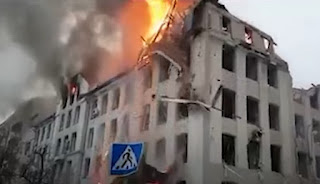

Now, like the officers who didn’t intervene to prevent George Floyd’s death, we’re playing “Let’s you and him fight; I’ll hold your coats” with Vladimir Putin and Volodymyr Zelenskyy. How are those sanctions working for Ukrainians?

We told Putin we wouldn’t fight. Didn’t want WWIII. Especially with nukes. OK, so does that go for NATO nations as well? If you see a bully seriously injuring a kid half his size, do you not intervene unless the victim goes to your school? What if we had put our troops along the Ukrainian border, instead of telling Putin we never will? Would he invade? Go nuclear?

America needs to “study war.”
______________
Nicholas Johnson, former U.S. Maritime Administrator, had shared responsibility for sealift to Vietnam. Contact: mailbox@nicholasjohnson.org

SOURCES

Ain’t gonna study war no more. Down by the Riverside, https://en.wikipedia.org/wiki/Down_by_the_Riverside

Take it from the top. “Take it from the top; idiom,” Merriam-Webster Dictionary, Military’s “best and brightest” keep us out of wars.

Founders and Declaration of War. “Power to Declare War, Origins & Development: From the Constitution to the Modern House,” United States House of Representatives, https://history.house.gov/Institution/Origins-Development/War-Powers/

"If America was going to survive as a republic, they reasoned, declarations of war required careful debate in open forums among the public’s representatives.

“there was a growing sense that such monumental responsibility belonged with the legislative branch.”

“Like George Mason of Virginia, the founders felt that war should be difficult to enter, and they expected congressional debate to restrain the war-making process.”

“to declare war against a foreign power is to send their constituents, their neighbors, their family, and even themselves into harm’s way.”

“Congress has not declared war since 1942”

Google search: Federalist Papers AND House of Representatives AND declaration of war

Federalist No. 29, “Concerning the Militia”

William Van Alstyne, “Congress, the President, and the Power to Declare War: A Requiem for Vietnam,” U Penn LRev, vol 121, No 1, Nov 1972, p. 7 https://scholarship.law.wm.edu/cgi/viewcontent.cgi?article=1799&context=facpubs

Draft creates war opposition; Draft abolished, Selective Service kept. Elliott Ackerman, “Why Bringing Back the Draft Could Stop America’s Forever Wars,” TIME, Oct. 10, 2019, https://time.com/5696950/bring-back-the-draft/ (“Although the draft was abolished in 1973, the Selective Service registration requirement was resumed in 1980 . . ..” “Congress has also taken a renewed interest in the draft, having created in 2016 a bipartisan National Commission on Military, National and Public Service charged with two missions. . . . The second is to ‘explor[e] whether the government should require all Americans to serve in some capacity as part of their civic duty and the duration of that service.’”

Need for additional. “Under the military’s current standards, 71% of Americans ages 17 to 24 do not meet the physical or mental qualifications for military service.” [from Ackerman, TIME]

Military-industrial complex. “Military–industrial complex,” https://en.wikipedia.org/wiki/Military%E2%80%93industrial_complex

Corporate warriors. Use of “private military companies” employees. “Private Military Company,” Wikipedia, https://en.wikipedia.org/wiki/Private_military_company

Results of Google search: What proportion of fighting forces are corporate employees (like Blackwater)

In Iraq. Peter Singer, The Dark Truth about Blackwater,” Brookings, October 2, 2007, https://www.brookings.edu/articles/the-dark-truth-about-blackwater/ “the private military force in Iraq, which numbers more than 160,000 — at least as many as the total number of uniformed American forces there.”

In Afghanistan. Paul D. Shinkman, “Afghanistan’s Hired Guns,” US News, April 26, 2019, https://www.usnews.com/news/national-news/articles/2019-04-26/us-employs-unprecedented-number-of-security-contractors-in-afghanistan (“More than 5,800 privately employed security personnel are currently operating in Afghanistan under Pentagon contracts, according to the latest report released this month that the military headquarters overseeing Middle East wars compiles for Congress.

“Of the 5,883 security contractors outlined in the latest reports from U.S. Central Command, 2,567 of them are armed private security contractors. . . . The Costs of War project has documented that as many as 2,800 contractors have died in Afghanistan – a figure that often goes unmentioned in public remembrances of the 2,400 U.S. military deaths in that war.

“Services provided by private contractors in this fiscal year amount to approximately $2.3 billion, Babb says.”

Ellen Knickmeyer, “Costs of the Afghanistan war, in lives and dollars,” AP, August 16, 2021, https://apnews.com/article/middle-east-business-afghanistan-43d8f53b35e80ec18c130cd683e1a38f

Sam Rayburn. “To get along, go along.” RayBURNisms, Margo McCutcheon, “A Rayburnism a Day Keeps the Memory Alive: Sam Rayburn Quotes,” Texas Historical Commission, January 5, 2022, https://www.thc.texas.gov/blog/rayburnism-day-keeps-memory-alive-sam-rayburn-quotes

Lack of public involvement. “In the aftermath of 9/11, there was virtually no serious public debate about a war tax or a draft. Our leaders responded to those attacks by mobilizing our government and military, but when it came to citizens, President George W. Bush said, ‘I have urged our fellow Americans to go about their lives.’” [from Ackerman, TIME]

“If after 9/11 we had implemented a draft and a war tax, it seems doubtful that the millennial generation would’ve abided 18 successive years of their draft numbers being called, or that their boomer parents would’ve abided a higher tax rate to, say, ensure that the Afghan National Army could rely on U.S. troops for one last fighting season in the Hindu Kush. Instead, deficit spending along with an all-volunteer military has given three successive administrations a blank check with which to wage war.

“And wage war they have. Without congressional approval. Without updating the current Authorization for Use of Military Force, which was passed by Congress one week after 9/11. Currently we live in a highly militarized society but one which most of us largely perceive to be “at peace.” This is one of the great counterintuitive realities of the draft. A draft doesn’t increase our militarization. It decreases it.

“A draft places militarism on a leash.

“In the run-up to the 2018 midterm elections, 42% of Americans didn’t know whether we were still at war in Afghanistan.”

Burden on 1%. “The burden of nearly two decades of war–nearly 7,000 dead and more than 50,000 wounded–has been largely sustained by 1% of our population.” [from Ackerman, TIME]

Number of military actions since WW2. “Major Military Operations Since World War II,” Infoplease.com, Updated March 23, 2020, https://www.infoplease.com/history/us/major-military-operations-since-world-war-ii (list of 17)

Increase in Defense budget. Richard Nixon, “Annual Budget Message to the Congress, Fiscal Year 1973,” The American Presidency Project, UCSB, January 24, 1972, https://www.presidency.ucsb.edu/documents/annual-budget-message-the-congress-fiscal-year-1973 (“To provide this assurance, budget authority for Department of Defense research, development, test, and evaluation is being increased $838 million to an all-time high of $8.5 billion in 1973.”)

“Long-Term Costs of the Administration’s 2022 Defense Budget,” Congressional Budget Office, January 11, 2022, https://www.cbo.gov/publication/57541 (2010 approximately $800 B; request for 2022 $715B)

Inability to audit. Bill Chappell, “The Pentagon Has Never Passed An Audit. Some Senators Want To Change That,” npr, May 19, 2021, https://www.npr.org/2021/05/19/997961646/the-pentagon-has-never-passed-an-audit-some-senators-want-to-change-that (“Despite having trillions of dollars in assets and receiving hundreds of billions in federal dollars annually, the department has never detailed its assets and liabilities in a given year. For the past three financial years, the Defense Department's audit has resulted in a "Disclaimer of Opinion," meaning the auditor didn't get enough accounting records to form an assessment.”)

Npr. waste, fraud and financial mismanagement. (“The Pentagon and the military industrial complex have been plagued by a massive amount of waste, fraud and financial mismanagement for decades. That is absolutely unacceptable," said Sen. Bernie Sanders, I-Vt., who co-sponsored the bill with Sen. Chuck Grassley, R-Iowa, along with Sens. Ron Wyden, D-Ore., and Mike Lee, R-Utah.”)

Don’t do stupid stuff. Matthew Dickinson, “Obama's Michael Brown address: I won't do stupid things,” Christian Science Monitor, August 19, 2014, https://www.csmonitor.com/USA/Politics/Politics-Voices/2014/0819/Obama-s-Michael-Brown-address-I-won-t-do-stupid-things, (Obama is “ a president whose operating mantra is captured in the phrase “don’t do stupid things.”)

NJ’s Vietnam report. Personal experience; report unavailable.

Powell Doctrine. “Powell Doctrine,” Wikipedia, https://en.wikipedia.org/wiki/Powell_Doctrine

Military opposition to war. “Opposition to United States involvement in the Vietnam War,” Wikipedia, https://en.wikipedia.org/wiki/Opposition_to_United_States_involvement_in_the_Vietnam_War (“military critics of the [Vietnam] war pointed out that the Vietnam War was political and that the military mission lacked any clear idea of how to achieve its objectives.”)

While the Powell Doctrine cannot be considered “opposition to war” it is clearly a form of opposition to thoughtlessly starting wars; a checklist that, if followed, will often result in thoughtful folks abandoning the creation or participation in one. See, e.g., Nicholas Johnson, “Six Step Program for Avoiding War,” November 11, 2014, https://fromdc2iowa.blogspot.com/2014/11/six-step-program-for-avoiding-war_11.html, Nicholas Johnson, “Thinking About War Before Starting One,” March 20, 2013, https://fromdc2iowa.blogspot.com/2013/03/thinking-about-war-before-starting-one.html

Number of bases. David Vine, “Where in the World Is the U.S. Military?” Politico Magazine, July/August 2015, https://www.politico.com/magazine/story/2015/06/us-military-bases-around-the-world-119321/ (“Despite recently closing hundreds of bases in Iraq and Afghanistan, the United States still maintains nearly 800 military bases in more than 70 countries and territories abroad—from giant “Little Americas” to small radar facilities. Britain, France and Russia, by contrast, have about 30 foreign bases combined.”)

U.S. troops in other countries. Kirsten Bialik, “U.S. active-duty military presence overseas is at its smallest in decades,” Pew Research Center, August 22, 2017, https://www.pewresearch.org/fact-tank/2017/08/22/u-s-active-duty-military-presence-overseas-is-at-its-smallest-in-decades/ (Japan, 38,818; Germany, 34,602; South Korea, 24,189)

U.S. bases. Mele Mathieson, “How Many Military Bases Are in the US?” omni, September 3, 2021, https://www.omnimilitaryloans.com/military-life/how-many-military-bases-are-in-the-us/ (“How many military bases are in the United States?

“According to figures from the Pentagon as well as the Military Analysis Network, the United States has approximately 450 to 500 military bases. All 50 states have at least one base (Wyoming has just two, the largest of which is Francis E. Warren Air Force Base), but several have dozens.”)

Officers not intervening in George Floyd’s death. “Three Former Minneapolis Police Officers Convicted of Federal Civil Rights Violations for Death of George Floyd,” DOJ Office of Public Affairs, February 24, 2022, https://www.justice.gov/opa/pr/three-former-minneapolis-police-officers-convicted-federal-civil-rights-violations-death

Let’s you and him fight. Use as Google search. And, “Let’s you and Him Fight,” tvtropes, https://tvtropes.org/pmwiki/pmwiki.php/Main/LetsYouAndHimFight

Letter to the Editor

"The U.S. should ‘start studying war,’"
Jerry Smithey
The Gazette, March 28, 2022, p. 5A

Nicholas Johnson nailed it in his recent column: the “brake” in the House to declare war only works “if there is a draft of our youth, from families rich and poor, and [if] members of Congress accept their constitutional duty to debate and declare war (or not).”

Continued all-male draft registration — no active draft — means few Americans have had a personal vested interest in conflicts since Vietnam. Soldiers have either been volunteers or, in effect, mercenaries. That is not to disparage volunteers, but volunteers are very different from draftees. Additionally, most Americans don’t fully understand the economic consequences of war.

Our Congress lacks the intestinal fortitude or honesty to declare war — partly, at least, to avoid being on the record and, conveniently, to blame a president and his/her party, for perceived failures.

Drafted in 1970, I served for two years in the U.S. Army, not in combat, but I observed many disfigured and damaged Vietnam vets. With that perspective, I propose to engage Americans in war decisions by activating the draft, including women and all of a certain age range to serve in some capacity, with virtually no deferments, for a period of two years. Service could be in the military, in schools, hospitals, etc., but the wealthy, friends and children of Draft Board members, and relatives of politicians should not escape public service.

Americans “with a dog in the hunt” will then care about the decisions (or lack of decisions) members of that club called Congress.

Jerry Smithey
Swisher, Iowa

# # #


Sunday, August 22, 2021

Departure Disaster - Generals Had It Right

Four days ago (April 18) The Gazette published a column of mine, "Think About the Ending Before the Beginning," The Gazette, August 18, 2021, p. A6, reproduced in this blog as, "Starting and Ending Wars; Questions We Should Have Asked Before Invading Afghanistan," August 18, 2021, https://fromdc2iowa.blogspot.com/2021/08/starting-and-ending-wars.html

In it I said, "Before, rather than after, going to war the best and brightest of our military have 'thought a bit of the end of it.' They have a list of questions . . .. Among them are, 'What will be our exit strategy?' and 'After we leave will the people and their country be better off or worse off?'”

Knowing that about the military I could not believe that the departure President Biden pursued was something they had either urged upon him or even agreed to. But at that time I didn't have a source to cite to support my assumption.

I had even suggested in a prior (unpublished) version of that column (and included in the "Sources," under "Related") a rebuttal to the argument for leaving Afghanistan that "We shouldn't be keeping even 5000 or 10,000 troops in a foreign country." I wrote, "If true, then should we also bring the troops home from the other 150 (give or take) countries where we have even more troops -- Japan 54K, South Korea 26K, Germany 35K, Italy 12K, UK 9K?"

Today I came upon a couple of sources supporting (a) my assumption that the miliary did not support Biden's departure plans, and (b) that if we can justify 54,000 American troops still in Japan over 75 years after World War II what is so outrageous about keeping 5,000 or more troops in Afghanistan 20 years after our invasion?

Here are those sources:

The New York Times put six of its best reporters on its page one lead story today (Aug. 22) about the evolution of President Biden's approach to our troops departure from Afghanistan. After making reference to an April 2021 meeting in its opening sentence, the next sentence reads:
"It was two weeks after President Biden had announced the exit over the objection of his generals, but now they were carrying out his orders."

In other words, the generals did oppose Biden's departure plan -- while supporting the Constitution's requirement that they obey the commands of their civilian commander in chief. Michael D. Shear, et al, "Embassy in Kabul Warns Amricanws to Avoid Airport; Miscue After Miscue, Exit Plan Unravels," [Online headline: "Miscue After Miscue, U.S. Exit Plan Unravels; President Biden promised an orderly withdrawal. That pledge, compounded by missed signals and miscalculations, proved impossible.] New York Times, August 22, 2021, p. A1, https://www.nytimes.com/2021/08/21/us/politics/biden-taliban-afghanistan-kabul.html.

That story makes reference to an earlier New York Times report: Helene Cooper, Eric Schmitt and David E. Sanger, "Debating Exit From Afghanistan, Biden Rejected Generals’ Views; Over two decades of war, the Pentagon had fended off the political instincts of elected leaders frustrated with the grind of Afghanistan. But President Biden refused to be persuaded." New York Times, April 18, 2021, p. A1, https://www.nytimes.com/2021/04/17/us/politics/biden-afghanistan-withdrawal.html ("The report by the Afghanistan Study Group, a bipartisan panel examining the peace deal reached in February 2020 under the Trump administration, found that withdrawing troops based on a strict timeline, rather than how well the Taliban adhered to the agreement to reduce violence and improve security, risked the stability of the country and a potential civil war once international forces left.")

# # #

Wednesday, August 18, 2021

Starting and Ending Wars

Questions We Should Have Asked Before Invading Afghanistan;
There weren’t any good ways to leave Afghanistan, just the least-worst way. And we didn’t pick that one.

Nicholas Johnson
The Gazette, August 18, 2021, p. A6

[This is how it first appeared Aug. 17 online; hard copy headline: "Think About the Ending Before the Beginning"]

“If we’d thought a bit of the end of it,” Cole Porter laments in his lyrics to “Just One of Those Things.”

It’s a caution wisely applied in both love and war, as Rita Rudner illustrates in her standup: “Whenever I date a guy, I think, 'Is this the man I want my children to spend their weekends with?'”

Now think Afghanistan.
How will we know if we’re ever “successful”? What are our metrics?

Before, rather than after, going to war the best and brightest of our military have “thought a bit of the end of it.” They have a list of questions, set forth below. Among them are, “What will be our exit strategy?” and “After we leave will the people and their country be better off or worse off?” [Photo source: wikimedia.org, public domain]

Among the other questions are: What’s the problem, or challenge? What’s our goal? Is it sufficiently important, clearly defined and understood? Why will military force contribute to, rather than impede, its accomplishment? What more effective non-military alternatives are there?

What are the benefits and costs, gains and losses, risks and rewards? What will it require in troops, materiel, lives and treasure? How long will it take? Are the American people and their Congress supportive? For how long?


Might we be perceived as just the latest invaders? Can we protect innocent civilians? Is the area governed as a country, or as regions ruled by war lords? Are we picking sides in a civil war? Are we sufficiently informed about the territory and people where we’ll be fighting? Do we know their language, culture, history, tribal, political, and social structure? Will we be the only ones identified by uniforms, unable to distinguish friend from foe? [Photo source: wikimedia.org]

How will we know if we’re ever “successful”? What are our metrics?

As U.S. maritime administrator I had some responsibility for sealift to Vietnam and our MARAD representatives there. Before a trip to Saigon I was asked to report my assessment when I returned.

What was my conclusion, after matching the questions above to my observations in Vietnam? “You can’t play basketball on a football field.”

Or, as the computer in the 1983 movie “War Games” concludes, after comparing its countdown to “Global Thermonuclear War” with an unwinnable game of tic-tac-toe, there are times when “The only winning move is not to play.”


[See 1:42-1:46 (1:30-1:35 on original YouTube trailer) for computer's conclusion. The rest of what's provided here gives the context for that conclusion. This is a clip from a trailer for the film, available to the public on YouTube. If anyone connected to the film War Games objects to this use, promoting the film and thus encouraging people to watch the entire movie, give me a brief email to that effect and this will be taken down. mailbox@nicholasjohnson.org]

But we no longer have the luxury of deciding whether to play the game. That was decided by others 20 years ago. As the pottery display sign warns, “break it, you own it.” We own Afghanistan.

Paul Simon sang, “There must be 50 ways to leave your lover.” There weren’t any good ways to leave Afghanistan, just the least-worst way. And we didn’t pick that one.

Now America agonizes, like the hospitalized antivaxxer whose refusal to be vaccinated has him infected with COVID, breathing through a ventilator. He’s changed his mind. He begs to be vaccinated, only to be told, “We’re sorry, but it’s too late now.”

If only “we’d thought a bit of the end of it” in 2001 – and 2021.
______________________
Nicholas Johnson, the author of Columns of Democracy, was U.S. maritime administrator during the Vietnam War. mailbox@nicholasjohnson.org

# # #

SOURCES
Lyrics to “Just One of Those Things.” Cole Porter. https://genius.com/Cole-porter-just-one-of-those-things-lyrics “It was just one of those things/Just one of those crazy flings . . . If we’d thought a bit/Of the end of it/When we started painting the town . . . It was great fun/But it was just one of those things.”

Rita Rudner quote. “Rita Rudner Quote,” citing source as: “As quoted in: Mademoiselle: The Magazine for the Smart Young Woman, Volume 92 (Condé Nast Publications, 1986), p. 174.” https://libquotes.com/rita-rudner/quote/lbe6h0y; also https://www.brainyquote.com/quotes/rita_rudner_386695

War Games. https://www.imdb.com/title/tt0086567/

50 Ways to Leave Your Lover. Paul Simon, “50 Ways to Leave Your Lover,” Genius, https://genius.com/Paul-simon-50-ways-to-leave-your-lover-lyrics

Related (to prior versions of this column; still relevant but not necessary “sources” for this version. (a) When 911 was paid for and carried out by Saudis, why did we attack Afghanistan? (b) Yes, there were terrorists in Afghanistan. But there are well over 100 countries that could, and do, provide safe havens for terrorists. Why make Afghanistan our single major focus? (c) We shouldn't be keeping even 5000 or 10,000 troops in a foreign country. If true, then should we also bring the troops home from the other 150 (give or take) countries where we have even more troops -- Japan 54K, South Korea 26K, Germany 35K, Italy 12K, UK 9K?)

Saudis not Afghanis. Annika Kim Constantino, “U.S. reviews 9/11 documents for possible release after families tell Biden to skip memorial events,”CNBC, Aug. 9, 2021, https://www.cnbc.com/2021/08/09/9/11-attacks-biden-doj-reviews-documents-for-release.html

Terrorists in 134 countries. Global Terrorism Index, https://en.wikipedia.org/wiki/Global_Terrorism_Index (last edited Aug. 10, 2021)

100,000 troops in Afghanistan in August 2010. “A timeline of U.S. troop levels in Afghanistan since 2001,” AP/Military Times, July 6, 2016, https://www.militarytimes.com/news/your-military/2016/07/06/a-timeline-of-u-s-troop-levels-in-afghanistan-since-2001/

Troop deployments.

“United States Military Deployments,” Wikipedia, https://en.wikipedia.org/wiki/United_States_military_deployments (“The military of the United States is deployed in most countries around the world, with between 150,000 to 200,000 of its active-duty personnel stationed outside the United States and its territories.”)

“US Deployment Facts, How Many US Troops are Overseas?” VetFriends, https://www.vetfriends.com/resources/us_deployments_overseas.cfm (With more than 5000: Japan, Germany, South Korea, Kuwait, Italy, UK)

“Explained: The US military’s global footprint,” TRTWorld, March 15, 2021, https://www.trtworld.com/magazine/explained-the-us-military-s-global-footprint-45029 (“Washington keeps troops numbered around 150,000 to 200,000 abroad across more than 150 countries, according to different sources.” citing DOD data June 30, 2021; Japan 54K, South Korea 26K, Germany 35K, Italy 12K, UK 9K)

# # #

Sunday, January 20, 2019

The Wall

Six quick takeaways from reflection after this column was published:
(1) Talk of "a wall" across our southern border is to some degree "a solution in search of a problem;" if "the problem" is the number of undocumented immigrants, and rate of increase in immigration, (a) two-thirds of such immigrants (those who have overstayed their visas), and a larger percentage of the illegal drugs, have come through legal ports of entry, (b) at least some come across our almost open northern border with Canada, or by plane, boat, through tunnels, climbing over or digging under "border walls," or other means than walking across the southern border, and (c) there are some numbers indicating a decline in immigration. (More precisely, it is a possible partial solution to a relatively small proportion of a very much larger problem.)
(2) When addressing a problem it's more effective to treat its causes than its symptoms -- in this case the conditions that cause Central Americans to escape from their countries.
(3) If the focus is to remain on "border security" (rather than an holistic approach to "immigration policy and law") we at least need data and judgment from the U.S. and other countries' experts (non-ideological former border officials, academics, and "think tanks") as to the most cost-effective combinations of personnel, technology and barriers, specifying precisely the location, extent, and nature of any barriers (i.e., designed to prevent entry by vehicles, humans, or both).
(4) Our politicians (e.g., President, Speaker of the House) are no more qualified to dictate details of border security than the detailed designs of a fighter plane.
(5) If they are going to persist in doing so anyway, they at least need to speak in more specific and detailed language than "a wall" -- a word so vague as to be almost devoid of useful meaning in this context.
(6) A government "shutdown" (a) in this instance is doing enormous harm to hundreds of thousands of innocent federal workers, others dependent on federal services, and the economy, and (b) should never be used simply for leverage in bargaining regarding a campaign pledge.
Instead of a Wall, Focus on the Cause

Nicholas Johnson
The Gazette, January 20, 2019, p. D3

It makes no more sense to refuse to build “the wall” than to insist on building “the wall.”

Why? Because neither side explains what they’re talking about. [Photo credit: VOA file photo]

How about some facts and a pinch of rational analysis?

The Mexican-U.S. border includes water (Gulf of Mexico, Rio Grande, Pacific Ocean), mountains, deserts, urban areas, and wildlife habitats. It’s nearly 2000 miles long of which 650 miles already have “walls.” Some remaining stretches make more enforcement and economic sense than others.

Under ideal conditions walls costs $4 to $8 million dollars a mile – more than a two-lane highway. In other areas costs are multiples of that. Some places are nearly impossible to reach or prohibitively expensive.

Walls can be tunneled under and climbed over. We don’t have enough border agents to watch every few feet of fence through isolated deserts, canyons and mountains. What the agents want, and some economists say makes more benefit-cost sense, are more (a) communications and surveillance technology, and (b) personnel.

Can walls stop illegal drugs? The Drug Enforcement Administration says all but a tiny percentage come through legal ports of entry.

Are immigrants criminals? The percentage who commit crimes is less than the percentage for U.S. citizens.

Moreover, the families coming from Guatemala, Honduras and El Salvador are a symptom, not a cause. They are escaping poverty, violence, lack of education and jobs – conditions we’ve helped create and have done little to alleviate.

Suppose dripping water from your kitchen ceiling was filling the pan you placed to catch it. Would your solution be to get a bigger bucket? Or would you go upstairs, discover the bathtub was overflowing, scream at whoever did it, shut off the faucet and start mopping?

In Afghanistan, after an Army general itemized extensive U.S. military construction projects, the popular stand-up comic, Kathleen Madigan, responded, “Wow! That is amazing. When we’re done, we should invade Detroit.”

Think about it. We’ve spent 17 years and trillions of dollars “improving” Afghanistan. What if we had also spent less than half that time and money “invading” northern Central America, training and hiring locals to build and staff schools, police stations, and hospitals? It would have been a lot easier to eliminate violence, crime and gangs from those countries than to eliminate the Taliban from Afghanistan.

It would have minimized our immigration challenges and costs. Few, if any, Central Americans would even think about leaving a happy home to walk a thousand miles or more to the United States.

We could still do it. Meanwhile, does anybody know where I can find a bigger bucket?
_______________
Nicholas Johnson’s latest book is Columns of Democracy. www.nicholasjohnson.org Contact: mailbox@nicholasjohnson.org

Columns of Democracy (2018)

For those interested in more on this topic and others, Nicholas Johnson's latest book, Columns of Democracy (2018), is now available from Iowa City's Prairie Lights Bookstore, 15 S. Dubuque Street, or if you live outside of Iowa City: Amazon, https://tinyurl.com/yama2h3b (scroll to "Books by Nicholas Johnson," click on "Paperback," for "Sort by" select "Publication Date"), Barnes & Noble, https://tinyurl.com/ybjwxuuh (scroll down), and the publisher, Lulu Press, https://tinyurl.com/yd8g47de.


#Afghanistan #CentralAmerica #ColumnsOfDemocracy #immigration #KathleenMadigan #Mexico #Pelosi #Trump #Wall

Tuesday, August 29, 2017

Afghanistan: Our Unaffordable War to Nowhere

The Reasons We Should Leave

Contents

History

Absent Prerequisites for War

"War on Terror" is Oxymoron

Cost of Wars

The Powell Doctrine

Conclusion

Nicholas Johnson's Additional Writing on War and Terrorism

Some Recent Afghanistan-Related General Media News and Opinion

The shorthand for President Obama's foreign policy? "Don't do stupid stuff."[Christi Parsons, Kathleen Hennessey and Paul Richter, "Obama Argues Against Use of Force to Solve Global Conflicts," Los Angeles Times, April 28, 2014.]

Our 16-years-long military efforts in Afghanistan qualify as "stupid stuff." The list of reasons is long, and has been discussed in a variety of contexts by me since 2001, illustrated in the 23 examples linked below. So I'll try to keep this short.


-- Sam Cooke, "What a Wonderful World" ("Don't know much about history . . ..")

History. We fail to learn from history. When it comes to war, we go where "no nation has won before."

France had been interested in Vietnam since the 17th and 18th Centuries, ultimately creating a large colony (French Indochina) in 1887 which it ruled until defeated by the Vietnamese in the First Indochina War [1946-1954]. ["France-Vietnam Relations," Wikipedia.] Never mind. We're not French. Those Vietnamese won't be able to defeat our military might. Remember how that worked out for us?

And so it's been in Afghanistan.

"Great Britain and Russia [were] maneuvering for influence in Afghanistan" as early as 1826. The British brought military force to Afghanistan on three occasions: 1839-1842, 1878-1889, and 1919. None ended well for the British.
Following the 1839-1842 conflict, "The Afghans. . . would tolerate neither a foreign occupation nor a king imposed on them by a foreign power, . . . insurrections broke out" and ultimately the British were run out of the country. The outcome of the second Afghan War was a little more complicated, but ended with the murder of the British envoy, and a joint effort of Britain and Russia to draw what are today's Afghanistan boundaries.
After the 1919 war, Britain had to recognize Afghanistan's independence, and Afghanistan was one of the first states to recognize the Soviet Union (with a treaty of friendship). That "special relationship" lasted until the Russian invasion of Afghanistan in 1979. Editors, "Anglo-Afghan Wars," Encyclopedia Britannica.

Russia (Soviet Union) was involved militarily in Afghanistan from 1955 to 1989. "The Soviet Invasion of Afghanistan and the U.S. Response, 1978–1980," Department of State, Office of the Historian, Milestones: 1977-1980 ("Since 1955 Moscow had provided military training and materiel to Afghanistan; by 1973, a third of active [Afghan] troops had trained on Soviet soil.")

The results for the Russians were little better than for the British. "The War" lasted from December 1979 to February 1989. "Soviet-Afghan War," Wikipedia.

And with what results?
"In the brutal nine-year conflict, an estimated one million civilians were killed, as well as 90,000 Mujahideen fighters, 18,000 Afghan troops, and 14,500 Soviet soldiers. Civil war raged after the withdrawal, setting the stage for the Taliban's takeover of the country in 1996."
Alan Taylor, "The Soviet War in Afghanistan, 1979-1989," The Atlantic, August 4, 2014 (includes 41 large photos).

Absent Prerequisites for War. Might there be some common themes in why Great Britain, Russia, and the United States have been so unsuccessful over the past 200 years in trying to conduct "wars" in Afghanistan? Let's see.

In addition to our refusal to study history, and our hubris in believing we have a level of smarts and military might denied all other countries, it's as if we don't recognize that war1 is not war2 -- all wars are not the same. You can't expect to win wars you launch willy-nilly, wherever, whenever, with whomever you choose. There are conditions and characteristics that make for wars' successful, and unsuccessful, likely outcomes.

It's best if your military effort is a response to your country being attacked (e.g., Revolutionary War; World War II). Next best is coming to the defense of another country that has been invaded (Kuwait in Gulf War I). Worst are unnecessary, "pre-emptive" attacks on other nations that have not attacked us (e.g., Vietnam, Iraq, Afghanistan).

Why? Think about it. If Iowa had a 200-year-history of Canadian military invasions from time to time, and Canadian tanks and military were now moving, uninvited, through Minnesota, toward Iowa -- regardless of their pretense for doing so -- even I would be picking up a gun. The Canadians would have a hard time "winning Iowans' hearts and minds." Similarly, when we create a war inside a country with a centuries-old history of foreign invaders, it's not unreasonable for those whose home it is to think of us as just the latest in that history, and respond as Iowans would to Canadians.

Obviously, supporting one side in another country's civil war is even worse. There's no way it can be universally popular ("a British shipyard [built] two warships for the Confederacy . . . over vehement protests from the US." "United Kingdom and the American Civil War" Wikipedia.org.)

Fighting in countries where most Americans know little or nothing about that country's language, culture, economy, history, politics, literature, religion, social structure, and geography -- such as Vietnam, Iraq, and Afghanistan -- is bristling with unintended consequences that make "winning" somewhere between extraordinarily difficult and impossible (as distinguished from the European Theatre of WWII).

"War on Terror" is Oxymoron." Whatever "terror" may be, it is not a country, or even a tightly coordinated group of individuals. Of course, every country seeks to minimize the death and damage to its citizens and property from acts of violence. But were the deliberate human and property damage in Oklahoma City, Boston, and Charlottesville really part of a "war"? The literary license in labeling anti-violence efforts a "war" is questionable at best; but strategies and tactics premised on the assumption that it really is "a war" are self-defeating and dangerous.

Wars are best when fought on behalf of, or against, countries rather than failed states; countries with some semblance of an organized central government -- more like Germany in WWII, rather than 21st Century Afghanistan, which is still largely a collection of tribal war lords' fiefdoms.

Wars are best when both sides wear uniforms that distinguish them from each other -- and the surrounding civilian population. The Taliban and ISIS often don't wear uniforms. Without uniforms it's very difficult to tell your enemy from your allies, and civilian casualties mount and further erode support for U.S. forces -- who are easy to identify.

Wars are best when there is a "front line" (as in Europe in WWII). (1) Fighting individuals without uniforms, (2) who can easily blend in with the population, (3) over constantly shifting parcels of land, (4) individuals who can easily shift from one place to another, (5) resulting in our gaining, losing, and regaining once again the same "battlegrounds," is a recipe for our seemingly endless wars in Vietnam, Iraq and Afghanistan, with their ever-increasing death tolls and financial burdens.

Cost of Wars. A year ago, the combined costs of U.S. military actions in Iraq, Syria, Afghanistan and Pakistan (2001-2016) were estimated at $4.207 trillion ($4.792 trillion minus the Department of Homeland Security budgets). Neta C. Crawford [Boston University], "US Budgetary Costs of Wars through 2016: $4.79 Trillion and Counting; Summary of Costs of the US Wars in Iraq, Syria, Afghanistan and Pakistan and Homeland Security," Brown University Institute of International & Public Affairs, September 2016.

Because it's hard to imagine that much money, how could we translate $4.2 trillion into its opportunity cost -- the other things we could have bought with it (but weren't able to)? What else could that $4.2 trillion have paid for? Here are some possibilities: a 35-year program of tuition-free college at public universities, or health insurance premiums for every American for 12 years, or wiping out all student loan and credit card debt while leaving an additional $2 trillion for rebuilding infrastructure, or a fund to pay for rebuilding after the damage from the next 41 major tropical storms. Ethan Wolff-Mann, "7 Amazing Things America Could Have Bought Instead of a $1.45 Trillion Jet," Money, May 2, 2016 (if you care, and can't follow my math, email me for an explanation).

While I believe the Brown University and Money magazine numbers do not distort the reality, even with the best of intentions precision in these matters is impossible. For starters, what do you count? The numbers do not seem to include the post-war costs of such things as rebuilding the infrastructure we've destroyed in war (such as the post-WWII Marshall Plan), lifetime healthcare for wounded combat veterans, the consequences from the opportunity costs mentioned above. If you include the costs in the war torn countries (as I think we should), although worse than economic numbers convey, what tort law calls the "pain and suffering" of the population, the survivors who have lost their primary income provider, not to mention their homes, the wounded, dying and dead, the children denied food, shelter, and education -- not to mention parents -- would be enormous. [Photo credit: U.S. Department of Defense.]

Even if we could agree on what costs to include, determining what they were is virtually impossible with a Defense Department that is so sloppy in its accounting that it is impossible to audit. "The Department of Defense . . . once again finds itself under intense scrutiny . . . because it couldn't account for more than a trillion dollars in financial transactions, not to mention dozens of tanks, missiles and planes." Tom Abate, "Military Waste Under Fire / $1 Trillion Missing -- Bush Plan Targets Pentagon Accounting," SFGATE, San Francisco Chronicle, May 18, 2003.

The Powell Doctrine. There are some basic questions to ask about any rational undertaking -- starting a business, choosing a college and major, planning a vacation trip, building a new home or office building.

The consequences of failing to do so can lead to physical injury, financial disaster or bankruptcy, or merely great disappointment.

In the case of war, the consequences can be much more serious, as the discussion above suggests. This is not to say that there are never acceptable reasons for going to war, or maintaining overwhelming military might as a strategy for avoiding the need to go to war. It is only to say that, if you prepare and use a checklist before packing the car and going on a family vacation, you might also want to have and use a checklist before going to war.

Here is a variation of the ways I've summarized that checklist of questions in the past -- sort of my version of the Powell Doctrine:
  • Is the national security of our homeland seriously threatened?

  • What, specifically, is the goal you’re trying to accomplish?

  • What nonviolent means might accomplish the goal, and have they all been tried and failed?

  • Why do you think a military operation will contribute to (rather than impede) the accomplishment of the goal?

  • In a benefit-cost analysis, what are the risks, what are the costs (including opportunity costs), what will a military mission require in troops, materiel, lives and treasure to achieve that goal, and what will be the benefits for the United States?

  • What is a reasonble projection of how long the military mission will take to achieve the goal?

  • Are the American people, their representatives, and the international community prepared to take those risks, provide those resources and pay those costs for as long as it takes?

  • What are the probabilities that a military intervention will make matters worse?

  • What are the metrics or other means to inform us whether we’ve ever been “successful”?

  • What, then, will be the exit strategy?

  • What will happen when we leave?

  • Will that be consistent with our original mission?
  • See, e.g., "General Semantics, Terrorism and War," Fordham University, New York City, September 8, 2006 (sub-heading "War: Military Control of the Civilians and the Powell Doctrine"); also as Nicholas Johnson, What Do You Mean and How Do You Know, ch. 6 "You As Citizen II: Terrorism and War," p. 61, and see, Stephen M. Walt, "Applying the 8 Questions of the Powell Doctrine to Syria," Foreign Policy, September 3, 2013.

    Conclusion. I could go on with this -- indeed the list below suggests I already have. Why? Because President Trump -- after opposing our war in Afghanistan for years -- has recently announced that it will be perpetuated by his Administration. In fact, he wants to send even more troops and taxpayer money into the hopeless pit.

    A "war" in Afghanistan was a mistake from the very beginning. If we were trying to punish the state most involved in 9/11 it was Saudi Arabia -- the country that supplied both the financing and the participants. But the U.S. didn't want to declare war on Saudi Arabia after 9/11 any more than it wanted to bomb Idaho after Oklahoma City. So we chose Afghanistan instead.

    It was argued that Afghanistan was "harboring terrorists." But any near-failed state can and does do that. To totally eliminate terrorist training in Afghanistan (1) would require more like 200,000 to 300,000 American troops (as I, and others, suggested at the time; clearly President Obama's 100,000 weren't enough) -- if even that would do it. (2) Our efforts to do that turn out to be counterproductive: our mere presence in the Middle East only intensifies anti-American feelings and terrorist recruiting. (3) Terrorists can, and do, easily move from one part of the world to another. If we drove them all out of Afghanistan they would not disappear, they would merely relocate -- as they now have in at least 70 countries. "Michael Evans" "Al-Qaeda finds three safe havens for terror training" The Times (of London), July 2, 2008 ("Al-Qaeda, Osama bin Laden’s terrorist organisation, driven out of Afghanistan and defeated in Iraq, is re-emerging in strength in three alternative safe havens for training, operational planning and recruiting – Pakistan, Somalia and Algeria – according to Western intelligence and defence sources").

    To the best of my recollection, no American official has declared that our real motive for staying in Afghanistan is to plunder it's resources. I raised this possibility in "Why Afghanistan? Think Oil & Gas," September 25, 2009. Rachel Maddow recently suggested it might be our search for a source of the rare earth element Lanthanum (LA); transcript not yet posted. (If we were in Afghanistan for rare earth elements, however, we've been a little late. While we were sending troops the Chinese were sending negotiators, and have by now pretty much cornered all the supplies in Afghanistan's rare earth market.)

    In summary, the politicians pursuit of our Afghanistan War has ignored virtually all of the Powell Doctrine checklist. We never should have entered Afghanistan in the first place. As soon as that was obvious we should have left. Having failed to do so for 16 years, it is a very expensive tragedy (in lost lives and opportunities to fund what America really does need) that our current president has gone against his earlier instincts and is sending more troops to keep it going.

    # # #

    Nicholas Johnson's Additional Writing on War and Terrorism

    "Spending on Military Always Comes at al Cost," The Gazette, April 9, 2017, p. D5, embedded in "Of Missiles and Teachers," April 7, 2017

    "Focus on Muslims Misplaced After Shooting," Iowa City Press-Citizen, June 17, 2016, p. A5

    Understanding Terrorist Thugs," The Daily Iowan, December 3, 2015; "What Motivates Terrorist Thugs," The Gazette, December 20, 2015,

    Nicholas Johnson, "Sober Risk Assessment Needed to Respond to Terror," Iowa City Press-Citizen, November 28, 2015, p. A11; and as "Sober Risk Assessment Needed to Respond to Terror," Standard-Times [San Angelo, Texas], November 28, 2015

    Nicholas Johnson, "Syria's Refugees: Job One and Job Two," The Gazette, November 1, 2015

    "Why Unwinnable 'Wars' Are 'Stupid Stuff;' Add 'Impossible to Win' to Objections to War With ISIS," September 23, 2014

    "Six Step Program for Avoiding War," Iowa City Press-Citizen, November 11, 2014, p. A7

    "Is U.S. Response Strengthening ISIS? Playing Into the Terrorists' Hands," September 19, 2014

    " Why Iowans Should Care About Iraq War III; Why Do We Accept Words Like 'Islam,' 'State,' and 'Caliphate'?" September 16, 2014

    "Is War the Best Answer?" Iowa City Press-Citizen, September 12, 2014, p. A7; embedded in " Whatever the Question, Is War the Best Answer?" September 10, 2014

    "Syria: Moral Imperatives and Rational Analyses; Spotting the Issues," September 4, 2013

    "Thinking About War -- Before Starting One," March 20, 2013

    "Terrorism, War, 9/11 and Looking Within," September 10, 2011

    "War in Libya, the Unanswered Questions," March 23, 2011

    "General Semantics, Terrorism and War," Fordham University, New York City, September 8, 2006; also as Nicholas Johnson, What Do You Mean and How Do You Know, ch. 6 "You As Citizen II: Terrorism and War," p. 61

    "War in Iraq: The Military Objections," International Law Talks: War With Iraq, University of Iowa College of Law, February 27, 2003

    "Ten Questions for Bush Before War," The Daily Iowan, February 4, 2003, p. A6

    Nicholas Johnson, "Capitalists Can Help U.S. Avert War with Iraq," Iowa City Press-Citizen, Sunday Insight, October 6, 2002, p. A11

    Nicholas Johnson, "On Iraq, Tell the Rest of the Story," Iowa City Gazette, October 2, 2002, p. A4

    Nicholas Johnson, "Let's not get between Iraq and a hard place," Omaha World-Herald, August 13, 2002 (and as published in the Iowa City Press-Citizen and as submitted to both)

    Nicholas Johnson, "Search for Better Response Than War; Don't Reward the Terrorists, but Understand Their Interests," Des Moines Sunday Register Opinion/Iowa View, June 30, 2002, p. OP3

    Nicholas Johnson, "Rethinking Terrorism," National Lawyers Guild Conference, University of Iowa, Iowa City, Iowa, March 2, 2002

    "Teach Our Children Tolerant Ways," Iowa City Press-Citizen, September 25, 2001, p. 9A

    # # #

    Some Recent Afghanistan-Related General Media News and Opinion

    Glenn Thrush and Maggie Haberman, "Forceful Chief of Staff Grates on Trump, and the Feeling Is Mutual," New York Times, September 2, 2017, p. A1

    Micah Zenko, "Bush and Obama Fought a Failed 'War on Terror.' It's Trump's Turn." New York Times, August 26, 2017, p. A17

    Mujib Mashal, "Trump's Afghan Gamble Now Rests on General He Doubted," New York Times, August 25, 2017, p. A1

    Mujib Mashal, "U.S. Troop Increase in Afghanistan Is Underway, General Says," New York Times, August 24, 2017

    Max Fisher and Amanda Taub, "Why Afghanistan's War Defies Solutions," New York Times, August 24, 2017, p. A4

    Bret Stephens, "On Afghanistan, There's No Way Out," New York Times, August 24, 2017

    Rod Nordland, "What an Afghanistan Victory Looks Like Under the Trump Plan," New York Times, August 23, 2017, p. A1

    # # #

    Tuesday, August 09, 2011

    The Last One to Die . . .

    August 9, 2011, 1:50 p.m.

    . . . for a mistake


    Every Sunday toward the end of ABC News' "This Week with Christiane Amanpour," she says (as she does 45 seconds into the excerpt above, from the August 7, 2011, show's "Lives of Note" segment), "And we remember all of those who died in war this week."

    It is, for me, a very somber moment; a Sunday church service of sorts. No more multi-tasking. I stop whatever else I am doing to focus on the name, rank and young age of each. I think of their families, loved ones, parents.

    Last Sunday Amanpour continued, "The Pentagon has yet to release the identities of the Americans who were killed yesterday in the single deadliest attack of the war in Afghanistan, but we have learned the names of seventeen soldiers and Marines who were killed the days before."

    With the soldiers' names, their home towns scrolled by: Edmond, Oklahoma; Broken Arrow, Oklahoma; Daly City, California; Columbus, Georgia; Wilson, North Carolina; Moscow, Pennsylvania; Brecksville, Ohio; Dallastown, Pennsylvania; Sapulpa, Oklahoma; Sliver Spring, Maryland; Holton, Kansas; Jacksonville, Florida; Red Bay, Alabama; Chelsea, Oklahoma; Chatsworth, California; Vernal, Utah; Warner Robins, Georgia.

    They are not all well known American towns. Some are little more than a stop for gas when you take a trip along one of America's scenic "blue highways." But this week, each of those 17 towns is filled with grieving Americans.

    The men and women in today's military were not drafted. They volunteered. We need a military, and all of us owe thanks and more to those willing to serve.

    But we, and our elected officials, also owe them common sense, and more restraint in our willingness to risk their lives.

    If there were hostile armed forces entering the United States from Canada, Mexico, or either coast by sea, I would be willing to take up arms myself, even in my advanced age, to help protect my country.

    But the war into which we sent these 17 soldiers, and the 38 who died last Saturday, is not that kind of war.

    The likelihood of the Afghan Taliban doing harm to Americans residing in the United States is somewhere between slim and none at all. Even in 2001, the individuals who attacked us on 9/11, and their funding, primarily came from Saudi Arabia not Afghanistan; and our decade-long goal since then -- to capture or kill bin Laden -- now truly is, "mission accomplished." The only Americans who are at risk of harm from the Taliban are those who have been sent into Afghanistan -- over the objections of many Afghans -- and whose presence is now fueling Afghan hostility and Taliban recruiting efforts.

    The bumper sticker says, "Whatever is the question, war is not the answer." That's not, strictly speaking, always true in every instance. I'm not confident there was any meaningful answer besides war to Hitler's advance through Europe. War is sometimes not only an answer, it is the only answer.

    But as I have written about the Viet Nam war, and in comparable ways about Iraq and Afghanistan, war is not a very sensible option when and if,
    1. given the history of the country, you will be perceived as only the latest in a centuries-long string of invaders (which prior to us in Viet Nam were the French),

    2. you can’t speak or understand the native language,

    3. you know little or nothing of the history, religion, culture and customs of the people, and have little grasp of the territory in which you’re fighting,

    4. you are easily identified by your “enemy,” and to make sure you will be, you wear uniforms

    5. your enemy, on the other hand, looks almost identical to your allies and the locals you employ, and refuses to wear a uniform,

    6. since there is no “front line,” as such, territory is repeatedly lost, and gained, only to be lost again,

    7. during which battles, your troops are given the impossible choice between (a) killing disproportionately large numbers of innocent civilians, or (b) being killed by enemy fighters who look like innocent civilians,

    8. with the consequence that an internal inconsistency exists between the strategy of “winning hearts and minds,” and the tactic of “burning down the village to save it,” such that the longer the fighting continues the more counterproductive it becomes

    9. up to and including the possibility of exacerbating, rather than reducing, chaos and civil war
    Nicholas Johnson, "General Semantics, Terrorism and War" (2006).

    That piece also contains my own version of what's credited to former General Colin Powell as the "Powell Doctrine" -- questions the military leaders (and we citizens and taxpayers) need to ask our politicians before sending our sons, daughters and dollars to war:
    * What, specifically, is the goal you’re trying to accomplish?
    * Why do you think a military operation will contribute to (rather than impede) its accomplishment?
    * What will it require in troops, materiel, lives and treasure to achieve that goal?
    * Are you prepared to provide those resources and pay those costs?
    * Will the American people support this effort for as long as it takes -- and how long will that be?
    * How will we know if we’ve ever been “successful”?
    * What, then, will be our exit strategy?
    * What will happen when we leave?
    * Will that be consistent with our original mission?
    Given the conditions under which war is, and is not, a viable option, and given the questions that need to be at least asked, and hopefully answered, before engaging in war, my own view is that we ought to get our military personnel out of Afghanistan before even more will die.

    In reflecting on the 30 more American dead in one helicopter (38 counting Afghans, whom I think should and do count), I hear an echo of the words of Senator John Kerry -- then a 27 year old Navy veteran of Vietnam -- in testimony before the Senate Foreign Relations Committee on April 23, 1971:
    How do you ask a man to be the last man to die in Vietnam? How do you ask a man to be the last man to die for a mistake?
    Kerry's entire moving presentation is very much worth reading, the video excerpt worth watching, in the context of Afghanistan today. Deborah White, "John Kerry's Famed 1971 Testimony to Congress on Vietnam," About.com.


    A cynic might respond, "Don't be worrying about the last military man or woman to die in Afghanistan, Nick. The last person to die in Afghanistan hasn't yet been born."

    We can only hope and pray that's not true.

    Yet from what I read and hear in the media, we have troops in 150 countries, SOCOM (United States Special Operations Command) forces in 75, headed toward 100 by the end of this year, plus the CIA personnel and the private sector warriors. SOCOM has increased its numbers by four-fold or more since 9/11, and shows no signs of slowing down. (See/hear, e.g., Tom Ashbrook, "Special Operations Forces In Afghanistan," On Point, August 9, 2011.)

    So, sadly, the cynic is probably right.

    Nor are our military adventures unrelated to the global financial troubles, and the riots in London. The best estimates are that when everything is totaled up, the cost of Iraq and Afghanistan, including the lifelong care of the wounded, will run something like the $2-3 trillion we currently need to balance a budget.

    Given that, in Afghanistan, even defining "success" seems almost as difficult as achieving it, one is not reassured by President Obama's insistence that "We will press on and we will succeed. Our troops will continue the hard work . . .." "President Obama Pledges to Press on in Afghan War," Reuters, August 8, 2011.

    One is reminded of more of the commentary regarding the Viet Nam war, so effectively embedded into the anti-war protest songs that played a role in ultimately bringing that failed effort to an end.

    Press on?

    How about "push on"?

    Here's Pete Seeger's Viet Nam era "Waist Deep in the Big Muddy ("and the big fool said to push on"):


    While we're at it, here are a couple more from that war:

    Edwin Starr singing his song "War (What is it good for? Absolutely nothing)" (1969)


    An excerpt from the lyrics:
    "War, what's it good for?/Absolutely nothing."
    War..huh...look out...
    What is it good for?
    Absolutely nothing...listen to me ohhhhh
    WAR! I despise,
    'cause it means destruction of innocent lives,
    War means tears to thousands of mother's eyes,
    When their sons gone to fight and lose their lives.
    I said WAR!...huh...good God y'all,
    What is it good for?
    Absolutely nothing
    And . . .

    Country Joe & The Fish, "Feel Like I'm Fixing to Die Rag"


    with an excerpt from those lyrics:
    Well, come on all of you, big strong men,
    Uncle Sam needs your help again.
    He's got himself in a terrible jam
    Way down yonder in Vietnam
    So put down your books and pick up a gun,
    We're gonna have a whole lotta fun.

    And it's one, two, three,
    What are we fighting for ?
    Don't ask me, I don't give a damn,
    Next stop is Vietnam;
    And it's five, six, seven,
    Open up the pearly gates,
    Well there ain't no time to wonder why,
    Whoopee! we're all gonna die.

    Come on Wall Street, don't be slow,
    Why man, this is war au-go-go
    There's plenty good money to be made
    By supplying the Army with the tools of its trade,
    But just hope and pray that if they drop the bomb,
    They drop it on the Viet Cong.
    Why aren't we out in the streets? Why aren't there songs protesting the Afghan war?

    Because those who favor war, even when it is counterproductive, learned a lesson from Viet Nam. To keep the American people from demanding an end to foreign and military policies of perpetual war, you need only provide the illusion that it is war without sacrifice.

    (1) War costs nothing -- except for those few Americans (as a percentage of 325 million) who die or are wounded. We don't have to pay the costs of war. There are no war taxes. We simply put it on our Chinese credit card; we borrow the money -- plus a little more for tax breaks for the wealthy.

    (2) We've abolished the draft. No one has to go to war; just the ones who want to. What could be more American than that?

    As a strategy for perpetual war, it seems to have worked.

    The last one to die for this mistake? She's yet to be born.

    # # #

    Monday, May 09, 2011

    Justice Was Done

    May 9, 2011, 4:45 p.m.
    And see, "Bin Laden Killed -- Significance? The Two-Trilion-Dollar Assassination" May 1, 2011; and the additional points made in Gregory Johnson, "The Impact and Consequences of Osama Bin Laden's Assassination," May 1, 6, 7, 10, 2011.

    Examining Heads
    Justice was done. And I think that anyone who would question that [Osama Bin Laden] the perpetrator of mass murder on American soil didn't deserve what he got needs to have their head examined.

    -- President Barack Obama, CBS "60 Minutes," May 8, 2011
    Bin Laden is dead. Many Americans seem to believe that the only appropriate thing to say on such an occasion is "USA! USA!" or "We're Number One!" They may even be right about that. At a minimum, for anyone to sit back and reflect on what we did and how and why we did it risks an accusation of "un-American" at best. That makes this blog entry one of the most difficult to write.

    No matter how precisely it is conditioned and qualified, given the emotional subject matter the odds are good that at least some readers will come away with the impression that I (a) do not fully and appropriately appreciate the accomplishment of the Navy SEALS who killed Ben Ladin, (b) the daring and skill of President Obama and his advisers, or, worst of all, (c) am somewhat ambivalent about the desirability of eliminating Bin Laden.

    All those assertions would be false.

    Clearly, the world -- not just the United States -- is better off without Bin Laden; and the intelligence gathering, planning, training, and professional execution of those plans by the Obama Team and Navy SEALS qualifies as one of America's greatest intelligence and special operations accomplishments ever.

    OK?

    Moreover, there are no claims here of either expertise, or the knowledge supported by research, regarding international law or criminal law. These are just some random thoughts about the events of a week ago.

    1. Justice. What does the President mean by "Justice was done"? "Bringing someone to justice," or saying "He got justice," carries at least two possible meanings. (a) It can mean "revenge," or "retribution" -- "an eye for an eye." This was the meaning in America's "lawless" wild west -- where the advice to "shoot first, ask questions later" enabled anyone carrying a gun to play all the parts: legislature, complainant, investigator, arresting officer, county attorney, grand jury, judge, jury, warden and executioner, and to play all of them within a fraction of a second. It was what enabled the KKK to carry out lynchings without the bother of troublesome "legal technicalities." It's the mafia's approach to settling scores, the urban gangs' protection of their territory, and the cause of the tens of thousands of dead Mexicans who got in the way of the drug cartels.

    (b) But bringing someone to justice can also mean that someone believed to be guilty is put through the judicial system, and process -- and provided its protections -- before they are killed or otherwise punished. Some of those involved in terrorist plots in the U.S., including that on 9/11, have been "brought to justice" in this sense. Clearly, had Bin Laden, like the others, been brought to justice in this sense, and a judge and jury concluded that Bin Laden was in fact, as Obama asserted, the "perpetrator of mass murder on American soil," the President could then accurately assert (if one accepts that a jury verdict is the definition of "legal truth") that Bin Laden did "deserve what he got." (Although, even then, were he given the death penalty, he would probably have died by lethal injection under medical supervision rather than a shot to the head in a bedroom in the middle of the night.)

    Thus, we must conclude that our President was using the word "justice" in the American wild west sense.

    2. Killing in Context. Not all killing is "murder." A reasonable apprehension that one is under attack and at risk of being killed may turn the killing of the attacker from "murder" into "self defense." Reckless, though sober, driving at excessive speed, with absolutely no intention of killing anyone, may turn a pedestrian's death from "murder" into "manslaughter." The insanity of the defendant may protect him. And, of course, the debate continues in state legislatures and elsewhere regarding the circumstances under which "assisted suicide," or the aborting of a fetus, should be punished as murder.

    3. Examining Heads. President Obama says, "anyone who would question that the perpetrator of mass murder on American soil didn't deserve what he got needs to have their head examined."

    (a) As mentioned above, such a statement totally ignores with a verbal leapfrog the matter of process. Of anyone found guilty beyond a reasonable doubt of "mass murder" it can fairly be said that he did "deserve what he got," up to and including the death penalty. However, under our legal system of "justice" we make a distinction between a before-trial assertion and a post-conviction verdict.

    (b) To say of someone that he "needs to have their head examined" is to close off any possibility of civil and rational discussion and exploration of issues.

    This runs totally counter to what the President asserts is his approach to the exploration of issues and decision making:
    [O]ne of the things that we've done here is to build a team . . . where everybody speaks their mind. . . . [W]hat I've tried to do is make sure that every time I sit down in the situation room, every one of my advisors around there knows I expect them to give me their best assessments.

    And so the fact that there were some who voiced doubts about this approach was invaluable, because it meant the plan was sharper, it meant that we had thought through all of our options, it meant that when I finally did make the decision, I was making it based on the very best information.
    (c) The fact is that not everyone agrees regarding the virtue of wild west assassinations. Of the 193 countries in the United Nations, 49% have abolished the death penalty. "Use of Capital Punishment by Nation," wikipedia.org. Sixteen U.S. states have banned the death penalty. Many of the world's great religions look askance at killing. When the U.S. military did its "recruiting" with a mandatory draft, even the military recognized the rights of "conscientious objectors" to refuse to serve in positions potentially requiring killing in war.

    (d) Among those "some who voiced doubts about this approach" among the President's advisers, we cannot know the nature of their objections. But it does seem to me not totally unreasonable for someone to hold the view that we would have better served our national security by capturing and interrogating Bin Laden than by assassinating him.

    For these and other reasons it does seem to me a bit out of line for the President to suggest that all who disagree with him do so as a result of mental deficiency or psychiatric disability.

    4. War and Other International Law. Of course, a major exception to the prohibition of murder is "war." (a) For example, suppose it was the Pakistan Army rather than the Taliban that was running things in Afghanistan, and Bin Laden was the commanding general in charge inside the Pakistan Army Afghanistan headquarters, and, at the request of the Afghanistan government, the U.S. Congress had passed a declaration of war against Pakistan that included driving them out of Afghanistan (which they had invaded; as with Iraq's invasion of Kuwait in the 1991 Gulf War). Under these circumstances, I believe that killing Bin Laden -- whether by bombing the headquarters where he was, or by making it a special ops mission -- would be justified under the rules of war and not considered murder.

    But an analysis of the rationale for Bin Laden's assassination a week ago is not this clear cut.

    Whatever it is we are doing, it is not a nation vs. nation war in the old World War II, or Gulf War I, sense. The U.S. military are the only combatants wearing uniforms. We are not fighting a nation, we are fighting an "ism" -- terrorism, "the war on terrorism."

    It is apparently our theory that it is a "war," subject to the rules of war, because we say it is a war, rather than, say, an international police crime-fighting effort.

    Because this is not a war against any one nation, does this mean that we can, in the name of "war," enter any and all nations, without their invitation or permission, whenever we want to so long as we can offer a credible claim that there are "terrorists" in that country? Apparently so. We invaded Afghanistan and Iraq as "wars of choice," fly drones over Yemen (also on assassination missions) -- and now Pakistan.

    President Obama acknowledged as much:
    Obviously, we're going into the sovereign territory of another country [Pakistan] and landing helicopters and conducting a military operation. And so if it turns out that it's a wealthy, you know, prince from Dubai who's in this compound, and, you know, we've spent Special Forces in -- we've got problems. So there were risks involved geopolitically in making the decision.
    Insofar as we were "conducting a military operation" in "the sovereign territory of another country," doesn't that raise the same issues whether it turns out to be Bin Laden or that Dubai prince?

    The facts regarding the potential capture, but ultimate assassination, of Bin Laden remain unclear, at least to me. However, my understanding of international law (which may be wrong), is that those facts make a difference: If this were a conventional war, and our enemy wore uniforms, and we were in a position to kill one of them, but it was clear that they were off-guard, unarmed and wished to surrender, it is then not OK to assassinate them. Indeed, there have been instances in which American military have killed either enemy combatants, or what seem to have been innocent civilians, in such situations and been court martialed for doing so.

    No, to be clear, I am in no way suggesting our brave SEALS should be court martialed. Of course not. It may very well be that, regardless of the circumstances, it was appropriate and legal to kill him. But it does seem to me the distinctions are worth noting and reflecting upon anyway.

    This was not shooting at someone in a uniform, who was shooting at us, on a battlefield in a country to which we had been invited to conduct military operations. This was entering the territory of a sovereign nation with a military operation, not only without invitation or permission, but with advance notice of repeated objections to our conducting military operations there. Although located in a town with Pakistani military installations, the home in which Bin Laden was shot was in a suburban residential neighborhood. It was the middle of the night, in a private home with some 20 residents, in the bedroom where he was with his wife. Best as I can tell from newspaper reports, although he was "resisting" (after all, who wouldn't), he was unarmed and represented no physical danger to the SEALS.

    Not incidentally, not only was there some question as to whether this operation was going to work, there was some question as to whether the man they found there was, in fact, Bin Laden.

    President Obama:
    This was a very difficult decision, in part because the evidence that we had was not absolutely conclusive. This was circumstantial evidence that he was gonna be there. . . . But we didn't have a photograph of bin Laden in that building. There was no direct evidence of his presence. . . . And there are a lot of things that could go wrong. I mean there're a lot of moving parts here. . . . as outstanding a job as our intelligence teams did -- and I cannot praise them enough they did an extraordinary job with just the slenderest of bits of information to piece this all together -- at the end of the day, this was still a 55/45 situation. I mean, we could not say definitively that bin Laden was there. Had he not been there, then there would have been significant consequences. . . .

    KROFT: When did you start to feel comfortable that bin Laden had been killed?

    PRESIDENT OBAMA: When they landed [presumably this is a reference to landing back in Afghanistan] we had very strong confirmation at that point that it was him. Photographs had been taken. Facial analysis indicated that in fact it was him. We hadn't yet done DNA testing, but at that point we were 95 percent sure. . . .
    5. Concluding Comments.

    The entire "60 Minutes" interview is available in video, below, followed by textual excerpts that I found relevant to the discussion above.

    As this blog entry began, "Clearly, the world -- not just the United States -- is better off without Bin Laden; and the intelligence gathering, planning, training, and professional execution of those plans by the Obama Team and Navy SEALS qualifies as one of America's greatest intelligence and special operations accomplishments ever."

    I'm as pleased as anyone that Bin Laden is no longer walking the earth. I do not think that anyone needs be prosecuted for war crimes. But the President is invoking "who we are":
    But we don't need to spike the football. . . . [W]e don't trot out this stuff [photos of Bin Laden's wounds] as trophies. . . . [T]hat's not who we are. . . .

    We thought it was important to think through ahead of time how we would dispose of the body . . . consulting with experts in Islamic law and ritual, to find something that was appropriate that was respectful of the body. . . . [T]hat, again, is somethin' that makes us different.
    And so I ask, "who are we?" Because the answer to that question, our occupation of the world's moral high ground, is going to involve a little more than the sophistication of a Grade B Hollywood western in which we all cheer when the white hats kill off the black hats in the final scene.
    _______________

    "Obama on Bin Laden: The Full '60 Minutes' Interview," CBS, May 8, 2011 -- the video, followed by relevant textual excerpts:


    This was a very difficult decision, in part because the evidence that we had was not absolutely conclusive. This was circumstantial evidence that he was gonna be there. . . . But we didn't have a photograph of bin Laden in that building. There was no direct evidence of his presence. . . . And there are a lot of things that could go wrong. I mean there're a lot of moving parts here. . . . as outstanding a job as our intelligence teams did -- and I cannot praise them enough they did an extraordinary job with just the slenderest of bits of information to piece this all together -- at the end of the day, this was still a 55/45 situation. I mean, we could not say definitively that bin Laden was there. Had he not been there, then there would have been significant consequences.

    Obviously, we're going into the sovereign territory of another country and landing helicopters and conducting a military operation. And so if it turns out that it's a wealthy, you know, prince from Dubai who's in this compound, and, you know, we've spent Special Forces in -- we've got problems. So there were risks involved geopolitically in making the decision. . . .

    [O]ne of the things that we've done here is to build a team that is collegial and where everybody speaks their mind. And there's not a lot of snipin' or back-biting after the fact. And what I've tried to do is make sure that every time I sit down in the situation room, every one of my advisors around there knows I expect them to give me their best assessments.

    And so the fact that there were some who voiced doubts about this approach was invaluable, because it meant the plan was sharper, it meant that we had thought through all of our options, it meant that when I finally did make the decision, I was making it based on the very best information. . . . [T]here were sufficient risks involved where it wasn't as if any of the folks who were voicing doubts were voicing somethin' that I wasn't already runnin' through in my own head. You know, we understood that there were some significant risks involved in this. . . .

    KROFT: When did you start to feel comfortable that bin Laden had been killed?

    PRESIDENT OBAMA: When they landed we had very strong confirmation at that point that it was him. Photographs had been taken. Facial analysis indicated that in fact it was him. We hadn't yet done DNA testing, but at that point we were 95 percent sure. . . .

    KROFT: Why haven't you released them [photos of Bin Laden]?

    PRESIDENT OBAMA: . . . It is important for us to make sure that very graphic photos of somebody who was shot in the head are not floating around as an incitement to additional violence. As a propaganda tool.

    You know, that's not who we are. You know, we don't trot out this stuff as trophies. You know, the fact of the matter is this was somebody who was deserving of the justice that he received. And I think Americans and people around the world are glad that he's gone. But we don't need to spike the football. . . .

    KROFT: Was it your decision to bury him at sea?

    PRESIDENT OBAMA: It was a joint decision. We thought it was important to think through ahead of time how we would dispose of the body if he were killed in the compound. And I think that what we tried to do was, consulting with experts in Islamic law and ritual, to find something that was appropriate that was respectful of the body.

    Frankly we took more care on this than, obviously, bin Laden took when he killed 3,000 people. He didn't have much regard for how they were treated and desecrated. But that, again, is somethin' that makes us different. And I think we handled it appropriately.

    Justice was done. And I think that anyone who would question that the perpetrator of mass murder on American soil didn't deserve what he got needs to have their head examined.
    # # #