Showing posts with label Columns of Democracy. Show all posts

Wednesday, February 16, 2022

The Supreme Court, Constitution and Democracy

High Court Mystique is Shattered
Nicholas Johnson
The Gazette, February 16, 2022, p. A7

Who finally decides what is “the law”? The Supreme Court.

Justice Robert Jackson once conceded, “We are not final because we are infallible, but we are infallible because we are final.”

Politicizing an impartial Court weakens our democracy.

Imagine as many as 30,000 parts, precisely engineered, manufactured, and delivered. If properly installed and maintained, they can become what you call “my car.”

Our democracy is also a creation of many parts.

At its base are what Alexis de Tocqueville [Democracy in America, 1835] called “associations.” We are volunteers in over a million non-profits and informal gatherings, from union locals and church congregations to clubs for gardening or playing bridge.

Next are the institutions I’ve called the Columns of Democracy, such as public schools and libraries to educate us; independent investigative journalism to inform us; networks from highways to broadband to promote our e pluribus unum; culminating in an expanding electorate and ever easier voting.

Of course, as Columbo might say, “There’s just one more thing.” The judiciary.

Most of our behavior is moderated not by laws but by norms, such as “Iowa nice.” There are norms for resolving most disputes. But occasionally, whether in business or in marriage, we just can’t “work it out.”

One approach used to be the challenge to a duel or some other form of homicide. Or maybe a war.

Another is like fighting siblings going to one or both parents to settle a dispute. We realize we need a resolution and agree to accept the decision of an arbitrator or judge.

And if 94 federal district and 13 appellate courts don’t agree about “the law”? We ask our “parents,” the Supreme Court, to hear our case.

Unlike the politicized executive and legislative branches, the Constitution gives justices life tenure, in part, to create a politically nonpartisan, impartial Court. In selecting which cases to hear, it may reject those turning on a “political question.”

With no access to military force, the Court needs more than finality and impartiality for public acceptance of its infallibility. It needs some mystique.

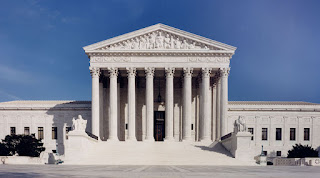
Like the building.

I served as Justice Hugo Black’s law clerk. My first day my wife needed the car and drove me to work. When she pulled up in front of the Supreme Court, our wide-eyed, disbelieving daughter, Julie, asked incredulously, “Daddy, you work in there?!” (Not incidentally, as I recall, there were no “partisan” conversations among clerks or justices during my year.) [Photo credit: U.S. Supreme Court.]

It’s not just the building’s exterior. There’s also the marble, high ceilings, hallway gates, black robes, the curtain dramatizing justices entrance into an imposing courtroom, the bench well above lawyers and audience, the secret justices-only “conference.”

Now politicians, journalists, public – and even justices’ behavior – are treating the Court’s justices as a third political branch (“liberal,” “conservative”). It’s as if they were throwing rocks, shattering the mystique and grand vision of the Constitution’s drafters.

Who’s left to be infallible? Only authoritarians?
____________
Nicholas Johnson clerked for Justice Hugo Black and is the author of Columns of Democracy. Contact mailbox@nicholasjohnson.org
# # #

SOURCES
Infallible because we are final. Deborah Rhode, “Ethics in Practice: Lawyers’ Roles, Responsibilities, and Regulation,” Oxford University Press, https://epdf.pub/ethics-in-practice-lawyers-roles-responsibilities-and-regulation.html (“An observation by Justice Robert Jackson applies to judges generally: ‘We are not final because we are infallible, but we are infallible because we are final.’” Brown v. Allen, 344 U.S. 443, 532, 540 (1953) (Mr. Justice Jackson, concurring). 10. See, e.g., 28 U.S.C. Sec. 455; and American Bar Association, Model Code of Judicial Ethics.”)

30,000 car parts. Nicole Wakelin, “How Many Parts Are In A Car?” NAPA Know How Blog, July 2, 2021, https://knowhow.napaonline.com/how-many-parts-are-in-a-car/ (“The exact number of parts in a car varies widely from car to car, but what’s the average? Typically, you can expect that there are about 30,000 parts in your car, from the tiniest nuts and bolts to the engine block.”)

Civic Society. Alexis de Tocqueville, Democracy in America (1835)

Steve Hoenisch, “The Relation Between Civic Society and Newspapers in the Writings of Alexis de Tocqueville and Robert Putnam,” criticism.com, https://www.criticism.com/md/putnam1.html

“Associations Matter,” The Center for Association Leadership, 2012, http://www.thepowerofa.org/wp-content/uploads/2012/03/Associations-Matter-FINAL.pdf

Columbo. Columbo, Wikipedia, https://en.wikipedia.org/wiki/Columbo (“Columbo is an American crime drama television series starring Peter Falk as Columbo, a homicide detective with the Los Angeles Police Department. … He often leaves a room only to return with the catchphrase "Just one more thing" to ask a critical question.”)

Number of federal district and circuit courts. Offices of the United States Attorneys, “Introduction To The Federal Court System,” https://www.justice.gov/usao/justice-101/federal-courts (“There are 94 district courts, 13 circuit courts, and one Supreme Court throughout the country.”)

“Political Question” Doctrine. “Political Question Doctrine,” Legal Information Institute, Cornell Law School, https://www.law.cornell.edu/wex/political_question_doctrine (“Federal courts will refuse to hear a case if they find that it presents a political question. This doctrine refers to the idea that an issue is so politically charged that federal courts, which are typically viewed as the apolitical branch of government, should not hear the issue.”)

Court as Third Political Branch. Jeffrey Rosen, “The Court Loses Its Chief Pragmatist; With the upcoming retirement of Justice Stephen Breyer, the country moves into a more ideologically divided future,” The Atlantic, January 26, 2022, https://www.theatlantic.com/ideas/archive/2022/01/stephen-breyer-retirement-supreme-court-biden/619331/

“Public’s Views of Supreme Court Turned More Negative Before News of Breyer’s Retirement; 84% say justices should not bring their political views into decisions,” Pew Research Center, Feb. 2, 2022, https://www.pewresearch.org/politics/2022/02/02/publics-views-of-supreme-court-turned-more-negative-before-news-of-breyers-retirement/ (from August 2020 to January 2022, approval of Court dropped from 70% favorable to 54%; lowest in 40 years)

# # #
  Additional Related Material Not Used Directly

Today’s court justices: name, BDY, year appointed, home, law school: https://ballotpedia.org/Supreme_Court_of_the_United_States

Google search: "Supreme Court" AND (political OR politics)

Federalist No. 78 discusses the power of judicial review. It argues that the federal courts have the job of determining whether acts of Congress are constitutional and what must be done if government is faced with the things that are done on the contrary of the Constitution.

Why is Federalist 51 important? Government Must Furnish the Proper Checks and Balances Between the Different Departments.” Madison wrote Federalist 51 to explain how separation of powers with checks and balances protects liberty. Madison borrowed the concept of separation of powers from Montesquieu, a French political philosopher.Sep 6, 2011

Federalist No 81 - The Avalon Projecthttps://avalon.law.yale.edu › fed81 The Federalist Papers : No. 81 ... But the errors and usurpations of the Supreme Court of the United States will be uncontrollable and remediless.

Supreme Court of the United Stateshttps://www.supremecourt.gov › DocketPDFPDF Jan 31, 2019 — to the United States Court of Appeals for the Federal Circuit ... Madison James, Federalist 47, THE FEDERALIST. PAPERS. 25 pages

ABA’s “landmark cases” - https://www.americanbar.org/groups/public_education/programs/constitution_day/landmark-cases/

Lifetime appointments related to non-political decisions - Hamilton's main point in Federalist #78 is that a lifetime appointment will give Federal Justices the ability to work objectively on behalf of the people. If they were to seek reelection, they might act in bad faith in an effort to retain the office. May 1, 2020 Lifetime Appointments for the Court - Federalist #78 - Founder ...

Google search - "Constitutional Convention" 1787 (judges OR "judicial branch" OR judiciary OR "supreme court")

Debate from the Constitutional Convention regarding the function of the judiciary (July 21, 1787) - https://www.thirteen.org/wnet/supremecourt/democracy/sources_document5.html

See also: https://www.thirteen.org/wnet/supremecourt/democracy/sources.html

# # #


Wednesday, July 07, 2021

How Do You Know?

What to Believe or How to Think?
Nicholas Johnson
The Gazette, July 7, 2021, p. 6

A lifelong friend we’ll call “Ralph” told me his father always asked, upon Ralph’s return from school, “Did they teach you what to believe, or did they teach you how to think?”

The Harvard Business Review published “Why China Can’t Innovate” and concluded, “The problem . . . is not . . . the Chinese people . . . but the political world in which their schools . . . need to operate, which is very much bounded.”

Americans’ innovative, entrepreneurial, economic, artistic and intellectual comparative success is largely driven by the educators who have taught us “how to think.”

As you may have noticed, for the past six years America has been sliding from the “shining city on a hill” down toward the pit of authoritarian dictatorship with the uncontrolled speed of a kid on a plastic sledding saucer in winter.

A democracy can no more stand without supporting institutions than a beach home can stand without pilings. Democracies need their respected and protected “columns of democracy” – professional, independent, journalists; wise, impartial, non-partisan judges; electoral procedures that encourage ever-increasing numbers of voters – and dedicated public school educators teaching students “how to think.”


President Thomas Jefferson wished “most to be remembered” as “Father of the University of Virginia,” not president. Iowa’s early 12,000 schools made it number one. When I was teaching at UC Berkeley, California’s tuition-free education fueled its position as, today, the world’s fifth greatest economy. [Photo Credit: Iowa Department of Education (“Here is the original well of an 1800s school house located near Shellsburg in Benton County.”) And see, Tom Morain, “One-Room Schools,” Iowa Pathways, Iowa PBS, undated, https://www.iowapbs.org/iowapathways/mypath/one-room-schools (“The first schoolhouse in Iowa was built in 1830 in Lee County.”)]

Educators’ freedom is as essential to our economy as to our democracy and our “pursuit of happiness.”

Chinese journalists explained to me the freedoms they have – so long as they don’t use the wrong words.

Fortunately, the Iowa Commissar of Acceptable K-12 Vocabulary does not understand education.

Some years ago, I was asked to speak to Iowa’s National Issues Forum high school students at the Herbert Hoover Library. I shared a basic general semantics tool: “What Do You Mean and How Do You Know?” (Asking yourself and others, “What facts brought you to the verbal generalizations you just used?” and, “What were your sources supporting that conclusion? Why do you believe them reliable?”) The technique was successfully used by a couple Metro High School teachers after that talk, became the subject of a doctoral dissertation, and a published book.

Teachers should ask their school board’s lawyer about HF 802's restrictions. But as I read it, teachers are free to present, or better have students find, historic facts about African-Americans’ lives during the last 400 years; answer students’ questions; ask students, “How do you know?” and let them draw their own conclusions and generalizations. In other words, teaching them “how to think” and evaluate research. Like Chinese journalists, Iowa’s teachers still have their freedom to teach – just so long as they don’t use the Commissar’s forbidden words and phrases.

Ralph’s dad understood education. So do Iowa’s teachers. It’s just a little more challenging to teach, or do journalism, within an authoritarian dictatorship.
_______________
Nicholas Johnson, Iowa City, is the author of Columns of Democracy and What Do You Mean and How Do You Know? Contact: mailbox@nicholasjohnson.org

# # #

SOURCES
Regina M. Abrami, William C. Kirby, and F. Warren McFarlan, “Why China Can’t Innovate,” Harvard Business Review, March 2014, https://hbr.org/2014/03/why-china-cant-innovate (the full last paragraph reads, ““The problem, we think, is not the innovative or intellectual capacity of the Chinese people, which is boundless, but the political world in which their schools, universities, and businesses need to operate, which is very much bounded.”)

Courtney Vinopal, “2 out of 3 Americans believe U.S. democracy is under threat,” PBS, July 2, 2021. https://www.pbs.org/newshour/politics/2-out-of-3-americans-believe-u-s-democracy-is-under-threat

“City on a hill.” Matthew 5:14; Ronald Reagan’s use, “A Vision for America,” Nov. 3, 1980, “City upon a Hill,” Wikipedia, https://en.wikipedia.org/wiki/City_upon_a_Hill

Amy Meadows, “How to Install Piling for a Beach House,” https://www.ehow.com/how_7891751_install-piling-beach-house.html

Democracy’s supporting institutions. Columns of Democracy (2018)

Jefferson’s epitaph. “Jefferson’s Gravestone,” Thomas Jefferson Encyclopedia, Jefferson Monticello, https://www.monticello.org/site/research-and-collections/jeffersons-gravestone (“Before his death, Thomas Jefferson left explicit instructions regarding the monument to be erected over his grave. In this undated document, Jefferson supplied a sketch of the shape of the marker, and the epitaph with which he wanted it to be inscribed:
"... on the faces of the Obelisk the following inscription, & not a word more:

Here was buried Thomas Jefferson Author of the Declaration of American Independence of the Statute of Virginia for religious freedom & Father of the University of Virginia

"because by these," he explained, "as testimonials that I have lived, I wish most to be remembered.")
12,000 Iowa schools. “A walk through Iowa’s one-room schoolhouses,” Iowa Department of Education, https://educateiowa.gov/walk-through-iowa-s-one-room-schoolhouses (“more . . . than any other state in the union”)

Tom Morain, “One-Room Schools,” Iowa Pathways, Iowa PBS, undated, https://www.iowapbs.org/iowapathways/mypath/one-room-schools (“The first schoolhouse in Iowa was built in 1830 in Lee County.”)

California tuition-free education. Lilia Vega, “The history of UC tuition since 1868,” The Daily Clog, The Daily Californian, Dec. 22, 2014, https://www.dailycal.org/2014/12/22/history-uc-tuition-since-1868/

“Economy of California,” Wikipedia, https://en.wikipedia.org/wiki/Economy_of_California (“If California were a sovereign nation (2019), it would rank as the world's fifth largest economy, ahead of India and behind Germany.”)

Theodore R. Breton, “The Role of Education in Economic Growth: Theory, History and Current Returns,” Educational Research, v55 n2 p121-138 2013, https://eric.ed.gov/?id=EJ1036518, (“The paper presents evidence that education has direct and indirect effects on national output. Educated workers raise national income directly because schooling raises their marginal productivity.”)

What do you mean? What Do You Mean and How Do You Know? (2009), ch. 5, p. 49

Use in Metro High School. Although the author used the Metro experience as a major part of the book, Metro was presented as an anonymous high school. Jane Bolgatz, Talking Race in the Classroom (2005)

The law prohibiting reference to such words and phrases as “systemic racism” originated as House File 802, and can now be found, as enrolled, at https://tinyurl.com/myesry7j

Samantha Hernandez and Ian Richardson, “Iowa Poll: More than half of Iowans oppose new law limiting certain concepts from racism, sexism training,” Des Moines Register, June 29, 2021, https://www.desmoinesregister.com/story/news/politics/iowa-poll/2021/06/29/iowa-poll-law-targeting-critical-race-theory-schools-ban-teaching-some-racism-sexism-concepts/7720792002

# # #

Saturday, February 13, 2021

Impeachment: A Third View

Contents
Executive Summary
Presidential Oath
Summary of Trial Lawyers' Arguments
Minority Leader McConnell's Reaction
The Article in 2nd Impeachment
Reaction to Articles in 1st Impeachment
Was Speech Text "Incitement"?
The Speech in Context
What Was Trump's Impeachable Offense?
Executive Summary

Many "Articles of Impeachment" of presidents itemize a specific act or two, e.g., Trump's first impeachment, pressure on Ukraine government; Trump's second, his Jan. 6 speech. This blog post endeavors to build a case for a preeminent Article when a president's actions, whether with intent or effect, constitute an attack on democracy itself, as embodied in the Columns of Democracy, i.e., the essential foundational institutions that support and make possible our democracy, e.g., the peaceful transfer of power after inclusive, free and fair elections, or a respected, free and factual mass media.
[here are adjacent examples of both from Trump's Jan. 16 speech: "[O]ur election was so corrupt that in the history of this country we've never seen anything like it. And you know what else? We don't have a free and fair press. Our media is not free, it's not fair. . . . It's become the enemy of the people." Brian Naylor, "Read Trump's Jan. 6, Speech, A Key Part of Impeachment Trial," npr, Feb. 10, 2021, text and video https://www.npr.org/2021/02/10/966396848/read-trumps-jan-6-speech-a-key-part-of-impeachment-trial].

# # #

"I do solemnly swear (or affirm) that I will faithfully execute the Office of President f the United States, and will to the best of my Ability, preserve, protect and defend the Constitution of the United States."

U.S. Constitution, Art. II, Sec. 1, Clause 8
Introduction

President Trump's lawyers -- and supporters in and out of the House and Senate -- argue he should not be found to have engaged in "high crimes and misdemeanors" because (a) his January 6 Ellipse speech did not "incite" the violence that followed, (b) it is unconstitutional for the Senate to hold an impeachment trial of a former president whose term has expired (he cannot, by definition, be "removed" from an office he no longer holds), (c) Senate rules require separate charges be in separate Articles, (d) it would violate his First Amendment rights to punish or forbid such a speech, and (e) it would be further divisive of an American population desperately in need of unity.
Following the Senate Trial vote Feb. 13, Minority Leader Mitch McConnell spoke. He first excoriated former President Trump and his behavior, and then explained his "not guilty" vote, citing Constitution Article II, Sec. 4: "The President, Vice President and all civil Officers of the United States, shall be removed from Office on Impeachment for, and Conviction of, Treason, Bribery, or other high Crimes and Misdemeanors." McConnell argued that to convict Trump he would have to be, at the time of the conviction, "president," which he was not; it would also be impossible for him to "be removed from Office."
The House impeachment managers, with Representative Jamie Raskin as lead manager, argue that (a) Trump did incite the crowd to storm the Capitol (4 years of telling his "big lie" -- "landslide" "stolen" election victory -- statements; selection of place, date and time of Congress' certifying electoral votes; his support of prior crowd violence; refusal to order support for Capitol police or tell insurgents to stop; and statements of participants that they were following Trump's orders), (b) a Senate trial of an impeached former president no longer in office is constitutional (language of Constitution, English practice that influenced drafters, their remarks, majority of legal scholars), (c) First Amendment does not protect speech triggering seditious insurrection, (d) for the Senate not to convict would set a precedent for future presidents, and (e) accountability (of Trump) was essential to putting this behind us (thus, presumably, contributing to unity).

Something like that.

As a former U.S. Supreme Court law clerk, law professor, and occasional constitutional law prof, I was overwhelmed with the creativity, quality, effectiveness and delivery of Rep. Jamie Raskin and the other House Managers. (Full disclosure: I had shared some undertakings with his late father, Marc; my first memory of Jaimie was watching his participation as a child in a White House demonstration.) I could not have done it as well as they did. I have no suggestions as to how they could have done it better, and certainly no "criticisms."

Thus, what follows is not about their presentation of the House's Article (by which they were to some extent bound), but some reactions to the theory and wording of that Article.
# # #

A Third View

The Article of Impeachment, "Incitement of Insurrection," [H.Res. 24, 117th Cong., https://www.congress.gov/bill/117th-congress/house-resolution/24/text] consists of five paragraphs.

Following the title ("Incitement of Insurrection") the first paragraph contains the allegation that, "Trump engaged in high Crimes and Misdemeanors by inciting violence."

The second paragraph mentions the House and Senate Joint Session "to count the votes of the Electoral College" and Trump's "statements that, in context, encouraged -- and foreseeably resulted in -- lawless action at the Capitol."

The two-sentence third paragraph refers to Trump's "prior efforts to subvert and obstruct the certification of the results of the 2020 Presidential election," and his "phone call on January 2, 2021, [to] the secretary of state of Georgia."

The fourth paragraph reads in its entirety, "In all this, President Trump gravely endangered the security of the United States and its institutions of Government. He threatened the integrity of the democratic system, interfered with the peaceful transition of power, and imperiled a coequal branch of Government. He thereby betrayed his trust as President, to the manifest injury of the people of the United States."

The concluding, fifth paragraph asserts that "he will remain a threat to national security, democracy, and the Constitution if allowed to remain in office, and has acted in a manner grossly incompatible with self-governance and the rule of law."
My reaction to this text is similar to my reaction to Article I in Trump's first impeachment
[Articles of Impeachment Against Donald John Trump, H.Res.755 — 116th Congress, Dec. 18, 2019], emphasizing his interactions with the Ukrainian government:
What the House Democrats should have emphasized for a confused public (and Republican Senate), is why Trump's impeachment, and Senate conviction, should be a slam dunk. It is because, unlike other behavior that has, or has not, been found to be impeachable during the 62 impeachment hearings in the House since 1789, what Trump has been doing is something the drafters had experienced, caused them great legitimate concern, and they specifically tried to prevent: namely, foreign interference in our politics, government, and especially elections, whether sought from within or imposed from abroad.
"Impeachment: What the House Should Have Said; Trump's Conviction Should Have Been A Slam Dunk," FromDC2Iowa, Jan. 21, 2020, https://fromdc2iowa.blogspot.com/2020/01/impeachment-what-house-should-have-said.html.
(See also, "Understanding Impeachment," FromDC2Iowa, Nov. 11, 2019, https://fromdc2iowa.blogspot.com/2019/11/understanding-impeachment.html; and Articles of Impeachment Against Donald John Trump, H.Res.755 — 116th Congress, Dec. 18, 2019, [https://www.congress.gov/bill/116th-congress/house-resolution/755/text], Article I: Abuse of Power/"President Trump solicited the interference of a foreign government, Ukraine, in the 2020 United States Presidential election. He did so through a scheme or course of conduct that included soliciting the Government of Ukraine to publicly announce investigations that would benefit his reelection . . . Trump, by such conduct, has demonstrated that he will remain a threat to national security and the Constitution if allowed to remain in office, and has acted in a manner grossly incompatible with self-governance and the rule of law.")
Article I is headed, "Incitement of Insurrection." The first paragraph charges "Trump engaged in high Crimes and Misdemeanors by inciting violence against the Government of the United States." The second paragraph asserts, "Shortly before the Joint Session commenced, President Trump, addressed a crowd [where he] willfully made statements that . . . encouraged -- and foreseeably resulted in -- lawless action at the Capitol."

Taken out of its context, it is difficult to find within the text of Trump's Jan. 6 11,153-word, hour-plus speech an "incitement of insurrection."
[Brian Naylor, "Read Trump's Jan. 6, Speech, A Key Part of Impeachment Trial," npr, Feb. 10, 2021, text and video https://www.npr.org/2021/02/10/966396848/read-trumps-jan-6-speech-a-key-part-of-impeachment-trial.] He did not suggest the mob hang the Vice President and shoot the Speaker of the House, attack the Capitol police, leave bombs at the DNC and RNC headquarters, break windows and bang on doors, or other of the horrific things that happened. What did he recommend be done with senators and House members who do not support him? "You primary them." What else did he say? "[W]e're going to walk down to the Capitol, and we're going to cheer on our brave senators and congressmen and women;" "I know that everyone here will soon be marching over to the Capitol building to peacefully and patriotically make your voices heard."

In context, however, the January 6 speech was but part of a year-long chain of "incitements" for which it was the last; without those early links Trump's speech might never have produced the disaster it did.

There were lines and phrases in the Article that hinted at some of the links in that chain. The House Managers did their best to include them in their story, but such efforts did little to establish that Trump's January 6 speech, standing alone, constituted "incitement of insurrection."

Here are some examples:
  • "President Trump repeatedly issued false statements asserting that the Presidential election results were the product of widespread fraud and should not be accepted by the American people . . .."

  • "he reiterated false claims that 'we won this election, and we won it by a landslide.'”

  • "President Trump’s conduct on January 6, 2021, followed his prior efforts to subvert and obstruct the certification of the results of the 2020 Presidential election.

  • Those prior efforts included a phone call on January 2, 2021, during which President Trump urged the secretary of state of Georgia . . .."

  • "President Trump gravely endangered the . . . institutions of Government. He threatened the integrity of the democratic system, interfered with the peaceful transition of power . . .."

  • "Trump, by such conduct, has demonstrated that he will remain a threat to national security, democracy, and the Constitution"
The common theme in Trump's behavior was the design of a no-lose strategy; a desire to hang onto the presidency come what may. If he received the most electoral votes he would win. If he did not he had a number of potential paths to retained power. He tried them all. For months prior to the election he repeatedly fed his base the lie that American elections are "fraudulent" and "rigged." Mail-in ballots were not to be trusted. He argued that he would, of course, have the support of the majority of voters, and that, therefore, if he was not proclaimed the winner the results were obviously dishonest. Election night, early returns sometimes went his way. Later, as the mail-in ballot returns came in and the lead shifted, Trump insisted that was proof the election had been stolen from him. When recounts only confirmed his loss, his next step was to file lawsuits challenging the vote. He lost 61 of them. He then turned to speaking directly to electors, county auditors, state secretaries of state, legislators and governors in an effort to get them to change their state's electoral vote count. By late December he was becoming desperate. His last hope was to reverse, stop, or delay the congressional certification of the states' electoral college votes.

That is the context. That was the playing out of his scheme. The Jan. 6 speech, and the insurrection by a mob he had brought to anger over months, was not his initial desire. Stopping the final certification of the Electoral College vote was his last chance. It was only the last domino to fall at the end of a months' long chain.

In other words, the gravamen of Trump's impeachable "high crimes and misdemeanors" was not his speech, it was his attack on our democracy itself; in this case, our system of voting described in another part of Article II (Sec. 1, clauses 1-3), and Amendment XII, that describe the Electoral College system.

In my book, Columns of Democracy, I make the point that a democracy can be neither created, nor sustained, standing alone. It requires a foundation of supporting "columns," such as a respected free and independent media, and, in this case, a system of voting that is respected and trusted by the citizenry as inclusive, easy to use, accurate and honestly administered. Such a system makes for the smooth transfers of power that distinguish democracies from authoritarian dictatorships. Attacking that system, weakening it, threatening the voters trust in it, failing to support peaceful transfer of power -- that should be the impeachable offence.

# # #

Wednesday, January 13, 2021

Democracy Is Not a Spectator Sport

Democracy Is Not a Spectator Sport

Nicholas Johnson
The Gazette, January 13, 2021, p. A6

On Feb. 14, 2014, Donald Trump told Fox, "When the economy crashes, when the country goes to total hell, and everything is a disaster, then you’ll have riots to go back to where we used to be, when we were great.”

By January 6, 2021, the economy had crashed, our federal government’s pandemic response was the world’s worst, and it seemed like “everything is a disaster.”

It was time for a Trump rally. He claimed “hundreds of thousands of American patriots” were there. The Park Service permit approved 30,000, and with no official count, the media settled on “thousands.”

Trump told them, “After this, we’re going to walk down — and I’ll be there with you — to the Capitol . . .because you’ll never take back our country with weakness, you have to show strength, and you have to be strong. We have come to demand that Congress do the right thing."

Minutes later, at the Capitol, we watched his followers’ “show strength” by staging one of Trump’s predicted “riots to go back to . . . when we were great.”

Some Americans are aware of our slowly crumbling columns of democracy, institutions essential to democracy’s creation and preservation. For them, Trump’s January 6 mob was no surprise. Riots are a part of the endgame in an authoritarian-wannabe’s playbook. It was only a matter of time.

Turns out representative democracy is not universally popular among Americans. The Pew Research Center found 13% thought it totally bad; others thought substitutions for elected officials with direct democracy (29%), experts (40%), strong leaders (22%), or military rule (17%) good ideas.

More voted last Nov. 3 than in any election for 120 years. That was 67% of eligible voters. One-third didn’t vote. An Ipsos survey revealed 23% were “not interested in politics.”

A democracy is fragile, and subject to President Lyndon Johnson’s observation that, “It takes a carpenter to build a barn, but any jackass can knock it down.”

We cannot know if it will be possible to rebuild our shattered democracy. What we do know is that it cannot be rebuilt just by substituting one president for another. It cannot be rebuilt by those who just “believe in” democracy or merely prefer it to alternatives.

It will require those who recognize and work to oppose attacks on the columns of democracy. A democracy requires an educated electorate, a trusted and independent mass media, a wise and nonpartisan judiciary, and efforts to increase, rather than suppress, ease of voting.

Inadequate education and library budgets are an attack on democracy. So is failure to support media with subscriptions and advertising, talk of “fake news” and “enemy of the people,” reverse Robin Hood legislation, or treating courts as a third political branch of government.

Are you willing to watch a little less television to have time for calls and emails to officials? Share more of the resources you can afford with local media and democracy-promoting candidates? Help sturdy our crumbling columns of democracy? [Image: Constitutional Convention of 1787, National Park Service]

If there are enough of us doing that, we have a prayer of rebuilding our barn, the democracy our founders hoped for. If not, we’re just waiting for the next authoritarian-wannabe, and the next January 6.

Nicholas Johnson of Iowa City is the author of Columns of Democracy (2018). Contact: mailbox@nicholasjohnson.org

SOURCES

"When the economy crashes, when the country goes to total hell, and everything is a disaster, then you’ll have riots to go back to where we used to be, when we were great.” “Donald Trump’s 2014 Political Predictions,” Fox News Interview, video, 6:26, Feb. 10, 2014, 2:02-2:12 https://video.foxnews.com/v/3179604851001#sp=show-clips Snopes https://www.snopes.com/fact-check/trump-economy-crashing-quote/

"After this, we’re going to walk down — and I’ll be there with you — . . . to the Capitol . . .. Because you’ll never take back our country with weakness, you have to show strength, and you have to be strong. We have come to demand that Congress do the right thing . . .." Trump, Jan 6, 2021

"Donald Trump Speech 'Save America' Rally Transcript," Jan. 6, 2021, Segment beginning 16:25, https://www.rev.com/blog/transcripts/donald-trump-speech-save-america-rally-transcript-january-6

Snopes: https://www.snopes.com/fact-check/trump-tell-supporters-storm/

Crowd size. “How Many Were at the MAGA Trump March & Protest in DC? Crowd Size Photos,” copy of Park Service permit (5000; modified to 30,000). Reports: “thousands” at rally “hundreds” at Capitol. https://heavy.com/news/maga-march-trump-dc-rally-crowd-photos/

NYTimes collection of stories: https://www.nytimes.com/live/2021/01/06/us/washington-dc-protests

Support for democracy: Richard Wike, Katie Simmons, Bruce Stokes and Janell Fetterolf, “Democracy widely supported, little backing for rule by strong leader or military,” Pew Research Center, Oct. 10, 2017, https://www.pewresearch.org/global/2017/10/16/democracy-widely-supported-little-backing-for-rule-by-strong-leader-or-military/

Percentage voting: Domenico Montanaro, “Poll: Despite Record Turnout, 80 Million Americans Didn't Vote. Here's Why,” Dec. 15, 2020, NPR, https://www.npr.org/2020/12/15/945031391/poll-despite-record-turnout-80-million-americans-didnt-vote-heres-why
Ipsos survey: "Nonvoters' reasons for not voting include: not being registered to vote (29%); not being interested in politics (23%) . . .." Ibid.

# # #

Monday, October 21, 2019

What Is A Newspaper?

What Is A Newspaper?"
Nicholas Johnson
The Gazette, October 21, 2019, p. A5
NOTE: The first entry in this blog post is the 584-word text, and the requested "sources," as presented to The Gazette's Editorial Board. As of this morning (Oct. 21) the print version (shortened for space and slightly modified) has not yet been posted on The Gazette's Web site. When it is available it will be copied and reproduced below, with a direct link to it here.

For the record, I am not employed by The Gazette, have no financial interest in the paper or its parent corporation, no family member working there, and am not paid for the columns I submit. My motive for writing this column, as my book, Columns of Democracy, makes clear is that I believe very strongly in the urgency of reestablishing democracy in America, and the preeminent role of local journalism in making that possible.

Gazette columnist Adam Sullivan’s “America Needs Local Newspapers” (Oct. 11), put forward a well-written case for local news in general and Iowa’s Carroll Times Herald and Quad-City Times in particular. Both papers had substantial costs of defending themselves in trials they ultimately won.

He’s right. And it’s not just local. Authoritarians are disparaging and assassinating journalists. But there are multiple sources of their stories.

It’s local news that’s disappearing. National print newspaper ad revenue dropped from $60 billion to $20 billion in 15 years. Half our 3,000 counties have only one newspaper, 171 have none; 2,100 papers closed.

So what? Democracies die from a thousand cuts to their supporting institutions: universal public education; fair, inclusive elections; nonpartisan, respected judges -– what I’ve called the Columns of Democracy.

And the greatest of these? An independent, respected journalism. Says who? Says Thomas Jefferson: “Were it left to me to decide whether we should have a government without newspapers, or newspapers without a government, I should not hesitate a moment to prefer the latter. But I should mean that every man should receive those papers and be capable of reading them."

“Receive those papers?” Little more than one percent of Americans subscribe to the New York Times, or Washington Post, or Wall Street Journal. “Capable of reading them?” Mandatory public education was originally to provide us the civic virtues for active participation in democracy. No longer.

The Gazette is preeminent among our local democratic institutions, serving all of them. Its investigative reporters are our communities’ “inspectors general.” It informs us about our local businesses; schools, colleges and universities; courts, city councils, county supervisors, legislators – plus presidential candidates. It monitors our hospitals, public roads, bridges, parks and libraries. It tracks our safety, from natural disasters to the law breakers and enforcers. It hears our complaints and publishes our letters. It is our historian and librarian, with Time Machine articles and book, Ties to Our Past – plus papers from 1883. It educates and offers advice about our physical and financial wellness, cooking, cars, homes and gardens, “Things To Do Today” and Sunday’s “What’s Trending on the Gazette.com.” [Photo credit: Tony Webster, January 25, 2016]

But wait, there’s more! Examine carefully each story, and reporter’s name, in one day’s hard copy or Green Gazette. Leaf through a week’s papers, or stroll through the vast Web site with its Menu, More Links, Our Sites, and Additional Links.

The Gazette is magazines, like Iowa Ideas and HER, special supplements like Hoopla and quarterly Brain Teasers. It is editorial board meetings, Pints and Politics, business breakfasts, and Iowa Ideas symposium. It’s generous support of dozens of organizations and causes -– and more than this space can hold. [Photo: Pints & Politics event before packed house at Theater Cedar Rapids, first evening of 2019 Iowa Ideas symposium, Oct. 3, 2019. From stage right: Erin Jordan, Todd Dorman, James Lynch, Lyz Lenz, Adam Sullivan. Photo credit: Nicholas Johnson]

Forty-five years ago, as a congressional primary candidate, I could look around an Iowa town and guess the quality of its newspaper. It’s still true. If there are things you like about our part of Iowa thank The Gazette.

But it needs our support more than our thanks. Unlike other public institutions, it’s not only protected from government interference it also gets no government support.

The Gazette cannot do it alone. It can print newspapers, but it can’t print money. It needs advertising dollars from an engaged business community. It and our democracy need more of us to subscribe -– even if only digitally.

It is we who need to be engaged in our communities, we who need to be informed about our local challenges and opportunities, we who need to financially support, read and act on the local news in this paper. Do your part.
_______________
Nicholas Johnson of Iowa City, former media law professor and FCC commissioner, is the author of Columns of Democracy." Comments: mailbox@nicholasjohnson.org

# # #

SOURCES

[https://cpj.org/data/killed/?status=Killed&motiveConfirmed%5B%5D=Confirmed&type%5B%5D=Journalist&start_year=1992&end_year=2019&group_by=year; Committee to Protect Journalists (“1354 Journalists Killed between 1992 and 2019/Motive Confirmed”)

https://cpj.org/data/reports.php?status=Imprisoned&start_year=2018&end_year=2018&group_by=location (“250 Journalists Imprisoned in 2018”)

Amanda Erickson, “2018 Has Been a Brutal Year for Journalists, and It Keeps Getting Worse,” The Washington Post, Oct. 19, 2018, https://www.washingtonpost.com/world/2018/10/09/has-been-brutal-year-journalists-it-keeps-getting-worse/

RWB World Press Freedom Index, https://rsf.org/en/2019-world-press-freedom-index-cycle-fear]

Newspaper economics. Derek Thompson, “The Print Apocalypse and How to Survive It,” The Atlantic, Nov. 3, 2016, https://www.theatlantic.com/business/archive/2016/11/the-print-apocalypse-and-how-to-survive-it/506429/

The Rise of a New Media Baron and the Emerging Threat of News Deserts; Daily Papers That Were Closed, Merged, or Shifted to Weeklies, http://newspaperownership.com/additional-material/closed-merged-newspapers-map/

Newspapers closed. Douglas A. McIntyre, “Over 2000 American Newspapers Have Closed in Past 15 Years,” 24/7 Wall St., July 23, 2019, https://247wallst.com/media/2019/07/23/over-2000-american-newspapers-have-closed-in-past-15-years/ (“Abernathy told 24/7 Wall St. that, “It appears at this stage that we’ve lost approximately 2,100 papers, all but 70 of which are weeklies, since 2004.” The industry implosion has left almost half of the counties in America (1,449) with only one newspaper, which is usually a weekly. As of the most recent count, 171 counties do not have a paper at all.”)

Thomas Jefferson quote. Thomas Jefferson to Edward Carrington," January 16, 1787, Julian P. Boyd, ed., The Papers of Thomas Jefferson, 11:48-49 (emphasis supplied). http://press-pubs.uchicago.edu/founders/documents/amendI_speechs8.html

Not used: Indeed the media, sometimes called the fourth branch of government, is the only industry recognized and protected by our Constitution (“Congress shall make no law … abridging the freedom … of the press”).

Subscribers. NY Times “new goal of 10 million subscriptions by 2025, up from 4.3 million today. Nearly 80 percent of those 2018 subscribers are digital.” AP New York Times subscriber numbers are skyrocketing in the Trump age, Over 265,000 digital subscriptions were added in the last three months of 2018,” Feb. 6, 2019 https://www.marketwatch.com/story/new-york-times-subscriber-numbers-are-skyrocketing-in-the-trump-age-2019-02-06

Reporters Without Borders’ World Press Freedom Index 2019 ranking of 180 countries finds only 24% “good” or “satisfactory.” The U.S. fell to 48th.

Wednesday, March 20, 2019

Saving Democracy

What's the current state of our democracy?

Nicholas Johnson
Iowa City Press-Citizen, March 20, 2019, p. A7

Democracies can correct policy mistakes. They can't correct anything after the destruction of institutions without which we have no democracy: a respected, independent judiciary and mass media, public education, libraries – and efforts to ease and encourage voting.

The Iowa legislature politicizes our founders’ non-partisan judiciary, disparages the media, cuts funding for education, reduces the number who can vote and increases the difficulty for those who can. This is not just legislation, or politics as usual. This is how democracies die, “not with a bang but with a whimper.”

Sadly, this is happening throughout the U.S. and around the world. Planet Rulers now lists 50 countries’ rulers as “dictators.” And at home: What’s the state of democracy in Iowa City?

It’s essential we watch for the signs of a deteriorating democracy and know how to fight back.

On Saturday, March 30, 4:00 p.m., there will be a discussion of these issues at Prairie Lights, 15 S. Dubuque St., along with a reading from Columns of Democracy. Hope to see you there.

-Nicholas Johnson, Iowa City

For more on this event see, https://www.prairielights.com/live/nicholas-johnson
and, Columns of Democracy, Columns of Democracy.com


# # #

Wednesday, March 13, 2019

Iowa's Judiciary and Hamilton's Warning

Iowa's Judiciary Must Remain Independent
Nicholas Johnson
The Gazette, March 13, 2019, p. A6

Water quality. Education budgets. Healthcare. Opioid epidemic. Workforce development. Tax cuts. All important, all debated under the Golden Dome and in our not-so-golden homes, all appropriate subjects for a democracy’s discussions.

So how are changes in how Iowa appoints its judges different? Because a truly independent judiciary is one of the “columns of democracy” – institutions without which there is no democracy. The court system was deliberately created by our founders as a non-political institution to check the legislative and executive branches and protect citizens’ constitutional rights.

Turning the judiciary into a third political branch of government is like removing one leg from a three-legged stool. A democracy wobbles, falls, and ultimately dies without the supporting columns of democracy, such as the checks and balances of three branches of government, independent judiciary and media.

Many true conservatives are members of the Federalist Society. They’ve read the Federalist Papers, written by Alexander Hamilton, John Jay and James Madison in 1787 to promote the ratification of the new United States Constitution. [Photo credit: Wikimedia Commons; Alexander Hamilton portrait by John Trumbull, 1806.]

They are familiar with what Hamilton wrote in Federalist 78. All Iowa legislators should read it as well. Here are some excerpts:

"There is no liberty if the power of judging be not separated from the legislative and executive powers. Liberty can have nothing to fear from the judiciary alone but would have everything to fear from its union with either of the other departments.”

“This independence of the judges is equally requisite to guard the Constitution and the rights of individuals from the effects of … designing men, or the influence of particular [circumstances which] sometimes disseminate among the people themselves, and which, though they speedily give place to better information, and more deliberate reflection, have a tendency, in the meantime, to occasion dangerous innovations in the government, and serious oppressions of the minor party in the community.”

“No man can be sure that he may not be tomorrow the victim of a spirit of injustice, by which he may be a gainer to-day. And every man must now feel, that the inevitable tendency of such a spirit is to sap the foundations of public and private confidence, and to introduce in its stead universal distrust and distress.”

“If the power of making [judicial appointments] was committed either to the Executive or legislature, there would be danger of an improper complaisance to the branch which possessed it; if to both, there would be an unwillingness to hazard the displeasure of either.”

It is as if Alexander Hamilton had arisen from the dead and walks among us. He was spotted on stage in Des Moines’ Civic Center last June, and his Federalist 78 speaks to us today as if he wrote it yesterday.

True conservatives, who look to the “original intent” of those who wrote our State and federal constitutions, will resist the current lure of instant additional political advantage. They will read Hamilton’s words over again, understand that without a non-partisan independent judiciary there can be no democracy, and do all in their power to oppose those who would further politicize our courts. _______________
Nicholas Johnson of Iowa City is a three-time presidential appointee and author of, most recently, "Columns of Democracy." It will be discussed at Iowa City's Prairie Lights Books, March 30, 4 p.m. Comments: mailbox@nicholasjohnson.org

# # #

Sunday, January 20, 2019

The Wall

Six quick takeaways from reflection after this column was published:
(1) Talk of "a wall" across our southern border is to some degree "a solution in search of a problem;" if "the problem" is the number of undocumented immigrants, and rate of increase in immigration, (a) two-thirds of such immigrants (those who have overstayed their visas), and a larger percentage of the illegal drugs, have come through legal ports of entry, (b) at least some come across our almost open northern border with Canada, or by plane, boat, through tunnels, climbing over or digging under "border walls," or other means than walking across the southern border, and (c) there are some numbers indicating a decline in immigration. (More precisely, it is a possible partial solution to a relatively small proportion of a very much larger problem.)
(2) When addressing a problem it's more effective to treat its causes than its symptoms -- in this case the conditions that cause Central Americans to escape from their countries.
(3) If the focus is to remain on "border security" (rather than an holistic approach to "immigration policy and law") we at least need data and judgment from the U.S. and other countries' experts (non-ideological former border officials, academics, and "think tanks") as to the most cost-effective combinations of personnel, technology and barriers, specifying precisely the location, extent, and nature of any barriers (i.e., designed to prevent entry by vehicles, humans, or both).
(4) Our politicians (e.g., President, Speaker of the House) are no more qualified to dictate details of border security than the detailed designs of a fighter plane.
(5) If they are going to persist in doing so anyway, they at least need to speak in more specific and detailed language than "a wall" -- a word so vague as to be almost devoid of useful meaning in this context.
(6) A government "shutdown" (a) in this instance is doing enormous harm to hundreds of thousands of innocent federal workers, others dependent on federal services, and the economy, and (b) should never be used simply for leverage in bargaining regarding a campaign pledge.
Instead of a Wall, Focus on the Cause

Nicholas Johnson
The Gazette, January 20, 2019, p. D3

It makes no more sense to refuse to build “the wall” than to insist on building “the wall.”

Why? Because neither side explains what they’re talking about. [Photo credit: VOA file photo]

How about some facts and a pinch of rational analysis?

The Mexican-U.S. border includes water (Gulf of Mexico, Rio Grande, Pacific Ocean), mountains, deserts, urban areas, and wildlife habitats. It’s nearly 2000 miles long of which 650 miles already have “walls.” Some remaining stretches make more enforcement and economic sense than others.

Under ideal conditions walls costs $4 to $8 million dollars a mile – more than a two-lane highway. In other areas costs are multiples of that. Some places are nearly impossible to reach or prohibitively expensive.

Walls can be tunneled under and climbed over. We don’t have enough border agents to watch every few feet of fence through isolated deserts, canyons and mountains. What the agents want, and some economists say makes more benefit-cost sense, are more (a) communications and surveillance technology, and (b) personnel.

Can walls stop illegal drugs? The Drug Enforcement Administration says all but a tiny percentage come through legal ports of entry.

Are immigrants criminals? The percentage who commit crimes is less than the percentage for U.S. citizens.

Moreover, the families coming from Guatemala, Honduras and El Salvador are a symptom, not a cause. They are escaping poverty, violence, lack of education and jobs – conditions we’ve helped create and have done little to alleviate.

Suppose dripping water from your kitchen ceiling was filling the pan you placed to catch it. Would your solution be to get a bigger bucket? Or would you go upstairs, discover the bathtub was overflowing, scream at whoever did it, shut off the faucet and start mopping?

In Afghanistan, after an Army general itemized extensive U.S. military construction projects, the popular stand-up comic, Kathleen Madigan, responded, “Wow! That is amazing. When we’re done, we should invade Detroit.”

Think about it. We’ve spent 17 years and trillions of dollars “improving” Afghanistan. What if we had also spent less than half that time and money “invading” northern Central America, training and hiring locals to build and staff schools, police stations, and hospitals? It would have been a lot easier to eliminate violence, crime and gangs from those countries than to eliminate the Taliban from Afghanistan.

It would have minimized our immigration challenges and costs. Few, if any, Central Americans would even think about leaving a happy home to walk a thousand miles or more to the United States.

We could still do it. Meanwhile, does anybody know where I can find a bigger bucket?
_______________
Nicholas Johnson’s latest book is Columns of Democracy. www.nicholasjohnson.org Contact: mailbox@nicholasjohnson.org

Columns of Democracy (2018)

For those interested in more on this topic and others, Nicholas Johnson's latest book, Columns of Democracy (2018), is now available from Iowa City's Prairie Lights Bookstore, 15 S. Dubuque Street, or if you live outside of Iowa City: Amazon, https://tinyurl.com/yama2h3b (scroll to "Books by Nicholas Johnson," click on "Paperback," for "Sort by" select "Publication Date"), Barnes & Noble, https://tinyurl.com/ybjwxuuh (scroll down), and the publisher, Lulu Press, https://tinyurl.com/yd8g47de.


#Afghanistan #CentralAmerica #ColumnsOfDemocracy #immigration #KathleenMadigan #Mexico #Pelosi #Trump #Wall

Sunday, November 18, 2018

The Media Under Siege


The Media, Under Siege:
And What KHOI Can Do About It
Nicholas Johnson 
KHOI-FM 89.1 Fundraiser: An Evening with Nicholas Johnson 
Ames, Iowa 
November 16, 2018


Thank you for the invitation I join you this evening. The only thing nicer than being asked to speak is to be invited back to speak.

The topic, and speech title, you have requested is “Media Under Siege.” Always the conscientious student, I feel obliged to say something about the assignment you’ve given me, and we’ll begin with that.

But it might be useful to put that siege in context, especially during our discussion period. So I’ll also have something to say about our democracy under siege; what it takes to create and maintain a democracy, the role of media in that process, the role of KHOI, and what you and I can do in our daily lives to help revive that democracy.

Media under siege. Five months ago, June 28th, five journalists were assassinated in the newsroom of the Capital Gazette, near Annapolis. Last month, October 2nd, Jamal Khashoggi, a Saudi journalist working for the Washington Post, was brutally assassinated in the Saudi Consulate in Istanbul.

Sadly, these six journalists are a small percentage of the 1000 journalists who have been assassinated over the past ten or fifteen years. Assassination is the ultimate silencing of the media, the ultimate example of media under siege. And those assassinated are just the ones killed because of the content of their reporting. Many more have died while reporting from a battlefield or during other dangerous assignments.

Assassinations are not the only threat. Newspaper subscription and advertising revenue is about half of what it once was. Television network affiliates, formerly guaranteed at least one-third of the potential viewing audience, now find themselves competing with 500 cable and satellite channels.

The influence of both broadcasters and publishers is further diminished by the competition for eyeballs. Every hour we spend staring at a laptop or smartphone screen, searching the Internet, checking our Facebook page, answering email or texting friends, watching YouTube videos, playing video games, reading or watching the thousands of online social media, news sources, podcasts and videos, are hours not spent looking at a TV screen or newspaper.

I’m informed there are some people who spend time tending their gardens, taking a walk in the woods, or reading books, without any electronic devices. Frankly, I find that unlikely; and at best a minuscule percentage.

Finally, media are among the first institutions to come under attack in the 49 nations headed by dictators, authoritarian strongmen or wannabes. Such leaders conduct massive propaganda campaigns. They revise the schools’ textbooks. The ruler’s control of the media can take the form of personal or government ownership of stations and newspapers, intimidation and punishment of publishers and journalists, criticism designed to erode the public’s trust of independent media, or blocking citizen access to external broadcast signals, Internet sites and publications.

We will return to the media in a few minutes and during our discussion period.

The Context: democracy under siege. But first, let’s provide a little context for KHOI and its need for our financial support. KHOI is a much more essential institution, in this place and at this time, than even its fans may be aware.

For the media is not the only essential institution that is under siege.

Our democracy may well not survive the current attacks upon it from home and abroad. Let me repeat that. Our democracy may well not survive the current attacks upon it from home and abroad.

Like climate change, there comes a time when the red line has been crossed, when the life of a democracy, or even life on Earth, can no longer be resuscitated.

Like a good marriage, a good democracy is something we must work at. An apocryphal story reported a poll in which local citizens were asked which they thought the greater problem in their community, ignorance or apathy. Most answered, simply, “I don’t know, and I don’t care.”

A democracy requires people who do know and do care; people who have an almost religious faith in both the idea and the reality of democracy. It needs those who know the questions to ask, have access to accurate and relevant facts, the education to understand them, and the interest, energy and motivation to act accordingly, to fulfill the responsibility democracy places upon us.

When one of the kids would come running into the house after school, they would say to my wife, Mary Vasey, “Hey, Mom, make me a sandwich.” Did you have kids like that? Mary’s response was to place her hand on their head, and solemnly incant, “You are a sandwich.”

Unfortunately, the creation and preservation of a democracy is even more difficult than turning a child into a sandwich. And yet the destruction of a democracy can occur almost as quickly as you can turn a sandwich into a child.

Most often democracies yield to dictators, not from external military aggression, but from internal defection, using the very freedoms and processes democracy provides. We like to say that it can’t happen here. But it has already happened here. On February 20, 1939. 20,000 Americans, dressed as Nazis, filled Madison Square Garden, with arms raised in the Nazi salute. They cheered as the speaker called for a “white, Gentile-ruled United States.”
[https://www.theatlantic.com/video/index/542499/marshall-curry-nazi-rally-madison-square-garden-1939/]
Only three weeks ago tomorrow an anti-Semite with an AR-15 turned the Tree of Life Synagogue into a tree of death for 11 Jews in Pittsburgh’s Squirrel Hill neighborhood. Reports of hate crimes took a big jump last year, up to 7100.
[https://www.nytimes.com/2018/11/13/us/hate-crimes-fbi-2017.html]
You can’t buy a democracy in a store. You can’t create one by passing a law. In that sense there is no such thing as “democracy.” There are only the nations, and their people, whose institutions make a democracy possible. These institutions are to a democracy what the columns, or pilings, are to a beach house, raised above the relentless storm surge.

Democracy's institutions.
  • Education. Well-funded free public K-12 and higher education
  • .
  • Libraries. Free public libraries for those with the education to use them
  • .
  • Courts. A respected, independent judiciary to check the leader’s abuses
  • .
  • Voting. Legislators representing constituents’ interests, not special interests, elected from districts that have not been gerrymandered, with voting systems designed to encourage, rather than discourage, citizens’ participation
  • .
These are among what I have called the Columns of Democracy in my most recent book by that title. If those institutions are supported, adequately funded, respected, and encouraged a democracy is possible. When they are damaged or destroyed democracy collapses, just like that beach house when it loses its columns.

Communications. All of these institutions are essential to democracy. But communication and the media were thought to be central by our founders and remain so today.

Look at all our predecessors did.

Thomas Jefferson said, “Were it left to me to decide whether we should have a government without newspapers, or newspapers without a government, I should not hesitate a moment to prefer the latter.” To which he immediately added, “But I should mean that every man should receive those papers and be capable of reading them.”
["The basis of our governments being the opinion of the people, the very first object should be to keep that right; and were it left to me to decide whether we should have a government without newspapers, or newspapers without a government, I should not hesitate a moment to prefer the latter. But I should mean that every man should receive those papers and be capable of reading them." – Thomas Jefferson to Edward Carrington," January 16, 1787, Julian P. Boyd, ed., The Papers of Thomas Jefferson, 11:48-49 (emphasis supplied).]
In two sentences he made the case for the First Amendment, free public education, and universal postal delivery of newspapers, magazines and books at subsidized rates. Jefferson made no mention of his presidency on his tombstone, but did include, “Father of the University of Virginia.”

We’ve had public schools since Boston Latin School in 1635, a central purpose of which was always civics, turning Americans into participating citizens.

Jefferson also saw the necessity of libraries. Following the 1814 Library of Congress fire he doubled the former collection, making available his personal library of about 6500 volumes.

In addition to the postal system with its Pony Express, the subsidization of canals, railroads, universal telephone service (plus today’s broadband), airlines and the Interstate Highway system also served in part to facilitate communication.

Let us first be a little more precise about what we mean by “the media” and its contribution to democracy. Much of what’s on radio and television, and in books and magazines, has little to nothing to do with the Columns of Democracy or citizenship. It may even be counterproductive.

Entire sections of newspapers are devoted to sports. Even the New York Times has its popular, if incredibly difficult, crossword puzzle.

The 19-minute “ABC World News Tonight” contains little world news and even less of the information citizens need. It deliberately attracts an audience that apparently likes to be frightened, even terrorized, by an exited anchor person’s dramatic portrayals of the day’s worst disasters and dangers – some of which aren’t even legitimate local news where they occurred. Storms are “deadly”, a driver was “trapped” in her vehicle, school buses were involved in “tragedies,” there was a “scare” at sea onboard a listing cruise ship. There are “deadly” airline and highway accidents, shootings and stabbings, fires and floods, explosions and hurricanes.

ABC comes a lot closer to what Paddy Chayefsky predicted as the future of news, in the movie “Network,” than any CBS Evening News with Walter Cronkite. It certainly makes a fellow want to stay safely indoors watching television.

No, what we want to focus upon is the information a democracy’s citizens need to address the challenges and opportunities confronting their democracy; all sides of the problems and solutions, the public policy questions, and the answers offered from other communities and nations.

And speaking of other nations, let’s separate and identify some categories of the information we need and the media that provide it.
International news. What’s happening on the world’s continents, and nations’ capitals? There’s no shortage of sources. My iPhone has apps bringing me news from the world’s best newspapers: the Guardian in London, Le Monde from Paris, others in Berlin, Moscow, Karachi, Doha, Erbil, Beijing, Mumbai, Tokyo.

National news. For us, that’s mostly what happened in New York and Washington today, plus some regional centers like Chicago and Los Angeles – along with an occasional midterm election or huge California fire. Again, we can have multiple sources and apps on our smartphones: New York Times, Washington Post, Wall Street Journal, AP, Bloomberg, plus PBS and NPR.

State news. For state news, the Des Moines Register used to self-identify as “the newspaper all Iowa depends upon.” And it was; delivered by truck around the state, available on the counter of every small-town café. There is no equivalent today, although The Gazette does a nice job of state news for eastern Iowa, and the Register still serves central Iowa.
Local news: communication and community. All of which brings us to KHOI, perhaps the Ames Tribune, and the subject of local news.

Americans may have multiple sources for international, national, and even state news.

But if you want to know the arguments for and against the new water plant, who’s died and who’s opened a new business, what roads are closed for construction, what’s happening with property taxes, or the results of your local school board election, for most Iowans neither the New York Times nor the Register are going to be much help.

Unlike international and national news, there simply are no alternative sources for the local news that is the most important supporting column for a community's democracy. This is an essential need that KHOI is uniquely positioned to provide for Ames.

Like every other industry, some newspapers are doing better than others. But the national average is that subscriptions and advertising revenue are now about half what they once were. Hundreds of papers have gone out of business. Virtually all have had to cut back on reporters, and therefore the number of government agencies, subjects and local news stories.

Television and radio stations have an ADI, their “area of dominant influence,” the geographical area within which residents not only can but do receive their signal. Newspapers have “circulation areas.” For many purposes, those ADIs and circulation areas are the most meaningful geographical definition of our “communities” – regardless of where the “city limits” may be.

Think about the number of words beginning with “c-o-m-m”: commune, the commons, communal, communitarian, yes; but also, community and communication. For community is the essential chemical element from which democracies are made. And communication networks are what create and define our communities – whether the family as a community; the teachers, parents and kids in a K-12 school; a church congregation; the workplace; suburban development; city, county, state, nation, and for some, their sense of being a part of a global community.

Without communication communities disintegrate, and without communities democracies fail.

What can we do? What can KHOI do? What can you, you and I, do?

Political. We can increase our political participation. Only 55% of Americans eligible to register actually vote. That makes us 26th in the world; eight countries are above 75%; Belgium is 87% and we’re 55%.

Iowa City is in Johnson County; what some call the “Peoples Republic of Johnson County.” We’re only two percentage points above the U.S. average. Of Iowa City residents eligible to register, often less than 10% vote in school board, City, or County Supervisor elections. Hopefully, Ames is better.

But merely voting is not enough. As Frederick Douglas observed, “Power concedes nothing without a demand. It never did and it never will.” We must keep in touch with our elected officials: with personal visits, phone calls, emails, letters, and demonstrations.

You can volunteer to work for candidates or political parties. You can run for office, or agree to serve on one of our multiple governments’ boards and commissions.

Media. When conventional media suffer so does our democracy. If you have a business, support your newspaper by advertising. Think of it as a charitable contribution; one you can take as a tax-deductible business expense. Become a subscriber. Be a contributor of columns and letters to the editor. And support independent, nonprofit media financially: KHOI, Iowa Public Radio and Television.

If local media are not able to assign fulltime beat reporters to the school board or city council, consider doing it yourself. Become familiar with Ames’ Website, www.CityOfAmes.org. Learn about your 26 local government departments – the Planning & Zoning Commission, or Parks & Recreation Department – pick the one that most interests you. Then follow its work, write about it in a blog, social media, and submissions to newspapers. Produce or participate in a KHOI program reporting on local institutions.

K-12, Higher Education, and Public Libraries. One of the earliest purposes of American schools was “civics;” giving students the knowledge and skills they need to be citizens in a democracy. How well are your local schools performing that historic and essential function? If you don’t know, find out. Are they adequately funded?

Over 100 years ago Iowans decided that eight years of free public education was not enough. We began requiring12 years and high schools. Isn’t it about time Iowa go from K-12 to K-14, with free public community colleges, as Tennessee, California and other places are doing? You can play a role in increasing public funding of Iowa’s K-12 schools, community colleges, and higher education institutions like Ames’ own Iowa State University.

Free public libraries are an essential companion to education in creating and maintaining a democracy. Are yours – and Iowa State’s – adequately funded? Is there more you could do locally to increase citizens’ use of their resources?

Judiciary. We want a rule of law, not the law of rulers. How much do you know about legal services for the poor, our local and appellate judges, their qualifications, their independence, their budgets, the efforts to turn the judiciary into just another partisan branch of government?

Community. Each of us can do more to help build a sense of community with the little things we do each day, including the smile and greeting we give a stranger we pass on the street. We can do more to promote civility in our relationships; to go beyond tolerating diversity to celebrating diversity and the richness it adds to our lives. We can try to learn more about the needs of individuals in various segments of our community; needs for housing, nutrition, healthcare, transportation – and what’s being done to meet those needs.

And there is a role for KHOI with each of these Columns of Democracy: politics and governing, media, education, libraries, the judiciary, community building. You’re already doing much of this heavy lifting. But is there more you could do with your programming, identifying issues for discussion, and giving electronic voice to Ames’ voiceless?

When Benjamin Franklin was leaving the Constitutional Convention a stranger asked him, “What kind of a government did you give us? A Republic or a Monarchy?” To which Franklin responded, “A Republic, if you can keep it.”

For 230 years we’ve kept it. Our democracy has had its challenges – the Civil War, the Great Depression – but it has never before been threatened with extinction. Now that’s a possibility. We can no longer take it for granted, no longer assure our grandchildren that America’s democracy will forever survive.

Whether our democracy continues is up to us, how much you and I are willing to do, and what you do with KHOI. That’s what I’d like for us to now discuss.

# # #