Showing posts with label Thomas Jefferson. Show all posts

Wednesday, August 24, 2022

Live Through All Time or Die

Libraries Essential to Democracy
Nicholas Johnson
The Gazette, August 24, 2022, p. A6

At least some Americans may be slowly awakening to the demise of their democracy.

As Abraham Lincoln said in 1838, and others emphasized since, “At what point then is the approach of danger to be expected? I answer, if it ever reach us, it must spring up amongst us. It cannot come from abroad. If destruction be our lot, we must ourselves be its author and finisher. As a nation of freemen, we must live through all time, or die by suicide.”

Well, it has now “sprung up amongst us.”

As a stew is the result of its ingredients, so is a democracy the result of the civic organizations and institutions that support its shaky structure: a courageous, trusted mass media; a wise, respected non-partisan judiciary; citizens who vote and honorable officials who count those votes.

Central is the cluster of efforts to prepare all citizens to be their own governors. Elections. Public schools. First Amendment protections and reduced postal rates for newspapers and books. Local and national elections. The roads and rail to turn “e pluribus” into “unum.”

And public libraries.
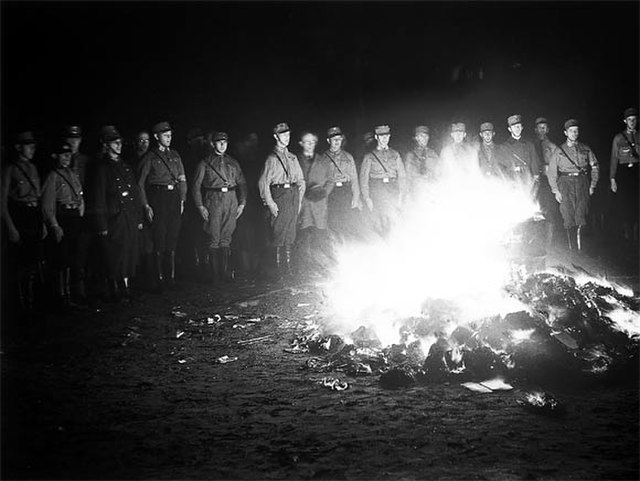
Although the Nazis’ book burnings are perhaps the most notorious, authoritarians have been burning books for 2,000 years. [Photo: Book burning in Nazi Germany, 1933; source: Wikimedia commons]

The U.S. is no exception. When the British burned the 3,000 books in the Capitol during the War of 1812, Thomas Jefferson offered to sell the Congress his near-7,000 book library. Because Federalists argued his books would spread his “infidel philosophy,” the appropriation to buy them only passed by a narrow margin along party lines. Sound familiar?

Forcing librarians to leave, and a library to close, while less dramatic than book burning, produces the same result. As it did in Vinton, Iowa, earlier this year – even though Americans overwhelmingly oppose removal of books from libraries (70 percent Republicans, 75 percent Democrats). [Photo: Vinton, Iowa, public library; source: https://www.vinton.lib.ia.us/about/library-history]

Libraries have been a part of Homo Sapiens’ culture since our agricultural age. One of the first, in the seventh century BC, well before Dewey decimal classification, held 30,000 cuneiform tablets organized by topic.

Not surprisingly, it was political organizing by members of women’s clubs that led the establishment of 75-80 percent of U.S. libraries in the late 1800s and early 1900s.

In 1896 the Cedar Rapids Federation of Ladies Literacy Clubs generated enough public pressure for a library that the City Council scheduled a vote. Iowa was then one of two states that allowed women to vote on limited tax issues, including libraries.

It was approved by 59 votes (1,105 to 1,046).

The Gazette reported that “Had it not been for the efforts of the women themselves who voted in every ward in the city, the proposition would undoubtedly have been lost” – noting that half the men who voted didn’t bother to vote on the library proposal.

Today’s Iowa public libraries, and their personnel, still offer books and “information desks,” but oh, so much more. Never have they been more essential if our democracy is to “live through all time.”
__________
Nicholas Johnson was a Presidential Advisor, White House Conference on Libraries and Information Services, 1979 Contact mailbox@nicholasjohnson.org

SOURCES

Lincoln on “approach of danger.” Abraham Lincoln, “The Perpetuation of Our Political Institutions,” Springfield, Young Men’s Lyceum, Jan. 27, 1837, “Report of Address Before the young Men’s Lyceum of Springfield, Illinois, 27 January 1838,” Roy P. Basler, ed., The Collected Works of Abraham Lincoln, Rutgers University Press, 1953, https://papersofabrahamlincoln.org/documents/D200130

Nazi book burning. Michael S. Roth, “How Nazis destroyed books in a quest to destroy European culture,” Washington Post, Feb. 24, 2017, https://www.washingtonpost.com/opinions/how-nazis-destroyed-books-in-a-quest-to-destroy-european-culture/2017/02/24/244aee94-cdf3-11e6-a87f-b917067331bb_story.html Photo on Wikimedia commons: On Wikimedia commons: https://upload.wikimedia.org/wikipedia/commons/thumb/b/b4/Joseph_Schorer_B%C3%BCcherverbrennung_1933.jpg/640px-Joseph_Schorer_B%C3%BCcherverbrennung_1933.jpg

“Book Burning,” Holocaust Encyclopedia, U.S. Holocaust Memorial Museum, https://encyclopedia.ushmm.org/content/en/article/book-burning

Authoritarians burning books. “Book Burning, 213 BC-2011 AD,” University of Wisconsin-Milwaukee, https://uwm.edu/libraries/burnedbooks/ (“Since ancient times, people from virtually all religions and societies have burned books as a form of censorship, protest, or hate mongering. … Tyrants throughout history -- from Imperial China to Stalin to the Khmer Rouge to Castro -- have attempted to preemptively quell sedition by eliminating subversive texts from the population.”)

Jefferson’s library. “Sale of Books to the Library of Congress (1815),” Monticello, https://www.monticello.org/research-education/thomas-jefferson-encyclopedia/sale-books-library-congress-1815 (“Jefferson's offer was met by warm support from many in the House and Senate; still, the bill introduced to authorize the purchase of Jefferson's library faced congressional opposition, particularly from the Federalists, such as Cyrus King, who argued that Jefferson's books would help disseminate his "infidel philosophy" and were "good, bad, and indifferent ... in languages which many cannot read, and most ought not."[3] The bill finally passed with a narrow margin along party lines.[4]”

Vinton library. Gage Miskimen, “With another leader leaving, Vinton Public Library closes for now; Library lost 2 directors in 2 years amid resident complaints,” The Gazette, July 9, 2022, https://www.thegazette.com/news/with-another-leader-leaving-vinton-public-library-closes-for-now/ (“The library board met Tuesday to accept the resignation of Colton Neely, the interim director. … Most recently departing the library before Neely was Renee Greenlee, its director for six months. … Vinton also saw another director, Janette McMahon, resign in July 2021. … McMahon previously told The Gazette that she received complaints about children’s books on display, including “Joey,” written by first lady Jill Biden, and “Superheroes Are Everywhere” by Vice President Kamala Harris. She said some residents argued the library should have more books about former Republican President Donald Trump on display. “I can’t buy what doesn’t exist, and there weren’t quality books about Trump.”)

Gage Miskimen, “Two directors quit Vinton library after complaints about hirings, LGBTQ and Biden books,” The Gazette, June 20/July 10, 2022, hegazette.com/news/two-directors-quit-vinton-library-after-complaints-about-hirings-lgbtq-and-biden-books/

Gage Miskimen, “Vinton Library to Reopen Monday with Limited Hours,” The Gazette, July 15, 2022, p. A1 (“Previous directors left for other jobs amid city resident complaints about the library’s display of LGBTQ books and books about Democratic President Joe Biden and Vice President Kamala Harris.”)

Opposition to book removal. American Library Association, https://www.ala.org/advocacy/fight-censorship (“Large majorities of voters (71%) oppose efforts to have books removed from their local public libraries, including a majority of Democrats (75%), independents (58%), and Republicans (70%). Most voters and parents hold librarians in high regard, have confidence in their local libraries to make good decisions about what books to include in their collections, and agree that libraries in their communities do a good job offering books that represent a variety of viewpoints. Hart Research Associates and North Star Opinion Research on behalf of the American Library Association among 1,000 voters and 472 parents of children in public school. The survey was conducted March 1 to 6, 2022, and the sample is demographically and geographically representative of U.S. voters and parents.”)

History of Libraries. Don Vaughan,” A Brief History of Libraries,” britanica.com, https://www.britannica.com/story/a-brief-history-of-libraries (“The library concept dates back millennia. The first systematically organized library in the ancient Middle East was established in the 7th century BCE by Assyrian ruler Ashurbanipal in Nineveh, in contemporary Iraq. It contained approximately 30,000 cuneiform tablets assembled by topic.”)

Dewey Decimal Classification, Wikipedia, https://en.wikipedia.org/wiki/Dewey_Decimal_Classification

Women and libraries. Carnegie Library, Wikipedia, https://en.wikipedia.org/wiki/Carnegie_library (“Beginning in 1899, Carnegie's foundation funded a dramatic increase in the number of libraries. This coincided with the rise of women's clubs in the post-Civil War period. They primarily took the lead in organizing local efforts to establish libraries, including long-term fundraising and lobbying within their communities to support operations and collections.[5] They led the establishment of 75–80 percent of the libraries in communities across the country.[6]”)

“Our History,” Cedar Rapids Public Library, https://www.crlibrary.org/our-history/ (“While women could not vote generally, in 1894, Iowa became one of only two states to pass legislation allowing women to vote on limited tax issues, including library levies. The City Council put the matter to a public vote on March 2, 1896. The results were 1,105 votes yes to 1,046 no. The library was approved by just 59 votes. The Gazette reported returns showed half the men who voted didn’t vote on the question at all, and speculated the vote may be challenged on the grounds that ‘the women are illegal.’ “Had it not been for the efforts of the women themselves who voted in every ward in the city, the proposition would undoubtedly have been lost,” the article said. The mayor asked Van Vechten to choose the new library’s first Board of Trustees. The four women and five men of the new board elected Van Vechten their president. The Gazette dubbed her “the mother of the library.”)

# # #

Tuesday, July 26, 2022

Which Side Are You On?

Which Side Are You On?
Nicholas Johnson
The Gazette, July 26, 2022, p. A6

In a panel discussion of whether America’s difficulties were the fault of media or politicians, Congressman Barney Frank interjected, “Our constituents aren’t all that great either.”

Abraham Lincoln, like George Washington and Thomas Jefferson before him, warned of the fragility of a democracy confronting an authoritarian-driven mob: “And when such a one does [appear] it will require the people to be united with each other, attached to the government and laws, and generally intelligent, to successfully frustrate his designs.”

The House Select January 6 Committee’s investigation of officials encouraging authoritarian dictatorship is essential – in a country where 44% of U.S. households, 50 percent of Republicans and 18 percent of Democrats have guns.

And yes, a democracy requires independent, respected institutions, such as judges and courts, human rights and voting rights, newspapers and libraries.

However, as with Abraham Lincoln, Thomas Jefferson’s oft-quoted preference of “newspapers without government” (over “government without newspapers”) was followed with the less mentioned, “but I should mean that every [person] should receive those papers and be capable of reading them.”

Both Jefferson and Lincoln were emphasizing the need to prepare us as citizens.

Americans will someday search for the enemy who caused our democracy to crumble and wash away, like sandcastles at the seashore. They will discover, as Walt Kelly’s cartoon Pogo observed, “we have met the enemy and he is us.”

The founders realized all Americans would need to be well informed and involved to function as democracy’s governors. They made it job one for each of us. Volunteers, handsomely paid with the rights and freedoms of democracy, in exchange for responsibilities willingly accepted.

To train us they provided free public education. Iowa created more one-room schoolhouses than any other state (12,000-plus). To create the social benefits of easily accessible information the founders created a postal service with reduced rates for books, magazines, newspapers and nonprofits. The colonial libraries have expanded to over 9,000 today – 542 in Iowa.

Each of us can help keep our democracy – or push us further down the slope to fascist dictatorship – in hundreds of little and big ways each day. Whether you chose to praise our election officials, teachers and librarians – or drive them to resign (as in Vinton). Whether you choose to subscribe or advertise in newspapers.

Whether you volunteer in political campaigns, contribute what you can, and never miss voting. Stay informed about policy and politics, while questioning unsupported assertions. Learn enough about other democracies evolution into authoritarian states to spot those changes here. Participate in neighborhood associations and civic organizations.

Pew reports only 40 percent of Americans are committed to democracy. A third of Republicans and 17 percent of Democrats say, “a strong leader who can govern without interference from other branches of government is a good thing.”


“Which side are you on, boys?” union organizers sang in 1930s Harlan, Kentucky. It’s a question you must answer today. The most important decision you’ll ever make. You can’t sit this one out.

Which side are you on?

[Photo source: "Harlan County War," wikipedia.org/wiki/Harlan_County_War] _______________
Nicholas Johnson is the author of Columns of Democracy. Contact mailbox@nicholasjohnson.org

SOURCES

Barney Frank. The quote is from memory. I heard him say it. But I cannot find a source where it is reported or recall the details.

“Barney Frank,” Wikipedia, https://en.wikipedia.org/wiki/Barney_Frank#Public_image (“In 2004 and again in 2006, a survey of Capitol Hill staffers published in Washingtonian [magazine] gave Frank the title of the ‘brainiest,’ ‘funniest,’ and ‘most eloquent’ member of the House.”)

Abraham Lincoln. “Report of Address Before the Young Men’s Lyceum of Springfield, Illinois, 27 January 1838, ‘The Perpetuation of Our Political Institutions,” (full text Lincoln speech), https://papersofabrahamlincoln.org/documents/D200130 (See full paragraph beginning: “The question recurs “how shall we fortify against it?”)

George Washington. “Washington’s Farewell Address to the People of the United States,” Sept. 19, 1796, U.S. Senate, https://www.senate.gov/artandhistory/history/resources/pdf/Washingtons_Farewell_Address.pdf

(“Promote then, as an object of primary importance, institutions for the general diffusion of knowledge. In proportion as the structure of a government gives force to public opinion, it is essential that public opinion should be enlightened.”)

Thomas Jefferson. See below.

January 6 Committee. “Select Committee to Investigate the January 6xth Attack on the United States Capitol,” https://january6th.house.gov/

Gun ownership. Lydia Saad, “What Percentage of Americans Own Guns?” Gallup News, https://news.gallup.com/poll/264932/percentage-americans-own-guns.aspx

32% of Americans own guns; 44% live in a gun household “Republicans (50%), rural residents (48%), men (45%), self-identified conservatives (45%) and Southerners (40%) are the most likely subgroups to say they personally own a gun. Liberals (15%), Democrats (18%), non-White Americans (18%), women (19%) and Eastern residents (21%) are the least likely to report personal gun ownership.”

Thomas Jefferson. “Jefferson Quotes & Family Letters,” Monticello, https://tjrs.monticello.org/letter/1289

(“Promote then, as an object of primary importance, institutions for the general diffusion of knowledge. In proportion as the structure of a government gives force to public opinion, it is essential that public opinion should be enlightened.” … (“the basis of our governments being the opinion of the people, the very first object should be to keep that right; and were it left to me to decide whether we should have a government without newspapers, or newspapers without a government, I should not hesitate a moment to prefer the latter, but I should mean that every man should receive those papers & be capable of reading them.”)

Pogo/“we have met the enemy.” “Pogo (comic strip),” Wikipedia, https://en.wikipedia.org/wiki/Pogo_%28comic_strip%29 (page contains image of strip with that quote)

Iowa schoolhouses. “A Walk Through Iowa’s One-Room Schoolhouses,” Iowa Department of Education,” https://educateiowa.gov/walk-through-iowa-s-one-room-schoolhouses

(“Take the one-room school house, once ubiquitous across Iowa’s country landscape. Numbering an astonishing 12,000 to 14,000 at one time, depending on what report you use, Iowa had more one-room school houses than any other state in the union.”)

Postal Service and reduced rates. “A Brief History of Preferred Postal Rates,” U.S. Postal Service Inspector General, Aug. 20, 2012, https://www.uspsoig.gov/blog/brief-history-preferred-postage-rates

(“Since the beginning of the Post Office and the Postal Act of 1792, certain types of mail have qualified for lower postage through preferred rates. It was assumed that these types of mailings yield social benefits for senders, recipients, and more importantly, a large nation. Preferred rates’ roots trace to the first federal postal policy, which recognized that disseminating newspapers at below-cost postage would advance the important social goal of educating the electorate. Soon after, magazines received special rates. For its first 50 years, the Post Office was predominantly a newspaper circulation service . . ..”)

Vinton librarians. Gage Miskimen, “With another leader leaving, Vinton Public Library closes for now; Library lost 2 directors in 2 years amid resident complaints,” The Gazette, July 9, 2022, https://www.thegazette.com/news/with-another-leader-leaving-vinton-public-library-closes-for-now/

(“The library board met Tuesday to accept the resignation of Colton Neely, the interim director. Neely, formerly the library’s children’s director, will become a museum curator in Burlington. . . . Most recently departing the library before Neely was Renee Greenlee, its director for six months. She had been the children’s and family services library assistant at the Marion Public Library and had worked at the Hiawatha Public Library and the Kirkwood Community College library. Greenlee, who left the Vinton post in May and started a new job at the Cedar Rapids Public Library, declined to comment. . . . Vinton also saw another director, Janette McMahon, resign in July 2021. She now is director of the DeWitt Public Library in Clinton County.

McMahon previously told The Gazette that she received complaints about children’s books on display, including “Joey,” written by first lady Jill Biden, and “Superheroes Are Everywhere” by Vice President Kamala Harris. She said some residents argued the library should have more books about former Republican President Donald Trump on display.

“I can’t buy what doesn’t exist, and there weren’t quality books about Trump.”)

Gage Miskimen, “Two directors quit Vinton library after complaints about hirings, LGBTQ and Biden books,” The Gazette, June 20/July 10, 2022, Thegazette.com/news/two-directors-quit-vinton-library-after-complaints-about-hirings-lgbtq-and-biden-books/

Gage Miskimen, “Vinton Library to Reopen Monday with Limited Hours,” The Gazette, July 15, 2022, p. A1

(“closed this week after losing its interim director — and, before that, two directors in two years — will reopen for limited hours beginning Monday.

Marandah Mangra-Dutcher, “Johnson County librarians oppose Iowa bills looking to change intellectual freedom,” The Daily Iowan, March 20, 2022, https://dailyiowan.com/2022/03/20/johnson-county-librarians-oppose-iowa-bills-looking-to-change-intellectual-freedom/

David Sye, “Beyond Book Banning: Efforts to Criminally Charge Librarians,” Office for Intellectual Freedom, American Library Association, March 8, 2022, https://www.oif.ala.org/oif/beyond-book-banning-efforts-to-criminally-charge-librarians/

Vinton, Iowa, https://en.wikipedia.org/wiki/Vinton,_Iowa

Marcela Cabello and Stuart M. Butler, “How Public Libraries Help Build Healthy Communities,” Brookings, https://www.brookings.edu/blog/up-front/2017/03/30/how-public-libraries-help-build-healthy-communities/

(“According to a 2015 Pew survey, almost two-thirds of adult Americans say that closing their local library would have a major impact on their community. As Pew found, over 90 percent of adults think of public libraries as “welcoming and friendly places,” and about half have visited or otherwise used a public library in the last 12 months.”)

Crystle Martin, “Who says libraries are dying? They are evolving into spaces for innovation,” theconversation.com, Aug. 19, 2015, https://theconversation.com/who-says-libraries-are-dying-they-are-evolving-into-spaces-for-innovation-44820

(“many of today’s public libraries are taking on newer roles. They are offering programs in technology, career and college readiness and also in innovation and entrepreneurship – all 21st-century skills, essential for success in today’s economy.”

Pew authoritarian study. Richard Wike, Katie Simmons, Bruce Stokes and Janell Fetterolf, “Globally, Broad Support for Representative and Direct Democracy,” Pew Research Center, October 16, 2017, https://www.pewresearch.org/global/2017/10/16/globally-broad-support-for-representative-and-direct-democracy/

(“Unconstrained executive power also has its supporters. In 20 countries, a quarter or more of those polled think a system in which a strong leader can make decisions without interference from parliament or the courts is a good form of government.”

[Info in chart; not quotation. U.S. 40% committed to democracy; additional 44% willing to consider non-democratic alternatives]

“And in the U.S., a third of Republicans say a strong leader who can govern without interference from other branches of government is a good thing, compared with 20% of independents and 17% of Democrats.”)

Which side are you on? “Which Side Are You On?” Wikipedia, https://en.wikipedia.org/wiki/Which_Side_Are_You_On%3F (origins),

“Which Side Are You On?” (song; 1941 recording by Almanac Singers including Pete Seeger, https://www.youtube.com/watch?v=BEwE0R_7TDc&t=17s (or https://www.youtube.com/watch?v=BEwE0R_7TDc)

Harlan, Kentucky. “Harlan County War,” Wikipedia, https://en.wikipedia.org/wiki/Harlan_County_War

(“The Harlan County War, or Bloody Harlan, was a series of coal mining-related skirmishes, executions, bombings, and strikes (both attempted and realized) that took place in Harlan County, Kentucky, during the 1930s. The incidents involved coal miners and union organizers on one side, and coal firms and law enforcement officials on the other.[1] The question at hand: the rights of Harlan County coal miners to organize their workplaces and better their wages and working conditions. It was a nearly decade-long conflict, lasting from 1931 to 1939. Before its conclusion, an indeterminate number of miners, deputies, and bosses would be killed, state and federal troops would occupy the county more than half a dozen times, two acclaimed folk singers would emerge, union membership would oscillate wildly, and workers in the nation's most anti-labor coal county would ultimately be represented by a union.”)

# # #


Tags: Abraham Lincoln, authoritarian, Barney Frank, democracy, education, George Washington, citizen governors, guns, Harlan County War, House Jan 6 Committee, January 6, Thomas Jefferson

Wednesday, June 22, 2022

The Day Democracy Died

Listening to Washington and McLean
Nicholas Johnson
The Gazette, June 22, 2022, p. A6

George Washington warned his “Friends and Fellow-Citizens” there could be days like this in his farewell address of September 19, 1796. Political parties could become “potent engines by which cunning, ambitious, and unprincipled men will be enabled . . . to usurp for themselves the reins of government.”
[Photo credit: wikimedia commons; Gilbert Stuart painting.]

Individuals may then “seek security and repose in the absolute power of an individual; and sooner or later the chief of some prevailing faction . . . turns this disposition to the purposes of his own elevation on the ruins of public liberty.”

“[L]et there be no change by usurpation; . . . it is the customary weapon by which free governments are destroyed.”

Are you old enough to remember the lyrics to Don McLean’s song, “American Pie,” about “the day the music died”?

It will be nothing to sing about, but we’re headed toward “the day democracy died.” Some say it’s already dead. “The day democracy died” was January 6, 2021.

It’s more complicated than that.

Like preparing your garden soil in the spring, a democracy can only grow in a nation with, one, a civil society of non-governmental and non-business organizations – from Rotary Clubs to garden clubs, trade unions to Wordle groups. And, two, people who understand and reject authoritarian rule, and affirmatively seek democracy (as we discovered after 20 unsuccessful years in Afghanistan).

The first was found in America by de Tocqueville and published in 1835 in his “Democracy in America.”

The second was made clear by Thomas Jefferson in the 1776 Declaration of Independence, listing and charging the “King of Great Britain [with] a history of repeated injuries and usurpations, all having in direct object the establishment of an absolute Tyranny.“

Many components, properly assembled and maintained, can become a car. Similarly, a democracy only emerges with the assembly and maintenance of components. A non-political, respected judiciary. A trusted electoral system, expanding participants and easing voting.

Thomas Jefferson considered independent media so essential to democracy that choosing “government without newspapers, or newspapers without a government, I should not hesitate a moment to prefer the latter.”

George Washington thought education a component. “In proportion as the structure of a government gives force to public opinion, it is essential that public opinion should be enlightened.”

How to destroy a democracy? As the Nazi Hermann Goering explained, “it is always a simple matter to drag the people along, whether it is a democracy, or a fascist dictatorship . . .. It works the same in any country.”

The authoritarian’s playbook isn’t complicated. You destroy the public’s trust in its democratic institutions. Promote divisiveness, fear and anger. Repeat “the big lie” until it’s believed by the faithful. Convince the public the media is “the enemy of the people.”

Or, as in Iowa currently, you attack the public education system, prescribe the books and subjects that can and can’t be taught, reduce the appropriations, demonize the teachers.

It works the same in any country. Including ours. Just like George Washington warned us.
____________
Nicholas Johnson is the author of Columns of Democracy. Website: nicholasjohnson.org Contact: mailbox@nicholasjohnson.org
# # #

SOURCES

Washington’s Farewell Address. “Washington’s Farewell Address to the People of the United States,” Sept. 19, 1796, U.S. Senate, https://www.senate.gov/artandhistory/history/resources/pdf/Washingtons_Farewell_Address.pdf

“[A]void the necessity of those overgrown military establishments which, under any form of government, are inauspicious to liberty, and which are to be regarded as particularly hostile to republican liberty.” p. 8

“However combinations or associations . . . may now and then answer popular ends, they are likely . . . to become potent engines by which cunning, ambitious, and unprincipled men will be enabled to subvert the power of the people and to usurp for themselves the reins of government, destroying afterwards the very engines which have lifted them to unjust dominion.” p. 12

“I have already intimated to you the danger of parties in the state . . .. Let me now . . . warn you . . . against the baneful effects of the spirit of party, generally. This spirit . . . exists under different shapes in all governments, . . . but, in those of the popular form, it is seen in its greatest rankness and is truly their worst enemy.

The alternate domination of one faction over another, sharpened by the spirit of revenge natural to party dissension [and] the most horrid enormities, is itself a frightful despotism. But this leads at length to a more formal and permanent despotism. The disorders and formal and permanent despotism. The disorders and miseries . . . gradually incline . . . men to seek security and repose in the absolute power of an individual; and sooner or later the chief of some prevailing faction, more able or more fortunate than his competitors, turns this disposition to the purposes of his own elevation on the ruins of public liberty.” pp. 13-14

“[L]et there be no change by usurpation; . . . it is the customary weapon by which free governments are destroyed.” p. 16

“But if I may even flatter myself that they [these words] may be productive of some partial benefit, some occasional good, that they may now and then recur to moderate the fury of party spirit, to warn against the mischiefs of foreign intrigue, to guard against the impostures of pretended patriotism -- this hope will be a full recompense for the solicitude for your welfare, by which they have been dictated.” (italics added) p. 24

Other:

“Promote then, as an object of primary importance, institutions for the general diffusion of knowledge. In proportion as the structure of a government gives force to public opinion, it is essential that public opinion should be enlightened.”
. . .
“avoiding likewise the accumulation of debt, not only by shunning occasions of expense, but by vigorous exertions in time of peace to discharge the debts which unavoidable wars may have occasioned, not ungenerously throwing upon posterity the burden which we ourselves ought to bear.” p. 17

The day the music died. Lyrics to Don McLean’s song, “American Pie.” Don McLean, “American Pie (Full Length Version),” Lyrics, https://www.lyrics.com/lyric/14026136/American+Pie+%28Full+Length+Version%29

January 6, 2021. Nicholas Fandos and Emily Cochrane, “After Pro-Trump Mob Storms Capitol, Congress Confirms Biden’s Win; A normally ceremonial ritual in Congress exploded into chaos as protesters, egged on by President Trump, forced their way into the Capitol to stop the counting of electoral votes to confirm President-elect Joseph R. Biden Jr.’s victory,” New York Times, January 7, 2021, p. A1, https://www.nytimes.com/2021/01/06/us/politics/congress-gop-subvert-election.html

Peter Baker, “A Mob and the Breach of Democracy: The Violent End of the Trump Era; Those who warned of worst-case scenarios under President Trump — only to be dismissed as alarmists — found some of their darkest fears realized in the storming of the Capitol on Wednesday,” New York Times, January 7, 2021, p. A1, https://www.nytimes.com/2021/01/06/us/politics/trump-congress.html

Democracy in America. Alexis de Tocqueville, Democracy in America, vol. II, Sec. 2 (See headings, “Of the Uses which the Americans Make of Public Associations; Of the Relation of Public Associations and the Newspapers; Relation of Civil to Political Associations”), 1835, https://xroads.virginia.edu/~Hyper/DETOC/toc_indx.html.

Declaration of Independence. “Declaration of Independence: A Transcription,” America’s Founding Documents, National Archives, July 4, 1776, https://www.archives.gov/founding-docs/declaration-transcript

Newspapers without government. Extract from Thomas Jefferson to Edward Carrington, Paris Jan. 16. 1787 (“the basis of our governments being the opinion of the people, the very first object should be to keep that right; and were it left to me to decide whether we should have a government without newspapers, or newspapers without a government, I should not hesitate a moment to prefer the latter. but I should mean that every man should receive those papers & be capable of reading them.”) “Jefferson Quotes & Family Letters,” Monticello, https://tjrs.monticello.org/letter/1289

Washington on education (public enlightenment). “Promote then, as an object of primary importance, institutions for the general diffusion of knowledge. In proportion as the structure of a government gives force to public opinion, it is essential that public opinion should be enlightened.” Washington Farewell Address, supra, p. 17

Hermann Goering, “the same in every country.” "Naturally the common people don't want war; neither in Russia, nor in England, nor in America, nor in Germany. That is understood. But after all, it is the leaders of the country who determine policy, and it is always a simple matter to drag the people along, whether it is a democracy, or a fascist dictatorship, or a parliament, or a communist dictatorship. Voice or no voice, the people can always be brought to the bidding of the leaders. That is easy. All you have to do is to tell them they are being attacked, and denounce the pacifists for lack of patriotism and exposing the country to danger. It works the same in any country." Nazi Germany’s Hermann Goering in 1946. [Accuracy confirmed, and source identified at: David Mikkelson, “Did a Nazi Leader Say Convincing People to Support War is ‘Simple’? Nazi Luftwaffe commander Hermann Goering was one of the highest-ranking Nazis who survived to be captured and put on trial for war crimes,” Snopes, Oct. 4, 2002, http://www.snopes.com/quotes/goering.htm; or https://www.snopes.com/fact-check/war-games/

Trump, media “the enemy of the people.” Brett Samuels, “Trump ramps up rhetoric on media, calls press ‘the enemy of the people,’” The Hill, April 5, 2019, https://thehill.com/homenews/administration/437610-trump-calls-press-the-enemy-of-the-people/ (“The press is doing everything within their power to fight the magnificence of the phrase, MAKE AMERICA GREAT AGAIN! They can’t stand the fact that this Administration has done more than virtually any other Administration in its first 2yrs. They are truly the ENEMY OF THE PEOPLE! — Donald J. Trump (@realDonaldTrump) April 5, 2019”

The Big Lie. “the broad masses of a nation are always more easily corrupted in the deeper strata of their emotional nature than consciously or voluntarily; and thus in the primitive simplicity of their minds they more readily fall victims to the big lie than the small lie, since they themselves often tell small lies in little matters but would be ashamed to resort to large-scale falsehoods. It would never come into their heads to fabricate colossal untruths, and they would not believe that others could have the impudence to distort the truth so infamously. Even though the facts which prove this to be so may be brought clearly to their minds, they will still doubt and waver and will continue to think that there may be some other explanation.” Adolf Hitler, Mein Kampf, vol. I, ch. X, “Joseph Goebbels: On the ‘Big Lie,’” Jewish Virtual Library, https://www.jewishvirtuallibrary.org/joseph-goebbels-on-the-quot-big-lie-quot; see also, Ralph Manheim translation, Sentry Edition, Houghton Mifflin, 1943, pp. 231-232.

Attacks on public education. Todd Dorman, “Iowa Lawmakers should try transparency before they impose it on teachers,” The Gazette, March 20, 2022, https://www.thegazette.com/staff-columnists/iowa-lawmakers-should-try-transparency-before-they-impose-it-on-teachers/ (“Among the most stringent concepts being considered are provisions that would require teachers to post all of their course materials online, from book titles and articles to videos and online links to materials, twice during the school year, in August and January. School districts that violate the rules could have their state funding docked for each day of non-compliance. Wanted: Clairvoyant social studies teachers capable of predicting how world and national events might affect their curriculum.”)

Ty Rushing, “Fed Up: How Educators in Kim Reynolds’ Iowa Feel After Nonstop GOP Attacks,” Iowa Starting Line, March 4, 2022, https://iowastartingline.com/2022/03/04/fed-up-how-educators-in-kim-reynolds-iowa-feel-after-nonstop-gop-attacks/ (“There were more than 50 education bills introduced during this year’s Iowa legislative session, including proposals to place surveillance cameras in public school classrooms, ban books, jail teachers, and take funding away from public schools to support private institutions.

Republican lawmakers, who have introduced the bulk of these policies, have done so under the guises of “transparency” and “parental choice” to prohibit teachers from enacting a “sinister agenda,” as Senate President Jake Chapman phrased it on the opening day of the legislative session. Gov. Kim Reynolds has devoted much of her attention and agenda on school-related bills in recent months.

The rhetoric and policies have weighed heavily on Iowa educators this year.

‘The attacks on teachers and discussions of jail time and cameras is absolute insanity. Teachers are being singled out and disrespected. We are simply trying our best to care for kids and help them learn,’ said Salley Wieland, a Des Moines special education teacher.

‘We are educated professionals who have the ability to put our skills to use outside the classroom; many teachers have said they are leaving. I will not be returning.’”)

Bruce Lear, “A Storm’s Coming. It’s Time to Act,” Bleeding Heartland, Feb. 4, 2022, https://www.bleedingheartland.com/2022/02/04/a-storms-coming-its-time-to-act/ (“Here’s just some of the intensity of this storm.

First, Iowa Senate President Jake Chapman vowed to pass a law to jail educators who make books, he considers pornographic available to students. He opened the 2022 legislative session by accusing Iowa teachers of having a “sinister agenda” to harm children.

Now, he’s made good on his bullying by introducing Senate File 2198, which makes it a serious misdemeanor to knowingly distribute obscene material in school. The bill also allows a parent or guardian to sue the school for civil damages.

Chapman isn’t the only bully. In her Condition of the State address, Governor Kim Reynolds suggested Iowa public school libraries were full of dirty books that would be X-rated if they were movies. Later she proposed that all classroom syllabuses and library books be published online for parents to review.

. . .

To one up Reynolds and Chapman, Republican State Representative Norlin Mommsen introduced House File 2177. His bill would require a live feed in every Iowa public school classroom, so parents can see in real time whether teachers are corrupting the youth. Another unfunded mandate. But what about most parents, who don’t want their children on camera?”)

# # #

Monday, April 19, 2021

World Happiness Index 2021; We're Number One?

America's Rank: Incarceration, Happiness and Life Expectancy

"We hold these truths to be self-evident, that all [people] are created equal, that they are endowed by their Creator with certain unalienable Rights, that among these are Life, Liberty and the pursuit of Happiness.--That to secure these rights, Governments are instituted . . .."
Declaration of Independence, July 4, 1776

"The care of human life and happiness and not their destruction is the only legitimate object of good government."
Thomas Jefferson, to Maryland Republicans, 1809, The Writings of Thomas Jefferson, Memorial Edition, 1903-04

"Everyone has the right to a standard of living adequate for the health and well-being of [themselves and their] family, including food, clothing, housing and medical care and necessary social services, and the right to security in the event of unemployment, sickness, disability, widowhood, old age or other lack of livelihood in circumstances beyond [their] control."
Universal Declaration of Human Rights, United Nations, Article 25(1), 1948
A true patriot looks for ways to make America's democracy stronger, and then sets about trying to make it happen. That requires confronting and acknowledging where we're a few cars off the rails. It also requires a little modesty born of a fact-based examination of reality. A patriot knows America is great enough to, borrowing from Jack Nichiolson's line, "handle the truth."

So what about this "We're Number One!! We're Number One!!" business?

We are number one among all nations with some things. In defense spending we're not only number one, we spend approximately what is spent by the next 10 nations combined! [In order: China, India, Russia, Saudi Arabia, France, Germany, United Kingdom, Japan, South Korea and Brazil. See "Comparison: Government Defence Expenditure," countryeconomy.com.]

We're also number one in prison population (2016/2017). We have 2,153,600 prisoners -- roughly 600,000 more than number 2, China (1,561,086). But that's not a fair comparison; the better figure is prisoners per 100,000 population. By that standard we have 6 times more prisoners than China: 662.5 per 100,000 to China's 110.4 per 100,000. [See "Total Prison Population," countryeconomy.com.]


So how are we doing when it comes to the happiness of Americans, and the conditions that contribute to one's happiness, goals that were important to our founders -- and those who wrote the Universal Declaration of Human Rights? [Photo of one-year-old on her birthday, displaying enough happiness to put her well up on anyone's "happiness index."]

America ranks, not "number one!" in happiness, but nineteenth in the list below. How those nations rank in life expectancy is represented in the number following "LE."


1 - Finland - LE 19
2 - Denmark - LE 24
3 - Switzerland - LE 6
4 - Iceland - LE 8
5 - Netherlands - LE 25
6 - Norway - LE 5
7 - Sweden - LE 16
8 - Luxembourg - LE 23
9 - New Zealand - LE 22
10 - Austria - LE 27
11 - Australia - LE 11
12 - Israel - LE 10
13 - Germany - LE 29
14 - Canada - LE 20
15 - Ireland - LE 9
16 - Costa Rica - LE 32
17 - United Kingdom - LE 26
18 - Czech Republic - LE 44
19 - United States - LE 42

It's something to think about; for example, "What do those top 7 nations have that we don't -- and why?" And then? Then try to do something about it.

Sources: World Happiness Index 2021 (click on "Countries" to list countries alphabetically, and "World Happiness Ranking" to list countries by happiness), and World Happiness Report 2021 ("The World Happiness Report is a publication of the Sustainable Development Solutions Network, powered by data from the Gallup World Poll and Lloyd’s Register Foundation, who provided access to the World Risk Poll. The 2021 Report includes data from the ICL-YouGov Behaviour Tracker as part of the COVID Data Hub from the Institute of Global Health Innovation."). The "Life Expectancy at Birth" rankings can be found HERE.

Monday, October 21, 2019

What Is A Newspaper?

What Is A Newspaper?"
Nicholas Johnson
The Gazette, October 21, 2019, p. A5
NOTE: The first entry in this blog post is the 584-word text, and the requested "sources," as presented to The Gazette's Editorial Board. As of this morning (Oct. 21) the print version (shortened for space and slightly modified) has not yet been posted on The Gazette's Web site. When it is available it will be copied and reproduced below, with a direct link to it here.

For the record, I am not employed by The Gazette, have no financial interest in the paper or its parent corporation, no family member working there, and am not paid for the columns I submit. My motive for writing this column, as my book, Columns of Democracy, makes clear is that I believe very strongly in the urgency of reestablishing democracy in America, and the preeminent role of local journalism in making that possible.

Gazette columnist Adam Sullivan’s “America Needs Local Newspapers” (Oct. 11), put forward a well-written case for local news in general and Iowa’s Carroll Times Herald and Quad-City Times in particular. Both papers had substantial costs of defending themselves in trials they ultimately won.

He’s right. And it’s not just local. Authoritarians are disparaging and assassinating journalists. But there are multiple sources of their stories.

It’s local news that’s disappearing. National print newspaper ad revenue dropped from $60 billion to $20 billion in 15 years. Half our 3,000 counties have only one newspaper, 171 have none; 2,100 papers closed.

So what? Democracies die from a thousand cuts to their supporting institutions: universal public education; fair, inclusive elections; nonpartisan, respected judges -– what I’ve called the Columns of Democracy.

And the greatest of these? An independent, respected journalism. Says who? Says Thomas Jefferson: “Were it left to me to decide whether we should have a government without newspapers, or newspapers without a government, I should not hesitate a moment to prefer the latter. But I should mean that every man should receive those papers and be capable of reading them."

“Receive those papers?” Little more than one percent of Americans subscribe to the New York Times, or Washington Post, or Wall Street Journal. “Capable of reading them?” Mandatory public education was originally to provide us the civic virtues for active participation in democracy. No longer.

The Gazette is preeminent among our local democratic institutions, serving all of them. Its investigative reporters are our communities’ “inspectors general.” It informs us about our local businesses; schools, colleges and universities; courts, city councils, county supervisors, legislators – plus presidential candidates. It monitors our hospitals, public roads, bridges, parks and libraries. It tracks our safety, from natural disasters to the law breakers and enforcers. It hears our complaints and publishes our letters. It is our historian and librarian, with Time Machine articles and book, Ties to Our Past – plus papers from 1883. It educates and offers advice about our physical and financial wellness, cooking, cars, homes and gardens, “Things To Do Today” and Sunday’s “What’s Trending on the Gazette.com.” [Photo credit: Tony Webster, January 25, 2016]

But wait, there’s more! Examine carefully each story, and reporter’s name, in one day’s hard copy or Green Gazette. Leaf through a week’s papers, or stroll through the vast Web site with its Menu, More Links, Our Sites, and Additional Links.

The Gazette is magazines, like Iowa Ideas and HER, special supplements like Hoopla and quarterly Brain Teasers. It is editorial board meetings, Pints and Politics, business breakfasts, and Iowa Ideas symposium. It’s generous support of dozens of organizations and causes -– and more than this space can hold. [Photo: Pints & Politics event before packed house at Theater Cedar Rapids, first evening of 2019 Iowa Ideas symposium, Oct. 3, 2019. From stage right: Erin Jordan, Todd Dorman, James Lynch, Lyz Lenz, Adam Sullivan. Photo credit: Nicholas Johnson]

Forty-five years ago, as a congressional primary candidate, I could look around an Iowa town and guess the quality of its newspaper. It’s still true. If there are things you like about our part of Iowa thank The Gazette.

But it needs our support more than our thanks. Unlike other public institutions, it’s not only protected from government interference it also gets no government support.

The Gazette cannot do it alone. It can print newspapers, but it can’t print money. It needs advertising dollars from an engaged business community. It and our democracy need more of us to subscribe -– even if only digitally.

It is we who need to be engaged in our communities, we who need to be informed about our local challenges and opportunities, we who need to financially support, read and act on the local news in this paper. Do your part.
_______________
Nicholas Johnson of Iowa City, former media law professor and FCC commissioner, is the author of Columns of Democracy." Comments: mailbox@nicholasjohnson.org

# # #

SOURCES

[https://cpj.org/data/killed/?status=Killed&motiveConfirmed%5B%5D=Confirmed&type%5B%5D=Journalist&start_year=1992&end_year=2019&group_by=year; Committee to Protect Journalists (“1354 Journalists Killed between 1992 and 2019/Motive Confirmed”)

https://cpj.org/data/reports.php?status=Imprisoned&start_year=2018&end_year=2018&group_by=location (“250 Journalists Imprisoned in 2018”)

Amanda Erickson, “2018 Has Been a Brutal Year for Journalists, and It Keeps Getting Worse,” The Washington Post, Oct. 19, 2018, https://www.washingtonpost.com/world/2018/10/09/has-been-brutal-year-journalists-it-keeps-getting-worse/

RWB World Press Freedom Index, https://rsf.org/en/2019-world-press-freedom-index-cycle-fear]

Newspaper economics. Derek Thompson, “The Print Apocalypse and How to Survive It,” The Atlantic, Nov. 3, 2016, https://www.theatlantic.com/business/archive/2016/11/the-print-apocalypse-and-how-to-survive-it/506429/

The Rise of a New Media Baron and the Emerging Threat of News Deserts; Daily Papers That Were Closed, Merged, or Shifted to Weeklies, http://newspaperownership.com/additional-material/closed-merged-newspapers-map/

Newspapers closed. Douglas A. McIntyre, “Over 2000 American Newspapers Have Closed in Past 15 Years,” 24/7 Wall St., July 23, 2019, https://247wallst.com/media/2019/07/23/over-2000-american-newspapers-have-closed-in-past-15-years/ (“Abernathy told 24/7 Wall St. that, “It appears at this stage that we’ve lost approximately 2,100 papers, all but 70 of which are weeklies, since 2004.” The industry implosion has left almost half of the counties in America (1,449) with only one newspaper, which is usually a weekly. As of the most recent count, 171 counties do not have a paper at all.”)

Thomas Jefferson quote. Thomas Jefferson to Edward Carrington," January 16, 1787, Julian P. Boyd, ed., The Papers of Thomas Jefferson, 11:48-49 (emphasis supplied). http://press-pubs.uchicago.edu/founders/documents/amendI_speechs8.html

Not used: Indeed the media, sometimes called the fourth branch of government, is the only industry recognized and protected by our Constitution (“Congress shall make no law … abridging the freedom … of the press”).

Subscribers. NY Times “new goal of 10 million subscriptions by 2025, up from 4.3 million today. Nearly 80 percent of those 2018 subscribers are digital.” AP New York Times subscriber numbers are skyrocketing in the Trump age, Over 265,000 digital subscriptions were added in the last three months of 2018,” Feb. 6, 2019 https://www.marketwatch.com/story/new-york-times-subscriber-numbers-are-skyrocketing-in-the-trump-age-2019-02-06

Reporters Without Borders’ World Press Freedom Index 2019 ranking of 180 countries finds only 24% “good” or “satisfactory.” The U.S. fell to 48th.

Sunday, November 18, 2018

The Media Under Siege


The Media, Under Siege:
And What KHOI Can Do About It
Nicholas Johnson 
KHOI-FM 89.1 Fundraiser: An Evening with Nicholas Johnson 
Ames, Iowa 
November 16, 2018


Thank you for the invitation I join you this evening. The only thing nicer than being asked to speak is to be invited back to speak.

The topic, and speech title, you have requested is “Media Under Siege.” Always the conscientious student, I feel obliged to say something about the assignment you’ve given me, and we’ll begin with that.

But it might be useful to put that siege in context, especially during our discussion period. So I’ll also have something to say about our democracy under siege; what it takes to create and maintain a democracy, the role of media in that process, the role of KHOI, and what you and I can do in our daily lives to help revive that democracy.

Media under siege. Five months ago, June 28th, five journalists were assassinated in the newsroom of the Capital Gazette, near Annapolis. Last month, October 2nd, Jamal Khashoggi, a Saudi journalist working for the Washington Post, was brutally assassinated in the Saudi Consulate in Istanbul.

Sadly, these six journalists are a small percentage of the 1000 journalists who have been assassinated over the past ten or fifteen years. Assassination is the ultimate silencing of the media, the ultimate example of media under siege. And those assassinated are just the ones killed because of the content of their reporting. Many more have died while reporting from a battlefield or during other dangerous assignments.

Assassinations are not the only threat. Newspaper subscription and advertising revenue is about half of what it once was. Television network affiliates, formerly guaranteed at least one-third of the potential viewing audience, now find themselves competing with 500 cable and satellite channels.

The influence of both broadcasters and publishers is further diminished by the competition for eyeballs. Every hour we spend staring at a laptop or smartphone screen, searching the Internet, checking our Facebook page, answering email or texting friends, watching YouTube videos, playing video games, reading or watching the thousands of online social media, news sources, podcasts and videos, are hours not spent looking at a TV screen or newspaper.

I’m informed there are some people who spend time tending their gardens, taking a walk in the woods, or reading books, without any electronic devices. Frankly, I find that unlikely; and at best a minuscule percentage.

Finally, media are among the first institutions to come under attack in the 49 nations headed by dictators, authoritarian strongmen or wannabes. Such leaders conduct massive propaganda campaigns. They revise the schools’ textbooks. The ruler’s control of the media can take the form of personal or government ownership of stations and newspapers, intimidation and punishment of publishers and journalists, criticism designed to erode the public’s trust of independent media, or blocking citizen access to external broadcast signals, Internet sites and publications.

We will return to the media in a few minutes and during our discussion period.

The Context: democracy under siege. But first, let’s provide a little context for KHOI and its need for our financial support. KHOI is a much more essential institution, in this place and at this time, than even its fans may be aware.

For the media is not the only essential institution that is under siege.

Our democracy may well not survive the current attacks upon it from home and abroad. Let me repeat that. Our democracy may well not survive the current attacks upon it from home and abroad.

Like climate change, there comes a time when the red line has been crossed, when the life of a democracy, or even life on Earth, can no longer be resuscitated.

Like a good marriage, a good democracy is something we must work at. An apocryphal story reported a poll in which local citizens were asked which they thought the greater problem in their community, ignorance or apathy. Most answered, simply, “I don’t know, and I don’t care.”

A democracy requires people who do know and do care; people who have an almost religious faith in both the idea and the reality of democracy. It needs those who know the questions to ask, have access to accurate and relevant facts, the education to understand them, and the interest, energy and motivation to act accordingly, to fulfill the responsibility democracy places upon us.

When one of the kids would come running into the house after school, they would say to my wife, Mary Vasey, “Hey, Mom, make me a sandwich.” Did you have kids like that? Mary’s response was to place her hand on their head, and solemnly incant, “You are a sandwich.”

Unfortunately, the creation and preservation of a democracy is even more difficult than turning a child into a sandwich. And yet the destruction of a democracy can occur almost as quickly as you can turn a sandwich into a child.

Most often democracies yield to dictators, not from external military aggression, but from internal defection, using the very freedoms and processes democracy provides. We like to say that it can’t happen here. But it has already happened here. On February 20, 1939. 20,000 Americans, dressed as Nazis, filled Madison Square Garden, with arms raised in the Nazi salute. They cheered as the speaker called for a “white, Gentile-ruled United States.”
[https://www.theatlantic.com/video/index/542499/marshall-curry-nazi-rally-madison-square-garden-1939/]
Only three weeks ago tomorrow an anti-Semite with an AR-15 turned the Tree of Life Synagogue into a tree of death for 11 Jews in Pittsburgh’s Squirrel Hill neighborhood. Reports of hate crimes took a big jump last year, up to 7100.
[https://www.nytimes.com/2018/11/13/us/hate-crimes-fbi-2017.html]
You can’t buy a democracy in a store. You can’t create one by passing a law. In that sense there is no such thing as “democracy.” There are only the nations, and their people, whose institutions make a democracy possible. These institutions are to a democracy what the columns, or pilings, are to a beach house, raised above the relentless storm surge.

Democracy's institutions.
  • Education. Well-funded free public K-12 and higher education
  • .
  • Libraries. Free public libraries for those with the education to use them
  • .
  • Courts. A respected, independent judiciary to check the leader’s abuses
  • .
  • Voting. Legislators representing constituents’ interests, not special interests, elected from districts that have not been gerrymandered, with voting systems designed to encourage, rather than discourage, citizens’ participation
  • .
These are among what I have called the Columns of Democracy in my most recent book by that title. If those institutions are supported, adequately funded, respected, and encouraged a democracy is possible. When they are damaged or destroyed democracy collapses, just like that beach house when it loses its columns.

Communications. All of these institutions are essential to democracy. But communication and the media were thought to be central by our founders and remain so today.

Look at all our predecessors did.

Thomas Jefferson said, “Were it left to me to decide whether we should have a government without newspapers, or newspapers without a government, I should not hesitate a moment to prefer the latter.” To which he immediately added, “But I should mean that every man should receive those papers and be capable of reading them.”
["The basis of our governments being the opinion of the people, the very first object should be to keep that right; and were it left to me to decide whether we should have a government without newspapers, or newspapers without a government, I should not hesitate a moment to prefer the latter. But I should mean that every man should receive those papers and be capable of reading them." – Thomas Jefferson to Edward Carrington," January 16, 1787, Julian P. Boyd, ed., The Papers of Thomas Jefferson, 11:48-49 (emphasis supplied).]
In two sentences he made the case for the First Amendment, free public education, and universal postal delivery of newspapers, magazines and books at subsidized rates. Jefferson made no mention of his presidency on his tombstone, but did include, “Father of the University of Virginia.”

We’ve had public schools since Boston Latin School in 1635, a central purpose of which was always civics, turning Americans into participating citizens.

Jefferson also saw the necessity of libraries. Following the 1814 Library of Congress fire he doubled the former collection, making available his personal library of about 6500 volumes.

In addition to the postal system with its Pony Express, the subsidization of canals, railroads, universal telephone service (plus today’s broadband), airlines and the Interstate Highway system also served in part to facilitate communication.

Let us first be a little more precise about what we mean by “the media” and its contribution to democracy. Much of what’s on radio and television, and in books and magazines, has little to nothing to do with the Columns of Democracy or citizenship. It may even be counterproductive.

Entire sections of newspapers are devoted to sports. Even the New York Times has its popular, if incredibly difficult, crossword puzzle.

The 19-minute “ABC World News Tonight” contains little world news and even less of the information citizens need. It deliberately attracts an audience that apparently likes to be frightened, even terrorized, by an exited anchor person’s dramatic portrayals of the day’s worst disasters and dangers – some of which aren’t even legitimate local news where they occurred. Storms are “deadly”, a driver was “trapped” in her vehicle, school buses were involved in “tragedies,” there was a “scare” at sea onboard a listing cruise ship. There are “deadly” airline and highway accidents, shootings and stabbings, fires and floods, explosions and hurricanes.

ABC comes a lot closer to what Paddy Chayefsky predicted as the future of news, in the movie “Network,” than any CBS Evening News with Walter Cronkite. It certainly makes a fellow want to stay safely indoors watching television.

No, what we want to focus upon is the information a democracy’s citizens need to address the challenges and opportunities confronting their democracy; all sides of the problems and solutions, the public policy questions, and the answers offered from other communities and nations.

And speaking of other nations, let’s separate and identify some categories of the information we need and the media that provide it.
International news. What’s happening on the world’s continents, and nations’ capitals? There’s no shortage of sources. My iPhone has apps bringing me news from the world’s best newspapers: the Guardian in London, Le Monde from Paris, others in Berlin, Moscow, Karachi, Doha, Erbil, Beijing, Mumbai, Tokyo.

National news. For us, that’s mostly what happened in New York and Washington today, plus some regional centers like Chicago and Los Angeles – along with an occasional midterm election or huge California fire. Again, we can have multiple sources and apps on our smartphones: New York Times, Washington Post, Wall Street Journal, AP, Bloomberg, plus PBS and NPR.

State news. For state news, the Des Moines Register used to self-identify as “the newspaper all Iowa depends upon.” And it was; delivered by truck around the state, available on the counter of every small-town café. There is no equivalent today, although The Gazette does a nice job of state news for eastern Iowa, and the Register still serves central Iowa.
Local news: communication and community. All of which brings us to KHOI, perhaps the Ames Tribune, and the subject of local news.

Americans may have multiple sources for international, national, and even state news.

But if you want to know the arguments for and against the new water plant, who’s died and who’s opened a new business, what roads are closed for construction, what’s happening with property taxes, or the results of your local school board election, for most Iowans neither the New York Times nor the Register are going to be much help.

Unlike international and national news, there simply are no alternative sources for the local news that is the most important supporting column for a community's democracy. This is an essential need that KHOI is uniquely positioned to provide for Ames.

Like every other industry, some newspapers are doing better than others. But the national average is that subscriptions and advertising revenue are now about half what they once were. Hundreds of papers have gone out of business. Virtually all have had to cut back on reporters, and therefore the number of government agencies, subjects and local news stories.

Television and radio stations have an ADI, their “area of dominant influence,” the geographical area within which residents not only can but do receive their signal. Newspapers have “circulation areas.” For many purposes, those ADIs and circulation areas are the most meaningful geographical definition of our “communities” – regardless of where the “city limits” may be.

Think about the number of words beginning with “c-o-m-m”: commune, the commons, communal, communitarian, yes; but also, community and communication. For community is the essential chemical element from which democracies are made. And communication networks are what create and define our communities – whether the family as a community; the teachers, parents and kids in a K-12 school; a church congregation; the workplace; suburban development; city, county, state, nation, and for some, their sense of being a part of a global community.

Without communication communities disintegrate, and without communities democracies fail.

What can we do? What can KHOI do? What can you, you and I, do?

Political. We can increase our political participation. Only 55% of Americans eligible to register actually vote. That makes us 26th in the world; eight countries are above 75%; Belgium is 87% and we’re 55%.

Iowa City is in Johnson County; what some call the “Peoples Republic of Johnson County.” We’re only two percentage points above the U.S. average. Of Iowa City residents eligible to register, often less than 10% vote in school board, City, or County Supervisor elections. Hopefully, Ames is better.

But merely voting is not enough. As Frederick Douglas observed, “Power concedes nothing without a demand. It never did and it never will.” We must keep in touch with our elected officials: with personal visits, phone calls, emails, letters, and demonstrations.

You can volunteer to work for candidates or political parties. You can run for office, or agree to serve on one of our multiple governments’ boards and commissions.

Media. When conventional media suffer so does our democracy. If you have a business, support your newspaper by advertising. Think of it as a charitable contribution; one you can take as a tax-deductible business expense. Become a subscriber. Be a contributor of columns and letters to the editor. And support independent, nonprofit media financially: KHOI, Iowa Public Radio and Television.

If local media are not able to assign fulltime beat reporters to the school board or city council, consider doing it yourself. Become familiar with Ames’ Website, www.CityOfAmes.org. Learn about your 26 local government departments – the Planning & Zoning Commission, or Parks & Recreation Department – pick the one that most interests you. Then follow its work, write about it in a blog, social media, and submissions to newspapers. Produce or participate in a KHOI program reporting on local institutions.

K-12, Higher Education, and Public Libraries. One of the earliest purposes of American schools was “civics;” giving students the knowledge and skills they need to be citizens in a democracy. How well are your local schools performing that historic and essential function? If you don’t know, find out. Are they adequately funded?

Over 100 years ago Iowans decided that eight years of free public education was not enough. We began requiring12 years and high schools. Isn’t it about time Iowa go from K-12 to K-14, with free public community colleges, as Tennessee, California and other places are doing? You can play a role in increasing public funding of Iowa’s K-12 schools, community colleges, and higher education institutions like Ames’ own Iowa State University.

Free public libraries are an essential companion to education in creating and maintaining a democracy. Are yours – and Iowa State’s – adequately funded? Is there more you could do locally to increase citizens’ use of their resources?

Judiciary. We want a rule of law, not the law of rulers. How much do you know about legal services for the poor, our local and appellate judges, their qualifications, their independence, their budgets, the efforts to turn the judiciary into just another partisan branch of government?

Community. Each of us can do more to help build a sense of community with the little things we do each day, including the smile and greeting we give a stranger we pass on the street. We can do more to promote civility in our relationships; to go beyond tolerating diversity to celebrating diversity and the richness it adds to our lives. We can try to learn more about the needs of individuals in various segments of our community; needs for housing, nutrition, healthcare, transportation – and what’s being done to meet those needs.

And there is a role for KHOI with each of these Columns of Democracy: politics and governing, media, education, libraries, the judiciary, community building. You’re already doing much of this heavy lifting. But is there more you could do with your programming, identifying issues for discussion, and giving electronic voice to Ames’ voiceless?

When Benjamin Franklin was leaving the Constitutional Convention a stranger asked him, “What kind of a government did you give us? A Republic or a Monarchy?” To which Franklin responded, “A Republic, if you can keep it.”

For 230 years we’ve kept it. Our democracy has had its challenges – the Civil War, the Great Depression – but it has never before been threatened with extinction. Now that’s a possibility. We can no longer take it for granted, no longer assure our grandchildren that America’s democracy will forever survive.

Whether our democracy continues is up to us, how much you and I are willing to do, and what you do with KHOI. That’s what I’d like for us to now discuss.

# # #

Sunday, December 03, 2017

Defending Democracy

Defending Democracy
Nicholas Johnson
The Gazette, December 3, 2017, p. C4
Don't it always seem to go
That you don't know what you've got
‘Til it’s gone


— Joni Mitchell, “Big Yellow Taxi”
There are many divisive issues these days: climate change, renewable fuels, perpetual war, health care, tax reform, higher education, trade policy. The list seems endless.

However, most agree on preserving democracy’s fundamental pillars: free speech, public education, voting rights, and an independent judiciary.

Presidents Thomas Jefferson and James Madison offered us insights.

Media. Jefferson wrote, ““were it left to me to decide whether we should have a government without newspapers, or newspapers without a government, I should not hesitate a moment to prefer the latter.”

Media are one of the few industries expressly protected by the Constitution (First Amendment). They were to serve all the people, creating a “marketplace of ideas,” a check on abuses by the powerful, from which “truth” would emerge. There would be no central control of media by either government or big business.

Americans’ 19th Century “Internet,” its “social media,” was transportation -– rivers, roads, a trans-continental railroad, and pony express. Our “e-mail” was their postal mail. Low postal rates encouraged the distribution of books, magazines and newspapers.

For the FCC to repeal Net Neutrality, ownership limits, or the Fairness Doctrine, or politicians to say media are “the enemy of the American people,” chops away at democracy’s pillars. (Now 46% of voters believe media make up anti-Trump stories.)

Free public education and libraries. Jefferson continued, “But I should mean that every [person] should receive those [newspapers] and be capable of reading them.” In his epitaph, he chose to be remembered as “Father of the University of Virginia” –- omitting any reference to his presidency.

Madison agreed: “a people who mean to be their own Governors, must arm themselves with the power which knowledge gives.”

Free public schools would enable citizens to inform themselves. Free public libraries would provide every American access to the information resources of kings.

When legislatures don’t fully fund public universities, adding to the trillion-dollar debt of graduates, they are undercutting democracy’s pillar of “free public education.” This not only hampers America’s ability to compete with the nations that do provide tuition-free college, it also strikes a blow against democracy.

Voting rights. Over time, the opportunity to vote – a democracy fundamental -- was expanded from white, male, landowners over 21 to everyone over 18.

State legislatures that pass laws making it more difficult, rather than easier, for all to vote, or that draw district lines enabling a minority of voters to elect a majority of their representatives, are attacking a democracy fundamental.

Independent judiciary. The founders created a respected, independent branch of government, the judiciary, as a constitutional check on Congress and the executive branch. Federal judges’ independence was protected by their lifetime appointments. Justice would be delivered under a “rule of law” rather than a law of rulers.

To disparage the judiciary, charging bias, or lack of competence, to appoint those unqualified, weakens a democracy’s last, best protection of our civil rights.

We can probably survive most wrongheaded public policies. What our democracy can’t survive are attacks on its fundamental pillars. Let’s defend what we’ve got before it’s gone.
_______________
Nicholas Johnson is a former FCC commissioner who maintains www.nicholasjohnson.org. Contact: mailbox@nicholasjohnson.org

# # #

Monday, December 01, 2014

Three Legged Calves, Wolves, Sheep and Democracy's Media

December 1, 2014, 12:30 p.m.

Contents

Democracy's Constitutional Basis

Media's Changes and Challenges

TV's Junk News is to Democracy What Junk Food is to Nutrition

Two Nights with "World News Tonight"

John Oliver: Stand-Up Comic is Democracy's Savior

Conclusion


Thomas Jefferson on Newspapers and the "Prey of the Rich on the Poor"


The basis of our governments being the opinion of the people, the very first object should be to keep that right; and were it left to me to decide whether we should have a government without newspapers, or newspapers without a government, I should not hesitate a moment to prefer the latter. But I should mean that every [person] should receive those papers and be capable of reading them.

I am convinced that those societies (as the Indians) which live without government enjoy in their general mass an infinitely greater degree of happiness than those who live under European governments. Among the former, public opinion is in the place of law, and restrains morals as powerfully as laws ever did any where. Among the latter, under pretense of governing they have divided their nations into two classes, wolves and sheep. I do not exaggerate. . . .

Cherish therefore the spirit of our people, and keep alive their attention. Do not be too severe upon their errors, but reclaim them by enlightening them. If once they become inattentive to the public affairs, you and I, and Congress, and Assemblies, judges and governors shall all become wolves. It seems to be the law of our general nature, in spite of individual exceptions; and experience declares that man is the only animal which devours his own kind, for I can apply no milder term . . . to the general prey of the rich on the poor.

-- Thomas Jefferson to Edward Carrington," January 16, 1787, Julian P. Boyd, ed., The Papers of Thomas Jefferson, 11:48-49.

Lippmann on "Sideshows and Three Legged Calves"

[T]he troubles of the press [like other institutions] go back to a common source; to the failure of self-governing people to transcend their casual experience and their prejudice, by inventing, creating, and organizing a machinery of knowledge.

It is because they are compelled to act without a reliable picture of the world, that governments, schools, newspapers and churches make such small headway against the more obvious failings of democracy, against violent prejudice, apathy, preference for the curious trivial as against the dull important, and the hunger for sideshows and three legged calves. This is the primary defect of popular government, a defect inherent in its traditions, and all its other defects can, I believe, be traced to this one.

-- Walter Lippmann, Public Opinion 275-76 (Pelican Books, 1922, 1946)
Many, including myself, usually just quote from this opening passage Jefferson's revelation that, put to the choice, he would "prefer newspapers without a government." Sometimes we add, if not his change of choice, at least his disparaging remarks after being buffeted about by the press while in office: “The man who reads nothing at all is better educated than the man who reads nothing but newspapers.” (Or, as Mark Twain is falsely credited with having put it, "If you don’t read the newspaper, you’re uninformed. If you read the newspaper, you're misinformed.")

But this is too serious a matter for one-liners. Jefferson, in this context as in so many others, got it closer to right before his presidency.

Democracy's Constitutional Basis

Governments, at least our federal government, were created by the people to benefit the people. They were not created by the people to increase the abi1ity of the 1% to prey upon the poor. The U.S. Constitution begins, "We the People of the United States," and continues, "in Order to . . . promote the general Welfare . . .." The language is consistent with the Declaration of Independence's assertion that "We hold these Truths to be self-evident, that all [persons] are created equal . . . endowed . . . with certain unalienable Rights, that among these are Life, Liberty, and the pursuit of Happiness," and it then continues, "That to secure these Rights, Governments are instituted . . ., deriving their just Powers from the Consent of the Governed . . .." These documents come from, and gain their legitimacy from "the people," whose welfare they are designed to serve.

These are more than noble sentiments. They are at the core of the Constitution's purpose, they represent the pole star that should light the way of our Supreme Court justices as they search for the meaning of that document's provisions -- rather than, for example, stretching to conclude, along with the Republicans' last presidential choice, that "corporations are people."

As those who pay attention have always known, Jefferson was right: "It seems to be the law of our general nature" that when our nation's central purpose is left unattended and defended we will continue to suffer "the prey of the rich on the poor" -- as we do today. Our government will enhance citizens' "life, liberty, and pursuit of happiness" only to the extent that the people continually pressure it to do so.

When roughly half of the eligible voters don't even bother to vote, and all too many are so uninformed or misinformed about the issues of the day that they can be persuaded to vote against their own best interests, "the law of our general nature" continues to rule.

Media's Changes and Challenges

There is much to be said about the changed structure of America's news industry today, the last 20 years' impact of technology, the concentration of media power along with the increasing number and diversity of sources, the role of advertising, the alternative digital-only news sources, the decline in hard-copy newspaper readership and employment for journalists, citizen-created news and opinion, foundation-funded investigative journalism and other alternative business models, both the decline (hard copy newspapers and TV) and expansion (digital-only) in global coverage, and the role of social media in limiting, and providing, viewers' access to news.

I recall in the 1960s watching President Lyndon Johnson standing over the AP and UPI teletypes he'd had installed in the oval office, eagerly reading the stories as the teletype keys clattered out the news on rolls of paper. He was the president of the United States, with access to nearly unlimited resources, but even he could not have -- indeed he could not even dream of -- what millions of Americans carry in their pockets today.

The Gazette these days is full of stories reprinted from Reuters, McClatchy, Tribune, Washington Post, Los Angeles Times, Pittsburgh Post-Gazette, Atlanta Journal-Constitution, St. Louis Post-Dispatch, Kansas City Star and other sources. There was a time when that would have been a real contribution for local readers -- and even today I value The Gazette editors' selections. But I can and do get the full coverage of many of those papers on a laptop or smart phone.

Indeed, I not only have some of those Gazette sources -- The New York Times, Wall Street Journal, Washington Post, Reuters, Bloomberg -- at the touch of my iPhone, I find some of the best coverage of what's going on elsewhere comes from sources that supplement American media. During the Viet Nam War, the New York Time found the Agence France‑Presse news service one of their best sources; today the online French language Le Monde remains one of my favorite supplements. The BBC, even after budget cuts, is still perhaps the world's best. Pakistan's online English-language Dawn newspapers helped me understand our initial adventures in Afghanistan; the London Guardian went beyond U.S. media's coverage of Ed Snowden's NSA revelations; Aljazerra gives another slant on the Mideast; and my most recent addition to that list of my smart phone's news apps, Rûdaw, provides on-the-ground coverage from Kurdistan.

Many of these services provide another take on news from the U.S. as well as news from their country or region. We also have multiple sources for news from America's largest cities -- especially New York and Washington.

In towns with only one monopoly newspaper, one that's been sold to a chain, or one that's had to lay off a significant number of journalists, enterprising citizens may be able to find alternative sources of international and national news. But they have no alternative ways of finding out what's going on closest to home -- let alone the results of investigative reporting that can serve as a check on institutional and corporate abuses.

We are fortunate in Iowa City to have access to three local papers: the student Daily Iowan (with the largest circulation), The Gazette, and the Iowa City Press-Citizen -- as well as the Des Moines Register and other Iowa papers sometimes reporting our local news. The Iowa City papers' payrolls have been cut, leaving their remaining able and energetic journalists the herculean task of filing multiple, often lengthy stories some days -- something they seem to be doing with great skill and spirit. Even so, there are even major local institutions, such as the County Board of Supervisors, that often have no coverage at all.

But our greatest challenge in reaching Jefferson's ideal of a democracy run by a well-informed, participating citizenry is what almost seems to be the deliberate effort of America's old television networks to dumb down, distract, and discourage their news audiences.

Here is but one example of the phenomenon, process and consequence of journalism's choice of topic and means of presentation: T. Michael Maher, "How and Why Journalists Avoid the Population-Environment Connection," Minnesotans for Sustainability, March 1997 ("Abstract. Recent surveys show that Americans are less concerned about population than they were 25 years ago, and they aren’t connecting environmental degradation to population growth. News coverage is a significant variable affecting public opinion, and how reporters frame a problem frequently signals what is causing the problem. Using a random sample of 150 stories about urban sprawl, endangered species and water shortages, Part I of this study shows that only about one story in 10 framed population growth as a source of the problem. Further, only one story in the entire sample mentioned population stability among the realm of possible solutions. Part II presents the results of interviews with 25 journalists whose stories on local environmental problems omitted the causal role of population growth. It shows that journalists are aware of the controversial nature of the population issue, and prefer to avoid it if possible. Most interviewees said that a national phenomenon like population growth as beyond the scope of what they could write as local reporters.")

TV's Junk News is to Democracy What Junk Food is to Nutrition

We are a nation of 315 million individuals, many of whom have so little memory of their education, and such an obliviousness to basic information, that Jay Leno was able to make an entertainment format ("Jay Walking") out of it. Our gross ignorance of other countries and cultures helps create everything from "ugly American" tourists to endless, unwinnable wars abroad that actually increase the risk of terrorism at home. Many high school grads headed to Iraq couldn't find it on a map; 10% couldn't find the United States. Most of our major health problems, and costs, come from behavioral choices within the control of patients (e.g., tobacco, alcohol, diet, exercise). From school board to presidential elections, voter participation is 5-50%.

The three or four TV networks may not have the audiences they once had. But it is still true that, on the one hand we have devastating consequences from our massive ignorance and misinformation, and on the other hand we have a television industry with access to the minds of a plurality of American citizens for an average of some three to four hours a day. That is 80,000 to 100,000 hours over a lifetime--at least fifty times the 1800 hours students spend in college classrooms earning a bachelor's degree.

Put another way, when I was an occasional guest on a network late night show I calculated that to reach as many people as that opportunity provided I would need to lecture to a room full of people, every hour on the hour, eight hours a day, 50 weeks a year, for 300 years!

I continue to believe, and try to live by, the old sayings: "with great power goes great responsibility"; "For unto whomsoever much is given, of him shall be much required"; and "Ask not what your country can do for you -- ask what you can do for your country." [Harry Truman, Remarks in Independence at the Liberty Bell Luncheon, Independence, Missouri (Nov. 6, 1950); Luke 12:48 (King James); President John F. Kennedy, Inaugural Address (Jan. 20, 1961).]

Is television to blame for everything that needs fixing in America? Of course not. Does it have the power to cure all our ills? No. Nor is this to say that programmers should provide the public nothing but an unrelieved diet of educational, public-affairs, and cultural programming. They would not stay in business long if they did. It is to say that if neither ratings nor profits need suffer from product placement, there is no reason they need suffer from information and education placement either. Entertainment content matters; advertising's messages matter.

But entertainment programming aside, cannot we reasonably demand of the executives who dictate what their networks' news divisions are permitted to do -- using the public's airwaves under licenses requiring them to serve "the public interest" -- that at least that portion of the programming contributes to an informed citizenry?

What a travesty--to be given so much access to such a huge audience, an audience with such serious needs, only to fritter it away with what Walter Lippmann once called "sideshows and three legged calves." The problem is television's nonfeasance as well as its malfeasance -- having been given the power and opportunity to do such enormous good, and then failing to do it. That is the charge; that is the crime.

Two Nights with "World News Tonight"

To the extent we watch television news in our house, it's the "PBS Newshour." Prior to that, if we catch a bit of local news it's on the ABC affiliate, KCRG-TV. As a result, we see the ABC promo for its evening news, and the first minute or two of the ABC news (since the Newshour gets underway a little after the half hour). Those snippets made me sufficiently curious about the rest of ABC's half hour that I watched a couple clear through. But I haven't been back.

"Let's go to the video tape" -- a line Warner Wolf first made famous on WTOP-TV in Washington. Let's take a look at ABC's "World News Tonight."

First, it's not an hour-long program, like the "PBS Newshour." It's not even a half-hour.

When traveling to Japan with some regularity, I once calculated that Japan's NHK provided more news about America each day than the minutes NBC set aside in its schedule for all of each day's news. (Of course, NHK also presented the news from Europe, Asia, the rest of the world and, oh yes, Japan, as well.)

Why is "World News Tonight" not even a half hour? Because of the commercials. After you subtract the time they spend trying to sell us stuff, there's only 20 minutes left in this "half-hour program" for the "news hole."

As if that's not bad enough, let's take a look at what they're putting down that hole -- and, therefore, what they are not telling us about -- and what they seem to be trying to do to us.


So, second, the unifying theme throughout the presentation seems to be a play on our emotions -- 15 minutes or more of drama designed to increase fright, flight and fear, followed by a happy close -- thereby playing with both our adrenalin and dopamine. [Cartoon credit: Wiley Miller, "Non Sequitur,", Dec. 4, 2014.

Third, the subjects covered are mostly a herd of three-legged calves interrupted occasionally by, "Oh, look at the squirrel."
"The dumbing down of America is most evident in the slow decay of substantive content in the enormously influential media, the 30 second sound bites (now down to 10 seconds or less), lowest common denominator programming, credulous presentations on pseudoscience and superstition, but especially a kind of celebration of ignorance”

-- Carl Sagan Source: The Demon-Haunted World: Science as a Candle in the Dark
Here are some illustrations from their equivalent of headlines from a randomly selected couple of consecutive evenings a couple of weeks ago.

In the first: A snowfall is a "deadly" storm. The early use of drones becomes a drone "scare." A White House intruder is a security "scare." Notwithstanding the absence of any supporting video, a pre-verdict Ferguson was a "State of Emergency." We were shown an "alarming image" worthy of a "Holiday Alert" that holiday gift packages are about to be stolen from our homes. There was a "mystery" involving a beauty queen. And the happy close? A couple given $14 million for their idea involving digital photos -- with the lottery-like closing line, "Is your idea next?"

Celebrity news is regularly given time: this first evening it included the cancellation of Bill Cosby's show, Bono's auto accident, and the death of Motown singer Jimmy Ruffin -- kind of what might have been trailers for "Entertainment Tonight," or other video versions of People magazine.

The next night was babies night. We were warned that our babies fingers might be cut off by their strollers. Another "warning for parents" was the segment headlined "Spying on Your Children," which informed us that the Russians were hacking into our security cameras and streaming the content of our baby monitors. We were told that the car crash tests' results were "the worst ever seen," truly "alarming." And then, as if to drive the point home, and add another threat to our survival to our list of ABC-engendered fears, we were shown video of "Car Demolishing a Building" -- "an entire building demolished in seconds in a cloud of dust."

But most of the 20 minutes that night was occasioned by Mike Nichols' death and a tribute to his life -- with occasional references to the fact he had been married to ABC's Diane Sawyer. The evening "news" both opened and closed with lengthy (by ABC News' standards) tributes and film clips regarding Nichols.

So if these are not among the subjects Americans most need to know, what might ABC have been informing us about? Here are some of former Secretary of Labor Robert Reich's suggestions:
"The moral crisis of our age has nothing to do with gay marriage or abortion; it’s insider trading, obscene CEO pay, wage theft from ordinary workers, Wall Street’s continued gambling addiction, corporate payoffs to friendly politicians, and the billionaire takeover of our democracy."

-- Robert Reich [from his Facebook post, June 29, 2014]
PBS. For contrast, here's what the "PBS Newshour" included that first night: "A look at the Gulf oil spill after the cameras had gone"; "Will arming school administrators protect students?"; "What's next for NSA reform in Congress?"; "Protecting Afghanistan's Buddhist Heritage"; and "Debating the implications if Obama acts on immigration" -- along with, I should note in fairness, serious reporting of some of the stories ABC had regarding the heavy snow and Bill Cosby's problems.

CBS. To provide more balance I watched the CBS Evening News for December 1. It made two points: (1) My major complaint is about ABC, not all commercial TV networks' news efforts. (2) CBS demonstrates that there can be a commercially viable alternative to ABC's approach -- even within a comparable 20-minute window.

CBS took a positive, factual approach to the Ferguson story: the President's request for $75 million of body cams for police, a Missouri commission devoted to increasing community trust, new technology that can be installed in police guns that immediately reports to headquarters when it's out of the holster or fired (the Ferguson officer's radio was on the wrong channel), and the extent to which the peaceful protests were now nationwide. There was data and insight about "cyber shopping" -- and Amazon's 15,000 robots filing orders. A significant Supreme Court case regarding the application of First Amendment protection of threatening speech was explained, as was the recent AAA research regarding the impressive safety driving records of those over 65. The network has been tracking remedial programs for high school dropouts this year, and closed with a realistic appraisal (as distinguished from "happy news") of the Sunburst Academy.

John Oliver: Stand-Up Comic is Democracy's Savior

For an even more dramatic contrast, consider the fact that John Oliver, on HBO's "Last Week Tonight" (also available on YouTube), within what is intended to be an entertaining comedic show, is dealing with material, and a critical approach, that goes well beyond the journalism that even PBS is doing. Moreover, he is attracting, in online "viewers" alone (2-4 million -- over 7 million for his "net neutrality" bit), as many or more than ABC's news gets in the 25-54 age group it cares about. Here are some examples.

"The Lottery," Nov. 9, 2014

"State lotteries claim to be good for education and the general wellbeing of citizens. But are they? (Spoiler alert: No.)"


"State Legislatures and ALEC," November 2, 2014

"While midterm coverage is largely focused on the parts of Congress that do very little, vital (and bizarre) midterm elections are going unexamined. State legislators pass a lot of bills, and some of that efficiency is thanks to a group called ALEC that writes legislation for them. It’s as shady as it sounds!"


"Sugar," October 26, 2014

"Sugar. It's in everything! Is it good for us? Well, the sugar industry thinks so."


"Civil Forfeiture," Oct. 5, 2014

"Did you know police can just take your stuff if they suspect it's involved in a crime? They can! It’s a shady process called “civil asset forfeiture,” and it would make for a weird episode of Law and Order."


"Net Neutrality," June 1, 2014

"Cable companies are trying to create an unequal playing field for internet speeds, but they're doing it so boringly that most news outlets aren't covering it. John Oliver explains the controversy and lets viewers know how they can voice their displeasure to the FCC. (www.fcc.gov/comments, for any interested parties)"


This bit had 7.2 million viewers, many of whom responded to John Oliver's suggestion they write the FCC.

Conclusion

A democracy requires an informed citizenry. Necessarily, we rely on the mass media to provide it. The commercial television networks (and the FCC) are failing us with this responsibility -- one that they owe us legally as well as morally, ethically, and journalistically. The most dramatic evidence of their failure is that Americans must turn to one of its best stand-up comics for the serious journalism they need.

# # #