December 1, 2014, 12:30 p.m.
Contents
Democracy's Constitutional Basis
Media's Changes and Challenges
TV's Junk News is to Democracy What Junk Food is to Nutrition
Two Nights with "World News Tonight"
John Oliver: Stand-Up Comic is Democracy's Savior
Conclusion
Thomas Jefferson on Newspapers and the "Prey of the Rich on the Poor"

The basis of our governments being the opinion of the people, the very first object should be to keep that right; and were it left to me to decide whether we should have a government without newspapers, or newspapers without a government, I should not hesitate a moment to prefer the latter. But I should mean that every [person] should receive those papers and be capable of reading them.
I am convinced that those societies (as the Indians) which live without government enjoy in their general mass an infinitely greater degree of happiness than those who live under European governments. Among the former, public opinion is in the place of law, and restrains morals as powerfully as laws ever did any where. Among the latter, under pretense of governing they have divided their nations into two classes, wolves and sheep. I do not exaggerate. . . .
Cherish therefore the spirit of our people, and keep alive their attention. Do not be too severe upon their errors, but reclaim them by enlightening them. If once they become inattentive to the public affairs, you and I, and Congress, and Assemblies, judges and governors shall all become wolves. It seems to be the law of our general nature, in spite of individual exceptions; and experience declares that man is the only animal which devours his own kind, for I can apply no milder term . . . to the general prey of the rich on the poor.
-- Thomas Jefferson to Edward Carrington," January 16, 1787, Julian P. Boyd, ed., The Papers of Thomas Jefferson, 11:48-49.
Lippmann on "Sideshows and Three Legged Calves"
[T]he troubles of the press [like other institutions] go back to a common source; to the failure of self-governing people to transcend their casual experience and their prejudice, by inventing, creating, and organizing a machinery of knowledge.
It is because they are compelled to act without a reliable picture of the world, that governments, schools, newspapers and churches make such small headway against the more obvious failings of democracy, against violent prejudice, apathy, preference for the curious trivial as against the dull important, and the hunger for sideshows and three legged calves. This is the primary defect of popular government, a defect inherent in its traditions, and all its other defects can, I believe, be traced to this one.
-- Walter Lippmann, Public Opinion 275-76 (Pelican Books, 1922, 1946)
Many, including myself, usually just quote from this opening passage Jefferson's revelation that, put to the choice, he would "prefer newspapers without a government." Sometimes we add, if not his change of choice, at least his disparaging remarks after being buffeted about by the press while in office: “The man who reads nothing at all is better educated than the man who reads nothing but newspapers.” (Or, as
Mark Twain is falsely credited with having put it, "If you don’t read the newspaper, you’re uninformed. If you read the newspaper, you're misinformed.")
But this is too serious a matter for one-liners. Jefferson, in this context as in so many others, got it closer to right
before his presidency.
Democracy's Constitutional Basis
Governments, at least our federal government, were created by the people to benefit the people. They were not created by the people to increase the abi1ity of the 1% to prey upon the poor. The U.S. Constitution begins, "We the People of the United States," and continues, "in Order to . . . promote the general Welfare . . .." The language is consistent with the Declaration of Independence's assertion that "We hold these Truths to be self-evident, that all [persons] are created equal . . . endowed . . . with certain unalienable Rights, that among these are Life, Liberty, and the pursuit of Happiness," and it then continues, "That to secure these Rights, Governments are instituted . . ., deriving their just Powers from the Consent of the Governed . . .." These documents come from, and gain their legitimacy from "the people," whose welfare they are designed to serve.
These are more than noble sentiments. They are at the core of the Constitution's purpose, they represent the pole star that should light the way of our Supreme Court justices as they search for the meaning of that document's provisions -- rather than, for example, stretching to conclude, along with the Republicans' last presidential choice, that "corporations are people."
As those who pay attention have always known, Jefferson was right: "It seems to be the law of our general nature" that when our nation's central purpose is left unattended and defended we will continue to suffer "the prey of the rich on the poor" -- as we do today. Our government will enhance citizens' "life, liberty, and pursuit of happiness" only to the extent that the people continually pressure it to do so.
When roughly half of the eligible voters don't even bother to vote, and all too many are so uninformed or misinformed about the issues of the day that they can be persuaded to vote against their own best interests, "the law of our general nature" continues to rule.
Media's Changes and Challenges
There is much to be said about the changed structure of America's news industry today, the last 20 years' impact of technology, the concentration of media power along with the increasing number and diversity of sources, the role of advertising, the alternative digital-only news sources, the decline in hard-copy newspaper readership and employment for journalists, citizen-created news and opinion, foundation-funded investigative journalism and other alternative business models, both the decline (hard copy newspapers and TV) and expansion (digital-only) in global coverage, and the role of social media in limiting, and providing, viewers' access to news.
I recall in the 1960s watching President Lyndon Johnson standing over the AP and UPI teletypes he'd had installed in the oval office, eagerly reading the stories as the teletype keys clattered out the news on rolls of paper. He was the president of the United States, with access to nearly unlimited resources, but even he could not have -- indeed he could not even dream of -- what millions of Americans carry in their pockets today.
The Gazette these days is full of stories reprinted from Reuters, McClatchy, Tribune, Washington Post, Los Angeles Times, Pittsburgh Post-Gazette, Atlanta Journal-Constitution, St. Louis Post-Dispatch, Kansas City Star and other sources. There was a time when that would have been a real contribution for local readers -- and even today I value
The Gazette editors' selections. But I can and do get the full coverage of many of those papers on a laptop or smart phone.
Indeed, I not only have some of those
Gazette sources --
The New York Times,
Wall Street Journal,
Washington Post, Reuters, Bloomberg -- at the touch of my iPhone, I find some of the best coverage of what's going on elsewhere comes from sources that supplement American media. During the Viet Nam War, the
New York Time found the Agence France‑Presse news service one of their best sources; today the online French language
Le Monde remains one of my favorite supplements. The BBC, even after budget cuts, is still perhaps the world's best. Pakistan's online English-language
Dawn newspapers helped me understand our initial adventures in Afghanistan; the London
Guardian went beyond U.S. media's coverage of Ed Snowden's NSA revelations; Aljazerra gives another slant on the Mideast; and my most recent addition to that list of my smart phone's news apps, Rûdaw, provides on-the-ground coverage from Kurdistan.
Many of these services provide another take on news from the U.S. as well as news from their country or region. We also have multiple sources for news from America's largest cities -- especially New York and Washington.
In towns with only one monopoly newspaper, one that's been sold to a chain, or one that's had to lay off a significant number of journalists, enterprising citizens may be able to find alternative sources of international and national news. But they have no alternative ways of finding out what's going on closest to home -- let alone the results of investigative reporting that can serve as a check on institutional and corporate abuses.
We are fortunate in Iowa City to have access to three local papers: the student
Daily Iowan (with the largest circulation),
The Gazette, and the
Iowa City Press-Citizen -- as well as the
Des Moines Register and other Iowa papers sometimes reporting our local news. The Iowa City papers' payrolls have been cut, leaving their
remaining able and energetic journalists the herculean task of filing multiple, often lengthy stories some days -- something they seem to be doing with great skill and spirit. Even so, there are even major local institutions, such as the County Board of Supervisors, that often have no coverage at all.
But our greatest challenge in reaching Jefferson's ideal of a democracy run by a well-informed, participating citizenry is what almost seems to be the deliberate effort of America's old television networks to dumb down, distract, and discourage their news audiences.
Here is but one example of the phenomenon, process and consequence of journalism's choice of topic and means of presentation:
T. Michael Maher, "How and Why Journalists Avoid the Population-Environment Connection," Minnesotans for Sustainability, March 1997 ("
Abstract. Recent surveys show that Americans are less concerned about population than they were 25 years ago, and they aren’t connecting environmental degradation to population growth. News coverage is a significant variable affecting public opinion, and how reporters frame a problem frequently signals what is causing the problem. Using a random sample of 150 stories about urban sprawl, endangered species and water shortages, Part I of this study shows that only about one story in 10 framed population growth as a source of the problem. Further, only one story in the entire sample mentioned population stability among the realm of possible solutions. Part II presents the results of interviews with 25 journalists whose stories on local environmental problems omitted the causal role of population growth. It shows that journalists are aware of the controversial nature of the population issue, and prefer to avoid it if possible. Most interviewees said that a national phenomenon like population growth as beyond the scope of what they could write as local reporters.")
TV's Junk News is to Democracy What Junk Food is to Nutrition
We are a nation of 315 million individuals, many of whom have so little memory of their education, and such an obliviousness to basic information, that Jay Leno was able to make an entertainment format ("Jay Walking") out of it. Our gross ignorance of other countries and cultures helps create everything from "ugly American" tourists to endless, unwinnable wars abroad that actually increase the risk of terrorism at home. Many high school grads headed to Iraq couldn't find it on a map; 10% couldn't find the United States. Most of our major health problems, and costs, come from behavioral choices within the control of patients (
e.g., tobacco, alcohol, diet, exercise). From school board to presidential elections, voter participation is 5-50%.
The three or four TV networks may not have the audiences they once had. But it is still true that, on the one hand we have devastating consequences from our massive ignorance and misinformation, and on the other hand we have a television industry with access to the minds of a plurality of American citizens for an average of some three to four hours a day. That is 80,000 to 100,000 hours over a lifetime--at least fifty times the 1800 hours students spend in college classrooms earning a bachelor's degree.
Put another way, when I was an occasional guest on a network late night show I calculated that to reach as many people as that opportunity provided I would need to lecture to a room full of people, every hour on the hour, eight hours a day, 50 weeks a year, for 300 years!
I continue to believe, and try to live by, the old sayings: "with great power goes great responsibility"; "For unto whomsoever much is given, of him shall be much required"; and "Ask not what your country can do for you -- ask what you can do for your country." [Harry Truman, Remarks in Independence at the Liberty Bell Luncheon, Independence, Missouri (Nov. 6, 1950); Luke 12:48 (King James); President John F. Kennedy, Inaugural Address (Jan. 20, 1961).]
Is television to blame for everything that needs fixing in America? Of course not. Does it have the power to cure all our ills? No. Nor is this to say that programmers should provide the public nothing but an unrelieved diet of educational, public-affairs, and cultural programming. They would not stay in business long if they did. It is to say that if neither ratings nor profits need suffer from product placement, there is no reason they need suffer from information and education placement either. Entertainment content matters; advertising's messages matter.
But entertainment programming aside, cannot we reasonably demand of the executives who dictate what their networks' news divisions are permitted to do -- using the public's airwaves under licenses requiring them to serve "the public interest" -- that at least
that portion of the programming contributes to an informed citizenry?
What a travesty--to be given so much access to such a huge audience, an audience with such serious needs, only to fritter it away with what Walter Lippmann once called "sideshows and three legged calves." The problem is television's nonfeasance as well as its malfeasance -- having been given the power and opportunity to do such enormous good, and then failing to do it. That is the charge; that is the crime.
Two Nights with "World News Tonight"
To the extent we watch television news in our house, it's the "PBS Newshour." Prior to that, if we catch a bit of local news it's on the ABC affiliate, KCRG-TV. As a result, we see the ABC promo for its evening news, and the first minute or two of the ABC news (since the Newshour gets underway a little after the half hour). Those snippets made me sufficiently curious about the rest of ABC's half hour that I watched a couple clear through. But I haven't been back.
"Let's go to the video tape" -- a line Warner Wolf first made famous on WTOP-TV in Washington. Let's take a look at ABC's "World News Tonight."
First, it's not an hour-long program, like the "PBS Newshour." It's not even a half-hour.
When traveling to Japan with some regularity, I once calculated that Japan's NHK provided more news about
America each day than the minutes NBC set aside in its schedule for
all of each day's news. (Of course, NHK also presented the news from Europe, Asia, the rest of the world and, oh yes, Japan, as well.)
Why is "World News Tonight" not even a half hour? Because of the commercials. After you subtract the time they spend trying to sell us stuff, there's only 20 minutes left in this "half-hour program" for the "news hole."
As if that's not bad enough, let's take a look at what they're putting down that hole -- and, therefore, what they are not telling us about -- and what they seem to be trying to do to us.
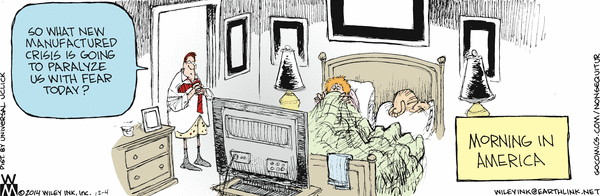
So, second, the unifying theme throughout the presentation seems to be a play on our emotions -- 15 minutes or more of drama designed to increase fright, flight and fear, followed by a happy close -- thereby playing with both our adrenalin and dopamine. [Cartoon credit:
Wiley Miller, "Non Sequitur,", Dec. 4, 2014.
Third, the subjects covered are mostly a herd of three-legged calves interrupted occasionally by, "Oh, look at the squirrel."
"The dumbing down of America is most evident in the slow decay of substantive content in the enormously influential media, the 30 second sound bites (now down to 10 seconds or less), lowest common denominator programming, credulous presentations on pseudoscience and superstition, but especially a kind of celebration of ignorance”
-- Carl Sagan Source: The Demon-Haunted World: Science as a Candle in the Dark
Here are some illustrations from their equivalent of headlines from a randomly selected couple of consecutive evenings a couple of weeks ago.
In the first: A snowfall is a "deadly" storm. The early use of drones becomes a drone "scare." A White House intruder is a security "scare." Notwithstanding the absence of any supporting video, a pre-verdict Ferguson was a "State of Emergency." We were shown an "alarming image" worthy of a "Holiday Alert" that holiday gift packages are about to be stolen from our homes. There was a "mystery" involving a beauty queen. And the happy close? A couple given $14 million for their idea involving digital photos -- with the lottery-like closing line, "Is your idea next?"
Celebrity news is regularly given time: this first evening it included the cancellation of Bill Cosby's show, Bono's auto accident, and the death of Motown singer Jimmy Ruffin -- kind of what might have been trailers for "Entertainment Tonight," or other video versions of
People magazine.
The next night was babies night. We were warned that our babies fingers might be cut off by their strollers. Another "warning for parents" was the segment headlined "Spying on Your Children," which informed us that the Russians were hacking into our security cameras and streaming the content of our baby monitors. We were told that the car crash tests' results were "the worst ever seen," truly "alarming." And then, as if to drive the point home, and add another threat to our survival to our list of ABC-engendered fears, we were shown video of "Car Demolishing a Building" -- "an entire building demolished in seconds in a cloud of dust."
But most of the 20 minutes that night was occasioned by Mike Nichols' death and a tribute to his life -- with occasional references to the fact he had been married to ABC's Diane Sawyer. The evening "news" both opened and closed with lengthy (by ABC News' standards) tributes and film clips regarding Nichols.
So if these are not among the subjects Americans most need to know, what might ABC have been informing us about? Here are some of former Secretary of Labor Robert Reich's suggestions:
"The moral crisis of our age has nothing to do with gay marriage or abortion; it’s insider trading, obscene CEO pay, wage theft from ordinary workers, Wall Street’s continued gambling addiction, corporate payoffs to friendly politicians, and the billionaire takeover of our democracy."
-- Robert Reich [from his Facebook post, June 29, 2014]
PBS. For contrast, here's what the "PBS Newshour" included that first night: "A look at the Gulf oil spill after the cameras had gone"; "Will arming school administrators protect students?"; "What's next for NSA reform in Congress?"; "Protecting Afghanistan's Buddhist Heritage"; and "Debating the implications if Obama acts on immigration" -- along with, I should note in fairness, serious reporting of some of the stories ABC had regarding the heavy snow and Bill Cosby's problems.
CBS. To provide more balance I watched the CBS Evening News for December 1. It made two points: (1) My major complaint is about ABC,
not all commercial TV networks' news efforts. (2) CBS demonstrates that there
can be a commercially viable alternative to ABC's approach -- even within a comparable 20-minute window.
CBS took a positive, factual approach to the Ferguson story: the President's request for $75 million of body cams for police, a Missouri commission devoted to increasing community trust, new technology that can be installed in police guns that immediately reports to headquarters when it's out of the holster or fired (the Ferguson officer's radio was on the wrong channel), and the extent to which the peaceful protests were now nationwide. There was data and insight about "cyber shopping" -- and Amazon's 15,000 robots filing orders. A significant Supreme Court case regarding the application of First Amendment protection of threatening speech was explained, as was the recent AAA research regarding the impressive safety driving records of those over 65. The network has been tracking remedial programs for high school dropouts this year, and closed with a realistic appraisal (as distinguished from "happy news") of the Sunburst Academy.
John Oliver: Stand-Up Comic is Democracy's Savior
For an even more dramatic contrast, consider the fact that John Oliver, on HBO's "Last Week Tonight" (also available on
YouTube), within what is intended to be an entertaining comedic show, is dealing with material, and a critical approach, that goes well beyond the journalism that even PBS is doing. Moreover, he is attracting,
in online "viewers" alone (2-4 million -- over 7 million for his "net neutrality" bit), as many or more than ABC's news gets in the 25-54 age group it cares about. Here are some examples.
"The Lottery," Nov. 9, 2014
"State lotteries claim to be good for education and the general wellbeing of citizens. But are they? (Spoiler alert: No.)"
"State Legislatures and ALEC," November 2, 2014
"While midterm coverage is largely focused on the parts of Congress that do very little, vital (and bizarre) midterm elections are going unexamined. State legislators pass a lot of bills, and some of that efficiency is thanks to a group called ALEC that writes legislation for them. It’s as shady as it sounds!"
"Sugar," October 26, 2014
"Sugar. It's in everything! Is it good for us? Well, the sugar industry thinks so."
"Civil Forfeiture," Oct. 5, 2014
"Did you know police can just take your stuff if they suspect it's involved in a crime? They can! It’s a shady process called “civil asset forfeiture,” and it would make for a weird episode of Law and Order."
"Net Neutrality," June 1, 2014
"Cable companies are trying to create an unequal playing field for internet speeds, but they're doing it so boringly that most news outlets aren't covering it. John Oliver explains the controversy and lets viewers know how they can voice their displeasure to the FCC. (www.fcc.gov/comments, for any interested parties)"
This bit had 7.2 million viewers, many of whom responded to John Oliver's suggestion they write the FCC.
Conclusion
A democracy requires an informed citizenry. Necessarily, we rely on the mass media to provide it. The commercial television networks (and the FCC) are failing us with this responsibility -- one that they owe us legally as well as morally, ethically, and journalistically. The most dramatic evidence of their failure is that Americans must turn to one of its best stand-up comics for the serious journalism they need.
# # #