Showing posts with label Constitution. Show all posts

Tuesday, January 30, 2024

Cards, Courts and Congress

Court Got It Right on Chevron
Nicholas Johnson
The Gazette, January 30, 2024, p. A6

Ever heard of Bryan Berg? Me neither.

Iowa State graduate and faculty member, Brian Berg, collects world records for number of playing cards in a house of cards. In 2010 he spent 44 days constructing a replica of the Venetian Macao with 218,000 cards.

Now imagine you created that playing card replica and pranksters think it cool to smash it and watch all 218,000 cards flutter down.

Why do I ask you to imagine?


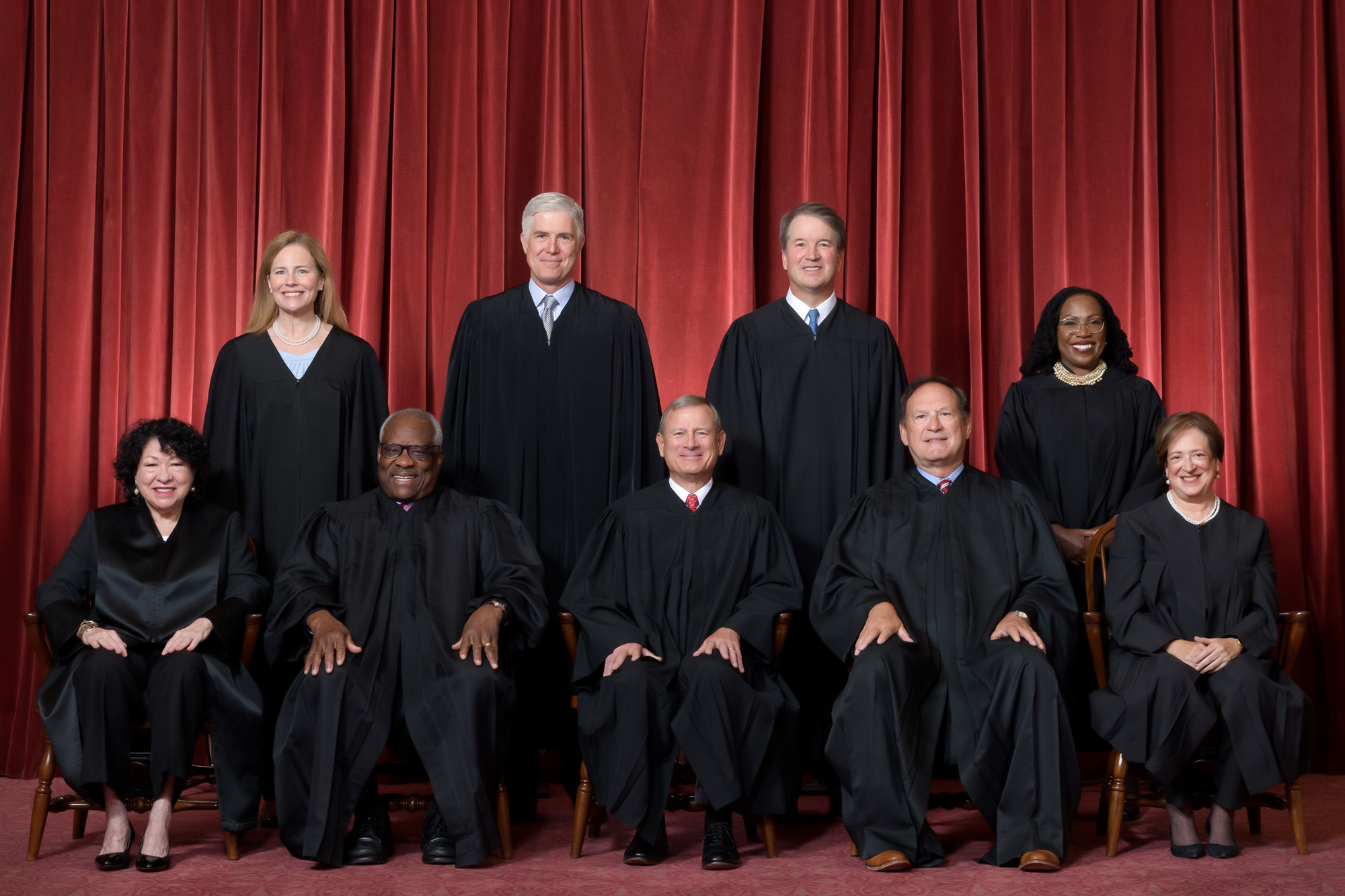
Because that’s the best analogy I can think of for the Supreme Court’s stretching its long arm of the law into matters the Constitution considers political. Stirring this poisonous stew, bubbling on the back burner behind the curtain, that will forever change our lives. [Photo credit: Supreme Court Historical Society. See, "SOURCES," below for names of current Justices.]

The Constitution leads with, “All legislative Powers herein granted shall be vested in a Congress of the United States, which shall consist of a Senate and House of Representatives.” Art. I, Sec. 1.

For the last 40 years the Court has followed its unanimous holding in the Chevron case, giving deference to “reasonable” agency interpretations of laws. (“Policy arguments . . . should be addressed to legislators or administrators, not to judges. The EPA's interpretation of the statute . . . represents a reasonable accommodation . . . and is entitled to deference.”)

Congress publishes its laws in the 60,000-page U.S. Code. Few Representatives and Senators have the time to read all of them, let alone enforce their daily administration. What do they do? They create agencies with the power to administer the laws, to write and enforce nearly 200,000 detailed regulations in 242 volumes – under Congress’ watchful eye.

This column is not a legal opinion. But it does draw on experience: Supreme Court law clerk, associate at corporate law firm, head of executive branch agency (MARAD), commissioner of regulatory commission (FCC), presidential advisor, reformer. To borrow from Joni Mitchell, “I’ve looked at Chevron from all sides now.”

My conclusion? Chevron got it right.

In 2022 four percent of the House and Senate candidates received $1 billion in political contributions. Four billion was spent on 12,000 lobbyists. Big corporations need not violate the law because they help write the law – and help select the heads of agencies. Employees move from companies to agencies and back again. Business neither deserves nor needs the Court’s help.

There are already plenty of checks on agencies’ abuses of their power. Congress writes the laws and shapes the agencies’ powers. It hears the complaints of big business – and too often yields. Congress can always change any law or agency regulation. Each agency gets annual congressional oversight by budget and oversight sub-committees.

Big corporations already have too much control over what the Constitution and prior Supreme Courts have ruled is the sole responsibility of Congress. That business keeps knocking on the Supreme Court’s door to grub for more would be as hilarious as a Kathleen Madigan stand-up routine if it were not so outrageous, dangerous, unconstitutional – and costly.

Nicholas Johnson believes, with Winston Churchill, that a constitutional democracy is the least-worst form of government. mailbox@nicholasjohnson.org

SOURCES
Justices' photos "The Supreme Court -- Current Justices," Supreme Court Historical Society, "Collection of the Supreme Court of the United States," https://supremecourthistory.org/supreme-court-justices/

(Names:

"Front row, left to right — Associate Justices Sonia Sotomayor, Clarence Thomas, Chief Justice John G. Roberts, Jr., Associate Justices Samuel A. Alito, Jr. and Elena Kagan.

Back row — Associate Justices Amy Coney Barrett, Neil M. Gorsuch, Brett M. Kavanaugh and Ketanji Brown Jackson.")

Bryan Berg “Bryan Berg,” Wikipedia, https://en.wikipedia.org/wiki/Bryan_Berg (“In 2010, Berg exceeded his own record by using over 218,000 cards to construct a replica of the Venetian Macao, which took 44 days.”)

Constitution and Congress U.S Constitution, Art. I, Sec. 1, “The Constitution of the United States: A Transcription,” America’s Founding Documents, National Archives, https://www.archives.gov/founding-docs/constitution-transcript (“All legislative Powers herein granted shall be vested in a Congress of the United States, which shall consist of a Senate and House of Representatives.” Art. I, Sec. 1.)

Art. I, Sec. 8 contains 18 clauses; e.g., General Welfare; Spending and Commerce; Post Offices; Copyright; Maritime, Military and War Powers

“Art. I, Sec. 8: The Congress shall have Power [Clause 1] . . .. To make all Laws which shall be necessary and proper for carrying into Execution the foregoing Powers, and all other Powers vested by this Constitution in the Government of the United States, or in any Department or Officer thereof.” [Clause 18.])

Chevron Chevron U.S.A., Inc. v. NRDC, 467 U.S. 837 (June 25, 1984), Justia, U.S. Supreme Court, https://supreme.justia.com/cases/federal/us/467/837/ (“Annotation, Primary Holding: A government agency must conform to any clear legislative statements when interpreting and applying a law, but courts will give the agency deference in ambiguous situations as long as its interpretation is reasonable.”) (pp. 859-866. “Parsing the general terms in the text of the amended Clean Air Act -- particularly the provisions of §§ 302(j) and 111(a)(3) pertaining to the definition of "source" -- does not reveal any actual intent of Congress as to the issue in these cases. To the extent any congressional "intent" can be discerned from the statutory language, it would appear that the listing of overlapping, illustrative terms was intended to enlarge, rather than to confine, the scope of the EPA's power to regulate particular sources in order to effectuate the policies of the Clean Air Act. Similarly, the legislative history is consistent with the view that the EPA should have broad discretion in implementing the policies of the 1977 Amendments. The plantwide definition is fully consistent with the policy of allowing reasonable economic growth, and the EPA has advanced a reasonable explanation for its conclusion that the regulations serve environmental objectives as well. The fact that the EPA has from time to time changed its interpretation of the term "source" does not lead to the conclusion that no deference should be accorded the EPA's interpretation of the statute. An agency, to engage in informed rulemaking, must consider varying interpretations and the wisdom of its policy on a continuing basis. Policy arguments concerning the "bubble concept" should be addressed to legislators or administrators, not to judges. The EPA's interpretation of the statute here represents a reasonable accommodation of manifestly competing interests, and is entitled to deference.”)

No authoritative list Clyde Wayne Crews Jr., “How Many Federal Agencies Exist? We Can't Drain The Swamp Until We Know,” Forbes, July 5, 2017, https://www.forbes.com/sites/waynecrews/2017/07/05/how-many-federal-agencies-exist-we-cant-drain-the-swamp-until-we-know/?sh=61f82b281aa2 (“[The] recent Sourcebook of United States Executive Agencies -- had the following to say: ‘[T]here is no authoritative list of government agencies. For example, FOIA.gov [maintained by the Department of Justice] lists 78 independent executive agencies and 174 components of the executive departments as units that comply with the Freedom of Information Act requirements imposed on every federal agency. This appears to be on the conservative end of the range of possible agency definitions. The United States Government Manual lists 96 independent executive units and 220 components of the executive departments. An even more inclusive listing comes from USA.gov, which lists 137 independent executive agencies and 268 units in the Cabinet.’ That's right: There is ‘no authoritative list of government agencies.’")

“A-Z index of U.S. government departments and agencies; Find contact information for U.S. federal government departments and agencies including websites, emails, phone numbers, addresses, and more,” USA.gov, https://www.usa.gov/agency-index .

U.S. Code United States Code,” House of Representatives, https://uscode.house.gov/detailed_guide.xhtml (“The United States Code ("Code") contains the general and permanent laws of the United States, arranged into 54 broad titles according to subject matter. The organization of the Code was originally established by Congress in 1926 with the enactment of the act of June 30, 1926, chapter 712.”)

60,000 Pages in US Code “GPO Produces U.S. Code with New Digital Publishing Technology,” GovInfo, https://www.govinfo.gov/features/uscode-2018 (“The U.S. Code is a consolidation and codification by subject matter of the general and permanent laws of the United States, and is produced in a Main Edition every six years. The 2018 Main Edition is approximately 60,000 pages encompassing 54 volumes, and is prepared by the Office of the Law Revision Counsel.”)

Code of Federal Regulations Clyde Wayne Crews, “Tens of Thousands of Pages and Rules in the Federal Register,” Competitive Enterprise Institute, June 30, 2021, https://cei.org/publication/tens-of-thousands-of-pages-and-rules-in-the-federal-register-2/ (“The Expanding Code of Federal Regulations The page count for final rules in the Code of Federal Regulations (CFR) is not as dramatic as the yearly count of tens of thousands of pages in the Federal Register, but it is still considerable. In 1960, the CFR contained 22,877 pages. Since 1975 until the end of 2019, its total page count had grown from 71,224 to 185,984, including the index—a 161 percent increase. The number of CFR bound volumes stands at 242 for the past four years, compared with 133 in 1975.”)

Nicholas Johnson experience See, “Nicholas Johnson,” Website, nicholasjohnson.org, https://www.nicholasjohnson.org/about/njbio04.html and “Nicholas Johnson, Retired Adjunct Faculty Member,” University of Iowa College of Law, “People,” https://law.uiowa.edu/people/nicholas-johnson

Joni Mitchell Joni Mitchell, “Both Sides, Now,” incredible rendition by Joni Mitchell at 2022 Newport Folk Festival, https://www.youtube.com/watch?v=9evpH6yjxrI

“Both Sides, Now,” Wikipedia, https://en.wikipedia.org/wiki/Both_Sides,_Now

Campaign Contributions; federal, 2022 “Fundraising Totals: Who Raised the Most?” Open Secrets, https://www.opensecrets.org/elections-overview/fundraising-totals (Top 10 House Members, Top 10 (of 33 Senators running) Senators; the total raised by each, when totaled for all 20: $940,895,001). House 435, Senate 100 (one third run every two years). 435 + 33 = 468. Top 20 fundraisers represented 4.273504 percent of 468.)

Registered lobbyists; spending Taylor Giorno, “Federal lobbying spending reaches $4.1 billion in 2022 — the highest since 2010,” Open Secrets, Jan. 26, 2023, https://www.opensecrets.org/news/2023/01/federal-lobbying-spending-reaches-4-1-billion-in-2022-the-highest-since-2010/ (“At least 13,784 organizations deployed 12,609 federal lobbyists throughout 2022. . . . Total federal lobbying skyrocketed to $4.1 billion in 2022, a new OpenSecrets analysis of federal lobbying disclosures found.”)

Winston Churchill “The worst form of Government,” International Churchill Society, Feb. 25, 2016, https://winstonchurchill.org/resources/quotes/the-worst-form-of-government/ (“Many forms of Government have been tried, and will be tried in this world of sin and woe. No one pretends that democracy is perfect or all-wise. Indeed it has been said that democracy is the worst form of Government except for all those other forms that have been tried from time to time.…” Winston S Churchill, 11 November 1947)

# # #

Tuesday, June 13, 2023

Democracy and Political Norms

Democracy Depends on Political Norms
Nicholas Johnson
The Gazette, June 13, 2023, p. A5

Politicians who play by our democracy’s essential political norms put the oil in its joints. Those who violate them risk democracy’s creaking and breakdown.

Political norms are no more complicated than kindergarten norms. “Treat others as you want to be treated.” “Sharing is caring.” Like the norms of the NFL or movie studios.

Players want to win the game. But once over they accept the score and each other to maintain a league that can produce an $18 billion season. Bill Maher has explained how good movies can be made by actors who don’t like each other, but work together because, “We’ve got a movie to make.”

Politicians must do no less. They have a nation to govern. They must accept election results and maintain civility and respect for those with whom they disagree.

In 2008 a supporter of Senator John McCain attacked Obama as “an Arab.” McCain bristled, "No ma'am, he's a decent family man, citizen, that I just happen to have disagreements with.”

Abraham Lincoln beat Stephen Douglas for the presidency. Douglas’ response? "Partisan feeling must yield to patriotism. I'm with you, Mr. President, and God bless you."


In 2000 Senator Al Gore became the first presidential candidate since 1888 to win the plurality of the vote but lose the electoral vote. The election was ultimately decided by four Justices of the Supreme Court appointed by President Reagan and one appointee of President H.W. Bush. Al Gore’s response?

“While I strongly disagree with the court's decision, I accept it. I accept the finality of this outcome …. For the sake of our unity as a people and the strength of our democracy, I offer my concession.” [Photo credit: C-SPAN; this is a still photo that does not link to the video. To watch and listen to the video of Al Gore's concession speech, Dec. 13, 2000, click here: https://www.c-span.org/video/?161263-1/al-gore-concession-speech -- a 7-minute video that should be seen by every American before the 2024 election.]

Equally important is the norm of forbearance. Just because the Constitution grants the president or Congress a power doesn’t mean its use complies with norms.

President Washington knew he was creating norms. His self-restraints included terms (two), executive orders (eight) and pardons (16). He only vetoed two bills, signing many with which he disagreed “out of respect” for the Congress.

Article II, section 2 of the Constitution says the president has power to appoint Supreme Court justices – “with the advice and consent of the Senate.”

In 1986 Democrats joined in the approval of President Reagan’s nomination of conservative Antonin Scalia for a 98-0 vote. Between 1866 and 2016 the Senate never refused to hold hearings on a president’s Supreme Court nomination – including the 74 occasions when it was the last year of the president’s term. Why? That was the norm.

Until President Obama’s nomination of Merrick Garland March 16, 2016. (Robert Bork was given a hearing; and supported by three Democrats and opposed by six Republicans.)

We have the power to fix our democracy – at the ballot box. Ask yourself four questions: “Does this candidate follow the norms? Practice tolerance and forbearance? Strengthen or weaken democracy? Would a kindergarten teacher say he or she ‘Plays well with others?’”

Nicholas Johnson is the author of “Columns of Democracy.” mailbox@nicholasjohnson.org

SOURCES
Kindergarten norms. Frances McIntosh, “Want A Higher-Performing Team? Follow Kindergarten Rules,” Forbes, Feb. 5, 2018, https://www.forbes.com/sites/forbescoachescouncil/2018/02/05/want-a-higher-performing-team-follow-kindergarten-rules/

Chaffron, “Kindergarten Keynotes : 8 Gold Star Rules For the Grownup World,” Mack’s Musings, Aug. 7, 2018, https://mackthemaverick.com/2018/08/07/kindergarten-keynotes-8-gold-star-rules-for-the-grownup-world/

For a list: Google search “Kindergarten rules for adults”

NFL. Chris Kolmar, “20+ National Football League Demographic and Financial Statistics [2023]: NFL Revenue + History,” Zippia.com, March 27, 2023, https://www.zippia.com/advice/nfl-demographics-financials/ (“The NFL’s total 2022 revenue was $18 billion, an increase from $12.2 billion in 2020.”)

Personal observation: at least some opposing players greeting and even giving hugs to each other.

Movies. Bill Maher, “New Rule: Parliament Fights,” Real Time with Bill Maher, YouTube, Feb. 17, 2023, 1.5 million views as of June 5, 2023, https://www.youtube.com/watch?v=5O1ezj7qcwQ (“I know we hate each other, but we’ve got a movie to make.”)

McCain. John McCain’s defense of Obama. “McCain Counters Obama ‘Arab” Question,” https://www.youtube.com/watch?v=jrnRU3ocIH4 (“"No ma'am, he's a decent family man, citizen, that I just happen to have disagreements with on fundamental issues, and that's what this campaign is all about," McCain said to applause. https://abc7chicago.com/mccain-defends-obama-arab-2008-campaign-john/4058948/

“John McCain’s 2008 Concession speech,” https://www.npr.org/2008/11/05/96631784/transcript-of-john-mccains-concession-speech (numerous passages throughout)

Douglas. “Text of Gore’s Concession Speech,” New York Times, Dec. 13, 2000, https://www.nytimes.com/2000/12/13/politics/text-of-goreacutes-concession-speech.html (“Almost a century and a half ago, Senator Stephen Douglas told Abraham Lincoln, who had just defeated him for the presidency, "Partisan feeling must yield to patriotism. I'm with you, Mr. President, and God bless you.")

Gore. “2000 United States Presidential Election,” Wikipedia, https://en.wikipedia.org/wiki/2000_United_States_presidential_election (“Though Gore came in second in the electoral vote, he received 543,895 more popular votes than Bush,[53] making him the first person since Grover Cleveland in 1888 to win the popular vote but lose in the Electoral College.[54]”)

“Supreme Court Nominations (1789-Present),” U.S. Senate, https://www.senate.gov/legislative/nominations/SupremeCourtNominations1789present.htm (Voted against Gore: Reagan appointees Rehnquist, Kennedy, O’Connor, Scalia; HW Bush appointee Thomas Voted for Gore: Ford appointee Stevens; HW Bush appointee Souter; Clinton appointees Breyer and Ginsberg)

Mark S. Brodin, “Bush v. Gore: The Worst (or at least second-to-the-worst) Supreme Court Decision Ever,” 12 Nev. L.J. 563 (2012), https://scholars.law.unlv.edu/nlj/vol12/iss3/8/

“Al Gore,” Wikipedia, https://en.wikipedia.org/wiki/Al_Gore (“On December 13, 2000, Gore conceded the election.”)

“Text of Gore’s Concession Speech,” New York Times, Dec. 13, 2000, https://www.nytimes.com/2000/12/13/politics/text-of-goreacutes-concession-speech.html (“while I strongly disagree with the court's decision, I accept it. I accept the finality of this outcome, which will be ratified next Monday in the Electoral College. And tonight, for the sake of our unity as a people and the strength of our democracy, I offer my concession.”)

Washington. Restraint in number of terms. How Democracies Die, pp. 105-06

Restraint in issuing vetoes and executive orders. How Democracies Die, p. 129

“The Executive Clemency of George Washington: One of Just a Handful of Pardons Ever Signed by President George Washington,” RAAB Collection, https://www.raabcollection.com/presidential-autographs/george-washington-pardon (“The influence of Washington's clemency policy is striking. He signed very few clemency warrants as President, perhaps as few as 16, and of those known 16, since some were issued for multiple applicants, they covered 28 individuals.”)

Justices Appointments.

Constitution. The Constitution of the United States, Art. II, Sec. 2 (“He [the President] shall have Power, . . . and by and with the Advice and Consent of the Senate, shall appoint . . . Judges of the supreme Court . . ..”)

Holding hearings. Supreme Court appointments norm. (“In theory, the Senate could block presidents from appointing any of their preferred … justices …. This has not happened because of an established Senate norm of deferring to presidents …. Between 1880 and 1980 more than 90 percent of Supreme Court nominees were approved …. In the 150-year span between 1866 and 2016 the Senate never once prevented the president from filling a Supreme Court seat.”) How Democracies Die, pp. 135-36.

Scalia appointment. “The ultra conservative Antonin Scalia, a Reagan appointee, was approved in 1986 by a vote of 98 to 0, despite the fact that the Democrats had more than enough votes (47) to filibuster.” How Democracies Die, pp. 136.

Successors’ appointments. “On seventy-four occasions during this period [1866-2016], presidents attempted to fill Court vacancies prior to the election of their successor. And on all seventy-four occasions – though not always on the first try – they were allowed to do so.” How Democracies Die, pp. 136.

Obama/Garland. “On March 16, 2016, President Barack Obama nominated appellate judge Merrick Garland to fill Scalia’s seat. ... a qualified candidate, and … an ideological moderate. But for the first time in American history, the U.S. Senate refused to even consider an elected president’s nominee for the Supreme Court. ... Since 1866, every time a president had moved to fill a Supreme Court vacancy prior to the election of his successor, he had been allowed to do so. … It was an extraordinary instance of norm breaking.” How Democracies Die, pp. 145-46.

“Merrick Garland Supreme Court nomination,” Wikipedia, https://en.wikipedia.org/wiki/Merrick_Garland_Supreme_Court_nomination (“On March 16, 2016, President Obama nominated Merrick Garland, the Chief Judge of the United States Court of Appeals for the District of Columbia Circuit, to fill the vacant seat on the Court.”)

Bork hearing. “Robert Bork Supreme Court nomination,” Wikipedia, https://en.wikipedia.org/wiki/Robert_Bork_Supreme_Court_nomination

General. Steven Levitsky and Daniel Ziblatt, How Democracies Die, New York: Crown, 2018 Index, “norms, democratic,” Index p. 308 pp. 5-8, 21, 23, 61-62, 65-78, 87-92 (rewriting rules), 100-144, 146-149, 153-155, 157-162 (mutual toleration), 167-175, 176-203 204, 210-211, 212-213, 217, 220, 222, 230-231

Google search: “origins of "norms," their relationship to regulations, laws, and constitutional provisions and how essential norms are to the preservation of a democracy”

Ashraf Ahmed, “A Theory of Constitutional Norms,” Michigan Law Review, May 2022, https://michiganlawreview.org/journal/a-theory-of-constitutional-norms/

Josh Chafetz & David E. Pozen, “How Constitutional Norms Break Down,” U.C.L.A. Law Review, 65 UCLA L. Rev. 1430 (2018), https://www.uclalawreview.org/how-constitutional-norms-break-down/

# # #

Wednesday, January 25, 2023

Cutting Cost Centers

Begin With Budget Cuts to Military
Nicholas Johnson
The Gazette, January 25, 2023, p. A6

Republican Grover Norquist thought government should shrink enough he could drown it in a bathtub.

The current House seems to share that goal. Where should they begin?

Peter Drucker was called the founder of modern management. American and Japanese businesses owe him big time for his proposed reforms. One was the concept of cost centers, tackle the big stuff.

So what’s the largest cost center? That’s easy. Military appropriations.

We want to protect our people and borders. There are good reasons for having a military. The question is: how much?


The administration’s request for $733 billion is more than the defense spending of the next nine nations combined! Might that be figurative and literal overkill? [Photo credit: U.S. Strategic Command; the ultimate cost of the USS Gerald R. Ford aircraft carrier, R&D and construction, was $17.5 billion. See "SOURCES," below.]

We have 750 bases in 80 countries. Programs and operations are so vast few if any know how much money went where or what happened to it. Accountants say it’s simply impossible to audit the military.

As the House’s own website reports, “the founders felt that war should be difficult to enter.” They believed giving the House sole constitutional power “to declare war” would increase that difficulty. Members would be paying the price financially and with their children.

Today? Not so much. There’s no draft. Congress can be generous — $64 billion for Lockheed, $42 billion for Raytheon. In return, defense contractors are generous campaign donors. This year Congress boosted its generosity with $58 billion more than the $773 billion requested.

Defense spending is designed to keep things from happening outside our borders. Civilians don’t use or even touch the weapons.

Domestic spending makes things happen inside our borders. The Declaration of Independence says the purpose of government is to secure our unalienable rights to life, liberty, and pursuit of happiness. These rights not only increase our quality of life with things we can touch and use — education, food, health care, housing, and highways -- they improve our economy.

What’s worse, there’s evidence our defense spending is not doing us that much good.

As Abraham Maslow wrote, “If the only tool you have is a hammer, it is tempting to treat everything as if it were a nail.” How’s that hammer been working for us in Vietnam, Iraq, Afghanistan, and elsewhere?

China isn’t perfect. Maybe we aren’t either. But China is helping build other countries’ infrastructure, economic growth — and China’s access to their resources. The U.S. showcasing “my military is bigger than yours” may create more wartime allies — and wars — but few true friends.

Some of America’s “best and brightest” are at the top of the military. They know the human costs of war. They approach it with the analytical rigor of the Powell Doctrine. (Questions like: “What non-military strategies might be better? What’s our exit strategy? Why will conditions become, and stay, better after we leave?”)

We pride ourselves on “civilian control of the military.” There are times when we might have been better off with military control of the civilians.

Defense appropriations. The best place to start cutting cost centers.

Nicholas Johnson, when U.S. Maritime Administrator, had some responsibility for military sealift during the Vietnam War. mailbox@nicholasjohnson.org

SOURCES
Grover Norquist. “Grover Norquist,” Wikipedia, https://en.wikipedia.org/wiki/Grover_Norquist (“Norquist favors dramatically reducing the size of government.[12] He has been noted for his widely quoted quip from a 2001 interview with NPR's Morning Edition: "I'm not in favor of abolishing the government. I just want to shrink it down to the size where we can drown it in the bathtub."[55][56]”)

Cost Centers/Peter Drucker. Peter Drucker, Wikipedia, https://en.wikipedia.org/wiki/Peter_Drucker ("the founder of modern management." [2] [ Denning, Steve (August 29, 2014). "The Best Of Peter Drucker". Forbes.] . . . "The fact is," Drucker wrote in his 1973 Management: Tasks, Responsibilities, Practices, "that in modern society there is no other leadership group but managers. If the managers of our major institutions, and especially of business, do not take responsibility for the common good, no one else can or will."[25])

Troy Segal, “Profit Center: Characteristics vs. a Cost Center, With Examples,” Investopedia, Dec. 07, 2020, https://www.investopedia.com/terms/p/profitcentre.asp ("Peter Drucker coined the term "profit center" in 1945.")

Sayantan Mukhopadhyay, "Cost Center vs Profit Center," WallStreetMojo, https://www.wallstreetmojo.com/cost-center-vs-profit-center/ ("Cost Center is that department within the organization responsible for identifying and maintaining the organization’s cost as low as possible by analyzing the processes and making necessary changes in the company. . . . Management guru, Peter Drucker first coined the term “profit center” in 1945. After a few years, Peter Drucker corrected himself by saying that there are no profit centers in business, and that was his biggest mistake. He then said that there are only cost centers in a business and no profit center. If any profit center existed for a business, that would be a customer’s check that hadn’t been bounced.")

The USS Gerald R. Ford aircraft carrier. Photo from Alexander Timewell, "Making History on USS Gerald R. Ford as Deployment Nears," U.S. Strategic Command, Oct. 4, 2022, https://www.stratcom.mil/Media/News/News-Article-View/Article/3179395/making-history-on-uss-gerald-r-ford-as-deployment-nears/ and see https://media.defense.gov/2022/Oct/04/2003090918/1920/1080/0/220413-N-OH637-1019.JPG
Cost: Fox Van Allen, "Meet the US Navy's new $13 billion aircraft carrier; The USS Gerald R. Ford (CVN 78) is the most technologically advanced warship ever built," CNET, Dec. 10, 2019, https://www.cnet.com/pictures/meet-the-navys-new-13-billion-aircraft-carrier/null/ ("The Ford itself will cost US taxpayers $12.8 billion in materials and labor. This doesn't take into account the $4.7 billion spent in research and development of the new carrier class." Total $17.5 billion)

Defense Appropriations. “U.S. Defense Spending Compared to Other Countries,” May 11, 2022, https://www.pgpf.org/chart-archive/0053_defense-comparison (chart: “The United States spends more on defense than the next 9 countries combined” [$801 B vs. $777 B])

Bill Chappell, “The Pentagon Has Never Passed An Audit. Some Senators Want To Change That,” NPR, May 19, 2021, https://www.npr.org/2021/05/19/997961646/the-pentagon-has-never-passed-an-audit-some-senators-want-to-change-that (“The Pentagon and the military industrial complex have been plagued by a massive amount of waste, fraud and financial mismanagement for decades. That is absolutely unacceptable," said Sen. Bernie Sanders, I-Vt., who co-sponsored the bill with Sen. Chuck Grassley, R-Iowa, along with Sens. Ron Wyden, D-Ore., and Mike Lee, R-Utah.

Despite having trillions of dollars in assets and receiving hundreds of billions in federal dollars annually, the department has never detailed its assets and liabilities in a given year. For the past three financial years, the Defense Department's audit has resulted in a "Disclaimer of Opinion," meaning the auditor didn't get enough accounting records to form an assessment. . . . But critics note that all federal agencies, including the Pentagon, have been under the same requirement to undergo an independent financial audit since the early 1990s. Every other federal department has satisfied audit requirements since fiscal 2013, when the Department of Homeland Security had its first clean audit.”)

“FY23 Defense Budget Breakdown; Army, Air Force, and Navy-Marine Corps budget and contracting priorities,” Bloomberg Government, https://about.bgov.com/defense-budget-breakdown/#:~:text=2022%2D2023%20Defense%20budget%20breakdown&text=The%20request%20for%20the%20fiscal,appropriation%20for%20this%20fiscal%20year (“President Joe Biden’s proposed $773 billion budget for the Defense Department . . .. ‘Yearly U.S. Defense spending on contractors; Total defense spending on contractors in the past five years,’ 2021 – $408.8 Billion, 2020 – $448.9 Billion”)

John M. Donnelly, “Pentagon: Hill added $58 billion to current defense budget; Additions included money for disasters, war in Ukraine, ships and more,” Roll Call, July 14, 2022, https://rollcall.com/2022/07/14/pentagon-hill-added-58-billion-to-current-defense-budget/ (“Defense Department appropriations legislation for the current fiscal year funded more than $58 billion worth of military projects that the administration did not request, according to a first-of-its-kind Pentagon report.”)

“Defense Primer: Department of Defense Contractors,” Congressional Reference Service, Dec. 19, 2018, https://crsreports.congress.gov/product/pdf/IF/IF10600/4#:~:text=As%20of%20October%202018%2C%20USCENTCOM,Afghanistan%2C%20Syria%2C%20and%20Iraq. “List of Defense Contractors,” Wikipedia, https://en.wikipedia.org/wiki/List_of_defense_contractors

“Military-Industrial Complex,” Wikipedia, https://en.wikipedia.org/wiki/Military%E2%80%93industrial_complex

“GOVERNMENT CONTRACTOR DEMOGRAPHICS AND STATISTICS IN THE US,” Zippia, https://www.zippia.com/government-contractor-jobs/demographics/ (“How Many Government Contractor Are There In The Us? There are over 5,138 Government Contractors in the United States.”)

Military bases. Doug Bandow, “750 Bases in 80 Countries Is Too Many for Any Nation: Time for the US to Bring Its Troops Home, CATO Institute, Oct. 4, 2021, https://www.cato.org/commentary/750-bases-80-countries-too-many-any-nation-time-us-bring-its-troops-home (“some 750 American military facilities remain open in 80 nations and territories around the world. No other country in human history has had such a dominant presence. . . . Washington has nearly three times as many bases as embassies and consulates. America also has three times as many installations as all other countries combined. . . . “These bases are costly in a number of ways: financially, politically, socially, and environmentally. US bases in foreign lands often raise geopolitical tensions, support undemocratic regimes, and serve as a recruiting tool for militant groups opposed to the US presence and the governments its presence bolsters. In other cases, foreign bases are being used and have made it easier for the United States to launch and execute disastrous wars, including those in Afghanistan, Iraq, Yemen, Somalia, and Libya.”)

Top Defense Contractors. “Top 100 Defense Companies for 2022,” Defense News, https://people.defensenews.com/top-100/ (Top 5 with Defense Revenue in billions: Lockheed Martin ($64.4), Raytheon Technologies ($42), Boeing ($35), Northrop Grumman ($31.4), General Dynamics ($31))

Founders’ intentions. U.S. House of Representatives, History, Art & Archives, “Power to Declare War,” https://history.house.gov/Institution/Origins-Development/War-Powers/ (“Like many powers articulated in the U.S. Constitution, Congress’ authority to declare war was revolutionary in its design, and a clear break from the past when a handful of European monarchs controlled the continent’s affairs. . . . Like George Mason of Virginia, the founders felt that war should be difficult to enter, and they expected congressional debate to restrain the war-making process. . . . For the Members, to declare war against a foreign power is to send their constituents, their neighbors, their family, and even themselves into harm’s way.”)

Constitutional provisions. “The Congress shall have Power To . . . provide for the common Defence and general Welfare of the United States.” —U.S. Constitution, Article I, section 8, clause 1

“The Congress shall have Power . . . To declare War, grant Letters of Marque and Reprisal, and make Rules concerning Captures on Land and Water; “To raise and support Armies, but no Appropriation of Money to that Use shall be for a longer Term than two Years; “To provide and maintain a Navy; “To make Rules for the Government and Regulation of the land and naval Forces; “To provide for calling forth the Militia to execute the Laws of the Union, suppress Insurrections and repel Invasions; “To provide for organizing, arming, and disciplining, the Militia, and for governing such Part of them as may be employed in the Service of the United States, reserving to the States respectively, the Appointment of the Officers, and the Authority of training the Militia according to the discipline prescribed by Congress” —U.S. Constitution, Article I, section 8, clauses 11–16

Declaration of Independence. National Archives, Milestone Documents, “Declaration of Independence (1776),” https://www.archives.gov/milestone-documents/declaration-of-independence (“We hold these truths to be self-evident, that all men are created equal, that they are endowed by their Creator with certain unalienable Rights, that among these are Life, Liberty and the pursuit of Happiness.--That to secure these rights, Governments are instituted among Men, deriving their just powers from the consent of the governed . . .”)

Our hammer. “Law of the Instrument,” Wikipedia.org (“The law of the instrument, law of the hammer,[1] Maslow's hammer (or gavel), or golden hammer[a] is a cognitive bias that involves an over-reliance on a familiar tool. Abraham Maslow wrote in 1966, "If the only tool you have is a hammer, it is tempting to treat everything as if it were a nail."[2])

The Powell Doctrine. Nicholas Johnson, “The Powell Doctrine” in “Afghanistan: Our Unaffordable War to Nowhere,” FromDC2Iowa.blogspot.com, Aug. 29, 2017, https://fromdc2iowa.blogspot.com/2017/08/afghanistan-our-unaffordable-war-to.html#powell

“Powell Doctrine,” Wikipedia, https://en.wikipedia.org/wiki/Powell_Doctrine (“The Powell Doctrine states that a list of questions all have to be answered affirmatively before military action is taken by the United States: Is a vital national security interest threatened? Do we have a clear attainable objective? Have the risks and costs been fully and frankly analyzed? Have all other non-violent policy means been fully exhausted? Is there a plausible exit strategy to avoid endless entanglement? Have the consequences of our action been fully considered? Is the action supported by the American people? Do we have genuine broad international support?[2]”)

Eisenhower’s Military-Industrial Complex. National Archives, Milestone Documents, President Dwight D. Eisenhower’s Farewell Address (1961), Transcript, Jan. 17, 1961, https://www.archives.gov/milestone-documents/president-dwight-d-eisenhowers-farewell-address (“America's leadership and prestige depend, not merely upon our unmatched material progress, riches and military strength, but on how we use our power in the interests of world peace and human betterment. . . . there is a recurring temptation to feel that some spectacular and costly action could become the miraculous solution to all current difficulties. . . . This conjunction of an immense military establishment and a large arms industry is new in the American experience. The total influence-economic, political, even spiritual-is felt in every city, every state house, every office of the Federal government. . . . In the councils of government, we must guard against the acquisition of unwarranted influence, whether sought or unsought, by the military-industrial complex. The potential for the disastrous rise of misplaced power exists and will persist.

We must never let the weight of this combination endanger our liberties or democratic processes. . . . only an alert and knowledgeable citizenry can compel the proper meshing of the huge industrial and military machinery of defense with our peaceful methods and goals, so that security and liberty may prosper together. . . . this world of ours, ever growing smaller, must avoid becoming a community of dreadful fear and hate, and be, instead, a proud confederation of mutual trust and respect. . . . [The conference] table, though scarred by many past frustrations, cannot be abandoned for the certain agony of the battlefield. . . . Together we must learn how to compose difference, not with arms, but with intellect and decent purpose. . . . To all the peoples of the world, I once more give expression to America's prayerful and continuing inspiration:

We pray that peoples of all faiths, all races, all nations, may have their great human needs satisfied; that those now denied opportunity shall come to enjoy it to the full; that all who yearn for freedom may experience its spiritual blessings; that those who have freedom will understand, also, its heavy responsibilities; that all who are insensitive to the needs of others will learn charity; that the scourges of poverty, disease and ignorance will be made to disappear from the earth, and that, in the goodness of time, all peoples will come to live together in a peace guaranteed by the binding force of mutual respect and love.”)

Speech writer Malcolm Moos. “Malcolm Moos,” Wikipedia, https://en.wikipedia.org/wiki/Malcolm_Moos (“Moos joined President Eisenhower's staff as a special assistant in 1957 and became his chief speech writer in 1958. Among the many speeches Moos wrote for President Eisenhower, he wrote Eisenhower's valedictory speech which warned of the influence of the military-industrial complex in 1961.[3]”)

# # #

Tuesday, November 22, 2022

Bipartisanship

U.S. House Needs More Bipartisanship
Nicholas Johnson
The Gazette, Nov. 22, 2022, p. A6

Even dreams that never come true sometimes lead to proposals that do. So may it be with my dream for selecting speakers of the U.S. House of Representatives.

Mike Huckabee said when he inspected planes before flying: “I'm not just interested in the left wing or the right wing, I'd kind of like for both of them to be there.”

Well, so would I. And after the last election, an increasing number of Republicans and Democrats think so as well. By definition, a successful democracy requires more than one ruling political party. It requires bipartisanship, time and effort at legislating, with compatibility, mutual respect, and willingness to compromise.

Unfortunately, it is the U.S. House of Representatives’ traditions and norms that have created the battlefield. The Constitution imposes no such constraints. Article I, Section 2, merely states, “The House … shall choose their Speaker ….”

The Speaker need not be a majority party member – nor even a member of the House (though no outsiders have been elected, some received votes).

Republicans need to rebuild their party. Democrats want Republicans they can work with. Voters are disgusted, asking both parties to start helping working people, not just major donors.


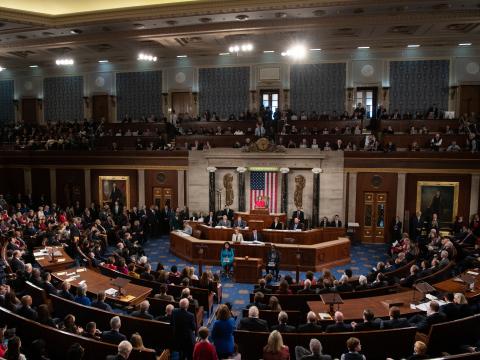
The opportunity before the House is the selection of their next Speaker. [Photo credit/source: U.S. House of Representatives.]

Yes, I know the House Republicans have pre-selected Minority Leader Kevin McCarthy. But he may not have the support of a House majority when the vote is taken Jan. 3.

Rather than leave McCarthy with the need to yield power to his no-compromises, election-denying, party-without-a-platform, MAGA, extremist, insurrectionist House members, how about the ultimate bipartisanship?

Each party can have its leadership. And tradition would dictate a Speaker from the House majority party. But shouldn’t the Speaker be the choice of both major parties?

There is precedent. In 1910, dissatisfied Republicans joined Democrats in stripping Speaker Joseph Cannon of some powers. In 1997, Republican Speaker Newt Gingrich feared dissenting Republicans would vote with Democrats, making Democrat Dick Gephardt Speaker. In Nancy Pelosi’s 2021 election as Speaker, two votes went to neither her nor McCarthy, and three members voted “present.”

On a more positive note, since 2017 the House “Problem Solvers Caucus,” with 58 members (29 from each party), has been successfully seeking to foster bipartisan cooperation on key policy issues.

Wouldn’t it be worth a similar try to build a majority from both parties that could agree on a Republican Speaker who would serve all House Members? A Speaker indebted only to them, with no need for concessions to those Members more interested in winning a war with the “enemy” party than legislating for the American people.

Like Huckabee’s airplane, the House needs wise adults on left and right. With or without a bipartisan speaker, hopefully this dream of one may inspire other proposals for converting the current mudball fight into a legislative body of problem solvers worthy of the name — and the U.S. House.

Nicholas Johnson is the author of “Columns of Democracy.” mailbox@nicholasjohnson.org

SOURCES

Picking presidents. “It’s Huckabee; My Republican Pick: Governor Mike Huckabee,” July 24, 2007, https://fromdc2iowa.blogspot.com/2007/07/its-huckabee.html

Speaker of the House:

Constitution. “The House of Representatives shall chuse their Speaker and other Officers; and shall have the sole Power of Impeachment.” U.S. Constitution, Art. I, Sec. 2, https://constitution.congress.gov/constitution/.

“Speaker of the United States House of Representatives,” Wikipedia.org, https://en.wikipedia.org/wiki/Speaker_of_the_United_States_House_of_Representatives (“The most recent election for House speaker took place January 3, 2021, on the opening day of the 117th United States Congress, two months after the 2020 House elections in which the Democrats won a majority of the seats. Incumbent speaker, Democrat Nancy Pelosi, secured a narrow majority of the 427 votes cast and was elected to a fourth (second consecutive) term. She received 216 votes to Republican Kevin McCarthy's 209 votes, with two votes going to other persons; also, three representatives answered present when their names were called.[34]” …”In 1997, several Republican congressional leaders tried to force Speaker Newt Gingrich to resign. However, Gingrich refused since that would have required a new election for speaker, which could have led to Democrats along with dissenting Republicans voting for Democrat Dick Gephardt (then minority leader) as speaker.” … “non-members have received a few votes in various speaker elections over the past several years.[8] Every person elected speaker, however, has been a member.[7] … As the Constitution does not state the duties of the speaker, the speaker's role has largely been shaped by traditions and customs that evolved over time.” ,,, “In 1910, however, Democrats and several dissatisfied Republicans joined together to strip Cannon of many of his powers, including the ability to name committee members and his chairmanship of the Rules Committee.[18]” … “John Boehner was elected speaker when the 112th Congress convened on January 5, 2011, and was subsequently re-elected twice, at the start of the 113th and 114th Congresses. On both of those occasions his remaining in office was threatened by the defection of several members from his own party who chose not to vote for him.[23][24]”)

Capitalization. “'Speaker' an exception,” Chicago Manual of Style, https://www.chicagomanualofstyle.org/qanda/data/faq/topics/Capitalization/faq0003.html

House leadership. McCarthy. John Wagner and Mariana Alfaro, “Republicans engage in full-scale brawl after disappointing midterm elections,” The Washington Post, Nov. 15, 2022, https://www.washingtonpost.com/politics/2022/11/15/mccarthy-speaker-house-control-midterms/

Marianna Sotomayor, “As Pelosi backs away, a new generation of Democrats steps forward; Democratic lawmakers both seasoned and new embraced the prospect of a fresh start, while recognizing the massive impact Pelosi has had,” Washington Post, Nov. 18, 2022, https://www.washingtonpost.com/politics/2022/11/18/pelosi-backs-away-new-generation-democrats-step-forward/ (“Reps. Hakeem Jeffries (N.Y.), Katherine M. Clark (Mass.) and Pete Aguilar (Calif.) have emerged as the expected leaders …. Jeffries, 52, would break barriers as the first Black person to lead any party in either chamber of Congress. Clark, 58, could become the second woman to serve as minority whip, and Aguilar, 43, would be the second Hispanic lawmaker to chair the caucus if elected this month.” “… Kevin McCarthy (R-Calif.), who earned the GOP conference’s nomination to be speaker next term ….” “Republicans begin to acknowledge that they will have to rely on Democrats to approve must-pass legislation to overcome their razor-thin majority.”

Problem solvers. “Problem Solvers Caucus,” https://problemsolverscaucus.house.gov/about

“Problem Solvers Caucus,” https://en.wikipedia.org/wiki/Problem_Solvers_Caucus (“The Problem Solvers Caucus is a bipartisan group in the United States House of Representatives that includes members equally divided between Democrats and Republicans, who seek to foster bipartisan cooperation on key policy issues. The group was created in January 2017 as an outgrowth of meetings held by political organization No Labels starting in 2014.[5].” … “Today, the Problem Solvers Caucus is co-chaired by Rep. Josh Gottheimer (D-NJ) and Rep. Brian Fitzpatrick (R-PA), and counts 58 members evenly divided between the parties, who are working to forge bipartisan solutions to America's toughest challenges.[6]”)

# # #

Wednesday, September 07, 2022

Civics Can Save Us

Civics Can Save Us
Nicholas Johnson
The Gazette, September 7, 2022, p. A5

Like Robert Frost confronting “two roads diverged in a wood,” Americans must choose. One road requires heavy lifting, rebuilding the decaying democracy our founders gave us; the other is an easy stroll down the green fairways of indifference to an authoritarian dictatorship.

As with other public challenges, the outcome will be decided in our public schools – a core institution for a self-governing people.

Boston Latin School was founded in 1635; the first free, taxpayer-supported public school four years later. Pennsylvania created the first statewide free education in 1790.

By the 1830s schools were adding years of instruction, the first high schools, and Alexis de Tocqueville observed, “It is by the attention it pays to public education that the original character of American civilization is at once placed in the clearest light.” He noted laws “establishing schools in every township, and obliging the inhabitants, under pain of heavy fines, to support them.”

“The character of American civilization” can still be judged by the attention we pay to public education. We’ve yet to add an additional two years of free education. Too many students are ignorant of American history and the provisions of our Constitution. MAGA politicians and parents attack underpaid K-12 teachers who ultimately leave their jobs. College tuition soars, while many university presidents are paid $1 million or more (over twice the U.S. president’s take-home pay), and student loan borrowers now owe $1.75 trillion.

The most significant K-12 class for future citizens governing themselves is “civics education.”

Civics education is nothing new, and its content and rationale change over time. In 820 BC the “civics education” Sparta lawgiver Lycurgus encouraged was designed to create citizens devoted to the public good.

By the 19th Century civics education was recognized as a major goal of public schools. In New England, de Tocqueville reported, “every citizen receives . . . the history of [the] country, and the leading features of its Constitution. … politics are the end and aim of education ….”

Today, the National Council for the Social Studies is the go-to source for civics education. Their position paper, “Revitalizing Civic Learning in Our Schools” should be required reading for every superintendent, school board member, principal, teacher, and parent.

It begins, “As Thomas Jefferson, Horace Mann, John Dewey and other great educators understood, public schools do not serve a public so much as create a public. The goal of schooling [is] to equip a citizenry with the knowledge, skills, and dispositions needed for active and engaged civic life.”

Note the words “skills.” It is not sufficient that students read the Constitution and study Congress. As one researcher found, “students did best when discussing current events in class daily, simulating democratic processes regularly and engaging in community service annually.... [With only a] fleeting knowledge base [students] are poorly prepared for the demands of democratic governance.”
[Photo credit: Iowa State University; "Legislative Day is an opportunity for youth to learn about one of the core program areas of 4-H — leadership and civic engagement ... Youth participants were able to ... meet members of the Iowa House of Representatives and Senate to discuss issues affecting youth." March 3, 2020.]

Add Claire Nader’s new book for kids, parents and teachers, “You Are Your Own Best Teacher,” and there’s still hope for us.

Nicholas Johnson’s social studies teacher was Dr. John Haefner. mailbox@nicholasjohnson.org

SOURCES

Two roads. Robert Frost, “The Road Not Taken,” Poetry Foundation, https://www.poetryfoundation.org/poems/44272/the-road-not-taken (“. . . Two roads diverged in a wood, and I—/I took the one less traveled by,/And that has made all the difference.”)

Boston Latin; the first free; first statewide free. “History of education in the United States,” Wikipedia, https://en.wikipedia.org/wiki/History_of_education_in_the_United_States (“The first American schools in the thirteen original colonies opened in the 17th century. Boston Latin School was founded in 1635 and is both the first public school and oldest existing school in the United States.[1] The first free taxpayer-supported public school in North America, the Mather School, was opened in Dorchester, Massachusetts, in 1639.[2][3]”)

“K-12,” Wikipedia, https://en.wikipedia.org/wiki/K-12 (“U.S. public education was conceived of in the late 18th century. In 1790, Pennsylvania became the first state to require some form of free education for everyone regardless of whether they could afford it. New York passed similar legislation in 1805. In 1820, Massachusetts became the first state to create a tuition-free high school, Boston English.[2] The first K–12 public school systems appeared in the early 19th century. In the 1830s and 1840s, Ohioans were taking a significant interest in the idea of public education.”)

Alexis de Tocqueville. Alexis de Tocqueville, Democracy in America (1835/1840) See generally, “Alexis de Tocqueville,” Wikimedia, https://en.wikipedia.org/wiki/Alexis_de_Tocqueville, and “2. Democracy in America.” Also, “Democracy in America,” Wikipedia, https://en.wikipedia.org/wiki/Democracy_in_America

Quotes from “Democracy in America” used in the column can be found by searching for them in the text: Alexis De Tocqueville, Democracy in America, vol. I, 1835, Henry Reeve translation, https://www.gutenberg.org/files/815/815-h/815-h.htm#link2HCH0041

Ignorance of history/Constitution. Glenn Ricketts, “Knowledge of American History Rapidly Becoming History,” American History, National Association of Scholars, March 23, 2015, https://www.nas.org/blogs/article/knowledge_of_american_history_rapidly_becoming_history (“Now on the heels of our report comes the US Education Department’s National Assessment of Educational Progress quadrennial survey, The Nation’s Report Card: U.S. History 2010. As the title indicates, this study measures knowledge of the rudiments of US history among K-12 students at the elementary, middle and secondary levels. … eighty per cent of fourth graders, eighty-three per cent of eighth graders and eighty-eight per cent of high school seniors flunked the minimum proficiency rating. And within the senior cohort, a mere two per cent correctly answered a question about the Supreme Court’s 1954 landmark decision in Brown v. Board of Education.”)

“Editorial: Citizenship 101: Too many Americans are ignorant of the basics of democracy,” Los Angeles Times, Dec. 29, 2014, https://www.latimes.com/opinion/editorials/la-ed-citizenship-civics-20141230-story.html (“A survey of adults conducted in September by the Annenberg Public Policy Center of the University of Pennsylvania found that only 36% could name all three branches of the U.S. government; 35% couldn’t name even one. Only 27% of respondents knew that it requires a two-thirds vote of the House and Senate to override a president’s veto, and 21% wrongly thought that a 5-4 Supreme Court decision must be returned to Congress for reconsideration. Kathleen Hall Jamieson, the director of the Annenberg center, said the survey “offers dramatic evidence of the need for more and better civics education.”

Today, “Warren wrote, ‘education is perhaps the most important function of state and local governments. Compulsory school attendance laws and the great expenditures for education both demonstrate our recognition of the importance of education to our democratic society. It is required in the performance of our most basic public responsibilities, even service in the armed forces. It is the very foundation of good citizenship.’” [Chief Justice Earl Warren, Brown v. Board of Education, 1954]

“[Retired] Supreme Court Justice Sandra Day O’Connor … in a 2008 article written with former Rep. Lee Hamilton of Indiana, … argued that ‘civic education has been in steady decline over the past generation, as high stakes testing and an emphasis on literacy and math dominate school reforms. Too many young people today do not understand how our political system works.’”)

Attacks on teachers. Edward Graham, “Who is Behind the Attacks on Educators and Public Schools? The manufactured outrage perpetuated by dark money networks is both a danger to educators and a distraction from helping students and parents,” neaToday, Dec. 14, 2021, https://www.nea.org/advocating-for-change/new-from-nea/who-behind-attacks-educators-and-public-schools (“This peddling of misinformation and fear has led to a sharp increase in threats aimed at educators and school board officials, many of whom have been intimidated and threatened in alarming numbers across the country—outside school grounds, across social media, and, most notoriously, at local school board meetings.

Small groups of radicalized adults, egged on by these bad actors, have been whipped into a furor over COVID safety protocols and the false notion that children are being taught “critical race theory.” Some of these protests have ended in chaos, with school board members in Virginia receiving death threats and protesters in San Diego County forcing their way into a school board meeting and declaring themselves the newly-elected board.

Educators across the country have also shared horror stories about the assaults and abuses they’ve had to endure for simply doing their jobs. Teachers in California and Texas were physically assaulted over wearing masks, and in Arizona, a group of men were arrested and charged after attempting to abduct an elementary school principal for following COVID-19 guidelines.”)

Tuition increases. Melanie Hanson, “College Tuition Inflation Rate,” Education Data Initiative, last updated Aug. 10, 2022, https://educationdata.org/college-tuition-inflation-rate (Numerous calculations. e.g., “After adjusting for currency inflation, college tuition has increased 747.8% since 1963.”)

College presidents pay. Anya Kamenetz, “More College Presidents Join the Millionaires’ Club,” nprEd, Dec. 13, 2017, https://www.npr.org/sections/ed/2017/12/13/569943593/more-college-presidents-join-the-millionaires-club (“The chief executives of 59 private colleges and seven public universities took home more than $1 million in total compensation in 2015, according to an analysis released this week by The Chronicle of Higher Education.”)

Darian Somers and Josh Moody, “10 Public Universities Run by Highest-Paid Presidents; These university presidents make at least $1 million,” USNews Education, Aug. 6, 2019, https://www.usnews.com/education/best-colleges/slideshows/10-public-universities-run-by-highest-paid-presidents (“The U.S. president makes $400,000 per year. But numerous university presidents make more than double that. At least 40 National University presidents earn twice what President Donald Trump does on a yearly basis, according to a 2019 report from The Chronicle of Higher Education.”)

Total student loan debt. Anna Helhoski, Ryan Lane, “Student Loan Debt Statistics: 2022,” Nerdwallet, Aug. 25, 2022, https://www.nerdwallet.com/article/loans/student-loans/student-loan-debt (“Student loan borrowers in the United States owe a collective nearly $1.75 trillion in federal and private student loan debt as of August 2022, according to the Federal Reserve Bank of St. Louis.”)

Lycurgus. “Lycurgus (lawgiver),” https://en.wikipedia.org/wiki/Lycurgus_(lawgiver) (“Lycurgus (/laɪˈkɜːrɡəs/; Greek: Λυκοῦργος Lykourgos; fl. c. 820 BC) was the quasi-legendary lawgiver of Sparta ….”)

De Tocqueville, “every citizen.” See above, “Alexis de Tocqueville” and “Quotes from ‘Democracy in America.’”

National Council for the Social Sciences. https://www.socialstudies.org

“Revitalizing Civic Learning in Our Schools.” “Revitalizing Civic Learning in Our Schools; A Position Statement of National Council for the Social Studies,” Approved 2013, https://www.socialstudies.org/position-statements/revitalizing-civic-learning-our-schools (“As Thomas Jefferson, Horace Mann, John Dewey and other great educators understood, public schools do not serve a public so much as create a public.1 The goal of schooling, therefore, is not merely preparation for citizenship, but citizenship itself; to equip a citizenry with the knowledge, skills, and dispositions needed for active and engaged civic life.”)

One researcher found. Shawn Healy [Civic Learning Scholar, McCormick Foundation; taking “con” position], “Con,” Marcia Clemmitt, “Civic Education: Are Students Learning How to be Good Citizens? Pro/Con Should states make the U.S citizenship test a graduation requirement” CQPress, CQ Researcher, Feb. 3, 2017, https://library.cqpress.com/cqresearcher/document.php?id=cqresrre2017020306 (“students did best when discussing current events in class daily, simulating democratic processes regularly and engaging in community service annually. These practices are too often neglected in content-centered courses, and students depart with a fleeting knowledge base and are poorly prepared for the demands of democratic governance.”)

Claire Nader book. Claire Nader, “You Are Your Own Best Teacher: Sparking the Curiosity, Imagination, and Intellect of Tweens,” Essential Books, Washington, D.C., (2022) (Jonathan Kozol (author, “Death At An Early Age”): “[An] engaging book about the need for children . . . to speak without self-censorship and to ‘open their own doors and windows’ …”

Juliet Schor (Boston College Professor of Sociology): “Should we be surprised that young people, such as Greta Thunberg, Leah Namugerwa, and Jamie Margolin sparked the largest climate change demonstration in history? No, says Claire Nader … in this engaging, surprising, and wise book ….”

Plus seven additional endorsements.)

# # #

Friday, July 03, 2020

Frederick Douglass on July 4th

"What to the Slave Is the Fourth of July?

Frederick Douglass
Rochester Ladies' Anti-Slavery Society, Corinthian Hall, Rochester, N.Y., July 5, 1852

He who could address this audience without a quailing sensation, has stronger nerves than I have. I do not remember ever to have appeared as a speaker before any assembly more shrinkingly, nor with greater distrust of my ability, than I do this day. A feeling has crept over me, quite unfavorable to the exercise of my limited powers of speech. The task before me is one which requires much previous thought and study for its proper performance. I know that apologies of this sort are generally considered flat and unmeaning. I trust, however, that mine will not be so considered. Should I seem at ease, my appearance would much misrepresent me. The little experience I have had in addressing public meetings, in country schoolhouses, avails me nothing on the present occasion. [Portrait source: Wikimedia Commons; Douglass at 37; he was 34 when he delivered this address.]

The papers and placards say, that I am to deliver a 4th [of] July oration. This certainly sounds large, and out of the common way, for it is true that I have often had the privilege to speak in this beautiful Hall, and to address many who now honor me with their presence. But neither their familiar faces, nor the perfect gage I think I have of Corinthian Hall, seems to free me from embarrassment.

The fact is, ladies and gentlemen, the distance between this platform and the slave plantation, from which I escaped, is considerable — and the difficulties to be overcome in getting from the latter to the former, are by no means slight. That I am here to-day is, to me, a matter of astonishment as well as of gratitude. You will not, therefore, be surprised, if in what I have to say I evince no elaborate preparation, nor grace my speech with any high sounding exordium. With little experience and with less learning, I have been able to throw my thoughts hastily and imperfectly together; and trusting to your patient and generous indulgence, I will proceed to lay them before you.

This, for the purpose of this celebration, is the 4th of July. It is the birthday of your National Independence, and of your political freedom. This, to you, is what the Passover was to the emancipated people of God. It carries your minds back to the day, and to the act of your great deliverance; and to the signs, and to the wonders, associated with that act, and that day. This celebration also marks the beginning of another year of your national life; and reminds you that the Republic of America is now 76 years old. I am glad, fellow-citizens, that your nation is so young. Seventy-six years, though a good old age for a man, is but a mere speck in the life of a nation. Three score years and ten is the allotted time for individual men; but nations number their years by

2

thousands. According to this fact, you are, even now, only in the beginning of your national career, still lingering in the period of childhood. I repeat, I am glad this is so. There is hope in the thought, and hope is much needed, under the dark clouds which lower above the horizon. The eye of the reformer is met with angry flashes, portending disastrous times; but his heart may well beat lighter at the thought that America is young, and that she is still in the impressible stage of her existence. May he not hope that high lessons of wisdom, of justice and of truth, will yet give direction to her destiny? Were the nation older, the patriot’s heart might be sadder, and the reformer’s brow heavier. Its future might be shrouded in gloom, and the hope of its prophets go out in sorrow. There is consolation in the thought that America is young. Great streams are not easily turned from channels, worn deep in the course of ages. They may sometimes rise in quiet and stately majesty, and inundate the land, refreshing and fertilizing the earth with their mysterious properties. They may also rise in wrath and fury, and bear away, on their angry waves, the accumulated wealth of years of toil and hardship. They, however, gradually flow back to the same old channel, and flow on as serenely as ever. But, while the river may not be turned aside, it may dry up, and leave nothing behind but the withered branch, and the unsightly rock, to howl in the abyss-sweeping wind, the sad tale of departed glory. As with rivers so with nations.

Fellow-citizens, I shall not presume to dwell at length on the associations that cluster about this day. The simple story of it is that, 76 years ago, the people of this country were British subjects. The style and title of your “sovereign people” (in which you now glory) was not then born. You were under the British Crown. Your fathers esteemed the English Government as the home government; and England as the fatherland. This home government, you know, although a considerable distance from your home, did, in the exercise of its parental prerogatives, impose upon its colonial children, such restraints, burdens and limitations, as, in its mature judgment, it deemed wise, right and proper.

But, your fathers, who had not adopted the fashionable idea of this day, of the infallibility of government, and the absolute character of its acts, presumed to differ from the home government in respect to the wisdom and the justice of some of those burdens and restraints. They went so far in their excitement as to pronounce the measures of government unjust, unreasonable, and oppressive, and altogether such as ought not to be quietly submitted to. I scarcely need say, fellowcitizens, that my opinion of those measures fully accords with that of your fathers. Such a declaration of agreement on my part would not be worth much to anybody. It would, certainly, prove nothing, as to what part I might have taken, had I lived during the great controversy of 1776. To say now that America was right, and England wrong, is exceedingly easy. Everybody can say it; the dastard, not less than the noble brave, can flippantly discant on the tyranny of England towards the American Colonies. It is fashionable to do so; but there was a time when to pronounce against England, and in favor of the cause of the colonies, tried men’s souls. They who did so were

3

accounted in their day, plotters of mischief, agitators and rebels, dangerous men. To side with the right, against the wrong, with the weak against the strong, and with the oppressed against the oppressor! here lies the merit, and the one which, of all others, seems unfashionable in our day. The cause of liberty may be stabbed by the men who glory in the deeds of your fathers. But, to proceed.

Feeling themselves harshly and unjustly treated by the home government, your fathers, like men of honesty, and men of spirit, earnestly sought redress. They petitioned and remonstrated; they did so in a decorous, respectful, and loyal manner. Their conduct was wholly unexceptionable. This, however, did not answer the purpose. They saw themselves treated with sovereign indifference, coldness and scorn. Yet they persevered. They were not the men to look back.

As the sheet anchor takes a firmer hold, when the ship is tossed by the storm, so did the cause of your fathers grow stronger, as it breasted the chilling blasts of kingly displeasure. The greatest and best of British statesmen admitted its justice, and the loftiest eloquence of the British Senate came to its support. But, with that blindness which seems to be the unvarying characteristic of tyrants, since Pharaoh and his hosts were drowned in the Red Sea, the British Government persisted in the exactions complained of.

The madness of this course, we believe, is admitted now, even by England; but we fear the lesson is wholly lost on our present ruler. Oppression makes a wise man mad. Your fathers were wise men, and if they did not go mad, they became restive under this treatment. They felt themselves the victims of grievous wrongs, wholly incurable in their colonial capacity. With brave men there is always a remedy for oppression. Just here, the idea of a total separation of the colonies from the crown was born! It was a startling idea, much more so, than we, at this distance of time, regard it. The timid and the prudent (as has been intimated) of that day, were, of course, shocked and alarmed by it.

Such people lived then, had lived before, and will, probably, ever have a place on this planet; and their course, in respect to any great change, (no matter how great the good to be attained, or the wrong to be redressed by it), may be calculated with as much precision as can be the course of the stars. They hate all changes, but silver, gold and copper change! Of this sort of change they are always strongly in favor.

These people were called Tories in the days of your fathers; and the appellation, probably, conveyed the same idea that is meant by a more modern, though a somewhat less euphonious term, which we often find in our papers, applied to some of our old politicians.

4

Their opposition to the then dangerous thought was earnest and powerful; but, amid all their terror and affrighted vociferations against it, the alarming and revolutionary idea moved on, and the country with it.

On the 2d of July, 1776, the old Continental Congress, to the dismay of the lovers of ease, and the worshipers of property, clothed that dreadful idea with all the authority of national sanction. They did so in the form of a resolution; and as we seldom hit upon resolutions, drawn up in our day whose transparency is at all equal to this, it may refresh your minds and help my story if I read it. “Resolved, That these united colonies are, and of right, ought to be free and Independent States; that they are absolved from all allegiance to the British Crown; and that all political connection between them and the State of Great Britain is, and ought to be, dissolved.”

Citizens, your fathers made good that resolution. They succeeded; and to-day you reap the fruits of their success. The freedom gained is yours; and you, therefore, may properly celebrate this anniversary. The 4th of July is the first great fact in your nation’s history — the very ring-bolt in the chain of your yet undeveloped destiny.

Pride and patriotism, not less than gratitude, prompt you to celebrate and to hold it in perpetual remembrance. I have said that the Declaration of Independence is the ring-bolt to the chain of your nation’s destiny; so, indeed, I regard it. The principles contained in that instrument are saving principles. Stand by those principles, be true to them on all occasions, in all places, against all foes, and at whatever cost.

From the round top of your ship of state, dark and threatening clouds may be seen. Heavy billows, like mountains in the distance, disclose to the leeward huge forms of flinty rocks! That bolt drawn, that chain broken, and all is lost. Cling to this day — cling to it, and to its principles, with the grasp of a storm-tossed mariner to a spar at midnight.

The coming into being of a nation, in any circumstances, is an interesting event. But, besides general considerations, there were peculiar circumstances which make the advent of this republic an event of special attractiveness.

The whole scene, as I look back to it, was simple, dignified and sublime.

The population of the country, at the time, stood at the insignificant number of three millions. The country was poor in the munitions of war. The population was weak and scattered, and the country a wilderness unsubdued. There were then no means of concert and combination, such as exist now. Neither steam nor lightning had then been reduced to order and discipline. From the Potomac to

5

the Delaware was a journey of many days. Under these, and innumerable other disadvantages, your fathers declared for liberty and independence and triumphed.

Fellow Citizens, I am not wanting in respect for the fathers of this republic. The signers of the Declaration of Independence were brave men. They were great men too — great enough to give fame to a great age. It does not often happen to a nation to raise, at one time, such a number of truly great men. The point from which I am compelled to view them is not, certainly, the most favorable; and yet I cannot contemplate their great deeds with less than admiration. They were statesmen, patriots and heroes, and for the good they did, and the principles they contended for, I will unite with you to honor their memory.

They loved their country better than their own private interests; and, though this is not the highest form of human excellence, all will concede that it is a rare virtue, and that when it is exhibited, it ought to command respect. He who will, intelligently, lay down his life for his country, is a man whom it is not in human nature to despise. Your fathers staked their lives, their fortunes, and their sacred honor, on the cause of their country. In their admiration of liberty, they lost sight of all other interests.

They were peace men; but they preferred revolution to peaceful submission to bondage. They were quiet men; but they did not shrink from agitating against oppression. They showed forbearance; but that they knew its limits. They believed in order; but not in the order of tyranny. With them, nothing was “settled” that was not right. With them, justice, liberty and humanity were “final;” not slavery and oppression. You may well cherish the memory of such men. They were great in their day and generation. Their solid manhood stands out the more as we contrast it with these degenerate times.

How circumspect, exact and proportionate were all their movements! How unlike the politicians of an hour! Their statesmanship looked beyond the passing moment, and stretched away in strength into the distant future. They seized upon eternal principles, and set a glorious example in their defense. Mark them!

Fully appreciating the hardship to be encountered, firmly believing in the right of their cause, honorably inviting the scrutiny of an on-looking world, reverently appealing to heaven to attest their sincerity, soundly comprehending the solemn responsibility they were about to assume, wisely measuring the terrible odds against them, your fathers, the fathers of this republic, did, most deliberately, under the inspiration of a glorious patriotism, and with a sublime faith in the great principles of justice and freedom, lay deep the corner-stone of the national superstructure, which has risen and still rises in grandeur around you.

6

Of this fundamental work, this day is the anniversary. Our eyes are met with demonstrations of joyous enthusiasm. Banners and pennants wave exultingly on the breeze. The din of business, too, is hushed. Even Mammon seems to have quitted his grasp on this day. The ear-piercing fife and the stirring drum unite their accents with the ascending peal of a thousand church bells. Prayers are made, hymns are sung, and sermons are preached in honor of this day; while the quick martial tramp of a great and multitudinous nation, echoed back by all the hills, valleys and mountains of a vast continent, bespeak the occasion one of thrilling and universal interest — a nation’s jubilee.

Friends and citizens, I need not enter further into the causes which led to this anniversary. Many of you understand them better than I do. You could instruct me in regard to them. That is a branch of knowledge in which you feel, perhaps, a much deeper interest than your speaker. The causes which led to the separation of the colonies from the British crown have never lacked for a tongue. They have all been taught in your common schools, narrated at your firesides, unfolded from your pulpits, and thundered from your legislative halls, and are as familiar to you as household words. They form the staple of your national poetry and eloquence.

I remember, also, that, as a people, Americans are remarkably familiar with all facts which make in their own favor. This is esteemed by some as a national trait — perhaps a national weakness. It is a fact, that whatever makes for the wealth or for the reputation of Americans, and can be had cheap! will be found by Americans. I shall not be charged with slandering Americans, if I say I think the American side of any question may be safely left in American hands.

I leave, therefore, the great deeds of your fathers to other gentlemen whose claim to have been regularly descended will be less likely to be disputed than mine!

My business, if I have any here to-day, is with the present. The accepted time with God and his cause is the ever-living now.

Trust no future, however pleasant,
Let the dead past bury its dead;
Act, act in the living present,
Heart within, and God overhead
.

We have to do with the past only as we can make it useful to the present and to the future. To all inspiring motives, to noble deeds which can be gained from the past, we are welcome. But now is the time, the important time. Your fathers have lived, died, and have done their work, and have done much of it well. You live and must die, and you must do your work. You have no right to enjoy a child’s share in the labor of your fathers, unless your children are to be blest by your labors. You

7

have no right to wear out and waste the hard-earned fame of your fathers to cover your indolence. Sydney Smith tells us that men seldom eulogize the wisdom and virtues of their fathers, but to excuse some folly or wickedness of their own. This truth is not a doubtful one. There are illustrations of it near and remote, ancient and modern. It was fashionable, hundreds of years ago, for the children of Jacob to boast, we have “Abraham to our father,” when they had long lost Abraham’s faith and spirit. That people contented themselves under the shadow of Abraham’s great name, while they repudiated the deeds which made his name great. Need I remind you that a similar thing is being done all over this country to-day? Need I tell you that the Jews are not the only people who built the tombs of the prophets, and garnished the sepulchres of the righteous? Washington could not die till he had broken the chains of his slaves. Yet his monument is built up by the price of human blood, and the traders in the bodies and souls of men shout — “We have Washington to our father.” — Alas! that it should be so; yet so it is.

The evil that men do, lives after them, The good is oft-interred with their bones.

Fellow-citizens, pardon me, allow me to ask, why am I called upon to speak here to-day? What have I, or those I represent, to do with your national independence? Are the great principles of political freedom and of natural justice, embodied in that Declaration of Independence, extended to us? and am I, therefore, called upon to bring our humble offering to the national altar, and to confess the benefits and express devout gratitude for the blessings resulting from your independence to us?

Would to God, both for your sakes and ours, that an affirmative answer could be truthfully returned to these questions! Then would my task be light, and my burden easy and delightful. For who is there so cold, that a nation’s sympathy could not warm him? Who so obdurate and dead to the claims of gratitude, that would not thankfully acknowledge such priceless benefits? Who so stolid and selfish, that would not give his voice to swell the hallelujahs of a nation’s jubilee, when the chains of servitude had been torn from his limbs? I am not that man. In a case like that, the dumb might eloquently speak, and the “lame man leap as an hart.”

But, such is not the state of the case. I say it with a sad sense of the disparity between us. I am not included within the pale of this glorious anniversary! Your high independence only reveals the immeasurable distance between us. The blessings in which you, this day, rejoice, are not enjoyed in common. — The rich inheritance of justice, liberty, prosperity and independence, bequeathed by your fathers, is shared by you, not by me. The sunlight that brought life and healing to you, has brought stripes and death to me. This Fourth [of] July is yours, not mine. You may rejoice, I must mourn. To drag a man in fetters into the grand illuminated temple of liberty, and call upon him to join you in joyous anthems, were inhuman mockery and sacrilegious irony. Do you mean, citizens, to mock me, by asking me to speak to-day? If so, there is a parallel to your conduct. And let me warn

8

you that it is dangerous to copy the example of a nation whose crimes, lowering up to heaven, were thrown down by the breath of the Almighty, burying that nation in irrecoverable ruin! I can to-day take up the plaintive lament of a peeled and woe-smitten people!

“By the rivers of Babylon, there we sat down. Yea! we wept when we remembered Zion. We hanged our harps upon the willows in the midst thereof. For there, they that carried us away captive, required of us a song; and they who wasted us required of us mirth, saying, Sing us one of the songs of Zion. How can we sing the Lord’s song in a strange land? If I forget thee, O Jerusalem, let my right hand forget her cunning. If I do not remember thee, let my tongue cleave to the roof of my mouth.”

Fellow-citizens; above your national, tumultuous joy, I hear the mournful wail of millions! whose chains, heavy and grievous yesterday, are, to-day, rendered more intolerable by the jubilee shouts that reach them. If I do forget, if I do not faithfully remember those bleeding children of sorrow this day, “may my right hand forget her cunning, and may my tongue cleave to the roof of my mouth!” To forget them, to pass lightly over their wrongs, and to chime in with the popular theme, would be treason most scandalous and shocking, and would make me a reproach before God and the world. My subject, then fellow-citizens, is AMERICAN SLAVERY. I shall see, this day, and its popular characteristics, from the slave’s point of view. Standing, there, identified with the American bondman, making his wrongs mine, I do not hesitate to declare, with all my soul, that the character and conduct of this nation never looked blacker to me than on this 4th of July! Whether we turn to the declarations of the past, or to the professions of the present, the conduct of the nation seems equally hideous and revolting. America is false to the past, false to the present, and solemnly binds herself to be false to the future. Standing with God and the crushed and bleeding slave on this occasion, I will, in the name of humanity which is outraged, in the name of liberty which is fettered, in the name of the constitution and the Bible, which are disregarded and trampled upon, dare to call in question and to denounce, with all the emphasis I can command, everything that serves to perpetuate slavery — the great sin and shame of America! “I will not equivocate; I will not excuse;” I will use the severest language I can command; and yet not one word shall escape me that any man, whose judgment is not blinded by prejudice, or who is not at heart a slaveholder, shall not confess to be right and just.

But I fancy I hear some one of my audience say, it is just in this circumstance that you and your brother abolitionists fail to make a favorable impression on the public mind. Would you argue more, and denounce less, would you persuade more, and rebuke less, your cause would be much more likely to succeed. But, I submit, where all is plain there is nothing to be argued. What point in the anti-slavery creed would you have me argue? On what branch of the subject do the people of this country need light? Must I undertake to prove that the slave is a man? That point is conceded already. Nobody doubts it. The slaveholders themselves acknowledge it in the enactment of laws for

9

their government. They acknowledge it when they punish disobedience on the part of the slave. There are seventy-two crimes in the State of Virginia, which, if committed by a black man, (no matter how ignorant he be), subject him to the punishment of death; while only two of the same crimes will subject a white man to the like punishment. What is this but the acknowledgement that the slave is a moral, intellectual and responsible being? The manhood of the slave is conceded. It is admitted in the fact that Southern statute books are covered with enactments forbidding, under severe fines and penalties, the teaching of the slave to read or to write. When you can point to any such laws, in reference to the beasts of the field, then I may consent to argue the manhood of the slave. When the dogs in your streets, when the fowls of the air, when the cattle on your hills, when the fish of the sea, and the reptiles that crawl, shall be unable to distinguish the slave from a brute, then will I argue with you that the slave is a man!

For the present, it is enough to affirm the equal manhood of the Negro race. Is it not astonishing that, while we are ploughing, planting and reaping, using all kinds of mechanical tools, erecting houses, constructing bridges, building ships, working in metals of brass, iron, copper, silver and gold; that, while we are reading, writing and cyphering, acting as clerks, merchants and secretaries, having among us lawyers, doctors, ministers, poets, authors, editors, orators and teachers; that, while we are engaged in all manner of enterprises common to other men, digging gold in California, capturing the whale in the Pacific, feeding sheep and cattle on the hill-side, living, moving, acting, thinking, planning, living in families as husbands, wives and children, and, above all, confessing and worshipping the Christian’s God, and looking hopefully for life and immortality beyond the grave, we are called upon to prove that we are men!

Would you have me argue that man is entitled to liberty? that he is the rightful owner of his own body? You have already declared it. Must I argue the wrongfulness of slavery? Is that a question for Republicans? Is it to be settled by the rules of logic and argumentation, as a matter beset with great difficulty, involving a doubtful application of the principle of justice, hard to be understood? How should I look to-day, in the presence of Americans, dividing, and subdividing a discourse, to show that men have a natural right to freedom? speaking of it relatively, and positively, negatively, and affirmatively. To do so, would be to make myself ridiculous, and to offer an insult to your understanding. — There is not a man beneath the canopy of heaven, that does not know that slavery is wrong for him.

What, am I to argue that it is wrong to make men brutes, to rob them of their liberty, to work them without wages, to keep them ignorant of their relations to their fellow men, to beat them with sticks, to flay their flesh with the lash, to load their limbs with irons, to hunt them with dogs, to sell them at auction, to sunder their families, to knock out their teeth, to bum their flesh, to starve them into obedience and submission to their masters? Must I argue that a system thus marked with

10

blood, and stained with pollution, is wrong? No! I will not. I have better employments for my time and strength than such arguments would imply.

What, then, remains to be argued? Is it that slavery is not divine; that God did not establish it; that our doctors of divinity are mistaken? There is blasphemy in the thought. That which is inhuman, cannot be divine! Who can reason on such a proposition? They that can, may; I cannot. The time for such argument is passed.

At a time like this, scorching irony, not convincing argument, is needed. O! had I the ability, and could I reach the nation’s ear, I would, to-day, pour out a fiery stream of biting ridicule, blasting reproach, withering sarcasm, and stern rebuke. For it is not light that is needed, but fire; it is not the gentle shower, but thunder. We need the storm, the whirlwind, and the earthquake. The feeling of the nation must be quickened; the conscience of the nation must be roused; the propriety of the nation must be startled; the hypocrisy of the nation must be exposed; and its crimes against God and man must be proclaimed and denounced.

What, to the American slave, is your 4th of July? I answer: a day that reveals to him, more than all other days in the year, the gross injustice and cruelty to which he is the constant victim. To him, your celebration is a sham; your boasted liberty, an unholy license; your national greatness, swelling vanity; your sounds of rejoicing are empty and heartless; your denunciations of tyrants, brass fronted impudence; your shouts of liberty and equality, hollow mockery; your prayers and hymns, your sermons and thanksgivings, with all your religious parade, and solemnity, are, to him, mere bombast, fraud, deception, impiety, and hypocrisy — a thin veil to cover up crimes which would disgrace a nation of savages. There is not a nation on the earth guilty of practices, more shocking and bloody, than are the people of these United States, at this very hour.

Go where you may, search where you will, roam through all the monarchies and despotisms of the old world, travel through South America, search out every abuse, and when you have found the last, lay your facts by the side of the everyday practices of this nation, and you will say with me, that, for revolting barbarity and shameless hypocrisy, America reigns without a rival.

Take the American slave-trade, which, we are told by the papers, is especially prosperous just now. Ex-Senator Benton tells us that the price of men was never higher than now. He mentions the fact to show that slavery is in no danger. This trade is one of the peculiarities of American institutions. It is carried on in all the large towns and cities in one-half of this confederacy; and millions are pocketed every year, by dealers in this horrid traffic. In several states, this trade is a chief source of wealth. It is called (in contradistinction to the foreign slave-trade) “the internal slave trade.” It is, probably, called so, too, in order to divert from it the horror with which the foreign slave-trade is

11

contemplated. That trade has long since been denounced by this government, as piracy. It has been denounced with burning words, from the high places of the nation, as an execrable traffic. To arrest it, to put an end to it, this nation keeps a squadron, at immense cost, on the coast of Africa. Everywhere, in this country, it is safe to speak of this foreign slave-trade, as a most inhuman traffic, opposed alike to the laws of God and of man. The duty to extirpate and destroy it, is admitted even by our DOCTORS OF DIVINITY. In order to put an end to it, some of these last have consented that their colored brethren (nominally free) should leave this country, and establish themselves on the western coast of Africa! It is, however, a notable fact that, while so much execration is poured out by Americans upon those engaged in the foreign slave-trade, the men engaged in the slave-trade between the states pass without condemnation, and their business is deemed honorable.

Behold the practical operation of this internal slave-trade, the American slave-trade, sustained by American politics and America religion. Here you will see men and women reared like swine for the market. You know what is a swine-drover? I will show you a man-drover. They inhabit all our Southern States. They perambulate the country, and crowd the highways of the nation, with droves of human stock. You will see one of these human flesh-jobbers, armed with pistol, whip and bowieknife, driving a company of a hundred men, women, and children, from the Potomac to the slave market at New Orleans. These wretched people are to be sold singly, or in lots, to suit purchasers. They are food for the cotton-field, and the deadly sugar-mill. Mark the sad procession, as it moves wearily along, and the inhuman wretch who drives them. Hear his savage yells and his bloodchilling oaths, as he hurries on his affrighted captives! There, see the old man, with locks thinned and gray. Cast one glance, if you please, upon that young mother, whose shoulders are bare to the scorching sun, her briny tears falling on the brow of the babe in her arms. See, too, that girl of thirteen, weeping, yes! weeping, as she thinks of the mother from whom she has been torn! The drove moves tardily. Heat and sorrow have nearly consumed their strength; suddenly you hear a quick snap, like the discharge of a rifle; the fetters clank, and the chain rattles simultaneously; your ears are saluted with a scream, that seems to have torn its way to the center of your soul! The crack you heard, was the sound of the slave-whip; the scream you heard, was from the woman you saw with the babe. Her speed had faltered under the weight of her child and her chains! that gash on her shoulder tells her to move on. Follow the drove to New Orleans. Attend the auction; see men examined like horses; see the forms of women rudely and brutally exposed to the shocking gaze of American slave-buyers. See this drove sold and separated forever; and never forget the deep, sad sobs that arose from that scattered multitude. Tell me citizens, WHERE, under the sun, you can witness a spectacle more fiendish and shocking. Yet this is but a glance at the American slave-trade, as it exists, at this moment, in the ruling part of the United States.

I was born amid such sights and scenes. To me the American slave-trade is a terrible reality. When a child, my soul was often pierced with a sense of its horrors. I lived on Philpot Street, Fell’s Point,

12

Baltimore, and have watched from the wharves, the slave ships in the Basin, anchored from the shore, with their cargoes of human flesh, waiting for favorable winds to waft them down the Chesapeake. There was, at that time, a grand slave mart kept at the head of Pratt Street, by Austin Woldfolk. His agents were sent into every town and county in Maryland, announcing their arrival, through the papers, and on flaming “hand-bills,” headed CASH FOR NEGROES. These men were generally well dressed men, and very captivating in their manners. Ever ready to drink, to treat, and to gamble. The fate of many a slave has depended upon the turn of a single card; and many a child has been snatched from the arms of its mother by bargains arranged in a state of brutal drunkenness.

The flesh-mongers gather up their victims by dozens, and drive them, chained, to the general depot at Baltimore. When a sufficient number have been collected here, a ship is chartered, for the purpose of conveying the forlorn crew to Mobile, or to New Orleans. From the slave prison to the ship, they are usually driven in the darkness of night; for since the antislavery agitation, a certain caution is observed.

In the deep still darkness of midnight, I have been often aroused by the dead heavy footsteps, and the piteous cries of the chained gangs that passed our door. The anguish of my boyish heart was intense; and I was often consoled, when speaking to my mistress in the morning, to hear her say that the custom was very wicked; that she hated to hear the rattle of the chains, and the heartrending cries. I was glad to find one who sympathized with me in my horror.

Fellow-citizens, this murderous traffic is, to-day, in active operation in this boasted republic. In the solitude of my spirit, I see clouds of dust raised on the highways of the South; I see the bleeding footsteps; I hear the doleful wail of fettered humanity, on the way to the slave-markets, where the victims are to be sold like horses, sheep, and swine, knocked off to the highest bidder. There I see the tenderest ties ruthlessly broken, to gratify the lust, caprice and rapacity of the buyers and sellers of men. My soul sickens at the sight.

Is this the land your Fathers loved,
The freedom which they toiled to win?
Is this the earth whereon they moved?
Are these the graves they slumber in?


But a still more inhuman, disgraceful, and scandalous state of things remains to be presented. By an act of the American Congress, not yet two years old, slavery has been nationalized in its most horrible and revolting form. By that act, Mason and Dixon’s line has been obliterated; New York has become as Virginia; and the power to hold, hunt, and sell men, women, and children as slaves

13

remains no longer a mere state institution, but is now an institution of the whole United States. The power is co-extensive with the Star-Spangled Banner and American Christianity. Where these go, may also go the merciless slave-hunter. Where these are, man is not sacred. He is a bird for the sportsman’s gun. By that most foul and fiendish of all human decrees, the liberty and person of every man are put in peril. Your broad republican domain is hunting ground for men. Not for thieves and robbers, enemies of society, merely, but for men guilty of no crime. Your lawmakers have commanded all good citizens to engage in this hellish sport. Your President, your Secretary of State, our lords, nobles, and ecclesiastics, enforce, as a duty you owe to your free and glorious country, and to your God, that you do this accursed thing. Not fewer than forty Americans have, within the past two years, been hunted down and, without a moment’s warning, hurried away in chains, and consigned to slavery and excruciating torture. Some of these have had wives and children, dependent on them for bread; but of this, no account was made. The right of the hunter to his prey stands superior to the right of marriage, and to all rights in this republic, the rights of God included! For black men there are neither law, justice, humanity, not religion. The Fugitive Slave Law makes mercy to them a crime; and bribes the judge who tries them. An American judge gets ten dollars for every victim he consigns to slavery, and five, when he fails to do so. The oath of any two villains is sufficient, under this hell-black enactment, to send the most pious and exemplary black man into the remorseless jaws of slavery! His own testimony is nothing. He can bring no witnesses for himself. The minister of American justice is bound by the law to hear but one side; and that side, is the side of the oppressor. Let this damning fact be perpetually told. Let it be thundered around the world, that, in tyrant-killing, king-hating, people-loving, democratic, Christian America, the seats of justice are filled with judges, who hold their offices under an open and palpable bribe, and are bound, in deciding in the case of a man’s liberty, hear only his accusers!

In glaring violation of justice, in shameless disregard of the forms of administering law, in cunning arrangement to entrap the defenseless, and in diabolical intent, this Fugitive Slave Law stands alone in the annals of tyrannical legislation. I doubt if there be another nation on the globe, having the brass and the baseness to put such a law on the statute-book. If any man in this assembly thinks differently from me in this matter, and feels able to disprove my statements, I will gladly confront him at any suitable time and place he may select.

I take this law to be one of the grossest infringements of Christian Liberty, and, if the churches and ministers of our country were not stupidly blind, or most wickedly indifferent, they, too, would so regard it.

At the very moment that they are thanking God for the enjoyment of civil and religious liberty, and for the right to worship God according to the dictates of their own consciences, they are utterly silent in respect to a law which robs religion of its chief significance, and makes it utterly worthless

14

to a world lying in wickedness. Did this law concern the “mint, anise, and cumin” — abridge the right to sing psalms, to partake of the sacrament, or to engage in any of the ceremonies of religion, it would be smitten by the thunder of a thousand pulpits. A general shout would go up from the church, demanding repeal, repeal, instant repeal! — And it would go hard with that politician who presumed to solicit the votes of the people without inscribing this motto on his banner. Further, if this demand were not complied with, another Scotland would be added to the history of religious liberty, and the stern old Covenanters would be thrown into the shade. A John Knox would be seen at every church door, and heard from every pulpit, and Fillmore would have no more quarter than was shown by Knox, to the beautiful, but treacherous queen Mary of Scotland. The fact that the church of our country, (with fractional exceptions), does not esteem “the Fugitive Slave Law” as a declaration of war against religious liberty, implies that that church regards religion simply as a form of worship, an empty ceremony, and not a vital principle, requiring active benevolence, justice, love and good will towards man. It esteems sacrifice above mercy; psalm-singing above right doing; solemn meetings above practical righteousness. A worship that can be conducted by persons who refuse to give shelter to the houseless, to give bread to the hungry, clothing to the naked, and who enjoin obedience to a law forbidding these acts of mercy, is a curse, not a blessing to mankind. The Bible addresses all such persons as “scribes, Pharisees, hypocrites, who pay tithe of mint, anise, and cumin, and have omitted the weightier matters of the law, judgment, mercy and faith.”

But the church of this country is not only indifferent to the wrongs of the slave, it actually takes sides with the oppressors. It has made itself the bulwark of American slavery, and the shield of American slave-hunters. Many of its most eloquent Divines. who stand as the very lights of the church, have shamelessly given the sanction of religion and the Bible to the whole slave system. They have taught that man may, properly, be a slave; that the relation of master and slave is ordained of God; that to send back an escaped bondman to his master is clearly the duty of all the followers of the Lord Jesus Christ; and this horrible blasphemy is palmed off upon the world for Christianity.

For my part, I would say, welcome infidelity! welcome atheism! welcome anything! in preference to the gospel, as preached by those Divines! They convert the very name of religion into an engine of tyranny, and barbarous cruelty, and serve to confirm more infidels, in this age, than all the infidel writings of Thomas Paine, Voltaire, and Bolingbroke, put together, have done! These ministers make religion a cold and flinty-hearted thing, having neither principles of right action, nor bowels of compassion. They strip the love of God of its beauty, and leave the throng of religion a huge, horrible, repulsive form. It is a religion for oppressors, tyrants, man-stealers, and thugs. It is not that “pure and undefiled religion” which is from above, and which is “first pure, then peaceable, easy to be entreated, full of mercy and good fruits, without partiality, and without hypocrisy.” But a religion which favors the rich against the poor; which exalts the proud above the humble; which

15

divides mankind into two classes, tyrants and slaves; which says to the man in chains, stay there; and to the oppressor, oppress on; it is a religion which may be professed and enjoyed by all the robbers and enslavers of mankind; it makes God a respecter of persons, denies his fatherhood of the race, and tramples in the dust the great truth of the brotherhood of man. All this we affirm to be true of the popular church, and the popular worship of our land and nation — a religion, a church, and a worship which, on the authority of inspired wisdom, we pronounce to be an abomination in the sight of God. In the language of Isaiah, the American church might be well addressed, “Bring no more vain ablations; incense is an abomination unto me: the new moons and Sabbaths, the calling of assemblies, I cannot away with; it is iniquity even the solemn meeting. Your new moons and your appointed feasts my soul hateth. They are a trouble to me; I am weary to bear them; and when ye spread forth your hands I will hide mine eyes from you. Yea! when ye make many prayers, I will not hear. YOUR HANDS ARE FULL OF BLOOD; cease to do evil, learn to do well; seek judgment; relieve the oppressed; judge for the fatherless; plead for the widow.”

The American church is guilty, when viewed in connection with what it is doing to uphold slavery; but it is superlatively guilty when viewed in connection with its ability to abolish slavery. The sin of which it is guilty is one of omission as well as of commission. Albert Barnes but uttered what the common sense of every man at all observant of the actual state of the case will receive as truth, when he declared that “There is no power out of the church that could sustain slavery an hour, if it were not sustained in it.”

Let the religious press, the pulpit, the Sunday school, the conference meeting, the great ecclesiastical, missionary, Bible and tract associations of the land array their immense powers against slavery and slave-holding; and the whole system of crime and blood would be scattered to the winds; and that they do not do this involves them in the most awful responsibility of which the mind can conceive.

In prosecuting the anti-slavery enterprise, we have been asked to spare the church, to spare the ministry; but how, we ask, could such a thing be done? We are met on the threshold of our efforts for the redemption of the slave, by the church and ministry of the country, in battle arrayed against us; and we are compelled to fight or flee. From what quarter, I beg to know, has proceeded a fire so deadly upon our ranks, during the last two years, as from the Northern pulpit? As the champions of oppressors, the chosen men of American theology have appeared — men, honored for their socalled piety, and their real learning. The Lords of Buffalo, the Springs of New York, the Lathrops of Auburn, the Coxes and Spencers of Brooklyn, the Gannets and Sharps of Boston, the Deweys of Washington, and other great religious lights of the land have, in utter denial of the authority of Him by whom they professed to be called to the ministry, deliberately taught us, against the example or

16

the Hebrews and against the remonstrance of the Apostles, they teach that we ought to obey man’s law before the law of God.

My spirit wearies of such blasphemy; and how such men can be supported, as the “standing types and representatives of Jesus Christ,” is a mystery which I leave others to penetrate. In speaking of the American church, however, let it be distinctly understood that I mean the great mass of the religious organizations of our land. There are exceptions, and I thank God that there are. Noble men may be found, scattered all over these Northern States, of whom Henry Ward Beecher of Brooklyn, Samuel J. May of Syracuse, and my esteemed friend (Rev. R. R. Raymond) on the platform, are shining examples; and let me say further, that upon these men lies the duty to inspire our ranks with high religious faith and zeal, and to cheer us on in the great mission of the slave’s redemption from his chains.

One is struck with the difference between the attitude of the American church towards the antislavery movement, and that occupied by the churches in England towards a similar movement in that country. There, the church, true to its mission of ameliorating, elevating, and improving the condition of mankind, came forward promptly, bound up the wounds of the West Indian slave, and restored him to his liberty. There, the question of emancipation was a high religious question. It was demanded, in the name of humanity, and according to the law of the living God. The Sharps, the Clarksons, the Wilberforces, the Buxtons, and Burchells and the Knibbs, were alike famous for their piety, and for their philanthropy. The anti-slavery movement there was not an anti-church movement, for the reason that the church took its full share in prosecuting that movement: and the anti-slavery movement in this country will cease to be an anti-church movement, when the church of this country shall assume a favorable, instead of a hostile position towards that movement. Americans! your republican politics, not less than your republican religion, are flagrantly inconsistent. You boast of your love of liberty, your superior civilization, and your pure Christianity, while the whole political power of the nation (as embodied in the two great political parties), is solemnly pledged to support and perpetuate the enslavement of three millions of your countrymen. You hurl your anathemas at the crowned headed tyrants of Russia and Austria, and pride yourselves on your Democratic institutions, while you yourselves consent to be the mere tools and body-guards of the tyrants of Virginia and Carolina. You invite to your shores fugitives of oppression from abroad, honor them with banquets, greet them with ovations, cheer them, toast them, salute them, protect them, and pour out your money to them like water; but the fugitives from your own land you advertise, hunt, arrest, shoot and kill. You glory in your refinement and your universal education yet you maintain a system as barbarous and dreadful as ever stained the character of a nation — a system begun in avarice, supported in pride, and perpetuated in cruelty. You shed tears over fallen Hungary, and make the sad story of her wrongs the theme of your poets, statesmen and orators, till your gallant sons are ready to fly to arms to vindicate her cause against her oppressors;

17

but, in regard to the ten thousand wrongs of the American slave, you would enforce the strictest silence, and would hail him as an enemy of the nation who dares to make those wrongs the subject of public discourse! You are all on fire at the mention of liberty for France or for Ireland; but are as cold as an iceberg at the thought of liberty for the enslaved of America. You discourse eloquently on the dignity of labor; yet, you sustain a system which, in its very essence, casts a stigma upon labor. You can bare your bosom to the storm of British artillery to throw off a threepenny tax on tea; and yet wring the last hard-earned farthing from the grasp of the black laborers of your country. You profess to believe “that, of one blood, God made all nations of men to dwell on the face of all the earth,” and hath commanded all men, everywhere to love one another; yet you notoriously hate, (and glory in your hatred), all men whose skins are not colored like your own. You declare, before the world, and are understood by the world to declare, that you “hold these truths to be self evident, that all men are created equal; and are endowed by their Creator with certain inalienable rights; and that, among these are, life, liberty, and the pursuit of happiness;” and yet, you hold securely, in a bondage which, according to your own Thomas Jefferson, “is worse than ages of that which your fathers rose in rebellion to oppose,” a seventh part of the inhabitants of your country.

Fellow-citizens! I will not enlarge further on your national inconsistencies. The existence of slavery in this country brands your republicanism as a sham, your humanity as a base pretence, and your Christianity as a lie. It destroys your moral power abroad; it corrupts your politicians at home. It saps the foundation of religion; it makes your name a hissing, and a bye-word to a mocking earth. It is the antagonistic force in your government, the only thing that seriously disturbs and endangers your Union. It fetters your progress; it is the enemy of improvement, the deadly foe of education; it fosters pride; it breeds insolence; it promotes vice; it shelters crime; it is a curse to the earth that supports it; and yet, you cling to it, as if it were the sheet anchor of all your hopes. Oh! be warned! be warned! a horrible reptile is coiled up in your nation’s bosom; the venomous creature is nursing at the tender breast of your youthful republic; for the love of God, tear away, and fling from you the hideous monster, and let the weight of twenty millions crush and destroy it forever!

But it is answered in reply to all this, that precisely what I have now denounced is, in fact, guaranteed and sanctioned by the Constitution of the United States; that the right to hold and to hunt slaves is a part of that Constitution framed by the illustrious Fathers of this Republic.

Then, I dare to affirm, notwithstanding all I have said before, your fathers stooped, basely stooped

To palter with us in a double sense:
And keep the word of promise to the ear,
But break it to the heart.


18

And instead of being the honest men I have before declared them to be, they were the veriest imposters that ever practiced on mankind. This is the inevitable conclusion, and from it there is no escape. But I differ from those who charge this baseness on the framers of the Constitution of the United States. It is a slander upon their memory, at least, so I believe. There is not time now to argue the constitutional question at length — nor have I the ability to discuss it as it ought to be discussed. The subject has been handled with masterly power by Lysander Spooner, Esq., by William Goodell, by Samuel E. Sewall, Esq., and last, though not least, by Gerritt Smith, Esq. These gentlemen have, as I think, fully and clearly vindicated the Constitution from any design to support slavery for an hour.

Fellow-citizens! there is no matter in respect to which, the people of the North have allowed themselves to be so ruinously imposed upon, as that of the pro-slavery character of the Constitution. In that instrument I hold there is neither warrant, license, nor sanction of the hateful thing; but, interpreted as it ought to be interpreted, the Constitution is a GLORIOUS LIBERTY DOCUMENT. Read its preamble, consider its purposes. Is slavery among them? Is it at the gateway? or is it in the temple? It is neither. While I do not intend to argue this question on the present occasion, let me ask, if it be not somewhat singular that, if the Constitution were intended to be, by its framers and adopters, a slave-holding instrument, why neither slavery, slaveholding, nor slave can anywhere be found in it. What would be thought of an instrument, drawn up, legally drawn up, for the purpose of entitling the city of Rochester to a track of land, in which no mention of land was made? Now, there are certain rules of interpretation, for the proper understanding of all legal instruments. These rules are well established. They are plain, common-sense rules, such as you and I, and all of us, can understand and apply, without having passed years in the study of law. I scout the idea that the question of the constitutionality or unconstitutionality of slavery is not a question for the people. I hold that every American citizen has a right to form an opinion of the constitution, and to propagate that opinion, and to use all honorable means to make his opinion the prevailing one. Without this right, the liberty of an American citizen would be as insecure as that of a Frenchman. Ex-Vice-President Dallas tells us that the Constitution is an object to which no American mind can be too attentive, and no American heart too devoted. He further says, the Constitution, in its words, is plain and intelligible, and is meant for the home-bred, unsophisticated understandings of our fellow-citizens. Senator Berrien tell us that the Constitution is the fundamental law, that which controls all others. The charter of our liberties, which every citizen has a personal interest in understanding thoroughly. The testimony of Senator Breese, Lewis Cass, and many others that might be named, who are everywhere esteemed as sound lawyers, so regard the constitution. I take it, therefore, that it is not presumption in a private citizen to form an opinion of that instrument.

19

Now, take the Constitution according to its plain reading, and I defy the presentation of a single proslavery clause in it. On the other hand it will be found to contain principles and purposes, entirely hostile to the existence of slavery.

I have detained my audience entirely too long already. At some future period I will gladly avail myself of an opportunity to give this subject a full and fair discussion.

Allow me to say, in conclusion, notwithstanding the dark picture I have this day presented of the state of the nation, I do not despair of this country. There are forces in operation, which must inevitably work the downfall of slavery. “The arm of the Lord is not shortened,” and the doom of slavery is certain. I, therefore, leave off where I began, with hope. While drawing encouragement from the Declaration of Independence, the great principles it contains, and the genius of American Institutions, my spirit is also cheered by the obvious tendencies of the age. Nations do not now stand in the same relation to each other that they did ages ago. No nation can now shut itself up from the surrounding world, and trot round in the same old path of its fathers without interference. The time was when such could be done. Long established customs of hurtful character could formerly fence themselves in, and do their evil work with social impunity. Knowledge was then confined and enjoyed by the privileged few, and the multitude walked on in mental darkness. But a change has now come over the affairs of mankind. Walled cities and empires have become unfashionable. The arm of commerce has borne away the gates of the strong city. Intelligence is penetrating the darkest corners of the globe. It makes its pathway over and under the sea, as well as on the earth. Wind, steam, and lightning are its chartered agents. Oceans no longer divide, but link nations together. From Boston to London is now a holiday excursion. Space is comparatively annihilated. Thoughts expressed on one side of the Atlantic, are distinctly heard on the other. The far off and almost fabulous Pacific rolls in grandeur at our feet. The Celestial Empire, the mystery of ages, is being solved. The fiat of the Almighty, “Let there be Light,” has not yet spent its force. No abuse, no outrage whether in taste, sport or avarice, can now hide itself from the all-pervading light. The iron shoe, and crippled foot of China must be seen, in contrast with nature. Africa must rise and put on her yet unwoven garment. “Ethiopia shall stretch out her hand unto God.” In the fervent aspirations of William Lloyd Garrison, I say, and let every heart join in saying it:

20

God speed the year of jubilee
The wide world o’er
When from their galling chains set free,
Th’ oppress’d shall vilely bend the knee,

And wear the yoke of tyranny
Like brutes no more.
That year will come, and freedom’s reign,
To man his plundered fights again
Restore.

God speed the day when human blood
Shall cease to flow!
In every clime be understood,
The claims of human brotherhood,
And each return for evil, good,
Not blow for blow;
That day will come all feuds to end.
And change into a faithful friend
Each foe.

God speed the hour, the glorious hour,
When none on earth
Shall exercise a lordly power,
Nor in a tyrant’s presence cower;
But all to manhood’s stature tower,
By equal birth!
That hour will come, to each, to all,
And from his prison-house, the thrall
Go forth.

Until that year, day, hour, arrive,
With head, and heart, and hand I’ll strive,
To break the rod, and rend the gyve,
The spoiler of his prey deprive —
So witness Heaven!
And never from my chosen post,
Whate’er the peril or the cost,
Be driven.


# # #


Source: Frederick Douglass: Selected Speeches and Writings, ed. Philip S. Foner (Chicago: Lawrence Hill, 1999), 188-206; Frederick Douglass, “What to the Slave Is the Fourth of July?” (1852), The University of Texas at Austin, College of Liberal Arts, Core Texts, https://liberalarts.utexas.edu/coretexts/_files/resources/texts/c/1852%20Douglass%20July%204.pdf

# # #