Showing posts with label Democrats. Show all posts

Friday, February 24, 2023

Now Is The Time For Democrats

Now Is The Time For Democrats
Nicholas Johnson
The Gazette, February 24, 2023, p. A6

“Now is the time for all good Iowa Democrats to come to the aid of their party” is more than a keystroking exercise. Iowa Dems’ best and brightest are planning the party’s future. Now is the time to give them our ideas.

Here are three suggestions involving neighbors, civics and finances.

Neighbors. The current issue of Jim Hightower’s “Lowdown” (hightowerlowdown.org) skins alive the party’s national and state leadership for their dismissal of Republican small towns and counties. Even last-minute email and other technology contacts won’t do. “Being there still matters most. Constant in-person connections at ball games, bars . . . just showing up where people live.”


Hightower notes that John Fetterman spent months in Pennsylvania’s small towns, getting to know people, and helping with their challenges. Only later did he campaign there. He didn’t win those counties, but he won three percentage points more than President Biden. Not much? Only until you realize that was 110,000 votes. [For the source, credits, and story accompanying this photo see the first entry under "SOURCES," below.]

“It’s hard to score points if you don’t have a team on the field.”

Civics. Earlier in our nation’s history, civic education was broadly seen as integral to the purposes of public schools and universities. Now, not so much.

What’s even tougher to find are civics courses that include students’ experience with “talking truth to power,” bringing about change – even if just their cafeteria’s offerings. Given the current attacks on public school curriculum, libraries and teachers, this might not be the best time to campaign for civics return.

But there’s nothing to prevent the political parties taking on this responsibility – ideally jointly. Community organizing and campaigning techniques are relatively content neutral. Survival of our democracy depends on millions of young people developing a passion for political action.

Finances. Over 50 years ago California Speaker Jesse Unruh coined the expression, “Money is the mother’s milk of politics.” Today that mother’s milk has gone sour.

Federal candidates spend a half or more of their time in Washington dialing for dollars, millions of dollars, instead of legislation and constituents’ needs. Most of my candidates’ emails last year were a daily drumbeat of requests for money. Years ago my research revealed that the payback on contributions ran $1000 to $1 or more. Contribute a million, get back a billion.

Are there no alternatives to this rotting cancer? Of course there are.

Overturn Citizens United. Impose limits on length of campaigns. Build teams of self-motivated, trained volunteers; cut paid staff. Follow Congresswoman Katie Porter’s example: regularly email thoughtful ideas, not constant begging for dollars. Ban corporate PACs. Create free media worthy of coverage, not paid media viewers shut out.

Cut costs for candidates buy buying for all – stock radio and TV commercials, yard signs with space for personalized stickers.

These are neither the only, nor the best, ideas. But if every Iowa Democrat who cares about our state’s future – or even half of them – would give it some thought, and share those thoughts, we could reshape our party and state.

Nicholas Johnson lives in Iowa City and thinks about Democrats’ days gone by. mailbox@nicholasjohnson.org

SOURCES
Photo credit. This photo by Jim Zons appears at the top of an online story in the Washington Monthly by Robin A. Johnson, "How Democrats Can Win in White Working-Class Districts; Let them control their own messages - and give them the resources they need," Washington Monthly, Jan. 17, 2022, washingtonmonthly.com/2022/01/17/how-democrats-can-win-in-white-working-class-districts/. I only discovered this photo and story after my column was being published by The Gazette. Had I known of it earlier I would have given it equal, or higher, prominance along with Jim Hightower's take on these issues.

The caption on the photo in the story reads, "Road work. Democrat Jeff Smith (right) outperforms his party in rural Wisconsin by building close personal relationships with voters."

Excerpts from the first few paragraphs:
Ever since he narrowly won his race for the Wisconsin State Senate in 2018, Democrat Jeff Smith has never stopped campaigning—though he does so in unusual ways. For instance, he regularly parks his trademark “big, red truck”—a 1999 Dodge Ram pickup—on the side of a road, plants a six-foot handmade sign that reads “Stop and Talk With Senator Jeff Smith,” and engages with his constituents on whatever topics are on their minds. These “Stop and Talks” help him in his role not only as a candidate but also as a policy maker. “Every conversation sparks a new idea,” he told me.

Smith represents Wisconsin’s 31st State Senate District in the western part of the state, which Donald Trump won twice. . . . It is emblematic of the kind of geography Democrats have been losing in recent cycles and need to get better at to avoid being wiped out electorally in 2022 and 2024.

To win reelection . . . [is] tough, though, because the Democratic brand has become so toxic in the rural and small-town parts of the district. . . .Voters there, he says, identify the party with unpopular policies, like “defund the police,” that he and most other Democrats never supported. They also increasingly bring up their belief that Joe Biden stole the 2020 election. His best hope, he told me, is to build enough trust with enough individual voters in rural counties that they will overcome their partisan leanings. That’s why he lets those who stop to chat lead the discussion. “If you listen to voters long enough, you can find something we agree on,” he observed, pointing to negotiating down prescription drug prices as an example. “That starts the process of building trust.” If he can engage with voters before the party label comes up, their response is often “You know, you are the only Democrat I can vote for.”
The Washington Monthly was founded in 1969, about halfway through my FCC term, and very much a part of my life at that time. If you are not familiar with its origins, personalities, influance and impact on Washington, you will enjoy, and be impressed by, a high quality, short video documentary. Go to washingtonmonthly.com/about, and at the bottom of the page click on: "How Washington Really Works: Charlie Peters and the Washington Monthly."

I believe the use of the photo and these paragraphs is well within the law of "fair use," given the subject matter, the amount used, the total lack of any economic benefit to myself, and the positive (and de minimis) economic impact for the magazine, author and photographer. Objections to this conclusion can be sent to: mailbox@nicholasjohnson.org

Now is the time. J. Ajlouny, “Who Said That?” Feb. 28, 2016, https://www.jajlouny.com/who-said-that/ (“Now is the time for all good men to come to the aid of their party.”

Charles E. Weller (1840–1925)

Scarcely anyone who learned to type before 1960 is not familiar with this “little finger exercise” created by New Jersey typewriter salesman Charles E. Weller. The phrase was composed to help learners become accustomed to the rigors of typewriting. It was used by millions of typing students until the newer, less political “The quick brown fox jumped over the lazy dog” was coined by an instructor whose name has been forever lost to posterity. There was an advantage to the new phrase, however; in using each letter of the alphabet at least once, it also served as a quick test to determine if the machine had any broken or missing keys.”)

Iowa IDP Reformers’ proposals. Laura Belin, “New Iowa Democratic Party chair Rita Hart has her work cut out for her; Iowa Democrats at lowest ebb in decades,” Capital Dispatch, Jan. 30, 2023, iowacapitaldispatch.com/2023/01/30/new-iowa-democratic-party-chair-rita-hart-has-her-work-cut-out-for-her

“Hart Vision for IDP,” 2023, 11 pp., pdf, https://www.bleedingheartland.com/static/media/2023/01/Hart-Vision-for-IDP-2023.pdf

Brianne Pfannenstiel, “Tired of losing, big-name Iowa Democrats forge new groups looking for long-term gains,” Des Moines Register, Oct. 3, 2022, https://www.desmoinesregister.com/story/news/politics/2022/10/03/iowa-democrats-new-solutions-for-long-term-gains-elections/10390964002/

(“The work has evolved out of a group called The Hughes Project, which launched in the wake of the 2020 elections. . . . [Jack] Hatch banded together with . . . Fred Hubbell, Democratic donor Harry Bookey, former Gov. Tom Vilsack and Iowa Democratic Party Chair Ross Wilburn — to launch the Hughes Project in early 2021. . . . Out of that work, Hatch said, came a plan to launch a donor group called the Alliance For A Better Iowa, a research hub called the Heartland Research Project, a communications hub and a nonprofit hub — all individual organizations that would be part of a broader political constellation with a shared progressive agenda.

Though the goals align with those of the Iowa Democratic Party, the groups operate as separate organizations.

“Likeminded Iowans and donors have come together to build an offensive, long-term strategy and create change,” said Jamie Burch Elliott, the executive director of Alliance For A Better Iowa. “… This type of work is new for Iowa, and we’re still in the startup phase.”

The changes mirror projects in other states. But Burch Elliott said Iowa's efforts are not aligned with the Democracy Alliance, a national organization that pools money from Democratic mega-donors to fund ‘the infrastructure necessary to advance a progressive agenda for America,’ according to its website. . . . “[Jack] Hatch said one of the groups the Alliance is helping to fund is Progress Iowa, a progressive issue advocacy group that has been operating in the state for about seven years and is part of the larger Progress Now network.

‘This year, we've been able to expand our staff, expand our capacity to do the work that we've done for years, which is to organize and connect Iowans with their local government and tell their story,’ Progress Iowa Executive Director Matt Sinovic said.

He said the group regularly works with Iowans to help connect them with their local elected officials, post on social media, write letters to the editor and engage in public advocacy efforts.

‘When you talk to people around the state, they’re just living their life and doing the best they can,’ Sinovic said. ‘All they want is for the political process to help them out a little bit. And when you give people the opportunity to share that, that is incredibly powerful.’”)

Brianne Pfannenstiel, “Iowa Democratic heavyweights joining forces to figure out how to win elections again,” Des Moines Register, March 3, 2021, https://www.desmoinesregister.com/story/news/politics/2021/03/03/iowa-democrats-review-what-went-wrong-2020-chart-path-to-win-2022-vilsack-governor-politics-election/6815912002/ (“After a round of ‘heartbreaking’ losses in 2020, a group of Iowa Democratic heavyweights are banding together to take stock of what went wrong and how to bring the party back to relevance in 2022.

Former Gov. Tom Vilsack, first lady Christie Vilsack, former Lt. Gov. Patty Judge, former state Sen. Jack Hatch, 2018 governor candidate Fred Hubbell, Iowa Democratic Party Chair Ross Wilburn and Democratic donor Harry Bookey are leading the effort.

The group — which is calling itself the ‘Hughes Project’ after former Iowa Gov. Harold Hughes — is circulating a survey to Democrats at every level of state and local politics to gauge what went well and what fell flat. . . . ‘We are listening and learning from unions, community leaders, candidates, elected officials, volunteers and all those who care about Iowa's future,’ [Fred] Hubbell said in a statement.”

Ellen Goodmann Miller, “Iowa Democrats: It’s Time to Challenge Ourselves,” Bleeding Heartland, Jan. 27, 2022, https://www.bleedingheartland.com/2022/01/27/iowa-democrats-its-time-to-challenge-ourselves/ (“I’m concerned that if we only invite people who can afford a seat at the table to decide who is worthy as a candidate in our party, we’re not only losing our way, we’re forgetting who we are.”)

The Hightower Lowdown. Jim Hightower, “Can’t Anybody Here Play This Game?” The Hightower Lowdown, vol. 25, No. 1, Jan. 2023, https://hightowerlowdown.org/article/dear-democratic-party-cant-anybody-here-play-this-game/ (“Casey Stengel spent over 50 years in baseball as a player, manager, and colorful raconteur, capping his Hall of Fame career in 1962 as manager of a brand-new major-league ball club, the New York Mets. The start-up team was, in a word, terrible. It lost 120 of its 160 games that first year, the worst pro team since 1899. Exasperated by the players’ almost comical ineptness, Stengel threw up his hands: “Can’t anybody here play this game?” It’s my New Year’s wish that the national Democratic Party establishment will quit playing the momentous game of politics as though they’re the ’62 Mets, muffing easy ground balls, dropping pop-ups, and botching scoring opportunities.

. . .

Start with a basic: GET THE HELL OUT OF WASHINGTON! Not just organizationally, but politically, ideologically … attitudinally. The once-proud Party of the People has become (in the public mind and in fact) a corporate-serving Washington party of aloof, well-off insiders. Today’s entrenched Democratic establishment of high-dollar donors, lobbyists, consultants, and old-line politicos regularly opposes The People, especially you “outsider” democratic champions who dare challenge the plutocratic status quo. The party’s Washington club has become particularly aggressive in mounting negative campaigns against strong progressive Democrats running for Congress and other top offices. The insiders’ electoral strategy is to recruit and finance candidates in their own image–urban, urbane professionals who try to tiptoe into office with bland, middle-of-the-road policies of pretend reform that preserve all the abusive power of the existing system.

. . .

ADIOS, SUCKERS

But in the past year or so, the party’s strategic thinkers have formulated a plan for these alienated constituents. It’s called “Adios.”

Yes, believe it or not, they’ve actually decided that the smart thing to do is just kiss-off entire swaths of the country–especially the farm counties and factory towns of rural America. Forget the “Give ’em hell” scrappy spirit of Harry Truman, these geniuses are surrendering those millions of voters without a fight, labeling them a lost cause, unworthy of expending political money and effort.

. . .

BEING THERE

Despite today’s emphasis on high-tech, low-touch campaigning via Zoom, cell phones, email, TikTok, instant polls, robocalls, etc., being there still matters most. That means constant in-person connections with people at backyard barbeques, ball games, places of worship, community events, bars, farmer’s markets, festivals … and, well, just showing up where the people live. This is especially true for progressive efforts to build grassroots trust, defeat lies, and develop long-term political relationships with voters. And it’s truer yet in smaller communities where word-of-mouth support is invaluable.

A party or campaign that only passes through town with a get-out-the-vote crew in the last month of an election does not count as being there. People need to feel that the party is a living presence –with ears as well as a mouth–committed to being a helpful participant in the whole of community life.

. . .

It’s hard to score if you don’t put a team on the field!

. . .

WHY RURAL MATTERS

. . .

The Rural Democracy Initiative reports that several 2022 campaigns that openly defied the party strategy of ignoring rural areas turned small gains into vital Democratic victories. For example, prior to running for US Senate in Pennsylvania, John Fetterman had spent months visiting the state’s many small communities, getting to know the people and working with them on their various needs. He established a personal link and some level of trust that Democrats generally didn’t have. Then, as a candidate, he came back and actively campaigned for support. As a result, even though he didn’t win the red counties, he increased the Democratic share there over Biden’s 2020 run from 26% to 29%. Although the increase looks small, the impact was huge: By “showing up” in rural counties that the national party says to abandon, Fetterman pulled in more than 110,000 extra votes.

. . .

SIGN OF THE TIMES

A tangible indicator of the Democratic Party’s withdrawal from the rural landscape is that local party supporters in many states literally can’t even get an allotment of yard signs for distribution. GOP banners for statewide candidates crop up like weeds in many small towns and along country roads, but there’s often no visible trace of Democrats contesting for the area’s votes.

. . .

IMMOVABLE VOTERS?

This is not a population that is squeamish about confronting the moneyed powers, about fighting repressive Republican authoritarianism, or about embracing laws and programs that help workaday people get a fair shake. Economic inequality is not a theory out here–it’s personal experience, and the term “1-percenter” to refer to the entitled rich is a common expletive. Yet, viewing the hinter-land from their lofty Washington perch, party consultants have proclaimed that “rurals” might once have been FDR Dems, but now they’ve indelibly turned into blood-red Republican Trumpers, opposed to all things Democratic, from candidates to policies.

Uh … no. Even in states that are now largely run by Republicans, rural voters want aggressively progressive democratic reforms:

Two of the biggest issues in the farm country of the Plains, upper Midwest, and South are stopping destructive pipeline profiteers and breaking up the monopoly power of industrial meat factories that routinely exploit workers, farmers, and the environment.

. . .

Democrats are not losing rural elections because their ideas are radical or too anti-establishment, but specifically because party leaders are too timid and unwilling to fight for those ideas (and too often maneuvering behind the scenes to kill them). People see this. Longtime activist Matt Hildreth, who heads RuralOrganizing.org, says the result of the hypocrisy is inevitable: “The number one question that we lose rural voters on is ‘Are Democrats fighting for you?'”

POSSIBILITIES

Are the Democrats going to be a national party, seeking a governing majority that unifies the full progressive potential of America’s diverse people around our ideals of equal opportunity for all? Or not?

Yes, the party must mobilize and increase the base of tried-and-true Dems, for their activism, leadership, and votes are the bedrock of the party’s success. But that focus does not require any compromise of party principles, nor does it limit reaching beyond that support to bring home alienated voters who both hold deep democratic values and embrace bold Democratic policies. To the contrary, such outreach strengthens the party’s numbers and its political credibility as an unflinching champion of “little-d” democratic progress.

Also, getting there is doable, for a nucleus of tenacious, gutsy, smart, passionate, energetic, and optimistic grassroots progressives abides in these counties. There might only be two of them in a particular town, or they might constitute a latent majority, but however many, they represent potent potential, eager to battle anti-democracy elites and organize locally for policies and candidates advancing the workaday majority.

Rather than keep paying $500-an-hour fees to its flock of old-line Washington consultants, the national party apparatus should be sending $500-a-month to each of these scrappy groups of rural Democrats. With even the slightest wherewithal and long overdue moral support, they will build a grassroots election infrastructure that, in conjunction with metro Democrats, can actually produce a government worthy of the American people’s progressive aspirations.

That’s a party worth fighting for.”)

Civics education/Earlier in our history. Integral to K-12 and higher ed. Lisa Guilfoile and Brady Delander, “Introduction, Guidebook: Six Proven Practices for Effective Civic Learning,” Education Commission of the States and National Center for Learning and Civic Engagement, Jan. 2014, http://www.ecs.org/clearinghouse/01/10/48/11048.pdf (“Earlier in our nation’s history, civic education was broadly seen as integral to the purposes of public schools and universities.”) Education Commission of the States, https://ecs.org (search: “civics”) Educating for American Democracy, https://educatingforamericandemocracy.org

Attacks on schools, teachers. Chelsea Sims, "GOP bills attack Iowa school libraries, librarians," BleedingHeartland, Feb. 21, 2022, https://www.bleedingheartland.com/2022/02/21/gop-bills-attack-iowa-school-libraries-librarians/ ("Coordinated political groups around the country have decided that school libraries are a threat to their children, rather than a safe haven filled with wonder and connection.

The Iowa GOP has joined this effort to discredit and defame the incredible work of educators and librarians, claiming we are distributing obscene materials or teaching a false version of history. Although we can't help taking these attacks personally, we also know they are part of a decades-long effort to defund public education and funnel public dollars to private schools and the corporations that benefit.")

Money is mother’s milk of politics. “Jesse M. Unruh,” Wikipedia, https://en.wikipedia.org/wiki/Jesse_M._Unruh#cite_note-9 (“Quotes On campaign contributions: "Money is the mother's milk of politics." 1966[9] 9. Lou Cannon. Ronnie and Jesse. p. 99.)

Elected officials fundraising. "An Inside Look at Congressional Fundraising," The Government Affairs Institute, https://gai.georgetown.edu/an-inside-look-at-congressional-fundraising/ ("[R]aising campaign money involves a lot of . . . time. Incoming lawmakers are instructed to spend upwards of four hours per day raising money, which is time taken away from the legislative responsibilities of being an elected official. . . . [W]inning a congressional seat is not cheap. According to data compiled by MapLight, successful House members in the 2012 cycle raised an average of $1,689,580, while winning Senators, on average, raised $10,476,451.")

$1000-to-1 return. Nicholas Johnson, "Campaigns: You Pay $4 or $4000," Des Moines Register, July 21, 1996, p. C2, https://www.nicholasjohnson.org/rcntpubl/campaign.html ("We could pay about $4 apiece in direct federal funding of campaigns. That's $1 billion from us, and $1 billion for the campaigns.

Or we could end up paying $4000 each. That's what happens when we sit it out, and let America's wealthiest individuals pay the $1 billion. That's $1 trillion from us to get $1 billion for the campaigns.

The $3996 difference? That's what we'll pay in increased prices for food, insurance, gasoline, bank interest rates, and bills from doctors, telephone and cable-television companies, among others.

The choice is yours. Tell your elected officials you want federal funding of campaigns and pay $4, or stick with the present system and pay $4000. Which will it be?" Supporting sources included.)

"Politicians & Elections," OpenSecrets, https://www.opensecrets.org/elections/ ("[A] campaign contribution may carry an expectation that the money will get repaid in the form of favorable legislation, less stringent regulations, political appointments, government contracts or tax credits-to name a few forms of payback.")

Citizens United. Adam Schiff, "Congressman Schiff Introduces Constitutional Amendment to Overturn Citizens United," Press Release, March 24, 2022, https://schiff.house.gov/news/press-releases/congressman-schiff-introduces-constitutional-amendment-to-overturn-citizens-united ("Today, Congressman Adam Schiff (D-Calif.) introduced a constitutional amendment to overturn the Supreme Court’s Citizens United decision, and once again allow for reasonable restrictions on corporate campaign contributions and other spending.

In 2010, the Supreme Court ruled in Citizens United v. Federal Election Commission that corporations and special interest groups could spend nearly unlimited funds on election campaigns. In the decade since, outside groups spent more than $4.4 billion in federal elections – nearly $1 billion of which was untraceable “dark money” – with some of the biggest contributors coming from Wall Street, the pharmaceutical industry, and the NRA.

'Thanks to one disastrous ruling, wealthy megadonors, corporations, and special interest groups have been able to influence elections when that power should belong with the American people. This has eroded faith in the government’s ability to deliver for the people and their families,” said Schiff. “Dark money should have no place in our democracy. It is time to return power to the people, and overturn Citizens United once and for all.'

Specifically, the amendment would make it clear the Constitution does not restrict the ability of Congress or the states to propose reasonable, content-neutral limitations on private campaign contributions and independent expenditures. It would also allow states to enact public campaign financing systems, which can restrict the influence of corporate and private wealth.")

Shorter time for campaigns. Danielle Kurtzleben, "Why Are U.S. Elections So Much Longer Than Other Countries'?" National Public Radio, Oct 21, 2015, https://www.npr.org/sections/itsallpolitics/2015/10/21/450238156/canadas-11-week-campaign-reminds-us-that-american-elections-are-much-longer ("The U.S. doesn't have an official campaign season, but the first candidate to jump into the presidential race, Ted Cruz, announced his candidacy on March 23 — 596 days before Election Day.

Meanwhile, Canada just wrapped up its latest campaign season. That one was longer than usual — about 11 weeks. To the south, Mexican general election campaigns start 90 days before election day (and have to stop three days prior to the election), with an additional 60-day "pre-campaign" season, in which candidates vie for the nomination.

How do so many other countries keep their campaigns so short while the U.S. drags on so long? The simple answer is that many countries have laws dictating how long a campaign period is, while the U.S. doesn't.

. . .

'Voters in [Canada] would not have the tolerance or would not accept a system where that kind of money is spent on campaigns. There would be a huge uproar,' said Don Abelson, professor of political science at the University of Western Ontario. 'The elections tend to be very short. They don't tend to be terribly expensive.'

Indeed, Canadians balked even at the country's recent 11-week campaign.

And in many countries, there's not room for a massive advertising arms race like the U.S. has, anyway. Brazil, the U.K. and Japan, among many others, simply don't allow candidates to purchase TV ads (but that doesn't mean zero ads — in some countries, like Japan, candidates each get equal, free, ad space).")

Public financing. "Public Campaign Financing; Why It Matters," Brennan Center for Justice, https://www.brennancenter.org/issues/reform-money-politics/public-campaign-financing ("Brennan Center for Justice has pioneered the most effective and promising solution to the problem of big money in politics: small donor public financing, a system in which public funds match and multiply small donations.")

Nick Thompson, "International Campaign Finance: How Do Countries Compare?" CNN, March 5, 2012, https://www.cnn.com/2012/01/24/world/global-campaign-finance/index.html ("In Norway, government funding accounted for 74% of political parties’ income in 2010, according to Statistics Norway. And unlike in the U.S., where candidates and their supporters can buy as much television time as they can afford, political ads are banned from television and radio.")

"Campaign Finance," Wikipedia, https://en.wikipedia.org/wiki/Campaign_finance ("Other countries choose to use government funding to run campaigns. Funding campaigns from the government budget is widespread in South America and Europe.[10] The mechanisms for this can be quite varied, ranging from direct subsidy of political parties to government matching funds for certain types of private donations (often small donations) to exemption from fees of government services (e.g., postage) and many other systems as well. Supporters of government financing generally believe that the system decreases corruption; in addition, many proponents believe that government financing promotes other values, such as civic participation or greater faith in the political process. Not all government subsidies take the form of money; some systems require campaign materials (often air time on television) to be provided at very low rates to the candidates.")

Congresswoman Katie Porter. "Katie Porter," https://en.wikipedia.org/wiki/Katie_Porter, ("[Katie Porter] is the U.S. representative from California's 47th congressional district since 2023, previously representing the 45th congressional district from 2019 to 2023. She is the first Democrat to be elected to represent the 45th district, covering much of south-central Orange County was born on January 3, 1974, in Fort Dodge, Iowa. She grew up on a farm in southern Iowa. . . . In 2005, she joined the faculty of the University of Iowa College of Law as an associate professor,[14] becoming a full professor there in 2011.[19]" Examples of substantive emails received by the author include: "Support 100 Black Men of America" (with an appeal for funds, not for herself, but for that organization), Feb 6; "Beyonce and Ticketmaster," (describing the problem and urging "the Department of Justice to launch an investigation into Ticketmaster after the Taylor Swift ticket mess."), Feb. 4; and "Katie's New Amendment" (congressional amendment to allow Americans to "virtually testify" before the House Oversight Committee), Feb. 1)

Stock TV commercials. No source; personal experience. As a board member of the Democratic National Committee Harriman Communications Center, Washington, D.C., I participated in the effort to save candidates (and states' Democratic Parties) the expense (as I now recall of about $50,000) for the production of a TV commercial. The proposal was that stock footage would be prepared for a list of the issues candidates were addressing. Candidates could buy each commercial for about $500 (rather than $50,000), add a personal touch on the open and close, and have professional quality commercials. Unfortunately, I cannot recall the dates of those meetings or find any records.

# # #

Tuesday, November 22, 2022

Bipartisanship

U.S. House Needs More Bipartisanship
Nicholas Johnson
The Gazette, Nov. 22, 2022, p. A6

Even dreams that never come true sometimes lead to proposals that do. So may it be with my dream for selecting speakers of the U.S. House of Representatives.

Mike Huckabee said when he inspected planes before flying: “I'm not just interested in the left wing or the right wing, I'd kind of like for both of them to be there.”

Well, so would I. And after the last election, an increasing number of Republicans and Democrats think so as well. By definition, a successful democracy requires more than one ruling political party. It requires bipartisanship, time and effort at legislating, with compatibility, mutual respect, and willingness to compromise.

Unfortunately, it is the U.S. House of Representatives’ traditions and norms that have created the battlefield. The Constitution imposes no such constraints. Article I, Section 2, merely states, “The House … shall choose their Speaker ….”

The Speaker need not be a majority party member – nor even a member of the House (though no outsiders have been elected, some received votes).

Republicans need to rebuild their party. Democrats want Republicans they can work with. Voters are disgusted, asking both parties to start helping working people, not just major donors.


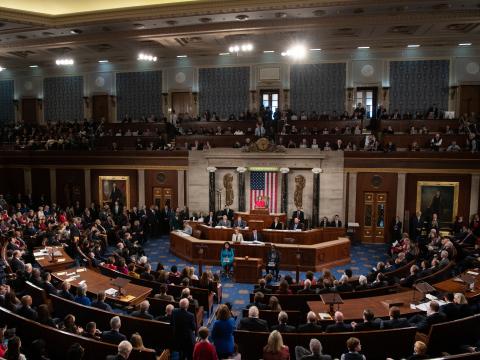
The opportunity before the House is the selection of their next Speaker. [Photo credit/source: U.S. House of Representatives.]

Yes, I know the House Republicans have pre-selected Minority Leader Kevin McCarthy. But he may not have the support of a House majority when the vote is taken Jan. 3.

Rather than leave McCarthy with the need to yield power to his no-compromises, election-denying, party-without-a-platform, MAGA, extremist, insurrectionist House members, how about the ultimate bipartisanship?

Each party can have its leadership. And tradition would dictate a Speaker from the House majority party. But shouldn’t the Speaker be the choice of both major parties?

There is precedent. In 1910, dissatisfied Republicans joined Democrats in stripping Speaker Joseph Cannon of some powers. In 1997, Republican Speaker Newt Gingrich feared dissenting Republicans would vote with Democrats, making Democrat Dick Gephardt Speaker. In Nancy Pelosi’s 2021 election as Speaker, two votes went to neither her nor McCarthy, and three members voted “present.”

On a more positive note, since 2017 the House “Problem Solvers Caucus,” with 58 members (29 from each party), has been successfully seeking to foster bipartisan cooperation on key policy issues.

Wouldn’t it be worth a similar try to build a majority from both parties that could agree on a Republican Speaker who would serve all House Members? A Speaker indebted only to them, with no need for concessions to those Members more interested in winning a war with the “enemy” party than legislating for the American people.

Like Huckabee’s airplane, the House needs wise adults on left and right. With or without a bipartisan speaker, hopefully this dream of one may inspire other proposals for converting the current mudball fight into a legislative body of problem solvers worthy of the name — and the U.S. House.

Nicholas Johnson is the author of “Columns of Democracy.” mailbox@nicholasjohnson.org

SOURCES

Picking presidents. “It’s Huckabee; My Republican Pick: Governor Mike Huckabee,” July 24, 2007, https://fromdc2iowa.blogspot.com/2007/07/its-huckabee.html

Speaker of the House:

Constitution. “The House of Representatives shall chuse their Speaker and other Officers; and shall have the sole Power of Impeachment.” U.S. Constitution, Art. I, Sec. 2, https://constitution.congress.gov/constitution/.

“Speaker of the United States House of Representatives,” Wikipedia.org, https://en.wikipedia.org/wiki/Speaker_of_the_United_States_House_of_Representatives (“The most recent election for House speaker took place January 3, 2021, on the opening day of the 117th United States Congress, two months after the 2020 House elections in which the Democrats won a majority of the seats. Incumbent speaker, Democrat Nancy Pelosi, secured a narrow majority of the 427 votes cast and was elected to a fourth (second consecutive) term. She received 216 votes to Republican Kevin McCarthy's 209 votes, with two votes going to other persons; also, three representatives answered present when their names were called.[34]” …”In 1997, several Republican congressional leaders tried to force Speaker Newt Gingrich to resign. However, Gingrich refused since that would have required a new election for speaker, which could have led to Democrats along with dissenting Republicans voting for Democrat Dick Gephardt (then minority leader) as speaker.” … “non-members have received a few votes in various speaker elections over the past several years.[8] Every person elected speaker, however, has been a member.[7] … As the Constitution does not state the duties of the speaker, the speaker's role has largely been shaped by traditions and customs that evolved over time.” ,,, “In 1910, however, Democrats and several dissatisfied Republicans joined together to strip Cannon of many of his powers, including the ability to name committee members and his chairmanship of the Rules Committee.[18]” … “John Boehner was elected speaker when the 112th Congress convened on January 5, 2011, and was subsequently re-elected twice, at the start of the 113th and 114th Congresses. On both of those occasions his remaining in office was threatened by the defection of several members from his own party who chose not to vote for him.[23][24]”)

Capitalization. “'Speaker' an exception,” Chicago Manual of Style, https://www.chicagomanualofstyle.org/qanda/data/faq/topics/Capitalization/faq0003.html

House leadership. McCarthy. John Wagner and Mariana Alfaro, “Republicans engage in full-scale brawl after disappointing midterm elections,” The Washington Post, Nov. 15, 2022, https://www.washingtonpost.com/politics/2022/11/15/mccarthy-speaker-house-control-midterms/

Marianna Sotomayor, “As Pelosi backs away, a new generation of Democrats steps forward; Democratic lawmakers both seasoned and new embraced the prospect of a fresh start, while recognizing the massive impact Pelosi has had,” Washington Post, Nov. 18, 2022, https://www.washingtonpost.com/politics/2022/11/18/pelosi-backs-away-new-generation-democrats-step-forward/ (“Reps. Hakeem Jeffries (N.Y.), Katherine M. Clark (Mass.) and Pete Aguilar (Calif.) have emerged as the expected leaders …. Jeffries, 52, would break barriers as the first Black person to lead any party in either chamber of Congress. Clark, 58, could become the second woman to serve as minority whip, and Aguilar, 43, would be the second Hispanic lawmaker to chair the caucus if elected this month.” “… Kevin McCarthy (R-Calif.), who earned the GOP conference’s nomination to be speaker next term ….” “Republicans begin to acknowledge that they will have to rely on Democrats to approve must-pass legislation to overcome their razor-thin majority.”

Problem solvers. “Problem Solvers Caucus,” https://problemsolverscaucus.house.gov/about

“Problem Solvers Caucus,” https://en.wikipedia.org/wiki/Problem_Solvers_Caucus (“The Problem Solvers Caucus is a bipartisan group in the United States House of Representatives that includes members equally divided between Democrats and Republicans, who seek to foster bipartisan cooperation on key policy issues. The group was created in January 2017 as an outgrowth of meetings held by political organization No Labels starting in 2014.[5].” … “Today, the Problem Solvers Caucus is co-chaired by Rep. Josh Gottheimer (D-NJ) and Rep. Brian Fitzpatrick (R-PA), and counts 58 members evenly divided between the parties, who are working to forge bipartisan solutions to America's toughest challenges.[6]”)

# # #

Thursday, May 19, 2022

Why Iowa Dems Should Back Franken

Click HERE for Nicholas Johnson, "Mike Franken is a Democrat with Statewide Appeal," Iowa City Press Citizen, May 18, 2022, p. A7.

Click HERE for two-minute video, "Johnson Endorses Admiral Mike Franken," Aug 5, 2022.

Franken Experienced in D.C. Government
Nicholas Johnson
The Gazette, May 29, 2022, p. C2

I’ve often supported losing candidates whose utopian hopes aligned with mine. Everything being equal, I’ve chosen women candidates.

Today things aren’t equal.

Not this primary. Not among Iowa Democrats’ U.S. Senate choices. All Iowans will benefit from having a Democrat join our Republican. Plus, there’s much each senator can do for Iowa – whichever party controls the Senate.


For winning, the strongest candidate is former Admiral Mike Franken, hands down. He already knows Washington, with personal experience in the Senate, White House and Pentagon. His leadership skills have been recognized and rewarded. He will immediately have the respect of the other senators.
[Photo credit: "Franken for Iowa" Facebook page.]

Most important in winning, Franken was raised and shaped by Western Iowa.

Republican majorities carry 93 of our 99 counties. Democrats need a goal of a more statewide political party.

Based on my time in Ida County, and in north central Iowa during my 1974 congressional primary, Mike Franken’s demeanor, record, common sense, and ties to the people in small town western Iowa will help Iowa’s Democrats reach that goal.

Nicholas Johnson
Iowa City

SOURCES

Franken’s “experience in the Senate, White House and Pentagon. His leadership skills have been recognized and rewarded.”

“In Washington, D.C., he served a fellowship in congressional affairs for the Office of the Secretary of the Navy; as the political-military chair in the Chief of Naval Operations' Executive Panel, in Navy's Plans and Strategy Deep Blue staff; in the Assessments Division in support of Navy's representation in the Joint Requirements Oversight Council and in the Joint Staff's Joint Operations Division overseeing U.S. Pacific Command operations. He presented the worldwide orders book to Secretary Donald Rumsfeld from 2003 to 2005 and was the first military officer to serve as a legislative fellow for Senator Ted Kennedy.[4]” “Michael T. Franken,” Wikipedia, https://en.wikipedia.org/wiki/Michael_T._Franken

“Franken earned a bachelor’s degree in engineering, a master’s degree from the College of Physics at the Naval Postgraduate School and professional studies at MIT, UVA’s Darden School of Business, and the Brookings Institute.[1] Franken was a member of the U.S. Navy. He retired from military service as a three-star admiral in 2017.[1] Franken worked in a variety of positions in Washington, D.C. He was the first military officer on Senator Ted Kennedy’s staff. He also worked in the U.S. Department of Defense.” “Michael Franken,” BallotPedia, https://ballotpedia.org/Michael_Franken

“He saw sea duty in four navy destroyers, a destroyer squadron, and an aircraft carrier. He deployed frequently to the world’s hotspots and was the first commanding officer of the USS WINSTON S CHURCHILL. He has significant Pentagon experience beginning with a legislative tour with Senator Edward Kennedy, and then in multiple strategy, policy, and planning positions involving the Indo-Pacific, the Middle East, Europe, and Africa. In these uncertain times with our democracy under attack, Iowans need Admiral Mike Franken in the US Senate. Through his work in the US Navy and at the Pentagon, Mike knows the global challenge of Russian aggression, and the propaganda and disinformation tactics used by Vladmir Putin. . . . Michael Franken has dedicated his life to serving our country and doing what’s right. Franken was the only voice on a team of military advisers to oppose George W. Bush’s invasion of Iraq. Franken served under President Barack Obama and oversaw numerous successful missions to protect our country including leading U.S. forces in Africa to fight terrorists and pirates.” Franken for Iowa, https://frankenforiowa.com/about/

“raised and shaped by Western Iowa.” “Franken was born the youngest of nine children in rural Sioux County, Iowa. His father was a machinist and blacksmith. His mother was a school teacher. He joined the navy at age 22 at the urging of an older brother.[9] In 1989, Franken married his wife Jordan. Together, they have two children.[10] Franken lives in downtown Sioux City, Iowa.” “Michael T. Franken,” Wikipedia, https://en.wikipedia.org/wiki/Michael_T._Franken

“Franken was born in Sioux County, Iowa. He was one of nine children. During his youth, Franken worked alongside his father at the Lebanon Farm Shop, working with farm equipment and trucks. When he was 17 years old, Franken began working at Sioux Preme Packing Company to pay for college. He also worked as bar manager, math tutor, bouncer, and as a law firm’s civil engineer.” “Michael Franken,” BallotPedia, https://ballotpedia.org/Michael_Franken

“Mike grew up working in his father’s small machine shop where he ran a lathe, did welding, and helped with general implement repair. He was a hired hand for neighboring farms until, at the age of 17, he began a three-year-stint working at a slaughterhouse in Sioux Center, Iowa. He obtained a Navy scholarship in 1978 and graduated in engineering from the University of Nebraska. . . . His life in Lebanon, Iowa has taught him the values of community, family, faith, and rural life, which guides his efforts to invest and build in rural Iowa. . . . As the father of a child with disabilities, he has seen how inconsistent care can be in years where he was transferred 17 different times. She would have great support in one community and the next there would be no support. For his daughter and for veterans who were injured, he seeks to pick up the banner of former Senator Tom Harkin as a disability advocate.” “Franken for Iowa,” https://frankenforiowa.com/about/

“Republican majorities carry 93 of our 99 counties.” Trump carried 93 of 99 Iowa counties in 2020. “Donald Trump Won in Iowa,” Politico, Jan. 6, 2021, https://www.politico.com/2020-election/results/iowa/

# # #

Mike Franken is a Democrat with Statewide Appeal
Nicholas Johnson
Iowa City Press Citizen, May 18, 2022, p. A7

I’ve often supported losing candidates whose utopian hopes align with mine. Everything being equal, I choose the woman candidate. But things aren’t equal.

Not this year, not with Iowa Democrats’ U.S. Senate primary choices. It’s too important that Iowa have one Democratic senator. There’s much they can do for Iowa, even if Republicans control the Senate.

For winning, the strongest candidate is former Admiral Mike Franken, hands down. He’s already had Senate experience.

It’s worrisome Abby Finkenauer didn’t have a surplus of nomination signatures, and that she burned through 95% of her early successful fundraising.

Well over 90% of House members are re-elected. Finkenauer is not in that percentage. An inability to get reelected in an eastern Iowa district doesn’t bode well for getting elected statewide.

Donald Trump carried 93 of Iowa’s 99 counties. Democrats need a statewide following and party.

Based on my time in Ida County, and in north-central Iowa during my 1974 congressional primary, I believe Franken’s demeanor and ties to the people in smalltown western Iowa will help reach that goal.

Once in Washington, he will immediately enjoy the respect of the other senators.

Nicholas Johnson, Iowa City

# # #

Wednesday, February 10, 2021

Democrats’ ‘Bridge Too Far’

Struggling Democrats Must Build More Bridges

Nicholas Johnson
The Gazette, Feb. 10, 2021, p. A6

Linn County Auditor Joel Miller says, “to run for statewide office may be a bridge too far if the Democratic Party cannot broaden their appeal in rural Iowa.”

He’s an optimist. The reality’s worse.

Color Iowa’s 99 counties red and blue. Six went for Joe Biden (the three with state universities, plus Linn, Polk and Scott); 93 for the former president – 94 percent.


That’s even worse than the national map: 83 percent of the nation’s counties are red; 17 percent are blue. [Photo credit: U.S. Bureau of Land Management]

Yes, I know. We don’t vote by county. Besides, half of the country’s population lives in only 143 of those counties (5 percent) – enough to make Joe Biden president.

But a political party that relies on the east coast for money and the left coast for votes is not a national party. Democrats shouldn’t be surprised to discover they’ve alienated voters in that 83 percent of U.S. counties who feel ignored and have understandably turned anti-establishment.

It doesn’t have to be this way. There was a time when it wasn’t.

An oft-told story bears repeating.

As Ken Burns tells it, “When FDR's funeral procession went by, a man collapsed; he was so overcome. A neighbor picked him up and said, 'Did you know the president?' And he responded, 'No, but he knew me.'"

Few presidents since have made that connection. President Biden has a chance.

President Franklin Roosevelt’s legacy was a Democratic Party tent sheltering those in abject poverty, the working poor, union members, small farmers, and lower middle class. Had the party nurtured that coalition instead of Wall Street, knocked on their doors and listened, it would today control most city councils and state legislatures -- plus the U.S. House, Senate and White House.

Two Texas Democratic Party officials asked me, a college student, to run for the Legislature. Stunned, I explained I was an Iowa boy, with two part time jobs, a heavy course load and knew few Austin voters.

They responded with a story of another recruit. He mumbled while talking to his shoes and asking voters, “You wouldn’t vote for me would you?”

Now understanding their standards, and decidedly less flattered, I asked, “How’d he do?”

“He won,” one replied. “He knocked on every door in Travis County – and won.” I took a pass on that opportunity.

But I remembered the lesson during the 1962 Pat Brown-Richard Nixon gubernatorial race, door knocking in an unorganized county where I knew fewer voters than I’d known in Travis County, Texas. If they were willing to door-knock I’d assign them an area and move on.

Could the Democratic National Committee find at least one experienced campaign organizer to work each of the 2500 counties now painted red? Of course. And it must if it is to be a national party representing more than 5 percent of America’s counties and 50 percent of its people, building bridges well within Joel Miller’s reach.
_______________
Nicholas Johnson of Iowa City held three presidential appointments and is the author of Columns of Democracy. Comments: mailbox@nicholasjohnson.org

SOURCES

Joel Miller. Gage Miskimen, “Linn County Auditor Considers Run for Secretary of State,” The Gazette, Feb. 2, 2021, p. A3; https://www.thegazette.com/subject/news/linn-county-auditor-may-run-for-secretary-of-state-in-2022-20210202

Republican counties. Iowa Trump 93 Biden 6 (Black Hawk, Johnson, Linn, Polk, Scott, Story, https://www.politico.com/2020-election/results/iowa/

Republican counties U.S. “The Biden and Trump data in the posts appears to match the information reported by the Brookings Institute on Nov. 7. On Dec. 8, the think tank updated the report to say Biden had won 509 counties and Trump 2,547 counties, according to ‘unofficial results from 99% of counties.’” [Me: 509+2547=3056] https://www.reuters.com/article/uk-factcheck-votes-counties-election/fact-check-clarifying-the-comparison-between-popular-vote-and-counties-won-in-the-2020-election-idUSKBN2931UY

143 counties, half population “U.S. Census Bureau, population is not homogeneously distributed across the country. In 2017, out of a total of 3,142 counties and county equivalents more than half of the population inhabited just 143 counties. https://www.reuters.com/article/uk-factcheck-votes-counties-election/fact-check-clarifying-the-comparison-between-popular-vote-and-counties-won-in-the-2020-election-idUSKBN2931UY

“But he knew me.” Google search [“did you know" no "but he knew me"] turns up dozens of sources where quoted/told, but in sample none discovered with a citation to an acceptable academic or journalistic source. Maybe Ken Burns’ is the best for authenticity: Bob Fisher, “Ken Burns Spends 14 Hours with ‘The Roosevelts,” Documentary Magazine, Sept. 12, 2014, https://www.documentary.org/online-feature/ken-burns-spends-14-hours-roosevelts

# # #

Monday, September 23, 2019

Understanding Trump: Know Thine Opponent

Understanding Trump

For 2500 years humans have been advised of the importance of knowing, of understanding, one's opponent in politics and enemy in war. Notwithstanding the availability of such advice it is more often ignored than followed -- including our "wars" in Vietnam and soon-score of years in Afghanistan.

The first known offer of this advice came from a famous Chinese general, Sun Tzu (544-496 B.C.). He wrote:
If you know the enemy and know yourself, you need not fear the result of a hundred battles. If you know yourself but not the enemy, for every victory gained you will also suffer a defeat. If you know neither the enemy nor yourself, you will succumb in every battle.
Sun Tzu, The Art of War, III. Attack by Stratagem, 18.

I read books when I have time to sit. When I'm driving, walking, or tending to home chores that require my eyes but not my ears, I listen to audiobooks. This morning, while doing kitchen chores, I was listening to Cliff Sims' Team of Vipers. Sims was involved with the Trump campaign and White House and seems capable of a relatively balanced portrayal of the President -- at least as far as I am in the book. What he said reminded of Sun Tzu, so much so that one section of Sims' chapter 7 caused me to go back to it later, when at my laptop and able to transcribe it. [Photo: Cliff Sims with President Trump on walkway outside Oval Office; photo credit: Yellowhammer News]

Cliff Sims was describing former Speaker Newt Gingrich's effort to categorize politicians by using the ancient Greek poet Archilochus' line, "a fox knows many things, but a hedgehog one important thing." Hedgehogs are the "big picture guys." Foxes are the policy wonks, focused on details and creative alternative solutions to problems.

With these ancient literary sources in mind, here is what Sims wrote:
Trump is a hedgehog who knows one very big thing: 'We need change.' . . . He is the agent who will deliver the needed change. . . . Trump believes he alone, often through shere force of will, can solve certain problems. That's one lens. Layered on top of that is his belief that all of life is a negotiation, and that all negotiation is a zero-sum game. There's no such thing as a 'win-win.' Someone will win and someone will lose. Layered on top of that is his belief that personal relationships are paramount, taking precedence in all negotiations, even over mutual interests. And layered on top of that is his belief that creating chaos gives him an advantage, because he's more comfortable in the mayhem than anyone else.
Make of it what you will. This characterization of Trump helped me to understand the Democrats' opponent. And I'm with Sun Tzu -- knowing, understanding, Trump is an essential part of any successful campaign.
# # #
See also, "Trump Will Lose? Don't Be So Sure,""The Gazette, May 29, 2019, p. A6.

# # #

Friday, September 20, 2019

Presidential Qualities

Considering Bullock's Presidential Qualities

Nicholas Johnson
The Gazette, September 18, 2019, p. A6

Democrats will end up voting for whomever their convention picks. This column is too early for an endorsement. My favorite will be someone as a campaigner who can beat President Trump, and as president will have the competence, compassion, relationships, experience and ethics to be effective.

Get out the vote? Yes. But to win the Democrats’ candidate will have to win over independents, Libertarians, Greens, and yes, Republicans and the 40-percent-plus of voters who still support President Trump. Where do those voters live? Where Democrats must go to become a national party: those 80 percent of U.S. counties that President Trump carried in 2016.

Earlier I wrote about Marianne Williamson’s formula for Democrats’ victory – while acknowledging her odds of becoming the party’s candidate were somewhere between slim and none. ("Trump Won't Be Beat With Plans Alone," The Gazette, Aug. 17, 2019) Governor Steve Bullock’s current odds may be no better. But his qualities and strengths are something Democrats should look for in whomever they choose next July.

Bullock is the only incumbent Democratic governor to win re-election in a state that Trump carried (in Montana by 20 points).

He’s persuaded his Republican Legislature to pass progressive programs: campaign finance reform, Medicaid expansion and more. He is, as we say, mostly “right on the issues,” both as governor and as campaigner.

He’s been sufficiently pro-labor as Montana’s attorney general, governor and practicing lawyer to have been endorsed by the AFL-CIO – and Iowa’s Attorney General Tom Miller. And he’s sufficiently respected by other governors to chair the National Governors Association.

He is a young 53. I have two sons older than that.

He and his wife, Lisa, grew up in Montana, have been married to each other for 20 years and have three children. Both are well educated; he has a law degree, with honors, from Columbia, she a degree in mathematics and computer science.


[Photo credit: Gage Skidmore; https://commons.wikimedia.org. Governor Steve Bullock speaking with attendees at the 2019 Iowa Democratic Wing Ding at Surf Ballroom in Clear Lake, Iowa.]

He comes across as genuine, comfortable in his skin and his Levis. He can connect with small town folk, farmers, ranchers, and others in the mountain time zone and the 80 percent of counties Trump carried, as well as Washington (where he practiced law) and New Hampshire, where he’s picked up support.

We have no training program for presidents. Any president would benefit from experience on the receiving end of the White House’s impact on school boards, cities, counties, state governors, legislatures, the U.S. House and Senate, military, intelligence and executive branch agencies, federal courts, international organizations and our allies.

No Democratic presidential candidate today has the range of experience in those venues possessed by President George H.W. Bush (43’s father) or former New Mexico Governor Bill Richardson (tinyurl.com/y4tt2zb8).

“Senator” is not an administrative position. Governors come the closest to the administrative and legislative challenges confronting presidents; 17 presidents had experience as governors.

Whomever the Democrats ultimately choose, Bullock provides examples of the strengths they should be seeking.

__________
Nicholas Johnson of Iowa City is a three-time presidential appointee whose latest book about Washington is Catfish Solution. Comments: mailbox@nicholasjohnson.org

# # #

Links to Governor Bullock Sites
As explained in the opening paragraph, this blog post is NOT an endorsement. But if you are intrigued by what you've just read, here are links to Governor Bullock's Web site and some of his supporters' Facebook pages:

Web Page
Bullock 2020, https://stevebullock.com, and see "Meet Steve," https://stevebullock.com/meet-steve/

Facebook
Steve Bullock For President
https://www.facebook.com/groups/stevebullock/
Bullock For America
https://www.facebook.com/groups/bullockforamerica/
Governor Steve Bullock
https://www.facebook.com/GovernorBullock/
Gov. Steve Bullock For President 2020 https://www.facebook.com/Gov-Steve-Bullock-For-President-2020-398433613859824/

And here are some of the sources used in writing this post:

Sources
(1) Brandon Duffy, “Democratic hopeful Steve Bullock on what Amazon and President Trump have in common, and why young voters should care,” CNBC, Sept. 1, 2019,

https://www.cnbc.com/2019/09/01/2020-candidate-steve-bullock-on-what-amazon-and-trump-have-in-common.html

(2)Wikipedia, “Steve Bullock (American politician),”

https://en.wikipedia.org/wiki/Steve_Bullock_(American_politician)

(3) S Grace Panetta, “Steve Bullock is running for president in 2020. Here's everything we know about the candidate and how he stacks up against the competition,” Business Insider, Jul. 31, 2019, 11:11 AM

https://www.businessinsider.com/who-is-steve-bullock-age-bio-family-key-positions-2019-5

(4) Steve Bullock’s Biography, Vote Smart,

https://votesmart.org/candidate/biography/110899/steve-bullock#.XW8ZAOhKiM8

(5) Jonathan Martin, “Steve Bullock, Montana Governor, Is Running for President,” New York Times, May 14, 2019, p. A18,

https://www.nytimes.com/2019/05/14/us/politics/steve-bullock-2020.html

(6) Steve Israel, “Can Steve Bullock Win?” The Hill, Aug. 21, 2019,

https://thehill.com/opinion/campaign/458172-can-steve-bullock-win

(7) “First Lady Lisa Bullock,” Office of Governor Steve Bullock,” undated,

https://governor.mt.gov/First-Lady

(8) “List of Presidents of the United States by Previous Experience,” Wikipedia

https://en.wikipedia.org/wiki/List_of_presidents_of_the_United_States_by_previous_experience

(9) The tinyurl following the Governor Bill Richardson experience reference (https://tinyurl.com/y4tt2zb8) links to one of my prior Gazette columns, “Candidates’ ‘Experience,’” (The Gazette, March 30, 2008, p. A9, https://tinyurl.com/y4tt2zb8)

(10) For number of counties carried by Trump in 2016 see, e.g., Mark Muro and Sifan Liu, “Another Clinton-Trump Divide: High-Output America vs Low-Output America,” The Avenue, Brookings, Nov. 29, 2016

https://www.brookings.edu/blog/the-avenue/2016/11/29/another-clinton-trump-divide-high-output-america-vs-low-output-america/

# # #

Note: Some of the handful of words that were deleted for reasons of space in the published column have been included in this version.

Saturday, August 17, 2019

Marianne Williamson’s Questions and Answers

Reading from latest book, #CatfishSolution, next Saturday, Aug. 24, #IowaCity's #PrairieLights, 4-5PM. Hope to see you there.
____________

Trump Won't Be Beat With Plans Alone

Nicholas Johnson
The Gazette, August 17, 2019, p. A5

Where the column as submitted differs from the column as published the submission is indicated in [brackets] and italics.

Marianne Williamson may not have “the answer.” But she’s the only one who has framed the right questions [– the essential first step to finding answers.] Whether or not that qualifies her to be president, it clearly qualifies her to be a [Democratic Party] campaign strategist. Those who trivialize and mock her do so at their party’s and America's peril.

Here are the questions: "What strategy is President Donald Trump using?" and "What strategy does that require of Democrats?" [One might modify Williamson’s answers, but she's correctly answered the first question and pointed us in the right direction on the second.]

At the June 27 Democratic Debates, she warned the Party that plans are not enough: “Donald Trump … didn’t win by saying he had a plan."

She doesn’t advocate abandoning 20th Century political strategies. Democratic Party candidates still need to meet party members who now stay home or vote Republican – especially the ones living in the 80 percent of American counties that Trump carried in 2016. The candidates must show up, really listen to voters’ challenges and needs, and propose plans that at least outline solutions.
[Photo credit: By Supearnesh - Own work, CC BY-SA 4.0, https://commons.wikimedia.org/w/index.php?curid=80914139]

But Williamson closed that Debate by posing and answering the first question: "Donald Trump is not going … to be beaten just by somebody who has plans. He is going to be beaten by somebody who has an idea what this man has done. This man has reached into the psyche of the American people and he has harnessed fear for political purposes."

She’s right about that. Trump won, and may win again, by personally utilizing the same strategy in speech [and tweet] that he and the Russians use in their social media campaigns.

Trump may or may not believe in climate-change science, but he sure believes in the neurological science of the amygdalae, limbic cortex and brain stem, some of the most phylogenetically primitive regions of the brain. He believes in the science of reward and addiction that increase smart phone, videogame and slot machine players’ TOD (time on device); advertisers manipulating consumers into buying things they don't need, with money they don't have, to impress people they don't like; gaslighting, social psychology’s findings regarding groups’ influence on individuals; and the science behind propaganda [and the big lie.]
[Photo credit: public domain, http://lbc.nimh.nih.gov/images/brain.jpg (found on page http://lbc.nimh.nih.gov/osites.html).]

In short, he understands the role of fear, anger and hatred of "the other" [in successful campaigns.] He knows the [2020] presidential election will be won more by targeting the most primitive regions of the brains of [140 million or more] voters than by what’s aimed at their cerebral cortices.

So, "What strategy does that require of Democrats?"

Williamson says, "I have had a career harnessing the inspiration and the motivation and the excitement of people." And in her closing statement said that Trump has "harnessed fear for political purposes and only love can cast that out. . . . I’m going to harness love for political purposes."

Her use of the word “love,” with its romantic associations, was neither a precise nor helpful choice in this political context. The Greco-Christian term “agape” would have been only marginally better.

The challenge is much more complex. Trump is strategically increasing the emotions of hate and fear. [In this contest on a playing field in the most primitive regions of Americans’ brains,] what can Democrats do to excite even greater emotional responses involving compassion, empathy, and feelings of community [necessary to our “more perfect union”]?

Marianne Williamson’s questions are a major contribution that deserves understanding and appreciation. Now it’s up to Democrats’ candidates to craft and apply the answers.
__________
Nicholas Johnson is a native Iowan and three-time presidential appointee; his latest book is "Columns of Democracy." [Nicholas Johnson, a native Iowan and former FCC commissioner, will be doing a reading from his latest book, Catfish Solution, at Iowa City’s Prairie Lights, Aug. 24, 4:00-5:00. Contact:: mailbox@nicholasjohnson.org]

# # #

Wednesday, June 26, 2019

Everybody Gets an Office

Everybody Gets an Office, Even the Losers

Nicholas Johnson
The Gazette, July 7, p. D2

Democrats have 13 categories of challenges Nov. 3, 2020. ("Why Trump May Win,” May 29, 2019). One of the 13 was on display at The Gazette/Iowa Public Radio’s June 20 Pints & Politics: Why 23 outstanding, qualified candidates are as much curse as blessing. Ben Kieffer asked the 150 politically savvy attendees to applaud if they’d picked their candidate. Only one did. Everyone else clapped for “haven’t picked one.” Two debate nights later many remain undecided. [Photo credit: Nicholas Johnson, Pints & Politics audience, Big Grove Brewery, Iowa City, June 20, 2019.]

Followers of the 22 “losers” may lack enthusiasm for the ultimate winner. What to do? How about this: Have all 23 individually pledge that if they win, they will offer an appropriate, important position in their administration to each of the 22 former candidates who want one (e.g., White House, cabinet, major agency, ambassadorship). They can all have offices, though only one is oval. In other words, we kind of elect all of them. Would that make you more enthusiastic for the winner if your choice loses? What do you think?

Nicholas Johnson
Iowa City
# # #

Everybody Gets an Office

Nicholas Johnson
Iowa City Press-Citizen, June 26, 2019, p. A7

Democrats have 13 categories of challenges Nov. 3, 2020. See “Why Trump May Win.” One of the 13 was on display at a recent local gathering of 150 politically savvy folks: Having 23 outstanding, qualified candidates is as much curse as blessing. The host asked the group to applaud if they had picked their candidate. Only one person responded. Everyone else clapped when asked if they “hadn’t yet picked one.”

Followers of the 22 “losers” may lack enthusiasm for the ultimate winner. What to do? How about this: Have all 23 individually pledge that if they win they will offer to each of the other 22 an important administration position (for which they are qualified) to every former candidate who wants one (e.g., White House, cabinet, major agency, ambassadorship). They all get offices, though only one is oval. In other words, we kind of elect all of them. Would that make you more enthusiastic for the winner if your choice loses? What do you think?

Nicholas Johnson
Iowa City

# # #

Monday, April 15, 2019

Presidential Candidates' Rankings and Experience

Democratic 2020 Presidential Primary:
Candidates, Rankings and Experience
April 15, 2019; updates April 23, 25, 26
Related:
* Presidential Candidates Rankings, April 15, 2019 (with updates)
* Impeachment and the Mueller Report, April 22, 2019 (with update),
* Presidential Experience: How Your Candidate Measures Up, April 28, 2019
* Democrats Qualified for Debates: Will Your Candidate be in the Debates? April 29, 2019
* Dem Primary Candidates' Ranking - May 2, 2019: How's Your Candidate Ranked?, May 2, 2019
* May 4 Updates: Popularity; Klobuchar; Iowa 2nd District, May 4, 2019
* What Dems are up against; some insights from 2-1/2 years ago: Donald Trump’s Barrel of Squirrels: How Does the Donald Do It? Sept. 26 2016
* Attacks on our democracy and what we can do about it: Columns of Democracy available from Iowa City’s Prairie Lights and Amazon.
Introduction
This site is intended to be an entertaining conversation starter for those who enjoy and follow politics and have maintained enough civility to continue to speak about such matters with friends and family.

I have not endorsed any candidate, and am not now working in any candidate's campaign. (If and when that changes I will post a notice to that effect.)

Moreover, this blog post does not engage in the foolishness of forecasting -- especially this early in the campaign. Plenty of "unknown unknowns" will be encountered along the road to November 3, 2020, any one of which can change the outcome during a single news cycle.

This is simply one approach to the question, "Where are we now?"

The Ranking
As of today (April 15) Ballotpedia.org reports there are 227 Democratic Party candidates, 84 Republicans, 24 Libertarians and 14 from the Green Party.
Update April 23, 2019: As one would expect, the number of candidates remains relatively steady: Democrats up 2 to 229, Libertarians up 1 to 25, Republicans and Greens steady at 84 and 14. Ballotpedia (a site full of additional interesting and useful data as well).
We will be reporting on the top three or four Democrats, as measured by four criteria: popularity with voters, money raised, number of donors, and weighted endorsements.

My judgment as to the top four at this time, considering all four criteria, are: Bernie Sanders, Kamala Harris, Beto O'Rourke and Cory Booker (pictured below in that order; first three from Wikimedia, no Wikimedia of Booker so used selfie he took). Here's how they rank:

Popularity (from Real Clear Politics): Sanders, 21.7%; O'Rourke, 8.3%; Harris, 7.8%, Booker, 3.7%. (Biden, at 31.2%, is excluded from this ranking because he has not yet entered the race.) Rolling Stone, presumably also measuring popularity, changes rankings each week. This week they are consistent with Real Clear Politics' findings. Currently, Rolling Stone's rankings for this and last week were: Sanders (1, 1), Harris (2, 2), O'Rourke (4, 3), Booker (7, 6).
Update April 23, 2019: This week we expand the leaders' group from 4 to 6: At the top, Biden (30%) and Sanders (22.5%); in the next cluster O'Rourke (8.8%), Harris (8.5%), with Buttigieg and Warren tied at (6.0%). Real Clear Politics. The latest single poll, Monmouth, April 23, reports (name; percentage): Biden 27; Sanders 20; Harris 8; Buttigieg 8; Warren 6. Rolling Stone changed slightly to Real Clear Politics' 5: Sanders, Harris, Warren, O'Rourke, and Buttigieg (in that order).

Joe Biden. Of course, with Biden at 30%, and predictions he'll announce this Wednesday (April 24), that's a game-changer for the current front runners. April 25: It finally occurred this morning, rather than yesterday. It will be a couple of weeks before we can gather and update info on his money, number of donors, endorsements -- and whether his announcement will increase, or decrease, his support percentage.
April 26: Biden's announcement April 25 produced little news and less enthusiasm from most media. Many stories led with a list of reasons why Democrats should not, and will not, select him as their candidate, along with reporting President Trump's disparaging nickname for him: "Sleepy Joe." Here's an example: Jonathan Martin and Alexander Burns, "5 Questions That Will Determine if Joe Biden Can Succeed," The New York Times, April 25, 2019, p. A17. No candidate among the 20 now considered serious candidates has the range and depth of experience essential to a president's competence on Day One (though all have more than the current incumbent). But as limited as even Biden's is (U.S. senator, vice president, two prior presidential primaries, some international), his experience exceeds that of any of the others. His pre-announcement popularity with voters (30%) also put him at the head of the pack. Kind words seemed relegated to the opinion pages. Here's Republican David Brooks, "Your Average Joe," The New York Times, April 25, 2019 [Photo: Joe Biden, World Economic Forum, 2005; Credit: wikimedia commons.]
Money Raised (in total dollars and dollars per day; from PBS Newshour): Sanders ($18.2M; $444,000/day); Harris ($12M; $171,000/day); O'Rourke ($9.4M; $520,000/day); Booker ($5M; $84,745/day). Note the consistency in the Money Raised ranking and the Popularity ranking.
Update April 23, 2019: PBS Newshour reports no changes from last week for Sanders, Harris and O'Rourke. But we should probabaly now note that Buttigieg has raised $7 million ($107,000/day) and Klobuchar $5.2 million ($104,000 per day), both ahead of Booker, last week and this, at $5 million.
Number of Donors (from New York Times, Feb. 9, 2019): Given that the first primary is "the money primary" (discussed in Commentary, below) the total donated to each candidate is a relevant measure of their strength for a variety of reasons, including popularity. But because it can be so significantly affected by the receipt, or rejection, of PAC money and other large contributions it can be deceiving. (And because candidates can solicit and count their $1.00 and $5.00 contributions, their "average" (i.e., mean) contribution can also be deceiving.)

Therefore, the number of donors is data worth considering. (Bear in mind, these numbers are significantly affected by how long the candidate has been in the race, and change daily if not hourly, but the calculation on any given day provides some useful information. The following ranking was reported by the Times on Feb. 9 of this year.) Our current four candidates (Sanders, O'Rourke, Harris, Booker) are ranked 1, 2, 5, 8. Sanders, 1.2 million; O'Rourke, 743,000; Harris, 239,000; Booker, 56,000. (Those ranked 3, 4, 6, 7 are Elizabeth Warren (343,000), Kirsten Gillibrand (272,000), Sherrod Brown (114,000), and Jeff Merkley (105,000).
Update April 23, 2019: Some candidates report number of donors, others don't (e.g., Cory Booker). Some indication of numbers can be gathered from data regarding average contributions. Here's a CBS News report as of April 15. Emily Tillett, "2020 Democratic Presidential Candidates Reveal First Quarter Fundraising Efforts," CBS News, April 15, 2019.
Sanders - 900,000 donors (includes 100,000 Independents, 20,000 Republicans) - 99.5% of donors gave less than $100, 88% of money came in $200 or less amounts - average donation $20
Harris - 218,000 donors - 98% less than $200 - average $28
O'Rourke - 218,000 donors - 98% less than $200 - average $43
Buttigieg - ($7,000,000) - 158,550 donors - 64% less than $200 - average $36.35
Warren - 135,000 donors - 99% less than $200 - average $28
Endorsements (from 538's points allocation system, from one to ten based on prestige/influence of the endorser): Booker (57), Harris (55), Sanders (21), O'Rourke (14).
Update April 23, 2019: Booker, Harris and O'Rourke are unchanged (57, 55, 14). Sanders is up one (to 22). And there are three additions for us this week: Klobuchar, who leaped to third place at 44; Biden, who is now being included, at 21; and Warren at 18. (Buttigieg is ranked ninth with 8 endorsement points.) FiveThirtyEight.

Update April 29, 2019: Big news, but no surprise: following Biden's declaration of candidacy he arrived on FiveThirtyEight's endorsement chart at number one, with 75 points. Booker (2), Harris (3), Sanders (6), and O'Rourke (7) still unchanged (at 57, 55, 22 and 14 points each). Klobuchar (4) has dropped from 44 to 39 points. Warren (5) is up from 18 to 23; Buttigieg (9) has risen from 8 to 11 points.
Commentary.
In terms of the concerns I've expressed regarding attacks on our democracy (Columns of Democracy), the Popularity ranking (Sanders, (O'Rourke, Harris, or Harris, O'Rourke), Booker), though both imperfect and clearly premature, comes the closest to "the people's choice." Money Raised, which produced the same ranking, and Number of Donors, which produced a similar ranking, are similar measures -- in this instance not just of the donor's marginal preference of one candidate over others, but of enough commitment to part with their money. (This is especially-to-only true if the candidate has refused PAC money and is relying on small contributions. To the extent money is coming from the 1%, PACs, and corporate bundling of checks we have a preliminary primary that Larry Lessig has called "the money primary," from which the surviving candidates are picked by the major donors who usually expect something in return. Voters are then left with choices from among only those candidates who have been cleared and "nominated" by America's most wealthy to run in the second primary.)

Endorsements raise separate, but related issues to those raised by "the money primary" -- as Bernie Sanders discovered in 2016. As the FiveThirtyEight site explains, "Party elites use endorsements to influence not only voters but also each other, hoping to get other powerful party members to rally behind the candidate they think would be most acceptable." In other words, just as there is "the money primary" there is also the "Democratic Party elites primary." Just as the major donors tend to have their own reasons for favoring one candidate over another, so do the Democratic Party elites.

Note that Booker and Kobuchar, who rank number one and three respectively with endorsements, rank 5 and 6 in fundraising, 7 and 8 in popularity, and 8 and 10 in number of donors.

Experience.
So far this blog has focused on candidates. There is another factor that should be relevant to voters, but is often overlooked. That is: if your candidate were to win the general election, and become president, which of their past experiences and skills give you some confidence they will be able to not only win election as president but be able to function with competence as president? That is the subject of the blog post "Presidential Experience," April 28, 2019.

Issues
Am I interested in "the issues," the new (and old) ideas being put forth by the candidates? You bet I am. I love to learn about new public policy ideas, research and write about them, and think up new ones of my own. I've spent much of my life doing just that.

Candidate Andrew Yang has a "platform" (scroll down his "policies" page) that looks like it has about 100 such proposals. I'll probably look through all of them at some point.

There will be something connected to this blog post about policy if this post becomes an ongoing project.

I care about a candidate's intelligence, their curiosity, their creativity. But more than their creative ideas, what I want to know is their understanding of the processes that can transform those ideas into a reality that has a positive impact on people's lives.

As I have put the question to every presidential candidate I have talked to during the past 40 years or so, "Why are coal miners going to be safer in the mines with you in the White House?" along with similar questions. In other words, "I like your proposals, but how are you going to make them happen when they will be so strongly opposed by the major donors to the House and Senate members whom you'll have to persuade to vote for them?"

It's relatively easy to come up with new ideas, even very popular new ideas -- especially if you have a research team to write them and they're tested with polling and focus groups before you reveal what they are, and you're able to follow the advice to "be sincere, even if you don't mean it." What's far from easy is having a Lyndon Johnson's knowledge of what it takes to translate those ideas into legislation that one can get through the House and Senate and still win reelection. Get your candidate to talk about that.

Meanwhile, I'll inform myself regarding what the candidates are proposing. It may reveal something about their background, values, process and focus. I just won't, ultimately, end up endorsing anyone based on their stump speeches alone.

# # #

Thursday, May 24, 2018

Democrats Should Choose Norris

Introduction: If Iowa Democrats hope to win the governorship in 2018, their strategy needs to change. Most recently, their presidential candidate, Hillary Clinton, carried only 6 of Iowa's 99 counties. In 2014 it was even worse. Their last candidate for governor, Jack Hatch, carried only one county, Johnson -- known to Iowans in the western part of the state as "the People's Republic of Johnson County."

Whoever gets the nod in the Democrats' June 5 primary (or June 16 convention) will have the support of virtually all the state's Democrats, and access to the necessary money, for the general election on November 6. Thus, the issue for Democrats voting in the primary really ought to be, not who can win the primary, but who has the best possibility of winning the general election. Iowans registered as Republicans have an edge over the number of Democrats. But the largest political party by far is the "No Party" party, the independents. Whoever is chosen ought to be able to get the majority of votes from Hillary's 6 counties. The question is who can pile up the most votes in the other 93 counties.

Among the five candidates, my intuition, after a lifetime of politics, is that John Norris would do the best of the five in those 93 counties.

But there is a more powerful reason, almost unrelated to partisan politics, why Democrats Should Choose Norris. And that is the subject of this piece in the Press-Citizen.

N.J.


Democrats Should Choose Norris

Nicholas Johnson
Iowa City Press-Citizen, May 23, 2018, p. 7A

Why do you make primary choices? How do you choose from six quality governor candidates?

Politically? Win-at-any-cost? Even so, winners of primaries aren’t always best for general elections.

The best fundraiser? Party officer who’s “earned it”? One with most “Elvis”? Youngest? Oldest? Tallest? Best looking?

Looking for comfort, compatibility? Someone your age, gender, socio-economic class, race, religion? Policy positions closest to yours?

Understandable, after this legislative year, for a Democrat to focus on a winning governor and House candidates.

But once they’re there? Being a wise, compassionate, effective, politically savvy, accomplished governor requires very different qualities and skills from those of a winning candidate.

What are they?

For an Iowa governor: someone with whom Iowa farmers are comfortable; experience in the governor's office and Iowa agencies; party leadership; understanding Iowa's relationship to federal government, international markets and organizations

By these standards? It’s John Norris, hands down. He was a fifth-generation farm boy in southwest Iowa; been chief of staff to an Iowa governor, federal cabinet member, and congressman; chair of Iowa's Utilities Board and Iowa Democratic Party; presidential appointee to federal and United Nations' agencies; worked with a U.S. senator. Experienced at winning, and one fine guy.

Nicholas Johnson, Iowa City

# # #