Showing posts with label Iowa. Show all posts

Saturday, March 14, 2026

Welcome to FromDC2Iowa: Contents & Guide

Over 1,500 blog posts on a variety of topics since 2006.

What to do?

1. Old friend of the blog and repeat visitor? You already know what you want to do and how to do it.

2. First time visitor? Here are some choices:

(a) "I'm just looking." Look to right-hand column listing years. Clicking on the little triangle in front of a year will display the months of that year. Clicking on the little triangle in front of any of the displayed months will display the titles on blogs posted that month. Clicking on a blog post's title will take you to the text of that blog post.

(b) Researching a Topic? Scroll down the right-hand column to "Search;" enter key words to search on, select "FromDC2Iowa blog" or "Nicholas Johnson Web Site" and follow directions. Want ideas? Visit "Key Word Searches."

(c) Searching by Date? Scroll down right-hand column to "Blog Archive." As explained in (a), above, click on triangle in front of year to display months, month to display posts.

3. Who is this blog's author? Nicholas Johnson.

_________________________

Tuesday, August 15, 2023

What Governors Do

This, Children, is What Governors Do
Nicholas Johnson
The Gazette, August 15, 2023, p. A5

When very young my first introduction to the people, rivers, and ducks of China came from “The Story of Ping.” It became one of my favorites.

My dad used to say that children’s constant questions are their 400 little tugs each day, trying to get the world inside their heads. But some of his responses to my stream of questions was just, “That’s the way ducks do.”

I always associated his line with Ping. Though I looked, I can’t find it there now. But it’s still useful.

When a little older my definition of “president” was Franklin Roosevelt. “The way presidents do” was, for me, what FDR did.

For Iowa’s children in their early teens, their definition of “governor” is Governor Kim Reynolds. For them, whatever she says or does becomes, “That’s the way governors do.”

No, it’s not.

And her critics might be more successful showing Iowans what other governors can and are doing than focusing on what she shouldn’t be doing.


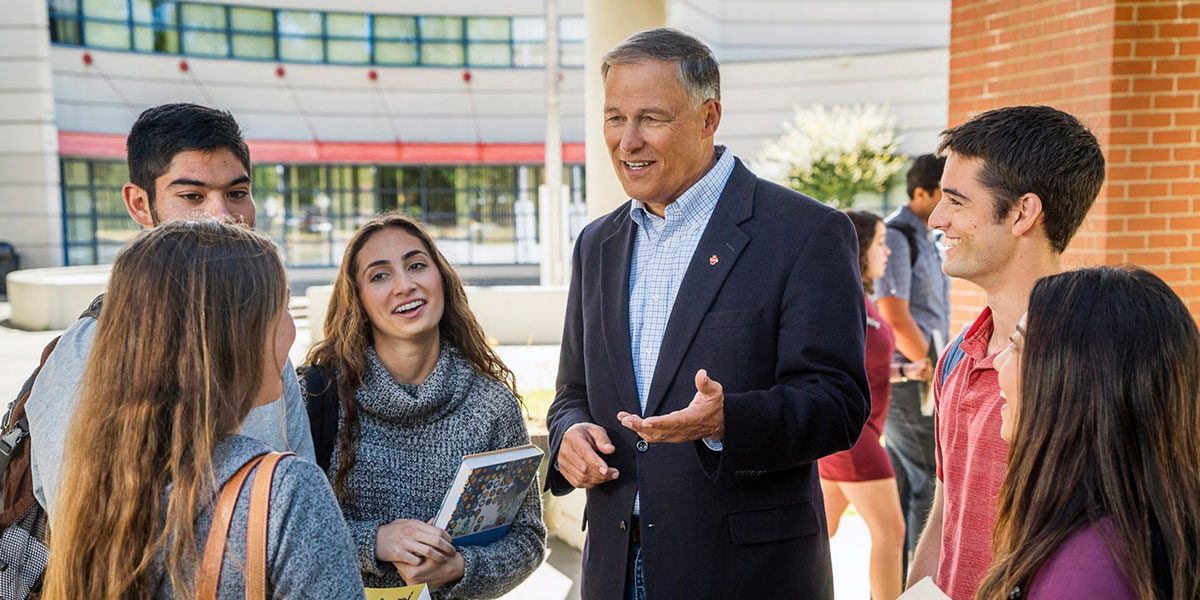
My exhibit: Washington State’s Governor Jay Inslee. [Photo from: https://www.jayinslee.com/top-priorities/health-care.]

His impressive experience includes an economics major, law degree and practice, city government (city prosecutor), Washington legislature (four years), U.S. House (13 years), national government (regional director, U.S. Department of Health and Human Services), country’s longest serving governor (11 years), chair, Democratic Governors Association.

His latest “state of the state” address makes no mention of restrictions on how doctors can practice medicine, professional teachers can teach or the books librarians can provide. No efforts to make life more difficult for LGBTQ people. No increases in his executive power. No curtailing of access to public information for media and other Washingtonians. No refusal to hold press conferences. No cuts in support of the poor. No taxpayer-funded private and religious schools. [No headline-grabbing trip south for Washington’s law officers to stop immigrants.]

What has he accomplished or proposed? Some examples:

Human rights. “Housing is a Human Right” campaign (construction; zoning; $1 billion for homeless and affordable housing); public transportation. More access to healthcare; including immigrants’ and women’s rights. Reduced racial disparities. Marriage equality. Protection of LGBTQ rights. Paid family and medical leave.

Early childhood education and care. Schools provide students mental and educational support, and programs for those with special needs. Reformed criminal justice system. Suspension of executions. Marijuana single misdemeanor offenders pardoned.

Environment. Leading climate change action advocate. Conservation of wildlife habitat; protection for endangered species. Cleaner water and air. [Sustainable agriculture and forestry. Ban on fracking. One hundred percent clean energy goal.]

Economy. Need-related college financial aid (boosted state’s economy). Increased minimum wage. Record low unemployment; 500,000 new jobs. A “Working Families Tax Credit” – rather than tax cuts for Washington’s wealthiest.

The result?

Washington has been ranked the best state in the U.S., second best for business and third best for workers and teachers. Similar to what Iowa’s ranking sometimes was under both Republican and Democratic former governors.

And that, dear Iowa children, “Is the way governors do”!

Nicholas Johnson wonders what Governor Inslee will do next; it won’t be reelection. Contact: mailbox@nicholasjohnson.org

NOTE: Text [within brackets] was deleted by the editors for space reasons.

SOURCES

Jay Inslee, General. Note: Most of the assertions and items listed in the column are from the following general sources:

Wikipedia: Jay Inslee, Wikipedia, https://en.wikipedia.org/wiki/Jay_Inslee

“Washington Governor Jay Inslee,” https://governor.wa.gov/

“Jay Inslee Governor,” https://www.jayinslee.com/ (campaign website)

Jay Inslee, “Building a Washington That Works for Everyone,” https://www.facebook.com/WaStateGov

The Seattle Times, use The Times Search feature, enter: Jay Inslee, https://www.seattletimes.com/

Results from Google search for, “Governor Jay Inslee”

Inslee’s experience. See, Jay Inslee, Wikipedia, https://en.wikipedia.org/wiki/Jay_Inslee

Nation’s longest serving governor. “List of Current United States Governors, Wikipedia, https://en.wikipedia.org/wiki/List_of_current_United_States_governors (“Currently, the longest serving incumbent U.S. governor is Jay Inslee of Washington, having served since January 2013 . . ..”)

State of the state. Jay Inslee, “2023 State of the State Address: Bold actions for building a stronger Washington,” Jan. 10, 2023, https://governor.wa.gov/news/speeches/2023-state-state-address-bold-actions-building-stronger-washington

Accomplishments. Gene Johnson and Ed Komenda, “Democratic Washington Gov. Jay Inslee won’t seek 4th term,” Associated Press, May 1, 2023, https://apnews.com/article/inslee-democrat-2024-climate-450cb6ef6347f0ac04022f079c3c0e13 (“Among his accomplishments he lists a cap-and-trade system for carbon emissions in the state and a trio of gun violence prevention measures that he signed into law last month, including a ban on semi-automatic assault rifles that is already being challenged in court by gun rights advocates.

Early this year the state Supreme Court upheld a capital gains tax Inslee promoted as a way to address what was considered the nation’s most regressive tax system.

He also vowed to protect gay rights and abortion access as conservative states constrained them, and he bought the state a three-year stockpile of a popular abortion drug in anticipation of court rulings that could limit its availability.

Inslee said he still has work to do before his exit, including collaborating with legislators and community leaders to address Washington’s homelessness crisis and speeding efforts to broaden behavioral health services.”)

Terra Sokol, “Gov. Jay Inslee Approves Salary Increases for Teachers,” News Radio, 560 KPQ, April 22, 2023, https://kpq.com/gov-jay-inslee-approves-salary-increases-for-teachers/ (“Program supervisors and instructors would make a minimum of $72,728 a year, administration $107,955 a year, and classified staff (paras, office staff, custodians) would receive $52,173 a year. . . . Salary increases total to approximately $1 billion and will go into effect in the 2024-25 school year.”)

Katherine Long, “Could you go to college tuition-free in Washington? Here’s how to find out,” Seattle Times, May 28, 2019, https://www.seattletimes.com/education-lab/could-you-go-to-college-tuition-free-in-washington-heres-how-to-find-out/ (“Last week, Gov. Jay Inslee signed into law a sweeping higher-education bill that will cut the cost of tuition, or make it free, for low- and median-income students. In a tweet, he described it as creating “a statewide #freecollege plan for eligible students.” Nationally, the bill has been hailed as a progressive approach to making college more affordable, and it’s expected to reach up to 110,000 students. . . . The Workforce Education Investment Act replaces the State Need Grant with a new program, the Washington College Grant (WCG), and makes the money an entitlement. Grants can cover up to 100% of tuition plus service and activity fees, and do not need to be paid back. It’s not a so-called “last-dollar” program — a student who qualifies for WCG could also receive a federal Pell grant, for example.

The legislation is built on the idea that Washington’s economy already employs a lot of college graduates, many of whom move here to chase opportunity — yet only about 31% of Washington’s own high-school graduates have earned a degree or credential by the age of 26, according to one study.

Being clear and upfront about who qualifies, and guaranteeing the money, removes the uncertainty surrounding financial aid. That, in turn, should make it easier for school districts and colleges to encourage kids to think about earning a certificate or a two- or four-year college degree, or becoming trained through a registered apprenticeship (also covered) . . ..[Chart indicates declining dollar support as family income increases above $69,000. $10,748 available up to incomes $46,000 or below. Declines to $5374 at $64,000 and $0 at $69,000 and above.]

Claire Withycombe, “Gov. Inslee signs bills to increase housing in WA,” Seattle Times, May 8, 2023, https://www.seattletimes.com/seattle-news/politics/gov-inslee-signs-wa-affordable-housing-bills/ (“Many of the bills are aimed at boosting the supply of homes in a state where it’s expensive and sorely needed.

Washington will now allow multifamily housing in many more neighborhoods, encourage people to develop accessory dwelling units, and streamline development regulations, among other policies. The overarching effort to smooth regulatory barriers, like zoning and permits, to building housing garnered bipartisan support.

“We are attacking this problem at its root, which is the lack of housing in the state of Washington,” Inslee said.

The Washington Department of Commerce estimates the state will need about 1 million more homes in the next 20 years.

This year, lawmakers also passed a budget with a $400 million investment in the state’s Housing Trust Fund, which finances affordable housing projects. That money will pay for about 3,000 new rental homes, and help about 250 to 400 households with homeownership, according to the department. . . .

Inslee signed nine bills about 1 p.m. Monday in Seattle at SEIU 775, and signed a 10th bill in a separate ceremony later that afternoon at the Northwest African American Museum, in a nod to the lengthy and harmful legacy of racist policies that kept many Black people from buying homes in certain neighborhoods and from building generational wealth.

House Bill 1474, which sponsors say is the first statewide policy of its kind, will help people who were affected by racist housing covenants designed to keep ethnic and religious minorities out of certain neighborhoods, as well as their descendants, with down payments and closing costs. . . .

Inslee signed nine bills about 1 p.m. Monday in Seattle at SEIU 775, and signed a 10th bill in a separate ceremony later that afternoon at the Northwest African American Museum, in a nod to the lengthy and harmful legacy of racist policies that kept many Black people from buying homes in certain neighborhoods and from building generational wealth.”)

New York Times. Reid J. Epstein, “Jay Inslee Sees Greener Pastures Ahead; After nearly 30 years in elected office, Washington’s governor plans to shift his focus to climate solutions and clean energy, underscoring the need for ‘a sense of optimism and confidence,’” New York Times, May 2, 2023, https://www.nytimes.com/2023/05/02/us/politics/jay-inslee-climate.html (“. . . [O]ne of America’s leading climate hawks.

Mr. Inslee ran for the 2020 Democratic presidential nomination by arguing that the country would have to radically reshape its relationship with fossil fuels and promote renewable energy. . . . [H]is goals later became the blueprint for the climate spending in the Inflation Reduction Act, which President Biden signed into law last year. . . .

In 2007, I [Inslee] said we’re going to be driving electric cars. People thought I was smoking the cheap stuff. Well, now we’re buying them so fast that production can’t even keep up.”]

Reid J. Epstein, “Gov. Jay Inslee of Washington, Climate Champion, Won’t Seek Re-Election; Mr. Inslee, 72, a former presidential candidate and a leading Democratic proponent of policies to slow climate change, said he would not seek a fourth term,” New York Times, May 1, 2023, . https://www.nytimes.com/2023/05/01/us/politics/jay-inslee-washington-governor.html (“Mr. Inslee and the Washington State attorney general, Bob Ferguson, filed a series of lawsuits against Mr. Trump’s administration, challenging policies on its ban on travel from several predominantly Muslim countries, its separation of migrant children from their parents and its unwinding of climate regulations.”)

David Wallace-Wells, “Gov. Jay Inslee Is Taking a Well-Earned Climate Victory Lap,” New York Times, Aug. 31, 2022, https://www.nytimes.com/2022/08/31/opinion/environment/jay-inslee-ira-climate-change.html (“[C]limate has become one of the issues that really holds the Democratic coalition together.

I think the reason for that is because it is such a powerful job creator — a good-paying-job creator. I mean, I can’t turn over a rock in my state where I can’t point to good jobs being created, in Moses Lake, where battery companies are coming in and Lind, Washington, where a solar plant went in and Arlington, where there’s electric planes that are in development. It’s just an explosion and it’s a welcome one. . . .

[In] 2009 or 2010, I brought a Chevy Volt, the prototype for the hybrid electric, to Capitol Hill because I wanted to show my colleagues, “Look what’s coming. Electric cars are coming.” . . . I was just being teased mercilessly by my friends . . .. Now people have a waiting list for the F-150, the Lightning, 10 miles long. . . .

I looked at the Alpine Meadows and thought about how they are at such risk right now. . . . [W]e’ve lost 45 percent of our glaciers — Olympic National Park, and the same thing’s happening on Rainier. It’s just great to see action today, knowing that Alpine Meadows might have a chance for my grandkids.”)

Best state and top priorities:

Best state. Levi Pulkkinen, "Education, Energy and Economy Lead Washington to Top Spot in Best States Ranking; The Evergreen State takes the top spot again in the U.S. News Best States ranking on the strength of its tech sector and other industries," U.S. News, March 9, 2021, https://www.usnews.com/news/best-states/articles/2021-03-09/why-washington-is-the-best-state-in-america ("For the second time, Washington has been named No. 1 in the U.S. News Best States ranking and is the first state to earn the top spot twice in a row.")

Economic Recovery. “Jay Inslee Governor, Top Priorities, Economic Recovery,” https://www.jayinslee.com/top-priorities/economic-recovery

(“During Jay’s tenure, Washington has made historic steps to improve the lives of Washingtonians. In his first term, Jay led Washington out of the Great Recession. By his second term, he brought Washington together to create what CNBC rated the top state for businesses and Oxfam declared the best state for workers.”

https://www.jayinslee.com/about - “Under his clear leadership, Washington helped build an economy that is ranked number one for both businesses and workers.”)

Healthcare. https://www.jayinslee.com/top-priorities/health-care

(“Jay has protected and expanded access to health care under the Affordable Care Act (ACA) to nearly 800,000 additional Washingtonians, driving uninsured rates to record lows. . . . • Expanded the Affordable Care Act to nearly 800,000 Washingtonians
• Protected those with pre-existing conditions and women’s reproductive rights
• Signed first public health care option in the country
• Passed historic long-term care benefit program so seniors can receive the care they need
. . . Jay has made Washington state a leader in reproductive health care. He helped to pass and sign the Reproductive Parity Act, which requires health plans that include maternity care services to also cover abortion services and for all health plans to cover over the counter contraceptives without a prescription.

We must change how we take care of people who suffer from mental illness in Washington state. That’s why Jay championed and signed legislation to integrate physical services and behavioral health services by significantly transforming the state’s mental health system and reshaping how and where patients receive care.”)

Education. https://www.jayinslee.com/top-priorities/education

(“[He] invested billions in our education system.

These important investments have resulted in increased access to early learning, including all-day kindergarten so that children can start building a foundation at an early age for success. For children with the most need, he pushed to secure $130 million for direct special education services and expand Breakfast After the Bell program to ensure Washington’s kids are focused on learning, not hunger.

Jay values our teachers and he’s worked to increase educator pay more than any other state and to lower class sizes so our educators can focus on giving our children the best possible education. He has also made a commitment to recruit and retain more diverse educators in our schools.”

• Enacted all-day kindergarten
• Raised teacher pay and lowered class sizes
• Funded full and partial college tuition assistance for working and middle-class Washingtonians
• Launched Career Connect to give 100,000 students career-ready apprenticeships and technical training


[The] Workforce Education Investment Act, which ensures full and partial college tuition scholarships are available to working and middle-class Washingtonians. . . . [And the] Career Connect Washington. This program connects 100,000 Washington students with career-ready education like apprenticeships and technical education.”)

Climate; Clean Energy. https://www.jayinslee.com/top-priorities/climate-and-clean-energy

(“Known as the “greenest governor in the country,” he has made Washington state a leader in both the fight against climate change and growing clean energy jobs — something he knows will be vital to our economic comeback post-COVID.

, , , Jay set the state on a pathway to a carbon neutral electrical grid by 2030 and to be powered by 100 percent clean electricity by 2045. We have built the cleanest energy grid in the nation and a $6 billion wind energy industry, while also increasing the use of solar energy and electric vehicles.

• Committed Washington to have a carbon neutral electrical grid by 2030 and 100% clean energy electricity by 2045
• Built cleanest energy grid in nation and helped build a $6 billion wind energy industry
• Signed orca and salmon protections

He led the passage of the greenest transportation package in our state’s history to create an estimated 200,000 jobs.”)

Justice and Safety. https://www.jayinslee.com/top-priorities/justice-and-safety

(“Jay wants to rethink public safety and eradicate systemic racism not just in law enforcement, but in education, healthcare, housing, and other areas of inequality. . . . He issued a moratorium on the death penalty . . .. offered pardons to individuals with misdemeanor marijuana convictions . . .. [and] helped pass bipartisan de-escalation and deadly force standards to ensure there is accountability for police violence.

Jay . . . is working to eliminate Washington’s rape kit backlog.

He has fought . . . gun violence, banning dangerous mass-killing tools like bump stocks, made sure guns are kept out of the hands of high-risk individuals, and supported the passage of voter-approved universal background checks.”)

# # #


Tuesday, August 01, 2023

Quality Housing for All

Quality Housing for All is Possible
Nicholas Johnson
The Gazette, August 1, 2023, p. A 6

“Everyone has the right to a standard of living adequate for [their] health and well-being . . . including . . . housing . . .” declares the U.N.’s Universal Declaration of Human Rights. If you find the Bible more persuasive, many versions include in Matthew 25, “I was homeless and you gave me a room.”

The Iowa Code provides equivalent rights for farm animals. And yet 1.6 billion people not only don’t have the housing Jesus called for and the U.N. considers a human right, they’re lacking the housing rights of Iowa’s animals.

Two million U.S. housing units were judged to be “extremely inadequate.” There are around 500,000 homeless people each evening.

U.S. agencies and organizations also measure “housing insecurity” (e.g., high costs, poor quality, unstable neighborhoods or overcrowding). For renters the percentages with housing insecurity range from 30 percent (Florida) to 17 percent (Wyoming). In Iowa it’s 23 percent.

It’s not like Iowa’s doing nothing. The state, county and city governments have programs. Vouchers, affordable housing in new developments (mixed income, inclusionary zoning), rezoning, housing trust funds, government owned and operated and “housing first” for the homeless.

But a conflict of goals is bound to occur when housing programs look to profit-maximizing capitalist landlords to provide housing for all at prices that leave everyone with enough left over for nutrition, healthcare, transportation and other basic needs.

Where might we look for alternatives?

When I served on the Iowa City School Board, we wanted new ideas. With 16,000 U.S. school districts, we set aside meeting time to discuss what Education Week was reporting and other countries were doing.

Iowa’s governmental units could do the same, researching others’ housing solutions. Take Vienna for example.


The focus of Vienna’s “social housing” is not on giving money to the poor, passed through to landlords. It’s on construction of a livable, lovable city and society – connected with cheap, frequent, fast public transportation. The Viennese believe such a city requires upscale, architecturally attractive cheap housing for everyone. Housing that mixes middle class with the poor. Housing conveniently located in neighborhoods with a range of facilities and services, such as a community center, swimming pool, dental clinic, library, post office, restaurant. [Photo credit: wikimedia.org/commons]

Anyone earning under about $80,000 (U.S.) can apply if they’ve had a single Vienna address for two years. The financial requirements are such that 80 percent of Vienna’s residents choose to rent. The U.S. defines “affordable” as 30 percent of before-tax income. (Landlords extract more from nearly half of all renters.) Vienna defines “affordable” as closer to 20 percent of after-tax income. No one’s excluded, and no one’s evicted if their income increases. The homeless are provided “housing first” facilities.

When people pay less, but get quality, inclusive housing they have less finance-related stress – and more money left over to live life and boost the local economy.

We could do it here. In fact, we’ve tried in California, Maryland and Washington.

Why not Iowa?

Nicholas Johnson believes the U.N. and Jesus would like Vienna’s housing. Contact: mailbox@nicholasjohnson.org

SOURCES
Universal Declaration of Human Rights, United Nations, Dec. 10, 1948, Article 25, https://www.un.org/en/about-us/universal-declaration-of-human-rights (“Everyone has the right to a standard of living adequate for the health and well-being of himself and of his family, including food, clothing, housing and medical care and necessary social services, and the right to security in the event of unemployment, sickness, disability, widowhood, old age or other lack of livelihood in circumstances beyond his control.”)

Matthew 25. Numerous sources from Google search: “Which versions of the Bible include ‘I was homeless and you gave me a room’ in Matthew 25?” For example, “Matthew 25:35-40,” You Version, Bible.com, https://www.bible.com/bible/97/MAT.25.34,35,36 (“I was homeless and you gave me a room”)

Animal rights. Code of Iowa, Sec. 717B.3(1)(d), https://www.legis.iowa.gov/docs/ico/chapter/717B.pdf (“1. A person commits animal neglect when the person owns or has custody of an animal, confines that animal, and fails to provide the animal with any of the following conditions for the animal’s welfare: . . .

d. Ventilated shelter reasonably sufficient to provide adequate protection from the elements and weather conditions suitable for the . . . animal so as to maintain the animal in a state of good health . . . . The shelter must protect the animal from wind, rain, snow, or sun and have adequate bedding to provide reasonable protection against cold and dampness. . ..”)

1.6 billion without adequate housing. “First-ever United Nations Resolution on Homelessness,” Department of Economic and Social Affairs, United Nations, March 9, 2020, https://www.un.org/development/desa/dspd/2020/03/resolution-homelessness/ (“A serious violation of human dignity, homelessness has become a global problem. It is affecting people of all ages from all walks of life, in both developed and developing countries.

Globally, 1.6 billion people worldwide live in inadequate housing conditions, with about 15 million forcefully evicted every year, according to UN-Habitat, which has noted an alarming rise in homelessness in the last 10 years. Young people are the age group with the highest risk of becoming homeless.”)

Adequate housing in U.S. Housing insecurity in the United States https://en.wikipedia.org/wiki/Housing_insecurity_in_the_United_States (Chart: “Rented households facing housing insecurity (%)” High: Florida (30%), low: Wyoming (17%). Iowa (23%). “The American Housing Survey, using a standard of “extremely inadequate” housing, found (averaging numbers from 2005, 2007 and 2009) 2 million units to be “extremely inadequate” (1,896,890 units).”

U.S. Homelessness. “How many homeless people are in the US? What does the data miss?” USA Facts, May 23, 2023, https://usafacts.org/articles/how-many-homeless-people-are-in-the-us-what-does-the-data-miss/ (“More than half a million people experienced homelessness in America last year. The Department of Housing and Urban Development (HUD) counted around 582,000 Americans experiencing homelessness in 2022. That’s about 18 per 10,000 people in the US, up about 2,000 people from 2020.”)

U.S. school districts. Imed Bouchrika, “101 American School Statistics: 2023; Data, Trends & Predictions,” https://research.com/education/american-school-statistics (“The U.S. is currently home to 16,800 school districts.”)

Vienna. Homelessness. “Homelessness in Austria,” Policies & Strategies, Feantsa Country Fiche, 2017, https://www.feantsa.org/download/austria-20178599194934673684360.pdf (“Vienna and Upper Austria have adopted an integrated program on homelessness, covering prevention, accommodation and reintegration. The program in Vienna is known as the Vienna Integration Program for Homeless People (Vienna Multi-Stage Scheme). Housing First approaches are being implemented.”)

Viennese incomes. "Average Salary in Vienna, Austria," SalaryExpert, undated, https://www.salaryexpert.com/salary/area/austria/vienna ("51,823" -- $57,347 US)

"The average salary and minimum wage in Austria," Expatica, March 4, 2023, https://www.expatica.com/at/working/employment-law/minimum-wage-austria-89338/ ("The median salary in Austria is about €2,182 per month. However, the median income for full-time employees working all year round in 2020 was €40,415 [$44,723 U.S.] for women and €46,292 [$51,227 U.S.] for men. Normally, this includes the basic salary, bonuses, annual leave payments, and sick pay.")

"Cost of Living in Vienna," Numbeo, 2023, https://www.numbeo.com/cost-of-living/in/Vienna • ("A family of four estimated monthly costs are 3,483.6$ (3,153.1€) without rent (using our estimator). • A single person estimated monthly costs are 1,008.7$ (913.0€) without rent. • Vienna is 33.7% less expensive than New York (without rent, see our cost of living index). • Rent in Vienna is, on average, 75.1% lower than in New York.")

Transportation. “The Public Transport System,” Visiting Vienna, https://www.visitingvienna.com/transport/public/ (“The public transport system is definitely one of Vienna’s good points. Cheap, frequent, fast, clean, efficient, and rarely overcrowded.”)

Vienna; Excerpts from Francesca Mari, “It Might Look Like Vienna; Soaring real estate markets have created a worldwide housing crisis. What can we learn from a city that has largely avoided it?” Magazine, New York Times, May 26, 2023, https://www.nytimes.com/2023/05/23/magazine/vienna-social-housing.html

Note: I found this to be one of the best sources regarding the Vienna social housing program. Rather than trying to link each of these excerpts to the precise language in two of the column’s paragraphs they are simply listed in the order in which they appear in this New York Times Magazine article – thereby making them easier to find.

Questions the reader may have about any of my assertions should be answered by one or more of them.

Conversion from Austria Euros to U.S. dollars with ExchangeRate.com, https://www.exchangerate.com/currency-exchange-rate-cities/vienna.html


Viennese law dictates that rents in public housing can increase only with inflation, and only when the year’s inflation exceeds 5 percent. By the time she retired in 2007, Eva’s rent was only 8 percent of her income. Because her husband was earning 4,000 euros a month, their rent amounted to 3.6 percent of their incomes combined.

# # #

In Vienna, a whopping 80 percent of residents qualify for public housing, and once you have a contract, it never expires, even if you get richer. Housing experts believe that this approach leads to greater economic diversity within public housing — and better outcomes for the people living in it.

# # #

49 percent of American renters — 21.6 million people — are cost-burdened, paying landlords more than 30 percent of their pretax income, and the percentage can be even higher in expensive cities. In New York City, the median renter household spends a staggering 36 percent of its pretax income on rent.

# # #

In Vienna, 43 percent of all housing is insulated from the market, meaning the rental prices reflect costs or rates set by law — not “what the market will bear” or what a person with no other options will pay.

# # #

The mean gross household income in Vienna is 57,700 euros [$63,151 US] a year, but any person who makes under 70,000 euros [$77,462 US] qualifies for a [social housing] unit. Once in, you never have to leave. It doesn’t matter if you start earning more.

# # #

80 percent of all households in Vienna choose to rent.

# # #

Vienna prioritizes subsidizing construction, while the United States prioritizes subsidizing people, with things like housing vouchers. One model focuses on supply, the other on demand. Vienna’s choice illustrates a fundamental economic reality, which is that a large-enough supply of social housing offers a market alternative that improves housing for all.

# # #

[T]he average waiting time to get a [social housing unit] is about two years (at any given moment there are 12,000 or so people on the waiting list, and each year about 10,000 or more people are housed). Vienna residents — anyone who has had a fixed address for two years, whether they are a citizen or not — may apply, and applications are evaluated based on need.

# # #

City housing officials point out that having wealthier tenants in ["social housing"] helps thwart the problems that accompany concentrated poverty, creating a more stable, healthier environment for everyone. Unlike in the United States, where public housing is only for the poorest . . . the relative integration of ["social housing"] means that they are not stigmatized.

# # #

[One social housing project] housed 5,000 people in 1,400 apartments. These apartments were coveted. “It had two central laundries, two communal bathing facilities with tubs and showers, a dental clinic, maternity clinic, a health-insurance office, library, youth hostel, post office, and a pharmacy and 25 other commercial premises, including a restaurant and the offices and showroom of the BEST, the city-run furnishing and interior-design advice center,” Blau writes. Now fewer than 3,000 tenants live [there] — not because it’s undesirable but because living standards have improved and, in response, Vienna has allotted tenants more space . . . [combining] some of the units to create larger ones.

# # #

Vienna has succeeded in curbing the craving to own. It has done it by driving down the price of land through rezoning and rent control.

# # #

Living in Alt-Erlaa, Willie enjoyed access to seven rooftop swimming pools, seven indoor swimming pools, tennis courts, gyms and acclaimed art. When the rest of the delegation joined us, he led us toward one of his favorite aspects of the buildings: two murals in the lobby of the second building meditating on the role of the news media and labor in society.

# # #

The spiral of overvaluation in housing, which makes the housing-haves rich and the have-nots desperately poor, has brought us to a point where only something radical can solve it. The problem with housing in the United States is that it has been locked in as a means of building wealth, and building wealth is irreconcilable with affordability. The housing crisis in the United States is proof. Even in 2017, before the pandemic, around 113 million Americans — some 35 percent of the nation’s population — were living with a serious housing problem, such as physically deficient housing, burdensome costs or no housing at all, notes Alex F. Schwartz, an urban-studies professor at the New School.

# # #

The United States government intervenes heavily in the housing market. It’s just a two-tiered system, as Gail Radford, the historian, argues. There’s generous support for affluent homeowners and deliberately insufficient support for the lowest-income households. In 2017, the United States spent $155 billion on tax breaks to homeowners and investors in rental housing and mortgage-revenue bonds, more than three times the $50 billion spent on affordable housing.

# # #

Though “social housing” represented a large initial government outlay, Vienna’s social housing is now self-sustaining. Guess how much of the residents’ salary goes toward the program. One percent. Social housing drives down rents in the private market by as much as 5 percent. Vouchers may appear cheaper in the short term, but directly financing well-regulated public and limited-profit construction is the only way to mitigate speculation and hedge against ever-increasing housing costs. In 2020, New York and California spent $377 and $248 per capita, respectively, in housing development, while Vienna spent just $124 — and approximately half of Vienna’s spending is on low-interest financing that will be repaid and then re-lent.

# # #

Local social-housing programs, many of them inspired by Vienna, are underway in Montgomery County, Md.; Seattle; and California. And they have a long legacy in New York, which built 66,000 affordable apartments and 69,000 limited-profit co-op apartment units from 1955 to 1981.

# # #

Seattle. “A place to live, a place to grow; Providing housing and supportive services for people with low incomes,” Seattle Housing Authority, 2023, https://www.seattlehousing.org/

Montgomery County, Maryland. “Housing,” Montgomery Planning, July 19, 2023, https://montgomeryplanning.org/planning/housing/

California. “Five More Jurisdictions Designated Prohousing,” California Department of Housing and Development, 2023, https://www.hcd.ca.gov/

# # #

Wednesday, May 03, 2023

Are Electric Cars the Answer?

Are Electric Cars the Answer?
Nicholas Johnson
The Gazette, May 3, 2023, p. A6

Can Americans’ electric cars slow climate change?

In 1971 the comics’ Pogo ecologically observed, “We have met the enemy and he is us.” We have now witnessed more and stronger tornadoes and hurricanes, droughts and floods, heat waves and wildfires.

Since 1990 the annual official warnings have intensified. UN Secretary Guterres now advocates “climate action on all fronts: everything, everywhere, all at once.”

However impressive our politicians’ rhetoric and professed goals, neither will save us. Consider President Biden’s electric cars plan. He wants 67 percent of America’s newly manufactured cars to be electric by 2032.

But what does “electric” mean when 80 percent of U.S. electricity is generated from fossil fuels? (Iowa only 40 percent.)

Among the proposal’s other numerous challenges are four: consumers, chargers, cobalt and China.

Consumers. Cars on dealers’ lots are not cars in driveways. Recently 70 percent of car sales were used cars. The average age of drivable cars is 13 years. So we’re talking the occasional purchase of one third of car sales.

Used EV cars? An EV car’s “range” is the miles it can go from a 100 percent charge. But the recommended charge is between 20 and 80 percent – 60 percent of its “range.” Excessive heat or cold, fast chargers, driving speed, age and miles, reduce it further. Why buy a used battery, whether in a car or flashlight?


Chargers. Unless the EV owner lives in a house or apartment with a personal, assigned charging station, that EV is just street decoration. Gas tanks fill in five minutes. Charging takes 30 minutes to hours. Is the hunt and wait time worth it? On the road, PBS found numerous broken chargers; electricity priced four times what homeowners pay. Will they remain unregulated? [Photo credit: Wikimedia commons; EV owner's questions: Is there any charger within your remaining "range" in this sparcely populated countryside? Once there, is it turned on? Is it broken? Does the nozzel fit your car? Will it accept your credit card? How long will the charge take? How many times what homeowners pay for electricity are you being charged? If it won't work for you, do you have enough "range" left to reach the next charging station?]


[Credit: Toons, "The Electric Car," May 26, 2023, https://www.toonpool.com/cartoons/the%20electric%20car_13284]

Cobalt. You can’t buy 1000-2000-pound lithium EV batteries, or their components, in most U.S. cities. Gathering lithium, cobalt, and other minerals is not like pumping oil or mining coal. For example, the Congo gathers 70 percent of the world’s cobalt with the hands of children and forced labor.

China. China has a 10-year head start on EVs, producing two-thirds of global EV cars and 75 percent of EV batteries. It controls half the world’s components, refining and processing capacity. The U.S. has 10 percent of EV production and 7 percent of battery production, with shortages of necessary minerals. The U.S. can’t be world EV car champion. Cooperation with China would benefit both countries.

There are alternatives.

Seatbelts weren’t popular with manufacturers or customers. The government’s response? Requiring them on all government vehicles. Soon all cars followed.

Much CO2 comes from fleets, postal and other delivery vehicles, city and school buses. Replacing them with EVs and individual charging stations should be project one.

Some EVs have burst into flames, especially e-bikes. But peddling one, or walking; working from home; housing closer to workplaces are among other alternatives.

EV cars? OK. Just don’t put America’s biggest bet on them.

Nicholas Johnson drove a dealer’s EV car. Loved it as a toy; it was not practical (for him) as a car. mailbox@nicholasjohnson.org

SOURCES
Climate change. Gregory Johnson, “Eco News 2023,” Resources for Life, April 22, 2023, https://resourcesforlife.com/docs/item38972

Fiona Harvey, “Scientists deliver ‘final warning’ on climate crisis: act now or it’s too late; IPCC report says only swift and drastic action can avert irrevocable damage to world,” The Guardian, March 20, 2023, https://www.theguardian.com/environment/2023/mar/20/ipcc-climate-crisis-report-delivers-final-warning-on-15c (The Intergovernmental Panel on Climate Change (IPCC), made up of the world’s leading climate scientists, set out the final part of its mammoth sixth assessment report on Monday . . . boiled down to one message: act now, or it will be too late. The UN secretary general, António Guterres, said: “This report is a clarion call to massively fast-track climate efforts by every country and every sector and on every timeframe. Our world needs climate action on all fronts: everything, everywhere, all at once. . . . we have failed to reverse the 200-year trend of rising greenhouse gas emissions, despite more than 30 years of warnings from the IPCC, which published its first report in 1990 . . . impacts, such as the loss of agriculture, rising sea levels, and the devastation of the natural world”)

“How Do We Know Climate Change Is Real?” Global Climate Change, NASA, https://climate.nasa.gov/evidence/

“The Causes of Climate Change,” Global Climate Change, NASA, https://climate.nasa.gov/causes/

“Climate Change 2023: Synthesis Report,” UN Environment Programme, March 20, 2023, https://www.unep.org/resources/report/climate-change-2023-synthesis-report

“Environment Under Review; We empower governments and other stakeholders in evidence-based decision-making,” UN Environment Programme, https://www.unep.org/explore-topics/environment-under-review

Pogo – enemy is us. “File: Pogo - Earth Day 1971 poster.jpg,” https://en.wikipedia.org/wiki/File:Pogo_-_Earth_Day_1971_poster.jpg (“We have met the enemy and he is us.”)

Effects of climate change. “The Effects of Climate Change,” Global Climate Change, NASA, https://climate.nasa.gov/effects/ (“Midwest. Extreme heat, heavy downpours, and flooding will affect infrastructure, health, agriculture, forestry, transportation, air and water quality, and more.)

Warnings since 1990. Fiona Harvey, “Scientists deliver ‘final warning’ on climate crisis: act now or it’s too late; IPCC report says only swift and drastic action can avert irrevocable damage to world,” The Guardian, March 20, 2023, https://www.theguardian.com/environment/2023/mar/20/ipcc-climate-crisis-report-delivers-final-warning-on-15c (“we have failed to reverse the 200-year trend of rising greenhouse gas emissions, despite more than 30 years of warnings from the IPCC, which published its first report in 1990 . . .”)

Guterres. Ibid. (“The UN secretary general, António Guterres, said: “This report is a clarion call to massively fast-track climate efforts by every country and every sector and on every timeframe. Our world needs climate action on all fronts: everything, everywhere, all at once. . . . “)

Biden Plan. Ana Faguy, “Planned EPA Rules Could Make 67% Of New U.S. Cars Electric By 2032,” Forbes, April 12, 2023, https://www.forbes.com/sites/anafaguy/2023/04/12/biden-proposes-standards-designed-to-make-most-new-us-cars-electric-by-2032 (“The Environmental Protection Agency announced two proposed rules Wednesday designed to ensure that 67% of new passenger cars and 25% of heavy trucks sold in the U.S. are all-electric by 2032, in the latest push from the Biden Administration to reduce planet-warming emissions by pivoting to electric vehicles.”)

See also, “FACT SHEET: President Biden Announces Steps to Drive American Leadership Forward on Clean Cars and Trucks,” The White House, Aug. 5, 2021, https://www.whitehouse.gov/briefing-room/statements-releases/2021/08/05/fact-sheet-president-biden-announces-steps-to-drive-american-leadership-forward-on-clean-cars-and-trucks/ Although approaching two years old, this statement provides additional wording and clues with regard to what vehicles are included – Cars only? Cars and “light trucks”? Cars, light trucks, and medium to heavy trucks?

Whatever is ultimately included as the President’s plan unfolds from proposals to legislation and action, this column is focused on “cars,” as that is of greatest relevance to most of the news stories and data – and readers of The Gazette.

Electricity from fossil fuels. “Renewable Energy,” Office of Energy Efficiency & Renewable Energy, Department of Energy, https://www.energy.gov/eere/renewable-energy (“Renewable Energy [in the US] generates about 20% of all U.S. electricity.”)

“Renewable and Nonrenewable Energy Sources,” World Energy Use, Texas Gateway, https://www.texasgateway.org/resource/79-world-energy-use (“About 85 percent of our energy comes from nonrenewable fossil fuels—oil, natural gas, coal.”)

Steve Cohen, “Fossil Fuels, Renewable Energy, and Electric Vehicles,” State of the Planet, Columbia University Climate School, Feb. 21, 2022, https://news.climate.columbia.edu/2022/02/21/fossil-fuels-renewable-energy-and-electric-vehicles/

“Emissions of Carbon Dioxide in the Transportation Sector,” Congressional Budget Office, Dec. 22, 2022, https://www.cbo.gov/publication/58861 [credits at end of document] (“Increases in CAFE and greenhouse gas emissions standards and changes in incentives for purchasing electric vehicles take time to improve the average fuel economy of vehicles on the road because the stock of vehicles is replaced slowly. The average age of passenger vehicles driven in the United States is 12 years, so even several years after a new standard is adopted or electric vehicle sales are boosted, most vehicles on the road will still be older models that produce more emissions.”) See heading, “Average age of cars 13.1 years,” below.

Iowa’s electricity from wind. “Iowa State Profile and Energy Estimates,” Independent Statistics and Analysis, U.S. Energy Information Administration, July 21, 2022, https://www.eia.gov/state/analysis.php?sid=IA (60% Iowa’s electricity comes from wind. “In 2021, nearly three-fifths of Iowa's total electricity net generation came from renewable resources, almost all of it from wind.24”)

Used Cars 70%. Ben Ellencweig, Sam Ezratty, Dan Fleming, and Itai Miller, “Used cars, new platforms: Accelerating sales in a digitally disrupted market,” McKinsey, June 6, 2019, https://www.mckinsey.com/industries/automotive-and-assembly/our-insights/used-cars-new-platforms-accelerating-sales-in-a-digitally-disrupted-market (39.4/56.7=0.694 “McKinsey’s auto retail micro-market model (ARM3) for used-car demand in the United States estimates that Americans buy 39.4 million used cars each year, versus 17.3 million new ones (2018), and that used-vehicle sales will increase faster than new-vehicle sales over the next five years.”)

Average age of cars 13.1 years. Nishant Parekh and Todd Campau, “Average Age of Vehicles in the US Increases to 12.2 years, according to S&P Global Mobility,” S&P Global, May 23, 2022, https://www.spglobal.com/mobility/en/research-analysis/average-age-of-vehicles-in-the-us-increases-to-122-years.html ([Chart indicates average age for “light vehicles” is 12.2 years; but the average for “cars” is 13.1 years] “The average age of light vehicles in the US reached an all-time high in 2022 as the vehicle fleet climbed to 283M passenger cars and light trucks. The average age of light vehicles in operation (VIO) in the US rose to 12.2 years this year, increasing by nearly two months over the prior year, according to new research from S&P Global Mobility (formerly the automotive team at IHS Markit). This is the fifth straight year the average vehicle age in the US has risen. This year's average age marks another all-time high for the average age even as the vehicle fleet recovered, growing by 3.5 million units in the past year.”)

Used, New, Age, Total vehicles. Ashlee Tilford, “Car Ownership Statistics 2023,” Forbes Advisor, March 7, 2023, https://www.forbes.com/advisor/car-insurance/car-ownership-statistics/ (“There were a total of 278,063,737 personal and commercial vehicles registered to drivers in the U.S. in 2021. [1] . . . Sales of electric vehicles (EVs), plug-in hybrid electric vehicles and hybrid electric vehicles accounted for 12.3% of all new vehicles sold in 2022, up 2.7 percentage points from 2021, according to the National Automobile Dealers Association. . . . In 2022, the average sales price for a new car was $45,646, and the average sales price for a used car was $30,796.[7])

Source unknown; Google response to question: “What percentage of private vehicle sales each year are used vehicles and what percent are new vehicles?” “The findings mirror National Automobile Dealers Association (NADA) data that says the average dealer achieves a roughly 0.75:1 used-to-new sales ratio. May 7, 2018” Source: Dale Pollak, “3 Pillars Of A Stellar Used-to-New Vehicle Sales Ratio,” Like I See It, May 7, 2018, https://www.dalepollak.com/2018/05/3-pillars-stellar-usedtonew-vehicle-sales-ratio/

Car Value. “Why Does a New Car Lose Value After It's Driven off the Lot?” Cars Direct, March 11, 2020, https://www.carsdirect.com/used-car-prices/why-does-a-new-car-lose-value-after-its-driven-off-the-lot (“A new car depreciates or loses value almost immediately after you drive it off a dealer's lot. As a quick rule of thumb, a car will lose between 15% and 20% of its value each year according to Bankrate.com.”)

EV cars’ “range.” Jordan Fromholz, “Do Electric Cars Lose Range Over Time? Here is the Data,” Plugin Report, c. 2017, https://pluginreport.com/do-electrics-cars-lose-range-over-time/

Charging. Credit: These opening sources and commentary were provided by Sherman Johnson: (“Here's a PBS video from the most recent [April 26, 2023] NewsHour. It turns out the EV experience can sometimes be lacking: "Demand for electric vehicles growing, but can charging network keep up?" https://youtu.be/fAVuwKTalk4 According to PBS, attempting to drive in certain areas in an EV can be frustrating, time consuming, and/or expensive. In their experience, many chargers do not work, and even when they do they are expensive. The rate at one charger they showed was *$0.48* per kWh! That's about 4x the average cost of residential electricity. FOUR (4) times! https://neo.ne.gov/programs/stats/inf/204.htm 33.7kWh has the same amount of energy (BTUs) as one gallon of gas. $0.48/kWh x 33.7kWh = ~*$16.20* -- for the energy equivalent of one (1) gallon of gasoline! So even if the EV gets over 100 MPGe, it will still cost more per mile to operate than a typical ICE vehicle!

The national average price of gas is about $3.65/gallon. $16.20 / $3.65 = over 4.4 gallons of gas that could be purchased for $16.20. So an ICE car that gets over ~25 mpg will cost LESS per mile (for fuel) than an EV that gets ~100 MPGe (when paying 48 cents per kWh). That means that unless a person can charge at home, an EV may not be the best choice. The owner may have to pay exorbitant rates for electricity; they have to hope there is a charger available -- and that it works; they must wait for their car to charge -- anywhere from 1/2 hour to an hour or more. Oh, and don't forget the fat fines for leaving the EV at the charger after it's done charging. Those are some of the potential downsides of EVs. The other side of the argument might be that there is plenty of competition; that the chargers (especially the highest power ones) are very expensive, as is the installation (concrete pads; trenching for underground cables; upgrading the utility service; new transformers, etc.) and permits, etc. Obviously, the cost per kWh will be somewhat higher at commercial chargers than residential rates -- the question is, how much is reasonable? If there truly is adequate competition, then perhaps $0.48 to $0.58 (and more) per kWh is the amount they must charge to make a reasonable profit -- but I doubt it. I can understand that the companies installing chargers need a reasonable ROI, but -- without knowing all of the costs involved -- ~$0.50 per kWh seems very high. Also, once the initial costs are recouped, they should be able to lower the cost per kWh, because ongoing maintenance costs will be relatively low. To be fair, EVs do make a lot of sense for a large segment of drivers. Primarily those that can charge at home (or at work), and do not discharge the battery beyond the amount they can recharge it (usually overnight at home -- 100 to 200 miles in 10 hours with a Level 2 residential charger). In that case, an EV: * Saves money (much lower cost per mile for “fuel”. * Saves time -- no gas tank to fill; no oil changes; tune-ups, etc. * Is always "full" when leaving home. * Helps reduce the owner's carbon footprint (reduction varies according to type of EV and source of electricity). * Is fun to drive. Even some moderately priced EVs are quick: https://insideevs.com/news/534101/electric-cars-60mph-acceleration-20210919/ Good, concise charger info: Level 1; Level 2; DC Fast Charging, etc., https://www.transportation.gov/rural/ev/toolkit/ev-basics/charging-speeds Here's a good related article: https://www.jdpower.com/cars/shopping-guides/what-is-kwh-per-100-miles )

And see, “Chasing Carbon Zero,” NOVA, PBS, April 26, 2023, https://www.youtube.com/watch?v=cN-P4ilk7Iw 2:45-5:47, 43:44-48:40.

For a little balance, see Christian Agatie, "This 2018 Tesla Model 3 Passed the 300,000-Mile Mark, Here's What You Need To Know," Auto Evolution, July 26, 2022, https://www.autoevolution.com/news/this-2018-tesla-model-3-passed-the-300000-mile-mark-here-s-what-you-need-to-know-194534.html ("The guy works as a courier and drives more than 300 miles every night, Monday to Friday. This also explains the high mileage after only four years on the road. As you’ve guessed by now, he drives 90% of the time at highway speed, which is not very taxing on the drivetrain. Nevertheless, he often needs to charge at Superchargers, which is known to take a toll on the battery. But even so, 310,000 miles and still 80% of the battery left is impressive. Most people would not drive that much in a decade.")

Lithium battery weight. “Electric car battery weight explained,” EV Driver, EVBOX, Feb. 17, 2023, https://blog.evbox.com/ev-battery-weight (“On average, however, EV batteries weigh around 454 kg (1,000 pounds), although some can weigh as much as 900 kg (2,000 pounds).”)

Cobalt. David Iaconangelo, “U.S. strikes at China with EV battery deal,” EnergyWire, E&E News, Jan. 20, 2023, https://www.eenews.net/articles/u-s-strikes-at-china-with-ev-battery-deal/ (“The deal also raises questions about how new U.S. influence in the region might affect alleged labor abuses in the Congolese cobalt sector, which provides 70 percent of the world’s supply. Last year, the Labor Department added lithium-ion batteries to its list of goods made with child labor or forced labor due to reports of abuses in the country’s cobalt mines (Energywire, Oct. 5, 2022).”)

See, in “China EV Sales,” below, Hannah Northey, “Biden’s EV Bet is a Gamble on Critical Minerals,” E&E News Greenwire, April 18, 2023, https://www.eenews.net/articles/bidens-ev-bet-is-also-a-gamble-on-critical-minerals/

“Critical Minerals in Electric Vehicle Batteries,” Congressional Research Service, Aug. 29, 2022, https://crsreports.congress.gov/product/pdf/R/R47227 (“More than 16 million total EVs have been sold worldwide, with about 6.6 million EVs sold in 2021. The U.S. EV market is small when compared to those in China and Europe: new U.S. EV registrations were slightly less than 10% of new global EV registrations in 2021, while registrations in China were 50% of the global total and European registrations were 35%. . . . These EV battery chemistries depend on five critical minerals whose domestic supply is potentially at risk for disruption: lithium, cobalt, manganese, nickel, and graphite. The U.S. Geological Survey designated these and other minerals as “critical,” according to the methodology codified in the Energy Act of 2020. The United States is heavily dependent on imports for these minerals for use in EV batteries and other applications.”)

"Salton Sea lithium deposits could help EV transition, support economically devastated area" https://youtu.be/zq3x54cgLvM (From below the video: Jan 24, 2023 "The demand for electric vehicles is surging in the U.S., sparked in part by the Biden administration’s Inflation Reduction Act and the subsidies it offers. But a looming supply shortage of lithium threatens to stall the EV transition. Stephanie Sy traveled to California's Salton Sea where lithium deposits could help meet the country’s energy needs and support an economically devastated region. Correction: This segment stated that the Salton Sea area alone could produce nearly six times the lithium currently produced globally. This was a miscalculation. The region could produce an amount of lithium roughly equal to existing annual global output, not six times the amount.")

China EV sales. May Zhou, “China Drives Up Global EV Sales to New Record,” China Daily, Jan. 17, 2023, https://www.chinadaily.com.cn/a/202301/17/WS63c602dba31057c47ebaa0ab.html (“China accounted for around two-thirds of global sales of full EVs last year.”)

David Iaconangelo, “U.S. strikes at China with EV battery deal,” EnergyWire, E&E News, Jan. 20, 2023, https://www.eenews.net/articles/u-s-strikes-at-china-with-ev-battery-deal/ (“Congo and Zambia are major global sources of cobalt and copper, key ingredients in lithium-ion batteries. Once extracted, those minerals are often exported to China, where they are subsequently processed and incorporated into batteries. China made about 75 percent of the world’s lithium-ion batteries in 2021, compared with 7 percent for the U.S., according to the International Energy Agency. . . . The deal also raises questions about how new U.S. influence in the region might affect alleged labor abuses in the Congolese cobalt sector, which provides 70 percent of the world’s supply. Last year, the Labor Department added lithium-ion batteries to its list of goods made with child labor or forced labor due to reports of abuses in the country’s cobalt mines (Energywire, Oct. 5, 2022).”)

[2 pages] Hannah Northey, “Biden’s EV Bet is a Gamble on Critical Minerals,” E&E News Greenwire, April 18, 2023, https://www.eenews.net/articles/bidens-ev-bet-is-also-a-gamble-on-critical-minerals/ (“EPA in its proposed tailpipe rules released last week, which would aggressively limit emissions from cars, SUVs and trucks on U.S. roads by 2032, includes key assertions about the future of the EV industry. Among those: The price of lithium needed to make batteries will “likely stabilize” at or near historic levels by the mid-2020s . . .. “No one … has any idea whether that’s correct or not,” said Morgan Bazilian, public policy professor at the Colorado School of Mines. Right now, critical minerals like lithium, cobalt and nickel needed to make EV batteries are largely mined and processed abroad — an industry dominated by China. . . . Andrew Miller, chief operating officer at U.K. mining data firm Benchmark Mineral Intelligence, said he doesn’t expect the U.S. to be able to produce the amount of lithium it needs over the coming decades. Miller also said he expects the “incredibly volatile” pricing around lithium and other minerals seen in recent weeks and months to continue, throwing into question the United States’ ability to secure enough material in an increasingly competitive global landscape. . . . The nation’s ability to deploy EVs at an aggressive clip will hinge, in part, on bringing down the price tag of EV batteries — which account for up to 40 percent of the car’s cost — and securing supplies of critical minerals and metals needed to manufacture them. As it stands, today’s battery and mineral supply chains revolve around China, and the International Energy Agency has said that supply chains will need to expand tenfold to meet the world’s ambitions for EV adoption. China pumps out three-quarters of all lithium-ion batteries, and over half of lithium, cobalt and graphite processing and refining capacity is located there, according to IEA. The U.S., in comparison, has a much smaller role, with only 10 percent of EV production and 7 percent of battery production capacity. . . . Miller said it’s “incredibly optimistic” to look at the lithium in the ground across the United States and expect the nation can rely on projects coming into production. “This isn’t something that happens quickly,” he said. He predicted many projects wouldn’t reach “their full potential or even … some type of production” until the 2030s. . . . “You’re constrained by the fact that there’s fundamentally not enough material to recycle to meet your ambitions,” he said. “You’re going to need new mines, you’re going to need recycling, we’re going to need technology to play a role.” . . . Specifically, a car becomes eligible for half of the Inflation Reduction Act’s $7,500 tax credit if at least 40 percent of the critical minerals in an EV battery are extracted or processed in the United States or in a country that has a free-trade agreement with the United States, or are recycled in North America. To receive the other half of the credit, 50 percent of EV battery components must be manufactured or assembled in North America. Eligible cars cannot contain battery components from “foreign entities of concern” starting in January, a rule that kicks in for minerals the following year. . . . Timothy Johnson, a professor of energy and environment at Duke University’s Nicholas School of the Environment, said the targets for developing supply chains under both the Inflation Reduction Act and the tailpipe rule are “aspirational” given where the United States is right now. While the minerals exist in the U.S. and its allies, Johnson said the bigger question is whether people will accept what’s poised to be a mining boom in the name of climate change as nations across the globe search for minerals like lithium, manganese, copper and graphite needed for not just EVs, but also electrifying buildings, boosting renewables and energy storage. “It would take the equivalent of, I think, the industrial ramp-up you saw in the run up to World War II, that’s the level of industrial transformation that needs to take place,” said Johnson. “So physically, could we do it? Yeah, if we decided, but I think the big question here is would it be socially acceptable.”)

Hiroko Tabuchi and Brad Plumer, “How Green Are Electric Vehicles? In short: Very green. But plug-in cars still have environmental effects. Here’s a guide to the main issues and how they might be addressed,” New York Times, Nov. 9, 2021, https://www.nytimes.com/2021/03/02/climate/electric-vehicles-environment.html (“the lithium-ion cells that power most electric vehicles rely on raw materials — like cobalt, lithium and rare earth elements — that have been linked to grave environmental and human rights concerns. . . . “)

“Can Geothermal Energy Solve the Lithium Shortfall?” Geothermal Technologies Office, Department of Energy, Oct. 18, 2021, https://www.energy.gov/eere/geothermal/articles/can-geothermal-energy-solve-lithium-shortfall (“Hot salty water, or geothermal brine, is pumped to the surface and converted to a gas that turns a turbine to generate electricity from heat within the Earth. In addition to electricity production, these geothermal brines can yield lithium, brought up in the brine solution from thousands of feet underground.”)

EV Fires. Becky Sullivan, “What's driving the battery fires with e-bikes and scooters?” Technology, NPR, March 11, 2023, https://www.npr.org/2023/03/11/1162732820/e-bike-scooter-lithium-ion-battery-fires (“Last week's blaze joined the more than 200 fires in New York City last year caused by batteries from e-bikes, electric scooters and similar devices. Lithium-ion battery explosions are now the third leading cause of fires in the city, the fire department says. . . . They're small, lightweight and powerful — but they're also prone to overheating and catching fire, said Michael Pecht, a professor of engineering at the University of Maryland. "Ever since lithium-ion batteries started to be prevalent in products, we've seen fires," he said. . . . "They can provide a lot of power to our cell phones and to our computers for a relatively long period of time in a very small volume," he said. "But because we have so much energy packed in that small volume, if there is a problem, then they're very flammable." . . . Chevy, Hyundai and Chrysler have all been forced to issue recalls over battery fires in electric vehicles. The Federal Aviation Administration reported more than 60 incidents last year in which lithium-ion batteries . . . overheated, began smoking or caught fire on airplanes.”)

Ask Bing: “How serious is the problem of lithium ion batteries bursting into flame?”

“These lithium-ion batteries can’t catch fire because they harden on impact,” 2018 Technology Innovation Program: Safe Impact Resistant Electrolytes (SAFIRE), Oak Ridge National Laboratory, Sept. 5, 2018, https://www.ornl.gov/news/these-lithium-ion-batteries-cant-catch-fire-because-they-harden-impact (“Lithium-ion batteries commonly used in consumer electronics are notorious for bursting into flame when damaged or improperly packaged. These incidents occasionally have grave consequences, including burns, house fires and at least one plane crash. Inspired by the weird behavior of some liquids that solidify on impact, researchers have developed a practical and inexpensive way to help prevent these fires. They presented their results in August at the 256th National Meeting & Exposition of the American Chemical Society (ACS). “’In a lithium-ion battery, a thin piece of plastic separates the two electrodes,’ said Gabriel Veith of the Department of Energy’s Oak Ridge National Laboratory, the project’s principal investigator. ‘If the battery is damaged and the plastic layer fails, the electrodes can come into contact and cause the battery's liquid electrolyte to catch fire.’”)

Larry Greenemeier, “Could Chevy Volt Lithium-Ion Battery Fires Burn Out Interest in EVs and Hybrids?” Scientific American, Nov 29, 2011, https://blogs.scientificamerican.com/observations/could-chevy-volt-lithium-ion-battery-fires-burn-out-interest-in-evs-and-hybrids/ (“Lithium-ion battery fires are nothing new, but until now they have been more a problem for makers of cell phones, MP3 players and laptops than car companies. As Scientific American reported in August 2010, the usual cause of lithium-ion battery fires has been "thermal runaway," a chemical reaction that could start from excessive overheating, then potentially cause a cell to catch fire or explode.”)

Go to https://www.bing.com/search?q=lithium+ion+batteries+bursting+into+flame&toWww=1&redig=CA9ACE5EDDF5449C95D5F6A980AC91D8

Andres Picon, “Why 6 flooded EVs burst into flames after Hurricane Ian,” Climate Wire, E&E News (“essential energy and environment”), Oct 21, 2022, https://www.eenews.net/articles/why-6-flooded-evs-burst-into-flames-after-hurricane-ian/ (“In the days after Hurricane Ian made landfall in Florida, firefighters near Naples put out six blazes in electric vehicles that had been submerged in seawater. It was a first. The North Collier Fire Control & Rescue District had never before dealt with an EV fire. The hurricane’s storm surge flooded thousands of vehicles with salt water, and the surprising fires added a challenge to a fire department that was already overwhelmed by search and rescue operations in the wake of the deadly storm. The fires also put a political target on electric vehicles. . . . Pol, the Purdue engineering professor, said he would be hesitant to purchase an electric vehicle. “I am aware of how much energy [an EV’s lithium-ion battery] can store,” he said, “and that could go wrong one way or another.”)

See generally, “Are Electric Cars Worse For The Environment? Myth Busted,” Engineering Explained, YouTube, c. 2019, 13:46, https://www.youtube.com/watch?v=6RhtiPefVzM and https://www.youtube.com/results?search_query=engineering+explained+ev+vs+ice for more

“The EPA Wants Millions More EVs On The Road. Should You Buy One?” Consider This, NPR, April 14, 2023, 15:00, https://www.npr.org/2023/04/14/1170175321/the-epa-wants-millions-more-evs-on-the-road-should-you-buy-one (issues discussed: Range, Charging stations, 67% EV sales necessary, 7% sales now, $58K average, Could lose factory jobs (easier to assemble), Need more mass market, Will be more and cheaper, Not used EVs, Don’t have a charger nearby, Tax credits 50% components 40% only if minerals or recycled in US)

E-bike fires have been a special concern to Kate Johnson, who lives in New York City. Here are some sample stories:

"2 youths were killed in the latest fire blamed on an e-bike in New York City," AP and NPR, April 11, 2023, https://www.npr.org/2023/04/11/1169169634/fatal-e-bike-fires ("An electric bicycle powered by a lithium ion battery is being blamed for a fatal fire on Monday in New York City that killed two youths, marking the latest in a string of e-bike-related fires in the city. . . . With Monday's fire, there have been five fire-related deaths this year in New York City where officials have said the cause of the blaze was an e-bike, out of 59 total e-bike-related fires this year.")

Winnie Hu and Joshua Needelman, "Two Young People Killed in E-Bike Fire in Queens; The bike’s battery was being charged near the front door of the apartment building when the blaze ignited and quickly spread," New York Times, April 10, 2023, https://www.nytimes.com/2023/04/10/nyregion/e-bike-fire-queens-fatal.html.

Peter Charalambous, "Amid a rise in fires and deaths, New York City enacts new e-bike rules; At least 19 people died nationwide in 2022 due to these devices," ABC News, March 20, 2023, https://abcnews.go.com/US/amid-rise-fires-deaths-new-york-city-enacts-e-bike-law/story?id=97984159

Scott Patterson, "E-Bike Battery Fires Are Soaring, Especially in New York; Many of the fires start when people charge bikes overnight, allowing them to overheat," The Wall Street Journal, March 6, 2023, https://www.wsj.com/articles/e-bike-battery-fires-are-soaring-especially-in-new-york-a3c1e45c

# # #

Wednesday, September 07, 2022

Civics Can Save Us

Civics Can Save Us
Nicholas Johnson
The Gazette, September 7, 2022, p. A5

Like Robert Frost confronting “two roads diverged in a wood,” Americans must choose. One road requires heavy lifting, rebuilding the decaying democracy our founders gave us; the other is an easy stroll down the green fairways of indifference to an authoritarian dictatorship.

As with other public challenges, the outcome will be decided in our public schools – a core institution for a self-governing people.

Boston Latin School was founded in 1635; the first free, taxpayer-supported public school four years later. Pennsylvania created the first statewide free education in 1790.

By the 1830s schools were adding years of instruction, the first high schools, and Alexis de Tocqueville observed, “It is by the attention it pays to public education that the original character of American civilization is at once placed in the clearest light.” He noted laws “establishing schools in every township, and obliging the inhabitants, under pain of heavy fines, to support them.”

“The character of American civilization” can still be judged by the attention we pay to public education. We’ve yet to add an additional two years of free education. Too many students are ignorant of American history and the provisions of our Constitution. MAGA politicians and parents attack underpaid K-12 teachers who ultimately leave their jobs. College tuition soars, while many university presidents are paid $1 million or more (over twice the U.S. president’s take-home pay), and student loan borrowers now owe $1.75 trillion.

The most significant K-12 class for future citizens governing themselves is “civics education.”

Civics education is nothing new, and its content and rationale change over time. In 820 BC the “civics education” Sparta lawgiver Lycurgus encouraged was designed to create citizens devoted to the public good.

By the 19th Century civics education was recognized as a major goal of public schools. In New England, de Tocqueville reported, “every citizen receives . . . the history of [the] country, and the leading features of its Constitution. … politics are the end and aim of education ….”

Today, the National Council for the Social Studies is the go-to source for civics education. Their position paper, “Revitalizing Civic Learning in Our Schools” should be required reading for every superintendent, school board member, principal, teacher, and parent.

It begins, “As Thomas Jefferson, Horace Mann, John Dewey and other great educators understood, public schools do not serve a public so much as create a public. The goal of schooling [is] to equip a citizenry with the knowledge, skills, and dispositions needed for active and engaged civic life.”

Note the words “skills.” It is not sufficient that students read the Constitution and study Congress. As one researcher found, “students did best when discussing current events in class daily, simulating democratic processes regularly and engaging in community service annually.... [With only a] fleeting knowledge base [students] are poorly prepared for the demands of democratic governance.”
[Photo credit: Iowa State University; "Legislative Day is an opportunity for youth to learn about one of the core program areas of 4-H — leadership and civic engagement ... Youth participants were able to ... meet members of the Iowa House of Representatives and Senate to discuss issues affecting youth." March 3, 2020.]

Add Claire Nader’s new book for kids, parents and teachers, “You Are Your Own Best Teacher,” and there’s still hope for us.

Nicholas Johnson’s social studies teacher was Dr. John Haefner. mailbox@nicholasjohnson.org

SOURCES

Two roads. Robert Frost, “The Road Not Taken,” Poetry Foundation, https://www.poetryfoundation.org/poems/44272/the-road-not-taken (“. . . Two roads diverged in a wood, and I—/I took the one less traveled by,/And that has made all the difference.”)

Boston Latin; the first free; first statewide free. “History of education in the United States,” Wikipedia, https://en.wikipedia.org/wiki/History_of_education_in_the_United_States (“The first American schools in the thirteen original colonies opened in the 17th century. Boston Latin School was founded in 1635 and is both the first public school and oldest existing school in the United States.[1] The first free taxpayer-supported public school in North America, the Mather School, was opened in Dorchester, Massachusetts, in 1639.[2][3]”)

“K-12,” Wikipedia, https://en.wikipedia.org/wiki/K-12 (“U.S. public education was conceived of in the late 18th century. In 1790, Pennsylvania became the first state to require some form of free education for everyone regardless of whether they could afford it. New York passed similar legislation in 1805. In 1820, Massachusetts became the first state to create a tuition-free high school, Boston English.[2] The first K–12 public school systems appeared in the early 19th century. In the 1830s and 1840s, Ohioans were taking a significant interest in the idea of public education.”)

Alexis de Tocqueville. Alexis de Tocqueville, Democracy in America (1835/1840) See generally, “Alexis de Tocqueville,” Wikimedia, https://en.wikipedia.org/wiki/Alexis_de_Tocqueville, and “2. Democracy in America.” Also, “Democracy in America,” Wikipedia, https://en.wikipedia.org/wiki/Democracy_in_America

Quotes from “Democracy in America” used in the column can be found by searching for them in the text: Alexis De Tocqueville, Democracy in America, vol. I, 1835, Henry Reeve translation, https://www.gutenberg.org/files/815/815-h/815-h.htm#link2HCH0041

Ignorance of history/Constitution. Glenn Ricketts, “Knowledge of American History Rapidly Becoming History,” American History, National Association of Scholars, March 23, 2015, https://www.nas.org/blogs/article/knowledge_of_american_history_rapidly_becoming_history (“Now on the heels of our report comes the US Education Department’s National Assessment of Educational Progress quadrennial survey, The Nation’s Report Card: U.S. History 2010. As the title indicates, this study measures knowledge of the rudiments of US history among K-12 students at the elementary, middle and secondary levels. … eighty per cent of fourth graders, eighty-three per cent of eighth graders and eighty-eight per cent of high school seniors flunked the minimum proficiency rating. And within the senior cohort, a mere two per cent correctly answered a question about the Supreme Court’s 1954 landmark decision in Brown v. Board of Education.”)

“Editorial: Citizenship 101: Too many Americans are ignorant of the basics of democracy,” Los Angeles Times, Dec. 29, 2014, https://www.latimes.com/opinion/editorials/la-ed-citizenship-civics-20141230-story.html (“A survey of adults conducted in September by the Annenberg Public Policy Center of the University of Pennsylvania found that only 36% could name all three branches of the U.S. government; 35% couldn’t name even one. Only 27% of respondents knew that it requires a two-thirds vote of the House and Senate to override a president’s veto, and 21% wrongly thought that a 5-4 Supreme Court decision must be returned to Congress for reconsideration. Kathleen Hall Jamieson, the director of the Annenberg center, said the survey “offers dramatic evidence of the need for more and better civics education.”

Today, “Warren wrote, ‘education is perhaps the most important function of state and local governments. Compulsory school attendance laws and the great expenditures for education both demonstrate our recognition of the importance of education to our democratic society. It is required in the performance of our most basic public responsibilities, even service in the armed forces. It is the very foundation of good citizenship.’” [Chief Justice Earl Warren, Brown v. Board of Education, 1954]

“[Retired] Supreme Court Justice Sandra Day O’Connor … in a 2008 article written with former Rep. Lee Hamilton of Indiana, … argued that ‘civic education has been in steady decline over the past generation, as high stakes testing and an emphasis on literacy and math dominate school reforms. Too many young people today do not understand how our political system works.’”)

Attacks on teachers. Edward Graham, “Who is Behind the Attacks on Educators and Public Schools? The manufactured outrage perpetuated by dark money networks is both a danger to educators and a distraction from helping students and parents,” neaToday, Dec. 14, 2021, https://www.nea.org/advocating-for-change/new-from-nea/who-behind-attacks-educators-and-public-schools (“This peddling of misinformation and fear has led to a sharp increase in threats aimed at educators and school board officials, many of whom have been intimidated and threatened in alarming numbers across the country—outside school grounds, across social media, and, most notoriously, at local school board meetings.

Small groups of radicalized adults, egged on by these bad actors, have been whipped into a furor over COVID safety protocols and the false notion that children are being taught “critical race theory.” Some of these protests have ended in chaos, with school board members in Virginia receiving death threats and protesters in San Diego County forcing their way into a school board meeting and declaring themselves the newly-elected board.

Educators across the country have also shared horror stories about the assaults and abuses they’ve had to endure for simply doing their jobs. Teachers in California and Texas were physically assaulted over wearing masks, and in Arizona, a group of men were arrested and charged after attempting to abduct an elementary school principal for following COVID-19 guidelines.”)

Tuition increases. Melanie Hanson, “College Tuition Inflation Rate,” Education Data Initiative, last updated Aug. 10, 2022, https://educationdata.org/college-tuition-inflation-rate (Numerous calculations. e.g., “After adjusting for currency inflation, college tuition has increased 747.8% since 1963.”)

College presidents pay. Anya Kamenetz, “More College Presidents Join the Millionaires’ Club,” nprEd, Dec. 13, 2017, https://www.npr.org/sections/ed/2017/12/13/569943593/more-college-presidents-join-the-millionaires-club (“The chief executives of 59 private colleges and seven public universities took home more than $1 million in total compensation in 2015, according to an analysis released this week by The Chronicle of Higher Education.”)

Darian Somers and Josh Moody, “10 Public Universities Run by Highest-Paid Presidents; These university presidents make at least $1 million,” USNews Education, Aug. 6, 2019, https://www.usnews.com/education/best-colleges/slideshows/10-public-universities-run-by-highest-paid-presidents (“The U.S. president makes $400,000 per year. But numerous university presidents make more than double that. At least 40 National University presidents earn twice what President Donald Trump does on a yearly basis, according to a 2019 report from The Chronicle of Higher Education.”)

Total student loan debt. Anna Helhoski, Ryan Lane, “Student Loan Debt Statistics: 2022,” Nerdwallet, Aug. 25, 2022, https://www.nerdwallet.com/article/loans/student-loans/student-loan-debt (“Student loan borrowers in the United States owe a collective nearly $1.75 trillion in federal and private student loan debt as of August 2022, according to the Federal Reserve Bank of St. Louis.”)

Lycurgus. “Lycurgus (lawgiver),” https://en.wikipedia.org/wiki/Lycurgus_(lawgiver) (“Lycurgus (/laɪˈkɜːrɡəs/; Greek: Λυκοῦργος Lykourgos; fl. c. 820 BC) was the quasi-legendary lawgiver of Sparta ….”)

De Tocqueville, “every citizen.” See above, “Alexis de Tocqueville” and “Quotes from ‘Democracy in America.’”

National Council for the Social Sciences. https://www.socialstudies.org

“Revitalizing Civic Learning in Our Schools.” “Revitalizing Civic Learning in Our Schools; A Position Statement of National Council for the Social Studies,” Approved 2013, https://www.socialstudies.org/position-statements/revitalizing-civic-learning-our-schools (“As Thomas Jefferson, Horace Mann, John Dewey and other great educators understood, public schools do not serve a public so much as create a public.1 The goal of schooling, therefore, is not merely preparation for citizenship, but citizenship itself; to equip a citizenry with the knowledge, skills, and dispositions needed for active and engaged civic life.”)

One researcher found. Shawn Healy [Civic Learning Scholar, McCormick Foundation; taking “con” position], “Con,” Marcia Clemmitt, “Civic Education: Are Students Learning How to be Good Citizens? Pro/Con Should states make the U.S citizenship test a graduation requirement” CQPress, CQ Researcher, Feb. 3, 2017, https://library.cqpress.com/cqresearcher/document.php?id=cqresrre2017020306 (“students did best when discussing current events in class daily, simulating democratic processes regularly and engaging in community service annually. These practices are too often neglected in content-centered courses, and students depart with a fleeting knowledge base and are poorly prepared for the demands of democratic governance.”)

Claire Nader book. Claire Nader, “You Are Your Own Best Teacher: Sparking the Curiosity, Imagination, and Intellect of Tweens,” Essential Books, Washington, D.C., (2022) (Jonathan Kozol (author, “Death At An Early Age”): “[An] engaging book about the need for children . . . to speak without self-censorship and to ‘open their own doors and windows’ …”

Juliet Schor (Boston College Professor of Sociology): “Should we be surprised that young people, such as Greta Thunberg, Leah Namugerwa, and Jamie Margolin sparked the largest climate change demonstration in history? No, says Claire Nader … in this engaging, surprising, and wise book ….”

Plus seven additional endorsements.)

# # #

Wednesday, August 31, 2022

Laboring for American Workers

Laboring for American Workers
Nicholas Johnson
The Gazette, August 31, 2022, p. A5

Where have all the workers gone? And what can Democrats do about it next Monday?

Had Democrats stuck with the coalition Franklin Roosevelt bequeathed them they would today be winning by wide margins every election from the local schoolhouse to the White House.

That coalition carries forward in the name, “the Minnesota Democratic–Farmer–Labor Party.” Not incidentally, that party controls half of Minnesota's U.S. House seats, both U.S. Senate seats, the lower house of the state legislature, and the governorship.

Both parties have watched the cost of presidential and congressional campaign expenses go from $23 million in 1952 ($257 million in 2020 dollars) to $14.4 billion in 2020 – a 56 fold increase.

In response, the Democrats tried to build a national political party with money from the east coast and voters on the left coast. The result? Flyover country became fly away country. When workers asked, “What have you done for us lately?” all they heard was crickets.

By the 2020 election 83 percent of the 3112 U.S. counties studied were solid Republican. Iowa Democrats’ results were worse: 94 percent of the counties went for Trump. (Democrats picked up the three counties with state universities plus Polk, Linn, and Scott.)

The pay and benefits of union jobs that had enabled workers to enjoy the middle-class rewards of homes, cars, boats and college-educated kids had largely disappeared. When the air traffic controllers went on strike in 1981 President Reagan shut out the union and fired 3,000 members. His message to industry leaders? Union busting is OK.


In the 1950s 35 percent of private sector workers belonged to unions. By 2012, after a half-century of Republicans’ successful efforts at union busting, it had fallen to 6.6 percent. [Photo credit: The United Food & Commercial Workers International Union.]

Union members were not just a source of funds and votes. They also used to do the most significant share of the heavy lifting – door knocking, leaflet distribution, phone calling, and taking voters to the polls.

Today much of that person-to-person campaigning goes undone.

I recall (but can’t find) a Wall Street Journal item in the early 1960s about a firm in California that claimed it could elect anyone to any office with a $100,000 TV-only campaign. With no TV competition they were quite successful. During 2019-2020 political TV, radio and digital advertising reached $8.5 billion.

But today’s TV effectiveness is not what it used to be. And mastery of political use of social media has yet to occur.

Democrats can’t magic wand their party’s problems away.

Meanwhile, what Democrats can do is to seize the ultimate teachable moment each Labor Day offers the party – starting with next Monday.

They can organize Labor Day Democratic party celebrations and rallies in communities and neighborhoods around the country. They can emphasize what the party’s elected officials have delivered to working people over the past century. Not today’s candidates’ promises. What Republicans have done to oppose them, further enriching the wealthy while ignoring, or opposing, workers’ interests.

It's no cure-all, but it sure would be a good start.
__________
Nicholas Johnson was a board member, DNC Harriman Communications Center. mailbox@nicholasjohnson.org

SOURCES
Minnesota DFL. “Minnesota Democratic-Farmer-Labor Party,” Wikipedia, https://en.wikipedia.org/wiki/Minnesota_Democratic-Farmer-Labor_Party (“It is currently the state's favored party, controlling half of Minnesota's U.S. House seats, both U.S. Senate seats, the lower house of the state legislature, and the governorship.”)

Campaigns cost. “$23 Million for 1952 Campaigns,” CQ Almanac [Congressional Quarterly], 1953, https://library.cqpress.com/cqalmanac/document.php?id=cqal53-1365614 (“GOP Reports $13,814,997, Democrats $6,159,844 For White House, Capital Races; CQ Lists Spending Reports Of 133 Groups, Names $5,000 Donors In 30 States

The 1952 campaign, Presidential and Congressional, cost the two major parties and other national political groups $23 million, according to reports filed with the Clerk of the House by political organizations. The total includes expenditures for Congressional campaigns. (For detailed analysis of Congressional campaign spending, see page 40.)

Republican Congressional candidates and national and special political committees spent a total of $13.8 million. Democratic groups and candidates spent $6.2 million. The remaining $3 million was recorded as expenditures by labor groups, minor parties and unaffiliated political groups.”)

Karl Evers-Hillstrom, “Most Expensive Ever: 2020 Election Cost $14.4 Billion,” Open Secrets, Feb. 11, 2021, https://www.opensecrets.org/news/2021/02/2020-cycle-cost-14p4-billion-doubling-16/ (“Political spending in the 2020 election totaled $14.4 billion, . . .. While the presidential election drew a record $5.7 billion, congressional races saw a stunning $8.7 billion in total spending.”)

“$1 in 1952 is Worth $11.18 Today,” CPI Inflation Calculator, https://www.in2013dollars.com/us/inflation/1952?amount=1#:~:text=Value%20of%20%241%20from%201952,cumulative%20price%20increase%20of%201%2C018.02%25 [based on U.S. Bureau of Statistics data] (“Value of $1 from 1952 to 2022. $1 in 1952 is equivalent in purchasing power to about $11.18 today, an increase of $10.18 over 70 years. The dollar had an average inflation rate of 3.51% per year between 1952 and today, producing a cumulative price increase of 1,018.02%.”) [Thus, the 2020 value of $23 million in 1952 would be $257 million.]

Republican counties. Samuel Wonacott, “87% of Americans Live in a County That Has Voted For the Same Party in the Past Three presidential Elections,” Ballotpedia News, news.ballotpedia.org/2022/04/18/87-of-americans-live-in-a-county-that-has-voted-for-the-same-party-in-the-past-three-presidential-elections/ (“After the 2020 presidential election, 288 million Americans lived in either a Solid Democratic or Republican county, 87.2% of the 330 million covered in this analysis.” map of counties; 459 solid Democratic, 2368 solid Republican)

“Donald Trump Won in Iowa,” Politico, Jan. 6, 2021, https://www.politico.com/2020-election/results/iowa/ (map showing counties)

Percentage in unions. Mike Collins, “The Decline Of Unions Is A Middle Class Problem,” Forbes, Mar. 19, 2015, https://www.forbes.com/sites/mikecollins/2015/03/19/the-decline-of-unions-is-a-middle-class-problem/?sh=5b0d78667f2d (“President Reagan - Reagan Kicked off the era of union busting by successfully shutting out the air traffic controllers union in 1981. After a nationwide strike 3,000 workers were dismissed by Reagan. This was a signal to industry that union busting was o.k. It was also a signal to future presidents and politicians that taking an anti-union stance was not necessarily a political liability.”

“In 2013 the unionized workforce in America hit a 97 year low. Only 11.3% of all workers were unionized. In the private sector unionization fell to 6.6%, down from a peak of 35% in the 1950s. American corporations have made a concerted effort to get rid of unions and reduce labor costs since 1980, and they have been very successful.”)

“Unions by the Numbers,” Barnes & Thornburg, Jan. 24, 2022, https://btlaw.com/en/insights/blogs/labor-relations/2022/unions-by-the-numbers-2022-edition (“In 2021, the number of wage and salary workers belonging to unions continued to decline (-241,000) to 14.0 million, and the percent who were members of unions was 10.3 percent, the U.S. Bureau of Labor Statistics reported today. The rate is down from 10.8 percent in 2020 . . ..” crediting U.S. Bureau of Labor Statistics.)

TV ads. Howard Homonoff, “2020 Political Ad Spending Exploded: Did It Work?” Forbes, Dec. 8, 2020, https://www.forbes.com/sites/howardhomonoff/2020/12/08/2020-political-ad-spending-exploded-did-it-work/?sh=7fa848d3ce0d (“In the 2019-2020 election cycle, total political advertising spending reached $8.5 billion across TV, radio and digital media. This was 30% higher than the $6.7 billion projected earlier this year, and 108% more than spending in 2017-2018, which was a record at that time. We saw 9.3 million of TV ads alone in more than 4300 federal, state and local elections ….”)
# # #