Showing posts with label healthcare. Show all posts

Tuesday, January 16, 2024

Ask Your Doctor

Ask Your Doctor About TV Ads
Nicholas Johnson
The Gazette, January 16, 2024, p. A5

It’s outrageous that Big Pharma keeps filling our living rooms with TV commercials for pharmaceuticals. Profits for Pharma, profits for TV industry, bad for your health.

All of the United Nation’s 193 countries forbid this manipulation – except the U.S. and New Zealand.

Over 7 billion people agree with me.

Why? As Elizabeth Barrett Browning once put it, “Let me count the ways.”

Examples for starters: Healthcare costs. Generics suppression.

Pressures on doctors. Costs of advertising. Unnecessary prescriptions. Off-label use. Side effects confusion.

For detail on a couple more:

1. One of the most effective ways of increasing Big Pharma’s global sales of $1.48 trillion, while decreasing Americans’ health, is to pound away on our television screens the message that only pills will enable our tiptoeing along the tulips-lined path to health. What a bucket of toenail clippings that is!


The law requires recitation of side effects. But coming at you with the frequency of a crazed woodpecker attacking a tree, amidst the deliberate diversions of dozens of scampering squirrels on the screen? How many side effects can you remember, let alone understand -- except perhaps “can be fatal”? [Photo: screenshot of one frame of pharmaceutical TV commercial. ("Fair use" because: Not of financial benefit to blog; tiny portions of drug commercial and of blog post; not used for art, but for news reporting and commentary; product not identified.) "Can be fatal" mentioned as possible side effect in sound track, but not in scrolled text of side effects on screen.)

Google “What will reduce your chances of getting cancer, a heart attack, high blood pressure, diabetes, dementia or other serious diseases -- while increasing years of quality life?”

Notice how few answers involve pills? Notice the overlap in recommendations – regardless of the disease?

You and I hold the keys to our pill-free longevity, health and happiness. Foods like fruits and vegetables (rather than sweet grease and salty grease), movement and exercise (150 minutes a week rather than recliner hours), regular sound sleep (7-8 hours rather than all-nighters), vaccinations, weight control (track your BMI), social time (face-to-face, smart phones pocketed), stress reduction, no tobacco and little alcohol.

It's not the law, it’s your choice.

Only take what your doctor prescribes. Ignore Pharma’s pricey pills promotions. Save your money.

Create your own health.

2. Why does Big Pharma spend a billion a month advertising pills to people who can’t legally buy them?

Ever thought about that? We can’t buy this stuff without a doctor’s prescription.

It’s like manufacturers putting TV commercials for toys in children’s programs. Few children in that audience can afford them. But manufacturers profit off the free child labor that will pester parents.

Similarly, Big Pharma’s TV ads are the drug pushers’ effort to profit off free adult labor pestering doctors.

3. “It’s all about the money.”

There are many providers of products and services, capitalist competitors with prices regulated by “the market,” who well serve the public. But there are essentials, such as housing and health care, for which charging an unregulated, profit-maximizing price is unacceptable. Especially when Americans must pay for a drug 8 times the price charged in Turkey, as taxpayers pay half the total pharmaceutical research costs, and Big Pharma keeps all the profits.

In the spirit of “All the News That Fits We Print,” this is only a sample. Want more? Ask your doctor.

Nicholas Johnson was former co-director of the Iowa Institute for Health, Behavior and Environmental Policy. Contact mailbox@nicholasjohnson.org

SOURCES
193 countries; 191 forbid TV pharmaceutical commercials.

“Who are the current members of the United Nations?” Dag Hammarskjold Library, United Nations, Dec. 5, 2023, https://ask.un.org/faq/14345 (“There are currently 193 UN Member States. Each of the Member States of the United Nations has one seat in the General Assembly.”)

Ziad F. Gellad and Kenneth W. Lyles, “Direct-to-Consumer Advertising of Pharmaceuticals,” National Library of Medicine, National Institutes of Health, https://www.ncbi.nlm.nih.gov/pmc/articles/PMC3967783/ [Am. J. Med., 2007 Jun.] (“Direct-to-consumer advertising emerged from relative obscurity in 1997 to become a potent force shaping the future of health care, and the United States and New Zealand are the only countries in the world at present to allow it.”)

7 billion in 191 countries (world minus U.S. and New Zealand).

“World Population 1950-2024,” macriotrends, https://www.macrotrends.net/countries/WLD/world/population (“The current population of World in 2024 is 8,118,835,999, a 0.91% increase from 2023.”)

“U.S. and World Population Clock,” U.S. Population, U.S. Census Bureau, https://www.census.gov/popclock/ (“The United States Population on Jan. 9, 2024 was: 335,921,625)

“New Zealand Population,” worldometers, https://www.worldometers.info/world-population/new-zealand-population/ (“New Zealand Population (LIVE) [Jan. 10, 2024], 5,250,254)

(US + NZ = 341,171,879)

(World – US & NZ = 7,777,664,120)

Elizabeth Barrett Browning “count the ways”).

Elizabeth Barrett Browning, “How Do I Love Thee?” (Sonnet 43), poets.org, https://poets.org/poem/how-do-i-love-thee-sonnet-43 (“How do I love thee? Let me count the ways. I love thee to the depth and breadth and height My soul can reach,. . ..”)

Examples for starters.

See, “Reasons to oppose TV pharmaceutical commercials,” below.

$1.48 trillion.

“Global pharmaceutical industry - statistics & facts,” statista, https://www.statista.com/topics/1764/global-pharmaceutical-industry/ (“The market has experienced significant growth during the past two decades, and pharma revenues worldwide totaled 1.48 trillion U.S. dollars in 2022.”)

FDA regulation of TV pharmaceutical commercials.

“Direct-to-Consumer Prescription Drug Advertisements: Presentation of the Major Statement in a Clear, Conspicuous, and Neutral Manner in Advertisements in Television and Radio Format,” U.S. Food and Drug Administration, Nov. 21, 2023, https://www.fda.gov/about-fda/economic-impact-analyses-fda-regulations/direct-consumer-prescription-drug-advertisements-presentation-major-statement-clear-conspicuous-and (“This final rule implements a statutory requirement that in human prescription drug advertisements presented directly to consumers in television or radio format (DTC TV/radio ads), and stating the name of the drug and its conditions of use, the major statement relating to side effects and contraindications must be presented in a clear, conspicuous, and neutral manner.”)

Alternatives to pills.

Meghan Rosen, “When it comes to physical activity, every bit counts; There’s no such thing as “the best exercise.” Rather lots of things — big and small — can help,” Science News, Jan. 2, 2024, https://www.sciencenews.org/article/physical-activity-exercise-health-benefits

Talk to your primary care physician – or browse the Mayo Clinic site (https://www.mayoclinic.org/). Mayo says “Regular exercise can help you control your weight, reduce your risk of heart disease and certain cancers, and strengthen your bones and muscles.” https://www.mayoclinic.org/healthy-lifestyle/fitness/basics/fitness-basics/hlv-20049447

https://diet.mayoclinic.org/us/motivational-tips/weight-loss-calculator/

https://www.mayoclinic.org/healthy-lifestyle/fitness/basics/sports-nutrition/hlv-20049447

“Can You Lengthen Your Life? Researchers Explore How To Stay Healthy Longer,” NIH News in Health, June 2016, https://newsinhealth.nih.gov/2016/06/can-you-lengthen-your-life [https://newsinhealth.nih.gov/]

https://www.mayoclinic.org/healthy-lifestyle/ (Healthy lifestyle topics Birth control - Healthy lifestyle topics Birth control Consumer health - Healthy lifestyle topics Consumer health Fitness - Healthy lifestyle topics Fitness Nutrition and healthy eating - Healthy lifestyle topics Nutrition and healthy eating Quit smoking - Healthy lifestyle topics Quit smoking Sexual health - Healthy lifestyle topics Sexual health Stress management - Healthy lifestyle topics Stress management Weight loss - Healthy lifestyle topics Weight loss)

“Prevent Heart Disease,” Centers for Disease Control and Prevention, https://www.cdc.gov/heartdisease/prevention.htm (fresh fruits and vegetables; healthy weight; physical activity (150 minutes/week))

Exercise and chronic disease: Get the facts

Mayo Clinic https://www.mayoclinic.org › in-depth › art-20046049 Exercise can improve the quality of life for people who've had cancer. It ... For people with type 2 diabetes, exercise can lower the risk of dying of heart ...

It's Never Too Late: Five Healthy Steps at Any Age

Johns Hopkins Medicine https://www.hopkinsmedicine.org › health › its-never-... Exercise lowers your risk of heart disease, type 2 diabetes, high blood pressure ... to reduce the risk for heart disease, diabetes, some cancers and dementia. ‎Be Active More Often · ‎Improve Your Diet · ‎Challenge Your Brain

Promoting Health for Older Adults

Centers for Disease Control and Prevention (.gov) https://www.cdc.gov › publications › factsheets › pro... Aging increases the risk of chronic diseases such as dementias, heart disease, type 2 diabetes, arthritis, and cancer. These are the nation's leading drivers of ...

Big Pharma’s advertising budget.

“Pharma advertising spending in the United States from October 2022 to January 2023,” statista, https://www.statista.com/statistics/1407234/pharma-ad-spend-us/ (Oct. 2022 and Nov. 2022 $1.2 billion each month; Dec. 2022 and Jan. 2023 $1.1 billion each month)

ICYMI: NEW STUDY FINDS BIG PHARMA SPENT MORE ON SALES AND MARKETING THAN R&D DURING PANDEMIC; AHIP Study Finds Top Drug Companies’ Sales and Marketing Budgets Swamp R&D Budgets,” Campaign for Sustainable Rx Pricing, https://www.csrxp.org/icymi-new-study-finds-big-pharma-spent-more-on-sales-and-marketing-than-rd-during-pandemic/ (“In case you missed it, America’s Health Insurance Plans (AHIP) released a new study Wednesday that found Big Pharma continued to spend more advertising and selling its products than investing in research and development (R&D) even amid unprecedented focus on the development of new treatments as a result of the COVID-19 pandemic.

The study found that ‘Of the 10 drug manufacturers examined, 7 of them spent more on selling and marketing expenses than they did on research and development.’”)

Reasons to oppose TV pharmaceutical commercials.

“A Perilous Prescription: The Dangers of Unregulated Drug Ads; Drug advertising policies need to be updated to protect public health,” Johns Hopkins Bloomberg School of Public Health,” March 2, 2023, https://publichealth.jhu.edu/2023/the-dangers-of-unregulated-drug-ads

Natasha Parekh and William H. Shrank, “Dangers and Opportunities of Direct-to-Consumer Advertising,” J Gen Intern Med. 2018 May; 33(5): 586–587; NIH, National Library of Medicine, National Center for Biotechnology Information, May 2018, https://www.ncbi.nlm.nih.gov/pmc/articles/PMC5910355/ (“The average television viewer in the United States (US) watches as many as nine drug advertisements per day and about 16 hours per year, far exceeding the time an average individual spends with his/her primary care physician.1 Since 2012 [2013-2017], spending on drug commercials has increased by 62%, and $5 billion were spent on drug commercials last year.2 Given their ubiquity, the article by Klara, et al. in this issue of JGIM offers one more piece of evidence to indicate that this medium is not operating as intended, and to force us to consider alternatives to the status quo.3 . . . the FDA has won substantial law suits and enforced penalties against pharmaceutical companies. For example, in 2012, Glaxo Smith Kline paid $3 billion and Abbott paid $1.6 billion in penalties for miscommunicating information in DTC advertising, while Eli Lilly paid $1.4 billion and Pfizer paid $2.3 billion in 2009.5 . . . DTC ads have been shown to misinform patients by over-emphasizing treatment benefits, under-emphasizing treatment risks, and promoting drugs over healthy lifestyle choices.1, 6 DTC advertising may also lead to overutilization and inappropriate prescribing.6 . . . Patients who requested drugs received them significantly more often than those who did not, suggesting patient requests have a dramatic effect on physician prescribing.7 Furthermore, critics argue that DTC advertising can impose strains on the patient-physician relationship and limit already limited appointment time with patients.1, 6 Perhaps the most significant critique of DTC advertising is its effects on rising drug costs due to over-prescribing of both inappropriate and brand name drugs (especially when cheaper generics are available). According to the Department of Health and Human Services, prescription drug spending in the US was about $457 billion in 2015.8 . . . The authors found that among 97 advertisements reviewed by authors, the quality of data presented was low—26% provided quantitative information for efficacy and benefit, 0% provided quantitative information on risks, and 13% promoted off-label use of medications (which is banned by the FDA). . . . How can we optimize the benefits of DTC advertising in empowering and engaging patients while minimizing the attendant risks of poor-quality DTC advertising? One option supported by the American Medical Association is banning DTC advertising.9 [9. American Medical Association. AMA Calls for Ban on DTC Ads of Prescription Drugs and Medical Devices. Published November 2015. Available at: https://www.ama-assn.org/content/ama-calls-ban-direct-consumer-advertising-prescription-drugs-and-medical-devices. Accessed January 1, 2018.] It is notable that, outside of the US, DTC advertising is banned in all other countries except New Zealand.”])

Examples of drugs, commercials (text and videos); Ineffective recitation of side effects.

Google: 2023 TV pharmaceuticals commercials

YouTube: 2023 TV pharmaceuticals commercials

Specific YouTube search: https://www.youtube.com/results?search_query=2023+TV+pharmaceuticals+commercials

Paxlovid Jardiance (4) Ozempic Otezla Chantix Pfizer vaccine Mounjaro “Pharmaceutical Ads – View Full Playlist” Dupixent “Find Pharma Ads – Browse Our Wide Range of Results”

TIME – Deceptive Drug Ads, https://www.youtube.com/watch?v=C7FGtYVQMFc

Amount Big Pharma spends on TV ads.

Julia Faria, “Pharma and healthcare industry advertising in the U.S. - statistics & facts,” statista, Dec. 18, 2023, https://www.statista.com/topics/8415/pharma-and-healthcare-industry-advertising-in-the-us/#topicOverview (“Prescription drug expenditure in the United States from 1960 to 2021,” $378 billion in 2021; “Pharma advertising spending in the United States from October 2022 to January 2023,” each month from Oct. to Dec. of 2022, and Jan. 2023, Pharma advertising was between $1.1 and $1.2 billion per month)

TV audience can’t legally buy product (without prescription).

“Prescription Medicines,” Healthy Living; Use Medicines Safely, U.S. Department of Health and Human Services, https://health.gov/myhealthfinder/healthy-living/safety/use-medicines-safely (“Prescription medicines are medicines you can get only with a prescription (order) from your doctor. You get these medicines from a pharmacy. These medicines are only safe to use if your name is on the prescription.”)

“Prescription Drugs Fast Facts,” U.S. Department of Justice, https://www.justice.gov/archive/ndic/pubs5/5140/5140p.pdf (“Yes, it is illegal to use prescription drugs without a valid prescription or to distribute them.”)

Advertising children’s toys to children.

“Money Sense for Your Children – The Pressures of Advertising,” Areas of Interest, Extension, University of Nevada, https://extension.unr.edu/areas-of-interest.aspx (“Children and Advertising According to the Federal Trade Commission, in 2004 children ages 2 to 11 saw 25,600 total TV ads and 2 1/4 hours of ad-supported TV a day.1 . . . Many of the things that children request are things they want because of high-pressure advertising on TV, the Internet, radio and billboards and in movies, newspapers and magazines. Children who haven’t learned to read yet can recite TV commercials. Exposed to the highly developed sales techniques used in most media, our children are constantly pressured to buy. Advertisers specifically tailor their work based on research. Companies start early creating brand-loyal customers. Groups of 3- to 5-year-olds were able to identify logos for fast food, retail stores and TV icons when shown “flash cards.”2 Celebrities and program icons encourage youth to identify happiness with possessions and endlessly urge the buying of expensive clothes and branded foods. . . . “But First This Important Message . . .” Are those words familiar to you? They should be. The website for the Children’s Advertising Review Unit of the Better Business Bureau includes this comment: “It is estimated that children in this nation watch an average of 3.5 hours of television every day, the equivalent on an annual basis of a 50-day marathon of TV viewing.” Forty percent of infants are regular TV and DVD viewers, and that number jumps to 90 percent for 2-year-olds.5”)

Where “the market” well serves the public.

“How the U.S. Economy Works,” U.S. Department of State, https://usa.usembassy.de/etexts/oecon/chap2.htm (“There are limits to free enterprise, however. Americans have always believed that some services are better performed by public rather than private enterprise. For instance, in the United States, government is primarily responsible for the administration of justice, education (although there are many private schools and training centers), the road system, social statistical reporting, and national defense. In addition, government often is asked to intervene in the economy to correct situations in which the price system does not work. It regulates "natural monopolies," for example, and it uses antitrust laws to control or break up other business combinations that become so powerful that they can surmount market forces.”)

Housing prices.

Mike Bebernes, “Rent control is making a comeback,” Yahoo News 360, Jan. 31, 2023, https://news.yahoo.com/rent-control-is-making-a-comeback-201559070.html (With rental prices still up significantly from where they stood before the pandemic, a growing number of cities across the country are dusting off an old solution to keep housing costs affordable: rent control. During November’s midterm elections, voters in Santa Monica, Calif., Portland, Maine, and Orlando all approved ballot measures that would place new limits on annual rent increases. Boston’s progressive mayor recently released a rent control proposal for the city. In early January, a group of 50 Democrats in Congress sent a letter urging the Biden administration to take action to address “historically high rental costs and housing instability” in the U.S., including “anti-rent gouging” measures. . . . But the new wave of rent control proponents . . . argue that housing has become such an unmanageable expense for millions of Americans that allowing prices to rise without any limitations is a recipe for widespread displacement, higher poverty and homelessness.”)

Prices for U.S. drugs in U.S. are 8 times prices in Turkey.

Katharina Bucholz, “U.S. Drug Prices Sky-High in International Comparison,” Statista, Aug. 9, 2022, https://www.statista.com/chart/27932/us-prescription-drug-prices-in-international-comparison/ (“Depending on the country of comparison, U.S. residents are paying twice as much, three times as much or even more for their prescription drugs. Research by Rand Corporation has found that U.S. prescription drug prices surpass those in 32 other countries by around 150 percent on average. U.S. patients are even paying triple the price for Rx drugs as Koreans, Portuguese and Australians and 3.5 times as much as Slovakians, Greeks and residents of some of the Baltic countries. Turkey saw the cheapest prescription drug prices in the comparison, with Americans paying almost eight times as much as residents there.”)

Taxpayers pay half of pharmaceutical research costs.

Ekaterina Galkina Cleary, Matthew J. Jackson, Edward W. Zhou, “Comparison of Research Spending on New Drug Approvals by the National Institutes of Health vs the Pharmaceutical Industry, 2010-2019,” [American Medical Association] JAMA Health Forum. 2023;4(4):e230511. doi:10.1001/jamahealthforum. 2023.0511; https://jamanetwork.com/journals/jama-health-forum/fullarticle/2804378

(“Conclusions and Relevance The results of this cross-sectional study found that NIH investment in drugs approved from 2010 to 2019 was not less than investment by the pharmaceutical industry, with comparable accounting for basic and applied research, failed clinical trials, and cost of capital or discount rates. The relative scale of NIH and industry investment may provide a cost basis for calibrating the balance of social and private returns from investments in pharmaceutical innovation. . . .

In this cross-sectional study, evidence suggests the public sector makes substantial contributions to the foundational knowledge on which drug approvals are based,1,2,4,6-8,41,42 but less to patents6,9 or development.2,3,37,43 Conversely, the industry is primarily responsible for product development and sponsored more than 99% of the product launches in this data set.6

The objective of this work was to compare NIH investments in recent drug approvals with reported investment by the industry. This required an accounting for NIH spending with costs for basic research on the targets for these drugs, applied research on the approved products, phased clinical trials of failed products, and the recommended discount rates for government spending.30,31 This accounting adheres closely to methods used to estimate industry investment,19,20 while also recognizing fundamental differences in the nature of public and private sector investment in prevailing economic theories.10

These analyses suggest that NIH project costs for basic or applied research associated with the products approved from 2010 to 2019 were significantly greater than reported industry spending. Costs for the NIH were also higher than industry costs when both included spending on failed clinical trials of candidate products. Including clinical failures, NIH investment (calculated with either a 3% or 7% discount rate) was not less than industry investment calculated with a 10.5% cost of capital. Investment from the NIH calculated with clinical failures and a 3% or 7% discount rate was also not less than industry investment calculated with clinical failures, additional costs of prehuman research, and 10.5% cost of capital. These results suggest that NIH investments in pharmaceutical innovation are comparable with those made by industry.”)

Dr. Ekaterina Galkina Cleary, Dr. Matthew Jackson and Dr. Edward Zhou, “New study shows NIH investment in new drug approvals is comparable to investment by pharmaceutical industry,” Newsroom, Bentley University, https://www.bentley.edu/news/new-study-shows-nih-investment-new-drug-approvals-comparable-investment-pharmaceutical

“All the news that fits we print.”

“Adolph Simon Ochs,” Britannica, https://www.britannica.com/biography/Adolph-Simon-Ochs#ref754367 (To set his paper apart from its more sensational competitors, Ochs adopted the slogan “All the News That’s Fit to Print” (first used October 25, 1896) and insisted on reportage that lived up to that promise.)

Judy Flander, “All The News That Fits We Print,” Personally Yours, Medium, Oct. 13, 2020, https://medium.com/personally-yours/all-the-news-that-fits-we-print-76c73e50439c

# # #

Tuesday, August 15, 2023

What Governors Do

This, Children, is What Governors Do
Nicholas Johnson
The Gazette, August 15, 2023, p. A5

When very young my first introduction to the people, rivers, and ducks of China came from “The Story of Ping.” It became one of my favorites.

My dad used to say that children’s constant questions are their 400 little tugs each day, trying to get the world inside their heads. But some of his responses to my stream of questions was just, “That’s the way ducks do.”

I always associated his line with Ping. Though I looked, I can’t find it there now. But it’s still useful.

When a little older my definition of “president” was Franklin Roosevelt. “The way presidents do” was, for me, what FDR did.

For Iowa’s children in their early teens, their definition of “governor” is Governor Kim Reynolds. For them, whatever she says or does becomes, “That’s the way governors do.”

No, it’s not.

And her critics might be more successful showing Iowans what other governors can and are doing than focusing on what she shouldn’t be doing.


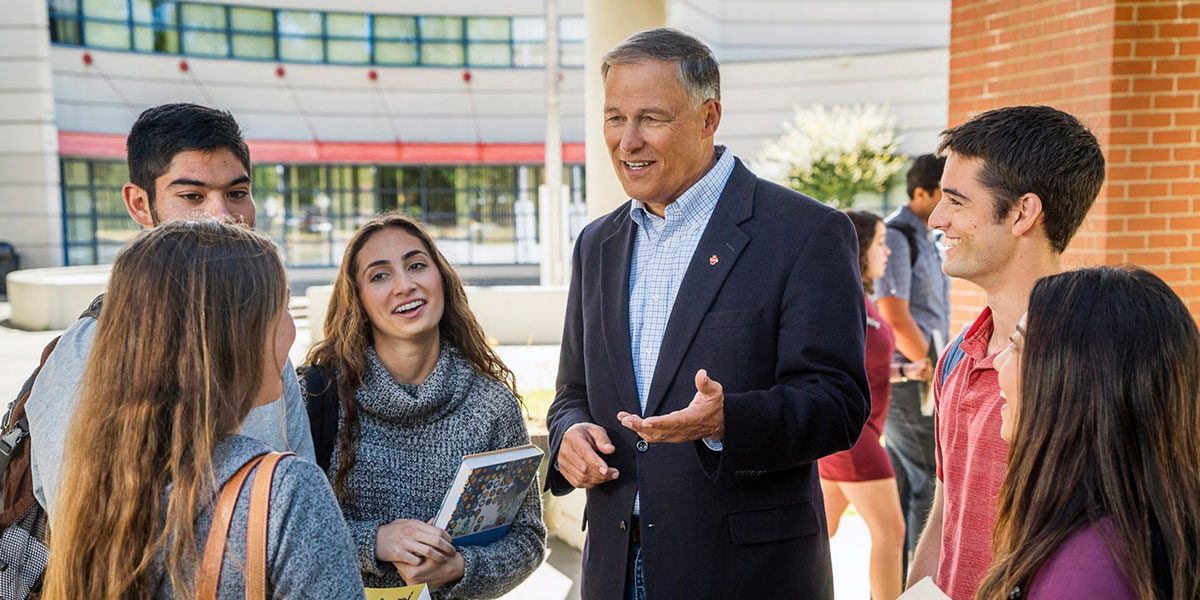
My exhibit: Washington State’s Governor Jay Inslee. [Photo from: https://www.jayinslee.com/top-priorities/health-care.]

His impressive experience includes an economics major, law degree and practice, city government (city prosecutor), Washington legislature (four years), U.S. House (13 years), national government (regional director, U.S. Department of Health and Human Services), country’s longest serving governor (11 years), chair, Democratic Governors Association.

His latest “state of the state” address makes no mention of restrictions on how doctors can practice medicine, professional teachers can teach or the books librarians can provide. No efforts to make life more difficult for LGBTQ people. No increases in his executive power. No curtailing of access to public information for media and other Washingtonians. No refusal to hold press conferences. No cuts in support of the poor. No taxpayer-funded private and religious schools. [No headline-grabbing trip south for Washington’s law officers to stop immigrants.]

What has he accomplished or proposed? Some examples:

Human rights. “Housing is a Human Right” campaign (construction; zoning; $1 billion for homeless and affordable housing); public transportation. More access to healthcare; including immigrants’ and women’s rights. Reduced racial disparities. Marriage equality. Protection of LGBTQ rights. Paid family and medical leave.

Early childhood education and care. Schools provide students mental and educational support, and programs for those with special needs. Reformed criminal justice system. Suspension of executions. Marijuana single misdemeanor offenders pardoned.

Environment. Leading climate change action advocate. Conservation of wildlife habitat; protection for endangered species. Cleaner water and air. [Sustainable agriculture and forestry. Ban on fracking. One hundred percent clean energy goal.]

Economy. Need-related college financial aid (boosted state’s economy). Increased minimum wage. Record low unemployment; 500,000 new jobs. A “Working Families Tax Credit” – rather than tax cuts for Washington’s wealthiest.

The result?

Washington has been ranked the best state in the U.S., second best for business and third best for workers and teachers. Similar to what Iowa’s ranking sometimes was under both Republican and Democratic former governors.

And that, dear Iowa children, “Is the way governors do”!

Nicholas Johnson wonders what Governor Inslee will do next; it won’t be reelection. Contact: mailbox@nicholasjohnson.org

NOTE: Text [within brackets] was deleted by the editors for space reasons.

SOURCES

Jay Inslee, General. Note: Most of the assertions and items listed in the column are from the following general sources:

Wikipedia: Jay Inslee, Wikipedia, https://en.wikipedia.org/wiki/Jay_Inslee

“Washington Governor Jay Inslee,” https://governor.wa.gov/

“Jay Inslee Governor,” https://www.jayinslee.com/ (campaign website)

Jay Inslee, “Building a Washington That Works for Everyone,” https://www.facebook.com/WaStateGov

The Seattle Times, use The Times Search feature, enter: Jay Inslee, https://www.seattletimes.com/

Results from Google search for, “Governor Jay Inslee”

Inslee’s experience. See, Jay Inslee, Wikipedia, https://en.wikipedia.org/wiki/Jay_Inslee

Nation’s longest serving governor. “List of Current United States Governors, Wikipedia, https://en.wikipedia.org/wiki/List_of_current_United_States_governors (“Currently, the longest serving incumbent U.S. governor is Jay Inslee of Washington, having served since January 2013 . . ..”)

State of the state. Jay Inslee, “2023 State of the State Address: Bold actions for building a stronger Washington,” Jan. 10, 2023, https://governor.wa.gov/news/speeches/2023-state-state-address-bold-actions-building-stronger-washington

Accomplishments. Gene Johnson and Ed Komenda, “Democratic Washington Gov. Jay Inslee won’t seek 4th term,” Associated Press, May 1, 2023, https://apnews.com/article/inslee-democrat-2024-climate-450cb6ef6347f0ac04022f079c3c0e13 (“Among his accomplishments he lists a cap-and-trade system for carbon emissions in the state and a trio of gun violence prevention measures that he signed into law last month, including a ban on semi-automatic assault rifles that is already being challenged in court by gun rights advocates.

Early this year the state Supreme Court upheld a capital gains tax Inslee promoted as a way to address what was considered the nation’s most regressive tax system.

He also vowed to protect gay rights and abortion access as conservative states constrained them, and he bought the state a three-year stockpile of a popular abortion drug in anticipation of court rulings that could limit its availability.

Inslee said he still has work to do before his exit, including collaborating with legislators and community leaders to address Washington’s homelessness crisis and speeding efforts to broaden behavioral health services.”)

Terra Sokol, “Gov. Jay Inslee Approves Salary Increases for Teachers,” News Radio, 560 KPQ, April 22, 2023, https://kpq.com/gov-jay-inslee-approves-salary-increases-for-teachers/ (“Program supervisors and instructors would make a minimum of $72,728 a year, administration $107,955 a year, and classified staff (paras, office staff, custodians) would receive $52,173 a year. . . . Salary increases total to approximately $1 billion and will go into effect in the 2024-25 school year.”)

Katherine Long, “Could you go to college tuition-free in Washington? Here’s how to find out,” Seattle Times, May 28, 2019, https://www.seattletimes.com/education-lab/could-you-go-to-college-tuition-free-in-washington-heres-how-to-find-out/ (“Last week, Gov. Jay Inslee signed into law a sweeping higher-education bill that will cut the cost of tuition, or make it free, for low- and median-income students. In a tweet, he described it as creating “a statewide #freecollege plan for eligible students.” Nationally, the bill has been hailed as a progressive approach to making college more affordable, and it’s expected to reach up to 110,000 students. . . . The Workforce Education Investment Act replaces the State Need Grant with a new program, the Washington College Grant (WCG), and makes the money an entitlement. Grants can cover up to 100% of tuition plus service and activity fees, and do not need to be paid back. It’s not a so-called “last-dollar” program — a student who qualifies for WCG could also receive a federal Pell grant, for example.

The legislation is built on the idea that Washington’s economy already employs a lot of college graduates, many of whom move here to chase opportunity — yet only about 31% of Washington’s own high-school graduates have earned a degree or credential by the age of 26, according to one study.

Being clear and upfront about who qualifies, and guaranteeing the money, removes the uncertainty surrounding financial aid. That, in turn, should make it easier for school districts and colleges to encourage kids to think about earning a certificate or a two- or four-year college degree, or becoming trained through a registered apprenticeship (also covered) . . ..[Chart indicates declining dollar support as family income increases above $69,000. $10,748 available up to incomes $46,000 or below. Declines to $5374 at $64,000 and $0 at $69,000 and above.]

Claire Withycombe, “Gov. Inslee signs bills to increase housing in WA,” Seattle Times, May 8, 2023, https://www.seattletimes.com/seattle-news/politics/gov-inslee-signs-wa-affordable-housing-bills/ (“Many of the bills are aimed at boosting the supply of homes in a state where it’s expensive and sorely needed.

Washington will now allow multifamily housing in many more neighborhoods, encourage people to develop accessory dwelling units, and streamline development regulations, among other policies. The overarching effort to smooth regulatory barriers, like zoning and permits, to building housing garnered bipartisan support.

“We are attacking this problem at its root, which is the lack of housing in the state of Washington,” Inslee said.

The Washington Department of Commerce estimates the state will need about 1 million more homes in the next 20 years.

This year, lawmakers also passed a budget with a $400 million investment in the state’s Housing Trust Fund, which finances affordable housing projects. That money will pay for about 3,000 new rental homes, and help about 250 to 400 households with homeownership, according to the department. . . .

Inslee signed nine bills about 1 p.m. Monday in Seattle at SEIU 775, and signed a 10th bill in a separate ceremony later that afternoon at the Northwest African American Museum, in a nod to the lengthy and harmful legacy of racist policies that kept many Black people from buying homes in certain neighborhoods and from building generational wealth.

House Bill 1474, which sponsors say is the first statewide policy of its kind, will help people who were affected by racist housing covenants designed to keep ethnic and religious minorities out of certain neighborhoods, as well as their descendants, with down payments and closing costs. . . .

Inslee signed nine bills about 1 p.m. Monday in Seattle at SEIU 775, and signed a 10th bill in a separate ceremony later that afternoon at the Northwest African American Museum, in a nod to the lengthy and harmful legacy of racist policies that kept many Black people from buying homes in certain neighborhoods and from building generational wealth.”)

New York Times. Reid J. Epstein, “Jay Inslee Sees Greener Pastures Ahead; After nearly 30 years in elected office, Washington’s governor plans to shift his focus to climate solutions and clean energy, underscoring the need for ‘a sense of optimism and confidence,’” New York Times, May 2, 2023, https://www.nytimes.com/2023/05/02/us/politics/jay-inslee-climate.html (“. . . [O]ne of America’s leading climate hawks.

Mr. Inslee ran for the 2020 Democratic presidential nomination by arguing that the country would have to radically reshape its relationship with fossil fuels and promote renewable energy. . . . [H]is goals later became the blueprint for the climate spending in the Inflation Reduction Act, which President Biden signed into law last year. . . .

In 2007, I [Inslee] said we’re going to be driving electric cars. People thought I was smoking the cheap stuff. Well, now we’re buying them so fast that production can’t even keep up.”]

Reid J. Epstein, “Gov. Jay Inslee of Washington, Climate Champion, Won’t Seek Re-Election; Mr. Inslee, 72, a former presidential candidate and a leading Democratic proponent of policies to slow climate change, said he would not seek a fourth term,” New York Times, May 1, 2023, . https://www.nytimes.com/2023/05/01/us/politics/jay-inslee-washington-governor.html (“Mr. Inslee and the Washington State attorney general, Bob Ferguson, filed a series of lawsuits against Mr. Trump’s administration, challenging policies on its ban on travel from several predominantly Muslim countries, its separation of migrant children from their parents and its unwinding of climate regulations.”)

David Wallace-Wells, “Gov. Jay Inslee Is Taking a Well-Earned Climate Victory Lap,” New York Times, Aug. 31, 2022, https://www.nytimes.com/2022/08/31/opinion/environment/jay-inslee-ira-climate-change.html (“[C]limate has become one of the issues that really holds the Democratic coalition together.

I think the reason for that is because it is such a powerful job creator — a good-paying-job creator. I mean, I can’t turn over a rock in my state where I can’t point to good jobs being created, in Moses Lake, where battery companies are coming in and Lind, Washington, where a solar plant went in and Arlington, where there’s electric planes that are in development. It’s just an explosion and it’s a welcome one. . . .

[In] 2009 or 2010, I brought a Chevy Volt, the prototype for the hybrid electric, to Capitol Hill because I wanted to show my colleagues, “Look what’s coming. Electric cars are coming.” . . . I was just being teased mercilessly by my friends . . .. Now people have a waiting list for the F-150, the Lightning, 10 miles long. . . .

I looked at the Alpine Meadows and thought about how they are at such risk right now. . . . [W]e’ve lost 45 percent of our glaciers — Olympic National Park, and the same thing’s happening on Rainier. It’s just great to see action today, knowing that Alpine Meadows might have a chance for my grandkids.”)

Best state and top priorities:

Best state. Levi Pulkkinen, "Education, Energy and Economy Lead Washington to Top Spot in Best States Ranking; The Evergreen State takes the top spot again in the U.S. News Best States ranking on the strength of its tech sector and other industries," U.S. News, March 9, 2021, https://www.usnews.com/news/best-states/articles/2021-03-09/why-washington-is-the-best-state-in-america ("For the second time, Washington has been named No. 1 in the U.S. News Best States ranking and is the first state to earn the top spot twice in a row.")

Economic Recovery. “Jay Inslee Governor, Top Priorities, Economic Recovery,” https://www.jayinslee.com/top-priorities/economic-recovery

(“During Jay’s tenure, Washington has made historic steps to improve the lives of Washingtonians. In his first term, Jay led Washington out of the Great Recession. By his second term, he brought Washington together to create what CNBC rated the top state for businesses and Oxfam declared the best state for workers.”

https://www.jayinslee.com/about - “Under his clear leadership, Washington helped build an economy that is ranked number one for both businesses and workers.”)

Healthcare. https://www.jayinslee.com/top-priorities/health-care

(“Jay has protected and expanded access to health care under the Affordable Care Act (ACA) to nearly 800,000 additional Washingtonians, driving uninsured rates to record lows. . . . • Expanded the Affordable Care Act to nearly 800,000 Washingtonians
• Protected those with pre-existing conditions and women’s reproductive rights
• Signed first public health care option in the country
• Passed historic long-term care benefit program so seniors can receive the care they need
. . . Jay has made Washington state a leader in reproductive health care. He helped to pass and sign the Reproductive Parity Act, which requires health plans that include maternity care services to also cover abortion services and for all health plans to cover over the counter contraceptives without a prescription.

We must change how we take care of people who suffer from mental illness in Washington state. That’s why Jay championed and signed legislation to integrate physical services and behavioral health services by significantly transforming the state’s mental health system and reshaping how and where patients receive care.”)

Education. https://www.jayinslee.com/top-priorities/education

(“[He] invested billions in our education system.

These important investments have resulted in increased access to early learning, including all-day kindergarten so that children can start building a foundation at an early age for success. For children with the most need, he pushed to secure $130 million for direct special education services and expand Breakfast After the Bell program to ensure Washington’s kids are focused on learning, not hunger.

Jay values our teachers and he’s worked to increase educator pay more than any other state and to lower class sizes so our educators can focus on giving our children the best possible education. He has also made a commitment to recruit and retain more diverse educators in our schools.”

• Enacted all-day kindergarten
• Raised teacher pay and lowered class sizes
• Funded full and partial college tuition assistance for working and middle-class Washingtonians
• Launched Career Connect to give 100,000 students career-ready apprenticeships and technical training


[The] Workforce Education Investment Act, which ensures full and partial college tuition scholarships are available to working and middle-class Washingtonians. . . . [And the] Career Connect Washington. This program connects 100,000 Washington students with career-ready education like apprenticeships and technical education.”)

Climate; Clean Energy. https://www.jayinslee.com/top-priorities/climate-and-clean-energy

(“Known as the “greenest governor in the country,” he has made Washington state a leader in both the fight against climate change and growing clean energy jobs — something he knows will be vital to our economic comeback post-COVID.

, , , Jay set the state on a pathway to a carbon neutral electrical grid by 2030 and to be powered by 100 percent clean electricity by 2045. We have built the cleanest energy grid in the nation and a $6 billion wind energy industry, while also increasing the use of solar energy and electric vehicles.

• Committed Washington to have a carbon neutral electrical grid by 2030 and 100% clean energy electricity by 2045
• Built cleanest energy grid in nation and helped build a $6 billion wind energy industry
• Signed orca and salmon protections

He led the passage of the greenest transportation package in our state’s history to create an estimated 200,000 jobs.”)

Justice and Safety. https://www.jayinslee.com/top-priorities/justice-and-safety

(“Jay wants to rethink public safety and eradicate systemic racism not just in law enforcement, but in education, healthcare, housing, and other areas of inequality. . . . He issued a moratorium on the death penalty . . .. offered pardons to individuals with misdemeanor marijuana convictions . . .. [and] helped pass bipartisan de-escalation and deadly force standards to ensure there is accountability for police violence.

Jay . . . is working to eliminate Washington’s rape kit backlog.

He has fought . . . gun violence, banning dangerous mass-killing tools like bump stocks, made sure guns are kept out of the hands of high-risk individuals, and supported the passage of voter-approved universal background checks.”)

# # #


Tuesday, January 18, 2022

Doing Well By Doing Good

Doing Well By Addressing The Poor
Nicholas Johnson
The Gazette, January 18, 2022, p. A6

I asked Senator Hubert Humphrey what he told newly elected senators. He said, “I tell ‘em they have to work four years for the Lord and then two years to get re-elected.”

There may never be another Hubert Humphrey, but there are officials who agree. Some may be responding to Jesus’ admonition we provide “the least of these” with food, water, shelter, clothing, health care – and prison visits (Matthew 25). Some acquire similar values from a different path.

Of course, others focus only on reelection -- pleasing major donors and party leadership.

Economics is not an exact science.

President Harry Truman’s assistant, Dr. John Steelman, described the President’s reaction to an economist providing “on the one hand” and “on the other hand” advice. When the economist left the oval office, Truman asked Steelman, “John, do you think you could find me a one-armed economist?”

That there are no “one-armed economists” is not because they are lacking in courage or knowledge. It is, as Harvard’s Alan Wang put it, “due to the inherently unpredictable sphere of study in which economics operates.”

“Greed – for lack of a better word – is good,” said Michael Douglas’ character, Gordon Gekko, in the movie “Wall Street.” Milton Friedman established the precedent with his assertion that “businesses serve society best when they abandon talk of ‘social responsibilities’ and solely maximize returns for shareholders.”

It’s hard to make social progress without support from the “greed is good” crowd.

Fortunately, there’s a small group who see the selfish interests for all, including billionaires, from a “rising tide that lifts all boats.” They prosper “doing well by doing good,” aware that shortsighted greed can lead to shooting oneself in the pocketbook.

To boost an economy, 70 percent of which is driven by consumer spending, consumers need money. Cutting taxes for the wealthy may increase sales of private planes and yachts but doesn’t do much for our Gross Domestic Product.

The futility of the “trickle down” theory was best explained by Harvard economist Ken Galbraith: “If you feed the horse enough oats, some will pass through to the road for the sparrows.”
• Iowa has a skilled workforce shortage. Community colleges create skilled workers. Many high school grads can’t afford tuition. Iowa’s businesses don’t want to train them. If greed is good, why don’t businesses force the legislature to provide free community college for all? They’d get their skilled workers – and shift the cost to taxpayers. [Photo credit: Kirkwood Community College, https://kirkwood.edu]

• Employee healthcare creates both hassle and huge costs for business. A universal single payer system would eliminate both – and give taxpayers the bill.

• Self-described plutocrat Nick Hanauer makes a similarly persuasive case for a $15 minimum wage, citing Seattle’s experience. That way those who work in restaurants can afford to eat in them. Everyone benefits, including the plutocrats – according to the 135 economists who agree.

Iowa legislators, how about putting in at least one year for the Lord? If greed is good, suppressing the poor makes neither dollars nor sense.
_______________
Nicholas Johnson is the author of What Do You Mean and How Do You Know? Contact: mailbox@nicholasjohnson.org

# # #

SOURCES

“Four years for the Lord.” This is my memory from a personal conversation between only the two of us that does not seem to have been recorded anywhere else.

“Matthew 25.” Bible, King James Version, Bible Gateway, https://www.biblegateway.com/passage/?search=Matthew%2025&version=KJV

President Truman, one-armed economist. “Quote Investigator,” https://quoteinvestigator.com/2019/04/10/one-handed/

Alan Wang, “unpredictable sphere of study.” Alan Y. Wang, “No, Economics Is Not a Science,” Harvard Crimson, Dec. 13, 2013, https://www.thecrimson.com/article/2013/12/13/economics-science-wang/

“Greed is good.” “The point is, ladies and gentleman, that greed – for lack of a better word – is good. Greed is right. Greed works. Greed clarifies, cuts through, and captures the essence of the evolutionary spirit. Greed, in all of its forms – greed for life, for money, for love, knowledge – has marked the upward surge of mankind.” Gordon Gekko, Wall Street (movie), 1987. https://www.youtube.com/watch?v=VVxYOQS6ggk (a 2:05 clip from the movie “Wall Street” containing this quote)

“His point . . . was that businesses serve society best when they abandon talk of ‘social responsibilities’ and solely maximize returns for shareholders.” Richard Holden, “Vital Signs: 50 years ago Milton Friedman told us greed was good. He was half right,” The Conversation, Hoover Institution, Sept. 17, 2020, https://theconversation.com/vital-signs-50-years-ago-milton-friedman-told-us-greed-was-good-he-was-half-right-146294

GDP & consumer spending. Kimberly Amadeo, “Components of GDP Explained,” The Balance, June 26, 2020, https://www.thebalance.com/components-of-gdp-explanation-formula-and-chart-3306015 (“Consumer spending comprises 70% of GDP.”)

Galbraith’s sparrows. John Kenneth Galbraith, “Recession Economics,” The New York Review, Feb. 4, 1982, https://www.nybooks.com/articles/1982/02/04/recession-economics/ (“If you feed the horse enough oats, some will pass through to the road for the sparrows.”)

Workforce. Erin Murphy and James Q. Lynch, “Iowa lawmakers agree on need for workers — but not how to get them,” The Gazette, Jan. 10, 2022, https://www.thegazette.com/article/iowa-lawmakers-agree-on-need-for-workers-but-not-how-to-get-them/

Minimum wage. Nick Hanauer. https://www.ted.com/talks/nick_hanauer_beware_fellow_plutocrats_the_pitchforks_are_coming

Molly Ball, “A Plutocrat’s Case for Raising the Minimum Wage,” The Atlantic, Jan/Feb 2016, https://www.theatlantic.com/magazine/archive/2016/01/a-plutocrats-case-for-raising-the-minimum-wage/419130/

Google search phrase: economists who believe raising minimum wage helps economy https://www.epi.org/economists-in-support-of-15-by-2024/ (“stimulate consumer demand, business activity, and job growth”) -- with list of 135 names

Minimum wage is about to rise in 21 states, 35 localities as more https://www.usatoday.com › story › money › 2021/12/20 Google search phrase: which cities or states have a $15 minimum wage

$7.25 The minimum wage in Iowa is $7.25. This is the same as the federal minimum wage, which has not changed since July 2009. Iowa is one of 21 states that follow the federal minimum wage. Mar 9, 2021 Google search: what is minimum wage iowa

What You Need to Know About Iowa's Minimum Wage – Square https://squareup.com › guide-to-iowa-minimum-wage

# # #

Sunday, December 24, 2017

Taxes Are Last Step Not First

[This blog post contains both a Gazette column, immediately below, a variation that appeared in the Iowa City Press-Citizen, the earlier blog post from which both were drawn [Introduction; Follow the Money; Where to Begin], and a sample of two of the comments they produced.]

Decisions Must Come Before Taxes

Nicholas Johnson

The Gazette, January 3, 2018, p. A5
[link to location on Gazette Web site.]

The worst thing about tax cut discussions is the “Oh, look at the squirrel” distraction from what we should be talking about.

Example? Cutting Iowa employers’ taxes can’t create more jobs when employers say their real problem is a shortage of skilled workers.

If a skilled workforce is needed, it’s time to increase, not slash, funding for the state’s universities and community colleges that create those workers.

What is your vision for America?

Some believe we are a nation of 320 million rugged individualists, where everyone is obliged to pull themselves up by their own bootstraps — even those without boots. As Grover Norquist revealed, “My goal is to get government down to the size where we can drown it in the bathtub.”

Others believe those benefiting from a community are morally obliged to care for everyone in the human family. Some cite Jesus’ urging us to provide food, drink, clothing, health care, and prison visits for “the least of these.”

Until we decide whether we want an America of rugged individualism or humanitarianism, little agreement on public policy can follow.

This newspaper is full of reporting and opinion about our plethora of policy challenges — affordable housing, education, environment, flood control, health care, homelessness, hunger, jobs, net neutrality, refugees, transportation, water quality. The Gazette’s Iowa Ideas project explores some answers.

Lynda Waddington recently described Philip Alston’s U.N. report on U.S. poverty and human rights. Read his comparative rankings for U.S. infant mortality (highest), water and sanitation (36th in the world), incarceration rate (highest), youth poverty (highest), poverty and inequality (35th of 37). [Philip Alston, "Statement on Visit to the USA on Extreme Poverty and Human Rights," United Nations, Office of the High Commissioner Human Rights, December 15, 2017.]

We built this America. Is it the nation and state you want? No? Then fix it. How do we do that? In order:

1. Don’t start with tax talk.

2. Decide whether we’re rugged individualists or humanitarians.

3. Provide enforcement of metrics for the values and society we want — for ourselves and “the least of these” — not just aspirations.

4. Develop public policies that can reach those goals.

5. Calculate their costs.

6. Explore ways of accomplishing goals through education and training, philanthropy and volunteerism, churches and trade unions, corporate policies and cost avoidance, other innovative approaches.

7. Propose a tax code, consistent with community values, sufficient to provide the remaining, necessary public funding. And remember:
• No tax cuts until there are surpluses and declining debt.

• When corporations and the wealthy have trillions of dollars they don’t use, don’t hand them more.

• Consumer spending drives 70 percent of the economy. If stimulus is needed, give the money to the bottom 80 percent who will spend it.
8. Vote.

Philip Alston reports that only 64 percent of Americans bother to register, and many of them don’t vote. In Canada and the U.K., 91 percent register, 96 percent in Sweden, nearly 99 percent in Japan.

Could that possibly be a part of our problem?
_______________
• Nicholas Johnson is a former law professor and commissioner on the Federal Communications Commission. Comments: mailbox@nicholasjohnson.org

____________________

Taxes Are Last Step, Not the First, to Making U.S. Great

Nicholas Johnson

Iowa City Press-Citizen, January 27, 2018, p. A6

The worst thing about tax cut discussions is the “Oh, look at the squirrel” distraction from what we should be talking about.

Example? Cutting Iowa employers’ taxes can’t create more jobs when employers say their real problem is a shortage of skilled workers.

If a skilled workforce is needed, it’s time to increase, not slash, funding for the state’s universities and community colleges that create those workers.

What is your vision for America?

Some believe we are a nation of 320 million rugged individualists, where everyone is obliged to pull themselves up by their own bootstraps — even those without boots. As Grover Norquist revealed, “My goal is to get government down to the size where we can drown it in the bathtub.”

Others believe those benefiting from a community are morally obliged to care for everyone in the human family. Some cite Jesus’ urging us to provide food, drink, clothing, health care, and prison visits for “the least of these.”

Until we decide whether we want an America of rugged individualism or humanitarianism, little agreement on public policy can follow.

There’s no shortage of policy challenges, such as affordable housing, education, environment, health care, hunger, jobs, net neutrality, refugees, transportation and water quality.

Last month, Philip Alston, United Nations special rapporteur on extreme poverty and human rights, reported America’s standing among nations: infant mortality (we’re highest), water and sanitation (36th in the world), incarceration rate (highest), poverty and inequality (35th of 37). (Read more: https://tinyurl.com/y8avqv4p)

We built this America. Are the present policies of America, Iowa, and Iowa City what you want? No? Then fix it. How do we do that? In order:

1. Don’t start with tax talk.

2. Decide whether we’re rugged individualists or humanitarians.

3. Provide enforcement of metrics for the values and society we want — for ourselves and “the least of these” — not just aspirations.

4. Develop public policies that can reach those goals.

5. Calculate their costs.

6. Explore ways of accomplishing goals through education and training, philanthropy and volunteerism, churches and trade unions, corporate policies and cost avoidance, other innovative approaches.

7. Propose a tax code, consistent with community values, sufficient to provide the remaining, necessary public funding. And remember:
• No tax cuts until there are surpluses and declining debt.

• When corporations and the wealthy have trillions of dollars they don’t use, don’t hand them more.

• Consumer spending drives 70 percent of the economy. If stimulus is needed, give the money to the bottom 80 percent who will spend it.

8. Vote.

Alston reports that only 64 percent of Americans bother to register, and many of them don’t vote. In Canada and the U.K., 91 percent register, 96 percent in Sweden, nearly 99 percent in Japan.

Could that possibly be a part of our problem?

Nicholas Johnson is a former law professor and commissioner on the Federal Communications Commission.

# # #

Original Blog Post

Why Would You Want to Do That?

Introduction. It's not easy losing weight, and I wanted to share my accomplishment with my doctor.

"Got my weight down to 215 pounds," I proudly said, "and my new goal is 210" -- before I realized what would surely come next. It did.

"Why would you want to do that?" he asked. It was not the first time during the previous near-forty years he'd uttered those words.

If medical treatment was essential he'd provide it. Otherwise, if he thought a patient had a touch of anxiety about their health, he believed some exercise and a sense of calm and well being were often as good as, and always cheaper than, any pills he could prescribe.

He appeared puzzled. "Don't you experience the joy of eating?" he continued. "Why deprive yourself of that pleasure?"

"I just thought it might be better for my health," I mumbled. Whereupon he brought out the morbidity and mortality data to reassure me that the additional five pounds would provide no statistically significant difference in my health or longevity.

Follow the Money. I thought again of his words when reading about the Republicans' plan to put $1.5 trillion on a credit card and then hand over the cash to billionaires. "Why would you want to do that?"

The top 1% of Americans own 40% of the country's wealth -- more than the total owned by the bottom 90% combined, more than anytime in the last 50 years. Worldwide, the total wealth of 62 families exceeds that of 3.4 billion people. [Christopher Ingraham, "The Richest 1 Percent Now Owns More of the Country's Wealth Than at Any Time in the Past 50 Years," The Washington Post, December 6, 2017.] [Photo credit: Kalynn Hines, "Why Are All American Houses Like Mansions?" Quora.]

It's hard to get a precise number on the dollar value of the wealth of individuals in the 1%. It depends on which economist you ask, what is and isn't counted, means vs. medians, and what year you use. But here are some (approximate) numbers from 2007 (obviously there have been substantial increases during the last 10 years of a soaring stock market).
Top 1% -- $14,000,000
Top 5% -- $1,250,000
Middle Fifth -- $110,000
Bottom Fifth -- -$14,000 (debt)
Joshua Kennon, "How Much Money Does It Take to be In the Top 1% of Wealth and Net Worth in the United States," Thoughts on Business, Politics, and Life, Table 3, November 14, 2011.

Even more significant is the near-two-trillion dollars of cash (and cash equivalents) held by American corporations (one-third of it by the top 5; 72% held overseas). [Matt Krantz, "A Third of Cash is Held by 5 U.S. Companies," USA Today, May 22, 2016.]

"OK, so what's your point?" you ask.

Ultimately, I want to address why a discussion of taxes is not the right place to begin. But since that's where the nation's dialog is at the moment, let's deal with it.

1. There's a "National Debt Clock" that increases by the second. On December 23, 2017, at 7:30 p.m. CT, the national debt was $20.6 trillion and growing. If massive tax cuts might sometime be appropriate, this is not that time.

2. If there ever were to be rational tax cuts they should come after the national debt is significantly reduced, and from balanced budget surpluses. Putting the cost of tax cuts on a credit card makes no more sense that paying for wars of choice with debt.

3. Why mention individuals' wealth and corporations' cash reserves? Because when there are trillions in cash sitting on the sidelines and bank loan rates are relatively low, there is no compelling rationale for handing out more cash to those who already have access to more than they can use.

4. Using the funds to improve the environment and the lives of those at the bottom of the wealth pyramid would not only create more human happiness per dollar, but would also more effectively boost an economy 70% dependent upon consumer spending. The wealthy already have most of what they need or want, and tend to invest, rather than spend, any excess income. [Photo credit: unknown; file photo.]

5. If the idea of helping the bottom 50% is not appealing, the money could at least better be used to carry out President Trump's expressed support for massive, essential, overdue, infrastructure projects.

In short, "Why would you want to do that?" It doesn't make economic sense.

But economics -- more specifically taxes -- is not where this conversation should begin.

Where To Begin? Imagine this breakfast table conversation:
"What are your plans for the day?"

"Oh, I thought I'd go down to the bank and borrow some money."

"How much?"

"Maybe $10,000, maybe $25,000. I don't know."

"Tell me now, why would you want to borrow that much money?"

"I don't know. I was just thinking I'd like to have more money."

"But you wouldn't have more money. After paying off the loan and interest you'd have less money. What are you going to do with the money anyway?"

"Just have it. I haven't really thought about what I'd actually do with the money."
That's one unlikely breakfast conversation. This one is more likely:
"We have to fix that big hole in the roof. How are we going to pay for it?

Insurance should cover most of it. And what better use for our "rainy day fund"? "Rainy day fund," get it?

Yeah, I get it. It's just that right now I don't find it funny. What if we need more?

Once we find out how much it's going to be, if we don't have enough I can always go down to the bank for a loan.
Where do you start? You start with your desire for a warm, dry house, and the ongoing maintenance to keep it that way. Then you address how you're going to pay for it.

That's how it ought to be with all governmental budgets -- city, county, state, and our federal budget. You don't ignore economic growth, the need for revenue, and tax policy. It's just that you don't start there.

You start with the most fundamental question. From your answer to that one the answers to the others will more easily flow.

Do you believe you have an obligation -- or if not, at least a desire and willingness -- to create an America that is a large, caring community in which no one is invisible? Or, do you find more appealing a country of individuals, with everyone on their own, where "greed is good," pollution is acceptable as long as it's profitable, and everyone must "pull themselves up by their bootstraps" -- regardless of whether or not they have boots -- until they, like you, can say, "I've got mine, Jack"?

If we're not just talking about professions of belief on Sunday, but the supporting evidence of action throughout the week, there is a discouraging quantity of evidence that a substantial number of Americans, and their elected representatives, are somewhere between a willingness to accept, and an enthusiasm for, the second choice.

So, let's pause for a moment to examine where America may have holes in its roof -- and its safety net.

I am indebted to The Gazette's Lynda Waddington for bringing to my attention Philip Alston, "Statement on Visit to the USA on Extreme Poverty and Human Rights," United Nations, Office of the High Commissioner Human Rights, December 15, 2017. (Mr. Alston is the United Nations Special Rapporteur on Extreme Poverty and Human Rights.) Lynda Waddington, "American Poverty is On Display," The Gazette, December 23, 2017, p. A5 (not yet available online).

When Philip Alston crawled up there on America's roof to take a look, here are some of the things he found.
In talking with people in the different states and territories I was frequently asked how the US compares with other states. While such comparisons are not always perfect, a cross-section of statistical comparisons provides a relatively clear picture of the contrast between the wealth, innovative capacity, and work ethic of the US, and the social and other outcomes that have been attained.
  • By most indicators, the US is one of the world’s wealthiest countries.
  • It spends more on national defense than China, Saudi Arabia, Russia, United Kingdom, India, France, and Japan combined.
  • US health care expenditures per capita are double the OECD average and much higher than in all other countries. But there are many fewer doctors and hospital beds per person than the OECD average.
  • US infant mortality rates in 2013 were the highest in the developed world.
  • Americans can expect to live shorter and sicker lives, compared to people living in any other rich democracy, and the “health gap” between the U.S. and its peer countries continues to grow.
  • U.S. inequality levels are far higher than those in most European countries.
  • Neglected tropical diseases, including Zika, are increasingly common in the USA. It has been estimated that 12 million Americans live with a neglected parasitic infection. A 2017 report documents the prevalence of hookworm in Lowndes County, Alabama.
  • The US has the highest prevalence of obesity in the developed world.
  • In terms of access to water and sanitation the US ranks 36th in the world.
  • America has the highest incarceration rate in the world, ahead of Turkmenistan, El Salvador, Cuba, Thailand and the Russian Federation. Its rate is nearly 5 times the OECD average.
  • The youth poverty rate in the United States is the highest across the OECD with one quarter of youth living in poverty compared to less than 14% across the OECD.
  • The Stanford Center on Poverty and Inequality ranks the most well-off countries in terms of labor markets, poverty, safety net, wealth inequality, and economic mobility. The US comes in last of the top 10 most well-off countries, and 18th amongst the top 21.
  • In the OECD the US ranks 35th out of 37 in terms of poverty and inequality.
  • According to the World Income Inequality Database, the US has the highest Gini rate (measuring inequality) of all Western Countries.
  • The Stanford Center on Poverty and Inequality characterizes the US as “a clear and constant outlier in the child poverty league.” US child poverty rates are the highest amongst the six richest countries – Canada, the United Kingdom, Ireland, Sweden and Norway.
  • About 55.7% of the U.S. voting-age population cast ballots in the 2016 presidential election. In the OECD, the U.S. placed 28th in voter turnout, compared with an OECD average of 75%. Registered voters represent a much smaller share of potential voters in the U.S. than just about any other OECD country. Only about 64% of the U.S. voting-age population (and 70% of voting-age citizens) was registered in 2016, compared with 91% in Canada (2015) and the UK (2016), 96% in Sweden (2014), and nearly 99% in Japan (2014).
Is that really the country you want? Or is it just kind of what happened while we were watching the Superbowl game, neither voting nor otherwise paying attention?

That's where we need to begin. What kind of country do we want? Is it inevitable, or at least OK, that we are accelerating climate change, that some people are just going to have to sleep on the streets, go without healthcare, lack adequate nutrition, education, job training, and the dignity that comes from at least some kind of regular work?

There is no secret sauce. It's clear what we could do, and how to do it. Other countries have offered us examples of how to create a caring nation -- one in which everyone has healthcare and meaningful work to do, one in which free public education extends beyond the 12th grade, one in which there's always someone to care for those without family or friends. Indeed, we accomplished some of these things ourselves coming out from under the Great Depression of the 1930s.

Until we candidly confront the kind of country we have become, decide we want a change, and fashion the programs that can bring it about, we can't begin to address how much it will cost, the best ways to pay for it -- and how to restructure our tax system.

# # #

Comments

Note: These columns and blog post generated much positive comment. With the permission of the authors, I reproduce here two emails that are illustrative of the others. Most merely addressed the proposed process and thought it a good idea. The author of the second comment, below, assumed hypothetically that the proposed process was in place and set forth some of the values and approaches he would bring to the table.

Dear Mr. Johnson,

I am an old man soon to be 79. was the Mayor of my small town for 8 years. HEAR-HEAR for your logical thoughts.

I wish the common sense you express was a very contagious viral disease and you could haunt the halls of all our elected bodies, state and federal, and infect all our law makers.

I am contacting my reps and telling to read and heed your thoughts.

Please continue your efforts to instill common sense in the electorate.

-- James Raymond

____________________

Read your piece in the Gazette today.

There are 6 million open jobs in America looking for qualified applicants.

The immigration systems both legal and illegal are bringing in people who do not have the skills or ducation to fill those jobs. So I assume you oppose the current immigration systems. Many people say we need immigration but then why are so many jobs unfilled with millions of illegal immigrants here?

Let's fix it:

- Revise the immigration system to be merit based. Limit chain migration and lottery systems that support unskilled entrants. Fund the wall and improve border security. Address VISA's for foreign students who want to stay, they are skilled people. I'm OK with DACA given these limitations.

- Approve a national voucher system so parents can chose where their funding goes for their children's education. Eliminate the US Dept. of Education and start over.

- Slash university funding. Focus resources on the kinds of skills and education the economy needs and minimize producing people with degrees who cannot find a job that matches those degrees. The current situation creates financial individual burdens and wastes valuable resources on inefficient programs.

- Create more programs to encourage trade schools to fill the jobs required to support the economy. Connect the funding to actual economic needs.

- Approve a federal budget amendment to limit federal debt. There is no net benefit to keep pushing ourselves toward the brink of financial > ruin.

- Impose a border tax so that countries that limit trade with the US are limited in access to our economy. Develop trade policies that support American jobs not American wealth.

- Reform Social Security and Medicare. Eliminate people who have not supported funding the system (see immigration). Increase the expense for those that can afford to pay a larger percentage of the cost of service.

- Make sure that the bottom 80% have skin in the game. Handing out free money is a fool’s errand. Instead of minimizing the number of people in poverty government policy has actually grown the percentage of the population on government assistance. The Great Society has been a colossal failure. Refer to 6 million job openings.

I vote every election. I vote against every Democrat because their party has moved so far to the left as to be unrecognizable as American citizens. Obama and Hillary Clinton are being proven to be crooks worse than the Watergate affair. At least the Republicans had the guts to tell Nixon to leave.

In conclusion the level of taxation is well above what is reasonable in a free society. I understand your point about deciding who you want to be before setting a level of funding. We simply disagree with so much of the current funding it seems reasonable to try and starve the beast, or as Grover put it "drown it in a bath tub". I would point out that the usual zero-sum arguments made by progressives receive on distain from me. There is always middle ground. I think you proposed that but I'm not really sure.

-- Gary Ellis

_________________________

Friday, July 28, 2017

GOP Healthcare: Just 'Tell 'em I lied'

An aide to Louisiana Governor "Uncle" Earl Long (1939-40; 1948-52; 1956-60), having faced a group of constituents demanding to meet with the Governor, and angry over his failure to deliver them a promised road, asked Long what the aide should tell the crowd. Governor Long replied,

"Tell 'em I lied."

-- Louisiana Governor Earl Long [full story in Endnote, below]
Why do the Republican members of the House and Senate seemingly feel compelled, like those who self-flagellate their backs with knives and chains, to march on to ever greater self-inflicted wounds, in order to make good on their promise to "repeal Obamacare"? [Photo credit: Gov. Earl K. Long speaking to the Legislature in June 1956; New Orleans Times-Picayune archive.]

Surely they are aware that the titular head of their party -- the President of the United States, Donald Trump -- with all of his lies and broken promises to supporters, has nonetheless enjoyed a successful political career. After all, as he's said of the media, "I'm president and they're not." [Michael D. Shear, "'I'm President and They're Not': Trump Attacks Media at Faith Rally," New York Times, July 2, 2017, p. A18.] As the Times has reported, "There is simply no precedent for an American president to spend so much time telling untruths."
"[H]ere are the numbers for the president’s first 100 days.
492: The number of false or misleading claims made by the president. That’s an average of 4.9 claims a day.
10: Number of days without a single false claim. (On six of those days, the president golfed at a Trump property.)
5: Number of days with 20 or more false claims. (Feb. 16, Feb. 28, March 20, April 21 and April 29, his 100th day in office.)" Glenn Kessler and Michelle Ye Hee Lee, "President Trump’s First 100 days: The Fact Check Tally," Washington Post, May 1, 2017.

And see, David Leonhardt and Stuart A. Thompson, "Trump's Lies," New York Times, Updated July 21, 2017 (with chronological itemized list; "There is simply no precedent for an American president to spend so much time telling untruths. Every president has shaded the truth or told occasional whoppers. No other president — of either party — has behaved as Trump is behaving. He is trying to create an atmosphere in which reality is irrelevant.")
As much as we may admire the congressional Republicans' ethical desire to keep commitments to constituents, why can't they, with regard to this healthcare business, follow their President's example, and that of Governor Earl Long, and simply say, "We lied"?

In fact, they even have a much more acceptable explanation than "we lied." I would suggest they consider something like this:
When Obamacare became law we did not like it. You did not like it. We did not like the process the Democrats used to get it enacted. During the years since, our efforts to repeal it have been frustrated by President Obama's threat to veto any repeal. As you've probably noticed, we've had our difficulties repealing it this year as well.

This is, in large part, a function of the passage of time.

There are things that even the Democrat Obamacare enthusiasts agree are wrong with the law. Whatever else happens, those defects must be fixed.

But after seven years of Americans living with Obamacare, getting access to insurance and healthcare, many of you have come to depend upon it. Few if any of our proposals to repeal it have had the support of more than 15 percent of the American people -- including Republicans. Changes that would continue, or increase, the tens of millions of Americans with no realistic access to Medicaid, Medicare or other adequate health insurance and healthcare, are neither good medicine nor politics.

We have not abandoned our quest, your quest, to improve on Obamacare. What we have come to recognize is that an outright repeal, with or without a replacement, is not politically possible. What is possible is to do better than the Democrats did in fashioning Obamacare while essentially locking us out. What we can do is to start over with the traditional legislative process of staff research, committee hearings with the nation's experts, and full floor debate regarding amendments -- a process that will enable Democrats and Republicans to work together. What we can do is create a process in which facts replace ideological arguments, a process in which every member of the House and Senate has some skin in the game, a process from which can come the best healthcare for all Americans that our representative democracy is capable of creating for the American people.
There's something to the old saying that when you find yourself at the bottom of a deep hole, the first step to getting out is to stop digging. The Republicans continued digging. It hasn't worked. Perhaps it's time to call on Winston Churchill. As Churchill once observed of our democracy, "The Americans will always do the right thing -- after they've exhausted all the alternatives." Now that Congress has pretty well exhausted all the alternatives, perhaps the next step is to do the right thing.

# # #

Endnote
The full story is told by Michael Kurtz and Morgan Peoples:
"During one of his campaigns for governor, Earl Long made a stump appearance before a crowd of farmers in rural St. Tammany Parish. In typical fashion, he promised that if elected, he would have a local road, heavily traveled and full of potholes, widened and paved. Long won the election abnd carried the rural district, but when the legislature convened, he failed to include the promised road work in his agenda of bills. Astonished and furious at this display of gubernatorial duplicity, a large contingent of irate citizens journeyed to Baton Rouge to see Governor Long. Earl would not see them, and they subjected his administrative aide to a barrage of threats and insults. Refusing to leave, they stood their ground and demanded that Long see them. Equally adamant, Earl turned down the impassioned pleas by his aid. The fist-shaking mob gave the aid one last chance, and out of sheer exasperation, he said to Long, "After all, governor, you did promise to have their road paved. What should I tell those people?" With a shrug, Earl replied, "Tell 'em I lied!"
Michael L. Kurtz, Morgan D. Peoples, Earl K. Long: The Saga of Uncle Earl and Louisiana Politics, (LSU Press, 1990), Preface

I will leave to others the search for other possible indicia of similarities between President Trump and the Governors Long, such as, "[Huey] Long became a dictator, disdaining the ordinary processes of constitutional government and flouting the principles of separation of powers. . . . [H]is successors engaged in outrageous acts of personal enrichment, stealing an estimated $100 million from the state [roughly $2 billion today]. . . . [Earl Long] openly practic[ed] spoils politics. He wrecked the state civil service system, fired civil servants for 'political halitosis,' and openly accepted 'campaign contributions' from gamblers and mobsters." Id., p. 9.

# # #

Tuesday, November 15, 2016

Tracking Trump

Contents
Updated Daily
Introduction: Why Track Trump?

Issues (an outline of categories in weekly compilations)

Week 1 -- November 9-15, 2016

Week 2 -- November 16-22, 2016

Week 3 -- November 23-29, 2016
Highlights and Trends
Week 4 -- November 30-December 6, 2016

Week 5 -- December 7-December 13, 2016

Week 6 -- December 14-December 20, 2016

Week 7 -- December 21-December 27, 2016

Week 8 -- December 28-January 3, 2017

Week 9 -- January 4-January 10, 2017

Week 10 -- January 11-January 17, 2017

[Note: Because of the physical volume of entries, beginning with Week 3 the blog post you are now on will remain the opening post for this series, and the links in its "Contents" section at the top of this post will take you to the new blog pages for subsequent weeks.]


Introduction: Why Track Trump?

Of the 1200 or so blog essays in FromDC2Iowa, most stand alone -- they treat a single subject, or event.

Occasionally a thread emerges, as a single, ongoing subject is dealt with over a period of months. For example, the Board of Regents' selection of University of Iowa president Bruce Harreld (someone with as little experience with higher education administration as Trump has had with the administration of government), was an ongoing subject of blog essays over a period of months.
See, e.g., "Business Background: Enough for University President?" September 2-October 31, 2015 (with links to 20 collections of material and comments); "UI President Harreld - Nov. 2015," November 1-30, 2015 (with links to 10 collections); "UI President Harreld - Dec. 2015," December 1-31, 2015 (with links to 10 collections); "UI President Harreld - Jan. 2016," January 1-31, 2016 (with links to 10 collections); "UI President Harreld - Feb. 2016," February 1-29, 2016 (with links to 11 collections).
The election of Donald J. Trump cries out even louder for such ongoing attention.

Every new U.S. president brings some measure of uncertainty as to what he will say and do. However, most have arrived with a package of clues as to what that might be, based on some sort of track record in the public sector.

President-elect Donald Trump brings no such record. Moreover, his unprecedented refusal to reveal his tax returns, and the sketchy, largely unproven assertions about his business record -- whether praise or criticism -- means we have even less solid information about his behavior in the private sector. [President-Elect Donald J. Trump; photo credit: Wikipedia]

In this, and succeeding, blog posts we will attempt to identify the issues requiring attention, and begin the process of finding and revealing the clues that may emerge regarding how a Trump Administration might deal with them. Where available, we will provide media reports with more detail. Our principal sources will be The New York Times and The Washington Post. For a full collection of New York Times' stories, see generally, "The Trump White House; Stories on the Presidential Transition and the Forthcoming Trump Administration," New York Times undated/updated.

____________________

The Issues

Transition. Regardless of agendas and intentions, a functioning executive branch of our federal government requires some 4,000 presidential appointees, and supporting civil service staff, who are experienced and knowledgeable. Those resources are now in place. Most of those folks will be gone by, or soon after, the inauguration of Donald Trump, January 20, 2017. Have their replacements been found? Are they being brought up to speed by their predecessors?

Leaders. One of the most significant subsets of an administration's staffing are those chosen by a president as his closest advisers. This is particularly significant for a president, like Trump, who has no experience and very little knowledge of what is required of a president. Who are those individuals? What do their experience, knowledge, ties to special interests, and ideological orientation tell us about the advice they'll be providing?

International. The president of the United States wears many hats, among them CEO of the executive branch, commander-in-chief of the military, leader of his or her political party, cheerleader in chief for the American people in times of trouble. But none is more important than the president's role as America's face for the 7 billion people living elsewhere (sometimes referred to as "leader of the free world"). Every one of these roles can benefit from a depth of knowledge and a breadth of experience -- for which Trump has neither. Will he reach out to America's (and the world's) "best and the brightest"? Or will he continue to rely on his questionable confidence that he "knows more than the generals" -- and the diplomatic corps?

Conflicts. For the last 40 years, every president coming into the office with investments has put them in a "blind trust" -- a separate legal entity, managed by an independent wealth manager during the president's term in office, during which time the president has neither control nor even knowledge of how the assets are being managed. During the campaign Trump did not agree to do this, saying that his business interests would be managed by his children. If that turns out to be the arrangement it would be an unprecedented conflict of interest.

Temperament. During the campaign, Donald Trump often engaged in behavior and speech that many, perhaps most, Americans (including many of his supporters) found unacceptably divisive, hateful, disrespectful of others -- and potentially dangerous in international relations. Will this continue from time to time, or was Trump's campaign performance merely that: a "performance"? Will he successfully transition into a new role as a responsible president?

Media. During the campaign Trump was unrestrained in his attacks on both individual journalists and "the media" in general. Since winning the election this seems to have toned down a little. An intimidated media cannot well serve a self-governing democracy, and there are many ways a president can intimidate -- especially when the media is a part of a much larger conglomerate with a diverse range of relationships with the federal government (e.g., proposed mergers, defense contracts).

Divisions. As the exit polls on election day confirmed, rarely have Americans been as deeply divided as they are now -- the economic 1% and the rest of us, urban and rural, old and young, college educated and high school, professionals and working class, whites and minorities, male and female, American-born and immigrants, religious and not so much, fact-driven and ideologues. Tragically, this has carried over into increases in everything from offensive speech to physical attacks. Regardless of the extent to which it is a consequence of the campaign Trump conducted, it seems to be a reality. He can choose to help with the healing, or simply pour more salt in the wounds.

Policy. There will be, potentially, a very long list of law and public policy areas to watch. There are many things he advocated during the campaign that he has already backed off from somewhat, may never have intended to do, or may discover he can't do. Meanwhile, those who would be adversely affected by the execution of his campaign rhetoric are understandably anxious. Here are some obvious matters with which to begin, starting with what Trump has identified as his top three. There will be more to come.
Immigration. Millions of individuals now living in America, Hispanics and Muslims immediately come to mind, will be impacted by whatever a Trump Administration decides to do.

Healthcare. "Repealing Obamacare" has been a Republican mantra since it was introduced. It never was a universal single-payer healthcare plan (like Medicare or Veterans' healthcare), it was a health insurance plan. But it was better than what many Americans had previously. Will it be replaced before it is repealed or afterwards? If it's only modified, how will Americans then be better or worse off?

Infrastructure. A central question -- aside from how much will be spent, and over what period of time -- is who will most benefit? Will the projects, and jobs, go to the most vulnerable Americans -- a rising tide to benefit those who don't yet even have a boat? Or will it go to upgrading the luxurious airline lounges and other airport facilities for the one-third of Americans who fly at least once each year? Will the money go to wealthy contractors and those with the skills to earn the median American wage (or more)? Or will it (like FDR's WPA and CCC) help those living in neighborhoods with 50 percent unemployment?

Energy. During the campaign Trump aligned himself with the climate change deniers, urged maximum development of U.S. oil, and indicated support for a return to coal as a source of energy and jobs for those in coal country. Whatever these policies prove to be will also have an impact on America's participation and cooperation with global efforts to reduce carbon emissions. Clues to policy will come from Trump's appointments in the executive branch agencies and his White House staff.

Education. Many education policy proposals were put forward during the campaign -- including a nod from Trump in favor of the general idea of making college "more affordable." Others' proposals have included tuition-free community college, our following the European policy of tuition-free higher education (either for all, or for those below a set income cap), tying payback on student loans to a percentage of income, and ideas regarding an expanded opportunity for pre-K education.
Week 1 -- November 9-15, 2016

Transition. Transitions are always difficult -- 60 plus days to put an executive branch federal government together. Trump's meeting with President Obama was a good sign, as was what was reported about what both of them said during and after the meeting. Somewhat troubling is that the designated leader of the transition, Vice President-elect Mike Pence, has indicated he'd like to go on being governor of Indiana until a week or so before the inauguration. There have been questions about the formal role of Trump's children (discussed under "conflicts"). Governor Chris Christie has already been replaced as Chief of Staff-designate by Republican National Committee Chair Reince Priebus. And apparently whoever is in charge has been somewhat slow in responding to offers of assistance from current office holders (including those in the CIA, Departments of State and Defense). Ben Carson has indicated he is not interested in a cabinet appointment because he lacks the experience and knowledge to do the job. The designated security adviser, former House Intelligence Committee Chairman Mike Rogers, has announced he will not be serving. But this is only one week in; there will be changes to come -- whether more stabilizing or chaotic.

See the detailed report in Julie Hirschfeld Davis, Mark Mazzetti and Maggie Habermannov, "Firings and Discord Put Trump Transition Team in a State of Disarray," The New York Times, November 16, 2016, p. A1 ("President-elect Donald J. Trump’s transition was in disarray on Tuesday, marked by firings, infighting and revelations that American allies were blindly dialing in to Trump Tower to try to reach the soon-to-be-leader of the free world."); and Karen DeYoung and Greg Miller, "Key figures purged from Trump transition team," Washington Post, November 15, 2016 ("'“It became clear to me that they view jobs as lollipops, things you give out to good boys and girls, instead of the sense that actually what you’re trying to do is recruit the best possible talent to fill the most important, demanding, lowest-paying executive jobs in the world,' [Eliot] Cohen ["a leading voice of opposition to Trump during the campaign who had advised those interested in administration jobs to take them, abruptly changed his mind, saying the transition 'will be ugly.'] said.").

Leaders. During the campaign Trump and his followers shouted out that he would "drain the swamp" -- meaning that he would rid Washington of special interests and their lobbyists. What he found when he drained the swamp were the creatures that lived there: lobbyists looking for jobs and contacts in a new administration. The Trump team was willing to take them on board. The Times detailed the process and named the individuals and their conflicts: Eric Lipton, "With Trump's Election, a Bonanza for Washington Lobbyists," New York Times, November 11, 2016, p. P1 (an inside look into who they are and how they do what they do); and Eric Lipton, "Trump Campaigned Against Lobbyists, but Now They're on His Transition Team," New York Times, November 12, 2016, p. A1 ("President-elect Donald J. Trump, who campaigned against the corrupt power of special interests, is filling his transition team with some of the very sort of people who he has complained have too much clout in Washington: corporate consultants and lobbyists.")

Later into the first week the headlines involved Trump's appointment of Steve Bannon as Chief Strategist and Senior Counselor to the President, a position he's characterized as equal to that of Chief of Staff Reince Priebus. The controversy involves Bannon's prior role as CEO of Breitbart. (You can examine for yourself its Web site here and its Facebook page here.)

See David Weigel, "Is Trump’s new chief strategist a racist? Critics say so," Washington Post, November 14, 2016 ("some of the highest praise for Bannon’s appointment came from white nationalists and white supremacists. . . . [C]omments celebrating the news have posted on Stormfront, a website for the 'White Nationalist Community,' including this one from a reader called Pheonix1993: 'Stephen Bannon: racist, anti-homo, anti-immigrant, anti-jewish, anti-establishment. Declared war on (((Paul Ryan))) Sounds perfect. The man who will have Trump’s ear more than anyone else. Being anti-jewish is not illegal.'”); and David A. Fahrenthold and Frances Stead Sellers, "How Bannon flattered and coaxed Trump on policies key to the alt-right," Washington Post, September 15, 2016 ("[W]hat policies Bannon may try to push can be gleaned from a series of one-on-one interviews on Bannon’s radio show between November 2015 and June of this year. In those exchanges, a dynamic emerged, with Bannon often coaxing Trump to agree to his viewpoint, whether on climate change, foreign policy or the need to take on Republican leaders in Congress.") Michael D. Shear, Maggie Haberman and Michael S. Schmidt, "Critics See Stephen Bannon, Trump's Pick for Strategist, as Voice of Racism," New York Times, November 15, 2016, p. A1 ("A fierce chorus of critics denounced President-elect Donald J. Trump on Monday for appointing Stephen K. Bannon, a nationalist media mogul, to a top White House position . . ..")

Katie Zezima, "Trump pits establishment against populism at the top of his White House team," Washington Post, November 14, 2016 (" Trump named his top two advisers [Steve Bannon and Reince Priebus] on Sunday [Nov. 13] . . . setting up what could be a battle within the White House between the populist, outsider forces that propelled his winning campaign and the party establishment that dominates Washington."); Michael D. Shear, Maggie Haberman and Alan Rappeport, "Donald Trump Picks Reince Priebus as Chief of Staff and Stephen Bannon as Strategist," New York Times, November 14, 2016, p. A1.

International.

Conflicts. The Trump children hold formal positions in the transition, as well as responsibility for running the Trump companies. The request (it's not known from whom) that they all receive top security clearances was apparently blocked by someone. But here's a story of one specific example of private profit from public position, along with ethics advisers general concerns: Drew Harwell, "With Ivanka’s jewelry ad, Trump companies begin to seek profit off election result," Washington Post, November 15, 2016 (Ivanka Trump's company using her family's appearance on "60 Minutes," with Ivanka wearing her company's $8800 bracelet, "marked one of the first moments since the election during which the Trump companies have sought to use Trump's presidential prominence to boost their private fortunes. But it may not be the last. Ethics advisers have increasingly voiced concerns over the unprecedented conflicts of interest that could arise from the soon-to-be first family's empire of real estate, luxury goods and licensing deals.").

Eric Lipton and Susanne Craig, "Donald Trump’s Far-Flung Holdings Raise Potential for Conflicts of Interest," New York Times, November 15, 2016, p. A1 ("The layers of potential conflicts he faces are in many ways as complex as his far-flung business empire, adding a heightened degree of difficulty for Mr. Trump — one of the wealthiest men to ever occupy the White House — in separating his official duties from his private business affairs.").

Temperament. After his election it was like someone threw a switch on Donald Trump -- he had kind words praising Hillary Clinton in his acceptance speech, and was deferential and praising of President Obama in the Oval Office. Julie Hirschfeld Davis, "Trump and Obama Hold Cordial 90-Minute Meeting in Oval Office," New York Times, November 11, 2016, p. A1.

For one of the more detailed descriptions of Trump's executive "style" by those who have worked with him and know him best, see Marc Fisher, "Trump’s huge transition will start with his tight inner circle," Washington Post, November 10, 2016 (e.g., "He reads little and rules by his gut. He picks people by first impressions, sometimes without even talking to them. He is laser-focused on how he is perceived and what people say about him.")

Media. Given the importance of an independent, First Amendment-protected media, it is unsettling when Trump says he wants to dilute the First Amendment. Marc Fisher, "Trump’s huge transition will start with his tight inner circle," Washington Post, November 10, 2016 ("Trump has also used the threat of lawsuits as a cudgel against those who block his way or criticize him in public; that’s an avenue he won’t have as president, though he has said he wants to dilute First Amendment protections of free speech.")

Divisions. Many commentators seem to believe what is intuitive: that Trump's hateful campaign rhetoric has in fact contributed to a deepening divide in America. Abigail Hauslohner, Sandhya Somashekhar and Susan Svrluga, "Vitriol only intensifies after bitter election," Washington Post, November 11, 2016 ("Three days since businessman Donald Trump won the presidency, it is clear that the animosity wrought by a historically divisive election did not simply die in its wake, but may have intensified. U.S. cities have been convulsed by anti-Trump protests. Swastikas, racial slurs and personal threats have appeared on public buildings and dorm room doors. And online, the vicious word-slinging between supporters of the two candidates has escalated to include videotaped accounts of personal confrontation and retribution."); Matt Zkapotosky, "Hate crimes against Muslims hit highest mark since 2001," Washington Post, November 14, 2016 ("Hate crimes against Muslims spiked last year to their highest level in more than a decade — an increase that experts and advocates say was fueled by anger over terrorist attacks and anti-Islam rhetoric on the campaign trail.") Eric Lichtblau, "U.S. Hate Crimes Surge 6%, Fueled by Attacks on Muslims," New York Times, November 15, 2016, p. A13 ("[A]ttacks against American Muslims surged last year . . .. The data . . . is the most comprehensive look at hate crime . . . by researchers and outside monitors, who have noted an alarming rise in some types of crimes tied to the vitriol of this year's presidential campaign . . ..")

Immigration. Julie Hirschfeld Davis, "Donald Trump Appears to Soften Stance on Immigration, but Not on Abortion," New York Times, November 14, 2016, p. A1 ("On immigration, he [Trump] said the wall that he has been promising to build on the nation’s southern border might end up being a fence in places. But he said his priority was to deport two million to three million immigrants he characterized as dangerous or as having criminal records . . . [not] all of the estimated 11 million undocumented immigrants in the country.")

Policy. There is a variation in many political campaigns between what the candidate says before and after election, once in office. Because so many of Trump's campaign assertions were frightening to many Americans, there's more interest than usual in what he's actually going to do. Some are inclined to give him the benefit of the doubt, that "of course, he'd never really do that." Others warn, "Don't be so sure. He's told you what he's going to do." So far it appears that he is backing off on some of his promises. There are other promises it will be hard to keep even if he'd like to: Sean Sullivan and Dana Priest, "Many of Trump's sweeping promises will be hard, if not impossible, to fulfill," Washington Post, November 10, 2016 ("Some of Trump’s most dramatic undertakings — such as canceling Obama’s “illegal” executive actions — can be done in his first hours as president. Other priorities, such as repealing and replacing the Affordable Care Act or building a wall on the U.S.-Mexico border, will require the approval of Congress, which will be controlled by Republicans but could still squabble over details. Others still could run into political or legal obstacles that may be difficult to overcome." The story includes a detailed run-through of many categories and detailed examples.)
Immigration. Jose A. DelReal, "Trump and advisers hedge on major pledges, including Obamacare and the wall," Washington Post, November 11, 2016 ("Trump built his campaign message around bold vows to, among other things, force Mexico to pay for a massive border wall, fully repeal the Affordable Care Act and ban Muslims from entering the United States. But in the days since his upset election victory, he or his advisers have suggested that those proposals and others may be subject to revision. . . . 'I want to solve health care, jobs, border control, tax reform,' he [Trump] said.")

Healthcare. After meeting with President Obama, Trump backed away from total repeal of the Affordable Care Act. Reed Abelson, "Donald Trump Says He May Keep Parts of Obama Health Care Act," New York Times, November 12, 2016, p. A1 ("Just days after a national campaign in which he vowed repeatedly to repeal President Obama’s signature health care law . . . Mr. Trump even indicated that he would like to keep two of the most popular benefits of the Affordable Care Act [preexisting conditions; children on parents' plans].")

Infrastructure.

Energy.

Education.

Week 2 -- November 16-22, 2016

Transition. Michael D. Shear, "Trump Says Transition's Going 'Smoothly,' Disputing Disarray Reports," New York Times, November 17, 2016, p. A14

Leaders. Here's a useful description from the Washington Post of "who's on first" during this second week -- the players and the plays inside the transition team: Philip Rucker and Robert Costa, "In Trump's Washington, rival powers and whispers in the president's ear," Washington Post, November 17, 2016; Karen DeYoung, "Trump defends pace of transition work as process remains opaque," Washington Post, November 17, 2016 ("The 'landing teams' for the State Department, the Justice Department, the Pentagon and the National Security Council will be announced and begin interacting with the Obama administration Thursday [Nov. 17], Republican National Committee communications director Sean Spicer said late Wednesday. Economic policy landing teams will be announced next week, followed by teams devoted to domestic policy and independent federal agencies.").

The role of Trump's children and their partners continues to be an issue. Julie Hirschfeld Davis and Maggie Haberman, "Donald Trump's Son-in-Law, Jared Kushner, Tests Legal Path to White House Job," New York Times, November 18, 2016, p. A1 (This thorough review of the legal, ethical and conflict of interest issues surrounding Trump's son-in-law's involvement begins, "Jared Kushner, the son-in-law of President-elect Donald J. Trump, has spoken to a lawyer about the possibility of joining the new administration, a move that could violate federal anti-nepotism law and risk legal challenges and political backlash.") And let us not overlook Jared's wife: Monica Hesse, "To understand the Trump presidency, we must decipher Ivanka," Washington Post, November 17, 2016.

National Security Adviser: Matthew Rosenberg and Maggie Haberman, "Trump Is Said to Offer National Security Post to Michael Flynn, Retired General," New York Times, November 18, 2016, p. A1 (this detailed critique of Flynn leads with, "President-elect Donald J. Trump has offered the post of national security adviser to Lt. Gen. Michael T. Flynn, . . . who believes Islamist militancy poses an existential threat [and who] will be a critical gatekeeper for a president with little experience in military or foreign policy issues. . . . [T]hey [Trump and Flynn] have both at times crossed the line into outright Islamophobia [and] exhibit a loose relationship with facts: General Flynn['s] . . . subordinates . . . called them “Flynn facts.”) Editorial, "Michael Flynn: An Alarming Pick for National Security Adviser," New York Times, November 19, 2016, p. A22 ("It's likely, given his record, that he will encourage Mr. Trump’s worst impulses, fuel suspicions of Muslims and bring to the job conflicts of interest from his international consulting work.")

Attorney General: Eric Lichtblau, Maggie Haberman and Ashley Parker, "Donald Trump Selects Senator Jeff Sessions for Attorney General," New York Times (online edition), September 18, 2016 ("Mr. Sessions, a former prosecutor . . . has opposed immigration reform as well as . . . proposals to cut mandatory minimum prison sentences. . . . [H]is nomination [to judgeship, by President Reagan] was rejected by the Republican-controlled Senate Judiciary Committee because of racially charged comments and actions. . . . Mr. Sessions had referred to the N.A.A.C.P. . . . as 'un-American' and 'Communist inspired.' . . . [He's] also accused of speaking disparagingly of the Voting Rights Act . . ..") Editorial, "Jeff Sessions as Attorney General: An Insult to Justice," New York Times, November 19, 2016, p. A22 ("Donald Trump ran a presidential campaign that stoked white racial resentment. His choice for attorney general — which, like his other early choices, has been praised by white supremacists — embodies that worldview. We expect today’s senators, like their predecessors in 1986 [who rejected President Reagan's appointment of Sessions to a federal judgeship], to examine Mr. Sessions’s views and record with bipartisan rigor. If they do, it is hard to imagine that they will endorse a man once rejected for a low-level judgeship to safeguard justice for all Americans as attorney general.") Thomas J. Sugrue, "Jeff Sessions' Other Civil Rights Problem," New York Times (online edition), September 21, 2016 ("Mr. Sessions [as] Alabama’s attorney general . . . left an indelible mark. He used the power of his office to fight to preserve Alabama’s long history of separate and unequal education.")

C.I.A. Director: Mark Mazzetti and Julie Hirschfeld Davis, "Mike Pompeo Is Trump's Choice as C.I.A. Director," New York Times (online edition), November 18, 2016 (Pompeo is a graduate of West Point (first in class) and Harvard Law School with three Congressional terms, and a member of the House Intelligence Committee who was especially critical of Hillary Clinton during the investigation of the 2012 Benghazi attack).

Secretary of Treasury: Ylan Q. Mui and Renae Merle, "With Treasury candidate come possible conflicts," Washington Post, November 18, 2016 (Steven T. Mnuchin, formerly with Goldman Sachs, is "A leading candidate to be ­President-elect Donald Trump’s treasury secretary [who] was deeply involved in running a bank that has received $900 million in federal bailout money and that has been accused of discrimination — examples of the potentially thorny conflicts of interest that could plague Trump’s nascent administration.")

Secretary of State: Phillip Rucker, "Trump mulls a secretary of state: Clone, crusader, statesman or clean slate?" Washington Post, November 19, 2016 (no indication of choice when this story ran, but South Carolina Governor Nikki Haley and former Governor (and Republican presidential candidate) Mitt Romney are in the running for Secretary of State, along with those who bring ideological baggage and other concerns). Michael S. Schmidt and Julie Hirschfeld Davis, "Trump Meets With Romney as He Starts to Look Outside His Inner Circle," New York Times, November 20, 2016, p. A1.

Editorial, "Donald Trump's Swamp Gets Murkier," New York Times, November 21, 2016, p. A 22 ("Now that he is president-elect, Donald Trump’s anti-corruption promise to “drain the swamp” of Washington lobbyists and powerful insiders seems to be rapidly dissolving in the swamp itself. An untold number of lobbyists and special interest players have been helping the Trump team’s transition to the White House, their path made easier, according to news reports, by vague and porous ethical standards. The most mischievous of these is a rule by which applicants merely have to de-register as government lobbyists one day to be ready the next for transition and administration jobs.")

Not only does the Trump team seem to be favoring lobbyists and other corporate representatives to head agencies that are supposed to regulate the appointees' former employers, but some of their investments, like Trump's, raise potential conflict of interest problems both here and abroad. Matthew Goldstein and Alexandra Stevenson, "Trump Adviser Takes Stake in China Ride-Sharing Company," November 19, 2016, p. B2 ("A hedge fund billionaire ["John Paulson, who made $15 billion betting against the housing market before the financial crisis"] who was an economic adviser to [Trump] . . . has taken a position in a fast-growing Chinese ride-sharing company that recently signed a deal to acquire Uber Technologies’ operations in China.")

International. Among many concerns one might have about Trump's first two weeks, his and the Transition Team's handling of international relations for our next president rank near the top. It can only be described as "reckless." They have rebuffed the Department of State's willingness to help. Global leaders have been left on their own to figure out how to reach Trump, or know who they should contact. The first face-to-face meeting is to be with the Japanese prime minister -- seemingly without thought to how this "decision" (to the extent there was one) might be received by those nations with which we are said to have "a special relationship." Here is a little lengthier excerpt than usual from the Times' take:
It has been noticed at the State Department that since his victory Mr. Trump has been talking with foreign leaders without any consultation on the often complex protocol involved. “We stand ready to support him and his team with any information that they might require,” said John Kirby, the State Department spokesman. “We are ready and able to provide context if it is desired.” “There has been no outreach to date,” Mr. Kirby added. Japan has been scrambling to find Republican foreign policy experts to advise Tokyo on Mr. Abe’s meeting with Mr. Trump, but have had little luck, according to Japanese officials. Nor, the officials said, have they been able to find anyone in Mr. Trump’s transition team to discuss talking points for the meeting. One official said that the planning for the meeting had been largely limited to logistics, and that was primarily handled by Matthew Freedman, the lobbyist and transition team member who was working on national security issues. But Mr. Freedman was fired on Monday.
Carl Hulse and Helene Cooper, "Donald Trump and Japan's Leader to Meet, With Plenty to Sort Out," New York Times, November 17, 2016, 4:00 a.m. update version.

Conflicts. Donald Trump's seeming refusal to follow the usual presidential protocol of selling his properties and putting the assets in a blind trust, managed in his interest by independent wealth managers who do not report to him, creates uncounted and uncountable conflicts of interest both at home and abroad. Numerous U.S. state and federal agencies, and foreign governments, impact his 500 LLC corporations, other interests, their operations and profits. The New York Times' Editorial Board provides some examples: Editorial, "Donald Trump's Tangled Web," New York Times, November 17, 2016, p. A30 ("Donald Trump refused to release his income tax returns during the campaign and now seems determined to lug every piece of financial baggage connected to his hotels, golf courses and other businesses into the White House.") Jonathan O'Connell and Mary Jordan, "For foreign diplomats, Trump hotel is place to be," Washington Post, November 18, 2016 ("About 100 foreign diplomats, from Brazil to Turkey, gathered at the Trump International Hotel this week to sip Trump-branded champagne, dine on sliders and hear a sales pitch about the U.S. president-elect’s newest hotel. . . . Now, those venues offer the prospect of something else: a chance to curry favor or access with the next president. Perhaps nowhere is that possibility more obvious than Trump’s newly renovated hotel a few blocks from the White House, on Pennsylvania Avenue. Rooms sold out quickly for the inauguration, many for five-night minimums priced at five times the normal rate, according to the hotel’s manager.")

Like gravity ("it's not just a good idea, it's the law"), Trump's global businesses may pose serious constitutional challenges as well as violating ethical norms regarding a president's conflict of interests. Adam Liptak, "Donald Trump's Business Dealings Test a Constitutional Limit," New York Times, November 22, 2016, p. A1 ("[T]he Emoluments Clause [of the U.S. Constitution; "no person holding . . . office [shall] accept any . . . emolument . . . of any kind whatever, from any . . . foreign state"] . . . now poses risks for [Trump] should he continue to reap benefits from . . . companies controlled by foreign governments.")

So long as Trump has even a general notion of what and where his business interests are, the only trust that could be truly "blind" would be one following his sale of all of his interests, and turning over the cash to an independent wealth manager to invest on his behalf -- but without his participation or knowledge. Regardless of how "independent" the manager may be, so long as Trump knows what he owns he will have both the appearance, and the reality, of a conflict of interest whenever a federal administrative agency, its proposed regulation, legislation, or the position taken in litigation by the Department of Justice, or hundreds of other examples, could have an impact on the profits or net worth of his investments. This is made even worse, of course, if (as he has proposed) his children will be continuing to run the businesses.

A recent example of his conflicts is illustrated by this double whammy quote from a Times' story: "Mr. Trump, as he used his golf resort as the backdrop for his official activities, gave no indication that he was concerned about news reports over the weekend that he had held meetings last week with three Indian business partners even as he was starting to assemble his administration." Michael S. Schmidt and Michael D. Shear, "Trump Turns Staid Process Into Spectacle as Aspirants Parade to His Door," New York Times, November 21, 2016, p. A1. (1) Whenever he selects a Trump-branded property (Trump Towers, or golf courses) for meetings he's promoting his business. (2) And he obviously sees no problem with continuing to manage his businesses abroad (the meeting with business partners from India) while considering the possibility of appointing Nikki Haley (born of immigrants to the U.S. from India) as his Secretary of State.

Drew Harwell and Anu Narayanswamy, "A scramble to assess the dangers of President-elect Donald Trump's global business empire," Washington Post, September 21, 2016 ("Donald Trump’s company has been paid up to $10 million [for his "brand"/name] by . . . one of Turkey’s biggest oil and media conglomerates, [that] has become an influential megaphone for the country’s increasingly repressive regime. That, ethics advisers said, forces the Trump complex into an unprecedented nexus: as both a potential channel for dealmakers seeking to curry favor with the Trump White House and a potential target for attacks or security risks overseas. . . . [They warn] of many others . . .. At least 111 Trump companies have done business in 18 countries and territories across South America, Asia and the Middle East.")

The problems are also illustrated by the unsavory and unprecedented spectacle of a president-elect having to take time to deal with a lawsuit regarding his prior fraudulent business practices, practices of sufficient significance and breadth to produce a settlement of $25,000,000. Steve Eder, "Donald Trump Agrees to Pay $25 Million in Trump University Settlement," New York Times, November 19, 2016, p. A1 ("[Trump] reversed course and agreed on Friday to pay $25 million to settle a series of lawsuits stemming from his defunct for-profit education venture, Trump University, finally putting to rest fraud allegations by former students, which have dogged him for years and hampered his presidential campaign. . . . [T]the allegations in the case . . .: Students paid up to $35,000 in tuition for a programs that . . . used high-pressure sales tactics and employed unqualified instructors.")

Temperament. Will Trump, as president, continue his campaign instinct to strike back against and and all -- and especially the media -- whenever others are not entirely to his liking? The continuing middle-of-the-night tweets are not reassuring. Michael D. Shear, "Trump Says Transition's Going 'Smoothly,' Disputing Disarray Reports," New York Times, November 17, 2016, p. A14 ("President-elect Donald J. Trump said on Wednesday that his transition was not in disarray, assailing news media reports about firings and infighting and insisting in an early-morning Twitter burst that everything was going 'so smoothly.'”)

He's continuing his disparaging adjectives (as in, during the campaign, "crooked Hillary"). Prior to a first meeting with the New York Times he refers to it as "the failing nytimes." Michael D. Shear and Carl Hulse, "Trump Reinstates New York Times Meeting While Pulling Back on Pursuing Case Against Clinton," New York Times (online editiion), November 22, 2016, 10:37 a.m. version (the widely publicized scheduled meeting Tuesday [Nov. 22] between Trump and the New York Times was abruptly cancelled by Trump with a 5:16 a.m. tweet: "I cancelled today's meeting with the failing @nytimes when the terms and conditions of the meeting were changed at the last moment. Not nice." Fifteen minutes later it was back on again: "Perhaps a new meeting will be set up with the @nytimes. In the meantime they continue to cover me inaccurately and with a nasty tone!")

Nor are his tweets limited to public and media figures; he's monitoring entertainment as well: Andrew R. Chow, "Alec Baldwin Returns to 'S.N.L.' as President-Elect Trump," New York Times, November 20, 2016 ("Alec Baldwin's return to 'Saturday Night Live' this weekend prompted another fiery response from President-elect Donald J. Trump on Twitter." The tweet read, "I watched parts of @nbcsnl Saturday Night Live last night. It is a totally one-sided biased show - nothing funny at all. Equal time for us?" [Nov. 20] Two hours earlier [5:22 a.m.] he tweeted about the cast of "Hamilton" statement to Mike Pence requesting a protection of their rights, "The cast and producers of Hamilton, which I hear is highly overrated, should immediately apologize to Mike Pence for their terrible behavior." Pence has made no public statement objecting to the cast's message. "Mr. Pence, who was greeted by a smattering of boos as he entered the theater, got it right when he said later, 'I nudged my kids and reminded them that’s what freedom sounds like.'” [Editorial, "Can Trump Tolerate Dissent?" Washington Post, November 22, 2016])

Media. Probably there will always be tension between the White House press corps and the sitting president and his or her staff. So far the focus has been on Trump's savage attacks on individual journalists and "the media" in general. But an equal, and perhaps even more significant aspect of president-press relations are the protocols regarding press presence and access, as the Times has editorialized: Editorial, "Trump Shouldn't Ditch the Press," Washington Post, November 17, 2016 ("In case of an emergency, it [the press pool] is on hand to provide timely and important information. Think, for example, of 9/11 and how the country was helped by knowing where the president was . . .. Equally important is the day-to-day information . . . about where the president is . . . and whom he is meeting with. Mr. Trump is not yet president, but the information protocols of the office still apply. His spokeswoman . . . said that the next administration intends 'to follow precedent in regards to access as soon as possible.' That commitment is reassuring. It should take effect now.")

He seems to be avoiding news conferences (although, in fairness, it should be noted that Hillary Clinton was also faulted for doing so during the campaign, as have previous presidents). Michael D. Shear and Julie Hirschfeld Davis, "Trump, on YouTube, Pledges to Create Jobs," New York Times, September 22, 2016, p. A1 ("The brief YouTube video offered one of the few opportunities for the public to hear from Mr. Trump directly since he was elected two weeks ago. The president-elect has declined to hold a news conference since his victory, and instead has used early-morning Twitter bursts to communicate.")

He called TV network executives and news anchors together for what could have been a conciliatory session between two major institutions (the presidency and the media) that need each other, and turned it into another attack. Michael M. Grynbaum and Sydney Ember, "Trump Summons TV Figures for Private Meeting, and Lets Them Have It," New York Times, November 22, 2016, p. A18 ("Mr. Trump, whose antagonism toward the news media was unusual even for a modern presidential candidate, described the television networks as dishonest in their reporting and . . . criticized some in the room by name . . ..")

He's continuing his disparaging adjectives (as in, during the campaign, "crooked Hillary"). Prior to a first meeting with the New York Times he refers to it as "the failing nytimes." Michael D. Shear and Carl Hulse, "Trump Reinstates New York Times Meeting While Pulling Back on Pursuing Case Against Clinton," New York Times (online editiion), November 22, 2016, 10:37 a.m. version (the widely publicized scheduled meeting Tuesday [Nov. 22] between Trump and the New York Times was abruptly cancelled by Trump with a 5:16 a.m. tweet: "I cancelled today's meeting with the failing @nytimes when the terms and conditions of the meeting were changed at the last moment. Not nice." Fifteen minutes later it was back on again: "Perhaps a new meeting will be set up with the @nytimes. In the meantime they continue to cover me inaccurately and with a nasty tone!")

Trump demonstrated during the campaign his ability to manipulate media to his ends, picking up an estimated $2 billion of free TV time in the process. He's continuing with one of his techniques: Paul Farhi, "Were Trump's 'Hamilton' tweets 'weapons of mass distraction'?" Washington Post, November 22, 2016 ("As he illustrated with tweets about the musical “Hamilton” over the weekend, President-elect Donald Trump knows how to change the subject — and the entire news cycle. Just as questions were mounting about Trump’s appointments, his business conflicts, his $25 million fraud-case settlement — bam! — Trump had everyone talking about something else.")

Divisions. Here's a post-election report worth reading whether you're concerned, or merely curious, about what appear to be increasing divides among Americans. William Wan, Tanya Sichynsky and Sandhya Somashekhar, "After Trump's Election: 'There are two Americas now,'" Washington Post, November 22, 2016 ("Two weeks after the election of Donald Trump, this is how divided America has become: People have moved beyond staring at the vast gulf that divides them and proceeded to arguing over who is to blame for it, what to do about it and even whether it exists at all.")

Samantha Schmidt, "‘Hijab grab’ defense: As reports of hate crimes spike postelection, Muslim women turn to self-defense," Washington Post, November 21, 2016.

Policy. Michael D. Shear and Julie Hirschfeld Davis, "Trump, on YouTube, Pledges to Create Jobs," New York Times, September 22, 2016, p. A1 ([In Trump's YouTube video, "he vowed to create jobs, renegotiate trade agreements, end restrictions on energy production and impose bans on lobbying. . . . [H]e steered clear of his most inflammatory campaign promises to deport immigrants and track Muslims and his pledge to repeal the Affordable Care Act.")
Immigration. Early reports indicate that Trump's promises to get tough on immigration, and "build a wall," have brought more immigrants and associated chaos rather than less: Joshua Partlow and Nick Miroff, "Fearing Trump’s wall, Central Americans rush to cross the U.S. border," Washington Post, November 19, 2016 ("President-elect Donald Trump has promised major change to the U.S. immigration system at a time when Central American families are flowing into the United States in growing numbers, many fleeing warlike conditions and poverty back home. . . . By winning the election, Trump may have inadvertently made his job even harder. His plans have become a selling point for the smugglers urging people to cross the border before a wall goes up, . . ..")

Healthcare.

Infrastructure.

Energy.

Education. Trump's election has already had a negative impact on U.S. colleges' enrollment of international students. Nida Najar and Stephanie Saul, "Is It Safe? Foreign Students Consider College in Donald Trump's U.S.," New York Times, November 18, 2016, p. A12 ("This year, the number of international students in United States colleges surpassed one million for the first time, bringing more than $32 billion a year . . .. College admissions officials in the United States . . . are worried that Mr. Trump’s election as president could portend a drop in international candidates. Canadian universities have already detected a postelection surge in interest from overseas.")

Lands. National parks, forests and other public lands are not the product of a mapmaker's whim. An even greater political battle than at the time of their creation is the continuous fight for their preservation. We are coming into a time of such a fight. Jack Healy and Kirk Johnson, "Battle Lines Over Trump's Lands Policy Stretch Across 640 Million Acres," New York Times, November 19, 2016, p. A9 ("Uranium mines around the Grand Canyon. Oil drilling rigs studding the Arctic National Wildlife Refuge. New coal and timber leases in the national forests. States divvying up millions of acres of federal land to dispose of as they wish.")
[Note: Because of the physical volume of entries, beginning with Week 3 the blog post you are now on will remain the opening post for this series, and the links in its "Contents" section at the top of this post will take you to the new blog pages for subsequent weeks.]

# # #