Showing posts with label greed is good. Show all posts

Tuesday, January 18, 2022

Doing Well By Doing Good

Doing Well By Addressing The Poor
Nicholas Johnson
The Gazette, January 18, 2022, p. A6

I asked Senator Hubert Humphrey what he told newly elected senators. He said, “I tell ‘em they have to work four years for the Lord and then two years to get re-elected.”

There may never be another Hubert Humphrey, but there are officials who agree. Some may be responding to Jesus’ admonition we provide “the least of these” with food, water, shelter, clothing, health care – and prison visits (Matthew 25). Some acquire similar values from a different path.

Of course, others focus only on reelection -- pleasing major donors and party leadership.

Economics is not an exact science.

President Harry Truman’s assistant, Dr. John Steelman, described the President’s reaction to an economist providing “on the one hand” and “on the other hand” advice. When the economist left the oval office, Truman asked Steelman, “John, do you think you could find me a one-armed economist?”

That there are no “one-armed economists” is not because they are lacking in courage or knowledge. It is, as Harvard’s Alan Wang put it, “due to the inherently unpredictable sphere of study in which economics operates.”

“Greed – for lack of a better word – is good,” said Michael Douglas’ character, Gordon Gekko, in the movie “Wall Street.” Milton Friedman established the precedent with his assertion that “businesses serve society best when they abandon talk of ‘social responsibilities’ and solely maximize returns for shareholders.”

It’s hard to make social progress without support from the “greed is good” crowd.

Fortunately, there’s a small group who see the selfish interests for all, including billionaires, from a “rising tide that lifts all boats.” They prosper “doing well by doing good,” aware that shortsighted greed can lead to shooting oneself in the pocketbook.

To boost an economy, 70 percent of which is driven by consumer spending, consumers need money. Cutting taxes for the wealthy may increase sales of private planes and yachts but doesn’t do much for our Gross Domestic Product.

The futility of the “trickle down” theory was best explained by Harvard economist Ken Galbraith: “If you feed the horse enough oats, some will pass through to the road for the sparrows.”
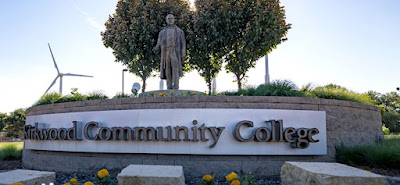
• Iowa has a skilled workforce shortage. Community colleges create skilled workers. Many high school grads can’t afford tuition. Iowa’s businesses don’t want to train them. If greed is good, why don’t businesses force the legislature to provide free community college for all? They’d get their skilled workers – and shift the cost to taxpayers. [Photo credit: Kirkwood Community College, https://kirkwood.edu]

• Employee healthcare creates both hassle and huge costs for business. A universal single payer system would eliminate both – and give taxpayers the bill.

• Self-described plutocrat Nick Hanauer makes a similarly persuasive case for a $15 minimum wage, citing Seattle’s experience. That way those who work in restaurants can afford to eat in them. Everyone benefits, including the plutocrats – according to the 135 economists who agree.

Iowa legislators, how about putting in at least one year for the Lord? If greed is good, suppressing the poor makes neither dollars nor sense.
_______________
Nicholas Johnson is the author of What Do You Mean and How Do You Know? Contact: mailbox@nicholasjohnson.org

# # #

SOURCES

“Four years for the Lord.” This is my memory from a personal conversation between only the two of us that does not seem to have been recorded anywhere else.

“Matthew 25.” Bible, King James Version, Bible Gateway, https://www.biblegateway.com/passage/?search=Matthew%2025&version=KJV

President Truman, one-armed economist. “Quote Investigator,” https://quoteinvestigator.com/2019/04/10/one-handed/

Alan Wang, “unpredictable sphere of study.” Alan Y. Wang, “No, Economics Is Not a Science,” Harvard Crimson, Dec. 13, 2013, https://www.thecrimson.com/article/2013/12/13/economics-science-wang/

“Greed is good.” “The point is, ladies and gentleman, that greed – for lack of a better word – is good. Greed is right. Greed works. Greed clarifies, cuts through, and captures the essence of the evolutionary spirit. Greed, in all of its forms – greed for life, for money, for love, knowledge – has marked the upward surge of mankind.” Gordon Gekko, Wall Street (movie), 1987. https://www.youtube.com/watch?v=VVxYOQS6ggk (a 2:05 clip from the movie “Wall Street” containing this quote)

“His point . . . was that businesses serve society best when they abandon talk of ‘social responsibilities’ and solely maximize returns for shareholders.” Richard Holden, “Vital Signs: 50 years ago Milton Friedman told us greed was good. He was half right,” The Conversation, Hoover Institution, Sept. 17, 2020, https://theconversation.com/vital-signs-50-years-ago-milton-friedman-told-us-greed-was-good-he-was-half-right-146294

GDP & consumer spending. Kimberly Amadeo, “Components of GDP Explained,” The Balance, June 26, 2020, https://www.thebalance.com/components-of-gdp-explanation-formula-and-chart-3306015 (“Consumer spending comprises 70% of GDP.”)

Galbraith’s sparrows. John Kenneth Galbraith, “Recession Economics,” The New York Review, Feb. 4, 1982, https://www.nybooks.com/articles/1982/02/04/recession-economics/ (“If you feed the horse enough oats, some will pass through to the road for the sparrows.”)

Workforce. Erin Murphy and James Q. Lynch, “Iowa lawmakers agree on need for workers — but not how to get them,” The Gazette, Jan. 10, 2022, https://www.thegazette.com/article/iowa-lawmakers-agree-on-need-for-workers-but-not-how-to-get-them/

Minimum wage. Nick Hanauer. https://www.ted.com/talks/nick_hanauer_beware_fellow_plutocrats_the_pitchforks_are_coming

Molly Ball, “A Plutocrat’s Case for Raising the Minimum Wage,” The Atlantic, Jan/Feb 2016, https://www.theatlantic.com/magazine/archive/2016/01/a-plutocrats-case-for-raising-the-minimum-wage/419130/

Google search phrase: economists who believe raising minimum wage helps economy https://www.epi.org/economists-in-support-of-15-by-2024/ (“stimulate consumer demand, business activity, and job growth”) -- with list of 135 names

Minimum wage is about to rise in 21 states, 35 localities as more https://www.usatoday.com › story › money › 2021/12/20 Google search phrase: which cities or states have a $15 minimum wage

$7.25 The minimum wage in Iowa is $7.25. This is the same as the federal minimum wage, which has not changed since July 2009. Iowa is one of 21 states that follow the federal minimum wage. Mar 9, 2021 Google search: what is minimum wage iowa

What You Need to Know About Iowa's Minimum Wage – Square https://squareup.com › guide-to-iowa-minimum-wage

# # #

Tuesday, March 18, 2014

TIF Apology

March 18, 2014, 7:20 a.m.

Note: And see "Addendum: If North Dakota Can Prosper from a State-Owned Bank, Why Not Iowa?" at the bottom of this blog essay/op ed column; and "TIFs: Too Many Negatives," March 25, 2014.

Note: The following was submitted to the Iowa City Press-Citizen with the headline, "TIF Apology," and was published this morning with the headline below. That headline's use of the word "transparency" is somewhat misleading. The column is not calling for governments to be more forthcoming and transparent regarding the details of their gifts to for-profit enterprises under the current system. [See, e.g., "TIFs: Too Many Negatives," March 25, 2014.] It is calling for a different system, a recognition of the reality that ours is a blended corporate-government economy, one that should substitute investments by taxpayers for what are now simply gifts. Taxpayers should get an ownership share, and a return on their investments. (The hard copy version also had a link to a nonexistent site. As reproduced in this blog essay the link is correct.) -- N.J. [Photo credit: Patrick McDonough.]

TIF: If You Can't Beat 'Em, Insist on More Transparency
Nicholas Johnson
Iowa City Press-Citizen
March 18, 2014, p. A7

I now realize that the dozens of my columns and blog essays over the years, itemizing in detail the evils of TIFs, grew out of a faulty premise.

It is not easy to admit a mistake, especially when one has made it so often. But you are owed that admission – along with a fuller explanation.

We’ve heard that “seeing is believing.” However, it is also true that “believing is seeing.” And what my upbringing and early education imbedded in my brain was a belief that colored my vision like the rainbow from a prism in the sun.

And what was that belief? It was that we have a capitalist, free private enterprise, market economy. Oh, sure, we had socialist enterprise as well: the Interstate highway system, national and state parks, libraries, public schools and universities. But business did business and government did government.

Now comes the realization that what I once saw so clearly was but a child of the ignorance born of ideology. It was the believing that made possible my seeing -- like the lines from the poem, “Last night I saw upon the stair/A little man who wasn't there.” (Hughes Mearns, 1899.)

I was believing in, and seeing, an economy that wasn’t there.

That’s why TIFs were seen to be an aberration, a cancer simultaneously attacking both capitalism’s foundation and taxpayers’ pocketbooks. (For numerous links to sources, see “TIFs: Links to Blog Essays,” http://fromdc2iowa.blogspot.com/2014/03/tifs-links-to-blog-essays.html.)

Like "Amazing Grace," I was blind, but now I see: We don’t have a capitalist system. We probably never did.

So how should we describe our economy? The word “fascism” carries too much baggage from World War II -- dictators, suppression of opposition, aggressive nationalism, and even racism. “Fascism” doesn’t describe America today. But from Washington, D.C., to cities, counties and states all across America, in terms of an economy, ours is the economy of fascism.

The more acceptable word today, “corporatism,” is less accurate. Because the economy we have is a blend, more resembling a purée than a salad or a stew with identifiable ingredients.

Cities’ taxpayers who cannot afford the tickets to an NFL, or even college football game, invest billions in stadiums, given as gifts to attract the billionaires who own teams of millionaires.

States have multiple funds of taxpayers’ money used to compete with other states by giving it away to attract businesses.

Washington is essentially an open bazaar, awash in money gladly given and generously rewarded.

Is this system corrupt? Of course. Welcome to the real world. All economic systems can have corruption – communist, socialist, capitalist, or our fascist.

Is our fascist economy less efficient than a true capitalist economy? Absolutely. Everybody is handling other peoples’ money. Is it less humane than a socialist system might be? Of course. When it comes to minimum wages or safer working conditions, our fascist economy is still driven by the character Gordon Gekko’s belief, in the movie "Wall Street," that “Greed is good.”

Folks, in the words Walter Cronkite used to sign off the CBS Evening News, “And that’s the way it is.” That’s the system we have. Get used to it. The beneficiaries love it. The victims don’t revolt.

What can we do? Tweak the system. Insist our governments invest our money rather than giving it away; that they take a share of the ownership – and the profits. Insist on detailed accounting of the return on our money they’re investing.

If a fascist economy is wrong, but intractable, we can at least try, as John Carver bemoans in another context, to “do the wrong thing better.”
_______________
Nicholas Johnson maintains the website www.nicholasjohnson.org and blog http://FromDC2Iowa.blogspot.com.

_______________

Addendum: If North Dakota Can Prosper from a State-Owned Bank, Why Not Iowa?

It only makes sense, so long as we're committed to a fascist economy, that we should try -- as the last line of the op ed column suggests -- "to do the wrong thing better."

One of the most obvious positive tweaks to our fascist economic system would be for governments to enter the banking business. (a) Instead of putting such balances as cities, counties and states have into commercial banks, or credit unions, they could earn more on our money by doing the banking themselves. (b) As a part of a proposal that financial aid to business favor loans over gifts (or what would hopefully become "investments" earning a return) the governmental unit could make loans to the favored businesses from the government's own bank.

Think this is a crazy idea? Think again. It's a fascist economy that's the crazy idea. City, county and state-owned banks are a big improvement over what we have, in our effort to do this "wrong thing better."

But who would ever do such a thing? How could you ever find a government willing to take on its local, commercial bankers?

Take a look at North Dakota: Robb Manelbaum, "What North Dakota’s Public Bank Does for Small Businesses," New York Times, March 13, 2014
North Dakota uses the bank to funnel deposits from state agencies back into the state’s economy through . . . loans, teaming with local private banks that initiate the transactions with borrowers. The state-owned bank typically takes half of a business loan, and the interest rate on the state-lent portion is normally one or two percentage points below the market rate.

In January, the Bank of North Dakota played a bit part in an ideological skirmish in the blogosphere after a young activist, Jesse A. Myerson, suggested putting a public bank in every state as one of “Five Economic Reforms Millennials Should Be Fighting For.” The piece led to some interesting discussions, including this response that Mr. Myerson’s suggestions were actually conservative reforms — and that the state-owned bank was responsible for there being more small-business loans in North Dakota than in neighboring states. . . .

[P]ublic banking advocates point most hopefully to efforts in Vermont. Last week, 15 Vermont towns passed resolutions urging the state legislature to establish a public bank. It could be very beneficial to the small community banks and the state. Even big cities could do this . . ..


North Dakota, Vermont -- why not a "City of Iowa City Fascist Economy Public Bank"? How about it Councillors?
# # #

Thursday, February 26, 2009

Infrastructure Insights

February 26, 2009, 8:30 a.m.

Lessons from Iowa City's Crumbling Infrastructure
(brought to you by FromDC2Iowa.blogspot.com*)

With our President talking about spending billions on "infrastructure," I thought it might be useful to bring this concept "FromDC2Iowa." But how? What might be an Iowa City-sized example of an "infrastructure" in need of repair?

And what lessons might it hold for our current global economic collapse?

Walking to town the other day, coming round and down the circular walkway across Riverside Drive to the Burlington Street bridge, I noticed some chunks of concrete and rust in a pile on the walkway.


Curious as to where it might have come from, I looked up and saw:


Apparently the steel used to hold the concrete together was beginning to rust through. Other, seemingly tiny spots showed the beginning of deterioration, presumably from deep within.


Sometimes there were what appeared to be lengthy stretches of rusting metal. Could this have anything to do with why the concrete span across the highway sort of bounces up and down when you walk on it, I wondered.


There were more missing chunks of concrete.


I'm no engineer, but I recall being told years ago that this can be a result of the salt used to melt ice on bridges in the winter -- whether pedestrian or car and truck bridges.

There are nearly 600,000 auto/truck bridges in the U.S. (597,404), and nearly a quarter of them need work (24.3%; 144, 942). Better Roads Magazine 2008 Roads Inventory, November 2008.

Our footbridge is just one little home town example of the economic challenge -- and opportunity for job creation -- confronting our nation if we were to really undertake the task of rebuilding the infrastructure (not just roads, bridges and schools, but natural gas pipelines, sewers, power lines, railroads, Internet broadband, and water lines, among other things).

We're still living with "infrastructure" built by the "CCC boys" and others during the last Great Depression 70 years ago -- indeed, some of our infrastructure is twice that age.

Somewhere along the way we lost a major part of what made America great: sacrificing and building for future generations, creating rather than just consuming. A commitment to, an investment in, future generations is what inspired the Louisiana Purchase, opened the West, spanned the continent with railroads, and later the Interstate Highway system; set aside some of our country's greatest beauty spots as national parks; built libraries, K-12 schools, land grant colleges, universities, and funded a "GI Bill" to fill them with returning veterans -- the list is endless.

We are no longer willing to share the sacrifice of war with our military: instead of pay-as-you-go financing, with citizens scrimping to buy the equivalent of the WWII "war bonds," our government grants tax breaks to our wealthiest and passes the cost to future generations; instead of rationing our president told us after 9/11 to "go shopping;" instead of a Selective Service draft, with the pain of dead sons and daughters falling on all American towns and families, we divert state and national guard members, and enrich the likes of Blackwater and Haliburton with the billions spent on for-profit, privatized war.

Instead of building family businesses over decades, we've turned a blind eye to businesses merging to a size now "too big to fail;" run by hired hands earning millions, willing to move on when more millions are offered elsewhere; whose performance is measured by three-month (quarterly) stock prices and other statistics. Why would they fix the roof this quarter when it's not going to start leaking until next quarter? Why worry about mortgages that will never be paid when bonuses are based on sales this quarter rather than bankruptcies next quarter? After all, you'll be gone four months from now.

Instead of the levels of saving of the Chinese, or even what Americans were averaging three decades ago (9%), we've spent the last ten years spending more than we earn -- a "negative" savings rate made possible (even if only temporarily) with second mortgages and credit cards.

Instead of building on the hills, and clearing the rivers' flood plains for parks, forests, prairies, and recreation areas for our own and future generations, we rebuild -- hoping and assuming that the government, somebody, anybody, will quite literally "bail us out" when the inevitable next flood occurs.

We act as if Gordon Gekko ("Wall Street" (1987)) was right: "Greed is good." Ayn Rand is our shepherd, we shall not want. Government is the problem, not the solution.

Karl Marx told us there would be days like this.** [Lest there be any question, no, I'm not advocating that "communism" would be an improvement over what we have.]

But even he did not predict crumbling walkways in Iowa City.
__________

[** I don't want to take the time to try to find passages in Das Kapital that would be both relevant and comprehensible, so here is a very quick and secondary source summary: "Marx argued that capitalism was prone to periodic crises. He suggested that over time, capitalists would invest more and more in new technologies, and less and less in labor. Since Marx believed that surplus value appropriated from labor is the source of profits, he concluded that the rate of profit would fall even as the economy grew. When the rate of profit falls below a certain point, the result would be a recession or depression in which certain sectors of the economy would collapse. Marx thought that during such a crisis the price of labor would also fall, . . .. Marx believed that increasingly severe crises would punctuate this cycle of growth, collapse, and more growth. Moreover, he believed that in the long-term this process would necessarily enrich and empower the capitalist class and impoverish the proletariat." Karl Marx, Wikipedia.]
_______________

* Why do I put this blog ID at the top of the entry, when you know full well what blog you're reading? Because there are a number of Internet sites that, for whatever reason, simply take the blog entries of others and reproduce them as their own without crediting the source. I don't mind the flattering attention, but would appreciate acknowledgment as the source -- even if I have to embed it myself. -- Nicholas Johnson

# # #