Showing posts with label Kirkwood Community College. Show all posts

Tuesday, January 18, 2022

Doing Well By Doing Good

Doing Well By Addressing The Poor
Nicholas Johnson
The Gazette, January 18, 2022, p. A6

I asked Senator Hubert Humphrey what he told newly elected senators. He said, “I tell ‘em they have to work four years for the Lord and then two years to get re-elected.”

There may never be another Hubert Humphrey, but there are officials who agree. Some may be responding to Jesus’ admonition we provide “the least of these” with food, water, shelter, clothing, health care – and prison visits (Matthew 25). Some acquire similar values from a different path.

Of course, others focus only on reelection -- pleasing major donors and party leadership.

Economics is not an exact science.

President Harry Truman’s assistant, Dr. John Steelman, described the President’s reaction to an economist providing “on the one hand” and “on the other hand” advice. When the economist left the oval office, Truman asked Steelman, “John, do you think you could find me a one-armed economist?”

That there are no “one-armed economists” is not because they are lacking in courage or knowledge. It is, as Harvard’s Alan Wang put it, “due to the inherently unpredictable sphere of study in which economics operates.”

“Greed – for lack of a better word – is good,” said Michael Douglas’ character, Gordon Gekko, in the movie “Wall Street.” Milton Friedman established the precedent with his assertion that “businesses serve society best when they abandon talk of ‘social responsibilities’ and solely maximize returns for shareholders.”

It’s hard to make social progress without support from the “greed is good” crowd.

Fortunately, there’s a small group who see the selfish interests for all, including billionaires, from a “rising tide that lifts all boats.” They prosper “doing well by doing good,” aware that shortsighted greed can lead to shooting oneself in the pocketbook.

To boost an economy, 70 percent of which is driven by consumer spending, consumers need money. Cutting taxes for the wealthy may increase sales of private planes and yachts but doesn’t do much for our Gross Domestic Product.

The futility of the “trickle down” theory was best explained by Harvard economist Ken Galbraith: “If you feed the horse enough oats, some will pass through to the road for the sparrows.”
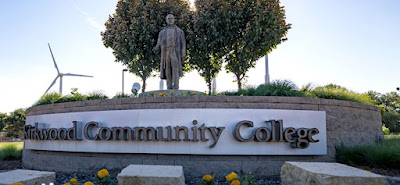
• Iowa has a skilled workforce shortage. Community colleges create skilled workers. Many high school grads can’t afford tuition. Iowa’s businesses don’t want to train them. If greed is good, why don’t businesses force the legislature to provide free community college for all? They’d get their skilled workers – and shift the cost to taxpayers. [Photo credit: Kirkwood Community College, https://kirkwood.edu]

• Employee healthcare creates both hassle and huge costs for business. A universal single payer system would eliminate both – and give taxpayers the bill.

• Self-described plutocrat Nick Hanauer makes a similarly persuasive case for a $15 minimum wage, citing Seattle’s experience. That way those who work in restaurants can afford to eat in them. Everyone benefits, including the plutocrats – according to the 135 economists who agree.

Iowa legislators, how about putting in at least one year for the Lord? If greed is good, suppressing the poor makes neither dollars nor sense.
_______________
Nicholas Johnson is the author of What Do You Mean and How Do You Know? Contact: mailbox@nicholasjohnson.org

# # #

SOURCES

“Four years for the Lord.” This is my memory from a personal conversation between only the two of us that does not seem to have been recorded anywhere else.

“Matthew 25.” Bible, King James Version, Bible Gateway, https://www.biblegateway.com/passage/?search=Matthew%2025&version=KJV

President Truman, one-armed economist. “Quote Investigator,” https://quoteinvestigator.com/2019/04/10/one-handed/

Alan Wang, “unpredictable sphere of study.” Alan Y. Wang, “No, Economics Is Not a Science,” Harvard Crimson, Dec. 13, 2013, https://www.thecrimson.com/article/2013/12/13/economics-science-wang/

“Greed is good.” “The point is, ladies and gentleman, that greed – for lack of a better word – is good. Greed is right. Greed works. Greed clarifies, cuts through, and captures the essence of the evolutionary spirit. Greed, in all of its forms – greed for life, for money, for love, knowledge – has marked the upward surge of mankind.” Gordon Gekko, Wall Street (movie), 1987. https://www.youtube.com/watch?v=VVxYOQS6ggk (a 2:05 clip from the movie “Wall Street” containing this quote)

“His point . . . was that businesses serve society best when they abandon talk of ‘social responsibilities’ and solely maximize returns for shareholders.” Richard Holden, “Vital Signs: 50 years ago Milton Friedman told us greed was good. He was half right,” The Conversation, Hoover Institution, Sept. 17, 2020, https://theconversation.com/vital-signs-50-years-ago-milton-friedman-told-us-greed-was-good-he-was-half-right-146294

GDP & consumer spending. Kimberly Amadeo, “Components of GDP Explained,” The Balance, June 26, 2020, https://www.thebalance.com/components-of-gdp-explanation-formula-and-chart-3306015 (“Consumer spending comprises 70% of GDP.”)

Galbraith’s sparrows. John Kenneth Galbraith, “Recession Economics,” The New York Review, Feb. 4, 1982, https://www.nybooks.com/articles/1982/02/04/recession-economics/ (“If you feed the horse enough oats, some will pass through to the road for the sparrows.”)

Workforce. Erin Murphy and James Q. Lynch, “Iowa lawmakers agree on need for workers — but not how to get them,” The Gazette, Jan. 10, 2022, https://www.thegazette.com/article/iowa-lawmakers-agree-on-need-for-workers-but-not-how-to-get-them/

Minimum wage. Nick Hanauer. https://www.ted.com/talks/nick_hanauer_beware_fellow_plutocrats_the_pitchforks_are_coming

Molly Ball, “A Plutocrat’s Case for Raising the Minimum Wage,” The Atlantic, Jan/Feb 2016, https://www.theatlantic.com/magazine/archive/2016/01/a-plutocrats-case-for-raising-the-minimum-wage/419130/

Google search phrase: economists who believe raising minimum wage helps economy https://www.epi.org/economists-in-support-of-15-by-2024/ (“stimulate consumer demand, business activity, and job growth”) -- with list of 135 names

Minimum wage is about to rise in 21 states, 35 localities as more https://www.usatoday.com › story › money › 2021/12/20 Google search phrase: which cities or states have a $15 minimum wage

$7.25 The minimum wage in Iowa is $7.25. This is the same as the federal minimum wage, which has not changed since July 2009. Iowa is one of 21 states that follow the federal minimum wage. Mar 9, 2021 Google search: what is minimum wage iowa

What You Need to Know About Iowa's Minimum Wage – Square https://squareup.com › guide-to-iowa-minimum-wage

# # #

Wednesday, August 23, 2017

Business Leaders: Make Legislators Fund Educated Workforce


[This excerpt from the PBS Newshour, August 29, 2017, describes a program in Colorado, analogous to those in Switzerland and Germany, that is consistent with what's discussed in the column, below. With thanks to Gregory Johnson for the suggestion to embed this.]


Can Biz Leaders Save Education?

Nicholas Johnson
The Gazette, Insight, August 22, 2017, p. A6

How can we get legislative funding for all Iowans’ post-high-school education?

Aside from bemoaning tuition increases — before increasing them again — those responsible have shown little sympathy and less results: state university presidents, Board of Regents, Gov. Kim Reynolds, and legislators.

Where can we turn?

How about those who hold political power and control: the business community?

Business leaders are assuming more social and political responsibility. When many Republican leaders did a little sidestep around President Donald Trump’s seeming tolerance of neo-Nazis, CEOs of large corporations resigned from Trump’s business councils in protest. A similarly prestigious group of corporate leaders defeated the Texas legislators’ “bathroom bill.” Many business owners are making sure their employees will have health care.

Might they lobby for education appropriations as well?

An educated population benefits everyone — and business most of all. Iowa’s problem is not a shortage of jobs. It is a shortage of skilled workers (as well as entrepreneurs and a creative class). More skilled workers mean less turnover and training, improved productivity, quality control, profits, and economic growth for Iowa’s towns.

Business leaders are aware the post-World War II economic boom was driven by a college-educated workforce of veterans, paid for by the GI Bill. California and New York built comparable economic growth with decades of tuition-free higher education. Globally, business leaders in 24 countries are benefiting from employees with tuition-free college educations; 13 of those countries offer tuition-free educations to other countries’ students as well (including ours).

Historically, Iowans willingly have financed public education since the first one-room schoolhouse in 1830. By 1910, the state was one of the first with a statewide high school system, until recently ranked one of the country’s best.

After another 107 years, expanding public education from K-12 to K-14 is scarcely a premature, radical move. Rules vary, but nine states already have some form of tuition-free community college: Arkansas, California (San Francisco), Louisiana, Minnesota, New York (plus four-year college), Oregon, Rhode Island, South Dakota, and Tennessee.

Expanding such a program to the three, four-year regents universities (as New York has done) might be premature. But starting with Iowa’s 15 community colleges ought to be possible. [Photo credit: Kirkwood Community College; welding classroom]

If Iowa wants to build a competitive edge in a global economy, it must first construct the educational foundation to support it. It simply can’t afford to leave qualified, willing students uneducated.

Business leaders: Legislators look to you for ideas as well as campaign contributions. You can give them a nudge, give them permission, you can insist they fund at least tuition-free public community colleges for Iowans.

Indeed, if you don’t insist, it will never happen.

Do it for your business, your shareholders, your town, your family — or because you know it’s the right thing to do. Just do it.
_______________
Nicholas Johnson is a former university professor who maintains www.nicholasjohnson.org. Comments: mailbox@nicholasjohnson.org

# # #

Tuesday, August 27, 2013

Reforming Higher Education

August 27, 2013, 1:00 p.m.

The President Has His Plan, What's Yours?

President Obama wants to reform higher education. He has a plan. It's designed to address the rampant acceleration of college tuition (well beyond general inflation rates), improve the value received by students for those tuition dollars, and provide more transparency in the comparative value between institutions. Tamar Lewin, "Obama's Plan Aims to Lower Cost of College," New York Times, August 22, 2013, p. A1. [Photo credit: multiple sources.]

He wants metrics that will include levels of tuition, graduation rates, and graduates' income.

The Administration concedes it hasn't yet worked out all the details. And well it should. But I hasten to add that I think the undertaking worthwhile. The fact there are problems doesn't mean the effort should be abandoned.

One of the problems is illustrated by the U.S. News law school rankings. (The President's proposal for law schools is that we all just lop off the third year. Voila, a one-third tuition cut! Well, not quite.) It is so easy to game the numbers that go into the rankings, as I've earlier laid out: "Random Thoughts on Law School Rankings." Want to improve a school's graduation rates for the President? Just turn your "grade creep" into a "grade walk," or better yet, "grade run." Just stop giving students Ds and Fs when they don't perform. Everybody graduates.

There's always the apples and oranges problems when comparing institutions. We have it with our Iowa City schools. Parents socioeconomic status (measured among K-12 students by who does, and does not, qualify for "free and reduced lunch") makes a difference. Children with parents in the upper 1%, or 10%, are more likely to have been read to, traveled more widely, seen more museums, concerts, theater, national parks, and provided additional intellectual and cultural stimulation in the form of academic tutoring, coaching in sports, or training in music and the arts. If those parents' children are having trouble in school, their parents are more likely to intervene on their children's behalf with teachers and administrators, and to be more effective when they do so, both because of their skill and their position in the community.

Comparing schools by comparing the test scores of students in school A with the students in school B is almost totally meaningless, without knowing more about those students. Moreover, there's not a lot of point to the exercise in a district like Iowa City's, where all the schools are of roughly equal (high) quality. But if you'd want to do it, you'd need to look at cohorts' scores -- because stability in general, and having gone through a single school, makes a difference for the student and is a better measure of the school. That is, look at the test scores of upper socio-economic kids in 6th grade, all of whom entered that school's kindergarten and have been there ever since. Do the same for the free-and-reduced lunch kids -- if you can find any, because many of those who entered kindergarten may have been homeless, or otherwise transferred from one school to another during the school years. Now, if you insist on comparing schools, you can compare those results with the comparably created results from other schools.

It was either Massachusetts or Connecticut that did a variant of this in dealing with the test scores generated as a result of No Child Left Behind. Goals were set for individual schools based on reasonable expectations given their demographics. They were then "ranked" in a sense against themselves. A school that could reasonably be expected to have test scores at the 93rd percentile, and only came in at the 78th percentile, knew it needed to make improvement. One that was projected to be at the 22nd percentile, and came in at the 38th, was praised for its performance.

The President's proposed metrics will create similar challenges.

Reduced-cost post-high school education for all is a major component in any state or nation's economic engine. All America benefited from the GI-Bill-funded college education provided veterans of World War II, and its contribution to America's post-war economic boom. California's near-free Universities of California, California State Universities, and community colleges boosted that state's economy to what would have made it the seventh largest economy in the world -- had it been a nation. The state (and city) of New York has reaped similar economic benefits from its very low cost college education system. This morning's Daily Iowan editorial hits on the same theme, "Invest in Education, Not Tax Cuts," The Daily Iowan, August 27, 2013, p. 4 ("The best way forward for Iowa is to invest in education instead of throwing money at property-tax cuts that barely affect corporations' bottom lines.").

One of the cost-saving-to-free alternatives to the present system involves the use of MOOCs ("massive open online courses"). See, "Higher Ed's Triumph of Hope Over History; Why Pay $100,000 or More for What's Available For Free?" August 18, 2013; "Higher Ed: When UI Loses Its Monopoly; From SUI to ACT," February 20, 2010.

The University of Iowa is not worried:
University of Iowa President Sally Mason said her school is moving methodically, but slowly on the latest education trend, massive online open courses, or MOOCs. . . . “Now there’s a lot of hype about it,” Mason said. “Some say the residential university will go away because we can have these MOOCs. I don’t belive that for a second.” . . . [S]he doesn’t see Iowa racing into the MOOC world.
Editorial, "New grads must create their own jobs," Quad City Times, August 25, 2013.

Meanwhile, the editorial continues, "University of Iowa Vice President of Research and Economic Development Dan Reed launched his own MOOC, about MOOCs: 'MOOCs: History, Hype and Reality.'”

I claim no expertise as an educational reformer. But I think education policy is so important for every individual, regardless of age and educational attainment, that I think everyone should not only feel free, but should be encouraged, to participate in the national discussion the President is trying to encourage.

So here's where I am at the moment in terms of cost control:

1. Do everything possible to reduce the time (and therefore cost) of obtaining a college degree.

2. Recognize community colleges are for many individuals (and our economy) the nation's best option. The old statistics I could easily find indicate that in 1999 there were 1655 community colleges with 5.6 million students -- 47% of all students enrolled in public institutions. "Digest of Education Statistics; Community College Facts at a Glance," Office of Vocational and Adult Education, U.S. Department of Education.

Many of the trades and professions for which a community college can prepare a student pay as well or better than the jobs in which many conventional college graduates end up. And they are certainly more precisely focused on what employers say they need. There's no substitute for an old fashioned liberal arts education when it comes to improving meaningful quality and joy of life. But there are many substitutes for students whose primary motive in pursuing a college degree is what they believe it will do for their income.

3. Encourage collaboration and cooperation among area high schools, community colleges, and universities to ease high school students obtaining college credits with such things as high school AP (advanced placement) courses, college CLEP (College Level Examination Program) exams, and joint enrollment (high school and community college, or university). Apply the recommendations of the National Commission on the High School Senior Year, that recognize the year can be used to much greater advantage by, among other things, getting seniors out of the high school building and into job shadowing and internships, research in the community, or community college or university courses. ("The Commission calls for moving away from a system in which the senior year is just more of the same to one in which the senior year provides time to explore options and prove knowledge and skills. Ideally, every senior should complete a capstone project, perform an internship, complete a research project, participate in community service, or take college-level courses." Id., p. 22.) Not incidentally, this approach has the added advantage of relieving "overcrowding" in the high schools.

An editorial in this morning's Press-Citizen notes that "the ties between UI and Kirkwood have strengthened quite a bit . . . a '2 Plus 2 Guaranteed Graduation Plan' [lets] students know in advance which Kirkwood credits apply directly to UI majors. The university has rented out classroom space in University Capitol Centre for Kirkwood to offer math and foreign language classes within walking distance of thousands of UI students. [All of which has created] a more collaborative, cooperative and innovative K-16 education system in Iowa." Editorial, "Voters Should Renew Levy for Kirkwood," Iowa City Press-Citizen, August 27, 2013, p. A7.

4. Cut the time at a high-priced college or university for a B.A. degree from eight semesters (10 if the student takes five years) to three. This would be similar to the "2 Plus 2" plan described above, with a modification. This low cost option would involve two years at a (comparatively low cost) community college, earning credits transferable to a university. This would be followed by the equivalent in credits of three semesters as a conventional student (with conventional costs) at the university (or conventional college). Up to the equivalent of one semester's credits could be earned by students who are able and willing to take, and be examined successfully over, MOOC courses, provided for free by other institutions. They could constitute the entire course load for a semester, or be spread over four semesters. Students would be charged for the testing/certification for the MOOC courses at the cost of administering the exams (hopefully in the $50 to $100 range, rather than the university's per-credit charge for in-classroom instruction).

I agree with UI President Mason that there will not be many high school graduates with sufficient self-discipline to put themselves through the equivalent of four years of MOOC instruction -- even if it is their only path to the college education they could not otherwise afford. But I disagree that MOOC instruction is not destined to play an ever larger role in higher education -- including at the University of Iowa -- along the lines of what I've described above. For starters, it already is, here as well as elsewhere. And increasingly, the certification/credit for completing such courses that I predicted three-and-a-half years ago is also coming into play.

Whatever we end up doing, the pressure to educate more Americans, at less cost, is coming from the White House, the State House, American parents, and students. We are going to need all the innovation and imagination we can bring to bear. My thoughts on the matter are always evolving and changing. As of this morning, they're what I've outlined above.

# # #