Showing posts with label politics. Show all posts

Saturday, March 14, 2026

Welcome to FromDC2Iowa: Contents & Guide

Over 1,500 blog posts on a variety of topics since 2006.

What to do?

1. Old friend of the blog and repeat visitor? You already know what you want to do and how to do it.

2. First time visitor? Here are some choices:

(a) "I'm just looking." Look to right-hand column listing years. Clicking on the little triangle in front of a year will display the months of that year. Clicking on the little triangle in front of any of the displayed months will display the titles on blogs posted that month. Clicking on a blog post's title will take you to the text of that blog post.

(b) Researching a Topic? Scroll down the right-hand column to "Search;" enter key words to search on, select "FromDC2Iowa blog" or "Nicholas Johnson Web Site" and follow directions. Want ideas? Visit "Key Word Searches."

(c) Searching by Date? Scroll down right-hand column to "Blog Archive." As explained in (a), above, click on triangle in front of year to display months, month to display posts.

3. Who is this blog's author? Nicholas Johnson.

_________________________

Tuesday, January 10, 2023

Cut the Tax Talk

Cut Out the Tax Cut Talk
Nicholas Johnson
The Gazette, January 10, 2023, p. A6

To borrow from The Who’s concluding lines to a song, “Meet the New Year, Same as the old year.”

It’s not that our joys-and-sorrows balance doesn’t leave a lot to be thankful for, compared with most of the world’s people. But we still have more serious challenges than we can surmount — most beyond their “Best if solved by” dates.

So why am I limiting myself to just one? It’s like “why did French men kiss women’s hands?” “Because you have to start somewhere.”

I’m starting with taxes.

Politicians, including some Iowa officeholders, use “tax cuts” as a sure election winner — and coverup for opposing a program.

But letting re-election and taxes trump public needs is like cutting into the front of the line at the checkout counter.

As they say in Rochester, “Hold the Mayo, let’s take another look at this.”


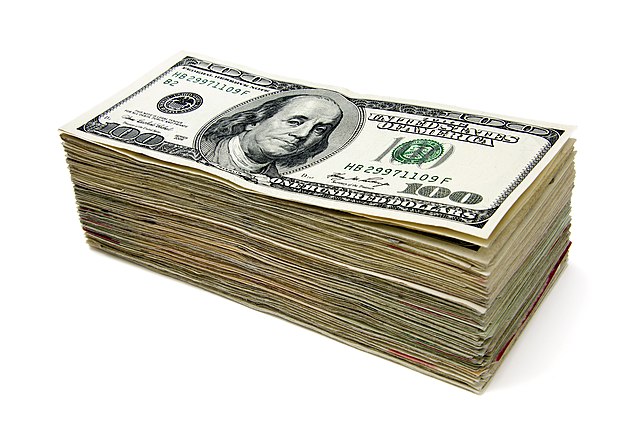
The initial relevant issues are (1) What kind of lives do we want for ourselves and our fellow Homo sapiens — in our families, communities, states, nation, and world? (2) Given those goals, what programs will be most helpful and efficient in reaching them? And (3) for each of those programs, what is the most effective and economical way of providing them? [Photo source: wikimedia/commons.]

Only after reaching consensus on the answers to those questions need we address the administrative details — including funding sources.

Look around. There are many. The philanthropy of individuals and institutions totals $500 billion annually. There are 2 million nonprofits. A quarter of Americans volunteer an average of 50 hours a year — a $184 billion value “for free.” Twothirds of us help our neighbors. Most churches have helping programs. Public-spirited corporations contribute money, participate in community programs, provide training and health care for employees.

And yes, there will be occasions when a tax-funded government program, or assistance, is the most economical and effective source.

But we need to begin with “what do we want?” and “what’s the best way to get it?”

By now you’re thinking of a version of that question for the Lone Ranger, “Who’s this ‘we’ you’ve been talking about, Nick?” Ah, you got me. Yes, I was including you — as well as, sadly, the much larger population of millions who never read this column.

How do we go from a column to a coordinated national movement? For it is the coordination that is most difficult. There are already numerous organizations, institutes, foundations, think tanks, academic centers, governmental units, and journalists working on slices. Health care, housing, nutrition, mental health, climate change, transportation, education, international relations and trade, and more.

What we need is a single source, with a website, that provides links to the best proposals in each category. An organization that will promote universities’ and other institutions’ multiple ongoing discussions like The Gazette’s annual “Iowa Ideas.”

Finally, we’ll need more emphasis on experiential high school civics beyond reading, discussion and exams. Also organizations that give their members the experience of achieving desirable change opposed by the powerful.

How’s that for a New Year’s aspiration?
_______________
Nicholas Johnson is a dreamer, but he’s not the only one. mailbox@nicholasjohnson.org

SOURCES
The Who. The Who, “Won’t Get Fooled Again,” https://www.google.com/search?q=song+lyrics+for+%22Won%27t+Get+Fooled+Again%22&rlz=1C1CHBF_enUS781US781&oq=song+lyrics+for+%22Won%27t+Get+Fooled+Again%22+&aqs=chrome..69i57j0i22i30i625.25925j0j15&sourceid=chrome&ie=UTF-8 (“Meet the new boss/Same as the old boss”)

World & Iowa wealth. “Distribution of Wealth,” Wikipedia, https://en.wikipedia.org/wiki/Distribution_of_wealth#Global_inequality_statistics (“Global inequality statistics A study by the World Institute for Development Economics Research at United Nations University reports that the richest 1% of adults alone owned 40% of global assets in the year 2000, and that the richest 10% of adults accounted for 85% of the world total. The bottom half of the world adult population owned 1% of global wealth.[10] A 2006 study found that the richest 2% own more than half of global household assets.[11]

According to the OECD in 2012 the top 0.6% of world population (consisting of adults with more than US$1 million in assets) or the 42 million richest people in the world held 39.3% of world wealth. The next 4.4% (311 million people) held 32.3% of world wealth. The bottom 95% held 28.4% of world wealth. The large gaps of the report get by the Gini index to 0.893, and are larger than gaps in global income inequality, measured in 2009 at 0.38.[12] For example, in 2012 the bottom 60% of the world population held same wealth in 2012 as the people on Forbes' Richest list consisting of 1,226 richest billionaires of the world.

A 2021 Oxfam report found that collectively, the 10 richest men in the world owned more than the combined wealth of the bottom 3.1 billion people, almost half of the entire world population. Their combined wealth doubled during the pandemic.[13][14][15]”)

Credit Suisse, “Global Wealth Report 2022,” Sept. 20, 2022, https://www.credit-suisse.com/about-us-news/en/articles/media-releases/global-wealth-report-2022---record-wealth-growth-in-2021-tapered-202209.html#:~:text=Global%20wealth%20per%20adult%20is,of%20UHNWIs%20will%20reach%20385%2C000.

Hand kissing. “Hand-Kissing,” Wikipedia, https://en.wikipedia.org/wiki/Hand-kissing

Tax Cuts. Erin Murphy, “Iowa Gov. Kim Reynolds signs into law $1.9 billion in tax cuts; Democrats say a flat tax mostly benefits high wage earners,” The Gazette, March 1, 2022, https://www.thegazette.com/state-government/iowa-gov-kim-reynolds-signs-into-law-1-9-billion-in-tax-cuts/ (“It is the third significant tax cuts legislation signed in the five years that Reynolds has been governor.”)

Hold the Mayo. Sean Baker, “Rochester as seen through seven decades of popular culture,” MedCityBeat, Aug. 27, 2019, https://www.medcitybeat.com/news-blog/2019/rochester-mayo-clinic-pop-culture-references (“AIRPLANE! “Alright, give me Hamm on 5, hold the Mayo.” In 1980, the film Airplane! pulled Mayo Clinic into the world of slapstick comedy. In this scene, Captain Clarence receives a call from a physician regarding a patient on the plane headed to Mayo Clinic for an organ transplant. The live heart for the transplant can be seen bouncing on the doctor’s desk.” With associated YouTube clip from movie)

Funding Sources. “Giving USA: Total U.S. Charitable Giving Remained Strong in 2021, reaching $484.85 Billion,” Indiana University Lilly Family School of Philanthropy at IUPUI [Indiana University-Purdue University Indianapolis], June 21, 2022, https://philanthropy.iupui.edu/news-events/news-item/giving-usa:--total-u.s.-charitable-giving-remained-strong-in-2021,-reaching-$484.85-billion.html?id=392#:~:text=Giving%20USA%202022%3A%20The%20Annual,%24466.23%20billion%20contributed%20in%202020 (“Giving USA 2022: The Annual Report on Philanthropy for the Year 2021, released today, reports that individuals, bequests, foundations and corporations gave an estimated $484.85 billion to U.S. charities in 2021. Total charitable giving in 2021 grew 4.0% over the revised total of $466.23 billion contributed in 2020.”)

“Value of Volunteer Time,” Independent Sector, April 18, 2022, https://independentsector.org/resource/value-of-volunteer-time/

International Labour Organization, “Volunteer Work Measurement Guide,” May 2021, https://www.ilo.org/wcmsp5/groups/public/---dgreports/---stat/documents/publication/wcms_789950.pdf

Volunteer Hub, “Best Practices: 40 Volunteer Statistics That Will Blow Your Mind,” https://www.volunteerhub.com/blog/40-volunteer-statistics/ (“2. One out of four Americans volunteer, two out of three Americans help their neighbor according to a study performed by The Corporation for National & Community Service. 7. Volunteerism has a value of over $184 billion dollars; 16. Volunteers, on average, spend 50 hours per year donating their time to the greater good. 17. Over 71% of volunteers work with only one organization each year. 22. There are more than 1.8 million active nonprofits in the United States alone.”)

Civics. See “SOURCES” for Nicholas Johnson, “Civics Can Save Us,” The Gazette, Sept. 7, 2022, p. A5, https://fromdc2iowa.blogspot.com/2022/09/civics-can-save-us.html

# # #

Tuesday, November 08, 2022

Money and Politics

Money in Politics Buys Influence
Nicholas Johnson
The Gazette, November 8, 2022, p. A8

California’s 1960”s Assembly Speaker, Jesse Unruh, was the first to observe, “money is the mother’s milk of politics.”

EMILY’s List, dedicated to supporting women candidates, named itself with an acronym for “Early Money is Like Yeast” – adding, “it makes the dough rise.”


And rise it has. The total for the 2018 congressional midterms was $5.7 billion. This year? Open Secrets reports over $9.3 billion.

And what percent of the 18-and-above U.S. population of 255 million personally donated a total of $200 or more to that $9 billion? For men, 0.58 percent; women, 0.35 percent. Total for the top five donors? $365 million.
[Photo: wikimedia; attribution: emergencydentistsusa.com/price]

What’s wrong with this picture? To borrow from Elizabeth Barrett Browning, “let me count the ways.”

Influence. It’s not clear that America ever had what Abraham Lincoln wished for at Gettysburg in 1863: a “government of the people, by the people, for the people.” Early Federalists were fond of the line, “Those who own the country ought to govern it.” We still have what those Federalists wanted: a “government of the people, by the wealthy, for the wealthy.”

Doubt it? Go back and re-read the numbers.

Everyone can cast one vote. Everyone does not have the same political influence. As Molly Ivins titled one of her books, “You Got to Dance with Them What Brung You.”

Investment. For some anonymous big donors their political contribution is an investment, not a gift. It can return more than buying stocks. I once calculated the return as 1000 or 2000 to one. Give a million dollars, get back a billion – in subsidies, contracts, tariffs, tax breaks, cut rates on drilling or grazing on public lands, or approved mergers.

Time. To put fundraising in perspective, a U.S. senator would have to raise $9343, every day, 365 days a year, for six years, to amass this year’s $25 million average campaign cost. For House members it’s $4528 a day for two years. That’s half, or more, of every day. No wonder they don’t have time to read, let alone write, legislation.

In addition to their own campaign, they’re expected to raise money for their party’s leadership and committee chairpersons – thereby further transferring political influence and power away from the individual Senate and House members.

So what can we do? There’s no shortage of suggestions. Here are examples – some used in other countries.
  • Public funding; from government, or via voters’ vouchers.
  • Term limits. When terms are expiring incumbents don’t need money.
  • Reject Citizens United. Corporations aren’t “persons;” dollars aren’t “speech.”
  • Outlaw dark money. If an organization’s money ultimately reaches candidates all its donors should be identified.
  • Limit weeks of campaigning.
And, because half of all campaign contributions pay for media and fundraising:
  • Require that TV stations, licensed to serve “the public interest,” provide free time to candidates.
  • Prohibit, or limit the number of, political TV commercials.
  • Require candidates using attack ads to pay for attached reply ads from the candidate attacked.
Anyone want “government for the people”? Let’s get to work.
_______________
Nicholas Johnson, a former FCC commissioner, has worked in political campaigns since 1952. Contact mailbox@nicholasjohnson.org

SOURCES
Mother’s milk. Gary Hooser, “The Mother’s Milk of Politics,” The Garden Island (Hawaii), Aug. 7, 2019, https://www.thegardenisland.com/2019/08/07/opinion/the-mothers-milk-of-politics/ (“Jesse Unruh . . . is credited with coining the phrase ….”)

Emily’s list. “Our History,” Emily’s List, https://www.emilyslist.org/pages/entry/our-history (“Early money is like yeast, it makes the dough rise.”)

$9 billion. “See how campaign money is being spent ahead of midterms,” PBS, Oct 17, 2022, https://www.pbs.org/newshour/show/see-how-campaign-money-is-being-spent-ahead-of-midterms (“You go back to 2018, [total spending was] $5.7 billion. … this year? … OpenSecrets says more than $9.3 billion ….”)

Donors. “Donor Demographics” [donors as percentage of U.S. population], Open Secrets, https://www.opensecrets.org/elections-overview/donor-demographics

“Who Are the Biggest Donors? Open Secrets, https://www.opensecrets.org/elections-overview/biggest-donors

(Top Individual Contributors: All Federal Contributions, 2021-2022 (rounded; top five) George Soros $128 million (Democrats) Richard Uihlein $81 million (Republicans) Kenneth C. Griffin $69 million (Republicans) Jeffrey S. & Janine Yass $47 (Republicans) Timothy Mellon $40 million (Republicans) $10,000 (Democrats) Total $365 million

E. B. Browning. Elizabeth Barrett Browning, “How Do I Love Thee?” (Sonnet 43), Poets.org, https://poets.org/poem/how-do-i-love-thee-sonnet-43 (“How do I love thee? Let me count the ways. I love thee to the depth and breadth and height My soul can reach …”)

Gettysburg Address. Abraham Lincoln, Gettysburg Address, Nov. 19,1863, https://www.loc.gov/resource/rbpe.24404500/?st=text (“… we here highly resolve that these dead shall not have died in vain, that this nation, under God, shall have a new birth of freedom, and that government of the people, by the people, for the people, shall not perish from the earth.”)

Those who own the country. Search Google Books with “Adams” AND “those who own the country” Numerous sources. Attributed to John Jay and Samuel Adams. Including, Gilbert John Clark, Life Sketches, Thoughts, Facts and Facetia/e of Eminent Lawyers (1895), vol. 1, p. 46, quoting from, John Adams Diary, 1774, p. 79, “’Those who own the country ought to govern it,’ was a favorite maxim with Mr. Jay.”

Molly Ivins. Molly Ivins, “You Got to Dance with Them What Brung You,” 1999, https://www.amazon.com/You-Dance-Them-What-Brung/dp/0679754873

Political “Investments.” Nicholas Johnson, “Campaigns: You Pay $4 or $4000,” Des Moines Register, July 21, 1996, p. 2C, https://www.nicholasjohnson.org/rcntpubl/campaign.html (“Why would anyone contribute so much money? The answer first came to me during President Nixon's Administration. Milk producers wanted a higher support price. The Department of Agriculture could find no justification. The producers gave Nixon $200,000. Shortly thereafter we all started paying $400 million more for our milk. The math isn't too hard: $400 million divided by $200,000 means the milk producers got a 2000-to-one return on that campaign contribution. What a "return on investment"!”)

“Campaign finance in the United States,” Wikipedia, https://en.wikipedia.org/wiki/Campaign_finance_in_the_United_States (“Campaign finance in the United States is the financing of electoral campaigns at the federal, state, and local levels. In 2020, nearly $14 billion was spent on federal election campaigns in the United States -- "making it the most expensive campaign in U.S. history",[1] "more than double" what was spent in the 2016 election.[2] Critics complain that following a number of Supreme Court decisions -- Citizens United v. FEC (2010) in particular -- the "very wealthy" are now allowed to spend unlimited amounts on campaigns (through "Super PACs"), and to prevent voters from knowing who’s trying to influence them (contributing "dark money" that masks their identity).[3] Consequently, as of at least 2022, critics (such as the Brennan Center for Justice) allege "big money dominates U.S. political campaigns to a degree not seen in decades" and is "drowning out the voices of ordinary Americans."[3]) (“More than one billion dollars of Dark money was donated in 2020.[50]”) (“No major party nominee turned down government funds for the general election from 1976, when the program was launched, until Barack Obama did so in 2008.[71] Obama again declined government funds for the 2012 campaign, as did Republican nominee Mitt Romney, setting up the first election since the program's launch in which neither major party nominee accepted federal funding.[72] Nor did either Donald Trump or Hillary Clinton accept federal funding for the 2016 general election.[73]”) (“Impact of contributions A 2016 experimental study in the American Journal of Political Science found that politicians made themselves more available for meetings with individuals when they believed that the individuals had donated to their campaign.[85] A 2011 study found that "even after controlling for past contracts and other factors, companies that contributed more money to federal candidates subsequently received more contracts."[86] A 2016 study in the Journal of Politics found that industries overseen by committees decreased their contributions to congresspeople who recently departed from the committees and that they immediately increase their contributions to new members of the committees, which is "evidence that corporations and business PACs use donations to acquire immediate access and favor—suggesting they at least anticipate that the donations will influence policy."[87]) (“A 2012 study by Lynda Powell examined "subtle and not-so-subtle ways in which money buys influence" in state legislatures "from setting a party's agenda, to keeping bills off the floor, to adding earmarks and crafting key language in legislation", rather than the roll call to vote yes or no on particular legislation.[90] She found that political money "carries more weight" in states with "more highly compensated legislators, larger chambers, and more professionalized leadership structures", where the "majority party's advantage is tightly contested and whose legislators are more likely to hold hopes of running for higher office";[90] less weight where legislatures have term limits and voters are more highly educated.[90][91]”)

Expenditures. “Top Spending Candidate Committees 2022 Cycle,” Expenditures, Open Secrets, https://www.opensecrets.org/campaign-expenditures (Top five Senate committees (rounded): Warnock $76 million; Mark Kelly $73 million, Val Demings $68 million, Fetterman $52 million, and Tim Ryan $45 million; Total $314 million. 6 years = 2190 days. $76 million/2190 = $34,703

David Knowles, “U.S. Senate seat now costs $10.5 million to win, on average, while US House seat costs, $1.7 million, new analysis of FEC data shows,” New York Daily News, March 11, 2013, https://www.nydailynews.com/news/politics/cost-u-s-senate-seat-10-5-million-article-1.1285491

Average cost. “Average Price of Victory,” Karl Evers-Hillstrom, “State of Money in Politics: The price of victory is steep,” Open Secrets, Feb. 19, 2019, https://www.opensecrets.org/news/2019/02/state-of-money-in-politics-the-price-of-victory-is-steep/ (“[In 2018] Victorious Senate candidates spent an average of $15.7 million, while the average winning House candidate shelled out just over $2 million on average.” See third “Source” cite. Total costs this year ($9.3 billion), vs. costs in 2018 ($5.7 billion), is a 163% increase. 163% of $15.7 million is $25.6 million; 163% of $2 million is $3.26 million. Daily costs. 6 years=2740 days. 25.6 million/2740=$9,343 2 years=720 days. 3.26 million/720=$4528

What can we do?

The examples/selections of proposals are my own, from reading, conversations, and experience over the years. I make no claim to being the first to think of any of them (except perhaps the last). What follows are random selections of material touching on these ideas.

General

Electoral Reform, Wikipedia, https://en.wikipedia.org/wiki/Electoral_reform (includes “4. Electoral reform by Country” for 17 countries)

Google search: “reforms to cut the high costs of American elections”

Column’s proposals.

Public funding: government or vouchers.

“Public financing of campaigns,” Campaign Finance in the United States,” Wikipedia, https://en.wikipedia.org/wiki/Campaign_finance_in_the_United_States#Public_financing_of_campaigns (“Massachusetts … taxpayers are allowed to contribute $1 to the statewide election fund by checking a box on their annual income taxes.” “Seattle voters approved the Democracy voucher program in 2015, which gives city residents four $25 vouchers to donate to participating candidates.[99] Vouchers have been proposed in other cities and states as a means to diversify the donor pool, help more candidates run for office, and boost political engagement.”)

Term limits. When their term is expiring incumbents don’t need money.

Dan Greenberg, “Term Limits: The Only Way to Clean Up Congress,” The Heritage Foundation, Aug. 10, 1994, https://www.heritage.org/political-process/report/term-limits-the-only-way-clean-congress (“[T]erm limits … are supported by large majorities of most American demographic groups; they are opposed primarily by incumbent politicians and the special interest groups which depend on them.”)

Reject Citizens United.

Corporations aren’t “persons;” dollars aren’t “speech.” “Campaign Finance Reform Amendment,” Wikipedia, https://en.wikipedia.org/wiki/Campaign_finance_reform_amendment

“We the People Amendment,” Campaign finance reform amendment, Wikipedia, https://en.wikipedia.org/wiki/Campaign_finance_reform_amendment#We_the_People_Amendment (“Section 2. Federal, State and local government shall regulate, limit, or prohibit contributions and expenditures, including a candidate’s own contributions and expenditures, to ensure that all citizens, regardless of their economic status, have access to the political process, and that no person gains, as a result of that person’s money, substantially more access or ability to influence in any way the election of any candidate for public office or any ballot measure.”)

Dark money.

“Dark money” exception,” “Campaign Finance in the United States,” Wikipedia, https://en.wikipedia.org/wiki/Campaign_finance_in_the_United_States#"Dark_money2_exception (“A major loophole to disclosure requirements is "dark money," so named because while the recipient knows the identity of those giving them money, the public knows neither the identity of the campaigns, candidates nor other entities receiving the money, nor the amounts raised and spent, as these are exempt from disclosure requirements.”)

Limit weeks of campaigning.

Danielle Kurtzleben, “Why Are U.S. Elections So Much Longer Than Other Countries'?” National Public Radio, Oct. 21, 2015, https://www.npr.org/sections/itsallpolitics/2015/10/21/450238156/canadas-11-week-campaign-reminds-us-that-american-elections-are-much-longer (Japan 12 days; France 2 weeks; Canada 78 days; Argentina 60 days; U.K. 139 days; Mexico 147 days;

Require that TV stations, licensed to serve “the public interest,” provide candidates free time.

Danielle Kurtzleben, ibid, “Big Money in Politics,” (“ … in some countries, like Japan, candidates each get equal, free, ad space”).

Prohibit, or limit the number of, political TV commercials.

Danielle Kurtzleben, ibid, “Big Money in Politics,” (“A candidate can't keep advertising for a year and a half, for example, without millions of dollars at his or her disposal. The U.S. system essentially requires candidates to raise millions of dollars to even mount a serious run.” “Brazil, the U.K. and Japan, among many others, simply don't allow candidates to purchase TV ads (but that doesn't mean zero ads — in some countries, like Japan, candidates each get equal, free, ad space).”)

Require political attack ads to pay for an attached reply ad from the candidate attacked.

By “attached ad” is meant that a reply to the attack would immediately follow the attack. Many variables are possible. The station (or social media source) could provide that the station would provide the time to the person attacked without charge (as the FCC required with its “personal attack” rule). It would be an equal opportunity to immediately reach the audience exposed to the attack (a variance on the “equal opportunity” rule). And it would provide a different view on a “controversial issue of public importance” (as required by the “fairness doctrine”).

So while this idea has no specific antecedent its underlying concept was the basis for analogous FCC rules (dates indicating when they were abolished): the “equal opportunity,” “fairness doctrine” (1987) and “personal attack” (2000) rules. (For the “equal opportunity” rule, see “Equal-Time Rule,” Wikipedia, https://en.wikipedia.org/wiki/Equal-time_rule .)

Overly simplified but adequate for our purposes, they all recognized the power of mass media, and the “public interest” requirement in stations’ licenses. “Equal opportunity” provided that if a station gave free time to one candidate, they were obliged to provide an “equal opportunity” to reach its audience to all other candidates for that office.

The “fairness doctrine” required two things: stations must provide some programming dealing with “controversial issues of public importance,” and, in doing so, provide a representation of the range of viewpoints on that issue.

The “Personal Attack Rule, https://en.wikipedia.org/wiki/Personal_attack_rule “The personal attack rule was invoked whenever ‘an attack is made upon the honesty, character, integrity, or like personal qualities of an identified person or group’ during broadcast or original cable TV programming while discussing ‘controversial issues of public importance.’[1] After such an attack, within a week the broadcast station or cable provider responsible for the programming was required to give the person or group attacked the following: notification and identification of the cablecast; a script, tape or accurate summary of the attack; and an offer of a reasonable opportunity to respond over the cable facilities.[1]”

# # #

Thursday, June 02, 2022

Candidates Are Fundraisers Not Legislators

Candidates Are Fundraisers Not Legislators
Nicholas Johnson
The Gazette, June 2, 2022, p. A4

Imagine you decide to run for the U.S. House or Senate. Play along with me now.

The first day after your announcement could you raise, as a Democrat, $6849 from your relatives and friends (Senate; or $2778 for a House race)? Might be a stretch, but possible?

Now imagine I tell you that it’s not just for one day. It’s that average every day for six years (Senate) or two years (House). That’s seven days a week, 52 weeks a year. Slack off and it’s more per day.


The average total cost for a Democrat’s Senate race is $15 million; $2 million for the House. The top ten Senate races in 2020 ranged from $180 million (Kentucky) to $299 million (North Carolina). It’s even more for Republicans. The combined cost of Iowa’s 2020 U.S. Senate race was $262 million. All for a job that pays $174,000 a year. [Photo source: wikimedia commons.]

If you win, your profession becomes fund raiser, not legislator. Finding thousands of dollars every day can take half an average Senator or House member’s time.

You lunch with one of your “major donors” who requests “a little favor.” Do you spit in their eye? No. As Molly Ivins’ titled a book, “You got to dance with them what brung you.”

This is no “ten cents a dance.”

Major donors’ contributions aren’t your supporters’ “donations,” they’re investments. Investments that return many multiples more than the stock market ever did.

Curious about an industry’s return on this “investment”? I researched it many years ago. It may be worse now. It was then between 1,000 and 2,000 to one. Contribute $1 million, get a return in exchange valued at $1 billion (or more). Examples included industries in milk, mining, timber, real estate, and individual companies like ADM, UPS and Gallo.

The returns can take many forms, such as tax breaks, government contracts, subsidies, tariffs, or access to public lands. It may be the defeat of popular progressive legislation that would have reduced corporate profits by that much, such as restrictions on gun sales, or radical reductions in pharmaceutical prices.

Who pays? We do, either as taxpayers (it’s our money) or as consumers (think milk and gas prices). As Simon and Garfunkel told Mrs. Robinson, “When you've got to choose/Every way you look at this, you lose.”

Are there alternatives? Yes; though House and Senate support is unlikely.
  • Public financing of campaigns might cost one percent of what we now pay.
  • Reduce the weeks of campaigning.
  • Broadcast time averages 50% of campaigns’ budgets. Free time for candidates is fair exchange for use of “the public’s airwaves.” Or, like Norway, ban political broadcast ads.
  • Overturn Citizens United. Millions in dark money isn’t the equivalent of what the founders called “speech.”
  • And many more ideas since the Tillman Act of 1907.
But until we’re able to turn our fundraisers and cult followers into legislators, Lincoln’s 159-year-old prayer for a “government of the people, by the people, for the people” will continue to be beyond our grasp.

Nicholas Johnson has been involved in campaigns from the presidency to school boards for nearly 70 years. Website nicholasjohnson.org. Contact mailbox@nicholasjohnson.org

SOURCES
Costs of elections.

Ally J. Levine and Minami Funakoshi, “2020 U.S. Senate Races,” Reuters, Nov. 24, 2020, https://graphics.reuters.com/USA-ELECTION/SENATE-FUNDRAISING/yxmvjeyjkpr/ (“The 2020 U.S. election cost nearly $14 billion . . ..”)

“Open Secrets,” https://www.opensecrets.org/

Eliana Miller, “Nine of the 10 most expensive Senate races of all time happened in 2020,” December 9, 2020, https://www.opensecrets.org/news/2020/12/most-expensive-races-of-all-time-senate2020/
Iowa’s 2020 U.S. Senate race; candidates spent $262 million Range for top ten races: $180 million (Kentucky) to $299 million (North Carolina)
Karl Evers-Hillstrom, “State of Money in Politics: The price of victory is steep,” Feb. 19, 2019, https://www.opensecrets.org/news/2019/02/state-of-money-in-politics-the-price-of-victory-is-steep/
(“Average Price of Victory (2018),
Senate Democrats (22) $15 M ($6849/day)
Senate Republicans (11) $19M ($8676/day)
House Democrats (235) $2M ($2778/day)
House Republicans (199) $2M ($2778/day)
Days in six-year term (365 x 6) 2190; x2 720

$174,000 salary. “Senate Salaries (1789 to Present),” https://www.senate.gov/senators/SenateSalariesSince1789.htm

Time spent by Senators/House Members raising money

Brent Ferguson, “Congressional Disclosure of Time Spent Fundraising,” Cornell Journal of Law and Public Policy, vol. 23, Issue 1Fall 2013, https://scholarship.law.cornell.edu/cgi/viewcontent.cgi?article=1390&context=cjlpp

Stacey Selleck, “CONGRESS SPENDS MORE TIME DIALING FOR DOLLARS THAN ON LEGISLATIVE WORK,” U.S. Term Limits, April 26, 2016, https://www.termlimits.com/congress-fundraising-priority/ (“Fundraising is big business in Washington, D.C. So big, in fact, that your newly elected Congressional representative is expected to spend half of his or her working hours dialing for dollars at a secret phone bank near Capitol Hill.”)

Tim Roemer, “Why Do Congressmen Spend Only Half Their Time Serving Us?” Newsweek, July 29, 2015, https://newsweek.com/why-do-congressmen-spend-only-half-their-time-serving-us-357995 (“How much of members' actual time is devoted to "dialing for dollars"? They are generally hard-working, honest, type A personalities, so in a typical 10-hour day, they might dedicate three hours. In election cycles during the heat of battle, it might escalate to more than half of their time. But it doesn't stop there. Members are now additionally "required" to raise money for "the party" and contribute to pools of funds at the Democratic Congressional Campaign Committee (DCCC) and the National Republican Campaign Committee (NRCC). As a member rises in seniority to committee chair or ranking member, their fundraising responsibilities multiply significantly. So just as they assume more jurisdiction, clout and a heavier legislative workload, they are simultaneously saddled with spending even more time raising even more money.”)

Amisa Ratliff, “The Congressional Fundraising Treadmill, July-September 2021,” Issue One, Oct. 24, 2021, https://issueone.org/articles/the-congressional-fundraising-treadmill-5-key-numbers-to-know-from-the-newest-house-and-senate-campaign-finance-filings/ (“Hours spent dialing for dollars are diverted away from lawmakers’ legislative and oversight responsibilities. The political parties reportedly suggest that members of Congress spend about 30 hours per week fundraising in the Republican and Democratic call centers across the street from the Capitol.”)

“You Got to Dance with Them What Brung You” is the title of one of Molly Ivins’ books.

“Ten Cents a Dance,” Wikipedia, https://en.wikipedia.org/wiki/Ten_Cents_a_Dance_(1931_film)

“Dance Halls,” encyclopedia.com, https://www.encyclopedia.com/humanities/encyclopedias-almanacs-transcripts-and-maps/dance-halls

The $1000-to-one return on contributions

Nicholas Johnson, “Campaigns: You Pay $4 or $4000,” Des Moines Register, July 21, 1996, p. C2, https://www.nicholasjohnson.org/politics/general/campaign.html (with citations to 14 sources of support for assertions)

Either way you lose.

Simon and Garfunkel, “Mrs. Robinson,” Song Meanings, https://songmeanings.com/songs/view/7391/ “When you've got to choose/Every way you look at this, you lose”

Alternatives.

Reid Wilson, “US election spending exceeds GDP of numerous countries,” The Hill, Dec. 7, 2020, https://thehill.com/homenews/campaign/529080-us-election-spending-exceeds-gdp-of-numerous-countries/ (“Americans spend more on politics and political campaigns than any other nation on Earth, and the 2020 election once again rewrote the fundraising record books. . . . The most expensive races attract more dollars than some small nations generate as their annual gross domestic product (GDP).”)

“Public Campaign Financing,” Brennan Center for Justice, https://www.brennancenter.org/issues/reform-money-politics/public-campaign-financing

Nick Thompson, “International campaign finance: How do countries compare?” CNN World, March 5, 2012, https://www.cnn.com/2012/01/24/world/global-campaign-finance/index.html
(“Norway Krishnan (Chandu Krishnan, executive director of TI UK), citing Scandinavia as a model, believes increased public funding would cut down party dependence on large donations and give the election system more credibility. In Norway, government funding accounted for 74% of political parties’ income in 2010, according to Statistics Norway. And unlike in the U.S. . . . political ads are banned from television and radio.”)
50% goes to TV/radio/media.

Marc Davis, “Where Presidential Candidates Get Campaign Funding,” Investopedia, Aug. 31, 2021, https://www.investopedia.com/financial-edge/1012/where-presidential-candidates-get-campaign-funding.aspx
(“How Money Is Spent “According to OpenSecrets.org, a release of data by the FEC showed that 48.9% (or $354.8 million) of donations go toward media advertisements, with administrative costs coming in second at 24.6%. Campaign expenses such as consulting, events, and surveys make up 12.8%, and 11.8% goes toward fundraising for donations. Less than 2% of expenditures are dedicated to loan payments, contribution refunds, parties, and miscellaneous costs.”)
Campaign Finance Reform

See generally, top 10 from Google search on: campaign finance reform (includes “Campaign Finance; We are building a democracy that works for all of us,” Common Cause, https://www.commoncause.org/our-work/money-influence/campaign-finance/)

The Tillman Act, 1907

"The Tillman Act of 1907," wikipedia, https://en.wikipedia.org/wiki/Tillman_Act_of_1907

The Gettysburg Address.

“The Gettysburg Address,” Gettysburg, Pennsylvania, Nov. 19, 1863, National Park Service, https://www.nps.gov/abli/learn/education/upload/updatedgettysburgaddress.pdf (“It is rather for us to be here dedicated to the great task remaining before us -- that from these honored dead we take increased devotion to that cause for which they gave the last full measure of devotion -- that we here highly resolve that these dead shall not have died in vain -- that this nation, under God, shall have a new birth of freedom -- and that government of the people, by the people, for the people, shall not perish from the earth.”)

# # #

Monday, June 08, 2020

A Response to Racism

A Response to Racism in America
Nicholas Johnson
The Gazette, June 8, 2020, p. A6
[As submitted; bracketed words deleted by The Gazette from hard copy edition for space]

Racism, like COVID-19, is [also] a global pandemic. It has been a systemic element of American culture for 400 years. Like the virus there is neither vaccine nor treatment, it spreads throughout the world in billions of incidents [every day], and as we’ve just been reminded, it can also kill. (Reproduction of handbill advertising a Charleston, South Carolina, slave auction in 1769. Credit: public domain, Wikimedia.org.)

What can we do?

One more impassioned speech or “study” won’t eradicate racism. But, as Thomas Paine said, "words pile up and then people do things." His words in "Common Sense" caused them to fight the Revolutionary War. Words are the "first step in a journey of a thousand miles" – [a journey] seldom completed on the first try.

Following similar protests for similar reasons, in 1968 President Lyndon Johnson created the Milton Eisenhower Commission with members capable of putting the national interest above political advantage. Their remarkable staff produced both the Commission's final report ("To Establish Justice, To Insure Domestic Tranquility") and 11 Staff Reports exposing [our] racism [pandemic] in numerous institutions.

Two [of those 11] volumes addressed "Violence and the Media."

As [an FCC commissioner] a Federal Communications Commission member at the time, I brought the [life] experience of being raised in the 1930s and ‘40s as an “anti-racist” in the midst of Iowa City's "northern racism," plus my disgust at the “southern racism” during my 1950s stay in the South. [during the 1950s.]

At the start [beginning] of my FCC efforts, broadcasting was one of the [single] most racist and sexist [among] American industries.

Change required improving licensees’ hiring practices, putting blacks [Blacks] in front of as well as behind the cameras, increasing the odds of blacks [Blacks] owning a radio or television station, enforcing station licensees' responsibility for meaningful community service, providing public access to [the] mass media (e.g., license renewal challenges, Fairness Doctrine, public access channels on cable, and low power community FM stations [, like KICI in Iowa City]) -- and much more.

It's time to do this again -- focusing on police practices and blacks' [Blacks] disproportionate incarceration, yes, but the other dark corners of systemic racism as well: food, housing, healthcare, child care, education and training, employment, transportation, payday loans. [– and much, much more.]

And fueling racism is how those enjoying white privilege [perceive and] use language; how we think, talk and teach our children. As [the lyrics of] “You’ve Got to be Carefully Taught” explained in the 1958 musical “South Pacific,” “You've got to be taught/Before it's too late/Before you are six/Or seven/Or eight/To hate all the people/Your relatives hate ..." [/You've got to/Be carefully taught.”]

[Is there hope?] Can it be done? [It has been done; progress] Progress was achieved in my little corner of the media’s racist ruins. Of course, much of that progress was undone once I left -- along with [President] Johnson's much more significant progress.

[President] Johnson was fully aware of the political consequences for the Democratic Party from his civil rights efforts. [(a party long dependent on the support of the southern states).] As he put it to an aide, "There goes the South for a generation." How many of our current elected officials can you imagine being willing to do the equivalent for the good of the nation?

What do we need? More political and institutional leaders willing to put the defeat of racism above politics, profits, and position. More understanding of the thousands of forms and locations of the racism virus. More willingness to change each of them, one at a time – and to keep at it as long as it takes.

Nicholas Johnson of Iowa City, was an FCC commissioner from 1966 to 1973. Comments: mailbox@nicholasjohnson.org
# # #

Note: On this morning's (June 8) Gazette editorial page I share the space with but one other author, Condoleezza Rice. So far as I can find out now, her column is not now available online. If I later find that it is, I will put a link here. Meanwhile, she and I end what each of us have to say on a similar note. She concludes, "What is your question about the impact of race on the lives of Americans? And what will you do to find answers?"

# # #

Sunday, March 01, 2020

Case for Iowa's Caucuses

Case for Iowa's Caucuses

Nicholas Johnson
The Gazette, March 1, 2020, p. D3

Every four years Iowa takes a beating from the 49 states that aren’t reporting first-in-the-nation presidential primary results.

Arguments include “Iowa’s too small, white and rural” -- and many Iowans can’t or don’t participate.

Could caucuses be improved? Of course. Nevada offers one option: four days of early “caucus” voting; ranked voting of up to five choices; and Saturday afternoon (instead of a weekday evening) for the in-person caucus gathering. [Photo: portion of Iowa City Precinct 3 caucus, Field House, Feb. 3, 2020; photo credit: Nicholas Johnson.]

The bi-coastal Democratic Party elite who confuse Iowa with Idaho and Ohio literally fly over the state going to New York or LA. They are the same folks who were willing to hand Republicans the 80 percent of America’s 3100 counties Trump won in 2016 – mostly counties they’d never visit.

Iowa is far more representative of America than they will ever know.

In 1974, after 12 tempestuous years in Washington, I planned to drive thousands of miles to revisit America. Then, invited to run in Iowa’s 3rd Congressional District primary, I realized those 3rd District counties were a microcosm of America. Moreover, they would take much less gas to drive around and visit than covering the entire country.

I closed my eyes and poked my finger at a map of the district. It landed on a small farming town of 100 residents that became my campaign home. A young farm family rented me an empty house on their property. A neighbor gave me some straw bales for insulation around its base. And the one church’s congregation welcomed me to its Sunday services. My checking account was with the town’s one bank. Businesses for miles around offered local banks’ blank counter checks. No ID was required. I’d just sign the blank check, take my purchase, and my new home’s bank would recognize my signature.

At that time these 3rd District counties had African-American, Latino and Native American populations. Farm families, sure, but also young professionals, small colleges and a state university, daily and weekly newspapers, entrepreneurs, industry (John Deere Tractor Factory), and union members (Waterloo’s UAW Local 838). Iowa was a state that invited, rather than rejected, immigrants, a state where students from around the world, in excellent K-12 schools, spoke over 100 languages.

The ability to go to any farm, business, home, or union hall and visit with anyone, the stories I heard, the friends I made, gave me an understanding of America no Washington job, book or TV show could offer. Those were some of the most rewarding months of my life.

Today, Iowa also has its share of counties with rural poverty; shuttered main streets, high schools and hospitals; opioid addiction and suicides. Iowans who, ignored by elite Democrats, look to Trump as their only salvation.

And those are just some of the reasons Iowa is the perfect state to be first-in-the-nation.

Here are some more.

Iowa’s size is an advantage. It’s possible for candidates to visit its 99 counties, to get a sense of an entire state while meeting, one-on-one, with a meaningful proportion of its diverse citizens.

Iowa can be to politics what spring training locations are to baseball. The number of Iowa’s national delegates are so insignificant that little’s at risk. Iowa lets candidates scrimmage, hone their talking points, interact with “real people,” better understand their opponents, experience hiring and managing staff while raising money. Iowa helps improve candidates’ national name recognition with free media coverage that’s also informative for the nation’s onlookers.

Keeping Iowa’s first-in-the-nation role is good for the candidates, for both political parties, all Americans, and our democracy. A wise Democratic National Committee should know that.
______________
Nicholas Johnson of Iowa City, is the author of Columns of Democracy. Comments: mailbox@nicholasjohnson.org

# # #


Tags: Democratic National Committee, Iowa caucuses, politics, precinct caucus, presidential primary, ranked voting,

Monday, September 23, 2019

Understanding Trump: Know Thine Opponent

Understanding Trump

For 2500 years humans have been advised of the importance of knowing, of understanding, one's opponent in politics and enemy in war. Notwithstanding the availability of such advice it is more often ignored than followed -- including our "wars" in Vietnam and soon-score of years in Afghanistan.

The first known offer of this advice came from a famous Chinese general, Sun Tzu (544-496 B.C.). He wrote:
If you know the enemy and know yourself, you need not fear the result of a hundred battles. If you know yourself but not the enemy, for every victory gained you will also suffer a defeat. If you know neither the enemy nor yourself, you will succumb in every battle.
Sun Tzu, The Art of War, III. Attack by Stratagem, 18.

I read books when I have time to sit. When I'm driving, walking, or tending to home chores that require my eyes but not my ears, I listen to audiobooks. This morning, while doing kitchen chores, I was listening to Cliff Sims' Team of Vipers. Sims was involved with the Trump campaign and White House and seems capable of a relatively balanced portrayal of the President -- at least as far as I am in the book. What he said reminded of Sun Tzu, so much so that one section of Sims' chapter 7 caused me to go back to it later, when at my laptop and able to transcribe it. [Photo: Cliff Sims with President Trump on walkway outside Oval Office; photo credit: Yellowhammer News]

Cliff Sims was describing former Speaker Newt Gingrich's effort to categorize politicians by using the ancient Greek poet Archilochus' line, "a fox knows many things, but a hedgehog one important thing." Hedgehogs are the "big picture guys." Foxes are the policy wonks, focused on details and creative alternative solutions to problems.

With these ancient literary sources in mind, here is what Sims wrote:
Trump is a hedgehog who knows one very big thing: 'We need change.' . . . He is the agent who will deliver the needed change. . . . Trump believes he alone, often through shere force of will, can solve certain problems. That's one lens. Layered on top of that is his belief that all of life is a negotiation, and that all negotiation is a zero-sum game. There's no such thing as a 'win-win.' Someone will win and someone will lose. Layered on top of that is his belief that personal relationships are paramount, taking precedence in all negotiations, even over mutual interests. And layered on top of that is his belief that creating chaos gives him an advantage, because he's more comfortable in the mayhem than anyone else.
Make of it what you will. This characterization of Trump helped me to understand the Democrats' opponent. And I'm with Sun Tzu -- knowing, understanding, Trump is an essential part of any successful campaign.
# # #
See also, "Trump Will Lose? Don't Be So Sure,""The Gazette, May 29, 2019, p. A6.

# # #

Friday, September 20, 2019

Presidential Qualities

Considering Bullock's Presidential Qualities

Nicholas Johnson
The Gazette, September 18, 2019, p. A6

Democrats will end up voting for whomever their convention picks. This column is too early for an endorsement. My favorite will be someone as a campaigner who can beat President Trump, and as president will have the competence, compassion, relationships, experience and ethics to be effective.

Get out the vote? Yes. But to win the Democrats’ candidate will have to win over independents, Libertarians, Greens, and yes, Republicans and the 40-percent-plus of voters who still support President Trump. Where do those voters live? Where Democrats must go to become a national party: those 80 percent of U.S. counties that President Trump carried in 2016.

Earlier I wrote about Marianne Williamson’s formula for Democrats’ victory – while acknowledging her odds of becoming the party’s candidate were somewhere between slim and none. ("Trump Won't Be Beat With Plans Alone," The Gazette, Aug. 17, 2019) Governor Steve Bullock’s current odds may be no better. But his qualities and strengths are something Democrats should look for in whomever they choose next July.

Bullock is the only incumbent Democratic governor to win re-election in a state that Trump carried (in Montana by 20 points).

He’s persuaded his Republican Legislature to pass progressive programs: campaign finance reform, Medicaid expansion and more. He is, as we say, mostly “right on the issues,” both as governor and as campaigner.

He’s been sufficiently pro-labor as Montana’s attorney general, governor and practicing lawyer to have been endorsed by the AFL-CIO – and Iowa’s Attorney General Tom Miller. And he’s sufficiently respected by other governors to chair the National Governors Association.

He is a young 53. I have two sons older than that.

He and his wife, Lisa, grew up in Montana, have been married to each other for 20 years and have three children. Both are well educated; he has a law degree, with honors, from Columbia, she a degree in mathematics and computer science.


[Photo credit: Gage Skidmore; https://commons.wikimedia.org. Governor Steve Bullock speaking with attendees at the 2019 Iowa Democratic Wing Ding at Surf Ballroom in Clear Lake, Iowa.]

He comes across as genuine, comfortable in his skin and his Levis. He can connect with small town folk, farmers, ranchers, and others in the mountain time zone and the 80 percent of counties Trump carried, as well as Washington (where he practiced law) and New Hampshire, where he’s picked up support.

We have no training program for presidents. Any president would benefit from experience on the receiving end of the White House’s impact on school boards, cities, counties, state governors, legislatures, the U.S. House and Senate, military, intelligence and executive branch agencies, federal courts, international organizations and our allies.

No Democratic presidential candidate today has the range of experience in those venues possessed by President George H.W. Bush (43’s father) or former New Mexico Governor Bill Richardson (tinyurl.com/y4tt2zb8).

“Senator” is not an administrative position. Governors come the closest to the administrative and legislative challenges confronting presidents; 17 presidents had experience as governors.

Whomever the Democrats ultimately choose, Bullock provides examples of the strengths they should be seeking.

__________
Nicholas Johnson of Iowa City is a three-time presidential appointee whose latest book about Washington is Catfish Solution. Comments: mailbox@nicholasjohnson.org

# # #

Links to Governor Bullock Sites
As explained in the opening paragraph, this blog post is NOT an endorsement. But if you are intrigued by what you've just read, here are links to Governor Bullock's Web site and some of his supporters' Facebook pages:

Web Page
Bullock 2020, https://stevebullock.com, and see "Meet Steve," https://stevebullock.com/meet-steve/

Facebook
Steve Bullock For President
https://www.facebook.com/groups/stevebullock/
Bullock For America
https://www.facebook.com/groups/bullockforamerica/
Governor Steve Bullock
https://www.facebook.com/GovernorBullock/
Gov. Steve Bullock For President 2020 https://www.facebook.com/Gov-Steve-Bullock-For-President-2020-398433613859824/

And here are some of the sources used in writing this post:

Sources
(1) Brandon Duffy, “Democratic hopeful Steve Bullock on what Amazon and President Trump have in common, and why young voters should care,” CNBC, Sept. 1, 2019,

https://www.cnbc.com/2019/09/01/2020-candidate-steve-bullock-on-what-amazon-and-trump-have-in-common.html

(2)Wikipedia, “Steve Bullock (American politician),”

https://en.wikipedia.org/wiki/Steve_Bullock_(American_politician)

(3) S Grace Panetta, “Steve Bullock is running for president in 2020. Here's everything we know about the candidate and how he stacks up against the competition,” Business Insider, Jul. 31, 2019, 11:11 AM

https://www.businessinsider.com/who-is-steve-bullock-age-bio-family-key-positions-2019-5

(4) Steve Bullock’s Biography, Vote Smart,

https://votesmart.org/candidate/biography/110899/steve-bullock#.XW8ZAOhKiM8

(5) Jonathan Martin, “Steve Bullock, Montana Governor, Is Running for President,” New York Times, May 14, 2019, p. A18,

https://www.nytimes.com/2019/05/14/us/politics/steve-bullock-2020.html

(6) Steve Israel, “Can Steve Bullock Win?” The Hill, Aug. 21, 2019,

https://thehill.com/opinion/campaign/458172-can-steve-bullock-win

(7) “First Lady Lisa Bullock,” Office of Governor Steve Bullock,” undated,

https://governor.mt.gov/First-Lady

(8) “List of Presidents of the United States by Previous Experience,” Wikipedia

https://en.wikipedia.org/wiki/List_of_presidents_of_the_United_States_by_previous_experience

(9) The tinyurl following the Governor Bill Richardson experience reference (https://tinyurl.com/y4tt2zb8) links to one of my prior Gazette columns, “Candidates’ ‘Experience,’” (The Gazette, March 30, 2008, p. A9, https://tinyurl.com/y4tt2zb8)

(10) For number of counties carried by Trump in 2016 see, e.g., Mark Muro and Sifan Liu, “Another Clinton-Trump Divide: High-Output America vs Low-Output America,” The Avenue, Brookings, Nov. 29, 2016

https://www.brookings.edu/blog/the-avenue/2016/11/29/another-clinton-trump-divide-high-output-america-vs-low-output-america/

# # #

Note: Some of the handful of words that were deleted for reasons of space in the published column have been included in this version.

Saturday, August 17, 2019

Marianne Williamson’s Questions and Answers

Reading from latest book, #CatfishSolution, next Saturday, Aug. 24, #IowaCity's #PrairieLights, 4-5PM. Hope to see you there.
____________

Trump Won't Be Beat With Plans Alone

Nicholas Johnson
The Gazette, August 17, 2019, p. A5

Where the column as submitted differs from the column as published the submission is indicated in [brackets] and italics.

Marianne Williamson may not have “the answer.” But she’s the only one who has framed the right questions [– the essential first step to finding answers.] Whether or not that qualifies her to be president, it clearly qualifies her to be a [Democratic Party] campaign strategist. Those who trivialize and mock her do so at their party’s and America's peril.

Here are the questions: "What strategy is President Donald Trump using?" and "What strategy does that require of Democrats?" [One might modify Williamson’s answers, but she's correctly answered the first question and pointed us in the right direction on the second.]

At the June 27 Democratic Debates, she warned the Party that plans are not enough: “Donald Trump … didn’t win by saying he had a plan."

She doesn’t advocate abandoning 20th Century political strategies. Democratic Party candidates still need to meet party members who now stay home or vote Republican – especially the ones living in the 80 percent of American counties that Trump carried in 2016. The candidates must show up, really listen to voters’ challenges and needs, and propose plans that at least outline solutions.
[Photo credit: By Supearnesh - Own work, CC BY-SA 4.0, https://commons.wikimedia.org/w/index.php?curid=80914139]

But Williamson closed that Debate by posing and answering the first question: "Donald Trump is not going … to be beaten just by somebody who has plans. He is going to be beaten by somebody who has an idea what this man has done. This man has reached into the psyche of the American people and he has harnessed fear for political purposes."

She’s right about that. Trump won, and may win again, by personally utilizing the same strategy in speech [and tweet] that he and the Russians use in their social media campaigns.

Trump may or may not believe in climate-change science, but he sure believes in the neurological science of the amygdalae, limbic cortex and brain stem, some of the most phylogenetically primitive regions of the brain. He believes in the science of reward and addiction that increase smart phone, videogame and slot machine players’ TOD (time on device); advertisers manipulating consumers into buying things they don't need, with money they don't have, to impress people they don't like; gaslighting, social psychology’s findings regarding groups’ influence on individuals; and the science behind propaganda [and the big lie.]
[Photo credit: public domain, http://lbc.nimh.nih.gov/images/brain.jpg (found on page http://lbc.nimh.nih.gov/osites.html).]

In short, he understands the role of fear, anger and hatred of "the other" [in successful campaigns.] He knows the [2020] presidential election will be won more by targeting the most primitive regions of the brains of [140 million or more] voters than by what’s aimed at their cerebral cortices.

So, "What strategy does that require of Democrats?"

Williamson says, "I have had a career harnessing the inspiration and the motivation and the excitement of people." And in her closing statement said that Trump has "harnessed fear for political purposes and only love can cast that out. . . . I’m going to harness love for political purposes."

Her use of the word “love,” with its romantic associations, was neither a precise nor helpful choice in this political context. The Greco-Christian term “agape” would have been only marginally better.

The challenge is much more complex. Trump is strategically increasing the emotions of hate and fear. [In this contest on a playing field in the most primitive regions of Americans’ brains,] what can Democrats do to excite even greater emotional responses involving compassion, empathy, and feelings of community [necessary to our “more perfect union”]?

Marianne Williamson’s questions are a major contribution that deserves understanding and appreciation. Now it’s up to Democrats’ candidates to craft and apply the answers.
__________
Nicholas Johnson is a native Iowan and three-time presidential appointee; his latest book is "Columns of Democracy." [Nicholas Johnson, a native Iowan and former FCC commissioner, will be doing a reading from his latest book, Catfish Solution, at Iowa City’s Prairie Lights, Aug. 24, 4:00-5:00. Contact:: mailbox@nicholasjohnson.org]

# # #

Wednesday, June 26, 2019

Everybody Gets an Office

Everybody Gets an Office, Even the Losers

Nicholas Johnson
The Gazette, July 7, p. D2

Democrats have 13 categories of challenges Nov. 3, 2020. ("Why Trump May Win,” May 29, 2019). One of the 13 was on display at The Gazette/Iowa Public Radio’s June 20 Pints & Politics: Why 23 outstanding, qualified candidates are as much curse as blessing. Ben Kieffer asked the 150 politically savvy attendees to applaud if they’d picked their candidate. Only one did. Everyone else clapped for “haven’t picked one.” Two debate nights later many remain undecided. [Photo credit: Nicholas Johnson, Pints & Politics audience, Big Grove Brewery, Iowa City, June 20, 2019.]

Followers of the 22 “losers” may lack enthusiasm for the ultimate winner. What to do? How about this: Have all 23 individually pledge that if they win, they will offer an appropriate, important position in their administration to each of the 22 former candidates who want one (e.g., White House, cabinet, major agency, ambassadorship). They can all have offices, though only one is oval. In other words, we kind of elect all of them. Would that make you more enthusiastic for the winner if your choice loses? What do you think?

Nicholas Johnson
Iowa City
# # #

Everybody Gets an Office

Nicholas Johnson
Iowa City Press-Citizen, June 26, 2019, p. A7

Democrats have 13 categories of challenges Nov. 3, 2020. See “Why Trump May Win.” One of the 13 was on display at a recent local gathering of 150 politically savvy folks: Having 23 outstanding, qualified candidates is as much curse as blessing. The host asked the group to applaud if they had picked their candidate. Only one person responded. Everyone else clapped when asked if they “hadn’t yet picked one.”

Followers of the 22 “losers” may lack enthusiasm for the ultimate winner. What to do? How about this: Have all 23 individually pledge that if they win they will offer to each of the other 22 an important administration position (for which they are qualified) to every former candidate who wants one (e.g., White House, cabinet, major agency, ambassadorship). They all get offices, though only one is oval. In other words, we kind of elect all of them. Would that make you more enthusiastic for the winner if your choice loses? What do you think?

Nicholas Johnson
Iowa City

# # #

Wednesday, May 29, 2019

Why Trump May Win

Trump Will Lose? Don't Be So Sure
Nicholas Johnson
The Gazette, May 29, 2019, p. A6

(As submitted; asterisks (*) indicate The Gazette modified the text for space reasons: e.g., the previous clause or sentence was deleted, or paragraph heading was run on into previous paragraph; regular formatting was substituted for bold paragraph headings.)

“It is unthinkable Americans would reelect Trump,” a friend said the other day. I told him to think harder. Here’s why.

Trump is president. Most presidents who want a second term get it; recently Presidents Bill Clinton, George Bush, and Barack Obama.*


[Photo credit: Wikimedia.org Commons/White House.]

He has experienced a win. First-timers find Presidential campaigns difficult; they make mistakes. Trump has a tested, winning playbook. [Added May 30: Moreover, he's been continuously campaigning ever since he descended that escalator into a crowd of paid extras June 16, 2015 -- four solid years next month, with 18 months to go.

The economy’s strong. Whatever the full data may show, Trump benefits from the public’s perception of a healthy economy – a major factor in presidential elections.

He’s a media master. He knows how to keep the stories and cameras on himself while diverting attention from his disasters. Worst case, he can start a war; remember “Wag the Dog”?

America’s gone red.* In 2016 Trump won 2,600 counties, 85 percent of our continental land area. Republicans control both houses in 32 states’ legislatures – the most ever.

He’s near the finish line. With his rock-solid 42 percent he only needs nine percent to win. The Democrat must cobble together 51 percent.

He has Russian support. Russia’s role in the 2016 election was no one-off. Their similar techniques throughout Europe and here will only intensify in 2020. Is it serious Russians can hack voting machines? Sure, but the least of our worries. When they can manipulate voters they don’t need to hack machines. Indeed, when they can foment our self-destructive civil war of words they can destroy our democracy from within without firing a shot.

Trump knows social media. He has already spent about as much on it as the top five Democratic candidates combined. (Are you unaware of how Facebook swings elections worldwide by increasing anger, divisiveness and manipulating voters?* We’ll talk about that after you’ve first read Roger McNamee’s book, Zucked (2019) and watched Carole Cadwalladr’s TED Talk, “Facebook’s Role in Brexit – and the Threat to Democracy” (2019), https://tinyurl.com/y4q8mcre.*)

Trump is unrestrained. His willingness to violate our Constitution, laws, social and political norms of behavior gives him a competitive advantage.

He studies and befriends authoritarian leaders. He uses their techniques. Want examples? He turns immigrants, Muslims, asylum-seekers and Democrats into “the enemy.” To expand presidential power he encourages citizens’ distrust in professional journalism, the judiciary and Congress’ constitutional powers. He transforms the Justice Department into his personal defense team.

Trump feeds his base raw meat. Democrats have ignored their base. President Franklin Roosevelt gave Democrats a coalition of the poor, working poor, working class, farmers and trade unionists. Had Democrats served and maintained that base they would win every election from school boards to the White House. Shoe leather and door knocking have given way to some Democrats’ belief that money from the East coast and voters from the West coast are enough to maintain a winning national party.*

He can avoid primaries. The Democratic Party’s primary candidates can’t. They must first raise and spend money on name identification and primary contests. Some will suffer bruises to their reputations. Party activists and voters are splintered. Those supporting unsuccessful candidates may end up with less enthusiasm for the ultimate winner.

Voter suppression benefits Trump. Many Democrats who want to vote won’t be able to.

Is it hopeless for the Democratic Party’s nominee? Of course not. We have an outstanding couple dozen candidates, any one of whom I’d welcome as a next-door neighbor. But to win Democrats must start with a realistic assessment of Trump’s strengths.
_______________
Nicholas Johnson is a native Iowan and three-time presidential appointee; his latest book is Columns of Democracy. Website: NicholasJohnson.org* Contact: mailbox@nicholasjohnson.org.*

# # #

Monday, April 15, 2019

Presidential Candidates' Rankings and Experience

Democratic 2020 Presidential Primary:
Candidates, Rankings and Experience
April 15, 2019; updates April 23, 25, 26
Related:
* Presidential Candidates Rankings, April 15, 2019 (with updates)
* Impeachment and the Mueller Report, April 22, 2019 (with update),
* Presidential Experience: How Your Candidate Measures Up, April 28, 2019
* Democrats Qualified for Debates: Will Your Candidate be in the Debates? April 29, 2019
* Dem Primary Candidates' Ranking - May 2, 2019: How's Your Candidate Ranked?, May 2, 2019
* May 4 Updates: Popularity; Klobuchar; Iowa 2nd District, May 4, 2019
* What Dems are up against; some insights from 2-1/2 years ago: Donald Trump’s Barrel of Squirrels: How Does the Donald Do It? Sept. 26 2016
* Attacks on our democracy and what we can do about it: Columns of Democracy available from Iowa City’s Prairie Lights and Amazon.
Introduction
This site is intended to be an entertaining conversation starter for those who enjoy and follow politics and have maintained enough civility to continue to speak about such matters with friends and family.

I have not endorsed any candidate, and am not now working in any candidate's campaign. (If and when that changes I will post a notice to that effect.)

Moreover, this blog post does not engage in the foolishness of forecasting -- especially this early in the campaign. Plenty of "unknown unknowns" will be encountered along the road to November 3, 2020, any one of which can change the outcome during a single news cycle.

This is simply one approach to the question, "Where are we now?"

The Ranking
As of today (April 15) Ballotpedia.org reports there are 227 Democratic Party candidates, 84 Republicans, 24 Libertarians and 14 from the Green Party.
Update April 23, 2019: As one would expect, the number of candidates remains relatively steady: Democrats up 2 to 229, Libertarians up 1 to 25, Republicans and Greens steady at 84 and 14. Ballotpedia (a site full of additional interesting and useful data as well).
We will be reporting on the top three or four Democrats, as measured by four criteria: popularity with voters, money raised, number of donors, and weighted endorsements.

My judgment as to the top four at this time, considering all four criteria, are: Bernie Sanders, Kamala Harris, Beto O'Rourke and Cory Booker (pictured below in that order; first three from Wikimedia, no Wikimedia of Booker so used selfie he took). Here's how they rank:

Popularity (from Real Clear Politics): Sanders, 21.7%; O'Rourke, 8.3%; Harris, 7.8%, Booker, 3.7%. (Biden, at 31.2%, is excluded from this ranking because he has not yet entered the race.) Rolling Stone, presumably also measuring popularity, changes rankings each week. This week they are consistent with Real Clear Politics' findings. Currently, Rolling Stone's rankings for this and last week were: Sanders (1, 1), Harris (2, 2), O'Rourke (4, 3), Booker (7, 6).
Update April 23, 2019: This week we expand the leaders' group from 4 to 6: At the top, Biden (30%) and Sanders (22.5%); in the next cluster O'Rourke (8.8%), Harris (8.5%), with Buttigieg and Warren tied at (6.0%). Real Clear Politics. The latest single poll, Monmouth, April 23, reports (name; percentage): Biden 27; Sanders 20; Harris 8; Buttigieg 8; Warren 6. Rolling Stone changed slightly to Real Clear Politics' 5: Sanders, Harris, Warren, O'Rourke, and Buttigieg (in that order).

Joe Biden. Of course, with Biden at 30%, and predictions he'll announce this Wednesday (April 24), that's a game-changer for the current front runners. April 25: It finally occurred this morning, rather than yesterday. It will be a couple of weeks before we can gather and update info on his money, number of donors, endorsements -- and whether his announcement will increase, or decrease, his support percentage.
April 26: Biden's announcement April 25 produced little news and less enthusiasm from most media. Many stories led with a list of reasons why Democrats should not, and will not, select him as their candidate, along with reporting President Trump's disparaging nickname for him: "Sleepy Joe." Here's an example: Jonathan Martin and Alexander Burns, "5 Questions That Will Determine if Joe Biden Can Succeed," The New York Times, April 25, 2019, p. A17. No candidate among the 20 now considered serious candidates has the range and depth of experience essential to a president's competence on Day One (though all have more than the current incumbent). But as limited as even Biden's is (U.S. senator, vice president, two prior presidential primaries, some international), his experience exceeds that of any of the others. His pre-announcement popularity with voters (30%) also put him at the head of the pack. Kind words seemed relegated to the opinion pages. Here's Republican David Brooks, "Your Average Joe," The New York Times, April 25, 2019 [Photo: Joe Biden, World Economic Forum, 2005; Credit: wikimedia commons.]
Money Raised (in total dollars and dollars per day; from PBS Newshour): Sanders ($18.2M; $444,000/day); Harris ($12M; $171,000/day); O'Rourke ($9.4M; $520,000/day); Booker ($5M; $84,745/day). Note the consistency in the Money Raised ranking and the Popularity ranking.
Update April 23, 2019: PBS Newshour reports no changes from last week for Sanders, Harris and O'Rourke. But we should probabaly now note that Buttigieg has raised $7 million ($107,000/day) and Klobuchar $5.2 million ($104,000 per day), both ahead of Booker, last week and this, at $5 million.
Number of Donors (from New York Times, Feb. 9, 2019): Given that the first primary is "the money primary" (discussed in Commentary, below) the total donated to each candidate is a relevant measure of their strength for a variety of reasons, including popularity. But because it can be so significantly affected by the receipt, or rejection, of PAC money and other large contributions it can be deceiving. (And because candidates can solicit and count their $1.00 and $5.00 contributions, their "average" (i.e., mean) contribution can also be deceiving.)

Therefore, the number of donors is data worth considering. (Bear in mind, these numbers are significantly affected by how long the candidate has been in the race, and change daily if not hourly, but the calculation on any given day provides some useful information. The following ranking was reported by the Times on Feb. 9 of this year.) Our current four candidates (Sanders, O'Rourke, Harris, Booker) are ranked 1, 2, 5, 8. Sanders, 1.2 million; O'Rourke, 743,000; Harris, 239,000; Booker, 56,000. (Those ranked 3, 4, 6, 7 are Elizabeth Warren (343,000), Kirsten Gillibrand (272,000), Sherrod Brown (114,000), and Jeff Merkley (105,000).
Update April 23, 2019: Some candidates report number of donors, others don't (e.g., Cory Booker). Some indication of numbers can be gathered from data regarding average contributions. Here's a CBS News report as of April 15. Emily Tillett, "2020 Democratic Presidential Candidates Reveal First Quarter Fundraising Efforts," CBS News, April 15, 2019.
Sanders - 900,000 donors (includes 100,000 Independents, 20,000 Republicans) - 99.5% of donors gave less than $100, 88% of money came in $200 or less amounts - average donation $20
Harris - 218,000 donors - 98% less than $200 - average $28
O'Rourke - 218,000 donors - 98% less than $200 - average $43
Buttigieg - ($7,000,000) - 158,550 donors - 64% less than $200 - average $36.35
Warren - 135,000 donors - 99% less than $200 - average $28
Endorsements (from 538's points allocation system, from one to ten based on prestige/influence of the endorser): Booker (57), Harris (55), Sanders (21), O'Rourke (14).
Update April 23, 2019: Booker, Harris and O'Rourke are unchanged (57, 55, 14). Sanders is up one (to 22). And there are three additions for us this week: Klobuchar, who leaped to third place at 44; Biden, who is now being included, at 21; and Warren at 18. (Buttigieg is ranked ninth with 8 endorsement points.) FiveThirtyEight.

Update April 29, 2019: Big news, but no surprise: following Biden's declaration of candidacy he arrived on FiveThirtyEight's endorsement chart at number one, with 75 points. Booker (2), Harris (3), Sanders (6), and O'Rourke (7) still unchanged (at 57, 55, 22 and 14 points each). Klobuchar (4) has dropped from 44 to 39 points. Warren (5) is up from 18 to 23; Buttigieg (9) has risen from 8 to 11 points.
Commentary.
In terms of the concerns I've expressed regarding attacks on our democracy (Columns of Democracy), the Popularity ranking (Sanders, (O'Rourke, Harris, or Harris, O'Rourke), Booker), though both imperfect and clearly premature, comes the closest to "the people's choice." Money Raised, which produced the same ranking, and Number of Donors, which produced a similar ranking, are similar measures -- in this instance not just of the donor's marginal preference of one candidate over others, but of enough commitment to part with their money. (This is especially-to-only true if the candidate has refused PAC money and is relying on small contributions. To the extent money is coming from the 1%, PACs, and corporate bundling of checks we have a preliminary primary that Larry Lessig has called "the money primary," from which the surviving candidates are picked by the major donors who usually expect something in return. Voters are then left with choices from among only those candidates who have been cleared and "nominated" by America's most wealthy to run in the second primary.)

Endorsements raise separate, but related issues to those raised by "the money primary" -- as Bernie Sanders discovered in 2016. As the FiveThirtyEight site explains, "Party elites use endorsements to influence not only voters but also each other, hoping to get other powerful party members to rally behind the candidate they think would be most acceptable." In other words, just as there is "the money primary" there is also the "Democratic Party elites primary." Just as the major donors tend to have their own reasons for favoring one candidate over another, so do the Democratic Party elites.

Note that Booker and Kobuchar, who rank number one and three respectively with endorsements, rank 5 and 6 in fundraising, 7 and 8 in popularity, and 8 and 10 in number of donors.

Experience.
So far this blog has focused on candidates. There is another factor that should be relevant to voters, but is often overlooked. That is: if your candidate were to win the general election, and become president, which of their past experiences and skills give you some confidence they will be able to not only win election as president but be able to function with competence as president? That is the subject of the blog post "Presidential Experience," April 28, 2019.

Issues
Am I interested in "the issues," the new (and old) ideas being put forth by the candidates? You bet I am. I love to learn about new public policy ideas, research and write about them, and think up new ones of my own. I've spent much of my life doing just that.

Candidate Andrew Yang has a "platform" (scroll down his "policies" page) that looks like it has about 100 such proposals. I'll probably look through all of them at some point.

There will be something connected to this blog post about policy if this post becomes an ongoing project.

I care about a candidate's intelligence, their curiosity, their creativity. But more than their creative ideas, what I want to know is their understanding of the processes that can transform those ideas into a reality that has a positive impact on people's lives.

As I have put the question to every presidential candidate I have talked to during the past 40 years or so, "Why are coal miners going to be safer in the mines with you in the White House?" along with similar questions. In other words, "I like your proposals, but how are you going to make them happen when they will be so strongly opposed by the major donors to the House and Senate members whom you'll have to persuade to vote for them?"

It's relatively easy to come up with new ideas, even very popular new ideas -- especially if you have a research team to write them and they're tested with polling and focus groups before you reveal what they are, and you're able to follow the advice to "be sincere, even if you don't mean it." What's far from easy is having a Lyndon Johnson's knowledge of what it takes to translate those ideas into legislation that one can get through the House and Senate and still win reelection. Get your candidate to talk about that.

Meanwhile, I'll inform myself regarding what the candidates are proposing. It may reveal something about their background, values, process and focus. I just won't, ultimately, end up endorsing anyone based on their stump speeches alone.

# # #