Showing posts with label voting. Show all posts

Wednesday, February 16, 2022

The Supreme Court, Constitution and Democracy

High Court Mystique is Shattered
Nicholas Johnson
The Gazette, February 16, 2022, p. A7

Who finally decides what is “the law”? The Supreme Court.

Justice Robert Jackson once conceded, “We are not final because we are infallible, but we are infallible because we are final.”

Politicizing an impartial Court weakens our democracy.

Imagine as many as 30,000 parts, precisely engineered, manufactured, and delivered. If properly installed and maintained, they can become what you call “my car.”

Our democracy is also a creation of many parts.

At its base are what Alexis de Tocqueville [Democracy in America, 1835] called “associations.” We are volunteers in over a million non-profits and informal gatherings, from union locals and church congregations to clubs for gardening or playing bridge.

Next are the institutions I’ve called the Columns of Democracy, such as public schools and libraries to educate us; independent investigative journalism to inform us; networks from highways to broadband to promote our e pluribus unum; culminating in an expanding electorate and ever easier voting.

Of course, as Columbo might say, “There’s just one more thing.” The judiciary.

Most of our behavior is moderated not by laws but by norms, such as “Iowa nice.” There are norms for resolving most disputes. But occasionally, whether in business or in marriage, we just can’t “work it out.”

One approach used to be the challenge to a duel or some other form of homicide. Or maybe a war.

Another is like fighting siblings going to one or both parents to settle a dispute. We realize we need a resolution and agree to accept the decision of an arbitrator or judge.

And if 94 federal district and 13 appellate courts don’t agree about “the law”? We ask our “parents,” the Supreme Court, to hear our case.

Unlike the politicized executive and legislative branches, the Constitution gives justices life tenure, in part, to create a politically nonpartisan, impartial Court. In selecting which cases to hear, it may reject those turning on a “political question.”

With no access to military force, the Court needs more than finality and impartiality for public acceptance of its infallibility. It needs some mystique.

Like the building.
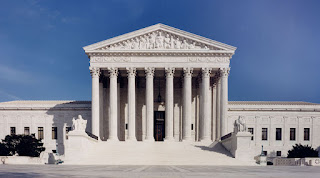
I served as Justice Hugo Black’s law clerk. My first day my wife needed the car and drove me to work. When she pulled up in front of the Supreme Court, our wide-eyed, disbelieving daughter, Julie, asked incredulously, “Daddy, you work in there?!” (Not incidentally, as I recall, there were no “partisan” conversations among clerks or justices during my year.) [Photo credit: U.S. Supreme Court.]

It’s not just the building’s exterior. There’s also the marble, high ceilings, hallway gates, black robes, the curtain dramatizing justices entrance into an imposing courtroom, the bench well above lawyers and audience, the secret justices-only “conference.”

Now politicians, journalists, public – and even justices’ behavior – are treating the Court’s justices as a third political branch (“liberal,” “conservative”). It’s as if they were throwing rocks, shattering the mystique and grand vision of the Constitution’s drafters.

Who’s left to be infallible? Only authoritarians?
____________
Nicholas Johnson clerked for Justice Hugo Black and is the author of Columns of Democracy. Contact mailbox@nicholasjohnson.org
# # #

SOURCES
Infallible because we are final. Deborah Rhode, “Ethics in Practice: Lawyers’ Roles, Responsibilities, and Regulation,” Oxford University Press, https://epdf.pub/ethics-in-practice-lawyers-roles-responsibilities-and-regulation.html (“An observation by Justice Robert Jackson applies to judges generally: ‘We are not final because we are infallible, but we are infallible because we are final.’” Brown v. Allen, 344 U.S. 443, 532, 540 (1953) (Mr. Justice Jackson, concurring). 10. See, e.g., 28 U.S.C. Sec. 455; and American Bar Association, Model Code of Judicial Ethics.”)

30,000 car parts. Nicole Wakelin, “How Many Parts Are In A Car?” NAPA Know How Blog, July 2, 2021, https://knowhow.napaonline.com/how-many-parts-are-in-a-car/ (“The exact number of parts in a car varies widely from car to car, but what’s the average? Typically, you can expect that there are about 30,000 parts in your car, from the tiniest nuts and bolts to the engine block.”)

Civic Society. Alexis de Tocqueville, Democracy in America (1835)

Steve Hoenisch, “The Relation Between Civic Society and Newspapers in the Writings of Alexis de Tocqueville and Robert Putnam,” criticism.com, https://www.criticism.com/md/putnam1.html

“Associations Matter,” The Center for Association Leadership, 2012, http://www.thepowerofa.org/wp-content/uploads/2012/03/Associations-Matter-FINAL.pdf

Columbo. Columbo, Wikipedia, https://en.wikipedia.org/wiki/Columbo (“Columbo is an American crime drama television series starring Peter Falk as Columbo, a homicide detective with the Los Angeles Police Department. … He often leaves a room only to return with the catchphrase "Just one more thing" to ask a critical question.”)

Number of federal district and circuit courts. Offices of the United States Attorneys, “Introduction To The Federal Court System,” https://www.justice.gov/usao/justice-101/federal-courts (“There are 94 district courts, 13 circuit courts, and one Supreme Court throughout the country.”)

“Political Question” Doctrine. “Political Question Doctrine,” Legal Information Institute, Cornell Law School, https://www.law.cornell.edu/wex/political_question_doctrine (“Federal courts will refuse to hear a case if they find that it presents a political question. This doctrine refers to the idea that an issue is so politically charged that federal courts, which are typically viewed as the apolitical branch of government, should not hear the issue.”)

Court as Third Political Branch. Jeffrey Rosen, “The Court Loses Its Chief Pragmatist; With the upcoming retirement of Justice Stephen Breyer, the country moves into a more ideologically divided future,” The Atlantic, January 26, 2022, https://www.theatlantic.com/ideas/archive/2022/01/stephen-breyer-retirement-supreme-court-biden/619331/

“Public’s Views of Supreme Court Turned More Negative Before News of Breyer’s Retirement; 84% say justices should not bring their political views into decisions,” Pew Research Center, Feb. 2, 2022, https://www.pewresearch.org/politics/2022/02/02/publics-views-of-supreme-court-turned-more-negative-before-news-of-breyers-retirement/ (from August 2020 to January 2022, approval of Court dropped from 70% favorable to 54%; lowest in 40 years)

# # #
  Additional Related Material Not Used Directly

Today’s court justices: name, BDY, year appointed, home, law school: https://ballotpedia.org/Supreme_Court_of_the_United_States

Google search: "Supreme Court" AND (political OR politics)

Federalist No. 78 discusses the power of judicial review. It argues that the federal courts have the job of determining whether acts of Congress are constitutional and what must be done if government is faced with the things that are done on the contrary of the Constitution.

Why is Federalist 51 important? Government Must Furnish the Proper Checks and Balances Between the Different Departments.” Madison wrote Federalist 51 to explain how separation of powers with checks and balances protects liberty. Madison borrowed the concept of separation of powers from Montesquieu, a French political philosopher.Sep 6, 2011

Federalist No 81 - The Avalon Projecthttps://avalon.law.yale.edu › fed81 The Federalist Papers : No. 81 ... But the errors and usurpations of the Supreme Court of the United States will be uncontrollable and remediless.

Supreme Court of the United Stateshttps://www.supremecourt.gov › DocketPDFPDF Jan 31, 2019 — to the United States Court of Appeals for the Federal Circuit ... Madison James, Federalist 47, THE FEDERALIST. PAPERS. 25 pages

ABA’s “landmark cases” - https://www.americanbar.org/groups/public_education/programs/constitution_day/landmark-cases/

Lifetime appointments related to non-political decisions - Hamilton's main point in Federalist #78 is that a lifetime appointment will give Federal Justices the ability to work objectively on behalf of the people. If they were to seek reelection, they might act in bad faith in an effort to retain the office. May 1, 2020 Lifetime Appointments for the Court - Federalist #78 - Founder ...

Google search - "Constitutional Convention" 1787 (judges OR "judicial branch" OR judiciary OR "supreme court")

Debate from the Constitutional Convention regarding the function of the judiciary (July 21, 1787) - https://www.thirteen.org/wnet/supremecourt/democracy/sources_document5.html

See also: https://www.thirteen.org/wnet/supremecourt/democracy/sources.html

# # #


Wednesday, March 17, 2021

Protecting Democracy

Will Our Democracy Survive?
Nicholas Johnson
The Gazette, March 17, 2021, p. 6A

Will our democracy survive?

Some things we prize can’t protect themselves. Like the environment. Since 1970 it’s had the Environmental Protection Agency (EPA).

Our democracy can’t protect itself either. What percentage of a nation’s people must want a government “of, by, and for the people” to make it a reality?

Between 121 and 140 House members refused to recognize President Biden’s election.

The 2020 election turnout was a 120-year record. Yet one-third of eligible voters didn’t vote; 23% are “not interested in politics.”

Only 18% of Americans think our democracy is “working very well.” Alternatives to democracy thought “good” include government by experts (40%), a strong man with few legislative restraints (22%), and the military (17%).

It’s not that no one is aware of our democracy’s disintegration.

There are already numerous individuals and organizations working to reduce divisiveness and increase collaboration, such as the 56 U.S. House members in the Progressive Caucus, Dr. Chris Peters’ Our Braver Angels Iowa, and LivingRoomConversations.com.

From our nation’s beginning civics preparation was a driving reason for colleges and public K-12 schools. Educators know this, and organizations such as the Education Commission of the States and Educating for American Democracy (with its “roadmap for excellence”) are working to bring it back.

The origin of the word “democracy” (Greek words for “people rule”) has motivated expansion of the eligible voting base from white, male landowners over 21 to include people of color, women, and those over 18.


There are two options for those whose political party loses elections.

The one democracy compels is a revised party platform of proposals more attractive to the electoral majority than the proposals of the other party; the second is to make it possible for a minority of voters to win the majority of elections and legislative seats with gerrymandered district boundaries and a variety of voter suppression techniques.

The Republican Party has chosen the second. It had no new platform of proposals for the 2020 election. It learned, as Senator Lindsey Graham explained, that without “election reform” “there will never be another Republican president.” It is now pushing some 250 “reforms” in 43 state legislatures.

Many organizations and individuals are working on these challenges – including the U.S. House with its broad “For the People Act of 2021” (HR 1).

The point is not that no one is monitoring and trying to strengthen the weak spots in our democracy. Many persons are.

What’s needed are two things.

The first is a central institution, constantly monitoring and commenting on all elements of our democracy – the efforts to make them stronger, and where they’re under attack. It could be a nonpartisan commission, a major foundation’s project or an academic center.

The second is a commitment from the mass media to give the reports of this institution daily coverage – similar to the regular reporting this past year of COVID cases, hospitalizations, deaths and now progress with vaccinations.

For democracy to have a prayer of survival it will require the attention, words and deeds of each of us.
__________
Nicholas Johnson, Iowa City, is the author of Columns of Democracy. Comments: mailbox@nicholasjohnson.org

# # #

SOURCES

EPA 1970. Environmental Protection Agency, https://www.epa.gov/history/origins-epa

Of, by and for the people. Gettysburg Address, Nov. 19, 1863, https://rmc.library.cornell.edu/gettysburg/good_cause/transcript.htm

Refusal to accept Biden’s election. Li Zhou, “147 Republican lawmakers still objected to the election results after the Capitol attack; Congress has certified President-elect Joe Biden as the winner of the election — but some Republicans still objected,” Vox, Jan. 7, 2021, https://www.vox.com/2021/1/6/22218058/republicans-objections-election-results

One-third didn’t vote. Domenico Montanaro, “Poll: Despite Record Turnout, 80 Million Americans Didn't Vote. Here's Why,” npr, Dec. 15, 2020, https://www.npr.org/2020/12/15/945031391/poll-despite-record-turnout-80-million-americans-didnt-vote-heres-why

Americans’ support for democracy. Carroll Doherty, “Key findings on Americans’ views of the U.S. political system and democracy,” Pew Research Center, Apr. 26, 2018, https://www.pewresearch.org/fact-tank/2018/04/26/key-findings-on-americans-views-of-the-u-s-political-system-and-democracy/ (“About six-in-ten Americans (58%) say democracy is working well in the U.S., though just 18% say it is working very well.”)

Richard Wike, Katie Simmons, Bruce Stokes and Janell Fetterolf, “Democracy widely supported, little backing for rule by strong leader or military,” Pew Research Center, Oct. 16, 2017, https://www.pewresearch.org/global/2017/10/16/democracy-widely-supported-little-backing-for-rule-by-strong-leader-or-military/

Divisiveness. Michael Dimock and Richard Wike, “America is exceptional in the nature of its political divide,” Pew Research Center, Nov. 13, 2020, https://www.pewresearch.org/fact-tank/2020/11/13/america-is-exceptional-in-the-nature-of-its-political-divide/ (“Americans both see this problem and want to address it. Overwhelming majorities of both Trump (86%) and Biden (89%) supporters surveyed this fall said that their preferred candidate, if elected, should focus on addressing the needs of all Americans, ‘even if it means disappointing some of his supporters.’”)

Carroll Doherty, “Key findings on Americans’ views of the U.S. political system and democracy,” Pew Research Center, Apr. 26, 2018, https://www.pewresearch.org/fact-tank/2018/04/26/key-findings-on-americans-views-of-the-u-s-political-system-and-democracy/ (“Today, nearly equal shares in both parties (46% of Democrats and 44% of Republicans) say “they like elected officials who make compromises with people they disagree with.”)

Problem solvers caucus, https://problemsolverscaucus-gottheimer.house.gov/; Dr. Chris Peters, Braver Angels Iowa, https://www.facebook.com/braverangelsiowa; Living Room Conversations, https://livingroomconversations.org/

Civics education. Integral to K-12 and higher ed. Lisa Guilfoile and Brady Delander, Introduction, Guidebook: Six Proven Practices for Effective Civic Learning,” Education Commission of the States and National Center for Learning and Civic Engagement, Jan. 2014, http://www.ecs.org/clearinghouse/01/10/48/11048.pdf (“Earlier in our nation’s history, civic education was broadly seen as integral to the purposes of public schools and universities.”) Education Commission of the States, https://ecs.org (search: “civics”) Educating for American Democracy, https://educatingforamericandemocracy.org

Voting. “Democracy (Ancient Greece),” Resource Library, National Geographic, https://www.nationalgeographic.org/encyclopedia/democracy-ancient-greece/ (“The word “democracy” comes from two Greek words that mean people (demos) and rule (kratos).”)

“History of Voting in America,” Secretary of State, State of Washington, https://www.sos.wa.gov/_assets/elections/history-of-voting-in-america-timeline.pdf (“1776 -- Only white men age 21 and older who own land can vote.”)

No Republican Platform. Reid J. Epstein, “The G.O.P. Delivers Its 2020 Platform. It’s From 2016,” The New York Times, Aug. 25, 2020, https://www.nytimes.com/2020/08/25/us/politics/republicans-platform.html (“Every four years since 1856, the Republican Party has produced a platform articulating its priorities for the next president. But like so much else disrupted by President Trump, the Republican National Committee has dispensed with producing a 2020 platform . . ..”)

Dominick Mastrangelo, “Graham: If Trump concedes election, Republicans will 'never' elect another president,” The Hill, Nov. 8, 2020, https://thehill.com/homenews/525063-lindsey-graham-if-trump-concedes-election-republicans-will-never-elect-another (“’If Republicans don't challenge and change the U.S. election system, there will never be another Republican president elected again,’ Graham said Sunday on Fox News.”)

250 laws 43 states. Amy Gardner, Kate Rabinowitz and Harry Stevens, “How GOP-backed voting measures could create hurdles for tens of millions of voters; At least 250 new laws have been proposed in 43 states to limit mail, early in-person and Election Day voting,” The Washington Post, March 11, 2021, https://www.washingtonpost.com/politics/interactive/2021/voting-restrictions-republicans-states/

“State Voting Bills Tracker 2021; State lawmakers continue to introduce voting and elections bills at a furious pace,” Brennan Center for Justice, Feb. 24, 2021, . https://www.brennancenter.org/our-work/research-reports/state-voting-bills-tracker-2021

H.R. 1 – For the People Act of 2021, https://www.congress.gov/bill/117th-congress/house-bill/1/text

# # #

Wednesday, February 10, 2021

Democrats’ ‘Bridge Too Far’

Struggling Democrats Must Build More Bridges

Nicholas Johnson
The Gazette, Feb. 10, 2021, p. A6

Linn County Auditor Joel Miller says, “to run for statewide office may be a bridge too far if the Democratic Party cannot broaden their appeal in rural Iowa.”

He’s an optimist. The reality’s worse.

Color Iowa’s 99 counties red and blue. Six went for Joe Biden (the three with state universities, plus Linn, Polk and Scott); 93 for the former president – 94 percent.


That’s even worse than the national map: 83 percent of the nation’s counties are red; 17 percent are blue. [Photo credit: U.S. Bureau of Land Management]

Yes, I know. We don’t vote by county. Besides, half of the country’s population lives in only 143 of those counties (5 percent) – enough to make Joe Biden president.

But a political party that relies on the east coast for money and the left coast for votes is not a national party. Democrats shouldn’t be surprised to discover they’ve alienated voters in that 83 percent of U.S. counties who feel ignored and have understandably turned anti-establishment.

It doesn’t have to be this way. There was a time when it wasn’t.

An oft-told story bears repeating.

As Ken Burns tells it, “When FDR's funeral procession went by, a man collapsed; he was so overcome. A neighbor picked him up and said, 'Did you know the president?' And he responded, 'No, but he knew me.'"

Few presidents since have made that connection. President Biden has a chance.

President Franklin Roosevelt’s legacy was a Democratic Party tent sheltering those in abject poverty, the working poor, union members, small farmers, and lower middle class. Had the party nurtured that coalition instead of Wall Street, knocked on their doors and listened, it would today control most city councils and state legislatures -- plus the U.S. House, Senate and White House.

Two Texas Democratic Party officials asked me, a college student, to run for the Legislature. Stunned, I explained I was an Iowa boy, with two part time jobs, a heavy course load and knew few Austin voters.

They responded with a story of another recruit. He mumbled while talking to his shoes and asking voters, “You wouldn’t vote for me would you?”

Now understanding their standards, and decidedly less flattered, I asked, “How’d he do?”

“He won,” one replied. “He knocked on every door in Travis County – and won.” I took a pass on that opportunity.

But I remembered the lesson during the 1962 Pat Brown-Richard Nixon gubernatorial race, door knocking in an unorganized county where I knew fewer voters than I’d known in Travis County, Texas. If they were willing to door-knock I’d assign them an area and move on.

Could the Democratic National Committee find at least one experienced campaign organizer to work each of the 2500 counties now painted red? Of course. And it must if it is to be a national party representing more than 5 percent of America’s counties and 50 percent of its people, building bridges well within Joel Miller’s reach.
_______________
Nicholas Johnson of Iowa City held three presidential appointments and is the author of Columns of Democracy. Comments: mailbox@nicholasjohnson.org

SOURCES

Joel Miller. Gage Miskimen, “Linn County Auditor Considers Run for Secretary of State,” The Gazette, Feb. 2, 2021, p. A3; https://www.thegazette.com/subject/news/linn-county-auditor-may-run-for-secretary-of-state-in-2022-20210202

Republican counties. Iowa Trump 93 Biden 6 (Black Hawk, Johnson, Linn, Polk, Scott, Story, https://www.politico.com/2020-election/results/iowa/

Republican counties U.S. “The Biden and Trump data in the posts appears to match the information reported by the Brookings Institute on Nov. 7. On Dec. 8, the think tank updated the report to say Biden had won 509 counties and Trump 2,547 counties, according to ‘unofficial results from 99% of counties.’” [Me: 509+2547=3056] https://www.reuters.com/article/uk-factcheck-votes-counties-election/fact-check-clarifying-the-comparison-between-popular-vote-and-counties-won-in-the-2020-election-idUSKBN2931UY

143 counties, half population “U.S. Census Bureau, population is not homogeneously distributed across the country. In 2017, out of a total of 3,142 counties and county equivalents more than half of the population inhabited just 143 counties. https://www.reuters.com/article/uk-factcheck-votes-counties-election/fact-check-clarifying-the-comparison-between-popular-vote-and-counties-won-in-the-2020-election-idUSKBN2931UY

“But he knew me.” Google search [“did you know" no "but he knew me"] turns up dozens of sources where quoted/told, but in sample none discovered with a citation to an acceptable academic or journalistic source. Maybe Ken Burns’ is the best for authenticity: Bob Fisher, “Ken Burns Spends 14 Hours with ‘The Roosevelts,” Documentary Magazine, Sept. 12, 2014, https://www.documentary.org/online-feature/ken-burns-spends-14-hours-roosevelts

# # #

Wednesday, January 13, 2021

Democracy Is Not a Spectator Sport

Democracy Is Not a Spectator Sport

Nicholas Johnson
The Gazette, January 13, 2021, p. A6

On Feb. 14, 2014, Donald Trump told Fox, "When the economy crashes, when the country goes to total hell, and everything is a disaster, then you’ll have riots to go back to where we used to be, when we were great.”

By January 6, 2021, the economy had crashed, our federal government’s pandemic response was the world’s worst, and it seemed like “everything is a disaster.”

It was time for a Trump rally. He claimed “hundreds of thousands of American patriots” were there. The Park Service permit approved 30,000, and with no official count, the media settled on “thousands.”

Trump told them, “After this, we’re going to walk down — and I’ll be there with you — to the Capitol . . .because you’ll never take back our country with weakness, you have to show strength, and you have to be strong. We have come to demand that Congress do the right thing."

Minutes later, at the Capitol, we watched his followers’ “show strength” by staging one of Trump’s predicted “riots to go back to . . . when we were great.”

Some Americans are aware of our slowly crumbling columns of democracy, institutions essential to democracy’s creation and preservation. For them, Trump’s January 6 mob was no surprise. Riots are a part of the endgame in an authoritarian-wannabe’s playbook. It was only a matter of time.

Turns out representative democracy is not universally popular among Americans. The Pew Research Center found 13% thought it totally bad; others thought substitutions for elected officials with direct democracy (29%), experts (40%), strong leaders (22%), or military rule (17%) good ideas.

More voted last Nov. 3 than in any election for 120 years. That was 67% of eligible voters. One-third didn’t vote. An Ipsos survey revealed 23% were “not interested in politics.”

A democracy is fragile, and subject to President Lyndon Johnson’s observation that, “It takes a carpenter to build a barn, but any jackass can knock it down.”

We cannot know if it will be possible to rebuild our shattered democracy. What we do know is that it cannot be rebuilt just by substituting one president for another. It cannot be rebuilt by those who just “believe in” democracy or merely prefer it to alternatives.

It will require those who recognize and work to oppose attacks on the columns of democracy. A democracy requires an educated electorate, a trusted and independent mass media, a wise and nonpartisan judiciary, and efforts to increase, rather than suppress, ease of voting.

Inadequate education and library budgets are an attack on democracy. So is failure to support media with subscriptions and advertising, talk of “fake news” and “enemy of the people,” reverse Robin Hood legislation, or treating courts as a third political branch of government.

Are you willing to watch a little less television to have time for calls and emails to officials? Share more of the resources you can afford with local media and democracy-promoting candidates? Help sturdy our crumbling columns of democracy? [Image: Constitutional Convention of 1787, National Park Service]

If there are enough of us doing that, we have a prayer of rebuilding our barn, the democracy our founders hoped for. If not, we’re just waiting for the next authoritarian-wannabe, and the next January 6.

Nicholas Johnson of Iowa City is the author of Columns of Democracy (2018). Contact: mailbox@nicholasjohnson.org

SOURCES

"When the economy crashes, when the country goes to total hell, and everything is a disaster, then you’ll have riots to go back to where we used to be, when we were great.” “Donald Trump’s 2014 Political Predictions,” Fox News Interview, video, 6:26, Feb. 10, 2014, 2:02-2:12 https://video.foxnews.com/v/3179604851001#sp=show-clips Snopes https://www.snopes.com/fact-check/trump-economy-crashing-quote/

"After this, we’re going to walk down — and I’ll be there with you — . . . to the Capitol . . .. Because you’ll never take back our country with weakness, you have to show strength, and you have to be strong. We have come to demand that Congress do the right thing . . .." Trump, Jan 6, 2021

"Donald Trump Speech 'Save America' Rally Transcript," Jan. 6, 2021, Segment beginning 16:25, https://www.rev.com/blog/transcripts/donald-trump-speech-save-america-rally-transcript-january-6

Snopes: https://www.snopes.com/fact-check/trump-tell-supporters-storm/

Crowd size. “How Many Were at the MAGA Trump March & Protest in DC? Crowd Size Photos,” copy of Park Service permit (5000; modified to 30,000). Reports: “thousands” at rally “hundreds” at Capitol. https://heavy.com/news/maga-march-trump-dc-rally-crowd-photos/

NYTimes collection of stories: https://www.nytimes.com/live/2021/01/06/us/washington-dc-protests

Support for democracy: Richard Wike, Katie Simmons, Bruce Stokes and Janell Fetterolf, “Democracy widely supported, little backing for rule by strong leader or military,” Pew Research Center, Oct. 10, 2017, https://www.pewresearch.org/global/2017/10/16/democracy-widely-supported-little-backing-for-rule-by-strong-leader-or-military/

Percentage voting: Domenico Montanaro, “Poll: Despite Record Turnout, 80 Million Americans Didn't Vote. Here's Why,” Dec. 15, 2020, NPR, https://www.npr.org/2020/12/15/945031391/poll-despite-record-turnout-80-million-americans-didnt-vote-heres-why
Ipsos survey: "Nonvoters' reasons for not voting include: not being registered to vote (29%); not being interested in politics (23%) . . .." Ibid.

# # #

Wednesday, March 20, 2019

Saving Democracy

What's the current state of our democracy?

Nicholas Johnson
Iowa City Press-Citizen, March 20, 2019, p. A7

Democracies can correct policy mistakes. They can't correct anything after the destruction of institutions without which we have no democracy: a respected, independent judiciary and mass media, public education, libraries – and efforts to ease and encourage voting.

The Iowa legislature politicizes our founders’ non-partisan judiciary, disparages the media, cuts funding for education, reduces the number who can vote and increases the difficulty for those who can. This is not just legislation, or politics as usual. This is how democracies die, “not with a bang but with a whimper.”

Sadly, this is happening throughout the U.S. and around the world. Planet Rulers now lists 50 countries’ rulers as “dictators.” And at home: What’s the state of democracy in Iowa City?

It’s essential we watch for the signs of a deteriorating democracy and know how to fight back.

On Saturday, March 30, 4:00 p.m., there will be a discussion of these issues at Prairie Lights, 15 S. Dubuque St., along with a reading from Columns of Democracy. Hope to see you there.

-Nicholas Johnson, Iowa City

For more on this event see, https://www.prairielights.com/live/nicholas-johnson
and, Columns of Democracy, Columns of Democracy.com


# # #

Sunday, November 22, 2015

Anyone for Democracy?

The following text was submitted to The Gazette as a part of one of its "Writers Circle" projects, this one focused on "voting." Portions removed from the hard copy published version are enclosed [in brackets]. The title was changed from "Anyone for Democracy?" to . . .

Let's Seize Our Opportunity, Take Responsibility Seriously

Nicholas Johnson
The Gazette, November 22, 2015, p. C3

“I am waiting for someone
to really discover America . . .”

-- Lawrence Ferlinghetti, “I Am Waiting,” A Coney Island of the Mind (1958)

On November 3 Iowa City held an election of city council members. The somewhat unique existence of two slates of candidates, whose differences over issues were clearly drawn, might have produced a massive voter turnout. It did not.

Approximately 62,000 Iowa City residents are eligible to register as voters. Of that number only 45,000 do so (72 percent). But wait; it gets worse. In the latest city council election only 15 percent of those who bothered to register also bothered to vote.

My Oxford English Dictionary (1971) defines “democracy” as “that form of government in which the sovereign power resides in the people as a whole, and is exercised either directly by them or by officers elected by them. In modern use often more vaguely denoting a social state, in which all have equal rights, without hereditary or arbitrary differences of rank or privilege.”

Has America ever had such a democracy? Does it have one now?

We believe we can bring “nation-building” to others, showing them the virtues of our democracy. But it is they who assume the risks associated with voting, including in some instances death, stand in long lines for hours, and emerge from the polls with a proud smile and a finger painted purple.

Meanwhile, many Americans stay at home with their TV sets and video games on Election Day, only to have their faces turn purple months later as they rail against the evils of [“guv-ment” (in quotes) was deleted and "government" was substituted].

Fact is, our nation began, not as a democracy, but as the plutocracy it remains today. As Noam Chomsky reminds us, it was John Jay who proclaimed that “those who own the country ought to govern it.”

To insure this result, voters were initially limited to males who were white, over 21, and owned land. This has been gradually expanded to include African Americans, those without land, women, and finally all over 18. Thus, those who own the country today have to govern it by choosing the nominees.

[William “Boss” Tweed, of New York’s 19th Century Tammany Hall, is credited with having said, “I don’t care who does the electing, so long as I get to do the nominating.” Today the nominating takes place in New York’s financial district, Wall Street, well to the south of the old Tammany Hall at 141 E. 14th Street. As Goldman Sachs’ CEO Lloyd Blankfein and his friends have said privately about Hillary Clinton and Jeb Bush, echoing Boss Tweed, "Those would be two very good choices and we’d be perfectly happy with them."]

[But if the American poor, working poor, working class, and lower middle class were well informed regarding their interests, registered, and then voted as a block, they could put their candidates in every elected position in the country, from school boards to the White House. That’s why it’s so important for the 1%, even though they do the nominating, to put every possible roadblock in the path of the poor on their way to the voting booth –- with schemes only restrained by the limits of their imagination.]

[And that is why the establishment’s two major parties make it virtually impossible for third parties to rise and survive. Proposals like instant runoff, fusion, and many more, would make it possible for us to vote with both our hearts and our heads -– better reflecting Americans’ true preferences, while leaving the two parties dominant. But the two majors generally succeed in keeping third party candidates from even being seen in the national debates.]

[Asked to delete or substitute something for the above paragraph, I proposed, and The Gazette used:] Voting reforms such as instant-runoff, ranked choice, or preferential voting would enable voters to vote for more than one candidate. Voting with both one's heart and head would better reflect Americans' true preferences. It also would breathe life into third parties, now usually excluded from participation by a Commission on Presidential Debates made up of the Democratic and Republican Parties' leadership.

Iowans are blest with laws and practices encouraging, rather than stifling, registration and voting. We are given the heady responsibility of playing a disproportionate role in the nomination of our presidential candidates. If anyone will ever “really discover America” it will probably be right here in Iowa. But only if we’ll take our responsibilities seriously and use the opportunities we have.
_______________
Nicholas Johnson, an Iowa City native, has worked in every presidential campaign since 1948 [, was a congressional primary candidate, and participated in party organizations at the national, county and precinct level]. He is the author of Are We There Yet? (2008) and the blog FromDC2Iowa.blogspot.com. Contact: mailbox@nicholasjohnson.org

# # #

The Gazette's online publication of the columns can be found here: "Writers Circle: Engaging Voters in Local Elections," November 23, 2015, 8:00 a.m. ("Earlier this month, members of The Gazette Writers Circle gathered to discuss this question: A fraction of eligible voters turned out to cast a ballot in this month’s municipal elections. How do we get more people engaged in local political decision making?")

# # #

Related:

Brandon Weber, "Here Are 3 Big Reasons Millions of Americans Don't Feel Like Voting," Upworthy (online), November 16, 2015 (gerrymandering; primary voting system; electoral college)

Friday, October 19, 2012

Third Parties Are Our Friends . . .

October 19, 2012, 9:50 a.m.

. . . and Need Not Be Threat to Major Parties

Say hello to Gary Johnson, once the Republican governor of New Mexico and currently the Libertarian Party candidate for president. He's no relation, and I won't be voting for him. But I'm glad he'll be on my Iowa ballot November 6, and you should be, too.

Nor are the Libertarians the only ones to join Governor Romney and President Obama. We'll also have the choice of the Constitution Party (Virgil Goode and James Clymer), Socialist Workers Party (James Harris and Alyson Kennedy), Party for Socialism and Liberation (Gloria LaRiva and Stefanie Beacham), and the Green Party (Jill Stein and Cheri Honkal). (Jerry and Jim Litzel will also appear, having been nominated by petition.)

Some of these third party candidates will be holding their own 90-minute debate, hosted by Larry King, Tuesday night [Oct. 23] at 8:00 p.m. CT -- the night after the last of the three major parties' presidential debates -- albeit only streaming over the Internet rather than broadcast to an audience of millions. Editorial, "Third-Party Debate Will Be Educational, Informative," Iowa City Press-Citizen, October 19, 2012, p. A7. Watch. It promises to be more informative and entertaining than what we've seen from Obama and Romney. Go to http://Ora.tv.

This blog entry advances two propositions: (1) We, as voters and American citizens, have benefited from, and therefore should welcome and encourage the participation of third parties in our political system. (2) The two major parties, now virulent opponents of third parties, would actually improve their odds if they would support a little reform called "instant runoff voting" (IRV) -- a win-win-win for major parties, third parties, and every American.

Why Third Parties Are Our Friends

True democracy has almost always been resisted by those in power. Most of those said to be the fathers of our democratic system, those who drafted the Declaration of Independence and Constitution, agreed with John Jay that, “Those who own the country, should run it.”

It is a view still widely held today by those in power.

As the 19th Century New York City political Boss William Tweed is credited with having said, “I don’t care who does the electing just so long as I do the nominating.”

If there are only two political parties those who control those parties’ purse strings can maintain their control of the nation by continuing to do the nominating.

The opposition to third parties by “those who own the country” is understandable. For it is third parties that have brought the American people most of the political and social progress we enjoy today –- much of which has come at the expense of the wealthy. That kind of progress was fought at every turn by those controlling the two major parties, often with the aid of local police and national guard in ways that left demonstrators injured, bleeding -- and often dead.

Ultimately one or the other of the two parties would adopt the proposal of a third party as its own, but only at the eleventh hour when its failure to do so would have seriously harmed the party’s political power and influence.

Third parties are a proud tradition in America -- and especially in Iowa's early history.

After the Civil War the Democratic Party came to be controlled by big business and the wealthy. It didn't do much for poor farmers. Disenchanted Democrats organized the People's Party.

By 1912 many Republicans were disgusted with big business control of their party. Those dissidents formed the Progressive Party.

James B. Weaver of Iowa was a third party nominee for president in 1892.

It turns out that most of the progress in this country has been opposed by both of the major parties. It has come about only when third parties have pushed the agenda and picked up enough popular support that they could no longer be ignored.

That's how we got regulation of banks and railroads, a progressive income tax, the eight-hour workday, direct popular election of U.S. senators, workers' compensation, and limitations on child labor. Yes, it is third parties we must thank for the women’s right to vote, antitrust controls over the worst of corporate abuses, the minimum wage, the fact that we’re not all working weekends, safety in the workplace, workers’ right to organize and bargain with employers, safe foods and medicines, social security, civil rights -– the list goes on. (See, e.g., the outline notes of Professor Donald R. Shaffer, University of Northern Colorado.)

So you can see why “those who own the country,” and today control both major political parties, would want to do all they can to prevent this kind of agitation and progress, and why I say that "third parties are our friends."

Opposition to Third Party Electoral Reforms
and Why Instant Runoff is Everyone's Answer

Both parties, and those who fund them, oppose at every turn any and all reforms that would permit more third party participation. The so-called Presidential Debates Commission is in fact an exclusive club for Democrats and Republicans, who have for the most part successfully prevented the American people from ever seeing third party alternatives to their nominees. They even oppose proposals that would eliminate the threat to them of what they persist in calling “spoilers.”

(Both parties, with their sense of entitlement to exclude all others from the political process, have the chutzpah to characterize anyone with the nerve to think they can also run for public office -- without the major parties’ permission -- as a “spoiler.”)

Because Instant Runoff Voting (IRV) can (a) eliminate "spoilers," (b) thereby helping the major parties win elections, while (c) also helping third parties to be viable, there's no reason not to adopt this reform.

How does IRV work? How does it help third parties? How does it help the major parties?

Here's how IRV works.

Our present system means a candidate can win without a majority of the votes; whoever gets the most votes wins, even if it's less than 50%. With IRV, the winner will have, and must have, something over 50%.

With our present system everyone can only vote once, and the votes are only counted once. Those who vote for a (usually losing) third party candidate never get a chance to say which of the two leading candidates they would prefer -- and therefore neither of the two leading candidates gets credit for what would have been third party voters' second choices. With IRV, each voter may vote for only one candidate if they wish; but they also have the option of ranking candidates, and indicating which would be their second choice if their first choice can't make it. If no candidate gets over 50% when first choice votes are counted, voters' second choices are considered until a candidate emerges with a majority of the votes.

Let's assume that those voting Libertarian prefer the Libertarian candidate to either Romney or Obama. Those voting Socialist Workers prefer their candidate. (Those whose first choice is Obama or Romney may vote only once, and only for their first choice.) But let's also make the inaccurate assumption, just for purposes of this discussion, that each of the third parties voters' have a second choice as well. If their first choice can't win the Libertarian voters would vote for Romney and the Socialist Worker Party members would vote for Obama.

Under the present system, both the third party members, and those affiliated with the two major parties, have to recognize that -- when the election is close -- those who vote for their favorite third party candidate may, thereby, contribute to the defeat of the major party candidate who would have been their second choice. Moreover, the "winner" is more likely to win with less than 50% of the total votes cast. In our example, let's say Obama gets 48% of Iowans' votes, Romney 44%, the Libertarian 5% and the Socialist Workers' candidate 3%.

IRV enables third party members to designate both their first and their second choice. Using our numbers, above, the first place votes are counted, and split 48-44-5-3. With IRV, at that point the candidate with the fewest first place votes (Socialist Workers) is dropped from contention -- but the second choices of those who voted for the eliminated candidate are now registered as first place votes for their second choice: Obama. The first place votes are then counted for a second time. Once the 3% Socialist Workers second choice votes for Obama are added to the 48% votes for Obama, it results in a 51-44-5 split, Obama has a majority, and is declared the winner.

Suppose our numbers were reversed: 48-44-3-5 (3% Libertarian, 5% Socialist Workers). No one has a majority. Libertarians have the fewest first place votes and are eliminated. Their second choice votes become first choice votes for Romney. But that still leaves no one with a majority: 48-49-3. Once again the candidate with the fewest first place votes is eliminated -- the Socialist Workers' candidate. Those voters' second choice (Obama) becomes their first choice, and following what is now the third count we have a 51-49 split.

Now here's one for the Romney supporters. Suppose the first vote count shows 47% for Obama, 46% for Romney, 2% Socialist Workers, 5% Libertarian. Under the present system the election's over; Obama wins Iowa's electoral votes. Can you now calculate what happens with IRV? That's right. The Socialist Workers' candidate is eliminated, and Obama picks up their 2%, making the new split 49% Obama, 46% Romney, 5% Libertarian. Obama is close to 50%, but there's still no winner; no one has over 50%. So we count the votes a third time. This time the Libertarian candidate is eliminated, throwing his votes to Romney, who now has 51% to Obama's 49%. Romney's declared the winner.

In other words, for the foreseeable future third parties will probably never win the White House, with or without IRV. The two major parties need have no fear of that. IRV will sometimes benefit the Republicans and sometimes the Democrats, but it will always produce a much better reflection of voters' actual preferences. Those who are more inclined toward the policies and proposals of a third party can indicate that with their vote -- while also selecting their second choice between the two most likely to win.

Still not clear? Like a 3-minute video from FairVote? Here it is:

Why IRV is a Win-Win-Win

Why is this a win for the major parties? Because they no longer need to worry about "spoilers." They will not only get the votes of those who view their candidate as their first choice, they will also pick up the votes of those for whom their candidate is a second choice.

Why a win for the public? Because we will have the more robust discussion of the issues brought about by a greater diversity of views. We will be offered a choice of candidates in addition to "the least worst alternative" from the two major parties. There will likely be more popular interest in politics in general and voting in particular. It will give us a more finely tuned opportunity to let the two major parties know where we stand than we reveal by just choosing between the two of them. It will come closer to a national poll of how we feel about a variety of issues and policies.

And why a win for the third parties, even if it's still unlikely any one of their candidates will live in the White House? States require third parties to obtain a designated percentage of votes cast, or names on petitions, in order to retain their status as a "party" entitled to be represented on future ballots. That's tough to do under current rules. There are many proposals to remedy this problem, but Instant Runoff Voting (IRV) is one obvious example. They will be able to attract more votes once people can vote both their hearts and their heads. It will help them to build membership, raise money, and attract more media attention.

To see a list of countries and cities where IRV is used, here and abroad, click here. For more on democratic, innovative, alternative voting systems see, e.g., the resources of the Center for Voting and Democracy.

# # #

Tuesday, January 19, 2010

Janelle Rettig for Supervisor

January 19, 2010, 7:00 a.m.

The Satisfaction, and Responsibility, of Voting
(brought to you by FromDC2Iowa.blogspot.com*)

It's election day.

Sadly, few of those eligible to vote will do so. Don't you be a stay-at-home. (Want to know more about today's election, including where you go to vote? Check out the Johnson County Auditor's Web site; you'll find it all there.)

There's a satisfaction to voting -- and a responsibility. Besides, there's a prize. Those who participate in the process of nominating and electing our public officials get the right to comment on how well they're doing their job once in office.

But the Johnson County Board of Supervisors positions are somewhat unique and more significant than those of other local, elected officials.

School Board members, who are paid nothing, hand over responsibility for running the school district to a very handsomely paid "superintendent."

The City Council members, who are paid something but not much, work with a "city manager" who is the administrator-in-chief of all the City's functions, offices and employees.

The County Board of Supervisors, by contrast, are the the "superintendents," the "managers," of the county programs -- and are paid as such.

They each have a real job. In fact, if we voters followed the school board's lead we'd be out there trying to find a search firm to select the candidates for supervisor we could then vote for.

What is their $85 million-dollar job? Take a look at the County Web site, the Supervisors' Web page, and especially the Power Point slides for the 2010 budget presentation last March (actually a slight reduction from the prior year).

It is a job that requires familiarity with and the skills to manage an incredible array of programs and projects.

All of which brings me to the reasons for voting for Janelle Rettig today.

Since the Iowa City Press-Citizen Editorial Board happens to agree with my assessment on this one, I'll just quote some passages from its editorial endorsement of Ms. Rettig and then add a comment or two based on my own experience working with her.

Rettig is the right choice for Jan. 19 election
January 13, 2009

Rettig's advantage isn't merely the result of having been appointed to the position in late October and serving as a supervisor for less than three months. It's the result of years of involvement in county politics and an acute understanding of the way local governments do and don't work.

Back in 2008, when Rettig chaired the Land, Water, Future campaign, we were very impressed with her knowledge of county issues. And the résumé she submitted when applying to be appointed to the supervisor position shows a strong amount of government experience working for Democrats and Republicans.

For two decades, in fact, Rettig has shown rare ability for a would-be politician: She examines issues from multiple perspectives. In her work with many local and state boards and commissions, Rettig repeatedly has shown she can seek and actually find compromise and common ground.

Rettig's past experience ranges from land use planning, to civil and human rights, to environmental and conservation issues, to government openness. . . .

Rettig provided the most comprehensive answers [of all those running for the position] for how our budget-tightening county needs to go about:

• reducing expenses by working more cooperatively with local cities and the state to streamline government functions;

• conducting public business in full view of the public and in as professional a manner as possible;

• ensuring that all residents have a voice in county government;

• updating and overseeing the county's land-use plan;

• keeping an eye on the operational expenses for the new joint emergency communication center; as well as

• deciding how best to address the problems needs on by inadequately sized county jail and county courthouse. . . .
I agree. I saw these qualities when working with her on the conservation bond issue.

Janelle Rettig scores about as high as anyone could in terms of the experience, raw intelligence, information, knowledge and wisdom -- the basic competence -- to do a professional job of county management.

That makes her rare enough as a candidate for such a position.

But she's so much more.

I've been involved in politics virtually all my life, as a candidate and as a part of others' campaigns for offices from president of the United States to school board member in Iowa City. As a result of that experience, one of the highest compliments I can pay anyone is that they are "a political person," in the highest sense of that phrase. To me, a political person is someone who really likes people, enjoys being around and getting to know them, who takes satisfaction in helping others to feel good about themselves, who can empathize with their sorrows and needs, and who is constantly looking for ways to help others -- as Robert Kennedy said, to "dream of things that never were, and ask 'why not'?" Moreover, in their governance, they can demonstrate a capacity to balance their idealism with just enough pragmatism to actually get things done -- without simply capitulating to the demands of the wealthiest, and most powerful. It is in these positive ways that I say Janelle Rettig is "a political person."

Ah, but there's more.

Anyone who can bike across Iowa for fun, as Janelle does during the RAGBRAI ride (that I used to do and report on for National Public Radio, but no longer) obviously has the energy needed for public office.

Put it all together and she's just fun to be around, smiling, enthusiastic, fun loving, energized. How many public officials do you feel about in that way?

Janelle Rettig is clearly someone you need to get out on a cold Iowa January day and vote for. Just do it. You'll feel good about yourself. I promise.
_______________
* Why do I put this blog ID at the top of the entry, when you know full well what blog you're reading? Because there are a number of Internet sites that, for whatever reason, simply take the blog entries of others and reproduce them as their own without crediting the source. I don't mind the flattering attention, but would appreciate acknowledgment as the source, even if I have to embed it myself. -- Nicholas Johnson