Showing posts with label civic education. Show all posts

Monday, October 21, 2019

What Is A Newspaper?

What Is A Newspaper?"
Nicholas Johnson
The Gazette, October 21, 2019, p. A5
NOTE: The first entry in this blog post is the 584-word text, and the requested "sources," as presented to The Gazette's Editorial Board. As of this morning (Oct. 21) the print version (shortened for space and slightly modified) has not yet been posted on The Gazette's Web site. When it is available it will be copied and reproduced below, with a direct link to it here.

For the record, I am not employed by The Gazette, have no financial interest in the paper or its parent corporation, no family member working there, and am not paid for the columns I submit. My motive for writing this column, as my book, Columns of Democracy, makes clear is that I believe very strongly in the urgency of reestablishing democracy in America, and the preeminent role of local journalism in making that possible.

Gazette columnist Adam Sullivan’s “America Needs Local Newspapers” (Oct. 11), put forward a well-written case for local news in general and Iowa’s Carroll Times Herald and Quad-City Times in particular. Both papers had substantial costs of defending themselves in trials they ultimately won.

He’s right. And it’s not just local. Authoritarians are disparaging and assassinating journalists. But there are multiple sources of their stories.

It’s local news that’s disappearing. National print newspaper ad revenue dropped from $60 billion to $20 billion in 15 years. Half our 3,000 counties have only one newspaper, 171 have none; 2,100 papers closed.

So what? Democracies die from a thousand cuts to their supporting institutions: universal public education; fair, inclusive elections; nonpartisan, respected judges -– what I’ve called the Columns of Democracy.

And the greatest of these? An independent, respected journalism. Says who? Says Thomas Jefferson: “Were it left to me to decide whether we should have a government without newspapers, or newspapers without a government, I should not hesitate a moment to prefer the latter. But I should mean that every man should receive those papers and be capable of reading them."

“Receive those papers?” Little more than one percent of Americans subscribe to the New York Times, or Washington Post, or Wall Street Journal. “Capable of reading them?” Mandatory public education was originally to provide us the civic virtues for active participation in democracy. No longer.

The Gazette is preeminent among our local democratic institutions, serving all of them. Its investigative reporters are our communities’ “inspectors general.” It informs us about our local businesses; schools, colleges and universities; courts, city councils, county supervisors, legislators – plus presidential candidates. It monitors our hospitals, public roads, bridges, parks and libraries. It tracks our safety, from natural disasters to the law breakers and enforcers. It hears our complaints and publishes our letters. It is our historian and librarian, with Time Machine articles and book, Ties to Our Past – plus papers from 1883. It educates and offers advice about our physical and financial wellness, cooking, cars, homes and gardens, “Things To Do Today” and Sunday’s “What’s Trending on the Gazette.com.” [Photo credit: Tony Webster, January 25, 2016]

But wait, there’s more! Examine carefully each story, and reporter’s name, in one day’s hard copy or Green Gazette. Leaf through a week’s papers, or stroll through the vast Web site with its Menu, More Links, Our Sites, and Additional Links.

The Gazette is magazines, like Iowa Ideas and HER, special supplements like Hoopla and quarterly Brain Teasers. It is editorial board meetings, Pints and Politics, business breakfasts, and Iowa Ideas symposium. It’s generous support of dozens of organizations and causes -– and more than this space can hold. [Photo: Pints & Politics event before packed house at Theater Cedar Rapids, first evening of 2019 Iowa Ideas symposium, Oct. 3, 2019. From stage right: Erin Jordan, Todd Dorman, James Lynch, Lyz Lenz, Adam Sullivan. Photo credit: Nicholas Johnson]

Forty-five years ago, as a congressional primary candidate, I could look around an Iowa town and guess the quality of its newspaper. It’s still true. If there are things you like about our part of Iowa thank The Gazette.

But it needs our support more than our thanks. Unlike other public institutions, it’s not only protected from government interference it also gets no government support.

The Gazette cannot do it alone. It can print newspapers, but it can’t print money. It needs advertising dollars from an engaged business community. It and our democracy need more of us to subscribe -– even if only digitally.

It is we who need to be engaged in our communities, we who need to be informed about our local challenges and opportunities, we who need to financially support, read and act on the local news in this paper. Do your part.
_______________
Nicholas Johnson of Iowa City, former media law professor and FCC commissioner, is the author of Columns of Democracy." Comments: mailbox@nicholasjohnson.org

# # #

SOURCES

[https://cpj.org/data/killed/?status=Killed&motiveConfirmed%5B%5D=Confirmed&type%5B%5D=Journalist&start_year=1992&end_year=2019&group_by=year; Committee to Protect Journalists (“1354 Journalists Killed between 1992 and 2019/Motive Confirmed”)

https://cpj.org/data/reports.php?status=Imprisoned&start_year=2018&end_year=2018&group_by=location (“250 Journalists Imprisoned in 2018”)

Amanda Erickson, “2018 Has Been a Brutal Year for Journalists, and It Keeps Getting Worse,” The Washington Post, Oct. 19, 2018, https://www.washingtonpost.com/world/2018/10/09/has-been-brutal-year-journalists-it-keeps-getting-worse/

RWB World Press Freedom Index, https://rsf.org/en/2019-world-press-freedom-index-cycle-fear]

Newspaper economics. Derek Thompson, “The Print Apocalypse and How to Survive It,” The Atlantic, Nov. 3, 2016, https://www.theatlantic.com/business/archive/2016/11/the-print-apocalypse-and-how-to-survive-it/506429/

The Rise of a New Media Baron and the Emerging Threat of News Deserts; Daily Papers That Were Closed, Merged, or Shifted to Weeklies, http://newspaperownership.com/additional-material/closed-merged-newspapers-map/

Newspapers closed. Douglas A. McIntyre, “Over 2000 American Newspapers Have Closed in Past 15 Years,” 24/7 Wall St., July 23, 2019, https://247wallst.com/media/2019/07/23/over-2000-american-newspapers-have-closed-in-past-15-years/ (“Abernathy told 24/7 Wall St. that, “It appears at this stage that we’ve lost approximately 2,100 papers, all but 70 of which are weeklies, since 2004.” The industry implosion has left almost half of the counties in America (1,449) with only one newspaper, which is usually a weekly. As of the most recent count, 171 counties do not have a paper at all.”)

Thomas Jefferson quote. Thomas Jefferson to Edward Carrington," January 16, 1787, Julian P. Boyd, ed., The Papers of Thomas Jefferson, 11:48-49 (emphasis supplied). http://press-pubs.uchicago.edu/founders/documents/amendI_speechs8.html

Not used: Indeed the media, sometimes called the fourth branch of government, is the only industry recognized and protected by our Constitution (“Congress shall make no law … abridging the freedom … of the press”).

Subscribers. NY Times “new goal of 10 million subscriptions by 2025, up from 4.3 million today. Nearly 80 percent of those 2018 subscribers are digital.” AP New York Times subscriber numbers are skyrocketing in the Trump age, Over 265,000 digital subscriptions were added in the last three months of 2018,” Feb. 6, 2019 https://www.marketwatch.com/story/new-york-times-subscriber-numbers-are-skyrocketing-in-the-trump-age-2019-02-06

Reporters Without Borders’ World Press Freedom Index 2019 ranking of 180 countries finds only 24% “good” or “satisfactory.” The U.S. fell to 48th.

Tuesday, August 14, 2007

Mason's Home Run

August 14, 2007, 8:00 a.m.

UI Presidents' Home Run Records

The Gazette has a Monday morning editorial feature it calls "Homers" and "Gomers" -- Gazette speak for "what's going right" and "what's going wrong." Yesterday it awarded a "Homer" to UI's new President Sally Mason:

VOICE OF REASON: Less than two weeks on the job, new University of Iowa President Sally Mason already has brought a calming demeanor to contentious campus issues.

She’s urging thorough, thoughtful discourse regarding a particularly emotional debate about corporate naming of colleges or departments. This is about Wellmark Blue Cross and Blue Shield’s offer of $15 million from its foundation in return for renaming the College of Public Health after Wellmark. Mason said discussion at next month’s Board of Regents meeting must clarify when corporate naming is appropriate and when it’s not.

Meanwhile, she rightly reminds that universities should not accept naming gifts from companies if there is an expectation of equivalent value in return. She’s also not about to fire the College of Public Health dean, as a prominent donor called for after the dean raised legitimate concerns about the Wellmark offer. Good to have you here, Mason.
Editorial, "Homers: What's Going Right; Voice of Reason," The Gazette, August 13, 2007, p. A4. It's a sentiment similar to those I earlier expressed in this blog immediately following the first reports of her comments.

Everyone -- except perhaps my beloved, and otherwise all-knowing colleague Arthur Bonfield -- knows that the big news last week was Barry Bonds 756th career home run, a feat (however achieved) that surpassed the former record of Hank Aaron.

But who knows what the "Homer" record is for UI presidents, and who holds it? When Sally Mason's swinging for the bleachers in the bottom of the ninth from time to time, what's the record she's trying to beat?

How about it, Gazette? "Inquiring minds want to know." How many "Homers" were her predecessors awarded?

Failing to Learn from our Mistakes

The evidence is continuing to mount that those getting the big bucks in our country aren't earning their pay.

The top one-half of one percent of the American people are given one-half of all the income. Why? Because, as the commercial used to put it, "They get it the old fashioned way; they earn it." They're smarter and more far-seeing than the rest of us, wiser and more experienced, deserving of being paid some 450-times more income than their employees.

Whenever I encounter a service person who's not performing up to what I'd hope for, I don't blame them, I blame their boss -- and that boss's boss. They are the ones who do the hiring, the training, decide who fits best in which jobs, set the standards and institutional values, the pay scales and benefits, impose quality control and safety standards, provide the preventive maintenance routines, and so forth.

I've written at length in this blog and elsewhere about board (and CEO) "governance," the value of the really tough task of thinking through "ends policies, and then tracking them with management information reporting systems.

Really competent management isn't in the business of responding to lost horses by manufacturing locks for swinging barn doors. It doesn't take a Virginia Tech shooting to get them thinking about campus safety. If you start thinking about "ends policies" for a university, student safety is going to enter the discussion fairly early on, I'd think. (In point of fact, it has for Iowa's universities -- the Regents, presidents, and responsible administrators had protections and procedures in place long before Virginia Tech -- procedures professionally followed in yesterday's threat.)

It's one thing not to do your highly-paid job when it comes to anticipating possible problems -- and opportunities -- in advance, and then doing something about them before it's too late. That's a skill worth paying for (even if not as much as we do pay).

But what can you say about someone who knows to a certainty, from prior disasters, what the problems are going to be -- and then does nothing?

Consider the recent news:

* Six coal miners in Utah -- the latest in a series of coal mine disasters befalling profit-maximizing, safety-minimizing coal mine companies -- are trapped (and likely dead) in the very spot in that mine that had already collapsed before!

* The I-35 bridge that collapsed in Minneapolis, killing perhaps as many as a dozen unsuspecting motorists, was known for over ten years to be defective in some particulars.

* The lives of seven astronauts on board the shuttle Endeavor are now at risk because of what may have been significant heat shield tile damage at lift-off. This is the same kind of problem that caused the deaths of the seven astronauts traveling in the Columbia in 2003. Other shuttles have had similar damage for similar reasons. (Bear in mind, the damage apparently leaves a layer of felt to protect the occupants from surface temperatures in the range of 2000 to 3000 degrees on re-entry.)
Note that none of these problems involve any legitimate element of surprise. They are not the result of having overlooked a detail despite the best efforts of bright, resourceful, administrators engaged in hours and hours of "what-if" scenarios, planning and the creation of "ends policies."

Nor is any the result of a low-level employee violating procedures in spite of management's best efforts to monitor performance.

No, they are the result of the negligent leadership by very highly paid executives who either don't even have the ability to learn from their own obvious, and literally fatal, prior mistakes -- or who simply don't care -- and who are then rewarded with embarrassingly large pay packages anyway.

"When will we ever learn?"

Arming Campus Police

Golly, if only the UI campus police carried guns we wouldn't have pipe bomb threats.

Really?

Yesterday's police blowing up of what turned out to be a perfectly benign student backpack is but one more example of the ineffectiveness of arming campus police. To have them carrying guns may increase feelings of security on the part of the university community in general -- and those police officers in particular. But it is unlikely to be an effective preventative for many (if any) of the threats to campus security we are likely to confront from pipe bomb threats to tornados -- or even shootings.

See, e.g., Brian Morelli, "Threat puts UI on alert; After e-mail clears buildings, police explode suspicious bag," Iowa City Press-Citizen, August 14, 2007, p. A1.

None of which is to detract from the campus police's judgment call on this occasion. Any bomb threat has to be taken seriously, even though many will prove to be a hoax. They responded promptly, in a measured way, found an unattended backpack, minimized risk to themselves and others, and destroyed it. I'm not sure what better response there could have been.

Still to come: Can UI's IT folks track down who sent the email and from where? Was the backpack left where it was because it was forgotten by its owner? Or was it left there to produce the response it did?

Finally, if this backpack was as smelly and dusty as reported -- and presumably had been there long enough to produce those conditions -- is that perhaps a clue that we need to have in place (like the airports) a little more attentive focus on "unattended baggage"? A policy like that holds a lot less risk to campus safety than putting guns in the hands of anyone.

# # #

Friday, July 20, 2007

Regents Confront Bully, Guns on Campus

July 20, 2007, 6:00, 7:40, 8:10 a.m.

Regents Address Bullies, Corporatization Policies, Guns on Campus;
Mason's Dilemma

The Campus Bully -- and Why Wellmark by Any Other Name Would Smell the Same

Brian Morelli, "Regent Accuses Donor of Bullying; Says It Was Improper for Pomerantz to Call for Firing," Iowa City Press-Citizen, July 20, 2007, p. A1

Erin Jordan, "Fethke Key to Rebound of Wellmark Naming Idea," Des Moines Register, July 20, 2007

Clara Hogan, "Regent Eyes Naming Policy," The Daily Iowan, July 20, 2007

Editorial, "UI could avoid future Wellmark controversies by standardizing rules on corporate donations," The Daily Iowan, July 20, 2007

Yesterday I wrote ("And the beating goes on") regarding the impropriety, and self-defeating quality, of Pomerantz' call for Dean Merchant's resignation. Today Brian Morelli reports the comparable response of the Regents to Pomerantz' behavior:

President Pro Tem David Miles: "I really think it is an improper attempt to dictate internal personal [personnel?] decisions at the regents institutions. He is attempting to bully our incoming president by threatening the loss of significant financial support if his demands are not met quickly. I trust the board will reject this interference. President Mason has my full support in the independent exercise of her authority as a Board of Regents appointee to manage the university and lead it forward. I think it is perfectly appropriate for Pomerantz to disagree vigorously. I think it is inappropriate to step across the line and demand the president fire the dean. Indeed, by its letter, the current policy would allow naming of a college after a commercial product. However, at least from what I have been able to find, it appears that naming a college after a corporate donor would be a first in higher education."

Regent Bonnie Campbell: "Terminating someone's employment is a very serious matter, and I would approach that skeptically. [Pomerantz] can say whatever he wants; we have a First Amendment. Obviously, it's a strong sentiment, but I don't know on what basis [Merchant] would be terminated."

Regent Bob Downer: "I am not aware of any basis at this point for calling for Dean Merchant's resignation. [Pomerantz] has earned the right to make whatever comment he chooses to make. Marvin Pomerantz is a great Iowan. No one I know has done more for education at all levels than Marvin Pomerantz."
I've written at length in prior blog entries about my view of the naming issue, and won't repeat that here -- except to note that the primary problem lies in taking the money, whatever name is or is not adopted for the college or put on the building, when there are inherent conflicts between the source and the recipient. (Given the ongoing -- and largely adversarial -- business relationships between the University and Wellmark that raises some question as to the propriety of the University accepting substantial grants from Wellmark for any purpose.)

Now that the movie "Sicko" is dramatizing the question of the propriety of insurance company profiteering from the delivery -- or, rather, the withholding -- of health care there is a special irony, as well as an offensive conflict of interest, in a College of Public Health accepting money (let alone naming itself after) a health insurance company at the height of the national debate over the future of Americans' health care and the negative impact of so-called "health" insurance companies.

"Sicko" -- Today's the Day! Today's the Day!

And speaking of "Sicko," yes, today's the day it -- at long last -- finally opens in Iowa City at the Sycamore Mall theater. Rachel Gallegos, "Group to Greet 'Sicko' With Pledge," Iowa City Press-Citizen, July 20, 2007, p. A1. If you go today, or this weekend, you'll have a lottery player's chance to win a visit -- at Michael Moore's expense -- to a country that provides free health care to all its citizens. The film also ties in with the SEIU's targeting of Iowa, and its presidential candidate visitors, for health care public policy. Representatives will be present at today's showings. Do see it if you haven't yet -- and then re-think the Wellmark naming issues.

Campus Police: "Believed to be Armed and Dangerous!"

Rod Boshart, "Campus Safety Changes Urged; Review Done in Wake of Virginia Tech Calls for Sirens, Cell Phone Messaging," The Gazette, July 20, 2007, p. A1.

Dan Piller, "Campus firearms issue goes to regents; Gov. Culver won't take a position on police having guns at universities," Des Moines Register, July 20, 2007.

No one wants to touch this one. The Governor says its for the Regents. The Regents say they'll respond to the universities presidents' recommendations.

Here are some preliminary thoughts:

(1) My memory is that the statistics indicate that those who keep a handgun in the house for "protection" are 16 times more likely to have it used in killing or wounding a member of the family or close friend than against a criminal. A similar phenomenon exists with armed campus police. They are much less likely to make tragic mistakes, much less likely to have their guns taken by criminals and then turned on them or other innocents, if they don't have weapons.

(2) Do we want University SWAT teams as well? Units of the National Guard housed on campus -- "just in case?" Hazmat crews? A university fire department? It's bad enough we have our own university bus system in a small community with some six or seven public transportation systems. My point? The Iowa City police headquarters is a couple blocks from the main campus along with one of the City's fire departments. The Johnson County Sheriff's headquarters a couple blocks in another direction. There are lots of resources to be coordinated and drawn upon -- including trained, armed police -- under a variety of foreseeable, and unforeseen, circumstances. We don't need to duplicate them all.

(3) A University loses something the more its campus communicates -- with metal detectors, video surveillance cameras, and armed police -- that everyone is so much at risk of physical harm that these 1984 measures are necessary. Are there risks in fact? Darn right. Although individuals' common sense (such as not wandering around dark streets, dead drunk, at 2:00 a.m.) can do a lot to minimize them. But it's hard to predict, let alone prevent, what those risks will be. Handguns are of little use in providing protection from tornadoes. To the maximum extent prudently possible, the more freedom of movement -- and absence of focus on "security," "terrorist threat levels," and military/police/weapons solutions to society's problems -- the better it is for a community of learning and research.

Regents: Guns, Naming and Governance

Diane Heldt, "Regents to Discuss Naming Rights Policy," The Gazette, July 20, 2007, p. B3.

Regents Miles and Downer are absolutely right to suggest -- as I proposed in a blog entry some time ago -- that the College of Public Health naming controversy needs to become part of an overall policy rather than treated as a single case to be resolved.

Ditto for guns on camps.

The point is, it all goes back to the Regents' lack of a meaningful, integrated, rational theory of governance. Without that they are going to continue to, at best, continue to only address policy issues after the fact as individual cases blow up like IED's along an Iraq road, and at worst not even see them as policy issues, micromanaging that which makes its way into the media and failing to micromanage that which does not.

As John Carver says, most advice for boards only tells them how to do the wrong things better. But they're still doing the wrong things. Figuring out what the right things are is this new Board of Regents' priority number one, in my humble opinion.

See, Nicholas Johnson, "An Open Letter to Regents on 'Governance," in "UI Held Hostage Day 451 - Open Letter to Regents," April 17, 2007, and Nicholas Johnson, "Regents, Governance, PR Firms, Strategic Planning, Presidential Selection, and June 13" in "UI Held Hostage Day 487 - Governance Regents Number One Priority," May 23, 2007.

President Sally Mason's Dilemma

Ashton Shurson, "Diversity Tops Mason's List," The Daily Iowan, July 19, 2007

If Sally Mason were not a skilled street fighter she never would have become Provost, and a finalist for President, at Purdue -- or selected as the next president for the University of Iowa. So I have no doubt she's going to be able to handle herself just fine once she gets here.

But she is walking into some real challenges at a time when, whatever may be said about the eyes of Texas, the eyes of Iowans are going to be on her every move.

So far as I know, Fethke has yet to express himself on the UI athletic program's ties to the gambling industry (in the form of various partnerships with the Riverside Gambling Casino) over the protests of the NCAA and many on campus. So she'll find that one on her otherwise cleaned out desk when she arrives.

The Governor and Regents are handing her the hot potato -- or gun barrel -- regarding arming the campus police.

The organizational structure of the UIHC and College of Medicine was radically altered ten days before her arrival -- a near billion-dollar-a-year component of the University for which she's ultimately responsible.

Then there's the Wellmark naming controversy -- which Pomerantz wants resolved before she arrives, and for which the Regents and faculty want more time. She's going to have to reassure Jim Merchant that he's not going to have to retire before his previously scheduled retirement next year (or not), and see if it is possible to start the UI relationship with Pomerantz all over again.
But the substance of those issues (and many, many more) is the least of her problem.

The great dilemma will be how best to control and present herself in the first few weeks. There are lots of ways of avoiding taking a stand on issues. She can say she looks to Robillard to run the hospital and College of Medicine and Barta to make decisions about gambling industry partnerships. She can set up committees or task forces to study guns on campus or other issues, and then wait for the issue to go away -- or, when necessary, say she's simply adopting the proposals of those groups. She can say she needs more time to study an issue.

But there's a hazard in over-using those techniques. Ultimately they can leave her open to a perception that she is being weak and not in charge. On the other hand, if she immediately starts proposing new policies, changing directions and making decisions that are clearly hers, for which she takes responsibility, there's a risk that she may get some of them wrong (for want of sufficient networking and input), or be criticized for being too authoritarian and going it alone.

She's undoubtedly already figured this out -- and more. And there's every reason to believe she has the experience, skill and charm to pull it off. But it is going to be interesting to watch.

# # #

Saturday, July 07, 2007

Resources for Life - Fairness - Updates

July 7, 2007, 7:15, 8:15, 9:30, 10:40, 11:40 a.m. [times reflect additions to the entry -- for the benefit of those few individuals who check back occasionally during the day -- as well as reflecting the fact that what is called "life" occasionally interrupts blogging]

Resources for Life Conference Today. You might want to consider attending the Resources for Life Conference, 10:00 a.m.-6:00 p.m., today July 7, Iowa City Public Library, Meeting Room A. From 3:15 to 4:00 p.m. I'll be speaking and moderating a discussion with those in attendance on what the conference organizer has titled, "Activism: Having a Positive Impact on the World." You can find more details about the conference here.

The way I think about Resources for Life, which primarily exits as a very extensive Web site, is as a non-commercial, non-partisan, non-denominational, free offering of a range of online and other resources dealing with virtually every aspect of living -- as reflected in the links from that opening Web page. It is the production of Gregory Johnson (who works -- and teaches a free course at the Public Library -- as a computer consultant) and is best known in other circles as the president of the Small House Society.

His small house movement has been the subject of features in -- among a great many other media -- the New York Times, Wall Street Journal, Australian Broadcasting, Time Magazine, Better Homes and Gardens, National Public Radio, Oprah Winfrey -- and locally in the Iowa City Press-Citizen, and The Gazette, as well as numerous local television stations. He doesn't sell the houses, but will probably be saying something about his house, and approach to simpler living generally, during the conference.

(Full disclosure: Gregory Johnson is my son.)

The Fairness Doctrine Today's a slow enough news day that I can finally turn to State29's request. A week or so ago State29 asked my opinion about what he calls the "unfairness doctrine" of the FCC (State29, "Who Decides What's Fair?" June 27, 2007) ("Considering that Iowa's own Nicholas Johnson was the FCC Commish during part of the Johnson and Nixon years, I'd be interested in reading his current opinion on a possible revival of the Unfairness Doctrine").

I started by Googling "Nicholas Johnson" and "fairness doctrine" just to see what I've written about it over the years. There were 422 hits on things I either didn't know about or had long since forgotten. I only looked at a few before finding what I thought was the best short answer -- though longer than what I'm going to write here this morning. It's contained in Nicholas Johnson, "With Due Regard for the Opinions of Others," California Lawyer, vol. 8, August 1988, pp. 52-55. If State29 is still interested, or there is anyone else reading this who is, I'd suggest starting with that. It's short, and yet pretty thorough.

For the views of U.S. Supreme Court justices in an 8-0 decision invoking an analysis of the issues and law similar to that which I set forth a year earlier, see Red Lion Broadcasting Co. v. FCC, 395 U.S. 367 (1969). It's very readable; take a look at it, you'll see.

Meanwhile, here are some summary points; most are spelled out in that piece.

I believe "with great power goes great responsibility" and that none has greater power in our time than those controlling the mass media. The "great power" I described in Nicholas Johnson, "The Media Barons and the Public Interest: An FCC Commissioner's Warning," The Atlantic, June 1968 (still maintained 40 years later on The Atlantic's Web site, though available only to subscribers) has multiplied many fold since then.

Even if one ignores, or believes no longer applicable, the earlier rational underpinnings of the Fairness Doctrine -- "the public owns the airwaves" (i.e., station "owners" are limited-term licensees, licensed to serve "the public interest, convenience and necessity"); the government's intrusion into the allocation system makes the licensee's station the equivalent of a "public forum" open to all views; the relative shortage of frequencies (there are still more people who would like to broadcast than there are available frequencies) results in a First Amendment requirement that some provision must be made for a range of views -- the requirements of a democratic society, and the moral obligations of those sitting astride a democracy's mass media, still require some equivalent of the Fairness Doctrine.

The Fairness Doctrine requires no more than what a profit-maximizing media owner, or responsible professional journalist, would do anyway. Its requirements are but two: a licensee must make some effort to deal with "controversial issues of local importance" (i.e., it cannot just be "a jukebox with commercials"), and when presenting controversial issues it must make some effort to present a range of views. "Controversy" sells papers and attracts viewers. Presenting a range of views is what creates, or perpetuates, the controversy. It was never much of a problem for responsible broadcasters, and news directors often actually welcomed it as a defense against aggressive sales managers (wanting to preserve advertising revenue by killing stories advertisers wouldn't like).

That the requirements are so minimal is probably a part of the reason that no station ever lost its license solely because of Fairness Doctrine violations. (See California Lawyer article, linked above.)

And what does the Fairness Doctrine prohibit? Essentially nothing.

There are limitations on a broadcaster's speech. They may be subject to a defamation suit. They may violate the copyright laws. They may engage in false and misleading advertising. They may reveal national security secrets. Other agencies and interests may wish to affect broadcasters' speech, but those are not matters for the FCC.

And there are essentially no limitations -- or detailed requirements -- of the Fairness Doctrine. Subject to the non-licensing restrictions mentioned above, a broadcaster can say anything he or she wants; there are no FCC limitations; they can attack others, misrepresent, be outrageously partisan, even be defamatory -- the FCC doesn't care, and the Fairness Doctrine doesn't require anything affecting their speech.

There is no requirement that any given programming be put on the air -- or taken off. There are no requirements as to format. There is not a requirement of "equal time." There is no requirement that each program be balanced; the Fairness Doctrine only addresses the overall programming of the licensee. (To respond to a charge of those opposing the reinstatement of the Fairness Doctrine, there are two reasons why Rush Limbaugh would not only not be taken off the air but would not be affected in any way by application of the Fairness Doctrine: (1) he is not a licensee, he is a program supplier, and (2) there is no Fairness Doctrine requirement that his program be balanced.) There is no requirement that a particular contrasting view be aired. The Fairness Doctrine does not trigger a right in any given individual to respond. (The station can use its own personnel if it wishes, or anyone it chooses.)

Essentially the only limitation the Fairness Doctrine did impose was that a licensee could not use the public's airwaves as an unrelieved instrument of propaganda for a single viewpoint while censoring all other views.

Our founders believed a "marketplace of ideas" an essential foundation for a self-governing people. I believe they were right. But as I've often said, "the ideas of the marketplace [i.e., advertising-dependent programming] do not make for a marketplace of ideas." Moreover, the more concentration of control of the mass media we have the greater this problem becomes.

This is only a sampling of things I could say -- and have said -- on the subject. Anyone interested in more please check the links, above.

Wellmark's College Since my prior blog entries here even more have joined the chorus of "What were they thinking?!" regarding UI administrators seriously proposing to rename the UI College of Public Health the "Wellmark Blue Cross-Blue Shield College of Public Health."

Editorial, "Honor People, Not Businesses at UI," The Gazette, July 7, 2007, p. A4.

Diane Heldt, "Wellmark naming rejected by faculty; They fear naming college for insurer would affect research,"
The Gazette, July 6, 2007, p. A1.

Lenni W. Kangas, "Regents Should Junk Proposal,"
Iowa City Press-Citizen, July 6, 2007.

Brenda M. Cruikshank, "Major Ethical Issue in Renaming School,"
Iowa City Press-Citizen, July 7, 2007, p. A13.

State29 now has a follow-up on the subject to his earlier State29, "Enron Field," July 3, 2007: State29, "Enron Field, Part Deux," July 6, 2007.

On a related topic (though not having to do with naming rights) the Register takes Wellmark to task for a proposal and secret process that is "not how it should work" and "not in the public's best interest." Editorial, "Public still in dark about hospital plans; Building proposals should get state review," Des Moines Register, July 7, 2007.

And in . . .

. . . Other News One of our boys made it -- deservedly. John Deeth looks good in his raspberry beret on page one of The Gazette. Rod Boshart, "Clogged With Blogs; For Better or for Worse, 1.5 million blogs bring seismic Change to Political Landscape," The Gazette, July 6, 2007, p. A1.

And, to no one's surprise, The Register has come out flatfooted to acknowledge that it really thinks it would be a cool move to shift taxes from those who own property to those who can't afford it. Editorial, "Vote 'Yes' to this Tax Increase; It's an Investment in Region's Quality of Life," Des Moines Register, July 5, 2007 (there has been a consistent drumbeat of opposition to the Register's stories and opinion supporting this tax shift from wealthy to poor, summed up succinctly in the first comment on the page: "The Register must think its readers are stupid"). And see Jeff Eckhoff, "More than $357,250 was spent on consultants for 'Destiny' project," Des Moines Register, July 7, 2007.

But by the next day the paper had redeemed itself a bit with an editorial totally consistent with my earlier comments about Michael Moore's film, "Sicko," and much more positive than its headline suggests. Editorial, "Yes, 'Sicko' is Propaganda, but it Shows Need for Reform," Des Moines Register, July 6, 2007;

and, speaking of "Sicko," in response to requests for how someone in Iowa City can see it, a Rapid Response entry reports:

"According to Michael Moore's website www.michaelmoore.com

Cedar Rapids: Now showing

Wehrenberg Galaxy 16 Theatres at 6840 Council Street NE"
# # #

Wednesday, June 27, 2007

Gov. Richardson & "The Question"

June 27, 2007, 6:00, 8:30 a.m. [times reflect additions to the entry -- for the benefit of those few individuals who check back occasionally during the day -- as well as reflecting the fact that what is called "life" occasionally interrupts blogging]

Richardson and "The Question"

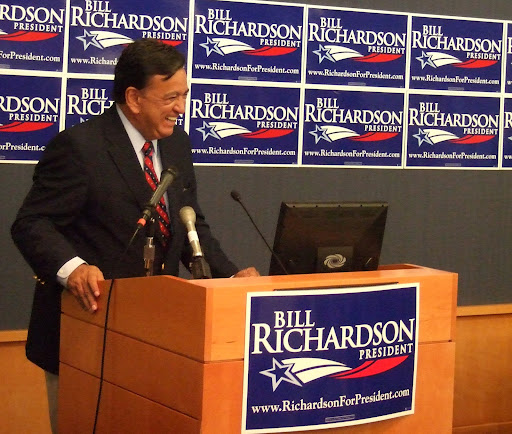
As predicted yesterday, John Deeth the blogger was at the Governor Bill Richardson event (Iowa City Public Library, June 26), and thus there's very little to add to his report.

Because he never travels without his laptop he figures it's entitled to its own bumper sticker, which says: "REBOOT AMERICA." It's one Richardson could have used as his theme yesterday.

Local papers covered the event, but -- even covering politics as horse race -- didn't think Richardson's rapid rise in the polls (from 1% to 13-18%) worth page one display. Leah Dorzweller, "Dem Presidential Hopeful Shares Executive Vision; Richardson Speaks to Packed Crowd at Public Library," Iowa City Press-Citizen, June 27, 2007, p. 3A; James Q. Lynch, "Richardson Draws I.C. Crowd," The Gazette, June 27, 2007, p. 3B; Erika Binegar, "Richardson Would Hit Ground Running," The Daily Iowan, June 27, 2007.

These days, with online newspapers, it's not enough that the paper's photographer provides one or two shots for the next day's edition. They're expected to prepare a "gallery" of pictures -- and virtually immediately. Here's the Press-Citizen's this morning. I can't compete with a professional camera and photographer with the eye of the P-C's Matthew Holst, but here is one from a selection of 13 pictures I took at that event and posted on my Picassa site.

So what is "The Question"? It's one I've put to most of the candidates for president since the early 1970s. It goes to the heart of what politics in a democratic society ought to be about. It's something we know how to do, and insist on in other countries. And yet few candidates have ever even thought about it -- let alone come up with a plan for implementation. What is the question, and how and why did I come up with it? And how did Richardson do with it?

The answers will come later this morning, after I've interrupted my blogging with a little bit of "life."

I'm back. But before addressing "The Question" I should note that, while I'm not endorsing anyone -- a lot can happen in the six months between now and the January caucus -- I thought Richardson did a great job yesterday. He was relaxed, engaging, funny, warm, and willing to stay a half hour or more beyond the 11:30 "deadline." I found his "the first six days in office" an effective way to package quite an array of what he proposes to do for us. And most of what he was proposing was very well received by the overflow and often enthusiastic crowd (as you'll see from one of my pictures -- which doesn't even show those in the hall outside Meeting Room A) -- and by me. (Much of the content of his remarks is provided in the stories and Deeth Blog linked above.)

The Question

So why was I questioning presidential candidates over 30 years ago? I had been asked to host a TV show on which they appeared, one each show. Frankly, I don't remember the details, except for what led to "The Question."

I quickly discovered that it was difficult to get anything very new or different from a candidate who had already been asked the standard questions dozens if not hundreds of times. It was as if they had little audio cassette tapes that they plugged into their brains and played back, one for each question.

What to do? I considered having someone throw them a baseball, or tip over their chair -- anything to throw them off guard a little, something that would provoke something more spontaneous than their polished performances. The producer said I couldn't do it.

So I finally came up with a question they hadn't confronted before, and I have been using variations of it ever since.

"The Question" on those early shows, and later in some Iowa living rooms, took the following form: "Senator," because it usually was a senator, "let's make two assumptions: one, you are 'right on the issues,' whatever that means to the audience; they like your platform and proposals. Two, you are elected president. Please tell us, why are the coal mine operators going to have less control over coal mine safety than they do now?" (Of course this can be, and often was, expanded with examples from many industries and agencies.)

Most candidates over the years have fallen mute. The best one could hope for was some feeble, "Well, I'm going to appoint good people to office." That was one answer clearly revealed they didn't understand the problem.

The "good people" they appoint to office (if such can be found, given industry pressure to appoint their people to the regulatory agencies they will have to deal with) will find themselves pretty isolated. It may be one of those agencies where employees come from, and return to, the industry. It may be one where they are wined and dined by industry representatives. These "good people" will be reporting to congressional committees made up of elected officials whose primary source of campaign funds is the very industry being "regulated." And the media? The mainstream media will largely ignore the agency. Media coverage will be primarily from the trade press covering -- and being funded with advertising dollars from -- the industry in question.

(Let me also note, for balance, that I have known a number of civil servants who are among the brightest and most public spirited, independent and courageous people anywhere.)

So much for "good people" heading agencies -- however much they may be an improvement over "bad people."

What is needed (as I privately explained to Governor Richardson yesterday) is the kind of citizen participation in agency process that -- when the decision goes for the industry, as it almost always will -- provides a "party," someone with "standing," to appeal the decision to the relevant U.S. Court of Appeals.

Such groups (primarily, if not exclusively, representing the interests of citizens and consumers rather than those with direct and substantial economic interests in the outcome) -- and, yes, I know they will represent far right conservative individuals as well as the lefties and libertarians -- can also use their access to the mainstream media, and the political process, to get the story out of the trade press and into the public consciousness. But their most effective leverage is through the judicial process when agencies are engaged in clear violations of law, as they sometimes are. Note that, without their participation there is simply no one who can appeal. The agency's pro-industry decision stands.

I didn't have notes yesterday, and I don't know if anyone has a recording of his presentation, so I don't know exactly how I phrased "The Question" to him. But it was somewhat along these lines:
"As you can tell from the response you've received there are a lot of folks here who seem to appreciate and support what you say you will do for us. What I'd like to know is what you propose to do to enable us to help you get those things accomplished in the face of special interest opposition? How can we better accomplish what we, as individuals and members of numerous citizens' groups, would like to accomplish in addition? Even with total public financing of campaigns we would still be up against overwhelming odds from the special interests with their well-paid thousands of lawyers, lobbyists and publicists, their advertising and public relations budgets -- and today their campaign contributions in the millions of dollars. What things do you have in mind along the line of the Legal Services Corporation, agency reimbursement of intervenors' expenses, treble-damage antitrust remedies, class action suits, private attorneys general actions, and so forth?"
Much as I like Richardson, I have to say he cast his lot with the majority of candidates who have either never thought about such things or don't think them very important. His was kind of an AmeriCorps-type response -- things the government could sponsor that would invoke the "ask what you can do for your country" response. Great ideas, but not likely to curb special interest control of the Congress and the agencies.

I've never known the details of the following story. It may be apocryphal. A citizens' group gained an appointment with President Roosevelt. After their presentation he said to them, "I agree with you absolutely. We must introduce that legislation. Now you go out there and make me do it." That is another thing we can do as citizens -- indeed, we are the only ones who can -- in addition to the litigation to keep the agencies honest. We can provide the political, grass roots support that enables elected officials who would like to do the right thing an argument to use with the special interests that oppose what they, and we, want to accomplish.

Over the years there have only been three who grasped the question, and two who understood the answers. Hubert Humphrey acknowledged it was a great question and that the next time I came to his office we should talk about it. Jesse Jackson and Ralph Nader knew how to proceed.

This year Barack Obama came closest, reminding me that he had worked as a community organizer. But he didn't carry his response beyond that.

It's not like this stuff is unknown in Washington. Even President George Bush has a rhetoric about "democracy" in other countries, though he doesn't always reflect the prerequisites to creating it. Those prerequisites involve something we call "civil (or civic) society" or "social capital." I've participated in some of these efforts abroad. This can involve everything from trade unions to Rotary Clubs to community media outlets; building citizen experience in coming together for public policy or programmatic purposes and then working to accomplish the stated goals.

We know how to do it -- and Obama's "community organizing" is a major component of the training. We just don't.

We know how to train our K-12 students to get out of the school house and into the court house, city council chambers and legislative halls to practice citizen power in a democracy. But we don't do much of that, either. (See, e.g., Center for Civic Education and National Council for the Social Studies and its "Creating Effective Citizens.")

We're not talking more "book learning" and classroom lectures here -- however important both may be -- we're talking "experiential learning" and performance -- political, policy, legal and media accomplishments.

A president could do a lot to build a "civic society" here in America -- but only after he or she begins to grasp why it is a need, and mounts the courage to take on the thousands of those in Washington who rather enjoy and find quite acceptable the rule by self-proclaimed elite that has served them so well.

# # #

[Note: If you're new to this blog, and interested in the whole UI President Search story . . .

This blog began in June 2006 and has addressed, and continues to addresses, a number of public policy, political, media, education, economic development, and other issues -- not just the UI presidential search. But that is the subject to which most attention has been focused in blog entries between November 2006 and June 2007.

The presidential search blog entries begin with Nicholas Johnson, "UI President Search I," November 18, 2006. They end with Nicholas Johnson, "UI Held Hostage Day 505 - Next (Now This) Week," June 10, 2007 (100-plus pages printed; a single blog entry for the events of June 10-21 ("Day 516"), plus over 150 attached comments from readers), and Nicholas Johnson, "UI Hostages Free At Last -- Habemas Mamam!," June 22, 2007.

Wondering where the "UI Held Hostage" came from? Click here. (As of January 25 the count has run from January 21, 2006, rather than last November.)

For any given entry, links to the prior 10 will be found in the left-most column. Going directly to FromDC2Iowa.Blogspot.com will take you to the latest. Each entry related to the UI presidential search contains links to the full text of virtually all known, non-repetitive media stories and commentary, including mine, since the last blog entry. Together they represent what The Chronicle of Higher Education has called "one of the most comprehensive analyses of the controversy." The last time there was an entry containing the summary of prior entries' commentary (with the heading "This Blog's Focus on Regents' Presidential Search") is Nicholas Johnson, "UI President Search XIII -- Last Week," December 11, 2006.

My early proposed solution to the conflict is provided in Nicholas Johnson, "UI President Search VII: The Answer," November 26, 2006.

Searching: the fullest collection of basic documents related to the search is contained in Nicholas Johnson, "UI President Search - Dec. 21-25," December 21, 2006 (and updated thereafter), at the bottom of that blog entry under "References." A Blog Index of entries on all subjects since June 2006 is also available. And note that if you know (or can guess at) a word to search on, the "Blogger" bar near the top of your browser has a blank, followed by "SEARCH THIS BLOG," that enables you to search all entries in this Blog since June 2006.]

# # #