July 7, 2007, 7:15, 8:15, 9:30, 10:40, 11:40 a.m. [times reflect additions to the entry -- for the benefit of those few individuals who check back occasionally during the day -- as well as reflecting the fact that what is called "life" occasionally interrupts blogging]
Resources for Life Conference Today. You might want to consider attending the Resources for Life Conference, 10:00 a.m.-6:00 p.m., today July 7, Iowa City Public Library, Meeting Room A. From 3:15 to 4:00 p.m. I'll be speaking and moderating a discussion with those in attendance on what the conference organizer has titled, "Activism: Having a Positive Impact on the World." You can find more details about the conference here.
The way I think about Resources for Life, which primarily exits as a very extensive Web site, is as a non-commercial, non-partisan, non-denominational, free offering of a range of online and other resources dealing with virtually every aspect of living -- as reflected in the links from that opening Web page. It is the production of Gregory Johnson (who works -- and teaches a free course at the Public Library -- as a computer consultant) and is best known in other circles as the president of the Small House Society.
His small house movement has been the subject of features in -- among a great many other media -- the New York Times, Wall Street Journal, Australian Broadcasting, Time Magazine, Better Homes and Gardens, National Public Radio, Oprah Winfrey -- and locally in the Iowa City Press-Citizen, and The Gazette, as well as numerous local television stations. He doesn't sell the houses, but will probably be saying something about his house, and approach to simpler living generally, during the conference.
(Full disclosure: Gregory Johnson is my son.)
The Fairness Doctrine Today's a slow enough news day that I can finally turn to State29's request. A week or so ago State29 asked my opinion about what he calls the "unfairness doctrine" of the FCC (State29, "Who Decides What's Fair?" June 27, 2007) ("Considering that Iowa's own Nicholas Johnson was the FCC Commish during part of the Johnson and Nixon years, I'd be interested in reading his current opinion on a possible revival of the Unfairness Doctrine").
I started by Googling "Nicholas Johnson" and "fairness doctrine" just to see what I've written about it over the years. There were 422 hits on things I either didn't know about or had long since forgotten. I only looked at a few before finding what I thought was the best short answer -- though longer than what I'm going to write here this morning. It's contained in Nicholas Johnson, "With Due Regard for the Opinions of Others," California Lawyer, vol. 8, August 1988, pp. 52-55. If State29 is still interested, or there is anyone else reading this who is, I'd suggest starting with that. It's short, and yet pretty thorough.
For the views of U.S. Supreme Court justices in an 8-0 decision invoking an analysis of the issues and law similar to that which I set forth a year earlier, see Red Lion Broadcasting Co. v. FCC, 395 U.S. 367 (1969). It's very readable; take a look at it, you'll see.
Meanwhile, here are some summary points; most are spelled out in that piece.
I believe "with great power goes great responsibility" and that none has greater power in our time than those controlling the mass media. The "great power" I described in Nicholas Johnson, "The Media Barons and the Public Interest: An FCC Commissioner's Warning," The Atlantic, June 1968 (still maintained 40 years later on The Atlantic's Web site, though available only to subscribers) has multiplied many fold since then.
Even if one ignores, or believes no longer applicable, the earlier rational underpinnings of the Fairness Doctrine -- "the public owns the airwaves" (i.e., station "owners" are limited-term licensees, licensed to serve "the public interest, convenience and necessity"); the government's intrusion into the allocation system makes the licensee's station the equivalent of a "public forum" open to all views; the relative shortage of frequencies (there are still more people who would like to broadcast than there are available frequencies) results in a First Amendment requirement that some provision must be made for a range of views -- the requirements of a democratic society, and the moral obligations of those sitting astride a democracy's mass media, still require some equivalent of the Fairness Doctrine.
The Fairness Doctrine requires no more than what a profit-maximizing media owner, or responsible professional journalist, would do anyway. Its requirements are but two: a licensee must make some effort to deal with "controversial issues of local importance" (i.e., it cannot just be "a jukebox with commercials"), and when presenting controversial issues it must make some effort to present a range of views. "Controversy" sells papers and attracts viewers. Presenting a range of views is what creates, or perpetuates, the controversy. It was never much of a problem for responsible broadcasters, and news directors often actually welcomed it as a defense against aggressive sales managers (wanting to preserve advertising revenue by killing stories advertisers wouldn't like).
That the requirements are so minimal is probably a part of the reason that no station ever lost its license solely because of Fairness Doctrine violations. (See California Lawyer article, linked above.)
And what does the Fairness Doctrine prohibit? Essentially nothing.
There are limitations on a broadcaster's speech. They may be subject to a defamation suit. They may violate the copyright laws. They may engage in false and misleading advertising. They may reveal national security secrets. Other agencies and interests may wish to affect broadcasters' speech, but those are not matters for the FCC.
And there are essentially no limitations -- or detailed requirements -- of the Fairness Doctrine. Subject to the non-licensing restrictions mentioned above, a broadcaster can say anything he or she wants; there are no FCC limitations; they can attack others, misrepresent, be outrageously partisan, even be defamatory -- the FCC doesn't care, and the Fairness Doctrine doesn't require anything affecting their speech.
There is no requirement that any given programming be put on the air -- or taken off. There are no requirements as to format. There is not a requirement of "equal time." There is no requirement that each program be balanced; the Fairness Doctrine only addresses the overall programming of the licensee. (To respond to a charge of those opposing the reinstatement of the Fairness Doctrine, there are two reasons why Rush Limbaugh would not only not be taken off the air but would not be affected in any way by application of the Fairness Doctrine: (1) he is not a licensee, he is a program supplier, and (2) there is no Fairness Doctrine requirement that his program be balanced.) There is no requirement that a particular contrasting view be aired. The Fairness Doctrine does not trigger a right in any given individual to respond. (The station can use its own personnel if it wishes, or anyone it chooses.)
Essentially the only limitation the Fairness Doctrine did impose was that a licensee could not use the public's airwaves as an unrelieved instrument of propaganda for a single viewpoint while censoring all other views.
Our founders believed a "marketplace of ideas" an essential foundation for a self-governing people. I believe they were right. But as I've often said, "the ideas of the marketplace [i.e., advertising-dependent programming] do not make for a marketplace of ideas." Moreover, the more concentration of control of the mass media we have the greater this problem becomes.
This is only a sampling of things I could say -- and have said -- on the subject. Anyone interested in more please check the links, above.
Wellmark's College Since my prior blog entries here even more have joined the chorus of "What were they thinking?!" regarding UI administrators seriously proposing to rename the UI College of Public Health the "Wellmark Blue Cross-Blue Shield College of Public Health."
Editorial, "Honor People, Not Businesses at UI," The Gazette, July 7, 2007, p. A4.
Diane Heldt, "Wellmark naming rejected by faculty; They fear naming college for insurer would affect research," The Gazette, July 6, 2007, p. A1.
Lenni W. Kangas, "Regents Should Junk Proposal," Iowa City Press-Citizen, July 6, 2007.
Brenda M. Cruikshank, "Major Ethical Issue in Renaming School," Iowa City Press-Citizen, July 7, 2007, p. A13.
State29 now has a follow-up on the subject to his earlier State29, "Enron Field," July 3, 2007: State29, "Enron Field, Part Deux," July 6, 2007.
On a related topic (though not having to do with naming rights) the Register takes Wellmark to task for a proposal and secret process that is "not how it should work" and "not in the public's best interest." Editorial, "Public still in dark about hospital plans; Building proposals should get state review," Des Moines Register, July 7, 2007.
And in . . .
. . . Other News One of our boys made it -- deservedly. John Deeth looks good in his raspberry beret on page one of The Gazette. Rod Boshart, "Clogged With Blogs; For Better or for Worse, 1.5 million blogs bring seismic Change to Political Landscape," The Gazette, July 6, 2007, p. A1.
And, to no one's surprise, The Register has come out flatfooted to acknowledge that it really thinks it would be a cool move to shift taxes from those who own property to those who can't afford it. Editorial, "Vote 'Yes' to this Tax Increase; It's an Investment in Region's Quality of Life," Des Moines Register, July 5, 2007 (there has been a consistent drumbeat of opposition to the Register's stories and opinion supporting this tax shift from wealthy to poor, summed up succinctly in the first comment on the page: "The Register must think its readers are stupid"). And see Jeff Eckhoff, "More than $357,250 was spent on consultants for 'Destiny' project," Des Moines Register, July 7, 2007.
But by the next day the paper had redeemed itself a bit with an editorial totally consistent with my earlier comments about Michael Moore's film, "Sicko," and much more positive than its headline suggests. Editorial, "Yes, 'Sicko' is Propaganda, but it Shows Need for Reform," Des Moines Register, July 6, 2007;
and, speaking of "Sicko," in response to requests for how someone in Iowa City can see it, a Rapid Response entry reports:
"According to Michael Moore's website www.michaelmoore.com
Cedar Rapids: Now showing
Wehrenberg Galaxy 16 Theatres at 6840 Council Street NE"
# # #
June 27, 2007, 6:00, 8:30 a.m. [times reflect additions to the entry -- for the benefit of those few individuals who check back occasionally during the day -- as well as reflecting the fact that what is called "life" occasionally interrupts blogging]
Richardson and "The Question"
As predicted yesterday, John Deeth the blogger was at the Governor Bill Richardson event (Iowa City Public Library, June 26), and thus there's very little to add to his report. 
Because he never travels without his laptop he figures it's entitled to its own bumper sticker, which says: "REBOOT AMERICA." It's one Richardson could have used as his theme yesterday.
Local papers covered the event, but -- even covering politics as horse race -- didn't think Richardson's rapid rise in the polls (from 1% to 13-18%) worth page one display. Leah Dorzweller, "Dem Presidential Hopeful Shares Executive Vision; Richardson Speaks to Packed Crowd at Public Library," Iowa City Press-Citizen, June 27, 2007, p. 3A; James Q. Lynch, "Richardson Draws I.C. Crowd," The Gazette, June 27, 2007, p. 3B; Erika Binegar, "Richardson Would Hit Ground Running," The Daily Iowan, June 27, 2007.
These days, with online newspapers, it's not enough that the paper's photographer provides one or two shots for the next day's edition. They're expected to prepare a "gallery" of pictures -- and virtually immediately. Here's the Press-Citizen's this morning. 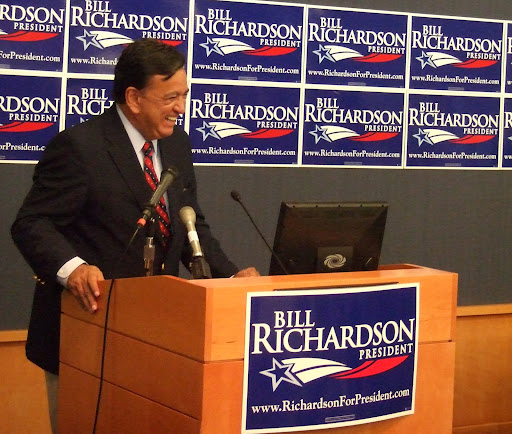 I can't compete with a professional camera and photographer with the eye of the P-C's Matthew Holst, but here is one from a selection of 13 pictures I took at that event and posted on my Picassa site.
So what is "The Question"? It's one I've put to most of the candidates for president since the early 1970s. It goes to the heart of what politics in a democratic society ought to be about. It's something we know how to do, and insist on in other countries. And yet few candidates have ever even thought about it -- let alone come up with a plan for implementation. What is the question, and how and why did I come up with it? And how did Richardson do with it?
The answers will come later this morning, after I've interrupted my blogging with a little bit of "life."
I'm back. But before addressing "The Question" I should note that, while I'm not endorsing anyone -- a lot can happen in the six months between now and the January caucus -- I thought Richardson did a great job yesterday. He was relaxed, engaging, funny, warm, and willing to stay a half hour or more beyond the 11:30 "deadline." I found his "the first six days in office" an effective way to package quite an array of what he proposes to do for us. And most of what he was proposing was very well received by the overflow and often enthusiastic crowd (as you'll see from one of my pictures -- which doesn't even show those in the hall outside Meeting Room A) -- and by me. (Much of the content of his remarks is provided in the stories and Deeth Blog linked above.)
The Question
So why was I questioning presidential candidates over 30 years ago? I had been asked to host a TV show on which they appeared, one each show. Frankly, I don't remember the details, except for what led to "The Question."
I quickly discovered that it was difficult to get anything very new or different from a candidate who had already been asked the standard questions dozens if not hundreds of times. It was as if they had little audio cassette tapes that they plugged into their brains and played back, one for each question.
What to do? I considered having someone throw them a baseball, or tip over their chair -- anything to throw them off guard a little, something that would provoke something more spontaneous than their polished performances. The producer said I couldn't do it.
So I finally came up with a question they hadn't confronted before, and I have been using variations of it ever since.
"The Question" on those early shows, and later in some Iowa living rooms, took the following form: "Senator," because it usually was a senator, "let's make two assumptions: one, you are 'right on the issues,' whatever that means to the audience; they like your platform and proposals. Two, you are elected president. Please tell us, why are the coal mine operators going to have less control over coal mine safety than they do now?" (Of course this can be, and often was, expanded with examples from many industries and agencies.)
Most candidates over the years have fallen mute. The best one could hope for was some feeble, "Well, I'm going to appoint good people to office." That was one answer clearly revealed they didn't understand the problem.
The "good people" they appoint to office (if such can be found, given industry pressure to appoint their people to the regulatory agencies they will have to deal with) will find themselves pretty isolated. It may be one of those agencies where employees come from, and return to, the industry. It may be one where they are wined and dined by industry representatives. These "good people" will be reporting to congressional committees made up of elected officials whose primary source of campaign funds is the very industry being "regulated." And the media? The mainstream media will largely ignore the agency. Media coverage will be primarily from the trade press covering -- and being funded with advertising dollars from -- the industry in question.
(Let me also note, for balance, that I have known a number of civil servants who are among the brightest and most public spirited, independent and courageous people anywhere.)
So much for "good people" heading agencies -- however much they may be an improvement over "bad people."
What is needed (as I privately explained to Governor Richardson yesterday) is the kind of citizen participation in agency process that -- when the decision goes for the industry, as it almost always will -- provides a "party," someone with "standing," to appeal the decision to the relevant U.S. Court of Appeals.
Such groups (primarily, if not exclusively, representing the interests of citizens and consumers rather than those with direct and substantial economic interests in the outcome) -- and, yes, I know they will represent far right conservative individuals as well as the lefties and libertarians -- can also use their access to the mainstream media, and the political process, to get the story out of the trade press and into the public consciousness. But their most effective leverage is through the judicial process when agencies are engaged in clear violations of law, as they sometimes are. Note that, without their participation there is simply no one who can appeal. The agency's pro-industry decision stands.
I didn't have notes yesterday, and I don't know if anyone has a recording of his presentation, so I don't know exactly how I phrased "The Question" to him. But it was somewhat along these lines:
"As you can tell from the response you've received there are a lot of folks here who seem to appreciate and support what you say you will do for us. What I'd like to know is what you propose to do to enable us to help you get those things accomplished in the face of special interest opposition? How can we better accomplish what we, as individuals and members of numerous citizens' groups, would like to accomplish in addition? Even with total public financing of campaigns we would still be up against overwhelming odds from the special interests with their well-paid thousands of lawyers, lobbyists and publicists, their advertising and public relations budgets -- and today their campaign contributions in the millions of dollars. What things do you have in mind along the line of the Legal Services Corporation, agency reimbursement of intervenors' expenses, treble-damage antitrust remedies, class action suits, private attorneys general actions, and so forth?"
Much as I like Richardson, I have to say he cast his lot with the majority of candidates who have either never thought about such things or don't think them very important. His was kind of an AmeriCorps-type response -- things the government could sponsor that would invoke the "ask what you can do for your country" response. Great ideas, but not likely to curb special interest control of the Congress and the agencies.
I've never known the details of the following story. It may be apocryphal. A citizens' group gained an appointment with President Roosevelt. After their presentation he said to them, "I agree with you absolutely. We must introduce that legislation. Now you go out there and make me do it." That is another thing we can do as citizens -- indeed, we are the only ones who can -- in addition to the litigation to keep the agencies honest. We can provide the political, grass roots support that enables elected officials who would like to do the right thing an argument to use with the special interests that oppose what they, and we, want to accomplish.
Over the years there have only been three who grasped the question, and two who understood the answers. Hubert Humphrey acknowledged it was a great question and that the next time I came to his office we should talk about it. Jesse Jackson and Ralph Nader knew how to proceed.
This year Barack Obama came closest, reminding me that he had worked as a community organizer. But he didn't carry his response beyond that.
It's not like this stuff is unknown in Washington. Even President George Bush has a rhetoric about "democracy" in other countries, though he doesn't always reflect the prerequisites to creating it. Those prerequisites involve something we call "civil (or civic) society" or "social capital." I've participated in some of these efforts abroad. This can involve everything from trade unions to Rotary Clubs to community media outlets; building citizen experience in coming together for public policy or programmatic purposes and then working to accomplish the stated goals.
We know how to do it -- and Obama's "community organizing" is a major component of the training. We just don't.
We know how to train our K-12 students to get out of the school house and into the court house, city council chambers and legislative halls to practice citizen power in a democracy. But we don't do much of that, either. (See, e.g., Center for Civic Education and National Council for the Social Studies and its "Creating Effective Citizens.")
We're not talking more "book learning" and classroom lectures here -- however important both may be -- we're talking "experiential learning" and performance -- political, policy, legal and media accomplishments.
A president could do a lot to build a "civic society" here in America -- but only after he or she begins to grasp why it is a need, and mounts the courage to take on the thousands of those in Washington who rather enjoy and find quite acceptable the rule by self-proclaimed elite that has served them so well.
# # #
[Note: If you're new to this blog, and interested in the whole UI President Search story . . .
This blog began in June 2006 and has addressed, and continues to addresses, a number of public policy, political, media, education, economic development, and other issues -- not just the UI presidential search. But that is the subject to which most attention has been focused in blog entries between November 2006 and June 2007.
The presidential search blog entries begin with Nicholas Johnson, "UI President Search I," November 18, 2006. They end with Nicholas Johnson, "UI Held Hostage Day 505 - Next (Now This) Week," June 10, 2007 (100-plus pages printed; a single blog entry for the events of June 10-21 ("Day 516"), plus over 150 attached comments from readers), and Nicholas Johnson, "UI Hostages Free At Last -- Habemas Mamam!," June 22, 2007.
Wondering where the "UI Held Hostage" came from? Click here. (As of January 25 the count has run from January 21, 2006, rather than last November.)
For any given entry, links to the prior 10 will be found in the left-most column. Going directly to FromDC2Iowa.Blogspot.com will take you to the latest. Each entry related to the UI presidential search contains links to the full text of virtually all known, non-repetitive media stories and commentary, including mine, since the last blog entry. Together they represent what The Chronicle of Higher Education has called "one of the most comprehensive analyses of the controversy." The last time there was an entry containing the summary of prior entries' commentary (with the heading "This Blog's Focus on Regents' Presidential Search") is Nicholas Johnson, "UI President Search XIII -- Last Week," December 11, 2006.
My early proposed solution to the conflict is provided in Nicholas Johnson, "UI President Search VII: The Answer," November 26, 2006.
Searching: the fullest collection of basic documents related to the search is contained in Nicholas Johnson, "UI President Search - Dec. 21-25," December 21, 2006 (and updated thereafter), at the bottom of that blog entry under "References." A Blog Index of entries on all subjects since June 2006 is also available. And note that if you know (or can guess at) a word to search on, the "Blogger" bar near the top of your browser has a blank, followed by "SEARCH THIS BLOG," that enables you to search all entries in this Blog since June 2006.]
# # #


