. . . because much of the content relates both to Washington, D.C., and "outside the beltway" -- the heartland, specifically Iowa -- and because after going from Iowa to Washington via Texas and California I subsequently returned, From DC 2 Iowa.
March 8, 2008, 11:00 a.m., 3:44, 8:41 p.m.; March 10, 2008, 2:00 p.m.; March 11, 2008, 6:15 p.m.; March 12, 2008, 7:00 a.m.
Hillary's Experience? What experience?
(For a lighthearted "Saturday Night Live" take on these issues March 8 see the video at the end of this blog entry -- where you will also find the results from Wyoming and Mississippi.)
There's been a lot of talk during the Democratic Party's primaries and caucuses about the "experience" and "qualifications" of the candidates.
Senator Hillary Clinton recently surrounded herself with former military officers and American flags and simply proclaimed that both she and Senator John McCain had the experience and qualifications to be "commander-in-chief" -- by which she clearly meant the ability to deal appropriately with another terrorist attack or other domestic emergency, or to take the country into a war that would be professionally conducted and decisively won.
About the same time her campaign was running this "3:00 a.m. phone call" political commercial -- showing sleeping children, with an anxious parent fearful for their safety, the commercial asks in effect, "Who do you want in the White House dealing with emergencies of sufficient seriousness that the president must be awakened at 3:00 a.m. to deal with them?" and then closes with a shot of Senator Clinton talking on the phone. (This is the commercial spoofed in the "Saturday Night Live" video.)
I won't comment on the appropriateness of conducting a campaign based on fear -- as President Bush and Vice President Cheney have done with 9/11 and their justifications for starting, and continuing, a war in Iraq. Nor will I dwell on the wisdom of her building up Senator McCain in her effort to contend that she is just as qualified as he is. My point for now is merely the "experience" factor.
For when the Clinton campaign was pressed to provide even one example of her ever having been confronted with a situation remotely similar to what was suggested by the "3:00 a.m. phone call" commercial her campaign spokespersons were, of course, unable to do so.
Not only has she provided little more than her own assertions for the proposition that she is "ready," and "tested," and "experienced," and "qualified" to be "commander-in-chief," her attacks on Senator Obama are equally devoid of support.
She asserts that while she and Senator McCain have the qualifications to be commander-in-chief all that Senator Obama has is a speech in 2002.
This is not the only context in which she has attacked his "lack of experience," ignored the existence of, and substance in, the long list of policy positions on his Web site, or endeavored to trivialize the significance of his charisma, the crowds he has attracted (not to mention the delegate lead he has amassed), the new voters he has potentially brought into the Democratic Party camp, and the education, experience, and philosophical foundations on which he has drawn to bring this about.
There is a hearty irony to her attempt to contrast her "experience" with his.
Don't take my word for it. Read her own words on her Web site. Under "Hillary" the most relevant portions are "Mother & Advocate," "First Lady," and "U.S. Senator." As you read through this material you can't help but be impressed (or depressed) with her almost total absence of administrative experience, and the extent to which her claimed "experience" is precisely what she criticizes in that of Senator Obama: speeches, writing, and "advocacy."
Here are some illustrative excerpts.
"Hillary went to Wellesley College, where she was chosen by her classmates to be the first-ever student commencement speaker. [That's the very first sentence.] . . . Next came Yale Law School, where Hillary . . . began her decades of work as an advocate for children and families. As a law student, Hillary . . . worked on some of the earliest studies . . .. When Bill was elected Governor of Arkansas, Hillary continued to advocate for children . . .. She . . . played a pioneering role in raising awareness of issues . . ..
[As First Lady.] When her husband was elected President in 1992, Hillary's work as a champion for women was recognized . . .. She traveled the globe speaking out against the degradation and abuse of women . . .. In the White House, Hillary led efforts to . . .. She helped launch . . .. Thanks in part to her efforts, . . .. As everyone knows, Hillary's fight for universal health coverage did not succeed. But her commitment to health care for every American has never wavered. She was instrumental in . . .. Hillary's 1995 book It Takes A Village, . . . became an international best seller. . . . Hillary's autobiography, Living History, was also a best seller.
[As U.S. Senator.] In 2000, Hillary was elected to the United States Senate [and] . . . continued her advocacy for children and families . . .. After the terrorist attacks of September 11, 2001, Hillary worked with her colleagues . . .. She fought to provide . . .. And she continues to work for . . .. She is . . . working to see that . . .. She has visited troops in Iraq and Afghanistan . . .. She has learned first-hand the challenges . . .. Hillary passed legislation . . .. She is an original sponsor of legislation that . . .. She has introduced legislation to . . .. She has supported a variety of . . .. She helped pass legislation that . . .. She has championed legislation to . . .. In the Senate, Hillary has not wavered in her work to . . .. She worked to . . .. She authored . . .. She sponsored legislation . . .. [She] is now leading the fight for . . .. Her strong advocacy for children continues in the Senate. Some of Hillary's proudest achievements have been her . . . legislation . . ., and her legislation to . . .. She has also proposed . . .. She has passed legislation . . .. Hillary has been a powerful advocate for . . .. Her commitment to supporting . . . was hailed by the New York Times as "frank talk. . .." Hillary is one of the original cosponsors . . .. Hillary is strongly committed to . . .. She introduced the . . .."
Now let me put these quotes in context to explain what I do, and do not, mean to suggest with them.
My limited point is simply that her "experience," like that of Senators Obama and McCain, is primarily "life experience" -- plus some useful (but not, standing alone, presidentially-qualifying) legislative experience. Her public interest work, life as First Lady, and brief senate career have been primarily a work of words -- the very thing for which she criticizes Senator Obama in her efforts to set herself apart as somehow more qualified than he is.
That is not to say that she has not spoken out on and written about important issues, volunteered for and otherwise contributed to the staff and boards of non-profit organizations, voted for and otherwise aligned herself with legislation -- much of which I would have agreed with, and even found commendable.
[March 14: However, a little caution may be in order in accepting her assertions of credit for some of what she claims. See Nicholas Johnson, "Hillary Makes Up 'Experience,'" March 14, 2008 (according to a Boston Globe expose, those who actually created and worked to pass the children's health program called SCHIP are irritated by, and refuting, her taking credit for it. Her Web site says that as First Lady "She was instrumental in designing and championing" the program. That blog entry also provides Time magazine's comparable take with regard to her Ireland and Kosovo claims).]
The reason there are ellipses in the place of subject matter in the excerpts above is not because I think those subjects irrelevant or unworthy. It is because the point I wish to make is that each, however commendable, involves speaking and writing. What "championed," "fighting" or "working for" mean in the legislative context is writing and speaking. They mean assigning staff members responsibility for coming up with new legislation (or merely signing on to bills authored by others), questioning witnesses testifying during sub-committee meetings, and talking to colleagues. They do not even necessarily mean that any legislation was ever enacted.
Senators make speeches -- some are creative and courageous speeches, some are lackluster and corrupt speeches, some are speeches they have actually written themselves (though this is rare) and others are merely speeches read from texts provided by staff members or lobbyists. (I have written Senators' speeches on behalf of clients.) But the activity in which senators are engaged, the "experience" they are gaining when they are "fighting" for this or that, is speaking experience.
Clearly, such legislative experience is not insignificant. It's useful experience for a president to have had. It's just not all the experience a president needs.
We take our politics seriously in Iowa.
So prior to the Iowa caucuses I tried to think through a set of "neutral principles" for comparing presidential candidates, and then summarized them in an op ed that was headlined, "Qualities to Keep in Mind When Picking a President" (Iowa City Press-Citizen, December 22, 2008; reproduced in the blog entry, Nicholas Johnson, "Op Ed: Caucus Choices Analysis," December 22, 2008).
Here are some excerpts from that column:
• Forget "electability." Any Democratic Party nominee is electable in 2008. (Although Sen. Hillary Rodham Clinton's high negatives create some risk.) Consider their ability to govern.
Experience at everything
All have "experience" at something. But a president needs experience at everything. Who has the broadest, deepest range of experience?
An American president is policy wonk in chief as well as commander in chief. Federal personnel director as well as national cheerleader. They must maintain our economy while improving our foreign relations. Above all, they must have superior, large-institution administrative skills and experience.
When they negotiate and deal with other major institutions it gives them credibility as well as real understanding if they've worked within them: Congress, cabinet positions, municipal and state governments, international organizations, and negotiations with foreign leaders.
We don't have a school for presidents. There's no parliamentary system to provide the ultimate prime ministers both administrative and legislative experience.
Quality rankings
So here are the qualities I'm looking for . . ..
• Experience administering large institutions (state or large city governments, corporations [cabinet departments]) . . ..
• A "people person" with charisma or down-home manner, sense of humor (including self-deprecation), or what Molly Ivins called "Elvis" . . ..
• The understanding and credibility earned by working inside both Washington's executive and legislative branches [cabinet departments, independent regulatory commissions, House and Senate] . . ..
• A willingness to put forward courageous, "best policy" proposals, rather than "starting off backing up" . . ..
• Experience working inside international organizations (e.g., U.N., World Bank). . ..
• Understanding of the elements and process of citizen empowerment [e.g., community organizing]. . ..
• An understanding of foreign policy (as distinguished from administering it) . . ..
• An ability to work with, but an independence from, special interest money and influence (the "Washington Establishment") . . ..
However, Clinton's strength in this department is her weakness. She and Bill could probably name all of their 4,000 presidential appointees in one evening without notes. But part of the reason for their millions from corporate lobbyists and PACs is the Washington Establishment's expectation of another pro-corporate, business-as-usual Clinton administration.
• Experience negotiating with foreign leaders . . ..
• Champion of the underdog . . ..
The column included evaluations by these standards of what was then a large field of candidates. While it did not conclude with an endorsement, New Mexico's Governor Bill Richardson obviously was well ranked.
He had, after all, experience in state government (as a governor), federal executive branch government (cabinet; Secretary of Energy), legislative (U.S. House of Representatives), international organizations (U.N. Ambassador), and negotiation (more than one successful release of hostages from hostile countries).
Senators in general, this year's crop of finalists, and Senator Hillary Clinton in particular, do not score very well by these standards -- certainly not well enough for her legitimately to be able to argue that she is "tested" and "qualified" to be president (and "commander-in-chief") while Senator Obama, by contrast, just "doesn't have the necessary experience."
She has not been a mayor, governor, or cabinet officer. She's never served in a state legislature or the U.S. House. She's never held a position in an international organization. She has never (so far as I know) been involved in hostage, trade, treaty or other international negotiations. She's never served in the military or worked in a civilian capacity in the Defense Department. So far as I know, as First Lady she did not even have the clearance to see classified documents that I had as U.S. Maritime Administrator. She's never run a major state or federal government department, or even functioned as a corporate CEO.
I do not assert that Senator Obama is more qualified, or has more experience, than has Senator Clinton -- nor, it should be noted, does he make that claim. Frankly, I think that while their life, and legislative, experiences are somewhat different, they are not, to borrow a phrase, "differences that make a difference" when it comes to their qualifications as a potential president.
If anything, Senator Obama has three additional relevant categories of experience that she does not. One is state legislative experience. (Not incidentally, when his years in the Illinois legislature are added to his years in the U.S. Senate he ends up having more years of legislative experience than she has.) Second, his race, his ties to Kenya, his having lived in Indonesia and among the diverse populations of Hawaii, exceed in my view -- but at least equal -- the ability to improve America's relations abroad that Senator Clinton may have gained from "traveling in 80 countries." Finally, and for reasons I won't take space, and your time, to lay out now, I put enormous weight on his community organizing experience that I believe underlies much, if not all, of what makes him qualified to be president, an authentic agent of change, and so attractive to millions.
But I'm not making the argument, and accepting responsibility for sustaining the burden of proof, that he is more qualified to be president than she -- only that I think Senator Clinton is not creditable and cannot be taken seriously when she asserts that she should be the preferred choice because she is so much more qualified than he is.
(Nor do I find persuasive the demographic arguments put forward by the Clinton camp:
The issue cannot be constructively characterized as how they've done, one-on-one, running against each other in Democratic Party primaries. It means little that she has, sometimes, drawn more heavily than he from natural Democratic Party demographic groups -- whites, without college education, earning under $50,000 a year (as he has drawn more heavily than her from others). Remember that it is Democratic Party primaries we're talking about here.
The question should be: What evidence is there that -- in a match-up between Senators Obama and McCain -- Democratic Party voters and Independents who voted in primaries for Senator Clinton would vote for Senator McCain rather than Senator Obama? I know of none (although I do have a smattering of anecdotal evidence regarding Independents and Democrats who have told me their first preference is Senator Obama, but that if Senator Clinton ends up as the nominee they will vote for Senator McCain). I don't see that it makes a lot of difference, standing alone, how demographic groups have aligned between Senators Clinton and Obama in a given Democratic Party primary. Moreover, most of the polls I have seen indicate pretty consistently that in one-on-one match-ups with Senator McCain, Senator Obama beats him by more than does Senator Clinton -- most recently 12 points to 6 points.)
There are two things she's done that might be thought of as quasi-administrative in nature.
(1) One was the assignment she had, such as it was, to come up with a health care plan for the Clinton Administration. As an "administrator" of that assignment her failed performance ranked with President Bush's administrative skills with Katrina and management of the Iraq War. Even Senator Clinton acknowledges on her Web site, "As everyone knows, Hillary's fight for universal health coverage did not succeed."
(2) The other is her administration of her current presidential campaign. Even her cheerleader-in-chief, her husband and former president Bill Clinton, acknowledges it has been a disaster. Starting off with more money from lobbyists and PACs than any other candidate in either party (I believe), and one of the most powerful political organizations of the 20th Century, with predictions all around that it was hers to lose -- Senator Obama, coming out of nowhere, has been able to amass more state victories (12 in a row at one point), virtually all caucus victories, more popular votes, and more elected delegates (currently about a 150 delegate margin). Her staff has been bickering, some have left, money has been squandered, she had to loan her campaign $5 million of her own money (while continuing to refuse to make public -- as Senator Obama has -- the tax returns that might indicate where that money came from), the campaign's focus continues to shift from "experience" to "solutions" to "tears" to "humor" ("Saturday Night Live" and "The Daily Show") to, now that she's finally "found her voice," a slash and burn, throw everything including the kitchen sink at Senator Obama whether it's true or not, negative campaign.
This is not just a very thin resume for someone aspiring to assume the most complex administrative job in the world, it's also not very reassuring.
(By contrast, David Wilhelm, Bill Clinton's 1992 campaign chairman who has endorsed Senator Obama, says of the Senator's efforts: “'He has out-worked her, out-organized her and out-raised her, . . .. I know organizational excellence when I see it, and the Obama campaign, win or lose, will serve as a model' of execution of strategy, message discipline, application of new technology and small-donor fund raising." Katharine Q. Seelye, "Bill Clinton Campaign Chair Goes for Obama,"New York Times: The Caucus, February 13, 2008, 1:58 p.m.
She repeatedly refers to her "35 years of experience" -- essentially a reference to everything she's done since leaving law school -- without ever specifying what it was, not to mention how much of it was truly relevant to the work of a president (and, if so, why).
Clearly, she does have seven years' legislative experience as a U.S. Senator -- far less than Senator McCain, but not significantly less than Senator Obama. She has had the "life experience" (including law practice and service on boards) I've already mentioned.
But how much credit can she claim as the spouse of a governor and a president? Based on my own experience, not much.
Do you gain insights and anecdotes from being around (or married to) another? Absolutely. But there is an enormous difference between having decisional responsibility, and merely offering comfort and sympathy to someone who does.
I served as a law clerk to a U.S. Court of Appeals judge (the 5th Circuit's Judge John R. Brown) and a U.S. Supreme Court justice (Justice Hugo Black). (I've just returned from a reunion dinner in the Supreme Court building with other Justice Black clerks and family.) Those experiences, and my ability to extrapolate from them in imagining what other judges do, gives me insights into the judicial process I might otherwise not have. Do they qualify me to be a Court of Appeals judge or Supreme Court justice? Of course not. Would they be of some marginal use were I to be a judge? I suppose.
My wife, Mary Vasey, is one of the nation's experts on "alternative education." She was one of the first to be picked for the national faculty of the Coalition of Essential Schools. She was an early faculty member of Metro High School in Cedar Rapids -- which twice won the U.S. President's award as one of the nation's best high schools. She helped plan the Iowa City alternative high school, Tate. Having retired from Metro, her love of the work, and skill at doing it, is such that she continues to volunteer her time at Tate.
I've lived with her for nearly 20 years. I've heard her after-school stories of what we call in church, the "joys and sorrows" of an alternative high school teacher. I've attended alternative high school events over the years, and come to know other teachers. Mary and I usually talk policy and politics at breakfast, and often that discussion involves K-12 issues.
Does my having been a spouse of an alternative high school teacher qualify me to be one? Not on your life; of that I am unalterably confident. I wouldn't last a week.
Similarly, I don't think being the wife of a governor provides the experience of being a governor, and I don't think being the wife of a president is the equivalent of the experience of being a president.
Think about it. If she were still Senator Hillary Rodham, if she did not have the name recognition that comes from what she went through as Bill Clinton's wife, if she did not have his last name, would she now be one of the entrants, let alone one of the two finalists, in the Democratic Party's presidential primary process based on her "experience"? I don't think so.
What about her foreign policy "experience"? "I've traveled to 80 countries," she tells us. What she fails to tell us is what she did in those countries. Was she there as a U.S. Ambassador, embassy employee, military officer or even Peace Corps worker? As the United States' U.N. Ambassador? As a U.N. (or other international organization's) official? Was she engaged in negotiations of any kind -- whether on behalf of American corporations, improved trade relations, seeking the release of hostages, or to obtain treaties? So far as I know, the answer is "no" to all of the above. Correct me if I'm wrong, but I believe these were, for the most part, "showing the flag," publicity and ceremonial visits.
President Kennedy once introduced himself as "the man who accompanied Jackie Kennedy to France." Notwithstanding that exalted billing, I don't think Jackie Kennedy would have suggested even that role qualified her to run for president.
I've traveled to something like 40 countries. Some have been holidays -- although even then I often would call on public officials or others related to my work. Other trips have involved working with foreign officials on official government business. Frankly, I would not begin to suggest that my 40 countries made me half as qualified to be president as Senator Clinton's 80 countries. I wouldn't even suggest it would qualify me to be an Assistant Secretary of State.
Has her travel been of some marginal benefit in contributing to her understanding other cultures and nations? I would assume so. That's one of the values of travel -- for anyone who's sufficiently humble and observant. I just think she's making far, far too much of it.
I would never say any of the three senators is "unqualified" to be president. I just don't think any of them -- especially Senator Clinton -- can make the case that they do have the experience and qualifications to be president while one of the others does not.
I think the following "Saturday Night Live" sketch from March 8, 2008, puts in perspective Senator Clinton's portrayal of the alleged contrast between her experience and that of Senator Obama. (If you get an "error" message in using the video below, use the link above.)
And see also, Matthew Yglesias, "Experience Gap,"The Atlantic.com, March 11, 2008, 9:42 a.m., which reproduces a memorandum from Greg Craig, former director, State Department Policy Planning staff (e.g., "When your entire campaign is based upon a claim of experience, it is important that you have evidence to support that claim. Hillary Clinton’s argument that she has passed 'the Commander-in-Chief test' is simply not supported by her record" -- following which he details the supporting data.)
Cold Open: An Unfair and Deceptive Message from Hillary Clinton
It's 3 A.M. and the phone rings somewhere in our nation's capital. President Obama calls Hillary in desperate need of help. Iran has developed a nuclear device with the help of the axis of evil. They've lied to him, and now he's in a blind, unreasoning panic born from inexperience. What's Obama to do?
Hillary tells Obama to man up. Russia will back down or risk violating the nuclear non-proliferation treaty. Hillary insists that the Secretary of State can explain, but Obama doubts that Secretary Sharpton can, admitting this wasn't his best appointment. Obama thanks Hillary and apologizes for calling every night, glossing over her request for payment if he's going to keep calling. He would trade all of his superficial charm and rock star appeal for an iota of Hillary's capabilities.
Hillary admits that what we've just witnessed is a dramatization, based on facts. Well, not facts, but what she calls specious campaign talking points. If you want a better future for our country, it's not too late. Call or write the offices of the Democratic National Committee. With enough pressure, we can convince party leaders that they've made a huge mistake. And one more thing... Live from New York, it's Saturday Night!
EXTRA - MISSISSIPPI UPDATE - The Washington Post is reporting this morning [March 12, 7:00 a.m.] that, with 90% of Mississippi's precincts reporting, Senator Obama received 60% of the votes (221,874) and Senator Clinton received 38% (142,671). This translates into 17 delegates for Senator Obama (for a total of 1596) and 11 for Senator Clinton (bringing her total to 1484) -- a 112 delegate margin for Senator Obama.
The New York Times reports [March 12, 7:20 a.m.] that with 99% of the precincts reporting Barack Obama has 60.7% of the votes (253,441) and Hillary Rodham Clinton has 37.1% (154,852)-- and says the 33 pledged delegate allocation has yet to be determined. It calculates the elected delegate totals to be 1348 Obama to 1210 Clinton -- a 138 vote margin for Senator Obama -- while reporting the Associated Press' calculation to be 1385 to 1237, a 148-vote spread. With super delegates it's 1510 to 1403 (107 spread) from the Times and 1596 to 1484 (a 112 spread) from the AP.
EXTRA - WYOMING UPDATE (March 8, 2008, 8:41 p.m. CT): With 100% Precincts Reporting Obama has 61% of the Votes, Clinton 38%.
Wyoming Democratic Caucus
Candidate. . . . Votes. .% Barack Obama. . .5,378. .61 Hillary Clinton. 3,312. .38 Other. . . . . . . .70. .1 Key: Red Checkmark Winner Precincts: 100% | Updated: 9:41 PM ET | Source: AP [as reported on Washington Post Web site] Delegates at stake: 12; Obama 7, Clinton 5
To borrow the punch line from a really bad (and irrelevant) joke . . .
"Tonight's the Night"
Today [Jan. 3] I awoke to a BBC radio report of the Iowa caucus process, along with a reporter's comment to me later in the day that there are journalists from 30-40 countries covering the political events in my little state of Iowa as they travel about in press busses.
Moreover, "today" began yesterday noon -- with the final countdown Iowa City appearances of Democratic candidates Obama, Edwards, Richardson, and this morning, Dodd (plus a couple we didn't attend).
Pictures from each of those four events, plus many more from throughout 2007, can be found on my Picasa Web site.
Elsewhere on this blog, linked from the lefthand column of this blog entry, as well as available from searches of the blog entries throughout 2007, deal with politics in general and the caucus process in particular.
My wife and I will be working this evening as Johnson County Democrats' co-chairs of one of Iowa's 1700-plus precincts: Iowa City 3. We're off now to set up the venue -- a ballroom at the University of Iowa students' Memorial Union.
Once those events are wrapped up, and I'm back home, I may add a bit of a report to this blog entry.
__________
Too late last night; here's the update.
Mary ran the meeting; 208 showed up (we were expecting 60-100). It was the same all across Iowa, roughly a doubling of the caucus turnout in 2004. Our precinct's 6 delegates split 3 for Obama, 2 for Richardson, 1 for Edwards. Clinton was not, as we say in caucus speak: "viable."
My own read of the statewide outcome -- like that of many commentators and the candidates themselves -- is that voters, at least in Iowa, were expressing a general sentiment more than a precisely analyzed and articulated preference for individual candidates (though there was a good measure of that as well) when they, literally, "stood" for their choice at the caucus. They're frustrated and hurting -- with Bush, with the Democrats failure to do anything meaningful about Bush and his war, with the perpetuation of corporate control of Washington constantly putting profits over people, with the bickering. For many caucus goers (I'm guessing) Obama and Huckabee simply represented the closest trees to take that lightning strike -- creditable alternatives to an unacceptable status quo. (Note that Edwards, who has been hammering a message consistent with this spirit, came in a good second.)
Clearly Clinton and Romney were the very big losers of the evening -- which is not to say, with their money, they can't make up some of that in the primaries to come.
I've added three photos to the Picasa photo site showing the orderly phase of the evening (the chair bringing us to order, and two presenters on behalf of candidates), and the size of the group in the IMU ballroom. The "caucus chaos" that followed would have been hard to capture in a still photo -- and virtually impossible given my other obligations at that time.
For some reason unexplained the Des Moines Register has removed its video of Senator Obama's Iowa Caucus Victory Speech of January 3rd -- said by many commentators to be one of the most impressive victory speeches of the last 50 years. Here it is from YouTube, so you can watch and judge for yourself:
If you never saw it, or would like a reminder, here are Part One and Part Two of his speech to the 2004 Democratic National Convention.
Democrats who attend their precinct caucus the evening of January 3 will suffer the blessing of too many wonderful choices. Here's this morning's [Dec. 22] op ed with my suggested analysis for sorting through them to a choice. (And see also on that page the adjoining column by former Congressman Jim Leach, "We should look to Eisenhower, not Reagan, in 21st century.")
All the Democratic Party's presidential candidates would make good-to-excellent presidents. How to choose?
Here are some suggestions from an Iowa-born old Washington hand.
• Don't miss the caucus. Take a friend. New York's Boss Tweed said, "I don't care who does the electing, just so long as I do the nominating." This is your chance to do the nominating. Plus, it's fun.
• Don't rely on "positions" and rhetoric. A campaign is not a presidency. Even if meaningful and honestly spoken, political forces and conditions change.
• Forget "electability." Any Democratic Party nominee is electable in 2008. (Although Sen. Hillary Rodham Clinton's high negatives create some risk.) Consider their ability to govern.
• Forget the media's top three. Clinton, Sen. Barack Obama and former Sen. John Edwards are going to New Hampshire regardless. Use your chance to "vote twice." Support one of the others you want kept in the race. If they're not initially "viable" at your caucus you can switch.
Experience at everything
All have "experience" at something. But a president needs experience at everything. Who has the broadest, deepest range of experience?
An American president is policy wonk in chief as well as commander in chief. Federal personnel director as well as national cheerleader. They must maintain our economy while improving our foreign relations. Above all, they must have superior, large-institution administrative skills and experience.
When they negotiate and deal with other major institutions it gives them credibility as well as real understanding if they've worked within them: Congress, cabinet positions, municipal and state governments, international organizations, and negotiations with foreign leaders.
We don't have a school for presidents. There's no parliamentary system to provide the ultimate prime ministers both administrative and legislative experience.
Quality rankings
So here are the qualities I'm looking for -- followed by my opinion of who ranks highest.
• Experience administering large institutions (state or large city governments, corporations) -- Gov. Bill Richardson (governor; Secretary of Energy), Rep. Dennis Kucinich (mayor of Cleveland).
• A "people person" with charisma or down-home manner, sense of humor (including self-deprecation), or what Molly Ivins called "Elvis" -- Obama (charisma and "Elvis"), Richardson (down-home; humor).
• The understanding and credibility earned by working inside both Washington's executive and legislative branches -- Richardson (cabinet (Energy), Congress). (Legislative: Clinton, Edwards, Kucinich, Obama, Richardson and Senators Joe Biden and Chris Dodd).
• A willingness to put forward courageous, "best policy" proposals, rather than "starting off backing up" --Kucinich (only one to organize and vote against the war, and propose universal single-payer health care rather than for-profit insurance).
• Experience working inside international organizations (e.g., U.N., World Bank) -- Richardson (UN ambassador).
• Understanding of the elements and process of citizen empowerment -- Obama (community organizer).
• An understanding of foreign policy (as distinguished from administering it) -- Biden, Dodd (plus, of course, Richardson).
• An ability to work with, but an independence from, special interest money and influence (the "Washington Establishment") -- My guess is that all have, can (and will have to) work with Washington's real power centers.
However, Clinton's strength in this department is her weakness. She and Bill could probably name all of their 4,000 presidential appointees in one evening without notes. But part of the reason for their millions from corporate lobbyists and PACs is the Washington Establishment's expectation of another pro-corporate, business-as-usual Clinton administration.
• Experience negotiating with foreign leaders -- Richardson (North Korea, Iraq, Sudan; U.N.; return of hostages); Biden and Dodd.
• Champion of the underdog -- Edwards, Kucinich.
You may have a different list of qualities and evaluation of candidates. But I hope this kind of approach may be helpful to you in a year when we are blessed with a very tough choice from among excellent candidates. _______________ Nicholas Johnson served as maritime administrator, FCC commissioner and presidential adviser for a White House Conference during the terms of three presidents. He now teaches at the University of Iowa College of Law and maintains the blog, FromDC2Iowa.blogspot.com.,/i>
June 27, 2007, 6:00, 8:30 a.m. [times reflect additions to the entry -- for the benefit of those few individuals who check back occasionally during the day -- as well as reflecting the fact that what is called "life" occasionally interrupts blogging]
Richardson and "The Question"
As predicted yesterday, John Deeth the blogger was at the Governor Bill Richardson event (Iowa City Public Library, June 26), and thus there's very little to add to his report. Because he never travels without his laptop he figures it's entitled to its own bumper sticker, which says: "REBOOT AMERICA." It's one Richardson could have used as his theme yesterday.
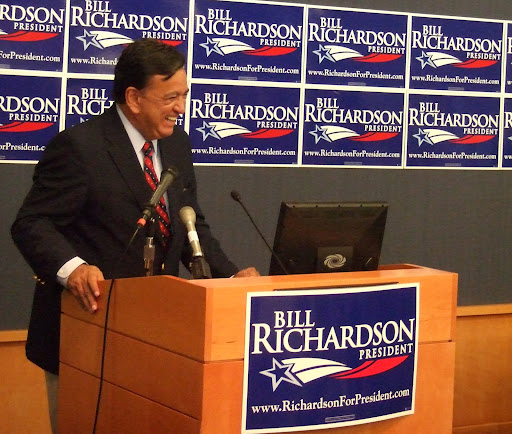
These days, with online newspapers, it's not enough that the paper's photographer provides one or two shots for the next day's edition. They're expected to prepare a "gallery" of pictures -- and virtually immediately. Here's the Press-Citizen's this morning. I can't compete with a professional camera and photographer with the eye of the P-C's Matthew Holst, but here is one from a selection of 13 pictures I took at that event and posted on my Picassa site.
So what is "The Question"? It's one I've put to most of the candidates for president since the early 1970s. It goes to the heart of what politics in a democratic society ought to be about. It's something we know how to do, and insist on in other countries. And yet few candidates have ever even thought about it -- let alone come up with a plan for implementation. What is the question, and how and why did I come up with it? And how did Richardson do with it?
The answers will come later this morning, after I've interrupted my blogging with a little bit of "life."
I'm back. But before addressing "The Question" I should note that, while I'm not endorsing anyone -- a lot can happen in the six months between now and the January caucus -- I thought Richardson did a great job yesterday. He was relaxed, engaging, funny, warm, and willing to stay a half hour or more beyond the 11:30 "deadline." I found his "the first six days in office" an effective way to package quite an array of what he proposes to do for us. And most of what he was proposing was very well received by the overflow and often enthusiastic crowd (as you'll see from one of my pictures -- which doesn't even show those in the hall outside Meeting Room A) -- and by me. (Much of the content of his remarks is provided in the stories and Deeth Blog linked above.)
The Question
So why was I questioning presidential candidates over 30 years ago? I had been asked to host a TV show on which they appeared, one each show. Frankly, I don't remember the details, except for what led to "The Question."
I quickly discovered that it was difficult to get anything very new or different from a candidate who had already been asked the standard questions dozens if not hundreds of times. It was as if they had little audio cassette tapes that they plugged into their brains and played back, one for each question.
What to do? I considered having someone throw them a baseball, or tip over their chair -- anything to throw them off guard a little, something that would provoke something more spontaneous than their polished performances. The producer said I couldn't do it.
So I finally came up with a question they hadn't confronted before, and I have been using variations of it ever since.
"The Question" on those early shows, and later in some Iowa living rooms, took the following form: "Senator," because it usually was a senator, "let's make two assumptions: one, you are 'right on the issues,' whatever that means to the audience; they like your platform and proposals. Two, you are elected president. Please tell us, why are the coal mine operators going to have less control over coal mine safety than they do now?" (Of course this can be, and often was, expanded with examples from many industries and agencies.)
Most candidates over the years have fallen mute. The best one could hope for was some feeble, "Well, I'm going to appoint good people to office." That was one answer clearly revealed they didn't understand the problem.
The "good people" they appoint to office (if such can be found, given industry pressure to appoint their people to the regulatory agencies they will have to deal with) will find themselves pretty isolated. It may be one of those agencies where employees come from, and return to, the industry. It may be one where they are wined and dined by industry representatives. These "good people" will be reporting to congressional committees made up of elected officials whose primary source of campaign funds is the very industry being "regulated." And the media? The mainstream media will largely ignore the agency. Media coverage will be primarily from the trade press covering -- and being funded with advertising dollars from -- the industry in question.
(Let me also note, for balance, that I have known a number of civil servants who are among the brightest and most public spirited, independent and courageous people anywhere.)
So much for "good people" heading agencies -- however much they may be an improvement over "bad people."
What is needed (as I privately explained to Governor Richardson yesterday) is the kind of citizen participation in agency process that -- when the decision goes for the industry, as it almost always will -- provides a "party," someone with "standing," to appeal the decision to the relevant U.S. Court of Appeals.
Such groups (primarily, if not exclusively, representing the interests of citizens and consumers rather than those with direct and substantial economic interests in the outcome) -- and, yes, I know they will represent far right conservative individuals as well as the lefties and libertarians -- can also use their access to the mainstream media, and the political process, to get the story out of the trade press and into the public consciousness. But their most effective leverage is through the judicial process when agencies are engaged in clear violations of law, as they sometimes are. Note that, without their participation there is simply no one who can appeal. The agency's pro-industry decision stands.
I didn't have notes yesterday, and I don't know if anyone has a recording of his presentation, so I don't know exactly how I phrased "The Question" to him. But it was somewhat along these lines:
"As you can tell from the response you've received there are a lot of folks here who seem to appreciate and support what you say you will do for us. What I'd like to know is what you propose to do to enable us to help you get those things accomplished in the face of special interest opposition? How can we better accomplish what we, as individuals and members of numerous citizens' groups, would like to accomplish in addition? Even with total public financing of campaigns we would still be up against overwhelming odds from the special interests with their well-paid thousands of lawyers, lobbyists and publicists, their advertising and public relations budgets -- and today their campaign contributions in the millions of dollars. What things do you have in mind along the line of the Legal Services Corporation, agency reimbursement of intervenors' expenses, treble-damage antitrust remedies, class action suits, private attorneys general actions, and so forth?"
Much as I like Richardson, I have to say he cast his lot with the majority of candidates who have either never thought about such things or don't think them very important. His was kind of an AmeriCorps-type response -- things the government could sponsor that would invoke the "ask what you can do for your country" response. Great ideas, but not likely to curb special interest control of the Congress and the agencies.
I've never known the details of the following story. It may be apocryphal. A citizens' group gained an appointment with President Roosevelt. After their presentation he said to them, "I agree with you absolutely. We must introduce that legislation. Now you go out there and make me do it." That is another thing we can do as citizens -- indeed, we are the only ones who can -- in addition to the litigation to keep the agencies honest. We can provide the political, grass roots support that enables elected officials who would like to do the right thing an argument to use with the special interests that oppose what they, and we, want to accomplish.
Over the years there have only been three who grasped the question, and two who understood the answers. Hubert Humphrey acknowledged it was a great question and that the next time I came to his office we should talk about it. Jesse Jackson and Ralph Nader knew how to proceed.
This year Barack Obama came closest, reminding me that he had worked as a community organizer. But he didn't carry his response beyond that.
It's not like this stuff is unknown in Washington. Even President George Bush has a rhetoric about "democracy" in other countries, though he doesn't always reflect the prerequisites to creating it. Those prerequisites involve something we call "civil (or civic) society" or "social capital." I've participated in some of these efforts abroad. This can involve everything from trade unions to Rotary Clubs to community media outlets; building citizen experience in coming together for public policy or programmatic purposes and then working to accomplish the stated goals.
We know how to do it -- and Obama's "community organizing" is a major component of the training. We just don't.
We're not talking more "book learning" and classroom lectures here -- however important both may be -- we're talking "experiential learning" and performance -- political, policy, legal and media accomplishments.
A president could do a lot to build a "civic society" here in America -- but only after he or she begins to grasp why it is a need, and mounts the courage to take on the thousands of those in Washington who rather enjoy and find quite acceptable the rule by self-proclaimed elite that has served them so well.
# # #
[Note: If you're new to this blog, and interested in the whole UI President Search story . . .
This blog began in June 2006 and has addressed, and continues to addresses, a number of public policy, political, media, education, economic development, and other issues -- not just the UI presidential search. But that is the subject to which most attention has been focused in blog entries between November 2006 and June 2007.
Wondering where the "UI Held Hostage" came from? Click here. (As of January 25 the count has run from January 21, 2006, rather than last November.)
For any given entry, links to the prior 10 will be found in the left-most column. Going directly to FromDC2Iowa.Blogspot.com will take you to the latest. Each entry related to the UI presidential search contains links to the full text of virtually all known, non-repetitive media stories and commentary, including mine, since the last blog entry. Together they represent what The Chronicle of Higher Education has called "one of the most comprehensive analyses of the controversy." The last time there was an entry containing the summary of prior entries' commentary (with the heading "This Blog's Focus on Regents' Presidential Search") is Nicholas Johnson, "UI President Search XIII -- Last Week," December 11, 2006.
Searching: the fullest collection of basic documents related to the search is contained in Nicholas Johnson, "UI President Search - Dec. 21-25," December 21, 2006 (and updated thereafter), at the bottom of that blog entry under "References." A Blog Index of entries on all subjects since June 2006 is also available. And note that if you know (or can guess at) a word to search on, the "Blogger" bar near the top of your browser has a blank, followed by "SEARCH THIS BLOG," that enables you to search all entries in this Blog since June 2006.]
Senator Obama's Heathcare Proposal Search Committee II Meeting Today; Campus Visits Plan Downtown Iowa City's Planning Meeting
Senator Obama on Healthcare
Although Senator Obama's healthcare proposals are in some ways only yesterday's news, and indeed were reported here in yesterday's blog entry, Nicholas Johnson, "UI Held Hostage Day 493 - Sen. Obama's Healthcare," May 29, 2007, it's all over today's papers. In fact, given how the national media is playing this story, it was a rather peculiar editorial decision at The Gazette that resulted in its placing its story this morning on page 3B rather than page 1A: James Q. Lynch, "Obama Unveils Health Plan," The Gazette, May 30, 2007, p. 3B.
I thought Dean Borg's report in this morning's "Morning Edition" on NPR an especially well edited, written, and delivered piece. (It should be available later this morning from http://www.npr.org.) Yesterday's blog entry linked to an early version of Kathryn Fiegen's story in this morning's Press-Citizen.
And, as you might imagine, State29 has his own take on what he characterizes as Obama's "snake oil health scare plan," State29, "Snake Oil Obama," May 30, 2007.
Clearly Senator Obama's is a "detailed plan" -- or about as detailed as you're likely to get as a campaign document from a candidate. It responds to the attacks from Senator Obama's toughest critics that he's just an inexperienced, charismatic, "empty suit" who won't reveal what he stands for. That has always been an unfair and inaccurate charge in any event, but yesterday's proposal should help answer it. It also responds to the SEIU demand that all candidates reveal their detailed healthcare proposals by August 1. (Senator Obama now joins former Senator John Edwards as one of the only two to do so.)
If you're hoping for "universal, single-payer" healthcare (as I lean toward -- and State29 leans as far away from as he possibly can without falling over) -- as is provided to the citizens of virtually every other industrialized nation -- this ain't it. But until we get meaningful public financing of campaigns, I'm not sure that's in the cards from this "best Congress that money can buy." So maybe this is a much better plan in its details than the "universal, single-payer" critics give it credit for. Maybe it's the most that a pragmatic, politically savvy healthcare policy wonk can honestly and realistically put forward.
Those who oppose any changes in the healthcare system will oppose this plan, just as they would oppose any other. But those who have a major economic stake in the present system, have disproportionate political power in shaping future changes, and are aware that some changes are simply going to have to come, may well get on board, figuring that this is the least-worst of the possible scenarios.
(1) The super rich don't need (and many don't even want) President Bush's tax cuts for the rich. That's a realistic source of funding for Senator Obama to look to for the modest public investment in healthcare he envisions -- but repealing those cuts will certainly not be a "slam dunk" for any president. (And, even if successful, we're still left with the roughly $40 trillion in unfunded entitlement obligations scheduled to become due and payable within the next 20 years or so.)
(2) His program will continue to be administered by the plethora of insurance companies we have now, which means doctors and hospitals will still be dealing with a variety of forms and reimbursement procedures, and we'll continue to pay these companies' executives healthcare administrative costs many times those of other countries. That should take at least much of the sting out of what would otherwise have been the overpowering objections of this politically influential group.
(3) The system will still be (in terms of numbers of persons covered) an employer-based healthcare system. So it's not disruptive in that regard. Why should employers support a proposal that continues to leave much of the burden on them? Because he lightens their burden. He points out that 80% of the cost of healthcare goes to benefit 20% of the people. And he proposes shifting much of that 80% to the federal government. He represents that this will result in lower premiums for the insured. Well, perhaps. But we've all seen lots of instances when that didn't occur -- as when the price of oil declines and the prices of gasoline goes up. (a) What provisions are there to insure that this element of his program won't simply further enrich insurance companies and employers, rather than reduce premiums for employees? (b) And, given the rate of inflation in healthcare costs, how many years will it be -- even under the best case scenario, with all the cost-shift benefits going to employees -- before the premiums are back up to what they are now?
(4) As for the currently uninsured, or under-insured, or only-sometimes-insured, Senator Obama proposes that the federal government "subsidize" the cost of premiums for those unable to pay market rates. But what will be the practical effect, and benefit, for, say, an unemployed, homeless, single, high school dropout, male in his mid-thirties? I mean that as a real question, not an assertion.
Look, I don't claim any more expertise on this subject (economics in general, and the economics of healthcare in particular; even though I guess I did serve for a time as co-director of the University of Iowa's Institute for Health, Behavior and Environmental Policy) than I do for any of the other subjects I write about. Moreover -- as also with those other subjects -- I quite regularly change my position once someone bothers to explain to me the errors in my thinking. So this is not, to borrow from the TV show, "my final answer." But it's what I'm thinking this morning.
Search Committee II Meeting Today; Campus Visits Plan
The quote from Professor Steve Collins, and the headline on Brian Morelli's story, make a powerful point in support of early revelation of the identity of potential UI presidential candidates. Brian Morelli, "Vetting Finalists Will Reveal Key Info,"Iowa City Press-Citizen, May 30, 2007, p. A3.
He quotes Steve Collins as saying, "Once your candidates have been publicly identified, the search committee can then call a wide variety of people. You also start hearing from faculty members here and at other universities that have information about the person." Collins speaks from experience. He chaired the UI search committee in 1995.
Collins continues, "I think when presidential searches around the country get into to trouble it is because they haven't spent enough time with the search and screening process."
That squares with my own experience with search committees. I recall one where a supposedly high powered (and certainly well paid) search firm was involved. We didn't have assignments, but I decided to take on a little interviewing on my own. I merely checked the Internet, and called some folks who had worked with the candidate and seemed logical people to talk with. What I came up with was extremely relevant. And yet none of the information I easily found on the Internet was presented to us by the search firm. None of the people I interviewed had ever talked to anyone at that firm or the institution doing the hiring.
(As Morelli quotes Search Committee I vice chair and UI history professor Katherine Tachau as saying, "[there are] two types of reference checks, a formal check with calls to candidates' references and an informal process of finding your own sources. The formal check is minimally useful, she said. 'It is not enough to hire on. That in combination with background checks are not enough. . . . The disadvantage of formal [checks is that those you interview] will not want to tell you anything negative about a candidate. ... No one becomes an adult without an enemy here or there. There are going to be negative comments out there [that will come out of the informal process].")
The University and Iowa City communities are made up of individuals who, together, will have hundreds of potential sources of information about any candidate Search Committee II will come up with. But they are not going to be able to gather that information in 48 hours. Some Iowa City folks will be out of town, and won't even know the person was a candidate. Some of the potential sources we know will be out of the country, or on holiday.
And many of the potential sources aren't immediately obvious. They come out of the serendipity of chance encounters and conversations.
"Where did you say this provost is now?" "X university." "You know, I think my neighbor's daughter graduated from there last year. Let me see if I can find out anything from her."
or . . .
"X university, eh? You know, I was on a panel a couple of years ago with a woman faculty member from there. I'm now remembering something she said at the time about his treatment of women. She left shortly thereafter. Let me look through my notes, see if I can find her name, and track down where she is now. We probably ought to find out more about that."
When you are able to have 10,000 people having those conversations -- instead of just the 10 or 15 on a search committee -- and you give the process months, rather than two days, to work through all the people included within their "six degrees of separation" you can avoid the problems Steve Collins identifies: "I think when presidential searches around the country get into to trouble it is because they haven't spent enough time with the search and screening process. When a search fails or presidents are appointed and they fail, I would consider that failures of the search process."
Search Committee II has done an excellent job of meeting one of its goals: keeping the UI and Iowa City communities in the dark, and giving the potential candidates a veil of confidentiality and secrecy. Whether, as a result, they will have "spent enough time with the search and screening process" will only be known after we are able to evaluate our new president's performance over the next year or two.''
Downtown Iowa City's Planning Meeting
The Iowa City Press-Citizen is not exactly noted for being hostile to local business. So when there was absolutely nothing in the paper (that I saw) on Monday or Tuesday (before the meeting) or today (following it) I should have figured out that the meeting I went to last night was not intended to be a public meeting.
The problem was, I thought I had read about it in the paper and that it was open to all. It turns out the reason I knew about it was because of an email my wife had been sent.
The meeting was led by a woman from the "Marketek" consulting firm for which the City of Iowa City is picking up the $62,500 tab as a gift to the business community. The other sponsors of the undertaking are the Iowa City Area Chamber of Commerce and the Downtown Association (for the leadership of which, I should add, I have very high regard).
It was one of those meetings with which you are surely familiar at which a consultant stands in front of the room, asks questions, and then writes on a flip chart or white board, or puts little sticky dots on posters of ideas -- or, on this occasion, took little slips of sticky paper on which audience members wrote ideas and stuck them on the wall. Ultimately they write up what you've said and sell it back to you.
Well into the meeting I felt a little like I'd accidentally walked into the wrong restroom. But since it wasn't a restroom, and no one seemed startled or hostile, we stayed. It was kind of interesting in its own way, and got me to thinking about what my vision of a future downtown Iowa City might be were I to have a vision, and were it to make any difference what my vision was.
While the Press-Citizen didn't cover the event The Gazette did. Gregg Hennigan, "Housing Urged in Downtown I.C.,"The Gazette, May 29, 2007, p. 1B. He picked up on my remark that "the area was no longer the business hub of the community it was when he was a child.' At that time, downtown was the mall,' he said."
My own vision builds on that observation -- as well as much of what I heard during the evening.
For starters, we should stop referring to it as "downtown" and start thinking of it as a "neighborhood."
When I was a kid (late 1930s, 1940s), the University of Iowa notwithstanding, Iowa City had a lot in common with any one of the other 98 county seat towns in Iowa -- except for the lack of a "square." It was where the surrounding farmers came on Saturdays to trade and shop. "Downtown" was the shopping area -- somewhat like today's malls -- with grocery and hardware stores, department and clothing stores, Sears and Wards, a couple of banks and book stores, movie theaters, and an ice cream parlor. There were no parking garages built by the City, nor parking meters lining the streets (though there were still some hitching posts around town). You parked in front of the stores.
Whether or not one would like to recreate that kind of shopping center downtown today (and I'm not sure I would) there's just no way that's going to happen. There's a reason why people like shopping malls and big box stores -- not the least of which is the freedom to park, for free, without the hassle of driving round and round in a parking garage while paying by the hour for the privilege.
So I think this new neighborhood needs to be a place where people live, not where they shop. And not just a place to live for those who desire, and can afford, condos going for between $250,000 and $1 million. A diverse population of college students and working class, and a variety of nationalities and ethnic groups, not just the wealthy. A place of arts and entertainment and restaurants. A bar or two, perhaps -- but not the 40 or 50 we have now. More trees and plants. A place that's friendly to bicycles and electric golf carts and those who like to walk. A place that's fed with shuttle buses running every 5 minutes to large parking lots (not garages) on the outskirts of the neighborhood. Interesting architecture. Historic markers telling the story of prior occupants.
But, quite frankly, I don't think my vision, or that of anyone else, will make much difference. I think we will continue to have the bars, traffic and parking garages. I think what will determine what downtown Iowa City becomes are those who profit from promoting Iowa City as the under-age alcohol abusers' binge drinking capital of America. That and the profit opportunities perceived and seized upon in the projects of our wealthy developers -- at least those projects ultimately approved and funded with taxpayers' money by a subservient City Council.
But it was fun to think about for an evening anyway.
Wondering where the "UI Held Hostage" came from? Click here. (As of January 25 the count has run from January 21, 2006, rather than last November.)
For any given entry, links to the prior 10 will be found in the left-most column. Going directly to FromDC2Iowa.Blogspot.com will take you to the latest. Each contains links to the full text of virtually all known media stories and commentary, including mine, since the last blog entry. Together they represent what The Chronicle of Higher Education has called "one of the most comprehensive analyses of the controversy." The last time there was an entry containing the summary of prior entries' commentary (with the heading "This Blog's Focus on Regents' Presidential Search") is Nicholas Johnson, "UI President Search XIII -- Last Week," December 11, 2006.
Searching: the fullest collection of basic documents related to the search is contained in Nicholas Johnson, "UI President Search - Dec. 21-25," December 21, 2006 (and updated thereafter), at the bottom of that blog entry under "References." A Blog Index of entries on all subjects since June 2006 is also available. And note that if you know (or can guess at) a word to search on, the "Blogger" bar near the top of your browser has a blank, followed by "SEARCH THIS BLOG," that enables you to search all entries in this Blog since June 2006.]
Responding to complaints that he is long on charisma and short on specifics, Senator Barack Obama unveiled a detailed heathcare plan today at one of the nation's largest teaching hospitals: the University of Iowa Hospital and Clinics (UIHC). For the advance text of his remarks, see "Obama Remarks as Prepared for Delivery,"Des Moines Register, May 29, 2007.
John Deeth has one of the most detailed and timely reports of the event at his "JDeeth" blog. And congratulations to John for the press pass he now legitimately wears as a reporter for the Center for Independent Media New Journalism Program.
For video of a local TV station's interview with the Senator, go to KCRG.TV, look for local news, and click on the "Video" link in "Obama Uses Iowa Examples for New Health Care Plan."
Presumably details of the plan will be available soon on the Obama Web site; meanwhile for details see, Mike Glover, "Obama Offers Universal Health Care Plan,"Newsday, May 29, 2007 (available from the Obama site). The Obama site has a "Creating a Healthcare System that Works" page, but it seems to be more a collection of random ideas (which is not to say they are not good random ideas) than it is an exposition of today's health insurance plan.
My photos of the event are available at http://picasaweb.google.com/NicholasIowa. (That site also has pictures of his April 12 Iowa City visit with roughly 10,000 Iowans on the Old Capitol lawn.)
It's too early, and too complicated, for me to offer any final judgments about this proposal. It doesn't look like a "universal single payer" solution to me. The vision seems to still involve an insurance-company-funded-and-administered system. But even if it's tweaking with bailing wire and chewing gum, there seem to be a lot of creative and useful tweaks. And, while any plan always needs more details worked out (otherwise it would be a 1200-page draft bill rather than a speech), however you may evaluate his details I think he's significantly responded to the critics who have called on him to produce more detailed plans.
Wondering where the "UI Held Hostage" came from? Click here. (As of January 25 the count has run from January 21, 2006, rather than last November.)
For any given entry, links to the prior 10 will be found in the left-most column. Going directly to FromDC2Iowa.Blogspot.com will take you to the latest. Each contains links to the full text of virtually all known media stories and commentary, including mine, since the last blog entry. Together they represent what The Chronicle of Higher Education has called "one of the most comprehensive analyses of the controversy." The last time there was an entry containing the summary of prior entries' commentary (with the heading "This Blog's Focus on Regents' Presidential Search") is Nicholas Johnson, "UI President Search XIII -- Last Week," December 11, 2006.
Searching: the fullest collection of basic documents related to the search is contained in Nicholas Johnson, "UI President Search - Dec. 21-25," December 21, 2006 (and updated thereafter), at the bottom of that blog entry under "References." A Blog Index of entries on all subjects since June 2006 is also available. And note that if you know (or can guess at) a word to search on, the "Blogger" bar near the top of your browser has a blank, followed by "SEARCH THIS BLOG," that enables you to search all entries in this Blog since June 2006.]