Showing posts with label Hillary Clinton. Show all posts

Wednesday, November 09, 2016

Democratic Party's Past -- and Future

A friend emailed me a reminder, this "morning after the night before," that Last July 25 I wrote a blog essay here titled "Why Trump May Win; Discouraged By The Democratic Party's Self-Inflicted Wounds." Others expressed comparable views at the time. None of us had much, if any, impact on the Party's actions this summer. But on re-reading that essay this morning, I realized that it might be worth posting excerpts from it again. For the next few days, weeks and months, both major parties' leadership will be engaged in trying to understand the presidential election and devise a change in course for their party's future. This may be of some help.

-- Nicholas Johnson
July 25, 2016

As a lifelong Democrat, I have for some years now been discouraged by the actions of the Democratic National Committee, and others who are considered members of the Party's establishment . . ..

The Democratic Party establishment had historically served, and been supported by, the poor, working poor, working class, union members, family farmers and a broad range of other demographic groups. Were it still both perceived and functioning as such, it could elect most officials from school boards and city councils to the U.S. Senate, House and White House. . . . [Photo credit: President-Elect Donald Trump, Wikipedia.org]

[But now] the Party's leadership has become -- and obviously wishes to remain -- funded by, and the legislative advocates for, Wall Street, large corporations, and the top 1% of America's socio-economic elite. It's mission, far more than the enactment of populist policies, is the perpetual re-election of office holders whose highest priority daily activity is raising money. . . .

The question is whether [this] will still work in this or any other country when one considers the Tea Party, Occupy movement, Brexit, and the unprecedented numbers and enthusiasm of the supporters of both Donald Trump and Bernie Sanders.

Whether justified or not, millions of angry Americans now look upon government, corporations, other powerful institutions, and those who run them, not just as uncaring for people like themselves, but as an enemy, deliberately adopting policies and budgets knowing the harms they will impose.

I am not arguing . . . that every Democratic Party official should have joined the Bernie Sanders campaign. But to so obviously trivialize, or oppose, his candidacy -- now documented in the DNC emails revealed by Wikileaks (not that it wasn't well known before) -- and carry on with 20th Century politics, was unnecessary and counterproductive. For the angry Americans, independents, youth, Democrats, Republicans, and others, it was "a poke in the eye with a sharp stick."

However experienced and well qualified for the presidency Hillary Clinton may be thought to be, when millions of potential voters (and what may turn out to be non-voters) have taken to the streets with pitchforks in hand, for the Democratic Party leadership to offer them its preeminent establishment icon only confirms their worst fears about their Democratic Party, not to mention America's future and their own.

And that's, I believe, "Why Trump May Win."

# # #

Monday, October 31, 2016

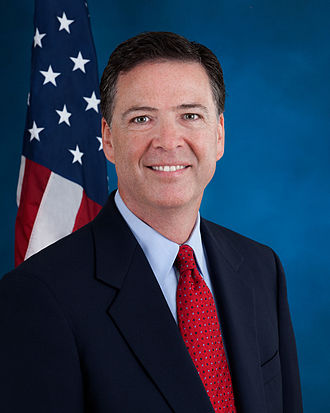
Hillary's New Emails: A Solution for FBI Director Comey

Related: Richard W. Painter, "On Clinton Emails, Did the F.B.I. Director Abuse His Power?" New York Times, October 30, 2016 (possible violation of Hatch Act; author: University of Minnesota law professor, and former chief White House ethics lawyer, 2005 to 2007); Matt Apuzzo, Michael S. Schmidt and Adam Goldman, "Justice Department Obtains Warrant to Review Clinton Aide's Emails," New York Times, October 31, 2016, p. A1 (background); Editorial, "Can Anyone Control the FBI?" The Washington Post, November 5, 2016 ("In the days since [FBI Director Comey's announcement of the 'discovery of additional emails in the investigation of Hillary Clinton’s private server'], the FBI’s behavior has grown even more questionable. FBI sources have fanned new doubts about Ms. Clinton’s candidacy with inaccurate leaks about an investigation of the Clinton Foundation."); Ben Brody and Chris Strohm, "FBI Surprises With Files on Clinton ’01 Pardon of Marc Rich," Bloomberg, November 1, 2016 ("The FBI unexpectedly released 129 pages of documents related to an investigation closed without charges in 2005 into President Bill Clinton’s pardon of Marc Rich, who had been married to a wealthy Democratic donor. The file was posted online Monday but received little attention until the FBI noted it in a tweet on Tuesday afternoon. It comes as Director James Comey faces fire from Democrats and even some Republicans for releasing information about his renewed investigation into Hillary Clinton’s use of e-mail."); Matt Apuzzo, Michael S. Schmidt and Adam Goldman, "Emails Warrant No New Action Against Hillary Clinton, F.B.I. Director Says," New York Times, November 7, 2016, p. A1.

F.B.I. agents are all but certain that it [their review of newly-found Huma Abedin-Hillary Clinton emails] will not be completed by Election Day, and believe it will take at least several weeks."

Michael S. Schmidt and Matt Apuzzo, "10 Questions (and Answers) About New Email Trove," The New York Times, October 31, 2016, p. A15.
FBI Director James B. Comey has created a bit of a mess.

Here's how he might get out of it.

The FBI's investigation of Hillary Clinton's treatment of classified emails as Secretary of State was wrapped up in July. Comey announced that while her procedures were "extremely careless," she had neither the requisite criminal intention, nor was there any other reason, to proceed with her prosecution.

One of Hillary's closest aides, Huma Abedin, was married to Congressman Anthony Weiner. Weiner, formerly infamous for sending women lewd pictures of himself, is now being investigated by the FBI for doing so with a 15 year old girl. As a product of that investigation, it appears that in addition to whatever else he may have had on his computer, there were some of Huma Abedin's emails -- possibly including email exchanges between her and Hillary Clinton.

Department of Justice practice is to not reveal details of ongoing criminal investigations, and not to make announcements that might affect the outcome of a political campaign within 60 days of Election Day. Comey, having made a commitment to members of Congress to keep them informed of developments regarding Clinton's classified emails, informed them -- 11 days before the presidential Election Day -- of the possibility there might be more emails as a result of the Weiner investigation. Apparently Weiner's computer, containing some 600,000 emails, had been sometimes shared with his wife.

At the time, Comey's FBI didn't even have a search warrant authorizing their access to Huma Abedin's emails. (Now they have one.) Apparently he had not even seen any of the relevant emails, let alone made a judgment about what problems they did, or did not, raise.

Given the role throughout the 2015-16 presidential campaign of what Senator Bernie Sanders once famously described as "Hillary's damned emails," it could have been predicted that Comey's rekindling this fire, raising suspicions without a soupçon of facts, would have the impact on the election's outcome that is already showing up. Talk about an "October surprise!"

What's worse, as the opening quote reports, the FBI is saying it's unlikely there will be any facts prior to Election Day.

So what's to be done? Don't insist, for now, that the excellent must be permitted to be the enemy of the good.

1. Do a quick search of the emails. Microsoft Outlook, and most other email programs, have a search feature. It's something I often use, and it's incredibly fast. If Google can search through billions of documents in less than a second, there's no reason why searching through 600,000 emails should take "several weeks."

2. How do Hillary and Abedin refer to each other in emails -- first name, full name, initials, title, code names? Do they always do so? Pull out every email that contains those identifiers -- whether in the text, to, from, or subject fields.

3. Then search those emails for words that might identify a classified email -- secret, top secret, confidential, C, eyes only, classified. Compare those with the classified emails of Secretary Clinton that the FBI has already investigated and remove the duplicates.

4. Print out and divide the remainder, if any, among however many FBI agents are necessary to get those emails read and evaluated within 24 hours (preferably agents formerly involved in the investigation of the Secretary's emails).

5. If nothing is discovered that significantly adds or subtracts from what was known in July, have Director Comey issue a statement something like the following:
I apologize to the American public, the Congress, and the presidential campaigns for any confusion that I may have created by my recent report to Congressional leaders regarding what we thought might be additional emails relevant to our previous investigation of former Secretary of State Clinton. My prior commitments to Congress required that I make some report as soon as I became aware of this development. It was certainly not my intention, nor that of the Bureau, to affect the election in any way.

In that spirit, I wish to announce that our preliminary evaluation of the newly discovered emails, some of which were duplicates, indicates that they will add nothing new to what we knew in July.

While we will continue to evaluate them more closely, I wanted to make clear that at this time it does not appear that we will be altering the advice we provided the Department of Justice at that time.
Of course, from the Clinton campaign's perspective this risks that disclosing what the initial search reveals might be much more damaging than what's now in the media -- and Trump's speeches.

And then there's always Comey's option to simply resign -- either explaining, or not, whatever pressures may have been applied to him that caused him to do this.

# # #

This essay was published by OpEdNews on November 1, 2016. It stimulated the following exchange of comments on that site:

Comment by Rob Kall: Good ideas, all of them, including Comey resigning.

Submitted on Tuesday, Nov 1, 2016 at 12:33:53 AM

Reply to Rob Kall: Email Reply from Nicholas Johnson: Thanks, Rob; appreciate it.

There's an old saying: "Get a reputation as an early riser and you can sleep all day."

I think that may have played a role in what I wrote: his reputation for courage in standing up to the surveillance community (his rush to Ashcroft's hospital bedside; although he also asked Apple for a back door), his quality education and law school teaching, his range of experience -- up to and including essentially running the Department of Justice as Deputy Attorney General. I, like so many others, was willing to give him the benefit of the doubt regarding his decision to violate two policies of the Justice Department (don't talk about ongoing investigations; don't do anything that might impact an election within 60 days of Election Day) -- "there must have been a good reason for him to do that."

Now I'm not so sure. I don't have enough facts at this point to come to a final judgment about any of this. But sadly, this "morning after the night before," I at least have to hold in suspension the possibility that, whether pushed into it by others or coming to it all on his own, at least a part of his motivation was to contribute to a diminishing of Clinton's margin of victory, or her defeat.

Meanwhile, and however that comes out, I do still think the earlier the FBI can follow the quick steps I outlined in the op ed the better.

Submitted on Tuesday, Nov 1, 2016 at 7:40:04 AM

Comment by Nicholas Johnson: With regard to Director Comey's possible resignation: this is, of course, a wholly separate issue. The more urgent matter is what can be done to minimize the harm he may have done to a presidential election. His departure would do virtually nothing to address that concern.

However, here are some brief notes on this "separate issue." FBI Directors are now appointed for ten-year terms. Appointed in 2003, Comey's term won't expire until 2023. He can, of course, resign at any time. And the ten-year terms are not, in effect, "ten years of a life appointment." FBI Directors can be, and have been, fired by presidents. President Obama has, so far, continued to express confidence in Director Comey.

Submitted on Tuesday, Nov 1, 2016 at 10:14:17 AM

Shad Williams Reply to Nicholas Johnson: Did not know that about the 10 year term. I will need to look up what is the term limit of the CIA director?

Submitted on Tuesday, Nov 1, 2016 at 12:10:16 PM

Reply to Shad Williams Email Reply from Nicholas Johnson: Shad: Thanks for the comment. To the best of my recollection the CIA Director is, like most other presidential appointees, someone who serves, as we say, "at the pleasure of the president." Otherwise put, she or he can be fired at any time. Indeed, some administrations have had the practice of getting a "resignation" from everyone they appoint -- that is, an undated letter of resignation to the president that can be dated and then used at any time.

Submitted on Tuesday, Nov 1, 2016 at 3:20:14 PM

Comment by BFalcon: Correct me if I am wrong.

Comey did not disclose anything about the investigation to public.

He wrote the letter to Congressional Committee as addendum to his testimony which, I presume, was his obligation.

Do you believe, if the search that you suggested finds something that could be relevant and incriminating, that they should, two or three days before elections, state that to public?

Submitted on Tuesday, Nov 1, 2016 at 11:57:35 PM

Reply to BFalcon Email Reply from Nicholas Johnson: Correct me if I am wrong.

Response: Thank you, BFalcon, for this provocative comment.

Comey did not disclose anything about the investigation to public.

Response: He disclosed a great deal about the investigation -- which has had an effect, whether intended or not, on voters' preferences. You are of course correct that he did not disclose anything about the results of the investigation, because according to him it not only had not ended it had not even begun until they got the necessary search warrant. He did not need to reveal the results of a yet-to-be-begun investigation. All he needed to do to impact Hillary's chances was to say that there was one, that in effect the investigation closed in July was reopened 11 days before the election.

He wrote the letter to Congressional Committee as addendum to his testimony which, I presume, was his obligation.

Response: He tried to suggest that he, as well as you, presumed that was his obligation. Obviously, since I am not privy to his communications with the Republican Congressional leadership, I cannot know what his "obligation" was. Some have said it is inappropriate to include members of Congress in the details of an ongoing investigation. Be that as it may, it would seem sufficient to me to both satisfy any obligation he might have while also complying with both Department of Justice procedures: no comments about ongoing investigations, and no comments within 60 days of an election that might affect its outcome. Any yet-to-be-discovered revelations that might or might not come out of Weiner's computer would not need to be reported until there is something to report; certainly, the fact the FBI was going to look there to see if there was anything worth pursuing is not of sufficient importance to warrant violating Department of Justice standards. The only thing the early statement accomplished was to raise suspicions and innuendo regarding a presidential candidate.

Do you believe, if the search that you suggested finds something that could be relevant and incriminating, that they should, two or three days before elections, state that to public?

Response: That is the result of what I am proposing. Comey should never have made the statement he did. Having done so he can't take it back. The damage has been done. Both campaigns and other leaders of both parties have urged that more facts be revealed. Hillary's insistence this be done suggests to me that she thinks there's little to nothing there. If it turns out there is a smoking gun, or arsenal, there then -- having gone this far -- the members of Congress he wrote, and the public, are probably entitled to know that before the election, rather than having to go into the voting booth with nothing but suspicions.

Submitted on Wednesday, Nov 2, 2016 at 2:20:02 PM

BFalcon Reply to Nicholas Johnson: Again, I am not sure from what you say that Comey disclosed anything to the public, did he?

If somebody is charged with investigation of a bunch of mail and testifies under oath that all the mail was investigated, it is my opinion that the person, when he learns that there is some more mail to be completed, should amend the testimony simply disclosing this fact.

I disagree with you that revealing e.g. that "there is possibly incriminating information" just before the elections would be right. The voters should make their choice without further "information" (necessarily incomplete and not final).

Submitted on Wednesday, Nov 2, 2016 at 8:50:07 PM

Reply to BFalcon Email Reply from Nicholas Johnson: BFalcon: Thanks for the follow-up. I disagree with you only in the sense that I have come to different conclusions -- as expressed in an earlier comment.

I do not disagree in the sense that I think you are "wrong." I think yours are rational, easily supported -- and, indeed, widely shared (including by Comey and Republican congressional leaders) -- conclusions (regarding both what Comey was "obliged" to do in the past, and in the future with pre-Election Day discoveries). -- Nick

Submitted on Thursday, Nov 3, 2016 at 10:20:02 AM

Comment by Nicholas Johnson: I am finding it increasingly difficult to suspend judgment regarding FBI Director Comey's and some agents' deliberate efforts to adversely affect Clinton's chances in next Tuesday's election. See this morning's Washington Post: Editorial, "Can Anyone Control the FBI?" The Washington Post, November 5, 2016 ("In the days since [FBI Director Comey's announcement of the 'discovery of additional emails in the investigation of Hillary Clinton's private server'], the FBI's behavior has grown even more questionable. FBI sources have fanned new doubts about Ms. Clinton's candidacy with inaccurate leaks about an investigation of the Clinton Foundation."), and Ben Brody and Chris Strohm, "FBI Surprises With Files on Clinton '01 Pardon of Marc Rich," Bloomberg, November 1, 2016 ("The FBI unexpectedly released 129 pages of documents related to an investigation closed without charges in 2005 into President Bill Clinton's pardon of Marc Rich, who had been married to a wealthy Democratic donor. The file was posted online Monday but received little attention until the FBI noted it in a tweet on Tuesday afternoon. It comes as Director James Comey faces fire from Democrats and even some Republicans for releasing information about his renewed investigation into Hillary Clinton's use of e-mail.")

Submitted on Saturday, Nov 5, 2016 at 11:07:57 AM

Comment by Nicholas Johnson: I suffer no illusions that there is anyone in Washington, let alone the Director of the FBI, who would know or care what I am thinking and writing about, or would be influenced by it if they did know. But it's always somewhat satisfying, after writing a proposed course of action, that others -- with more knowledge of the situation than I possess -- subsequently come to the same, or similar conclusions. So it is with my OpEdNews piece, above. In this case, what I proposed (Comey shouldn't have opened the issue, but having done so should now put all the agents necessary to going through the additional emails before election day, and then announce the results) is apparently what was done. (It is, however, not clear whether or not they used the specific steps I suggested for speeding the process, though it's reasonable to assume they did.) See Matt Apuzzo, Michael S. Schmidt and Adam Goldman, "Emails Warrant No New Action Against Hillary Clinton, F.B.I. Director Says," New York Times, November 7, 2016, p. A1.

Submitted on Monday, Nov 7, 2016 at 4:16:54 PM

# # #

Sunday, October 02, 2016

Law, Social Norms and Trump

"That's not nice. Next"

When I was a very young boy, and my mother was making a meal, or otherwise engaged, I'm told she'd turn to anyone handy and say, "Go find Nicky; see what he is doing and tell him to stop it."

That's how more and more traditional Republicans -- and Americans generally -- are coming to feel about Donald Trump.

The week of September 25 was a good example, from his ignoring advice on how to minimize self-inflicted harm during the Monday night debate with Hillary Clinton to his pre-dawn Twitter tirade Friday attacking Alicia Machado (the former Miss Universe).

"There ought to be a law," you say. But there's not.

Abraham Maslow may not have realized it, but he said something relevant to first-year law students when he observed, "I suppose it is tempting, if the only tool you have is a hammer, to treat everything as if it were a nail." Many of those law students are too quickly tempted to start thinking of all human behavior as a product of legal rights and responsibilities.

There are a number of Trump's controversies that may have legal significance. David A. Graham has listed 19 in a recent Atlantic article: The Beauty Pageant Scandals, Racial Housing Discrimination, Mafia Ties, Trump University, Tenant Intimidation, The Four Bankruptcies, The Undocumented Polish Workers, Alleged Marital Rape, Breaking Casino Rules, Antitrust Violations, Condo Hotel Shenanigans, Corey Lewandowski [former campaign manager], Suing Journalist Tim O'Brien for Libel, Refusing to Pay Workers and Contractors, Trump Institute, Buying Up His Own Books, Undocumented Models, The Trump Foundation, and The Cuban Embargo. (For each he provides "where and when," "the dirt," "the upshot," and "read more.") David A. Graham, "The Many Scandals of Donald Trump: A Cheat Sheet," The Atlantic, September 30, 2016.

But like the law students, we would be wrong to assume our only means of corralling the wild Trump involves courts, judges and lawyers.

Whether we are conscious of it or not, most of what regulates our behavior, to the extent anything does, is not the law as such, but rather social norms: what we eat and how we eat it; the distance we maintain when standing and talking to another; the clothes we do (or don't) wear for various locations, occasions and situations; the verbal and body language we employ when talking to contemporaries or supervisors. Most social norms are unwritten and evolve over time. Some come from our parents, our friends and neighbors in a small community, a religious organization, or our fellow workers at a university or business.

Just as there are penalties for violating the law, so too are there penalties for violating social norms -- including what the community may consider inappropriate speech. (See, Nicholas Johnson, "Was It Something I Said? General Semantics, the Outspoken Seven, and the Unacceptable Remark," October 30, 2010.) Is this a possible course for those concerned about Trump's hateful outbursts? It just may be.

In the summer of 1969, when the Los Angeles creative community -- actors, writers, directors, producers -- became concerned about what some of them thought of as "censorship" of their work by the networks, the FCC eventually agreed to hold a hearing on the matter. The witnesses who appeared were mostly white, male, network lawyers and lobbyists in suits.

The last one to appear was decidedly not a member of that club. It was my friend, Emmy and Grammy winner Mason Williams, head writer for the "Smothers Brothers Comedy Hour," a highly-rated CBS variety program with social and political content. Given the 1960s, Tom and Dick Smothers had generated both a large, loyal following of fans, and significant levels of network executives' anxiety -- anxiety that took the form of New York executives' close review and removal of some portions of the scripts created in LA.

Mason arrived with open shirt and beads, carrying a guitar, and copies for the FCC commissioners of what he called "The Mason Williams FCC Rapport," July 23, 1969. As he played and sang his way through his testimony he read from his "Rapport" some of the brain-bursts he'd entered in his journals (e.g., "Network television wants to keep you stupid so you'll watch it;" "Winning an Emmy from television is like getting a kiss from someone with bad breath"). [Photo credit: Wikipedia, public domain, Ken Kragen & Friends; Mason Williams, 1969.]

One of those brain-bursts, relevant to Donald Trump's speech, posited that someone had leveled an offensive and possibly erroneous charge against the President. (I won't repeat the offensive speech here. It can be found at page 66 of the "Rapport.") Rather than a network censoring the remark, Williams said:
Someday I hope that someone could appear on television and say [the offensive speech] and the public would individually be able to say, "That's not right. And that's not a nice thing to say. Next."
In other words, rather than have the FCC and networks censor creative content speech that violates social norms could be uttered, because society would have evolved to the point that we would simply reject it -- "that's not a nice thing to say" -- and either change channels, or go on to the next item, with the command, "Next."

Have we reached that point? Hardly. Indeed, many are concerned, as I am, that Trump's approach to political campaigning may be seen as a new normal by both the young and those with sufficient celebrity status to consider running for office themselves with a Trump-like campaign.

But there are hopeful signs that social norms regarding speech are beginning to join the other objections to Trump's candidacy -- his lack of political and governing experience, the character of his staff choices (some of whom had to be replaced), his policy proposals (e.g., building the wall, deporting 11 million, use of nuclear weapons), his untruthful utterances, his refusal to reveal his tax returns, and the 19 items involving his business practices noted above.

One source of those signs is what some solidly Republican newspapers have been writing in the course of not endorsing him:

The Dallas Morning News, which has never endorsed a Democratic Party presidential candidate since 1940, wrote: "We reject the politics of personal destruction. . . . He [Trump] plays on fear — exploiting base instincts of xenophobia, racism and misogyny — to bring out the worst in all of us, rather than the best." Editorial, "We Recommend Hillary Clinton for President," The Dallas Morning News, September 7, 2016.

A couple weeks later the Cincinnati Enquirer, which had never endorsed a Democratic Party presidential candidate since 1916, joined the Dallas Morning News with its endorsement of Hillary: "We've condemned his childish insults; offensive remarks to women, Hispanics and African-Americans; and the way he has played on many Americans' fears and prejudices to further himself politically. . . . Trump tears our country and many of its people down with his words so that he can build himself up. Trump has toned down his divisive rhetoric, . . .. But going two weeks without saying something misogynistic, racist or xenophobic is hardly a qualification for the most important job in the world. Why should anyone believe that a Trump presidency would look markedly different from his offensive, erratic, stance-shifting presidential campaign?" Editorial, "It Has to be Hillary Clinton," Cincinnati Enquirer, September 23, 2016

More would come in rapid order. The Arizona Republic, which has never endorsed a Democratic Party presidential candidate since it began publication in 1890 (as The Arizona Republican), wrote: "Trump mocked a reporter’s physical handicap. Picked a fight with a Gold Star family. Insulted POWs. Suggested a Latino judge can’t be fair because of his heritage. Proposed banning Muslim immigration. Each of those comments show a stunning lack of human decency, empathy and respect. Taken together they reveal a candidate who doesn’t grasp our national ideals. . . . She [Hillary Clinton] can move us beyond rancor and incivility." Editorial, "Endorsement: Hillary Clinton is the Only Choice to Move America Ahead," The Arizona Republic, September 27, 2016.

Here's what The Detroit News had to say: "[Donald Trump] rubs hard against the editorial board’s values as conservatives and Americans. [He] is unprincipled, unstable and quite possibly dangerous. .... Trump has attracted support from too many of those who represent the worst of human nature .... Few groups have been spared from his bile. . . . But the most worrisome thing about Trump is that he is willing to stir the populace by stoking their fears of sinister forces at work from within and without to tear down their traditions, values and families .... His sort of populism has led to some of history's great tragedies." The News, which has only endorsed Republican Party presidential candidates since it began publication in 1873, rather than endorsing Hillary Clinton, instead chose to skip Trump for Gary Johnson, the Libertarian Party candidate. Editorial, "Libertarian Gary Johnson for President," The Detroit News, September 29, 2016.

The next day the Chicago Tribune followed the Detroit News' example with its endorsement of Gary Johnson. This was only the third time in the last 169 years that it had endorsed any presidential candidate who was not a Republican (the two prior were both Chicagoan Barack Obama in 2008 and 2012). Its editorial said: "Trump has gone out of his way to anger world leaders, giant swaths of the American public, and people of other lands who aspire to immigrate here legally. He has neither the character nor the prudent disposition for the job." Editorial, "A Principled Option for U.S. President: Endorsing Gary Johnson, Libertarian," Chicago Tribune, September 30, 2016.

Finally, USA Today, one of America's national newspapers, took a different approach -- urging voters to not vote for Trump, while not endorsing any of the other three (Clinton, Johnson, or Stein). (Its editorial board only expresses consensus, and there was no consensus for an alternative.) This is the first time in the paper's 34-year history that it has expressed an editorial opinion for or against a candidate in any presidential election.

The Board wrote: "Trump has demonstrated repeatedly that he lacks the temperament, knowledge, steadiness and honesty that America needs from its presidents. . . . From the very beginning, Trump has built his campaign on appeals to bigotry and xenophobia, whipping up resentment against Mexicans, Muslims and migrants. His proposals for mass deportations and religious tests are unworkable and contrary to America’s ideals. . . . He speaks recklessly. . . . He has coarsened the national dialogue. Did you ever imagine that a presidential candidate would discuss the size of his genitalia during a nationally televised Republican debate? Neither did we. Did you ever imagine a presidential candidate, one who avoided service in the military, would criticize Gold Star parents who lost a son in Iraq? Neither did we. Did you ever imagine you’d see a presidential candidate mock a disabled reporter? Neither did we." Editorial, "Trump is 'Unfit for the Presidency,'"> USA Today, September 30, 2016. And see generally, Tim Dickinson, "5 Conservative Newspapers That Just Went 'Never Trump;' Why Papers That Have Backed Republicans for Decades Broke Ranks With This GOP Nominee," Rolling Stone, September 29, 2016.

(The USA Today editorial is also one of the most thorough in discussing the range of reasons not to vote for Trump, with the following headings: He is erratic; He is ill-equipped to be commander in chief; He traffics in prejudice; His business career is checkered; He isn't leveling with the American people; He speaks recklessly; He has coarsened the national dialogue; He's a serial liar.)

It is significant enough that solid, conservative newspapers that have never lifted a figment of type to help a Democratic presidential candidate, or oppose a Republican, are now opposing Trump -- and sometimes even endorsing Hillary Clinton. And most, like USA Today, have identified and enumerated categories of reasons why he is unacceptable.

But what I find most heartening is the growing formulation of a set of social norms, or political norms, regarding what is, and is not, acceptable speech in presidential campaigns. If this continues, it may just save us from future political candidates assuming Trump-style campaigns are the new normal.

Here's what you and I can do:

Next time you see Trump on TV, listen to what he says, and if you find it unacceptable, say so. Say to whomever is with you -- or out loud even if you are alone -- "That's not right. And that's not a nice thing to say. Next."

# # #

Sunday, September 25, 2016

Donald Trump's Barrel of Squirrels

How Does The Donald Do It?
Why do you watch sports on television? It's the only thing that happens on television. It actually occurs; that's why you can't stop watching it. Trump occurs. That's why we can't take our eyes off him.

-- Ron Suskind, on Chris Lydon's "Radio Open Source," September 8, 2016
In 1939, Robert Hutchins, boy wonder president of the University of Chicago, abolished its football program. I once asked another president of a major American university if he believed a semi-pro athletic program was a good fit inside "the academy," and how it could be justified. He replied, "I've always just considered it an anomaly."

Is that how we should think about a Donald Trump inside the American political system? As an anomaly?

Of course, part of the answer lies with his squirrels. But it's so much more.

For starters, there are solid, conventional explanations for what we have been doing to our politics ever since the Democratic Party joined the Republicans in ignoring the plight of the poor, working poor, beating back the unions that once enabled the working class to create a middle class, and then relying on the 1% to pay the party's bills.
Both parties failed to listen, and thus did not hear, the mounting public despair, disgust, and distrust that the parties created, and had by this year risen well above flood stage to rage. The Democratic Party's leadership refused to budge, even as primary and poll results revealed the state of the union was a demand for change, for representation, and a rejection of the establishment.

The Democrats offered a disaffected public their party's most quintessential establishment candidate, Hillary Clinton, with her 1950's-style campaign, and the second highest negatives of any presidential candidate ever. They had to have seen her struggle trying to best two of the nation's most unlikely presidential candidates -- Donald Trump and Bernie Sanders.

Bernie Sanders showed the Democrats what they had to do to win, how to generate not just numbers of voters but enthusiastic voters, how to attract new members from independents and first-time voters, and how to crowd-fund a presidential campaign with $27 contributions rather than billionaires. Not only did they not support him, or learn from him, or even thank him, they affirmatively fought him at every turn.

Then, of course, there's Hillary's familiar 30 years of baggage.
But there is much more to Trump's success and style than can be understood with conventional analyses of the Democratic Party's failures. [Photo credit: Wikipedia]

Who is this guy? What is he doing? Why is he doing it? How come so many Americans are supporting him? Are there any explanations?

In fact, there are an increasing number of theories as to how Donald Trump seems to have single-handedly bent what was once the American democratic process to his own ends.

One of my earlier theories emerged during conservative Hugh Hewitt's interview with Trump:
Hugh Hewitt (HH): You said the President was the founder of ISIS. I know what you meant. You meant that he created the vacuum, he lost the peace.

Donald Trump (DT): No, I meant he's the founder of ISIS.

. . .

HH: I think I would say . . . they created the vacuum into which ISIS came, but they didn't create ISIS. That's what I would say. . . . I'd just use different language to communicate it.

DT: But they wouldn't talk about your language, and they do talk about my language, right?

HH: Well, good point.
See, e.g., "Trump Might Not Be Blundering in Race," September 9, 2016; and "Understanding Trump," OpEdNews, August 29, 2016.

In other words, Trump's serious, presidential campaign strategy -- or perhaps just his personal, narcissistic goal -- may simply be to ensure he remains a visible ingredient in the media's ever-bubbling pot. There are very few ways for even America's most highly paid, skilled publicists to accomplish that. Trump has found, and seems to be comfortable with one of them: an outpouring of shocking assertions in colorful language, even if it often requires that he roam well outside the ample tent of truth.

Recently, Pulitzer Prize-winning journalist Ron Suskind provided a thoughtful expansion on my mere modest hunch, in an interview with one of America's brightest and most thoughtful talk show hosts: Chris Lydon, on WBUR's "Open Source." “Election 2016: Unreality T.V.,” September 8, 2016.

As Suskind explained,
"He [Trump] understands that the reality-based community is now being replaced by reality show values. And he knows how those work.

Here are some of the principles. Try to make sure it happens on the screen. Try to evolve, or devolve; just keep moving. Make sure their eyes are always on you. Make sure, even if what you say is nonsensical, and you flip back later and say 'I lied,' or 'I was wrong,' that they can't take their eyes off of you. . . .

Why do you watch sports on television? It's the only thing that happens on television. It actually occurs; that's why you can't stop watching it. Trump occurs. That's why we can't take our eyes off him.

And he understands that that's power. He flip flops four times in a day. Did he say it? Did he not say it? Is he taking it back? There's four different news stories between the morning and the night.

Hillary Clinton, what did she do that day? Was she even working?

He's got another day when you're only thinking about what Trump thinks, feels, or is going to say next. And because he occurs, actually happens in front of your eyes, you can't stop watching."
And a part of what you're watching are his almost constantly changing facial expressions -- a practiced skill of those who spend much time before a camera.

It's also possible, of course, that Trump was introduced at Wharton, and has long been, a student of Niccolò Machiavelli's 16th Century guidebook for tyrants, The Prince (1513) (Wikipedia: "Machiavelli described immoral behavior, such as dishonesty and killing innocents, as being normal and effective in politics."), or other literature by and about more recent dictators.

Suskind's point could be made, or expanded, to include the concept of "narrative," or "story;" or perhaps the distinction between appeals to emotion and appeals to intellect, which President Reagan so well understood. But Trump doesn't just "tell stories" -- Trump is the story, an ongoing story, like a soap opera, or episodic television series.

We love stories -- from Greek and Norse mythology, to Bible stories, to modern day comic book, film and television heroes. Whether consciously or unconsciously, Donald Trump may be playing, and Americans may be seeing him as, the World War II patriotic super-soldier and national savior, Captain America.

The childhood lessons from Aesop's Fables to The Little Engine That Could stick with us, and may be played out by us even as unaware adults. (The National Education Association once named the book one of its "Teachers' Top 100 Books for Children.")

Yes, give Americans a choice between a feature film or TV show of their liking and a serious and significant lecture (or political speech) and most will prefer the movie or TV show. Even on the rare occasions when serious subjects make it into the newspapers or onto our TV screens, many journalists (and politicians) will lead with the personal details of a single individual's experiences, their story.

Hillary's political speeches, and serious policy proposals, are now trying to compete with Trump's entertainment, and story.

It's not easy to get the kind of crowd for a political speech that is attracted to a rock concert, or whomever happens to be the most popular stand-up comic of the year. Frank Mankiewicz, campaign director for Senator George McGovern's 1972 presidential campaign, frustrated with the lack of media coverage, once made the point by saying he wanted to hire a campaign arsonist. The arsonist's job would be to set a fire in the early afternoon, wait for the TV trucks to arrive, cue McGovern to begin his speech, and hope that at least 30 seconds of it might make the evening news programs along with pictures of the fire.

As Suskind points out, Trump is doing the equivalent of setting four fires a day without ever striking a match.

Mark Hannah headlines that Trump is, in fact, a novelist, and that the presidential election is less about political choices than choices between fantasy and reality. He says of Trump's resistance to "inconvenient facts":
"We saw this resistance . . . when Trump denied that his campaign manager manhandled a reporter when video footage indicated otherwise. . . . [W]hen he claimed that the 'Obama administration was actively supporting Al Qaeda in Iraq,' that Ted Cruz's father 'was with Lee Harvey Oswald' before President Kennedy was assassinated and that 'crime is rising' in America. It's gotten to the point where those checking the facts are simply throwing their hands up in exasperation . . .. The contest between Donald Trump and Hillary Clinton isn't so much a contest of conservatism versus liberalism, isolationism versus internationalism, outsider versus insider, or incivility versus tact. it's a contest of the fantasy of one man versus the reality of the rest of us."
Mark Hannah, "Donald Trump, Our Great American Novelist," TIME, June 30, 2016.

Of course, while Trump's offensive and degrading remarks about women, African Americans, Latinos, Muslims, Gold Star mothers, prisoners of war, and people with disabilities, among others, can make news, they can also make enemies. If a candidate is serious about getting elected, how can that be handled? Charles Krauthammer has a theory that fits with Suskind's. As Krauthammer notes about the extraordinarily competent Kellyanne Conway:
"[Trump campaign manager] Kellyanne Conway has worked . . . on the theory that if [Trump] can just cross the threshold of acceptability, he wins. . . . Can you really repackage the boasting, bullying, bombastic, insulting, insensitive Trump into a mellow and caring version? . . . Turns out, yes. How? Deflect and deny -- and pretend it never happened. Where are they now -- the birtherism, the deportation force, the scorn for teleprompters, the mocking of candidates who take outside money? Down the memory hole. . . . In this surreal election season, there is no past. . . . [Trump] merely creates new Trumps."
Charles Krauthammer, "Clinton Sharpens, Trump Softens. He's Rising, She's Falling," The Washington Post, September 15, 2016.

Garrison Keillor, in what amounts to an open letter to Donald Trump, has a different take on what he's about. Keillor says to Trump: "The New York Times treats you like the village idiot. This is painful for a Queens boy trying to win respect . . .. Running for president is your last bid for the respect of Manhattan. . . . [Y]ou wish you could level with [your fans] for once and say one true thing: I love you to death and when this is over I will have nothing that I want." Garrison Keillor, "When This is Over, You Will Have Nothing That You Want," The Washington Post, August 9, 2016.

Trump probably doesn't see the possibility of a loss from his efforts. As he tells his African-American audiences, "What have you got to lose?" As he has bragged, “I could be the first presidential candidate to run and make money on it.” After all, 20 percent of his campaign expenditures are going to his own companies.

Donald Trump's name, his brand, which others pay handsomely to use, is perhaps his largest asset. This suggests another theory. What has he got to lose from a presidential race? Either he wins the presidency and puts his name on the White House, or he wins the lottery as he watches the value of his brand increase by millions if not billions of dollars.

Meanwhile, whenever he needs to change the subject, there's always that barrel of squirrels. [Photo credit: Edwin Kats/Rex Features, Daily Mail.]

Oh, look, there's one now.

# # #

Wednesday, August 10, 2016

When Words Can Kill

"Will no one rid me of the turbulent priest?"

-- King Henry II's casual reference to Archbishop of Canterbury Thomas Becket, following which four devoted knights were inspired to go to Canterbury, where they found and murdered Beckett, December 29, 1170

"Like the extreme right in Israel, many Republicans conveniently ignore the fact that words can kill. . . . [T]hey could use a short session with Yigal Amir, Yitzhak Rabin's assassin, who was inspired by the rabid rhetoric hurled at the Isrraeli prime minister . . .."

-- Chemi Shalev, Israel's Haaretz newspaper columnist, quoted in Thomas Friedman, "Trump's Wink Wink to 'Second Amendment People,'" New York Times, August 10, 2016, p. A19

"If she [Hillary Clinton] gets to pick her judges, nothing you can do, folks. Although the Second Amendment people -- maybe there is, I don't know."

-- Republican presidential candidate Donald Trump, Wilmington, North Carolina, August 9, 2016
_______________

This morning [August 10] the Times editorialized: "Three months from the presidential election . . . Americans find themselves asking whether Donald Trump has called for the assassination of Hillary Clinton. . . . His supporters have shouted 'kill her' . . . A New Hampshire delegate [said she should] 'be put in the firing line and shot for treason.'" Editorial, "Further Into the Muck With Mr. Trump," New York Times, August 10, 2016, p. A18. And see, Nick Corasaniti and Maggie Haberman, "Donald Trump Suggests 'Second Amendment People' Could Act Against Hillary Clinton," New York Times, August 10, 2016, p. A1.

Trump's opponents argue that Trump's remark -- "nothing you can do, folks. Although the Second Amendment people -- maybe there is, I don't know" -- was his intentional call for the assassination of Hillary Clinton.

His defenders say that's ridiculous; he was just saying that the Second Amendment supporters have proven to be well organized and politically effective, and that they might be able to bring enough political pressure to prevent a President Hillary Clinton from successfully nominating liberal judges.

In my view, both sides miss the point.

No one can know if, or what, Trump (or anyone else) is thinking when they speak. With Trump's often rambling and disjointed exposition it's often difficult to figure out what he has said after he has said it. And it is even more perilous to speculate about another's motive.

So the argument between those who believe Trump was advocating assassination of his opponent and those who think he was just urging citizen participation in the judicial selection process is one that cannot be, and will not be, resolved.

The point is that, based on what he said, that argument can (and did) take place.

That is to say, what he said was open to the interpretation, an interpretation by many, that he was calling for her to be shot -- an interpretation supported by the context.

Trump's now oft-quoted potential threat was preceded by the line, "Hillary wants to abolish, essentially abolish, the Second Amendment." Paul Barrett, "What Trump Gets Wrong About Clinton and the Second Amendment; Hint: everything," Bloomberg, August 10, 2016.

Put aside for the moment the facts that (a) none of the fact checkers who have researched this charge have been able to find a scintilla of evidence that Hillary Clinton has ever hinted of a desire to do away with the Second Amendment -- indeed, quite the opposite. She has said that she supports the Second Amendment. And (b), as the Constitution makes clear, constitutional amendments are not, like executive orders, something the president can simply "abolish" whenever she or he wants to.

In other words, his disjointed appeal -- "Although the Second Amendment people -- maybe there is, I don't know." -- came in the context of an attack on Hillary Clinton (however false its premise) regarding the constitutional amendment most near and dear to the hearts of America's gun owners.

In the past, I have often gone out of my way to defend those who were fired, or otherwise severely punished, for what sometimes seemed to be a single, relatively innocuous remark. See, e.g., Nicholas Johnson, "Was It Something I Said? General Semantics, the Outspoken Seven, and the Unacceptable Remark," Institute for General Semantics presentation, New York City, October 30, 2010.

Republican presidential candidate Donald Trump's remarks in Wilmington, North Carolina, yesterday were seriously dangerous. I would not, and do not, defend them. They forcefully bring into question not only his lack of fitness for office, but that of those other Republicans who continue to urge us to join with them in voting for him -- including Iowa's principal statewide-elected officials: Governor Branstad, and U.S. Senators Grassley and Ernst. Think about it.

# # #

Friday, July 29, 2016

The DNC Still Just Doesn't Get It

The Real Significance of DNC Emails
[A] man is not independent, and cannot afford views which might interfere with his bread and butter.

-- Mark Twain, "Corn-pone Opinions," (1901)

Update on polls: They vary, both over time and between pollsters. The only one that really matters, because it is definitive, is the one that counts voters' ballots on November 8, 2016. Meanwhile, here is what The New York Times "National Polling Average" reported on July 30, 2016: Hillary Clinton 42.6%, Donald Trump 42.1% -- in other words, a toss-up. Of the 5 polls averaged, among the 3 putting Clinton ahead they range from 43-42% to 40-35%; the two favoring Trump are 48-45% and 44-40%. Results for 11 swing states show Clinton leading in 9, by 0.2% (Ohio) and 1.3% (Florida) to 4.5% (Virginia) and 7.0% (Wisconsin). Trump leads in Georgia by 3.3% and Missouri by 8.2%. "2016 Election Polls; National Polling Average," New York Times, July 30, 2016.
_______________

Contents

The Convention

The Morning After

How the Democratic Party of 2016 Has Become the Republican Party of the 1940s and '50s

Why The DNC Still Just Doesn't Get It

The Growing Cancer of Campaign Finance

Why Sanders is Not Just a Candidate, and His Followers Are Not Just Campaign Supporters

Things Worth Losing an Election For

_______________

On Monday of this week [July 25] I wrote:
Today [Monday, July 25, 2016] before watching any of the Democratic National Convention, or reading any of the news reports coming from Philadelphia, I'm going to write about some of the reasons for my discouragement. Later this week, once the Convention is concluded, I plan to write on the same subject once again to see what impact the Convention has had on my thinking.
"Why Trump May Win," July 25, 2016. Now that the Convention is over, here are my thoughts.

The Convention

The Convention got off to a bit of a bumpy start. Senator Sanders' "Revolution" had been mollified earlier, somewhat, with a party platform incorporating most of Sanders' proposals. But the DNC's and party establishment's disdain remained, and was confirmed with the revelation of DNC emails confirming what Sanders had complained of from the beginning (e.g., the number and scheduling of debates to favor Secretary Clinton, joint fundraising by the DNC and Clinton campaign, and emailed discussions of how best to set back the efforts of Sanders' followers). See, Aaron Blake, "Here Are the Latest, Most Damaging Things in the DNC's Leaked Emails," Washington Post, July 25, 2016.

Monday morning DNC Chair Debbie Wasserman Schultz was booed so loudly by her own Florida delegation that, in an effort to minimize the booing in the full Convention hall, it was decided to relieve her of the normal DNC Chair role of opening and closing the Convention. Nonetheless, the Sanders' backers continued with booing every time Clinton's name was mentioned by a speaker.

Tuesday through Thursday, with Sanders' appeals to his followers, and full-throated support for the election of Secretary Clinton, the booing subsided somewhat and a rumored walk out Thursday evening did not occur -- although Sanders' flip left many of his followers with a sense of betrayal, and some in tears.

I won't review them all here, but I thought many of the speeches throughout the week were excellent and even moving (see, e.g., Philip Bump, "The Father of Muslim Soldier Killed in Action Just Delivered a Brutal Repudiation of Donald Trump," Washington Post, July 28, 2016). However, the media seem to have given Hillary Clinton's acceptance speech mixed reviews. The PBS panel, including David Brooks, seemed to think her speech text and delivery to be no better than just "acceptable." But even a couple New York Times' folks whose evaluation of the speech was a little snarky, had to acknowledge that their fact check of her assertions found them mostly 100% accurate. Michael D. Shear and Thomas Kaplan, "Fact-Checking Hillary Clinton's Acceptance Speech," New York Times (online), July 29, 2016.

If you haven't read her speech text I urge you to do so. "Hillary Clinton's DNC speech: Full Text," CNN Politics, updated July 29, 2016, 1:14 a.m. ET (with 59:22 video). Frankly, I liked it -- from the perspective of what she needed to say, and wanted to say, and did say.

No speech can erase her ties to Wall Street billionaires and refusal to share with us the texts of what she told them in $650,000 speeches, or her support of costly, unnecessary wars of choice that have diminished, rather than enhanced, our national security, or whatever else has produced negative opinions of her that are the second highest of all those who have ever been presidential candidates. (Trump's are the highest negatives.) But in the speech she embraced the Sanders' Revolution. ("Your cause is our cause. Our country needs your ideas, energy, and passion. That's the only way we can turn our progressive platform into real change for America. We wrote it together -- now let's go out there and make it happen together.") She provided a State-of-the-Union-style list of what she wanted to do as president, along with how she intended to pay for it. She made an effort to accommodate her advisers' urging that she try to make herself more human (with references to Chelsea and Bill Clinton, her mother and grandmother). I could go on with all the other bases she touched on her way to bringing it home. But you can come to your own judgment about that.

Only time, and continuous polling, will tell what impact it had.

As for general impressions of the Convention, I thought it was professionally well produced and for the most part smoothly executed -- a real contrast with the Republican Convention and Trump performances the prior week.

The Morning After

Because this morning [Friday, July 29, 2016], as I stretched, wiped the sleep seeds out of my eyes, and ground the coffee beans, I realized that we are now, at best, back where we were on Monday morning, July 18 -- before the Republican Convention.

She came into the Democratic Party Convention well behind Trump in the polls, nationally and in the states she must carry: Michigan, Ohio, Pennsylvania, and Florida, among others. Trump's performances in Iowa Thursday [July 28] afternoon and evening stole some of the media attention and poll bounce she otherwise would have received. He was back to calling her "Crooked Hillary." And Secretary Clinton had done herself, and the Democratic Party, no favors by going out of her way to honor the disgraced, and overtly anti-Sanders, former DNC Chair with the title of Honorary Chair of her campaign! At a minimum, this does nothing to refute the suspicion that she was complicit with Schultz's efforts to turn the DNC's resources to helping Clinton and defeating Sanders.

Her selection of Senator Tim Kaine as her vice president -- for all his virtues in that role for her -- only added to the disappointment among members of what the late Senator Paul Wellstone used to call "the Democratic wing of the Democratic Party" that the Party establishment was offering them just the same-old, same-old.

How the Democratic Party of 2016 Has Become the Republican Party of the 1940s and '50s

Yet Senator Kaine, perhaps inadvertently but clearly ill-advisedly, provided one of the most revealing assessments of his party during his acceptance speech when he said:
"Any party that would nominate Donald Trump for president has moved too far away from [the Republican] party of Lincoln. And I’ll tell you [disaffected Republicans], if any of you are looking for that party of Lincoln, we have got a home for you right here in the Democratic Party."
Will Drabold, "Read Tim Kaine’s Speech at the Democratic Convention," TIME, July 27, 2016

As I and others have earlier observed, the Democratic Party today (as distinguished from, say, the Democratic Party of Presidents Franklin Roosevelt, or Lyndon Johnson) most closely resembles the Republican Party of Presidents Eisenhower, Nixon, George H.W. Bush, and presidential candidate Nelson Rockefeller.

Alabama Governor George Wallace used to say, "There's not a dime's worth of difference" between the Democratic and Republican parties. That's not true. One has to evaluate the differences issue by issue. Then there is a dime's worth of difference, especially with regard to some social issues (e.g., abortion and gay marriage). But when it comes to capitulation to the demands of Wall Street, Big Pharma, Big Oil, large corporations, major donors generally, the NRA and other special interests, it is very difficult to make the case that those earning less that the median income (say, $50,000 a year) are better off with Democrats than Republicans.

Indeed, one of the most shameful and revealing bits of information in the DNC emails were the workings of the DNC in their relationships with major donors -- the provision of special perks and benefits, up to and including government jobs. Nicholas Confessore and Steve Eder, "In Hacked D.N.C. Emails, a Glimpse of How Big Money Works," New York Times, July 25, 2016, and Aaron Blake, "Here Are the Latest, Most Damaging Things in the DNC's Leaked Emails," Washington Post, July 25, 2016 (see "10) Flippant Chatter About Donors"). For an independent, professional, detailed and coherent report of a single event to explain this horrifying process, see Nicholas Confessore and Amy Chozick, "After Lying Low, Deep-Pocketed Clinton Donors Return to the Fore," New York Times, July 29, 2016, p. A1 (e.g., "While protesters marched in the streets and blocked traffic, Democratic donors congregated in a few reserved hotels and shuttled between private receptions with A-list elected officials. If the talk onstage at the Wells Fargo Center was about reducing inequality and breaking down barriers, Center City Philadelphia evoked the world as it still often is: a stratified society with privilege and access determined by wealth. . . . 'It’s business as usual,' said Libby Watson, who monitored lobbying events in Philadelphia on behalf of the Sunlight Foundation, a group devoted to government transparency.")

If one needs more illustration of the inequality created, and then ignored, by both major parties, one need look no further than the contrast between the Convention delegates' $600-a-night rooms (arranged by the DNC) with the 650-a-night homeless sleeping on the streets of Philadelphia while delegates ate, slept, partied, and met in comfort. ("[T]here are more than 500,000 homeless people in the United States. Out of all of them, 31 percent are living on the streets . . .. Philadelphia alone has more than 13,000 homeless people, both living on the streets and involved in programs and shelters. Approximately 650 homeless individuals sleep on the streets of Philadelphia on any given night." "South Philadelphia: Homeless People Are Struggling To Survive In The City," Philadelphia Neighborhoods, July 15, 2015.) Who spoke for them, let alone did anything?

Bluntly put, the Democratic Party has lost its soul, where access to power is gladly exchanged for access to money, and elected officials (not to mention DNC staff) spend up to half of every working day "dialing for dollars" rather than legislating.

Why The DNC Still Just Doesn't Get It

The afternoon of September 7, 2015, former Maryland Governor Martin O'Malley stopped by the Iowa City Federation of Labor's Annual Labor Day Picnic, held in the usual City Park Shelter #3. There were then five Democratic candidates in the race in addition to O'Malley: Lincoln Chafee, Hillary Clinton, Larry Lessig, Bernie Sanders, and Jim Webb. During my visit with Governor O'Malley he asked me who I was supporting. I explained that I was solidly behind Bernie Sanders, but that he, O'Malley, was my second choice. Given the field of competitors, rather than expressing disappointment he indicated that he was quite delighted to be my second choice.

And why was he my second choice? Because from among the conventional candidates he scored highest on my checklist: range of experience, accomplishments, values, and political/social skills; that is, both elect-ability and capacity to function as president. As it turned out, few primary and caucus-going Democrats seemed to share my assessment.

So why am I writing about Martin O'Malley in a race that narrowed to Clinton and Sanders and stayed on track at the Democratic National Convention to select Hillary Clinton?

Because I need an example of what I mean by a "conventional candidate" to explain the three examples of why it is I think "the DNC still just doesn't get it."

The DNC (and Party establishment) has failed to recognize and embrace what Sanders was offering them. And I don't mean his candidacy. They could be thankful for his gifts to them and still decide that, for whatever reasons, they believed someone else would make a better candidate. (Although given that most of the polls indicated he would run stronger against Trump than Clinton, elect-ability could not have been among the reasons.)

Why was what Sanders was offering of value to the Party?

Americans are increasingly unwilling to give their unwavering, lifetime loyalty and trust to major institutions, whether government, corporations (as employers or suppliers), or traditional organized religions.

Not surprisingly, they are also falling away from political party identification, which Gallup reports is now at all-time lows. Nearly a half of all voters (42%) now identify as "independents;" only 29% are still Democrats, and 26% say they are Republicans.

There are many ways to increase party identification and membership, but the long-term most efficient may be to focus on (1) the young (Robert Kennedy used to "campaign" among high school students too young to vote) and (2) that 42% who are independent. Senator Sanders was dramatically successful with both groups.

He walked away with the youth vote. "In the Democratic primaries and caucuses overall, Mr Sanders won 70% of the under-30 vote . . .." "Young v Old Votes for Bernie and Hillary in the 2016 Primaries," The Economist, April 27, 2016. And Nate Silver 538 has explained Sanders' attraction to independents:
Sanders does much better among independents than among Democrats. In New Hampshire, for instance, Sanders won Democrats by 4 percentage points while winning independents by nearly 50 percentage points, a split we’ve seen repeatedly since then. Some of Sanders’s strongest performances in primaries have come in places such as New Hampshire, Michigan and Wisconsin, states whose rules allow independents to vote in either primary. In fact, to date Sanders has compiled an unexpected record, performing very well in caucuses but having won just a single closed primary (Oklahoma’s). So why is Sanders doing so well among independents? It appears to be driven not by their ideology so much as their dislike of partisan politics.
Dan Hopkins, "Why Sanders Does Better With Independents; It's Not Because They're More Moderate Than Democrats," FiveThirtyEight.com, April 18, 2016.

The Growing Cancer of Campaign Finance

The number one political concern for overwhelming majorities of Americans is the corrupting influence of money. Even 80% of Republicans oppose the Citizens United v. FEC Supreme Court opinion. A New York Times/CBS poll revealed that 85% of Americans believe we need fundamental changes to our campaign finance system. Another found 72% preferred small-donor financing of campaigns as a solution. A Des Moines Register poll of Iowa's caucus-goers revealed that 91% of Republicans and 94% of Democrats were somewhere between "unsatisfied" and "mad as hell" about money in politics. Jeff Robinson, "There's Nothing Naive About Wanting To Change Our Broken System," Every Voice, January 20, 2016.

Needless to say, campaign finance is the elephant in the political living room when it comes to building party membership and winning elections -- even for those benefiting from the system who see no ethical or moral problems with a democracy choosing legislation based on the size of campaign contributions.

Indeed, as mentioned above, one of the most embarrassing revelations to come from the 20,000 DNC emails revealed by Wikileaks has to do with what they explain about how the DNC trades benefits, and even government jobs, for the biggest political contributions.

When challenged, most professional politicians come back with resigned explanations regarding the costs of electioneering, and how PACs and large donations from corporations and the top 1/10 of 1% are really just the only way they can pay for the process.

Well, Bernie Sanders has just shown them how he could run a very successful and well-funded campaign with roughly 8 million donors contributing an average of $27 to what became a $200 million campaign.

Trump may be despicable, but he has figured it out. So had Bernie Sanders. The DNC has not.

Americans are angry; only 24% believe the country is headed in the right direction. "Right Direction or Wrong Track; 24% Say U.S. Heading in Right Direction," Rasmussen Reports, July 25, 2016. Over 90% want a change in campaign finance. Young people are less interested in committing themselves to traditional, 20th Century political parties. The fastest growing American "political party" are independents.

Senator Sanders offered the DNC an example of how to cure their woes -- how to generate enthusiasm instead of disdain, how to appeal to the new, young voters and independents, and how to eliminate the crippling burden of multi-million-dollar fundraising from the wealthy. Like Swiss watchmakers ignoring the growing market for digital watches, or Kodak rejecting the opportunity to develop videotape and the Xerox process, the DNC turned its back on what Sanders was not only advocating, but demonstrating by example was possible.

Not only did the DNC ignore him, worse still it actively opposed his efforts. It bulled ahead with its 20th Century notion that the Democratic Party could win a national election all by itself, using nothing but what we called in Texas "yellow dog Democrats" (those who would vote a straight ticket for Democrats even if a candidate was a yellow dog). It assumed it could once more ignore the overwhelming public opposition to the way it finances its operations. It got behind a quintessentially establishment presidential candidate (and then vice president) who would enhance, rather than suppress, its ability to raise money. And it did everything in its power to prevent Sanders' success.

Why Sanders is Not Just a Candidate, and His Followers Are Not Just Campaign Supporters

All of which brings me back to Governor Martin O'Malley and Senator Bernie Sanders.

If you've noticed, as far as I know there has not been a peep out of Governor O'Malley, or any of his supporters, objecting to the candidacy of Hillary Clinton. By contrast, although most of the Sanders supporters say that if they are in a toss-up state they will hold their nose and vote for Clinton (though they are unlikely to contribute money or work in the campaign), they also say that if they are in a state that is overwhelmingly either pro-Trump or Clinton they will stay home, or vote Green or Libertarian.

Why are the Sanders supporters so upset? What's the difference between them and the O'Malley supporters?

Conventional political campaigns are kind of like a game. Indeed, the media is sometimes criticized for treating them like "a horse race" -- poll results, money raised, and crowd size. That doesn't mean they aren't hard fought, or that there aren't often bruised feelings that take a long time to heal. But the attitude among what we call "political people" is kind of like what I imagine the attitude among professional football players must be.

Pro football is rough and tumble. Games are hard fought. There are lots of injuries, and an occasional death, or lifetime consequences from too many concussions. At the end of a game there is a winner and a loser -- with financial rewards for the winner. But there are rules, and there will be another game next week, or next season. Players are traded from team to team. There is a kind of camaraderie among players, given their similar backgrounds, experiences and lives.

Politics is kind of like that. Going in, the candidates, staff and consultants know there will be winners and losers. There's a rough sense of the rules, and how the game will be played, and admiration for one's more skilled adversaries -- with whom one may work in the future. There is an understanding and acceptance of the role of big money in politics (as they say, "money is the mother's milk of politics"). No matter who wins they will probably have more in common with their opponent than differences -- like football players, due to their similar backgrounds, experiences and lives. Even if the election is stolen, there's a certain admiration for someone who can "steal it fair and square." It's a game played out within a closed system. You live to run another day.

Bernie Sanders "campaign" was not like that at all. He was, after all, not even a member of the Democratic Party (although he became one for purposes of the primaries). He was a Democratic Socialist. He had virtually no national name identification. He had virtually no money. He had no powerful, or wealthy, political friends, fans, or armies of followers. He did not agree with the golden rule of politics that "those who have the gold make the rules." He was, in every sense, an outsider, one of the least likely persons to be thought a serious presidential candidate. No, Bernie Sanders did not have a "campaign" to get himself nominated (though it had that appearance). He had a "revolution" in nearly every sense, and acknowledged it as much. (His continuing efforts now bear the name, "Our Revolution.")

He did not think campaigns should benefit, or be paid for by, the wealthy (later paid back on their "investment"). He thought they should include all demographic groups, including former non-voters, not just the older, regular voters. He believed that governments' primary responsibilities were to those without a voice, rather than those with the megaphones of modern media.

When Bernie Sanders did not win the nomination, when he was rebuffed and actively opposed by the DNC, it had almost no similarity to the significance of Governor O'Malley not getting the nomination. It was the defeat of a political revolution, the rebuff of an effort to democratize both the process and the public benefits that would flow from such changes. The closer analogy would be if those wishing to break from England in 1776 lost a vote, and those opposing the separation then asked them to please join in supporting their candidate for the Virginia House of Burgesses.

When Clinton seeks the support of Sanders' supporters (as distinguished from O'Malley supporters) she is not just asking them to switch from the candidate who lost to the candidate who won. It is as if Bill Maher was appealing to devout Catholics to abandon their faith and join in his campaign for president of an atheist organization. She is asking them to abandon their beliefs, their motives, what brought them into politics in the first place; she is asking them to suddenly switch from opposition to everything they hate about the present Democratic Party, and her, and work to perpetuate it.

Things Worth Losing an Election For

Then-Senator Joe Biden once told me, "Nick, there are some things worth losing an election for."

I don't know if he still believes that. I'd like to think he does. But if so, it would put him in a very small minority amongst today's professional politicians. Well over 90% of those in the U.S. House now have things so rigged that if they want to be reelected they will be. And they want to be reelected. There is, in the minds of many of them, no thing worth losing an election for. Like football coaches of old proclaimed, "winning is not the most important thing, winning is the only thing." Some are neither show horses nor work horses. They're not even sleeping in the barn. They spend their days raising money, and then paying back the donors at ratios of 1000-to-one to 2000-to-one. See, Nicholas Johnson, "Campaigns: You Pay $4 or $4000," Des Moines Register, July 21, 1996. For what? To keep their job. Because, they believe, "there's nothing worth losing an election for."

As I started this blog entry, it turns out that Mark Twain was right over 100 years ago when he observed, "[A] man is not independent, and cannot afford views which might interfere with his bread and butter."

# # #

Monday, July 25, 2016

Why Trump May Win

Discouraged By The Democratic Party's Self-Inflicted Wounds

And see, "The DNC Still Just Doesn't Get It," July 29, 2016.

Update July 25, 3:27 p.m. CT: Nate Silver 538 projects if election were held today [July 25] Trump would win by 54.5 to 45.5% for Hillary (percentages change over time).

Update on polls; July 30, 2016: They vary, both over time and between pollsters. The only one that really matters, because it is definitive, is the one that counts voters' ballots on November 8, 2016. Meanwhile, here is what The New York Times "National Polling Average" reported on July 30, 2016: Hillary Clinton 42.6%, Donald Trump 42.1% -- in other words, a toss-up. Of the 5 polls averaged, among the 3 putting Clinton ahead they range from 43-42% to 40-35%; the two favoring Trump are 48-45% and 44-40%. Results for 11 swing states show Clinton leading in 9, by 0.2% (Ohio) and 1.3% (Florida) to 4.5% (Virginia) and 7.0% (Wisconsin). Trump leads in Georgia by 3.3% and Missouri by 8.2%. "2016 Election Polls; National Polling Average," New York Times, July 30, 2016.
_______________

As a lifelong Democrat, I have for some years now been discouraged by the actions of the Democratic National Committee, and others who are considered members of the Party's establishment (many of whom are superdelegates). So discouraged that I'm going to undertake a two-part blog experiment.

Today [Monday, July 25, 2016] before watching any of the Democratic National Convention, or reading any of the news reports coming from Philadelphia, I'm going to write about some of the reasons for my discouragement. Later this week, once the Convention is concluded, I plan to write on the same subject once again to see what impact the Convention has had on my thinking.

It is not my purpose in this blog essay to deal with the personalities or qualifications of Hillary Clinton, Bernie Sanders, Debbie Wasserman Schultz, Donald Trump, or others. It is, rather, to address the way in which the Party, as a Party, has positioned itself in today's America. [Photo credit: Maring Photography; Contour by Getty Images.]

The Democratic Party establishment has historically served, and been supported by, the poor, working poor, working class, union members, family farmers and a broad range of other demographic groups. Were it still both perceived and actually functioning as such, it could elect a majority of officials from school boards and city councils to the U.S. Senate, House and White House. While there are still occasional nods in the direction of the unrepresented, the Party's leadership has become -- and obviously wishes to remain -- funded by, and the legislative advocates for, Wall Street, large corporations, and the top 1% of America's socio-economic elite. It's mission, far more than the enactment of populist policies, is the perpetual re-election of office holders whose highest priority daily activity is raising money.

In the latter years of the 20th Century this evolution might not have been very honorable, but at least it could still work.

The question is whether it will still work in this or any other country when one considers the Tea Party, Occupy movement, Brexit, and the unprecedented numbers and enthusiasm of the supporters of both Donald Trump and Bernie Sanders.

Whether justified or not, millions of angry Americans now look upon government, corporations, other powerful institutions, and those who run them, not just as uncaring for people like themselves, but as an enemy, deliberately adopting policies and budgets knowing the harms they will impose.

I am not arguing, in this essay at this time, that every Democratic Party official should have joined the Bernie Sanders campaign. But to so obviously trivialize, or oppose, his candidacy -- now documented in the DNC emails revealed by Wikileaks (not that it wasn't well known before) -- and carry on with 20th Century politics, was unnecessary and counter productive. For the angry Americans, independents, youth, Democrats, Republicans, and others, it was "a poke in the eye with a sharp stick."

However experienced and well qualified for the presidency Hillary Clinton may be thought to be, when millions of potential voters (and what may turn out to be non-voters) have taken to the streets with pitchforks in hand, for the Party leadership to offer them its preeminent establishment icon only confirms their worst fears about their Democratic Party, not to mention America's future and their own.

And that's, I believe, "Why Trump May Win."

Having written this, I now discover I'm not the only one with this assessment.

Michael Moore has written his analysis of why there is not just a chance that Trump could win, but "5 Reasons Why Trump Will Win."

Frankly, I think that all politics is too volatile to ever predict, with certainty, what will happen 100 days in the future. But I certainly share Moore's sense that Trump could win, and that he has a much greater chance of doing so than the Democratic Party establishment's actions indicate it understands.

Moore's analysis is too long to reproduce here in its entirety. But here are such clues as you may be able to pull from his five headings: (1) Midwest Math, or Welcome to Our Rust Belt Brexit, (2) The Last Stand of the Angry White Man, (3) The Hillary Problem, (4) The Depressed Sanders Vote, and (5) The Jesse Ventura Effect.

Read the full text and judge for yourself. Here's the link: Michael Moore, "5 Reasons Why Trump Will Win," MichaelMoore.com, July 23, 2016.

Robert Reich takes a comparable view. Here are some brief excerpts:
Does Hillary Clinton understand that the biggest divide in American politics is no longer between the right and the left, but between the anti-establishment and the establishment?

I worry she doesn’t –- at least not yet. . . .

In fairness, Hillary is only doing what she knows best. Moving to the putative center is what Bill Clinton did . . ..

But this view is outdated. . . .

The most powerful force in American politics today is anti-establishment fury at a system rigged by big corporations, Wall Street, and the super-wealthy.

This is a big reason why Donald Trump won the Republican nomination. It’s also why Bernie Sanders took 22 states in the Democratic primaries, including a majority of Democratic primary voters under age 45.

There are no longer “moderates.” There’s no longer a “center.” There’s authoritarian populism (Trump) or democratic populism . . ..

If Hillary Clinton and the Democratic Party don’t recognize this realignment, they’re in for a rude shock -– as, I’m afraid, is the nation. Because Donald Trump does recognize it. His authoritarian (“I’ am your voice”) populism is premised on it. . . .

Most basically, the anti-establishment wants big money out of politics. This was the premise of Bernie Sanders’s campaign. It’s also been central to Donald (“I’m so rich I can’t be bought off”) Trump’s appeal . . ..

Last January, a Des Moines Register poll of likely Iowa caucus-goers found 91 percent of Republicans and 94 percent of Democrats unsatisfied or “mad as hell” about money in politics.

Hillary Clinton doesn’t need to move toward the “middle.” . . .

She needs to move instead toward the anti-establishment –- forcefully committing herself to getting big money out of politics, and making the system work for the many rather than a privileged few.
Robert Reich: Does Hillary Get It? Tim Kaine Is As Vanilla Middle As You Can Get," RobertReich.org July 24, 2016

Watch this space. I'll return with my post-Convention reactions by the end of this week.

# # #