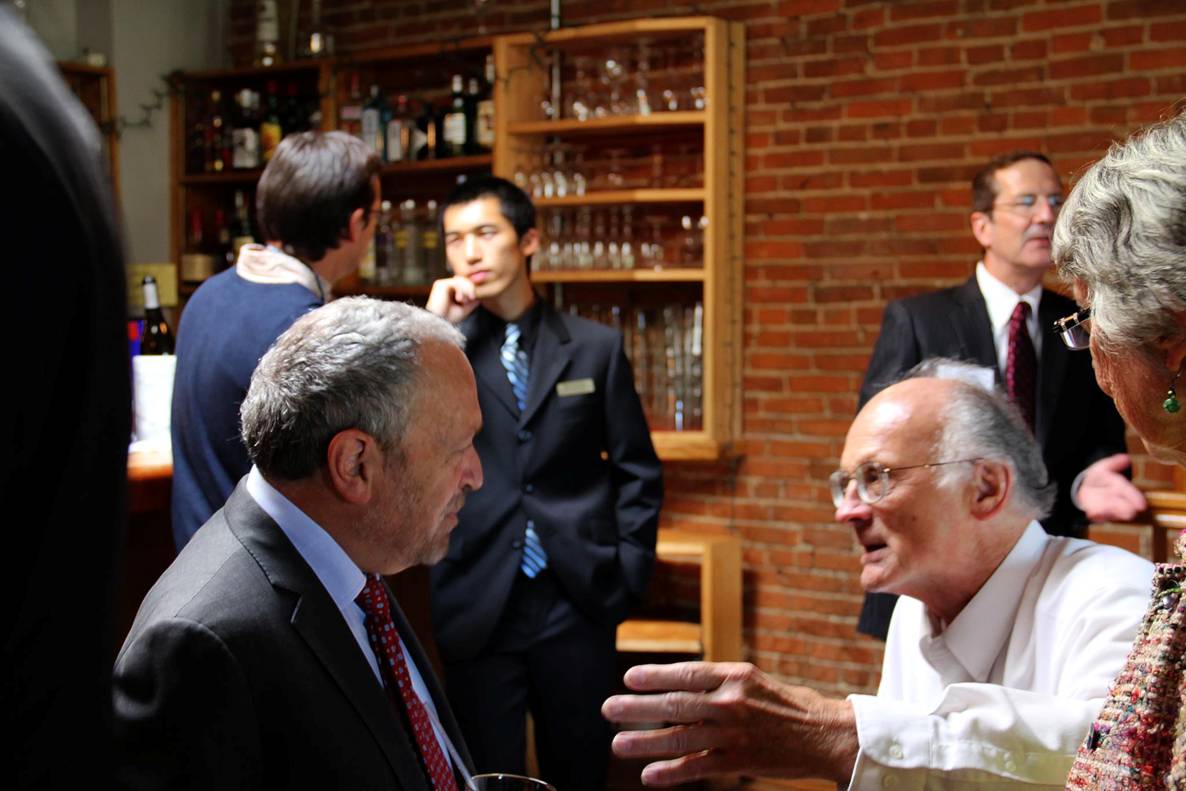
. . . because much of the content relates both to Washington, D.C., and "outside the beltway" -- the heartland, specifically Iowa -- and because after going from Iowa to Washington via Texas and California I subsequently returned, From DC 2 Iowa.
Update July 25, 3:27 p.m. CT: Nate Silver 538 projects if election were held today [July 25] Trump would win by 54.5 to 45.5% for Hillary (percentages change over time).
Update on polls; July 30, 2016: They vary, both over time and between pollsters. The only one that really matters, because it is definitive, is the one that counts voters' ballots on November 8, 2016. Meanwhile, here is what The New York Times "National Polling Average" reported on July 30, 2016: Hillary Clinton 42.6%, Donald Trump 42.1% -- in other words, a toss-up. Of the 5 polls averaged, among the 3 putting Clinton ahead they range from 43-42% to 40-35%; the two favoring Trump are 48-45% and 44-40%. Results for 11 swing states show Clinton leading in 9, by 0.2% (Ohio) and 1.3% (Florida) to 4.5% (Virginia) and 7.0% (Wisconsin). Trump leads in Georgia by 3.3% and Missouri by 8.2%. "2016 Election Polls; National Polling Average,"New York Times, July 30, 2016.
_______________
As a lifelong Democrat, I have for some years now been discouraged by the actions of the Democratic National Committee, and others who are considered members of the Party's establishment (many of whom are superdelegates). So discouraged that I'm going to undertake a two-part blog experiment.
Today [Monday, July 25, 2016] before watching any of the Democratic National Convention, or reading any of the news reports coming from Philadelphia, I'm going to write about some of the reasons for my discouragement. Later this week, once the Convention is concluded, I plan to write on the same subject once again to see what impact the Convention has had on my thinking.
It is not my purpose in this blog essay to deal with the personalities or qualifications of Hillary Clinton, Bernie Sanders, Debbie Wasserman Schultz, Donald Trump, or others. It is, rather, to address the way in which the Party, as a Party, has positioned itself in today's America. [Photo credit: Maring Photography; Contour by Getty Images.]
The Democratic Party establishment has historically served, and been supported by, the poor, working poor, working class, union members, family farmers and a broad range of other demographic groups. Were it still both perceived and actually functioning as such, it could elect a majority of officials from school boards and city councils to the U.S. Senate, House and White House. While there are still occasional nods in the direction of the unrepresented, the Party's leadership has become -- and obviously wishes to remain -- funded by, and the legislative advocates for, Wall Street, large corporations, and the top 1% of America's socio-economic elite. It's mission, far more than the enactment of populist policies, is the perpetual re-election of office holders whose highest priority daily activity is raising money.
In the latter years of the 20th Century this evolution might not have been very honorable, but at least it could still work.
The question is whether it will still work in this or any other country when one considers the Tea Party, Occupy movement, Brexit, and the unprecedented numbers and enthusiasm of the supporters of both Donald Trump and Bernie Sanders.
Whether justified or not, millions of angry Americans now look upon government, corporations, other powerful institutions, and those who run them, not just as uncaring for people like themselves, but as an enemy, deliberately adopting policies and budgets knowing the harms they will impose.
I am not arguing, in this essay at this time, that every Democratic Party official should have joined the Bernie Sanders campaign. But to so obviously trivialize, or oppose, his candidacy -- now documented in the DNC emails revealed by Wikileaks (not that it wasn't well known before) -- and carry on with 20th Century politics, was unnecessary and counter productive. For the angry Americans, independents, youth, Democrats, Republicans, and others, it was "a poke in the eye with a sharp stick."
However experienced and well qualified for the presidency Hillary Clinton may be thought to be, when millions of potential voters (and what may turn out to be non-voters) have taken to the streets with pitchforks in hand, for the Party leadership to offer them its preeminent establishment icon only confirms their worst fears about their Democratic Party, not to mention America's future and their own.
And that's, I believe, "Why Trump May Win."
Having written this, I now discover I'm not the only one with this assessment.
Michael Moore has written his analysis of why there is not just a chance that Trump could win, but "5 Reasons Why Trump Will Win."
Frankly, I think that all politics is too volatile to ever predict, with certainty, what will happen 100 days in the future. But I certainly share Moore's sense that Trump could win, and that he has a much greater chance of doing so than the Democratic Party establishment's actions indicate it understands.
Moore's analysis is too long to reproduce here in its entirety. But here are such clues as you may be able to pull from his five headings: (1) Midwest Math, or Welcome to Our Rust Belt Brexit, (2) The Last Stand of the Angry White Man, (3) The Hillary Problem, (4) The Depressed Sanders Vote, and (5) The Jesse Ventura Effect.
Robert Reich takes a comparable view. Here are some brief excerpts:
Does Hillary Clinton understand that the biggest divide in American politics is no longer between the right and the left, but between the anti-establishment and the establishment?
I worry she doesn’t –- at least not yet. . . .
In fairness, Hillary is only doing what she knows best. Moving to the putative center is what Bill Clinton did . . ..
But this view is outdated. . . .
The most powerful force in American politics today is anti-establishment fury at a system rigged by big corporations, Wall Street, and the super-wealthy.
This is a big reason why Donald Trump won the Republican nomination. It’s also why Bernie Sanders took 22 states in the Democratic primaries, including a majority of Democratic primary voters under age 45.
There are no longer “moderates.” There’s no longer a “center.” There’s authoritarian populism (Trump) or democratic populism . . ..
If Hillary Clinton and the Democratic Party don’t recognize this realignment, they’re in for a rude shock -– as, I’m afraid, is the nation. Because Donald Trump does recognize it. His authoritarian (“I’ am your voice”) populism is premised on it. . . .
Most basically, the anti-establishment wants big money out of politics. This was the premise of Bernie Sanders’s campaign. It’s also been central to Donald (“I’m so rich I can’t be bought off”) Trump’s appeal . . ..
Last January, a Des Moines Register poll of likely Iowa caucus-goers found 91 percent of Republicans and 94 percent of Democrats unsatisfied or “mad as hell” about money in politics.
Hillary Clinton doesn’t need to move toward the “middle.” . . .
She needs to move instead toward the anti-establishment –- forcefully committing herself to getting big money out of politics, and making the system work for the many rather than a privileged few.
“You have a lot of kids graduating college can’t find jobs. That’s what happened in Cairo. That’s what happened in Madrid. You don’t want those kinds of riots here.”
Bloomberg In 2011 our media have enabled us to focus upon, and cheer on, the rising tsunami of mass protest movements in Tunisia, Egypt, Libya, and elsewhere. We have seen that, while messy and usually disorganized, the ability of such movements to bring about change.
"The Arab Spring (Arabic: الربيع العربي; also known as the Arabic Rebellions or the Arab Revolutions) is a revolutionary wave of demonstrations and protests occurring in the Arab world. Since 18 December 2010 there have been revolutions in Tunisia[2] and Egypt;[3] a civil war in Libya resulting in the fall of its regime;[4] civil uprisings in Bahrain,[5] Syria,[6] and Yemen;[7] major protests in Israel,[8] Algeria,[9] Iraq,[10] Jordan,[11] Morocco,[12] and Oman,[13] and minor protests in Kuwait,[14] Lebanon,[15] Mauritania,[16] Saudi Arabia,[17] Sudan,[18] and Western Sahara.[19] Clashes at the borders of Israel in May 2011 have also been inspired by the regional Arab Spring.[20] The protests have shared techniques of civil resistance in sustained campaigns involving strikes, demonstrations, marches and rallies, as well as the use of social media to organize, communicate, and raise awareness in the face of state attempts at repression and internet censorship.[21]" "Arab Spring," Wikipedia.org.
Although Michael Bloomberg did not expand on his comment, he provided a pin prick of a reminder that such things could happen here -- although he limited the protesters to unemployed college graduates, and one senses he clearly views it as an option to be avoided. Not incidentally, if the Mayor hasn't noticed, "Occupy Wall Street" is already active. It's not one of "those kinds of riots" -- yet -- but it is getting close, very unambiguous in word and deed, and being subjected to a similar form of oppression, in this instance by New York City police:
And meanwhile, . . .
[Photo credit: Indigene editions La Voix de l'Enfant and NPR.] . . . WWII hero Stephane Hessel has titled his book Time for Outrage. See Eleanor Beardsley, "WWII Survivor Stirs Literary World With 'Outrage,'" NPR, September 22, 2011 (now two million copies in 30 languages) ("'If you want to be a real human being — a real woman, a real man — you cannot tolerate things which put you to indignation, to outrage. You must stand up. I always say to people, 'Look around; look at what makes you unhappy, what makes you furious, and then engage yourself in some action.''").
Poor People's Movements Had Bloomberg continued to speak on the subject it would have been necessary for him to acknowledge that such mass protest movements not only could happen here, they have happened here. And when they have happened here they have often proven to be very similar in effect to those we have cheered in the Arab spring -- a messy, disorganized way to produce change.
But they have been not just a way to produce change, for the working class and poor, many observers have concluded they are the only way to create progress.
Among such observers are Frances Fox Piven and Richard A. Cloward, authors of Poor People's Movements (New York: Random House/Vintage, 1977, paperback 1979). Tim Haight and I used it as one of the readings in a course we co-taught at the University of Wisconsin, Madison, in the spring of 1980. Piven and Cloward challenge many of the assumptions of America's Left as a result of their study of what is embodied in chapters titled, "The Unemployed Workers' Movement," "The Industrial Workers' Movement," "The Civil Rights movement," and "The Welfare Rights Movement."
They argue, for example, that efforts to "organize" the working poor actually tend to be self-defeating, for a variety of reasons, and what they say is "the obvious fact that whatever the people won was a response to their turbulence and not to their organized members." Introduction, first edition, p. xxiii. In the introduction to the paperback edition they take on their critics:
Some critics were dissatisfied, for example, with the various expressions of the post-World War II black movement: with the civil rights struggle in the South, or the riots in the North, or the surging demand for public welfare benefits that produced a welfare explosion in the 1960s. . . . But popular insurgency does not proceed by someone else's rules or hopes: it has its own logic and direction. It flows from historically specific circumstances: it is a reaction against those circumstances, and it is also limited by them.
Introduction, paperback, p. xi.
(Not incidentally, since welfare is mentioned, the authors observe, "Nor did the participants in the relief movement of the 1960s prefer welfare; together with Harrington, they plainly preferred decent jobs at decent wages. But they understood the political facts of their lives rather more clearly than Harrington: the unemployed poor in this period lacked the power to force programs of full employment." pp. xiii-xiv.)
Please understand, if it is not obvious, that I am not advocating "those kinds of riots here." What I am advocating is that those in a position to respond to legitimate demands from the unemployed and working poor not leave them with no option but the only one they have found to work in the past.
Let me make clear, I am not taking sides in this fight. There are reasons why the Iowa Democratic Party would want to distance itself from any group's behavior that was characterized as something other than "Iowa nice" -- however valid, or invalid, you might think its reasons. But in the context of this blog entry, the point is that there are also reasons why citizens who have been consistently ignored or rebuffed in their efforts to politely exercise their First Amendment right "to petition the government for a redress of grievances" might ultimately choose other tactics rather than give up entirely on what they consider legitimate, reasonable demands.
Here is an excerpt from the opinion piece:
Recent strong criticisms of Iowa Citizens for Community Improvement by Sue Dvorsky (the chairwoman of the Iowa Democratic Party) and John Deeth (a local Democrat and blogger) warrant a reply.
Both Dvorsky and Deeth take ICCI members to task for their confrontational conduct at a recent town hall meeting with Sen. Chuck Grassley in Carroll -- an event where neither Dvorsky or Deeth was present. Although a video record of the event is on the Internet, both seem to base their version of events on reportage from Douglas Burns of the Daily Times Herald, who claims CCI members "hurled insults" during the forum, then became "a mob" blocking Grassley from a subsequent media interview, and finally, used "physicality" to prevent the senator's clear passage to his car.
Watch the video and judge for yourself if any of this took place.
Deeth finds all of this "shameful, hateful and dangerous" -- especially considering Grassley is such a "venerable public servant and exceedingly decent man," as Burns put it. As a partisan Democrat, Deeth says that the only real way to change Grassley's vote is by beating him in an election and then chastises CCI members for not working for Democrat Roxanne Conlin.
There's only one problem with this. CCI is not a partisan political party. It is an issue-oriented, grassroots community organization working for change. Our members are Democrats, Republicans, Greens, Libertarians and independents. We don't have any political litmus test for participation in CCI.
A lot of the frustration people are feeling in this country is with a two-party "system" that seems to constantly shape-shift to serve the interests of corporations rather than people. People elect candidates who promise "change" then get no change at all.
Former Gov. Chet Culver [a Democrat] promised local control of hog lots and promptly changed his tune after the election. He promised his strong supporters in the union movement improvements to Iowa's collective bargaining process and then vetoed the bill. Is it any wonder that people get angry and discouraged?
Deeth and Dvorsky are unhappy with the way thousands of CCI members express this anger. They ridicule our "trite chants" and "demands" and ask that we abide by their version of civility. But history teaches us something different.
Women did not receive equal rights or suffrage by being nice. The civil rights struggle was not won by sitting quietly in the back of the bus. And the many victories of the labor movement were not won without noisy and sometimes bloody -- picket lines and strike actions.
As you see, ICCI is learning from, and applying, the lessons Piven and Cloward passed along in Poor People's Movements -- albeit with tactics (and dare I say, results) far less than those the authors examine.
Golden Rules and Revolutions Two and one-half years ago I wrote an eight-part blog entry series here on this theme, "Golden Rules and Revolutions." (That link goes to Part VIII, which opens with links to the prior seven in the series.)
The reference to "Golden Rules," of course, is to both the Biblical reference and the take-off, "S/he who has the gold makes the rules."
A European lecturer at the law school the other day took questions following a talk on controlling health care costs. In the course of the talk he blithely mentioned that, of course, all the EU countries have universal, single-payer health care systems. I asked,"How do you explain that European countries accept as a matter of course that citizens should be taxed to provide health care for all, while we're not even debating the issue any longer in the U.S.?" He replied, "I guess we just have more of a sense of solidarity."
He's right. The problem, of course, is that as the gap between our rich and poor continues to widen, as increasing hostility is driven by lack of jobs and social services, so long as we refuse to institute federal-government-as-employer-of-last-resort jobs programs and as a result our consumer-driven economy fails to recover, we are increasing the risk of "those kinds of riots here."
Here is an excerpt from the opening blog essay in that eight-part series, "Income Disparity & Revolution":
Increasing income disparity, despair. . . I am not a conspiratorial theorist, nor am I charging that anyone truly desires to turn the United States into a third world country, in which the top 1% of super rich rule over a 90% in abject poverty. All I would observe is that what is happening -- as a result of what will be spelled out in this series -- is not that different from what would be happening if that were the goal of government officials and the ruling elite.
[F]rom the late 1980s to the mid-2000s . . . inequality increased across the country. . . . No state has seen a significant decline in inequality during this period. . . .
On average, incomes have declined by 2.5 percent among the bottom fifth of families since the late 1990s, while increasing by 9.1 percent among the top fifth.
And see, for Iowa data, David DeWitte, "Report finds income gap growing in Iowa,"GazetteOnline, April 9, 2008, 11:40 a.m. ("The income gap between rich and poor is growing faster in Iowa than in most other states, according to a new report, which found a 49.3 percent average income growth in the wealthiest Iowa households over the past two decades. . . .")
. . . and Revolution. I recall reading many years ago -- where it was I would have no way of recalling now -- that there is a rough mathematical formula for predicting the point at which a growing income disparity will ultimately produce a revolution.
No, I don't think we're yet there in the United States.
But I am one of those who thinks Senator Obama was right when he said, "Lately, there has been a little, typical sort of political flare-up because I said something that everybody knows is true, which is that there are a whole bunch of folks in small towns in Pennsylvania, in towns right here in Indiana, in my home town in Illinois who are bitter. . . . They are angry. They feel like they have been left behind. They feel like nobody is paying attention to what they're going through." Perry Bacon Jr. and Shailagh Murray,"'Bitter' Is a Hard Pill For Obama to Swallow; He Stands by Sentiment as Clinton Pounces,"Washington Post, April 13, 2008, p. A6. . . .
It's reminiscent of Ben Stein's story about his visit with Warren Buffett.
It turned out that Mr. Buffett, with immense income from dividends and capital gains, paid far, far less as a fraction of his income than the secretaries or the clerks or anyone else in his office. . . . “How can this be fair?” he asked . . ..
Even though I agreed with him, I warned that whenever someone tried to raise the issue, he or she was accused of fomenting class warfare.
“There’s class warfare, all right,” Mr. Buffett said, “but it’s my class, the rich class, that’s making war, and we’re winning.”
Those who refuse to acknowledge what's happening in America can charge those who do with being "elitist," or fomenting "class warfare." But that does little to assuage the anger of those on the losing side of this warfare.
And when that anger is permitted to seethe long enough the news from elsewhere can serve as a reminder of the limits that ultimately come to constrain the greed of oppressive governments and the super rich elite.
Barbara J. Fraser, "As Economy Grows, Income Disparity in Latin America Widens,"Catholic News Service, August 3, 2007 ("a two-day general strike in the region was called to protest government economic policies. . . . The incident was one of many around Peru in mid-July, as teachers, farmers and others took their discontent to the streets . . .. ")
No, I don't think we need fear imminent revolution in America.
And no, I don't think the declining dollar, the $40 trillion in unfunded federal debt we're leaving to our great-grandchildren, our multi-billion-dollar negative trade balance, and recession mean we're on the precipice of third-world status.
But I do think we need to take the impact of our economy and governmental policies on ordinary Americans much more seriously than I sense our leaders and media are willing to do. Why? For starters, because I think it is the decent, just and humane thing to do.
But also for all the reasons I have laid out here and will in the rest of the series to come.
Robert Reich and "The Truth About the Economy" In a recent blog entry, in another context, I had occasion to share Robert Reich's two-minute explanation of the problem, "The Truth About the Economy." "Why Iowa? Chase Garrett and Robert Reich," September 8, 2011. It is even more relevant here:
We usually find ourselves in agreement, and certainly did on that one.
See also "Robert Reich Debunks 6 Big GOP Lies about the Economy" video, for related material:
Garry Trudeau's "Doonesbury" Finally, I conclude (did you think I never would?), with this morning's Doonesbury, from Garry Trudeau:
[With credit, and daily thanks and applause, to Garry B. Trudeau, Doonesbury.]
When you find Michael Bloomberg, Stephane Hessel, Frances Fox Piven & Richard A. Cloward, Iowa Citizens for Community Improvement, Robert Reich, and Garry Trudeau in agreement, it might just be a good time to rethink where we are going with America and why.
September 8, 2011, 3:00 p.m. (with some edits and additions September 9, 2011, 9:30 a.m.)
Just Your Everyday Walk Around a Small Iowa Town
I was lucky to have been born and raised in Iowa City, and schooled in the University's experimental elementary and high school (now North Hall). The next 30 years I spent elsewhere -- Texas, California, but mostly Washington, D.C. When I returned home, some friends and former colleagues on the east and west coasts would ask, "Iowa, Nick? Why Iowa?"
As those of us who live here know, there are hundreds of responses to those questions. Last evening provided yet one more.
Walking along downtown Iowa City's Washington Street, following a reception at a restaurant that can match many of those on the coasts, we came upon an amazing piano player, 22-year-old Chase Garrett. He was sitting at a piano kindly placed on the sidewalk by those who thought it would be a nice addition to this community of literature (one of three so designated by the United Nations), theater, music, and creative arts generally.
From there we wandered down the hill to the Iowa Memorial Union (about three blocks). (Another nice thing about Iowa City is that an easy walk can get you to many of the places you want to go. If you're in a hurry you can bike. With time to spare, you can even drive.)
What we found in the main lounge of the IMU was a standing room only crowd, packed to the walls, waiting to hear a free lecture by Robert Reich, http://robertreich.org, once Secretary of Labor and now University of California, Berkeley, professor of public policy.
Yet another advantage of life in an intellectual, research and cultural environment, Robert Reich's appearance was the University of Iowa Lecture Committee's Distinguished Lecture for 2010-2011, and one in the Public Policy Center's Forkenbrock Series, under the joint sponsorship of the University Lecture Committee, and the Public Policy Center (Peter C. Damiano, director).
He had the audience in the palm of his hand, roaming the stage with a hand held mike, no notes, incisive comment, humor, and a Jack-Benny-like sense of timing and the pause -- necessary last evening because of the audience's tendency to interrupt him with applause throughout, and a couple standing ovations. All in all a great evening.
It was nice to have a chance to visit with him before and after the event, recalling his campaigning in Iowa City for presidential candidate Senator Bill Bradley. Reich and I write on similar subjects and come to similar conclusions. The primary difference between us being (1) he knows what he's talking about, and I rely on gut instinct in coming to the same conclusions, and (2) people read what he writes and come to listen to what he has to say. (I am always surprised and delighted to discover that at least one of my close family members has actually read one of these blog entries. There was even one day last year when two had done so on the same day.) I told him that I got all my best ideas from him, and he was polite enough to instantly respond with the lie that he got all his best ideas from me.
I won't bother to repeat what he had to say in his lecture and Q and A; but here is his own truncated video version of some of his themes in 2:33 minutes.
Drake University, where he spoke the following evening, has a video of his Drake speech, albeit with less than adequate audio (apparently from a source other than his mike).
If you are a regular reader of this blog (there's bound to be one somewhere), you've encountered most of the themes here during the last three years or so. But I will refer you to a story in the local press in which Diane Heldt nicely captured the gist of Wednesday evening's presentation.
In his planned speech to the nation Thursday night about the economy, President Obama must be bold and ambitious, and relay the message of “priming the pump” with robust government stimulus and spending, former Secretary of Labor Robert Reich said Wednesday night at the University of Iowa.
Government stimulus to boost consumer spending, loans to the states to perk up their flagging budgets and stop job cuts and the re-creation of such programs as the WPA to add jobs are what’s needed to revive the economy — steps far beyond just extending unemployment and the tax cuts, Reich said.
“It is more important now than deficit reduction,” he told a standing-room only crowd at the Iowa Memorial Union. “The debt, the deficit issue, although real, is manageable. What needs to be addressed now is jobs and growth.”
About 500 people turned out Wednesday to see Reich speak, the UI’s 2011-12 Distinguished Lecture event. Reich served in three presidential administrations, most recently as the Secretary of Labor for President Bill Clinton. Reich has authored 13 books; his most recent is “Aftershock: The Next Economy and America’s Future.”
Reich said he’s not suggesting the way out of our economic morass is to consume more things and fill our homes. Rather than blind consumerism, he advocates a broader notion of consumption — consuming better health care, a better environment, better arts and all the benefits of living a better life.
Government can only get so far priming the pump with stimulus when there’s not enough water in the well to begin with, Reich said. The issue of wealth inequality in the United States has to be addressed to produce long-term economic solutions, he said.
The wealthiest people control so much of the income that the vast middle class doesn’t have enough purchasing power to keep the economy going without going into debt, he said. Without reversing this trend of inequality, the country will come up against this issue again and again, Reich said.
“My fear is there is not much of a dialogue going on about any of this,” he said.
Why Iowa?
Chase Garrett, Robert Reich, and a lovely, short September evening's walk. That's one reason why Iowa.
The Sunday Des Moines Register of May 22, 2011, had a major, page one spread about the rising costs of a college education. Except it wasn't about the cost of education. It was about the rising price of that education, comparing the increase in the share of those costs allocated to tuition with the rising price of peanut butter, milk and eggs. More on the Register's piece on down the blog.
First, here is my 300-word-limit response in the next week's Sunday Register, May 29:
Legislature shifted the cost of education Nicholas Johnson Des Moines Register May 29, 2011, p. P20
"The Challenge for Students, Parents and Schools: Runaway Tuition" (May 22), helped focus attention on the rising price of a college education.
Unfortunately, it conflated the "price" (to the student and parents) with the "cost" (to the universities) of that education.
Can universities do more to reduce the costs of education? Can they increase the quality and utility of that education? Absolutely.
However, it's both unfair and inaccurate to suggest that the sole cause of rising tuition is the increase in costs resulting from poor management by the Iowa Board of Regents and administrators.
A major reason for the increase in tuition is not the cost of education, but the allocation of those costs between taxpayers (who receive a public benefit from a well educated workforce) and the private beneficiaries (the students who go on to better jobs and lives).
When California universities charged no tuition, that didn't mean they had no costs. It meant taxpayers paid those costs.
The most appropriate allocation? That's a debate worth having.
But for now, let's recognize that it is the Iowa Legislature that has chosen to allocate an ever-increasing share of the costs to students' tuition; not the Iowa Board of Regents, universities' administrators or faculty members.
Here are some early excerpts from the Register story the week before, followed by some comments.
Iowa's two largest universities expect to pocket millions of dollars in extra tuition revenue next fiscal year, with the vast majority going to pay for additional faculty, programs aimed at lowering dropout rates and other student services, officials said.
That decision comes as the cost of earning a four-year degree in Iowa at a public university continues a steep march upward and pushes students to take on more debt, which, at $26,066 per graduating student, is the fourth-highest average in the country.
In the past 30 years, the average cost of tuition and fees at an Iowa public university has jumped 707 percent, more than four times the rate of inflation. College costs have increased each of the past 30 years for students and their families.
Meanwhile, a new survey shows families and students saddled with rising tuition and debt, stagnant wages and an uncertain job market are questioning whether a traditional college education is their ticket to the American dream.
Some universities are trying to respond to the converging forces with innovative classroom approaches and three-year degree programs. . . .
Americans are reassessing what they get for their tuition dollars.
Fifty-seven percent of those surveyed by the Pew Research Center say the higher education system does not provide a good value for the money they spend, and 75 percent say college is too expensive for most Americans to afford, according to findings released last week.
I acknowledge in the response to the Register's report, "Can universities do more to reduce the costs of education? . . . Absolutely." Frankly, I don't know enough to support that "absolutely" judgment. It's based simply on the intuition and experience that virtually every individual, business, government agency, and institution that is willing to address in detail its systems and processes, goals and operations, can probably come up with ways to reduce costs, at least a little -- often while improving quality and outputs.
It may well be that the salaries of universities' personnel, and the other costs of education (as distinguished from the price of education, tuition), have increased significantly further and faster than inflation in the costs of producing other goods and services. If so, that's a matter well worth investigating. If the increases represent necessary costs, held to the minimum, wise investments, and other consequences of skilled, creative and attentive management, that's one thing. If not, if alternative decisions could have produced greater quantity and quality of service at lower cost, that's another.
The point, for purposes of critiquing this Register story, is that it only addresses the increases in the price of education, not the costs of providing that education.
Beyond that, there was another opinion piece in the Sunday paper [May 29] of even greater relevance to America's future than my 300 words.
Robert Reich, the former U.S. secretary of labor, is now an author, columnist, blogger, and professor of public policy at the University of California at Berkley, testifies before Congress from time to time. The Register published as an essay an excerpt from his May 12 testimony before the U.S. Senate Committee on Health, Education, Labor and Pensions. It's vey much worth reading in its entirety; indeed it could be characterized as must reading for every American and public official.
To give you an idea of his subject, and thesis, here is is lead paragraph:
How did we go from the Great Depression to 30 years of Great Prosperity? And from there, to 30 years of stagnant incomes and widening inequality, culminating in the Great Recession? And from the Great Recession into such an anemic recovery?
In the course of answering those questions, here's what he had to say about the role of higher education:
Government also widened access to higher education. The GI Bill paid college costs for those who returned from war. The expansion of public universities made higher education affordable to the American middle class. . . .
Starting more than three decades ago, trade and technology began driving a wedge between the earnings of people at the top and everyone else. The pay of well-connected graduates of prestigious colleges and MBA programs has soared. But the pay and benefits of most other workers has either flattened or dropped. And the ensuing division has also made most middle-class American families less economically secure.
Government could have enforced the basic bargain. But it did the opposite. It slashed public goods and investments -- whacking school budgets, increasing the cost of public higher education, reducing job training, cutting public transportation and allowing bridges, ports and highways to corrode. . . .
Coping mechanism No. 3: Draw down savings and borrow to the hilt. After exhausting the first two coping mechanisms, the only way Americans could keep consuming as before was to save less and go deeper into debt. During the Great Prosperity the American middle class saved about 9 percent of their after-tax incomes each year. By the late 1980s and early 1990s, that portion had been whittled down to about 7 percent. The savings rate then dropped to 6 percent in 1994, and on down to 3 percent in 1999. By 2008, Americans saved nothing. Meanwhile, household debt exploded. By 2007, the typical American owed 138 percent of their after-tax income.
He concludes:
The fundamental economic challenge ahead is to restore the vast American middle class. That requires resurrecting the basic bargain linking wages to overall gains, and providing the middle class a share of economic gains sufficient to allow them to purchase more of what the economy can produce. As we should have learned from the Great Prosperity -- the 30 years after World War II when America grew because most Americans shared in the nation's prosperity -- we cannot have a growing and vibrant economy without a growing and vibrant middle class.
"To restore the vast American middle class" is going to require, among many other things discussed by Reich, a restoration of affordable post-high school college education -- as well as a reduction in the price of community college education, and skills training in the trades.
Had we been hell-bent on deliberately evolving into a third world country's population, with a statistically insignificant percentage of super-wealthy at one extreme, and 90 percent or more struggling just to get by, we would have adopted almost precisely the policies we have. That's not to say that it was deliberate. Others can explore the conspiracy theories. But that is the result.
But ranking right up there for labor, especially during this "jobless recovery" (or "jobless stagnation") economy, is finding jobs at which one can both labor and support a family.
Even "unemployment" is inching up. But the much more relevant measure is "underemployment."
"Underemployment" is the total number of those (1) who have recently been "laid off," plus (2) those who have given up looking, plus (3) those working part time who want and need full time work. So far as I know even that number excludes those who are working full or part time, but at jobs, and for pay, far below the level warranted by their professional training, skills and experience (not to mention financial need).
And according to the Gallup Chief Economist, the company's latest survey finds that number, at 18.6%, is now roughly two times the rate of "unemployment." Dennis Jacobe, "U.S. Underemployment at 18.6% in August," September 2, 2010 ("Underemployment, as measured by Gallup, was 18.6% in August, up from 18.4% at the end of July. Underemployment peaked at 20.4% in April and has yet to break below 18.3% this year.")
And of course, even these average numbers presume boiling water comfort. You know the line, "If your foot's in a bucket of ice water, and your hand is in a pan of boiling water, on average you're comfortable."
For professional men and women with advanced university degrees and some years of experience, unemployment, while always devastating for those experiencing it, now affects almost no larger a percentage than in economic boom times, and when it does it tends to last a shorter time for them than the "average time" for others.
For African-American high school dropouts it's a different story. And this is a goodly number of Americans. "In the inner cities, more than half of all black men do not finish high school." Erik Eckholm, "Plight Deepens for Black Men, Studies Warn,"New York Times, March 20, 2006.
Eckholm reports, "Black men in the United States face a far more dire situation than is portrayed by common employment and education statistics, a flurry of new scholarly studies warn . . ..
"In 2000, 65 percent of black male high school dropouts in their 20's were jobless — that is, unable to find work, not seeking it or incarcerated. By 2004, the share had grown to 72 percent, compared with . . . 19 percent of Hispanic dropouts. Even when high school graduates were included, half of black men in their 20's were jobless in 2004, up from 46 percent in 2000."
And bear in mind, this is a report from 2006, the "good old days" compared with the worst of the current downturn.
I have repeatedly argued in this blog for a federal jobs program, like those President Roosevelt created in the 1930s. If you want to jump start an economy that is 80% driven by consumer spending, and you're willing to invest trillions of dollars to do it, getting everyone employed is what seems to me to be the no-brainer solution (however politically unpopular in some quarters).
For example, when the car dealers' lots are filled with cars, because consumers either don't have the money to buy them or are too concerned about their future to risk doing so, it makes little sense to give money to corporate CEOs to build more plants and hire more workers. Why would a rational automobile CEO do that; to stack the newly manufactured cars on top of the ones already sitting out on the dealers' lots? One could have easily predicted (as I and a great many others did) that this kind of "stimulus" was not going to work for any sector of our economy (manufacturing, service, or retail). And it hasn't.
(Which is not to say that it has not had any, even very limited, short-term effect whatsoever. It is only to say that it has, rather obviously, not solved our problem -- as, I contend, putting everyone to work with those trillions of dollars would have done, and rather promptly and permanently.)
While that approach is certainly consistent with former Secretary of Labor Robert Reich's understanding of our challenge, I'll be the first to acknowledge that his analysis is far more sophisticated than my own. Robert B. Reich, "How to End the Great Recession,"New York Times, September 3, 2010, p. A21.
Organized labor is down to about 7 percent of the private work force.. . .
None of the standard booster rockets are working: near-zero short-term interest rates from the Fed, almost record-low borrowing costs in the bond market, a giant stimulus package and tax credits for small businesses that hire the long-term unemployed have all failed to do enough.
That’s because the real problem has to do with the structure of the economy, not the business cycle. No booster rocket can work unless consumers are able, at some point, to keep the economy moving on their own. . . .
But consumers no longer have the purchasing power to buy the goods and services they produce as workers; for some time now, their means haven’t kept up with what the growing economy could and should have been able to provide them.
This crisis began decades ago when a new wave of technology — things like satellite communications, container ships, computers and eventually the Internet — made it cheaper for American employers to use low-wage labor abroad . . .. The median male worker earns less today, adjusted for inflation, than he did 30 years ago.
But for years American families kept spending . . .. How did families manage this trick? First, women streamed into the paid work force. . . .
Second, everyone put in more hours. . . .
[T]third: going ever deeper into debt. . . . From 2002 to 2007, American households extracted $2.3 trillion from their homes. . . .
Now we’re left to deal with the underlying problem that we’ve avoided for decades. Even if nearly everyone was employed, the vast middle class still wouldn’t have enough money to buy what the economy is capable of producing.
Where have all the economic gains gone? . . . In the late 1970s, the richest 1 percent of American families took in about 9 percent of the nation’s total income; by 2007, the top 1 percent took in 23.5 percent of total income.
It’s no coincidence that the last time income was this concentrated was in 1928. . . .
The rich spend a much smaller proportion of their incomes than the rest of us. . . . [T]he economy is robbed of the demand it needs to keep growing and creating jobs. . . .
[T]he rich . . . invest their earnings . . . anywhere around the globe where they’ll summon the highest returns — . . . often it’s the Cayman Islands, China or elsewhere. . . .
Meanwhile, as the economy grows, the [middle class] spending fuels continued growth . . .. But because this situation can’t be sustained, at some point — 1929 and 2008 offer ready examples — the bill comes due.
This time around, . . . averting another Great Depression-like calamity removed political pressure for more fundamental reform. We’re left instead with a long and seemingly endless Great Jobs Recession.
[T]here is only one way back to full recovery: through more widely shared prosperity. In the 1930s, the American economy was completely restructured. New Deal measures — Social Security, a 40-hour work week with time-and-a-half overtime, unemployment insurance, the right to form unions and bargain collectively, the minimum wage — leveled the playing field.
In the decades after World War II, legislation like the G.I. Bill, a vast expansion of public higher education and civil rights and voting rights laws further reduced economic inequality. Much of this was paid for with a 70 percent to 90 percent marginal income tax on the highest incomes. And as America’s middle class shared more of the economy’s gains, it was able to buy more of the goods and services the economy could provide. The result: rapid growth and more jobs.
By contrast, little has been done since 2008 to widen the circle of prosperity. . . .
[Comparable] measures would not enlarge the budget deficit because they would be paid for. In fact, such moves would help reduce the long-term deficits by getting more Americans back to work and the economy growing again.
Policies that generate more widely shared prosperity lead to stronger and more sustainable economic growth — and that’s good for everyone. The rich are better off with a smaller percentage of a fast-growing economy than a larger share of an economy that’s barely moving. That’s the Labor Day lesson we learned decades ago; until we remember it again, we’ll be stuck in the Great Recession.
Clearly, turning trillions of dollars over to our wealthiest one percent has not helped the poor, the working poor, the underemployed, the working class and the middle class.
It is said that "a rising tide lifts all boats." Whether or not that's true, the absence of any tide at all moves no one's boat. Thus, it turns out that while the rich (and the politicians they control) have been doing in the rest of us, they have been shooting themselves in the wallet as well. _______________
* Why do I put this blog ID at the top of the entry, when you know full well what blog you're reading? Because there are a number of Internet sites that, for whatever reason, simply take the blog entries of others and reproduce them as their own without crediting the source. I don't mind the flattering attention, but would appreciate acknowledgment as the source -- even if I have to embed it myself. -- Nicholas Johnson
Times are tough, and they're not likely to get better soon -- certainly not so far as unemployment is concerned, now heading into double digits. And even these numbers fail to take account of those who have given up looking for work, are no longer receiving unemployment benefits, the former full time employees now holding part time jobs, those who have jobs but are under-employed at low skill jobs paying a fraction of what they earned before, those who have taken a significant cut in pay or no longer have health care or other benefits, or those whose medical bills leave them no option but bankruptcy.
Nouriel Roubini is one of the few economists to have predicted, early and with some considerable precision, the magnitude of the financial crisis that has now played out before our eyes. He says there's more to come, including an additional 10% drop in home prices once demand from first-time buyers dissipates. (Among a great many other things, the $8000 first-time-buyer credit program expires November 30. Recall the precipitous decline in new car sales following the expiration of the "cash for clunkers" auto industry subsidy). What's worse, he notes, is that "The stress is moving from residential mortgages that are still in deep trouble, to commercial real estate, where they [banks] are just starting to recognize that they're going to have massive, massive losses" -- from some $2 trillion in questionable commercial real estate loans. He continues, "Most of these losses are not [yet] recognized because they're keeping the loans at face value on their books." Walter Brandimarte, "US housing market not bottomed-economist Roubini,"Reuters, October 8, 2009.
Worse, as Elizabeth Warren noted on yesterday's "On Point" with Tom Ashbrook, Congress has essentially turned over the writing of the regulatory reform legislation to the lobbyists for the very guys who created the problems, are already back to business as usual, and are rapidly leading us into an even more severe financial catastrophe on down the road. "Creating Jobs in a Jobless Recovery,"On Point, October 8, 2009. (Harvard Law School Professor Elizabeth Warren is chair of the Congressional Oversight Panel charged with monitoring the Troubled Asset Relief Program, TARP.)
Also on the program was Robert Reich, former Secretary of Labor and now a professor of public policy at the University of California, Berkeley. He advocated, as I have over the past year, a re-enactment of the Glass-Steagall Act. First enacted in 1933, it limited bank speculation. In our headlong rush to the promised land of deregulation its prohibitions on bank holding companies owning financial companies were repealed in 1999. (Glass-Steagall also created the Federal Deposit Insurance Corporation.) Notwithstanding the rather persuasive, multi-trillion-dollar evidence we now have of its necessity, there is little to no enthusiasm in Washington for its return.
Nor is there support for the logical mantra, "If it's too big to fail, it's too big." By turning trillions of taxpayers' dollars over to the Wall Street banks, while ignoring the Main Street banks, the 100 that have failed are simply gobbled up as the big get even bigger. There's no movement to bring them to manageable size, nor to curtail their risky behavior, and the rewards in bonuses that result. Banks are calling the shots, telling the taxpayers, "Heads we win, tails you lose." Congress is content to let them continue to speculate with depositors' money, secure in the congressional promise that if they profit from their risky investments they get to keep the profits, and if they lose Congress will cover their losses with taxpayers' money. A sweet deal indeed, with no signs it's about to change.
So not only is it bad and getting worse, the odds are good -- given elected officials' disinclination to alienate their most generous campaign contributors -- that the light at the end of the tunnel is the headlight on an onrushing train of even more serious financial disasters for Main Street, brought to us courtesy of Wall Street and Pennsylvania Avenue.
When I was in Washington we had reasonable Republicans one could work with, and even admire -- while disagreeing over the details of policy. Nor am I today a partisan "anti-Republican." I am bi-partisan in my disgust with both parties' willingness to sell out the best interests of their constituents, especially those least able to fend for themselves, for the campaign contributions that enable them to be a member of Congress for life.
I would welcome a return of a constructive, civil and rational Republican "loyal opposition." It's not good for the Republican Party, and certainly not for the nation, for them to fashion their positions solely on their effort to "crush Obama" -- for example, recently cheering the news that his Copenhagen effort to bring the Olympics to Chicago had failed, or to stand in a solid phalanx of opposition to whatever he proposes as an obviously necessary health care reform. In the final analysis I don't think the American people are looking for "the Party of 'No.'"
Meanwhile, back in Iowa we have an especially urgent need to put partisanship behind us at this time, to come together, to put selfishness and greed behind us and focus on a shared sacrifice.
So I was disappointed to see on the Iowa House Republicans' Web site the reaction of their leader, Kraig Paulsen (R-Hiawatha), to the current State budget crisis: "'Today the governor raised property taxes,' said Paulsen. 'The result of this across the board cut is higher property taxes for Iowans. A tax increase that could have been avoided by better management of the state budget. The governor is pushing his out-of-control spending problem on to the backs of Iowans.'”
This is a time of testing of our moral values. As the late AFL-CIO President George Meany once explained it to me, "Nick, it's all about who gets the beans and who gets the pork chops." In his time workers could afford not only pork chops, but homes and college education for their kids. Ultimately, with "trickle down" economics, more were reduced to eating beans and limiting their kids education to high school. And that was in "our best of times."
We are heading into "the worst of times." How will we allocate the pain? Will those best able to absorb it accept a little more? Or will the wealthy, the CEOs and other administrators, continue to assume an entitlement to a continuation of a lifestyle that is multiples of what others can enjoy?
There is an issue of tough, serious, specific substantive decisions here.
_______________ * Why do I put this blog ID at the top of the entry, when you know full well what blog you're reading? Because there are a number of Internet sites that, for whatever reason, simply take the blog entries of others and reproduce them as their own without crediting the source. I don't mind the flattering attention, but would appreciate acknowledgment as the source, even if I have to embed it myself. -- Nicholas Johnson