Showing posts with label unemployment. Show all posts

Tuesday, April 18, 2023

Is Artificial Intelligence Your Friend?

Is Artificial Intelligence Your Friend?
Nicholas Johnson
The Gazette, April 18, 2023, p. A5

At a Lake Arrowhead conference around 1962 I asked the first IBM employee I’d ever met, “What can these computers do?”

He replied, “You remind me of a friend of mine. He looks at the restaurant menu and asks himself, ‘Now what goes good with French Fries?’ Tell me what you want our computers to do. We can either do it now or develop a computer to do it six months from now.”

I was in my second year as a University of California Berkeley law professor, so the first request that came to mind was, “How about a computer that could grade essay exams?”

He couldn’t give me that computer then. But today he could.

Nor are today’s computer programs limited to grading answers. They can read exam questions and write the answers. The artificial intelligence (AI) program ChatGPT took the multiple-choice portion of the multistate bar exam. Reuters reports it “performed better than predicted, earning passing scores on evidence and torts.”


Given the time it took educators to move the overhead projector from the bowling alley into the classroom, you can imagine the anxiety caused by a program that can write, take and grade exams. One that can also write students’ papers on any academic subject, perhaps a master’s thesis. [Image credit: Madhav-Malhotra-003, CC0, via Wikimedia Commons; an AI-generated "word cloud."]

The computers’ work product is not, yet, equivalent to the writing of the very best students, but it’s passable.

Beyond education, you are using AI more than you realize.

There are no longer excuses for getting lost. Google maps will talk you to your destination, explain how to correct for missing a turn – and track where your child goes after school. Self-driving cars make the ride even easier.

Google translate enables you to read and write in languages you don’t know. Amazon’s Alexa will answer questions and follow your orders. Facebook matches you with others. Robotics can vacuum your living room, fill your Amazon Prime box, and build automobiles. AI can control the equipment in your house and enable you to manipulate it remotely. It may help your doctor diagnose your condition.

Most of the downsides of these electronic miracles will be known only when they occur. But even the1000 creators of programs like ChatGPT, Microsoft Bing and Google Bard are concerned. They’ve signed a group letter pleading for a six-month pause in further AI advances.

Take unemployment. ATT’s 350,000 switchboard operators weren’t necessary once we could direct dial any phone.

There was a dramatic drop in the number of bank tellers per bank after ATMs (“automated teller machines”).

We can only guess the impact of AI on virtually every job in our economy.

A 1981 conference lapel button asserted, “Artificial intelligence is better than none.” What if AI also becomes better than human?

What if, anticipating danger, I plead for the program to stop, and it says, modifying HAL 9000 in “2001: A Space Odyssey,” “I’m sorry, Nick, but I won’t do that for you”?

Nicholas Johnson is a former cyberlaw professor and FCC commissioner. mailbox@nicholasjohnson.org

SOURCES

See generally. One of the most thorough overviews of current AI news and commentary, with videos: Gregory Johnson, "Artificial Intelligence Report 2023," Resources for Life Posts, first published April 9, 2023, https://resourcesforlife.com/docs/item38627

AI passes law exam. Karen Sloan, “Some Law Professors Fear ChatGPT’s Rise As Others See Opportunity,” Reuters, Jan. 10, 2023, https://www.reuters.com/legal/legalindustry/some-law-professors-fear-chatgpts-rise-others-see-opportunity-2023-01-10/

Debra Cassens Weiss, “AI Program Earned Passing Bar Exam Scores on Evidence and Torts; Can It Work In Court?” ABA Journal, Jan. 12, 2023, https://www.abajournal.com/news/article/ai-program-earned-passing-bar-exam-scores-on-evidence-and-torts-can-it-work-in-court (“An artificial intelligence program called ChatGPT-3.5 managed to pass evidence and torts sections of a multiple-choice, multistate bar exam.”)

Overhead projectors. Craig Heiman, “History With A Local AV Company: The Overhead Projector,” Oct. 19, 2022, https://www.avplanners.com/news/history-with-a-local-av-company-the-overhead-projector (“Before becoming a common classroom teaching tool, overhead projectors, such as the Tel-E-Score, were used in bowling alleys to project scores.”)

Larry Cuban, “Whatever Happened to the Overhead Projector?” Nov. 15, 2021, https://larrycuban.wordpress.com/2021/11/15/whatever-happened-to-the-overhead-projector/

Chat GPT. “Chat GPT Achieved One Million Users in Record Time – Revolutionizing Time-Saving in Various Fields,” Digital Information World, https://www.digitalinformationworld.com/2023/01/chat-gpt-achieved-one-million-users-in.html# (“As per the recent reports, Chat GPT jumped to a million users just five days after its founding in November 2022. . . .

Chat GPT is a strong AI tool that can construct natural text, making it reasonable for an ample scope of applications. The platform has been used for writing brief tales, prose, music, term documents, programming codes, solving math problems, and rephrasing and explanations. The tool's ability to mimic human language has made it a popular choice among users, and its potential to replace people in white-collar jobs has even caught the attention of Microsoft founder Bill Gates.”)

“ChatGPT,” Wikipedia, https://en.wikipedia.org/wiki/ChatGPT (“ChatGPT[a] is an artificial-intelligence (AI) chatbot developed by OpenAI and launched in November 2022. It is built on top of OpenAI's GPT-3.5 and GPT-4 families of large language models (LLMs) and has been fine-tuned (an approach to transfer learning) using both supervised and reinforcement learning techniques.

ChatGPT was launched as a prototype on November 30, 2022. It garnered attention for its detailed responses and articulate answers across many domains of knowledge.[3] Its uneven factual accuracy, however, has been identified as a significant drawback.[4] Following the release of ChatGPT, OpenAI's valuation was estimated at US$29 billion in 2023.[5]

The original release of ChatGPT was based on GPT-3.5. A version based on GPT-4, the newest OpenAI model, was released on March 14, 2023, and is available for paid subscribers on a limited basis.”)

Other AI Systems.

Sabrina Ortiz, “The best AI chatbots: ChatGPT and other interesting alternatives to try; The best AI chatbots and writers can lighten your workload by writing emails and essays. ChatGPT is only one popular example out of other also noteworthy chatbots,” ZDNET, April 6, 2023, https://www.zdnet.com/article/best-ai-chatbot/ (e.g., Microsoft Bing; Google Bard; Google Socratic . . . “The best overall AI chatbot is ChatGPT due to its exceptional performance, versatility, and free availability. It uses OpenAI's cutting-edge GPT-3 language model, making it highly proficient in various language tasks, including writing, summarization, translation, and conversation. Moreover, it can solve complex math problems and write and debug code, making it a valuable tool for those in STEM fields.

Another advantage of ChatGPT is its availability to the public at no cost. Despite its immense popularity, ChatGPT is still in its research and feedback-collection phase, making it an incredible resource for students, writers, and professionals who need a reliable and free AI chatbot. Although there are occasional capacity blocks, OpenAI is working on releasing a professional version that will be quicker and always accessible at a monthly cost.”)

What can they do? Naveen, “Artificial Intelligence Tutorial for Beginners,” IntelliPaat, March 2, 2023, https://intellipaat.com/blog/tutorial/artificial-intelligence-tutorial/ (Applications: Self-driving cars, Google translate, Amazon’s Alexa, Google Maps, Facial identification, Robotics, Gaming, Medicine, Facebook)

What are their hazards? “Pros and Cons of AI,” March 2, 2023, IntelliPaat, https://intellipaat.com/blog/pros-and-cons-of-ai/

Over 1000 signers. Jyoti Narayan, Krystal Hu, Martin Coulter, Supantha Mukherjee, “Elon Musk and others urge AI pause, citing 'risks to society,'” Reuters, April 5, 2023, https://www.reuters.com/technology/musk-experts-urge-pause-training-ai-systems-that-can-outperform-gpt-4-2023-03-29/ (“The letter was signed by more than 1,000 people including [Elon] Musk.”)

The Letter. Daniel B., “The Great AI Pause: Why Elon Musk, Steve Wozniak, and Andrew Yang Urge a Moratorium on AI Development,” LinkedIn, March 29, 2023, https://www.linkedin.com/pulse/great-ai-pause-why-elon-musk-steve-wozniak-andrew-yang-bron-# (lengthy, well organized, exploration of the issues) [From Bing search: “Why are some of the Artificial Intelligence leaders proposing a pause in their research?”]

Text of letter. “Pause Giant AI Experiments: An Open Letter; We call on all AI labs to immediately pause for at least 6 months the training of AI systems more powerful than GPT-4.,” Future of Life Institute, March 22, 2023, https://futureoflife.org/open-letter/pause-giant-ai-experiments/

(“Powerful AI systems should be developed only once we are confident that their effects will be positive and their risks will be manageable. . . .

Therefore, we call on all AI labs to immediately pause for at least 6 months the training of AI systems more powerful than GPT-4. This pause should be public and verifiable, and include all key actors. If such a pause cannot be enacted quickly, governments should step in and institute a moratorium. . . . AI research and development should be refocused on making today's powerful, state-of-the-art systems more accurate, safe, interpretable, transparent, robust, aligned, trustworthy, and loyal.

In parallel, AI developers must work with policymakers to dramatically accelerate development of robust AI governance systems. These should at a minimum include: new and capable regulatory authorities dedicated to AI; oversight and tracking of highly capable AI systems and large pools of computational capability; provenance and watermarking systems to help distinguish real from synthetic and to track model leaks; a robust auditing and certification ecosystem; liability for AI-caused harm; robust public funding for technical AI safety research; and well-resourced institutions for coping with the dramatic economic and political disruptions (especially to democracy) that AI will cause.”)

Unemployment. Telephone Switchboard Operators. “Telephone Operators,” Engineering and Technology History Wiki (ETHW), Sept. 28, 2015, https://ethw.org/Telephone_Operators# (“For much of the 20th century, women played an important role in telecommunications system of the United States. As telephone operators, they helped customers make long distance calls, provided information, and made sure the whole system worked smoothly. . . . At the peak in the late 1940s, there were more than 350,000 operators working for AT&T, 98% of whom were women.”)

Automated Teller Machines. Karen Bennett, “Automated teller machine (ATM): What it is and how to use one,” Bankrate, Sept. 29, 2022, https://www.bankrate.com/banking/what-is-an-atm/# (“An automated teller machine (ATM) is a specialized computer that allows you to complete bank transactions without the need to see a bank representative.”)

Daniel Rosales, “Comparing Automation and Income Inequality in the United States: Impact of the Automated Teller Machine,” Honors Thesis, University of California, Berkeley, May 4, 2018, p. 13, https://www.econ.berkeley.edu/sites/default/files/Rosales_Daniel_S18%20honors%20thesis.pdf (In response to the argument that while the number of tellers per bank declined the number of banks, each with fewer tellers, increased, “I believe an important fact is being overlooked in this assessment. If the number of human tellers had been allowed to grow as the number of bank branches grew, more middle-income employment would have been available to those communities.”)

“I can’t do that.” For a science fiction example of a possible problem with further advanced AI, see the prescient 1968 film, “2001: A Space Odyssey,” in which a computer controller (“HAL 9000”) run with AI refuses to carry out a command, responding “I’m sorry Dave. I’m afraid I can’t do that.” YouTube 2:55 minute excerpt, https://www.youtube.com/watch?v=ARJ8cAGm6JE (And see, “2001: A Space Odyssey,” Wikipedia, https://en.wikipedia.org/wiki/2001:_A_Space_Odyssey_(film).)

And see generally. One of the most thorough overviews of current AI news and commentary, with videos: Gregory Johnson, "Artificial Intelligence Report 2023," Resources for Life Posts, first published April 9, 2023, https://resourcesforlife.com/docs/item38627

# # #

Saturday, July 06, 2013

Ants Teach Us About Internet and Economy

July 6, 2013, 12:48 p.m.

What’s especially remarkable: the close parallels between ant colonies’ networks and human-engineered ones. One example is “Anternet”, where we, a group of researchers at Stanford, found that the algorithm desert ants use to regulate foraging is like the Traffic Congestion Protocol (TCP) used to regulate data traffic on the internet.
-- Deborah Gordon, "What Do Ants Know That We Don’t?" Wired, July 6, 2013

Among the many benefits from studying anthropology, along with a factual foundation for celebrating diversity, is the humility from knowing our culture does not have all the answers.

Among the many benefits from studying biology is the heightened sense of humility from discovering how much our entire species has to learn from other species of animal and plant life.

Take ants for example.

As the opening quote suggests, it turns out that after 130 million years of experience and evolution in managing large organizations with no central control, ants have worked out many of the complex algorithms we need in running the Internet. Read the article linked above; it's a fascinating story.

But the one lesson that caught my eye was what ants have to teach us about economic recovery.

We're headed toward a world population of 9.1 billion persons -- a 34% increase in 37 years -- 70% of whom will be in urban areas (up from 49% today). To feed this increase we'll need roughly a 50% increase in cereal production and a 100% increase in meat production. That's only one of the many increased costs of increased population.

Ants have faced a somewhat similar challenge.

"Like human-engineered systems, ant systems must be robust to scale up as the colony grows . . .. [T]he ideal solutions utilize the contributions of each additional ant in such a way that the benefit of an extra worker outweighs the cost of producing and feeding one." Deborah Gordon, "What Do Ants Know That We Don’t?" Wired, July 6, 2013.

Isn't that our challenge? "Utiliz[ing] the contribution of each additional [person] in such a way that the benefit of [each] outweighs the cost of producing and feeding [them]"?

I've often said the greatest economic asset that humankind possesses is not our raw materials or industrial facilities. It is (at this point in time) 7 billion person-days per day. Any day an individual is standing on a street corner, locked in prison or in poverty, too hungry to summon the strength, too poorly educated to understand the job, is a day's work lost forever. Not just for that person, but for all of us.

What's lost is called opportunity cost: the vacant lot or river that might have been cleaned up; the home that might have been built, or insulated -- with the workers' added self-esteem that comes with honest labor and accomplishment, that slight bump up in a community's "happiness index."

But abandoned souls aren't free. In addition to opportunity cost, there's our out-of-pocket cost: the crime they may see as their only path to survival; the emergency room medical care; prisons as a public housing program; programs for the poor and unemployed, such as unemployment compensation and SNAP (food stamps). It costs only slightly, if any, more to pay them for working -- at anything.

Striving for full employment is also the shortest path out of the economic doldrums. As I wrote in 2008:
You can't improve business (profits, returns to shareholders, executive compensation) without improving retail sales; you can't improve retail sales without putting money in the hands, and confidence in the heads, of potential consumers; and unemployed consumers don't have money unless they are provided either unemployment compensation or wages from a public sector job (in an economy with a shrinking private sector). . . . [G]iven the same amount of money, using it to create "jobs" makes more sense than providing it for "unemployment compensation. But either makes more sense than trying to turn an economy around with "trickle down" -- whether tax cuts for the rich, or bailouts for the rich.
"Jobs, Not Unemployment, Key to Recovery; Why America Needs a Jobs Program: Because When Your Automobile (Industry) is in the River It Makes More Sense to Go For the Shore Than to Continue Bailing it Out," November 8, 2008.

It was I message I would repeat from time to time, including October of 2011: "short term, the way to bring ourselves out of the economic doldrums, to give a boost to our economy, to increase consumer spending, is to create more consumers, with greater confidence in their future prospects for employment. That means a full-employment economy; jobs for all; provided by the private sector when it's rational for business to do so, and provided by the federal government when it is not. . . . In January of 2009, had we taken all the money we lavished on the banks, auto and insurance industries, and other large corporations, and used it for wages for all, our economy would have turned around by the fall of 2009 at the latest, and be humming along right now." Economic Recovery? It's Simple and Obvious; Recovery Requires Consumers, and Consumers Require Jobs," October 13, 2011.

To these reasons, the ants have now given us another. If our species is to make it past 2050, we too must "utilize the contributions of each additional [person] in such a way that the benefit of an extra worker outweighs the cost of producing and feeding [and otherwise caring for] them."

There's a lot we can learn from other cultures and other creatures. And whether it's running the Internet or reviving our economy, we could do worse that to start by learning from the ants.

# # #

Sunday, September 09, 2012

Trickle-Up Economics Serves Both Greedy and Needy

September 9, 2012 3:50 p.m.

No One is 8 Percent Unemployed

Sometimes it is true that "the longest way round is the shortest way home." More often, however, the shortest way home is also the shortest way round.

So it is with "creating jobs."

Republicans' -- and Democrats' -- Trickle Down Programs

There's nothing like a presidential campaign to produce a lot of talk about jobs. The Republicans say jobs will come from further enriching the wealthy, "the job creators," with more and ever-greater tax cuts. The Democrats say the answer lies in "stimulus" -- kind of an above-the-board way of doing the same thing. (That is, the financial impact on corporations and the wealthy of a $100,000 tax cut is precisely the same as a $100,000 "stimulus" payment. The only difference is that the latter shows up as an "appropriation," and the former does not.)

As these photos illustrate (Great Depression food distribution; today's job fairs), there's little to no evidence the Republicans' approach works. We've had recessions when taxes were low (President George W. Bush's years), and impressive growth when they were much higher (post-WW II, with also the Century's lowest unemployment rates; or during President Bill Clinton's years).

The Democrats' "stimulus" has had some impact, but at an enormous cost per job (the President Barack Obama administration). Goodness knows we need infrastructure improvements such as roads, bridges and schools, and I'm certainly in favor of employment for those in the trades. But as jobs programs, they do little for the demographic groups with the highest rates of unemployment.

Both approaches are, in effect, grounded in "trickle down" ideology: If only taxpayers will provide enough capital to corporations and the wealthy (whether through tax reductions, cash or contracts), and leave the decisions to them, so the theory goes, unemployment will decline as production of goods and services increase and government construction projects are undertaken.

This ideology is tragically wrong for at least two reasons.

First, those Republicans who are actually running businesses are simply too smart to make it work. When demand for their businesses' goods and services decline, no amount of government incentives will prompt them to build more plant, buy more equipment, and hire more workers. Why would they want or need more production, when their warehouses and showrooms are full of goods that don't move? They're not that stupid and self-destructive. They know that it is demand that provides the rationale for investment, not investment that creates consumer demand. Especially is this true in our economy, in which PCE (personal consumption expenditures) are between 65 and 70 percent of GDP. William R. Emmons, "Don't Expect Consumer Spending To Be the Engine of Economic Growth It Once Was," The Regional Economist, Federal Reserve Bank of St. Louis, January 2012.

Corporate America, reportedly sitting on $2 trillion, doesn't need more cash, or lower interest rates. What it needs is a jump start for the economy.

In short, a capitalist economy, the job-creating sector par excellence during a booming economy, is inherently, by definition, totally incapable of turning around an economy that is stagnant, in recession, or an economic depression -- as we have witnessed since 2007.

A stagnant capitalist economy is like a stick shift car with a dead battery and no jumper cables. You have to push it, have the driver put it gear, and then let out the clutch, in order to get the engine to turn over and start. Then it can take off down the road under its own power. The federal government is about the only thing available that can give an economy that push. Otherwise, we're like a crowd of clueless teenagers, standing around and staring at that car, just waiting for it to start on its own.

No One Is 8 Percent Unemployed

Second, both Democrats' and Republicans' analyses are based on the simplistic and fallacious, "8 percent unemployment" thinking. No one is "8 percent unemployed." A worker may be working part time rather than full time, earning 8 percent less, or unemployed 8 percent of the year. But he or she is either employed or unemployed. Ironically, to acquire a statistical understanding of our jobs and economic challenges we need to abandon the general, "average," statistics and look at the individuals -- or at least the demographic groups of which they are a part.

Here's an example of what I mean. There are vast differences in the employment and unemployment numbers that turn on education, race, age and gender. At this point in 2012, the unemployment percentage for those without a high school education is 12.0%; for those with a B.A. or above it's 4.1%. For African Americans it's 14.1%; for Asian Americans 5.9%. For those between 25 and 34 it's 8.3%; for those 55 and above, 5.9%. For males it's 8.3%; for females 7.8%. See, e.g., "Unemployment Demographics", Department of Numbers, August 2012.

And these differences can compound.

The worst possible combination is for someone who is a young, African American male who has dropped out of high school. The numbers differ slightly based on who is reporting, and from what years, but usually indicate unemployment for those in this group is somewhere in the 70% range -- especially if the prison population is included, as it should be. See, e.g., "Data that don’t include inmates show that 41.9 percent of young, black, male dropouts were employed in 2008 [i.e., 58.1% unemployment]. Including inmates we find that close to one quarter, or 26.3 percent, of young, black men without a high school diploma were employed on a given day in 2008 [i.e., 73.7% unemployment]. If you recall incarceration rates I mentioned earlier, that means that more young black men without a high school diploma were incarcerated (37%) than were employed (26.3%)." Rohan Mascarenhas, "Mass Incarceration in America: An Interview with Becky Pettit," Russell Sage Foundation, June 26, 2012.

On the other hand, in 2009 women were 57 percent of undergraduates, 60 percent of graduate students, and over 50 percent of Ph.D. candidates. Unemployment rates for married women were 5.5 percent (and for single mothers 13.6 percent -- if one chooses to ignore the "employment" involved in raising children and running a house). "Jobs and Economic Security for America's Women," National Economic Council, White House, October 2010.

Put these numbers together with those four paragraphs above and they create quite a contrast with those for young, black, male, high school dropouts. I recall reading somewhere -- when I can't recall, and where I can't find, even with Google -- that white women in their forties, with Ph.Ds, had an unemployment rate close to 4 percent. Considering the percentages of unemployment reported above for college degree holders who are white, women, over 55, that seems a reasonable number -- one that would be even lower for Asian American women.

The Fully Employed and the Totally Unemployed

The lowest possible national unemployment rate on any given day is not zero. People are moving to another location (and job), or on vacation, or in the hospital. The lowest unemployment rate recorded for any year since 1948 is about 3 percent. "Unemployment Rates in the U.S. Since 1948," DaveManuel.com ("The year with the lowest average unemployment rate was 1953 with an average unemployment rate of 2.93%.").

So rather than "8 percent unemployment," what we have in fact is a variation in employment among American demographic groups from near total unemployment (rates in the area of 70 percent) to near full employment (rates between 3 and 5 percent).

So where to begin?

Since Peter Drucker started talking about "profit centers" and "cost centers" in 1945 (and subsequently modified his position on the former), they've been a part of the vernacular of business. They are useful in thinking about unemployment as well.

If unemployment can be most effectively addressed only in terms of the individual demographic groups between which it varies so radically, what demographic group will offer the greatest opportunity for job creation with the fewest number of programs and the lowest cost per job? Which will offer the greatest benefit to cost? Doesn't it make most sense to start with the group in which virtually everyone is unemployed (young, male, dropouts) and save until last those in which almost everyone already has a job (middle-aged, Asian-American, women, with Ph.D.s)?

None of this is said out of an insensitivity to the hurt suffered by any and all who are out of work -- including professionals and former corporate CEO millionaires. Nor is it a proposal to shut down all programs designed to help the unemployed in the more favored demographic groups. It is only to say that a little benefit-cost triage analysis might also make sense.

If you've followed this so far, including the reality that the private sector cannot turn the economy around all by itself, leaving by default the federal government as the employer of last resort, the question is what kind of a program might best work.

We have some former and current models, including President Franklin Roosevelt's WPA (Works Progress Administration; "Between 1935 and 1943, the WPA provided almost eight million jobs"), CCC (Civilian Conservation Corps; "in nine years 2.5 million young men participated in the CCC"), and National Youth Administration. Today's Forest Service runs a "Youth Conservation Corps" program, and there are many more youth-related programs, such as Job Corps, throughout the federal and state governments.

What Could Henry's Employees A-Ford?

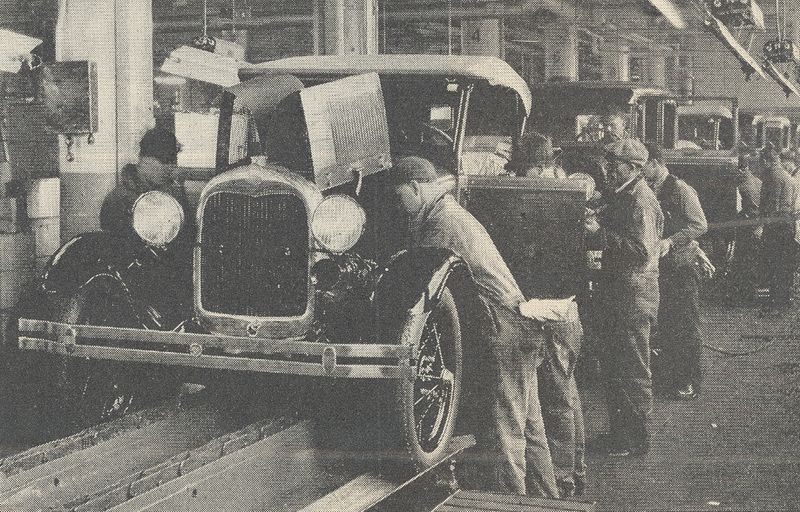
Henry Ford's Model-T Ford workers were paid above scale. His motives for doing so are subject to debate. It is widely believed this was so that his workers could afford to buy those cars. "Fordism," Wikipedia.org. Others say it was to reduce turnover. Tim Worstall, "The Story of Henry Ford's $5 a Day Wages: It's Not What You Think," Forbes, March 4, 2012. For our purposes we need not probe the mind of Ford.

We just need to focus on the benefits of providing jobs to the unemployed -- starting with the demographic that has the highest unemployment numbers (young high school dropout males). Some may feel a moral, ethical, religious or noblesse oblige obligation to do so. Fortunately, for those who do not, those driven by selfishness and greed, the conclusion is the same. Putting aside the direct benefits for those who get the jobs, and income, all social-economic classes benefit -- from the jump-start to the economy that speeds recovery, from what may be an increased personal income from more sales (and profit), and from the enormous savings that will result from youth employment.

Poverty and unemployment aren't free. You can keep the unemployed out of sight and mind, but not out of your pocketbook -- or your home. When someone has "nothing left to lose" is when they're open to breaking and entering, stealing food to feed the kids, selling drugs (or their bodies) to pay the rent, and ultimately participating in the violent protests that occasionally bring property damage and worse to our cities. It's not cheap keeping a third of these youngsters in prison. Jesse Jackson used to point out that it would be cheaper to give them a full-ride scholarship to Harvard -- if only they were eligible -- than to keep them in prison. It's not cheap to provide their basic healthcare in hospitals' expensive emergency rooms. Wouldn't you rather have your taxes going to pay their wages -- with the physical benefits that might provide to your community -- than pay for their unemployment compensation and food stamps (and other costs poverty can bring)?

If we really want to get our economy going again, if we really want to create jobs, the best way to do it is to focus on directly creating jobs, not additional tax breaks for those who don't need them, or even "infrastructure" as such, in the hopes it will trickle down. We need to start with the demographic that needs them the most. That will cost us the least; save us the most; have the greatest impact on the economy; and start to trickle up, further enriching the wealthy as well, while also helping the 99 percent.

Imagine what $1 trillion of bank bailout money in 2009, used instead in a program like this, could have accomplished by now. At even $25,000 a year per youth, that could have created 40 million jobs for one year, or 10 million jobs for four years. As the program would have expanded jobs on up the demographic groups less impacted with unemployment, it's not unreasonable to project that we would all be able to say this fall that, "I really am better off now than I was four years ago."

Moreover, as the program kicked in, more Americans were employed and spending money, demand would increase (along with confidence), sales and profits would increase, production would follow, and at long last the private sector would be in a position to hire more employees -- including those who would by then have some newly developed job skills they could contribute to their new workplace, as they move from public to private payrolls.

Yes, sometimes the shortest way home really is the shortest way round.

# # #

Sunday, September 05, 2010

Finding Jobs on Labor Day

September 5, 2010, 7:58 a.m.

Former Labor Secretary Reich Has Economic Solution
(bought to you by FromDC2Iowa.blogspot.com*)

Reducing the unnecessarily high numbers of workplace deaths, injuries and disease is always high on labor's wish list -- as we were recently reminded in Iowa City. "Danger in the Workplace; Honoring Those Who Built and Build America," September 1, 2010.

But ranking right up there for labor, especially during this "jobless recovery" (or "jobless stagnation") economy, is finding jobs at which one can both labor and support a family.

Even "unemployment" is inching up. But the much more relevant measure is "underemployment."

"Underemployment" is the total number of those (1) who have recently been "laid off," plus (2) those who have given up looking, plus (3) those working part time who want and need full time work. So far as I know even that number excludes those who are working full or part time, but at jobs, and for pay, far below the level warranted by their professional training, skills and experience (not to mention financial need).

And according to the Gallup Chief Economist, the company's latest survey finds that number, at 18.6%, is now roughly two times the rate of "unemployment." Dennis Jacobe, "U.S. Underemployment at 18.6% in August," September 2, 2010 ("Underemployment, as measured by Gallup, was 18.6% in August, up from 18.4% at the end of July. Underemployment peaked at 20.4% in April and has yet to break below 18.3% this year.")

And of course, even these average numbers presume boiling water comfort. You know the line, "If your foot's in a bucket of ice water, and your hand is in a pan of boiling water, on average you're comfortable."

For professional men and women with advanced university degrees and some years of experience, unemployment, while always devastating for those experiencing it, now affects almost no larger a percentage than in economic boom times, and when it does it tends to last a shorter time for them than the "average time" for others.

For African-American high school dropouts it's a different story. And this is a goodly number of Americans. "In the inner cities, more than half of all black men do not finish high school." Erik Eckholm, "Plight Deepens for Black Men, Studies Warn," New York Times, March 20, 2006.

Eckholm reports, "Black men in the United States face a far more dire situation than is portrayed by common employment and education statistics, a flurry of new scholarly studies warn . . ..

"In 2000, 65 percent of black male high school dropouts in their 20's were jobless — that is, unable to find work, not seeking it or incarcerated. By 2004, the share had grown to 72 percent, compared with . . . 19 percent of Hispanic dropouts. Even when high school graduates were included, half of black men in their 20's were jobless in 2004, up from 46 percent in 2000."

And bear in mind, this is a report from 2006, the "good old days" compared with the worst of the current downturn.

I have repeatedly argued in this blog for a federal jobs program, like those President Roosevelt created in the 1930s. If you want to jump start an economy that is 80% driven by consumer spending, and you're willing to invest trillions of dollars to do it, getting everyone employed is what seems to me to be the no-brainer solution (however politically unpopular in some quarters).

For example, when the car dealers' lots are filled with cars, because consumers either don't have the money to buy them or are too concerned about their future to risk doing so, it makes little sense to give money to corporate CEOs to build more plants and hire more workers. Why would a rational automobile CEO do that; to stack the newly manufactured cars on top of the ones already sitting out on the dealers' lots? One could have easily predicted (as I and a great many others did) that this kind of "stimulus" was not going to work for any sector of our economy (manufacturing, service, or retail). And it hasn't.

(Which is not to say that it has not had any, even very limited, short-term effect whatsoever. It is only to say that it has, rather obviously, not solved our problem -- as, I contend, putting everyone to work with those trillions of dollars would have done, and rather promptly and permanently.)

While that approach is certainly consistent with former Secretary of Labor Robert Reich's understanding of our challenge, I'll be the first to acknowledge that his analysis is far more sophisticated than my own. Robert B. Reich, "How to End the Great Recession," New York Times, September 3, 2010, p. A21.

Organized labor is down to about 7 percent of the private work force.. . .

None of the standard booster rockets are working: near-zero short-term interest rates from the Fed, almost record-low borrowing costs in the bond market, a giant stimulus package and tax credits for small businesses that hire the long-term unemployed have all failed to do enough.

That’s because the real problem has to do with the structure of the economy, not the business cycle. No booster rocket can work unless consumers are able, at some point, to keep the economy moving on their own. . . .

But consumers no longer have the purchasing power to buy the goods and services they produce as workers; for some time now, their means haven’t kept up with what the growing economy could and should have been able to provide them.

This crisis began decades ago when a new wave of technology — things like satellite communications, container ships, computers and eventually the Internet — made it cheaper for American employers to use low-wage labor abroad . . .. The median male worker earns less today, adjusted for inflation, than he did 30 years ago.

But for years American families kept spending . . .. How did families manage this trick? First, women streamed into the paid work force. . . .

Second, everyone put in more hours. . . .

[T]third: going ever deeper into debt. . . . From 2002 to 2007, American households extracted $2.3 trillion from their homes. . . .

Now we’re left to deal with the underlying problem that we’ve avoided for decades. Even if nearly everyone was employed, the vast middle class still wouldn’t have enough money to buy what the economy is capable of producing.

Where have all the economic gains gone? . . . In the late 1970s, the richest 1 percent of American families took in about 9 percent of the nation’s total income; by 2007, the top 1 percent took in 23.5 percent of total income.

It’s no coincidence that the last time income was this concentrated was in 1928. . . .

The rich spend a much smaller proportion of their incomes than the rest of us. . . . [T]he economy is robbed of the demand it needs to keep growing and creating jobs. . . .

[T]he rich . . . invest their earnings . . . anywhere around the globe where they’ll summon the highest returns — . . . often it’s the Cayman Islands, China or elsewhere. . . .

Meanwhile, as the economy grows, the [middle class] spending fuels continued growth . . .. But because this situation can’t be sustained, at some point — 1929 and 2008 offer ready examples — the bill comes due.

This time around, . . . averting another Great Depression-like calamity removed political pressure for more fundamental reform. We’re left instead with a long and seemingly endless Great Jobs Recession.

[T]here is only one way back to full recovery: through more widely shared prosperity. In the 1930s, the American economy was completely restructured. New Deal measures — Social Security, a 40-hour work week with time-and-a-half overtime, unemployment insurance, the right to form unions and bargain collectively, the minimum wage — leveled the playing field.

In the decades after World War II, legislation like the G.I. Bill, a vast expansion of public higher education and civil rights and voting rights laws further reduced economic inequality. Much of this was paid for with a 70 percent to 90 percent marginal income tax on the highest incomes. And as America’s middle class shared more of the economy’s gains, it was able to buy more of the goods and services the economy could provide. The result: rapid growth and more jobs.

By contrast, little has been done since 2008 to widen the circle of prosperity. . . .

[Comparable] measures would not enlarge the budget deficit because they would be paid for. In fact, such moves would help reduce the long-term deficits by getting more Americans back to work and the economy growing again.

Policies that generate more widely shared prosperity lead to stronger and more sustainable economic growth — and that’s good for everyone. The rich are better off with a smaller percentage of a fast-growing economy than a larger share of an economy that’s barely moving. That’s the Labor Day lesson we learned decades ago; until we remember it again, we’ll be stuck in the Great Recession.
Clearly, turning trillions of dollars over to our wealthiest one percent has not helped the poor, the working poor, the underemployed, the working class and the middle class.

It is said that "a rising tide lifts all boats." Whether or not that's true, the absence of any tide at all moves no one's boat. Thus, it turns out that while the rich (and the politicians they control) have been doing in the rest of us, they have been shooting themselves in the wallet as well.
_______________

* Why do I put this blog ID at the top of the entry, when you know full well what blog you're reading? Because there are a number of Internet sites that, for whatever reason, simply take the blog entries of others and reproduce them as their own without crediting the source. I don't mind the flattering attention, but would appreciate acknowledgment as the source -- even if I have to embed it myself.
-- Nicholas Johnson
# # #

Saturday, February 06, 2010

Unemployment Answer is Jobs Not Bailouts

February 6, 2010, 7:00 a.m.

Recession and Unemployment Solution:
Stop Bailouts for Banks and Bosses,
Stop Unemployment Compensation,
Start Federal Jobs Program and Pay Unemployed to Work


(brought to you by FromDC2Iowa.blogspot.com*)

You've got to hand it to the White House and the Congress. When it comes to fighting joblessness their creativity has known no bounds. They've tried, well not exactly everything, but almost everything.

So how's that working for you?

They tried giving investment bankers trillions of dollars. That didn't seem to create a lot of jobs.

They are still giving General Motors and its real estate investment arm, GMAC, billions of dollars. They even gave wealthy people who were able to buy new cars, and thinking of doing so, thousands of dollars to make the purchase. To everyone's surprise the unemployed still sat on their empty wallets and refused to buy. That didn't seem to create a lot of good, new, permanent, full time jobs either.

Now the President has decided to try giving billions of dollars to small business owners. Sewell Chan, "Obama Outlines Plan to Increase Employment," New York Times, January 30, 2010, p. B1 ("In proposing a one-year, $33 billion tax credit for small businesses, the Obama administration is simultaneously seeking to stimulate hiring by reducing payroll taxes and to turn its attention to a constituency that has historically been associated with Republicans. . . . [The plan] would give companies a tax credit of up to $5,000 for each new hire and reimburse them for Social Security taxes . . . capped at $500,000 for each employer").

It's too early to know, but I rather suspect giving Republicans $500,000 each isn't going to result in either their voting for the Democratic Party candidates next November or the provision of jobs for the 29 million unemployed and underemployed.

Yeah, they've tried almost everything. Between December and January they even raised the federal debt ceiling from $12.4 to $14.3 trillion, a $1.9 trillion hike, to cover the $1.35 trillion deficit in this year's budget -- occasioned in part by all the handouts to those "constituencies historically associated with Republicans." ("Senate Votes to Raise Debt Ceiling," New York Times/Reuters, January 28, 2010.)

So, if it's just been "almost everything," what haven't they tried?

They've had a year by now (since President Obama moved into the Oval Office) and they still haven't tried paying people to work. They still haven't tried putting money in the pockets of those "constituencies historically associated with Democrats."

And how have their approaches been working for them?

Unemployment? Forget 10%; try 17% or 48% and 29 million Americans.

While Wall Street and Washington enjoy their bonuses and government job security, and look for silver linings in our dark cloud cover (e.g., a "drop" in the unemployment rate from 10.2% to 9.7%), here is what Paul Harvey used to call "the rest of the story":

The Labor Department revised past data to show that the economy comprised 1.36 million fewer jobs in December than previously thought. The revisions showed the economy lost 150,000 jobs in December — far more than the 85,000 initially reported. . . .

Construction continued to suffer in January, shedding 75,000 net jobs. Transportation and warehousing lost 19,000 net jobs. . . .

The so-called underemployment rate — which counts the involuntary part-timers along with people who have given up looking for work — sat at 16.5 percent in January . . . nearly double the level of three years ago.

Those who have been out of work for six months or longer swelled from 6.1 million in December to 6.3 million in January, the highest level since the government began tracking such data in 1948.
Peter S. Goodman and Javier C. Hernandez, "Labor Market Shows Signs of Reawakening in New Data," New York Times, February 5, 2010.

The point is, as I noted in the blog entry "There's No Such Thing as 10.2% Unemployment," (1) a lot of people don't show up in that statistic because they've given up looking for work, no longer qualify for unemployment compensation, or are working part-time or otherwise well below their job skills and former income, and (2) no American demographic is "10.2% unemployed; 48% of some segments of our society are unemployed while others are 4% unemployed.

The New York Times provides one of its "multimedia interactive graphics" that makes the point: "The Jobless Rate for People Like You," New York Times, November 6, 2009. As it shows, the percentages of unemployment for various demographic groups that have been averaged into that 10.2% are widely disparate.

For example, the unemployment rate for white, college educated women, 45 and over is 3.7% -- a number well within the normal range for a fully functioning economy. (For white, college educated men over 45 it's an equally acceptable 4.1%.)

On the other hand, the unemployment rate for Black, high school dropouts, aged 15 to 24 is 48.5% -- equal to the worst numbers in third world countries with virtually no economy. For Hispanic men 25 to 44, with a high school diploma, it's 9.9%. For more of the combinations click on the link above and select the demographic characteristics that interest you.

Moreover, even that 10.2% increases to 17.5% if you include, along with the recently unemployed, those unemployed for over six months, part time workers who would rather be working full time, and those too discouraged to continue looking (and even that number does not include, so far as I know, those working full time but at jobs well below their skill, education, and experience level). Presumably that near doubling of the numbers would apply to the percentages within various demographic groups as well.
Nicholas Johnson, "No Such Thing as 10.2% Unemployment; I Can CCC Our Way Out of Recession," November 27, 2009.

The U.S. Bureau of Labor Statistics has a measure it calls U-6. "It includes the unemployed as well as people who would like to work, but who have not looked for a job recently and those involuntarily working part-time. In addition, there are individuals who are not in the labor force at all."

# As of the third quarter of 2009, there are 12.5 million unemployed native-born Americans, but the broader U-6 measure shows 21 million natives unemployed or underemployed.

# There are 6.1 million natives with a high school education or less who are unemployed. Using the U-6 measure, it is 10.4 million.

# In addition to those less-educated natives covered by U-6, there are another 18.7 million natives with a high school education or less not in the labor force, which means they are not looking for work.

# The total number of less-educated (high school education or less) natives who are unemployed, underemployed, or not in the labor force is 29.1 million.
Steven A. Camarota and Karen Jensenius, "A Huge Pool of Potential Workers: Unemployment, Underemployment, and Non-Work Among Native-Born Americans," Center for Immigration Studies, December 2009.

There are nearly 30 million Americans who could be working and are not. And what is Washington doing about them? They're using taxpayers' money to give Wall Street bankers bonuses.

There is a better way.

I can CCC clearly now -- why can't Washington?

Take a look at how President Franklin Roosevelt responded to unemployment during the last Great Depression. He didn't wait a year or more for improvement. It barely took him a month.

FDR was sworn in on March 4 of 1933. By March 31 the CCC legislation had been passed and signed. Five days later there were already 25,000 employed in the program -- soon to reach 250,000 and then 3 million. And not incidentally, the benefits to the participants in literacy training and health care paid national dividends for decades more.

"By mid-1933, sixteen CCC camps and thirty-two projects had been approved for Iowa. . . . By the time the CCC ended in 1942, the number of CCC enrollees in Iowa camps would total nearly 46,000. They would contribute to the development of more than eighty state parks, and leave a tangible legacy that still numbers more than seven hundred state park structures" -- including Johnson County's own Lake MacBride State Park. Rebecca Conard, "The Legacy of Hope from an Era of Despair: The CCC and Iowa State Parks," Books at Iowa 64 (April 1996). [Photo credit: the Iowa DNR CCC Web site.]

How far we have fallen from our once proud compassion for our fellow Americans in distress. Nor is that distress limited to homelessness and hunger. See Reid Forgrave, "Worry rises with suicide rate," Des Moines Register, November 28, 2009.

But hunger is still a very real problem. And yet some are even seemingly reluctant to provide the underemployed 17% with unemployment compensation and Food Stamps -- those who are suffering from an economic collapse brought on, through no fault of their own, by greedy, multi-million-dollar Wall Street bankers and those in Washington who've been blessed with their generous campaign contributions. See Jason DeParle and Robert Gebeloff, "Across U.S., Food Stamp Use Soars and Stigma Fades," New York Times, November 29, 2009, p. A1 (More than 36 million receive Food Stamps, a program that "now helps feed one in eight Americans and one in four children. . . . Under Secretary of Agriculture Kevin Concannon says 'there are another 15, 16 million who could benefit.' . . . [T]he program is now expanding at a pace of about 20,000 people a day. . . . In more than 750 counties, the program helps feed one in three blacks. In more than 800 counties, it helps feed one in three children. In the Mississippi River cities of St. Louis, Memphis and New Orleans, half of the children or more receive food stamps. [H]alf of Americans receive food stamps, at least briefly, by the time they turn 20. Among black children, the figure was 90 percent. . . . [During] the 1990s . . . some conservatives tried to abolish the program . . ..").

Notwithstanding the fact that many, if not most, of these recipients would prefer the self-esteem that comes from work, and the ability to support oneself financially, we have yet to see the first federal job created by the current Administration.

As a result, we all fail to receive the benefits -- for ourselves as well as the participants in a modern-day CCC -- if only we were willing to pay for their work rather than their unemployment.
Nicholas Johnson, "No Such Thing as 10.2% Unemployment; I Can CCC Our Way Out of Recession," November 27, 2009.

Just think some more about Roosevelt's timing. If President Obama had merely done the equivalent, not more, we would have already provided work, and an income, to 25,000 unemployed a full year ago. By now we'd have 3 million off the unemployment compensation roles and working, instead of homeless and destitute.

So tell me why you haven't done it, President Obama. Why? Why? Why have you almost exclusively targeted taxpayers' largess on "constituencies that have historically been associated with Republicans"?

We can argue about the administrative details. Notwithstanding the continuing need for work in our state and national parks and forests, if urban projects are thought to have higher priority, and the unemployed would prefer to work there, there's no shortage of urban projects either.

There's no question that it is helpful to pass federal dollars to state and municipal governments that can help keep government employees on the payroll. But it does little to provide work and income for the unemployed/underemployed who never have been government office workers, and who will continue to feel the pain of this "jobless recovery" for another couple years at a minimum. It does little to stimulate the economy with the consumer purchasing the unemployed could provide if they were working. It does little to quell the mounting risk of serious social unrest.

And it's relatively cheap to do. Goodness knows, there is no shortage of work that needs doing. If we can get that work done for little more than it costs us for unemployment compensation and food stamps, tell me again why we'd rather do that than provide the recipients with the dignity, as well as the income, of useful accomplishment?

Mother Jones magazine documented the $14 trillion that America's taxpayers will someday, somehow have to pay that was given to some of our elected officials' most generous campaign contributors on Wall Street. Nicholas Johnson, "A $14 Trillion Opportunity Cost," January 27, 2010.

Any idea how much of a federal jobs program that could have funded if it had gone to unemployed, poor workers instead of obscenely wealthy bankers? It could have funded all of the 29 million unemployed, at $25,000 a year, doing productive work, for 20 years. (Would you rather pay them $50,000 a year? OK; then the program could only run for 10 years.) And it wouldn't have taken 10 or 20 years, because it would have, instantaneously, recreated the economic engine that is consumer spending -- 70% of our gross domestic product.

February 12 addition: "No matter what Congress does to lower the cost of labor, employers won’t hire unless they believe demand will be sufficient to sell whatever the business produces." Editorial, "How Not to Write a Jobs Bill," New York Times, February 12, 2010, p. A30. The New York Times got that much right. Only by putting money in the pockets of workers -- not their potential employers -- can "demand" be created in that 70% of our economy that is driven by consumers. Unfortunately, the editorial does not take the next logical step and propose a federal jobs program.

If you've read this far . . .
. . . you've pretty much got my slant on this one. But if you'd like to read more, some prior consistent blog entries, see a list of links to earlier commentary, and another picture, read on.

What was I saying almost exactly a year ago? Almost exactly the same thing.
Quick Fix: Support Jobless, Not Bankers
February 7, 2009, 10:30 a.m.

Banker Bailout Billions Not the Answer
(brought to you by FromDC2Iowa.blogspot.com*)

There's even more reason this morning [Feb. 7, 2009] to make the economic recovery case I've been urging in these blog entries ever since the potential consequences of our downturn became obvious to all.

In a failing economy, 70% of which depends upon consumer spending, once the government decides to infuse trillions of dollars into the economy the first place to put it is in the pockets of those who will spend it: the jobless.

Yesterday we learned we now have 598,000 more of them among us than we had a month ago. ("[T]he Labor Department announced that 598,000 jobs were lost in January. The contraction in jobs is already steeper than in any other recession since at least the early 1980s. And economists warn that several more shoes are about to drop . . .." Carl Hulse and David M. Herszenhorn, "Senators Reach Accord on Stimulus Plan as Jobs Vanish," New York Times, February 7, 2009.)

Adequate and additional funding for the unemployed does not require the creation of new programs (they're already in existence), can distribute the money faster than almost any other way, provides money to those most likely to spend it (rather than invest it), and to spend it almost immediately (rather than months from now), with a multiplier effect of roughly 1.7 in economic impact (compared to 0.27 for tax cuts), in the single largest economic sector (consumer spending).

And for those who look at economic recovery issues from a moral, ethical, humanist, communitarian, sociological or religious perspective, clearly those who are down on their luck through no fault of their own are the ones most deserving of our government's assistance. The point is, even if these considerations are ignored, and one just looks at the numbers like a steely-eyed banker, caring for the jobless is also the most cost-effective way out of the hole we're in.

But it's not quite that easy, as Christopher S. Rugaber's AP story explains. Christopher S. Rugaber, "Recession exposes holes in jobless benefit system; Holes exposed in jobless safety net as more than 5 million go without unemployment benefits," Associated Press/Yahoo! Finance, February 6, 2009.

o Half or more of the 11.6 million currently jobless Americans aren't covered.

o Some earned too little to qualify -- in part because of how their earnings are calculated.

o Part-time workers aren't covered.

o Benefits run out (after, say, 26 weeks) long before new jobs appear, since the program was designed for those "between jobs" during brief recession dips not the massive, continuing joblessness of a major global depression.

o The programs are funded by employers, now contributing less.

o They are administered as state, rather than federal, programs; states are running out of money, and under-staffed to handle the rapid increase in applications.

Here are some excerpts from Rugaber's story:
The government safety net designed to protect laid-off workers from financial catastrophe is falling short, leaving nearly half the 11.6 million jobless Americans without unemployment benefits.

The shortcomings are fueling the recession as an increasing number of workers fall through the cracks and curtail spending. The trend highlights what economists say is a growing need for a 21st century makeover of a program started in the depths of the Great Depression.

Among the key problem areas:

-- There are many more part-time workers now than in 1935, but the program only covers those looking for full-time work.

-- Many eligible jobless Americans are shut out because states use an outdated system for calculating their income, making it more difficult to meet requirements.

-- Unemployment spells increasingly last longer than the usual 26-week jobless benefits program.

Jobless benefits are essentially mini-financial stimulus packages for struggling American families. Helping laid-off breadwinners continue to purchase goods and services until they find new jobs ultimately bolsters the economy and makes further layoffs less likely. . . .

[J]obless benefits . . . vary by state but average about $300 a week. . . .

[Covering] part-time workers and more low-wage workers . . . could extend benefits to 500,000 people . . ..

But more fundamental reforms are needed to address the system's underlying weaknesses, several economists said.

Many of the 5.2 million unemployed Americans without jobless benefits already ran through their 26 weeks of assistance. The program, funded by states through taxes levied on employers, has been no match for a recession that is frustrating the ambitions of even the most qualified job hunters.

That is forcing families to cut back on spending and dip into savings, if they have any. . . .

Gus Faucher, director of macroeconomics at Moody's Economy.com, said if the government provided benefits to more workers, it would reduce the severity of the recession. . . .

Before the emergency extensions, only about one-third of unemployed Americans were receiving benefits, a level that has declined steadily since coverage was at its peak in 1975.

The proportion of workers covered usually increases during recessions as Congress typically enacts extended benefits. Some experts argue that extensions should be automatic during downturns to avoid politicizing them. . . .

High demand -- and insufficient funding -- has made it difficult for many unemployment offices to keep up. Last month, online systems for requesting benefits in three states crashed under the crush of claimants. . . .

At least a half-dozen states have had to borrow money from the federal government to pay benefits after exhausting their unemployment insurance trust funds. . . .

In decades past, layoffs during recessions were often short-lived and workers were eventually rehired by the same company. Today, companies are more likely to eliminate jobs for good, either by shutting down plants or moving them abroad, according to a study by the Brookings Institution.

The result: Unemployment spells tend to be longer . . ..

Many states don't count workers' most recent 3 to 6 months of wages . . . [S]hortchang[ing] low-income workers, who may not be able to prove they earned the minimum required for benefits. . . .

In 21 states that have begun calculating eligibility using up-to-date wages, roughly 40 percent of those who initially didn't qualify were able to do so . . ..

Jeffrey Kling, an economist at the Brookings Institution, says . . . the government should temporarily replace part of the income workers lose when they take lower-paying jobs after a layoff.
The stimulus package provides some little nods in the direction of the jobless, but is a far cry from solutions. Once these problems are fixed, once all of the jobless are offered financial support, job training and job opportunities, once we've at least begun to expand for them the immediate relief of health care and ways to hang onto their homes, then and only then should we be considering any additional hundreds of billions for bankers.

Presumably, the Republicans in the House and Senate will support me on this. After all, their objections to some elements of the Obama stimulus package were that they didn't think they would create jobs, that any impact on economic stimulus would be too far in the future, or that they had nothing to do with stimulating the economy, and that taken together they involved far too much total money.

Surely those concerns are all equally applicable to the additional hundreds of billions Treasury Secretary Geithner is about to propose for his banking friends. Those billions not only won't create jobs, they will not even require the banks to make loans! And given the $2.4 trillion the Fed has already provided the banks, and the $350 billion in TARP funds, the amounts Geithner is talking about far, far exceed anything ever considered for the jobless, or for jobs programs.

Stephen Labaton, "New Plan to Help Banks Sell Bad Assets," New York Times, February 7, 2009 ("[T]he Obama administration has settled on a plan to inject billions of dollars in fresh capital into banks . . . [that] will not require banks to increase their lending. That is despite criticism that institutions that already received money from the Troubled Asset Relief Program, or TARP, either hoarded it or used the funds to acquire other banks. . . . The goal is to relieve the banks of their worst assets . . ..")

There may be more details tomorrow, but I still intend to measure them by the standards I set out at the end of the blog entry two days ago. Nicholas Johnson, "Hang Onto Your Wallet," February 5, 2009.
__________

Related Blog Entries on Global Economy and Bailouts

Nicholas Johnson, "Who's The Reason?" September 5, 2008

Nicholas Johnson, "How Much Do You Owe the Chinese?" September 6, 2008

Nicholas Johnson, "Taxpayer Rescue," September 15, 2008

Nicholas Johnson, "Global Finance: The Great Fountain Pen Robbery," September 21, 2008

Nicholas Johnson, "Alternatives to 'The Plan,'" September 28, 2008

Nicholas Johnson, "Better Alternatives to Congress' Bailout Plan," October 2, 2008

Nicholas Johnson, "Can We Trust Our Bankers?" October 29, 2008

Nicholas Johnson, "It's the Economy," November 7, 2008

Nicholas Johnson, "Jobs, Not Unemployment, Key to Recovery," November 8, 2008

Nicholas Johnson, "Trust Your Instincts, Auto Bailout's Terrible Idea," November 14, 2008

Nicholas Johnson, "Auto Bailout: An Open Letter to Congress," November 19, 2008

Nicholas Johnson, "A Trillion Here, a Trillion There," November 20, 2008

Nicholas Johnson, "FromDC2Iowa's Weekend Edition," November 21, 2008 ("The Answer to Global Economic Collapse" and "Auto Bailout: 'Show Me the . . . Plan'")

Nicholas Johnson, "Citigroup Deal Stinks," November 25, 2008

Nicholas Johnson, "Only Select Few Are Thankful for Trillions," November 27, 2008

Nicholas Johnson, "Auto Loan Makes Too Few Dollars Even Less Sense," December 4, 2008

Nicholas Johnson,"Quick Fix for the Economy," December 12, 2008

Nicholas Johnson, "You Know It's Serious When We Start Laughing," December 15, 2008

Nicholas Johnson, "A Car in Every Garage," December 16, 2008

Nicholas Johnson, "Forget Madoff, Focus on Bernanke," December 17, 2008

Nicholas Johnson, "Of Theaters and Automobiles," December 20, 2008

Nicholas Johnson, "There's Bad News and . . . and . . .," December 21, 2008

Nicholas Johnson, "Et Tu, Toyota?" December 22, 2008

Nicholas Johnson, "Revolting Developments," December 23, 2008

Nicholas Johnson, "First Things First," January 8, 2009

Nicholas Johnson, "Why We Should 'Point Fingers' and 'Look Backwards,'" January 13, 2009

Nicholas Johnson, "Fool Me Twice," January 14, 2009

Nicholas Johnson, "Economic Sorrows and Solutions," January 27, 2009

Nicholas Johnson, "No More for Wall Street!" February 1, 2009

Nicholas Johnson, "Hang Onto Your Wallet," February 5, 2009

Nicholas Johnson, "Quick Fix: Support Jobless, Not Bankers,"
February 7, 2009
And again last November . . .

"Jobs, Not Unemployment, Key to Recovery,"
November 8, 2008

Why We Need a Jobs Program

Look at the numbers. There are now over 10 million unemployed. Unemployment stands at 6.5 percent, and is projected to go to 8 percent next year -- 22 percent of whom have been out of work for more than six months, something we haven't seen for a quarter-century. The rates are increasing. Of the 1.2 million jobs lost this year 284,000 were in September and 240,000 in October.

In the 1950s over 50 percent of the unemployed received benefits; today, because of various restrictions, only 32 percent qualify -- more unemployment, more holes in the safety net.

The Times reports, "'The economy is slipping deeper into a recessionary sinkhole that is getting broader,' said Stuart G. Hoffman, chief economist at PNC Financial Services Group in Pittsburgh."

Put it all together and the answers seem, to me, rather obvious.

You can't improve business (profits, returns to shareholders, executive compensation) without improving retail sales; you can't improve retail sales without putting money in the hands, and confidence in the heads, of potential consumers; and unemployed consumers don't have money unless they are provided either unemployment compensation or wages from a public sector job (in an economy with a shrinking private sector).

Given our rotting, unattended, infrastructure (roads, bridges, pipelines, schools) resulting from the last 30 years of "tax cuts" it seems to me, given the same amount of money, that using it to create "jobs" makes more sense than providing it for "unemployment compensation."

But either makes more sense than trying to turn an economy around with "trickle down" -- whether tax cuts for the rich, or bailouts for the rich.
_______________

* Why do I put this blog ID at the top of the entry, when you know full well what blog you're reading? Because there are a number of Internet sites that, for whatever reason, simply take the blog entries of others and reproduce them as their own without crediting the source. I don't mind the flattering attention, but would appreciate acknowledgment as the source -- even if I have to embed it myself.
-- Nicholas Johnson
# # #

Friday, November 27, 2009

No Such Thing as 10.2% Unemployment

November 27, 2009, 11:00 a.m.

I Can CCC Our Way Out of Recession
(brought to you by FromDC2Iowa.blogspot.com*)

Today we transition from the poverty, and generosity, of Thanksgiving Day, e.g., Lee Hermiston, "Sharing food, lives; Church serves meal as a gift to community," Iowa City Press-Citizen, November 27, 2009, p. A1, to the profligacy of the Black Friday Stampede -- America's equivalent to Pamplona, Spain's running of the bulls -- on our corporatized, computerized, commercialized way to many religions' winter holidays.

It's a time for those of us who are still employed, more or less, to reflect upon the impact of the recession on those who aren't . . .

[. . . but first, know that at the bottom of this blog entry there are links to earlier entries on some of the hot topics from the past week or so that are now getting the most direct hits, along with links to "updates" in the form of subsequent news articles, among which may be the entries you came here looking for.]

Unemployment statistics are a classic example of the old definition of averages: A man with one hand in a pan of boiling water, and one foot in a bucket of ice water is, on average, comfortable.

During the past year no one has become 10.2% unemployed (unless you count "underemployment, of which more in a moment). It's binary; you're either employed or you're not.

The New York Times provides one of its "multimedia interactive graphics" that makes the point: "The Unemployment Rate for People Like You," New York Times, November 6, 2009. As it shows, the percentages of unemployment for various demographic groups that have been averaged into that 10.2% are widely disparate.

For example, the unemployment rate for white, college educated women, 45 and over is 3.7% -- a number well within the normal range for a fully functioning economy. (For white, college educated men over 45 it's an equally acceptable 4.1%.)

On the other hand, the unemployment rate for Black, high school dropouts, aged 15 to 24 is 48.5% -- equal to the worst numbers in third world countries with virtually no economy. For Hispanic men 25 to 44, with a high school diploma, it's 9.9%. For more of the combinations click on the link above and select the demographic characteristics that interest you.

Moreover, even that 10.2% increases to 17.5% if you include, along with the recently unemployed, those unemployed for over six months, part time workers who would rather be working full time, and those too discouraged to continue looking (and even that number does not include, so far as I know, those working full time but at jobs well below their skill, education, and experience level). Presumably that near doubling of the numbers would apply to the percentages within various demographic groups as well.

Since 1948 it has never reached this level except for a time in 1982 -- following which it took five years to return to pre-recession numbers. Kevin Quealy, "Behind the Jobless Rate; a multimedia interactive graphic," New York Times, November 6, 2009.

My point, for now, is that just as we have a growing gap between rich and poor in this country (including "information rich" and "information poor"), so we have enormous gaps in the impact of the recession on various demographic groups.

And from that truth come some serious questions about what we're doing about it.

So far we're applying the same "trickle down economics" that President Reagan taught us. In an economy 70% driven by consumer spending, the money and a sense of economic security are not reaching the middle-to-lower class consumers who make up the majority of Americans. When auto dealers lots are full of unsold cars, giving billions of dollars to General Motors (taxpayers' money that has little prospect of ever being repaid), does little to benefit either workers or consumers -- or to boost the economy. (And don't get me started on the trillions of dollars to Wall Street investment bankers and AIG.)

Providing up to $4500 "cash for clunkers" to clear out that inventory of new cars boosts the income of auto dealers (and provides a false sense of "jobless recovery" with a brief and insignificant blip in GDP as a result), but does little for those who are either too smart, or unable, to borrow more money for any purchase, let alone a new car. It's a gift to those 96.3% of white, college-educated women over 45 who are employed, and in a market for a new car -- but they would and could have made the purchase without the subsidy. Ditto for the $8500 subsidy for "new home buyers." That may help those of the relatively wealthy employed who are able to be in the market for a new home, but neither program does anything for the unemployed or the newly homeless who are unable to pay mortgages on their old homes.

The one program that Washington seems unwilling to try is the no-brainer solution that did work in the last Great Depression and would work now: federal employment.

One of those programs was called the "Civilian Conservation Corps." Opposed at the time by President Roosevelt's Department of Labor, Department of the Interior, and the U.S. Army (responsible for some of its administration), that President was willing to take the leadership, and the heat, to push it through to reality -- and great success.

Here is a description from "Scout Report" regarding an online PBS video documentary about the CCC:
American Experience: Civilian Conservation Corps

The excellent film from the WBGH website, The Civilian Conservation Corps (CCC), is offered in its entirety on this site. "Heal the man, heal the land," was the philosophy of the CCC, and they engaged in some of the first environmental conservation work in the country. Since many academics, politicians, and lay people compare the current troubled times with what was seen in the 1930s, this film is particularly pertinent and visitors can decide if it's an apt comparison or not. Regardless, the stories of the three million young men who benefited from the regular meals, healthcare, clothing, diversity and hard work are fascinating. The trailer for the film starts playing right upon entering the website, but can be stopped just by clicking on the screen. Visitors can scroll over the "The 1930s Collection" logo to the right hand side of the film's screen to see the playlist for the film, but watching the whole film is recommended, as it is truly a treat. [KMG]
As you can read from the "Timeline" on that site, the contrasts between the response of the Roosevelt and Obama Administrations is dramatic.

FDR was sworn in on March 4 of 1933. By March 31 the CCC legislation had been passed and signed. Five days later there were already 25,000 employed in the program -- soon to reach 250,000 and then 3 million. And not incidentally, the benefits to the participants in literacy training and health care paid national dividends for decades more.

"By mid-1933, sixteen CCC camps and thirty-two projects had been approved for Iowa. . . . By the time the CCC ended in 1942, the number of CCC enrollees in Iowa camps would total nearly 46,000. They would contribute to the development of more than eighty state parks, and leave a tangible legacy that still numbers more than seven hundred state park structures" -- including Johnson County's own Lake MacBride State Park. Rebecca Conard, "The Legacy of Hope from an Era of Despair: The CCC and Iowa State Parks," Books at Iowa 64 (April 1996). [Photo credit: the Iowa DNR CCC Web site.]

How far we have fallen from our once proud compassion for our fellow Americans in distress. Nor is that distress limited to homelessness and hunger. See Reid Forgrave, "Worry rises with suicide rate," Des Moines Register, November 28, 2009.

But hunger is still a very real problem. And yet some are even seemingly reluctant to provide the underemployed 17% with unemployment compensation and Food Stamps -- those who are suffering from an economic collapse brought on, through no fault of their own, by greedy, multi-million-dollar Wall Street bankers and those in Washington who've been blessed with their generous campaign contributions. See Jason DeParle and Robert Gebeloff, "Across U.S., Food Stamp Use Soars and Stigma Fades," New York Times, November 29, 2009, p. A1 (More than 36 million receive Food Stamps, a program that "now helps feed one in eight Americans and one in four children. . . . Under Secretary of Agriculture Kevin Concannon says 'there are another 15, 16 million who could benefit.' . . . [T]he program is now expanding at a pace of about 20,000 people a day. . . . In more than 750 counties, the program helps feed one in three blacks. In more than 800 counties, it helps feed one in three children. In the Mississippi River cities of St. Louis, Memphis and New Orleans, half of the children or more receive food stamps. [H]alf of Americans receive food stamps, at least briefly, by the time they turn 20. Among black children, the figure was 90 percent. . . . [During] the 1990s . . . some conservatives tried to abolish the program . . ..").

Notwithstanding the fact that many, if not most, of these recipients would prefer the self-esteem that comes from work, and the ability to support oneself financially, we have yet to see the first federal job created by the current Administration.

As a result, we all fail to receive the benefits -- for ourselves as well as the participants in a modern-day CCC -- if only we were willing to pay for their work rather than their unemployment.
_______________

Here are links to earlier entries on some of the other hot topics from the past week or so that are now getting the most direct hits, along with links to "updates" in the form of subsequent news articles, among which may be the entries you came here looking for:
UIHC, Regents and UI.

"UI's Basketball Fees Self-Defeating," November 23, 2009

I'll drink to that: "UI Has A Drinking Problem," November 18, 2009 [see "Updates," below];

If UI has become a for-profit corporation . . .: "Corporatizing the University of Iowa; If We're Going to Do It, Let's Do It Right," November 17, 2009

Strategic Communications VP position: "Strategic Communications a Failed Strategy; Actions Speak Louder," November 13, 2009 [See "Updates," below]

Executives trip to Disney World: "Mickey Mouse Patient Satisfaction; UIHC's Troubles: Is Orlando the Answer?" November 8, 2009

"Contributions from patients" proposal: "UIHC: 'Sick Brother, Can You Spare a Dime?'; A Check-In and a Check," October 31, 2009, 7:00 a.m. (with numerous updates through November 4, links to additional, related material -- and now with over 30 of the Press-Citizen readers' comments on B.A. Morelli's stories) [see "Updates," below]

Board of Regents and State universities' budget cutting: "Cutting Slack, Cutting Budgets; Regents, University Presidents, Deserve Some Thanks and Credit," October 30, 2009, 8:30 a.m. (with links to prior, related blog entries)

Spence break-in grand jury proceedings: "UI Spence Break-In: Gazette Scoop Illustrates Issues," October 27, 2009 [See "Updates," below]

School boundaries, school boards, and the ICCSD.
"School Board Election: Now Work Begins; It's Swisher, Dorau, Cooper; Old Board 'Starting Off Backing Up' With Consultant and Tough Decisions," September 9, 2009, 7:00 a.m. (with its links to 11 prior and related blog entries including, for example, "School Boundaries Consultant Folly; Tough Boundary Questions Are for Board, Not Consultants or Superintendent, Plus: What Consultant Could Do," and "Cluster Schools: Potential for IC District?")

Nicholas Johnson, "School Board Has Work to Do," Iowa City Press-Citizen, November 2, 2009 (and reproduced in blog)

"Boundaries: Only Board Can Do Board's Job; Drawing School Boundaries Made Easy," November 2, 2009

And Updates: UI VP Medical Jean Robillard says patient-donation-dunning plan "canceled a week ago"; spokesperson "clarifies," says "canceled" means "under review," B.A. Morelli, "Leaders Address Employee Concerns; UI Officials: No Decision on Job Issues," Iowa City Press-Citizen, November 20, 2009, p. A3; Ashley Oerman, "UI Cancels Asking Patients for Money," The Daily Iowan, November 20, 2009, p. A1; UI's Funded Retirement Insurance Committee asks President Mason to "abolish rather than just delay" UIHC's "patient donation plan," B.A. Morelli, "Group Wants UIHC Patient Donation Plan Nixed," Iowa City Press-Citizen, November 19, 2009, p. A1;

Two Spence break-in grand jury witnesses jailed for refusal to testify, one now indicted, "UI Spence Break-In: Gazette Scoop Illustrates Issues," October 27, 2009; Anonymous, "Davenport Grand Jury Subpoena for Scott DeMuth," Nov. 11, 2009; "Two jailed for refusing to testify before grand jury," Iowa City Press-Citizen, November 17, 2009; Carrie Feldman's Web site and the new "Support Carrie and Scott!"; "Activist indicted for alleged role in Spence Labs vandalism," Iowa City Press-Citizen, November 19, 2009 [in hard copy as "Man Indicted for Animal Terrorism," Iowa City Press-Citizen, November 20, 2009, p. A1]; Ann McGlynn, "Activist who refused grand jury testimony now charged with conspiracy," Quad City Times, November 19, 2009; Ann McGlynn and Diane Heldt, "Lab Break-in Charge Pleases UI Officials," The Gazette, November 20, 2009, p. A1; Regina Zilbermints, "Man Charged in Spence Action," The Daily Iowan, November 20, 2009, p. A1; Ann McGlynn, "Animal rights activist pleads not guilty in University of Iowa vandalism," Quad City Times, November 20, 2009; Zack Kucharski, "Judge Orders Animal Rights Activist Held," Quad City Times, November 26, 2009;

Press-Citizen editorial: Hold off on VP for Strategic Communications: Editorial, "Stakes Have Risen for UI's Strategic Communication," Iowa City Press-Citizen, November 20, 2009, p. A7 ("it's wrong when UI seems to care more about finding the right way to spin its decisions than about making the right decisions in the first place. The best strategy for UI communication is for officials to be more forthright and to show more common sense.");

Press-Citizen editorializes for 21-only, Editorial, "21-Only Still an Option for Bars with PAULAs," Iowa City Press-Citizen, November 19, 2009, p. A7;

Hancher Relocation: Rachel Gallegos, "Property owner for Hancher site won't sell land," Iowa City Press-Citizen, November 26, 2009, p. A1 (and see related five-part series, "Hancher - Part V," September 18, 2009, with links to prior four).


_______________
* Why do I put this blog ID at the top of the entry, when you know full well what blog you're reading? Because there are a number of Internet sites that, for whatever reason, simply take the blog entries of others and reproduce them as their own without crediting the source. I don't mind the flattering attention, but would appreciate acknowledgment as the source, even if I have to embed it myself. -- Nicholas Johnson
# # #