Showing posts with label president. Show all posts

Sunday, September 25, 2016

Donald Trump's Barrel of Squirrels

How Does The Donald Do It?
Why do you watch sports on television? It's the only thing that happens on television. It actually occurs; that's why you can't stop watching it. Trump occurs. That's why we can't take our eyes off him.

-- Ron Suskind, on Chris Lydon's "Radio Open Source," September 8, 2016
In 1939, Robert Hutchins, boy wonder president of the University of Chicago, abolished its football program. I once asked another president of a major American university if he believed a semi-pro athletic program was a good fit inside "the academy," and how it could be justified. He replied, "I've always just considered it an anomaly."

Is that how we should think about a Donald Trump inside the American political system? As an anomaly?

Of course, part of the answer lies with his squirrels. But it's so much more.

For starters, there are solid, conventional explanations for what we have been doing to our politics ever since the Democratic Party joined the Republicans in ignoring the plight of the poor, working poor, beating back the unions that once enabled the working class to create a middle class, and then relying on the 1% to pay the party's bills.
Both parties failed to listen, and thus did not hear, the mounting public despair, disgust, and distrust that the parties created, and had by this year risen well above flood stage to rage. The Democratic Party's leadership refused to budge, even as primary and poll results revealed the state of the union was a demand for change, for representation, and a rejection of the establishment.

The Democrats offered a disaffected public their party's most quintessential establishment candidate, Hillary Clinton, with her 1950's-style campaign, and the second highest negatives of any presidential candidate ever. They had to have seen her struggle trying to best two of the nation's most unlikely presidential candidates -- Donald Trump and Bernie Sanders.

Bernie Sanders showed the Democrats what they had to do to win, how to generate not just numbers of voters but enthusiastic voters, how to attract new members from independents and first-time voters, and how to crowd-fund a presidential campaign with $27 contributions rather than billionaires. Not only did they not support him, or learn from him, or even thank him, they affirmatively fought him at every turn.

Then, of course, there's Hillary's familiar 30 years of baggage.
But there is much more to Trump's success and style than can be understood with conventional analyses of the Democratic Party's failures. [Photo credit: Wikipedia]

Who is this guy? What is he doing? Why is he doing it? How come so many Americans are supporting him? Are there any explanations?

In fact, there are an increasing number of theories as to how Donald Trump seems to have single-handedly bent what was once the American democratic process to his own ends.

One of my earlier theories emerged during conservative Hugh Hewitt's interview with Trump:
Hugh Hewitt (HH): You said the President was the founder of ISIS. I know what you meant. You meant that he created the vacuum, he lost the peace.

Donald Trump (DT): No, I meant he's the founder of ISIS.

. . .

HH: I think I would say . . . they created the vacuum into which ISIS came, but they didn't create ISIS. That's what I would say. . . . I'd just use different language to communicate it.

DT: But they wouldn't talk about your language, and they do talk about my language, right?

HH: Well, good point.
See, e.g., "Trump Might Not Be Blundering in Race," September 9, 2016; and "Understanding Trump," OpEdNews, August 29, 2016.

In other words, Trump's serious, presidential campaign strategy -- or perhaps just his personal, narcissistic goal -- may simply be to ensure he remains a visible ingredient in the media's ever-bubbling pot. There are very few ways for even America's most highly paid, skilled publicists to accomplish that. Trump has found, and seems to be comfortable with one of them: an outpouring of shocking assertions in colorful language, even if it often requires that he roam well outside the ample tent of truth.

Recently, Pulitzer Prize-winning journalist Ron Suskind provided a thoughtful expansion on my mere modest hunch, in an interview with one of America's brightest and most thoughtful talk show hosts: Chris Lydon, on WBUR's "Open Source." “Election 2016: Unreality T.V.,” September 8, 2016.

As Suskind explained,
"He [Trump] understands that the reality-based community is now being replaced by reality show values. And he knows how those work.

Here are some of the principles. Try to make sure it happens on the screen. Try to evolve, or devolve; just keep moving. Make sure their eyes are always on you. Make sure, even if what you say is nonsensical, and you flip back later and say 'I lied,' or 'I was wrong,' that they can't take their eyes off of you. . . .

Why do you watch sports on television? It's the only thing that happens on television. It actually occurs; that's why you can't stop watching it. Trump occurs. That's why we can't take our eyes off him.

And he understands that that's power. He flip flops four times in a day. Did he say it? Did he not say it? Is he taking it back? There's four different news stories between the morning and the night.

Hillary Clinton, what did she do that day? Was she even working?

He's got another day when you're only thinking about what Trump thinks, feels, or is going to say next. And because he occurs, actually happens in front of your eyes, you can't stop watching."
And a part of what you're watching are his almost constantly changing facial expressions -- a practiced skill of those who spend much time before a camera.

It's also possible, of course, that Trump was introduced at Wharton, and has long been, a student of Niccolò Machiavelli's 16th Century guidebook for tyrants, The Prince (1513) (Wikipedia: "Machiavelli described immoral behavior, such as dishonesty and killing innocents, as being normal and effective in politics."), or other literature by and about more recent dictators.

Suskind's point could be made, or expanded, to include the concept of "narrative," or "story;" or perhaps the distinction between appeals to emotion and appeals to intellect, which President Reagan so well understood. But Trump doesn't just "tell stories" -- Trump is the story, an ongoing story, like a soap opera, or episodic television series.

We love stories -- from Greek and Norse mythology, to Bible stories, to modern day comic book, film and television heroes. Whether consciously or unconsciously, Donald Trump may be playing, and Americans may be seeing him as, the World War II patriotic super-soldier and national savior, Captain America.

The childhood lessons from Aesop's Fables to The Little Engine That Could stick with us, and may be played out by us even as unaware adults. (The National Education Association once named the book one of its "Teachers' Top 100 Books for Children.")

Yes, give Americans a choice between a feature film or TV show of their liking and a serious and significant lecture (or political speech) and most will prefer the movie or TV show. Even on the rare occasions when serious subjects make it into the newspapers or onto our TV screens, many journalists (and politicians) will lead with the personal details of a single individual's experiences, their story.

Hillary's political speeches, and serious policy proposals, are now trying to compete with Trump's entertainment, and story.

It's not easy to get the kind of crowd for a political speech that is attracted to a rock concert, or whomever happens to be the most popular stand-up comic of the year. Frank Mankiewicz, campaign director for Senator George McGovern's 1972 presidential campaign, frustrated with the lack of media coverage, once made the point by saying he wanted to hire a campaign arsonist. The arsonist's job would be to set a fire in the early afternoon, wait for the TV trucks to arrive, cue McGovern to begin his speech, and hope that at least 30 seconds of it might make the evening news programs along with pictures of the fire.

As Suskind points out, Trump is doing the equivalent of setting four fires a day without ever striking a match.

Mark Hannah headlines that Trump is, in fact, a novelist, and that the presidential election is less about political choices than choices between fantasy and reality. He says of Trump's resistance to "inconvenient facts":
"We saw this resistance . . . when Trump denied that his campaign manager manhandled a reporter when video footage indicated otherwise. . . . [W]hen he claimed that the 'Obama administration was actively supporting Al Qaeda in Iraq,' that Ted Cruz's father 'was with Lee Harvey Oswald' before President Kennedy was assassinated and that 'crime is rising' in America. It's gotten to the point where those checking the facts are simply throwing their hands up in exasperation . . .. The contest between Donald Trump and Hillary Clinton isn't so much a contest of conservatism versus liberalism, isolationism versus internationalism, outsider versus insider, or incivility versus tact. it's a contest of the fantasy of one man versus the reality of the rest of us."
Mark Hannah, "Donald Trump, Our Great American Novelist," TIME, June 30, 2016.

Of course, while Trump's offensive and degrading remarks about women, African Americans, Latinos, Muslims, Gold Star mothers, prisoners of war, and people with disabilities, among others, can make news, they can also make enemies. If a candidate is serious about getting elected, how can that be handled? Charles Krauthammer has a theory that fits with Suskind's. As Krauthammer notes about the extraordinarily competent Kellyanne Conway:
"[Trump campaign manager] Kellyanne Conway has worked . . . on the theory that if [Trump] can just cross the threshold of acceptability, he wins. . . . Can you really repackage the boasting, bullying, bombastic, insulting, insensitive Trump into a mellow and caring version? . . . Turns out, yes. How? Deflect and deny -- and pretend it never happened. Where are they now -- the birtherism, the deportation force, the scorn for teleprompters, the mocking of candidates who take outside money? Down the memory hole. . . . In this surreal election season, there is no past. . . . [Trump] merely creates new Trumps."
Charles Krauthammer, "Clinton Sharpens, Trump Softens. He's Rising, She's Falling," The Washington Post, September 15, 2016.

Garrison Keillor, in what amounts to an open letter to Donald Trump, has a different take on what he's about. Keillor says to Trump: "The New York Times treats you like the village idiot. This is painful for a Queens boy trying to win respect . . .. Running for president is your last bid for the respect of Manhattan. . . . [Y]ou wish you could level with [your fans] for once and say one true thing: I love you to death and when this is over I will have nothing that I want." Garrison Keillor, "When This is Over, You Will Have Nothing That You Want," The Washington Post, August 9, 2016.

Trump probably doesn't see the possibility of a loss from his efforts. As he tells his African-American audiences, "What have you got to lose?" As he has bragged, “I could be the first presidential candidate to run and make money on it.” After all, 20 percent of his campaign expenditures are going to his own companies.

Donald Trump's name, his brand, which others pay handsomely to use, is perhaps his largest asset. This suggests another theory. What has he got to lose from a presidential race? Either he wins the presidency and puts his name on the White House, or he wins the lottery as he watches the value of his brand increase by millions if not billions of dollars.

Meanwhile, whenever he needs to change the subject, there's always that barrel of squirrels. [Photo credit: Edwin Kats/Rex Features, Daily Mail.]

Oh, look, there's one now.

# # #

Thursday, March 22, 2012

Why Mitt Romney?

March 22, 2012, 9:05 a.m.

Better Than 'Least Worst' Republican

Every four years I take a look at the Republican field of presidential candidates.

There are two reasons why I'd probably never end up voting for any of them, and at least one reason why I engage in this exercise anyway.

First, over the years I've become increasingly non-partisan, disgusted with both of our money-driven major parties, and willing to give serious consideration to thoughtful ideas from anywhere on the political spectrum.

However, my political activity, such as it has been, is based in the Democratic Party. I've been registered as a Democrat, a Precinct Co-Chair for the Democrats, a member of the Party's county central committee, a candidate for Congress in a Democratic primary, and have received three presidential appointments from Democratic presidents.

Second, no matter how wonderful a presidential candidate of either party might be, he or she brings with them a cast of thousands to which at least some deference must be paid. (Although, as President Obama has shown the Democratic Wing of the Democratic Party that got him the nomination and much of the election, it need not be all that much deference.) I'm not thrilled with the national and Iowa leadership of either party. But I think the Democratic Party's gang of party members, major contributors, political consultants, staffers, lobbyists, elected officials, influence peddlers, and hangers-on would be at least marginally better than those who would surround and pressure any Republican president.

So why do I bother evaluating the Republican candidates for president?

Because, given our system, the president is virtually guaranteed to be either a Democrat or Republican -- whether chosen by the voters or the Supreme Court justices. One of the parties is going to win, and their candidate is going to govern us for better or worse. That's why I'm not interested in encouraging the nomination of the Republican candidate least likely to win. I want the Republican candidate who, if she or he wins, will do the best job.

That doesn't mean I'll be sending them money, going door-to-door on their behalf, or voting for them. But every American's conversations at the office water cooler, and family dinner table, contribute something to the national dialogue -- first reflected in public opinion polls, and ultimately in election results. So do blog entries, comments on call-in radio programs, letters to the editor in newspapers, and the other ways we express ourselves.

Of course, corporations, the wealthy -- the plutocracy -- continue to exercise grossly disproportionate influence over both parties, with their campaign contributions directly and now with their "super-pacs." As New York's Boss Tweed used to say, "I don't care who does the electing, just so long as I do the nominating." They are the ones who are doing the nominating for both parties.

But whatever the reasons for, and consequences of, our two party system, the fact is that every American has a stake in the candidates for the presidency offered us every four years by those two parties.

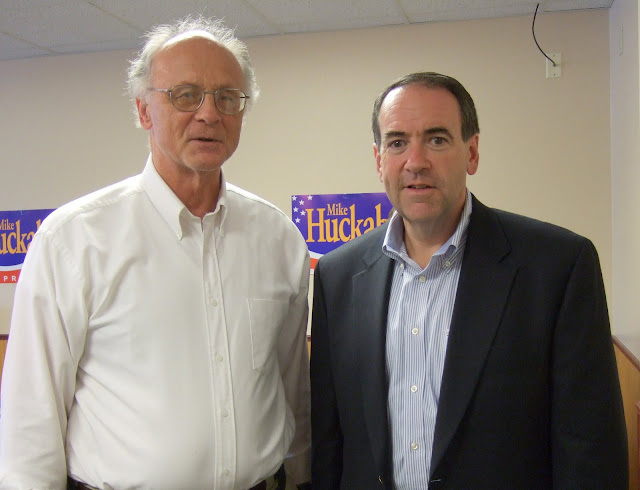
This round, my first Republican favorite was Indiana Governor Mitch Daniels. (See IN.gov/gov, and Mitch Daniels, wikipedia.org.) Once Daniels made it clear he was not running, I switched to Jon Huntsman (see "And the winner is . . . Jon Huntsman; Jon Huntsman . . . Better than 'Least Worst Republican,'" June 26, 2011; and "Jon Huntsman, Jr.," wikipedia.org. And see, from 2007, "It's Huckabee; My Republican Pick: Governor Mike Huckabee," July 24, 2007.)

Now it's Mitt Romney.

"Oh, so do you really prefer him to Rick Santorum?" a friend asked, sarcastically.

That's a cheap shot.

As I've learned more about Romney, I've become increasingly impressed with his smarts, education, experience, accomplishments, commitment to public service, and obvious managerial ability in running a presidential campaign. Today I would say of him (as I said earlier about Jon Huntsman), Mitt Romney is much, much better than just the "least worst Republican."

He has a lot more going for him than the fact that he is the obvious best choice from among the final four.

In 2007-08, as the candidates were touting their "experience" as qualifying them to be president, I gave some thought to "Just what is the experience that would qualify someone to be president?" Here's an abbreviated excerpt from an op ed column I wrote on the subject at that time:
There’s no perfect, qualifying “experience.” But two things can help.
One is experience at administering large institutions: a federal cabinet-level department, a state government, military branch, major university or corporation.

The other is the understanding and rapport earned by having worked in institutions with which a president must relate: city, county and state government; the federal executive, legislative, judicial and administrative branches; international organizations and embassies; labor unions and Wall Street, among others.
By these standards both Democrats and Sen. John McCain are unimpressive.
Nicholas Johnson, "Politics: Assessing Candidates' 'Experience,'" The Gazette, March 30, 2008, p. A9, embedded in blog, with links to many more items, in "Gazette Op Ed: Candidates' 'Experience,'" March 30, 2008.

At that time Governor Bill Richardson came the closest to the range of experiences I thought useful. Mitt Romney doesn't rank that high, given his relative lack of experience with the House, Senate, White House, and Cabinet positions. And his work with the Olympics, while useful, is not exactly the same as the State Department, an ambassadorship, or the United Nations, World Bank, IMF or other international organization. But he has been a governor (and in a state where he had to work with Democrats), which comes the closest to any training we have for the presidency, he's administered other large institutions (Bain; the Olympics; this year's campaign), and certainly has ties with Wall Street and the business community.

You may have noticed that I've said nothing so far about his likely positions on the issues, were he to become president. He would probably seldom come up with the solutions that I would. For example, if trade unionism has been, and could be again, America's shortest path to a vibrant middle class -- or if the quickest and cheapest way out of a recession is for the federal government to become the employer of last resort -- Romney would probably prefer driving a paved road (i.e., financial aid to the wealthy "job creators") to walking my dusty path to prosperity.

Many of these differences are candidly laid out in his campaign document, Believe in America: Mitt Romney's Plan for Jobs and Economic Growth, September 1, 2011 (listing "Romney for President" as the author), which is available as a pdf file from the Romney campaign Website and as free Kindle download from Amazon.

For example, in the opening section, "Day One, Job One; Five Bills for Day One; Five Executive Orders for Day One," one of the top five executive orders is "An Order to Empower American Businesses and Workers: Reverses the executive orders issued by President Obama that tilt the playing field in favor of organized labor, including the one encouraging the use of union labor on major government construction projects," p. 7. (I suspect there are a good many workers who would willingly forgo this "empowerment.") Among Romney's tax proposals are reducing the corporate tax to 25%, continuing the present low rates on capital gains, and abolishing the estate tax (currently only applied to estates over $5 million) -- proposals unlikely to do much to stimulate consumer spending by the working poor and unemployed, pp. 37-47, 154.)

Moreover, even if he wanted to give a hand up to the 99%, he would be opposed by the same special interests that President Obama is now confronting.

As for his position papers and statements during the past year, this is a Republican primary campaign, after all. Romney needs the support of the members of a party that has largely lost its rational middle. His opponents charge him with not being conservative enough! I give him (and other candidates) some slack regarding what they say and do while campaigning (within limits).

His opponents' charges that he is the "Etch A Sketch" candidate is another bum rap, in my view. Peter Grier, "Romney Etch A Sketch: Is aide's comment a present for his foes?" Christian Science Monitor, March 22, 2012 ("Asked whether Mr. Romney had moved too far to the right for the general election, [senior Romney aide Eric] Fehrnstrom said [on CNN] that the GOP hopeful would hit a reset button for the fall campaign. 'It’s almost like an Etch A Sketch,' he said. 'You can kind of shake it up and restart it all over again.' . . . Romney’s primary opponents immediately seized upon the image of an erasable toy to project their doubts about the depths of Romney’s conservatism. Both Rick Santorum and Newt Gingrich held up Etch A Sketches at rallies on Wednesday.") Fehrnstrom's choice of metaphor may have been very unfortunate, but he spoke the truth about all candidates. Hopefully candidates don't outright lie during the primary and general election campaigns, but is it really news that they change emphasis and nuance as they must appeal, first to their own party's extremes, and then to the independents in the middle during the general election? Indeed, what they say and how they say it will vary from town to town and audience to audience.

What some others see as his shortcomings, I see as positives. I may well be wrong, but what others see as flip-flopping I see as managerial pragmatism. We've seen what ideological purity, and refusal to negotiate let alone compromise, has produced in Washington. President Obama is kind of a pragmatist, albeit one who gives in too much and too early (in my judgment). Romney's experience as Massachusetts' governor qualifies him to do as well, or better.

Some others are troubled by his Mormon religion. I see it as a positive. Santorum's vision of an American version of the Taliban, using government to impose one group's religious and social values on the rest of us, appeals to me not at all. As a fallen-away Unitarian, I have studied, and participated in, most of the world's most popular religions at one time or another (including the Mormon) as I've worked out my own. Whether you call it religion, ethics, or morality, I think it useful for individuals (and the communities in which they live) to carry a moral compass that they check for directions from time to time. Maybe it's no more than a hunch, but Romney seems to have that.

Nor do I find his seeming inability to speak the language of ordinary Americans disqualifying -- that his tie to NASCAR fans is that he knows a number of folks who own race teams, his appeal to UAW members is that his wife has two Cadillac cars, that his income from lecture fees is only a modest $300,000-plus. I find such unscripted comments almost charming in an odd sort of way. For more from this perspective, see Ashley Parker and Michael Barbaro, "The Retooled, Loose Romney, Guessing Voters’ Age and Ethnicity," New York Times, December 28, 2011, p. A1.

My wife sees in some politicians a quality she calls "Elvis." Bill Clinton had "Elvis." Romney clearly does not.

What I see in Romney is a bright, well informed, analytical, hard working, focused, pragmatic, problem-solving manager. A little touch of "Elvis" would be comforting, but it doesn't trump the other qualities. See Ashley Parker and Michael Barbaro, "Romney Takes Analytic Approach to Campaign Chaos," New York Times, February 28, 2012, p. A16 ("Mr. Romney’s once inevitable-seeming march toward the Republican nomination has endured an agonizing stretch of setbacks . . ., unexpected challenges . . . and verbal mishaps . . .. So the candidate is taking refuge in what he knows best: rigorous analysis of the problem and a calm determination to execute a long-term plan. 'He just sits down and is cold and clinical and analytical,' said John H. Sununu, a former governor of New Hampshire and a Romney adviser who has spent hours with him on the campaign trail.")

Some reports of his relationships as governor with the Massachusetts legislators are a little troublesome. Michael Barbaro, "Legislators Recall Governor Who Didn't Mingle," New York Times, March 10, 2012, p. A1 ("For officials used to the glad-handing and alcohol-lubricated culture of local politics, Mr. Romney was an unfamiliar breed: a data-driven chief executive used to delivering unquestioned orders, a political newcomer who cast the legislature as a foe, a delegator who preferred working with just the leadership and an emotionally remote figure who tended not to socialize — and because of his Mormon religion did not drink. Even though he worked just a few hundred feet from them for four years, Mr. Romney displayed little interest in getting to know lawmakers and never developed real relationships . . ..") A president can probably get by with no "Elvis," but they all need a little "LBJ."

One of the most insightful columns about Romney (meaning the author shares my instincts about the man) is David Brooks, "The Wealth Issue," New York Times, January 20, 2012, p. A27 ("[I]s Mitt Romney’s character formed by his wealth . . . corrupted by ease and luxury? The notion is preposterous. All his life, Romney has been a worker and a grinder. He earned two degrees at Harvard simultaneously (in law and business). He built a business. He’s persevered year after year, amid defeat after defeat, to build a political career . . . the sort of relentlessness that we associate with striving immigrants, not rich scions. . . . George Romney, Mitt’s father, was born in Mexico. But when he was 5, in 1912, Mexican revolutionaries confiscated their property and threw them out. . . . Within days, they went from owning a large Mexican ranch to being penniless once again, drifting from California to Idaho to Utah, where again they built a fortune. . . . Romney . . . may have character flaws, but he does not have the character flaws normally associated with great wealth. His signature is focus and persistence. The wealth issue is a sideshow.")

We have been well served by some presidents, governors and senators of wealth; George H.W. Bush, Franklin Roosevelt, the three Kennedy brothers, and the Rockefellers come to mind. Wealth can carry with it a sense of oblesse oblige, a sense of independence from the baser political pressures. I don't know enough about Romney today, or his Massachusetts record, to have a sense of how he scores on this quality, or would as president. But while I don't think wealth "is a sideshow" in this context, neither should it be disqualifying.

And that's my response to the question: "Why Mitt Romney?"

# # #

Sunday, June 26, 2011

And the winner is . . . Jon Huntsman

June 26, 2011, 3:00 p.m.

Jon Huntsman . . . Better than "Least Worst Republican"

Every four years about this time I begin taking a look at the Republican field of presidential candidates.

There are two reasons why I'd probably never end up voting for any of them, and at least one reason why I engage in this exercise anyway.

Although I've become increasingly non-partisan over the years, and increasingly willing to give serious consideration to thoughtful ideas from anywhere on the political spectrum, my political activity, such as it has been, has been based in the Democratic Party. I've been registered as a Democrat, a Precinct Co-Chair for the Democrats, a member of the Party's county central committee, ran for Congress in a Democratic primary, and received three presidential appointments from Democratic presidents.

Secondly, no matter how wonderful a presidential candidate of either party might be, he or she brings with them a cast of thousands to which at least some deference must be paid. (Although, as President Obama has shown the Democratic Wing of the Democratic Party that got him the nomination and much of the election, it need not be all that much deference.) I'm not thrilled with the national and Iowa leadership of either party. But given what the Republicans have shown me in the House of Representatives in Washington, and Des Moines, I think I'd rather have the Democratic Party's gang of party members, contributors, political consultants, staffers, lobbyists and elected officials than theirs.

So why do I bother evaluating the Republican candidates for president?

Because, given our system, the president is virtually guaranteed to be either a Democrat or Republican. One of them is going to win, and govern us for better or worse. That's why I'm not interested in promoting the Republican candidate least likely to win. I'm interested in promoting the Republican candidate who, if she or he wins, will do the best job. ("Promoting" may be a bit strong; I'm not going to contribute money to, or time to "campaigning" for, Huntsman. But every American's water cooler, and family dinner table, conversations contribute something to the national dialogue first reflected in public opinion polls, and ultimately in election results. So do blog entries, comments on call-in radio programs, letters to the editor in newspapers, and the other ways we express ourselves.)
The one thing that does unite Democrats and Republicans every election year is their fear and hatred of third parties. Third parties have been the source of many of the most progressive legislative solutions to our nation's challenges, such as child labor laws, wages and hours legislation, and Social Security. Everyone, even the two major parties, would be aided by innovative approaches such as instant runoff election, and fusion tickets. The two parties unite in stopping such innovations, because they would also showcase the popular support the third parties would have. The two parties tightly control the presidential debates, setting the bar to entry so high as to almost always eliminate popular third party candidates from their primary means of reaching the American voters with their message. The net result is that business, the wealthy -- the plutocracy -- continue to control both parties with campaign contributions. As New York's Boss Tweed used to say, "I don't care who does the electing, just so long as I do the nominating." They are the ones who are doing the nominating for both parties.
Whatever the reasons for, and consequences of, our two party system, the fact is that every American, including especially those who don't even bother to vote in the general election, has a stake the candidates offered us every four years for the presidency.

This year my first Republican favorite was Indiana Governor Mitch Daniels. (See IN.gov/gov, and Mitch Daniels, wikipedia.org.) That was when, like roughly a third of Republicans still today, I'd never heard of Huntsman. Once Daniels made it clear he was not running, I started looking elsewhere.

Iowans are used to not only meeting, but conversing with, the presidential candidates -- and more than once -- before (literally) standing with their choice at the precinct caucus. Given that Huntsman has chosen to skip Iowa -- a publicized, if only temporary, disastrous choice of Hillary Clinton in 2007-08 -- I will probably never have the opportunity to talk with him.

Nor have I done all the research on Huntsman I will have done by the time the caucuses are held. So you have access to the same information I do from the Internet.

(Ambassador Huntsman in Beijing, riding his bike to meetings rather than taking the long, black limo. Photo credit: Huntsman Web page.)

Here are some obvious sources:

There are at least three steps into his personal Web site, http://www.jon2012.com/. That link opens on "the daily video." (Today it shows him at a quick-draw shooting range. Given his positions on "God, guns and gays," it's about his only opportunity to rally some Republican support.) Click "skip" and you're on the U.S. map of his Facebook followers: http://www.jon2012.com/user/facebook. That gives you the choice to "Connect with Facebook" or "Sign up without Facebook." Scroll to the very bottom and you can click on "Skip Sign Up." Click on that (the URL will change from day to day) and you've reached what amounts to the opening Web page.

The Web resources are certainly up to today's voters' technological expectations. He has the "daily videos," a daily Twitter comment, Facebook discussions, blog, speeches, press Web page, background information about his positions on issues and career. (Wikipedia offers a summary: "Jon Huntsman, Jr.," wikipedia.org.)

We don't really have a training program, or conventional career track, for presidents, similar to that in parliamentary systems (i.e., member, minister, prime minister). The closest we come is former governors (e.g., Carter, Reagan, Clinton, and Bush). Goodness knows, time as a governor -- managing multiple departments, balancing budgets, partisanship and special interests -- is helpful. But the presidency requires so much more -- an understanding of diverse cultures and the resulting international relations, creating and overseeing the world's largest (and most expensive) military (with bases in 150 countries and multiple wars), personal familiarity with the inner workings of the House and Senate, federal-state relations, the life and role of cabinet officers. The list goes on.

Governor Bill Richardson had the most thorough resume among the Democratic Party candidates in 2007-08, but in the end the significance of his experience (e.g., member of Congress; governor; UN Ambassador; cabinet officer) never registered with the voters.

Among the electorate are some who seem to be judging candidates more on their race and religion, appearance and hair style, whether they'd be a good person to drink beer with, or their position on gay marriage, than on their relevant knowledge, experience, record of accomplishment, and ability to govern our nation. Thus, Huntsman's qualifications may be of no more relevance than were those of Richardson.

Jon Huntsman (he's a "Jr.," and there's now a Jon III) came from great wealth. But it seems to have inspired a life more focused on public service than that of a playboy (though he's kept his high school keyboarding talent) -- in the spirit of the Rockefeller and Kennedy children. Huntsman started early, from Eagle Scout, to his two-year missionary tour in Taiwan, to working for Senator Orin Hatch, and then President Reagan, by the time he was 22. At 32 he had already held three presidential appointments: Deputy Assistant Secretary for the Trade Development Bureau of the Commerce Department; Deputy Assistant Secretary of commerce for East Asia and the Pacific; and U.S. ambassador to Singapore (the youngest head of a U.S. diplomatic mission in a century).

His knowledge of China (including fluency in Mandarin) is a major asset for any U.S. president in the 21st Century.

And his comment that "I can't say I am overly religious. I get satisfaction from many different types of religions and philosophies," obviously appeals to the Unitarian in me -- given that the Unitarians provide extra points, rather than excommunication, for visiting other churches. Statement quoted in, Kirk Johnson, "Two G.O.P. Hopefuls Divide the Voters in Deep-Pocketed Utah," New York Times, June 26, 2011, p. 17.

He has had substantive experience running the family business, including its international expansion. There are reasons why the Pew Center on the States ranked Utah as the best-managed state in the nation, and why he was re-elected in 2008 with 78% of the vote (including -- understandably, it's not now on his Web site -- 36% of those registered as Democrats).

Clearly, his major hurdle will be getting the support of his Party's ultra-conservatives and religious right. (Business, the wealthy, and professionals who are Republicans should flock to him.)

If the Republicans were smart enough to give him the nomination, and the economy continues to stagnate or worse, he could very well win the election against Obama. But, as Matt Bai notes in today's [June 26] New York Times Magazine ("'Is It Always Like This?'", p. MM36) "Of those [Republican voters] who said they had heard of him, 36 percent said there was no chance he'd win their vote." (If you're interested in Huntsman, that piece also has some insightful information you'll want to know about one of Huntsman's top political advisers, John Weaver.)

Bai asserts that "Huntsman believes in the science of climate change, and he favors civil unions for gay couples and leniency for the children of illegal immigrants." I would support other things he's done, and positions he's taken (though of course not all), but I'm especially attracted to Bai's report that Huntsman "refused, bizarrely, to describe himself as a conservative. Huntsman said he didn’t like political labels, but if he had to pick one, he considered himself a 'pragmatic problem-solver.'" It's the ideologues who seem to be creating the roadblocks to progress in Washington (and Des Moines). We could do with more "pragmatic problem-solvers."

Clearly, as a conservative, Huntsman shares Huckabee's feeling that "he's just not angry about it."

There has already been a lot written by others about Huntsman. There will be much more. It will inevitably at least revise some of the particulars in my judgments about Huntsman. But based on what I now know, and the current field of Reublican candidates for their Party's presidential nomination, he's this Democrat's favorite Republican for 2011 and 2012.

And see Stanley Fish's comparable conclusions the next day, "Handicapping Huntsman," Opinionator/New York Times, June 27, 2011, 8:30 p.m.

# # #

Here, for the record, are the results of my analysis four years ago:

In 2008 my choice from among the Republicans was Mike Huckabee. "It's Huckabee; My Republican Pick: Governor Mike Huckabee," July 24, 2007.

Needless to say, I didn't pick him for his positions on the issues or his religious convictions. We would have disagreed about virtually everything -- up to and including evolution and the origins of the universe. What I liked was his experience (and record) as a governor, what seemed to be a kind of basic decency, and a sense of humor.

What first caught my ear was his rejoinder to being questioned about his conservative credentials. He responded something like, "Oh, I'm a conservative all right, I'm just not angry about it."

Asked if he was "pro-life," he responded something along these lines: "Of course, I believe in right to life. I just don't think the right to life stops at the end of the birth canal. I think a right to life has to include a right to nutrition, housing, health care and education."

When I first met him he expressed the same thought in another context: national security. National security, he said, requires a nation's ability to provide its citizens food and fuel, a better educational system and health care for all Americans. It was reminiscent of one of Dennis Kucinich' chants about "weapons of mass destruction": "poverty is a weapon of mass destruction," "lack of health care is a weapon of mass destruction." At worst, Huckabee's comment demonstrated a comprehension of how social programs have to be packaged to be sold; at best, it provided a clue as to what he'd really like to see government do.

He said we need both a global perspective and a focus on our internal needs, using as an analogy the way he inspects a plane before he boards: "I'm not just interested in the left wing or the right wing; I'd kind of like for both of them to be there."

My feelings about Huckabee were similar to my feelings about the last Pope. John Paul was Catholic. I was not. We disagreed about a number of issues -- including the role of women in the church, contraception, and the propriety of government mandated laws prohibiting abortion. But he was just about the only world leader then speaking out on issues of war, peace and poverty. It seemed to me you had to give him credit for that.

There was a soft side to Huckabee. He met people easily. He came across as friendly, comfortable, relaxed and genuine -- as well as often genuinely funny.

He told of being asked if he was "one of those narrow minded Baptists who thinks only Baptists are going to heaven." He replied, "No. I'm even more narrow minded than that. I even know a good many Baptists who aren't going to heaven."

He can use self-deprecating humor: "I'm leading in New Hampshire," he said. "The biggest percentage favors 'None of the above.' And that's me; I'm 'none of the above.'" At another point he referred to feeling like "a fireplug in a neighborhood of dogs" -- though, alas, I can't now remember the context.

So that was some of what led me to Huckabee four years ago -- while working to get Obama nominated and elected.

# # #

Saturday, December 22, 2007

Op Ed: Caucus Choices Analysis [Dec. 22]

December 22, 2007, 6:00 a.m.

Democrats who attend their precinct caucus the evening of January 3 will suffer the blessing of too many wonderful choices. Here's this morning's [Dec. 22] op ed with my suggested analysis for sorting through them to a choice. (And see also on that page the adjoining column by former Congressman Jim Leach, "We should look to Eisenhower, not Reagan, in 21st century.")

Qualities to keep in mind when picking a president

Nicholas Johnson

Iowa City Press-Citizen

December 22, 2007, p. 15A

__________


All the Democratic Party's presidential candidates would make good-to-excellent presidents. How to choose?

Here are some suggestions from an Iowa-born old Washington hand.

• Don't miss the caucus. Take a friend. New York's Boss Tweed said, "I don't care who does the electing, just so long as I do the nominating." This is your chance to do the nominating. Plus, it's fun.

• Don't rely on "positions" and rhetoric. A campaign is not a presidency. Even if meaningful and honestly spoken, political forces and conditions change.

• Forget "electability." Any Democratic Party nominee is electable in 2008. (Although Sen. Hillary Rodham Clinton's high negatives create some risk.) Consider their ability to govern.

• Forget the media's top three. Clinton, Sen. Barack Obama and former Sen. John Edwards are going to New Hampshire regardless. Use your chance to "vote twice." Support one of the others you want kept in the race. If they're not initially "viable" at your caucus you can switch.
Experience at everything

All have "experience" at something. But a president needs experience at everything. Who has the broadest, deepest range of experience?

An American president is policy wonk in chief as well as commander in chief. Federal personnel director as well as national cheerleader. They must maintain our economy while improving our foreign relations. Above all, they must have superior, large-institution administrative skills and experience.

When they negotiate and deal with other major institutions it gives them credibility as well as real understanding if they've worked within them: Congress, cabinet positions, municipal and state governments, international organizations, and negotiations with foreign leaders.

We don't have a school for presidents. There's no parliamentary system to provide the ultimate prime ministers both administrative and legislative experience.

Quality rankings

So here are the qualities I'm looking for -- followed by my opinion of who ranks highest.

• Experience administering large institutions (state or large city governments, corporations) -- Gov. Bill Richardson (governor; Secretary of Energy), Rep. Dennis Kucinich (mayor of Cleveland).

• A "people person" with charisma or down-home manner, sense of humor (including self-deprecation), or what Molly Ivins called "Elvis" -- Obama (charisma and "Elvis"), Richardson (down-home; humor).

• The understanding and credibility earned by working inside both Washington's executive and legislative branches -- Richardson (cabinet (Energy), Congress). (Legislative: Clinton, Edwards, Kucinich, Obama, Richardson and Senators Joe Biden and Chris Dodd).

• A willingness to put forward courageous, "best policy" proposals, rather than "starting off backing up" --Kucinich (only one to organize and vote against the war, and propose universal single-payer health care rather than for-profit insurance).

• Experience working inside international organizations (e.g., U.N., World Bank) -- Richardson (UN ambassador).

• Understanding of the elements and process of citizen empowerment -- Obama (community organizer).

• An understanding of foreign policy (as distinguished from administering it) -- Biden, Dodd (plus, of course, Richardson).

• An ability to work with, but an independence from, special interest money and influence (the "Washington Establishment") -- My guess is that all have, can (and will have to) work with Washington's real power centers.

However, Clinton's strength in this department is her weakness. She and Bill could probably name all of their 4,000 presidential appointees in one evening without notes. But part of the reason for their millions from corporate lobbyists and PACs is the Washington Establishment's expectation of another pro-corporate, business-as-usual Clinton administration.

• Experience negotiating with foreign leaders -- Richardson (North Korea, Iraq, Sudan; U.N.; return of hostages); Biden and Dodd.

• Champion of the underdog -- Edwards, Kucinich.
You may have a different list of qualities and evaluation of candidates. But I hope this kind of approach may be helpful to you in a year when we are blessed with a very tough choice from among excellent candidates.
_______________
Nicholas Johnson served as maritime administrator, FCC commissioner and presidential adviser for a White House Conference during the terms of three presidents. He now teaches at the University of Iowa College of Law and maintains the blog, FromDC2Iowa.blogspot.com.,/i>

# # #