Showing posts with label Governor Jon Huntsman. Show all posts

Saturday, September 22, 2012

Abandoning Romney

September 22, 2012, 2:40 p.m.

Foreign Relations Disqualification, Now Domestic, Too

Last March I wrote a favorable blog entry about Mitt Romney. "Why Mitt Romney? Better than 'Least Worst' Republican," March 22, 2012. Today I need to provide a significant addendum to those remarks.
Why Romney?

The March blog entry explained how I got to Romney: "This [every-four-years] round, my first Republican favorite was Indiana Governor Mitch Daniels. (See IN.gov/gov, and Mitch Daniels, wikipedia.org.) Once Daniels made it clear he was not running, I switched to Jon Huntsman (see "And the winner is . . . Jon Huntsman; Jon Huntsman . . . Better than 'Least Worst Republican,'" June 26, 2011; and "Jon Huntsman, Jr.," wikipedia.org."

My addendum today is that I should have stuck with those choices rather than compulsively moving on to the third in line because of an irrational felt need to list somebody.

For what I realize today is that Romney has now demonstrated, during the ensuing months, a lack of the ability to be an acceptable president -- first with regard to foreign affairs, and now domestic as well.

Why would I, a Democrat -- albeit one who wishes we'd promptly enact instant-runoff voting so that I could vote in elections with both my heart and my head -- bother to write anything favorable about a Republican challenger to a Democratic president seeking re-election? As I wrote in March, after the November election "the president is virtually guaranteed to be either a Democrat or Republican -- whether chosen by the voters or the Supreme Court justices. . . . I'm not interested in encouraging the nomination of the Republican candidate least likely to win. I want the Republican candidate who, if she or he wins, will do the best job."

As I was quick to make clear, "That doesn't mean I'll be sending them money, going door-to-door on their behalf, or voting for them. . . . I've said nothing so far about his [Romney's] likely positions on the issues, were he to become president. He would probably seldom come up with the solutions that I would."

But I was willing to grant, "As I've learned more about Romney, I've become increasingly impressed with his smarts, education, experience, accomplishments, commitment to public service, and obvious managerial ability in running a presidential campaign. . . . What I see . . . is a bright, well informed, analytical, hard working, focused, pragmatic, problem-solving manager. A little touch of 'Elvis' would be comforting, but it doesn't trump the other qualities." I considered his Mormon religion a plus. ("I think it useful for individuals . . . to carry a moral compass that they check for directions from time to time.")

His lack of "Elvis" appeared almost endearing at that time; a man with six homes, one of which had elevators for his automobiles, making the efforts of a somewhat sheltered, shy, very wealthy guy trying, and failing, to reach out to working- and middle-class Americans: "Nor do I find his seeming inability to speak the language of ordinary Americans disqualifying -- that his tie to NASCAR fans is that he knows a number of folks who own race teams, his appeal to UAW members is that his wife has two Cadillac cars, that his income from lecture fees is only a modest $300,000-plus. I find such unscripted comments almost charming in an odd sort of way."

His Foreign Relations Lack Sensitivity, Knowledge, Common Sense

The first evidence of Romney's lack of foreign relations finesse came, one, two, three, during his London-Israel-Poland trip. "Romney as Ambassador-in-Chief; When Experience and Common Sense Matter," July 31, 2012.

Another shocking revelation came during his ill-fated remarks at the fund raising event in Boca Raton on May 17: "And I look at the Palestinians not wanting to see peace anyway, for political purposes, . . . and these thorny issues, and I say there's just no way. . . . [I]t's going to remain an unsolved problem." "Full Transcript of the Mitt Romney Secret Video," Mother Jones, September 19, 2012. Other comments of his on this, and other, occasions reveal an almost total reliance on an ever-increasing military budget (without specifying how it would be spent), and absence of his awareness of the role of diplomacy, intelligence gathering, police (as distinguished from military) presence, Peace Corps and student and other exchanges of citizens, and foreign aid -- as at least a part of an integrated approach to dealing with the world's problems and our best national interests.

Most recently his unfortunate and untimely comments at the time of the uprisings in Libya and Egypt were greeted with disapproval from all quarters -- including thoughtful Republicans with foreign relations experience. See, e.g., Jack Mirkinson, "Mitt Romney Response To Libya, Egypt Attacks Called 'Irresponsible,' 'Craven,' 'Ham-Handed,'" The Huffington Post, September 12, 2012 ("Many members of the media reacted with puzzlement and criticism to Mitt Romney's continuing criticism of the White House response to the deadly attacks in Libya and Egypt. The Romney campaign drew fire on Wednesday morning for issuing a blistering statement condemning the American embassy in Egypt . . ..").

His Ignorance of the American People is Appalling

You've probably already seen this quote. But here are portions of it again, before some comments about its significance.

"There are 47 percent of the people who will vote for the president no matter what. All right, there are 47 percent who are with him, who are dependent upon government, who believe that they are victims, who believe that government has a responsibility to care for them, who believe that they are entitled to health care, to food, to housing, to you name it. That that's an entitlement. And the government should give it to them. And they will vote for this president no matter what. . . .

"These are people who pay no income tax. Forty-seven percent of Americans pay no income tax. So our message of low taxes doesn't connect. . . . And so my job is not to worry about those people — I'll never convince them that they should take personal responsibility and care for their lives."
"Full Transcript of the Mitt Romney Secret Video," Mother Jones, September 19, 2012 (transcriiption by Sydney Brownstone, Maya Dusenbery, Ryan Jacobs, Deanna Pan, and Sarah Zhang).

Where to begin? For starters, his math and assertions are a little confusing and garbled. (1) It's true that something like 47% of the American people pay no "federal income tax." (2) There is a percentage of both Republicans and Democrats that can be counted on to register and vote, and to vote for their parties' candidates. I don't have such numbers, but would doubt that they reach 47% of "the people" for either party. (3) There are undoubtedly some people who come close to Romney's description. Again I have no numbers; they probably don't exist. But whatever they are, they aren't 47% of "the people." (4) Nor is there an overlap between all these 47% -- those who feel they are "entitled," who also don't pay income taxes, who also all will vote for President Obama. (5) In fairness, one tries to turn "my job is not to worry about those people" into a strategic comment about his conduct of a campaign; that he needs to concentrate on those who have not yet made up their minds, rather than those who will vote for Obama no matter what. But when he follows it with "I'll never convince them that they should take personal responsibility" it ends up sounding more judgmental, and dismissive, than strategic politics.

His comments about the payment of taxes are particularly ironic. (1) One who is unemployed, unable to work due to disability or age (either too young or too old), or living in poverty as a member of the working poor, may well have good reason for not paying federal income tax. (2) However, there are very few among those Americans who don't qualify as federal income tax payers who are not "taxpayers." The largest group is paying payroll taxes (now 15% according to Romney). There are the FICA (Social Security) and Medicare payments, state income taxes, sales taxes, property taxes, gasoline taxes, and a variety of other payments to the federal and states' governments.

Note, there is no significant difference between (a) someone who owes $10,000 in federal income tax, pays it, but qualifies for a $1000 federal payment of one kind or another, and (b) someone who would owe $10,000 in federal income tax, but doesn't need to pay it, because they qualify for a 10% lower income tax rate. Both end up netting $9000 to the government.

Now consider Mitt Romney's "entitlement." His tax on his just-reported 2011 adjusted gross income of $13.7 million, at even a mere 35%, would have been $4.8 million. Instead, it was only $1.9 million -- that looks to me like nearly $3 million less than what his secretary would have to pay, if he paid her a salary of $13.7 million. A pretty hefty entitlement I'd say. And based on his insistence of even greater tax breaks for the "job creators" it's not unfair to call it the equivalent of the "entitlements" he criticizes in others. Nicholas Confessore and David Kocieniewski, "Romney Reveals He Paid 14% Rate in '11 Tax Return," New York Times, September 22, 2012, p. A1.

Moreover, quoting from the Times, "Mr. Romney’s tax return for last year showed just how sensitive a political matter his wealth and tax rate has become. In a bit of reverse financial engineering, he and his wife, Ann, gave up $1.75 million worth of charitable deductions, raising his tax payments significantly.

"Had he claimed all the deductions to which he was entitled in 2011, his effective rate could have dipped to near 10 percent, contradicting his past assurances that he had never paid below 13 percent.

"But forgoing the full deductions available to him put him at odds with his own past assertions that he had never paid more taxes than he owed and his statement that if he had done so, 'I don’t think I’d be qualified to become president,” as he put it to ABC News in July.'"

(Although well beyond merely cynical, I assume that after the election he could file an amended return and get the full benefit of his unused deductions.)

But so far we've just considered the inconsistencies, miscalculations and ironies in his remarks. Let us turn for a moment to what is most troublesome.

It's fair, I believe, putting aside his erroneous 47%, to conclude that he truly believes there are a significant number of the American people "who are dependent upon government, who believe that they are victims, who believe that government has a responsibility to care for them, who believe that they are entitled to health care, to food, to housing, to you name it. That that's an entitlement. And the government should give it to them. . . . [And that he will] never convince them that they should take personal responsibility and care for their lives."

Unlike last March, when I found "such unscripted comments [demonstrating his detachment from ordinary Americans] almost charming in an odd sort of way," these remarks are no longer charming. In addition to the ignorance they reveal, his distance from, and lack of empathy for, the bulk of the American people, they are also mean spirited in a way I formerly assumed did not exist within Romney. Apparently they do.

Coupled with Romney's demonstrated lack of intuitive competence and common sense with regard to foreign relations, I must with sorrow go back to my original selections of Daniels and Huntsman as the ones the Republicans should have chosen -- albeit too late in the campaign to do the Party any good.
# # #

Sunday, June 26, 2011

And the winner is . . . Jon Huntsman

June 26, 2011, 3:00 p.m.

Jon Huntsman . . . Better than "Least Worst Republican"

Every four years about this time I begin taking a look at the Republican field of presidential candidates.

There are two reasons why I'd probably never end up voting for any of them, and at least one reason why I engage in this exercise anyway.

Although I've become increasingly non-partisan over the years, and increasingly willing to give serious consideration to thoughtful ideas from anywhere on the political spectrum, my political activity, such as it has been, has been based in the Democratic Party. I've been registered as a Democrat, a Precinct Co-Chair for the Democrats, a member of the Party's county central committee, ran for Congress in a Democratic primary, and received three presidential appointments from Democratic presidents.

Secondly, no matter how wonderful a presidential candidate of either party might be, he or she brings with them a cast of thousands to which at least some deference must be paid. (Although, as President Obama has shown the Democratic Wing of the Democratic Party that got him the nomination and much of the election, it need not be all that much deference.) I'm not thrilled with the national and Iowa leadership of either party. But given what the Republicans have shown me in the House of Representatives in Washington, and Des Moines, I think I'd rather have the Democratic Party's gang of party members, contributors, political consultants, staffers, lobbyists and elected officials than theirs.

So why do I bother evaluating the Republican candidates for president?

Because, given our system, the president is virtually guaranteed to be either a Democrat or Republican. One of them is going to win, and govern us for better or worse. That's why I'm not interested in promoting the Republican candidate least likely to win. I'm interested in promoting the Republican candidate who, if she or he wins, will do the best job. ("Promoting" may be a bit strong; I'm not going to contribute money to, or time to "campaigning" for, Huntsman. But every American's water cooler, and family dinner table, conversations contribute something to the national dialogue first reflected in public opinion polls, and ultimately in election results. So do blog entries, comments on call-in radio programs, letters to the editor in newspapers, and the other ways we express ourselves.)
The one thing that does unite Democrats and Republicans every election year is their fear and hatred of third parties. Third parties have been the source of many of the most progressive legislative solutions to our nation's challenges, such as child labor laws, wages and hours legislation, and Social Security. Everyone, even the two major parties, would be aided by innovative approaches such as instant runoff election, and fusion tickets. The two parties unite in stopping such innovations, because they would also showcase the popular support the third parties would have. The two parties tightly control the presidential debates, setting the bar to entry so high as to almost always eliminate popular third party candidates from their primary means of reaching the American voters with their message. The net result is that business, the wealthy -- the plutocracy -- continue to control both parties with campaign contributions. As New York's Boss Tweed used to say, "I don't care who does the electing, just so long as I do the nominating." They are the ones who are doing the nominating for both parties.
Whatever the reasons for, and consequences of, our two party system, the fact is that every American, including especially those who don't even bother to vote in the general election, has a stake the candidates offered us every four years for the presidency.

This year my first Republican favorite was Indiana Governor Mitch Daniels. (See IN.gov/gov, and Mitch Daniels, wikipedia.org.) That was when, like roughly a third of Republicans still today, I'd never heard of Huntsman. Once Daniels made it clear he was not running, I started looking elsewhere.

Iowans are used to not only meeting, but conversing with, the presidential candidates -- and more than once -- before (literally) standing with their choice at the precinct caucus. Given that Huntsman has chosen to skip Iowa -- a publicized, if only temporary, disastrous choice of Hillary Clinton in 2007-08 -- I will probably never have the opportunity to talk with him.

Nor have I done all the research on Huntsman I will have done by the time the caucuses are held. So you have access to the same information I do from the Internet.

(Ambassador Huntsman in Beijing, riding his bike to meetings rather than taking the long, black limo. Photo credit: Huntsman Web page.)

Here are some obvious sources:

There are at least three steps into his personal Web site, http://www.jon2012.com/. That link opens on "the daily video." (Today it shows him at a quick-draw shooting range. Given his positions on "God, guns and gays," it's about his only opportunity to rally some Republican support.) Click "skip" and you're on the U.S. map of his Facebook followers: http://www.jon2012.com/user/facebook. That gives you the choice to "Connect with Facebook" or "Sign up without Facebook." Scroll to the very bottom and you can click on "Skip Sign Up." Click on that (the URL will change from day to day) and you've reached what amounts to the opening Web page.

The Web resources are certainly up to today's voters' technological expectations. He has the "daily videos," a daily Twitter comment, Facebook discussions, blog, speeches, press Web page, background information about his positions on issues and career. (Wikipedia offers a summary: "Jon Huntsman, Jr.," wikipedia.org.)

We don't really have a training program, or conventional career track, for presidents, similar to that in parliamentary systems (i.e., member, minister, prime minister). The closest we come is former governors (e.g., Carter, Reagan, Clinton, and Bush). Goodness knows, time as a governor -- managing multiple departments, balancing budgets, partisanship and special interests -- is helpful. But the presidency requires so much more -- an understanding of diverse cultures and the resulting international relations, creating and overseeing the world's largest (and most expensive) military (with bases in 150 countries and multiple wars), personal familiarity with the inner workings of the House and Senate, federal-state relations, the life and role of cabinet officers. The list goes on.

Governor Bill Richardson had the most thorough resume among the Democratic Party candidates in 2007-08, but in the end the significance of his experience (e.g., member of Congress; governor; UN Ambassador; cabinet officer) never registered with the voters.

Among the electorate are some who seem to be judging candidates more on their race and religion, appearance and hair style, whether they'd be a good person to drink beer with, or their position on gay marriage, than on their relevant knowledge, experience, record of accomplishment, and ability to govern our nation. Thus, Huntsman's qualifications may be of no more relevance than were those of Richardson.

Jon Huntsman (he's a "Jr.," and there's now a Jon III) came from great wealth. But it seems to have inspired a life more focused on public service than that of a playboy (though he's kept his high school keyboarding talent) -- in the spirit of the Rockefeller and Kennedy children. Huntsman started early, from Eagle Scout, to his two-year missionary tour in Taiwan, to working for Senator Orin Hatch, and then President Reagan, by the time he was 22. At 32 he had already held three presidential appointments: Deputy Assistant Secretary for the Trade Development Bureau of the Commerce Department; Deputy Assistant Secretary of commerce for East Asia and the Pacific; and U.S. ambassador to Singapore (the youngest head of a U.S. diplomatic mission in a century).

His knowledge of China (including fluency in Mandarin) is a major asset for any U.S. president in the 21st Century.

And his comment that "I can't say I am overly religious. I get satisfaction from many different types of religions and philosophies," obviously appeals to the Unitarian in me -- given that the Unitarians provide extra points, rather than excommunication, for visiting other churches. Statement quoted in, Kirk Johnson, "Two G.O.P. Hopefuls Divide the Voters in Deep-Pocketed Utah," New York Times, June 26, 2011, p. 17.

He has had substantive experience running the family business, including its international expansion. There are reasons why the Pew Center on the States ranked Utah as the best-managed state in the nation, and why he was re-elected in 2008 with 78% of the vote (including -- understandably, it's not now on his Web site -- 36% of those registered as Democrats).

Clearly, his major hurdle will be getting the support of his Party's ultra-conservatives and religious right. (Business, the wealthy, and professionals who are Republicans should flock to him.)

If the Republicans were smart enough to give him the nomination, and the economy continues to stagnate or worse, he could very well win the election against Obama. But, as Matt Bai notes in today's [June 26] New York Times Magazine ("'Is It Always Like This?'", p. MM36) "Of those [Republican voters] who said they had heard of him, 36 percent said there was no chance he'd win their vote." (If you're interested in Huntsman, that piece also has some insightful information you'll want to know about one of Huntsman's top political advisers, John Weaver.)

Bai asserts that "Huntsman believes in the science of climate change, and he favors civil unions for gay couples and leniency for the children of illegal immigrants." I would support other things he's done, and positions he's taken (though of course not all), but I'm especially attracted to Bai's report that Huntsman "refused, bizarrely, to describe himself as a conservative. Huntsman said he didn’t like political labels, but if he had to pick one, he considered himself a 'pragmatic problem-solver.'" It's the ideologues who seem to be creating the roadblocks to progress in Washington (and Des Moines). We could do with more "pragmatic problem-solvers."

Clearly, as a conservative, Huntsman shares Huckabee's feeling that "he's just not angry about it."

There has already been a lot written by others about Huntsman. There will be much more. It will inevitably at least revise some of the particulars in my judgments about Huntsman. But based on what I now know, and the current field of Reublican candidates for their Party's presidential nomination, he's this Democrat's favorite Republican for 2011 and 2012.

And see Stanley Fish's comparable conclusions the next day, "Handicapping Huntsman," Opinionator/New York Times, June 27, 2011, 8:30 p.m.

# # #

Here, for the record, are the results of my analysis four years ago:

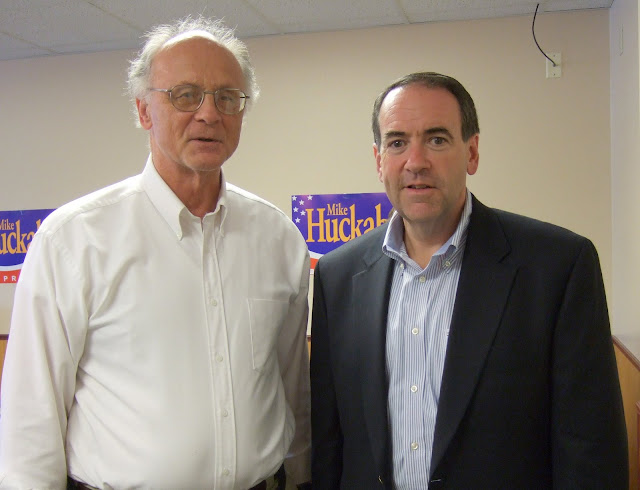
In 2008 my choice from among the Republicans was Mike Huckabee. "It's Huckabee; My Republican Pick: Governor Mike Huckabee," July 24, 2007.

Needless to say, I didn't pick him for his positions on the issues or his religious convictions. We would have disagreed about virtually everything -- up to and including evolution and the origins of the universe. What I liked was his experience (and record) as a governor, what seemed to be a kind of basic decency, and a sense of humor.

What first caught my ear was his rejoinder to being questioned about his conservative credentials. He responded something like, "Oh, I'm a conservative all right, I'm just not angry about it."

Asked if he was "pro-life," he responded something along these lines: "Of course, I believe in right to life. I just don't think the right to life stops at the end of the birth canal. I think a right to life has to include a right to nutrition, housing, health care and education."

When I first met him he expressed the same thought in another context: national security. National security, he said, requires a nation's ability to provide its citizens food and fuel, a better educational system and health care for all Americans. It was reminiscent of one of Dennis Kucinich' chants about "weapons of mass destruction": "poverty is a weapon of mass destruction," "lack of health care is a weapon of mass destruction." At worst, Huckabee's comment demonstrated a comprehension of how social programs have to be packaged to be sold; at best, it provided a clue as to what he'd really like to see government do.

He said we need both a global perspective and a focus on our internal needs, using as an analogy the way he inspects a plane before he boards: "I'm not just interested in the left wing or the right wing; I'd kind of like for both of them to be there."

My feelings about Huckabee were similar to my feelings about the last Pope. John Paul was Catholic. I was not. We disagreed about a number of issues -- including the role of women in the church, contraception, and the propriety of government mandated laws prohibiting abortion. But he was just about the only world leader then speaking out on issues of war, peace and poverty. It seemed to me you had to give him credit for that.

There was a soft side to Huckabee. He met people easily. He came across as friendly, comfortable, relaxed and genuine -- as well as often genuinely funny.

He told of being asked if he was "one of those narrow minded Baptists who thinks only Baptists are going to heaven." He replied, "No. I'm even more narrow minded than that. I even know a good many Baptists who aren't going to heaven."

He can use self-deprecating humor: "I'm leading in New Hampshire," he said. "The biggest percentage favors 'None of the above.' And that's me; I'm 'none of the above.'" At another point he referred to feeling like "a fireplug in a neighborhood of dogs" -- though, alas, I can't now remember the context.

So that was some of what led me to Huckabee four years ago -- while working to get Obama nominated and elected.

# # #