. . . because much of the content relates both to Washington, D.C., and "outside the beltway" -- the heartland, specifically Iowa -- and because after going from Iowa to Washington via Texas and California I subsequently returned, From DC 2 Iowa.
Showing posts with label Governor Mike Huckabee. Show all posts
Showing posts with label Governor Mike Huckabee. Show all posts
Jon Huntsman . . . Better than "Least Worst Republican"
Every four years about this time I begin taking a look at the Republican field of presidential candidates.
There are two reasons why I'd probably never end up voting for any of them, and at least one reason why I engage in this exercise anyway.
Although I've become increasingly non-partisan over the years, and increasingly willing to give serious consideration to thoughtful ideas from anywhere on the political spectrum, my political activity, such as it has been, has been based in the Democratic Party. I've been registered as a Democrat, a Precinct Co-Chair for the Democrats, a member of the Party's county central committee, ran for Congress in a Democratic primary, and received three presidential appointments from Democratic presidents.
Secondly, no matter how wonderful a presidential candidate of either party might be, he or she brings with them a cast of thousands to which at least some deference must be paid. (Although, as President Obama has shown the Democratic Wing of the Democratic Party that got him the nomination and much of the election, it need not be all that much deference.) I'm not thrilled with the national and Iowa leadership of either party. But given what the Republicans have shown me in the House of Representatives in Washington, and Des Moines, I think I'd rather have the Democratic Party's gang of party members, contributors, political consultants, staffers, lobbyists and elected officials than theirs.
So why do I bother evaluating the Republican candidates for president?
Because, given our system, the president is virtually guaranteed to be either a Democrat or Republican. One of them is going to win, and govern us for better or worse. That's why I'm not interested in promoting the Republican candidate least likely to win. I'm interested in promoting the Republican candidate who, if she or he wins, will do the best job. ("Promoting" may be a bit strong; I'm not going to contribute money to, or time to "campaigning" for, Huntsman. But every American's water cooler, and family dinner table, conversations contribute something to the national dialogue first reflected in public opinion polls, and ultimately in election results. So do blog entries, comments on call-in radio programs, letters to the editor in newspapers, and the other ways we express ourselves.)
The one thing that does unite Democrats and Republicans every election year is their fear and hatred of third parties. Third parties have been the source of many of the most progressive legislative solutions to our nation's challenges, such as child labor laws, wages and hours legislation, and Social Security. Everyone, even the two major parties, would be aided by innovative approaches such as instant runoff election, and fusion tickets. The two parties unite in stopping such innovations, because they would also showcase the popular support the third parties would have. The two parties tightly control the presidential debates, setting the bar to entry so high as to almost always eliminate popular third party candidates from their primary means of reaching the American voters with their message. The net result is that business, the wealthy -- the plutocracy -- continue to control both parties with campaign contributions. As New York's Boss Tweed used to say, "I don't care who does the electing, just so long as I do the nominating." They are the ones who are doing the nominating for both parties.
Whatever the reasons for, and consequences of, our two party system, the fact is that every American, including especially those who don't even bother to vote in the general election, has a stake the candidates offered us every four years for the presidency.
This year my first Republican favorite was Indiana Governor Mitch Daniels. (See IN.gov/gov, and Mitch Daniels, wikipedia.org.) That was when, like roughly a third of Republicans still today, I'd never heard of Huntsman. Once Daniels made it clear he was not running, I started looking elsewhere.
Iowans are used to not only meeting, but conversing with, the presidential candidates -- and more than once -- before (literally) standing with their choice at the precinct caucus. Given that Huntsman has chosen to skip Iowa -- a publicized, if only temporary, disastrous choice of Hillary Clinton in 2007-08 -- I will probably never have the opportunity to talk with him.
Nor have I done all the research on Huntsman I will have done by the time the caucuses are held. So you have access to the same information I do from the Internet.
(Ambassador Huntsman in Beijing, riding his bike to meetings rather than taking the long, black limo. Photo credit: Huntsman Web page.)
Here are some obvious sources:
There are at least three steps into his personal Web site, http://www.jon2012.com/. That link opens on "the daily video." (Today it shows him at a quick-draw shooting range. Given his positions on "God, guns and gays," it's about his only opportunity to rally some Republican support.) Click "skip" and you're on the U.S. map of his Facebook followers: http://www.jon2012.com/user/facebook. That gives you the choice to "Connect with Facebook" or "Sign up without Facebook." Scroll to the very bottom and you can click on "Skip Sign Up." Click on that (the URL will change from day to day) and you've reached what amounts to the opening Web page.
The Web resources are certainly up to today's voters' technological expectations. He has the "daily videos," a daily Twitter comment, Facebook discussions, blog, speeches, press Web page, background information about his positions on issues and career. (Wikipedia offers a summary: "Jon Huntsman, Jr.," wikipedia.org.)
We don't really have a training program, or conventional career track, for presidents, similar to that in parliamentary systems (i.e., member, minister, prime minister). The closest we come is former governors (e.g., Carter, Reagan, Clinton, and Bush). Goodness knows, time as a governor -- managing multiple departments, balancing budgets, partisanship and special interests -- is helpful. But the presidency requires so much more -- an understanding of diverse cultures and the resulting international relations, creating and overseeing the world's largest (and most expensive) military (with bases in 150 countries and multiple wars), personal familiarity with the inner workings of the House and Senate, federal-state relations, the life and role of cabinet officers. The list goes on.
Governor Bill Richardson had the most thorough resume among the Democratic Party candidates in 2007-08, but in the end the significance of his experience (e.g., member of Congress; governor; UN Ambassador; cabinet officer) never registered with the voters.
Among the electorate are some who seem to be judging candidates more on their race and religion, appearance and hair style, whether they'd be a good person to drink beer with, or their position on gay marriage, than on their relevant knowledge, experience, record of accomplishment, and ability to govern our nation. Thus, Huntsman's qualifications may be of no more relevance than were those of Richardson.
Jon Huntsman (he's a "Jr.," and there's now a Jon III) came from great wealth. But it seems to have inspired a life more focused on public service than that of a playboy (though he's kept his high school keyboarding talent) -- in the spirit of the Rockefeller and Kennedy children. Huntsman started early, from Eagle Scout, to his two-year missionary tour in Taiwan, to working for Senator Orin Hatch, and then President Reagan, by the time he was 22. At 32 he had already held three presidential appointments: Deputy Assistant Secretary for the Trade Development Bureau of the Commerce Department; Deputy Assistant Secretary of commerce for East Asia and the Pacific; and U.S. ambassador to Singapore (the youngest head of a U.S. diplomatic mission in a century).
His knowledge of China (including fluency in Mandarin) is a major asset for any U.S. president in the 21st Century.
And his comment that "I can't say I am overly religious. I get satisfaction from many different types of religions and philosophies," obviously appeals to the Unitarian in me -- given that the Unitarians provide extra points, rather than excommunication, for visiting other churches. Statement quoted in, Kirk Johnson, "Two G.O.P. Hopefuls Divide the Voters in Deep-Pocketed Utah,"New York Times, June 26, 2011, p. 17.
He has had substantive experience running the family business, including its international expansion. There are reasons why the Pew Center on the States ranked Utah as the best-managed state in the nation, and why he was re-elected in 2008 with 78% of the vote (including -- understandably, it's not now on his Web site -- 36% of those registered as Democrats).
Clearly, his major hurdle will be getting the support of his Party's ultra-conservatives and religious right. (Business, the wealthy, and professionals who are Republicans should flock to him.)
If the Republicans were smart enough to give him the nomination, and the economy continues to stagnate or worse, he could very well win the election against Obama. But, as Matt Bai notes in today's [June 26] New York Times Magazine ("'Is It Always Like This?'", p. MM36) "Of those [Republican voters] who said they had heard of him, 36 percent said there was no chance he'd win their vote." (If you're interested in Huntsman, that piece also has some insightful information you'll want to know about one of Huntsman's top political advisers, John Weaver.)
Bai asserts that "Huntsman believes in the science of climate change, and he favors civil unions for gay couples and leniency for the children of illegal immigrants." I would support other things he's done, and positions he's taken (though of course not all), but I'm especially attracted to Bai's report that Huntsman "refused, bizarrely, to describe himself as a conservative. Huntsman said he didn’t like political labels, but if he had to pick one, he considered himself a 'pragmatic problem-solver.'" It's the ideologues who seem to be creating the roadblocks to progress in Washington (and Des Moines). We could do with more "pragmatic problem-solvers."
Clearly, as a conservative, Huntsman shares Huckabee's feeling that "he's just not angry about it."
There has already been a lot written by others about Huntsman. There will be much more. It will inevitably at least revise some of the particulars in my judgments about Huntsman. But based on what I now know, and the current field of Reublican candidates for their Party's presidential nomination, he's this Democrat's favorite Republican for 2011 and 2012.
And see Stanley Fish's comparable conclusions the next day, "Handicapping Huntsman," Opinionator/New York Times, June 27, 2011, 8:30 p.m.
# # #
Here, for the record, are the results of my analysis four years ago:
Needless to say, I didn't pick him for his positions on the issues or his religious convictions. We would have disagreed about virtually everything -- up to and including evolution and the origins of the universe. What I liked was his experience (and record) as a governor, what seemed to be a kind of basic decency, and a sense of humor.
What first caught my ear was his rejoinder to being questioned about his conservative credentials. He responded something like, "Oh, I'm a conservative all right, I'm just not angry about it."
Asked if he was "pro-life," he responded something along these lines: "Of course, I believe in right to life. I just don't think the right to life stops at the end of the birth canal. I think a right to life has to include a right to nutrition, housing, health care and education."
When I first met him he expressed the same thought in another context: national security. National security, he said, requires a nation's ability to provide its citizens food and fuel, a better educational system and health care for all Americans. It was reminiscent of one of Dennis Kucinich' chants about "weapons of mass destruction": "poverty is a weapon of mass destruction," "lack of health care is a weapon of mass destruction." At worst, Huckabee's comment demonstrated a comprehension of how social programs have to be packaged to be sold; at best, it provided a clue as to what he'd really like to see government do.
He said we need both a global perspective and a focus on our internal needs, using as an analogy the way he inspects a plane before he boards: "I'm not just interested in the left wing or the right wing; I'd kind of like for both of them to be there."
My feelings about Huckabee were similar to my feelings about the last Pope. John Paul was Catholic. I was not. We disagreed about a number of issues -- including the role of women in the church, contraception, and the propriety of government mandated laws prohibiting abortion. But he was just about the only world leader then speaking out on issues of war, peace and poverty. It seemed to me you had to give him credit for that.
There was a soft side to Huckabee. He met people easily. He came across as friendly, comfortable, relaxed and genuine -- as well as often genuinely funny.
He told of being asked if he was "one of those narrow minded Baptists who thinks only Baptists are going to heaven." He replied, "No. I'm even more narrow minded than that. I even know a good many Baptists who aren't going to heaven."
He can use self-deprecating humor: "I'm leading in New Hampshire," he said. "The biggest percentage favors 'None of the above.' And that's me; I'm 'none of the above.'" At another point he referred to feeling like "a fireplug in a neighborhood of dogs" -- though, alas, I can't now remember the context.
So that was some of what led me to Huckabee four years ago -- while working to get Obama nominated and elected.
Yesterday I commented about some problems I thought Senator Barack Obama was creating for himself. Nicholas Johnson, "Change We Can No Longer Believe In," June 22, 2008 (a play on his campaign slogan, "Change We Can Believe In").
Today I'm going to respond to one of the comments following yesterday's blog entry as a way of trying to clarify what I thought I was, and was not, saying.
Yes, I know, this is very unusual for me. I run an open blog. I receive, and leave posted, critical comments -- as a practical application of my theoretical beliefs about the First Amendment, the Fairness Doctrine, and what I have called "the separation of content and conduit." The only ones I remove are those that attempt an inappropriate use of this blog as a billboard to advertise a product or service. Nor do I normally carry on the discussion, or otherwise respond to comments, in the comments section. I figure I've had my say, and the comments deserve to speak for themselves.
So my response this morning is not an effort to engage in a she-said-he-said, 'tis-'t'aint ongoing exchange to prove that I'm "right" and someone else is "wrong." It's simply an introductory way into a little more commentary by me about yesterday's blog entry.
The comment reads as follows:
These are the right-wing talking points. I can't believe you're falling for them! Obama is going to do everything he can to make sure we do not have a third Bush administration. This is worth a few necessary sacrifices. Personally, I am thrilled to finally have a candidate who is committed to winning, knows how to do it, and who doesn't foolishly hand the country over to the evil Republicans at his first opportunity. Please don't do the Republicans' work for them. Why not beat up on McSame? That would serve the country better.
Supportive-Constructive vs. Partisan-Mean-Spirited Criticism. During Senator Hillary Clinton's campaign I pointed out that she was not doing her campaign a favor by emphasizing her superior "35 years of experience," and having passed the "commander-in-chief test," including "traveling to 80 countries" and risking her life to sniper fire.
Why? Well, because there was no meaningful distinction between the amount of presidentially-qualifying life experience she'd had since law school and that of Senators Obama and McCain (all of whom were devoid of the range of experience one would hope for in a president -- such as that of Governor Bill Richardson or the first President Bush), when both of whom had more years of legislative experience than she did, there was nothing in 11,000 pages of White House records to indicate her significant involvement in decisions, and there was videotape documenting the absence of sniper fire.
I believe there is some evidence that my judgment was right, and that what was perceived by voters to be "politics as usual," her attempting to claim something that could not withstand analysis, did in fact do her much more harm than good during the primary elections and caucuses.
It was in a similar spirit -- I thought -- that I was pointing out what I believed to be a self-defeating move by the Obama campaign. I noted that when a candidate chooses to raise the electorate's expectations to incredible heights with promises of "change" in Washington, and getting rid of "the old politics" of corporate control, resulting in Independents and young people flocking to his or her side by the millions, they have created a much higher platform from which to fall from grace.
What he has created is a very precious and fragile asset that can very quickly disappear when and if supporters get a sense that the "change" he has promised is no longer a change they can "believe in."
These are not "yellow dog Democrats" (voters who are so loyal to the Democratic Party they would vote for an old yellow dog if it was in the Democrats' column on the ballot). Many of his supporters are Independents in fact as well as name, and young, first-time voters who have no "party loyalty" whatsoever at this stage of their political life.
On the one hand it is unfair to hold Senator Obama to a higher standard than other candidates; on the other hand, it is a standard he has created and chosen to run on -- like Senator Clinton claiming that we should vote for her because of her "superior experience."
So why, you might fairly ask, do I choose to offer the Obama campaign this advice by way of a blog entry rather than a private communication? Because this is the most effective means available to me, however feeble it may be, to get a message to the campaign. (So far as I know, the Obama Web site, http://www.barackobama.com/index.php offers no way for supporters to interact with the campaign staff -- unless they want to send money.)
Was I Right? Last evening alone -- just based on what I read and saw in the media -- I was far from the only person expressing these concerns. Senator Obama's flips on public financing of campaigns and other issues was a topic, or the subject of comments, from a number of sources one would assume lean in favor of Obama: Keith Olbermann, KOS, MoveOn.org, and Jon Stewart's "The Daily Show" (which led with ridicule of him in this "Indecision 2008 - Finance Reform" video). (See from minute 1:43-2:57 in the video below.)
These are just what I happened upon; I haven't researched to see how much more there is.
So I scarcely think that, had I refrained from yesterday's blog entry, Senator Obama would have been spared this criticism -- not to mention what he got for his, now withdrawn, premature presidential seal.
John Nichols gives Obama the following advice in the current (July 7, 2008) issue of The Nation regarding one of the "change we can no longer believe in" topics I mentioned yesterday: his moves toward a more favorable view of NAFTA.
Obama also told Fortune that he no longer believes in unilaterally reopening NAFTA and earned praise from the magazine for "toning down his populist rhetoric." If he keeps this up, Obama will also receive a thank-you note from John McCain, a militant supporter of free trade, a position that ought to hurt him in states like Michigan, Ohio and Pennsylvania, where surveys show widespread anti-free trade sentiments. Only if Obama goes soft on trade issues will McCain have a serious chance to win over these disgruntled working-class voters. Unfortunately, Obama seems to be doing just that. It's a mistake Democrats like Al Gore and John Kerry have made in the past.
Note that neither Nichols nor I are talking about the merits of free trade or NAFTA. We are talking about both how to win elections and how and why Democrats continue to lose them -- by promising to represent the interests of the working class, and then switching positions to please the interests of corporations and the richest 1/10th of 1% of campaign donors.
"Right Wing Talking Points." I don't really believe these are "right wing talking points" -- "not that there's anything wrong with that" (to quote a Seinfeld line). If the right wing is attacking Obama in ways that are cutting into his support it would seem to me that pointing that out to the Obama campaign is doing the campaign a favor, rather than doing it a harm for which the messenger should be shot.
But who is it, truly, John Nichols and I or Senator Obama who "do the Republicans' work for them"?
It is Obama who is moving toward the Republicans' position on NAFTA. It is Obama who says he supports the Bush Administration's position on FISA and immunity for the telephone companies that illegally spied on Americans. Isn't that doing "the Republicans work for them"?
And how do our comments echo "right wing talking points"? Are Republicans complaining about Obama's shifts to more right wing positions on free trade and civil rights violations? I don't think so.
"Why not beat up on McSame" and "the evil Reublicans"? In fact, while I try to keep this blog relatively balanced (I've done a very favorable piece about Governor Mike Huckabee), as a result of doing so probably more of the entries would be said to "favor Obama" than any of the other candidates -- simply because he has, so far, offered less of which I was critical and much I found inspirational.
Governor Huckabee, asked if he really considered himself a "conservative," replied something along these lines: "Of course I'm a conservative; I'm just not angry about it." (That attitude is a part of what I find attractive about him -- notwithstanding the fact we probably disagree on every issue he's spoken to, including evolution.)
Well, I'm not "angry about it" either. I've never (so far as I now recall) referred to the Republicans as "evil." I have friends I enjoy talking politics with who are Republicans, Democrats, Libertarians, Green Party members, Naderites, and the old Kucinich gang -- and lots of Independents who are disgusted with both the national Democratic and Republican Parties -- all of whom have something to offer to the national dialog (and my own thinking). During the 2007-2008 Iowa primary I had some personal interaction with, and tried to be helpful in one way or another to, virtually all of the Democratic candidates.
So I'm not really very interested in "beating up on" much of anybody -- including those "evil Republicans."
On the other hand, I am certainly not a McCain supporter, and while I would not consider the things I've written about him as "beating up on" him I rather imagine he might.
At one point both Clinton and Obama supporters were saying that if their candidate did not receive the nomination they were going to vote for McCain. Among my responses was Nicholas Johnson, "Before You Actually Vote for McCain," April 30, 2008. In it I noted how the media were holding Obama and McCain to different standards. I discussed, and linked to, stories regarding his "anger problem." I included excerpts from MoveOn.org's well documented "10 Things You Should Know About John McCain but Probably Don't." And I had excerpts from Harold Meyerson's hilarious but scary "McCain on the Red Phone."
I can't know if the author of the comment would find that an adequate response to "Why not beat up on McSame? That would serve the country better." But it comes about as close as anything I'm likely to write.
"A few necessary sacrifices." Notwithstanding Senator Obama being labeled "one of" -- if not "the" -- most "liberal" U.S. senators, the fact is that his positions are far indeed from those of a Senator Russ Feingold, Congressman Dennis Kucinich or Ralph Nader. He has failed to vote on some potentially presidential-campaign-impeding issues. He has shown a willingness to switch positions from "liberal" to "Republican."
All presidents respond to pressure. The most public spirited actually seek out and encourage the public and media pressure that will make it possible for them to get Congress to do the right thing.
In my forthcoming book, Are We There Yet?, I relate the following:
The anecdote is told of President Franklin Roosevelt telling advocates of progressive ideas, in effect, “I agree with you. Now you go out there and make me do it” – at least with Frances Perkins (Social Security) and A. Philip Randolph (civil rights legislation), and probably many more. His point, of course, was a variant of the old adage, “When the people will lead their leaders will follow.” It’s very difficult to pass legislation over the opposition of the special interests without overwhelming popular awareness, involvement and support.
I have been, and remain, hopeful that Senator Obama, as president, will follow President Roosevelt's example. I base this on a conversation I had with Obama, his experience as a community organizer, his 50-state-strategy in the primary and now the general election campaign, his rejection of PAC and corporate money, and creation of roughly 1.5 million small contributors (and presumably the email addresses of even more supporters).
But that strategy, his strategy (if such it be), requires much from us. And so I say, "Ask not what a President Obama can do for you; ask what you can do for a President Obama."
And we best start now.
After he's elected it's too late. It is not enough, to quote from the comment, that he "is committed to winning [and] knows how to do it." Winning is not, to respectfully disagree with football coach Vince Lombardi and yesterday's author of the comment, "the only thing." "There are," as Senator Joe Biden said on one occasion in Iowa City, "some things worth losing an election for."
If a President Obama is to truly follow President Roosevelt's example it is not enough that we support his policies when he asks; he must also support our positions and policies when we ask. And the earlier we get about it the better -- for us, for him, and for our country.
Aside from giving him some advice yesterday on how to best win this election, that was all I was about.
President George Bush has characterized himself a "compassionate conservative." However appropriately you may think that label applies to our president, we've had some evidence recently that the phrase, compassionate conservative, is not the oxymoron many Democrats believe it to be.
As general semanticists were trying to get us to understand during the latter half of the Twentieth Century, much of what we see and hear, and virtually all of what we say, reveals far more about what is going on inside that electro-chemical soup we call our brains than anything going on in the "real world" of space-time events "out there."
I was reminded of this the other day when I read the comments of Senator Hillary Clinton and Governor Mike Huckabee regarding Senator Barack Obama's former minister, the Rev. Jeremiah Wright.
As I say, neither comment tells us much, if anything, about Rev. Wright. Both comments tell us volumes about the contrasts between Clinton and Huckabee.
First, here is an excerpt from the story about Clinton's reaction:
"Sen. Hillary Rodham Clinton, speaking for the first time directly about the association between the Rev. Jeremiah Wright and Sen. Barack Obama, said 'getting up and moving' would have been the right response to hearing the preacher's fiery sermons.
Wright 'would not have been my pastor,' Clinton said during an interview with the conservative editorial board of the Pittsburgh Tribune-Review, whose endorsement she is seeking. 'You don't choose your family, but you choose what church you want to attend,' she said."
"Obama has handled this about as well as anybody could, and I agree, it's a very historic speech [Barack Obama, "A More Perfect Union," March 18, 2008]. . . . He made the point and I think it's a valid one. That you can't hold the candidate responsible for everything that people around him may say or do. You just can't. Whether it's me, whether it's Obama, anybody else. But he did distance himself from the very vitriolic statements."
"I grew up in a very segregated South. And I think that you have to cut some slack . . . I'm probably the only conservative in America who's going to say something like this, but I'm just telling you. We've got to cut some slack to people who grew up being called names, being told you have to sit in the balcony when you go to the movie; you have to go to the back door to go into the restaurant and you can't sit out there with everyone else; there's a separate waiting room in the doctor's office; here's where you sit on the bus.
"And you know what? Sometimes people do have a chip on their shoulder and resentment and you have to just say, I probably would too. I probably would too. In fact, I may have had a more, more of a chip on my shoulder had it been me."
(Governor Huckabee earlier earned my once-every-four-years "if I had to pick a Republican who would it be?" award: Nicholas Johnson, "It's Huckabee," July 24, 2007 -- for many of the same reasons reflected in these quotes.)
Not incidentally, from Jackson's report Senator John McCain's reaction also spoke well of McCain: "John McCain, the assured Republican nominee resisted the attempt by FOX News's Sean Hannity to whip Wright's remarks into a pyre for Obama. McCain said coolly, 'I do know Senator Obama. He does not share those views . . . I've had endorsements of some people that I didn't share their views . . . My life has been one of reconciliation. . . .'"
In short, what we ought to be looking for are neither "compassionate conservatives" or "compassionate liberals," rather the quality of "compassionate maturity" in all of our candidates.
Yesterday [March 26] Tung Yin ("The Yin Blog") turned Senator Clinton's claims on her husband:
Experience to be President
If Hillary Clinton's main claim to the Democratic nomination over Barack Obama is her greater "experience" (in what?), then can we safely assume that she also believes that the country made a mistake in electing her husband in 1992?
After all, Bill Clinton had only been governor of a small state, while his opponent:
(1) was the sitting President of the United States -- itself no doubt the best experience for being President of the United States;
(2) had been a United States Ambassador to the United Nations;
(3) had headed the Central Intelligence Agency; and
(4) had served two terms as the Vice President of the United States -- a position at least comparable to Senator Clinton's eight years as the First Lady.
If you want to talk about experience, George H.W. Bush's record dwarfed Bill Clinton's . . . .
What Tung Yin kindly does not point out is that, however little experience Bill Clinton may have had to be president -- especially compared to that of the first President Bush or, I would add, Governor Bill Richardson -- it significantly exceeded that which Senator Clinton now has (insofar as her husband had at least the public administration experience, and useful knowledge of federal-state relations, that came from having been a governor).
To borrow the punch line from a really bad (and irrelevant) joke . . .
"Tonight's the Night"
Today [Jan. 3] I awoke to a BBC radio report of the Iowa caucus process, along with a reporter's comment to me later in the day that there are journalists from 30-40 countries covering the political events in my little state of Iowa as they travel about in press busses.
Moreover, "today" began yesterday noon -- with the final countdown Iowa City appearances of Democratic candidates Obama, Edwards, Richardson, and this morning, Dodd (plus a couple we didn't attend).
Pictures from each of those four events, plus many more from throughout 2007, can be found on my Picasa Web site.
Elsewhere on this blog, linked from the lefthand column of this blog entry, as well as available from searches of the blog entries throughout 2007, deal with politics in general and the caucus process in particular.
My wife and I will be working this evening as Johnson County Democrats' co-chairs of one of Iowa's 1700-plus precincts: Iowa City 3. We're off now to set up the venue -- a ballroom at the University of Iowa students' Memorial Union.
Once those events are wrapped up, and I'm back home, I may add a bit of a report to this blog entry.
__________
Too late last night; here's the update.
Mary ran the meeting; 208 showed up (we were expecting 60-100). It was the same all across Iowa, roughly a doubling of the caucus turnout in 2004. Our precinct's 6 delegates split 3 for Obama, 2 for Richardson, 1 for Edwards. Clinton was not, as we say in caucus speak: "viable."
My own read of the statewide outcome -- like that of many commentators and the candidates themselves -- is that voters, at least in Iowa, were expressing a general sentiment more than a precisely analyzed and articulated preference for individual candidates (though there was a good measure of that as well) when they, literally, "stood" for their choice at the caucus. They're frustrated and hurting -- with Bush, with the Democrats failure to do anything meaningful about Bush and his war, with the perpetuation of corporate control of Washington constantly putting profits over people, with the bickering. For many caucus goers (I'm guessing) Obama and Huckabee simply represented the closest trees to take that lightning strike -- creditable alternatives to an unacceptable status quo. (Note that Edwards, who has been hammering a message consistent with this spirit, came in a good second.)
Clearly Clinton and Romney were the very big losers of the evening -- which is not to say, with their money, they can't make up some of that in the primaries to come.
I've added three photos to the Picasa photo site showing the orderly phase of the evening (the chair bringing us to order, and two presenters on behalf of candidates), and the size of the group in the IMU ballroom. The "caucus chaos" that followed would have been hard to capture in a still photo -- and virtually impossible given my other obligations at that time.
For some reason unexplained the Des Moines Register has removed its video of Senator Obama's Iowa Caucus Victory Speech of January 3rd -- said by many commentators to be one of the most impressive victory speeches of the last 50 years. Here it is from YouTube, so you can watch and judge for yourself:
If you never saw it, or would like a reminder, here are Part One and Part Two of his speech to the 2004 Democratic National Convention.
"We're glad to hear Gov. Chet Culver say emphatically, 'Iowa will go first, that is the bottom line,' but . . . at the rate the process is speeding up, the parties might as well hold their caucuses for the 2012 election at the same time."
"Man Bites Dog" is often used as an example of what makes news: the unusual, the unexpected. By that standard why does the Press-Citizen headline: "Romney Tops Straw Poll" (hardcopy only; not online; reference to Register) and the Register"Romney's Drive Pays Off"?
Where's the "news"? Romney blanketed the state with straw-poll-focused TV commercials prior to the event, spent something like $1,000,000 by the time he'd brought in 100 bus loads of voters -- old Chicago style -- and then fed and entertained them, and paid the Republican $35 poll tax for each of them to vote at an "election" in which the leading contenders weren't even participating! (Fred Thompson, who has not even entered the race and didn't show up, got 1.4% of the vote; Rudy Giuliani 1.3%; and John McCain 0.7%. Thus, two of these non-contenders got more than two "straw poll candidates": Duncan Hunter, 1.2%; John Cox, 0.3%.)
What's the significance of "tops straw poll" in an election in which three of the leading contenders aren't even running?
At that, Romney only got 4516 votes from the 33,000 Republicans in attendance -- 13.7% (although 31.6% of those actually voting).
The real news (as I see it) is Mike Huckabee's second place finish (18.1%). At least The Gazette, alone among this morning's papers, bothered to note in a sub-head, "Huckabee Takes Second Place." (It also had the most useful front-page information: a layout of the 11 candidates pictures, votes and percentages.) Huckabee had no pre-poll TV commercials and a fraction of Romney's money. He's essentially splitting the Christian conservative vote with Sam Brownbeck (who came in third at 15.3%) -- all of which makes Huckabee's victory even more remarkable (and newsworthy). (Together Huckabee and Brownback had 33.4% of the vote -- more than Romney -- and when one or the other drops out much of their support will probably go to the one who remains.) Rod Boshart and James Lynch, "GOP Straw Poll Voters Pick Romney; Huckabee Takes Second Place; Brownback Third,"The Gazette, August 12, 2007, p. A1.
"Huckabee's a Winner! Stuns Iowa's Republicans and Journalists." That would have been my headline. Then maybe a sub-head, "Romney Buys Most Votes." Something like that.
Anyone my age will remember the story of the "Three Little Pigs." The moral -- at least encouraged, if not actually underwritten, by the brick manufacturers' trade association -- is that brick is a more substantial building material than straw for those needing protection from wolves with above-average lung capacity.
An infrastructure built on straw and rust makes no more sense than a housing program relying on straw. And not incidentally, pouring steel-eroding salt on icy bridges made of steel doesn't make a lot more sense these days than the old advice to "pour oil on troubled waters."
Children's stories and analogies aside, the Des Moines Register takes a serious look at infrastructure this morning with its lead editorial and two very well-written columns from Dick Doak and Ismael Hossein-Zadeh (along with David Yepsen's conclusion that at least in Iowa, when it comes to infrastructure "politics will trump policy").
Editorial, "Bill is Due to Shore Up Infrastructure,"Des Moines Register, August 12, 2007, p. OP 1 ("the American Society of Civil Engineers . . . puts the grand total of America's infrastructure needs at $1.6 trillion).
Richard Doak, "Quit Tax Breaks; Rebuild America Instead,"Des Moines Register, August 12, 2007, p. OP 3 ("Might there be a connection between the deplorable state of the nation's infrastructure and the penchant for giving away public money to private enterprises?")
Ismael Hossein-Zadeh, "What Drives Neglect? Tax Cuts, Military Spending,"Des Moines Register, August 12, 2007, p. OP 3. ("[F]or the same amount of money [as the cost of the Iraq War in 2007, $140 billion, we could have had]: 13,842 new elementary schools, or 39 million people with health care, or 19 million Head Start places for children.")
Michael Moore's movie, "Sicko" -- his best work to date, and a film that should be seen by every American who believes they may someday require medical care -- makes the persuasive point that even those Americans who do have health insurance (not to mention the 45 million who don't) aren't getting what they're paying for (so long as insurance companies, and their executives and employees, are economically enriched by denying rather than paying claims).
For those who stubbornly cling to the ideological fantasy that our profit-maximizing, claim-denying, capitalist, insurance-company dictated, disease-treating system for the rich gives us the world's best health care system, now comes more solid statistical evidence that it doesn't.
Twenty years ago Americans ranked 11th in the world in life expectancy -- a measure clearly relevant in comparing countries' health care systems. Today we've dropped to 42nd. It doesn't help that one-third of us are obese and two-thirds are overweight -- as but one bit of evidence of our unhealthy lifestyles -- but clearly our mean-spirited and broken health care delivery system bears a major responsibility.
For those who ridicule Moore for using Cuba as an example of a good health care system, consider this. A baby born in Cuba has a better chance of surviving its first year than a baby born in the U.S. That's right; Cuba has a better infant mortality rate than we do. It turns out that we're also 42nd in the world in infant mortality -- 41 countries do a better job than we do -- another common and relevant comparative measure. Infant mortality in Beijing is 4.6 per thousand births; in New York City it's 6.5.
And, hey, you "right-to-life" folks, isn't the death of a new-born at least as much of a loss of life as aborting a fetus before it's born by means of an abortion? Why aren't you lobbying for a universal, single-payer health care (not "health insurance") system? Do you realize if we did as well as Singapore we'd have more than 18,900 additional surviving babies each year?
Wellmark Lobbies to Prevent Policy Holders' Protection from Fraud
The Register's four-day series on insurance abuses winds down today with another four stories and editorials -- one of which notes that, thanks to lobbying by Wellmark (along with others), Iowa remains the only state in the nation that forbids individual consumers to bring lawsuits under the Consumer Fraud Act. Check the Register's Online edition for all four.
Just in case you needed more persuasion than what's provided in the movie "Sicko" as to why America needs to get the overreaching, health-care-denying, profit-maximizing insurance industry out of health care so we can join the rest of the world with a universal, single-payer system -- well, here it is.
Johnson wouldn't think twice about taking on Zieser's case and others like it if Iowa had what's called a "private right of action."
Iowa doesn't.
It's the only state in the country that doesn't allow individual consumers to hire private attorneys and sue under the Consumer Fraud Act.
. . .
This anomaly in state law affects Iowans in a host of situations - if they believe they have been victimized by a door-to-door salesman, by a roofer who didn't complete the job, or, in the case of the Zieser family, by a long-term-care insurance company.
For seven years, the Iowa Attorney General's Office has proposed legislation to create a private right of action for certain consumer-fraud violations. Then Iowans would have the same legal recourse as residents in every other state. Last legislative session, Senate File 520 looked as if it might finally pass.
It didn't.
One only has to look at the "Lobbyist Declarations" on the legislation to see why. Powerful interests, including health insurer Wellmark Inc., Allied Insurance, Principal Financial Group and the Iowa Association of Business and Industry, registered "against."
These guys don't even want to take responsibility for the consequences of their own fraudulent practices! And they're willing to pay big money to legislators (not bribes, mind you, these are just "campaign contributions") and lobbyists to see to it that they don't have to. Never mind that in the process they make Iowans the shame, the laughing stock, and the least well protected consumers in the nation.
Hey, it's the great American way. Privatization, the marketplace, profit maximization -- "greed is good" is our mantra. So what's a little fraud along the way? Probably just a "bad apple" -- it's certainly not endemic to the system.
And if we can get our name associated with a prestigious College of Public Health, so much the better.
In other University-related news . . .
Cindy Hadish, "University Hospitals: Botched Discharge Probed; Patient Never Made it Back to Nursing Home,"The Gazette, July 25, 2007, p. B1 ("State inspectors are reviewing procedures at University Hospitals . . .. [Iowa Department of Inspections and Appeals] spokesperson David Werning said inspectors were asked to conduct the 'full-blown' survey at the request of the [federal] Centers for Medicare/Medicaid Services . . .. A worst-case scenario, both Werning and hospital officials said, would be the hospital losing its Medicare certification.")
Although neither University administrators nor City Council members see enough wrong with the very profitable bar industry in Iowa City -- and its very impressive record of ever-increasing the community's national reputation for college students' binge drinking -- to actually do anything meaningful about it, a UI junior has just won an entrepreneural competition for a profit-making business plan to provide non-alcohol venues. Dave DeWitte, "Bar Alternatives Winner Seeks Financing,"The Gazette, July 25, 2007, p. B8 ("I don't know how many times, sitting in a classroom, I've heard, 'If there was something else, I'd do it. But there's not, so I'm going to the bars.'")
"Regents Seek to Void Part of Union Contract; Board Claims Portion of Agreement Violates Federal Privacy Act,"The Gazette, July 25, 2007, p. B3 (The union in question is an organization of graduate students, who work as teaching assistants and in other jobs at the University. For the union to function for a group that is so constantly changing in membership it obviously needs information that only the University has regarding graduate students' employment -- names and rates of pay. The union's contract provides that it's entitled to it. Now the Regents and University would like to renege on this provision. I know no more about this case than what's in the story, and I have not researched the law.)
Lisa Rossi, "Study questions universities' bid for 2-year grads; A sizable number of those with degrees from Iowa community colleges are heading out of state for their bachelor's degrees,"Des Moines Register, July 25, 2007 ("Iowa community college enrollment has risen sharply in recent years. The Des Moines Register reported that a record 85,715 students were attending the state's 15 community colleges last fall, up 3 percent from the previous year and up 25 percent from five years ago." Bottom line: (1) Iowa's community colleges are a big, and usually under-reported, story -- 85,715 students! They represent a low cost alternative to providing freshman and sophomore education at high cost research universities. (2) A couple out-of-state schools are treating our community college transfers better than are our Regents' universities. For the system to work we have to get more competitive, integrated and accommodating.)
Brian Morelli, "Mason Following Naming Debate,"Iowa City Press-Citizen, July 24, 2007, p. A1 (Morelli quotes Mason as saying she wants "what's best for [the University], the College of Public Health and the donors who are so important to our continued success" (emphasis supplied).) Bob Elliott, "A Black Eye for UI State of Iowa,"Iowa City Press-Citizen, July 24, 2007, p. A11 ("There are dangers attached to accepting enormous financial contributions from individuals such as Marvin Pomerantz, who may then believe they've earned the right to make suggestions as bizarre as firing a college dean because he embarrassed an insurance company").
"What's a Unitarian and Democrat like you doing at an evangelical Christian rally for a Republican presidential candidate like Huckabee?" a friend asked yesterday.
I explained, "Some partisans want to do all they can to see to it that the opposing party picks the absolutely worst candidate possible -- so they'll be easier to beat. That's never been my approach. One of these parties' candidates is going to end up being president. Given the Democrats' finely honed skill at snatching defeat from the jaws of victory, even though 2008 should be the Democrats' year we could just end up with another Republican president. If that happens I'd like it to be someone the country can live with."
Don't get me wrong. I'll be voting for the Democrat. There may be some scenario in which I would end up voting for a Republican president in November 2008 -- it's just never happened before and I'm incapable of imagining what it might be. But that doesn't mean I don't care who their nominee turns out to be.
I don't pretend to have thoroughly studied the records of all the Republican presidential candidates, but based on what I do know my favorite of the lot is Mike Huckabee. So I decided to go out to North Liberty to listen to him yesterday, this former governor who's lost 100 pounds, and runs marathons, and yet insists on holding his gatherings with voters in franchised outlets of the "Pizza Ranch." My pictures of the Huckabee event are here.
I don't remember what the TV interview was, but I do remember the first time Huckabee got my attention. Because the impression he made then has been borne out over the intervening months up to any including yesterday.
He was asked if he was "pro-life." He responded something along these lines: Of course, I believe in right to life. I just don't think the right to life stops at the end of the birth canal. I think a right to life has to include a right to nutrition, housing, health care and education.
Yesterday he expressed the same thought in another context: national security. National security, he said, requires a nation's ability to provide its citizens food and fuel, a better educational system and health care for all Americans. It was reminiscent of one of Dennis Kucinich' chants about "weapons of mass destruction": "poverty is a weapon of mass destruction," "lack of health care is a weapon of mass destruction." At worst it demonstrates a comprehension of how social programs have to be packaged to be sold; at best it provides a clue as to what he'd really like to see government do.
He thinks our striving for "energy independence" should be a 10-year, not a 20-year goal. He pointed to our successful undertaking to get "a man on the moon" as evidence of our ability to accomplish the difficult -- while noting something like, "although I suspect there are a good many of you here who still think that moon walk was faked somewhere on a stage set in Arizona."
He's not an isolationist, saying that we need both a global perspective and a focus on our internal needs, using the analogy of the way he inspects a plane before he boards: I'm not just interested in the left wing or the right wing, I'd kind of like for both of them to be there.
My sense is (again, I need to study his record more closely) that during his 10 years as governor he really did make some progress with education, the environment, roads, more efficiently administered state government -- and health care for Arkansas citizens, especially an additional 200,000 children. While he cut welfare, he didn't dump on the recipients. He said something to the effect that he'd never met anyone who really wanted to be on welfare; they want to succeed on their own.
In another TV interview I watched he was asked if he was a "conservative." He responded something like this: Sure I'm a conservative; I'm just not angry about it.
As for being "a uniter not a divider" (Bush's phase, not Huckabee's) bear in mind that Arkansas is over 80% Democratic registration. To be elected, and re-elected as a Republican governor in the State of Arkansas says something, without more, about that person's non-partisan ability to work with everyone.
Look, Huckabee's not trying to fool anyone and neither am I. He is a conservative. He used to be a Baptist preacher. He probably really would put restrictions on abortion -- if that was something a president could do. He favors raising all federal revenue from a sales tax rather than an income tax -- thereby permitting the dissolution of the Internal Revenue Service. (This so-called "fair tax" would shift an enormous tax burden from the wealthy to the poor -- I think. It might possibly bring on stag-flation as consumers confronted the sticker shock of significantly increased prices. I need to study it.) He may even really believe that's a good idea -- though I would hope it, too, would be politically impossible to pull off. He may even have been one of those who raised his hand at the Republican debate when the candidates were asked for a show of hands if they did not believe in evolution.
Huckabee's a Republican. He has to appeal to the Party's evangelical, conservative base. Didn't you ever read What's the Matter with Kansas? That's the way the Republicans obtained, and retained, power. They give the evangelical base the hot button rhetoric about God, guns and gays -- and doing away with IRS -- but then never do anything, or at least not very much, about delivering on the rhetoric. Meanwhile, they take the money, and return the benefits, to business interests and the wealthy. But before you get to feeling all smug and superior just remember that when it comes to raising millions from, and returning billions to, big business the inside-the-beltway Democrats have proven every bit as adept as Republicans.
It's kind of like my feelings about the last Pope. He was Catholic. I was not. We disagreed about a number of issues -- including the role of women in the church, contraception, the propriety of governmentally mandated laws about abortion, and so forth. But he was just about the only world leader speaking out on issues of war, peace and poverty. It seemed to me you had to give him credit for that.
There's a soft side to Huckabee. He meets people easily -- admittedly easier to do when there are only 40 there. But he comes across as friendly, comfortable, relaxed and genuine -- as well as often genuinely funny. He doesn't shout at you when he speaks. He's probably given the talk thousands of times -- which makes it easier to do without notes -- but you don't get the sense it's been written by media advisors, focus group tested, and overly rehearsed.
He acknowledged that he had once been a pastor, and that it might trouble some people, but that it had the effect of putting a human face on every social problem our society confronts: couples in debt, the elderly, and a variety of social pathologies are, he said, very concrete to him. He told of being asked if he was "one of those narrow minded Baptists who thinks only Baptists are going to heaven." He replied, "No. I'm even more narrow minded than that. I even know a good many Baptists who aren't going to heaven."
Jesus' name never came up during the hour-and-a-half meeting to the best of my recollection. Huckabee did not lead the group (most of whom came from a local evangelical congregation) in prayer. If God had told him anything in the last few days worth repeating Huckabee was willing to plagiarize it and use it without attributing the source. I'm not even sure he even asked God to bless them before he left. Maybe he did. It's hard not to if you want to run for any office in America. Now that I think about it, he didn't have anything to say about guns and gays either -- just the IRS.
Many candidates will tell you they were the first in their family to attend college. Huckabee goes 'em one better: he's the first in his family line ever to graduate from high school. He's experienced poverty first hand.
He's an optimist ("America's greatest generation has not yet been born") without being saccharine. (Remember Robert Kennedy's line: "Some see things as they are and ask 'why'? I dream of things that never were and ask 'why not'?")
He can use self-deprecating humor: "I'm leading in New Hampshire. The biggest percentage favors 'None of the above.' And that's me; I'm 'none of the above.'" At another point he referred to feeling like "a fireplug in a neighborhood of dogs" -- though, alas, I can't now remember the context.
Finally, he makes the point, as would I, that he has actually run a government. Americans are not irrational in selecting former governors as candidates for president and then electing them to office. That doesn't mean they all become great presidents or that everyone agrees with their programs. Some have even been disasters.
But a governorship is really about the only training ground we have for the presidency -- administering, managing something that requires making decisions and taking responsibility for them while working with the individuals and institutions necessary to build the consensus that makes progress possible. It creates an actual record of governing that can be judged -- for good or for ill. In any event, that's very different from making speeches on the Senate floor, or even working with a personal staff, all of whom are supposedly loyal to you.
Adlai Stevenson had been governor of Illinois (Democratic candidate 1952, 1956). Spiro Agnew was Vice President and had been governor of Maryland. Jimmy Carter was elected president in 1976 and had been governor of Georgia. Ronald Reagan had been governor of California, and served two terms as president. Michael Dukakis, who was the Democratic candidate in 1988, had been governor of Massachusetts. President Clinton was elected in 1992 and 1996 and, like Huckabee, had been governor of Arkansas. George W. Bush was elected in 2000 and 2004 and was formerly governor of Texas.
Based on that list, clearly experience as governor is not the only criterion one would look for in a president. But it's at least one factor that can be evaluated.
This year we have two governors running: Bill Richardson and Mike Huckabee -- at least one of whom may, as governors before them have done, end up being the pick of their party, even if not, ultimately, the American people.
 (Ambassador Huntsman in Beijing, riding his bike to meetings rather than taking the long, black limo. Photo credit: Huntsman Web page.)
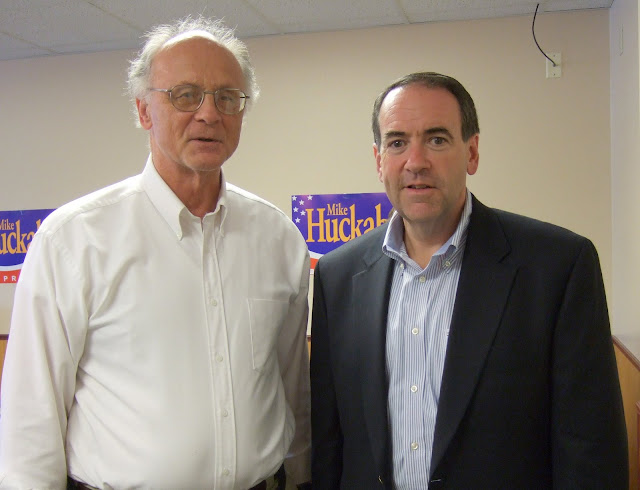 In 2008 my choice from among the Republicans was Mike Huckabee. "It's Huckabee; My Republican Pick: Governor Mike Huckabee," July 24, 2007.

