Showing posts with label impeachment. Show all posts

Saturday, February 13, 2021

Impeachment: A Third View

Contents
Executive Summary
Presidential Oath
Summary of Trial Lawyers' Arguments
Minority Leader McConnell's Reaction
The Article in 2nd Impeachment
Reaction to Articles in 1st Impeachment
Was Speech Text "Incitement"?
The Speech in Context
What Was Trump's Impeachable Offense?
Executive Summary

Many "Articles of Impeachment" of presidents itemize a specific act or two, e.g., Trump's first impeachment, pressure on Ukraine government; Trump's second, his Jan. 6 speech. This blog post endeavors to build a case for a preeminent Article when a president's actions, whether with intent or effect, constitute an attack on democracy itself, as embodied in the Columns of Democracy, i.e., the essential foundational institutions that support and make possible our democracy, e.g., the peaceful transfer of power after inclusive, free and fair elections, or a respected, free and factual mass media.
[here are adjacent examples of both from Trump's Jan. 16 speech: "[O]ur election was so corrupt that in the history of this country we've never seen anything like it. And you know what else? We don't have a free and fair press. Our media is not free, it's not fair. . . . It's become the enemy of the people." Brian Naylor, "Read Trump's Jan. 6, Speech, A Key Part of Impeachment Trial," npr, Feb. 10, 2021, text and video https://www.npr.org/2021/02/10/966396848/read-trumps-jan-6-speech-a-key-part-of-impeachment-trial].

# # #

"I do solemnly swear (or affirm) that I will faithfully execute the Office of President f the United States, and will to the best of my Ability, preserve, protect and defend the Constitution of the United States."

U.S. Constitution, Art. II, Sec. 1, Clause 8
Introduction

President Trump's lawyers -- and supporters in and out of the House and Senate -- argue he should not be found to have engaged in "high crimes and misdemeanors" because (a) his January 6 Ellipse speech did not "incite" the violence that followed, (b) it is unconstitutional for the Senate to hold an impeachment trial of a former president whose term has expired (he cannot, by definition, be "removed" from an office he no longer holds), (c) Senate rules require separate charges be in separate Articles, (d) it would violate his First Amendment rights to punish or forbid such a speech, and (e) it would be further divisive of an American population desperately in need of unity.
Following the Senate Trial vote Feb. 13, Minority Leader Mitch McConnell spoke. He first excoriated former President Trump and his behavior, and then explained his "not guilty" vote, citing Constitution Article II, Sec. 4: "The President, Vice President and all civil Officers of the United States, shall be removed from Office on Impeachment for, and Conviction of, Treason, Bribery, or other high Crimes and Misdemeanors." McConnell argued that to convict Trump he would have to be, at the time of the conviction, "president," which he was not; it would also be impossible for him to "be removed from Office."
The House impeachment managers, with Representative Jamie Raskin as lead manager, argue that (a) Trump did incite the crowd to storm the Capitol (4 years of telling his "big lie" -- "landslide" "stolen" election victory -- statements; selection of place, date and time of Congress' certifying electoral votes; his support of prior crowd violence; refusal to order support for Capitol police or tell insurgents to stop; and statements of participants that they were following Trump's orders), (b) a Senate trial of an impeached former president no longer in office is constitutional (language of Constitution, English practice that influenced drafters, their remarks, majority of legal scholars), (c) First Amendment does not protect speech triggering seditious insurrection, (d) for the Senate not to convict would set a precedent for future presidents, and (e) accountability (of Trump) was essential to putting this behind us (thus, presumably, contributing to unity).

Something like that.

As a former U.S. Supreme Court law clerk, law professor, and occasional constitutional law prof, I was overwhelmed with the creativity, quality, effectiveness and delivery of Rep. Jamie Raskin and the other House Managers. (Full disclosure: I had shared some undertakings with his late father, Marc; my first memory of Jaimie was watching his participation as a child in a White House demonstration.) I could not have done it as well as they did. I have no suggestions as to how they could have done it better, and certainly no "criticisms."

Thus, what follows is not about their presentation of the House's Article (by which they were to some extent bound), but some reactions to the theory and wording of that Article.
# # #

A Third View

The Article of Impeachment, "Incitement of Insurrection," [H.Res. 24, 117th Cong., https://www.congress.gov/bill/117th-congress/house-resolution/24/text] consists of five paragraphs.

Following the title ("Incitement of Insurrection") the first paragraph contains the allegation that, "Trump engaged in high Crimes and Misdemeanors by inciting violence."

The second paragraph mentions the House and Senate Joint Session "to count the votes of the Electoral College" and Trump's "statements that, in context, encouraged -- and foreseeably resulted in -- lawless action at the Capitol."

The two-sentence third paragraph refers to Trump's "prior efforts to subvert and obstruct the certification of the results of the 2020 Presidential election," and his "phone call on January 2, 2021, [to] the secretary of state of Georgia."

The fourth paragraph reads in its entirety, "In all this, President Trump gravely endangered the security of the United States and its institutions of Government. He threatened the integrity of the democratic system, interfered with the peaceful transition of power, and imperiled a coequal branch of Government. He thereby betrayed his trust as President, to the manifest injury of the people of the United States."

The concluding, fifth paragraph asserts that "he will remain a threat to national security, democracy, and the Constitution if allowed to remain in office, and has acted in a manner grossly incompatible with self-governance and the rule of law."
My reaction to this text is similar to my reaction to Article I in Trump's first impeachment
[Articles of Impeachment Against Donald John Trump, H.Res.755 — 116th Congress, Dec. 18, 2019], emphasizing his interactions with the Ukrainian government:
What the House Democrats should have emphasized for a confused public (and Republican Senate), is why Trump's impeachment, and Senate conviction, should be a slam dunk. It is because, unlike other behavior that has, or has not, been found to be impeachable during the 62 impeachment hearings in the House since 1789, what Trump has been doing is something the drafters had experienced, caused them great legitimate concern, and they specifically tried to prevent: namely, foreign interference in our politics, government, and especially elections, whether sought from within or imposed from abroad.
"Impeachment: What the House Should Have Said; Trump's Conviction Should Have Been A Slam Dunk," FromDC2Iowa, Jan. 21, 2020, https://fromdc2iowa.blogspot.com/2020/01/impeachment-what-house-should-have-said.html.
(See also, "Understanding Impeachment," FromDC2Iowa, Nov. 11, 2019, https://fromdc2iowa.blogspot.com/2019/11/understanding-impeachment.html; and Articles of Impeachment Against Donald John Trump, H.Res.755 — 116th Congress, Dec. 18, 2019, [https://www.congress.gov/bill/116th-congress/house-resolution/755/text], Article I: Abuse of Power/"President Trump solicited the interference of a foreign government, Ukraine, in the 2020 United States Presidential election. He did so through a scheme or course of conduct that included soliciting the Government of Ukraine to publicly announce investigations that would benefit his reelection . . . Trump, by such conduct, has demonstrated that he will remain a threat to national security and the Constitution if allowed to remain in office, and has acted in a manner grossly incompatible with self-governance and the rule of law.")
Article I is headed, "Incitement of Insurrection." The first paragraph charges "Trump engaged in high Crimes and Misdemeanors by inciting violence against the Government of the United States." The second paragraph asserts, "Shortly before the Joint Session commenced, President Trump, addressed a crowd [where he] willfully made statements that . . . encouraged -- and foreseeably resulted in -- lawless action at the Capitol."

Taken out of its context, it is difficult to find within the text of Trump's Jan. 6 11,153-word, hour-plus speech an "incitement of insurrection."
[Brian Naylor, "Read Trump's Jan. 6, Speech, A Key Part of Impeachment Trial," npr, Feb. 10, 2021, text and video https://www.npr.org/2021/02/10/966396848/read-trumps-jan-6-speech-a-key-part-of-impeachment-trial.] He did not suggest the mob hang the Vice President and shoot the Speaker of the House, attack the Capitol police, leave bombs at the DNC and RNC headquarters, break windows and bang on doors, or other of the horrific things that happened. What did he recommend be done with senators and House members who do not support him? "You primary them." What else did he say? "[W]e're going to walk down to the Capitol, and we're going to cheer on our brave senators and congressmen and women;" "I know that everyone here will soon be marching over to the Capitol building to peacefully and patriotically make your voices heard."

In context, however, the January 6 speech was but part of a year-long chain of "incitements" for which it was the last; without those early links Trump's speech might never have produced the disaster it did.

There were lines and phrases in the Article that hinted at some of the links in that chain. The House Managers did their best to include them in their story, but such efforts did little to establish that Trump's January 6 speech, standing alone, constituted "incitement of insurrection."

Here are some examples:
  • "President Trump repeatedly issued false statements asserting that the Presidential election results were the product of widespread fraud and should not be accepted by the American people . . .."

  • "he reiterated false claims that 'we won this election, and we won it by a landslide.'”

  • "President Trump’s conduct on January 6, 2021, followed his prior efforts to subvert and obstruct the certification of the results of the 2020 Presidential election.

  • Those prior efforts included a phone call on January 2, 2021, during which President Trump urged the secretary of state of Georgia . . .."

  • "President Trump gravely endangered the . . . institutions of Government. He threatened the integrity of the democratic system, interfered with the peaceful transition of power . . .."

  • "Trump, by such conduct, has demonstrated that he will remain a threat to national security, democracy, and the Constitution"
The common theme in Trump's behavior was the design of a no-lose strategy; a desire to hang onto the presidency come what may. If he received the most electoral votes he would win. If he did not he had a number of potential paths to retained power. He tried them all. For months prior to the election he repeatedly fed his base the lie that American elections are "fraudulent" and "rigged." Mail-in ballots were not to be trusted. He argued that he would, of course, have the support of the majority of voters, and that, therefore, if he was not proclaimed the winner the results were obviously dishonest. Election night, early returns sometimes went his way. Later, as the mail-in ballot returns came in and the lead shifted, Trump insisted that was proof the election had been stolen from him. When recounts only confirmed his loss, his next step was to file lawsuits challenging the vote. He lost 61 of them. He then turned to speaking directly to electors, county auditors, state secretaries of state, legislators and governors in an effort to get them to change their state's electoral vote count. By late December he was becoming desperate. His last hope was to reverse, stop, or delay the congressional certification of the states' electoral college votes.

That is the context. That was the playing out of his scheme. The Jan. 6 speech, and the insurrection by a mob he had brought to anger over months, was not his initial desire. Stopping the final certification of the Electoral College vote was his last chance. It was only the last domino to fall at the end of a months' long chain.

In other words, the gravamen of Trump's impeachable "high crimes and misdemeanors" was not his speech, it was his attack on our democracy itself; in this case, our system of voting described in another part of Article II (Sec. 1, clauses 1-3), and Amendment XII, that describe the Electoral College system.

In my book, Columns of Democracy, I make the point that a democracy can be neither created, nor sustained, standing alone. It requires a foundation of supporting "columns," such as a respected free and independent media, and, in this case, a system of voting that is respected and trusted by the citizenry as inclusive, easy to use, accurate and honestly administered. Such a system makes for the smooth transfers of power that distinguish democracies from authoritarian dictatorships. Attacking that system, weakening it, threatening the voters trust in it, failing to support peaceful transfer of power -- that should be the impeachable offence.

# # #

Tuesday, January 21, 2020

Impeachment: What the House Should Have Said


Trump's Conviction Should Have Been A Slam Dunk

President Trump's defenders excuse his urging Ukraine (plus earlier Russia, and later China) to interfere in our elections. They are left with the argument that he may have done it, it wasn't a nice thing to do, but it's not an "impeachable offense." 

The House Democrats' characterization of their first article of impeachment isn't much better: "Abuse of Power." Saying the president "violated his oath of office," or "the Constitution," provides little more specificity than "abuse of power" (even when supported with evidence of Trump's pressure on Ukraine).

What's an "impeachable offense"? There can be, and has been, debate as to whether individual examples of presidential bad behavior should constitute a basis for impeachment. But there are two as to which there is little or no question.

Many conservatives argue that we should be bound by what the Constitution's drafters intended. Most lawyers would at least agree "original intent," or "legislative history," are at a minimum relevant evidence to consider in defining and applying terms.

What the House Democrats should have emphasized for a confused public (and Republican Senate), is why Trump's impeachment, and Senate conviction, should be a slam dunk. It is because, unlike other behavior that has, or has not, been found to be impeachable during the 62 impeachment hearings in the House since 1789, what Trump has been doing is something the drafters had experienced, caused them great legitimate concern, and they specifically tried to prevent: namely, foreign interference in our politics, government, and especially elections, whether sought from within or imposed from abroad. [Photo credit: Constitutional Convention; original painting by Junius Brutus Stearns, painter; photo is public domain, commons.wikimedia.org.]

This assertion is supported by numerous references in the history of the time, The Federalist Papers, and notes from the Constitutional Convention. But one need go no further than the Constitution's provisions. "Treason" ("the crime of betraying one's country") is specifically mentioned as a ground for impeachment. Presidents must be born in the U.S. They are forbidden to accept any "emoluments" (gifts or titles) from other countries.

[A second specific but more general concern, tangentially related to to the drafters' efforts to avoid foreign influence, was their insisting on preventing future presidents from assuming the powers of a king. Their earlier Declaration of Independence made that clear: "The history of the present King of Great Britain is a history of repeated injuries and usurpations, all having in direct object the establishment of an absolute Tyranny over these States" -- following which they offer a long list of the Declaration's equivalent of "articles of impeachment" of the King. And then: "A Prince whose character is thus marked by every act which may define a Tyrant, is unfit to be the ruler of a free people."

These concerns continued through the Constitutional Convention, ultimately taking the form of the "checks and balances" on the executive provided by the judiciary, House and Senate; the four-year limit on a president's terms of office, denying presidents the power "to declare war" exercised by kings -- and the ultimate power of the House to impeach, and the Senate to remove, a president.]

I set forth below an excerpt from the House's "Trial Memorandum" for the Senate that deals with these issues (plus the link to the entire document). This discussion of of foreign influence is well done, and documented with footnotes. Unfortunately, it is buried in the "Memorandum" where few will find and read it, and has never been elevated and emphasized for the public, House members and Senators as the most powerful argument for convicting the President.

# # #

TRIAL MEMORANDUM
OF THE UNITED STATES HOUSE OF REPRESENTATIVES
IN THE IMPEACHMENT TRIAL OF PRESIDENT DONALD J. TRUMP


January 18, 2020, pp. 9-12

Fresh from their experience under British rule by a king, the Framers were concerned that corruption posed a grave threat to their new republic. As George Mason warned the other delegates to the Constitutional Convention, “if we do not provide against corruption, our government will soon be at an end.”43 The Framers stressed that a President who “act[s] from some corrupt motive or other” or “willfully abus[es] his trust” must be impeached,44 because the President “will have great opportunitys of abusing his power.”45

43 2 The Records of the Federal Convention of 1787, at 392 (Max Farrand ed.,1911) (Farrand).
44 Background and History of Impeachment: Hearing Before the Subcomm. on the Constitution of the H. Comm. on the Judiciary, 105th Cong. 49 (1998) (quoting James Iredell).
45 2 Farrand at 67.

The Framers recognized that a President who abuses his power to manipulate the democratic process cannot properly be held accountable by means of the very elections that he has rigged to his advantage.46 The Framers specifically feared a President who abused his office by sparing “no efforts or means whatever to get himself re-elected.”47 Mason asked: “Shall the man who has practised corruption & by that means procured his appointment in the first instance, be suffered to escape punishment, by repeating his guilt?”48

46 See id. at 65.
47 Id. at 64.
48 Id. at 65.

Thus, the Framers resolved to hold the President “impeachable whilst in office” as “an essential security for the good behaviour of the Executive.”49 By empowering Congress to immediately remove a President when his misconduct warrants it, the Framers established the people’s elected representatives as the ultimate check on a President whose corruption threatened our democracy and the Nation’s core interests.50

49 Id. at 64.
50 See The Federalist No. 65 (Alexander Hamilton).

The Framers particularly feared that foreign influence could undermine our new system of self-government.51 In his farewell address to the Nation, President George Washington warned Americans “to be constantly awake, since history and experience prove that foreign influence is one of the most baneful foes of republican government.”52 Alexander Hamilton cautioned that the “most deadly adversaries of republican government” may come “chiefly from the desire in foreign powers to gain an improper ascendant in our councils.”53 James Madison worried that a future President could “betray his trust to foreign powers,” which “might be fatal to the Republic.”54 And, of particular relevance now, in their personal correspondence about “foreign Interference,” Thomas Jefferson and John Adams discussed their apprehension that “as often as Elections happen, the danger of foreign Influence recurs.”55

51 See, e.g., 2 Farrand at 65-66; George Washington, Farewell Address (Sept. 19, 1796), George Washington Papers, Series 2, Letterbooks 1754-1799: Letterbook 24, April 3, 1793–March 3, 1797, Library of Congress (Washington Farewell Address); Adams-Jefferson Letter, https://perma.cc/QWD8- 222B.
52 Washington Farewell Address.
53 The Federalist No. 68 (Alexander Hamilton).
54 2 Farrand at 66.
55 Adams-Jefferson Letter, https://perma.cc/QWD8-222B.

Guided by these concerns, the Framers included within the Constitution various mechanisms to ensure the President’s accountability and protect against foreign influence— including a requirement that Presidents be natural-born citizens of the United States,56 prohibitions on the President’s receipt of gifts, emoluments, or titles from foreign states,57 prohibitions on profiting from the Presidency,58 and, of course, the requirement that the President face reelection after a four-year Term.59 But the Framers provided for impeachment as a final check on a President who sought foreign interference to serve his personal interests, particularly to secure his own reelection.

56 U.S. Const., Art. II, § 1, cl. 5.
57 U.S. Const., Art. I, § 9, cl. 8.
58 U.S. Const., Art. II, § 1, cl. 7.
59 U.S. Const., Art. II, § 1, cl. 1.

In drafting the Impeachment Clause, the Framers adopted a standard flexible enough to reach the full range of potential Presidential misconduct: “Treason, Bribery, or other high Crimes and Misdemeanors.”60 The decision to denote “Treason” and “Bribery” as impeachable conduct reflects the Founding-era concerns over foreign influence and corruption. But the Framers also recognized that “many great and dangerous offenses” could warrant impeachment and immediate removal of a President from office.61 These “other high Crimes and Misdemeanors” provided for by the Constitution need not be indictable criminal offenses. Rather, as Hamilton explained, impeachable offenses involve an “abuse or violation of some public trust” and are of “a nature which may with peculiar propriety be denominated political, as they relate chiefly to injuries done immediately to the society itself.”62 The Framers thus understood that “high crimes and misdemeanors” would encompass acts committed by public officials that inflict severe harm on the constitutional order.63

60 U.S. Const., Art. II, § 4; see 2 Farrand at 550.
61 2 Farrand at 550.
62 The Federalist No. 65 (Alexander Hamilton) (capitalization altered).
63 These issues are discussed at length in the report by the House Committee on the Judiciary. See H. Rep. No. 116-346, at 28-75.
64 Statement of Facts ¶ 160.
65 Id. ¶ 161.

Tags: #Constitution, #Constitutional Convention, #elections, #Federalist Papers, #House, #impeachable offense, #impeachment, #original intent, #legislative history, #President Donald Trump, #Senate, #Trump, #Ukraine

Monday, November 11, 2019

Understanding Impeachment

There is so much nonsense spouted about impeachment these days, whether deliberate obfuscation or unknowingly, that you might find these items useful. (The most basic sources, from the Constitution, are Article II, Section 4 (impeachment power), Art. I, Sec. 2, Clause 5 (possessed by the House), Art. I, Sec. 3, Cl. 6 (trial in Senate). You are spared additional footnotes, though specific citations can be provided if desired.)

This material is hoped, intended and believed to be accurate, but does not purport to be, and is not, either a "legal opinion" or "scholarship."

There are three sections to which these links can take you: (1) The Obligation to Impeach, (2) Impeachment Standard Not "Illegality," and (3) Trump Has Violated the Law. [Photo credit: Wikimedia.]

The Obligation to Impeach. Every president, House and Senate member, and federal judge has sworn to uphold the Constitution. The Constitution requires each branch (legislative, executive and judicial) to maintain the balance of power among the three branches and prevent constitutional violations by the other two.

Thus, it can be argued the House has a constitutional obligation to begin an impeachment inquiry when there is reason to believe a president may have said or done things that precedent suggests constitute “Treason, Bribery, or other high Crimes and Misdemeanors.”

The Congress has no more constitutional right to evade this responsibility, to fail to exercise this specifically granted power, than it has a right to fail to exercise its power to take the census every ten years. It certainly cannot refuse to start an impeachment inquiry because it might be politically harmful to the majority party in the House, or because the president may fail to win reelection. Nor can it fail to impeach because the Senate is unlikely to convict, any more than a grand jury can fail to indict because of the possibility the trial jury may be biased in favor of the accused.

Why? Because there are more reasons for the impeachment power than the potential removal of a specific president. Impeachment is designed to maintain for the future both (1) the standards of presidential conduct required by the founders and (2) exercise of the checks and balances the Constitution compels between the Legislative and Executive branches.

Impeachment Standard Not “Illegality.” President Trump’s defenders have altered their arguments as facts evolved – from, in effect, “he didn’t do it,” to “he may have done it, but he did nothing wrong,” to “he may have exercised bad judgment and done something wrong, but he did nothing illegal,” to “it can’t have been illegal because there was no quid-pro-quo,” to “even if it was illegal, and there was a quid-pro-quo, it is not an impeachable offense.”

As “Late Night” host Seth Meyers would say, “It’s time for a closer look.”

The founders modeled their constitutional standard for impeachment on British practice, which had its origins in 1341. Articles of impeachment in Great Britain included such things as “arbitrary and tyrannical government,” “procuring offices for persons who were unfit, and unworthy of them,” “squandering away the public treasure,” “improprieties in office,” “gross maladministration,” “corruption in office,” “neglect of duty,” excessive drinking and cursing that created “the highest scandal . . . on the kingdom.”

The British practice was to treat impeachment as a remedy separate from the process and standards of the criminal law and to include conduct not expressly recognized as “illegal.”

Interpretation of the U.S. Constitution’s language is influenced, but not bound, by British history. But American history is almost identical. The writings of Constitutional Convention members Alexander Hamilton, James Wilson, and James Madison indicate they believed impeachment did not require criminal offences. Nothing in the records of the states’ ratification of the Constitution indicate they believed impeachment was limited to criminal offenses. Of the first 13 impeachments by the House since 1789 (mostly of judges), at least 10 included charges that did not involve criminal law. Finally, Congress has never attempted to define “impeachment” in Title 18 of the U.S. Code (criminal code).

So far, three U.S. presidents have been impeached (Presidents Andrew Johnson, Richard Nixon, Bill Clinton) and a fourth (President Trump) is undergoing an impeachment inquiry. None, so far, has been removed from office following the Senate trial. (President Johnson was saved by one vote; President Nixon resigned before his seemingly inevitable formal impeachment.)

Each presidential impeachment has involved some article dealing with other than criminal illegality.

As discussed in ”Trump’s High Crimes and Misdemeansors,” October 31, 2019, President Andrew Johnson’s tenth article of impeachment charged “That the President of the United States, unmindful of the high duties of his high office and the dignity and proprieties thereof, and of the harmony and courtesies which ought to exist and be maintained between the executive and legislative branches of the Government of the United States . . . [did] make and declare, with a loud voice, certain intemperate, inflammatory and scandalous harangues, and therein utter loud threats and bitter menaces . . . amid the cries, jeers and laughter of the multitudes then assembled . . ..”

The first of the Articles of Impeachment regarding President Nixon included: “[Nixon] has prevented, obstructed, and impeded the administration of justice . . .. [He has] engaged personally and through his close subordinates and agents, in a course of conduct or plan designed to delay, impede, and obstruct the investigation of such illegal entry [into Democratic National Committee headquarters]; to cover up, conceal and protect those responsible; and to conceal the existence and scope of other unlawful covert activities. “ (This is followed by nine examples.)

Article II, par. 5, alleged that “he knowingly misused the executive power by interfering with agencies of the executive branch, including the Federal Bureau of Investigation . . . and the Central Intelligence Agency.” Article III charged that he “has failed without lawful cause or excuse to produce papers and things as directed by duly authorized subpoenas issued by the Committee on the Judiciary of the House of Representatives . . ..”

President Bill Clinton’s third article of impeachment included, after citing 7 specific items, “In all of this, [Clinton] has undermined the integrity of his office, has brought disrepute on the Presidency, [and] has betrayed his trust as President . . ..”

Taken together, the evidence is overwhelming that the validity of an article of impeachment does not turn on whether a "law" has been violated. Thus, even if it were true, as some Trump defenders contend, that "he has done nothing illegal" it does not follow that, therefore, he cannot and should not be impeached.

But wait, even if one insists that a violation of law is a requirement for impeachment . . .

Trump Has Violated the Law. Although unnecessary for impeachment, for a response to those who argue “he did nothing illegal” or “there was no quid-pro-quo” it seems clear he did violate the law, and that the law he violated does not require proof of a “quid-pro-quo.”

The law involved is contained in Section 30121 of Title 52, United States Code (“Voting and Elections”).

The relevant words are, “It shall be unlawful for . . . a person to solicit . . . or receive . . . from a foreign national ["a . . . thing of value . . . in connection with a Federal . . . election"].

(The primary subsection is Sec. 30121(a)(2). The [bracketed] words are from subsection 30121(a)(1)(A) because Sec. 30121(a)(2) defines what cannot be received as that which was "described in subparagraph (A) or (B) of paragraph (1).")

Thing of Value. Given the quantity of confirming testimony regarding the range of ways that Trump displayed his desire to obtain dirt on former Vice President, and candidate for president, Joe Biden, there can be no doubt he considered such information “a thing of value in connection with a Federal election.”

Solicitation. Notes from Trump’s conversation with Ukrainian President Volodymyr Zelensky included Trump’s now-infamous line, “I would like to ask you to do us a favor, though.” It turns out there was more than one “favor” requested, but one is enough to clearly establish “solicitation.”

Quid-Pro-Quo. Note that the law does not require a quid-pro-quo. So even if there had been no quid-pro-quo that would have been irrelevant to whether Sec. 30121 had been violated. Clearly, it would not have been a defense. But for whatever relevance it may have, it seems to have clearly been the impression of many of those who have testified before Congress that a quid-pro-quo was understood by both presidents.

Without exploring yet another possible crime, the existence of a quid-pro-quo, while irrelevant to Section 30121, may be very relevant to a charge of bribery.

Thursday, October 31, 2019

Trump's High Crimes and Misdemeanors

Trump's High Crimes and Misdemeanors
Like the individual "charges" in a grand jury's indictment, there are individual "articles" in an impeachment. I have obtained one of those Articles:

“Article 10. That the President of the United States, unmindful of the high duties of his high office and the dignity and proprieties thereof, and of the harmony and courtesies which ought to exist and be maintained between the executive and legislative branches of the Government of the United States, designing and intending to set aside the rightful authorities and powers of Congress, did attempt to bring into disgrace, ridicule, hatred, contempt and reproach, the Congress of the United States, and the several branches thereof, to impair and destroy the regard and respect of all the good people of the United States for the Congress and the legislative power thereof, which all officers of the government ought inviolably to preserve and maintain, and to excite the odium and resentment of all good people of the United States against Congress and the laws by it duly and constitutionally enacted; and in pursuance of his said design and intent, openly and publicly and before divers assemblages of citizens of the United States, . . . on divers other days and times, as well before as afterwards, make and declare, with a loud voice, certain intemperate, inflammatory and scandalous harangues, and therein utter loud threats and bitter menaces . . . amid the cries, jeers and laughter of the multitudes then assembled . . ..”

Pretty flowery language maybe, but this is a solumn business. A violation of "the high duties of his high office and the dignity and proprieties thereof" pretty well covers a part of what Congress is dealing with, wouldn't you say?

Scholars seeped in details of impeachments in American history will recognizer the quote, above, as one of the 11 Articles of Impeachment of President Andrew Johnson (no relation) approved by Congress March 4, 1868.

So its relevance for us today is not that it is language ultimately included in whatever Articles of Impeachment of President Trump the House sends on to the Senate.

However, for those who interpret the Constitution's language historically, relying on "original intent," it is (1) language that could describe President Trump's behavior, and (2) evidence of what the House of Representatives found to be among the "high crimes and misdemeanors" warranting impeachment at the time of the first impeachment 151 years ago.

Sources, Credits and Links

Text source: https://www.senate.gov/…/…/briefing/Impeachment_Johnson.htm… Photo credit: wikimedia.org, Congressman Brad Sherman, June 12, 2017; Illustration credit: Theodore R. Davis, Harper's Weekly, April 11, 1868.

#articlesOFimpeachment, #charges, #Congress, #Constitution, #courtesy, #dignity, #GrandJury,#hatred, #highcrimesANDmisdemeanors, #HouseOfRepresentatives, #impeachment, #indictment, #originalintent, #PresidentAndrewJohnson, #PresidentDonaldTrump, #propriety, #Senate
# # #

Saturday, September 28, 2019

An Evangelical Explains Trump

Why did evangelicals vote for Trump?
Thomas L. Johnson
Quora.com, July 18, [otherwise undated; presumably 2019]

NOTE: In order to do anything involving President Donald Trump -- from impeachment to presidential election defeat -- it is necessary to understand as much as possible about the man. There are a number of blog posts and columns in which I've taken a stab at it. For example:
"Intelligence Community's Inspector General and Impeachment," September 26, 2019
Understanding Trump: Know Thine Opponent," September 23, 2019
"Trump Won't Be Beat With Plans Alone," The Gazette, August 17, 2019, p. A5 (blog post title: "Marianne Williamson's Questions and Answers")
"Trump Will Lose? Don't Be So Sure," The Gazette, May 29, 2019 (blog post title: "Why Trump May Win") (a list of 13 categories of Trump's advantages)
• For a contrary view to the one presented here, see Anthea Butler, "White Evangelicals Love Trump and Aren't Confused About Why. No One Should Be.: Focusing on the Disconnect Betseen Trump's Actions and the Moral Aspects of Evangelicals' Faith Misses the Issue That Keeps Their Support Firm," Think, NBC News, September 27, 2019.
However, one perspective I have not, and cannot, provide is how the evangelical portion of his base rationalize to themselves their relatively solid support of the man, seemingly regardless of his violations in thought, word and deed of what one would assume to be evangelicals' beliefs and standards.

As Mayor Pete Buttigieg has put it, "I do think it’s strange, knowing that no matter where you are politically, the gospel is so much about inclusion and decency and humility and care for the least among us, that a wealthy, powerful, chest-thumping, self-oriented, philandering figure like [Donald Trump] can have any credibility at all among religious people. ... Your morality is deeply lacking if all you want is a child born but not a child fed, not a child educated, not a child housed. ... That’s not pro-life. That’s pro-birth." Sojourners. "For a party that associates itself with Christianity, to say that … God would smile on the division of families at the hands of federal agents, that God would condone putting children in cages, has lost all claim to ever use religious language again." The Atlantic.

[Photo caption: "Members of Cross Community Church, an EA congregation in Berne, Indiana, pose for a photo published on the Evangelical Assocation's Desk Calendar." Photo credit: FatherRon2011, Creative Commons Attribution-Share Alike 3.0, Wikimedia.org.]

The following piece by Thomas L. Johnson (no relation) provides some helpful insights:
# # #
As an evangelical who did not and never will vote for Donald J. Trump, I fully understand why many evangelicals voted for a man who is crass, mean-spirited, personally unethical, and embarrassingly self-serving. They felt that they had no choice and have every reason to feel that again in 2020:
• Trump gave them two Supreme Court justices who will vote their interests for the next thirty years. Given the reality that many if not most evangelicals have never come to terms with abortion, particularly later term abortion, that absolves Trump of his extramarital dalliances.
• Trump has evoked the sort of tribalism that evangelicals understand. They live in a world of us versus them; so does Trump.
• Like Trump, evangelicals do not allow science to compete with their preconceived notions in areas like global warming or perceived conspiracies.
• Trump has embraced Israel. Many conservative Christians see Israel as part of the end-of-times prophecies.
• Like Trump, evangelicals are not fans of social change of the sort that came out of the Obama years. They believe in two genders determined and defined at birth, in a biblical view of marriage as the union of one man and one woman, and of a level of patriotism that rejects figures like Colin Kaepernick or Megan Rapinoe.
While Hillary Clinton’s campaign and personality were non-starters for evangelicals in 2016, often for reasons created or exploited by Cambridge Analytica, a Democratic candidate from the Medicare for All, open border, free education wing of the Democratic Party will present an even larger challenge.

Given their 25–26% share of the total electorate and their over 80% allegiance to Trumpism, evangelicals will more than offset the moderates who will move out of their comfort zone in the middle to vote for an Elizabeth Warren or Bernie Sanders.

Thursday, September 26, 2019

Intelligence Community's Inspector General and Impeachment

Now What?
As I watched the three hours of the House Intelligence Committee's questioning of Director of National Intelligence Joseph Maguire it increasingly seemed to me that (1) no one was entirely pure, and (2) the Constitution and Acts of Congress are inadequate to resolve the challenges confronting the Committee and the Director. [Photo: Director Joseph Maguire; source: Wikimedia Commons.]

The Trump-can-do-no-wrong Republicans were overstating President Trump's innocence. The Democrats were playing fast and loose with the language of the Inspector General of the Intelligence Community Act (IGICA) and trying to get Director Joseph Maguire to make statements in support of their case for impeachment that Maguire was at least entitled, if not required, to refuse to make. And Director Maguire was refusing to acknowledge the conflict of interest he had in (a) serving the President who had appointed him and to whom he reported, and (b) carrying out the spirit (though not the language) of the IGICA. [Photo: President Donald Trump; source: Wikimedia Commons.]

This blog is not a "legal opinion." I have read the IGICA -- which can be found here 50 USC Sec. 3033 -- and scanned the 8000-plus-word Responsibilities and Authorities of the Director of National Intelligence Act -- available here 50 USC Sec. 3024. That's not enough research to produce a definitive judgment about the applicability of either or both laws.

But the IGICA's title referencing the "Intelligence Community," its numerous uses of variations of the phrase "programs and activities within the responsibility and authority of the Director of National Intelligence" throughout the Act, can reasonably lead one to the conclusion that the probable legislative history of the Act (i.e., events preceding and surrounding its creation, press reports, committee hearings, and debates on the floor) would not support an interpretation of the language of the Act as including the process to be followed in the case earlier before Director Maguire and now before Congress: namely acts of the President alleged to be "fraud and abuse," other criminal violations, or threats to national security. [Photo: House Intelligence Committee Chair, Adam Schiff; source: Wikimedia Commons.]

Of course, this does not mean that the President did no wrong. It is only to say that it is not clear that the IGICA contemplated or addressed, let alone compelled, the Inspector General to investigate, or Director Maguire to send to the Intelligence Committee the Inspector General's findings.

What they clearly could do, and did do, was to refer the whistle-blower's complaint to the FBI.

The central problem, as I now see it, is that neither the Constitution nor acts of Congress address the challenges to our democracy posed by a president like President Donald Trump. Indeed, I doubt that the founders' effort to avoid a monarchy in the White House, and their single choice of impeachment as a check on "high crimes and misdemeanors," envisioned the possibility we would ever elect a president like Trump.

The Constitution provides for impeachment of the president and other officials, Article II, Sec. 4, that the House "shall have the sole Power of Impeachment." Article I, Sec. 2, clause 5, and that the Senate "shall have the sole Power to try all Impeachments." Article I, Sec. 3, clause 6. (Article II, Sec. 4, provides: "The President, Vice President and all civil Officers of the United States, shall be removed from Office on Impeachment for, and Conviction of, Treason, Bribery, or other high Crimes and Misdemeanors.")

The 25th Amendment, certified by the President in 1967, provides for removal of a president found to be "unable to discharge the powers and duties of his office" -- a remedy primarily focused on physical or mental disability.

While the allegations in the whistle-blower's complaint may be among the most serious of Trump's offenses, the challenge confronting Congress is the tsunami of Trump's governance by tweets, over 14,000 false or misleading statements, attacks on columns of democracy (such as an independent media and judiciary), brazen violations of previously accepted required norms, ethics, morality, laws and constitutional restraints on presidents. For a partial list, see, e.g., Max Boot, "Trump Isn't Just Violating Norms -- He's Also Breaking the Law," The Washington Post, April 25, 2019.

What Congress must do is (1) reassert the constitutional powers it has been granted, that have gradually been taken over by the Executive branch, and (2) then address what additional checks are necessary to deal with this unprecedented string of presidential abuses. Perhaps what is first needed is a kind of Congressional Inspector General whose sole job it is to oversee the president and White House staff, receiving whistle-blower complaints, doing its own monitoring, then reporting to the House and Senate leadership and relevant committees. Perhaps this could provide the congressional incentive to create the constitutionally appropriate additional legislation to restrain the variety and quantity of presidential abuses unimagined by the constitution's drafters.

# # #

Monday, April 22, 2019

Impeachment and the Mueller Report

Random Thoughts Regarding
Impeachment and the Mueller Report
April 22, 2019; April 23
Related:
* Presidential Candidates Rankings, April 15, 2019 (with updates)
* Impeachment and the Mueller Report, April 22, 2019 (with update),
* Presidential Experience: How Your Candidate Measures Up, April 28, 2019
* Democrats Qualified for Debates: Will Your Candidate be in the Debates? April 29, 2019
* Dem Primary Candidates' Ranking - May 2, 2019: How's Your Candidate Ranked?, May 2, 2019
* May 4 Updates: Popularity; Klobuchar; Iowa 2nd District, May 4, 2019
* What Dems are up against; some insights from 2-1/2 years ago: Donald Trump’s Barrel of Squirrels: How Does the Donald Do It? Sept. 26 2016
* Attacks on our democracy and what we can do about it: Columns of Democracy available from Iowa City’s Prairie Lights and Amazon.
Politics and the Constitution

The Constitution specifically imposes on every member of the House of Representatives the power and responsibility for impeaching a president. ("The President ... shall be removed from Office on Impeachment for, and Conviction of, Treason, Bribery, or other high Crimes and Misdemeanors." Art. II, Sec. 4. "The House of Representatives ... shall have the sole Power of Impeachment." Art. I, Sec. 2.5. "The Senate shall have the sole Power to try all Impeachments." Art. I, Sec. 3.6).

There is no provision excluding this responsibility from "cases in which so doing might result in a House member's inability to be reelected," or "cases in which conviction by the Senate is highly unlikely." It is as inappropriate (and possibly unconstitutional) for a member of the House to fail to support an impeachment inquiry for partisan reasons as for that Member to pursue impeachment for partisan reasons.

The founders laid this responsibility upon the House for reasons similar to their choosing the House as the body to declare war (a constitutional obligation House members have also sidestepped) -- because it is the closest to the people who will bear the burden of both decisions.

Grounds for Impeachment

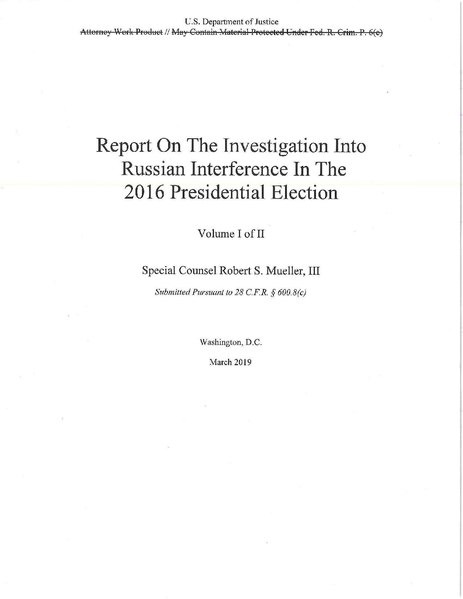
Not only is it impossible to read the Mueller Report -- or even the books and daily newspaper reports about President Trump -- without concluding that an impeachment inquiry is clearly warranted, but the Report's authors suggest that is their conclusion as well.

Although constrained by the distinctions between the powers of an "Independent Counsel" and a "Special Counsel," and their lack of authority to indict a sitting president, the authors note that "a criminal investigation during the President's term is permissible" (vol. II, p. 1), and that "a President does not have immunity after he leaves office," leading to their decision to conduct "a thorough factual investigation in order to preserve the evidence when memories were fresh and documentary materials were available." (vol. II, p. 1). That certainly sounds like a contemplation of at least the possibility of an indictment for obstruction of justice after Trump leaves office. This conclusion is reinforced with the comment that "we are unable to reach [the] judgment . . . after a thorough investigation of the facts that the President clearly did not commit obstruction of justice ... " (vol. II, p. 2) along with the ten or more categories of "overarching factual issues" and "general statements about the President's conduct." (vol. II, p. 7).

In addition to possible future indictments for obstruction of justice, the Report states, "The conclusion that Congress may apply obstruction laws to the President’s corrupt exercise of the powers of office accords with our constitutional system of checks and balances and the principle that no person is above the law.” (vol. II, p. 8)

Finally, a simple comparison of the charges and findings regarding the behavior of Trump against those of the two presidents impeached by the House during the past 50 years renders laughable any suggestion that Trump's offenses do not warrant an impeachment inquiry.

President Richard Nixon's impeachment involved his response to an old fashioned physical break-in at Democratic Party headquarters. The articles of impeachment were for obstruction of justice, abuse of power, and contempt of Congress. (The latter was for Nixon's refusal to comply with Congressional subpoenas -- something Trump is currently doing, although Trump is going above and beyond mere refusal by actually suing the Congressional committee!). (https://en.wikipedia.org/wiki/Impeachment_process_against_Richard_Nixon).

For Trump Administration's current refusal to comply with Congress' demands, see Peter Baker, Annie Karni and Alan Rappeport, "Democrats Ask and Trump Says No, Signaling a Bitter Fight Ahead," New York Times, April 23, 2019, p. A12, and Robert Costa, Tom Hamburger, Josh Dawsey and Rosalind S. Helderman, "Trump Says He is Opposed to White House Aides Testifying to Congress, Deepening Power Struggle with Hill," The Washington Post, posted April 23, 2019, 8:28 PM.

President Bill Clinton's two article of impeachment -- for perjury and obstruction of justice -- grew out of a "sexual harassment lawsuit filed against Clinton by Paula Jones" and inappropriate sexual encounters with a White House intern. (https://en.wikipedia.org/wiki/Impeachment_of_Bill_Clinton).

Impeachment Alternatives

If, as Speaker Nancy Pelosi and many other Party leaders urge, there is not to be an impeachment of President Trump, notwithstanding the constitutional obligations of House members, I have urged alternatives such as House resolutions or censure.

What the House must provide, for the sake of our democracy and constitution, as well as the legacy of this House, is more than mere multiple congressional committee hearings. There must be some form of House action, with a recorded vote of each member.

____________________

Following the publication of this blog post analogous analyses have been published. Here are two (with no suggestion this blog post was read by either of them, something I would consider highly unlikely):

Hillary Clinton, "Mueller Documented a Serious Crime Against All Americans. Here's How to Respond," The Washington Post, April 24, 2019, 4:44 PM

Elizabeth Drew, "The Danger in Not Impeaching Trump; It may be risky politically, but Congress has a responsibility to act," The New York Times, April 25, 2019

# # #

Saturday, August 04, 2018

Impeachment Petition

Note: Accidentally came upon this document today. While still a federal official I presented this Petition to members of the U.S. House of Representatives in October 1973 urging the impeachment of President Richard Nixon. I just barely remember doing it. It seemed worth republishing in this way. One can read it looking for the similarities with what could be the content of a similar document regarding President Donald Trump. Moreover, it's timely: August 9th we commemorate the 44th anniversary of President Nixon's resignation. -- N.J., August 4, 2018.

A Petition to the House of Representatives Regarding the Impeachment of
President Richard M. Nixon
From
Federal Communications Commissioner Nicholas Johnson
[1]


October 29, 1973

In the course of history of men and nations there are times when citizens must take a stand.

The tumultuous, exciting experiment called the United States of America has brought a number of decision points to its citizens. The Declaration of Independence of our colonies from England was one of the first and hardest choices we had to make as a people. Each war—the Revolution, Civil War, World Wars I and II, the Southeast Asian War—has called for a personal commitment of support, or opposition, from each citizen. And so today, as we ponder the initiation of impeachment proceedings against our President, must each American man, woman—and, yes, even child—ponder the facts and issues as he or she is best able, and come to some judgment.

It is crucial to our decision that we understand what we are, and what we are not, called upon to judge at this time. A conviction following the impeachment of the President—that is, his removal from office, or not, based upon findings by the United States Senate as to his guilt or innocence of charges—is not the issue at this time. Presidents are no more beneath the protections of the law than they are above its prohibitions; President Nixon is entitled to the same presumption of "innocent-until-proven-guilty" as any other citizen.

No, the only question that is now before the American people—and it is they who are the ultimate actors in this drama—is whether the House of Representatives should send to the Senate for trial the allegations against the President regarding the constitutional grounds for impeachment: "treason, bribery or other high crimes and misdemeanors.” To borrow an analogy from our more conventional court proceedings, we are not sitting as a jury deciding guilt or innocence; we are merely sitting as a grand jury, deciding whether or not to indict and bring to trial. [President Richard Nixon departing White House August 9, 1974, following resignation; photo credit: U.S. Government; public domain.]

Prejudgments of guilt or innocence should no more frighten us into motionless inaction than should outrage propel us to judgment.

If ever there was a time to put aside partisan considerations, this is such a time. And I believe that, to the extent partisanship has been evident on these issues, it may have been evidenced in the reluctance of Congressional Democrats as much as Republicans. it is charged that some Democrats may have hesitated to act because the polls did not yet indicate majority support for a conviction of impeachment, that others may be fearful they will be charged with precipitate and partisan action, and that all are mindful of the political disadvantages of running a Democratic nominee against an incumbent Republican President in 1976.

I must admit that I am not free of fault on this score. Richard Nixon's political career has been a part of my consciousness for 25 years. During the course of his Presidency, I have detailed some of the offenses that we must now consider in evaluating the propriety of House hearings—his manipulation of the media, the role of big money, and the war in Camobdla. [2] The evidence regarding the conduct of President Nixon's 1972 Presidential campaign has been available to all of us for over a year. The uproar following the resignations and firings in the Department of Justice the weekend of October 20, 1973 was the moment of decisions for millions of Americans. Through all these events I have remained silent.

I can no longer.

As a Presidential appointee [3] and currently active federal official, I recognize the seriousness of this action. But I also recognize the seriousness of continued silence, that “not to decide is to decide.”

Accordingly, I am today sending a copy of this statement to members of the House of Representatives, urging them to support the prompt initiation of House proceedings regarding the allegations of impeachable conduct by President Richard M. Nixon. I am simultaneously urging those of my fellow citizens who share my views to write their Representatives.

It seems both appropriate and necessary that the reasons for my action be set forth.

It is with deliberation that this decision, and statement, have been delayed until the “resolution" of the tapes issue; because, in my view, the allegations compelling House action on Presidential impeachment are unaffected by the events and issues surrounding the tapes. And it has been my desire to present the case without the diversionary complications of that issue.

In the flashing headlines surrounding burglaries, buggings, bribery, and break-ins, the most serious allegations have often been shadowed or ignored. it seems to me useful to review them here.

War. President Nixon ordered a land invasion of the sovereign state of Cambodia by American troops in May 1970 without the Constitutionally-required approval of Congress, and in violation of Cambodia's neutrality, as recognized by principles of international law and the United Nations which the United States is pledged to support. Even prior to that time, he authorized a secret bombing war against Cambodia which was undisclosed and overtly misrepresented to the American people, the press, members of the Senate and House, and even the civilian officials of the Department of Defense.

Free Press. President Nixon has waged a systematic campaign against the news media, including, but not limited to, the subpoenaing of newsmen's notes and films, wiretapping of Washington correspondents, the unprecedented effort to enforce "prior restraint" of publication (the Pentagon Papers), the jailing of newsmen, fraudulent FBI investigations of newsmen (the Daniel Schorr case), frightening non-complaint networks and stations with ominous recriminations (while promising economic protectionism for good behavior), attempting to control the lyrics of popular songs, and trying to influence the funding, programming, personnel, and administration of the Public Broadcasting Corporation.

Impoundment. The degree to which President Nixon has used the impoundment process to defy the authority of Congress to fund legislative programs is unprecedented—over 640 billion for health care, housing for the needy, assistance for children of working mothers, and the handicapped.

Electoral interference. During President Nixon's 1972 campaign there were violations of federal law in the collection and illegal use of campaign funds; a list of “enemies” was compiled for purposes of harassment by the Internal Revenue Services; fraud, espionage, libel, burglary, wiretapping, extortion, false reporting, bribery, and perjury were designed to—and very probably did—have an Impact (whether or not decisive) upon the outcome of that election.

Use of Government Property. Unanswered questions remain regarding the use of government funds to improve private homes in California and Florida—as well as the private financial and tax transactions involving the acquisition of those properties.

Invasion of Privacy. Widespread use of wiretapping (including the wiretapping of his own employees), the secret taping of his own conversations with others, the investigations and spying on private citizens, the maintenance of dossiers on civilians by the military, all indicate a less than full commitment to the letter and spirit of the privacy guarantees of the Fourth Amendment. The President's July 23, 1970 approval of the interdepartmental intelligence project (subsequently abandoned at FBI Director Hoover’s insistence) and the 1971 creation of a special investigative unit (“the plumbers”), indicates an affirmative intention to violate such rights.

Legal Procedures. While Daniel Ellsberg was on trial, White House aides burglarized his psychiatrist’s office for possible evidence, and discussed with the Judge presiding over that trial his possible Directorship of the FBI. In May 1971 over 13,000 people were arrested in a Washington dragnet, on direct orders of the White House, and in a manner subsequently found by the courts to have been unconstitutional. Having agreed to abide by a court ruling regarding his tapes, the President subsequently refused to either appeal from, or comply with, a lawful order of the Court of Appeals—a position from which he subsequently retreated. Grand juries have been urged to return politically motivated indictments.

Intelligence Independence. There is evidence that the President and his aides sought to subvert the independence of the FBI and CIA, using those agencies to serve their own illegal, personal, and political ends.

Bribery. The evidence is not yet fully complied regarding the relationship between the $60 million that was collected for the President's 1972 campaign and every governmental decision that may have been influenced thereby. Sufficient facts have already come to light, however, to suggest that there were at least some instances in which “bribery" may have taken place for which the American people are now paying the high price of a government-ordered “inflation” of "regulated” prices.

Many of these items are, at this point, only allegations that may be proven to be false. They are, however, illustrative of the "treason, bribery, or other high crimes and misdemeanors" referred to in Article II, Section 4 of the Constitution as grounds for Impeachment.

it is precisely because of—and not in spite of—my patriotism that I believe these charges cannot be Ignored. My childhood was not so different from that of Richard Nixon. I, too, made an early commitment to public life, to study and participate in government, politics, law and law enforcement. I, too, was active in student government from the time of my grade school years. I, too, have participated in party politics throughout my adult life (though in much lesser roles than he). I, too, keep a flag in my office, and can sing the national anthem with the best of them. I, too, have studied the lives of our great American leaders, and have had the privilege of feeling the personal influence and inspiration of some of them—in my case, men like Supreme Court Justice Hugo L. Black and President Lyndon B. Johnson. I too, have served the federal government during the past decade.

And so I can say that it is precisely because I do love America, because I have a commitment to the genius of its Idea that is sentimental as well as intellectual, personal as well as professional, pragmatic as well as Idealistic, that I cannot sit by silently and watch its decline and fall.

Without a commitment to our Constitution, without a defense of our dream, without the inspiration of our Ideals, America is nothing but another authoritarian industrialized state with rapacious rich and ravaged poor, freeways and factories, and neon signs amongst the natural beauty.

We cannot say “politics has been ever thus.” That is simply not true. The Presidents of my lifetime—Roosevelt, Truman, Eisenhower, Kennedy and Johnson—may not have been paragons of virtue in every aspect of their lives. But I take pride in the fact that the cumulative allegations against all of them combined do not equal in seriousness the significance of any one of the nine categories of charges I have itemized regarding President Nixon.

We owe it to those who look to us for leadership to assert unequivocally that the past few years have not been "business as usual” in the land of Jefferson and Lincoln, that the lamp of liberty still burns bright from the Statue of Liberty to the eternal flame in Arlington Cemetery. We owe it to the "huddled masses yearning to breathe free” who look to us from across the seas, we owe it to our children—before the sparkle of youthful hope and Idealism turns forever to the hard, cold stare of cynical despair. And, not least of all, we owe it to ourselves— those of us in “the establishment,” the opinion leaders, the captains of industry, the educators, the ministers, the officials—who, If we are to lead, must feel of ourselves that we are fit to lead.

For America never promised the world it would be perfect. We are a bustling, brawling, boisterous people. We have a history of more materialism than is good for us, and more wars than have been good for anybody. All we have ever guaranteed is that "all men are created equal” and that no one would be bored. And, with occasional backsliding, we’ve struggled to make good on those promises.

We never said our Presidents, judges, and legislators would be free of fault. indeed, the genius of our system of government is that it quite candidly creates checks and balances to deal with fault. Our leaders are not figures descended from royalty, gods or angels who “can do no wrong.” They are quite human, "of, by and for the people,” with all the strengths and weaknesses of the other mortals they serve and represent.

Thus, the great shame of the actions leading to the charges against President Nixon has not yet come. That the charges have surfaced, that the press has reported them, that the Senate and courts have investigated them, should be a matter of greatest national pride. No, the great shame will come to our nation If, and only If, knowing the charges, the House of Representatives refuses to act.

And so I conclude as I began. It is not my judgment that the President should be convicted after a trial. Under our Constitution, it is the United States Senate that will hear that case and consider the question. And just as all American citizens now sit as an advisory panel to the House, so will we then all sit as judges with the Senate. The only issue before us now is whether the facts, charges, and allegations I have summarily outlined here are sufficient cause for the House to send the matter to the Senate. That they require such action seems to me clear beyond doubt—although I expressly reserve judgment on whether the President should be removed from office following his Senate trial.

It is encouraging and commendable that the House judiciary Committee has begun hearings. I urge every Member to support the efforts of that Committee and to expedite the transmission of this case to the Senate, where it belongs.

FOOTNOTES


1. The text of this petition was taken from Congressional Record, October 31, 1973
[https://www.gpo.gov/fdsys/pkg/GPO-CRECB-1973.../GPO-CRECB-1973-pt27-8-2.pdf]. The heading was:
PETITION TO HOUSE
HON. ROBERT F. DRINAN
OF MASSACHUSETTS
IN THE HOUSE OF REPRESENTATIVES
Wednesday, October 31, 1973
Mr. DRINAN. Mr. Speaker, all of us are aware of the achievements of Nicholas Johnson, a distinguished Commissioner of the Federal Communications Commission. Mr. Johnson has taken the very bold and brave step of speaking out before the House of Representatives on the subject of an impeachment inquiry of the President of the United States. I am hopeful that my colleagues will read carefully Commissioner Johnson's petition to the House of Representatives regarding the impeachment of President Richard M. Nixon. The petition follows:
2. For example, "Government by Television: A Case Study, Perspectives and Proposals," Earth (March 1971), pp. 50-69, 92-93; "Subpoenas, Outtakes and Freedom of the Press: An Appeal to Media Management," reprinted as "Stations Are Standing By While News is Threatened,” Television/Radio Age (April 6. 1970), pp. 69. 114, 116, 118, 120, 124, 126. 128. 132; “Dear Vice President Agnew," The New York Times, Oct. 11, 1970, p. D-17; “The Power of the People and the Obligation to Dissent,” Los Angeles Free Press (May 29, 1970). p. 15; "Evil Times and Great Wealth,” speech delivered at the University of Northern Iowa, Cedar Falls, Iowa, Oct. 15, 1973.

3. July 1, 1966, by then-President Lyndon B. Johnson, not President Richard Nixon.

# # #

Tuesday, July 04, 2017

Unfit To Be The Ruler

A Long Train of Abuses

"A Prince, whose character is thus marked by every act which may define a Tyrant, is unfit to be the ruler of a free people."

-- Declaration of Independence, July 4, 1776

"Whenever the Vice President and a majority of [congressionally designated individuals] transmit to the [President of the Senate and Speaker of the House] their written declaration that the President is unable to discharge the powers and duties of his office, the Vice President shall immediately assume the powers and duties of the office as Acting President."

-- U.S. Constitution, Amendment 25, Section 4, February 10, 1967

With the long holiday weekend, family gatherings, and fireworks displays, few know, and pause to remember, that it is our independence from Britain that we celebrate. Fewer still will give a thought to King George III, let alone acknowledge that Americans were far from unanimous in their desire to escape his rule. Estimates are that 20 to 35% of the colonists opposed independence (with another third undecided).

So it is again today, 241 years later. Americans are once again divided -- and by about the same percentages -- regarding their current King George III replacement: President Donald Trump. A hard core of 29% to 40% support him and 50% to 60% oppose or are undecided (depending on questions asked and events at time of poll). [Rough figures: There are 250 million Americans over 18 (eligible to register), 200 million registered (80% of the 250 M); November 2016 results: Trump 62 million, Clinton 64 million (126 million total about half of those 18+; 60% of those registered.]

It is not the purpose of this piece to put the arguments for or against America's independence from Britain, or arguments for or against the re-election (or impeachment) of President Trump. The purpose is somewhat analogous to the purpose of the prior blog post, "Not All Criticism is Defamation," July 4, 2017 [embedded: "Is Superintendent Criticism 'Defamation'?" Iowa City Press-Citizen, June 28, 2017, p. 7A] (without taking a position on whether the local school superintendent was deserving of criticism, it simply set forth the basics of defamation law for those arguing the issue).

In other words, for purposes of this blog essay, what were the concerns expressed in the Declaration of Independence regarding the removal of King George III's rule over the colonies, to what extent are they applicable to President Trump, and what are the provisions of the U.S. Constitution regarding the removal of a U.S. president when there are concerns about his or her performance in office?

We begin with excerpts from the Declaration of Independence.

"[Americans] are endowed by their Creator with certain unalienable Rights, that among these are Life, Liberty and the pursuit of Happiness. — That to secure these rights, Governments are instituted . . ..

"[W]when a long train of abuses and usurpations . . . evinces a design to reduce them under absolute Despotism, it is their right, it is their duty, to throw off such Government . . .. He has refused his Assent to Laws, the most wholesome and necessary for the public good . . . unless suspended in their operation till his Assent should be obtained; and when so suspended, he has utterly neglected to attend to them. . . . He has obstructed the Administration of Justice . . .. He has affected to render the Military independent of and superior to the Civil Power. He has combined with others to subject us to a jurisdiction foreign to our constitution, and unacknowledged by our laws . . .. For cutting off our Trade with all parts of the world . . ..

He is at this time transporting large Armies of foreign Mercenaries to compleat the works of death, desolation, and tyranny, already begun with circumstances of Cruelty & Perfidy scarcely paralleled in the most barbarous ages, and totally unworthy the Head of a civilized nation. . . . He has excited domestic insurrections amongst us . . .. A Prince, whose character is thus marked by every act which may define a Tyrant, is unfit to be the ruler of a free people." [Photo credit: Wikimedia Commons; Sir William Beechey's oil painting of King George III, c. 1800/]

-- Declaration of Independence, July 4, 1776

There are a number of provisions in the U.S. Constitution that relate to the president's powers, obligations, and the standards for public (and congressional) evaluation of his or her fitness for (or removal from) office.

The offenses justifying consideration of impeachment are relatively specific: treason, bribery, high crimes and misdemeanors. It is a two-step process -- kind of like the (1) indictment, and (2) trial/conviction of a criminal defendant -- with the "indictment" (impeachment) in the House and trial and "conviction" in the Senate.
"The President . . . shall be removed from office on impeachment for, and conviction of, treason, bribery, or other high crimes and misdemeanors."

-- U.S. Constitution, Article II, Section 4

"The House of Representatives . . . shall have the sole power of impeachment."

-- U.S. Constitution, Article I, Section 2, Clause 5

"The Senate shall have the sole power to try all impeachments. . . . Judgment in cases of impeachment shall not extend further than to removal from office . . .."

-- U.S. Constitution, Article I, Section 2, Clauses 6, 7
President Trump has refused to (1) make public the last few years of his tax returns, (2) sell off his assets and put the proceeds in a legitimate "blind trust," -- both customary political norms for presidents -- and (3) continues to benefit financially from foreign governments' payment for use of his properties, special privileges regarding his family's business proposals in other countries, and foreigners' purchases of Trump condo units and other properties in the U.S. This behavior has raised questions about his possible violation of the Constitutional prohibition of presidents' receipt of "emoluments."
"[N]o no person holding any office of [the U.S. government] shall . . . accept of any present, emolument . . . of any kind whatever, from any . . . foreign state."

-- U.S. Constitution, Article I, Section 9, Clause 8

"The President shall . . . receive for his services, a compensation . . . and he shall not receive . . . any other emolument from the United States, or any of them."

-- U.S. Constitution, Article II, Section 1, Clause 7
We know that the most consequential function of a vice president is the possibility of his or her ascension to the presidency. The Constitution refers to this happening because of, for example, the death or resignation of a president. It might also occur following an impeachment and conviction, as discussed above.

But there is additional language in Article II, Section 1, that has recently come into the media and public dialogue, namely the president's "inability to discharge" the responsibilities of the presidency. Without going into detail here, Google searches will reveal that some of the president's critics argue this language does, or should, cover a range of President Trump's offensive behavior, actions, inaction, seeming lack interest in the details of policy and norms of the presidency, failure to nominate persons for essential positions, inability to build bi-partisan coalitions, lack of basic knowledge, and possible mental health issues. (His supporters dismiss such concerns, assert he's entitled to tweet personal attacks on what he perceives as his critics, and that the media is "the enemy of the people.")

Go back and re-read paragraphs seven and eight of this blog post, above, excerpting language from the Declaration of Independence. Notice how many of the colonists' complaints about King George III have their analogous equivalent in critics' complaints about President Trump.
"In case of the removal of the President from office, or of his death, resignation, or inability to discharge the powers and duties of the said office, the same shall devolve on the Vice President . . .."

-- U.S. Constitution, Article II, Section 1, Clause 6

"Whenever the Vice President and a majority of [congressionally-designated individuals] transmit to the [President of the Senate and Speaker of the House] their written declaration that the President is unable to discharge the powers and duties of his office, the Vice President shall immediately assume the powers and duties of the office as Acting President."*

-- U.S. Constitution, Amendment 25, Section 4
Forgive me this serious interruption of your holiday weekend, but whether you are a Trump supporter or critic, I thought you might find it useful -- today and throughout the months to come -- to have access to the actual language relevant to an evaluation of President Trump's performance.

# # #


* "But the seemingly most insoluble problem was that of presidential inability—Garfield lying in a coma for eighty days before succumbing to the effects of an assassin’s bullet, Wilson an invalid for the last eighteen months of his term, the result of a stroke—with its unanswered questions: who was to determine the existence of an inability, how was the matter to be handled if the President sought to continue, in what manner should the Vice President act, would he be acting President or President, what was to happen if the President recovered." -- Congressional Reference Service.

Wednesday, April 05, 2017

Collusion, Treason, Trump and Putin

Collusion
1. a secret agreement, especially for . . . treacherous purposes; conspiracy

2. Law. a secret understanding between two or more persons to gain something illegally . . . or to appear as adversaries though in agreement


-- Dictionary.com

Treason
Whoever, owing allegiance to the United States, . . . adheres to their enemies, giving them aid and comfort within the United States or elsewhere, is guilty of treason . . . and shall be incapable of holding any office under the United States.

-- 18 U.S. Code §2381 (1994)

Impeachment
The President . . . shall be removed from office on impeachment for, and conviction of, treason, bribery, or other high crimes and misdemeanors.

-- U.S. Constitution, Article II, §4 (The 25th Amendment to the Constitution provides alternative procedures following a finding that the president is "unable to discharge the powers and duties of his office.")

_______________

What can we pluck from the speculation and wild accusations, alternative facts and devious denials, regarding Russia's involvement in our last presidential election? Here's a quick, three-part summary:

Russia. Russian President Vladimir Putin was not fond of Hillary Clinton and preferred Donald Trump as the next U.S. president. Individuals in Russia were involved in hacking into computers of the Democratic National Committee and Clinton Campaign, and facilitating release of some of their content. They, or others in Russia, prepared propaganda and false damaging information about Clinton and distributed it throughout the U.S. through social media. However probable it may be that some voters were, to some extent, influenced in their opinions of the candidates, and even ultimate choices at the ballot box, there is no procedure for collecting the data necessary to prove or disprove such suspicions. It is unlikely that, but for these Russian efforts, Clinton would have won the electoral vote (although there's no way that can be proved or disproved). There have been assertions that Russians wanted to manipulate voting machines, but no evidence that, if so, they were successful in doing so.

Trump. A second, related, line of inquiry has involved the past and present ties that Trump, his family, campaign and other associates, may have with Russian oligarchs, banks, politicians and government officials. This includes Americans' interests in investments there (or payments from there) and Russians' investments or payments here. A significant number of individuals in both countries, meetings, and transactions have been identified and reported. Of course, a substantial impediment to a thorough understanding is Trump's refusal to comply with the norm that presidents reveal their past tax returns. And the Trump Team's case has not been strengthened by the number of instances in which their contacts with Russians (or payments from Russians) have been denied, only to have been unequivocally confirmed later.

Collusion. A third, and seemingly final inquiry addresses the possibility that there was "collusion," a "conspiracy," among the joint forces of Putin and Trump, working together in their efforts to defeat Clinton and elect Trump. Such a finding ("beyond a reasonable doubt") is somewhere between extremely difficult and impossible to prove without documents (e.g., electronic messages, meeting notes, transcripts of conference calls) or the testimony of those present at such meetings. If a "secret agreement" or "conspiracy" (as "collusion" is defined at the top of this post) can be shown, fine. But an inability to do so should not be the end of the matter. Indeed, it should not have been the beginning, either.

Here is an effort at an explanatory analogy for where the Putin-Trump inquiry should have begun.

Consider the terrorist attack on 9/11. That involved collusion, or a conspiracy -- an organization, communication and control, financing, training, a plan, and the execution of that plan. That was the case with some of the terrorist attacks in Europe and elsewhere. But as our government, intelligence community, and international cooperation became more sophisticated, loose affiliations such as Al Qaeda and ISIS found it increasingly difficult to carry out such organized attacks. Did they give up? No. What did they do? They changed strategy and procedures.

They began sending out to everyone in the world with an Internet connection the equivalent of the computer-generated emails we all get from time to time notifying us that we can't "reply" to the email. They said, in effect, "Don't leave your country; don't try to contact us or come to the Middle East for training; don't try to organize massive destruction like 9/11. Do what you can do where you are: shoot somebody or throw them off a rooftop, make a car bomb or drive your car into a crowd." Many to most of those who were persuaded by these Web pages and social media messages, persuaded to engage in some terrorist act, were not a part of a conspiracy, or collusion with a terrorist organization's leadership. They had attended no meetings, had no conversations, received no electronic communications personal to them. What they do is "consistent" with the organization's goals and strategies, but it does not constitute "collusion."

This is something we experience in our daily lives. Local street demonstrations -- whether the global "Women's March" demonstrations on January 21, or those throughout Russia on March 26; whether those of the Tea Party or Occupy -- often emerge and grow without any need for a conspiracy, collusion, or communication. Nor need it always be as dramatic as terrorist acts or demonstrations. The same is true of fads in food, dress, sports, or smartphones.

And that, I believe, is how we should approach the actions of Putin and Trump before, during, and after the November 8, 2016, presidential election. It is not necessary that they and their teams talked strategy with each other, or enabled each other's actions, or coordinated their campaign strategies and tactics. [Photo credit: Reuters/Alexander Zemlianichenko, AP Photo/Evan Vucci, Business Insider/Skye Gould]

"Treason," defined at the top of this post, only speaks of "giving [enemies] aid and comfort." Clearly, Putin derived "aid and comfort" from the outcome of the election, and the attitudes and actions of Trump's Team that have paralleled Putin's own.

So where's the evidence? Here are some excerpts from Newsweek's take last August:
Not since the beginning of the Cold War has a U.S. politician been as fervently pro-Russian as Republican presidential candidate Donald Trump. . . . Trump has praised President Vladimir Putin as a real leader, “unlike what we have in this country.” Trump has also dismissed reports that Putin has murdered political enemies (“Our country does plenty of killing also,” he told MSNBC) . . .. When Russian hackers stole a cache of emails [from the DNC] . . . Trump called on “Russia, if you’re listening,” to hack some more. . . .

“Trump advocates isolationist policies and an abdication of U.S. leadership in the world. He cares little about promoting democracy and human rights,” [says U.S. ambassador to Russia from 2012 to 2014] Michael McFaul. “A U.S. retreat from global affairs fits precisely with Putin’s international interests.” . . . Kremlin-sponsored propaganda outlets like Sputnik and RT . . . have lavishly praised Trump, . . . supported Trump’s assertion that Barack Obama “founded ISIS,” and Russia’s world-class army of state-sponsored hackers has targeted Hillary Clinton and the Democratic Party. . . .

[T]he Kremlin’s support for Trump is part of a longstanding strategy to sow disruption and discord in the West. Whether it’s by backing French ultra-nationalists . . . or boosting Donald Trump’s chances by blackening the Democrats, the Kremlin believes Russia benefits every time the Western establishment is embarrassed. . . .

Former CIA Director Mike Morell wrote . . . that Putin “recruited Mr. Trump as an unwitting agent of the Russian Federation” with flattery. But the truth is more nuanced. Trump’s pro-Putinism goes back to at least 2007, when he told CNN that [Putin] was doing “a great job” rebuilding Russia. Trump was pushing real estate deals in Moscow at the time and, according to one Moscow-based American businessman . . . Trump’s admiration for Putin was rooted in “pure self-interest. . . . He was looking to make friends and business partners” among Russia’s politically connected elite. . . .

Trump’s . . . political career has made him an important part of Putin’s wider strategy to weaken the West and court conservatives around the world . . .. into a grand anti-liberal alliance headed by Russia. In August, Moscow hosted a gathering of nationalist and separatist activists from all over Europe and the U.S. . . ..

“The target of the hacks wasn’t just Clinton,” [former head, Estonian intelligence] Eerik-Niiles Kross, wrote . . .. "What the Russians have in their sights is nothing less than the democratic fabric of American society and the integrity of the system of Western liberal values. . . . The political warfare of the Cold War is back -- in updated form, with meaner, more modern tools, including a vast state media empire in Western languages, hackers, spies, agents, useful idiots, compatriot groups, and hordes of internet trolls.” In other words, Trump is merely a useful stooge in the Kremlin’s grand design to encourage NATO disunity, U.S. isolationism and the breakup of Europe.
Owen Matthews, "How Vladimir Putin is Using Donald Trump to Advance Russia's Goals," Newsweek, August 29, 2016.

OK; keep the search for "collusion" or a "conspiracy" on the back burner. But what the media's investigative reporters, House, Senate, and any other investigative committees ought to be focusing on is making the case for what Putin and Trump are doing in parallel that results in weakening the world's great democracies -- whether or not it is the result of joint planning.

_______________

Comparable analyses and conclusions are found in many other sources, including "The view from the Kremlin: Putin's War on the West," The Economist," Feb. 12, 2015; and Mark Galeotti, "Putin’s Chaos Strategy Is Coming Back to Bite Him in the Ass," Foreign Policy, October 26, 2016 ("The Russian president has sown confusion and conflict around the world the past two years. But his short-sighted meddling isn’t the work of a mastermind.")

And compare what Putin and Trump are seemingly trying to accomplish with this 2004 UN General Assembly list of the necessary elements of a successful democracy:
• Separation and balance of power
• Independence of the judiciary
• A pluralistic system of political parties and organisations
• Respect for the rule of law
• Accountability and transparency
• Free, independent and pluralistic media
• Respect for human and political rights; e.g., freedoms of association and expression; the right to vote and to stand in elections
Michael Meyer-Resende, "International Consensus: Essential Elements of Democracy," Democracy Reporting International (October 2011).

And see also, "Tracking Trump," November 9, 2016-January 19, 2017; "Resources for Trump Watchers," February 11, 2017.

# # #