School Board Members Must Speak Out
Nicholas Johnson
The Gazette, October 6, 2021, p. A6
Returning to my Iowa City home from Washington, confronting appeals of friends who were teachers, I agreed to run for school board, won, but promised only one term.
Later, I tried to recruit new school board members. It wasn’t easy.
Perhaps it was my candid sales pitch: “Well, you may not get any pay, but at least you’ll get a lot of grief.”
We spend less on K-12 than other countries, and our economy grows faster than education spending. But our federal, state and local governments budget $734 billion for it annually -- roughly the size of the defense budget.
Given the responsibilities of school board members it’s remarkable they have neither entrance requirements nor training.
But then neither do presidential appointees.
Maritime Administrator at 29, and lacking administrative experience, I asked Commerce Secretary Luther Hodges about training. There was none. I pleaded for at least some advice. He said all I needed to remember was to pee every chance I got.
Iowa City’s much beloved librarian, Lolly Eggers, served as my school board campaign treasurer, and provided, as befits a librarian, a book: John Carver, Boards That Make a Difference. She had found it useful with her board. So did we.
As Carver puts it, most advice for boards just teaches “how to do the wrong things better.”
Our superintendent was preparing the board’s agenda, complete with what motions should be made and when. As I said at the time, “We don’t have board meetings, we have superintendent meetings to which the board members are invited and have the best seats.” We changed that, redefining the roles of board members and superintendents. [Photo credit unknown, possibly Nicholas Johnson; from blog post, "The School Bored."]
The Cedar Rapids school board’s Board Governance Policies bear some similarity to what we did 23 years ago.
Where they differ in practice involves the role of elected officials and group decision making. We made clear individual board members did not speak for the board. But they did speak -- and listen.
As FCC commissioner I wrote some 400 dissenting opinions. As a school board member, I wrote a newspaper column every two weeks about K-12 education. Sometimes painful for my colleagues, my writing was nonetheless tolerated as part of the group decision-making process.
One reason democracies have multi-person legislative bodies, appellate courts, commissions – and school boards – is the assumption groups produce better decisions than authoritarian dictators. When group members are elected officials, they have an added obligation to express their views, communicate with and represent constituents, to be a voice for the voiceless, an ear for the unheard.
There is not a single challenge confronting Iowa’s school boards that has not been discovered, diagnosed, treated, and resolved by one of America’s 16,800 school boards, or the 19 countries that outscore the U.S. for quality of K-12 education.
School board members need to spend hours regularly studying the literature, reporting, speaking out and stimulating discussion. That, and many other tasks, are things that cannot properly be delegated to a superintendent and board chair.
_______________
Nicholas Johnson is a former Iowa City school board member. See https://nicholasjohnson.org/governance Contact: mailbox@nicholasjohnson.org
SOURCES
[School Board. My term ran from 1998 to 2001.]
[K-12 expenditures. Melanie Hanson, “U.S. Public Education Spending Statistics,” EducationData.org, Aug. 2, 2021, https://educationdata.org/public-education-spending-statistics]
[Defense Budget. “Budget Basics: National Defense,” Peter G. Peterson Foundation, Aug. 2, 2021, https://www.pgpf.org/budget-basics/budget-explainer-national-defense (“The United States spent $725 billion on national defense during fiscal year (FY) 2020 according to the Office of Management and Budget . . ..”)]
[Use of word “pee” in The Gazette; precedent. Adam Sullivan. 2021 headline:
“Banning fake pee? In this economy?” The Gazette, Feb. 19, 2021, https://www.thegazette.com/staff-columnists/banning-fake-pee-in-this-economy/ ]
[Lolly Eggers. Iowa City Public Library Librarian, served from 1975-95. “Iowa City Public Library celebrates legacy of Lolly Eggers, Former Library Director,” Press Release, Iowa City Public Library,” July 2, 2021, https://www.icpl.org/press-releases/iowa-city-public-library-celebrates-legacy-lolly-eggers-former-library-director]
[Carver. Doing the wrong things better. John Carver, “Remaking Governance,” American School Board Journal, March 2000, p. 26, http://nicholasjohnson.org/writing-2/asbjcarv.html]
[Cedar Rapids School Board governance. “Article 2 Board Governance and Operations,” Cedar Rapids Community School District Policies and Procedures,” https://crschools.us/series/200/]
[Group decision making. Tim Barnett, “Group Decision Making,” Encyclopedia of Management, Reference for Business, https://www.referenceforbusiness.com/management/Gr-Int/Group-Decision-Making.html ]
[Number of school boards. Imed Bouchrika, “101 American School Statistics: 2020/2021 Data, Trends & Predictions,” Education, Research.com, June 10, 2020, https://research.com/education/american-school-statistics (“The U.S. is currently home to 16,800 school districts.”)]
[19 counties better than US education. “20 Best Education System in the World,” edsys, May 22, 2019, https://www.edsys.in/best-education-system-in-the-world/;
Patricia Fioriello, “Top K-12 Education System in the World,” Critical Issues in Education, https://drpfconsults.com/top-k-12-education-system-in-the-world/
(“The top five K-12 education systems worldwide are as follows:” – the U.S. did not make the list)]
# # #
August 26, 2010, 10:00 a.m.
Iowa City School Board Hires Governance Consultant
(bought to you by FromDC2Iowa.blogspot.com*)
The School Board (ICCSD) has announced it's going to bring in a consultant (a practice it regularly uses, most recently with drawing District boundaries and hiring a new Superintendent) to help it come up with some notion of "governance." Gregg Hennigan, "Iowa City school board may hire ‘governance’ consultant," The Gazette, August 20, 2010.
My hat's off to them, and our new Superintendent, Steve Murley, for displaying the leadership to undertake this always-ongoing "Job One," extraordinarily difficult and time consuming, but absolutely essential task.
I have written at length on this subject, during my service on the Board and since, and won't repeat all that here. However, recently a blog entry of mine from a year ago has been receiving a lot of hits. The viewership may have something do with the School Board's new effort. It was written about the Iowa City City Council's difficulties with their City Manager. "River City's Problem: Council-Manager Governance; The Necessity of Governance Theory and Practice," April 18, 2009. Here are its concluding paragraphs that someone may find relevant to the Board's current undertaking:
Most of us enter into our roles as members of corporate or non-profit boards, multi-member public bodies (such as school boards or regulatory commissions) with some notion of substance (such as "education" in the case of a school board or the Board of Regents, or a city government's functions in the case of a city council) but little to no thought about governance process.
It's something the group has to perceive as an individual and group benefit, something each member wants to do. Otherwise it won't work. Carver has walked away from what would otherwise have been very lucrative work sessions once it became obvious that there was not that kind of commitment on the part of every member of the group. (Speaking of which, there's no need to hire Carver; the school board went through the process all on its own, relying on the books.)
Thinking through what that process should be, understanding and implementing a "governance" model (there are others besides Carver's), are among the most difficult jobs a city council member will ever undertake -- and given their responsibilities that's saying a lot. It takes individual study, research, hours of analytical thought and hopefully writing, the kind that causes little drops of blood to form on your forehead and drop onto the keyboard, before you are even ready to begin the group's discussion, agreement, and drafting that can produce your own specific application of basic governance principles. Although the process can be facilitated by an outsider, the end product is not something that can be delegated to a consultant or to staff. It has to be done by each individual council member.
No wonder most city councils and boards of all kinds aren't enthusiastic about undertaking such a task.
But there's a word for those who do. They are called "successful."
And their city managers tend to stay on the job for more than 11 months.
Good luck, folks. I'll be watching with interest -- and hopefully, in the end, with admiration.
_______________
* Why do I put this blog ID at the top of the entry, when you know full well what blog you're reading? Because there are a number of Internet sites that, for whatever reason, simply take the blog entries of others and reproduce them as their own without crediting the source. I don't mind the flattering attention, but would appreciate acknowledgment as the source -- even if I have to embed it myself.
-- Nicholas Johnson
# # #
June 15, 2010, 2:00 p.m.
[For BP disaster see, "Uncanny Prediction of BP Disaster & Response," June 10, 2010; "BP's Commercial: Shame on Media," June 9; "Big Oil: Calling Shots, Corrupting Government," May 26, 2010; "Obama As Finger-Pointer-In-Chief," May 18, 2010; "Big Oil + Big Corruption = Big Mess," May 10, 2010; "P&L: Public Loss From Private Profit," May 3, 2010.]
Praise of Plugge and Reflections on Governance
(bought to you by FromDC2Iowa.blogspot.com*)
The Gazette had a nice editorial about ICCSD's departing Superintendent Lane Plugge this morning. There are some excerpts and a link at the bottom of this blog entry. I wrote and posted my own ode to Debbie and Lane last Christmas Eve, "The Plugge Era: 1999-2010," December 24, 2009, so you can read it there if you care to, rather than my repeating the sentiments again here.
But this was one of those mornings when two sufficiently related items hit my desk at the same time to warrant a blog comment. (Actually one hit my kitchen porch and the other was an email that crept quietly upon my computer screen.)
So you can understand the relationship between the editorial and the email, let me set the stage with a quote from my ode to Lane, linked above:
I remain convinced that any school board that would properly do its job, expressing its goals and governance wishes with clarity, would find that Lane would be doing his best to give the Board whatever it said it wanted -- within the bounds of federal, state, and local law and regulations. Requiring a superintendent to perform the board's job as well as his own is as unfair as it is inappropriate.
Earlier last year I had written about what I perceived as governance problems between the Iowa City City Council and its City Manager. "River City's Problem: Council-Manager Governance; The Necessity of Governance Theory and Practice," April 18, 2009.
As you'll see if you check it out, ICCSD School Board President Patti Fields put in a comment there about "the Carver model" of governance (saying she had found it a "barrier"), and others put in comments as well.
One, from "John Barleykorn," included the sentence, "You don't need to have a specific model, you just need clearly defined roles and expectations" -- a sentiment with which I agree and have often expressed. (I put in a comment myself on that blog entry: "I do not, and need not, make a case for Carver. [T]here are alternatives. The only alternative I find unacceptable is no governance model, policy or rules. That's true chaos . . ..")
Like Board President Fields (whom I like and respect), others in Iowa City also have, as I perceive it, "thrown the baby (clearly defined Board-Superintendent roles and expectations) out with the bathwater (the John Carver governance model)."
And so it was that an email from the State of Washington brightened my day. It was from Rick Maloney, someone I do not know, but who obviously shares the approach that I (and "John Barleykorn") take to board-CEO relations and allocation of responsibilities. It is reproduced here with his permission.

I stumbled across your writing about governance on the internet while researching for a presentation to a Western Washington University superintendent certification cohort on the subject of school boards.
I very much enjoyed the ideas that you shared with your fellow school board members in 1998, then was pleased to find that your board subsequently transitioned to the Carver model. Our board did exactly the same during 2001-2003, also without the assistance of a high-priced consultant, mostly by thoroughly reading and applying the principles in Carver's books. We did attend a training session as a board-superintendent team in 2002, but then accomplished the policy development and 'launch' (and 7 years, so far, of operation and maintenance of the model) by ourselves. I keep up my learning by presenting on the model and writing on related topics.
As for the WWU superintendent candidates, I plan to give them, as potential future manipulators of school boards, a sense of 'there is a better way to govern' (that boards really do have their own role, and that administrators don't necessarily know what that role is) without trying to detach them completely from reality. I have a visceral reaction to people like Doug Eadie and Paul Houston who teach about the "care and feeding" of boards. Of course the reality is that if boards drop the ball and go into reactive rather than proactive mode, it is incumbent on the superintendent to lead not only the district but also its board of directors. But I want to give them a feel for the appropriate role that a board CAN take if it leads, and delegates to the superintendent the authority to manage the district.
I'm attaching an article that I recently wrote for the American School Board Journal on treating board work as a professional calling. A friend and I have put together a website, sharing what we have learned about policy governance with other boards here in Washington State. http://www.policygov.com.
-- Rick Maloney, University Place School District #83
[Photo credit: www.policygov.com] I always find it reassuring to discover that other school districts have taken the governance issues seriously, and even followed the same process with it that our Board did when I was there.
When working with the government in Kazakhstan some years ago, since my ideas seemed to be more highly regarded there than in Iowa City, I came up with a hypothesis of explanation for the disparity.The theory was that the respect accorded one's expertise varies with the square of the distance from one's home. Thus, since Kazakhstan was about as far from Iowa as one could get without leaving our planet, I should prepare myself for reentry to North America, and then Iowa City.
I am hoping that the same theory will apply to Rick Maloney. At home, his school board chooses to misspell his last name and leave him out of the group picture of the Board. If the theory holds, given that University Place is 1882 miles from Iowa City, that should make his advice at least 3.5 million times more respected in Iowa City than in his school district (and than mine is in my school district).
Clearly, his suggestions will be accorded at least far more respect than my own. And, with luck, his District's Policy Governance Policies, and his Web site, will be sufficiently well regarded in Iowa City to prompt a reconsideration of the value of governance principles for Iowa, and Iowa City, institutions as well.
It would be the greatest gift we could give our new Superintendent, Steve Murley, when he starts to work next month, to save him the impossible assignment of having to function as both superintendent and school board. (See Murley's comment on Board's need for "clear governance system" in "School Boards, Superintendents, Contracts & Candor," April 28, 2010.)
April 28, 2
And finally, here are some excerpts from The Gazette's editorial about Lane Plugge:
Plugge kept focus on students
Iowa City school district Superintendent Lane Plugge dealt with just about everything in his 11 years on the job. . . .
And through it all, he kept a cool head and a firm hand on the wheel.
'He's a person of integrity,' Jim Pedersen, director of human resources for the school district, told us this week. 'He's got a tremendous work ethic. . . ."
Not all Plugge's decisions were without controversy, but there's little question that Plugge always remembered his primary responsibility was to the district's students.
Plugge announced last winter that he'd be leaving the district to take a position as chief administrator of the Green Hills Area Education Agency near Council Bluffs. His last day with the Iowa City school district is June 30.
He served the district during a period of rapid growth - during his tenure, school enrollment increased by more than 1,200 students - and all the challenges that entails. . . .
In more than a decade with Iowa City Schools, he developed a community reputation as being an accessible administrator who listened to public opinion - even if his decisions didn't always please everyone. . . .
Pedersen said it was Plugge's interpersonal skills that anchored his success: He was approachable, articulate and didn't flaunt his authority. . . .
'Anytime you can keep that continuity, that consistency, that shared vision [for the 11 years Plugge was in Iowa City] - if you can keep that person in a leadership role, it's good for the organization,' he said.
Lane Plugge was good for Iowa City schools and students.
Editorial, "Plugge Kept Focus on Students," The Gazette, June 15, 2010, p. 4.
We wish Debbie and Lane well as they settle, still in Iowa but closer to their Nebraska home. It has been my pleasure to know and work with them.
_______________
* Why do I put this blog ID at the top of the entry, when you know full well what blog you're reading? Because there are a number of Internet sites that, for whatever reason, simply take the blog entries of others and reproduce them as their own without crediting the source. I don't mind the flattering attention, but would appreciate acknowledgment as the source -- even if I have to embed it myself.
-- Nicholas Johnson
# # #
April 18, 2009, 1:00 p.m.
The Necessity of Governance Theory and Practice
(brought to you by FromDC2Iowa.blogspot.com*)
[And see the follow up to this blog entry at Nicholas Johnson, "Lombardo Firing Mystery," April 21, 2009.]
The Iowa City City Council has peremptorily fired its city manager -- the one it said last April, after its nine-month search, was "an absolute great fit for Iowa City . . . [who] had all the qualities we were looking for." Gregg Hennigan, "Council Fires I.C. manager; Mayor: It's a Personnel Matter," The Gazette, April 18, 2009, p. A1 (quoting Council Member Mike O'Donnell). I hadn't noticed that he'd gained any weight over the last 11 months, but apparently he no longer "fits." Lee Hermiston and Brian Morelli, "City Council Fires Lombardo; Ex-City Manager Says Fit Wasn't Right," Iowa City Press-Citizen, April 18, 2009, p. A1.
The Press-Citizen's Editorial Board, which tracks the City Council's personalities and actions much closer than I do, editorializes this morning, "in recent weeks, we've seen Lombardo and the Iowa City Council publicly debate who is responsible for setting priorities, who is responsible for implementing those priorities and where does the buck actually stop." Editorial, "City Left With No Manager at a Very Bad Time," Iowa City Press-Citizen, April 18, 2009, p. A12.
That language is a description of a "governance" problem.
A letter writer (who must have written before the firing) even uses the word. "What I expect from local government is a prioritization of needs . . .. Please, then, keep funding the library -- perhaps even go check out some books on governance." Steve Radosevich, "Council's Skills Leave a Lot to be Desired," Iowa City Press-Citizen, April 18, 2009, p. A12.
This is something with which I've offered to help the City Council in the past -- for free, of course. No interest was expressed.
Two years ago I sensed a similar problem with the Iowa Board of Regents, and offered them the blog entry, Nicholas Johnson, "An Open Letter to Regents on 'Governance,'" April 17, 2007 -- much of which would be directly applicable to the City Council-City Manager relationship.
Earlier, as a member of the Iowa City Community School District Board I worked with my fellow board members in actually implementing the approach of one of our nation's leading governance gurus, John Carver. The history of that effort is available on the Web page, Nicholas Johnson, "Board Governance Theory and Practice," April 28, 2000. That site also contains a link to a summary article of his that lays out the basic principles for those who would prefer not to read through his books.
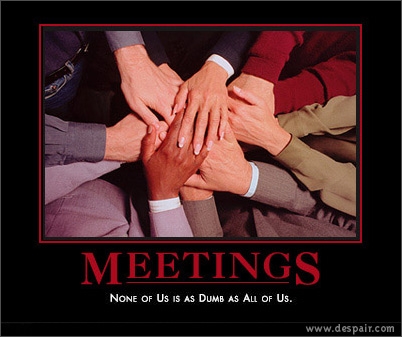
 You may have seen this poster about "Meetings," with the caption: "None of us is as dumb as all of us." [Credit: Despair, Inc.]
As John Carver says, "boards are incompetent groups of competent individuals." Or you may have heard the definition of a camel, as "a horse built by a committee."
Carver has successfully applied his principles to everything from the nation's largest Fortune 500 corporate boards to some of its smallest non-profits and school boards. His approach works with any institution governed by a group rather than a single administrator.
Carver contends that most boards -- or in this case city councils -- find themselves somewhere along a continuum from "rubber stamping" at one end to "micro-managing" on the other end (when they shouldn't be anywhere on that continuum), and that most instruction for boards only teaches them how to do the wrong things better.
Most of us enter into our roles as members of corporate or non-profit boards, multi-member public bodies (such as school boards or regulatory commissions) with some notion of substance (such as "education" in the case of a school board or the Board of Regents, or a city government's functions in the case of a city council) but little to no thought about governance process.
It's something the group has to perceive as an individual and group benefit, something each member wants to do. Otherwise it won't work. Carver has walked away from what would otherwise have been very lucrative work sessions once it became obvious that there was not that kind of commitment on the part of every member of the group. (Speaking of which, there's no need to hire Carver; the school board went through the process all on its own, relying on the books.)
Thinking through what that process should be, understanding and implementing a "governance" model (there are others besides Carver's), are among the most difficult jobs a city council member will ever undertake -- and given their responsibilities that's saying a lot. It takes individual study, research, hours of analytical thought and hopefully writing, the kind that causes little drops of blood to form on your forehead and drop onto the keyboard, before you are even ready to begin the group's discussion, agreement, and drafting that can produce your own specific application of basic governance principles. Although the process can be facilitated by an outsider, the end product is not something that can be delegated to a consultant or to staff. It has to be done by each individual council member.
No wonder most city councils and boards of all kinds aren't enthusiastic about undertaking such a task.
But there's a word for those who do. They are called "successful."
And their city managers tend to stay on the job for more than 11 months.
_______________
* Why do I put this blog ID at the top of the entry, when you know full well what blog you're reading? Because there are a number of Internet sites that, for whatever reason, simply take the blog entries of others and reproduce them as their own without crediting the source. I don't mind the flattering attention, but would appreciate acknowledgment as the source -- even if I have to embed it myself. -- Nicholas Johnson
# # #
March 10, 2009, 7:30 a.m.
Come Let Us Reason Together
(brought to you by FromDC2Iowa.blogspot.com*)
Yesterday I reported on our local school board's open public forum, March 7, regarding its proposed demolition of Roosevelt Elementary School, and my small group's negative reactions to the idea on that occasion. Nicholas Johnson, "Roosevelt: Valuing Our Schools; Process and Substance in School Facilities Decisionmaking," March 9, 2009, 8:30 a.m., edited with additional links and comments at 4:45 p.m.
I have written enough, on a variety of subjects, over the years that it is no longer uncommon for me to Google a subject in the course of research and discover I've already written about it in a prior document I'd long since forgotten.
This morning I am indebted to Ed Stone for bringing to my attention a document I helped draft nine years ago that I wished I'd recalled, and included in my blog entry, yesterday. Ed Stone, "Revisit 2000 Long-Range Plan," Iowa City Press-Citizen, March 10, 2009, p. A9.
One of my efforts as a member of our local school board (1998-2001) was to try to bring some rational analysis to the governance and policy making process of the board itself. (We ended up choosing, studying, and implementing the John Carver model. For more see, Nicholas Johnson, "Board Governance: Theory and Practice.")
As one of a number of consequences of that reconfiguration of Board-Superintendent relations, the Board addressed and ultimately approved the document to which Ed Stone refers -- a document it turns out he (but not I) found on my own Web site! (The Press-Citizen includes excerpts from the document in the hard copy edition, and a link to the entire document in the online edition.)
It's titled, simply, "Long Range Planning Process and Parameters, An ICCSD Board Document, Approved April 11, 2000." [And see, "Appendix: Evolution of the ICCSD Board's February 2002 Proposal for District Boundaries and Educational Opportunities -- A Bibliography," Draft February 15, 2002.]
I have observed over my years in Washington and elsewhere that (a) when civil, intelligent, informed, and independent individuals get together (i.e., persons not representing clients, causes or ideologies), and freely explore, discuss and propose solutions to a public policy challenge, they often (not always, but often) end up coming to consensus, and that (b) when other, similarly constituted groups engage in a similar exercise they will, more often than not, come up with the same (or very similar) consensus as the first group..
So it is when one compares the contents of the "Long Range Planning Process and Parameters" document of 2000 with the objections raised to the Roosevelt demolition plan in 2009 by the small groups reporting to last Saturday's assembled citizens (including the concerns I reported in my blog entry yesterday).
Here is the entirety of the Board's impressively brief "Long Range Planning Process and Parameters" policy and governance document:
Long Range Planning Process and Parameters
An ICCSD Board Document
Approved April 11, 2000
Long range planning. We want to take advantage of this somewhat unique opportunity to begin an ongoing effort to envision many aspects of the ICCSD five to ten years out, not merely come up with “boundaries” and lines on a map. Many of these options or proposals will have implications for buildings, boundaries and programs; others will not.
Research. We want our decisions, and those of the Superintendent, to be research-based. By this we mean not only the best demographic projections and other District data available, but also the alternatives, experience and best practices reflected in the literature and Internet-published material.
Optimum school size. The Board expressly requests from the Superintendent a research-based report regarding the optimum range of elementary and secondary schools’ enrollment from the standpoint both of cost (schools that are too small) and educational and social values (schools that are too large).
Community communication and concerns. We want to make every effort to minimize unnecessary community concerns during the course of our deliberations and those of the Superintendent. We need the freedom to be able to consider the widest possible range of options while reassuring stakeholders that it is not our intent to implement any option without thorough discussion with the community. As always, the Board and Superintendent welcome public input and will develop a communications plan to ensure that end.
Timing. The Board is looking five to ten years into the future. It recognizes the difficulty of doing so with any precision. But it believes it is in the District’s interest to have such a plan, even if it needs to be revisited and revised every year. It will seek to minimize disruption on District families by notifying the community as far in advance as possible of impending changes. Such advance notice makes planning and transitions easier for everyone.
Board decision-making responsibility. The members of the Board have the ultimate, personal and political responsibility for developing the policy and parameters that will be used to guide the long range and boundary planning process. The Board seeks input from the community and administration, and envisions an ongoing, back-and-forth dialogue and regular revision. It expressly requests the Superintendent to inform the Board, as promptly as possible, if and when he believes a Board-established parameter is seriously flawed, impossible of attainment, or simply unwise. But the policies will be worked out by the Board. It will not merely approve a Superintendent’s recommendation. The decision regarding the determination of boundaries will be that of the Board.
Superintendent’s responsibility. The Superintendent is responsible for completing the long range and boundary planning process. While doing so he will provide the Board with such data and research as it may need for its deliberations. He will keep the Board informed of the progress of the long range and boundary planning process. He is expected to guide the process in accordance with all relevant Board policies and parameters. Prior to implementation he is expected to bring the final plan, including the implementation schedule, to the Board for its approval.
First option: Present Schools. An option that must be considered is the use of existing schools. Any and all other options may also be considered.
The first boundaries option as to which the Board requests input from the Superintendent involves full utilization of the District’s present buildings with no new buildings or major additions. The 2004 projections indicate that some of the east side elementary schools will then be at 40-60% of capacity. Many of the west side elementary schools will be nearer 100% of capacity. One (Wickham) will be at 153% of capacity. (Kirkwood will be at 111%, Coralville at 109%.) What would be the cost – in increased busing expenditures and increased student time on buses – of shifting students from west to east? The Board cannot declare in advance how much such cost is “too much.” But it believes its responsibility to property tax payers is such that, if the additional cost is not too much, such a solution is preferable to a multi-million-dollar construction program for new school buildings while existing buildings remain underutilized.
The Board encourages the Superintendent to examine the feasibility of options such as (but not limited to) magnet schools, middle schools, age-grouped schools (i.e., all-kindergarten or K-3 schools), year-round schools, increased job shadowing or independent research (to reduce high school crowding), to use existing facilities in the most cost effective manner.
Second option: New buildings, building remodeling and expansion. Another option is to remodel and expand the District's present schools. (Of course, some remodeling may be a part of long range planning even if not necessary to reduce overcrowding.) The Board requests from the Superintendent in this connection (in addition to the “optimum school size,” above) information regarding the capacity, present and projected enrollment of each school, along with information regarding the amount of available land for expansion. It will then consider a parameter that will produce the maximum benefit (in terms of reduced crowding, and optimum school size) at the least cost (in terms of quantity of construction, adverse impact on families, and lengthened bus rides).
New buildings. Only if the present buildings are inadequate – with or without remodeling and expansion – will the Board consider the option of building a new schools. “Inadequate” includes the conclusion that the use of present buildings will “cost too much” as defined above.
Closing schools. The Board’s preference is that all present schools continue in use – subject to being persuaded that such a preference makes no educational or economic sense.
Low income students’ distribution. The Board’s present intuition is that there are educational and social benefits from elementary school students’ exposure to a diversity of classmates. (As with any other intuitive beliefs of Board members the Board invites the presentation of research findings that either support or challenge its assumption.) At the present time, with a District average of 17% low income students, the proportion in each elementary school varies from 2% to nearly 50%. The Board expressly requests the Superintendent prepare for its consideration a number of alternative models reflecting the implications (economic costs, number of students bussed, time spent on buses) of a more equal distribution of students. Prior to knowing those costs the Board expresses no view as to its preferred range of the percent of low income students at each elementary school.
Occupancy as percent of capacity. The Board wants to maintain an equivalency of educational opportunity between buildings.
Impact on junior and senior high schools. The Board presumes that any boundaries or long range planning decisions will result in a roughly equal allocation of students among the two junior highs and two high schools. If this is not the result of its decisions it will want to revisit them.
Neighborhood schools. To the extent consistent with the Board's preferences and options, above, it would like to maintain the concept of neighborhood schools, keep attendance areas contiguous, keep families together, and limit students to one forced transfer during their elementary years.
__________
[Of these 16 bold-headed paragraphs, the Press-Citizen hard copy edition excerpts paragraph numbers 1, 3, 8, 10, 12, and 16.]
Note how the governance model is working in this instance. These are clearly the Board's "planning process and parameters" -- not a Superintendent-drafted document rubber stamped by the Board. It is the Board that has done the very hard, analytical and creative work of thinking through and then establishing the policy, the goals, what John Carver calls "ends policies." At the same time the Board makes it expressly clear that it respects the Superintendent's professional expertise, and that it is willing to modify its approach when data and research suggest that modifications are required. Having made its very specific policy preferences and parameters expressly clear, it then leaves the implementation of them to the Administration (with a requirement of management information reporting against mileposts of progress and other updates from the Administration to the Board), free of Board members' micro-managing of the Superintendent's day-to-day decisions.
Ed Stone is writing about, and drawing upon this document regarding, allocation of students between our two conventional high schools (City and West; Tate serves the entire District).
But its relationship to the Roosevelt demolition proposal, and the reasons citizens have offered for opposing that proposal, is obvious.
Note that it is also a District-wide long range plan, not an effort to deal with a couple schools at a time.
As for process, see another op ed in this morning's Press-Citizen, Jim Throgmorton, "It's How the Light Gets In," Iowa City Press-Citizen, March 10, 2009, p. A9. Here are some excerpts:
A couple of weeks ago, the Iowa City School Board had a public discussion of its Strategic Facilities Improvement Plan as part of a regular board meeting. It didn't go very well. Parents were angry and the board members appeared defensive. Tension filled the room. . . .
Gad, I thought, this is a no-brainer. The president of the board . . . could have greeted the audience with a genuine welcoming smile. Having solicited "feedback" from parents about the district's plan, . . . board members and staff could have taken no more than 10 or 15 minutes to welcome people, lay out the agenda for the night and indicate what they hoped to learn from the public during the hearing.
[They] could have displayed genuine pleasure that so many people had committed their own time and energy to read the plan, to come to the district's office on a cold February night, and to share their assessment of the plan with board members.
Instead of telling this very well-educated audience that they "misunderstand," board members could have acknowledged that one of the primary purposes of the hearing was to let people say how the facts should be weighed.
Once the hearing had ended, [they] could have thanked people for speaking and indicated how their views would be incorporated into the district's final plan.
In his lovely song, "Anthem," Leonard Cohen sings:
"Ring the bells, the bells
That still can ring.
Forget your perfect offering.
There is a crack, a crack, in everything.
That's how the light gets in."
There was a crack in the district's plan. Parents saw it and drew attention to it. Feedback like that should be welcomed and embraced. It's how the light gets in.
A functioning governance model, and long range planning that is truly of the Board (not mere rubber-stamping of Administration proposals), are essential. But, as Throgmorton emphasizes, the Board's process in community relations is also important. Indeed, the more inadequate its planning and proposals the more essential it becomes.
Hopefully, Board members are learning from their "demolition disaster," reason will ultimately rule, Roosevelt will be saved, diversity will be better balanced, and a reasoned, sense of boundaries' evolution within a District-wide long range plan will emerge.
_______________
* Why do I put this blog ID at the top of the entry, when you know full well what blog you're reading? Because there are a number of Internet sites that, for whatever reason, simply take the blog entries of others and reproduce them as their own without crediting the source. I don't mind the flattering attention, but would appreciate acknowledgment as the source -- even if I have to embed it myself. -- Nicholas Johnson
# # #
October 24, 2008, 11:45 a.m.
Of Mission and Metrics:
Iowa Universities Presidents' "Performance Goals"
The presidents of Iowa's Board of Regents and its three universities have announced the "performance goals" for the universities' presidents -- goals that will guide the Regents in evaluating the presidents' annual bonuses for superior performance.
Since I've been advocating this for some years, it's rewarding to see the process started.
But, alas, if I were teaching management instead of law, and these proffered "performance goals" were presented to me by my students as part of a class writing exercise, I fear they would be graded somewhere between a "D" and an "F."
That's OK in one sense; I guess, as the Frenchman explained when asked why he kissed women on the hand, "You have to start somewhere." The effort has begun and I'm grateful for that.
Before explaining the rationale for the low grades, let me candidly acknowledge my limitations. I am not now teaching management, nor have I ever done so. I have a law degree, not an MBA. Most members of the Board of Regents, and many of the universities' administrators, have had much more education, training and day-to-day experience with management and administration than I have. So I cannot, and would not if I could, suggest that my reactions must be accepted because they come from someone with more authority than the authors of these documents.
My reactions must be evaluated on their merits. Either they make sense to you or they don't.
That's not to say I'm totally devoid of experience. As U.S. Maritime Administrator I had responsibility for roughly 100 programs and projects with a couple-billion-dollar impact, thousands of employees, reserve fleet ships, a four-year academic institution (U.S. Merchant Marine Academy), ship building and operating subsidy programs, sea lift to Viet Nam, work with NATO, and so forth. During that time I created the "MARAD Management Information Reporting System" (a description of which was written up and published by the Government Printing Office for the guidance of other government agencies). As a local school board member I studied and led the adoption of the John Carver board-CEO governance model. And occasionally some of the business literature has caught my eye over the years. But all together it's more of a hobby interest these days than the kind of expertise that a College of Business professor, or business executive on the Board of Regents, would bring to bear.
See, e.g., U.S. Department of Commerce Maritime Administration, "The MARAD Management Information Reporting System" (1965); Nicholas Johnson, "Board Governance: Theory and Practice" (2000-2001); John Carver, "Remaking Governance: The creator of 'Policy Governance' challenges school boards to change," American School Board Journal, March 2000, p. 26 (a very useful, summary presentation of the Carver basics for all institutions); Nicholas Johnson, "An Open Letter to Regents on 'Governance,'" April 17, 2007.
So, for what it's worth, from my perspective there are two basic steps to the creation of "performance goals," neither of which would appear to have been applied in this case.
The first is the extraordinarily difficult task of figuring out what the institution -- corporation or university -- is really about. John Carver talks in terms of "ends policies" (developed by boards and executed by CEOs, that, not incidentally, double as the CEO's "job description" and basis for raises and bonuses -- or firing). What's sometimes called a firm's "core competency" is related, as are "mission" statements, or more generally "purposes" or "goals." I used to put it to the school board and superintendent in the form of the question, "How would we know if we'd ever been successful?"
The second is "metrics" -- the creation of a standard capable of precise measurement of the CEO/institution's achievement of its goals/mission/ends policies.
Thinking through the most appropriate expression of mission for any institution, not to mention the metrics for measuring its accomplishment, is very, very tough work.
An example I sometimes use is a mythical non-profit organization (or school board) devoted to reducing teen pregnancy. New board members insist on some measure of the success of their well-intentioned, but not very precisely focused, staff. Two years later the annual report proudly reveals improvements in the number of presentations in schools, condoms and pamphlets distributed, column-inches of newspaper coverage, and drop-in teens who've come by the office. It's well received by the board members -- until one of them notes that the purpose of the organization is not presentations, publications, and publicity; it's the reduction in teen pregnancy. "How can that be measured?" she asks.
Of course, there's all kinds of jargon, and software, that invades this process and may or may not be of help. See, e.g., Wayne W. Eckerson, "See It Coming," February 1, 2006 (Eckerson is the author of Performance Dashboards: Measuring, Monitoring, and Managing Your Business (John Wiley & Sons, 2005)); the article is reproduced as Fredericksburg Speakers/The Center for Success, "CEO Goals Implementation Process," undated ("If you don't have a coherent business strategy or haven't translated that strategy into a series of interrelated objectives and metrics, a performance dashboard is going to drive the organization faster, but in the wrong direction.").
Here's an excerpt from a corporate board's agenda item reviewing its CEO's "performance goals."
The current CEO goals were adopted on February 23, 2005 and are attached as Table A. While they cover a lot of topics unfortunately few of the goals are measurable and there are few high level summary goals or outside measures . . ..
A previous Chugach mission statement said:
"Maximize the value customers receive by safely providing competitively priced, reliable energy and services through innovation, leadership and prudent management."
It has been said many times in many forums,
"If it isn't measured, it doesn't get done." [emphasis in original]
In order to monitor our progress in achieving these objectives the BOD, members, and staff need a reporting mechanism that is directly tied to the critical items in the mission statement.
Ray Kreig, "Chugach CEO Goals," prepared as agenda item for August 10, 2005, Chugach Electric Board of Directors Meeting, August 5, 2005.
(As a Procter & Gamble executive and former school board colleague of mine used to express this truism, "You get what you measure.")
Of course, setting CEO performance goals, however essential, is not enough. The CEO must have the capability to, as Larry the Cable Guy puts it, "Get 'er done," as this oft-quoted Fortune article notes:
Of course you have to deliver results, but you're unlikely to do so if you haven't developed performance forecasts for the next eight quarters, not just the usual four. You should have ideas now for changes you may have to make six to eight quarters out. . . .
Every company, even the most successful, has bad news, usually lots of it. If you're not hearing it, are you letting the trouble build? . . .
Effective CEOs use processes to drive decisions, not delay them. They start by focusing on initiatives that are clear, specific, and few, and they don't launch a new one until those in progress are embedded in the company's DNA. . . .
Yes, strategy matters. A good, clear strategy is necessary for success -- but not sufficient for survival. So look again at all those derailed CEOs . . . smart people who worried deeply about a lot of things. They just weren't worrying enough about the right things: execution, decisiveness, follow-through, delivering on commitments.
Ram Charan and Geoffrey Colvin, "Why CEOs Fail," Fortune Magazine, June 29, 1999, p. 69.
Against this background, let's use as an example UI President Sally Mason's "performance goals." Erin Jordan, "University Presidents' Bonuses Now Linked to Goals," Des Moines Register, October 23, 2008; in this morning's Press-Citizen as Erin Jordan, "Mason's Pay Tied to Performance; President Must Meet Goals to Net $80K," Iowa City Press-Citizen, October 24, 2008.
One goal involves new personnel: two vice presidents to replace those she fired, two others (including a new VP for "strategic communications"), and a new head of Equal Opportunity and Diversity (whose term is expiring), and to complete three of the searches by June 30, 2009.
A second involves flood recovery: (1) she will "continue restoration [and] reopening of facilities; [at a] minimum threshold . . . restoring reliabile utility service [from a power plant that sustained $20 million in damage]; and (2) "develop a comprehensive flood mitigation plan" especially "for seven campus buildings."
Third, sexual assaults: (1) "lead UI in developing a new sexual assault policy and investigation process," (2) "continue sexual harassment training for UI employees," with a "minimum threshold [of] (a) putting the sexual assault policy in place and (b) training a portion of faculty, staff and teaching assistants in the next year."
Alcohol, the fourth subject, led to a goal to "form a safety task force focused on reducing alcohol abuse."
Finally, fundraising: "to increase fundraising by the UI Foundation by 5 percent."
There may be more, but that's the full list from this morning's Press-Citizen.
So let's go through them one at a time.
For starters, all of them sound more like a "to-do" list than "goals," but we'll return to that in a minute.
The first, personnel, item at least has a specific deadline: June 30. Though it's not unfair to note that there's no reference to the actual hiring of these replacements, let alone their arrival at Iowa, only the search for them. And eight months seems a generous and easily attainable "goal" for any search. Isn't this a rather routine function, rather than a "goal," a change, or improvement of some sort in the institution's execution of its mission?
The same can be said for the second, the flood recovery effort that is to "continue." There's no offered metric for measuring what is "recovery," how it is to be measured, how much is the targeted goal for the remainder of the academic year, and so forth. As for the "plan," that's not difficult to come up with; the question is whether it's any good. Treasury Secretary Paulson came up with a two-page "plan" for reversing the economic downturn; it ended up being so far off the mark that he and the Congress agreed it needed to be radically changed. What kind of expert/peer review are we going to have of this plan? Is it really something that will reflect the UI president's personal input, or will it, like the Stolar Report, simply be farmed out to a "consultant" -- in which case why should she be paid all or part of an additional $80,000 for doing that?
The new sexual assault policy and investigation process is something the Regents have already asked of the universities and is underway. Some changes have already been put in place. Is coming up with a response to a Regents' command, one that involves and will represent the work product of staff from all three universities, really worthy of being called a "goal" which, if met, entitles a university president to a "bonus"? Moreover, to use "to continue sexual harassment training for UI employees" with a "minimum threshold [of] . . . training a portion of faculty" as the justification for a bonus is to reward the mere "continuation" of a program apparently already underway, without defining its content and change, the metrics for measuring its impact on the actual number and severity of incidents of "sexual harrassment" (presumably its purpose), what level of change would warrant reward, or how large a "portion" of faculty having been trained will meet this "goal."
Alcohol abuse is a serious problem on the UI campus. It is not unrelated to the sexual assault problem mentioned above, as President Mason has herself noted. Yesterday the new Provost, Wallace Loh, firmly spoke out in opposition to alcohol abuse -- certainly better than not speaking to the subject, or coming out in favor of alcohol abuse -- but without, however, proposing anything specific be done about it. But is the creation of "a safety task force focused on reducing alcohol abuse" worthy of financial reward? For starters, we have such a task force now, as I understand it, so any extra cash for this one is kind of a slam dunk. Second, we've kind of always had one for the last 20 years or more. Third, like my "reducing teen pregnancy" example, above, they've never really accomplished much in terms of either measuring or reducing alcohol abuse and its consequences -- aside from spending the grants for the "Stepping Up Project" over the years.
The State of Iowa provides only a small proportion of the University of Iowa's budget. That's sad for a "public" state university initially established to provide essentially free higher education for Iowans. But it's the reality, with the result that one of the major tasks to befall university presidents, including ours, is to raise money. But note how this goal is worded: "to increase fundraising by the UI Foundation." Why should the president -- as distinguished from those who actually did the work that brought about the increased fund raising -- be the one rewarded financially for this accomplishment? It goes on to specify "5 percent." That's commendable and much better than simply "to increase." If a given university president is especially adept at fund raising, and specific gifts and grants can be traced to his or her efforts, some recognition of that might be appropriate. Even in that case, however, should not a "bonus" represent performance above and beyond the expected normal? How much have grants and gifts normally increased from year to year? Would another 5 percent increase be a remarkable accomplishment, or the average expected increase, or even below average?
So even if these "goals" were the most high priority, central, appropriate aspirations for our University, I'm not convinced that they could not be improved with some rethinking and redrafting.
But put those concerns aside. I don't mean to be picky.
The far more fundamental disappointment is what they reflect about the Regents' and presidents' thinking about the purposes, missions, ends policies, and goals of our Regents institutions.
Do these goals reflect why we're here, or the most important things we're trying to accomplish with State higher education for our students and the citizens of Iowa: That we successfully hire replacements for those we peremptorily fire? That we get the water out of flooded buildings, negligently built on flood plains? That we raise more money?
Indeed, in order to raise that money, let alone spend it wisely, don't we first need to know what we're trying to accomplish with the money, and how those expenditures will contribute to the accomplishment of our mission?
What is our mission? (I have some ideas, but I'm not going to extend this by starting that discussion now.) How would we know if we'd ever been successful? What are the metrics by which we might find the answer to that question?
Once we figure that one out, aren't those the bases for coming up with the goals that truly matter, the goals that bring us closer to what we're really all about, the goals when met that might really be a solid reason for providing a bonus and "job well done" to an educational administrator?
# # #
May 1, 2008, 12:15 p.m.; May 3, 2008, 8:00 p.m. (electoral vote update)
What Do Parental Leave, Project Vote Smart,
and the Electoral College Have in Common?
Click to go directly to:
Electoral College
Project Vote Smart
Parental Leave
Electoral College. In Nicholas Johnson, "It's the Electoral College, Stupid!" April 22, 2008, I wrote,
"In point of fact, none of this [Senators Clinton's and Obama's shares of elected and super delegates, popular votes, or states "won"] matters.
What matters are electoral votes. Just as the delegate count is how the Democratic Party's rules provide for the nomination of a presidential candidate (though there is some remaining argument about the appropriate degree of independence super-delegates can properly exercise), so do the electoral college votes determine who gets elected president.
In short, the question is not how Clinton and Obama do when running against each other, the question -- for those who put "winning" first in their selection of a nominee -- is how each will do running against Senator McCain in November.
Since then, using the latest polling data from each state, I've put together my own spreadsheet of states, their electoral votes, and in match ups between Obama-McCain and Clinton-McCain who gets a given state's electoral votes.
As you might suspect, there are some states that will be won by either Clinton or Obama -- or lost to McCain -- regardless of who the Democrats' nominee may be, and some where the nominee makes a difference. Other states are too close to call -- for either Obama or Clinton, or for both.
Obviously, what folks say to pollsters in February, March and April is of only limited predictive value in guessing what they'll do in casting a secret ballot in November. But it's of some use, especially if you toss out (as I have) those instances in which the polls indicate it's pretty close. (There are many sources of this data; the one I relied on mostly is Electoral-vote.com.)
Anyhow, at this point in time (May 1):
(1) All the states have 540 electoral votes; so it takes 270 (or 271) to win.
(2) Deleting the results in states too close to call, or won by McCain, Senator Obama is now leading in states with 213 electoral votes and Senator Clinton in states with 194.
(3) Senator McCain wins states with 172 electoral votes running against Obama, and wins 268 electoral votes running against Clinton.
May 3 Update: Incorporating the data from Rasmussen Reports into the spreadsheet of what I already had from Electoral-vote.com the match-ups now indicate Senator Obama would have 229 to McCain's 196, and Senator Clinton would have 181 to his 322.
Again, to remind, in addition to polls' weaknesses as predictors of future events, they also change over time; a couple weeks from now we'll have some new and different numbers. Moreover, we still have more primaries to go -- most immediately, Indiana and North Carolina next Tuesday, May 6.
Project Vote Smart. In a 2004 Des Moines Register op ed I wrote,
Some candidates complain about the media's focus on elections as a horse race. They're right -- there isn't much issues coverage. But when candidates are invited by Project Vote Smart to disclose their positions on issues via the Internet, it might surprise you to find out who refuses.
Nicholas Johnson, "Election as a Civics Class," Des Moines Register, November 6, 2004.
In 2006 I blogged,
Taking a stand.
The Gazette editorialized the other day about Project Vote Smart's National Political Awareness Test. It's a non-partisan, "good government" effort to provide voters information about the positions of their candidates for public office. (The organization's page for Iowans is here.) Editorial, "Voters Want to Know," The Gazette, August 31, 2006.
The Gazette reports that "Both major political parties are advising candidates not to take the test. Party officials say the candidates will lose control of their campaign messages and they will be exposed to opposition research." That's one awful commentary about our major political parties -- both of them. What's worse, for a Democrat, is who did, and who did not, take "the test."
The Republican candidate for Iowa governor, Congressman Jim Nussle, did. The Democratic candidate, Secretary of State Chet Culver, did not. Moreover, apparently he has always refused to take it even as Secretary of State.
Republican incumbent Congressman Jim Leach not only takes the test, he was actually one of the founding board members for the organization. His Democratic Party challenger, Dave Loebsack, has so far refused to take it. [Note: (May 1) He subsequently responded to the criticism and took the test.]
Nicholas Johnson, "Taking a Stand" in "It's Getting Harder to be a Democrat," September 1, 2006.
This morning The Gazette is back on the topic again:
[S]adly, the number of state legislative and congressional candidates who took the Iowa version of the national survey, carefully composed by the respected Project Vote Smart organization, has dropped steadily over the past decade. In 1996, 40 percent of Iowa’s candidates for state legislative offices took the survey. In 2006, a paltry 7 percent did so. As for congressional candidates, two-thirds responded in 1996 but just one-third . . . did in 2006. The response rates from Iowa candidates are among the nation’s lowest. . . .
[W]hy do the vast majority of candidates refuse to participate?
Most cite pressure from their political parties and professional advisers, who tell candidates not to answer questions about positions on issues because opponents may use the information against them.
Oh. ... Then it seems they’re telling us that running for office is only about winning — that taking a position on major issues affecting their constituents isn’t important to the campaign process.
Not much courage in that.
Editorial, "The Courage to Take a Position," The Gazette, May 1, 2008, p. A4.
I wish The Gazette, I, and the many others including the Project Vote Smart folks who are trying to do something about all this could have a greater impact, rather than having to raise the issue every two years.
I'll have some suggestions at the end of this section, but as for this morning I'm feeling pretty much the same way I did when I wrote,
"Ya don't play-a da game . . . ya don't make-a da rules"
That was the reaction the Des Moines Register's beloved humor columnist Donald Kaul once offered to those religious leaders who practice celibacy but want to regulate the sexual behavior of everyone else. (Kaul's still writing; see Minuteman Media.) . . .
I've expressed in this blog my disappointment with Democrats (and Republicans) who refuse to disclose their positions on the issues to Project Vote Smart and others. See, "Taking a Stand" in Nicholas Johnson, "It's Getting Harder to Be a Democrat," September 1, 2006.
Elections are an opportunity for "continuing education" on the public policy choices confronting our country. See, Nicholas Johnson, "Election as a Civics Class," Des Moines Register, November 6, 2004. Project Vote Smart exists to encourage that education and public dialog. See, Project Vote Smart.
President Clinton said something to the effect that "we have more problems than we deserve, and more solutions than we've ever tried." However important you may think the issues of "God, guns and gays," or the "war on terrorism" (and Iraq), may be, there is a lot more we need to talk about.
There's no room to list everything, but universal health care (and basic public health measures), reversing the ever-increasing multi-trillion-dollar debt and adverse balance of trade, energy policy (including global warming), and attempting to rebuild positive international relations come immediately to mind as examples.
When candidates deliberately try to avoid the "teachable moments" provided by the campaign season, when they demonstrate their willingness to put their own election or re-election above the interests of the nation (or state), they are doing all of us a grave injustice -- if not, indeed, demonstrating their lack of qualifications to hold office.
At a minimum, when they refuse to participate in Project Vote Smart they should at least have the decency not to attempt to use to their partisan advantage the positions of their opponents who have participated.
"Ya don't play-a da game, ya don't make-a da rules."
Nicholas Johnson, "Ya don't play-a da game . . . ya don't make-a da rules," September 6, 2006.
So what can we do?
We can write letters to the editor of our local papers, urging them to use their much longer and stronger levers of power to pry participation out of our local candidates.
We can write the candidates themselves, and ask them in open meetings why they haven't participated.
We can help support the work of Project Vote Smart.
And given The Gazette's commendable focus on this issue over time, I'd like to politely suggest that it might want to turn some reporters' resources, and space in the paper, to reporting -- by name -- which candidates are refusing to participate, along with the positions on the issues of those who do.
Parental Leave. The University of Iowa has created (or expanded) its leave-with-pay policies for new parents. It's not necessary for me to get into the details for purposes of this commentary (which is fortunate, since I don't claim to understand them). State29, "Be Bold," May 1, 2008, does that -- and suggests the policy should be extended from the first six months of life to the first 18 years.
Intuitively it strikes me as, at worst, an acceptable idea. UI professors will still do some research and writing from home (which is supposed to be roughly half of what they're getting paid for anyway); it will help retain faculty; and it's undoubtedly good for the kids. On the other hand, someone will have to be hired to teach their classes, and there are some equity issues if the perk is not given to all UI employees.
No, the aspect of this I want to address is "governance," the relationship between the Regents and the UI administration, the "process."
Once the new members of the Board of Regents had been installed, and the disastrous year of searching for a new UI president was rapidly coming to any end, I wrote them an "open letter" with some suggestions about "governance." Nicholas Johnson, "An Open Letter to Regents on 'Governance'" in "UI Held Hostage Day 451 - Open Letter to Regents," April 17, 2007.
The way this faculty leave issue has been handled indicates to me that it may well be possible that there's still a little more work to be done by both sides with regard to their "governance model."
Former Regents' President Michael Gartner is reported to have sent an email to the current President, David Miles, indicating that Gartner first learned of this decision from the newspapers and that, in his opinion, it should have been discussed and approved by the Regents before being implemented: "I would like to raise the issue of process: Should a far-reaching policy such as this first be approved . . . by the Board of Regents?" Brian Morelli, "Regent Questions New UI Leave Policy for Parents; Raises Concerns About Whether It Sets Bad Precedent," Iowa City Press-Citizen, May 1, 2008, p. A1.
UI President Sally Mason took a different view of the process:
[She] said the policy codified what has existed in the operations manual at UI for the past eight years. Some departments have been allowing the modified duties already, and staff and 12-month tenure-track faculty already have reaped the benefits as well, she said. The new policy only applies to nine-month time tenure-track faculty, she said.
Mason said she didn't mind if the regents wanted to discuss the policy or have it explained to them, but she did not expect them to intervene.
"It would be interesting, perhaps precedent-setting, if they get involved at this level. It would be a little curious," Mason said.
Brian Morelli, "Regent Questions New UI Leave Policy for Parents; Raises Concerns About Whether It Sets Bad Precedent," Iowa City Press-Citizen, May 1, 2008, p. A1, A6.
The Gazette reports, "Regarding that policy, UI officials said it was their understanding the change needed only internal administrative approval at the university. Mason said UI officials checked with the regents’ office about the policy before moving forward with it." Diane Heldt, "New UI Policy Prompts Broader Benefit Questions," May 1, 2008, p. B3.
And,
"Susan Johnson, the U of I's associate provost, told the Register that she did not think the university's policy change required the regents' approval.
"For many years, university policy has authorized modifications of employee work schedules and duties to help reduce conflict with parental obligations," Johnson said.
Lisa Rossi, "Regent suggests that U of I acted too quickly," Des Moines Register, May 1, 2008.
So now let's see what we have here. A Regent would like to have the policy discussed and approved by the Regents. An associate provost "did not think" the policy required Regents' approval. Unnamed "UI officials said it was their understanding the change needed only internal administrative approval." Apparently the UI President felt the governance relationship with the Regents was such that it was necessary that "officials checked with the regents’ office about the policy before moving forward with it" and that, having done so, "she did not expect them to intervene." She also thought relevant the fact that related policies had been a part of UI regulations for eight years.
Now there are many approaches to governance besides that of John Carver -- though his is widely used and is very good in my experience. See, Nicholas Johnson, "Board Governance: Theory and Practice," with links to full text of some of John Carver's writing. It's probably not so important which governance model is used by a board-CEO as that the matter of governance has been thought through and some model established.
Carver talks in terms of "ends policies;" what most of us would call "measurable goals." Figuring out what those should be for a university, not to mention a statewide system of universities, is not easy; it's the kind of thing that makes your head hurt if you do it right. We're not talking about vague, general "strategic plans" or "mission statements." If you're interested in what we are talking about read Carver.
Carver says most boards (and he's worked with everything from NGOs to Fortune 500 corporate boards to school boards) are somewhere along a continuum from "micro-managing" to "rubber-stamping" when, in his view, there's no proper place along that continuum for them to be. Much of the literature, in his view, just explains to boards -- which he calls "incompetent groups of competent people" -- how to do the wrong things better.
It's tough to summarize more than one book in less than one paragraph. But I'll try anyway. A major part of his model is that it is the board's responsibility to come up with the "ends policies" (measurable goals) and then the CEO's responsibility to figure out how to achieve them. Those ends policies are both the CEO's job description and the standards by which her or his annual performance is evaluated.
Otherwise expressed, this creates a relationship in which the board says to the CEO, "go until we say stop," instead of "stop until we say go." There are "executive limitations" established by the board. But so long as the ends are attained, and the limitations are not violated, it's totally up to the CEO to choose the means.
How would such an approach have applied in this instance?
I think Gartner was right to "spot the issue" -- the governance ambiguity. But, without knowing more, my instinct would be to have ends policies such that the details of faculty leave policies would probably be considered "means" for a CEO (i.e., in this instance the UI president) rather than something for the Regents to address in an ends policy.
Were the ends policies clearly laid out, a Regent would know that this is not a matter with which Regents need concern themselves. An associate provost would not have to think, she would know that the administration did, or did not, have authority to move ahead. Officials would not be acting merely on their understanding. The President would not need to have an aide contact the Regents before implementing the new policy, nor think that because the university had already done something similar that therefore this variation need not come from the Regents.
So let me repeat, I do not think the policy is substantively flawed, nor that the Regents should have discussed and approved it before it was implemented. That's not what I'm writing about -- one way or the other.
All I'm suggesting is that it would be smoother and more efficient and effective for everyone involved if a governance policy had been clearly and precisely thought through, articulated, put to paper, and followed.
This faculty leave policy change just seemed to me a useful case study of that "process," of governance models (and their absence) -- not because it was an example of the results of necessarily erroneous administrative decisions.
Process. So today's theme is "process." Process in evaluating the progress of primaries and elections, process in making it possible for voters to know something of their candidates' positions, and process in board-CEO relationships.
# # #
August 21, 2007, 8:40 a.m.
Lots of news items inspiring commentary this morning:
Building Character (or is it "characters") Through Sports
Three Iowa football players are in trouble with the law; two for credit card theft and one for failing to make a court date regarding a prior offense based on an offense before that. Scott Dochterman, "2 Iowa Receivers Charged, Suspended," The Gazette, August 21, 2007, p. C1.
And pro ball players are also on the legal pages. The Atlanta Falcons' Michael Vick pleaded guilty yesterday to animal abuse in a dogfighting operation, conspiracy charges, and bankrolling gambling -- crimes with a maximum term of five years in prison and a $250,000 fine. Sentencing is now scheduled for August 27 (next Monday) -- at which time it's more likely to be one year than five. AP, "Vick to Plead Guilty," The Gazette, August 21, 2007, p. C4.
Very likely in the minds of these four the greatest penalty will be the interference the legal system is going to put in the way of their getting back on the field for awhile.
What ought to be on the minds of our UI and athletic program administrators is: What went wrong? We put enormous resources into the recruiting, guidance and academic assistance for these athletes.
Ironically, one of the credit cards was stolen from inside one of those very expensive resources: the University of Iowa's Gerdin Athletic Learning Center. Makes you wonder what they're learning inside that building.
No program, however tightly run, can prevent all conceivable legal violations and other misconduct. But does the story behind these sad and costly violations provide any insight into how our own program could do even better? Let's find out.
Party On!
Of course, every time the reputation of the University and its athletic program take a punch in the nose like that, fortunately there is always some good news to balance it out. And so it is this morning.
The UI may only rank 64th among America's universities according to U.S. News & World Report, but by golly we're 5th in the nation for students' consumption of hard liquor according to the Princeton Review (not to mention number of bars per student and "most profitable market in which to operate a bar with the least City Council and University oversight" according to me). Hey, at least we're known for something positive around here. Hieu Pham, "UI Again Ranks Among Party Schools; School Also Ranks 5th for Har Liquor Use, 18th for Beer Use," Iowa City Press-Citizen, August 21, 2007, p. A1.
UI VP for Student Services, Phillip Jones, put it best: "We suffer from a reputation that has, unfortunately, been earned." Erin Jordan, "Less Partying Gives U of I a Real Reason to Celebrate,"
Des Moines Register, August 21, 2007. How earned? The University's own statistics reveal that "nearly 70 percent of U of I students surveyed last fall by Student Health Services said they had participated in binge drinking in the previous two weeks."
How is the United Way Like an Overcrowded Jail
I often write about governance models, and governance guru John Carver's notion of "ends policies." This approach requires the kind of hard thinking by board members that produces little beads of blood on your forehead. "What is it we're really, and most fundamentally, trying to accomplish?"
Once you think about it, it turns out that "We got 32% more news coverage for our organization than last year," or "We exceeded our fund raising goal by more than $25,000," or "We handed out more leaflets in high schools this year than in any prior year" don't qualify as "ends policies."
The Gazette, always a leader in "civic journalism," is this morning editorializing about -- regardless of what the United Way of East Central Iowa folks are calling their process -- amounts to this kind of tough thinking about "ends policies" (or "goals").
The whole editorial is worth reading, but here's an excerpt:
Some details on what’s changing in United Way’s transition from its traditional role to the new community impact model:
* Traditional: United Way is a fundraising organization. New: United Way is a community impact organization.
* Traditional: Funds agencies and programs. New: Invests in strategies for community change.
* Traditional: What do agencies need? New: What does the community need/want?
* Traditional: Emphasis is on money raised. New: Emphasis is on impact agenda results
* Traditional: Builds relationships with businesses. New: Builds relationships with businesses, individual donors and the entire community.
Editorial, "United Way's Expanded Role," The Gazette, August 21, 2007, p. A4.
So what on earth does this have to do with jails?
The Press-Citizen is editorializing this morning that we need a timeline for building a new Johnson County jail. Editorial, "Establish Clear Timeline for Overcrowded Jail," Iowa City Press-Citizen, August 21, 2007, p. A11.
In fairness, the editorial does provide the balance that Press-Citizen editorials often do. It notes,
the question has long been whether the county is using the space it has most effectively. The Sheriffs' and other departments have to prove that they are working together to alleviate enough of that overcrowding through jail diversion programs and other alternatives. Only then will Johnson County voters be convinced that a new jail is not merely an expansion of the "incarceration industry." No one is interested in merely having the county lock more people up; we want the county to lock up the people who present a danger and to be providing alternatives and rehabilitation to those inmates for whom it would be beneficial.
When it comes to the final sentence, however, the paper advises, "It's past time to establish a clear timeline for how long the county expects the jail staff and other law enforcement officers to work in such an overcrowded facility."
How might we think about the "jail issue" if we were to apply the Cedar Rapids United Fund, and Gazette's, notion of "traditional" and "new" thinking -- or what John Carver calls "ends policies"?
What is it we're really trying to accomplish when we have conversations (and editorials and blog entries) about the number of Iowa City police officers, whether or not to arm the campus police, or whether to build the consultants' recommended 450-bed new jail?
Isn't the "end" we seek a community that minimizes the threats to its inhabitants' health, safety and (as the Declaration of Independence puts it) "pursuit of happiness"? That includes a focus on clean air, water and safe food; the need for affordable housing; plans for dealing with natural disasters, such as tornadoes and flooding; epidemics of new strains of flu -- and, of course, the adverse consequences of criminal behavior.
That is one (not the only) way of expressing our "ends policy." That's not to say we're unconcerned about criminals in crowded conditions, or county employees working there. It's only to say that it is but a relatively minor sub-set of what we're really trying to accomplish.
When we do get around to that subset issue, that "means" to our "end," we have another challenge. As the Press-Citizen puts it, "The Sheriffs' and other departments have to prove that they are working together to alleviate enough of that overcrowding through jail diversion programs and other alternatives."
And after we have put in hours of searching the Internet for what other counties -- and nations -- have done to most efficiently deal with this challenge, and after we have run the benefit-cost analyses for all conceivable alternatives to the way the current criminal justice system works, we are left with another question.
Like the issue of how many police officers the City of Iowa City should employ, the question of how many beds for criminals should be supplied by Johnson County in the form of a 450-bed, multi-million-dollar jail is a "peak load problem."
That is to say, it's highly unlikely we will ever have enough police -- or space in jail, or hospital emergency room personnel, beds and supplies -- to deal with worst case scenarios. We probably want to maintain something more than the average (whether mean, median or modal measures) need for all of these resources. But how much more is a judgment question -- and a judgment question that must balance the enormous cost of maintaining mostly unused facilities and resources against the costs of not having them on the rare occasions when they really are needed.
This further complicates the comparative benefit-cost analyses of, say, a 450-bed Johnson County jail vs. transportation to other State of Iowa or counties' facilities. (It's almost inconceivable that there would not be economic and other benefits to Iowa's 99 counties cooperating on this, as other, basic county obligations -- as has been advocated to little avail over the past half-century or more.) If, after exhausting all possible alternatives to putting persons in jail, we are transporting, every day between 20 and 30 prisoners elsewhere, and the most reasonable projections are that this will continue and possibly even increase, and the cost of doing so is greater than housing them in Johnson County, a case could be made for creating more jail beds here (although not necessarily 350 more).
There are others more wise than I about the criminal justice system, prisons, county government -- and benefit-cost analyses. But it does seem to me that our logic is a little simplistic when we say that (1) our jail is "overcrowded" (without providing answers to the "what do you mean? and how do you know?" questions), (2) the only way to solve an overcrowded jail problem is to build more and bigger jails and prisons, and, therefore, (3) we need a timeline regarding the planning and ultimate construction of a multi-million-dollar, 450-bed jail.
# # #
May 23, 2007, 11:55 a.m.
Regents, Governance, PR Firms, Strategic Planning, Presidential Selection, and June 13
As I have written here at length over the past few months, the number one, top priority issue confronting the Board of Regents -- and especially its new additions -- is the study, eventual selection, and application of, a governance model. See, e.g., most recently, Nicholas Johnson, "An Open Letter to Regents on 'Governance," in "UI Held Hostage Day 451 - Open Letter to Regents," April 17, 2007.
Two recent items further illustrate this need.
So far as is known, the Regents' Executive Director and President, without formal Board action, have decided to hire a public relations firm. "Request for Proposals: Promotional Services for the Board of Regents, State of Iowa;" see especially, Section F. Proposal to Implement the Statement of Work, p. 8. By May 21 there were sufficient questions regarding the content of this RFP that a "Questions and Answers" had to be issued. See, Associated Press, "Regents Want to Hire a Marketing, PR Expert," Des Moines Register, May 18, 2007 ("I don't have the expertise to say, 'How do we get this news on the front page of some newspapers around the state?'" [Regents Executive Director Gary] Steinke says. "That's the kind of thing we need to do a better job of — blowing our own horn.")
Clearly, anyone who would phrase the question in that way is in need of a little guidance. The way you "get this news on the front page" is to provide the newspaper, in timely fashion, with information which -- in their judgment, not yours -- is worthy of the front page, and then return their phone calls promptly when they call. Every for-profit and non-profit institution in the country, along with most celebrities, wants to "blow its own horn." Do you have any idea how much of their public relations firms' self-serving (and not incidentally very expensive) horn blowing on behalf of clients ends up in newspaper editors' circular files -- often unopened?
Actually, it's highly unlikely that there is advice from any public relations firm in the country that is even the equal, let alone better than, that which could be easily provided by the fellow who happens to be the President of the Board of Regents. He is, after all, a former newspaper editor, a frequent newspaper contributor, a newspaper owner, and former President of NBC News. Aside from his advice and guidance, most of the routine media relations tasks can be performed by someone among those 21 employees in Steinke's office ("The Board Office has 21 individuals," Answer to Question 9, "Questions and Answers," p. 3).
So it's not clear to me (without knowing more) why the Board would need a public relations firm. As "JackDM" put it, in a comment on the Register's May 18 AP story:
Since when do we need to hire PR and Marketing Firms for State departments or agencies? I mean are they going to do ads that say "We are better than the Illinois Board of Regents?"
The Board of Regents and their staff have never had a sense of reality. Instead of all those salaries they should disband the Regents Office and allow the Universities to govern themselves like the majority of states do. We save money on the building rent in Urbandale, we eliminate salaries and benefits for the goof offs in the office, and eliminate private plane travel, meal benefits at five star restaurants, and...the embarrassment of the Board of Regents. The money could be placed into the colleges to at least keep tuition steady. Go to the Board of Regents website and look at the budget they have!
Now don't get me wrong. I don't think we should do away with the Board of Regents, and I frankly doubt that its staff consists of "goof offs." But I do think the Board -- and we -- need to think through the governance model. What, exactly, is it that the Board should be doing and why?
Why does "the Board" need a public relations firm? There is relatively little news that comes from the Board of Regents, as such. Not only is a Board public relations firm unnecessary, it would make matters worse in a variety of ways -- not the least of which would be public relations.
The most newsworthy stories (mostly positive, but also negative) come from the Regents' institutions themselves -- such as the University of Iowa. In the nature of media relations -- especially in an age of the 24/7 news cycle -- efficient and effective coverage requires that the stories, and the media's contacts, come from those on the scene. So far as I can see, the institutions' news services are doing about as good a job as anyone could, given their resources. Requiring them to run their stories and responses to reporters' questions through "the Regents' public relations firm" would be one of the biggest steps backward imaginable.
So far as I know, it's relatively unusual for, say, a corporate board of directors to have its own public relations firm -- separate and apart from that which serves the company. So we're back once again to governance issues.
If you conceive of the Regents' institutions as the subsidiary corporations of a conglomerate corporation called The Board of Regents, with the President of the Board as the CEO, the Executive Director as the COO (his actual self-characterization), and the 8 other Regents as vice presidents reporting to the CEO, that's one model -- not very far from the way the present Board seems to work. Under such a model, it would still be inefficient, but otherwise understandable, to have all contact with the media run through "headquarters." [Source: "The single contact person will be the Executive Director . . . chief operating officer of the Board of Regents . . .." Answer to Question 9, "Questions and Answers," p. 3.]
If, on the other hand, you apply the John Carver model to the Board, along with the 80-year-old national tradition of "shared governance" of universities, with the universities' presidents as close as you'll get to a CEO, responsibility for media relations would normally rest with the universities.
And that is why, before the Board can even think about the matter of hiring a public relations firm it first needs to address, as its top priority, the matter of a governance model.
The same thing can be said for Michael Gartner's unilateral announcement that the June 13 meeting is to be devoted in large measure to "strategic planning."
From this morning's Gazette: Diane Heldt, "Regents ready for strategic planning," The Gazette, May 23, 2007, p. B2.
The state Board of Regents, the presidents of Iowa’s three public universities, and a University Hospitals leader will discuss long-term strategic planning at the June 13 regents meeting in Des Moines. Regents President Michael Gartner, in an e-mail to the regents, the presidents of the University of Iowa, Iowa State University and the University of Northern Iowa, and to Jean Robillard, vice president for medical affairs and dean of the UI Carver College of Medicine, laid out a plan for the discussion.
It’s a good time to jump back into the subject, Gartner told The Gazette, because the June meeting is light on other business, the UI presidential search is coming to a close, and four new regents are in place. ‘‘It seems like a good time to sit back and take an assessment of where we are and where we’d like to go,’’ he said.
It will be an informal, public discussion of the long-term views for the UI, ISU, UNI and University Hospitals, he said, and likely the first in a series of discussions.
Questions suggested in his e-mail include:
| What should the universities look like academically and structurally in 10 years?
| What areas should each excel in, both in teaching and in research?
| When is duplication needed and when is it a less-than-ideal use of resources?
| What existing areas at each institution need to be fortified, what new areas need to be launched, what areas must be maintained but not emphasized, what areas should be phrased out?
| How can each university best serve the state’s and its citizens’ changing and increasingly diverse interests?
| What can the universities do to make sure entering students are more than adequately prepared for a university curriculum?
* * *
This raises all kinds of questions. A month ago I addressed some of them in the context of the need for a Regents-Universities governance model. Nicholas Johnson, "An Open Letter to Regents on 'Governance," in "UI Held Hostage Day 451 - Open Letter to Regents," April 17, 2007.
The Board of Regents already does some of this [establish John Carver's "ends policies"] with "strategic plans" and "goals" for its institutions' presidents. (See, for example, "2004-2009 Strategic Plan of the Board of Regents," which, while largely hortatory and devoid of measurable goals, anticipates such might be developed.) One of the most relevant sections of its "Policy Manual," Chapter 6, "Academic Policies and Procedures," is "Under Revision." Although the Board may also have addressed the equivalent of "executive limitations" I am not aware it has done so. But see, e.g., Regents' Policy Manual, Chapter 7.02, "Code of Business and Fiduciary Conduct," (3) "Compliance with Law."
Earlier, in January, I addressed related issues:
We know that Regent Gartner earlier wanted to get a "strategic planning" process started before UI had a president or the UNI president had much time on the job. Is that still going on? Will there be a new UI strategic plan in place to greet the new UI president (if one can ever be found under these circumstances)?
* * *
(5) A lot of work needs to be done on a new "strategic plan" -- as well as a governance model for Regents-universities' relationships. A new president will walk into either (a) the current vacuum, not knowing what will emerge from the Regents' process on either topic, or (b) very recently adopted documents the president had no opportunity to help shape.
Nicholas Johnson, "UI President Search Held Hostage Day 59 - Jan. 14," January 14, 2007.
1. If we are, in fact, to have a new UI president selected by July 1, Search Committee II has concluded its clandestine interviews, campus visits are planned, and there's to be a Regents meeting on June 13, I would think (without knowing more) that the top priority on June 13 would be a consideration of Search Committee II's list of finalists for Regents' consideration.
2. Now it's one thing not to undertake strategic planning between last November and this month because we want to wait until we have a new UI president in place. That's proven to be a long time to wait. But wait we did. So now we're going to take it up two weeks before he or she has been selected? Why does that make sense -- especially given our prior patience?
3. The current Regents' strategic plan is titled, "2004-2009 Strategic Plan of the Board of Regents, State of Iowa." Since that would seem, on its face, to have a couple of years yet to go, it's not totally clear what the effect of the proposed discussion will be. Is the new Board about to "take it from the top" with a sort of "zero-based strategic planning," or will the output be revisions to the 2009 Plan?
4. Most fundamental, of course, once again, is the matter of governance model. Until the Regents and their universities' administrators have decided who is responsible for what and to whom and when and why, it is a little difficult to come up with what they call a "strategic plan," Carver calls "ends policies," and most would simply call "measurable goals."
5. Finally, we still have the related issue of the relative role of the President of the Board and the entire membership of the Board. My own preference (and that of many other students of governance) would be for the setting of agendas, the posing of discussion questions (as in Gartner's email), and the focus of the Board at its meetings to be something that comes out of prior discussions among all 9 members (rather than unilaterally from the President or staff).
_____________
UICCU and "Optiva"
The UICCU-Optiva story is essentially behind us. There may be occasional additions "for the record," but for the most part the last major entry, with links to the prior material from October 2006 through March 2007, is "UICCU and 'Optiva'" in Nicholas Johnson, "UI Held Hostage Day 406 - March 3 - Optiva," March 3, 2007. Since then there have been two major additions: Nicholas Johnson, "Open Letter to UICCU Board" in "UI Held Hostage Day 423 - March 20 - UICCU," March 20, 2007, and "'Open Letter': Confirmation from World Council of Credit Unions" in "UI Held Hostage Day 424 - March 21 UICCU," March 21, 2007.
# # #
[Note: If you're new to this blog, and interested in the whole UI President Search story . . .
These blog entries begin with Nicholas Johnson, "UI President Search I," November 18, 2006.
Wondering where the "UI Held Hostage" came from? Click here. (As of January 25 the count has run from January 21, 2006, rather than last November.)
For any given entry, links to the prior 10 will be found in the left-most column. Going directly to FromDC2Iowa.Blogspot.com will take you to the latest. Each contains links to the full text of virtually all known media stories and commentary, including mine, since the last blog entry. Together they represent what The Chronicle of Higher Education has called "one of the most comprehensive analyses of the controversy." The last time there was an entry containing the summary of prior entries' commentary (with the heading "This Blog's Focus on Regents' Presidential Search") is Nicholas Johnson, "UI President Search XIII -- Last Week," December 11, 2006.
My early proposed solution to the conflict is provided in Nicholas Johnson, "UI President Search VII: The Answer," November 26, 2006.
Searching: the fullest collection of basic documents related to the search is contained in Nicholas Johnson, "UI President Search - Dec. 21-25," December 21, 2006 (and updated thereafter), at the bottom of that blog entry under "References." A Blog Index of entries on all subjects since June 2006 is also available. And note that if you know (or can guess at) a word to search on, the "Blogger" bar near the top of your browser has a blank, followed by "SEARCH THIS BLOG," that enables you to search all entries in this Blog since June 2006.]
# # #
Media Stories and Commentary
See above.
_______________
Technorati tags: football, athletics, academics, high school, college, University of Iowa, education, K-12, leadership, university president, Michael Gartner, Iowa Board of Regents, UI president search, Nicholas Johnson, FromDC2Iowa
_______________
Nicholas Johnson's Main Web Site http://www.nicholasjohnson.org/
Nicholas Johnson's Iowa Rain Forest ("Earthpark") Web Site
Nicholas Johnson's Blog, FromDC2Iowa
Nicholas Johnson's Blog Index
_______________