Showing posts with label school boundaries. Show all posts

Saturday, May 09, 2015

Racism in Our Schools -- and Everywhere Else

May 9, 2015, 1:15 p.m.
I'm a very, . . . lucky guy. I've got a lot going for me: I'm healthy, I'm relatively young, I'm white -- which, thank God for that . . .. That is a huge leg up. Are you kidding me? Oh, God, I love being white. I really do. Seriously, if you're not white, you're missing out. Because [being white] is thoroughly good.

Let me be clear, by the way. I'm not saying that white people are better. I'm saying that being white is clearly better. Who could even argue? If it was an option, I would re-up every year. "Oh, yeah, I'll take 'white' again, absolutely. I've been enjoying that. I'm gonna stick with white, thank you.
"

-- Louis C.K., "On Being White"

Laughter is one way of dealing with deep pain. Action is another.

While the rest of the nation has been coming to the realization that racism in police-community relations is not limited to one or two cities, the Iowa City Community School District, with the leadership of Kingsley Botchway, is taking action with regard to its schools' endemic challenges of race and racism -- symbolized with the disparity of a faculty that is 4% minority teachers serving a student population that is 35% minority students. [Photo credit: David Scrivner, Iowa City Press-Citizen.]

"While the Iowa City Community School District . . . attempts to diversify its staff and create equitable environments for students, some experts say . . . the district might face barriers in recruiting minorities, making long-term cultural changes in classrooms and funding staff changes." Holly Hines, "Expert: Equity Plan a Postive, Challenging Step; Administrators, Teachers, National Official Discuss Elements of ICCSD Equity Proposal," Iowa City Press-Citizen, May 9, 2015, p. A1.

To get a realistic sense of the potential "barriers" confronting our school district in this mission one needs a realistic understanding of racism in America. Not just racism 50 or 200 years ago, but racism yesterday, still today, and likely tomorrow -- racism everywhere.

As Brave New Films reports:
Thousands of resumes were mailed to employers. They were identical except for the names. Black-sounding names were 50% less likely to be called back.

Black people are charged prices roughly $700 higher than white people when buying [the same] cars.

Multiple studies show black drivers are twice as likely to get pulled over [for the same driving behavior].

Black clients are shown 17.7% fewer houses for sale.

Marijuana use is equal between blacks and whites. Yet black people are 4 times more likely to be arrested.

Black people are incarcerated at nearly six times the rate of white people.

Doctors did not inform black patients as often as white ones about an important heart procedure. [And see, Damon Tweedy, "The Case for Black Doctors," New York Times, May 17, 2015, p. SR1.]

White legislators did not respond as frequently to constituents with black sounding names -- in both political parties.

If this isn't racism, what is? Racism isn't over.
"Racism is Real" promo, Brave New Films. [The promo closes with citations to its list of sources for these assertions.]

For some more insight into the depths of what we're dealing with here -- both the causes and the cures -- see, Nicholas Kristof, "Our Biased Brains," New York Times, May 7, 2015, p. A29 (e.g., "In one study, 3-month-old white infants were shown photos of faces of white adults and black adults; they preferred the faces of whites. For 3-month-old black infants living in Africa, it was the reverse.")

(Ironically, Kristof continues, "Researchers find that in contrast to other groups, AfricanAmericans do not have an unconscious bias toward their own. From young children to adults, they are essentially neutral and favor neither whites nor blacks. [Harvard psychology professor Mahzarin] Banaji and other scholars suggest that this is because even young AfricanAmerican children somehow absorb the social construct that white skin is prestigious and that black skin isn’t. In one respect, that is unspeakably sad; in another, it’s a model of unconscious race neutrality.")

Apparently racism is prevalent from the time we are three months old, throughout every institution and aspect of our culture. It may even be embedded in our DNA. Can any Iowa City resident or School Board member deny that it may be involved to at least some degree in our discussions of school boundaries? Can President Obama's hate-filled opponents deny that racism may play at least some teeny-tiny role in their opposition to everything he advocates -- even policies they once proposed? (The Southern Poverty Law Center's annual measure of hate groups in the U.S. indicates that while their number ranged from 131 to 149 during 2001 to 2008, during President Obama's presidency, from 2010 through 2014, the number ranged from 824 to 1360.)

I am about as familiar as a white boy can be with the evil consequences of racism, as a result of spending most of the 1950s in Texas and throughout the South -- with a poll tax designed to further reduce blacks voting, black and white water fountains and restrooms, "No Colored" signs in restaurant and store windows, a lawsuit required to open a law school to blacks, and crosses burned in the yards of the federal judges for whom I worked in their efforts to right these wrongs.

Such experiences helped shaped my reaction as an F.C.C. commissioner upon discovering that the broadcasting industry the Commission was supposed to regulate "in the public interest" was one of, if not the, country's most racist and sexist. I pushed for, and the Commission achieved, increased employment of African-Americans and women in front of the cameras and in broadcast management.

I was made aware of my own color consciousness during the process of writing this. Taking a break to feed fish in a backyard pond, my eye caught the flashing lights of a parked police car. There was no indication that the African-American who had been stopped was being treated with anything other that the utmost civility and respect. And yet, given recent events, my initial wondering and concern for him caused me to question whether I would have been similarly apprehensive had he been white.

There's hope. As Nicholas Kristof reports:
[W]e can resist a predisposition for bias against other groups.

One strategy that works is seeing images of heroic African-Americans; afterward, whites and Asians show less bias, a study found. Likewise, hearing a story in which a black person rescues someone from a white assailant reduces anti-black bias in subsequent testing. It’s not clear how long this effect lasts.

Deep friendships, especially romantic relationships with someone of another race, also seem to mute bias — and that, too, has implications for bringing young people together to forge powerful friendships.

“If you actually have friendships across race lines, you probably have fewer biases,” Banaji says. “These are learned, so they can be unlearned.”
I wish Iowa Law grad Kingsley Botchway good luck in his efforts working with the School District's administrators, faculty, staff and students. But the fact is, every single one of us has a lot of homework we need tending to when it comes to racism throughout America.

# # #

Friday, April 25, 2014

ICCSD: School Boundaries Simple Three-Step

April 25, 2014, 8:15 a.m.

Note and Summary: This blog essay was first posted two years ago. As Iowa City School District school boundary lines are once again in the news (e.g., Holly Hines, "Parents Want Kids Walking to School; Concerned Proposed Longfellow Boundaries Would Limit That Option," Iowa City Press-Citizen, April 25, 2014, p. A1), it seemed worthwhile to post it again. In brief, it's a suggestion that (1) to ease stakeholders' buy-in to any proposal the changes' effective date might better be six to seven years in the future, and (2) rather than regularly returning to these divisive and disruptive boundary issues when changes are needed, the School Board might be well advised to adopt a flexible boundary policy (with two, rather than one, boundary lines for each school), giving the Board, and its superintendent, the ability to respond to modest changes in population over time that only affect parents and children who are new to the District.

School Board Alternatives to Procrastination and Frustration

Who goes to which K-12 schools and why?

There are 15,000 school districts and school boards across the country confronting those questions.

[Photo of prior, not current, ICCSD Board. Photo credit: Nicholas Johnson.]

Apparently the Iowa City Community School District (ICCSD) school board is now doing so again.

Here's a three-step process for easing everyone's pain.

Step One. Decide to do it. You. The Board members. Not a community committee or a consultant or the Superintendent. Not a series of open forums prayerfully in search of what one board member called "a solution that satisfies the whole community." Alesha L. Crews, School board members talk about next steps; Say portable buildings a short-term solution, should not be permanent," Iowa City Press-Citizen, May 17, 2012, p. A3.

You are the buffer among the District's stakeholders -- students, parents, administrators, teachers, staff, property tax payers, and citizens. Face it, you'll never satisfy them all.

Only you can create "fairness" for the poor and working poor and lower middle class District parents, when the contests arise in which their interests are pitted against those of our most economically and political powerful families.

Remember, this is a public school system. No one but you has a right to dictate policy. Dissatisfied students and parents who want more absolute control over the details have options, from private schools, to other school districts, to home schooling.

Consider their wishes? Of course. But to think, as one board member put it, that it is "absolutely critical that we don’t ignore anyone’s needs," is a classic example of the triumph of hope over experience. It will inevitably produce the K-12 equivalent of the line that "a camel is a horse built by committee."

Nothing against camels mind you, but only the Board can create a rational, efficient, school system in which all the pieces fit, work together, and optimize the desired output -- increased numbers of students graduating closer to their academic potential.

As Nike says, "Just do it."

Step Two. Think specifically about District goals, not generally about drawing lines.

This is where "if you don't know where you want to go, the odds are very high that you'll never get there" comes into play.

Here are some of the destinations you might want to think about:

(a) Are you willing to take your time, or do you have to do it right now? You could announce a new approach to redistricting that will take effect six or seven years from now. That would eliminate most of the emotional opposition from students and parents affected by a shorter time in which to accommodate change. Most of those who will be affected by a future plan don't yet have kids in school -- or haven't even yet moved to Iowa City.

(b) How much flexibility, or rigidity, do you want? Flexibility is a variable that can be turned up or down, like a rheostat controlling the lighting in a dining room. Do you want fixed, immovable lines -- until the next time you have a redistricting crisis? Or would you like to give the Superintendent, and yourselves, some flexibility?

For example, you could provide (and, if (a) is adopted, not until, say, seven years from now) that (1) once assigned to an elementary school a student could finish at that school, but that (2) there would be two, not just one, geographical areas feeding that school. [i] One would be immediately contiguous to the school, a small enough area that virtually no projection of increased population would result in more students living there than the school could properly hold. The children of families living in, or moving into, that area would be assigned to that school. [ii] The other, larger area, would give the Board and Superintendent the flexibility to assign students living there to any one of three or four closest schools. (Of course, once assigned, under principle (a) the student could finish there.) Thus, as new families moved into that larger area they might know the probabilities of where their children would be assigned, but they would not have a firm commitment of a school from the District. (For more discussion and detail, see, e.g., "Disparity in Class Sizes: Simple Solution Rejected," October 13, 2010.)

(c) Settle upon your position with regard to the demographic balance represented in the assignment of "free and reduced lunch" students to the schools. You may want greater disparity than we now have, less, about the same, or have no position, leaving the outcome to chance -- the latter in all probability a policy that will produce an increase in the disparity. Just make up your minds; hopefully with specific numbers.

(d) There are many other variables you can think about, resolve, and announce. Do I have personal preferences on some of these District goals? Of course. But that's irrelevant. These are the Board's decisions to make. My focus at the moment is not on what you decide but what it is you decide about.

By laying out your own very specific metrics for where you say the District is headed, and providing that they will have little to no impact on today's students and parents, because they won't take effect immediately, you provide stability for the future, and virtually eliminate the emotional opposition.

Step Three. Evolve toward your goals. With a little advance individual reading and thinking, Steps One and Two should be capable of resolution with one or two weekends of Board-member-only workshops. Remember, it's your decisions we're talking about, not those of some consultant. Once you announce the outcome, where the District is headed, it will be possible -- without forcing decisions, but as needs for tweaking arise (like now!) -- to make those decisions consistent with your longer range plan (without imposing it wholesale ahead of schedule).

When I confront computer frustration, which seems to happen with some regularity, my computer consultant son, Gregory (http://ResourcesForLife.com) usually advises, "Well, Dad, there are three steps," following which he puts in simple, three-step language what it is that his cyberlaw professor father should do to get on with his personal life in our digital world.

I thought this "Three Simple Steps to School Redistricting" might be helpful for our local School Board as well. We'll see.
# # #

Tuesday, September 27, 2011

Equalizing K-12 Class Size

September 27, 2011, 8:20 a.m.

Many Advantages of Cluster Schools

The Press-Citizen reports this morning that class sizes in the Iowa City Community School District's elementary schools vary from 13 to 33 students. That is a needless irritant for students, parents, teachers, and principals alike. Rob Daniel, "Area schools adjusting to varying class sizes; District still able to provide adequate instruction," Iowa City Press-Citizen, September 27, 2011, p. A1.

When it comes to unequal class sizes, as this story illustrates, the District’s central administration, principals and teachers have been extraordinarily creative and constructive given the hand they’ve been dealt by the Board.

There are simple solutions that could create almost precisely equal class sizes throughout the District.

Large classes involve two separate issues.

One is the District’s “average” class size – a number that’s determined by the simple math of dividing the total number of elementary school students in the District by the total number of elementary school teachers. The only way to reduce that average number is to hire more teachers.

The other involves the disparity in class sizes between classrooms in different schools (or within a school) illustrated in this article.

One solution to that problem is cluster schools. That’s an approach that can only be undertaken by the School Board, with its new membership.

Cluster schools have a number of additional advantages in addition to equalizing class sizes across the District. As I have summarized elsewhere, they could:
• Be politically feasible, minimize family disruption, and maximize developers' and realtors' advance notice, by implementing them gradually over, say, three to six years.

• Reduce busing costs.

• Cut administrative costs by two-thirds.

• Equalize grades' class size.

• Reduce overcrowding and equalize percentage occupancy of schools.

• Provide central administration flexibility in assigning students to schools.

• Maintain present schools while minimizing taxpayers' burden for costly new ones.

• More nearly equalize each school's percentage of free-and-reduced-lunch students.
For more explanation and details see, Nicholas Johnson, "District needs cluster schools," Iowa City Press-Citizen, June 3, 2009, embedded in "Cluster Schools: Potential for IC District?" June 3, 2009; and "Disparity in Class Sizes: Simple Solution Rejected; Community's Choice is 'Patch and Mend,'" October 13, 2010.

As the heading on that last blog entry indicates, the idea was not even given enough consideration to be rejected by the last Board. And I won't be stunned if it's ignored by the "new Board" as well.

But the point is not so much the value of the precise details of this particular cluster schools approach. It is that, with 15,000 school districts throughout America out there, there are few problems that the ICCSD confronts that have not been experienced, addressed, resolved and reported on by at least one other Board, somewhere, at some time.

It's the Board members' job to make a regular investment of time -- as individuals and as a Board -- researching, reading, reporting, discussing, and trying out as pilot projects the innovative ideas and programs that other Districts are adding to the growing list of "what works."

# # #

Tuesday, September 06, 2011

Governance: School Board Job No. 1

September 6, 2011, 7:45 a.m.

There's been a lot of confusion around town regarding the "Carver governance model." Here is a brief, 500-word effort to explain why and how it empowers, rather than restrains in any way, school boards and their stakeholders. Additional resources on this and other K-12 topics is below the column.

(Mis)understanding Carver
Nicholas Johnson
Iowa City Press-Citizen
September 6, 2011, p. A7
[temporary Press-Citizen link:
http://www.press-citizen.com/article/20110906/OPINION02/109060303/-Mis-understanding-Carver]


A blazing sunset filled the Grand Canyon. But as I was taking it in from the canyon's rim, the photographer next to me swore at his expensive Nikon camera.

"What's the matter?" I asked.

"My camera doesn't work," he said.

"The lens cover's on," I observed.

"Again?!" he exclaimed. "That's the trouble with these (expletive) Nikons."

And that's been our community's trouble with the Carver governance model. We're confusing the idea with its execution.

Carver works for Fortune 500 corporations, large and small non-profits -- and other districts' school boards.

It even worked for ours at one time.

"Plan your work, and work your plan" is good advice for any effort. But if the plan doesn't come off the shelf, the results are no more satisfying than when the lens cover doesn't come off the camera.

The basics of Carver are common sense, and the common practices of anyone who achieves their goals, including everyone reading this paper. A teenager plans to be a doctor. A couple plans a wedding. Iowa City's Combined Efforts Theater goes from script writing to opening night. Coach Kirk Ferentz goes from recruiting to a winning football season. The Powell Doctrine's evaluation of when you do, and don't, go to war and how. Every budding entrepreneur with a business plan.

We all know, "if you don't know where you're going, the odds are very good you'll never get there." It's great to plan, but if you're not clear whether you're planning a wedding or a waterfall in the backyard it's unlikely you'll end up with either.

It's the same with planning a school district's future.

School administrators and teachers need to be involved in planning, but they are overworked as it is. They don't have time for sitting around thinking about the future of the district.

Carver says that's board members' No. 1 job. Identifying and then transforming the district's highest priority ideals into specific dates, measurable goals and regular reports -- with constant monitoring. It's not like a one-time vaccination. It's continuous, hard work. Their job.

That, and drafting job descriptions -- their own, not an easy task, and the superintendent's. Much of the latter can be his accomplishment of board goals.

Carver is not about how boards conduct meetings. Nor how or whether board members answer their email, visit schools or welcome citizen input.

Carver simply reminds them that, whatever else they choose to do, they must first answer the question, "How would we know if we were ever 'successful'?"

Carver's suggestions are like an exercise routine. Make the commitment, work the plan, you'll get results. But as we all know, because there are more exercise books purchased than read, and more read than followed, is not a reason to curse the books.

Iowa City has abundant human resources. Once our board determines and reveals precisely where the district is going, we can get there.

But the picture will remain cloudy if we continue to curse the camera and refuse to remove the lens cover.
_______________
Nicholas Johnson, a former member of the Iowa City Community School Board, maintains www.nicholasjohnson.org and teaches at the University of Iowa College of Law.

__________

Resources

Nicholas Johnson served as a member of the Iowa City Community School District school board 1998-2001. Published material during that term, including the 75 or so bi-weekly Press-Citizen columns on K-12 issues, can be found here.

For more on governance and Carver in general, and what the school board did in particular, see Nicholas Johnson, "Board Governance: Theory and Practice" (last updated April 24, 2001).

For an update on what's been written since, go to the main Web page, http://www.nicholasjohnson.org, look for the Google search icon in the left column, put "governance" in the search panel, click the dot in front of "FromDC2Iowa Blog," and click on "Google Search." As of this morning that produced 249 hits.

This week two public meetings with school board candidates (tonight and Thursday) will focus on school finance, and school boundaries.

School finance. The former is addressed in a five-part series of Press-Citizen columns, numbers 6, 7, 8, 9 and 10 (Dec. 22, 1998 through Feb. 16, 1999), available here.

School boundaries. Within the limits of federal and state law, school boards can design school boundaries however they'd like. A way of thinking about that task is laid out in
Nicholas Johnson, "District needs cluster schools," Iowa City Press-Citizen, June 3, 2009, reprinted in the blog entry "Cluster Schools Potential for IC District?" June 3, 2009. This source also contains the lively exchange of comments the column inspired.

Note, as with Carver's approach to governance, that the "cluster schools" approach to boundaries does not limit a school board in any way. It can make schools as roughly equal, or as different, as it likes with regard to say, comparative class sizes, distribution of "free-and-reduced-lunch" children, distances students travel by bus, and other variables. It simply provides a way of looking at, thinking and discussing, district-wide school boundary plans that have enough guiding principles and flexibility to last 10 or 20 years.

# # #

Saturday, June 12, 2010

Iowa City Schools & the Betrayal of Representative Democracy

June 12, 2010, 8:00 a.m.
[For BP disaster see, "Uncanny Prediction of BP Disaster & Response," June 10, 2010; "BP's Commercial: Shame on Media," June 9; "Big Oil: Calling Shots, Corrupting Government," May 26, 2010; "Obama As Finger-Pointer-In-Chief," May 18, 2010; "Big Oil + Big Corruption = Big Mess," May 10, 2010; "P&L: Public Loss From Private Profit," May 3, 2010.]

School Board's Boundary Decision in Perspective
(bought to you by FromDC2Iowa.blogspot.com*)

With a headline referring to a "Betrayal of Representative Democracy" you may be surprised to discover that I am about to provide a little sympathetic perspective to my criticism of the school board's boundary process and decision.

The challenge the board confronted, the choices before them, come from the core of representative democracy theory, and involve a dilemma at least identified (and to some extent resolved) as long ago as 1774.

As the Press-Citizen reported June 12,

School board president Patti Fields said the parents who spoke out at the forums and subsequent school board sessions were clear on what they wanted.

"In the end, it [the school board] felt the community's priority was (in maintaining) neighborhood schools," she said. "People became protective of what was comfortable. Change isn't easy."
Rob Daniel, "School Officials: Process is Working," Iowa City Press-Citizen, June 12, 2010.

It may surprise you, but I couldn't agree with her more -- on all counts: "change isn't easy," people protect what's comfortable, and in this instance that meant making no change in school boundaries.

The day before the paper's editorial saw it differently:

But the 2010 redistricting debacle also showed that our schools leaders still have no idea how to strike a balance between too little community input and too overwhelmingly much. They either failed to take heed from lessons learned in the 2009 Roosevelt debacle or they simply overcompensated.
Editorial, "A few lessons to learn from redistricting," Iowa City Press-Citizen, June 11, 2010.

Frankly, that comes closer to my own takeaway from the redistricting process, but for the slightly different reasons famously analyzed and expounded by Edmund Burke 236 years ago in his "Speech to the Electors of Bristol."

It is [a representative’s] duty to sacrifice his repose, his pleasures, his satisfactions, to [his constituents]; and . . . to prefer their interest to his own. But his unbiased opinion, his mature judgment, his enlightened conscience, he ought not to sacrifice to you . . .. These he does not derive from your pleasure; no, nor from the law and the constitution. They are a trust from Providence, for the abuse of which he is deeply answerable. Your representative owes you, not his industry only, but his judgment; and he betrays, instead of serving you, if he sacrifices it to your opinion.
Edmund Burke, “Speech to the Electors of Bristol,” November 3, 1774, The Works of the Right Honourable Edmund Burke (1854‐56), vol. 1, pp. 446‐48, as reproduced in The Founders’ Constitution (University of Chicago, 1987), vol. 1, ch. 13, document 7.

Burke did not offer elected officials a simple, clean mathematical model for calculating their decisions on controversial issues with precision. But he did make courageously clear to his constituents that he would be betraying, rather than serving them if he merely surveyed and then sacrificed his own best judgment to, and voted, their opinions.

When a school board redraws its district boundaries, should it be aware of, and give some consideration to, the opinions of parents? Of course. The same goes for the opinions of other stakeholders as well. That is a part of the responsibility of a "representative."

But a school board meeting is not a New England town meeting, with a direct democracy in which everyone votes on every issue and the majority rules.

In 1955 did the Little Rock school board hold community meetings to find out if the Little Rock parents preferred to keep the segregated schools they had, or desegregate them? Did they vote on the basis of "the community's priority (in maintaining) [segregated] schools"? No. Indeed, as President Eisenhower noted, in ordering troops to Little Rock in 1957 to quell the dangerous public violence over the decision, "In May of 1955, the Little Rock School Board approved a moderate plan for the gradual desegregation of the public schools in that city." "Text of the Address of the President of the United States, Delivered From His Office in the White House," White House News Release, September 24, 1957.

I rather suspect that the members of the Little Rock school board, and President Eisenhower, were as fully aware as ICCSD Board President Patti Fields, that "People became protective of what was comfortable. Change isn't easy." They went ahead with desegregation anyway. Not because it was popular, but because it was right.

School board members have -- or ought to have, if they do not -- access to vast bodies of data regarding "what works" in K-12 education. They are not only able, but should feel themselves required, to put in the time to become familiar with the relevant literature and experiences of other school districts nationwide and worldwide.

As a result of having done that homework, like Edmund Burke, school board members also then have an obligation to bring to the decision making process their knowledge and experience, their "unbiased opinion . . . mature judgment [and] enlightened conscience." They need to believe, and act as if they believed, something I heard then presidential candidate, now Vice President, Joe Biden say more than once in 2007 and 2008: "There are some things worth losing an election for."

Admittedly, this is a balancing act. Admittedly, the wisdom, the responsibility, of Burke's perspective is widely ignored by our other representatives -- especially in this election year -- when their polling of our opinions precedes the formulation of their own. But that doesn't make it right.

And that is why my "betrayal of representative democracy" charge is, in fact, at least in some measure an expression of understanding and sympathy.
_______________

* Why do I put this blog ID at the top of the entry, when you know full well what blog you're reading? Because there are a number of Internet sites that, for whatever reason, simply take the blog entries of others and reproduce them as their own without crediting the source. I don't mind the flattering attention, but would appreciate acknowledgment as the source -- even if I have to embed it myself.
-- Nicholas Johnson
# # #

Saturday, May 01, 2010

The Beat Goes On, But Music's Out of Tune

May 1, 2010, 7:10 a.m.

Just When I Thought There Was No More School News
(brought to you by FromDC2Iowa.blogspot.com*)

Schools Update

Boundaries/Redistricting
[If you're looking for links to the prior 11-part series on the recent superintendent search, see "Superintendent Murley's Calm Seas, Smooth Sailing," April 29, 2010.]

When I was asked how I liked being a school board member I often responded, "Well, you may not get any pay, but at least you get a lot of grief." Now it turns out, when it comes to paying for our redistricting efforts we may have the reverse of that: "We may not have solved the boundaries problem during the last year, but at least it's cost us a lot of money."

This morning's Gazette reports, Gregg Hennigan, "Iowa City Schools Paid $106,000 for Consultant," The Gazette, May 1, 2010, p. A3. (Why do we have to get that news from Cedar Rapids? Why wasn't that story in the Press-Citizen -- or did I just miss it?)

But how good is the Board's data? Julie Eisele, "Letter: Where is School Board Getting Information?" Iowa City Press-Citizen, May 1, 2010, p. A11. Apparently the "dangers" of students driving to school along I-80 -- which some parents and Board members have used as an argument against one of the proposed boundary changes -- are statistically substantially less than their driving on in-city routes (according to studies by the staff of the Johnson County Council of Governments, JCCOG).

It's reminiscent of Mark Twain's observation that "It's not what we don't know that hurts us, it's what we know that ain't so." [The quote, in a variety of forms, is variously attributed to Mark Twain, Will Rogers, and others. (The Penguin Dictionary of Modern Humorous Quotations, 1987, attributes it to Josh Billings.)

Or, as the poster in the modest office of one of my favorite one-time school superintendents put it: "In God we trust. All others bring data." (Attributed to W. Edwards Demming.)

Oh, and how is the neighboring, big city approach to redistricting going; the one that I wrote about recently? Right on schedule. It took exactly the planned two weeks from the Board's first announcement, through informing parents, public meetings -- to the Board's vote last Tuesday night. And what did their consultant cost them? Not a dime. So far as I know they didn't have one. Is there a lesson there? See "School Boundaries: There Are Better Ways; Options Include: (1) Others' Practices, and (2) Common Sense; The Rock Island-Milan School District," April 16, 2010; and Nicole Lauer, "Rock Island board changes boundaries for six schools," Dispatch-Argus Quad-Cities Online, April 27, 2010.

Now our City Council wants to weigh in on the Board's redistricting with a meeting Monday. That should be a big help -- notwithstanding a Council member's acknowledgment that, "We still feel this is a decision to be made by the School Board." Lee Hermiston, "Iowa City Council to Discuss Redistricting," Iowa City Press-Citizen, May 1, 2010, p. A1.

Actually, I think the Iowa City metropolitan area should do a lot more working together (as the School District ought to do a lot more working with other local educational institutions such as Regina and Kirkwood). That's what JCCOG is about. After all, our total population is roughly that of an apartment development in one of the world's larger cities. And yet we're served with dozens of city councils, police and fire departments, bus companies, school districts, and other governmental units and institutions. The City of Iowa City (amongst a great many other organizations) does have a stake in school boundaries. Where they're drawn has an impact on City services (e.g., water, sewer, roads, fire and police), property tax revenues, and the direction of business and residential growth and "development," including that impact on green space and flood control. Unfortunately, we don't currently have the process set up to create, utilize and have the School District benefit from input provided by the City Council of Iowa City (and Coralville, at an earlier meeting).

Students' performance; SINA; and No Child Left Behind

And speaking of educational data, and "what we know that ain't so," take a look at Rob Daniel's "Schools Try to Improve in Math and Reading," Iowa City Press-Citizen, May 1, 2010, p. A1.

This could be (and undoubtedly has been) a subject for a doctoral dissertation at a college of education. So I'll just make one little point.

Years ago, as a school board member concerned about our schools' performance, while doing some research on the Internet, I came upon the rankings of schools in either Massachusetts or Connecticut. I don't now remember which. Anyhow, they did not compare the schools with each other on the basis of students' test scores. They compared each school with itself. So a school with an average 82 percentile score was considered a SINA school (not literally, but figuratively) if a reasonable expectation, for that school, would have been a 94 percentile score. Similarly, a school that one would reasonably predict would have a 27 percentile score would be heralded as a great success when it came in at the 42 percentile.

Similarly, Iowa City parents and School Board members, do what you need to do under federal and state law. But if you feel some need to do a comparative evaluation of Iowa City's schools, to make sure you buy a home where your kid can go to "the best" school, make sure you're looking at the right numbers. For example, you might want to look at the progress of the children of middle and upper class parents who stay in the same school from kindergarten through sixth grade. How much progress do they make during those seven years? That's apples-to-apples, schools-to-schools. Or, similarly, consider the children of poor, homeless parents who spend only one year (but at least one full year) in the school. How much progress do those students make in a year? (The same could be done, if you cared to, for race, ethnicity, and special needs students.)

My own (uninformed by such data) opinion is that by those measures all of our schools are roughly equal. We have good teachers everywhere. It's kind of silly to make major decisions on the basis of which school is "best" -- but it's especially silly if your data mixes the test scores of the homeless kid who only stayed in the school for four months with those of the over privileged who spend seven years there. I wouldn't be surprised to discover, with an apples-to-apples comparison, that some of our SINA and high percentage "free-and-reduced-lunch" schools are actually the District's "best" schools. Why? Because, like the old Avis Rental Car ad, their teachers have to "try harder." (Avis' "We try harder" campaign was launched by then-Avis CEO Robert Townsend.)

Pounding nails. You know the concept: Don't be too outstanding in your organization or, like a nail that's sticking out, you'll just be pounded down. I don't know why institutions tend to get rid of their very best people. Oh, I have some ideas, but I won't go into that here. But we may have yet another example from within our School District.

I acknowledge a lack of first-hand knowledge of the facts. But that's never held me back before. But apparently City High has a program called Fas Trac that, while it may need some proof reading help with its spelling, is otherwise working wonders in turning kids' lives around under the charismatic leadership of someone named Henri Harper.

So what is the District doing? It's laying him off and redesigning the program he created into something much more conventional and easily managed. See Editorial, "Programs Only As Good As the Staff Who Run Them," Iowa City Press-Citizen, May 1, 2010, p. A11; and two letters to the editor: Claire Ashman, "Changes With Fas Trac; Fas Trac Program is a Success, So Why Cut Teacher?" and Annie Tucker, "Changes With Fas Trac; Fas Trac is Essential in Eliminating Systemic Inequity," Iowa City Press-Citizen, May 1, 2010, p. A11.

Wow! And just when I thought there would be nothing more to say about the local schools this morning, and that I'd probably be writing about the joys, campaign contributions, politics of -- and lessons from -- off shore drilling for oil.
_______________

* Why do I put this blog ID at the top of the entry, when you know full well what blog you're reading? Because there are a number of Internet sites that, for whatever reason, simply take the blog entries of others and reproduce them as their own without crediting the source. I don't mind the flattering attention, but would appreciate acknowledgment as the source -- even if I have to embed it myself.
-- Nicholas Johnson
# # #

Friday, April 16, 2010

School Boundaries: There Are Better Ways

April 16, 2010, 11:00 a.m., 9:00 p.m.
[And see the following day's blog entry, "How to Pick a School Superintendent; And My Questions for Candidates," April 17, 2010.]

Options Include: (1) Others' Practices, and (2) Common Sense
(brought to you by FromDC2Iowa.blogspot.com*)

The cost of our local School Board's approach to redrawing school boundary lines, the cost in both money and the even greater value of thousands of human hours, is incalculable -- both because the total is so huge, and because it would be so embarrassing were it to be revealed.

Have you ever thought during the past few months, "There's got to be a better way"? Of course you have. Because there is -- or, rather, there are. One way of going about it is illustrated by a sister school district down the road. Another is a common sense approach consisting of a summary of what I've been advocating over the past decade or more.

The Rock Island-Milan School District

The ICCSD is not the only school district from among the 15,000 in the U.S. that is confronting the need to redraw its schools' boundary lines. It's a challenge most districts confront at one time or another.

However, most districts also manage to resolve it without months of undirected chaos, changes in direction, and the "assistance" of expensive consultants.

A friend sent me this story from the Quad-Cities Dispatch-Argus Online of April 14.

You want to know how that school board and superintendent handle significant boundary changes?

Affected parents received letters two days ago, April 14, notifying them of (a) what the boundary changes would be, (b) when and where public meetings will be held next Monday, Tuesday, and Wednesday, and (c) that the matter will be resolved by the Board on April 27.

In case you haven't yet calculated it, that's less than two weeks from start to finish -- with at least no evidence from the story of any role for major direction and decisions being outsourced and delegated to expensive consultants.

Now don't get me wrong. I've spent a professional lifetime trying to increase public interest and participation in governmental decision making. And, yes, I think two weeks is a little quick for such major decisions. But it does offer an illustration of the proposition that this process needn't be quite as complicated, confused, lengthy and expensive as our Board members continue to make it.

My own personal recommendations as to what they should have done will come later. For now, here's the story from Moline:

The Rock Island-Milan School District is recommending boundary changes for the next school year that would affect students at six schools.

Affected families received letters Wednesday about the proposed changes and planned community meetings to discuss why the changes are needed.

An expected increase of 125 students at the planned Rock Island Academy, an increase of 60 students within the Denkmann boundaries and a proposed housing development near the Rock River prompted the recommendations, said associate superintendent Mike Oberhaus. The increased enrollments at the Academy and Denkmann mean both sites would approach or exceed their capacities if changes were not made, he said.

Sixth grade students next school year would have the choice of remaining at their current school.

If the school board approves the recommendations, as scheduled, at its April 27 meeting, the Rock Island Academy/Frances Willard boundary change would affect the largest number of students, moving 103 students into Frances Willard.

* * *

Rock Island-Milan boundary change meetings

Families affected by the recommended boundary changes are invited to attend one of three community meetings. All will begin at 5:30 p.m.

- The April 19 meeting will be held at Church of Peace, 1114 12th St., Rock Island.
- The April 20 meeting will be held at the Century Woods Community Room, 1400 5th Ave., Rock Island.
- The April 21 meeting will be held at the Rock Island Intermediate Academy, 2100 6th Ave., Rock Island.
Nicole Lauer, "School boundary changes may move Rock Island, Milan students," Quad-Cities Dispatch-Argus Online, April 14, 2010.

Common Sense, Uncommonly Applied

Because there are 23 prior blog entries or other writing, below, that expand on the following themes, this section is truncated rather than repeating their content at length.

So, what are the steps for a school board to go through to become fully functioning when it comes to drawing boundary lines and selecting superintendents?

First, Governance. Board members who refuse to give focused attention to devising and articulating their governance model are doomed to spend their terms in a chaos and confusion that will leave their school district worse off than when they arrived. They need not adopt the John Carver model; there are others. But there needs to be a level of agreement with regard to who is doing what and where and how and why; relations among the board members, and between the board the superintendent and other administrators; delegation orders, use of consultants, and the process for interacting with teachers, parents, and other stakeholders; and the other elements that go into rational thinking about the procedures of governance. It's not clear to me that our Board has yet done this.

Second, Goals, metrics and management information reporting systems. As Yogi Berra is credited with having said, "If you don't know where you're going, chances are you will end up somewhere else." Or, as the Farmer's Almanac once put it, "To err is human, but to really foul things up requires a computer" -- to which we might add, "or a school board." It's not enough to have a "mission statement" such as "to educate our children for a global economy." The Board doesn't need to use Carver's "ends policies," but it needs something similar: goals that it would like the District (and its superintendent) to reach; goals that are measurable and can be charted against time. It needs to be able to answer the question, "How would we know if we'd ever been successful?" Beyond board-created goals, it may also want to track other data about the District with management information reporting system charts, even if they deal with matters delegated to the superintendent.

Third, K-12 innovations. A school board need not implement every educational fad of the month. As is said, "the cutting edge can become the bleeding edge." But neither should it stick with the status quo as a default because it doesn't know what alternatives are available. Every institution needs an "institutional cerebral cortex." For a school district that's its school board. Principals, teachers, parents -- and, yes, the superintendent -- all have their hands full with a backlog of urgent tasks. Only the board members have both the time, and the responsibility, to think about educational innovations that might improve the quality of education received by the students. Board members need to read the literature, including the trade weeklies, to inform themselves, and think through ahead of time, how they feel about things like magnet schools, cluster schools, team teaching, alternative high schools, optimum high school size, alternative approaches to the high school senior year, and the rest of the vast array of available and tested innovative reforms of conventional, still largely 19th Century K-12 schools.

Fourth, School boundaries. The Board needed to take the reins on what anyone could have predicted would otherwise become this runaway wagon. It needs to announce, at the outset, which of the educational innovations it has studied (discussed in "Third," above) that it would like to try, at least on a pilot basis, especially if their implementation would impact on boundary lines. It needs to announce up front not just its vague priority list of principles, but the precise metrics it intends to apply, such as optimum percentage occupancy of buildings, students' maximum distance from school, and the acceptable range of the percentage of "free-and-reduced-lunch" students in each building. That's not to say it should not, or cannot, modify its opening standards as it receives public input. It's just to say that this is the Board's responsibility and one that cannot be delegated to a superintendent, consultant, or extremely large "community committee." In any event, it is the most efficient way to proceed -- if one wishes to conclude the process in something more like Moline's two weeks than our one year plus.

Fifth, Selecting a superintendent. When I was on the board and it was in the process of coming up with architectural plans for a new school building, without having gone through the process described in "Third," above, I commented that, "Normally before one engages an architect one is able to tell him or her whether they intend to build a courthouse or an outhouse." Similarly, unless and until a Board has gone through "First," "Second," and "Third," above, it is not in a position to go searching for a superintendent. Indeed, one should be extremely suspicious of anyone who would be willing to be considered for the job of working with such a school board.

The Press-Citizen reports this evening in its online edition that the Board has come up with the names of three finalists. "School District Announces Superintendent Finalists," Iowa City Press-Citizen, April 16, 2010.

There are a lot of questions I'd like to ask those fellows. Perhaps I'll post some of them on this blog tomorrow.

Related Blog Entries Regarding School Board
Governance, Boundary Line Drawing and Superintendent Selection

1. Nicholas Johnson, "School Boundaries: There Are Better Ways; Options Include: (1) Others' Practices, and (2) Common Sense," April 16, 2010;

2. Nicholas Johnson, "School Board Can't Do Job? There They Go Again" January 7, 2010;

3. Nicholas Johnson, "Drawing School Boundaries: Clarity vs. Chaos; Bumps on the Road to Boundaries," November 11, 2009;

4. Nicholas Johnson, "Only Board Can Do Board's Job; Drawing School Boundaries Made Easy," November 2, 2009;

5. Nicholas Johnson, "School Board Election: Now Work Begins; It's Swisher, Dorau, Cooper; Old Board 'Starting Off Backing Up' With Consultant and Tough Decisions; Meanwhile, Part of $6 Million that Mysteriously Disappeared Miraculously Reappears," September 9, 2009;

6. Nicholas Johnson, "Labor and Schools Deserve Respect, Support; Labor Day Monday, School Board Election Tuesday," September 7, 2009;

7. Nicholas Johnson, "School Board Governance: First Things First; School Board Forum Producers Charis-Carlson and Yates Create Hit, But Where Was Candidates' Awareness of 'Job One': Their Governance Model?" September 4, 2009;

8. Nicholas Johnson, "IC School Board Needs Fresh Thinking; Swisher Starting Dialogue," September 2, 2009;

9. Nicholas Johnson, "School Boundaries Consultant Folly; Tough Boundary Questions Are for Board, Not Consultants or Superintendent, Plus: What Consultant Could Do," August 28, 2009;

10. Nicholas Johnson, "School Board Members' Advice; So You Want to be a School Board Member," August 19, 2009;

11. Nicholas Johnson, "UI VPs and ICCSD Consultants; Concerns About Consultants and Vice Presidents," August 14, 2009;

12. Nicholas Johnson, "Cluster Schools: Potential for IC District? From this morning's [June 3] Press-Citizen . . ." June 3, 2009;

13. Nicholas Johnson, "School Boundaries; Tonight's Schools Meeting and the more to come," March 30, 2009;

14. Nicholas Johnson, "Demolition Disaster; Come Let Us Reason Together," March 10, 2009 (contains links to additional sources);

15. Nicholas Johnson," Roosevelt: Valuing Our Schools; Process and Substance in School Facilities Decisionmaking," March 9, 2009 (contains "Earlier, Related Writing" section with links to seven additional sources).
And a sampling of . . .

Earlier, Related Writing
16. Over 80 regular Press-Citizen columns (during term as school board member) dealing with K-12 issues; e.g., Nicholas Johnson, "We Can Direct Coming Changes," Iowa City Press-Citizen, September 26, 2000, p. 9A;


17. Nicholas Johnson, "Board Governance: Theory and Practice,"
April 28, 2000;

18. Nicholas Johnson, "Boundaries: An Opening Think Piece," November 14, 1999 Ver. 3.0;

19. Nicholas Johnson, "Quick Fixes Are Too Disruptive," Iowa City Press-Citizen, November 23, 1999, p. 15A (boundary setting);

20. Nicholas Johnson, "Reality: We Just Can't Have it All," Iowa City Press-Citizen, February 27, 2001, p. 7A (how to create equity/equality in class sizes across the District);

21. Nicholas Johnson, "Educational Opportunities and Class Size Equity: A Proposal for the Iowa City Community School District Board," March 25, 2001;

22. Nicholas Johnson, "Smaller Schools Are Better," Iowa City Press-Citizen," August 28, 2001, p. 9A, in "K-12 Alternatives to Calling Police," July 2, 2007;

23. Nicholas Johnson, "The SILO Sales Tax for K-12 Schools" in "UI Held Hostage Day 379 - Feb. 4," February 4, 2007
______________

* Why do I put this blog ID at the top of the entry, when you know full well what blog you're reading? Because there are a number of Internet sites that, for whatever reason, simply take the blog entries of others and reproduce them as their own without crediting the source. I don't mind the flattering attention, but would appreciate acknowledgment as the source -- even if I have to embed it myself.
-- Nicholas Johnson
# # #

Wednesday, November 11, 2009

Drawing School Boundaries: Clarity vs. Chaos

November 11, 2009, 7:40 a.m.

Bumps on the Road to Boundaries
(brought to you by FromDC2Iowa.blogspot.com*)

This morning's blog entry is a commentary about the School Board's most recent efforts at rethinking its elementary school attendance boundaries, at its meeting last evening, November 10.
But first, here are links to earlier entries on this topic and some of the other hot topics from the past week or so that are now getting the most direct hits, among which may be the entries you are looking for:

School boundaries, school boards, and the ICCSD. "School Board Election: Now Work Begins; It's Swisher, Dorau, Cooper; Old Board 'Starting Off Backing Up' With Consultant and Tough Decisions," September 9, 2009, 7:00 a.m. (with its links to 11 prior and related blog entries including, for example, "School Boundaries Consultant Folly; Tough Boundary Questions Are for Board, Not Consultants or Superintendent, Plus: What Consultant Could Do," and "Cluster Schools: Potential for IC District?")

Nicholas Johnson, "School Board Has Work to Do," Iowa City Press-Citizen, November 2, 2009 (and reproduced in blog)

"Boundaries: Only Board Can Do Board's Job; Drawing School Boundaries Made Easy," November 2, 2009

UIHC, Regents and UI.
Executives trip to Disney World: "Mickey Mouse Patient Satisfaction; UIHC's Troubles: Is Orlando the Answer?" November 8, 2009

"Contributions from patients" proposal: "UIHC: 'Sick Brother, Can You Spare a Dime?'; A Check-In and a Check," October 31, 2009, 7:00 a.m. (with numerous updates through November 4, links to additional, related material -- and now with over 30 of the Press-Citizen readers' comments on B.A. Morelli's stories)

Board of Regents and State universities' budget cutting: "Cutting Slack, Cutting Budgets; Regents, University Presidents, Deserve Some Thanks and Credit," October 30, 2009, 8:30 a.m. (with links to prior, related blog entries)

Spence break-in grand jury proceedings: "UI Spence Break-In: Gazette Scoop Illustrates Issues," October 27, 2009
Sunday, November 8, the School Board held a work session at which they navigated one or two bumps in the road to a school boundaries policy. Rob Daniel, "Board lays out redistricting expectations; Schools should have similar numbers of low-income students," Iowa City Press-Citizen, November 9, 2009 ("It was eventually determined that the boundary committee should aim for schools to have a poverty level of no more than 20 percent higher than the district average, which currently stands at about 28 percent."); Holly Hines, "School Board outlines boundary plans," Daily Iowan, November 9, 2009.

Last evening [Nov. 10] it finalized its "criteria." Rob Daniel, "School Board finalizes criteria for boundaries," Iowa City Press-Citizen, November 11, 2009, p. A1:

"the boundary committee will develop two to three scenarios while keeping in mind demographics, finances, keeping neighborhood schools and neighborhoods intact and projected enrollments and building uses. The demographics consideration also includes drawing boundaries in such a way that no school would be more than 20 percentage points higher than the district poverty average, which is currently about 28 percent, the board said. . . . Board member Mike Cooper said . . . 'The more flexibility, the better. I'm sure the committee will take all four of these (criteria) to heart.'"

And see, Holly Hines, "School Board Approves Redistricting Goals," The Daily Iowan, November 11, 2009, p. A2; Gregg Hennigan, "I.C. School Board Settles on Boundary Priorities," The Gazette, November 11, 2009, p. A2.

As always, there's good news and bad news.

The best good news is that this school district is blessed with the leadership of Lane Plugge. It's reminiscent of the line used in a number of songs, "If it weren't for bad luck, I'd have no luck at all." If it weren't for Lane the Board would have no leadership at all.

His is a perfect personality for the task before us -- and I say "us" because how this boundary business comes out will affect everyone for a few miles around, whether they happen to have children in the ICCSD schools or not. It is a rare superintendent who can work with the likes of me, on the one hand, trying to bring some clear articulation to Board governance and goals, and on the other, keep his calm, and make sure things don't fall too far off the track in the midst of the Board's present chaos, confusion and deliberately structured ambiguity.

He knows what a school board should do -- legally, managerially, financially, and in shaping policy and goals. He knows a superintendent should not be doing the Board's job. But he also has the patience and ability to work with, and around, the hand of cards the voters dealt him.

Having watched the Board's discussion of boundaries last evening, I've kind of reversed my position. As awful as the result may be, for reasons I'll explain in a moment, given the Board's lack of either the will or ability to do its job, the utilization of a consultant and a committee may have been a brilliant stroke on Lane's part. It gives the Board the opportunity it seems to want to be able to avoid responsibility for the ultimate decisions, provides them the assistance they seem to need to do anything at all -- while at the same time avoiding the otherwise awkward, but only available, alternative of having the superintendent to do their job for them.

So Lane's the best news.

Another bit of good news, for which Lane is also responsible, is the creation in advance of a schedule of meetings of the committee, public forums, and the presentation of its ultimate report.

Finally, there is the use of at least one metric in the midst of this sea of ambiguity. The disparity of the percentage of FRL students in elementary schools is to be kept between a 48 percent maximum (the 28% District average, plus 20%) and a minimum that is not specified. (Even if the minimum is also subject to the 20% variation, that would mean schools could have anything from 8% to 48% -- a 6-to-1 ratio.) That would not have been my choice, but I have never argued this is about my choice -- only that the Board arrive at, and announce, its choice, which it has now done and for which congratulations and appreciation are in order.

On this one the Board may actually be reflecting the plurality of community opinion -- though how would anyone know what that is? -- that a 6-to-1 disparity is just fine, especially if the parents in question can continue to send their kids to a school with the low percentage (and the ones who can't are free to transfer out to another school).

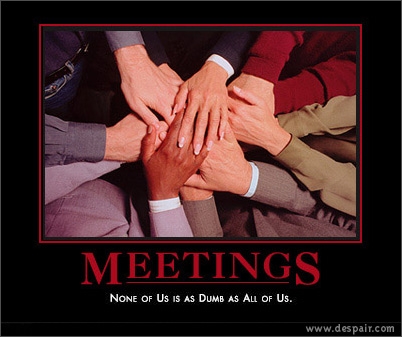
I should make unambiguously plain at the outset that I believe the seven Board members, as individuals, are obviously committed to public service, and otherwise worthy of our thanks. The problem comes with what happens to groups, as illustrated by this poster:

The mere fact that each is an outstanding individual -- knowledgeable, caring and bright -- does not mean that when they come together and act as a board that the results will resemble anything done by people who are caring, informed and bright. You may have seen this poster about "Meetings," with the caption: "None of us is as dumb as all of us." [Credit: Despair, Inc.] One of our nation's major gurus of governance, John Carver, puts it this way in defining boards: "boards are incompetent groups of competent individuals." Or you may have heard the definition of a camel, as "a horse built by a committee."

As for the Board's current chaos and ambiguity, I'm reminded of a story. Concerned about their community's lack of progress, a poll was commissioned to ask the question, "Which do you think is the worst problem in our community, ignorance or apathy?" The majority response came back, "I don't know, and I don't care."

Is there a point at which, notwithstanding "elections," so few people care to vote that it is only nostalgic nonsense to refer to a community as a "democracy"? I think the School District may be at that point when 10% or less of eligible voters even bother to vote for their School Board members. Or perhaps it is the case that the population really does follow and understand in great detail the Board's approach to this boundary business, and is so affirmatively in accord with its approach that it sees no need to question what the Board is doing. Whichever it may be, my sense is that mine is a lonely voice in the wilderness on these issues, and that the Board may very well be reflecting its constituents' desires.

Nonetheless, I'm going to continue to share my own view of the matter for whatever inherent persuasiveness it may present to any who care.

I most recently wrote about these issues in Nicholas Johnson, "School Board Has Work to Do," Iowa City Press-Citizen, November 2, 2009 (and reproduced in blog). On that occasion I noted, among other things:

"[It] is the board's, and only the board's, legal, managerial, economic and political responsibility . . . [to] go beyond the vague 'prioritizing its top criteria' . . .. Telling a committee of 30 that it should keep in mind the board's 'priority of demographic considerations' is equivalent to Congress telling the FCC to regulate broadcasting 'in the public interest.' . . .

[T]he board . . . should start by calculating the percentage of "free-and-reduced-lunch" students in the District-wide student population. [It's now done so; the answer is 28 percent.]

It could then say, to state the extremes, that it wants:

• To specify precise percentages to maximize the FRL disparity, within the limits of the law: Some elementaries with a disproportionately high percentage of FRL students, and others disproportionately low (like now). [Of the three options I offered, this seems to be the one it has selected: no minimum FRL percentages specified, a 48 percent maximum (20% over 28%) -- producing conceivably as much as an 8-to-1 disparity from school to school (e.g., 6% vs. 48%).] . . .

Abdicating leadership

But for the board to delegate its responsibility for boundaries to a committee of unelected citizens in the form of a multiple-variable set of criteria with no algorithm, made up of vague categories with no metrics, is an abdication of its responsibility, a kicking the can down the road, a recipe for chaos and frustration, and an unconscionable imposition on the time, energy, good will and financial resources of 30 dedicated local citizens and the public at large. . . .

New data, physical impracticability, political or economic pressures may well call for some rational modifications occasionally.

But at any given point in time, everyone simply must have specific numbers to work with -- numbers not from the administration, a consultant or committees, but from the board.

Having done its job it is then possible, if the board desires, to delegate the task of creating specific, alternative line-drawing possibilities to the superintendent, a consultant or a committee -- but not before."
At that point in time I was only focusing on the ambiguity in the Board's use of language.

Having now watched the deliberations last evening [Nov. 10] I am even more concerned about the chaos involving the structure and process of its decision making.

It has taken what could be a rather unique clean structure and process -- the Iowa Code provides that the Board has the power, and the Board makes the decisions -- and turned it into the ambiguous chaos that prevails elsewhere in government.

o Consider Washington and health care. How's that been working for us? There are 435 folks in the House, almost half of whom have vowed to "break" the President by voting against anything he's for. Now that it's finally come up with a 1000-2000-page bill with something for everyone (at least some of which has nothing to do with health care) it goes to the Senate, where it has been declared to be "dead on arrival" and will require, for reasons best known to the Senate, 60 of 100 votes to pass rather than 50. If there's anything left in it for the American people after it comes out of the Senate, if it ever does, it must go to a "conference committee" for further watering down. Finally, if the President can hold his nose long enough to sign it, it will become law.

o There are similar problems within the Regents' university system. The UI faculty has some power, as do the college deans, president and other administrators -- although, as in Animal Farm, when it comes to the hospital and athletics "some are more equal than others." Nor is that the end of it, for the Regents have a kind of ultimate authority under the Iowa Code, as does the Legislature (or, more particularly, those legislators in the leadership and on the relevant committees).
Elected officials in Washington and Des Moines (at least those who would really like to get things done on the people's behalf) must envy school board members. As with any elected official, Board members have some responsibility to their constituents, and a significant number of stakeholder groups. But the legal authority stops with them; they need report to no one -- not the city council, not the legislature; only the courts can reign them in, and then only if they violate some federal or state law.

Given this rather uniquely clean bit of authority, what has our Board done? It has taken the smoothly working beauty of an Iowa City decision making machine and tried (and succeeded, alas) to turn it into something as chaotic and dysfunctional as the governance systems of Washington for health care and Des Moines for universities. Why would anyone want to do that?

It has, with a skill at ambiguity seldom if ever equaled, dispersed its power in all directions. There are the seven individual Board members. There is the Board acting (as it should) as a Board. There is the Superintendent. There is now a consultant. There are 30 (with promises of more) individuals on a committee. There is the committee acting as a committee (either unanimously, or with widely splintered views). Then there are two of the Board members (Mike Cooper and Tuyet Dorau) who will also hold the title of "ex officio" members of the committee (a wholly inappropriate role for individual Board members); and some imprecise role that will be played out by the consultant, Superintendent, and other District administrators at the committee meetings. All have some -- and often conflicting -- authority for this process and its ultimate decision; for none has that authority (and its limits) been defined.

Like "snatching defeat from the jaws of victory," in addition to creating "criteria" that provide no direction (with the exception of the 20% metric), the Board has now also deliberately created this blob of undefined roles and interwoven quasi-legal loci of power and will have to live with it.

As I listened to the exchange among Board members last evening my concerns were only heightened. Someone sought clarification on "what the consultant has told us we must do." Someone else commented that the 20% metric might be modified in some cases if one of the other "criteria" conflicted. There was some confusion about what "ex officio" would mean.

To end on a more positive note, here's a suggestion that I've written about before.

I believe in "the ratchet principle." You know, like a jack you put under a car. You start with something and then try to improve it. Writers may use it as an alternative to what some have described as the process of looking at a keyboard and waiting for little drops of blood to fall off of your forehead onto the keys.

Let's start with a map -- not one of the "two or three scenarios" the Board is delegating as an assignment to its committee; not as anything anyone thinks the Board would ever end up with. But as a place to start.

Nor need it be a multi-thousand-dollar precise map. Surely the administration can make pretty accurate estimates of many of these numbers.

1. Building occupancy.
(a) Do with building occupancy what the Board has done with FRL. What is the total elementary school population for the District?
(b) What is the maximum occupancy of each elementary (not counting "temporaries"), and what is that District total?
(c) If students were assigned such that every elementary had the identical percentage of its maximum occupancy, what would that percentage occupancy be?
(d) If every elementary student was assigned to the school closest to him or her, working outward from each school in all directions until that occupancy percentage is reached for each school, where would those boundary lines be drawn?

2. Free and reduced lunch.
(a) Do the same exercise using only that nearly one-third (28%) of the elementary students who are FRL.
(b) What is 28% of the student population of each elementary (using the optimum/average occupancy calculated above)?
(c) If every FRL student was assigned to the school closest to him or her, working outward from each school in all directions until its 28% is reached, where would those boundary lines be drawn?
(d) Do the same exercise as in 2 (a)-(c), above, forgetting about the percentages in each school; assign each FRL student to the closest elementary. What percentages of FRL would that produce in each school? You then have the data (with the visual of a map) to decide the most cost-effective way of reallocating FRL students to meet the 48% maximum.

Having done these, and similar, exercises there are some maps on the wall. All can, literally and figuratively, "see" what this is all about. Those involved, whether Board or committee, can then meaningfully talk about the modifications they want in the metrics that produced those visuals. They can "ratchet up" to ever increasing detailed modifications of those maps.

Ideally, as I've suggested before, there is no reason why these kind of "what if" games could not be played with software plus data made available by the District to the administration, Board, committee and any member of the public (presumably online). All kinds of maps could then be drawn by anyone with the time and inclination to do so. I can't believe the software isn't easily available, possibly even for free. (But no, I'm not going to volunteer to take the time to find it.)

Failing that, however, as least some early, fixed maps of the range of what various formulas would mean geographically would be a cheap, and very useful, compromise.
_______________
* Why do I put this blog ID at the top of the entry, when you know full well what blog you're reading? Because there are a number of Internet sites that, for whatever reason, simply take the blog entries of others and reproduce them as their own without crediting the source. I don't mind the flattering attention, but would appreciate acknowledgment as the source, even if I have to embed it myself. -- Nicholas Johnson
# # #

Monday, November 02, 2009

Boundaries: Only Board Can Do Board's Job

November 2, 2009, 5:45 a.m.

For Wednesday, November 4, blog entry, see "UIHC: 'Sick Brother, Can You Spare a Dime."

Drawing School Boundaries Made Easy
(brought to you by FromDC2Iowa.blogspot.com*)

This morning's blog entry is a reproduction of an op ed column of mine on school boundary line drawing that appears in this morning's Iowa City Press-Citizen, below.
But first, here are links to entries on some of the other hot topics from the past week or so that are now getting the most direct hits, among which may be the entries you are looking for:

School boundaries, school boards, and the ICCSD. "School Board Election: Now Work Begins; It's Swisher, Dorau, Cooper; Old Board 'Starting Off Backing Up' With Consultant and Tough Decisions," September 9, 2009, 7:00 a.m. (with links to 11 prior, and related, blog entries).

The UIHC's controversial "contributions from patients" proposal. "UIHC: 'Sick Brother, Can You Spare a Dime?'; A Check-In and a Check," October 31, 2009, 7:00 a.m. (with links to additional, related material -- and now with over 30 of the Press-Citizen readers' comments on B.A. Morelli's stories).

Board of Regents and State universities' budget cutting. "Cutting Slack, Cutting Budgets; Regents, University Presidents, Deserve Some Thanks and Credit," October 30, 2009, 8:30 a.m. (with links to prior, related blog entries).

Spence break-in grand jury proceedings. "UI Spence Break-In: Gazette Scoop Illustrates Issues," October 27, 2009.

Positive benefits to brain from Internet searching. "This Blog's Good For Your Brain; Searching the Internet to Find It Even More So," October 26, 2009, 6:00 a.m.
_______________

School Board Has Work to Do
Nicholas Johnson
Guest Opinion

Iowa City Press-Citizen, November 2, 2009
http://www.press-citizen.com/article/20091102/OPINION02/911020313/1020/School-board-has-work-to-do

Asked how he felt after losing the presidency in 1952, Adlai Stevenson quipped, "It hurts too much to laugh, but I'm too old to cry."

Following the tragic farce of our school board's attempt last week to "prioritize its criteria" for school boundaries, apparently this paper's editorial board didn't hurt enough to prevent giving us a laugh Saturday ("Our View: District needs civil dialogue, not clickers" [Iowa City Press-Citizen, October 31, 2009]).

I, however, have never been too old to cry, and thought the matter too serious to laugh.

Nor am I too proud not to beg: "Board, please, please reconsider your approach."

Board flexibility

"Local control of schools" means that the board can do virtually anything with our schools not prohibited by federal or state law. It can decide to let some schools sit virtually empty while others are overcrowded.

It can push the disparity between schools' percentages of students in various socio-economic classes up to the limit of the law -- or try to make them more equal than the law requires. They can draw perfect circles around each school as its boundary, or vary them to achieve a variety of goals.

Leadership with metrics

The board simply must, however, go beyond the vague "prioritizing its top criteria," reported in Thursday's Press-Citizen [Josh O'Leary, "Board finalizes priorities; Not all members pleased with process," Iowa City Press-Citizen, October 29, 2009], and provide metrics. This is the board's, and only the board's, legal, managerial, economic and political responsibility.

Example: Telling a committee of 30 that it should keep in mind the board's "priority of demographic considerations" is equivalent to Congress telling the FCC to regulate broadcasting "in the public interest."

Continuing with the "demographics" example, within the bounds of the law the board can choose from a range of metrics.

It should start by calculating the percentage of "free-and-reduced-lunch" students in the District-wide student population.

It could then say, to state the extremes, that it wants:

• To specify precise percentages to maximize the FRL disparity, within the limits of the law: Some elementaries with a disproportionately high percentage of FRL students, and others disproportionately low (like now).

• To use busing and boundaries to make the FRL percentages equal in all schools.

• To do it so that all schools' FRL percentage disparities are within some fixed percentage points of each other, specifically set by the board (say, 5 percent).

Abdicating leadership

But for the board to delegate its responsibility for boundaries to a committee of unelected citizens in the form of a multiple-variable set of criteria with no algorithm, made up of vague categories with no metrics, is an abdication of its responsibility, a kicking the can down the road, a recipe for chaos and frustration, and an unconscionable imposition on the time, energy, good will and financial resources of 30 dedicated local citizens and the public at large.

Ultimately, these metrics will emerge -- either because they finally have been declared by the board, or because they are evident "de facto" from the numbers that result from what it's done. That being the case, the earlier the board specifies specific numbers for, say, FRL or percentage occupancy of schools, the better.

Obviously, this is not to say that, having done so, the board should be forbidden to ever change its collective mind. Quite the contrary. New data, physical impracticability, political or economic pressures may well call for some rational modifications occasionally.

But at any given point in time, everyone simply must have specific numbers to work with -- numbers not from the administration, a consultant or committees, but from the board.

Having done its job it is then possible, if the board desires, to delegate the task of creating specific, alternative line-drawing possibilities to the superintendent, a consultant or a committee -- but not before.
__________
Former Iowa City School Board member Nicholas Johnson's blog can be found at http://FromDC2Iowa.blogspot.com.
_______________
* Why do I put this blog ID at the top of the entry, when you know full well what blog you're reading? Because there are a number of Internet sites that, for whatever reason, simply take the blog entries of others and reproduce them as their own without crediting the source. I don't mind the flattering attention, but would appreciate acknowledgment as the source, even if I have to embed it myself. -- Nicholas Johnson
# # #

Thursday, October 29, 2009

Board of Regents and School Board's Boundaries

October 29, 2009, 9:15 a.m.

It's Been a Weird Week in Lake Woebegon
(brought to you by FromDC2Iowa.blogspot.com*)

The big news today for many readers of this blog will be whatever comes out of the Board of Regents' meeting in Cedar Falls today regarding budget cuts at the three State universities. Staci Hupp, "Regents, presidents to discuss budget cuts today," Des Moines Register, October 29, 2009; Diane Heldt, "Regents open to large-scale budget cuts," The Gazette, October 29, 2009, p. A1. And see Nicholas Johnson, "TARP Lessons for Iowa's Budget Cutters," October 23, 2009, with links to numerous related blog entries.

With some exceptions, during the school year I've tried to hold the blog entries to Monday, Wednesday and Friday. But this week the Spence break-in revelations, leaked out Tuesday, warranted an immediate report and comment. Nicholas Johnson, "UI Spence Break-in: Gazette Scoop Illustrates Issues," October 27. And now today the Board of Regents' actions will be the story -- but not until this evening (if I can get to it before tomorrow morning). Meanwhile, the Register and Gazette stories, linked above, give some notion of what may be coming.

Meanwhile, we can only plead with our local School Board members to reconsider their approach to the redrawing of elementary school boundaries.

School Board and School Boundaries. I've written enough op ed columns and blog entries about boundaries that a summary statement, plus these links to more, ought to be enough. For some suggestions and analysis of alternative Board approaches see the 11 blog entries linked at the end of "School Board Election: Now Work Begins," Sept. 9, especially "School Boundaries Consultant Folly," Aug. 28, and "Cluster Schools: Potential for IC District?" June 3.

1. Substantive results. Obviously, I have my own opinion about the best substantive standards. But those preferences are irrelevant to the point I want to make. I won't even comment about the rather bizarre procedure it, and the consultant, utilized to "poll" Board members rather than voting.

2. School Board flexibility. "Local control of schools" means that the Board can do virtually anything with our schools that is not prohibited by federal or state law. They can decide to let some schools sit virtually empty while others are overcrowded. They can push the disparity between schools with regard to the percentages of students in various socio-economic classes up to the limit of the law -- or try to make them more equal than the law requires. They can draw circles around each school as its boundary, or vary them somewhat to achieve a variety of goals.

3. Board must lead -- and with metrics. The Board simply must, however, go beyond the vague "prioritiz[ing of] its top criteria" reported in this morning's Press-Citizen: Josh O'Leary, "Board finalizes priorities; Not all members pleased with process," Iowa City Press-Citizen, October 29, 2009, p. A1. This is the Board's legal, managerial, and political responsibility.

For example, telling a committee of 30 that it should keep in mind the Board's "priority" of "demographic considerations" is equivalent to Congress telling the FCC in 1934 that it is to regulate radio (and then television) in "the public interest."

Continuing with the "demographics" example, within the bounds of the law the Board can choose from a range of metrics.

(a) It should start by calculating the percentage of "free-and-reduced-lunch" (FRL) students in the District-wide student population.

(b) It could then say, to state the extremes, that it wants to [1] maximize the disparity, within the limits of the law, resulting in some elementary schools with a disproportionately high percentage of FRL students, and other schools that have a disproportionately low percentage of FRL students (kind of like what we have now), or to [2] draw boundaries and/or bus students so as to make the FRL percentages equal in all schools. [3] Or it could say that all schools' FRL percentages should be within some fixed number of percentage points of each other, say 5% or 10%, or whatever other percentage it wants.

I now express no view as to which of those metrics it should choose.

But for the Board to delegate its responsibility for boundaries to a committee of unelected citizens in the form of a multiple-variable set of criteria with no algorithm, made up of vague categories with no metrics, is an abdication of its responsibility, a kicking the can down the road, a recipe for chaos and frustration, and an unconscionable imposition on the time, energy, good will and financial resources of 30 dedicated local citizens and the public at large.

Ultimately, these metrics will emerge -- either because they have, finally, been declared by the Board, or because they are evident "de facto" from the numbers that have resulted from what they've done. That being the case, the earlier on the Board puts some specific metrics on the table the better off we all will be.

Obviously, this is not to say that, having done so, the Board should be forbidden to ever change its collective mind. Quite the contrary. New data, physical impractibility, political or economic pressures may very well call for some rational modifications in the numbers from time to time.

But at any given point in time, starting now, it is the Board, and only the Board, that should be specifying the specific numbers with regard to the criteria that it, prior Boards, and I, have laid out over the years.

Having done so, it is then possible, if the Board desires, to delegate the task of alternative line-drawing possibilities to the Superintendent, a consultant, or a committee -- but not before.

__________

There has been very little actually done over the last 30 years with regard to meaningful curtailment of alcohol abuse by UI students. There have not even been many proposals that could have a meaningful impact were they to be adopted -- which they seldom if ever are.

This morning's op ed column by Professor Poe (which appeared earlier in the Daily Iowan) is an exception and very much worth reading. It may later call for some commentary on this blog, but not this morning.

Marshall Poe, "Are Drunk Students Kicking Down Your Door?" Iowa City Press-Citizen, October 29, 2009, p. A8.
_______________
* Why do I put this blog ID at the top of the entry, when you know full well what blog you're reading? Because there are a number of Internet sites that, for whatever reason, simply take the blog entries of others and reproduce them as their own without crediting the source. I don't mind the flattering attention, but would appreciate acknowledgment as the source, even if I have to embed it myself. -- Nicholas Johnson
# # #