June 15, 2010, 2:00 p.m.
[For BP disaster see, "Uncanny Prediction of BP Disaster & Response," June 10, 2010; "BP's Commercial: Shame on Media," June 9; "Big Oil: Calling Shots, Corrupting Government," May 26, 2010; "Obama As Finger-Pointer-In-Chief," May 18, 2010; "Big Oil + Big Corruption = Big Mess," May 10, 2010; "P&L: Public Loss From Private Profit," May 3, 2010.]
Praise of Plugge and Reflections on Governance
(bought to you by FromDC2Iowa.blogspot.com*)
The Gazette had a nice editorial about ICCSD's departing Superintendent Lane Plugge this morning. There are some excerpts and a link at the bottom of this blog entry. I wrote and posted my own ode to Debbie and Lane last Christmas Eve, "The Plugge Era: 1999-2010," December 24, 2009, so you can read it there if you care to, rather than my repeating the sentiments again here.
But this was one of those mornings when two sufficiently related items hit my desk at the same time to warrant a blog comment. (Actually one hit my kitchen porch and the other was an email that crept quietly upon my computer screen.)
So you can understand the relationship between the editorial and the email, let me set the stage with a quote from my ode to Lane, linked above:
I remain convinced that any school board that would properly do its job, expressing its goals and governance wishes with clarity, would find that Lane would be doing his best to give the Board whatever it said it wanted -- within the bounds of federal, state, and local law and regulations. Requiring a superintendent to perform the board's job as well as his own is as unfair as it is inappropriate.
Earlier last year I had written about what I perceived as governance problems between the Iowa City City Council and its City Manager. "River City's Problem: Council-Manager Governance; The Necessity of Governance Theory and Practice," April 18, 2009.
As you'll see if you check it out, ICCSD School Board President Patti Fields put in a comment there about "the Carver model" of governance (saying she had found it a "barrier"), and others put in comments as well.
One, from "John Barleykorn," included the sentence, "You don't need to have a specific model, you just need clearly defined roles and expectations" -- a sentiment with which I agree and have often expressed. (I put in a comment myself on that blog entry: "I do not, and need not, make a case for Carver. [T]here are alternatives. The only alternative I find unacceptable is no governance model, policy or rules. That's true chaos . . ..")
Like Board President Fields (whom I like and respect), others in Iowa City also have, as I perceive it, "thrown the baby (clearly defined Board-Superintendent roles and expectations) out with the bathwater (the John Carver governance model)."
And so it was that an email from the State of Washington brightened my day. It was from Rick Maloney, someone I do not know, but who obviously shares the approach that I (and "John Barleykorn") take to board-CEO relations and allocation of responsibilities. It is reproduced here with his permission.

I stumbled across your writing about governance on the internet while researching for a presentation to a Western Washington University superintendent certification cohort on the subject of school boards.
I very much enjoyed the ideas that you shared with your fellow school board members in 1998, then was pleased to find that your board subsequently transitioned to the Carver model. Our board did exactly the same during 2001-2003, also without the assistance of a high-priced consultant, mostly by thoroughly reading and applying the principles in Carver's books. We did attend a training session as a board-superintendent team in 2002, but then accomplished the policy development and 'launch' (and 7 years, so far, of operation and maintenance of the model) by ourselves. I keep up my learning by presenting on the model and writing on related topics.
As for the WWU superintendent candidates, I plan to give them, as potential future manipulators of school boards, a sense of 'there is a better way to govern' (that boards really do have their own role, and that administrators don't necessarily know what that role is) without trying to detach them completely from reality. I have a visceral reaction to people like Doug Eadie and Paul Houston who teach about the "care and feeding" of boards. Of course the reality is that if boards drop the ball and go into reactive rather than proactive mode, it is incumbent on the superintendent to lead not only the district but also its board of directors. But I want to give them a feel for the appropriate role that a board CAN take if it leads, and delegates to the superintendent the authority to manage the district.
I'm attaching an article that I recently wrote for the American School Board Journal on treating board work as a professional calling. A friend and I have put together a website, sharing what we have learned about policy governance with other boards here in Washington State. http://www.policygov.com.
-- Rick Maloney, University Place School District #83
[Photo credit: www.policygov.com] I always find it reassuring to discover that other school districts have taken the governance issues seriously, and even followed the same process with it that our Board did when I was there.
When working with the government in Kazakhstan some years ago, since my ideas seemed to be more highly regarded there than in Iowa City, I came up with a hypothesis of explanation for the disparity.The theory was that the respect accorded one's expertise varies with the square of the distance from one's home. Thus, since Kazakhstan was about as far from Iowa as one could get without leaving our planet, I should prepare myself for reentry to North America, and then Iowa City.
I am hoping that the same theory will apply to Rick Maloney. At home, his school board chooses to misspell his last name and leave him out of the group picture of the Board. If the theory holds, given that University Place is 1882 miles from Iowa City, that should make his advice at least 3.5 million times more respected in Iowa City than in his school district (and than mine is in my school district).
Clearly, his suggestions will be accorded at least far more respect than my own. And, with luck, his District's Policy Governance Policies, and his Web site, will be sufficiently well regarded in Iowa City to prompt a reconsideration of the value of governance principles for Iowa, and Iowa City, institutions as well.
It would be the greatest gift we could give our new Superintendent, Steve Murley, when he starts to work next month, to save him the impossible assignment of having to function as both superintendent and school board. (See Murley's comment on Board's need for "clear governance system" in "School Boards, Superintendents, Contracts & Candor," April 28, 2010.)
April 28, 2
And finally, here are some excerpts from The Gazette's editorial about Lane Plugge:
Plugge kept focus on students
Iowa City school district Superintendent Lane Plugge dealt with just about everything in his 11 years on the job. . . .
And through it all, he kept a cool head and a firm hand on the wheel.
'He's a person of integrity,' Jim Pedersen, director of human resources for the school district, told us this week. 'He's got a tremendous work ethic. . . ."
Not all Plugge's decisions were without controversy, but there's little question that Plugge always remembered his primary responsibility was to the district's students.
Plugge announced last winter that he'd be leaving the district to take a position as chief administrator of the Green Hills Area Education Agency near Council Bluffs. His last day with the Iowa City school district is June 30.
He served the district during a period of rapid growth - during his tenure, school enrollment increased by more than 1,200 students - and all the challenges that entails. . . .
In more than a decade with Iowa City Schools, he developed a community reputation as being an accessible administrator who listened to public opinion - even if his decisions didn't always please everyone. . . .
Pedersen said it was Plugge's interpersonal skills that anchored his success: He was approachable, articulate and didn't flaunt his authority. . . .
'Anytime you can keep that continuity, that consistency, that shared vision [for the 11 years Plugge was in Iowa City] - if you can keep that person in a leadership role, it's good for the organization,' he said.
Lane Plugge was good for Iowa City schools and students.
Editorial, "Plugge Kept Focus on Students," The Gazette, June 15, 2010, p. 4.
We wish Debbie and Lane well as they settle, still in Iowa but closer to their Nebraska home. It has been my pleasure to know and work with them.
_______________
* Why do I put this blog ID at the top of the entry, when you know full well what blog you're reading? Because there are a number of Internet sites that, for whatever reason, simply take the blog entries of others and reproduce them as their own without crediting the source. I don't mind the flattering attention, but would appreciate acknowledgment as the source -- even if I have to embed it myself.
-- Nicholas Johnson
# # #
December 24, 2009, 2:00 p.m.
Thanks for the Memories
(brought to you by FromDC2Iowa.blogspot.com*)
 Two days ago the Press-Citizen reported that the Iowa City Community School District Superintendent, Lane Plugge, will be resigning the end of this school year to become the chief administrator of the Green Hills Area Education Agency in Council Bluffs. Rob Daniel, "Plugge leaving for new position; Says job in Western Iowa closer to family," Iowa City Press-Citizen, December 22, 2009. [Photo credit: Press-Citizen.] Today the paper devoted a lengthy editorial to his years here, and some requests regarding what the paper would like for him to do before he leaves. Editorial, "A challenge for Lane Plugge during his final six months," Iowa City Press-Citizen, December 24, 2009, p. 7A.
Debbie and Lane have never made a secret of their love for Nebraska (and the Huskers!), their family ties there, and their desire to be closer. Ten years in one place is a long run for anyone in the superintendent biz, so it's not exactly like they're running out on us.
Still, it was a real pleasure to get to know both of them, and I'll miss them. They're the kind of folks you'd like to have as next door neighbors, and had they been I'm sure we would have spent a lot of time together.
During my three years on the School Board I always found Lane to be accommodating and reasonable and a pleasure to work with. Indeed that's a reason why, after a near-five-year hiatus of silence on education issues, as I've returned to expressing some views about District matters my focus has been on the failures of the School Board rather than the Superintendent.
I remain convinced that any school board that would properly do its job, expressing its goals and governance wishes with clarity, would find that Lane would be doing his best to give the Board whatever it said it wanted -- within the bounds of federal, state, and local law and regulations. Requiring a superintendent to perform the board's job as well as his own is as unfair as it is inappropriate.
Being a superintendent is kind of a thankless job under the best of circumstances. There are just too many categories of stakeholders, not to mention individuals, all of whom demand to be pleased even though their wishes are often mutually inconsistent: government officials, other District administrators, teachers and other employees, parents, students, media, taxpayers, Democrats and Republicans.
I once asked Walter Cronkite's sidekick commentator, Eric Sevareid, dubbed "the grey eminence," how he felt about working at CBS. He said it was similar to "the sensation of being eaten by ducks."
My guess is that Lane must have felt a similar sensation some days.
Anyhow, rather than wait until next June to say goodbye, I thought I'd take this occasion to wish him and Debbie all the best on this new venture.
Donald Kaul and I once decided that Iowa's motto should be, "Warmer than Minnesota, more fun than Nebraska." It turned out it was too long to fit on a license plate. And besides, with Lane closer to the border even Nebraska might be more fun. But it's our loss.
_______________
* Why do I put this blog ID at the top of the entry, when you know full well what blog you're reading? Because there are a number of Internet sites that, for whatever reason, simply take the blog entries of others and reproduce them as their own without crediting the source. I don't mind the flattering attention, but would appreciate acknowledgment as the source, even if I have to embed it myself. -- Nicholas Johnson
# # #

November 11, 2009, 7:40 a.m.
Bumps on the Road to Boundaries
(brought to you by FromDC2Iowa.blogspot.com*)
This morning's blog entry is a commentary about the School Board's most recent efforts at rethinking its elementary school attendance boundaries, at its meeting last evening, November 10.
But first, here are links to earlier entries on this topic and some of the other hot topics from the past week or so that are now getting the most direct hits, among which may be the entries you are looking for:
School boundaries, school boards, and the ICCSD. "School Board Election: Now Work Begins; It's Swisher, Dorau, Cooper; Old Board 'Starting Off Backing Up' With Consultant and Tough Decisions," September 9, 2009, 7:00 a.m. (with its links to 11 prior and related blog entries including, for example, "School Boundaries Consultant Folly; Tough Boundary Questions Are for Board, Not Consultants or Superintendent, Plus: What Consultant Could Do," and "Cluster Schools: Potential for IC District?")
Nicholas Johnson, "School Board Has Work to Do," Iowa City Press-Citizen, November 2, 2009 (and reproduced in blog)
"Boundaries: Only Board Can Do Board's Job; Drawing School Boundaries Made Easy," November 2, 2009
UIHC, Regents and UI.
Executives trip to Disney World: "Mickey Mouse Patient Satisfaction; UIHC's Troubles: Is Orlando the Answer?" November 8, 2009
"Contributions from patients" proposal: "UIHC: 'Sick Brother, Can You Spare a Dime?'; A Check-In and a Check," October 31, 2009, 7:00 a.m. (with numerous updates through November 4, links to additional, related material -- and now with over 30 of the Press-Citizen readers' comments on B.A. Morelli's stories)
Board of Regents and State universities' budget cutting: "Cutting Slack, Cutting Budgets; Regents, University Presidents, Deserve Some Thanks and Credit," October 30, 2009, 8:30 a.m. (with links to prior, related blog entries)
Spence break-in grand jury proceedings: "UI Spence Break-In: Gazette Scoop Illustrates Issues," October 27, 2009
Sunday, November 8, the School Board held a work session at which they navigated one or two bumps in the road to a school boundaries policy. Rob Daniel, "Board lays out redistricting expectations; Schools should have similar numbers of low-income students," Iowa City Press-Citizen, November 9, 2009 ("It was eventually determined that the boundary committee should aim for schools to have a poverty level of no more than 20 percent higher than the district average, which currently stands at about 28 percent."); Holly Hines, "School Board outlines boundary plans," Daily Iowan, November 9, 2009.
Last evening [Nov. 10] it finalized its "criteria." Rob Daniel, "School Board finalizes criteria for boundaries," Iowa City Press-Citizen, November 11, 2009, p. A1:
"the boundary committee will develop two to three scenarios while keeping in mind demographics, finances, keeping neighborhood schools and neighborhoods intact and projected enrollments and building uses. The demographics consideration also includes drawing boundaries in such a way that no school would be more than 20 percentage points higher than the district poverty average, which is currently about 28 percent, the board said. . . . Board member Mike Cooper said . . . 'The more flexibility, the better. I'm sure the committee will take all four of these (criteria) to heart.'"
And see, Holly Hines, "School Board Approves Redistricting Goals," The Daily Iowan, November 11, 2009, p. A2; Gregg Hennigan, "I.C. School Board Settles on Boundary Priorities," The Gazette, November 11, 2009, p. A2.
As always, there's good news and bad news.
The best good news is that this school district is blessed with the leadership of Lane Plugge. It's reminiscent of the line used in a number of songs, "If it weren't for bad luck, I'd have no luck at all." If it weren't for Lane the Board would have no leadership at all.
His is a perfect personality for the task before us -- and I say "us" because how this boundary business comes out will affect everyone for a few miles around, whether they happen to have children in the ICCSD schools or not. It is a rare superintendent who can work with the likes of me, on the one hand, trying to bring some clear articulation to Board governance and goals, and on the other, keep his calm, and make sure things don't fall too far off the track in the midst of the Board's present chaos, confusion and deliberately structured ambiguity.
He knows what a school board should do -- legally, managerially, financially, and in shaping policy and goals. He knows a superintendent should not be doing the Board's job. But he also has the patience and ability to work with, and around, the hand of cards the voters dealt him.
Having watched the Board's discussion of boundaries last evening, I've kind of reversed my position. As awful as the result may be, for reasons I'll explain in a moment, given the Board's lack of either the will or ability to do its job, the utilization of a consultant and a committee may have been a brilliant stroke on Lane's part. It gives the Board the opportunity it seems to want to be able to avoid responsibility for the ultimate decisions, provides them the assistance they seem to need to do anything at all -- while at the same time avoiding the otherwise awkward, but only available, alternative of having the superintendent to do their job for them.
So Lane's the best news.
Another bit of good news, for which Lane is also responsible, is the creation in advance of a schedule of meetings of the committee, public forums, and the presentation of its ultimate report.
Finally, there is the use of at least one metric in the midst of this sea of ambiguity. The disparity of the percentage of FRL students in elementary schools is to be kept between a 48 percent maximum (the 28% District average, plus 20%) and a minimum that is not specified. (Even if the minimum is also subject to the 20% variation, that would mean schools could have anything from 8% to 48% -- a 6-to-1 ratio.) That would not have been my choice, but I have never argued this is about my choice -- only that the Board arrive at, and announce, its choice, which it has now done and for which congratulations and appreciation are in order.
On this one the Board may actually be reflecting the plurality of community opinion -- though how would anyone know what that is? -- that a 6-to-1 disparity is just fine, especially if the parents in question can continue to send their kids to a school with the low percentage (and the ones who can't are free to transfer out to another school).
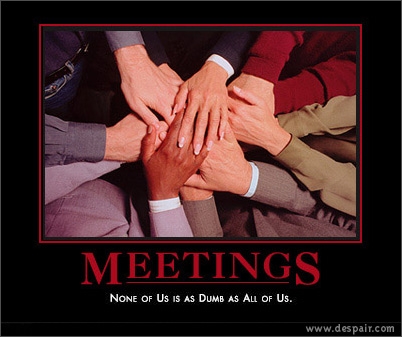
I should make unambiguously plain at the outset that I believe the seven Board members, as individuals, are obviously committed to public service, and otherwise worthy of our thanks. The problem comes with what happens to groups, as illustrated by this poster:
The mere fact that each is an outstanding individual -- knowledgeable, caring  and bright -- does not mean that when they come together and act as a board that the results will resemble anything done by people who are caring, informed and bright. You may have seen this poster about "Meetings," with the caption: "None of us is as dumb as all of us." [Credit: Despair, Inc.] One of our nation's major gurus of governance, John Carver, puts it this way in defining boards: "boards are incompetent groups of competent individuals." Or you may have heard the definition of a camel, as "a horse built by a committee."
As for the Board's current chaos and ambiguity, I'm reminded of a story. Concerned about their community's lack of progress, a poll was commissioned to ask the question, "Which do you think is the worst problem in our community, ignorance or apathy?" The majority response came back, "I don't know, and I don't care."
Is there a point at which, notwithstanding "elections," so few people care to vote that it is only nostalgic nonsense to refer to a community as a "democracy"? I think the School District may be at that point when 10% or less of eligible voters even bother to vote for their School Board members. Or perhaps it is the case that the population really does follow and understand in great detail the Board's approach to this boundary business, and is so affirmatively in accord with its approach that it sees no need to question what the Board is doing. Whichever it may be, my sense is that mine is a lonely voice in the wilderness on these issues, and that the Board may very well be reflecting its constituents' desires.
Nonetheless, I'm going to continue to share my own view of the matter for whatever inherent persuasiveness it may present to any who care.
I most recently wrote about these issues in Nicholas Johnson, "School Board Has Work to Do," Iowa City Press-Citizen, November 2, 2009 (and reproduced in blog). On that occasion I noted, among other things:
"[It] is the board's, and only the board's, legal, managerial, economic and political responsibility . . . [to] go beyond the vague 'prioritizing its top criteria' . . .. Telling a committee of 30 that it should keep in mind the board's 'priority of demographic considerations' is equivalent to Congress telling the FCC to regulate broadcasting 'in the public interest.' . . .
[T]he board . . . should start by calculating the percentage of "free-and-reduced-lunch" students in the District-wide student population. [It's now done so; the answer is 28 percent.]
It could then say, to state the extremes, that it wants:
• To specify precise percentages to maximize the FRL disparity, within the limits of the law: Some elementaries with a disproportionately high percentage of FRL students, and others disproportionately low (like now). [Of the three options I offered, this seems to be the one it has selected: no minimum FRL percentages specified, a 48 percent maximum (20% over 28%) -- producing conceivably as much as an 8-to-1 disparity from school to school (e.g., 6% vs. 48%).] . . .
Abdicating leadership
But for the board to delegate its responsibility for boundaries to a committee of unelected citizens in the form of a multiple-variable set of criteria with no algorithm, made up of vague categories with no metrics, is an abdication of its responsibility, a kicking the can down the road, a recipe for chaos and frustration, and an unconscionable imposition on the time, energy, good will and financial resources of 30 dedicated local citizens and the public at large. . . .
New data, physical impracticability, political or economic pressures may well call for some rational modifications occasionally.
But at any given point in time, everyone simply must have specific numbers to work with -- numbers not from the administration, a consultant or committees, but from the board.
Having done its job it is then possible, if the board desires, to delegate the task of creating specific, alternative line-drawing possibilities to the superintendent, a consultant or a committee -- but not before."
At that point in time I was only focusing on the ambiguity in the Board's use of language.
Having now watched the deliberations last evening [Nov. 10] I am even more concerned about the chaos involving the structure and process of its decision making.
It has taken what could be a rather unique clean structure and process -- the Iowa Code provides that the Board has the power, and the Board makes the decisions -- and turned it into the ambiguous chaos that prevails elsewhere in government.
o Consider Washington and health care. How's that been working for us? There are 435 folks in the House, almost half of whom have vowed to "break" the President by voting against anything he's for. Now that it's finally come up with a 1000-2000-page bill with something for everyone (at least some of which has nothing to do with health care) it goes to the Senate, where it has been declared to be "dead on arrival" and will require, for reasons best known to the Senate, 60 of 100 votes to pass rather than 50. If there's anything left in it for the American people after it comes out of the Senate, if it ever does, it must go to a "conference committee" for further watering down. Finally, if the President can hold his nose long enough to sign it, it will become law.
o There are similar problems within the Regents' university system. The UI faculty has some power, as do the college deans, president and other administrators -- although, as in Animal Farm, when it comes to the hospital and athletics "some are more equal than others." Nor is that the end of it, for the Regents have a kind of ultimate authority under the Iowa Code, as does the Legislature (or, more particularly, those legislators in the leadership and on the relevant committees).
Elected officials in Washington and Des Moines (at least those who would really like to get things done on the people's behalf) must envy school board members. As with any elected official, Board members have some responsibility to their constituents, and a significant number of stakeholder groups. But the legal authority stops with them; they need report to no one -- not the city council, not the legislature; only the courts can reign them in, and then only if they violate some federal or state law.
Given this rather uniquely clean bit of authority, what has our Board done? It has taken the smoothly working beauty of an Iowa City decision making machine and tried (and succeeded, alas) to turn it into something as chaotic and dysfunctional as the governance systems of Washington for health care and Des Moines for universities. Why would anyone want to do that?
It has, with a skill at ambiguity seldom if ever equaled, dispersed its power in all directions. There are the seven individual Board members. There is the Board acting (as it should) as a Board. There is the Superintendent. There is now a consultant. There are 30 (with promises of more) individuals on a committee. There is the committee acting as a committee (either unanimously, or with widely splintered views). Then there are two of the Board members (Mike Cooper and Tuyet Dorau) who will also hold the title of "ex officio" members of the committee (a wholly inappropriate role for individual Board members); and some imprecise role that will be played out by the consultant, Superintendent, and other District administrators at the committee meetings. All have some -- and often conflicting -- authority for this process and its ultimate decision; for none has that authority (and its limits) been defined.
Like "snatching defeat from the jaws of victory," in addition to creating "criteria" that provide no direction (with the exception of the 20% metric), the Board has now also deliberately created this blob of undefined roles and interwoven quasi-legal loci of power and will have to live with it.
As I listened to the exchange among Board members last evening my concerns were only heightened. Someone sought clarification on "what the consultant has told us we must do." Someone else commented that the 20% metric might be modified in some cases if one of the other "criteria" conflicted. There was some confusion about what "ex officio" would mean.
To end on a more positive note, here's a suggestion that I've written about before.
I believe in "the ratchet principle." You know, like a jack you put under a car. You start with something and then try to improve it. Writers may use it as an alternative to what some have described as the process of looking at a keyboard and waiting for little drops of blood to fall off of your forehead onto the keys.
Let's start with a map -- not one of the "two or three scenarios" the Board is delegating as an assignment to its committee; not as anything anyone thinks the Board would ever end up with. But as a place to start.
Nor need it be a multi-thousand-dollar precise map. Surely the administration can make pretty accurate estimates of many of these numbers.
1. Building occupancy.
(a) Do with building occupancy what the Board has done with FRL. What is the total elementary school population for the District?
(b) What is the maximum occupancy of each elementary (not counting "temporaries"), and what is that District total?
(c) If students were assigned such that every elementary had the identical percentage of its maximum occupancy, what would that percentage occupancy be?
(d) If every elementary student was assigned to the school closest to him or her, working outward from each school in all directions until that occupancy percentage is reached for each school, where would those boundary lines be drawn?
2. Free and reduced lunch.
(a) Do the same exercise using only that nearly one-third (28%) of the elementary students who are FRL.
(b) What is 28% of the student population of each elementary (using the optimum/average occupancy calculated above)?
(c) If every FRL student was assigned to the school closest to him or her, working outward from each school in all directions until its 28% is reached, where would those boundary lines be drawn?
(d) Do the same exercise as in 2 (a)-(c), above, forgetting about the percentages in each school; assign each FRL student to the closest elementary. What percentages of FRL would that produce in each school? You then have the data (with the visual of a map) to decide the most cost-effective way of reallocating FRL students to meet the 48% maximum.
Having done these, and similar, exercises there are some maps on the wall. All can, literally and figuratively, "see" what this is all about. Those involved, whether Board or committee, can then meaningfully talk about the modifications they want in the metrics that produced those visuals. They can "ratchet up" to ever increasing detailed modifications of those maps.
Ideally, as I've suggested before, there is no reason why these kind of "what if" games could not be played with software plus data made available by the District to the administration, Board, committee and any member of the public (presumably online). All kinds of maps could then be drawn by anyone with the time and inclination to do so. I can't believe the software isn't easily available, possibly even for free. (But no, I'm not going to volunteer to take the time to find it.)
Failing that, however, as least some early, fixed maps of the range of what various formulas would mean geographically would be a cheap, and very useful, compromise.
_______________
* Why do I put this blog ID at the top of the entry, when you know full well what blog you're reading? Because there are a number of Internet sites that, for whatever reason, simply take the blog entries of others and reproduce them as their own without crediting the source. I don't mind the flattering attention, but would appreciate acknowledgment as the source, even if I have to embed it myself. -- Nicholas Johnson
# # #
August 28, 2009, 7:20 a.m.
For other, related blog entries, see:
Nicholas Johnson, "School Board Governance: First Things First; School Board Forum Producers Charis-Carlson and Yates Create Hit, But Where Was Candidates' Awareness of "Job One": Their Governance Model?" September 4, 2009;
Nicholas Johnson, "IC School Board Needs Fresh Thinking; Swisher Starting Dialogue,"
Nicholas Johnson, "School Boundaries Consultant Folly; Tough Boundary Questions Are for Board, Not Consultants or Superintendent, Plus: What Consultant Could Do," August 28, 2009;
Nicholas Johnson, "School Board Members' Advice; So You Want to be a School Board Member," August 19, 2009;
Nicholas Johnson, "UI VPs and ICCSD Consultants; Concerns About Consultants and Vice Presidents," August 14, 2009;
Nicholas Johnson, "Cluster Schools: Potential for IC District?" June 3, 2009;
Nicholas Johnson, "School Boundaries; Tonight's Schools Meeting and the more to come," March 30, 2009;
Nicholas Johnson, " Demolition Disaster; Come Let Us Reason Together," March 10, 2009 (contains links to additional sources);
Nicholas Johnson," Roosevelt: Valuing Our Schools; Process and Substance in School Facilities Decisionmaking," March 9, 2009 (contains "Earlier, Related Writing" section with links to seven additional sources).
Tough Boundary Questions Are for Board
Not Consultants or Superintendent
Plus: What Consultant Could Do
(brought to you by FromDC2Iowa.blogspot.com*)
The Press-Citizen reported Wednesday (August 26) that it looks like the School Board's hiring of a boundaries consultant is a done deal. Rob Daniel, "School district closer to hiring consultant; Board members say they generally support idea," Iowa City Press-Citizen, August 26, 2009, p. A1.
The prospect of a consultant being involved in, as Daniel describes it, the "move toward a third comprehensive high school and [the project to] re-align school boundaries district wide," raises a number of possibilities, questions and concerns.
September 8th??!! You've got to be kidding! The story concludes, "[Superintendent Lane] Plugge said he will bring back a 'plan of work' with RSP [the consultant] along with probable costs for the consultants' services to the board at its next meeting on Sept. 8."
In case you haven't yet made a note of it, September 8th is the day when a minimum of two and possibly three new board members will be elected to this seven-person board -- nearly one-half of the membership. (Don't forget to vote.)
Buildings, boundaries -- and the hiring of consultants -- are all highly charged, controversial issues. With the results of the School Board election only hours after the meeting, why on earth would an outgoing board want to decide (or even be briefed on) these issues without the newly elected board members present and participating? It's not as if postponing this meeting would be holding off on a major decision for months, to the detriment of the District. We're talking minutes or hours here.
Tough Boundary Questions Are for Board -- before hiring consultant. There are a number of tough, basic policy issues that simply must be resolved by the School Board and cannot be delegated out to a "consultant" -- or the Superintendent for that matter.
(1) Do we want to continue the piecemeal approach to elementary school (and high school) boundaries, evaluating and redrawing them one school at a time, or do we want to undertake a District wide reevaluation and boundary line redrawing exercise?
What are the Board's goals, and parameters, with regard to:
(2) The disparity in the "free and reduced lunch" populations between elementary schools? Do we, does the Board, want boundaries that result in all schools being within 5 percentage points of each other on this measure? 10 percent? Equal? Or does the Board desire (or is it fearful of challenging) the perpetuation of those disparities -- capitulating to those who like things just the way they are (or who would prefer they be even more unequal)?
(3) The disparity in the percentage of optimum occupancy for each elementary? As with "free and reduced," how much disparity is acceptable in the percentages on this measure? Or is the Board even willing to continue to build new schools rather than more efficiently utilize those that now have empty classrooms?
(4) The disparities in "class size" in terms of, for example, the number of third graders in each third grade classroom across the District? (There are approaches to boundaries that can make all schools' class sizes roughly equal.)
(5) Are we, is the Board, willing to consider any changes in the general configuration of our elementary and junior high schools, changes that would have an impact upon, among other things, boundaries (e.g., K-3, 4-6, 6-8 buildings; magnet schools)?
(6) "Best practices" and most data indicate that, however good our high schools are today (and all three are), they could be even better if we were to follow the advice that no high school should exceed a 600 to 800 enrollment. (Above that, there is a marked increase in drop-outs and absenteeism, bullying and violence, alcohol and drug abuse, graffiti and vandalism, and teen pregnancy. There's also some evidence of a decline in academic performance, though that data is less definitive.) Can we afford to have the best? Can we afford not to? Are we willing to pay for it? The answers to this one obviously affects the discussion and decisions surrounding the "third conventional high school," budgets -- and the transition to the future boundaries for whatever high schools we may have.
(7) Do we want the Board and Administration to have the flexibility of zones within which, over time, new students could be assigned to more than just one school, as necessary to meet the "goals and parameters" noted above?
(8) More generally, do we want to create a process and formula that indicate how boundaries will be modified in the future -- thereby avoiding the need to re-invent the wheel every few years -- or just get the current challenge and controversy behind us as quickly as possible?
Could a "consultant" from Olathe, Kansas, address and give us their opinion about how we should respond to these choices? Of course; but so could anyone stopped at random on any city street in America.
The point is, the above issues are matters of judgment for the people of Iowa City, not Olathe; they are political questions; questions that need to be answered by the stakeholders of the Iowa City Community School District -- through the members of the School Board that they have elected, and will elect on September 8th (as informed by the input of those stakeholders who have spoken at Board meetings and otherwise communicated with Board members).
What a consultant could do. Once these issues have been addressed and resolved by the Board, then and only then there may well remain specialized, technical tasks for which the Superintendent does not have staff expertise available. For example, there's the matter of taking the Board's resolution of its preferred parameters, calculating the amount and location of student population growth over time, and applying the Board's parameters to those numbers. I would think we'd have someone on staff who could perform that function; but if not, that clerical task could be outsourced without having transferred major policy decisions along with it.
The 'What-If' Machine. We have fewer than 12,000 students in the District. That is clearly a relatively small number of entries for a computer. In fact, anyone with Microsoft Office 2007 has the programs to handle that number of entries in either a database ("Access") or spreadsheet ("Excel"). Although mapping software exists, I don't have access to it on my laptop (so far as I know -- one's always discovering new features) -- aside from "Mapquest," Google Earth, and Bing.
So I'm assuming it would not be that big a challenge, in 2009, to come up with the mapping program I describe below.
[Thirty years ago, as one of the presidential assistants to President Jimmy Carter charged with organizing and operating the 1979 White House Conference on Libraries and Information Services, my son Gregory and I witnessed a display of a similar computer program with capabilities far beyond what I'm about to describe. That's why I'm simply assuming that, given the rate of increases in computer capabilities, and decreases in their costs per transaction, what I'm proposing is either already in existence or could be cheaply created.]
What I'd like to see is a combination database and mapping program that would enable anyone in the community -- not just ICCSD administrators and staff -- to engage in "What If" boundary-drawing exercises that would display the resulting boundary lines when driven by alternative inputs regarding such things as elementary schools' percentage occupancy, allocation of free-and-reduced-lunch students, students' distance from schools, and other variables.
Presumably the District (1) already has the necessary raw data to do this (students' names, date of birth, street address, current school) and (2) the ability to protect students' privacy (e.g., use of numbers rather than names, year of birth instead of month-day-year, numbered blocks instead of street addresses).
What if the only metric was that every child is assigned to the closest school? Where would those boundaries be?
What if all schools had free-and-reduced-lunch numbers within 10 percentage points of each other, but students were otherwise assigned to the closest school? What would the boundaries look like?
What if all elementary schools were at the same percentage of their optimum occupancy? How would those boundary lines change?
Such questions and more could be put to such a program and the results quickly revealed. It would ultimately save enormous amounts of time and money for everyone interested in these issues -- including the taxpayers who will end up paying for the consultant. And it would make for much more meaningful, and hopefully civil, participation by the District's stakeholders in the process -- including much more helpful, and fact-based, input from the community to the Board.
If that's what the Board wants the consultant (or some University or other local software experts) to do I'm all for it. We really need a computer mapping program like that -- available to all.
Otherwise, I think the Board needs to wait for the outcome of the school board election September 8th, and then get on with what it is we elect them to do: to bravely, intelligently, and with the aid of their own thorough research, make those tough decisions.
_______________
Here are some additional excerpts from Daniel's story (linked at the top of this blog entry), with my comments interspersed in italics:
The school board heard from representatives of RSP Associates of Olathe, Kan., at its meeting Tuesday night about what the consultants can do to help district officials solve the enrollment and boundary issues. The consultants were brought in by Superintendent Lane Plugge to help determine how to build the new high school in the North Liberty area while the district wrestles with crowding at West High and budget woes.
"Help district officials solve the enrollment and boundary issues" sounds, to me, more like total capitulation to, or delegation of decision making to, a "consultant" than "consultation."
And what on earth does "help determine how to build the new high school" mean? Don't we know how to build a high school? What we often don't do is to thoroughly research and think through all the things we'd like to do inside that high school, and what we want the outcomes to be, and why, and how those decisions might impact the physical structure. A consultant might emphasize the importance of that step. But a consultant can't make those decisions for the Board either. After that, it's a matter of getting some more community input, selecting and working with the architect, and then selecting and working with a contractor or contractors and providing appropriate oversight. That's "how to build a new high school."
Mark Porter, education planner with RSP, said the group has a 97 percent accuracy rate in making enrollment projections over two years. He said the consultants have helped with numerous school districts in settling boundary and enrollment projection issues including helping the Ankeny School District with its plans to build a second high school last year. He said the consultants could help the district get the correct information to make a good decision on whether to build the third comprehensive high school.
"You want this information to be right the first time," Porter said. "You have to have correct data."
RSP, according to principal planner Robert Schwarz, can help the district figure out its enrollment projections using enrollment and development trends, figure migration patterns in and out of the district, and help district officials develop a plan that can be presented for approval by the school board. He said he hopes to spend the fall collecting and analyzing enrollment, census, construction and development data before presenting the group's finding and recommendation in October. The district then can form a committee of parents, teachers and school board members to formulate a plan through meetings and public forums before presenting a plan to the school board for approval in the spring.
Schwarz said RSP could help do this without being biased toward one end or another.
"We are an unbiased third party," he said. "We're going to be looking at real world data that exists in your community." . . .
The reference to "enrollment projections" and the suggestion that the consultant "can help the district figure out its enrollment projections using enrollment and development trends, figure migration patterns in and out of the district" sounds like what I called, above, "specialized, technical tasks" that follow from, rather than precede, determine or supplant, fundamental Board policy decisions. So, although we ought to be able to do that ourselves -- at least with resources inside Iowa City if not within the ICCSD staff, without having to go to Olathe, Kansas -- I'm relatively untroubled with a consultant performing that task.
On the other hand, as the sentence continues, it becomes more problematical: "and help district officials develop a plan that can be presented for approval by the school board." What this sounds like, at least superficially, is that (1) the Board has delegated the boundary policy and third conventional high school decisions to the Superintendent, (2) the Superintendent has handed them off to a consultant, following which (3) the Superintendent will perform the transmission belt function of passing along this "Board policy" created by a consultant to the Board, which will then (4) put its imprimatur on the value judgment of these Olathe residents.
I've never wished more fervently to be wrong. But I just call 'em as I see 'em, and from where I now sit this looks to me like a foul ball.
____________
* Why do I put this blog ID at the top of the entry, when you know full well what blog you're reading? Because there are a number of Internet sites that, for whatever reason, simply take the blog entries of others and reproduce them as their own without crediting the source. I don't mind the flattering attention, but would appreciate acknowledgment as the source, even if I have to embed it myself. -- Nicholas Johnson
# # #
July 14, 2009, 8:30 a.m.
Concerns About Consultants and Vice Presidents
(brought to you by FromDC2Iowa.blogspot.com*)
UI vice presidents and ICCSD school district consultants are back in the news.
Wikipedia tells us that "A consultant, from the Latin 'consultare,' means 'to discuss' from which we also derive words such as consul and counsel . . .."
Put "consultants" into Google and you get 88 million hits.
Clearly, there's a lot of discussion going on. Why it's going on and whether it's worth the time and money is what interests me.
Rob Daniel's piece in the Press-Citizen yesterday, informing me that "The Iowa City School District could hire a consultant to help sort out what needs to be done to eventually build a third high school," is what got me thinking about consultants once again. Rob Daniel, "District may hire consultant; Would help smooth planning process for new high school," Iowa City Press-Citizen, August 13, 2009, p. A3.
Similar issues (for reasons I'll discuss shortly) are raised by this morning's story by Brian Morelli, "UI goes forward with VP search; Hope to fill senior communications position by Nov.," Iowa City Press-Citizen, August 14, 2009, p. A3.
It turns out that, notwithstanding the initial objections to the UI expenditure in these economic times, we're going ahead with the creation of yet another Vice Presidential position: "Vice President for Strategic Communication." UI's vice presidents are paid a minimum of $214,000. Thus, this new position -- with benefits, office and staff -- means we're talking well in excess of $300,000 a year (an extra $10 annually from each of 30,000 students).
So why are we doing this now, while cuts are being made throughout the University and UI spokesman Tom Moore acknowledges that "The economic climate requires thoughtful decision-making"? Because, apparently, it was "through that [thoughtful decision-making] process [that] it was determined we should move forward with creating this position."
I guess that explanation should probably be enough to silence all doubters.
After all, as Moore continued, "The new position is essential to . . . assuring that we communicate effectively with all our constituents."
Obviously, I don't have the perspective of the UI president's office, I'm no expert, and I certainly haven't memorized every University of Iowa publication and media effort. But I track every local and national story in the media about the University and almost always have been well impressed with the quality of the University News Service personnel and output, and the range of UI publications: the main UI Web page, the News Digest, the @Iowa news items, the Alumni Magazine and Spectator, the faculty fyi, there's some publication for parents I recall -- and there are no doubt many more, such as our law school's "Iowa Advocate" and four law reviews. When someone at the University stumbles and falls the media is going to notice and report the fact. Not much public relations can do about that. In fact, do too much and we are worse off and charged with "spin," or do too little and we're charged with "stonewalling." That goes with the territory. But day in and day out I'll compare our public relations, quality of News Service releases, and the media treatment we receive as a result, with that of any of our sister institutions. So I don't know exactly what this "communicate effectively with all our constituents" -- obviously suggesting we're not doing it now -- is all about.
Hold that thought. I'll be back to the vice president in a minute.
Before I continue, let me make a couple of things clear. It is not the purpose of this blog entry to criticize either the University or the school district. That's because (a) the points I want to make have to do with administrators' use of consultants, and the equivalent of vice presidents, in general, and (b) because I don't have enough of the background facts involved in these two decisions to come to definitive conclusions about their justification and wisdom. (However, even if I don't have confidence in the answers I do have confidence in the questions and what are not intended to be anything more than superficial suspicions.)
Now let's examine Superintendent Lane Plugge's explanation of the reasons for his consultant.
Daniel reports the consultant is "to discuss the process of getting a new high school built in the North Liberty area. He [Plugge] said the consultant was necessary to help analyze the financial and enrollment data the district already has and use that data to possibly eventually redraw boundaries district wide." He then quotes Plugge, "What I'm looking to get from that consultant is the public engagement in the process."
To summarize, the consultant (a) will "discuss the process" of building new schools, (b) "analyze financial and enrollment data" already possessed, (c) "possibly redraw boundaries," and (d) provide "public engagement."
We'll come back to that explanation as well. But first, just what is it consultants and vice presidents do?
No institution -- corporation, university, government agency -- can have all the specialized expertise it needs in its permanent employees. It makes financial sense, when addressing challenges that could not have been predicted, or that come up extremely rarely, to bring in an outsider -- an architect, trial lawyer, doctor, or specialist in toxic waste disposal. Moreover, even with staff expertise, decisions of sufficient seriousness, when there is disagreement within the profession as to the best course of action, may significantly benefit from "a second opinion."
But all too often the functions of consultants and "vice presidents" (which I'm using in the general sense of anyone holding a title and responsibility for some of a CEO's functions) are far less savory.
A CEO (a title I'll use to include "president," "commissioner," "superintendent," "executive director," or "chair") for a variety of possible reasons may want a "vice president" for "decision deniability," a potential scapegoat, either in general, or with regard to a specific sub-set of his or her responsibilities. Or perhaps he or she is insecure about their ability to do a portion of their job, a job for which they were hired on the assumption they had that expertise. Or perhaps they lack confidence in the ability of those actually doing a given task and, rather than go through the unpleasantness of firing them, prefer to hire another administrative layer of oversight. (Again, I have no factual basis to believe any of this applies to UI VPs.)
A consultant may be hired for similar reasons. They may be brought in, and instructed, to support a decision of the CEO (already made in fact; while the appearance is that the consultant is proposing something not formerly considered) that needs political shoring up. They may be hired to perform tasks well within the job descriptions of permanent employees -- tasks those employees are incompetent, or otherwise simply not up, to performing.
At best, an outside consultant will have to be educated from the knowledge base possessed by the permanent employees. At worst s/he will bring to the institution little more than the general, basic textbook knowledge from their profession that many of the employees could quickly read on their own.
During my time on the school board we recognized the urgency of addressing (creating, actually) the governance system (the role and function of the board; the members relations with each other; the board's relationship to the superintendent, and other administrators; the functions of the superintendent and his/her evaluation; management information reporting systems). We could have hired a consultant; not just someone who had read John Carver's books, but the author -- at a cost of about $5000 a day. Instead, we chose to buy the books, read them, and relate Carver's suggestions to our own local circumstances. As a result, we were not simply accepting a consultant's suggestions with less than full understanding, we were willing to put in the hours necessary to really master the concepts and make the governance system we created our own.
Let me repeat and make clear: (a) I like Lane Plugge ("what's not to like?") and try to be as supportive as I can, and (b) I really do not know the "back story" on why he and the Board are now considering hiring a consultant. (c) I'd like to believe it's fully warranted in this instance.
It's just that superficially and simplistically it seems to me the tasks he has identified are tasks well within the job descriptions and expertise of administrators and staff the District already has in place: the ability to (a) "discuss the process" of building new schools, (b) "analyze financial and enrollment data" already possessed, (c) "possibly redraw boundaries," and (d) encourage "public engagement."
We have bright and experienced school board members. We have a number of administrators with advanced degrees from quality colleges of education. Moreover, isn't the process of building a high school very similar to the process of building an elementary school -- only for slightly bigger people? Isn't that something they've already done? Do they really need a consultant to "discuss the process"? Haven't they been thoroughly trained, aren't they already experienced, in the analysis of financial and enrollment data? Isn't the drawing of school boundaries about as bullseye central to the responsibility of a school board member (setting goals and criteria) and superintendent (application of Board's criteria to data) as any decision they'll ever make?
I've provided some suggestions on how they might improve their efforts at "public engagement" -- as have a number of other members of the public. But this is something they ought to be doing on an ongoing basis, and it's not rocket science. If they really have additional questions about how best to do it there's plenty of advice on the Internet and from local citizens. And perhaps the first principle of "public engagement" is that it is self-defeating to delegate the task to a consultant -- Board members need to involve their personal hearts, minds and bodies in the process.
Ultimately my initial questions about this use of a consultant may be satisfactorily answered. I really do hope so. It's just that those answers are not now apparent.
Similar questions remain for me about the UI's latest vice presidential addition. I am even more hopeful that my initial questions about that one will also be answered.
____________
* Why do I put this blog ID at the top of the entry, when you know full well what blog you're reading? Because there are a number of Internet sites that, for whatever reason, simply take the blog entries of others and reproduce them as their own without crediting the source. I don't mind the flattering attention, but would appreciate acknowledgment as the source, even if I have to embed it myself. -- Nicholas Johnson
# # #
Although entered as a comment by "BigOldDiesel" on the Press-Citizen's UI VP story rather than here, because it expresses a reasonable and relevant point of view, different from my own, in fairness I wanted to reproduce it here:
Nick,
Perhaps we've been reading different versions of the PC. It's pretty clear to me that both the ICCSD and the UI have gotten their butts kicked in the realm of public opinion lately, and that they need help.
I agree that both Mason and Plugge should have better skills in terms of PR and public engagement, but at the same time I look at all the things they have to do well as CEOs... we're already asking a lot of our executives, and if they can hire this expertise and that expertise will a) enable better decisions, and b) give them time to focus on areas more appropriate to their skills, that seems like a positive.
I don't like Plugge. I think that he's a pretty poor executive and that he's done tremendous harm to our district. Since we can't get rid of him at this point, I think getting him some help with an issue that's clearly beyond his skills isn't a bad idea.
I like Mason, and I think she and the University needs PR expertise in a huge way.
8/14/2009 11:49:39 AM