June 29, 2007, 6:15 a.m.
State29 has asked my opinion about what he calls the "unfairness doctrine" of the FCC (State29, "Who Decides What's Fair?" June 27, 2007), repealed by the agency but gaining renewed congressional interest -- and Republican opposition. I'm going to get to that the first slow news day that comes along. Meanwhile, . . .
Will Newt be the Gingrich Who Stole Christmas?
No, I've not been mesmerized by Newt Gingrich. And I don't even want to get into a discussion of the three specific proposals in the "American Solutions" sheet that was handed out. ("First, . . . English must be the language of government" and "every American must have the right to say 'one nation under God' . . .. Second, . . . move government from a fossilized unionized 1965 model [so as to create] space for more tax cuts. Third, . . . we have an obligation . . . to defeat our enemies. . . .")
Here's some of my reaction. If you want a virtual transcript of the event (11:30-1:30, June 28, Quality Inn, Iowa City), as usual see the John Deeth Blog, "Newt Gingrich Live in Iowa City," June 28, 2007.
My own photos of the event are on my Picasa site.
The morning newspapers' coverage includes Rachel Gallegos, "Gingrich Urges Moving Beyond Party Lines in Iowa City Visit," Iowa City Press-Citizen, June 29, 2007; James Q. Lynch, "Gingrich Unveils Plan for American Solutions; Ex-House Speaker Urges Bipartisan Effort," The Gazette, June 29, 2007, p. B5; and Christopher Patton, "Newt Touts New Way," The Daily Iowan, June 29, 2007.
Gingrich wasn't going for applause lines and didn't have many. Most of the applause provided by his predominantly Republican audience (the event was organized by the Johnson County Republicans after all) followed the occasional references to keeping immigrants out, winning wars and tax cuts.
And I guess I was wondering why, if you really want to organize a bi-partisan, tri-partisan, or non-partisan movement, you would have meetings organized by a single political party. Why not issue invitations to the leadership of all political parties -- and other related organizations -- in the area where workshops are held? Why not include some of those 511,000 elected public officials he talks about? As it is, American Solutions comes across as what might be interpreted as simply a way to expand the base of the present Republican Party, to attract more supporters of its platforms and proposals. But, hey, I guess you start where you are.
His rhetoric of process is encouraging. There are not "red states" and "blue states," he says, just "red, white and blue states." (I don't think he would have stolen that from Barack Obama, but he has a similar line.) Gingrich says he is involving all the presidential candidates in American Solutions; that these are challenges we need to work on as Americans, not as Democrats and Republicans.
So putting aside the substance that's likely to come out of his effort, and the possible presidential campaign (or Republican Party membership building) that's behind it, I think the model, the proposed process, is something that every American should find at least intriguing -- if not actually something worth their participation.
There were at least five Democrats present. We agreed the Republicans really know how to organize these things. For one thing, they feed you. Broccoli, no less. Healthy food. And they have a staffer to print your name and coordinates, to make sure they are legible on their list and your name tag (so Newt can call you by name).
As I commented to one Democrat, "You know, we talk about feeding the poor, but you have to come to a Republican event to get free food." He responded, "Hey, I'm going to get fed at a Democratic affair tonight actually." He paused a beat, reflected, and then added, "Of course, I have to bring the food. It's a pot luck."
I decided to get into the spirit of the thing and go the whole nine yards. One of the opening highlights of the event was the opportunity to get photographed with The Speaker and entered into the organization's data base. It reminded me of the receiving lines at the White House when President and Mrs. Johnson would patiently shake hands with each guest at a dinner or bill signing. So I said to him, "Mr. Speaker, is this the way we're going to be doing it at the White House?" And he said . . . no, I guess it wouldn't be right of me to reveal that. He probably deserves to pick his own time and place for any announcement.
During his presentation the analysis went somethng like this. There's "the world that works" and "the world that fails." The world that works is, of course, the marketplace. And "the world that fails"? That's right, the government. (And no, I didn't ask him how Haliburton fits into that model.)
As one example of his stories and illustrations, he asks how many people have ever tracked a package on UPS. Most hands go up. (I was tracking two at the time myself.) He points out that UPS and FedEx can track the exact location of millions of packages in real time -- while they are moving.
And then the contrast -- meanwhile, the government can't even locate immigrants who are not in motion. They're sitting still. "How can there be such a gap between the methods and technological applications in the private sector and the government?" he asks. "Should we perhaps just send each immigrant a package?"
He speaks of the need for "metrics" in our schools (what John Carver calls "ends policies," and most folks would call "measurable goals") without mentioning "No Child Left Behind." It kind of reminded me of the question I used to put to my school board colleagues: "How would we know if we'd ever been successful?" So I couldn't disagree with him on that one.
What can we do? We need to take the best of Drucker, Demming and Toyota and apply it to government.
Government needs to offer its "customers" what entrepreneurs have to: more choice, cheaper prices, and greater convenience.
He points out that much more than the presidency is involved. There are, he says, 511,000 elected officials in the United States, counting everyone from school board members to members of Congress. All areas of government can do better, and all need to be involved in his process.
And to make sure they are, he wants to create advisory committees for each unit of government, at least half the members of each to come from professions, businesses or other organizations that are actually applying the most efficient and innovative techniques, models and best practices.
And what all of us, together, should be looking for are, as he's named the organization, "American Solutions." To involve the American people most broadly, American Solution utilizes a Web site and the Internet, workshops, house parties, live and streaming video, and so forth. He's thinking of using the Wikipedia model to create a "SolutionsWiki" to which everyone can enter their suggestions.
Hey, look, after what I wrote about "The Question" that I put to presidential candidates ("Gov. Richardson & 'The Question'"), how can I disagree with that? Speaker Gingrich is actually not just providing a sort of answer to my question, he's actually organizing an effort to demonstrate what that answer might look like. I think the more public involvement the better. It's a variation on creating what Ralph Nader refers to as "the public citizen."
At a minimum, you might want to check out americansolutions.com. And then? You're own your own; assumption of risk.
# # #
[Note: If you're new to this blog, and interested in the whole UI President Search story . . .
This blog began in June 2006 and has addressed, and continues to addresses, a number of public policy, political, media, education, economic development, and other issues -- not just the UI presidential search. But that is the subject to which most attention has been focused in blog entries between November 2006 and June 2007.
The presidential search blog entries begin with Nicholas Johnson, "UI President Search I," November 18, 2006. They end with Nicholas Johnson, "UI Held Hostage Day 505 - Next (Now This) Week," June 10, 2007 (100-plus pages printed; a single blog entry for the events of June 10-21 ("Day 516"), plus over 150 attached comments from readers), and Nicholas Johnson, "UI Hostages Free At Last -- Habemas Mamam!," June 22, 2007.
Wondering where the "UI Held Hostage" came from? Click here. (As of January 25 the count has run from January 21, 2006, rather than last November.)
For any given entry, links to the prior 10 will be found in the left-most column. Going directly to FromDC2Iowa.Blogspot.com will take you to the latest. Each entry related to the UI presidential search contains links to the full text of virtually all known, non-repetitive media stories and commentary, including mine, since the last blog entry. Together they represent what The Chronicle of Higher Education has called "one of the most comprehensive analyses of the controversy." The last time there was an entry containing the summary of prior entries' commentary (with the heading "This Blog's Focus on Regents' Presidential Search") is Nicholas Johnson, "UI President Search XIII -- Last Week," December 11, 2006.
My early proposed solution to the conflict is provided in Nicholas Johnson, "UI President Search VII: The Answer," November 26, 2006.
Searching: the fullest collection of basic documents related to the search is contained in Nicholas Johnson, "UI President Search - Dec. 21-25," December 21, 2006 (and updated thereafter), at the bottom of that blog entry under "References." A Blog Index of entries on all subjects since June 2006 is also available. And note that if you know (or can guess at) a word to search on, the "Blogger" bar near the top of your browser has a blank, followed by "SEARCH THIS BLOG," that enables you to search all entries in this Blog since June 2006.]
# # #
June 28, 2007, 7:20 a.m.
Today: Newt Gingrich, 11:30, Quality Inn, 2525 North Dodge, Iowa City. Think I'll go see what the policy wonk (and possible Republican candidate) has to say. He's sounding much more thoughtful and less confrontational these days than he used to.
"Sally, We Hardly Knew Ye"
The link is to the title of my former neighbor Kenny O'Donnell's book about Jack Kennedy, drawn from an Irish song's lyrics, neither of which really has any relation to Sally Mason, aside from the fact that before she ultimately retires she may be able to write her own Profiles in Courage and we're only now "Getting to Know You." (The latter song's lyrics are a little more on point, coming as they do from The King and I and containing the lines in the introduction, "if you become a teacher, By your pupils you'll be taught.")
Why am I leading with this? Because there were two stories yesterday that I really wish we'd had -- either from Search Committee II or the media, and not just for President Mason but for all the candidates -- during Interview Week.
Erin Jordan, "New UI leader's goal is 'helping;' She knows how college students with tight finances feel. As an undergraduate, the new U of I president had to struggle to pay for school," Des Moines Register, June 27, 2007
Diane Heldt, "New UI leader raring to go; Mason doing her homework by calling key people, listening," The Gazette, June 27, 2007, p. A1.
Erin Jordan's piece presents essentially the "story" of Mason's life. It's the kind of stuff of which presidential campaign biographies are made. It kind of reminded me of President Clinton's convention video, "A Man From hope." In fact, I was half way through the story before I realized it was about someone who had already been selected as president of the the University of Iowa rather than someone running for president of the United States. (Speaking of which, Mason says she'll stay at Iowa until she retires. With a bio like that, and if things go well for her, I wouldn't be surprised to see her staying on after that as Iowa's Governor.)
From the beginning of this presidential search process I have expressed frustration and concern regarding how little Search Committee II -- and the media -- provided us by way of this kind of background on the candidates. Bear in mind, I'm not talking about anything "confidential," any invasions of privacy, anything to which a candidate could express legitimate objection to having been revealed. I'm talking about public information -- the kind of information one can find on the Internet, the kind of information Erin Jordan and Diane Heldt had in yesterday's stories.
Such feature stories, backgrounders, and revelations of Internet Web sites would have been a real public service, a legitimate news story, in any case. But on this occasion the Search Committee professed to want public evaluations of the candidates. No one is legally required to ask the public what they think about anything. But when we are asked I think that then imposes on whoever is asking at least some obligation to provide more of the public information in its possession than what, in this instance, a candidate for a job provides in his or her resume (c.v.).
I certainly don't see anything wrong with a feature story about a new UI president -- especially after "UI Held Hostage Day 516." It was quite a wait.
But I can't help but be curious about how it came about. Was it all the reporters' idea, or that of their editor? Was it generated by public relations folks at Iowa or Purdue? A call from Mason herself? Or have the Regents gone ahead and hired their own public relations firm, as they were talking about doing? See Nicholas Johnson, "Regents, Governance, PR Firms, Strategic Planning, Presidential Selection, and June 13" in "UI Held Hostage Day 487 - Governance Regents Number One Priority," May 23, 2007. Not that any one of those routes would be unusual or inappropriate. Just curious.
# # #
[Note: If you're new to this blog, and interested in the whole UI President Search story . . .
This blog began in June 2006 and has addressed, and continues to addresses, a number of public policy, political, media, education, economic development, and other issues -- not just the UI presidential search. But that is the subject to which most attention has been focused in blog entries between November 2006 and June 2007.
The presidential search blog entries begin with Nicholas Johnson, "UI President Search I," November 18, 2006. They end with Nicholas Johnson, "UI Held Hostage Day 505 - Next (Now This) Week," June 10, 2007 (100-plus pages printed; a single blog entry for the events of June 10-21 ("Day 516"), plus over 150 attached comments from readers), and Nicholas Johnson, "UI Hostages Free At Last -- Habemas Mamam!," June 22, 2007.
Wondering where the "UI Held Hostage" came from? Click here. (As of January 25 the count has run from January 21, 2006, rather than last November.)
For any given entry, links to the prior 10 will be found in the left-most column. Going directly to FromDC2Iowa.Blogspot.com will take you to the latest. Each entry related to the UI presidential search contains links to the full text of virtually all known, non-repetitive media stories and commentary, including mine, since the last blog entry. Together they represent what The Chronicle of Higher Education has called "one of the most comprehensive analyses of the controversy." The last time there was an entry containing the summary of prior entries' commentary (with the heading "This Blog's Focus on Regents' Presidential Search") is Nicholas Johnson, "UI President Search XIII -- Last Week," December 11, 2006.
My early proposed solution to the conflict is provided in Nicholas Johnson, "UI President Search VII: The Answer," November 26, 2006.
Searching: the fullest collection of basic documents related to the search is contained in Nicholas Johnson, "UI President Search - Dec. 21-25," December 21, 2006 (and updated thereafter), at the bottom of that blog entry under "References." A Blog Index of entries on all subjects since June 2006 is also available. And note that if you know (or can guess at) a word to search on, the "Blogger" bar near the top of your browser has a blank, followed by "SEARCH THIS BLOG," that enables you to search all entries in this Blog since June 2006.]
# # #
June 27, 2007, 6:00, 8:30 a.m. [times reflect additions to the entry -- for the benefit of those few individuals who check back occasionally during the day -- as well as reflecting the fact that what is called "life" occasionally interrupts blogging]
Richardson and "The Question"
As predicted yesterday, John Deeth the blogger was at the Governor Bill Richardson event (Iowa City Public Library, June 26), and thus there's very little to add to his report. 
Because he never travels without his laptop he figures it's entitled to its own bumper sticker, which says: "REBOOT AMERICA." It's one Richardson could have used as his theme yesterday.
Local papers covered the event, but -- even covering politics as horse race -- didn't think Richardson's rapid rise in the polls (from 1% to 13-18%) worth page one display. Leah Dorzweller, "Dem Presidential Hopeful Shares Executive Vision; Richardson Speaks to Packed Crowd at Public Library," Iowa City Press-Citizen, June 27, 2007, p. 3A; James Q. Lynch, "Richardson Draws I.C. Crowd," The Gazette, June 27, 2007, p. 3B; Erika Binegar, "Richardson Would Hit Ground Running," The Daily Iowan, June 27, 2007.
These days, with online newspapers, it's not enough that the paper's photographer provides one or two shots for the next day's edition. They're expected to prepare a "gallery" of pictures -- and virtually immediately. Here's the Press-Citizen's this morning. 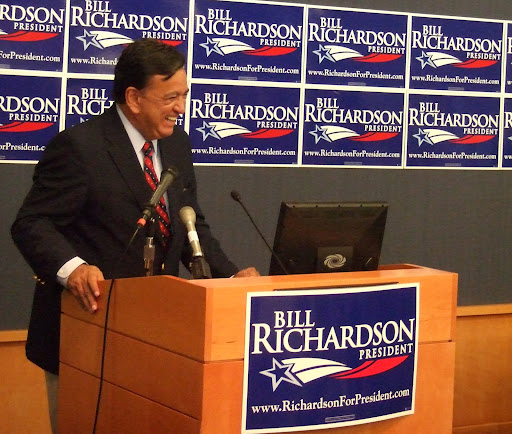 I can't compete with a professional camera and photographer with the eye of the P-C's Matthew Holst, but here is one from a selection of 13 pictures I took at that event and posted on my Picassa site.
So what is "The Question"? It's one I've put to most of the candidates for president since the early 1970s. It goes to the heart of what politics in a democratic society ought to be about. It's something we know how to do, and insist on in other countries. And yet few candidates have ever even thought about it -- let alone come up with a plan for implementation. What is the question, and how and why did I come up with it? And how did Richardson do with it?
The answers will come later this morning, after I've interrupted my blogging with a little bit of "life."
I'm back. But before addressing "The Question" I should note that, while I'm not endorsing anyone -- a lot can happen in the six months between now and the January caucus -- I thought Richardson did a great job yesterday. He was relaxed, engaging, funny, warm, and willing to stay a half hour or more beyond the 11:30 "deadline." I found his "the first six days in office" an effective way to package quite an array of what he proposes to do for us. And most of what he was proposing was very well received by the overflow and often enthusiastic crowd (as you'll see from one of my pictures -- which doesn't even show those in the hall outside Meeting Room A) -- and by me. (Much of the content of his remarks is provided in the stories and Deeth Blog linked above.)
The Question
So why was I questioning presidential candidates over 30 years ago? I had been asked to host a TV show on which they appeared, one each show. Frankly, I don't remember the details, except for what led to "The Question."
I quickly discovered that it was difficult to get anything very new or different from a candidate who had already been asked the standard questions dozens if not hundreds of times. It was as if they had little audio cassette tapes that they plugged into their brains and played back, one for each question.
What to do? I considered having someone throw them a baseball, or tip over their chair -- anything to throw them off guard a little, something that would provoke something more spontaneous than their polished performances. The producer said I couldn't do it.
So I finally came up with a question they hadn't confronted before, and I have been using variations of it ever since.
"The Question" on those early shows, and later in some Iowa living rooms, took the following form: "Senator," because it usually was a senator, "let's make two assumptions: one, you are 'right on the issues,' whatever that means to the audience; they like your platform and proposals. Two, you are elected president. Please tell us, why are the coal mine operators going to have less control over coal mine safety than they do now?" (Of course this can be, and often was, expanded with examples from many industries and agencies.)
Most candidates over the years have fallen mute. The best one could hope for was some feeble, "Well, I'm going to appoint good people to office." That was one answer clearly revealed they didn't understand the problem.
The "good people" they appoint to office (if such can be found, given industry pressure to appoint their people to the regulatory agencies they will have to deal with) will find themselves pretty isolated. It may be one of those agencies where employees come from, and return to, the industry. It may be one where they are wined and dined by industry representatives. These "good people" will be reporting to congressional committees made up of elected officials whose primary source of campaign funds is the very industry being "regulated." And the media? The mainstream media will largely ignore the agency. Media coverage will be primarily from the trade press covering -- and being funded with advertising dollars from -- the industry in question.
(Let me also note, for balance, that I have known a number of civil servants who are among the brightest and most public spirited, independent and courageous people anywhere.)
So much for "good people" heading agencies -- however much they may be an improvement over "bad people."
What is needed (as I privately explained to Governor Richardson yesterday) is the kind of citizen participation in agency process that -- when the decision goes for the industry, as it almost always will -- provides a "party," someone with "standing," to appeal the decision to the relevant U.S. Court of Appeals.
Such groups (primarily, if not exclusively, representing the interests of citizens and consumers rather than those with direct and substantial economic interests in the outcome) -- and, yes, I know they will represent far right conservative individuals as well as the lefties and libertarians -- can also use their access to the mainstream media, and the political process, to get the story out of the trade press and into the public consciousness. But their most effective leverage is through the judicial process when agencies are engaged in clear violations of law, as they sometimes are. Note that, without their participation there is simply no one who can appeal. The agency's pro-industry decision stands.
I didn't have notes yesterday, and I don't know if anyone has a recording of his presentation, so I don't know exactly how I phrased "The Question" to him. But it was somewhat along these lines:
"As you can tell from the response you've received there are a lot of folks here who seem to appreciate and support what you say you will do for us. What I'd like to know is what you propose to do to enable us to help you get those things accomplished in the face of special interest opposition? How can we better accomplish what we, as individuals and members of numerous citizens' groups, would like to accomplish in addition? Even with total public financing of campaigns we would still be up against overwhelming odds from the special interests with their well-paid thousands of lawyers, lobbyists and publicists, their advertising and public relations budgets -- and today their campaign contributions in the millions of dollars. What things do you have in mind along the line of the Legal Services Corporation, agency reimbursement of intervenors' expenses, treble-damage antitrust remedies, class action suits, private attorneys general actions, and so forth?"
Much as I like Richardson, I have to say he cast his lot with the majority of candidates who have either never thought about such things or don't think them very important. His was kind of an AmeriCorps-type response -- things the government could sponsor that would invoke the "ask what you can do for your country" response. Great ideas, but not likely to curb special interest control of the Congress and the agencies.
I've never known the details of the following story. It may be apocryphal. A citizens' group gained an appointment with President Roosevelt. After their presentation he said to them, "I agree with you absolutely. We must introduce that legislation. Now you go out there and make me do it." That is another thing we can do as citizens -- indeed, we are the only ones who can -- in addition to the litigation to keep the agencies honest. We can provide the political, grass roots support that enables elected officials who would like to do the right thing an argument to use with the special interests that oppose what they, and we, want to accomplish.
Over the years there have only been three who grasped the question, and two who understood the answers. Hubert Humphrey acknowledged it was a great question and that the next time I came to his office we should talk about it. Jesse Jackson and Ralph Nader knew how to proceed.
This year Barack Obama came closest, reminding me that he had worked as a community organizer. But he didn't carry his response beyond that.
It's not like this stuff is unknown in Washington. Even President George Bush has a rhetoric about "democracy" in other countries, though he doesn't always reflect the prerequisites to creating it. Those prerequisites involve something we call "civil (or civic) society" or "social capital." I've participated in some of these efforts abroad. This can involve everything from trade unions to Rotary Clubs to community media outlets; building citizen experience in coming together for public policy or programmatic purposes and then working to accomplish the stated goals.
We know how to do it -- and Obama's "community organizing" is a major component of the training. We just don't.
We know how to train our K-12 students to get out of the school house and into the court house, city council chambers and legislative halls to practice citizen power in a democracy. But we don't do much of that, either. (See, e.g., Center for Civic Education and National Council for the Social Studies and its "Creating Effective Citizens.")
We're not talking more "book learning" and classroom lectures here -- however important both may be -- we're talking "experiential learning" and performance -- political, policy, legal and media accomplishments.
A president could do a lot to build a "civic society" here in America -- but only after he or she begins to grasp why it is a need, and mounts the courage to take on the thousands of those in Washington who rather enjoy and find quite acceptable the rule by self-proclaimed elite that has served them so well.
# # #
[Note: If you're new to this blog, and interested in the whole UI President Search story . . .
This blog began in June 2006 and has addressed, and continues to addresses, a number of public policy, political, media, education, economic development, and other issues -- not just the UI presidential search. But that is the subject to which most attention has been focused in blog entries between November 2006 and June 2007.
The presidential search blog entries begin with Nicholas Johnson, "UI President Search I," November 18, 2006. They end with Nicholas Johnson, "UI Held Hostage Day 505 - Next (Now This) Week," June 10, 2007 (100-plus pages printed; a single blog entry for the events of June 10-21 ("Day 516"), plus over 150 attached comments from readers), and Nicholas Johnson, "UI Hostages Free At Last -- Habemas Mamam!," June 22, 2007.
Wondering where the "UI Held Hostage" came from? Click here. (As of January 25 the count has run from January 21, 2006, rather than last November.)
For any given entry, links to the prior 10 will be found in the left-most column. Going directly to FromDC2Iowa.Blogspot.com will take you to the latest. Each entry related to the UI presidential search contains links to the full text of virtually all known, non-repetitive media stories and commentary, including mine, since the last blog entry. Together they represent what The Chronicle of Higher Education has called "one of the most comprehensive analyses of the controversy." The last time there was an entry containing the summary of prior entries' commentary (with the heading "This Blog's Focus on Regents' Presidential Search") is Nicholas Johnson, "UI President Search XIII -- Last Week," December 11, 2006.
My early proposed solution to the conflict is provided in Nicholas Johnson, "UI President Search VII: The Answer," November 26, 2006.
Searching: the fullest collection of basic documents related to the search is contained in Nicholas Johnson, "UI President Search - Dec. 21-25," December 21, 2006 (and updated thereafter), at the bottom of that blog entry under "References." A Blog Index of entries on all subjects since June 2006 is also available. And note that if you know (or can guess at) a word to search on, the "Blogger" bar near the top of your browser has a blank, followed by "SEARCH THIS BLOG," that enables you to search all entries in this Blog since June 2006.]
# # #
June 26, 2007, 7:40 a.m. [times reflect additions to the entry -- for the benefit of those few individuals who check back occasionally during the day -- as well as reflecting the fact that what is called "life" occasionally interrupts blogging]
I'm going to try to attend Governor Bill "What Makes You Think You Can Be President?" Richardson's event this morning (10:30, Iowa City Public Library, Meeting Room A), and if blogger John Deeth is not there to cover it (in which case he will leave nothing more to be said about it) provide you a little commentary. He stopped by the Register's editorial board yesterday and received for his efforts what I would consider a very upbeat, favorable column. See, Andie Dominick, "Richardson packs jokes, thick resumé," Des Moines Register, June 26, 2007
Meanwhile . . .
Greed, Conflicts, Cover-ups and Corruption Yesterday I used a movie line in describing the central Iowa campaign to increase the sales tax -- and use the revenue to lower the property taxes of businesses and other property owners: "Greed is good." Nicholas Johnson, "'Greed Is Good' - Poverty? 'Yes, It's Your Destiny,'" June 25, 2007. It was a commentary addressing, I guess one would have to say, the morality of the wealthy using their economic and political power to shift the cost of government services (many of which benefit them disproportionately anyway, e.g., infrastructure, TIFs, tax forgiveness and other incentives) from themselves onto the backs of those least able to pay. Note, not incidentally, that an increase in sales taxes from 6 cents to 7 cents is not a "one penny" increase; it's a nearly 17% increase -- being advocated by the very folks who are usually supporting candidates who campaign on "cutting taxes" (by cutting programs not benefiting the wealthy).
Yesterday the comments on the Register's story included those complaining that the paper had become an advocate for the tax hike and that its "news" stories ought to be on the opinion page. No one will be saying that today. [There are 12 comments as of 8:00 a.m. One of the better, earlier comments, has for some reason been removed. None supports the tax-hike-shift proposal.] See, Jeff Eckhoff, "Woman denies she touted 'Destiny'; I don't even pay property taxes, Urbandale senior asserts," Des Moines Register, June 26, 2007. The story details efforts of the tax-hike-and-shift backers to misrepresent the proposal (mentioning that it will cut property taxes without mentioning it will increase sales taxes), and in the main story in the piece, using the photo of an 82-year-old woman who has long lived in apartments and pays no property taxes, along with a "quote" she never uttered, to advance their campaign.
(Wondering what State29 thinks about all of this? I'll be you can guess. State29, "The Project Destiny Scam," June 26, 2007.)
The story illustrates another problem with greed. Once money becomes the sole coin of the realm, and the need for profits is replaced with ever-increasing pressure for ever-increasing profits, conflicts of interest become ever more difficult to resolve ethically.
Years ago magazines aimed at women said little to nothing about the fact that the number of women dying from lung cancer was increasing, ultimately surpassing the number dying from breast cancer. Editors knew the story, they knew lung cancer's relationship to increased cigarette consumption by women, they knew manufacturers were targeting women -- and doing so in significant measure with the ads the companies were running in their magazines. But they needed the advertising revenue and, well, "women probably aren't interested in reading those stories anyway."
The NCAA wants to distance itself from sports gambling, and the gambling industry generally, in every way possible. It expressly forbids association with gambling casinos at NCAA events or in its advertising. It highly recommends that NCAA schools follow the same practice. It has written the UI athletic program with regard to its partnership with the Riverside Gambling Casino. And yet our football program tries to rationalize the gambling partnership while refusing to do anything about it.
This morning's Daily Iowan reports, Ashton Shurson, "Mason, Barta Set to Work Together," The Daily Iowan, June 26, 2007, that our new president has paid proper respect to the athletics program and its director. The story quotes Interim President Fethke as saying, "You have to respect the athletics director's opinion and point of view and trust that person."
Fethke's "respect" was so substantial that he's never (so far as I know) said anything critical in public regarding the NCAA's slap in our face about our gambling partnership with the Riverside Casino. Will the leadership that Mason brings include the ethical, moral and legal issues this relationship raises -- or will she continue the deafening silence from Jessup Hall on the issue because, after all, the athletic program is increasingly responsible for raising its own money, they have to get it where they can, and a university president must show "respect" to the athletic director?
Universities are not immune from the pressures that in corporate American can produce an Enron, or the political pressures that produce a U.S. Congress that simply can't "afford" to stand up to the pharmaceutical industry. Mason has been advised that as much as one-third of her time should be spent in fund raising. Clearly it's a major part of what she has been hired to do, a major part of the "performance" that can produce an extra $50,000 a year under her contract.
As such, she -- like every other big university's president -- will be subjected to similar pressures as the editor who must decide whether s/he can "afford" to run an essential story that will cause a loss of advertising revenue, an athletic director who must weigh the advice (and standards) of the NCAA against the revenue that can come from the gambling industry, or a politician in need of campaign contributions deciding how to vote on a measure that will clearly help her constituents but cause a special interest group to cut off her funding.
How will she decide whether to accept a major contribution from a donor who wants a faculty member fired (or hired), or a program established that is antithetical to the university's mission?
We've already stopped naming colleges and buildings for scholars and started naming them for donors. Are there any limits? The CEO of Home Depot gave $200 million to the Atlanta museum. Would we, for an equivalent amount, become "The Home Depot University of Iowa"? What if Larry Flynt would offer $300 million if we'd change the name to "Flynt University"? (After all there's a "Stanford University" and a "Duke University" -- named for a guy who made his money from tobacco.) Why not a "Flynt University"? We need his money as much as Barta needs the gambling industry's money.
What about a corporation that is willing to underwrite a multi-million-dollar research program -- so long as it gets a disproportionate share of the benefits from what it produces?
How candid should she be about, or should she even acknowledge at all, a potential scandal that could deal a blow to fund raising?
The question is not whether she will confront such conflicts. Of course she will. It goes with the territory in an age in which what used to be educational institutions with public support have developed more in common with for-profit corporations. The question is how she will respond to them. These conflicts often involve shades of gray. The more profitable choice can often be rationalized in some way -- as Barta tries to do with gambling money.
How many bars are there within walking distance of the campus -- 40? They are so profitable -- and therefore so politically powerful -- that the City Council seems incapable of doing anything meaningful to curb students binge drinking. Well, who are these customers anyway? They are students. The University's students. Our students. At a time when the University is in need of every source of income it can find, when it issues lucrative monopoly contracts to Coca Cola (so it can raise its prices) notwithstanding the product's health impact on students, why just wink at the profits from binge drinking when the University could be sharing in them? With a little ingenuity I think the University could be pulling in the lion's share of that money with its own entertainment venues. Something to think about.
I imagine that even President Mason cannot now imagine the choices -- the potential conflicts, cover-ups and corruption -- she will have to confront or how she will resolve them.
This morning's Register story illustrates how "just a little harmless doctoring of the promotional literature" is not only morally wrong, but can backfire. If those putting comments on that Register story represent the majority they may be, that may just be "all she wrote" on the sales tax for the wealthy.
The University's story? That's yet to be written.
# # #
[Note: If you're new to this blog, and interested in the whole UI President Search story . . .
This blog began in June 2006 and has addressed, and continues to addresses, a number of public policy, political, media, education, economic development, and other issues -- not just the UI presidential search. But that is the subject to which most attention has been focused in blog entries between November 2006 and June 2007.
The presidential search blog entries begin with Nicholas Johnson, "UI President Search I," November 18, 2006. They end with Nicholas Johnson, "UI Held Hostage Day 505 - Next (Now This) Week," June 10, 2007 (100-plus pages printed; a single blog entry for the events of June 10-21 ("Day 516"), plus over 150 attached comments from readers), and Nicholas Johnson, "UI Hostages Free At Last -- Habemas Mamam!," June 22, 2007.
Wondering where the "UI Held Hostage" came from? Click here. (As of January 25 the count has run from January 21, 2006, rather than last November.)
For any given entry, links to the prior 10 will be found in the left-most column. Going directly to FromDC2Iowa.Blogspot.com will take you to the latest. Each entry related to the UI presidential search contains links to the full text of virtually all known, non-repetitive media stories and commentary, including mine, since the last blog entry. Together they represent what The Chronicle of Higher Education has called "one of the most comprehensive analyses of the controversy." The last time there was an entry containing the summary of prior entries' commentary (with the heading "This Blog's Focus on Regents' Presidential Search") is Nicholas Johnson, "UI President Search XIII -- Last Week," December 11, 2006.
My early proposed solution to the conflict is provided in Nicholas Johnson, "UI President Search VII: The Answer," November 26, 2006.
Searching: the fullest collection of basic documents related to the search is contained in Nicholas Johnson, "UI President Search - Dec. 21-25," December 21, 2006 (and updated thereafter), at the bottom of that blog entry under "References." A Blog Index of entries on all subjects since June 2006 is also available. And note that if you know (or can guess at) a word to search on, the "Blogger" bar near the top of your browser has a blank, followed by "SEARCH THIS BLOG," that enables you to search all entries in this Blog since June 2006.]
# # #
June 25, 2007, 7:15, 9:00 a.m. [times reflect additions to the entry -- for the benefit of those few individuals who check back occasionally during the day -- as well as reflecting the fact that what is called "life" occasionally interrupts blogging]
Three items this morning:
Here's the latest in our "corporatized government" effort to "rob from the poor and give to the rich" -- the central Iowa "Yes to Destiny" campaign. I guess that means, "Yes, suck it up and accept it; your destiny is to continue to make us richer." All you can give the backers credit for is their lack of hypocrisy. There's no pretense of the "SILO" suggestion that "we're doing it for the kids." The stated purpose of the proposed sales tax (aside from some spare change) is to transfer local taxes from those who own property to those who can't afford to; a sales tax the purpose of which is to reduce property taxes. No duplicity here; they tell you, straight out, as Michael Douglas' character Gordon Gekko put it in the 1987 movie "Wall Street," "Greed is good." Before you read the story, read the comments (three as of this morning [now 14 by 11:50 a.m.]). Those writers are "right on." You'll find their comments at the bottom of the screen for Donnelle Eller, "Venues approach 'Destiny' plan as lifeblood," Des Moines Register, June 24, 2007.
More on indoor rain forests, attractions and economic development. John Carlson had a column yesterday about the Iowa Speedway in Newton and the "Iowa Corn Indy." John Carlson, "Iowa Corn Indy 250 revs up town that's seen tough times," Des Moines Register, June 24, 2007. Auto racing is one of the fastest growing attractions in the country, and it brought 35,000 people to Newton. I suspect the town would rather see a replacement for the 2000 Maytag jobs it's lost than 35,000 one-day tourists. But it's a real accomplishment, and congratulations to Newton!
It's another example of some of the economic realities regarding attractions as revenue-generating tourist attractions in Iowa. Gambling, auto racing, rock concerts, and football (and not necessarily in that order) are what bring out the crowds. Newton had roughly the same number of visitors in one day as the Old Capitol, Iowa Hall, or Herbert Hoover Presidential Library and birthplace have in an entire year.
Quasi-educational attractions serve a real purpose (including school children's tours), need and deserve our support -- private and public. But according to the best economists (and experience of other Iowa attractions) something like the proposed Pella indoor rain forest, a quasi-educational attraction at best, will never generate the fans that a winning Hawkeye football team can -- let alone the 1.5 million visitors yearly the promoters have sometimes predicted. (That's a number that would require every man, woman and child in Iowa, from new born babes to the terminally ill, to visit the place and pay the full admission fee every two years for the entirety of their lives. It's just not likely to happen -- especially once located a long drive off of Interstate 80.)
Finally, face it, Iowa is not a "tourist destination" for most Americans. That's not to say we shouldn't create more parks, trails and greenbelts. We should. For our own benefit if nothing else. (Costa Rica devotes more of its land area, 25%, to parks than any other country on earth. For Iowa, that would be the entirety of nearly 25 of our 99 counties. Instead, Iowa is one of, if not the, bottom states in the U.S. for percentage of land in parks and forests.) But our beautiful (to me) farms and prairie grass preserves will never compete for tourists with the national parks, skiing and mountain climbing in the Rockies; the beaches of the East and West coast states; Caribbean cruises; the urban attractions of New York, San Francisco and Las Vegas; or foreign travel.
Fortunately, they don't need to. To our agricultural and manufacturing base, the new ideas and start up corporations from our Regents' universities and entrepreneurial centers, we are now adding the alternative energy sources of biomass, wind and hydro. The 35,000 good paying, full time jobs they are capable of creating will, in the long run, do far more for Iowa's economic development than 35,000 racing fans sitting in bleachers in Newton for one day -- "not that there's anything wrong with that."
UI Prez Search and Executive Compensation. The Des Moines Register runs as an Associate Press Story this morning, "Mason's pay bump at U of I may affect her state peers," Des Moines Register, June 25, 2007. And see in that connection, Nicholas Johnson, "Executive Compensation" in "Prez Mason & Now What? - Life Goes On," June 23, 2007.
# # #
[Note: If you're new to this blog, and interested in the whole UI President Search story . . .
This blog began in June 2006 and has addressed, and continues to addresses, a number of public policy, political, media, education, economic development, and other issues -- not just the UI presidential search. But that is the subject to which most attention has been focused in blog entries between November 2006 and June 2007.
The presidential search blog entries begin with Nicholas Johnson, "UI President Search I," November 18, 2006. They end with Nicholas Johnson, "UI Held Hostage Day 505 - Next (Now This) Week," June 10, 2007 (100-plus pages printed; a single blog entry for the events of June 10-21 ("Day 516"), plus over 150 attached comments from readers), and Nicholas Johnson, "UI Hostages Free At Last -- Habemas Mamam!," June 22, 2007.
Wondering where the "UI Held Hostage" came from? Click here. (As of January 25 the count has run from January 21, 2006, rather than last November.)
For any given entry, links to the prior 10 will be found in the left-most column. Going directly to FromDC2Iowa.Blogspot.com will take you to the latest. Each entry related to the UI presidential search contains links to the full text of virtually all known, non-repetitive media stories and commentary, including mine, since the last blog entry. Together they represent what The Chronicle of Higher Education has called "one of the most comprehensive analyses of the controversy." The last time there was an entry containing the summary of prior entries' commentary (with the heading "This Blog's Focus on Regents' Presidential Search") is Nicholas Johnson, "UI President Search XIII -- Last Week," December 11, 2006.
My early proposed solution to the conflict is provided in Nicholas Johnson, "UI President Search VII: The Answer," November 26, 2006.
Searching: the fullest collection of basic documents related to the search is contained in Nicholas Johnson, "UI President Search - Dec. 21-25," December 21, 2006 (and updated thereafter), at the bottom of that blog entry under "References." A Blog Index of entries on all subjects since June 2006 is also available. And note that if you know (or can guess at) a word to search on, the "Blogger" bar near the top of your browser has a blank, followed by "SEARCH THIS BLOG," that enables you to search all entries in this Blog since June 2006.]
# # #
June 24, 2007, 8:00 a.m.; 12:30 p.m. [times reflect additions to the entry -- for the benefit of those few individuals who check back occasionally during the day -- as well as reflecting the fact that what is called "life" occasionally interrupts blogging]
Wanted to complete the links to news stories about the UI Prez Search that I didn't get to yesterday. Virtually all from November through June are now somewhere on this blog.
There 's also some commentary, below, regarding the Press-Citizen's editorial about increasing the size of the Iowa City police department.
Yesterday's and today's UI prez search links:
Brian Morelli, "New UI president starts connecting with students; Mason becoming a Hawkeye," Iowa City Press-Citizen, June 23, 2007
Brian Morelli, Fundraising Important Presidential Task," Iowa City Press-Citizen, June 23, 2007
Duncan Stewart, "UI Presidential History: Dear President Mason," Iowa City Press-Citizen, June 23, 2007
Russell Scott Valentino, "'A Person Who Can Unite Others, Motivate, Even Inspire Them,'" Iowa City Press-Citizen, June 23, 2007
John Solow, "'Our Athletics Department is Run By People of Great Integrity,'" Iowa City Press-Citizen, June 23, 2007
John C. Keller, "The Link Between Teaching, Research and Scholarly Missions," Iowa City Press-Citizen, June 23, 2007
Erin Jordan, "U of I head gets bonus if she stays for 5 years; Sally Mason's deferred compensation of $60,000 a year is in addition to her base salary of $450,000 per year," Des Moines Register, June 23, 2007
Diane Heldt, "Ripple effect; UI salary could mean pay bumps for other presidents in state," The Gazette, June 23, 2007, p. A1; Diane Heldt, "Open Search for UI President Gets an A," The Gazette, June 24, 2007, p. A1 (these stories may be found by going to The Gazette's main Web site and using drop down menus to find "06/23/2007" and "06/24/2007" and page "A1")
# # #
"How many police officers does it take to . . ."
Yesterday the Press-Citizen editorialized "Iowa City Police Understaffed in Relation to Nation," Iowa City Press-Citizen, June 23, 2007.
Let me make some things clear up front.
a. If we really need more police officers let's get them. I'm not opposed to raising taxes to do so, if necessary. But a City Government the size of that in Iowa City often contains people, practices and programs that could be run more efficiently -- and in the process often more effectively.
b. I like the police. My anticipated career when in junior high was in law enforcement. I helped organize, with some classmates, the "Johnson County Junior Bureau of Investigation." J. Edgar Hoover kindly sent us materials. We got old "wanted posters" from the Post Office, the Sheriff, and the Police Chief. A former FBI agent showed us how to make plaster casts of footprints. The first "book" I ever wrote was How to Classify Fingerprints. Our little group was permitted to attend the annual "Iowa Peace Officers' Short Course" -- and did very well on the exams.
c. My personal experiences with the police have been positive. I don't recall ever being given a ticket for anything more serious than overtime parking. But it's pretty easy to avoid speeding, and even parking, tickets when you put more miles on your bicycle each year than on your gas vehicle. So I don't take a lot of credit for that.
d. Like most of the subjects I write about, I claim no expertise as to this one either.
e. Moreover, I'm willing to work with the assumption that any ideas I can come up with have probably long been on the mind of our new Iowa City Police Chief, Sam Hargadine.
But, if not, he and others responsible for such things might want to consider the following -- many of which are beyond the control of our Police Department.
1. Less input, better output. There are retired admirals and generals who pointed out how cuts of as much as one-third of our defense budget would actually improve our national security and defense posture -- and that was years before they even needed to calculate the additional harm we're doing to our "homeland security" with the billions spent on our military operations in the Middle East. (See, e.g., Center for Defense Information.)
It's true of many governmental programs -- presumably including police protection.
It helps no one -- especially not tax payers -- to cut programs that are truly essential, not to mention programs that will return in savings later many times over what they cost today.
But it is not the case that "you get what you pay for" -- as Consumer Reports has been dramatically demonstrating for 70 years.
So what are some of those alternative approaches?
2. Task and Mission. What is it we're asking our police force to do? With regard to any given task, "Why?" Is it necessary for anyone to do it? If so, are police officers the best trained and efficient folks to call on?
Years ago, one of their tasks was to check for overtime parking and write up tickets. It was ultimately realized that we didn't need police officers -- well trained, armed and fully equipped, driving expensive, outfitted police cars -- to perform this function. It could be done just as adequately, and much cheaper, by others (especially given today's technology).
Here's another example of spending less and getting more. Cities like Iowa City, as well as others all across America, have experimented with at least some police officers on bicycles, or walking beats, as an alternative to their driving cars. It's both cheaper, and often more productive, as a way of integrating the police into neighborhoods.
Our department used to have, and I presume still does, a "community relations" program. Is there more that we could do on the front end (in our schools, among other things) to reduce the need for police on the back end? As with health care, prevention is almost always cheaper (and requires fewer officers) than dealing with a problem later.
Are there potential savings in administrative overhead? Are there paperwork requirements that are hindering officers from doing their jobs -- while adding to the administrative costs of processing the paper (or electronic reports)? On the other hand, are there administrative jobs that could be more efficiently done by officers than other employees; or, as with the parking tickets, jobs being done by officers that could be done more cheaply by others?
3. What's a "crime"? Bars are businesses designed to profit from the sale of alcohol. It's illegal for them to sell alcohol to anyone under the age of 21. To permit them to admit customers who are legally prohibited from participating in the business in which the bar is engaged defies common sense -- whether before or after 10:00 p.m. Under-age drinking in Iowa City's bars is commonplace, the bar owners know it, and they profit from it. My view is that we should either (a) lower the drinking age to 18, or (b) simply enforce the law, limiting admission to bars to those over 21.
I mention this now only because it is an example (which happens to be outside the power of the police department to control) of how what we define as a "crime" has an impact on the size (and budget) of our police department. Enforce the 21-only standard and my instinct tells me there would be less need for police downtown late at night on Fridays and Saturdays. (Whether, as some contend, there would be greater needs elsewhere as a result is another matter.)
What I call "the lesser drugs" (alcohol being our nation's number one hard drug problem by any measure), also offer examples. I don't know what the standards are now under Iowa law, or in Iowa City, regarding the quantities of marijuana that are either illegal or are thought worthy of police enforcement. But as those amounts are varied up or down they have an effect on needed police resources.
Not incidentally, they also have an impact on the "need" for additional jails and prisons. A system of "drug courts" and treatment programs may not affect the number of drug offenders coming to the attention of police and judges, but it can certainly have an impact on how many return.
The same can be said for speed limits, and restrictions on turns at intersections -- in fact virtually everything mentioned in the Code of Iowa and Municipal Code of Iowa City. The police can't change those laws, but they -- in consultation with the City Council, County Attorney and others -- can modify the standards they will apply in enforcement, and the County Attorney in prosecution.
4. "Peak loads," Coordination and Overtime. Peak loads are a classic problem for systems analysts.
In the days when men got their hair cut in barber shops, and usually on Saturdays, the shops had to decide how many chairs (and barbers) to have available. Too many and they lost money on chairs that sat empty most of the week. Too few and they lose customers on Saturday.
It's a problem for airlines, serving business customers who want to be on time for morning appointments in distant cities and back home for dinner. As you may have experienced, there's a bit of a crush in the early mornings and around 5:00 in the afternoon and early evening.
It's also a problem in staffing police departments, or fire departments.
There's no way we can afford to keep on a year-round payroll the 1000 police officers we'd like to have -- and would need, along with some national guard troops -- under some imaginable scenarios.
So what do we do? We don't staff up for those ultimate emergencies. We hire a few more than we need on some days, and a few less than we wish we had on others. And the factors that affect those needs are for the most part outside of the control of the police and unpredictable -- with the possible exception of football Saturdays, which are known in advance.
Given the variations in need from hour to hour and day to day, there is really only a range, rather than a precise number, of full time police officers that it would be reasonable for Iowa City to employ.
Consolidation and coordination. We're talking about a consolidated communications system for local law enforcement units in Johnson County. That's probably a great idea.
But what about the next step? The number of people in Johnson County is not that much more than the number who live in large apartment complexes in New York or Tokyo. Does it really make sense for that number of people to be served by what may be a dozen or more law enforcement organizations?
Talk about a win-win! With consolidation and coordination costs decline and quality of service improves. Just one of the reasons is that peak load problem. Each of the units must maintain a margin of resources to deal with unexpected demand. Add up all of those margins around the county, not to mention the duplication in administrative overhead, and you're talking about a lot of officers -- with budgets to match.
I don't minimize the embedded resistance to a change of this kind from within those units. And some of the resistance may well have a rational basis that would need to be seriously studied. But it might be worthwhile to think through the advantages of such a change as well, or as many of them as are politically attainable, rather than rejecting the idea out of hand.
Overtime is desired by some employees in any organization. It's an easy way to pick up additional income without working two jobs -- and in some retirement plans can even boost an employee's benefits beyond what his or her base pay was when working. So it necessarily creates a conflict of interest of sorts -- whether or not there is abuse. It may be that there could be some savings in overtime costs by rescheduling work days, postponing some tasks to regular work hours, and other advance planning. Clearly if there is an indisputable need for an ongoing level of overtime that exceeds the cost of an additional full time officer, it would be cheaper to hire one.
5. Statistics. My fading memory is that the rule of thumb used to be one police officer for every 1000 population. Apparently the national average is now 1.8 per 1000 for cities the size of Iowa City. We have 1.1 per thousand. Sounds like we need more police -- and we may.
But there are a couple of mathematical points to be made.
There are three comments readers have added to the Press-Citizen's editorial. One, by "geardaddies" at 8:42 p.m. Saturday, notes that there are "more than 30 full time police officers" with the UI's campus police. If true, they probably really do need to be included in the count -- at least in some way. That would bring the total Iowa City police resources much closer to that national average.
Is that particular average the most relevant? The editorial also reports that serious crime in Iowa City is down (while increasing in some similar college towns). Whether those numbers be accurate or not, might this "average" -- police officers per serious crime -- be the more relevant number? Of towns with populations similar to ours, what is the average number of police officers as a percentage of serious crimes per year? How do our number of police officers per serious crime compare with other communities numbers of police officers per serious crime?
Just a few thoughts as we ponder "How many police officers does it take to . . .."
# # #
[Note: If you're new to this blog, and interested in the whole UI President Search story . . .
This blog began in June 2006 and has addressed, and continues to addresses, a number of public policy, political, media, education, economic development, and other issues -- not just the UI presidential search. But that is the subject to which most attention has been focused in blog entries between November 2006 and June 2007.
The presidential search blog entries begin with Nicholas Johnson, "UI President Search I," November 18, 2006. They end with Nicholas Johnson, "UI Held Hostage Day 505 - Next (Now This) Week," June 10, 2007 (100-plus pages printed; a single blog entry for the events of June 10-21 ("Day 516"), plus over 150 attached comments from readers), and Nicholas Johnson, "UI Hostages Free At Last -- Habemas Mamam!," June 22, 2007.
Wondering where the "UI Held Hostage" came from? Click here. (As of January 25 the count has run from January 21, 2006, rather than last November.)
For any given entry, links to the prior 10 will be found in the left-most column. Going directly to FromDC2Iowa.Blogspot.com will take you to the latest. Each entry related to the UI presidential search contains links to the full text of virtually all known, non-repetitive media stories and commentary, including mine, since the last blog entry. Together they represent what The Chronicle of Higher Education has called "one of the most comprehensive analyses of the controversy." The last time there was an entry containing the summary of prior entries' commentary (with the heading "This Blog's Focus on Regents' Presidential Search") is Nicholas Johnson, "UI President Search XIII -- Last Week," December 11, 2006.
My early proposed solution to the conflict is provided in Nicholas Johnson, "UI President Search VII: The Answer," November 26, 2006.
Searching: the fullest collection of basic documents related to the search is contained in Nicholas Johnson, "UI President Search - Dec. 21-25," December 21, 2006 (and updated thereafter), at the bottom of that blog entry under "References." A Blog Index of entries on all subjects since June 2006 is also available. And note that if you know (or can guess at) a word to search on, the "Blogger" bar near the top of your browser has a blank, followed by "SEARCH THIS BLOG," that enables you to search all entries in this Blog since June 2006.]
# # #
June 23, 2007, 6:30, 7:30, 10:30 a.m. [times reflect additions to the entry -- for the benefit of those few individuals who check back occasionally during the day -- as well as reflecting the fact that what is called "life" occasionally interrupts blogging]
Some topics for a rainy Saturday morning on a screened-in porch: Press-Citizen's writers offer UI Prez Mason welcomes and advice; executives' pay; how many Iowa City police officers does it take to . . .; now it's back to the lesser responsibilities of picking a president of the United States -- and a City Manager for Iowa City.
I got so carried away with the "Executive Compensation" discussion, below, that this is going to be it for the day -- unless the entire city of Iowa City washes away with this rain, one of the leading presidential candidates drops out, or there is some equally newsworthy event. Those other topics, above, and promised links, will just have to wait.
The Press-Citizen's education beat goes on. Brian Morelli, who has done a great job covering the presidential search, has the paper's education beat. So the topics shift, but his beat goes on. Today he writes about UI students' reactions to Mason Friday (positive), and her fund raising responsibilities (formidable and time consuming).
The op ed page contains pieces by Russell Scott Valentino (a Press-Citizen presidential search blogger, suggesting that Mason will be, to borrow a phrase, "a uniter and not a divider").
Just to make sure, the hundreds of special interests on the campus are not waiting for President Mason's August arrival to let her know how important they are. And, hey, I don't disagree they are important. And I also agree that getting her head around all of them, and then undergoing -- and worse yet, trying to explain to everyone's satisfaction -- the task of budget allocations among them, may be her second toughest assignment after fund raising.
President's Committee on Athletics member John Solow explains the "great integrity" to be found in the athletic program ("me doth think . . ."); Graduate College Dean John Keller explains the value of Iowa's 104 graduate degree programs.
In spite of Duncan Stewart's base in the UI Libraries, he manages to make it all the way to the end of his column before revealing in his "Dear President Mason" open letter that the libraries are "the real heart of campus." Read it. It's a delightful blend of walking and talking tour suggestions, recollections of his own campus experiences, and humor.
Bob Patton, always incisive with his drawings, captures an issue receiving lesser attention. He pictures Mason at her desk, behind which is an absolutely HUGE painting of David Skorton (one of a number of people Duncan suggests Mason should at least talk to). Not only was he administratively, culturally and intellectually multi-faceted and accomplished, energized, and much beloved, a chart in this morning's Press-Citizen reveals he set new, and yet to be equaled, records in fund raising -- from $154, to $178, to $227 million each successive year. (This past year it dropped back significantly.) Clearly President Sally Mason is off to a good start. Equally clearly and inevitably, many will be judging her (whether fairly or unfairly) against the Skorton standard that Patton represents with that portrait in his editorial cartoon.
Executive Compensation. My mother used to tell the story of the boy who couldn't keep in step with the other members of the marching band. The boy's mother, watching the parade from the reviewing stands, observed to the woman sitting next to her, "Look, everybody's out of step but Johnny."
Far be it from me to suggest I'm the only one marching to the drummer. The Governor, the legislature, the Board of Regents, the Search Committee, and leaders of business all say we "need" to pay university presidents these days in the $500,000 to $1 million range. I'll leave it to them to draw the conclusion that our new UI president is worth that much. Regents President Gartner says she is "a steal at that price." OK.
So these comments aren't represented to be "right." They're just some thoughts of mine.
During the 1960s and 1970s, when I was traveling to Japan fairly regularly, I noticed (initially in the shipping and ship building businesses) that the Japanese executives were paying themselves what seemed to be about five times what the crafts people earned. They told me this was not only perfectly adequate, but was an essential part of their corporations' success. Coupled with the corporations' loyalty to workers, the limited disparity in pay communicated a sense of community and teamwork, a way of showing respect to the workers.
(And I'm now remembering there was a Washington law firm in the 1970s where all agreed everyone would receive the same pay -- secretaries and lawyers alike. It was a high quality outfit that ended up making some very significant law. Needless to say, morale was high.)
In the years since, I've watched the disparity in U.S. CEO pay go from 10-to-1, to 42-to-1 (1982), to 107-to-1 (1990), to a peak of 525-to-1 (2001). In education we see it in the packages paid coaches and presidents -- and school superintendents.
Iowa (my home state, where I am living by choice and of which I am mostly proud) seems to be following policies generated by business people and legislators who think it's somehow possible to "create good paying jobs" while simultaneously preventing every effort of workers to organize into the unions that would enable them to get that "good pay" for the jobs they are doing now. Ultimately, trying to produce "economic growth" by holding down the pay of 80 percent of the work force and then handing over these "savings" in labor costs to the wealthiest 2 percent as "profits" can't last forever.
Compare the gaps in pay between the UI's presidents, and its graduate student teaching assistants over time. Or the gaps between school superintendents and associates -- or even starting teachers. Not just the differences in percentage increases, but the actual dollar gaps. It's not a pretty picture.
Why are we playing this game of escalation? Is it really necessary? David Skorton didn't seem to think so.
In an interview last week, he [David Skorton] said that when he was hired, he asked the regents not to increase the pay from what the previous president had made.
"The average salary of the faculty at the University of Iowa is among the lowest when compared to peer institutions. At the time (2003), tuitions were being raised because of budget cuts," he said. "It wouldn't have been right" to accept a higher salary.
"When the median family income in Iowa is around $45,000 and I make over $300,000, it's hard to argue that is not a lot of money. It's very generous."
See Nicholas Johnson, "Pricey Presidents' Added Cost," The Daily Iowan, March 7, 2006, and its accompanying reproduction of the full text of sources. This quotation from Kathy A. Bolten, "The Rising Price of a President" (available from the link, above) continues, "In addition to his salary, Skorton receives an automobile allowance of $7,200, which he puts in a scholarship fund for U of I students."
"It wouldn't have been right to accept a higher salary" in 2003. Was he wrong then? Have times changed so much in four years? Or have our values?
It's as difficult to calculate the total cost of a UI president as it is for the president of the United States. We know the "salary" of $450,000. We know of the $60,000 a year extra for merely staying on the job -- if she stays five years ($300,000). Then there's the $50,000-a-year "bonus" (guaranteed the first year) if she not only stays on the job but actually does the job the Regents think she ought to be doing. But this is only the beginning. I'm assuming the "salary" figure does not include the TIAA-CREF retirement benefits. Let's assume they are 25% of her salary, and that the salary is "only" $450,000 for these purposes. That's at least another $100,000 a year. There's health insurance, and life insurance. Let's assume the University's contribution to those is at least $30-40,000. Don't forget the house. What would rental be worth in Iowa City? Certainly no less than $3000 a month ($36,000; and since it's a requirement of her contract it may well not be taxable income). The University has put millions into that house over the years. And it will continue to; it doesn't have to pay property taxes (there are none on state property) but it will continue to pay for maintenance, utilities, and presumably some staff. The president is given an automobile the University pays for (of unspecified value).
There's another aspect of "compensation" that is even harder to calculate because there is such an interweaving of the "personal" and "business-related" aspects of her job. Conventions, speaking engagements and meetings are often held at lovely resort locations. Contacts with wealthy donors (I used to be in the fund raising business) can be in very pleasant surroundings. It's not necessary to pay out of your own pocket for many meals. I'm not for a moment suggesting any abuse by those who, in effect, set their own travel and other schedules and draft their own job descriptions (as I used to). All I'm saying is that even with the most legitimate business travel there can be at least some brief moments of what most of us would call a "holiday" -- perhaps even grabbing an extra day or two at such a location for some much needed rest (and possibly an additional fund raising visit or two).
Clearly, the costs of offices and staff in Jessup Hall are business related. But, again, there is such an interweaving of the personal with the job that at least some of what supporting staff will be doing are things that, but for her holding the position and having access to them, she would be doing for herself or paying someone else to do.
Moreover, there will certainly be occasions when it will be an appropriate "business expense" for her to be accompanied by her husband to some of these places. He has indicated that he intends to help her with fund raising, among other things. On the other hand, there is also a personal pleasure (at least for me) in sharing such experiences with my wife when possible.
Clearly, her husband is holding a legitimate job with the University, and is as deserving of being paid for it as any other faculty or university employee. At the same time, at the time of appointment Skorton, and one of our candidates, were not married. There was (or would have been) no additional cost to the University for their spouse. But for Sally Mason being hired her husband would not have been -- not because he wouldn't meet our standards (I'm assuming he would) but simply because the two of them wouldn't be in Iowa City. He will be useful to the University, no question. But if they're like other married couples they think in terms of "family income." It is their joint incomes on which they pay taxes and from which they derive daily pleasure. The Masons are a package deal. And thus, under the "but for" test, it is not inappropriate to give at least some weight to what the University is paying him as a part of calculating the cost of getting her.
And she may be able to generate even be more income from corporate board memberships, speaking and writing. I can't know, so I'm not even considering that. (Clearly such "extras" are a significant part of our coaches' salaries -- and again under the "but for" test, most of that kind of income is a result of holding the position, not the person.)
Lest I haven't made it clear, let me repeat that I do not fault the Regents for offering, or President Mason for accepting, a compensation package that puts Iowa third in the Big Ten for presidential pay. No one can say that being in third place makes it way out of line -- and certainly not when compared with corporate CEO pay.
My points:
1. We should think of the total compensation package -- whether measured in terms of the cost to the University or the benefits to President Mason and her family -- as much closer to $1 million a year than the $450,000 "salary" it has been represented to be.
2. I concede that level of compensation is "in line" with what university presidents -- and certainly corporate CEOs -- are being paid these days.
3. But I can't believe there are not individuals of quality and experience who would love to lead an institution like Iowa, are not in it for the money, and would be contented to do so for a salary David Skorton characterized as "quite generous," and that the University of Wisconsin president is now paid ($333,000) for a university system that is not considered too shabby compared with Iowa.
4. Molly Ivins' observation is right. We've entered an age in which we're all coming to accept that "more is better and too much is not enough." These salaries are not a response to the needs of university presidents to be able to afford "more stuff." They have all the stuff they need -- and most of it is provided to them by their institutions for their exclusive use. It's about status, prestige and bragging rights -- for them and their institutions. It's based on an assumption that quality -- even with regard to something as non-commercial as education (or what education used to be) -- can be measured in dollars. It's an "educational system" that undergraduates attend in hopes of getting a higher paying job rather than merely asking customers, "Do you want fries with that?" It is an "educational system" that competes with others over how many start up corporations it has spun off.
5. I don't think I'm just living in the past, or refusing to change President Mason's light bulb. I've spent a lifetime alienating people by pushing for changes -- data driven "best practices" -- that they didn't want to know about, let alone accept. If I were involved in the Regents' "strategic planning" process I'd be asking about even more radical options than Michael Gartner (and President Mason) have posed. There are a lot of things I'd like to change about higher education.
But I do think we've lost something in K-12 as well as higher education as we've bought into our culture's (and, yes, television's) emphasis on hedonistic, materialistic, self-indulgent consumption as the path to happiness and self-worth.
Education used to provide an alternative, a buffer to knowing "the price of everything and the value of nothing." I'm not so sure it does anymore. We need that buffer, that ability to think creatively and critically -- ironically, not only for human happiness and the creation of "social capital," but for the creation of more conventional capital as well.
And I think if we are to bring back a balance in our students' thinking -- challenging their corporate values -- it needs to start at the top, with our university presidents' pay packages. I think we need more who say, with David Skorton, "When the median family income in Iowa is around $45,000 and I make over $300,000, it's hard to argue that is not a lot of money. It's very generous" -- and then create a scholarship fund with their automobile allowance.
In the 1970s there was a young man responsible for more consumer legislation than any United States Senator, much of which still benefits each of us today. He lived a spartan existence. Polls revealed he was the most respected American among college students. The nation's top law graduates rejected lucrative job offers from Wall Street in favor of working for him -- at a small fraction of the salary.
Those days are gone -- hopefully not forever. We can't expect our students to follow the example of Mahatma Gandhi, Mother Teresa and others who have spent their lives putting service to others above profit to self. But it would at least be nice if our students knew their names, had some notion of what they did, and didn't think them fools for not profiting from their celebrity.
Our students are watching and learning. The problem is that they may be learning more from what we value and reward than from what we say in the classroom.
# # #
[Note: If you're new to this blog, and interested in the whole UI President Search story . . .
This blog began in June 2006 and has addressed, and continues to addresses, a number of public policy, political, media, education, economic development, and other issues -- not just the UI presidential search. But that is the subject to which most attention has been focused in blog entries between November 2006 and June 2007.
The presidential search blog entries begin with Nicholas Johnson, "UI President Search I," November 18, 2006. They end with Nicholas Johnson, "UI Held Hostage Day 505 - Next (Now This) Week," June 10, 2007 (100-plus pages printed; a single blog entry for the events of June 10-21 ("Day 516"), plus over 150 attached comments from readers), and Nicholas Johnson, "UI Hostages Free At Last -- Habemas Mamam!," June 22, 2007.
Wondering where the "UI Held Hostage" came from? Click here. (As of January 25 the count has run from January 21, 2006, rather than last November.)
For any given entry, links to the prior 10 will be found in the left-most column. Going directly to FromDC2Iowa.Blogspot.com will take you to the latest. Each entry related to the UI presidential search contains links to the full text of virtually all known, non-repetitive media stories and commentary, including mine, since the last blog entry. Together they represent what The Chronicle of Higher Education has called "one of the most comprehensive analyses of the controversy." The last time there was an entry containing the summary of prior entries' commentary (with the heading "This Blog's Focus on Regents' Presidential Search") is Nicholas Johnson, "UI President Search XIII -- Last Week," December 11, 2006.
My early proposed solution to the conflict is provided in Nicholas Johnson, "UI President Search VII: The Answer," November 26, 2006.
Searching: the fullest collection of basic documents related to the search is contained in Nicholas Johnson, "UI President Search - Dec. 21-25," December 21, 2006 (and updated thereafter), at the bottom of that blog entry under "References." A Blog Index of entries on all subjects since June 2006 is also available. And note that if you know (or can guess at) a word to search on, the "Blogger" bar near the top of your browser has a blank, followed by "SEARCH THIS BLOG," that enables you to search all entries in this Blog since June 2006.]
# # #
June 22, 2007, 5:00, 7:00, 8:30, 10:15 a.m.
Habemus Mamam!

Turning the page.
After "UI Held Hostage Day 516" it only took three minutes to select our University's president. (Here are my own photos of the event.)
Before the meeting Michael Gartner exhibited an uncanny ability to tie his bow tie without a mirror. As Jon Stewart has said in another context, "Those things are not easy to tie." Very impressive -- as were the Regents interviews last week, and their 24-hour deliberation before selecting Mason.
Regents President Michael Gartner called the meeting to order at 3:03:30. Five Regents were present: Michael Gartner, David Miles, Bob Downer, Jack Evans, and Craig Lang. He polled those participating by phone as they reported in: Bonnie Campell, Jenny Connolly, Ruth Harkin and Rose Vasquez. At 3:05 Bonnie Campbell made a motion, essentially that they appoint Sally Mason at $450,000-plus-plus-plus (at least a 50% pay hike, details below), and by 3:05:42 it was unanimous -- to cheers. Gartner disbanded Search Committee II, and at 3:06:30 the meeting was adjourned.
Governor Chet Culver made the trip to Iowa City -- an important symbolic presence -- spoke well in support of education in general, the University of Iowa and Sally Mason in particular. He was accompanied by his Press Secretary Courtney Greene.
Michael Gartner spoke of Mason as a scholar and a leader. He was impressed with her "sparkle" and her "passion" for education, and now especially education at Iowa, when he spoke with her. He thanked the Governor, noting that "the Board got everything it needed and everything it asked for."
All expressed thanks to the Search Committee (Gartner said they "couldn't have come up with better candidates") and Interim President Gary Fethke. (All that was overlooked was a little recognition of Provost Mike Hogan's continued quality service and class while being rebuffed.)
And then it was Sally Mason's turn. She entered the Richey Ballroom to a standing ovation, the "Iowa Fight Song" (there was no mention of the Iowa Lottery in the lyrics as a result of a coming to sanity -- and a threatened copyright suit), and all smiles.
She is already showing her ability to stand up to Michael Gartner. He had suggested she enter in a Herky costume and she refused -- noting she already had an adequate black and gold wardrobe. Both are good signs.
Her "Go Hawks!" was well delivered, though she does need a little work on the pumping right arm.
Saying Iowa was "a university of hope, a writing university," she spoke of the "Iowa Promise" (think, question, research and change; our leadership role; off-campus impact for the economy and the people; diversity as a source of strength; Iowa's relationship with the world, and the world's with Iowa). With alums, the private sector, state and university, she said she'd be doing a lot of meeting and listening, and traveling throughout the state, recognizing that she does have "a steep learning curve, but has never been afraid of heights." She quoted Goddard's line from 1907, "It is difficult to say what is impossible." It was a speech of inspiration and challenge: Iowa is a great university but -- using President Kennedy's line without the Boston accent and lilt -- "We can do better." She even demonstrated a bit of Reagan's ability to tell a moving personal story. As the child of immigrants, and the first generation to attend college, her "understanding of the power of education is very personal; education changed my life." It was all appropriate to the occasion, well delivered -- and well received.
From there it was on to a news conference with husband Ken, which they both handled well (as you'll see in some of the news stories linked below), and then the reception.
All told, it was an afternoon of relief, joy -- and hopeful anticipation of what's to come -- with a new Governor, half of a Board of Regents, and finally, President of the University of Iowa.
And it was followed by an equally enjoyable and inspiring evening, with Jim Autry and his wife, former Lt. Governor Sally Pedersen, at Prairie Lights Bookstore with "Live From Prairie Lights" host Julie Englander. (Here are sample pictures from that event.) Jim, who never was your standard Enron-type CEO, has been writing up a storm in recent years, and advising executives how to -- for want of a better expression -- be better people (in ways that also enable them to make more profit). His latest book, from which he read, is Looking Around for God: The Oddly Reverent Observations of an Unconventional Christian. If you missed the broadcast, give it a listen from WSUI's archives (it's not there yet, but should be in a few days.) Believe me, you'll be glad you did.
By this morning the lightning had flashed, the thunder had rolled, and the skies emptied of about as much water as anyone ever put in a cloud. I don't know whether it was a result of Jim finding what he was looking around for, or just an omen of the amount of changes Sally Mason and the heavenly hosts have in store for us.
In either case, I think "the times, they are a changing."
Note that the former, 100-plus-page blog entry about the final two weeks of the presidential search remains available on this blog (along with its 150-plus comments), as do all the blog entries from last November through June that track the saga and link to the news stories and other source material.
Today's stories:
Erin Jordan and Danny Valentine, "New U of I president: Big challenges don't scare me; Sally Mason, who will become the 20th president of the University of Iowa, says she can handle the learning curve," Des Moines Register, June 22, 2007 (with important "New President's To-Do List" as sidebar)
Editorial, "Diversity emphasis a plus for U of I, Iowa; New president must confront funding issues, insist on openness," Des Moines Register, June 22, 2007
Diane Heldt, "'We can aim higher;' New UI President Shares Her Vision, Receives Warm Welcome; Regents Praise Mason's Passion and Leadership," The Gazette, June 22, 2007, p. A1; Gregg Hennigan, "Purdue Praises Departing Provost," The Gazette, June 22, 2007, p. A7; plus "Mason's Salary to be $450,000," p. A1, and "Iowa Reaction" and "Sally Mason Bio," The Gazette, June 22, 2007, p. A7 (all available from The Gazette's main Web page; use drop down menus to locate "6/22/2007" and pages "A1" and "A7")
Ashton Shurson, "A Passion for Education; Sally Mason Selected As Next UI President," The Daily Iowan, June 22, 2007 (a lengthy piece for the DI, along with a nice photo gallery)
Brian Morelli, "Regents unanimously approve Mason; New UI president set to take charge Aug. 1," Iowa City Press-Citizen, June 22, 2007
Brian Morelli, "Mason To Earn $560 K As President," Iowa City Press-Citizen, June 22, 2007 (with sidebar, "President Salaries in the Big 10," revealing that Iowa's former president, Mary Sue Coleman, now at Michigan, is number one at $742,000, and that Sally Mason will be number three at $560,000)
Kathryn Fiegen, "Ken Mason focuses on teaching, will accept UI position; He has researched genetics of amphibian pigmentation," Iowa City Press-Citizen, June 22, 2007
# # #
[Note: If you're new to this blog, and interested in the whole UI President Search story . . .
These blog entries begin with Nicholas Johnson, "UI President Search I," November 18, 2006.
Wondering where the "UI Held Hostage" came from? Click here. (As of January 25 the count has run from January 21, 2006, rather than last November.)
For any given entry, links to the prior 10 will be found in the left-most column. Going directly to FromDC2Iowa.Blogspot.com will take you to the latest. Each contains links to the full text of virtually all known media stories and commentary, including mine, since the last blog entry. Together they represent what The Chronicle of Higher Education has called "one of the most comprehensive analyses of the controversy." The last time there was an entry containing the summary of prior entries' commentary (with the heading "This Blog's Focus on Regents' Presidential Search") is Nicholas Johnson, "UI President Search XIII -- Last Week," December 11, 2006.
My early proposed solution to the conflict is provided in Nicholas Johnson, "UI President Search VII: The Answer," November 26, 2006.
Searching: the fullest collection of basic documents related to the search is contained in Nicholas Johnson, "UI President Search - Dec. 21-25," December 21, 2006 (and updated thereafter), at the bottom of that blog entry under "References." A Blog Index of entries on all subjects since June 2006 is also available. And note that if you know (or can guess at) a word to search on, the "Blogger" bar near the top of your browser has a blank, followed by "SEARCH THIS BLOG," that enables you to search all entries in this Blog since June 2006.]
# # #