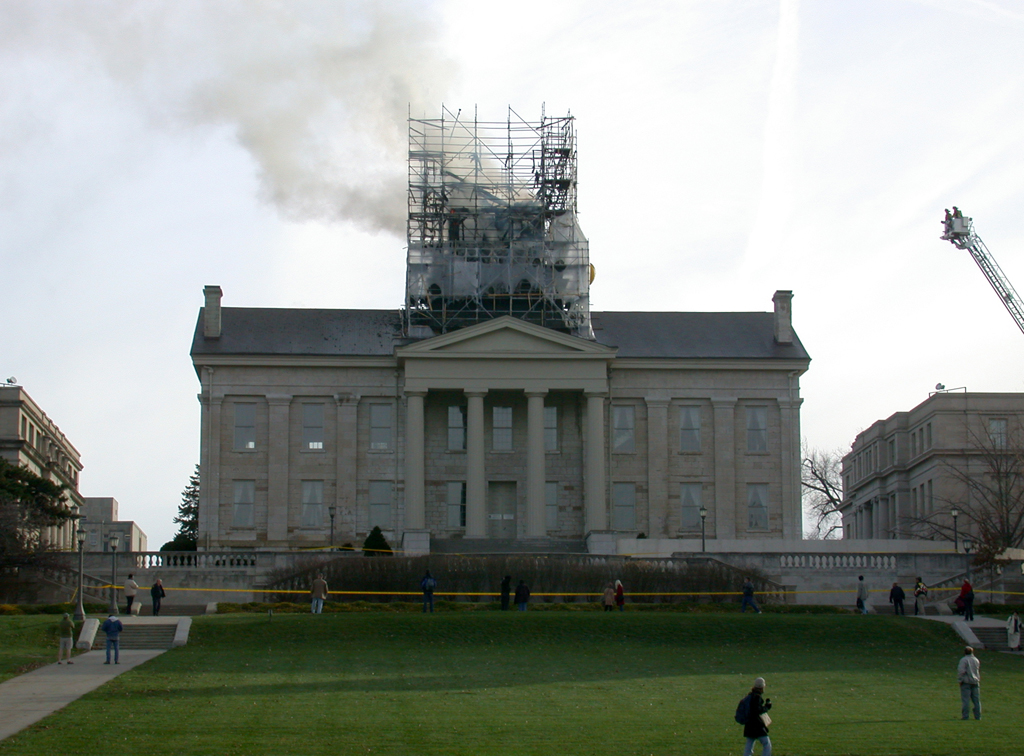
July 31, 2007, 6:00 a.m.
Corporatizing Education & Other U-News Updates
Our new UI President Sally Mason formally starts tomorrow, Wednesday, August 1. As Diane Heldt reports, she won't have to wait long for issues to arrive.
Diane Heldt, "Full Plate Awaits New President; Mason Takes Office Wednesday at UI," The Gazette, July 30, 2007, p. A1
One of the most recent big UI issues in the news has been the Wellmark naming controversy. This morning's papers report on revealing e-mails among UI officials and faculty. Mason has not yet tipped her hand, aside from saying she's following the issue and that it warrants a full and respectful discussion.
Erin Jordan, "U of I dean: Wellmark offer 'small;' He called it 'not acceptable,' but officials almost approved proposed gift," Des Moines Register, July 31, 2007
Diane Heldt, "Offer 'Embarrassingly Small;' Dean Says Wellmark Gift Would Have Undervalued College," The Gazette, July 31, 2007, p. B1
Brian Morelli, "E-mails Shed Light on Debate; Wellmark in the Name, Amount of Gift Discussed," Iowa City Press-Citizen, July 31, 2007, p. A1
As I've often written here -- and as these stories, and the Snell column, immediately below, support -- it will be a shame if this is perceived as merely the "Wellmark-UI College of Public Health Naming Issue" when it is so much bigger and can more usefully be addressed in the larger context of the corporatization of higher education generally, and at the UI in particular. Whatever President Mason's focus turns out to be, it won't be long before we'll get a sense from her statements and decisions as to just how much further the "University of Iowa, Inc." is going to slide into the for-profit sector during her tenure.
Joel Snell, "For Some Companies, UI is an Attractive 'Brand,'" The Gazette, July 31, 2007, p. A4
Barbara Ankenbrand, "Instead of Naming Rights, Wellmark Could Help Poor," The Gazette, July 31, 2007, p. A4
Nancy McHugh, "Wellmark's Missing Chace for True Philanthropy," The Gazette, July 31, 2007, p. A4
Sam Osborne, "Selling Naming Rights Could be Great Idea," The Gazette, July 31, 2007, p. A4
Another issue, which I'm going to do my darnedest to try to keep on the radar, is the partnership between the UI athletic program and the gambling industry. Interim President Fethke -- to the best of my recollection -- indicated that he would announce the UI position with regard to the football program's partnership with the Riverside Gambling Casino, which has been a matter of concern to the NCAA. So far as I know, nothing further was ever said. Now it turns out the athletic program is back in bed with the Iowa Lottery, after supposedly "severing ties" (accomplished, one assumes, by arguing that "Gee, it's not us, it's those awful folks at Iowa State; we can't help it if we play them in football"). And what say you, President Mason?
Rod Boshart, "Lottery to Give Away Hawks-Cyclones Tickets," The Gazette, July 30, 2007, p. B7
A couple of other stories, in other than a higher education context, further illustrate the potential hazards along the road to corporatization.
Clark Kauffman, "Agency takes gifts from those it regulates; The Department of Elder Affairs accepts thousands from senior-care companies," Des Moines Register, July 30, 2007
Editorial, "Get to bottom of consultant's sweet deal; Why did state lower bar to award bonus?" Des Moines Register, July 30, 2007 (A consultant, hired to help the State cut costs and become more efficient, was paid substantially in excess of actual savings achieved -- contrary to the consultant's representations -- including bonus payments for its poor performance. Those are legitimate journalistic topics. But my more general question would be, "Why are we hiring a consultant in the first place?" Executives -- whether in the for-profit or non-profit sectors -- are paid the big bucks because of the skills they supposedly bring to the job. What more appropriate, central and essential skill than the ability to master what it is your institution is doing, and then move it in ways that will cut costs while improving outputs?)
Other items include an encouraging report regarding Regents' universities-community college cooperation and coordination. (In this case, a "2 plus 2" program enabling what I've long advocated: that we encourage Iowa's community college system to provide the freshman and sophomore years' education and then ease the students' transition to a junior and senior year at a Regents institution. The advantages to all are obvious.) Brian Morelli has another nice piece about Fethke's tour of duty, and the Register has an editorial regarding open meetings and public records (both State and federal) -- an issue with the UI and its Board of Regents (see, e.g., "Regents Dismissed from Suit," The Gazette, July 31, 2007, p. B3).
Editorial, "Community College Degrees Pay Off," The Gazette, July 31, 2007, p. A4
Brian Morelli, "Colleagues Say Fethke Didn't Let Office Stagnate; Interim Leader's 14 Months Full of Action, Controversy," Iowa City Press-Citizen, July 31, 2007, p. A1
Editorial, "Speed Up Access to Federal Records," Des Moines Register, July 29, 2007 (including sidebar, "In Iowa Shore Up Meetings, Records Laws")
# # #
July 28, 2007 6:45 a.m.; July 29, 2007, 9:00 a.m.
Today's News:
Press-Citizen wants public back in "public health"
Four speak out on "Sicko"
Pomerantz to get honorary degree from UI
UI buildings on Regents' agenda
"Big Ten Network" in big tough negotiations
Editorial, "It's Time for the State to Help Put the 'Public' Back in 'Public Health,'" Iowa City Press-Citizen, July 28, 2007, p. A14.
Press-Citizen's "Diagnosing Michael Moore's 'Sicko,'" July 28, 2007, p. A15.
Richard Dobyns, "Why Not Socialize Health Care? It Would be Bad for Business"
Loreen Herwaldt, "Fair and Balanced 'Sicko' is Not, But Neither is the U.S. Health Care System"
Chris Atchison, "Moore Describes Challenges Better Than He Does Solutions"
Sam Levey, "Boldness Has Been Sadly Absent Among Our Nation's Leaders"
Kathryn Fiegen, "UI Seeking Honorary Degree for Pomerantz," Iowa City Press-Citizen, July 28, 2007, p. A1
Kathryn Fiegen, "Regents' Agenda Released for August; New Projects, Budget and Security Will be Discussed," Iowa City Press-Citizen, July 28, 2007, p. A3 (not available online); Kathryn Fiegen, "Regents Consider $267 Million in Capital Projects," Iowa City Press-Citizen Online, July 27, 2007
Scott Dochterman, "Tense Waiting Game; What's at Stake for big Ten Network, Cable Companies, Fans," The Gazette, July 28,2007, p. A1
Diane Heldt, "Fethke farewell; Impact of interim presidency to continue as he leaves UI post," The Gazette, July 29, 2007, p. A1
# # #
July 16, 2007, 6:15, 6:45, 7:45 a.m.
Updates: Sicko, Wellmark, UIHC, Search, Prisons, Bikes
Sicko
Marcy and Ed Rolene, "Thank You to Dean, Faculty," Iowa City Press-Citizen, July 16, 2007, p. A9 ("We drove to Cedar Rapids to see 'Sicko.' It confirmed what many Americans already believe. Health insurance companies look out for their bottom line, not for the health of the public.")
"The health of the public?" "Public health?" Hmmm. Could there be a connection here? Has Wellmark been moved to generosity by a Michael Moore movie? Was "The Wellmark College of Public Health" a preemptive strike, designed to associate "health insurance company" with "public health" in a positive way in the public's mind at the same time "Sicko" is being watched by millions of Americans?
"Sicko" very powerfully documents the role of insurance companies in denying Americans health care under our system -- not to mention their lobbying and campaign contributions designed to deny Americans the kind of health care system enjoyed by citizens of countries who are provided the benefits of universal, single-payer systems. Those countries provide their citizens health care for all, free to the recipient, at a lower cost to the society to cover all than we pay to cover some, with better results in terms of public health generally, including longer life expectancy and lower infant mortality rates than we have.
Anyhow, although the Rolenes had to drive to Cedar Rapids to see the film, Iowa City residents -- living as we do in what the Marcus Theaters considers a little, backwater, rural Iowa town -- will actually be able to give the theater chain our money to see "Sicko" locally this Friday, I'm told.
No health care delivery system is perfect -- not ours, not those of other countries. But I challenge anyone to watch that film with an open mind, from start to finish, and then explain to me why they still think the system we have is on balance better than the systems offered the citizens of the rest of the industerialized world. Elected public officials should be forced to watch "Sicko" -- and then report to the world how much money they've taken from the insurance and big pharma industries.
The Wellmark College of Public Health: "Gift" or Shrewd "Advertising Buy"?
Talk about being defensive! The following sounded more like the wild and crazy ranting of a deranged blogger from inside an insurance company board room than something that would come from an editorial board room: "pointless academic principles," "sudden attack of the ethical heebie-jeebies," "drum roll please," "interesting that the college was OK accepting the corporation's lavish gift, but apparently only as long as the outside world was unaware of the source." (Of course, no one ever said "the outside world" should be "unaware of the source" of the gift. Such gifts are always acknowledged with public announcements -- unless the donor wishes for them to be anonymous. That had nothing to do with the issue, which was the possible adverse consequences of an unprecedented naming of a University of Iowa college for a corporation.) I think the "thistle" should have been awarded to the Register, not the University. "Roses & Thistles: Iowa School of Public Hypocrisy," Des Moines Register, July 15, 2007, p. OP 1.
Press-Citizen's Single-Subject Op Ed Page: "Naming Right Draws Passionate Responses," July 14, 2007, p. A 15
Gregs G. Thomopulos, "No Strings Are Attached to Wellmark's UI Gift" [Thomopulos is a Wellmark board member]
Jim Lewers, "How Much is $15 Million? A Lot, But That Doesn't Matter" [So far as I've been able to discover this column is nowhere available on the Press-Citizen's Web site.]
Letters:
Peter Hansen, "Possible to Sell Out the Entire University"
Garry Kuhl, "Time for Wellmark to Return to Origins"
Kembrew McLeod, "A 'Gift' Should Have No Strings Attached"
Mike Woodhouse, "How Does Wellmark Have All That Cash?"
Wendy Luxenburg, "Faculty Decision Was the Right One"
UI Governance, UIHC, Wellmark, President
Brian Morelli, Dean Says UIHC CEO Role Being Stripped; Documents Show Insiders' Concerns," Iowa City Press-Citizen, July 14, 2007, p. A1
"Gary Fethke E-Mail to James Merchant" [June 5, 2007], Iowa City Press-Citizen, July 14, 2007
"Katen-Bahensky Letter to Gary Fethke" [December 5, 2006], Iowa City Press-Citizen, July 14, 2007
I have no idea what this is all about -- except that I imagine, as the captain of the Titanic discovered with regard to icebergs, that there is probably a good deal more below the surface than above.
There are some really tough governance and organizational issues here. So I'm left with general observations based on my administrative and managerial experience.
* When everybody is in charge, nobody's in charge. There's a value to having clean lines of responsibility with as few levels of reporting as possible -- up to and including the near-flat organization.
* There's no magic organizational alternative to good rapport among humans who like and respect each other and "play well with others." As much as one would sometimes like to "get the humans out of the loop," as it was phrased in the 1983 movie, War Games, as that film demonstrated we can't do it all with computers -- or with organization charts.
* The devil is in the details -- not in the organization charts. As Maritime Administrator I made a point of interviewing as many of the thousands of employees as possible about the details of their work days. That's the level at which meaningful "re-organization" -- not to mention improvements in morale -- needs to be done. It's a sub-set of MBWA -- management by walking around. When MARAD later became part of a "reorganization" effort the boxes were moved from the Department of Commerce to the Department of Transportation -- by individuals who had never set foot in the agency. The organizational issues I had earlier spotted and resolved -- or not -- were simply moved from one cabinet department to another without ever being addressed in the process. I have no way of knowing, but I would not be stunned to discover that the UIHC and College of Medicine could benefit from the kind of reorganization effort I put in at MARAD -- before addressing the design of the boxes on their organization charts.
UI Presidential Search
Diane Heldt, "Presidential Search to Cost UI $315,000," The Gazette, July 14, 2007, p. A1
Brian Morelli, "Second President Search Cost Over $81 K," Iowa City Press-Citizen, July 14, 2007
Prisons for Our Mentally Ill
Jennifer Hemmingsen, "Special Needs Unit Unveiled," The Gazette, July 14, 2007, p. B1
Rachel Gallegos, "Oakdale Unit Meets Prison Health Needs," Iowa City Press-Citizen, July 14, 2007, p. A3
Bicycling
Kathryn Fiegen, "Bike Riders Go the Distance and Eat All Along The B-Eat-en Path; Better Bikes Have Cyclists Traveling for a Bite to Eat," Iowa City Press-Citizen, July 15, 2007, p. A1
Rachel Galegos, "'Tour de Brew' Rides Across Eastern Iowa; Official Says Event's Attendance has Doubled Over Every Year Held," Iowa City Press-Citizen, July 15, 2007, p. A3
# # #
July 4, 2007, 6:00, 7:00 a.m. [addition of links and excerpt from "Conflicts, Cover-Ups and Corruption"], 8:35 a.m. [addition of "Other News" links], 3:10 p.m. [addition of links to photos of Coralville 4th of July parade (in "Other News" section)]
More on "The Name Game"
Yesterday morning, on reading the Press-Citizen's page one story that the University of Iowa was seriously considering the unprecedented step of naming one of its colleges after a corporation, I made an effort to think through some of the issues this raised in my mind. The blog entry on the subject ended up with 11 categories of issues involved in "The Name Game" surrounding the naming rights to universities, their colleges and buildings. Nicholas Johnson, "Wellmark's College of Public Health" in "The Corporate College of . . .," July 3, 2007.
By this morning it was obvious that I was not the only one who was concerned. Governor Culver, Board of Regents member Bob Downer, and numerous others were raising some of the same points that I had blogged about yesterday, reported in page one stories in the local press. E.g., Brian Morelli, "Possible Naming Raises Concerns; Some Fear Conflict of Interest with Wellmark, College," Iowa City Press-Citizen, July 4, 2007, p. A1.
State29, apparently blogging on these issues about the same time that I was, came up with a similar analysis -- although, as always, expressed in much more colorful language. State29, "Enron Field," July 3, 2007.
What's happening, as I see it, is but a tiny sub-set of a much larger, looming challenge that I wrote about in an earlier blog entry. Nicholas Johnson, "Greed, Conflicts, Cover-Ups and Corruption" in "Conflicts, Cover-Ups and Corruption," June 26, 2007.
Our so-called "public universities" (increasingly "private" in terms of operating budgets and escalating tuition and other student expenses) are in a period of transition -- although to what is not altogether clear. I wrote about these alternative futures in a Press-Citizen op ed. Nicholas Johnson, "Where Are We Going? Who's Going With Us?" Iowa City Press-Citizen, June 19, 2007.
Faculties, funded by grateful legislatures and protected by tenure, used to debate issues such as whether it was still necessary to require all Ph.D. candidates to exhibit some fluency in Latin and Greek. Most professors probably did not know -- and would have seen little reason why they should -- anything about their university's taxpayer-funded budget (aside from their own salary).
Today, an ever increasing number of faculty are (a) employed without thenure, and (b) required to personally raise part or all of their own salary and supporting expenses. There's not much talk about Greek and Latin requirements in that environment.
But these are changes for which many faculty -- and those among them functioning as deans -- are ill prepared. Not only do they not have experience, or hold degrees in, "business," they (like the public-policy-driven aspiring young politician) probably did not spend their early years honing a passion to become, and then spend a significant portion of their lives as, a major fund raiser.
We are familiar with the "conflicts, cover-ups and corruption" in business. When State29 headlines his blog entry about the Welmark College of Public Health "Enron Field" it's a shorthand we all immediately understand.
Indeed, there are some who would suggest that "business ethics" is an oxymoron. Notwithstanding our business schools' courses in the subject the scandals continue to fill the pages of our newspapers, the reports of our congressional hearings, and provide grist for feature films. (Michael Moore's "Sicko" is only the latest in a long line.) See, Nicholas Johnson, "'The Corporation' and the Search for Agreement," October 1, 2004 (reflections and suggestions following a UI College of Business viewing, and discussion, of the film "The Corporation").
But the business community has some awareness of the inherent conflict of interest it confronts on an hourly and daily basis. The recent reports regarding products from China -- from pet food, to human medicine, to children's toys to automobile tires -- are reminiscent of our own history of business (not all of it ancient history). Off-shore tax havens, outsourcing manufacturing, reducing quantities while increasing prices, pumping up stock prices with "creative accounting," raiding pension funds, cartels and price fixing among competitors -- the examples are endless.
It is said, "You get what you measure." And when all you measure is what falls to the bottom line (and bounces back in the form of ever-increasing stock prices) there is a great temptation to let moral and ethical values fall as well.
Unlike the business community -- and ironically in some ways -- the academy is much less experienced, sophisticated or reflective about such moral dilemmas. Moreover, we're handicapped -- as are the clergy and many politicians -- with the genuine belief that, because we, our mission and goals are so pure of mind and spirit and set apart from worldly matters, anything we do is of necessity equally pure and commendable. Those in business, by contrast, are aware of the moral and ethical pitfalls. They may choose to ignore ethical issues and focus only on maximizing ever-increasing profits, but at least they are aware of what they are doing. They know what the ethical standards are; they know what they're doing.
Academics often do not.
To help explain, let me repeat some of what I wrote in "Conflicts, Cover-Ups and Corruption." At the time, of course, I had no idea the University of Iowa would ever actually consider selling off the name of a college, or building, to a corporation. I was merely writing about the kinds of potential conflicts of interest, and tough ethical and moral dilemmas our new President, Sally Mason, will necessarily find herself having to address. The discussion helps to set "The Name Game" in the context of a range of ethical dilemmas. Here's an excerpt:
The story illustrates another problem with greed. Once money becomes the sole coin of the realm, and the need for profits is replaced with ever-increasing pressure for ever-increasing profits, conflicts of interest become ever more difficult to resolve ethically.
Years ago magazines aimed at women said little to nothing about the fact that the number of women dying from lung cancer was increasing, ultimately surpassing the number dying from breast cancer. Editors knew the story, they knew lung cancer's relationship to increased cigarette consumption by women, they knew manufacturers were targeting women -- and doing so in significant measure with the ads the companies were running in their magazines. But they needed the advertising revenue and, well, "women probably aren't interested in reading those stories anyway."
The NCAA wants to distance itself from sports gambling, and the gambling industry generally, in every way possible. It expressly forbids association with gambling casinos at NCAA events or in its advertising. It highly recommends that NCAA schools follow the same practice. It has written the UI athletic program with regard to its partnership with the Riverside Gambling Casino. And yet our football program tries to rationalize the gambling partnership while refusing to do anything about it.
This morning's Daily Iowan reports, Ashton Shurson, "Mason, Barta Set to Work Together," The Daily Iowan, June 26, 2007, that our new president has paid proper respect to the athletics program and its director. The story quotes Interim President Fethke as saying, "You have to respect the athletics director's opinion and point of view and trust that person."
Fethke's "respect" was so substantial that he's never (so far as I know) said anything critical in public regarding the NCAA's slap in our face about our gambling partnership with the Riverside Casino. Will the leadership that Mason brings include the ethical, moral and legal issues this relationship raises -- or will she continue the deafening silence from Jessup Hall on the issue because, after all, the athletic program is increasingly responsible for raising its own money, they have to get it where they can, and a university president must show "respect" to the athletic director?
Universities are not immune from the pressures that in corporate American can produce an Enron, or the political pressures that produce a U.S. Congress that simply can't "afford" to stand up to the pharmaceutical industry. Mason has been advised that as much as one-third of her time should be spent in fund raising. Clearly it's a major part of what she has been hired to do, a major part of the "performance" that can produce an extra $50,000 a year under her contract.
As such, she -- like every other big university's president -- will be subjected to similar pressures as the editor who must decide whether s/he can "afford" to run an essential story that will cause a loss of advertising revenue, an athletic director who must weigh the advice (and standards) of the NCAA against the revenue that can come from the gambling industry, or a politician in need of campaign contributions deciding how to vote on a measure that will clearly help her constituents but cause a special interest group to cut off her funding.
How will she decide whether to accept a major contribution from a donor who wants a faculty member fired (or hired), or a program established that is antithetical to the university's mission?
We've already stopped naming colleges and buildings for scholars and started naming them for donors. Are there any limits? The CEO of Home Depot gave $200 million to the Atlanta museum. Would we, for an equivalent amount, become "The Home Depot University of Iowa"? What if Larry Flynt would offer $300 million if we'd change the name to "Flynt University"? (After all there's a "Stanford University" and a "Duke University" -- named for a guy who made his money from tobacco.) Why not a "Flynt University"? We need his money as much as Barta needs the gambling industry's money.
What about a corporation that is willing to underwrite a multi-million-dollar research program -- so long as it gets a disproportionate share of the benefits from what it produces?
How candid should she be about, or should she even acknowledge at all, a potential scandal that could deal a blow to fund raising?
The question is not whether she will confront such conflicts. Of course she will. It goes with the territory in an age in which what used to be educational institutions with public support have developed more in common with for-profit corporations. The question is how she will respond to them. These conflicts often involve shades of gray. The more profitable choice can often be rationalized in some way -- as Barta tries to do with gambling money.
How many bars are there within walking distance of the campus -- 40? They are so profitable -- and therefore so politically powerful -- that the City Council seems incapable of doing anything meaningful to curb students' binge drinking. Well, who are these customers anyway? They are students. The University's students. Our students. At a time when the University is in need of every source of income it can find, when it issues lucrative monopoly contracts to Coca Cola (so it can raise its prices) notwithstanding the product's health impact on students, why just wink at the profits from binge drinking when the University could be sharing in them? With a little ingenuity I think the University could be pulling in the lion's share of that money with its own entertainment venues. Something to think about.
I imagine that even President Mason cannot now imagine the choices -- the potential conflicts, cover-ups and corruption -- she will have to confront or how she will resolve them.
This morning's Register story illustrates how "just a little harmless doctoring of the promotional literature" is not only morally wrong, but can backfire. If those putting comments on that Register story represent the majority they may be, that may just be "all she wrote" on the sales tax for the wealthy.
The University's story? That's yet to be written.
Nicholas Johnson, "Greed, Conflicts, Cover-Ups and Corruption" in "Conflicts, Cover-Ups and Corruption," June 26, 2007.
# # #
Other News:
Pictures of the Coralville Fourth of July Parade, with emphasis on presidential candidates (listed alphabetically by last name, Democrats and then Republicans) and other elected officials, separated by shots of other floats and scenes.
Note: As always, The Gazette's stories can be found at its main Web site.)
The Fourth of July: Speaking Truth to Power
Leonard Pitts, Jr., "America is at War With Itself," The Gazette, July 4, 2007 ("it seems to me it is not the people who make America great, but America that has made the people great -- [the idea of America] the idea of American exceptionalism")
And thanks to The Gazette for reminding us, today, of the full text of the Declaration of Independence, July 4, 1776, The Gazette, July 4, 2007, p. A7 -- the ultimate speaking of truth to power that made possible the birth of our nation.
Senator Biden's and Clinton's Visit
Here are the photos on my Picasa Web site for the Senator Biden event July 2, and Senator Clinton event July 3.
As always, John Deeth is the best (most thorough) source for political events. See John Deeth, "Biden Time on the Ped Mall," July 2, 2007, and "Clinton and Clinton Live at U Iowa," July 3, 2007 (with photos -- better than mine).
Rachel Gallegos, "Clintons visit Iowa City; Hillary Clinton talks health care, education in campaign stop," Iowa City Press-Citizen, July 4, 2007
James Q. Lynch, "Former First Lady Ready to Lead, Clintons Tell I.C.," The Gazette, July 4, 2007, p. A1.
Thomas Beaumont, "Clinton Says Her Campaign Has Recovered from Slow Start," Des Moines Register, July 4, 2007.
Wellmark College of Public Health
Brian Morelli, "Possible Naming Raises Concerns; Some Fear Conflict of Interest with Wellmark, College," Iowa City Press-Citizen, July 4, 2007, p. A1.
Diane Heldt, "Wellmark College at the UI?; Plan to put corporate name on school in exchange for gift prompts concern," The Gazette, July 4, 2007, p. A1.
Greg Thompson, "Some New Names for Other UI Departments," Iowa City Press-Citizen, July 4, 2007.
State29, "Enron Field," July 3, 2007.
Our "Destiny"? Shifting Taxes From the Wealthy to the Backs of the Poor
Melissa Walker, "'Destiny' to hurt poor the most, economist says; Those living on fixed incomes spend more of their money on taxable goods, they say," Des Moines Register, July 4, 2007.
# # #
[Note: If you're new to this blog, and interested in the whole UI President Search story . . .
This blog began in June 2006 and has addressed, and continues to addresses, a number of public policy, political, media, education, economic development, and other issues -- not just the UI presidential search. But that is the subject to which most attention has been focused in blog entries between November 2006 and June 2007.
The presidential search blog entries begin with Nicholas Johnson, "UI President Search I," November 18, 2006. They end with Nicholas Johnson, "UI Held Hostage Day 505 - Next (Now This) Week," June 10, 2007 (100-plus pages printed; a single blog entry for the events of June 10-21 ("Day 516"), plus over 150 attached comments from readers), and Nicholas Johnson, "UI Hostages Free At Last -- Habemas Mamam!," June 22, 2007.
Wondering where the "UI Held Hostage" came from? Click here. (As of January 25 the count has run from January 21, 2006, rather than last November.)
For any given entry, links to the prior 10 will be found in the left-most column. Going directly to FromDC2Iowa.Blogspot.com will take you to the latest. Each entry related to the UI presidential search contains links to the full text of virtually all known, non-repetitive media stories and commentary, including mine, since the last blog entry. Together they represent what The Chronicle of Higher Education has called "one of the most comprehensive analyses of the controversy." The last time there was an entry containing the summary of prior entries' commentary (with the heading "This Blog's Focus on Regents' Presidential Search") is Nicholas Johnson, "UI President Search XIII -- Last Week," December 11, 2006.
My early proposed solution to the conflict is provided in Nicholas Johnson, "UI President Search VII: The Answer," November 26, 2006.
Searching: the fullest collection of basic documents related to the search is contained in Nicholas Johnson, "UI President Search - Dec. 21-25," December 21, 2006 (and updated thereafter), at the bottom of that blog entry under "References." A Blog Index of entries on all subjects since June 2006 is also available. And note that if you know (or can guess at) a word to search on, the "Blogger" bar near the top of your browser has a blank, followed by "SEARCH THIS BLOG," that enables you to search all entries in this Blog since June 2006.]
# # #
July 3, 2007, 6:00 a.m., 7:15 p.m. [addition of photos from Senator Biden, and Senator Clinton events], and 8:25 p.m. [addition of response to attached reader comment, and reference to earlier blog entry, "Greed, Conflicts, Cover-Ups and Corruption"]
Wellmark's College of Public Health
The possibility of Wellmark buying the University of Iowa's College of Public Health came up in an exchange of comments added to a prior blog entry, Nicholas Johnson, "Gambling, Taxes and Cats," July 1, 2007. Today the story has moved from the blogosphere into the mainstream press as the lead story in this morning's Press-Citizen, Brian Morelli, "UI College May Get New Name; May be Named for Wellmark Foundation," July 3, 2007, p. A1.
There are a number of issues and concerns regarding the naming of public buildings in general and academic buildings in particular -- and the possibility of a Wellmark College of Public Health raises almost all of them.
* Should buildings be named for anybody?
* If so, should the naming be limited to ancient scholars, inventors, researchers, creative persons, and so forth -- such as the names that surround one of the buildings on the Pentacrest?
* Or, can the naming include more contemporary such individuals -- but only after they have died?
* And, if so, what about naming them for such individuals while they are still alive?
* Is it appropriate that the names of buildings and colleges be "sold off," in effect, to major donors -- with the symbolic consequence that an academic institution appears to be bestowing its greatest honors on wealth in preference to wisdom?
* If an academic institution is going to offer its programs for sale, should there be any individuals whose money should not be accepted for this purpose -- say, convicted felons, those who have made their money in illegal businesses, or from legal but questionable businesses (e.g., prostitution where legal, gambling, or pornography)? If so, how (and by whom) should these standards be established?
* Is there "a difference that makes a difference" between accepting money from an individual donor for these naming purposes, and accepting it in exchange for a name that includes the donor's corporation (or, as in this case, that corporation's foundation), thus putting the name of a business rather than a person on a building or college?
* If it is acceptable to include a corporate name in the name of an academic building or college, are there additional issues raised when that corporation's mission is in some way, directly or indirectly, related to the college's mission? For example, because corporations have their own training centers and "universities" (I once attended one run by IBM) does it risk confusion in the public mind (similar to the concerns in trademark law) to include a corporate name in the name of a university's college or building when its academic mission is similar to that of the corporation? Is this potential problem exacerbated at a university that includes in its mission "economic development" and the provision of space and other resources for the purpose of spinning off for-profit corporations?
* Does it make it better -- or worse -- that there is a commercial relationship between the corporate donor and the college in question? Does Wellmark's purchase of a UI medical college's name somehow compromise the ability of the University of Iowa to negotiate with Wellmark -- something that's already been a little controversial in the past? Will it prevent, or at least substantially impede, the ability of the University to switch providers sometime in the future, should that be seen to be in the University's best interest?
* What if the corporation's mission is actually antithetical to the mission of the college; e.g., what if the company in question had been, say, Phillip Morris, which contributes to one of the leading public health problems in America, rather than Wellmark, which merely profits from one of the leading public health problems in America? Would that have made a difference? (And there's the related question: Would a "Phillip Morris College of Law" be acceptable, although not a "Phillip Morris College of Public Health"?)
* Finally, when corporate money is accepted in exchange for the naming of buildings or colleges, what is the metric, what is the rate card and how is it calculated, in deciding how much to charge? To the extent the naming constitutes a form of advertising, is the advertising market relevant for these purposes? If so, should the fee charged be an annual payment, rather than a one-time payment, as would normally be the case with advertising?
There is a reason why business spends at least $250 billion a year on advertising -- and, since we are talking about public health, a good deal of which involves advertising for tobacco, alcohol and drugs that is viewed by children, according to the American Academy of Pediatrics' report. Advertising works; advertising sells; advertising is an investment that pays returns -- as it will in this case for Wellmark.
Consider what an advertiser gets for naming rights, say, Cellular One's arena in Cedar Rapids (formerly the Five Seasons Center). It's not just its name on a building -- that can be seen for miles around by anyone passing through town. The name is contained in every newspaper ad for a event at the venue. It's on highway signs directing people to the building. It's on the tickets. It's on every piece of stationery.
Wellmark will get the same range of benefits -- and more -- from having its name on a University of Iowa building. And how much more is it worth to gain the reputation and good will of a major university, by association, than just some old conference center?
We've long since decided we're willing to sell off the University's good reputation. If you haven't yet guessed, that troubles me. But accepting the reality of where we are at the moment, shouldn't we at least, as George Bernard Shaw suggested, start "haggling over price"? Don't we have the same obligation to the people of Iowa that we would if we were selling off the state's top soil -- to make sure we get the most for it we possibly can? When we take a lump sum to name a building after a corporation -- forever -- isn't there a great likelihood we're selling out too cheaply?
[There is a related discussion in Nicholas Johnson, "Greed, Conflicts, Cover-Ups and Corruption" in "Conflicts, Cover-Ups and Corruption," June 26, 2007, regarding the challenges confronting our next UI president as she necessarily must balance some of these moral/ethical questions against the fund raising that has been said to be at least one-third of her job. As that blog entry discusses, these potential conflicts go well beyond, of course, those involved in naming buildings and colleges. But in that earlier blog entry I ask,We've already stopped naming colleges and buildings for scholars and started naming them for donors. Are there any limits? The CEO of Home Depot gave $200 million to the Atlanta museum. Would we, for an equivalent amount, become "The Home Depot University of Iowa"? What if Larry Flynt [publisher of Hustler Magazine] would offer $300 million if we'd change the name to "Flynt University" [or "Hustler University"]? (After all there's a "Stanford University" and a "Duke University" -- named for a guy who made his money from tobacco.) Why not a "Flynt University"? We need his money as much as Barta needs the gambling industry's money.
A comment attached to today's blog entry notes the number of universities -- many quite distinguished -- named for business people who were major donors. This is a useful point, and I appreciate the offering of those examples. The person writing the comment urges no more than an acknowledgment that this names-for-dollars approach is not something new. I agree. However, I would note that:
(a) most of the examples listed -- including the addition of one I earlier noted that is not on the list (Duke; tobacco money) -- are private universities (Harvard, Yale, Dartmouth and Stanford). Admittedly, the University of Iowa -- with something like 13 percent of its budget coming from the State of Iowa -- is now "Iowa" in name only, and ever closer year by year, with its rising tuition and outside funding, to becoming a "private university" named for a state. Private universities are, by definition, with the exception of government grants for research, sustained by private tuition and donors. They have no (or few) alternative sources of funding. "Public universities," by contrast, were for the most part -- at least at their inception -- created with the notion of public funding, and free or virtually free tuition, as a public, non-corporate, institution.
(b) My discussion involves 11 paragraphs. That some universities (for the most part private universities) have been named for donors, and that this has been historically common and accepted, relates at most to the first five. It does not address the issues in the final six -- dealing with the naming of colleges, buildings or universities for corporations -- no examples of which are provided in the list in the comment.]
There are undoubtedly other issues involved as well, but this should be a good start on a few morning thoughts about "Wellmark's College of Public Health."
# # #
Other News:
Gartner praises Fethke; Biden impresses Iowa City yesterday; President and Mrs. President-Aspirant Clinton arrive today; over 40% white males have (or have had) alcoholism or serious drinking problem (and Iowa City's City Council and bars are doing their best to increase those numbers; way to go Iowa City); . . .
and I haven't forgotten State29's request for some commentary about the Fairness Doctrine (the subject of Tom Ashbrook's "On Point" (WBUR-AM) this morning, "Conservative Talk Radio").
Michael Gartner, "Fethke Excelled in Interim," Iowa City Press-Citizen, July 3, 2007.
Rob Daniel, "Biden: Iraq Solution Lies in Confederation," Iowa City Press-Citizen, July 3, 2007.
Shajia Ahmad, "Biden Details Iraq Solution," The Daily Iowan, July 3, 2007.
James Q. Lynch, "Biden Counts Off Qualifications in I.C.," The Gazette, July 3, 2007, p. B5; Associated Press, "30 Percent Have Abused Alcohol," The Gazette, July 3, 2007, p. A3 (both available at The Gazette's main Web site).
Here are the photos on my Picasa Web site for the Senator Biden event July 2 (yesterday), and Senator Clinton event today (July 3).
# # #
[Note: If you're new to this blog, and interested in the whole UI President Search story . . .
This blog began in June 2006 and has addressed, and continues to addresses, a number of public policy, political, media, education, economic development, and other issues -- not just the UI presidential search. But that is the subject to which most attention has been focused in blog entries between November 2006 and June 2007.
The presidential search blog entries begin with Nicholas Johnson, "UI President Search I," November 18, 2006. They end with Nicholas Johnson, "UI Held Hostage Day 505 - Next (Now This) Week," June 10, 2007 (100-plus pages printed; a single blog entry for the events of June 10-21 ("Day 516"), plus over 150 attached comments from readers), and Nicholas Johnson, "UI Hostages Free At Last -- Habemas Mamam!," June 22, 2007.
Wondering where the "UI Held Hostage" came from? Click here. (As of January 25 the count has run from January 21, 2006, rather than last November.)
For any given entry, links to the prior 10 will be found in the left-most column. Going directly to FromDC2Iowa.Blogspot.com will take you to the latest. Each entry related to the UI presidential search contains links to the full text of virtually all known, non-repetitive media stories and commentary, including mine, since the last blog entry. Together they represent what The Chronicle of Higher Education has called "one of the most comprehensive analyses of the controversy." The last time there was an entry containing the summary of prior entries' commentary (with the heading "This Blog's Focus on Regents' Presidential Search") is Nicholas Johnson, "UI President Search XIII -- Last Week," December 11, 2006.
My early proposed solution to the conflict is provided in Nicholas Johnson, "UI President Search VII: The Answer," November 26, 2006.
Searching: the fullest collection of basic documents related to the search is contained in Nicholas Johnson, "UI President Search - Dec. 21-25," December 21, 2006 (and updated thereafter), at the bottom of that blog entry under "References." A Blog Index of entries on all subjects since June 2006 is also available. And note that if you know (or can guess at) a word to search on, the "Blogger" bar near the top of your browser has a blank, followed by "SEARCH THIS BLOG," that enables you to search all entries in this Blog since June 2006.]
# # #
June 26, 2007, 7:40 a.m. [times reflect additions to the entry -- for the benefit of those few individuals who check back occasionally during the day -- as well as reflecting the fact that what is called "life" occasionally interrupts blogging]
I'm going to try to attend Governor Bill "What Makes You Think You Can Be President?" Richardson's event this morning (10:30, Iowa City Public Library, Meeting Room A), and if blogger John Deeth is not there to cover it (in which case he will leave nothing more to be said about it) provide you a little commentary. He stopped by the Register's editorial board yesterday and received for his efforts what I would consider a very upbeat, favorable column. See, Andie Dominick, "Richardson packs jokes, thick resumé," Des Moines Register, June 26, 2007
Meanwhile . . .
Greed, Conflicts, Cover-ups and Corruption Yesterday I used a movie line in describing the central Iowa campaign to increase the sales tax -- and use the revenue to lower the property taxes of businesses and other property owners: "Greed is good." Nicholas Johnson, "'Greed Is Good' - Poverty? 'Yes, It's Your Destiny,'" June 25, 2007. It was a commentary addressing, I guess one would have to say, the morality of the wealthy using their economic and political power to shift the cost of government services (many of which benefit them disproportionately anyway, e.g., infrastructure, TIFs, tax forgiveness and other incentives) from themselves onto the backs of those least able to pay. Note, not incidentally, that an increase in sales taxes from 6 cents to 7 cents is not a "one penny" increase; it's a nearly 17% increase -- being advocated by the very folks who are usually supporting candidates who campaign on "cutting taxes" (by cutting programs not benefiting the wealthy).
Yesterday the comments on the Register's story included those complaining that the paper had become an advocate for the tax hike and that its "news" stories ought to be on the opinion page. No one will be saying that today. [There are 12 comments as of 8:00 a.m. One of the better, earlier comments, has for some reason been removed. None supports the tax-hike-shift proposal.] See, Jeff Eckhoff, "Woman denies she touted 'Destiny'; I don't even pay property taxes, Urbandale senior asserts," Des Moines Register, June 26, 2007. The story details efforts of the tax-hike-and-shift backers to misrepresent the proposal (mentioning that it will cut property taxes without mentioning it will increase sales taxes), and in the main story in the piece, using the photo of an 82-year-old woman who has long lived in apartments and pays no property taxes, along with a "quote" she never uttered, to advance their campaign.
(Wondering what State29 thinks about all of this? I'll be you can guess. State29, "The Project Destiny Scam," June 26, 2007.)
The story illustrates another problem with greed. Once money becomes the sole coin of the realm, and the need for profits is replaced with ever-increasing pressure for ever-increasing profits, conflicts of interest become ever more difficult to resolve ethically.
Years ago magazines aimed at women said little to nothing about the fact that the number of women dying from lung cancer was increasing, ultimately surpassing the number dying from breast cancer. Editors knew the story, they knew lung cancer's relationship to increased cigarette consumption by women, they knew manufacturers were targeting women -- and doing so in significant measure with the ads the companies were running in their magazines. But they needed the advertising revenue and, well, "women probably aren't interested in reading those stories anyway."
The NCAA wants to distance itself from sports gambling, and the gambling industry generally, in every way possible. It expressly forbids association with gambling casinos at NCAA events or in its advertising. It highly recommends that NCAA schools follow the same practice. It has written the UI athletic program with regard to its partnership with the Riverside Gambling Casino. And yet our football program tries to rationalize the gambling partnership while refusing to do anything about it.
This morning's Daily Iowan reports, Ashton Shurson, "Mason, Barta Set to Work Together," The Daily Iowan, June 26, 2007, that our new president has paid proper respect to the athletics program and its director. The story quotes Interim President Fethke as saying, "You have to respect the athletics director's opinion and point of view and trust that person."
Fethke's "respect" was so substantial that he's never (so far as I know) said anything critical in public regarding the NCAA's slap in our face about our gambling partnership with the Riverside Casino. Will the leadership that Mason brings include the ethical, moral and legal issues this relationship raises -- or will she continue the deafening silence from Jessup Hall on the issue because, after all, the athletic program is increasingly responsible for raising its own money, they have to get it where they can, and a university president must show "respect" to the athletic director?
Universities are not immune from the pressures that in corporate American can produce an Enron, or the political pressures that produce a U.S. Congress that simply can't "afford" to stand up to the pharmaceutical industry. Mason has been advised that as much as one-third of her time should be spent in fund raising. Clearly it's a major part of what she has been hired to do, a major part of the "performance" that can produce an extra $50,000 a year under her contract.
As such, she -- like every other big university's president -- will be subjected to similar pressures as the editor who must decide whether s/he can "afford" to run an essential story that will cause a loss of advertising revenue, an athletic director who must weigh the advice (and standards) of the NCAA against the revenue that can come from the gambling industry, or a politician in need of campaign contributions deciding how to vote on a measure that will clearly help her constituents but cause a special interest group to cut off her funding.
How will she decide whether to accept a major contribution from a donor who wants a faculty member fired (or hired), or a program established that is antithetical to the university's mission?
We've already stopped naming colleges and buildings for scholars and started naming them for donors. Are there any limits? The CEO of Home Depot gave $200 million to the Atlanta museum. Would we, for an equivalent amount, become "The Home Depot University of Iowa"? What if Larry Flynt would offer $300 million if we'd change the name to "Flynt University"? (After all there's a "Stanford University" and a "Duke University" -- named for a guy who made his money from tobacco.) Why not a "Flynt University"? We need his money as much as Barta needs the gambling industry's money.
What about a corporation that is willing to underwrite a multi-million-dollar research program -- so long as it gets a disproportionate share of the benefits from what it produces?
How candid should she be about, or should she even acknowledge at all, a potential scandal that could deal a blow to fund raising?
The question is not whether she will confront such conflicts. Of course she will. It goes with the territory in an age in which what used to be educational institutions with public support have developed more in common with for-profit corporations. The question is how she will respond to them. These conflicts often involve shades of gray. The more profitable choice can often be rationalized in some way -- as Barta tries to do with gambling money.
How many bars are there within walking distance of the campus -- 40? They are so profitable -- and therefore so politically powerful -- that the City Council seems incapable of doing anything meaningful to curb students binge drinking. Well, who are these customers anyway? They are students. The University's students. Our students. At a time when the University is in need of every source of income it can find, when it issues lucrative monopoly contracts to Coca Cola (so it can raise its prices) notwithstanding the product's health impact on students, why just wink at the profits from binge drinking when the University could be sharing in them? With a little ingenuity I think the University could be pulling in the lion's share of that money with its own entertainment venues. Something to think about.
I imagine that even President Mason cannot now imagine the choices -- the potential conflicts, cover-ups and corruption -- she will have to confront or how she will resolve them.
This morning's Register story illustrates how "just a little harmless doctoring of the promotional literature" is not only morally wrong, but can backfire. If those putting comments on that Register story represent the majority they may be, that may just be "all she wrote" on the sales tax for the wealthy.
The University's story? That's yet to be written.
# # #
[Note: If you're new to this blog, and interested in the whole UI President Search story . . .
This blog began in June 2006 and has addressed, and continues to addresses, a number of public policy, political, media, education, economic development, and other issues -- not just the UI presidential search. But that is the subject to which most attention has been focused in blog entries between November 2006 and June 2007.
The presidential search blog entries begin with Nicholas Johnson, "UI President Search I," November 18, 2006. They end with Nicholas Johnson, "UI Held Hostage Day 505 - Next (Now This) Week," June 10, 2007 (100-plus pages printed; a single blog entry for the events of June 10-21 ("Day 516"), plus over 150 attached comments from readers), and Nicholas Johnson, "UI Hostages Free At Last -- Habemas Mamam!," June 22, 2007.
Wondering where the "UI Held Hostage" came from? Click here. (As of January 25 the count has run from January 21, 2006, rather than last November.)
For any given entry, links to the prior 10 will be found in the left-most column. Going directly to FromDC2Iowa.Blogspot.com will take you to the latest. Each entry related to the UI presidential search contains links to the full text of virtually all known, non-repetitive media stories and commentary, including mine, since the last blog entry. Together they represent what The Chronicle of Higher Education has called "one of the most comprehensive analyses of the controversy." The last time there was an entry containing the summary of prior entries' commentary (with the heading "This Blog's Focus on Regents' Presidential Search") is Nicholas Johnson, "UI President Search XIII -- Last Week," December 11, 2006.
My early proposed solution to the conflict is provided in Nicholas Johnson, "UI President Search VII: The Answer," November 26, 2006.
Searching: the fullest collection of basic documents related to the search is contained in Nicholas Johnson, "UI President Search - Dec. 21-25," December 21, 2006 (and updated thereafter), at the bottom of that blog entry under "References." A Blog Index of entries on all subjects since June 2006 is also available. And note that if you know (or can guess at) a word to search on, the "Blogger" bar near the top of your browser has a blank, followed by "SEARCH THIS BLOG," that enables you to search all entries in this Blog since June 2006.]
# # #
June 22, 2007, 5:00, 7:00, 8:30, 10:15 a.m.
Habemus Mamam!

Turning the page.
After "UI Held Hostage Day 516" it only took three minutes to select our University's president. (Here are my own photos of the event.)
Before the meeting Michael Gartner exhibited an uncanny ability to tie his bow tie without a mirror. As Jon Stewart has said in another context, "Those things are not easy to tie." Very impressive -- as were the Regents interviews last week, and their 24-hour deliberation before selecting Mason.
Regents President Michael Gartner called the meeting to order at 3:03:30. Five Regents were present: Michael Gartner, David Miles, Bob Downer, Jack Evans, and Craig Lang. He polled those participating by phone as they reported in: Bonnie Campell, Jenny Connolly, Ruth Harkin and Rose Vasquez. At 3:05 Bonnie Campbell made a motion, essentially that they appoint Sally Mason at $450,000-plus-plus-plus (at least a 50% pay hike, details below), and by 3:05:42 it was unanimous -- to cheers. Gartner disbanded Search Committee II, and at 3:06:30 the meeting was adjourned.
Governor Chet Culver made the trip to Iowa City -- an important symbolic presence -- spoke well in support of education in general, the University of Iowa and Sally Mason in particular. He was accompanied by his Press Secretary Courtney Greene.
Michael Gartner spoke of Mason as a scholar and a leader. He was impressed with her "sparkle" and her "passion" for education, and now especially education at Iowa, when he spoke with her. He thanked the Governor, noting that "the Board got everything it needed and everything it asked for."
All expressed thanks to the Search Committee (Gartner said they "couldn't have come up with better candidates") and Interim President Gary Fethke. (All that was overlooked was a little recognition of Provost Mike Hogan's continued quality service and class while being rebuffed.)
And then it was Sally Mason's turn. She entered the Richey Ballroom to a standing ovation, the "Iowa Fight Song" (there was no mention of the Iowa Lottery in the lyrics as a result of a coming to sanity -- and a threatened copyright suit), and all smiles.
She is already showing her ability to stand up to Michael Gartner. He had suggested she enter in a Herky costume and she refused -- noting she already had an adequate black and gold wardrobe. Both are good signs.
Her "Go Hawks!" was well delivered, though she does need a little work on the pumping right arm.
Saying Iowa was "a university of hope, a writing university," she spoke of the "Iowa Promise" (think, question, research and change; our leadership role; off-campus impact for the economy and the people; diversity as a source of strength; Iowa's relationship with the world, and the world's with Iowa). With alums, the private sector, state and university, she said she'd be doing a lot of meeting and listening, and traveling throughout the state, recognizing that she does have "a steep learning curve, but has never been afraid of heights." She quoted Goddard's line from 1907, "It is difficult to say what is impossible." It was a speech of inspiration and challenge: Iowa is a great university but -- using President Kennedy's line without the Boston accent and lilt -- "We can do better." She even demonstrated a bit of Reagan's ability to tell a moving personal story. As the child of immigrants, and the first generation to attend college, her "understanding of the power of education is very personal; education changed my life." It was all appropriate to the occasion, well delivered -- and well received.
From there it was on to a news conference with husband Ken, which they both handled well (as you'll see in some of the news stories linked below), and then the reception.
All told, it was an afternoon of relief, joy -- and hopeful anticipation of what's to come -- with a new Governor, half of a Board of Regents, and finally, President of the University of Iowa.
And it was followed by an equally enjoyable and inspiring evening, with Jim Autry and his wife, former Lt. Governor Sally Pedersen, at Prairie Lights Bookstore with "Live From Prairie Lights" host Julie Englander. (Here are sample pictures from that event.) Jim, who never was your standard Enron-type CEO, has been writing up a storm in recent years, and advising executives how to -- for want of a better expression -- be better people (in ways that also enable them to make more profit). His latest book, from which he read, is Looking Around for God: The Oddly Reverent Observations of an Unconventional Christian. If you missed the broadcast, give it a listen from WSUI's archives (it's not there yet, but should be in a few days.) Believe me, you'll be glad you did.
By this morning the lightning had flashed, the thunder had rolled, and the skies emptied of about as much water as anyone ever put in a cloud. I don't know whether it was a result of Jim finding what he was looking around for, or just an omen of the amount of changes Sally Mason and the heavenly hosts have in store for us.
In either case, I think "the times, they are a changing."
Note that the former, 100-plus-page blog entry about the final two weeks of the presidential search remains available on this blog (along with its 150-plus comments), as do all the blog entries from last November through June that track the saga and link to the news stories and other source material.
Today's stories:
Erin Jordan and Danny Valentine, "New U of I president: Big challenges don't scare me; Sally Mason, who will become the 20th president of the University of Iowa, says she can handle the learning curve," Des Moines Register, June 22, 2007 (with important "New President's To-Do List" as sidebar)
Editorial, "Diversity emphasis a plus for U of I, Iowa; New president must confront funding issues, insist on openness," Des Moines Register, June 22, 2007
Diane Heldt, "'We can aim higher;' New UI President Shares Her Vision, Receives Warm Welcome; Regents Praise Mason's Passion and Leadership," The Gazette, June 22, 2007, p. A1; Gregg Hennigan, "Purdue Praises Departing Provost," The Gazette, June 22, 2007, p. A7; plus "Mason's Salary to be $450,000," p. A1, and "Iowa Reaction" and "Sally Mason Bio," The Gazette, June 22, 2007, p. A7 (all available from The Gazette's main Web page; use drop down menus to locate "6/22/2007" and pages "A1" and "A7")
Ashton Shurson, "A Passion for Education; Sally Mason Selected As Next UI President," The Daily Iowan, June 22, 2007 (a lengthy piece for the DI, along with a nice photo gallery)
Brian Morelli, "Regents unanimously approve Mason; New UI president set to take charge Aug. 1," Iowa City Press-Citizen, June 22, 2007
Brian Morelli, "Mason To Earn $560 K As President," Iowa City Press-Citizen, June 22, 2007 (with sidebar, "President Salaries in the Big 10," revealing that Iowa's former president, Mary Sue Coleman, now at Michigan, is number one at $742,000, and that Sally Mason will be number three at $560,000)
Kathryn Fiegen, "Ken Mason focuses on teaching, will accept UI position; He has researched genetics of amphibian pigmentation," Iowa City Press-Citizen, June 22, 2007
# # #
[Note: If you're new to this blog, and interested in the whole UI President Search story . . .
These blog entries begin with Nicholas Johnson, "UI President Search I," November 18, 2006.
Wondering where the "UI Held Hostage" came from? Click here. (As of January 25 the count has run from January 21, 2006, rather than last November.)
For any given entry, links to the prior 10 will be found in the left-most column. Going directly to FromDC2Iowa.Blogspot.com will take you to the latest. Each contains links to the full text of virtually all known media stories and commentary, including mine, since the last blog entry. Together they represent what The Chronicle of Higher Education has called "one of the most comprehensive analyses of the controversy." The last time there was an entry containing the summary of prior entries' commentary (with the heading "This Blog's Focus on Regents' Presidential Search") is Nicholas Johnson, "UI President Search XIII -- Last Week," December 11, 2006.
My early proposed solution to the conflict is provided in Nicholas Johnson, "UI President Search VII: The Answer," November 26, 2006.
Searching: the fullest collection of basic documents related to the search is contained in Nicholas Johnson, "UI President Search - Dec. 21-25," December 21, 2006 (and updated thereafter), at the bottom of that blog entry under "References." A Blog Index of entries on all subjects since June 2006 is also available. And note that if you know (or can guess at) a word to search on, the "Blogger" bar near the top of your browser has a blank, followed by "SEARCH THIS BLOG," that enables you to search all entries in this Blog since June 2006.]
# # #
June 10, 2007, 7:15, 8:00, 9:25, 10:45 a.m.; 1:50, 3:50, 4:25, 8:15 p.m.
June 11, 2007, 6:00, 7:15 a.m.; 1:20, 8:30, 10:00 p.m.
June 12, 2007, 5:45, 6:45, 7:55 a.m., 2:40, 3:20, 7:00 p.m.
June 13, 2007, 5:30, 6:50, 7:30, 8:15 a.m; 1:40, 5:15, 6:00 p.m.
June 14, 2007, 7:00, 9:00 a.m.; 12:45 p.m.
June 15, 2007, 6:50 a.m.; 2:50, 8:00 p.m.
June 16, 2007, 7:20 a.m., 2:45, 4:00 p.m.
June 17, 2007, 6:00, 6:45, 10:40 a.m.; 2:25, 8:00 p.m.
June 18, 2007, 6:10, 8:07, 11:59 a.m.
June 19, 2007, 6:00, 9:30 a.m.; 12:30, 5:15 p.m.
June 20, 2007, 6:00, 7:45, 10:15 a.m.; 1:00, 3:00 p.m.
June 21, 2007, 5:30, 6:45 a.m.; 4:30 p.m.
June 22, 2007, 5:00 a.m.
Scroll down for . . .
Friday, June 22
Thursday, June 21
Wednesday, June 20
Tuesday, June 19
Monday, June 18
Sunday, June 17
Saturday, June 16
Friday, June 15
Thursday, June 14
Wednesday, June 13
Tuesday, June 12
Monday, June 11
Sunday, June 10
And Now There Are Four
Your Next Week's (Now This Week's) Schedule
And then?
Today's stories
And while we're waiting
Info About Our Candidates
Computer Breach, Gartner's Reach
Hogan Write-In Campaign Heating Up
Interested in the UI President Search story?
and stimulating comments from "Anonymous"
Friday, June 22
See, Nicholas Johnson, "UI Hostages Free At Last -- Habemas Mamam!," June 22, 2007 That is, the blog continues on, dealing with education and a range of other issues as it did before last November, but this particular blog entry that ran from June 10-22, although still available online and for comments, will no longer be updated daily. If you've been coming to this entry directly, the blog itself remains available as http://FromDC2Iowa.blogspot.com. Thank you for your interest.
Thursday, June 21
EXTRA: I've just come from the coronation. Governor Culver was there. Michael Gartner and four other Regents. Sally Mason and her husband, Ken. The TV and print journalists turned out. Richey Ballroom was full. Everyone was happy. President Mason hit just the right notes in her speech, handled her news conference following with skill, and the reception. (UITV has video of the event available.)
So the blog will continue (after all, the UI presidential search is only one of a number of issues it addresses), this 100-page-plus blog entry will stay up (and the comments section will remain open), but it is time to, as we say, "turn the page." For awhile I'll continue to have links in the forthcoming blog entries back to this one. Next up will be a new blog entry with some comments about the day, and a photo album of some highlights once I get it put together. (Since I have a commitment this evening, that may be tomorrow.)
# # #
To borrow a punch line, "Today's the day! Today's the day!"
"UI Held Hostage Day 516," and tomorrow we're "Free at last!" How am I feeling? Kind of like what John McCain must have felt like on checking out of the "Hanoi Hilton" in 1973.
Meanwhile, today has been proclaimed "Sally Mason Day."
After the cake and ice cream are gone, the balloons deflate, and the confetti has been swept up, she may be reminded of the sage advice: "Be careful what you wish for. You may get it."
But there will be time enough for her buyer's remorse. Today we all join in The Gazette's editorial headline: "Welcome, Sally Mason."
The coronation is scheduled for 3:00 p.m. today, Richey Ballroom, IMU, Iowa City: Regents' brief meeting announcing her appointment, followed by her remarks. Even the Guv, Chet Culver, is going to be there.
Today's newspaper coverage:
The Press-Citizen is "all Sally, all the time." Much of today's paper is devoted to "The Search" and the Regents' choice for president, Purdue Provost Sally Mason.
Brian Morelli, "Purdue provost next UI leader; Regents to make decision final today," Iowa City Press-Citizen, June 21, 2007
Rachel Gallegos, "UI Community Relieved Process is Finished," Iowa City Press-Citizen, June 21, 2007
Kathryn Fiegen, "Purdue officials: UI lucky to get Mason; Co-workers praise provost as good leader," Iowa City Press-Citizen, June 21, 2007
Kathryn Fiegen, "Mason's Economic Development Work Similar to UI's Oakdale," Iowa City Press-Citizen, June 21, 2007
Brian Morelli, "Bumpy Road to Presidency," Iowa City Press-Citizen, June 21, 2007
Editorial, "New President Deserves Chance for Success," Iowa City Press-Citizen, June 21, 2007
Jim Lewers, "Selection's Whys, Why Nots," Iowa City Press-Citizen, June 21, 2007
Erin Jordan, "Purdue's Mason will lead U of I; The regents will announce today the hiring of the school's 20th president," Des Moines Register, June 21, 2007
Editorial, "Welcome, Sally Mason," The Gazette, June 21, 2007, p. 4A; Diane Heldt, "Mason to Lead UI; 'You Are Getting a Great President,' Says Colleague of Purdue Provost," The Gazette, June 21, 2007, p. 1A (links to both may be found on The Gazette's main Web page; use drop down menus to find "6/21/2007" and pp. "A1" and "A4"); a revised version of Heldt's story is available from Gazette Online.
Ashton Shurson, "Reports Point to Mason," The Daily Iowan, June 21, 2007
State29 is back after a nearly two-week holiday, as feisty as ever. Also a believer in Internet research, he passes along today a couple items about Mason and Gartner: State29, "Sally 'Tiny Bubbles' Mason To Become The Next UI President Who Will Eventually Leave," June 21, 2007. Needless to say, he's not real enthusiastic about what he thinks is a $450,000 salary. Imagine what he'd might say if he told us what he really thought upon finding out it is actually $560,000. State29, "The $450,000 Bubble," June 21, 2007.
And when I last looked there were 156 comments entered into this blog entry, below. The conversation continues.
# # #
Wednesday, June 20
EXTRA: It's Mason! Erin Jordan, "Mason To Be New U of I President," Des Moines Register, June 20, 2007, 9:43 a.m. ("Sources close to the U of I said"). Diane Heldt, "Sally Mason Will Be Next UI President," The Gazette Online, June 20, 2007 ("A source close to the University told the Gazette"). Brian Morelli, "Regents to Name Sally Mason President," Iowa City Press-Citizen, June 20, 2007 (and see P-C's opening Web site page for numerous links to Mason-related material); Brian Morelli, "Road to New President Long, Rocky," Iowa City Press-Citizen, June 20, 2007 (in case you can't remember what we've been put through the last 515 days).
Quick, somebody tell the Regents they are going to meet and vote Sally Mason president tomorrow. They still (as of 1:00 p.m.) haven't posted on their Web site the legal notice of their meeting.
By 3:00 p.m. today (and possibly long before; Diane Heldt's story has been updated to say the notice went up at 2:30) there was a notice of tomorrow's 3:00 p.m. meeting. However I challenge you to find it on the Regents Web site, "Meeting Information Page." Neither "Board of Regents Meeting Information: Meeting Notices," "Dates for Meetings," nor "Information About Other Public Meetings: Meeting Notices" indicate any meeting other than the one to be held in August. Only by clicking on "Agenda" (for a meeting one must presume is nonexistent, since nowhere is there a "notice" of a meeting) can the notice of tomorrow's meeting be found. Anyhow, there it is, and thus the meeting tomorrow is legally on: Richey Ballroom, 3rd floor, IMU Building, UI, Iowa City, 3:00 p.m. (the room where the Regents' interviews took place last week).
# # #
"UI Held Hostage Day 515." So what do we know this morning?
That we'll probably be told the Regents' pick "later this week."
As of early this morning there was still no notice on the Regents' Web site of any meetings before the regularly scheduled gathering August 1. (Notice is required by Iowa law at least 24 hours before a meeting.)
Brian Morelli quotes Executive Director Gary Steinke as saying the meeting will be "later this week" and that it will be "to select UI's 20th president." Regent Craig Lang told him he'd received an email regarding a meeting at 3:00 p.m. Thursday (tomorrow), which, if held, Lang would have to attend by phone. Regent Bob Downer told the others he would be available then -- as well as other times. But Steinke told The Gazette that as for the meeting day and time, "We are still working things out." On the other hand, he told The Register's Erin Jordan that he is "making arrangements to hold a regents meeting and presidential announcement Thursday in Iowa City." They are just "looking for a venue."
Neither would tell Morelli whether a consensus candidate had already been agreed to. Regent David Miles refused to tell The Gazette. On the other hand, The Gazette headlines Diane Heldt's story "Consensus Apparently Reached" and reports Steinke told her, when asked, "I believe there is." He told Jordan, "I expect a vote." But then, Regent Bob Downer is quoted as saying, "We're focusing on certain candidates as compared to others" -- "candidates," plural, sounds more like a continuing evaluation than a conclusion. He and Regent Jenny Rokes spoke to Jordan. Downer told her, "How long it takes for us to have that consensus, I don't know." Rokes' feeling is similar: "There definitely was consensus that all of our candidates are great, [but] we're still agreeing on some things."
What about Regents' contact with candidates? Steinke told Heldt Regents have contacted one or more candidates, but not all four. He told Jordan it was "more than one." But what does that mean? Steinke refused to say. Is he giving them an eleventh hour chance to "withdraw" rather than not be chosen, or finding out if they can be present for the announcement? Philip Furmanski, who is apparently comfortable dealing with the media, repeated yesterday afternoon to Heldt that he had not yet been contacted as of that time. The other three are still hiding out and refusing to respond to media inquiries, like corporate executives approached by "CBS 60 Minutes" or Michael Moore. The Register's experience was identical.
But I couldn't help but notice the relevance of the following quote to our continuing saga of "The Elephant in the Administration Building," or "What About Mike?":
Iowa City is a really special place, and it is a community that is passionate about its community and its sense of community. So when you look at who leaders should be . . ., one thinks about who understands the community and who understands what makes this a special place."
Right. But who said it, and in what context?
It was Gannett Co. Senior Group President Mary Stier, announcing that Iowa City native, and Press-Citizen advertising director, Andrea Rhoades, has been named the paper's general manager.
When I know more, you will.
Today's stories:
Brian Morelli, "Regents May Choose Thursday," Iowa City Press-Citizen, June 20, 2007
Erin Jordan, "U of I leader vote likely Thursday; Two members of the Board of Regents say a consensus on the next president has not yet been reached," Des Moines Register, June 20, 2007
Diane Heldt, "Selection expected this week; Consensus apparently reached on choice for new UI president," The Gazette, June 20, 2007, p. A1 (go to The Gazette's Web site, use drop down menus to find "6/20/2007" and page "A1")
Kathryn Fiegen, "P-C Names New General Manager," Iowa City Press-Citizen, June 20, 2007
# # #
Tuesday, June 19
EXTRA: It now appears we'll have a decision following a Regents' meeting scheduled for 3:00 p.m. Thursday. See, Brian Morelli, "Regent Vote on President Could Come Thursday," Iowa City Press-Citizen, June 19, 2007, 5:08 p.m.; Diane Heldt, "UI Prez Pick Expected This Week," Gazette Online, June 19, 2007.
Today's news and opinion:
Brian Morelli, "Furmanski: UI Hasn't Called Me," Iowa City Press-Citizen, June 19, 2007
N. William Hines, "Regent Lemons and Lemonade," Iowa City Press-Citizen, June 19, 2007
Nicholas Johnson, "Where Are We Going? Who's Going With Us?" Iowa City Press-Citizen, June 19, 2007
Commentary
When will you know the Regents' choice of a UI president? Shortly after I do.
Iowa's open meetings law requires 24-hour notice of a meeting -- whether open or closed. (To have a closed meeting the Regents must first meet in open session, state the statutory justification for secrecy, and then go into a closed meeting.)
As of this morning, the only forthcoming meeting announced on the Regents' Web page is one for August 1-2, 2007. I'm not willing to predict much with regard to the Regents, but I am willing to predict we'll have a president announced before August. The original goal was July 1, that's certainly still attainable, and most are predicting a decision sometime this week.
But unless they're going into another "rolling closed meeting that never ends" (a practice from last November for which they're currently in litigation), or holding conference calls among no more than four Regents at a time (less than a quorum), which only violates the spirit of the law, we're not going to have an announcement today (that is, it will be at least 24 hours after they announce the time and place of their meeting). [An added authoritative comment confirms Sunday's meeting was formally and squarely cut and is thus incapable of rolling.]
If they are able to meet this week that also leaves the question of why they didn't hold their interviews of the four finalists this week, rather than dropping in on the middle of Search Committee II's planned week. Don't get me wrong, I have nothing but praise for Michael Gartner and those Regents' interviews -- the openness, the quality of the questions, and how much I learned from the six hours. Dean Hines addresses that subject in his op ed this morning, linked above. But it does make you wonder what the rush was all about last week.
Finally, it's just occurred to me that there's another matter to be noted with regard to Brian Morelli's inquiry of the four candidates regarding contact by the Regents. See links to his report, above, and below.
Sally Mason's exchange with Michael Gartner at her interview was not only a matter of her talking about the investigation of research at Purdue, it was a live demonstration of her ably actually handling, in public, an inquiry about a controversial (and somewhat confidential) matter. Similarly, the candidates' response to Morelli was not just their talking about how they handle media relations, it was a demonstration of their actually doing it.
Morelli reports Furmanski was the only one to respond. Draw your own conclusions. You may think it was foolhardy of him to speak to the press. For me, it demonstrated the kind of openness and transparency with the media that I like to see in administrators. (After all, even if they don't want to go on the record, they can always speak on "background" or "off the record" or say that the circumstances are such that they can't say anything "at this time." But at least they return the call, or answer the email.) In this instance, as I read Morelli's account, three simply stiffed him and chose not to respond at all.
My own commentary this morning is in my Press-Citizen op ed column, linked above. It is an effort to put the over-30,000 words of this blog entry into a 700-word op ed. You can read it and decide for yourself whether I picked the right topics.
Monday, June 18
EXTRA: You'd think someone would have the decency to explain to our four candidates what the hell's up with the Regents. The candidates have been cooperative, tolerant, flexible in adapting to the open Regents interviews, and incredibly patient. The least they deserve is a little update while they sit and wait for what may turn out to be yet one more full week beyond "Interview Week." Apparently they haven't received as much -- at least that's what Furmanski tells Morelli. Brian Morelli, "Furmanski Says He Has Not Been Contacted," Iowa City Press-Citizen, June 18, 2007, 11:43 a.m.
# # #
Counting the days. "UI Held Hostage Day 513." And still we wait. One is tempted to say, "How many ways can there be to say, 'The news is that there's no news'?" But the fact is we do know a little more than we knew yesterday morning.
(1) Regents President Gartner could have said after the Regents' closed session yesterday, "We don't want to make any announcements until we've finished the criminal background check and negotiated salary and other details with the candidate." In other words, after three hours of fruitful discussion we've settled on our choice but we still have some more detail work to do. But he didn't. He said they were still evaluating the candidates. And Regent Bonnie Campbell said everyone has their favorite one or two candidates. So at a minimum, we know that everyone -- or at least more than one of the four -- are still in the running, and that the Regents haven't found it to be an obvious choice. All four are still seen as having their strengths and weaknesses -- and, as Search Committee II Chair Dave Johnsen put it, very different learning curves.
(2) We also know that Gartner made a point of saying that Search Committee II would not be disbanded until a president had been selected and announced by the Regents. Now let me get this straight. Search Committee II members have put in uncounted hours over five months, looked over probably more than 100 possible candidates, settled on what they thought were the four best, wrote and presented their final Report to the Regents 13 hours after the online evaluations were closed -- but their work is not yet done? This is a little disquieting, given the outcome of Search I, when the Regents disbanded the Committee without making a choice from among finalists. That is, it leaves open the possibility that the Regents would, once again, reject all four. This possibility would be consistent with (1), above, namely their seeming inability to come to a quick consensus. The difference this time would be an avoidance of the one-two punch following Search I when the Regents and UI gave each other black eyes out on the playground. There would be a much more civil and smooth transition from Search II to Search III, using the personnel of Search Committee II. (Of course, for a variety of reasons this is a highly improbable scenario; still I thought it a Gartner comment worth noting.)
(3) We also know that what I've called "The Elephant in the Administration Building," or "What About Mike?" is still one of the biggest mysteries of this whole second saga -- a mystery of process as much as of individuals. No one's talking. But "inquiring minds want to know" -- and will eventually find out. Just as residents of the White House (regardless of party) seem incapable of learning from their predecessors that stonewalling is not the best way to deal with such matters, that lesson does not seem to have been learned elsewhere either. Fortunately, our elephant is a gentle, soft footed elephant that has so far avoided doing much damage to the furniture. But it's still a very large and very visible elephant.
(4) Finally, we also don't yet know how much use was made of the vast resources of the Internet in evaluating these candidates, or how much more is out there that has not to this day yet been revealed. At one point I seemed to be the only one who even thought the Internet relevant. Given the media's limited resources and time, and what is taught in journalism schools, reporters are much more likely to spend time sifting quotes from interviews than examining Web sites. (They did do some of this later.) Bear in mind, this is public information available to the world. It's not the product of confidential interviews or Committee deliberations. But to find the most relevant Web site needles in these haystacks requires more time spent sifting and evaluating than any one individual has available. And yet the Search Committee refused to make the relevant Web sites available to the public it was asking to provide it with evaluations. How useful are "evaluations" based on nothing but a cv, half-hour talk and Q & A session? I did no more than dip my toe in this material, and yet came up with some significant items early last week. It now turns out that one of the reasons the Search Committee did not provide the public a list of relevant Web sites may be that it didn't have them; that there was no organized effort by the Committee to divide up and examine all the sites that Google retrieves on the four candidates; that it was relying exclusively for these purposes on no more than such information as the search firm dragged in and presented (but for which it did not include the Web sites). Did the search firm do a thorough search? This is one question to which we probably never will know the answer.
Today's stories:
Brian Morelli, "Decision time: Regents on the clock; Group mostly quiet on timeline for picking president," Iowa City Press-Citizen, June 18, 2007
Erin Jordan, "U of I awaits verdict from regents on new leader; The board meets in Urbandale, but does not name a new president. A decision could come later this week," Des Moines Register, June 18, 2007
Diane Heldt, " Regents to take more time; Hiring decision could come this week on new UI president," The Gazette, June 18, 2007, p. A1
(go to The Gazette's main Web site and look in the drop down menus for for "6/18/2007" and page "A1")
Editorial, "Furmanski Best Choice for UI Prez," The Daily Iowan, June 18, 2007
Ashton Shurson, "Panel Favors Furmanski," The Daily Iowan, June 18, 2007
Finally, I'd like to thank some of my fellow bloggers for their links to, and generous comments about, these UI presidential search blog entries: Century of the Common Iowan; Iowa Independent; John Deeth Blog; and Popular Progressive.
Sunday, June 17
Update: The Regents 10:00 a.m. meeting received Search Committee II's Report, and then went into closed session at a time variously reported as 10:15 or 10:30, with Committee Chair David Johnsen, but no indication of how long the closed session would last or whether a final selection would be made. Nor has there been any revelation (of which I am aware) as to the rationale (the legal exception) for closing the meeting. To the extent the Board is discussing how they are going to proceed, what they are going to do and when they are going to do it, what additional administrative steps are left, how long the criminal background checks will probably take, and so forth, as I understand it, at least those portions of its discussions should be in open session.
By about 1:40 p.m. they came out of closed session, but made no announcement either as to their choice of a president or when they might next meet, or when the announcement might come. A couple of Regents speculated it would be somewhere between "very, very soon" and "sometime this week." See Brian Morelli, "Regents Adjourn, No President Yet," Iowa City Press-Citizen Online, June 17, 2007, 2:09 p.m.; Erin Jordan, "Regents: No Decision on U of I President Today," Des Moines Register, June 17, 2007, 1:58 p.m.; Morelli's report is expanded, with quotes from participants (but still no clue as to whom will be chosen), in Brian Morelli, "Regents Leave Many Questions Unanswered," Iowa City Press-Citizen Online, June 17, 2007, 5:18 p.m. And see Diane Heldt, "Regents Make No Decision Today," Gazette Online, June 17, 2007, 10:56 a.m., updated 7:00 p.m.
This morning's stories:
Time to read only one? Make it: Richard Doak, "Insiders need not apply; welcome the newest job-hopper to U of I," Des Moines Register, June 17, 2007, p. 3OP
Lisa Rossi and Erin Jordan, "Regents ask: Who's got staying power at U of I?," Des Moines Register, June 17, 2007, p. A1 (with "What's Next?" box)
Brian Morelli, "Furmanski tops with committee; Campus backs him and Mason," Iowa City Press-Citizen, June 17, 2007
Diane Heldt, " Report favors Furmanski, Mason; All 4 UI presidential finalists got positive reactions, regents told," The Gazette, June 17, 2007, p. A1 (go to The Gazette's main Web site, use drop down menus to find 6/17/2007 and "A1")
Although coming up with four nominees for the Regents to consider for president of the University of Iowa is clearly our most important obligation, I did take a break yesterday to devote a little time to that other obligation we Iowans have: coming up with two nominees (one Democrat; one Republican) for the American people to consider for president of the United States. Here are some photos of Elizabeth and John Edwards at the Johnson County Fairgrounds Saturday afternoon.
What to watch for, and pending issues: Regents will meet, in person and by phone, at 10:00. They could, but probably won't, announce their final choice at that time (before concluding criminal background checks, salary negotiation and other contract terms). With their new enthusiasm for openness, will that meeting be open or closed?
Search Committee II requested that its Report to the Regents (see link, below) remain secret until after the Regents' final decision. We were all happy to see it yesterday, and praise Michael Gartner and the Board for their born-again commitment to openness, but Gary Steinke's reference to the Attorney General's advice doesn't really address the question of speed. That a document is ruled to be a "public record" doesn't mean it must be posted on the Web or handed out as a news release in an agency's news room the moment it's received. It simply means it must be turned over when requested by a member of the media or public. Was there anything else behind this?
"The Elephant in the Administration Building" and "What About Mike?" (contained in the June 14th material, below) are still very much alive. Dick Doak's column (linked above) raises some of the same issues I have discussed here regarding the folly of always hiring from outside. The Rossi-Jordan piece, linked above, contains the results of their research regarding the longevity of university presidents in general and these four candidates in particular. And Diane Heldt's story, linked above, reports the exchange between students and Steinke regarding Hogan; Steinke, in effect, throws that hot potato with a Hail Mary pass all the way from Des Moines to the Dental Building in Iowa City.
Most of Brian Morelli's and Heldt's stories are about the content of the Report itself. So far, everyone who has looked at it independently (including myself) seems to believe that it rather obviously favors Furmanski.
Apparently he did better than Bantz in his interview before the UI faculty group. I've discussed my positive evaluation of Furmanski, below, with my only caveat being that what plays well on Broadway doesn't always play well in Hancher -- let alone in the legislative halls of the State Capitol, or downtown Red Oak. If we're not going to be permitted to have a president from within (which could be, but need not be, Mike Hogan) it seemed to me that, of the four, Bantz would be best received outside of "The Peoples Republic of Johnson County" -- in addition to the fact that all concede he is hands down the best public speaker of the lot.
Of course, as most observers concluded, and the Report reflects, all have their strong points and none would be a disaster.
Saturday, June 16
EXTRA: University of Iowa Presidential Search and Screen Advisory Committee, "Recommendations of the Search Committee Submitted to the Board of Regents," June 16, 2007, is now online.
The drafter/s have obviously made an effort to present a balanced analysis of the four, and have something nice to say about everyone. But if all one knew about the four is what has been presented here, it would be difficult to come away favoring anyone but Philip Furmanski.
Throughout this week's blog entry I have tried to be balanced as well; candid, but fair, noting what were, to me, the strengths of each as they emerged. My own reaction to Furmanski was very positive from the beginning: what my Internet searches uncovered, and how he handled the Regents' interview. (In fact, the only category for me in which he wasn't tops was in public speaking, where Charles Bantz clearly led the field hands down.)
But my reactions were largely personal.
When I was given my first presidential appointment as Maritime Administrator at the age of 29 I wrote some friends at the Harvard Business School, confessing, "Help, what do I do? I have never administered anything but a single secretary, and not that very successfully." Back by return mail came a box of books, inside of which was a handwritten note that said, "Read these books and do what they say." I did. It worked. And I've been interested in management literature and practices ever since.
As a result, whenever I'm watching something like our "Interview Week" part of what's going through my mind is: Would I hire this guy for my organization or business? Would I want to report to her, or work along side him? And the answers turn in part on the extent to which our management styles mesh well: use of research, data and best practices in addressing policy questions and establishing programs and procedures; genuine commitment to engagement and democratic process; use of measurable goals (Carver's "ends policies") and management information reporting system feedback; understanding of and insistence on governance models with clearly defined roles, and so forth. (Speaking of which, none of the candidates seemed to even grasp Michael Gartner's question, let alone provide an answer, to how "shared governance" should work. As I've blogged at length here in the "Open Letter to the Regents" and elsewhere, that's the issue that lies at the heart of the frustrating past, and any hope for the future, in UI-Regents relationships. It was but one of many great questions from Gartner.)
And by those standards it is uncanny how close Furmanski and I are on these approaches -- at least as it seemed to me from what I read about him and heard from him.
But since I have absolutely no interest in spending my time functioning as an educational administrator -- which is fortunate, since no one would want me to do so -- this coincidence is of no relevance, or even interest, to anybody but me. I had to address those issues in 1970 when Newsweek reported that McGeorge Bundy, Ramsey Clark, John Gardner and Nicholas Johnson were the four names that "crop up most often" on university presidential search lists as "ideal candidates." Thus, I had the good fortune of having to confront at an early age the distinction between "doing" and "being" and, in this context, after examining the job descriptions, the realization that I didn't really want to do what it is university presidents have to do. And, having had my share of titles, merely "being" a university president wasn't worth much. To paraphrase W.C. Fields, "All considered, I'd rather be in the classroom."
So my only concern regarding Dr. Furmanski, and it's minor, is that I know that my management style does not always go down well here in my home state, and I have to wonder whether it will work any better coming from a New Yorker. But he's had a lot more experience than I ever had or hoped to have at this stuff, and I imagine he has long since managed to perfect any skills he'll need on that score.
This morning's stories include reports of Charles Bantz' forum yesterday and also reflections on the week just past and the one to come.
Jeff Charis-Carlson, "Don't leave room for fiction writers," Iowa City Press-Citizen, June 16, 2007
Editorial, "Transparency remains key as search ends," Iowa City ress-Citizen, June 16, 2007
Brian Morelli, "No consensus on campus; Students, staff have no clear favorite," Iowa City Press-Citizen, June 16, 2007
Brian Morelli, "Bantz Touts Experience," Iowa City Press-Citizen, June 16, 2007
For photos of Bantz at his forum by a real photographer, see these by the Press-Citizen's Matthew Holst. For videos of all the candidates' forum sessions, now including Charles Bantz' as well, remember to check out the UITV site.
(I have been urging the Press-Citizen, and any other institution that has video of the Regents' four interview sessions, to make them available in full somewhere online. (The Press Citizen's online video offerings are now just very short excerpts.) If that ever happens I'll report the links here.)
Erin Jordan, "Regents to discuss U of I finalists; Board could name new president Sunday," Des Moiines Register, June 16, 2007
Erin Jordan, "Bantz says schools must know mission; The U of I finalist visits the campus and talks about how universities and corporations differ," Des Moines Register, June 16, 2007
Diane Heldt, "What UI Interviews Revealed; Finalists Cite Need to Embrace Change, Worry About Cost of Higher Education," The Gazette, June 16, 2007, p. A1; and Diane Heldt, "Finalist stresses liberal arts core; Bantz: Employers seek grads with world view," The Gazette, June 16, 2007, p. B3 (these stories can be found by going to The Gazette's Web site and using drop down menus to find 6/16/2007 and the relevant pages).
(The Daily Iowan does not publish on Saturday.)
And yesterday's "comments" added to this blog by readers brings the numbers of comments to 110 as of this morning.
Friday, June 15
Here are some photos of Charles Bantz at the Regents' interview, and this afternoon's forum. He did a rather unusual thing this afternoon. Apparently the guy can actually maintain eye contact and verbalize at the same time -- utilizing complete sentences no less -- without reading from a text written either by himself or a member of his staff. Having spent so much of my life in Washington, amidst speech writers and teleprompters, and based on the prior candidates' presentations, I haven't often seen someone speak this way -- I think it's called "extemporaneous." Quite remarkable. You know I'll bet that might be a desirable skill for a university president to have. Might be useful. So might be his wife, Sandra Petronio, whom I interviewed instead of him. She's accomplished, bright and charming (and included in one of the photos, linked above). In fact, if the Regents don't want to choose him they might just want to think about picking her and get them both as a "two-fer." Don't forget to send in your evaluation by 9:00 p.m.
One distinguished older professor indicated Bantz was his choice: "I think he'd make the best presidnt." Another knowledgeable University observer said to me that, notwithstanding Bantz' extemporaneous style, the only person he knew who could get so many ideas into so few words was Sandy Boyd.
Today's Event: Charles Bantz' presentation this afternoon, 3:45, Senate Chamber, Old Capitol. Note that the Press-Citizen has links to video excerpts from his Regents' interview (below), if you weren't able to catch that. It's less than 8 minutes, and worth watching -- especially given the restraining format of the afternoon sessions -- whether you plan to attend this afternoon or not. And you'll want to read over at least the three-page summary of his impressive (range of vision/focus, experience and accomplishments) 17-page curriculum vitae. Like the other three, Bantz has his own set of strengths -- some of which will make him particularly appealing to Iowans.
The deadline for your online evaluation of Sally Mason is 5:00 p.m. today; for Charles Bantz, 9:00 p.m. tonight.
The morning news: Now, here are your morning links to the newspaper stories regarding Purdue Provost Sally Mason's presentation yesterday afternoon:
Jim Lewers, "Week Serves Many Functions," Iowa City Press-Citizen, June 15, 2007
Brian Morelli, "Prepared for change; Candidate: Schools must evaluate work," Iowa City Press-Citizen, June 15, 2007. Morelli's story was also carried in the Journal and Courier (Lafayette, Indiana), June 15, 2007
Kathryn Fiegen, "Mason again asked about research controversy," Iowa City Press-Citizen, June 15, 2007
And, as always, check the Press-Citizen's "University of Iowa Presidential Search Interview Week" section at the top of the paper's opening page on its online Web site, where there are now some video excerpts from the Regents' interviews, and of course the blogging by the editors at "Interview Week," as well as Press-Citizen bloggers-for-a-week Russell Scott Valentino's essays on Becker and Mason, and Heather Waddell Gruber's insightful takes on all three so far.
And remember, the UITV site that has streaming video of the entirety of each candidate's afternoon public presentations (except of course for Charles Bantz, who is presenting this afternoon in the Senate Chamber of the Old Capitol at 3:45, and whose video will have to be linked after that).
Erin Jordan, "Last U of I candidate emphasizes diversity; Mason says recruiting efforts bring great rewards," Des Moines Register, June 15, 2007
Ashton Shurson, "Mason Stresses Diversity, Change," The Daily Iowan, June 15, 2007
As always, some of the most interesting commentary on this blog entry is found in the "Comments" section -- now 93 and counting -- which you can access from the bottom of this entry.
# # #
Which Comes First?
I have written at some length of the reasons why I believe that what the University of Iowa needs as president -- now, at this time in its history -- is someone from inside the UI community: "The Elephant in the Administration Building," below. That could be, but would not need to be, Provost Hogan. (This is not part of an evaluation of our four candidates. They, all competent, are irrelevant to this concern. It's about the needs and best interests of the University.)
Now there is yet another reason. It's one that requires me to admit that Michael Gartner was right and I was wrong about something last fall. President Gartner then thought we should be engaged in strategic planning. He offered some suggestions to his fellow Regents of questions that he thought needed to be pursued. I disagreed, arguing that we should have a president in place first who could participate in the process. I now think he was right and I was wrong -- and that it is one more reason why Search Committee II should advocate, and the Regents should choose, someone from inside the institution.
Even if they don't -- which I'd have to acknowledge is likely -- there are implications for what the Regents, and we, should immediately begin addressing once the president is selected.
Listening to our four candidates, especially at the Regents' interview sessions, but also in the afternoons in the Senate Chamber, was a very exciting experience for me. I really enjoy becoming informed about, and then discussing, public policy questions and options -- almost regardless of the subject. For example, in addition to my professional focus on media and cyberspace issues, prior to this presidential search an interest in the Iowa indoor rainforest proposal caused me to inquire, and then write about, attractions generally, and then economic development generally.
Since I was literally born in the University Hospital, attended University schools from the time I was two until graduating from University High School in 1952, my father was a UI professor, I've been teaching at its College of Law for the last 25 years or more, talking with colleagues about higher education issues, much of what was asked, and said, during this week was not all that new to me. But a lot was new, or at least spun in a new way.
And what it's caused me to reflect upon is an experience I had as a member of our local school board.
We were discussing the design of additions, and new school buildings, we were proposing to build. But we had not prefaced our discussion with any consideration of what was going to go on inside those buildings (kind of like the rainforest promoters).
As we looked at architectural plans, at one point in our discussion I observed, "You know, usually before you go to an architect you know whether you want him or her to design an outhouse or a courthouse."
Were the school board members going to follow the near-universal recommendation that high schools be kept to 650 students or so? (Beyond that is when there are the largest increases in dropouts, bullying, graffiti, teen pregnancy, drug use, and so forth.) Were we going to follow the recommendations of the National Commission on the High School Senior Year"? (They would have eliminated our high schools' "overcrowding.") Did our principals and teachers want to use more block scheduling and team teaching? (If so, that obviously affects the size of classrooms.) How about a cluster school concept, or magnet schools for elementary schools? (That would have, at that time, virtually eliminated the need for any new elementary schools.)
Of course, there was a lot of input from parents and teachers, although largely on other issues. And our alternative high school, Tate, was clearly not designed by them for over 650 students. But when it came to the school board, we "didn't have time" to address these questions. After all, we had to hurry up and approve the architect's plans.
What this past week has really impressed upon me, something I've known but haven't thought about a lot, is the radical range of options regarding where the University of Iowa may find itself 25 years from now. Michael Gartner was raising some of those questions and options last November and December (I think it was) -- and again in his questioning this week. So did the other Regents and all four of our candidates.
* We talk about "capital campaigns" for buildings. But with what is now possible with distance, distributive, and lifetime learning there is less need for buildings.
* "Globalization" is not just a change for which we must prepare our students, not just the movement of American manufacturing offshore to China, it significantly affects the identification of a university with a geographically fixed place.
* In a world Tom Friedman says is now "flat," it is not only possible for us to provide education for international students in Iowa City, we can provide it to them in homes, offices and schools in their own country. But education goes through those communication satellites both ways. Just as "customer support" now comes to us with calls to 800 numbers that are answered in Manilla and Bangalore, and U.S. income tax returns for Americans are being prepared abroad, so can student tutoring, and professorial lectures come back to our students from abroad.
* It's even true with medicine. Telemedicine permits diagnosis and treatment over great distances, drawing upon the expertise of some of our nation's top physicians here in Iowa City to assist doctors anywhere in Iowa -- or the world. Meanwhile, some Americans are going to Thailand and other countries, where they can obtain surgery or other treatments, usually from American-trained doctors, at something like one-fourth what it would cost here -- savings more than enough to cover round-trip airfare and a holiday in a luxury hotel while recuperating.
* We love our libraries. The law library Arthur Bonfield has built for us is generally recognized as one of, if not the, best law libraries in the U.S. (for a lot of reasons I won't elaborate). The efforts of Google (using our research library among others) to put all the world's books online, and searchable, may never "replace" libraries, but such projects have already had a major impact on collections, budgets, and usage -- not to mention what we used to call "inter-library loan" -- and are bound to have more.
* And looming everywhere is the growing commercialization of everything.
- College students used to be paid by companies to walk around town carrying sign boards front and back, advertising some product. Now the students pay the companies to do the equivalent, with corporate logos on hats, shirts, pants, and shoes.
- Students who used to come to learn (and perhaps party) now focus on "getting a job" (and lots of partying).
- Rooms, buildings, and even entire colleges that used to be named for scholars -- ancient and recent, local and internatonal -- now bear the names of wealthy donors.
- Universities' "public broadcasting stations," established as a "non-commercial" alternative to commercial broadcasting, are now running commercials (called, of course, "underwriting").
- Research professors at public universities who used to be paid by the state are now expected to raise their own salaries, and those of their assistants, through grants.
- Our candidates have made a point of their experience and ability to turn the professorial product into profit -- as the academy transforms itself from an institution for undergraduates enriched by a liberal arts curriculum into the equivalent of the "Bell Labs" that AT&T kept as an institution for shareholders enriched by dividends.
* I have no objection to commerce. But I also think there is a value in a civilized society to the creation and maintenance of at least some institutions that have nothing to do with commerce. I would not want to privatize our public libraries. Churches lose something when they become over-commercialized. I find our national parks more attractive as they are than they would be if run by Disney. And I think there is a value to having public universities that are focused on educating students, and supporting the research of their faculties. (Not incidentally, many public universities -- including those in California and the University of Iowa -- were created with the idea of providing a free, or virtually free, education. The "GI Bill" did that for many veterans at the University after World War II. I have a proposal, that has received some attention in Washington, that would essentially return us to those possibilities in a politically viable way that I won't elaborate at the moment.)
My point is not that my wishes should become state policy. My point is that each of our four candidates has their strengths and weaknesses. Depending on which way we want to move this Queen Mary called the University of Iowa, some are much better captains than others. And that for us to select one before we have decided where we want to sail this big vessel is like our school board delegating to an architect the design of schools before we knew what we wanted to accomplish inside the buildings.
My point is that the citizens of Iowa, their representatives, the Board of Regents, and the University community have some really big questions to address. And I think it is we, not someone from outside (in a position of decision-making authority, such as a new University president), who should be forcing ourselves to address and devlop consensus on the answers. Doing that would be easier, I think, if we did not have the crutch to lean on of awaiting our new president's answers.
Whomever is selected -- whether from among the four candidates or from inside the University -- Gartner was right. And once the puff of smoke emerges from the Old Capitol dome -- hopefully two days from now -- it will be time to put "Interview Week" behind us and start addressing the big questions that are still on the table after the interviews have ended.
# # #
Thursday, June 14
Today's events. Purdue Provost Sally Mason speaks today at 3:45 in the Old Capitol Senate Chamber. If her performance yesterday is any guide, my guess is that she will be the best of the lot so far in how she handles that format. I have an out-of-town prior family commitment I can't get out of this afternoon and evening, but I'll watch the streaming video when I get back, or tomorrow morning, and comment then. It should be good. Get there early if you want to get in. My understanding is that the deadline for our online evaluations of her is not until 5:00 tomorrow.
Morning news. I'm working on a mini-essay for this blog on "The Elephant in the Administration Building" at the moment, so I'll post it, and the links to this morning's newspaper stories, a little later. The news involves reviews of the performances of Becker and Mason, and Regents' evaluations of the open interview process and predictions of whether they'll actually make their final choice Sunday morning.
The biggest item, in some ways, is Gartner's questioning of Mason regarding her handling of an inquiry into allegations about a Purdue research project (ultimately investigated by the U.S. House of Representatives). I have earlier commented about the contrast in formats between the afternoon, 3:45 half-hour speeches plus Q&A from the candidates, and the Regents' 90-minute Q&A sessions (which I've found to be far more informative and helpful). I have suggested that getting candidates to address "case study problems" might be even more instructive. But what the Gartner-Mason exchange provided was even better.
As an alternative to "grading" students on the basis of exams, there is what is called "demonstration of mastery." We see it everywhere from the Coalition of Essential Schools organization, alternative schools like Cedar Rapids' Metro High School, to professional schools at UI and elsewhere. It's the system used by our athletic teams' coaches. "Don't tell me, show me." Mason was not asked to comment about some hypothetical case involving a university president's response to public (media or legislative) inquiries regarding an embarrassing and controversial matter. She was doing it, on the spot and on the fly (though surely she expected, and was prepared for it). And doing it about as well as anyone could, in my opinion, given what she had to work with. (Indeed, as a recent comment speculates, Gartner was actually doing her a favor with these exchanges rather than "grilling" her.) Speaking of which, when last I looked this blog entry is now up to some 78 comments.
Sorry for the late posting of links; life has a way of interfering with blogging. Here are the links to today's newspaper stories about the UI presidential search:
As always, don't forget to check some of the best blogging on the UI search at the Press-Citizen's "Interview Week."
Brian Morelli, "Open process praised; Regents talk about effects of having public interviews," Iowa City Press-Citizen, June 14, 2007
Brian Morelli, "Mason Peppered on Research Issues," Iowa City Press-Citizen, June 14, 2007
Brian Morelli, "Becker Wants to Take Iowa 'To the Next Level," Iowa City Press-Citizen, June 14, 2007
Jeff Charis-Carlson, "Regent Timing vs. Openness," Iowa City Press-Citizen, June 14, 2007
Erin Jordan, "U of I Finalists Tell of Change, Diversity," Des Moines Register, June 14, 2007
Diane Heldt, "Regents Leaders Pleased With Finalists," The Gazette, June 14, 2007, p. 1A; and "Gartner Takes a Ribbing," The Gazette, June 14, 2007, p. 11A (available from The Gazette's main Web site).
Ashton Shurson, "Regents Meet Last 2 Finalists," The Daily Iowan, June 14, 2007
# # #
The Elephant in the Administration Building
There are some subjects we don't discuss in polite company. And Iowans are nothing if not polite company. Currently, one of the subjects Search Committee II, and the Regents, have decided is not fit for the family dinner table is, to draw on the movie title, "What About Mike?"
Most of my blog entries produce one or two comments at most. This one is now at 78 and counting, as of this morning. All told, they represent over half the text in this blog entry. And most of those comments -- with the freedom of anonymity in what I run as a wide open comment section -- deal with "the elephant in the administration building."
The comments raise two separate, if related issues. And in my opinion by all odds the most important -- if UI Executive Vice President and Provost Mike Hogan's loyal and enthusiastic fans will forgive my saying so -- has nothing to do with Provost Hogan.
The most important issue, in my opinion, involves an exploration of what the University of Iowa most needs in its president -- at this moment in its history. That is a different question from what it most needed in the 1930s, 1960s -- or will need in 2015 or 2020. And it is a different question from who can best provide it.
Friends of mine in the 1960s (and still), Tom and Dick Smothers of "The Smothers Brothers Comedy Hour," included a bit in their more recent performances about being fired by CBS. Dick, putting it in perspective, says something about how many years ago that was. Tommy waits a beat, looks at him with that wonderful face of his and says, "Yeah, but I'm still pissed."
Today, some of those campus leaders who were most outspoken in their criticism of the Regents a mere six months ago -- when virtually every group on campus was passing resolutions of "no confidence" in the Regents -- are trying to put a positive "see-no-evil-hear-no-evil-speak-no-evil" spin on how wonderful Search Committee II has been, what really super, great candidates we have, and how nice it is of the Regents to come to Iowa City, hold open interviews and agree to give their Sunday morning over to a telephone conference call at which they might actually make a decision. We've even reached the point at which Interim President Gary Fethke can present Regents' President Michael Gartner with a tee shirt emblazoned "Does Not Play Well With Others," Gartner will actually put it on, and they'll laugh about it.
As Dick might have said, drawing on the song lyrics, "Oh, it's a long, long time to June from November."
To which Tommy would reply -- and many of the authors of those 78 comments have replied -- "Yeah, but I'm still pissed."
If the Regents do give us a president on Sunday, it will still be 512 days since the Board knew President Dave Skorton was leaving and that a new president would have to be found.
Clearly there is a lot of dissatisfaction -- even anger -- out there. It's not only in the blog comments, it's in the comments people make to me in conversation. Disappointment with the Regents, our interim president, Search Committee II, and the candidates their process has produced. Suspicions about ulterior motives and hidden agendas. Comments that seem to be based on solid information -- and those that may be, but look more like wild speculation.
And the most common complaint involves the omission of Mike Hogan from the list. I thought among the more interesting comments, primarily because of their juxtaposition one right after the other, were one from an elderly emeritus professor and another from a very young student. This seems to be a concern that bridges students and faculty and staff, young and old, liberals and conservatives.
Putting aside Hogan for the moment, what I think is needed now is a period of the mutual respect, comfort and calm that can best be provided by looking to the University of Iowa for leadership. Especially is this so given the quality of leadership that is available in the person of Mike Hogan. But that's not my main point, because I would believe it to be the case even if he were not here. (I have a number of colleagues at the law school who could serve as university presidents with distinction -- and at least one who has. There's a lot of leadership ability elsewhere around the campus as well.)
My point is simply that I think it would be advantageous -- at this time -- to have as president someone from the University of Iowa; that it would be best for the people of Iowa and their legislators, for the Board of Regents, for the members of Search Committee II, for Iowa's business community, and not incidentally for the students, staff, faculty and administrators of the University of Iowa.
At a time when we talk about providing good jobs for our kids to keep them in Iowa, our need to bring and retain quality people here, to get Iowans to return to the state, what better symbol could there be than to show this kind of respect to the Univerity, to say to the world and ourselves that it has quality worth retaining and doesn't need to look outside. Wouldn't that do more for the University's prestige and reputation than saying, in effect, "Not only do we not have any boys in Iowa who can play UI basketball, we don't even have any university administrators capable of running our university?"
I don't think the University is well served -- at this time -- by providing a springboard to a new president who has to be attracted, at least in part, by their awareness that we have sent presidents on to institutions like Michigan and Cornell. A new president who will have to spend at least half of all their time at Iowa getting to know the University and the state, further honing the skills that will make them more eligible for their next, more prestigious and profitable appointment.
There may be a future time when such a person is what we will need. I just don't think it's now.
So far, the response of the Regents, UI administration, and Search Committee II has been total silence. (Hogan himself, classy guy that he is, has urged folks to focus on the four we have and to go about it in a civil manner.) What this silence has thereby created -- for what appears to be, at a minimum, a significant minority -- is a resurgence of the feelings from last November that something is being forced upon them and that their suggestions and concerns have been neither heard nor responded to. That outcome, those feelings of being stiffed, were as predictable as was the outcome in Iraq. That being the case it's not clear to me why it has been chosen as the leadership's strategy. It certainly does not bode well for whomever is brought in as president.
Clearly, none of the candidates we're considering are total duds; they are all, at a minimum, seemingly not only adquately experienced and competent but individuals each of whom has some noteworthy story they can tell -- e.g., Mark Becker's dramatic increase in the enrollment at Minnesota's School of Public Health, Sally Mason's impressive accomplishments with diversity, and her truly intreging "Discovery Park." Other examples could be cited for all four. Each has distinguishing strengths -- and weaknesses -- as we all do.
No one among them has all the experience one would need with the range of UI units for which they'd have responsibility. But then no single human could have. (Clearly, all have more relevant experience than what I had when appointed Maritime Administrator. At my hearing members of the Senate Commerce Committee asked me, then 29 years old, what prior shipping experience I had that would qualify me for these multi-billion-dollar responsibilities. I explained that I had once operated a canoe on the Iowa River, but not very successfully. Fortunately, they found that sufficient shipping experience to give me their unanimous support.)
But equally clearly, none is what might be called a superstar. All are from schools that rank in prestige either at, or below, where the University of Iowa can be found on the list.
Moreover, through no fault of the candidates, they and we and universities throughout the United States are now caught up in a crazy competition of those who wish to be fast-track rising stars -- from dean, to provost, to president. They need to move every two or three years to demonstrate their worth -- a worth measured in dollars, as to which, as Molly Ivins once put it, "more is better and too much is not enough."
When colleagues are considering law school deanship positions (our law school is a prime recruiting ground) I ask them, "Is it that you really want to do what it is law school deans do, or is it that you just want to be a dean?" If they tell me they've always wanted to be a dean I wish them well, but predict they'll be back in the classroom in two or three years. Many are.
Many university presidential candidates these days "have always wanted to be a university president." It's not that they don't care at all about the future welfare of the institutions to which they apply, but they are often more interested in "becoming a university president" than they are in "serving university X as its president." If they aren't selected for a given position they don't go back to teaching and research, they just look for the next school where they might possibly "be a university president."
I'm not convinced that a system of short-term presidents, paid ever-escallating salaries many multiples of what universities pay staff, is good for anyone -- the presidents themselves, the taxpayers, faculty, students or the public. We're buying into that system because we assume we have to. I don't think we do.
Some of Hogan's fans have suggested that he should be the benchmark by which we evaluate the four candidates. "Is any given one of them better than Hogan?" I think this is the wrong question. (a) There are so many factors to consider. Talk about a multi-variable analysis! How can you say one is "better" than another? (b) The issue, to me, is not whether (by whatever standard) one is marginally better than Hogan. The question is, are they so obviously and overwhelmingly superior to Hogan that their superiority overwhelms the advantages Hogan brings (e.g., smooth and immediate transition (it's just a short walk down the hall for him), a widespread base of support on campus and throughout the state, someone as knowledgeable about the University's various units, their needs, strengths and weaknesses as anyone could possibly be -- as well as meeting the standards explored by the Regents with the other candidates, and the kinds of accomplishments Hogan's achieved, and the affection they have generated, as expressed in the comments below.)
The details: (1) Hogan wasn't part of the search. He was already subjected to a search, Search Committee I, which found him, not incidentally, one of the four best in the U.S. of those then available, and according to some assertions the top ranked of those. He has been a part of the search. (2) The Search Committee has already filled its finalist positions. No it hasn't; it had five slots and now has one empty due to a dropout. (3) The search process is over. No it's not; "it's not over until the physically fit Dental College Dean sings." (4)The Regents would reject him anyway. That may be true, but (a) we now have four new Regents who, so far as I know, haven't been asked, and (b) I would have assumed the job of Search Committee II was to let the Regents know who the Committee thinks are the best five finalists, not try to guess who the Regents would think are the best five candidates. Besides, the Regents can pick anyone they choose.
Are there advantages to bringing a new person in to head an institution, any institution? Of course. That's a path often chosen. The questions are whether those advantages exist for us now, whether if they do they address our most significant needs, and whether even if they do the advantages outweigh the disadvantages -- at this time in Iowa's history. I don't think so. Others do. You may be among them. Whether the Regents are also among them we'll know sometime after this weekend.
Will we survive whatever they do? Will we work with whomever they pick? Of course we will. I'd just like to set my sights for my university a little higher than mere survival.
Wednesday, June 13
Media Takes on Today's Regents' Interviews
Mason faces tough questions from regents (Purdue Provost Sally Mason has faced the toughest round of questioning yet of the finalists vying for the University of Iowa presidency.) Updated at 4:26 pm
Becker to draw on experience as dean (University of South Carolina Provost Mark Becker said his expectation of being a university president is similar to being a dean except much broader in scope.) Updated at 12:27 pm
And don't miss the P-C editors' insightful comments on the day's events in their blog, "Interview Week."
Here are the reports about today's interviews by Erin Jordan in the Des Moines Register and The Gazette's Diane Heldt.
Thoughts on the Afternoon Sessions Format
Well, the performance of the Regents, and Mark Becker, this morning only reinforced my judgment yesterday that (1) the Regents' decision to open their interview process to the public is something for which they are entitled to a lot of credit, (2) they are doing what has been by my standards a really great job (i.e., responsible, reflective, respectful, relaxed) of asking informed and incisive questions, and (3) that this format is far superior to what the afternoon, 3:45 public sessions have made possible.
There's not much a candidate can do with the assignment they're given in the afternoon -- and Mark Becker didn't do much (in my opinion).
This morning, by contrast, after Becker's interview I told Jim Merchant (a former colleague of mine at the UI's Institute for Health, Behavior and Environmental Policy, who, as Dean of the UI College of Public Health, has an interest in former public health dean Becker (as do I)) that I thought Becker's answers were "A-plus."
Later, a friend who is not normally quick to extravagant praise phrased it, "I thought he almost hit a home run."
(Lest there be question, that doesn't make Becker my favorite. (a) There's more to an evaluation than answers to Regents' questions. (b) We haven't yet seen Charles Bantz' 3:45 performance (Friday) or Provost Sally Mason -- 2:00 this afternoon, and 3:45 Thursday. Bantz also did very well with the Regents, as did Furmanski, and based on what we know of Provost Mason I'd bet she will also do an impressive job this afternoon. P.S. She did.) (c) Since the evaluations need to be "compared to what" -- that is, a comparative rather than an individual evaluation -- I couldn't have a favorite now anyway.)
But what this is about is not the candidates, but the interview process -- "getting to know you." What might be the most effective use of time with a candidate?
Imagine that you had worked your way up in the administration of America's subways -- from San Francisco's BART, to Washington's METRO, to the New York City subway. You've seldom if ever been in Iowa. For all you know "farm-to-market roads" is a tourist promotion program marketing the charm of Iowa's county roads. Now you're a finalist for a cabinet position as head of Iowa's Department of Transportation. And the Iowa Legislature has appointed a search committee that wants you to address an open public forum on the subject, "The Challenges and Opportunities Confronting Comprehensive Public Transportation Systems Today."
You'd be a fool to try to present yourself as someone who has mastered all the Iowa transportation issues and questions -- let alone put forward the solutions. You'd introduce yourself, talk about the jobs you've held in the past, and come up with some bromides or sayings of general applicability.
One of my mother's favorites, having lived through the Great Depression, was "Use it up, wear it out, make it do, or do without." Actually, that's one Mark Becker, or any other educational administrator, might find useful in these days of shrinking appropriations.
What he came up with instead were things like:
* The road ahead is not going to be smooth. There are going to be a lot of challenges.
* A university's resources are faculty, facilities and money.
* You need to recruit the right faculty, and then you need to retain them.
* Recruiting quality faculty and students is intensely competitive.
* If you're standing still today you're moving backwards.
* A university today must be globally oriented, but locally committed.
* It must ensure excellence in education as well as excellence in research.
* A university needs to take steps to ensure academic independence while also taking steps to ensure financial partnerships.
* Asking for money is an important part of the president's job.
* A university has to maintain its relevance to the state and the taxpayers.
* I would want to make the University of Iowa a destination of choice for faculty and students.
* There needs to be a protection of tenure.
All hard to argue with, but none unique, unexpected, or therefore very useful in figuring out what he would do as Iowa's president.
And my point again is that this was not his fault. This is not a criticism of Becker -- as his performance this morning bears witness -- it is an evaluation of the format.
Discussing this with a distinguished member of the faculty, he observed that the questions provided at those afternoon sessions aren't all that great either -- which is another problem for the candidates.
The Regents' approach shines by comparison because of the quality of their questions. Michael Gartner was especially good this morning, but really all nine were. Partly, of course, that's because the're asking about things they know about and for which they have responsibility. It's more like professional shop talk between peers.
I have learned a lot about higher education -- and what it is being transformed into -- during these four 90-minute sessions. Indeed, so much so that I am very hopeful the Regents will be willing to have them transcribed and posted on their Web site. (It's easier to work with text than audio or video for something like this.) Talk about public relations! I think it would advance by years Iowans' (and their legislators') appreciation for what the Regents, and their institutions, are about, what they can contribute to Iowa, what they are already contributing, and how we're trying to make them better.
But what might be even better -- even for the Regents, but especially for the public sessions (in the future, obviously) -- would be to pose to candidates something along the line of business school case studies and problems. The question then becomes not, "What are your solutions for Iowa?" or "Tell us what you've done to improve diversity at your school?" It is, "How would you go about thinking about handling the challenge in this case study? Operationally, what steps would you go through? Then what would you do?" Some of the Regents' questions have come very close to that.
Just a thought.
This morning's stories are linked below. Biggest, perhaps, has to do with the possibility of a Regents' selection coming out of a conference call meeting next Sunday at 10:00 a.m. Others involve the Regents' interviews of Charles Bantz and Philip Furmanski, and Mark Becker's presentation yesterday afternoon (with some commentary from me about its implications for the format of those sessions).
Today's agenda involves the Regents' final two interviews: Purdue Provost Sally Mason at 2:00 p.m. (her public forum will be tomorrow, Thursday, at 3:45) and Dr. Mark Becker at 9:30 this morning (his forum was yesterday). (I couldn't find any mention of this schedule on the Board of Regents Web site, only from the linked UI news releases.) And don't forget that the deadline for the online submission of your evaluation of Mark Becker is 5:00 this afternoon.
Links to the morning news, from . . .
The Press-Citizen:
Jim Lewers, "Candidates Show Different Approaches," Iowa City Press-Citizen, June 13, 2007
Brian Morelli, "Regents Hope to Name President Sunday," Iowa City Press-Citizen, June 13, 2007
Kathryn Fiegen, "Becker stresses recruitment in forum," Iowa City Press-Citizen, June 13, 2007
Brian Morelli, "Bantz says he'd make strong president," Iowa City Press-Citizen, June 13, 2007
Brian Morelli, "Furmanski Has Health Science Experience," Iowa City Press-Citizen, June 13, 2007
The Des Moines Register:
Erin Jordan, "U of I candidates put to test; Presidential prospects discuss budgets, fundraising with regents," Des Moines Register, June 13, 2007 (a page that also has some of the best pictures I've seen of Bantz, Becker and Furmanski)
Danny Valentine, "Finalist Becker says he can lead U of I through tough times," Des Moines Register, June 13, 2007
The Gazette:
Diane Heldt, "Presidential Search: UI pick possible Sunday; Regents to receive final report Saturday, meet Sunday morning," The Gazette, June 13, 2007, p. A1 (go to The Gazette's page, and use the drop down menus to look for "6/13/2007" and page "A1")
Gregg Hennigan, "University of Iowa Presidential Search: Finalist shares outlook; Mark Becker stresses global competition with local focus," The Gazette, June 13, 2007, p. B3 (go to The Gazette's page, and use the drop down menus to look for "6/13/2007" and page "B3")
The Daily Iowan:
Ashton Shurson, "Colleges the crown jewels, presidential finalist says," The Daily Iowan, June 13, 2007
Ashton Shurson, "Finalist Has Science History," The Daily Iowan, June 13, 2007
Clara Hogan, "Regents Interview 2 Finalists," The Daily Iowan, June 13, 2007
And don't forget that all four candidates' afternoon presentations can be viewed in streaming video from the UITV site.
Tuesday, June 12
For an incisive analysis of Mark Becker's presentation this afternoon (3:45-4:45) see, Jeff Charis-Carlson, "Becker's not as presidential," Iowa City Press-Citizen Online 'Interview Week' Blog, June 12, 2007, 5:28 p.m.
A couple folks told me this afternoon, "Hey, you left the Regents' meeting too soon." (I had understood they were just interviewing the two candidates and stayed for every minute of that. Apparently they went into a regular Regents' meeting in the afternoon dealing with other matters.) Having just praised Michael Gartner I really don't want to get into this next item, but I do feel obliged to refer you to others' reports. Brian Morelli, "Search Committee, Regents to Meet This Weekend," Iowa City Press-Citizen Online, June 12, 2007, 2:22 p.m.
Regents' President Michael Gartner thinks I blog like Mark Antony in Shakespeare's "Julius Caesar": "I come to bury Caesar, not to praise him." (Don't ask me how I know.) Frankly, I don't want to bury anybody, but when I get involved in an issue I -- like Michael -- call 'em as I see 'em.
And the way I saw 'em this morning causes me to come to praise Caesar. I don't just mean the fact the Regents held their interviews in public, as refreshing and commendable as that is. What I mean is how proud I was of the Regents -- something I admit I have not often said in this blog. They were prepared, informed (a credit as well to Search Committee II's briefing books), asked good questions, got some useful answers (not only about the candidates, but useful ideas for the University of Iowa regardless of who is president), had a nice rapport among themselves, and between them and the candidates. All in all I found it much more genuinely informative than the 3:45 session yesterday afternoon -- and Dr. Furmanski has now done both.
(That's a comment about the format and his assignment, not about how he handled it. As my wife and I were discussing this morning, anyone who's kept up with the higher ed literature, and read a couple of books, knows what the hot button items are: the importance of undergraduate education, the decline in public funding and need for innovative solutions, the impact of globalization, inter-disciplinary studies and coordination of resources, hiring and promoting women, emphasizing one's strengths as an institution, promoting diversity, shared governance, outputs of benefit to the state's economy, and so forth. Anyone can read the resulting speech text off the page (or teleprompter). Moreover, the afternoon Q&A sessions are controlled. The Regents' session, by contrast, was all unrehearsed Q&A -- albeit, with occasionally long answers.)
For reports of the morning, see Brian Morelli, "Bantz Says He Has Range of Problem Solving Skills," Iowa City Press-Citizen, June 12, 2007, 11:15 a.m., and "Furmanski Believes He Can Oversee UI Hospital," Iowa City Press-Citizen Online, June 12, 2007, 1:13 p.m. And see the Press-Citizen's "Interview Week" for Managing Editor Jim Lewers' blog entries from the Richey Ballroom. (When the Regents were a little late in getting started with the 8:45 session I reminded Lewers of the old standard students used to use regarding how long to wait for a late professor: "5 minutes for an assistant professor, 10 minutes for an associate professor . . ." at which point Lewers interjected, "And 511 days for a Regent." Clever fellow.)
Many have thanked me for doing this blog, or have indicated that they are enjoying it. In fact, before this morning I had not heard any serious objection. But since someone I respect questioned the propriety (and possible negative consequences) of my making reference to Internet sites containing information about the candidates, and there may be others who feel that way as well, I thought perhaps I should repeat some of the points I've made before.1. The Regents are empowered by the Code of Iowa to pick our president. They did not even need to have a search committee -- except for tradition, and that it would be a big mistake not to.
2. Search Committee II did not need to have on-campus interviews -- except, again, for tradition and that it would be a big mistake not to.
3. The Search Committee did not need to ask for evaluations from the University community, and other interested persons, regarding the candidates. They could have had the candidates come to the campus (or not) and simply have passed their names along to the Regents.
4. However, once Search Committee II asks for evaluations -- and we give it the benefit of the doubt that its desire is genuine, and that it will really take our evaluations into account and pass them along in presenting its "report" to the Regents on Saturday -- that imposes an obligation on those of us who participate, and the Committee, to see to it that our evaluations are informed.
5. With but few exceptions in the media, all that has been shared with the public by the media and the Search Committee are each candidate's efforts to put his or her best foot forward in their curriculum vitae, and the laudatory comments of their most enthusiastic friends and boosters. That has been important, and I'm pleased we have it. But, to quote the song line, "Is that all there is?" Of course not.
6. Had Search Committee II shared with the public the information it had about the candidates -- and I'm only talking now about the public information found in newspaper stories, or other sources on the Internet -- it would not be necessary for me, or our able journalists, to find and report the stories in those Internet sources. But my repeated requests of the Search Committee have gone unanswered. So I've done some of it -- actually only a little tiny bit of it -- myself.
7. What I've said so far is that (a) I have not found anything I would consider "disqualifying." Whether the Search Committee has offered us any superstars is a matter for every individual's subjective judgment. At a minimum, however, they've given us no duds. (b) The Internet contains such a wealth of information about individuals that, in my judgment, it is irresponsible in choosing a university president not to do as thorough a Google search on each of them as you would do before going out with them on a blind date. (c) I have made clear, repeatedly, that no information about an individual should be accepted at face value -- positive or negative -- in the hiring process. That applies to resumes and cv's, articles in newspapers, journals and books, what is learned in conversations with others -- and what is found on the Internet. So the mere fact I report in this blog what I've seen on an Internet site certainly does not mean I'm offering it as "truth." (d) Given that this information is available to the public on the Internet, is it not better that those charged with evaluating the candidates have an opportunity to ask about it -- and, not incidentally, that in fairness to the candidates that they have an opportunity to respond and explain -- rather than have the stories pass through the grapevine, with ever decreasing accuracy, as rumors? (e) Finally, what conceivable justification could there be for an attempt at a cover-up of possibly relevant public information about a candidate -- whether or not it can be easily explained away by them?
8. I am not opposed to any candidate, or supporting any candidate. I have no desire to do harm to any of their reputations. I see things in each of them I like very much, and other things that concern me slightly. My only goal -- given that the community has been asked to contribute to the candidates' evaluations -- is that those evaluations be as fully informed and constructive as possible.
9. If you do not find this explanation adequate then I guess it will just have to be one of those things about which "we agree to disagree."
Rankings. I don't put a lot of stock in rankings of universities, especially those of US News and World Report. But for those who think we are going to leap up in prestige as an institution with this next president -- whomever he or she may be from the group -- you might want to consider these numbers:
Rutgers (New Brunswick) 60
Iowa 64
Purdue 64
Indiana (Bloomington) 70
South Carolina 112
(The dropout's school, Missouri State isn't included in that ranking, but the University of Missouri comes in at 88 (Columbia) and 112 (Rolla).)
For what it's worth -- which isn't much.
_____
In Iowa City? Your day begins at 8:45 a.m. (rather than the publicized time of 9:00 a.m.) with the Regents' interview of that long-titled guy from Indianapolis, the last-revealed stealth candidate, Charles R. Bantz. It will run until 10:30 a.m. in the Richey Ballroom, Iowa Memorial Union, Madison and Jefferson Streets. Only revealed by the Search Committee to the University and Iowa City communities in a 5:57 p.m. email, we know very little about this guy beyond what he and his fans choose to tell us. Obviously, he's one who's going through the Regents' interview process before he comes back to do the Search Committee II on-campus dance on Friday. So that will let us get a peek at him today, while learning something of what the Regents' are looking for generally, and then give us three days to do a little research on him before filing our evaluations. And then, "don't change that dial." Following the Regents' opening act with Bantz, it's back to Furmanski at 11:00; same day, same Richey Ballroom -- but bring some munchies because it's scheduled to run until 12:30. And then at 3:45 p.m. it's South Carolina's Mark Becker, today's campus visitor, and back up the hill to the Senate Chamber in the Old Capitol for his presentation (and following reception). And don't forget your 5:00 p.m. deadline on sending your online evaluation of Dr. Furmanski to Search Committee II. Best to take care of that before going to hear Mark Becker.
Whether or not this short deadline (on top of a very busy and full Tuesday) was deliberately done to discourage community evaluations (and certainly informed evaluations), that will most certainly be its effect -- and needlessly so in my judgment. What is more, as the old story line has it, the most appropriate reply to "How's Furmanski?" is "Compared to what?" Any evaluation of Furmanski at this point is almost totally useless. He must be evaluated in comparison with the others. (And they, in turn, according to Mike Hogan's fans, must then be evaluated in comparison to him.)
Following from afar? "Newspapers" have become two different operations; both have "news" (sort of), but only one has paper. The papers' online services are a 24/7 operation; kind of like CNN, only with content. But papers are still nice to hold in the morning. And besides, until the "UPDATES" start to appear on the online sites their content is the most up-to-date and usually has more than what you read online the day before. Anyhow, I'm now going to try to gather and provide those links for you. There are a lot this morning; our local journalists are really doing their best to keep us informed. If only someone -- Search Committee II, or the media -- would hire somebody, if necessary, to do a thorough research job on these candidates on the Internet we wouldn't even need this blog (except for the raging attached "comments" from you all that have become a story in themselves).
I'm not photgrapher (as will be obvious if you look at these), but here are some pictures of Dr. Philip Furmanski's presentation Monday afternoon.
Ashton Shurson, "Furmanski Stresses Research, Undergraduate Education," The Daily Iowan, June 12, 2007.
Terry McCoy, "The Search for New Leadership," The Daily Iowan, June 12, 2007.
Clara Hogan, "Finalist Has Science History," The Daily Iowan, June 12, 2007.
NOTE: The Daily Iowan also has a link to the UITV, which is kindly videotaping the candidates' 3:45 p.m. afternoon presentations and making them available as streaming vido at this site. (I'll leave it to others to pick the best segments and upload them to YouTube.)
Lisa Rossi and Erin Jordan, "Indiana schools provide final presidential prospects; One, Purdue Provost Sally Mason, has worked closely with former ISU President Martin Jischke," Des Moines Register, June 12, 2007 (reflecting research, and new information).
Erin Jordan, "Furmanski kicks off U of I visits as a uniter; Rutgers colleagues call him a smart, straightforward leader," Des Moines Register, June 12, 2007 (Jordan spots "elephant in the Senate Chamber," asks and gets answer of sorts to, in effect, "How the hell do you propose to work with this Board of Regents?" She also asked, but doesn't report in this story, whether he'd yet met or talked to Michael Gartner. The answer? "No.")
For a University with the nation's top ranked opthalmology department it's amazing how many within its community cannot see an elephant in the Senate Chamber. Erin Jordan could see one. And you must not miss this morning's editorial cartoon in the Press-Citizen. The always insightful Bob Patton, the paper's editorial cartoonist and all-round graphic artist, as he so often does, puts a major issue into a small drawing. It's available on his blog/Web site, and called "The Final Four."
What's the issue? While the University's leadership is desperately trying to put the best face on the greatness of Search Committee II and its "final four" ("a great search with great candidates" as one leader put it), bubbling up through the basement, like Katrina into a New Orleans home, is the continuing dissatisfaction of the community with the Board of Regents, Search Committee II, the candidates they've come up with (none of whom satisfies the felt need of the State of Iowa, and the University of Iowa, to have a president who understands our present situation and can hit the ground running), the way it's all been handled, "UI Held Hostage Day 511" -- and, not incidentally, the inexplicable rejection of Mike Hogan from the list. Executive Vice President Hogan is a man who can go to work immediately, thoroughly understands our needs at the moment, and is at a minimum the functional equivalent of any of the finalists. The comments on this blog entry capture many of the elements of this dissatisfaction. For the leadership to pretend it's not there, to ignore it, may not be their most effective strategy. Anyhow, that's what Bob Patton is willing to recognize, communicate about, and capture in one editorial cartoon.
The Press-Citizen has a lot of useful textual information and commentary this morning as well. The headlines, with the Press-Citizen's summaries:
Candidate stresses undergraduates (At a public forum Monday, Philip Furmanski described himself as a biologist by temperament, an administrator who embraces liberal arts, undergraduate education and diversity, a strong fundraiser and an educator committed to reaching out to the state).
Group plans write-in campaign (Some University of Iowa alumni and student leaders are starting a write-in campaign to support UI Provost Michael Hogan for the UI president's post even though he is not a finalist).
Final 2 candidates announced (The two remaining candidates for the University of Iowa presidency come from the same state-wide university system in Indiana -- Sally Mason, a provost at Purdue University and Charles Bantz, a chancellor at Indiana University-Purdue University in Indianapolis).
Mason pushes for diversity (In the six years Purdue provost Sally Mason has been in her job, she has worked hard to install solid diversity programs with a science theme, a colleague said Monday).
Communication key to Bantz (Charles Bantz, University of Iowa presidential candidate and chancellor at Indiana University-Purdue University Indianapolis, has been described as a leader who listens)
And Opinion Page Editor Jeff Charis-Carlson's blog entry (noted here yesterday) has now been modified into an op ed column on his own opinion page: "Coming Across as Presidential."
For the relevant stories in this morning's Gazette, go to its site and look for Diane Heldt's story ("Last 2 UI Finalists Announced" on page 1A) and Gregg Hennigan's story ("First Finalist Holds Court" on page B3). Note also that The Gazette Online has what amounts to a Web site devoted to "The Search," including its prior stories and the fab four's fotos.
Monday, June 11
Evening update: Sorry for the late report. The afternoon was devoted to the Furmanski presentation and reception, and I had an early evening prior commitment.
Dr. Furmanski's presentation was unremarkable -- that's not a criticism, it's just that it was sort of what I'd expected he'd do, consistent with what I'd read (and reported here) about him. When I inquired about his prize-winning poet wife (prizes for four books of poetry that include the Iowa Poetry Prize) he explained they had recently divorced. I'll try to correct that in the info about the two of them I've posted. His international traveling experience, like mine, is that when you mention the University of Iowa what most folks respond with is, "Oh, that's where the Writers Workshop is, isn't it." I'll be posting some pictures later on of the presentation in the Old Capitol Senate Chamber, and the reception in McBride Hall.
And speaking of McBride, the two remaining stealth candidates were finally released  from confinement (shown here in front of McBride Hall this morning). Prior to that we only knew where they were, not who they were. (Search Committee Chair Johnsen insisted that, notwithstanding the heat, it was the only way their identities could be kept secret prior to this afternoon. Neither voiced any complaint upon being released, both saying they had really enjoyed their time in Iowa City so far.)
Well, it turned out that one, as reported on this blog some time ago, and subsequently researched and described here, is the Purdue Provost Sally Mason. (Scroll down to "Info About Our Candidates" for what I've already found, and written, about her.)
The other, the only true prior secret, was revealed to be Indiana University-Purdue University Indianapolis Chancellor Charles R. Bantz. (What a title, huh?) More about him later.
Diane Heldt was the first to have the story posted this afternoon, "Last UI Finalists Named," The Gazette Online, June 11, 2007, 2:11 p.m. The Press-Citizen presented a lengthy story with the news, photos, and links to their cv's a little later, "UI Announces Two Final Candidates," Iowa City Press-Citizen Online, June 11, 2007, 4:30 p.m. (And see, Brian Morelli, "Campaign Vows to Compare Each Candidate To UI Provost," Iowa City Press-Citizen Online, June 11, 2007, 3:15 p.m.) "Indianans Round Out U of I Finalists," Des Moines Register Online, June 11, 2007, 4:20 p.m. And for another "big picture" story from Erin Jordan, see "Leach Not 'In' for U of I Presdency," Des Moines Register Online, June 11, 2007 (schools turning to politicians for leadership). Clara Hogan, "UI Releases Last Presidential Finalists," The Daily Iowan Online, June 11, 2007, 6:03 p.m.
Search Committee II Chair Dave Johnsen emailed the news of the two additional candidates' names to the University community at 5:57 p.m. (including the fact that one is to be interviewed by the Board of Regents at 9:00 a.m. tomorrow). Hope everybody checks their email before they get to the office.
And it looks like some of the best writing (just damn good writing as well as informative) is going to be on the Press-Citizen's "Interview Week" blog. Managing Editor Jim Lewers has the facts, and some observations about the significance of, prior UI presidents' length of service. And Opinion Page Editor Jeff Charis-Carlson has a report of Furmanski's talk that I doubt will be rivaled anywhere tomorrow in the conventional media or blogosphere (certainly not on this blog). And this morning he had a very useful summary and commentary about the comments on this blog -- especially regarding Provost Hogan.
# # #
For those of you using this blog to help track the UI presidential search process through what we hope will be its final week, I thought it might be easier for you if I would enter everything for these seven days in this one blog entry, even though it was originally designed for yesterday, June 10.
For example, our very classy Provost Mike Hogan (now the subject of a write-in campaign (see below for "Hogan Write-In Campaign Heating Up" and the attached readers' anonymous "comments") has a letter in this morning's Press-Citizen that you'll want to read, along with the paper's editorial, and we do learn that the names of the remaining 2 of 4 stealth candidates (no longer 5 after yesterday's dropout) will be revealed late this afternoon.
But aside from that most of this morning's "news" was contained in this blog entry (below) yesterday -- indeed, including links to the content of this morning's stories when the newspapers put them online yesterday. (Nonetheless, I will soon add links here to this morning's stories as published.)
In addition to learning the final two names, today's big public event is Dr. Philip Furmanski's presentation at 3:45 and reception at 5:00 (see "Your Next Week's Schedule," below.
*New Info*: Erin Jordan, "U of I not alone in leader search; One candidate withdraws from consideration in Iowa," Des Moines Register, June 11, 2007 (a "big picture" story with Jordan's usual research and flair. As for the "corporatizing of higher education," she notes that Missouri's choice withdrew to become a steel manufacturing executive; Purdue's former president decided he'd rather work with semi-trailers than academics. Makes you think Iowa is lucky to have found any educational administrators still interested in universities -- at least until something better shows up for them.)
Brian Morelli's stories, reported and linked from this blog yesterday, are on page 1 of this morning's Press-Citizen: "Candidate Withdraws from UI Search; Interviews Kick Off Today" and "UI Leaders Impressed With Named Finalists." The paper's morning editorial, "UI Community Begins Its Hectic 'Interview Week,'" sets an informative and constructive tone. And then there's that classy letter from that classy guy, Provost Mike Hogan, "Visits Can Show Iowa Character" -- obviously aware of the community's sense of frustration, he urges that we "not let stress get the better of us" and that "It's our 'Iowa way' of working together that makes us great." (Note that the Press-Citizen also provides, at the top of its opening Web page, in the "Interview Week" section, links to five "multimedia" mpg excerpts from the interviews used in the two features it provided on Furmanski and Becker. Thus, it's no new factual information, but does let you hear the voices.)
Ashton Shurson, "Finalist Interviews for Head Job Begin," The Daily Iowan, June 11, 2007, catches the DI's readers up to date on what's been happening the last three days.
Alison Gowans, "UI Presidential Finalist Drops Out," The Gazette, June 11, 2007, p. A1, appeared for the most part yesterday as "UI Prez Candidate Withdraws," Gazette Online, June 10, 2007, 1:41 p.m.
Given the short fuse Search Committee II and the Regents have put on this final sprint to the finish line after our 511-day leisurely stroll, we are in greater need of the names of the remaining two stealth finalists than of the one who dropped out. (Their names are to be revealed at 4:00 this afternoon -- 15 minutes into Dr. Furmanski's presentation.)
But The Gazette revealed the dropout late this morning. Gregg Hennigan, "Missouri State President Withdrew As Candidate for UI Job," The Gazette Online, June 11, 2007, 11:18 a.m. His name is Michael Nietzel. (a) It's a little late to be exploring his qualities, but if you'd like a snapshot of his energy, vision, leadership and management style take a look at Steve Koehler, "Missouri State's expectations on the rise; Jordan Valley Innovation Center is just one example of the way the university is distinguishing itself academically," Springfield News-Leader, February 26, 2006. (b) It's also a little late for Search Committee II to be letting us know he dropped out since apparently they knew it last Friday! (c) And since he's only been on the job a year or so, and just got a big retention package three or four weeks ago, one wonders just how serious he was about coming here in the first place, and why Search Committee II could not have found all this out and dropped him off the list a month ago so as to avoid the negative publicity. (d) Finally, consider this excerpt from the story: "Nietzel said the university would not become a research institution. 'I do not believe we can become an institution that has a primary mission in research and scholarship across the whole domain like you would find at the land grant or research institution,' he said. . . . 'We don't need to get into the exotic research, . . . 'We need to get into stuff that's close to being a commercial product that will continue to create jobs.'"
Sunday, June 10
And Now There Are Four . . .
One candidate has withdrawn. "Presidential Candidate Withdraws," Iowa City Press-Citizen Online, June 10, 2007, 12:30 p.m, updated 6:56 p.m.; "UI Prez Candidate Withdraws," The Gazette Online, June 10, 2007, 1:41 p.m.; Erin Jordan, "U of I Presidential Candidate Withdraws," Des Moines Register, June 10, 2007, 2:38 p.m. And see, Brian Morelli, "Campus Leaders Impressed With First Two Named Candidates," Iowa City Press-Citizen Online, June 10, 2007, 6:59 p.m. Wouldn't you love to know who it was? Why they withdrew? It's one thing to be told (or figure out) by Wednesday evening which way the Board of Regents (or Michae Gartner) is leaning (after it has finished all its interviews) -- even though the campus visits arranged by Search Committee II won't be over until Friday evening. But it's something else to withdraw on Sunday, before the week's interviews even begin. Was it a matter of their growing disgust with the process? Did they get a better offer elsewhere? Did they get cold feet and lose confidence they had a fighting chance at being selected? Perhaps concerned what my Google search on them might turn up once I knew their name? Pressure from their current home campus?
Will we ever know who it is? There are at this point no fewer than 24 people who either know who this candidate is -- or will know by the end of this week. That's 13 Search Committee II members, 9 Regents plus COO Gary Steinke, and the candidate (all of whom were informed of the names of the five finalists, and will know by the end of this week which one of the five didn't show up). That gives the media a lot of potential sources with whom to work.
Obviously, this drop out will affect the following schedule, created for five candidates. But I'm going to leave it as it is until the Committee, and Regents, announce the changes.
UI Presidential Search: Your Next Week's Schedule
If you are a University administrator, or have otherwise been selected to participate in the small, closed meetings with the five finalists, I'm assuming you know when and where you're supposed to be.
If, like me, you're not permitted in such elite company, here's your schedule for next week. (Tuesday and Wednesday, with two sets of interviews going on simultaneously, are obviously the heaviest days.)
Today, Sunday, June 10. Sometime today (Dean Johnsen now announced it will be tomorrow) Search Committee II will reveal the identities of the final two (or three if Provost Sally Mason turns out not to be a candidate; as noted in the added item above, with the dropout this will be two, with or without Mason) of their five (now four) stealth candidates.
Monday, June 11. 3:45-4:45, Dr. Philip Furmanski, Old Capitol Senate Chamber. Public presentation; Q & A. 5:00-5:45, McBride, Museum of Natural History, reception.
Tuesday, June 12. 9:00-10:30 a.m. Regents' interview, 1 of 5, of unnamed candidate, Richey Ballroom, Iowa Memorial Union.
11:00-12:30 p.m. Regents interview, 2 of 5, Dr. Philip Furmanski.
NOTE: 5:00 p.m. deadline for submitting online feedback to Search Committee II regarding Dr. Furmanski.
3:45-4:45 p.m. Dr. Mark Becker, Old Capitol Senate Chamber. Public presentation; Q & A. 5:00-5:45 p.m., Old Capitol Museum, reception.
Wednesday, June 13.
9:30-11:00 a.m. Regents interview, 3 of 5, of unnamed candidate.
2:00-3:30 p.m. Regents interview, 4 of 5, of unnamed candidate.
NOTE: 5:00 p.m. deadline for submitting online feedback to Search Committee II regarding Dr. Becker.
3:45-4:45 p.m. Unnamed candidate, Old Capitol Senate Chamber. Public presentation; Q & A. 5:00-5:45 p.m., Old Capitol Museum, reception.
6:00-7:30 p.m. Regents interview, 5 of 5, of unnamed candidate.
Thursday, June 14
NOTE: 5:00 p.m. deadline for submitting online feedback to Search Committee II regarding Wednesday's unnamed candidate.
3:45-4:45 p.m. Unnamed candidate, Old Capitol Senate Chamber. Public presentation; Q & A. 5:00-5:45 p.m., Old Capitol Museum, reception.
Friday, June 14
NOTE: 5:00 p.m. deadline for submitting online feedback to Search Committee II regarding Thursday's unnamed candidate.
NOTE: 9:00 p.m. deadline for submitting online feedback to Search Committee II regarding today's (Friday's) unnamed candidate.
3:45-4:45 p.m. Unnamed candidate, Old Capitol Senate Chamber. Public presentation; Q & A. 5:00-5:45 p.m., Old Capitol Museum, reception.
And then?
At that point there is nothing left for us to do but to
* gather, 10,000 strong, on the Pentacrest lawn west of the Old Capitol building,
* hope it doesn't rain,
* wonder about the five finalists,
* share our grief that Mike Hogan was not among them,
* reflect on the contrast between the then-511 days it has taken us to get to this point and the incredible speed with which we were able to sprint to the finish line,
* speculate about whether Coach Lickliter's visit to all of Iowa's 99 counties will ever result in his finding an Iowa boy who can play basketball,
* and . . .
wait for the Regents to make that little puff of white smoke come out of the Old Capitol dome.
# # #Today's stories
Brian Morelli has a useful "here's where we've come from, here's where we're going" summary feature in this morning's Press-Citizen. Brian Morelli, "UI Ready for Whirlwind Week; Finalist Interviews Begin Today," June 10, 2007, p. A1.
And speaking of the Press-Citizen, (1) you ought to take a look at Managing Editor Jim Lewer's op ed yesterday, "Questions Worth Asking," Iowa City Press-Citizen, June 9, 2007 (with all the questions we're preparing for the candidates, here are some the candidates ought to be asking us, others and themselves), (2) the "Hogan's Heroes" portion of this morning's regular Sunday editorial, "Our Quick Take on Last Week's News Stories," Iowa City Press-Citizen, June 10, 2007, and . . .
(3) there are rumors that the Press-Citizen is going to offer up three, count 'em three, bloggers to provide on-going coverage of "Interview Week." This will be in addition to the regular "updates" the paper provides throughout the day to breaking additions to stories, or new stories, at its online site. I'll provide links to their contributions throughout the week as I'm able.
And, while we're waiting for Dr. Furmanski, you might also want to look at . . .
The story about Search Committee II member, and former Maytag Chairman and CEO Leonard Hadley's criticism of the Regents' open interview process: "I think it's going to kill candor." Gregg Hennigan, "UI Search Committee Member Criticizes Openness," The Gazette Online, June 9, 2007, 8:50 a.m.
If you haven't checked it recently, you might also want to take another look at the Search Committee II, UI Presidential Search Site. On that page, under "The Search Process" you will find links to "Interview Schedule," "Candidate Vitae" (each candidate's curriculum vitae along with a downloadable 1500 x 2100 pixel photo suitable for framing!), "Ealuation Form" (one for each candidate; and remember that these must be submitted not later than 5:00 p.m. the day following the candidate's Search Committee II visit, and by 9:00 p.m. Friday for that day's candidate), "Search Committee" (the wonderful folks who've brought you these five), "Search Meetings" (links to minutes of the open portions of all Search Committee II meetings), and "Contact Us" (email addresses).
The "comment" from "Anonymous" added to this blog entry at 9:54 this morning seemingly speaks with some authority in asserting that what we have coming, though as yet unrevealed by Search Committee II, are two candidates with backgrounds in communications and psychology. For anyone with that much inside knowledge to refer to "the remaining two unnamed candidates" (when there are still three) suggests to me they are saying that Purdue Provost Sally Mason (not yet "officially" confirmed) is indeed, as reported here days ago, one of the five finalists.
(And "Anonymous'" suggestion that "the regents already rejected Hogan once" requires a bit of response. (a) It is true that Search Committee I found that, of all possible future UI presidents, UI Provost Mike Hogan was one of the four most highly qualified in the entire United States. That much is right. It is also true that the Regents did not select him at that time. But what needs to be added is that the reason neither he nor any other of the four finalists was selected was because the Regents chose to call off the search and dismiss all Search Committee I members. (There was speculation at the time -- which I neither confirm nor deny -- that the reason for this rather extraordinary Regents' response (ultimately producing campus-wide resolutions of "no confidence" in the Regents) was that the favorite candidate of the Regents' president was not among the four.)
(b) "What do I know, I'm just a kid," but it seems to me the responsibility of a Search Committee II member is to pick from the field of potential candidates the four or five which that member of the Committee believes are, in their best personal judgment, the most highly qualified -- not to try to guess which ones the member believes the Regents would have thought to be the most qualified. That's the Regents' job. Thus, under any circumstances, but especially under these circumstances it is neither an excuse, nor even relevant, that "the regents already rejected Hogan once" -- even if it were true.
(c) Finally, as "Anonymous, 1:11 p.m." points out, given Governor Culver's four appointments to this nine-person Board since the Search Committee I debacle, "This is not the same Board of Regents.")
Here are the stories about the two finalists from the Des Moines Register and The Gazette.
Given the role of the University Hospital, and College of Medicine, at the University -- and in Search Committee I's dissolution, and Search Committee II's makeup and efforts -- the Des Moines Register's series about the hospital actually takes on some significance with regard to the UI presidential search.
Info About Our Candidates
The basic, conventional information about each candidate (e.g., their curriculum vitae, news release, and photo) can be found on the Search Committee II's UI Presidential Search Site. I will not repeat it here.
Mark Becker and Philip Furmanski. The results of my first, superficial efforts at Googling the two of them was reported in, Nicholas Johnson, "Philip Furmanski" and "Mark P. Becker," in "UI Held Hostage Day 503 - 'Pretty Please,'" June 8, 2007.
The results of my Googling the third candidate -- whose identity has been revealed, but whose candidacy has not been confirmed, Purdue Provost Sally Mason -- is contained in, Nicholas Johnson, "UI Presidential Search: The Utility of Campus Visits -- And the Internet/Here's an Example of What's Out There on the Internet," in "UI Held Hostage Day 502 - Show Me the Web Sites," June 7, 2007.
Some of the results from the additional Googling I did on Becker and Furmanski June 9 is available at Nicholas Johnson, "What Will We Know and When Will We Know It? Becker, Furmanski and Mason," in "UI Held Hostage Day 504 - Getting to Know You," June 9, 2007.
Computer Breach, Gartner's Reach, and Regents' Governance
The last time the UI experienced what appeared to have been a computer breach involving a single person's data (John Colloton's emails) Regents' President Michael Gartner thought it serious enough to warrant his personal micromanaging of an investigation. This past week, when "The University of Iowa has sent letters to about 1,000 students and applicants to the Molecular and Cellular Biology program and to 100 faculty members, warning them of a Web site security breach," I am unaware of any expression of concern whatsoever from any Regent. See the stories in The Gazette and the Des Moines Register.
Lest there be a question about my position: Since I don't think this is the kind of thing any rational governance model would assign as a task for the Regents, I think they are to be praised for their silence -- especially in light of the fact they have no governance model and thus each had to figure it out for themselves.
And speaking of President Gartner, I never got back to his letter to the editor the other day. There are a number of things he's done recently that I have commented about positively, and this is one more. First, let me reproduce it again; it's short.There is one vote to each regent
Aw, c'mon! Your story says, "Gartner has said" the finalists from the first search for president of the University of Iowa were rejected because they "lacked sufficient health-care experience, which he said would be necessary to oversee University Hospitals." And then you add, "However, many disputed that reason, saying in fact Gartner nixed the search when his preferred candidate, former Syracuse University provost Deborah Freund, did not make the list of finalists."
As you noted, the vote to reject the finalists was 6 to 2, and as you didn't note, all four regents on the Search Committee were among the six "no" votes. As your reporters well know, each regent has one vote; no regent has the power to "nix" anything.
Michael Gartner
president
Iowa state Board of Regents
Michael Gartner, "There is One Vote to Each Regent," Iowa City Press-Citizen, June 6, 2007.
He's right. And the lesson in that for his critics is that they are overlooking what should be the focus of their protest: the other eight Regents.
The only reason Michael Gartner can speak as if he was the Board of Regents, the only reason he can act like a CEO with the other Regents reporting to him as if they were his vice-presidents, the only reason the Board operates without ever having put a rational governance model in place, the only reason he is able to intimidate (if he does) -- is because they let him, because they do nothing about it, because they don't insist on the governance model that would have prevented 90% of the problems the Regents have confronted over the last 500-plus days. That's the only reason they're looking to hire a "public relations firm," as if their problems can be solved with duct tape.
Those eight Regents have all the power they need to run their Board the way they want to. If they don't agree with how Michael Gartner goes about his job (and theirs) they should be looking in the mirror, not at him. Meanwhile, the real issue is how they are going about their job. Don't blame Gartner.
For background on the Regents' desperate need for a governance model, see Nicholas Johnson, "An Open Letter to Regents on 'Governance," in "UI Held Hostage Day 451 - Open Letter to Regents," April 17, 2007, and Nicholas Johnson, "Regents, Governance, PR Firms, Strategic Planning, Presidential Selection, and June 13," in "UI Held Hostage Day 487 - Governance Regents Number One Priority," May 23, 2007.
# # #
Write-In Campaign Heats Up for President Mike Hogan
"Another UI Faculty" (Anonymous), 1:36 p.m., has proposed a write-in campaign for UI Provost Mike Hogan. His or her suggestion is that when we file our "evaluations" of each of the five (and now four) candidates that -- at least those who share "Another UI Faculty's" judgment -- should indicate that, whatever else they may think of the candidate in question, they think Mike Hogan would be better. Interesting idea -- and it's already picked up some support in subsequent Anonymous comments.
# # #
Since I haven't provided the standard slug regarding "Optiva" and the Presidential search for awhile, here they are again if you'd like to review some of the history of this saga:
# # #
[Note: If you're new to this blog, and interested in the whole UI President Search story . . .
These blog entries begin with Nicholas Johnson, "UI President Search I," November 18, 2006.
Wondering where the "UI Held Hostage" came from? Click here. (As of January 25 the count has run from January 21, 2006, rather than last November.)
For any given entry, links to the prior 10 will be found in the left-most column. Going directly to FromDC2Iowa.Blogspot.com will take you to the latest. Each contains links to the full text of virtually all known media stories and commentary, including mine, since the last blog entry. Together they represent what The Chronicle of Higher Education has called "one of the most comprehensive analyses of the controversy." The last time there was an entry containing the summary of prior entries' commentary (with the heading "This Blog's Focus on Regents' Presidential Search") is Nicholas Johnson, "UI President Search XIII -- Last Week," December 11, 2006.
My early proposed solution to the conflict is provided in Nicholas Johnson, "UI President Search VII: The Answer," November 26, 2006.
Searching: the fullest collection of basic documents related to the search is contained in Nicholas Johnson, "UI President Search - Dec. 21-25," December 21, 2006 (and updated thereafter), at the bottom of that blog entry under "References." A Blog Index of entries on all subjects since June 2006 is also available. And note that if you know (or can guess at) a word to search on, the "Blogger" bar near the top of your browser has a blank, followed by "SEARCH THIS BLOG," that enables you to search all entries in this Blog since June 2006.]
_______________
UICCU and "Optiva"
The UICCU-Optiva story is essentially behind us. There may be occasional additions "for the record," but for the most part the last major entry, with links to the prior material from October 2006 through March 2007, is "UICCU and 'Optiva'" in Nicholas Johnson, "UI Held Hostage Day 406 - March 3 - Optiva," March 3, 2007. Since then there have been two major additions: Nicholas Johnson, "Open Letter to UICCU Board" in "UI Held Hostage Day 423 - March 20 - UICCU," March 20, 2007, and "'Open Letter': Confirmation from World Council of Credit Unions" in "UI Held Hostage Day 424 - March 21 UICCU," March 21, 2007.
# # #