January 25, 2012, 8:30 a.m.
NCAA vs. Hawkeyes
Both the Press-Citizen and Gazette (and possibly Daily Iowan to come) have stories about Iowa Athletic Director Gary Barta's meeting with faculty leaders yesterday. The differences in the stories are striking.
The Press-Citizen's story, buried in small print at the bottom of page 3 leads with the report that Barta "defended the departments hiring practices and coaches' salaries" (the exclusive subject matter of the entire story). Emily Schettler, "Barta Defends Coaches' Salaries and Iowa's Hiring Practices," Iowa City Press-Citizen, January 25, 2012, p. 3.
The Gazette, by contrast, in heavy type at the top of the page, leads with "Barta on Tuesday [Jan. 24] told faculty leaders he is comfortable with the department's renewed relationship with the Iowa Lottery" (the exclusive subject matter of the Gazette's entire story). Diane Heldt, "Barta: I'm Comfortable with Lottery Relationship," The Gazette, January 25, 2012, p. 11A.
I guess you had to be there. (Which is probably the case of anyone's report of any event.)
Barta says he's "comfortable" with the Iowa Lottery "because it's a state-sponsored agency." Is that relevant? Should it be? During my first judicial clerkship (U.S. Court of Appeals, 5th Circuit) a significant part of our caseload involved what was then called "the numbers racket," often Mafia-run, it was considered a serious crime. So, OK, now the state has taken it over. Does that make it, for NCAA student-athlete purposes, not gambling? I don't think so.
 But what really caught my eye in Ms. Heldt's report was, "Barta said any relationships the department has with the gambling industry are limited to the Iowa Lottery . . .." [Photo of Kinnick scoreboard.]
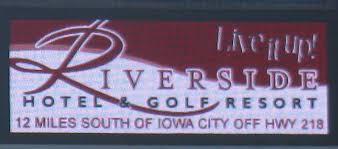
Why did that catch my eye? Because the last time I checked (so it may have changed), the Kinnick scoreboard was still running an advertisement for the Riverside gambling casino, and the casino still had a Kinnick skybox for its high rollers.
And my memory, and a prior blog entry, indicate that the NCAA at one time put the Iowa athletic program on notice that it did not look favorably on these gambling industry associations, in light of the concerns and spirit of Article 10.3. ("The NCAA wants to distance itself from sports gambling, and the gambling industry generally, in every way possible. It expressly forbids association with gambling casinos at NCAA events or in its advertising. It highly recommends that NCAA schools follow the same practice. It has written the UI athletic program with regard to its partnership with the Riverside Gambling Casino. And yet our football program tries to rationalize the gambling partnership while refusing to do anything about it."
"Conflicts, Cover-ups and Corruption," June 26, 2007.)
I very seldom reprint a former blog entry. But since this one is so on point, and since it's over five years old (and therefore long forgotten if ever remembered), I now do so:
"UI Football Promoting Gambling?" September 16, 2006
Is the University of Iowa Athletic Department, specifically the football program, promoting gambling?
There is very little ambiguity regarding the NCAA's rules regarding gambling on college sports. The NCAA Division I Manual provides [Note Jan. 25, 2012: What's below is the relevant Article 10.3 in 2006; the current, 2007 version, has been only slightly modified from this one.]:
10.3 GAMBLING ACTIVITIES
Staff members of a member conference, staff members of the athletics department of a member institution and student-athletes shall not knowingly: (Revised: 4/22/98 effective 8/1/98)
( a ) Provide information to individuals involved in organized gambling activities concerning intercollegiate athletics competition;
( b ) Solicit a bet on any intercollegiate team;
( c ) Accept a bet on any team representing the institution;
( d ) Solicit or accept a bet on any intercollegiate competition for any item (e.g., cash, shirt, dinner) that has tangible value; or (Revised: 9/15/97)
( e ) Participate in any gambling activity that involves intercollegiate athletics or professional athletics, through a bookmaker, a parlay card or any other method employed by organized gambling. (Revised: 1/9/96, 1/14/97 effective 8/1/97)
NCAA Division I Manual, Bylaw Article 10, Ethical Conduct, 10.3 (2001-02).
_______________
It couldn't be much clearer, could it? Academic institutions are able to claim that they want to maintain an impenetrable wall between their athletic programs, staff and student athletes, on the one hand, and the temptations of sports gambling on the other.
Of course, these standards do not address, nor could they, gambling on sports by those unaffiliated with a university. (And I am not claiming that the Universty's getting in bed with gambling interests, and taking the gambling industry's money, is "the same as" coaches and athletes betting on games.)
But it does seem a bit incongruous for the University's athletic program to enter into what amounts to a partnership with the gambling industry. How has it done that?
The University has (1) sold special indoor box facilities in the football stadium to a local gambling casino, aware that the casino purchased the facility to entertain, and encourage, high rollers, (2) knowing that the casino plans to bring gamblers into the state, put them up at its hotel, transport them to and from the football games, and (3) then agreed to let the casino use the football program's oversized electronic scoreboard to advertise the gambling casino to the 70,000 plus sports fans in attendance! (4) Removing any possible ambiguity about this, the Casino Web site's opening page currently displays, "Turn a Hawkeye game day into a weekend getaway!"
See William Petroski, "E. Iowa Casino to Lure U of I Fans; It will offer post-game parties, stadium shuttles," Des Moines Register, August 29, 2006 ("The casino has spent $165,000 for a three-year deal to lease a new skybox at Kinnick Stadium, and the casino has purchased dozens of football tickets for its preferred customers. Starting with the Iowa-Iowa State game on Sept. 16, charter buses will be offered to transport patrons between the casino parking lot and Kinnick Stadium, and there will be post-game parties at the Riverside complex."), and William Petroski, "Kinnick ‘Hotel’ ad omits 'Casino;' By design, an ad for Riverside's complex does not mention gambling," Des Moines Register, September 8, 2006 ("Chief Executive Officer Dan Kehl pointed out in a recent interview that . . . many students already gamble online.").
The duplicity is stunning. Apparently the University, recognizing the impropriety of what it was doing, but wanting the money from the gambling industry advertising anyway, decided everything would be OK if only it would falsely represent that no gambling actually takes place in a gambling casino by changing the name on its scoreboard from the gambling casino's real name -- the "Riverside Casino & Golf Resort" -- to that of a non-existant facility called the "Riverside Hotel & Golf Resort."
While I suspect that few of the 70,000 fans were led to believe that the Casino had truly decided to abandon gambling income for total dependence on its hotel business, there may well have been a few who found the name switch a little bizarre and baffling.
Not only does a university's promoting gambling to the young students in its charge violate basic principles of common sense and decency, it also violates the spirit of the law (which forbids anyone under the age of 21 to enter a gambling casino), and the spirit of the NCAA rules.
(Another incongruity is that while the University forbids consumption of alcohol in the stadium and some tailgating areas, a special dispensation to drink is granted to the Casino's stadium gamblers, as well as the guests of other purchasers of the $50,000-plus-a-year indoor skyboxes. There's no telling what lesson that provides the students in the stands and the athletes on the field.)
The University is certainly in no position to feign ignorance and innocence. As early as May 2006 the campus paper reported,
"[Riverside Casino Manager Joe] Massa has hired a sales manager to lure groups and conventions to the casino, and he plans to hire a sales staff in Chicago and Des Moines. A package could include a hotel stay with a trip to Kinnick Stadium for tailgating and box seats at an Iowa football game. Kehl says he wants to organize junkets to the casino, where out-of-state gamblers would be flown into the Eastern Iowa Airport."
Elaine Watkins-Miller, "If they build it, will they come?," Master's Media Project/Riverside Project, The Daily Iowan, May 5, 2006.
What has the University had to say about all of this?
"University of Iowa athletic director Gary Barta said Tuesday that the university would not place restrictions on a Riverside casino that has rented a Kinnick Stadium skybox with plans to bring big gamblers to Hawkeye football games.
“'We have never placed any restrictions on a company which owns tickets, how they use them secondarily,' Barta said. 'Once they are sold to a company, it is that individual’s or that company’s discretion how they use them.'
"The new $140 million casino at Riverside is placing a special marketing emphasis on Hawkeye football games. The casino, located 12 miles south of Iowa City, has spent $165,000 for a three-year lease on a skybox at Kinnick Stadium. The casino has also purchased dozens of Hawkeye football tickets for its preferred guests.
"Iowa has 19 casinos, but the opening of the Riverside complex Thursday at 9 p.m. marks the first time a casino has been so close to one of Iowa’s three state universities.
"Barta said the National Collegiate Athletic Association and the U of I are 'very concerned about possible ill effects as they relate to gambling and intercollegiate athletics.'
"He added, 'On the other hand, the various casinos in this state, they are legal businesses. So you walk that fine line between your concern about gambling and its association with intercollegiate athletics and what you know has been understood as a legal entity in this state.'"
Randy Peterson, "High-Level, High-Dollar, High Ol' Times," Des Moines Register, August 30, 2006 ("Casino's Football Skybox is OK With U of I").
The Hawkeyes won the game today, and a good one it was. And they've made a lot of money from the gambling industry.
But in the process they've certainly fallen far from the educational and moral high ground to which they profess to aspire.
Technorati tags: Iowa Rain Forest, economic development, attractions, tourism, rain forest, pork, Earthpark, Earthpork, Earth Park, Iowa, casino, gambling, Riverside, Pella, Riverside Casino & Golf Resort, football, college sports, sports betting, gambling and college football
October 26, 2007, 6:45 a.m.
Out of the Mouths of High School Student Editors
On occasion, the very fact that two related stories pass like ships in the night, each with no reference to the other, is really bigger news than what each reports.
So it was this week.
On October 24 the Press-Citizen Editorial Board published its take on race relations, Editorial, "All Johnson County should read 'Blood Done Sign My Name,'" Iowa City Press-Citizen, October 24, 2007.
(Not incidentally, the author, Timothy Tyson, is speaking this evening (Friday, October 26) at 7 p.m. in Room C20 of the Pomerantz Center on the University of Iowa campus.)
And just how does the Editorial Board support its rather grand suggestion that everyone in the county should read a book? It says,
"events described in this book are not fictional and are not part of some distant past. The One Community-One Book committee chose Tyson's book for all Johnson County to read precisely because the retelling of this story raises so many still relevant questions about race and identity, about law enforcement and justice, about historical memory and willful amnesia.
And it goes on to quote Washington Post reviewer Jonathan Yardley who tells us that the author's "chief aim is to persuade us that Americans are blind to their own history -- or, even worse, determined to falsify it -- and that they cannot hope to resolve the deepest and most intractable of all the country's problems, race, until they are willing to look history directly in the eye."
Fortunately, this issue of the paper made it onto the newsstands and porch steps of Iowa City.
Because, as a news story in that very same issue of the paper reported, another community paper, with a history of national awards that would be the envy of any commercial publication, was not so lucky. Rob Daniel, "Survey Prompts Pulling of School Newspaper," Iowa City Press-Citizen, October 24, 2007.
You see, it turns out that the Iowa City City High Little Hawk newspaper Executive Editor, Adam Sullivan, and his staff decided that rather than just urge their readers to read a book about "the deepest and most intractable of all the country's problems" they would gather some actual data about that portion of the problem that exists within their own high school in an effort to promote some discussion and solutions.
Rather than praising these teenagers' commendable and constructive efforts -- going well beyond those of the county's well-meaning, book-reading adults, focused on problems far from Iowa City 30 years ago -- City High Principal Mark Hanson decided the better course of action would be to seize all the copies of that issue of the paper (without telling Sullivan or others on the staff) in an effort to prevent this recognition of the school's very real racial challenges.
Why? Well, you see, apparently in Hanson's view, the problem in the school was not the pre-existing tension and prejudice between the races at City High, the problem was writing about it. (The story, in fact, reported a survey of student option -- you know, "data gathering" -- that revealed to no one's surprise that 13% of the white students are responding with prejudice to their characterization of an entire race, in short, to a label rather than individual persons with unique personalities.)
Here are my reactions:
1. Principal Hanson's reaction to a newspaper story reminds me of Defense Secretary Rumsfeld's reaction to the photographs from Abu Ghraib.
As Secretary Rumsfeld characterized the problem in his testimony before the U.S. Senate, "It is the photographs, the people running around with digital cameras."
The problem, in short, was the public relations impact on American citizens (and possibly the president's re-election), and on Iraqis' "hearts and minds." The problem was not our pre-interrogation techniques, the problem was the pictures of those techniques. No cameras, no problem.
Did Principal Hanson really think it was the newspaper report that caused what this morning's Gazette on-the-one-hand-on-the-other-hand editorial characterized as "three separate verbal confrontations" -- Hanson's offered explanation for seizing the newspapers? Did he really, like Rumsfeld, think if only there was no newspaper there would be no problem? It sure looks that way.
Had he made any prior effort to gather this data on his own? If not, why not? Was he aware of a race relations problem in his school? Had he done anything proactive to address it, or even to promote discussion? We now know what he is against, but what is he for?
"Just because you can get away with it doesn't mean you should do it."
2. As a lawyer, it is with sadness that I note the extent to which the existence of legal standards can contribute to the absence of moral and ethical restraints -- as well as common sense.
Want a couple examples?
Because alcohol is "legal" and "drugs" are not, we send users of the latter to fill our prisons, and wink at the use and abuse of what is, by any measure, our nation's number one hard drug: alcohol (in terms of numbers of persons impacted, the seriousness of that impact, economic loss, relation to crime, and seriousness of medical consequences).
The UI's athletic program argues there's nothing wrong with its profiting from partnerships with organized gambling. Why? Because gambling casinos are legal in Iowa.
Did Hanson have the legal right to do what he did? Notwithstanding Iowa's legal protections for the free speech of high school journalists, he may have -- though I don't think it's as clear a case as has been represented.
The law says a principal can intervene in the case of a high school newspaper containing material that is obscene, defamatory, or that encourages students to engage in behavior that is unlawful or violative of school regulations.
Clearly, the survey and story violated none of these standards -- indeed, quite the contrary.
It is the final category on which Hanson relied: newspaper content that will cause the "material and substantial disruption of the orderly operation of the school."
There are three arguments one might make as to why he was wrong.
1. As a matter of fact finding, a common sense, colloquial interpretation of the standard would suggest that "three separate verbal confrontations" -- something that probably occurs on occasion among faculty, as well as among students in the hallways, and is sometimes but a prelude to constructive discussion and problem solving -- scarcely constitutes a "material and substantial disruption of the orderly operation of the school."
2. Legally, while I doubt one would win the argument (for a variety of reasons) I think there's a question as to whether this provision is constitutionally "void for vagueness." Under Hanson's interpretation a principal might very well conclude that criticism of the principal, or his or her unpopular policies, would cause "disruption of the orderly operation of the school."
3. Moreover, given the context of the other named standards, one could also argue that conventional principles of statutory interpretation should rule out the possibility this provision provides a carte blanche grant of justification for principals to act on their every whim, or otherwise render meaningless the statutory purpose of providing protection for student editors.
Even assuming what he did was legal, the far greater wisdom is to be found in what Rob Daniel quotes Adam Sullivan as saying: "Legally, he may have been able to do that, [but] just because you can get away with it doesn't mean you should do it."
The Press-Citizen is right. It would be good for all of us to read Blood Done Sign My Name. It might be even better if we were also to read that survey and story in the Little Hawk and reflect on racial prejudice in Iowa City in 2007 as well as in Mississippi in the 1970s.
Additional stories:
As always, see State29 -- on this topic: "Da Principal is Yo Pal," October 24, 2007.
Erin Jordan, "School paper editor defends survey; The Iowa City High student says he sought to stir discussion about racism - and ran into censorship," Des Moines Register, October 25, 2007.
Gregg Hennigan, "Confronting Discrimination; Despite Confiscation, City High Newspaper Pursues Race Issue," The Gazette, October 26, 2007, p. B1.
Editorial, "Censorship Not Always Black and White," The Gazette, October 26, 2007, p. A4.
# # #
August 25, 2007, 10:30, 11:30 a.m.; August 26, 2007, 6:45 a.m.
Cribbing from the Crips? -- Facebook and Gang Signs
Thursday (August 23) I commented about the UI athletes' Facebook saga. Nicholas Johnson, "What Do Abu Ghraib and Athletes' Facebooks Have in Common?" in "Abu Ghraib, Rumsfeld, and Athletes' Facebook Photos," August 23, 2007.
Not only do athletes' Facebook entries include pictures with cash and alcohol, they also display their passion for good literature by presenting "favorite quotes," such as, "She can't say no if her mouth is taped shut."
But hand signs?
I'm pretty compulsive about reading the comments attached to these blog entries. They help to keep me honest, provide advice, and offer useful data and alternative points of view. From time to time I remind blog readers that some of the best stuff here is in the comments rather than the blog entries.
And this really turned out to be the case with that Facebook blog entry of mine -- though I didn't catch it myself. The comment read in its entirety,
Anonymous said...
Yeah, many of the college students drink. However, you have to examine the photos carefully to see what's going on.
Look at what the hands are doing. Look at the colors worn. You tell me if you see the same thing I see.
If the hand gestures and colors worn mean something, then this isn't normal student activity.
8/23/2007 03:58:00 PM
So, "colors"? "Hand gestures"? I was late with other obligations. I didn't follow up.
But a friend did, and here's what she referred me to:
New Jersey Office of the Attorney General, Juvenile Justice Commission, Gang Management Unit, Gang Awareness Guide: Recognize the Signs
Ask Images, "Crip Gang Hand Signs"
Harald Otto Schweizer, CSU-Fresno, Global Criminal Justice Links, "Gang Signs"
We're talking about what may be athletes' use of hand signals from the "Crips" gang. If you're not familiar with it, and its long-running battles with the "Bloods," here's what the New Jersey Attorney General's manual has to say:
Originally from Los Angeles, the Crips are an organization of aggressive and brutal gang members who are heavily involved in the drug trade. Throughout the 1980’s and 1990’s the Crips developed intricate networks and a respected reputation with other gangs across America. Crip gangs are well established across the United States.
Acknowledging that I know little to nothing about gangs, let alone their signs, let me reveal at the outset my uninformed guess that probably the UI football team does not have card-carrying members of the Crips gang on its roster. On the other hand, I am no more capable of proving that to be true than I am of proving the opposite; nor do I have the responsibility of a coach or athletic director for knowing it to be true.
Because I am personally aware of the consequences of the human capacity for rushing to, and expressing, defamatory conclusions on the basis of inadequate information, let me make sure to put the qualifiers on all this.
1. Gangs borrow colors and signs from other institutions. One gang, the Latin Kings, has black and gold as its colors, after all. If wearing black and gold was enough to make you a member of the Latin Kings there would be an awful lot of Iowa members on some Saturday fall afternoons in Iowa City. (Could that be why the Hawkeye athletic program is so popular in some quarters?) Another (not believed to have religious origins) uses a variation on the Star of David. One of the Crips' signs used by one of the athletes in a Facebook photo is a hand position also used in yoga. (Hey, how many friends do you have, like my source, who are experts in both gang signs and yoga postures?) Maybe our football coach is one of those coaches who are using yoga these days with various athletes, and that's where our football players got it.
2. Gangs change their signs from time to time -- usually just after adults have figured out what they are. This is, after all, a communications system designed to exclude us. Who knows if the Internet sources are accurate and up to date?
3. Non-gang members sometimes use gang signs to be cool, or funny. It's a matter of posing. Rappers use gang signs. The football players were probably just joking.
Following the uploading of this blog entry, there was another comment from Anonymous (my guess: probably the same Anonymous who put me on to this hand sign business in the first place) with sufficient additional detail -- and consistent with the online references linked above -- that I believe it warrants reproducing here:
Anonymous said...
Great of you to follow up the comments.
In those Hawkeye football pics, there are several gang signs.
The wrist watch may be gang related. The triangle on the face is a blood sign (dog).
The hand signs included 'E' (East Coast Bloods), the sign for Brim (a Blood gang), and and in the photo with all 3 players, Douglas is giving an obvious 'BL' (Bloods for Life).
The colors are significant too. Bowman wears red (not for NASCAR but for Blood). He wears a red bandana too.
Note the 'B' (Boston hat) B for Blood.
Further, the group called themselves the City Boys Inc. A drug dealing Detroit gang was called the Young Boys Inc. The Hawk players are from Detroit, probably a link there too.
Obviously these guys are not Bloods, but it is a bit disturbing.
8/25/2007 07:18:00 PM
My thanks to Anonymous for bringing all of this to my attention, that of other blog readers -- and any University administrators who might like to pursue this matter before a possible worst case scenario actually hits the mainstream media.
Betting on the Hawkeyes
When yesterday's Press-Citizen arrived it had stuck to the front of it one of those irritating advertising stickers. Why irritating? (1) Because page one ought to be reserved for news. There's no shortage of space for advertising inside. (2) Because it's not only a distraction, it also covers up whatever happens to be under the place it's arbitrarily affixed. (3) Once you remove it, with the underlying print stuck to its back it is, like a wad of chewing gum or pitch from a pine tree in the hand, not easy to dispose of.
Anyhow, yesterday's advertising sticker carried with it a bit of news. It read, in its entirety:
Park and Ride
Stop driving yourself crazy
with gameday parking!
Riverside Casino & Golf Resort to Kinnick Stadium!
Park & Ride starts the first home game of the season.
Round trip $10 for hotel guests, $20 for all others.
Call for time of departure - Toll Free 877.677.3456
RIVERSIDE
CASINO & GOLF RESORT
So, the partnership -- between the UI athletic program and the organized gambling industry -- continues.
Last year it involved advertising the gambling casino on the scoreboard, and a real deal for high rollers: flying them to the casino, putting them up in the hotel, transportation to and from the games, football tickets, seats in the skybox the casino bought from the UI -- where, of course, alcohol can be served -- and a return trip to gamble away whatever money they have left after, presumably, gambling on the outcome of the game. Never mind that what they are expected to leave behind at the casino is multiples of the cost of any services they receive.
This year's offer is, apparently, a joint marketing effort to increase ticket sales while extending gambling's allure to those failing to qualify as high rollers -- so long as they'll pay for the bus ride. (Though why anyone who could park within a couple blocks of the stadium for $20 or less would think it a bargain to drive, and be driven, some 60 miles or more of round trips for the same price is not immediately apparent.)
Morality, Money and Enthusiasm for the "Gambling Tax"
Both The Gazette and the Press-Citizen have had major stories about the gambling casino's first year. Gregg Hennigan, "The House is Winning; Riverside Casino Exceeds Expectations in its First Year," The Gazette, August 24, 2007, p. A1; Rachel Gallegos, "Riverside Casino: One Year Later; Win, Loss or Draw?; Residents Undecided About Casino's Effect on Area," Iowa City Press-Citizen, August 25, 2007, p. A1.
As regular readers of this blog have long since figured out, I'm not a big fan of gambling. Indeed, while I've often spent time observing the behavior of those in casinos (I was at Riverside last week) I've never left a nickel of my own behind.
My position would emphasize such things as that gambling (except, of course, for bingo) is opposed by most major religions. It was for years a federal crime, and outlawed in most of the 50 states including Iowa. Its externalities impose enormous social negatives on the communities where it is found. They include increases in domestic disturbances, alcoholism, crime, suicide, and bankruptcies. There are correlations between the number of casinos (how far a gambler needs to drive) and the numbers of problem, and addicted, gamblers; there's been a significant increase in gamblers seeking counseling since the Riverside Gambling Casino opened. There are also the direct economic costs of providing roads, water and sewer systems, and additional police (as in Riverside). I believe that position to be logically, internally consistent.
However, I will concede that the opposite is also logically, internally consistent. It would go something like this: archaeologists have demonstrated that humans have been gambling for thousands of years. While once illegal, it is no longer -- at least not for licensed casinos in Iowa. The law was changed by democratically elected representatives of a majority of the citizens who were no more subjected to campaign contributions and bribes than they are for any other legislation involving enormous economic stakes. While there are gambling addicts, they have treatment programs available. No one is compelled to enter a casino. Gambling, when engaged in for fun, with money one can afford to lose, is an individual citizen's voluntary marketplace decision regarding the expenditure of discretionary income spent for a form of entertainment. That kind of gambling does no (direct) harm to anyone. Why not permit it? (I may not hold this view, but it is at least internally logically consistent.)
Another often-overlooked advantage of gambling is its relation to prayer. As has been observed, "As long as there are algebra tests there will always be prayer in schools." It turns out that as the Powerball drawing for this evening has now reached $300 million, more and more potential players are turning to prayer as well as Powerball to assure their future. Adam Belz, "Millions of Reasons to Play -- and Pray," The Gazette, August 25, 2007, p. B1. I am sure that selecting the proper winner is a matter of great interest to God, whoever she may be, and that -- now that Mother Teresa has been revealed to have questioned her faith -- this will be the Lord's way of picking up a replacement adherent.
It is the third position that I find internally illogical and questionable. It is, "I am opposed to gambling because of all the harm it does to society and the costs it imposes. But because the casino makes little grants to various local projects and organizations I guess it's OK."
That's like saying, "Yes, I know that the sugared soft drinks in our high schools' vending machines contribute to our students obesity, diabetes, teeth and gum disease, but, gee, how else would we have been able to get the money to buy that wonderful scoreboard for the football field?" Or, "It would be disgraceful, and detract from the credibility of our professors' research, to name a college after a corporation. On the other hand, if the corporation would pay enough money, well, that would be different because, after all, 'revenue is needed.'"
In a society in which everything is for sale I guess I find it disturbing that ethics and morality are also on the auction block.
Another inconsistency I find is with those who fight "tax increases" tooth and nail and yet are even enthusiastic about what I call the "gambling tax." Why the "gambling tax"? Because citizens are bringing billions of dollars into Iowa's casinos, much of which stays there, and the community is getting back less than 10% of their losses in the form of these little community grants -- grants that contribute to the kinds of projects our tax dollars normally go to fund.
Whatever you may say about income, property, sales and FICA taxes, all of them (aside from what's paid out in corporate welfare and forfeited in TIFs) goes to government, its projects, and the employees necessary to carry them out. Most of the "gambling" tax goes to the organized gambling industry; only a little trickles down to the community.
It's kind of like "public financing of campaigns." We already have it. The public buys products at prices sufficiently inflated to cover the manufacturers' multi-million-dollar campaign "contributions," and then the corporation gets the credit for the money paid to the elected official. The pay back? Between 1000-to-one and 2000-to-one. Contribute a million dollars, you'll get back a billion dollars in the form of tax breaks, failure to enforce the antitrust laws, price supports, defense contracts, subsidies, access to public lands for oil or timber, earmarks, and in any other form the imagination of lobbyists can devise. Bottom line: We could have "public financing" because each of us contributes $2 into a campaign fund, or we could have "public financing" because each of us contributes an extra $2000 to the corporations we buy from -- following which they will pass along the $2 of our money and keep the rest. In either case it's "public financed campaigns."
Here again, there is another view about the "gambling tax" which I only came upon after writing this blog entry. I found it as a comment following the Press-Citizen's story about the Riverside casino this morning:
"Lotteries are how the poor people pay their share of the taxes." . . . At least you have a choice of paying a "volunteer tax." I have no choice in paying property tax, income tax, all the taxes on utilities and phone bills, and a host of other taxes imposed on citizens every day. . . . [A]t least when you gamble, you eventually see where some of that tax money is being spent, (Riverside) and you have fun while gambling.
So there you have it, as another blogger -- a very, very wealthy blogger -- puts it: "Fair and balanced. You decide."
# # #
August 17, 2007, 8:15, 10:40 a.m.; 9:20 p.m.
Stories Worth a Read, a Comment -- And Keeping an Eye On
All's Fair in Athletics and Cable Television
Negotiations continue between the "Big Ten Network" (BTN) and Mediacom. Andy Hamilton, "BTN Increases Pressure on Mediacom for Deal; UI Officials Urge Hawk Fans to Push for Network," Iowa City Press-Citizen, August 17, 2007, p. A1.
At the outset, recognize that "there's no such thing as a 'free cable channel.'" When cable program suppliers raise their prices to cable distribution companies, or when a new channel is added the cable company must pay for, that additional cost is going to find its way into every cable subscriber's monthly bill -- unless it's a "pay channel" for which the cable company recoups its cost by charging those cable subscribers who choose to pay extra for it each month.
Also recognize -- as if it could have escaped anyone's attention -- that collegiate athletics are now a classic example of the corporatization of the academy. They are in the profit maximizing business as much as any Fortune 500 corporation. They're paying coaches multi-million-dollar salaries, undertaking $100 million refurbishing projects with their venues, selling off both skyboxes and advertising on scoreboards to the highest corporate bidders, and entering into partnerships with organized gambling. So that's the context in which this BTN was created and is engaging in negotiations with the cable industry -- over our money. They will continue to stick it to their fans with everything from compulsory "contributions" to their program as a requirement before one is entitled to buy tickets, to overpriced hot dogs as well as ticket prices, to raising our cable bills -- up to the point that their overreaching so irritates fans that it produces a decline in the athletics programs' revenue.
From my perspective the controversial choice -- make every cable subscriber pay for a channel many don't want (BTN) so those who do can have it for "free" (i.e., at a disproportionately small increased cost for expanded basic paid by all cable subscribers) ,or make those who want it pay the entire cost as a "pay channel" (like HBO) -- is but a sub-set of much larger issues.
If I had my way, cable would operate as a common carrier. That would still allow the cable company owners to continue to attain riches beyond their wildest dreams of avarice -- by sucking money out of both ends of the straw: charging both those who want the cable company to distribute their programming and those who wish to receive it. (Once you get a cable system built the money just keeps on rolling in every month and the primary capital investment is for the wheelbarrows to carry it all to the bank.)
Like the AT&T of old, cable companies would be required to run a cable past everyone's home, and to expand their cable carrying capacity as necessary so as to be able to handle the programming of every program suppliers who was willing to pay their carriage fees.
The cable customers would then pay on the basis of individual channels chosen. The cost per channel would vary, depending on the number of subscribers and what the cable company and program supplier wanted to charge -- in short, it would be set by the market (presumably to optimize profit, taking into account alternative sources of supply). (And I'm assuming, for purposes of this discussion, that the average, total monthly cost per subscriber would be the same, or less, than it is now; in other words, that the companies' total costs and profits would remain the same.)
This system would eliminate the self-dealing (cable companies that own cable programming suppliers tend to favor them) and censorship. It would create more opportunities and make for a more competitive economic marketplace for those in the program production business. It would create a much wider range of choice, a much more diverse "marketplace of ideas," for the audience. And it would also more fairly allocate costs with benefits and individuals' choice.
Sorry for the long introduction, but it helps put the BTN in perspective.
I short, in my ideal world there would be no need for negotiations. BTN, as a matter of legal right, could have its programming distributed by Mediacom. It would be available for anyone who wanted to pay the fixed price for it. But no one who did not think it worth the price would be required to subscribe.
An analogy? Go to Time, Inc.'s, magazine Web site. It provides links to 18 of Time's magazines. Requiring you to pay for the BTN -- which is what putting it on "expanded basic" does -- would be like Time saying in order to get Time, the news magazine, you have to subscribe to (and pay for) all 18.
Another? Imagine going to one of those cineplexes with 12 theaters and having to pay a flat fee based on the assumption you're going to watch all 12 movies when you only wanted to watch (and pay for) one.
Bottom line -- since we're not going to be re-organizing the cable industry and its regulation anytime soon? I think BTN should be a pay channel.
What is it About the UI and "24th"?
The reactions of colleges and universities to the U.S. News & World Report annual ranking of all of them would be amusing if it weren't so serious.
Anyhow, in this morning's story (the rankings are online this morning and will be in the magazine Monday) we discover that the university Sally Mason recently left is tied for 24th (among public universities), the university to which Mike Hogan will soon be departing is tied for 24th, and the university to which President Mason came is also tied for 24th.
Iowa often works from a benchmark of 25th (among the 50 states) -- e.g., we want to bring our teachers' salaries up to "average." I'm reminded of the lyrics:
Clowns to the left of me,
Jokers to the right, here I am,
Stuck in the middle with you.
"Stuck in the Middle With You."
Brian Morelli, "UI Moves Up One Spot in Annual Rankings," Iowa City Press-Citizen, August 17, 2007, p. A1.
Desperately Trying to Put a Good Face on TIFs
One of Coralville's more prominent TIFs, the Coralville City Council-Marriott Hotel is celebrating its first birthday. It was cause enough for the Press-Citizen to devote an editorial and page-three story to the accomplishment. Editorial, "So Far, City's Gamble Seems to be Paying Off," Iowa City Press-Citizen, August 17, 2007, p. A11; Kathryn Fiegen, "Coralville Marriott Celebrates 1 Year; Hotel Looks to Its Future Growth," Iowa City Press-Citizen, August 17, 2007, p. A3.
In fairness, the editorial did acknowledge some of the downside of this venture:
Many local residents had -- and continue to have -- some ideological and pragmatic concerns about the venture. Some local hoteliers, arguing that city governments never should be involved in economic development projects that compete with other businesses already in the marketplace, brought a suit against the city to block the construction. . . . Others saw -- and continue to see -- the project as another example of Coralville officials overusing Tax Increment Financing districts as a means to boost economic development.
It's true that the hotel is not expected to hit full stride -- more than 70 percent occupancy and nearly $17 million in annual sales -- until 2010. And the project itself won't be paid off until sometime in the next 20 to 35 years.
Before this section of this blog entry was even written and uploaded there was a comment taking issue with what the author presumed I was going to write if ever I got around to it. Talk about prescience; he was right.
Here's the comment:
Ben Richards said...
I will defend the use of TIF. In many cases, TIF goes to build a specific piece of infrastructure such as a road with storm sewer. It does not "take away" funding from other entities because the tax base in question was not there to begin with. Not only that, cities are able to access the tax base right away for their debt service levy, which means lowering the cost of police and fire vehicles and any other projects using that levy. TIF was also used to revitalize the Sycamore Mall area. It is an indespensible tool for cities in economic development.
I see a lot of ignorance over what TIF is and the economic development scene in general.
8/17/2007 09:01:00 AM
Well, I've often acknowledged my own ignorance when it comes to TIFs. All I've had to draw and rely upon are common sense, intuition -- and the analysis by economists who do understand TIFs and other forms of corporate welfare. Because I've already written here at such length about TIFs, I'll just provide links to some of what has gone before, rather than just repeat it. I doubt that it will persuade Ben Richards and other advocates (and beneficiaries) of TIFs, but for any who are curious it will tell you probably more than you care to know about the basis for my own positions on the practice.
Nicholas Johnson, "TIF-ing My Toolshed," September 2, 2006.
Nicholas Johnson, "Supervisor Sullivan Says TIF, TIF, Tsk, Tsk," September 16, 2006.
Nicholas Johnson, "Press-Citizen Says 'Tough TIF,'" September 22, 2006.
Nicholas Johnson, "Why Do They Hate America?" October 2, 2006.
Nicholas Johnson, "Understanding TIFs (Revised 10/06/06)," October 5, 2006.
Nicholas Johnson, "Call the Cops: $3.755 Million Robbery in Progress," October 18, 2006.
Nicholas Johnson, "More on Corporate Welfare from 'Hat's Off' Winner," October 22, 2006.
Nicholas Johnson, "It's Not About 'Taxes,'" October 24, 2006.
Nicholas Johnson, "Riverside's Deeper Gambling Debt," November 11, 2006.
Nicholas Johnson, "UI Held Hostage Day 490 - Search & Taxes," May 26, 2007.
Nicholas Johnson, "The Terrible TIFs," July 26, 2007.
- Continuing Saga of CEO Responsibility: Coal Mines, Shuttle Flights and Retirement Homes
- Johnson County's "Affordable Housing": Consultant Proposes 450-Bed Jail
. . . more to come
# # #
August 2, 2007, 6:30, 9:00 a.m. (see "Putting a Dollar Value on Our Ethics: What Are the UI's Options?" below)
"Revenue is Needed"Once "revenue is needed" is the Polestar for a university's financial decisions its moral compass begins to spin as if it was located on the North Pole.
-- Nicholas Johnson, "UI Loves Gambling" in "UI Held Hostage Day 410 - March 7," March 7, 2007.
Wall Street Journal and Wall Street University. The announcement yesterday that the Bancroft family would, after all, sell the Wall Street Journal and the rest of Dow Jones to media mogul Rupert Murdock is illustrative of the issues confronting the University of Iowa -- and virtually all other institutions of higher education in America.
Murdoch offered $60 a share for stock traded at closer to $37 -- a total of $5 billion. The family resisted: "several members of the Bancroft family -- Dow Jones's controlling owners -- opposed Murdoch's bid, fearing the tabloid king would wreck the integrity of the Journal and use it to further his business and political interests. In the end, nearly two-thirds of the Bancroft family voted for the merger." Frank Ahrens, "Dow-Jones Murdoch Merge in $5.8B Deal; Sides Agree to Create Editorial Board as Buffer Between Murdoch, Wall St. Journal," Washington Post, August 1, 2007.
What tipped the balance? Apparently, Murdoch's willingness to satisfy some family members' request that he pick up the additional $30 million tab for their lawyers and analysts. David Folkenflik, "Murdoch Clutches Dow Jones," "Morning Edition," NPR, August 1, 2007.
In other words, the Bancroft family, which has owned Dow Jones for 100 years, and is concerned that Murdoch "would wreck the integrity of the Journal and use it to further his business and political interests," is willing to cast aside its concerns for an extra $30 million in a $5 billion deal!
Now consider the University of Iowa's position. There is reluctance to sell off naming rights for the College of Public Health to Wellmark for $15 million. Why? Our integrity is at stake. It is virtually unprecedented among American universities to name colleges for corporations. It would create, if not the reality, at least the appearance of a conflict of interest and raise questions about the integrity of the faculty's research. We are concerned that Wellmark "would wreck the integrity of the [College] and use it to further [Wellmark's] business and political interests."
Unless . . .. Unless what? Unless Wellmark might be willing to offer $20 million.
Here is the earlier discussion regarding "revenue is needed:"
In some ways most disturbing is the observation, reported in the Press-Citizen this morning [regarding the UI athletic program's partnerships with the organized gambling industry] that some "note that UI athletics will be entirely self-funded next year and say the revenue is needed."
This is the rationale for keeping highly sugared soft drinks in high school vending machines -- notwithstanding their contribution to obesity, diabetes and what dentists refer to as "Mountain Dew mouth." "The revenue is needed."
It's the rationale politicians use for accepting large bribes from special interest pleaders. "The revenue is needed."
After public broadcasting was expressly established as a "non-commercial," alternative broadcasting service, that was its rationale for taking the commercials that now clutter these "non-commercial" stations' airwaves. "The revenue is needed."
Of course, the politicians call them "campaign contributions" and the public broadcasting stations call the commercials "underwriting." But no one is fooled.
If "revenue is needed" is the standard, why not a line of cigarettes, or handguns, with Herky emblazoned on them?
Why not change the rules and sell alcohol throughout the football stands (rather than just in the skyboxes)? Better yet, why not have coeds dressed like Hooters waitresses making the sales?
Why just take pocket change from the Lottery and Casino; why not set up our own little gambling casino outside Kinnick and have folks place their bets on the game right there? After all, "revenue is needed."
It may be that arguments can be found justifying a university's ties to the gambling industries -- why those associations contribute in positive ways other than financial to a university's mission -- though none immediately occurs to me. Offer such reasons if you can. All I'm saying is that I don't think "revenue is needed" is a morally sound argument with which to support a university's partnerships with the gambling industry.
Once "revenue is needed" is the Polestar for a university's financial decisions its moral compass begins to spin as if it was located on the North Pole."
-- Nicholas Johnson, "UI Loves Gambling" in "UI Held Hostage Day 410 - March 7," March 7, 2007.
"Do as I say, don't do as I do" -- The Impact of Academics' Behavior on the Values of Students. There are many implications and consequences of the attitudes we adults communicate by our behavior as well as our words (especially when our actions don't match our words) with regard to the importance of money, and what we're willing to pay, and to sacrifice, in its pursuit -- up to and including our ethical, moral and religious values.
The point is as applicable to our naming of our College of Public Health as it is to our football program's partnerships with the organized gambling industry.
It's applicable to other aspects of our high school and college sports programs as well. Yesterday's "The Diane Rehm Show" focused on the impact of adults' standards, urgings and expectations on the unsportsmanlike conduct (and doping) by young athletes. Susan Page, guest host, "The Diane Rehm Show: Recent Sports Scandals," with guests, sports writers Christine Brennan, Sally Jenkins, Stefan Fatsis and Michael Josephson, August 1, 2007. Guest Michael Josephson's Josephson Institute of Ethics completed a study of the subject this year: "Survey of High School Athletes: What Are Your Children Learning? The Impact of High School Sports on the Values and Ethics of High School Athletes," February 16, 2007.
I don't know how the courses in our Departments of Philosophy, Religious Studies, College of Business -- indeed courses throughout the University -- treat the issue of selling out one's values for money, but I would hope and suspect they would not look kindly on the propriety of monetizing everything. See in this connection Nicholas Johnson, "'The Corporation' and the Search for Agreement," October 1, 2004 (commentary about the film "The Corporation" and a discussion of it at the UI College of Business).
Putting a Dollar Value on Our Ethics: What Are the UI's Options? The core of our present problem -- illustrated by the Wellmark naming controversy, but going far, far beyond it -- is the inherent conflict, and seeming hypocrisy, born of the ambiguity resulting from our failure to state with some precision just who and what we are. Clarification on that score is not a simple, total solution, but it would be better than what we have now -- regardless of how we come out on the issue. Here, it seems to me, are some of our choices:
1. The University as an oasis in a sea (or desert) of corporatization. Like national parks, we are set apart from the profit-maximizing, materialistic society in which we exist. Our mission is to provide a place where faculty can do research and teach, and students can exercise curiosity and learn, in a truly independent setting without need for concern about the impact of our ideas upon the financing of our institution. If that means we will be paid a little less, our buildings will be a little smaller, and we have to lobby the legislature a little more effectively, so be it. Whatever the contributions of corporate productivity may be to our society, there is also a societal value to maintaining places separate and apart from corporate values -- and values measured in a coin other than dollars.
2. "The business of America (and its universities) is business." We admit it. Education -- from K-12 through graduate school -- has always been about training our young for war and for employment by business. Over time the businesses have changed; we're no longer turning out high school graduates for assembly line jobs (though you wouldn't know it at some high schools) -- because there aren't any more assembly line manufacturing jobs now that we've shipped them overseas. But that doesn't change education's role in the economy. Why do students go to college anyway? Because they've been told precisely how many more dollars they'll be paid over the course of their lifetime if they do. Universities' research, as well as their graduates, have been supporting weapons programs and corporation's profit opportunities for decades. There's nothing new about this. And we've been taking their money forever -- Harvard, Duke, Stanford; numerous colleges and buildings, auditoriums and arenas, classrooms and professors' chairs -- are named for corporations and wealthy donors. Get over it. This is a non-issue. We're for sale. The only challenge is to get the maximum dollars we can from our donors. They want their name on a college or building? So, what's the problem -- so long as they pay enough for it, and pay by the year instead of for the life of the building?
3. The security of a slippery scale. We don't want to totally abandon our age-old cloistered role; and we don't want to totally abandon the money either. So we'll just be a little more precise about our rate card -- what's for sale, and what's not, and what the prices are. For example, we'll accept "gifts" from anyone and any corporation, regardless of their public reputation or how they earned their money. We'll happily do research for the Defense Department or any major corporation -- so long as the money is right. The names of individual persons (even if similar or identical to their businesses) can go anywhere: named chairs, classrooms, buildings, colleges, even the University -- again, so long as they pay by the year, and pay what's on our rate card. However, the names of corporations (or names clearly identified with corporations, such as our "Ronald McDonald House"), as such, can only be associated with non-academic buildings, classrooms and professorial chairs -- not colleges or the University.
This is, as I say, only an example. All of these elements can be tweaked up or down. We could, for example, say we would not accept any corporate money that comes with strings, such as naming rights or even designation of purpose. In other words this is just an illustrative template. The point of this third option is simply that we acknowledge that we are, after all, for sale (so we're not caught in the hypocrisy of saying we're not when in fact we are) -- in the great American and corporate tradition -- but we can still claim to have our integrity and values when it comes to, say, our refusal to give corporations naming rights to academic programs.
Are there other options? Perhaps. But this might well be the basis for the beginning of that "full and respectful discussion" that President Sally Mason has called for.
Here are some prior blog entries on these subjects, in reverse chronological order:
Nicholas Johnson, "The Corporatization of America's Higher Education" in "Strange Bedfellows: Academy & Corporate America," August 1, 2007 ("Once a university gets in bed with corporate America is oral sex 'adultery' -- hell, is it even 'sex'? Are we still virgins if we don't 'go all the way'? We're already in bed, folks. Now we're just drawing lines and haggling over price."),
Nicholas Johnson, "Corporatizing Education and Other U-News Updates" in "U-News Updates: Corporatizing Education," July 31, 2007 ("it will be a shame if this is perceived as merely the 'Wellmark-UI College of Public Health Naming Issue' when it is so much bigger and can more usefully be addressed in the larger context of the corporatization of higher education generally, and at the UI in particular. Whatever President Mason's focus turns out to be, it won't be long before we'll get a sense from her statements and decisions as to just how much further the 'University of Iowa, Inc.' is going to slide into the for-profit sector during her tenure."),
Nicholas Johnson, "Wellmark Naming" in "Abuses: Wellmark, Insurance, Athletics, Media," July 22, 2007 ("the Register has turned around [with its 'roses and thistles' recognition]; having formerly given the College of Public Health faculty a 'thistle' for turning down the money this morning it took some tweezers and removed that thistle and stuck it in Pomerantz instead."),
Nicholas Johnson, "President Sally Mason's Revelation" and "Spotting the Issue" in "Wellmark, Mason and 'The Issue,'" July 21, 2007, ("The underlying, fundamental issue -- one that is going to continue to arise in hundreds of contexts over the years ahead -- is the extent to which we either want to continue to encourage or to resist, the rapid transition from an academy pursuing knowledge to one pursuing wealth, from a focus on 'we' to 'me,' from a 'Great Society' of social programs for all to a privatized and corporatized profit-maximizing marketplace primarily benefiting the wealthy few, from the values of education and culture to those of conspicuous consumption and hedonism, from a nation that mixes corporatized services with socialized schools, libraries, parks, police, fire protection and armies to one in which all is for-profit and for sale, from one in which many decisions are still made on Main Street to one in which all decisions are made on Wall Street."),
Nicholas Johnson, "Wellmark Naming; Wellmark Reorganization?; Eastern Michigan" in "Wellmark, Rape and Murder," July 17, 2007 ("The case studies from the University of Iowa and the University of Eastern Michigan are each but sub-sets of a much larger issue: the ethical dilemmas created, and confronting university administrators, as formerly public universities' missions are transformed from (a) promoting students' education and professors' independent research into (b) more formal relationships as the subsidiaries of corporate America and the adoption of its profit-maximizing practices and acceptance of its funding."),
Nicholas Johnson, "More on 'The Name Game'" in "Name Game & Other Moral Dilemmas," July 4, 2007 ("Today, an ever increasing number of faculty are (a) employed without thenure, and (b) required to personally raise part or all of their own salary and supporting expenses. There's not much talk about Greek and Latin requirements in that environment. But these are changes for which many faculty -- and those among them functioning as deans -- are ill prepared. Not only do they not have experience, or hold degrees in, 'business,' they (like the public-policy-driven aspiring young politician) probably did not spend their early years honing a passion to become, and then spend a significant portion of their lives as, a major fund raiser."),
Nicholas Johnson, "Wellmark's College of Public Health" in "The Corporate College of . . .," July 3, 2007 ("We've long since decided we're willing to sell off the University's good reputation. If you haven't yet guessed, that troubles me. But accepting the reality of where we are at the moment, shouldn't we at least, as George Bernard Shaw suggested, start 'haggling over price'? Don't we have the same obligation to the people of Iowa that we would if we were selling off the state's top soil -- to make sure we get the most for it we possibly can? When we take a lump sum to name a building after a corporation -- forever -- isn't there a great likelihood we're selling out too cheaply?"),
Nicholas Johnson, "Greed, Conflicts, Cover-ups and Corruption" in "Conflicts, Cover-ups and Corruption," June 26, 2007 ("Universities are not immune from the pressures that in corporate American can produce an Enron, or the political pressures that produce a U.S. Congress that simply can't 'afford' to stand up to the pharmaceutical industry. Mason has been advised that as much as one-third of her time should be spent in fund raising. Clearly it's a major part of what she has been hired to do, a major part of the 'performance' that can produce an extra $50,000 a year under her contract. As such, she -- like every other big university's president -- will be subjected to similar pressures as the editor who must decide whether s/he can 'afford' to run an essential story that will cause a loss of advertising revenue, an athletic director who must weigh the advice (and standards) of the NCAA against the revenue that can come from the gambling industry, or a politician in need of campaign contributions deciding how to vote on a measure that will clearly help her constituents but cause a special interest group to cut off her funding."),
Nicholas Johnson, "UI Loves Gambling" in "UI Held Hostage Day 410 - March 7," March 7, 2007 ("(1) The Iowa Lottery commercial. Essentially everyone has come to agreement -- after they were caught, and the media was all over it -- that the specific commercial involving the Iowa Lottery and the Iowa Fight Song was a mistake. (The fact that the owner's lawyer pointed out to the litigation-shy University that the commercial was also a copyright violation contributed to reason's ultimate triumph with this one.) (2) UI-Lottery Ties. However, beyond the commercial, views shift. The Interim President and Athletic Director think there's nothing wrong with gambling that sufficient UI revenues won't cure. But yesterday the University's Faculty Council unanimously voted its disagreement. See Diane Heldt's story this morning, linked below. (As Heldt reports, AD Barta thinks 'the relationship with the lottery should continue.') (3) And the Gambling Casino? As I've repeatedly observed, and The Gazette headlined as one of its 'Gomers' Monday, the Iowa Lottery is not the only 'devil's bargain' -- as Professor Michael O'Hara characterized a UI-gambling partnership at the meeting yesterday. There's also the Athletic Department's partnership with the Riverside Gambling Casino. Why would the Faculty Council be so upset over the Lottery and fail even to mention the Gambling Casino contract?"),
Nicholas Johnson, "UI Football Promoting Gambling?" September 16, 2006 ("The Hawkeyes won the game today, and a good one it was. And they've made a lot of money from the gambling industry. But in the process they've certainly fallen far from the educational and moral high ground to which they profess to aspire.").
# # #
August 1, 2007, 6:45, 7:30, 8:30 a.m.; 3:00 p.m.
SAD EXTRA: Well, we've done it again. Mike Hogan, outstanding university administrator and scholar, incredibly decent human being, committed Iowan, much beloved, finalist (some say the favored first choice) in the first UI presidential search, has been run out of town, to follow David Skorton and Mary Gilchrist on to bigger and better things than playing the role of recipient of local abuse. See Diane Heldt, "UI Provost Headed to Connecticut," Gazette Online, August 1, 2007, 1:24 p.m.; Brian Morelli, "Hogan to Become UConn President," Iowa City Press-Citizen Online, August 1, 2007, 1:59 p.m.; Associated Press, "University of Iowa Provost Selected as UConn President," Gazette Online, August 1, 2007, 2:44 p.m.
The Corporatization of America's Higher Education
Once a university gets in bed with corporate America is oral sex "adultery" -- hell, is it even "sex"? Are we still virgins if we don't "go all the way"?
We're already in bed, folks. Now we're just drawing lines and haggling over price.
Today's most significant story? Lynn Hicks and Erin Jordan, "Wellmark proposal fuels debate on names; Where should universities draw the line in accepting corporate gifts?" Des Moines Register, August 1, 2007. (The Press-Citizen also carries the same story this morning under the headline, "Naming Dilemma a National Debate; Where Should Schools Draw the Line," p. A1.)
Why are these Register reporters' efforts so significant? Because they, like I, are trying to put the Wellmark naming controversy in a meaningful context where a "respectful discussion" of the issues can be fruitful.
As I've repeatedly alluded here, the issues the UI needs to address go well beyond Wellmark -- indeed, even the Wellmark naming issue can't be intelligently resolved without doing so in context. (Yesterday I wrote: "it will be a shame if this is perceived as merely the 'Wellmark-UI College of Public Health Naming Issue' when it is so much bigger and can more usefully be addressed in the larger context of the corporatization of higher education generally, and at the UI in particular").
As Hicks and Jordan remind us, virtually every university sees corporate infiltration as a potential problem -- and yet draws lines and makes distinctions that vary from campus to campus and don't always appear that persuasive or rational: name a professor for a corporation, but not her department or college; name a building but not a college; name a stadium or auditorium, but not an academic building; refuse to name anything but gladly accept corporate money.
Welcome to Iowa, Sally and Ken Mason! We'll return to this in a moment, but first we want to acknowledge the arrival, and first day on the job, of our new UI President Sally Mason. I don't know when she walked into her office, but by 6:32 a.m. this morning she had already sent the UI community an early morning greeting. Since it's a public document, I've made it available here. The Press-Citizen has also provided her an early morning editorial greeting and bit of advice, "Mason Must Start Job by Moving Forward," Iowa City Press-Citizen, August 1, 2007, p. A!!. (It also has a follow-up story on the mysterious "5th Finalist" for the UI president position, Brian Morelli, "Missouri St. Leader 5th Finalist for UI Job; Says He Still Has Work to Do," Iowa City Press-Citizen, August 1, 2007, p. A1 -- something I believe was known at the time but which, notwithstanding Missouri State President Mike Nietzel's repeated candid acknowledgment, "College of Dentistry Dean David Johnson, who led the UI search committee, declined to confirm or deny.")
More to come -- perhaps this afternoon (primarily references back to prior blog entries discussing these issues in greater depth (e.g., UI athletics department partnerships with organized gambling industry, etc.)) . . . Sorry, but the "more to come" is going to have to come tomorrow morning. It turned out there were a lot more prior blog entries on all this than I'd remembered. Meanwhile, don't miss the comments, below, on today's blog entry.
# # #
July 31, 2007, 6:00 a.m.
Corporatizing Education & Other U-News Updates
Our new UI President Sally Mason formally starts tomorrow, Wednesday, August 1. As Diane Heldt reports, she won't have to wait long for issues to arrive.
Diane Heldt, "Full Plate Awaits New President; Mason Takes Office Wednesday at UI," The Gazette, July 30, 2007, p. A1
One of the most recent big UI issues in the news has been the Wellmark naming controversy. This morning's papers report on revealing e-mails among UI officials and faculty. Mason has not yet tipped her hand, aside from saying she's following the issue and that it warrants a full and respectful discussion.
Erin Jordan, "U of I dean: Wellmark offer 'small;' He called it 'not acceptable,' but officials almost approved proposed gift," Des Moines Register, July 31, 2007
Diane Heldt, "Offer 'Embarrassingly Small;' Dean Says Wellmark Gift Would Have Undervalued College," The Gazette, July 31, 2007, p. B1
Brian Morelli, "E-mails Shed Light on Debate; Wellmark in the Name, Amount of Gift Discussed," Iowa City Press-Citizen, July 31, 2007, p. A1
As I've often written here -- and as these stories, and the Snell column, immediately below, support -- it will be a shame if this is perceived as merely the "Wellmark-UI College of Public Health Naming Issue" when it is so much bigger and can more usefully be addressed in the larger context of the corporatization of higher education generally, and at the UI in particular. Whatever President Mason's focus turns out to be, it won't be long before we'll get a sense from her statements and decisions as to just how much further the "University of Iowa, Inc." is going to slide into the for-profit sector during her tenure.
Joel Snell, "For Some Companies, UI is an Attractive 'Brand,'" The Gazette, July 31, 2007, p. A4
Barbara Ankenbrand, "Instead of Naming Rights, Wellmark Could Help Poor," The Gazette, July 31, 2007, p. A4
Nancy McHugh, "Wellmark's Missing Chace for True Philanthropy," The Gazette, July 31, 2007, p. A4
Sam Osborne, "Selling Naming Rights Could be Great Idea," The Gazette, July 31, 2007, p. A4
Another issue, which I'm going to do my darnedest to try to keep on the radar, is the partnership between the UI athletic program and the gambling industry. Interim President Fethke -- to the best of my recollection -- indicated that he would announce the UI position with regard to the football program's partnership with the Riverside Gambling Casino, which has been a matter of concern to the NCAA. So far as I know, nothing further was ever said. Now it turns out the athletic program is back in bed with the Iowa Lottery, after supposedly "severing ties" (accomplished, one assumes, by arguing that "Gee, it's not us, it's those awful folks at Iowa State; we can't help it if we play them in football"). And what say you, President Mason?
Rod Boshart, "Lottery to Give Away Hawks-Cyclones Tickets," The Gazette, July 30, 2007, p. B7
A couple of other stories, in other than a higher education context, further illustrate the potential hazards along the road to corporatization.
Clark Kauffman, "Agency takes gifts from those it regulates; The Department of Elder Affairs accepts thousands from senior-care companies," Des Moines Register, July 30, 2007
Editorial, "Get to bottom of consultant's sweet deal; Why did state lower bar to award bonus?" Des Moines Register, July 30, 2007 (A consultant, hired to help the State cut costs and become more efficient, was paid substantially in excess of actual savings achieved -- contrary to the consultant's representations -- including bonus payments for its poor performance. Those are legitimate journalistic topics. But my more general question would be, "Why are we hiring a consultant in the first place?" Executives -- whether in the for-profit or non-profit sectors -- are paid the big bucks because of the skills they supposedly bring to the job. What more appropriate, central and essential skill than the ability to master what it is your institution is doing, and then move it in ways that will cut costs while improving outputs?)
Other items include an encouraging report regarding Regents' universities-community college cooperation and coordination. (In this case, a "2 plus 2" program enabling what I've long advocated: that we encourage Iowa's community college system to provide the freshman and sophomore years' education and then ease the students' transition to a junior and senior year at a Regents institution. The advantages to all are obvious.) Brian Morelli has another nice piece about Fethke's tour of duty, and the Register has an editorial regarding open meetings and public records (both State and federal) -- an issue with the UI and its Board of Regents (see, e.g., "Regents Dismissed from Suit," The Gazette, July 31, 2007, p. B3).
Editorial, "Community College Degrees Pay Off," The Gazette, July 31, 2007, p. A4
Brian Morelli, "Colleagues Say Fethke Didn't Let Office Stagnate; Interim Leader's 14 Months Full of Action, Controversy," Iowa City Press-Citizen, July 31, 2007, p. A1
Editorial, "Speed Up Access to Federal Records," Des Moines Register, July 29, 2007 (including sidebar, "In Iowa Shore Up Meetings, Records Laws")
# # #
July 4, 2007, 6:00, 7:00 a.m. [addition of links and excerpt from "Conflicts, Cover-Ups and Corruption"], 8:35 a.m. [addition of "Other News" links], 3:10 p.m. [addition of links to photos of Coralville 4th of July parade (in "Other News" section)]
More on "The Name Game"
Yesterday morning, on reading the Press-Citizen's page one story that the University of Iowa was seriously considering the unprecedented step of naming one of its colleges after a corporation, I made an effort to think through some of the issues this raised in my mind. The blog entry on the subject ended up with 11 categories of issues involved in "The Name Game" surrounding the naming rights to universities, their colleges and buildings. Nicholas Johnson, "Wellmark's College of Public Health" in "The Corporate College of . . .," July 3, 2007.
By this morning it was obvious that I was not the only one who was concerned. Governor Culver, Board of Regents member Bob Downer, and numerous others were raising some of the same points that I had blogged about yesterday, reported in page one stories in the local press. E.g., Brian Morelli, "Possible Naming Raises Concerns; Some Fear Conflict of Interest with Wellmark, College," Iowa City Press-Citizen, July 4, 2007, p. A1.
State29, apparently blogging on these issues about the same time that I was, came up with a similar analysis -- although, as always, expressed in much more colorful language. State29, "Enron Field," July 3, 2007.
What's happening, as I see it, is but a tiny sub-set of a much larger, looming challenge that I wrote about in an earlier blog entry. Nicholas Johnson, "Greed, Conflicts, Cover-Ups and Corruption" in "Conflicts, Cover-Ups and Corruption," June 26, 2007.
Our so-called "public universities" (increasingly "private" in terms of operating budgets and escalating tuition and other student expenses) are in a period of transition -- although to what is not altogether clear. I wrote about these alternative futures in a Press-Citizen op ed. Nicholas Johnson, "Where Are We Going? Who's Going With Us?" Iowa City Press-Citizen, June 19, 2007.
Faculties, funded by grateful legislatures and protected by tenure, used to debate issues such as whether it was still necessary to require all Ph.D. candidates to exhibit some fluency in Latin and Greek. Most professors probably did not know -- and would have seen little reason why they should -- anything about their university's taxpayer-funded budget (aside from their own salary).
Today, an ever increasing number of faculty are (a) employed without thenure, and (b) required to personally raise part or all of their own salary and supporting expenses. There's not much talk about Greek and Latin requirements in that environment.
But these are changes for which many faculty -- and those among them functioning as deans -- are ill prepared. Not only do they not have experience, or hold degrees in, "business," they (like the public-policy-driven aspiring young politician) probably did not spend their early years honing a passion to become, and then spend a significant portion of their lives as, a major fund raiser.
We are familiar with the "conflicts, cover-ups and corruption" in business. When State29 headlines his blog entry about the Welmark College of Public Health "Enron Field" it's a shorthand we all immediately understand.
Indeed, there are some who would suggest that "business ethics" is an oxymoron. Notwithstanding our business schools' courses in the subject the scandals continue to fill the pages of our newspapers, the reports of our congressional hearings, and provide grist for feature films. (Michael Moore's "Sicko" is only the latest in a long line.) See, Nicholas Johnson, "'The Corporation' and the Search for Agreement," October 1, 2004 (reflections and suggestions following a UI College of Business viewing, and discussion, of the film "The Corporation").
But the business community has some awareness of the inherent conflict of interest it confronts on an hourly and daily basis. The recent reports regarding products from China -- from pet food, to human medicine, to children's toys to automobile tires -- are reminiscent of our own history of business (not all of it ancient history). Off-shore tax havens, outsourcing manufacturing, reducing quantities while increasing prices, pumping up stock prices with "creative accounting," raiding pension funds, cartels and price fixing among competitors -- the examples are endless.
It is said, "You get what you measure." And when all you measure is what falls to the bottom line (and bounces back in the form of ever-increasing stock prices) there is a great temptation to let moral and ethical values fall as well.
Unlike the business community -- and ironically in some ways -- the academy is much less experienced, sophisticated or reflective about such moral dilemmas. Moreover, we're handicapped -- as are the clergy and many politicians -- with the genuine belief that, because we, our mission and goals are so pure of mind and spirit and set apart from worldly matters, anything we do is of necessity equally pure and commendable. Those in business, by contrast, are aware of the moral and ethical pitfalls. They may choose to ignore ethical issues and focus only on maximizing ever-increasing profits, but at least they are aware of what they are doing. They know what the ethical standards are; they know what they're doing.
Academics often do not.
To help explain, let me repeat some of what I wrote in "Conflicts, Cover-Ups and Corruption." At the time, of course, I had no idea the University of Iowa would ever actually consider selling off the name of a college, or building, to a corporation. I was merely writing about the kinds of potential conflicts of interest, and tough ethical and moral dilemmas our new President, Sally Mason, will necessarily find herself having to address. The discussion helps to set "The Name Game" in the context of a range of ethical dilemmas. Here's an excerpt:
The story illustrates another problem with greed. Once money becomes the sole coin of the realm, and the need for profits is replaced with ever-increasing pressure for ever-increasing profits, conflicts of interest become ever more difficult to resolve ethically.
Years ago magazines aimed at women said little to nothing about the fact that the number of women dying from lung cancer was increasing, ultimately surpassing the number dying from breast cancer. Editors knew the story, they knew lung cancer's relationship to increased cigarette consumption by women, they knew manufacturers were targeting women -- and doing so in significant measure with the ads the companies were running in their magazines. But they needed the advertising revenue and, well, "women probably aren't interested in reading those stories anyway."
The NCAA wants to distance itself from sports gambling, and the gambling industry generally, in every way possible. It expressly forbids association with gambling casinos at NCAA events or in its advertising. It highly recommends that NCAA schools follow the same practice. It has written the UI athletic program with regard to its partnership with the Riverside Gambling Casino. And yet our football program tries to rationalize the gambling partnership while refusing to do anything about it.
This morning's Daily Iowan reports, Ashton Shurson, "Mason, Barta Set to Work Together," The Daily Iowan, June 26, 2007, that our new president has paid proper respect to the athletics program and its director. The story quotes Interim President Fethke as saying, "You have to respect the athletics director's opinion and point of view and trust that person."
Fethke's "respect" was so substantial that he's never (so far as I know) said anything critical in public regarding the NCAA's slap in our face about our gambling partnership with the Riverside Casino. Will the leadership that Mason brings include the ethical, moral and legal issues this relationship raises -- or will she continue the deafening silence from Jessup Hall on the issue because, after all, the athletic program is increasingly responsible for raising its own money, they have to get it where they can, and a university president must show "respect" to the athletic director?
Universities are not immune from the pressures that in corporate American can produce an Enron, or the political pressures that produce a U.S. Congress that simply can't "afford" to stand up to the pharmaceutical industry. Mason has been advised that as much as one-third of her time should be spent in fund raising. Clearly it's a major part of what she has been hired to do, a major part of the "performance" that can produce an extra $50,000 a year under her contract.
As such, she -- like every other big university's president -- will be subjected to similar pressures as the editor who must decide whether s/he can "afford" to run an essential story that will cause a loss of advertising revenue, an athletic director who must weigh the advice (and standards) of the NCAA against the revenue that can come from the gambling industry, or a politician in need of campaign contributions deciding how to vote on a measure that will clearly help her constituents but cause a special interest group to cut off her funding.
How will she decide whether to accept a major contribution from a donor who wants a faculty member fired (or hired), or a program established that is antithetical to the university's mission?
We've already stopped naming colleges and buildings for scholars and started naming them for donors. Are there any limits? The CEO of Home Depot gave $200 million to the Atlanta museum. Would we, for an equivalent amount, become "The Home Depot University of Iowa"? What if Larry Flynt would offer $300 million if we'd change the name to "Flynt University"? (After all there's a "Stanford University" and a "Duke University" -- named for a guy who made his money from tobacco.) Why not a "Flynt University"? We need his money as much as Barta needs the gambling industry's money.
What about a corporation that is willing to underwrite a multi-million-dollar research program -- so long as it gets a disproportionate share of the benefits from what it produces?
How candid should she be about, or should she even acknowledge at all, a potential scandal that could deal a blow to fund raising?
The question is not whether she will confront such conflicts. Of course she will. It goes with the territory in an age in which what used to be educational institutions with public support have developed more in common with for-profit corporations. The question is how she will respond to them. These conflicts often involve shades of gray. The more profitable choice can often be rationalized in some way -- as Barta tries to do with gambling money.
How many bars are there within walking distance of the campus -- 40? They are so profitable -- and therefore so politically powerful -- that the City Council seems incapable of doing anything meaningful to curb students' binge drinking. Well, who are these customers anyway? They are students. The University's students. Our students. At a time when the University is in need of every source of income it can find, when it issues lucrative monopoly contracts to Coca Cola (so it can raise its prices) notwithstanding the product's health impact on students, why just wink at the profits from binge drinking when the University could be sharing in them? With a little ingenuity I think the University could be pulling in the lion's share of that money with its own entertainment venues. Something to think about.
I imagine that even President Mason cannot now imagine the choices -- the potential conflicts, cover-ups and corruption -- she will have to confront or how she will resolve them.
This morning's Register story illustrates how "just a little harmless doctoring of the promotional literature" is not only morally wrong, but can backfire. If those putting comments on that Register story represent the majority they may be, that may just be "all she wrote" on the sales tax for the wealthy.
The University's story? That's yet to be written.
Nicholas Johnson, "Greed, Conflicts, Cover-Ups and Corruption" in "Conflicts, Cover-Ups and Corruption," June 26, 2007.
# # #
Other News:
Pictures of the Coralville Fourth of July Parade, with emphasis on presidential candidates (listed alphabetically by last name, Democrats and then Republicans) and other elected officials, separated by shots of other floats and scenes.
Note: As always, The Gazette's stories can be found at its main Web site.)
The Fourth of July: Speaking Truth to Power
Leonard Pitts, Jr., "America is at War With Itself," The Gazette, July 4, 2007 ("it seems to me it is not the people who make America great, but America that has made the people great -- [the idea of America] the idea of American exceptionalism")
And thanks to The Gazette for reminding us, today, of the full text of the Declaration of Independence, July 4, 1776, The Gazette, July 4, 2007, p. A7 -- the ultimate speaking of truth to power that made possible the birth of our nation.
Senator Biden's and Clinton's Visit
Here are the photos on my Picasa Web site for the Senator Biden event July 2, and Senator Clinton event July 3.
As always, John Deeth is the best (most thorough) source for political events. See John Deeth, "Biden Time on the Ped Mall," July 2, 2007, and "Clinton and Clinton Live at U Iowa," July 3, 2007 (with photos -- better than mine).
Rachel Gallegos, "Clintons visit Iowa City; Hillary Clinton talks health care, education in campaign stop," Iowa City Press-Citizen, July 4, 2007
James Q. Lynch, "Former First Lady Ready to Lead, Clintons Tell I.C.," The Gazette, July 4, 2007, p. A1.
Thomas Beaumont, "Clinton Says Her Campaign Has Recovered from Slow Start," Des Moines Register, July 4, 2007.
Wellmark College of Public Health
Brian Morelli, "Possible Naming Raises Concerns; Some Fear Conflict of Interest with Wellmark, College," Iowa City Press-Citizen, July 4, 2007, p. A1.
Diane Heldt, "Wellmark College at the UI?; Plan to put corporate name on school in exchange for gift prompts concern," The Gazette, July 4, 2007, p. A1.
Greg Thompson, "Some New Names for Other UI Departments," Iowa City Press-Citizen, July 4, 2007.
State29, "Enron Field," July 3, 2007.
Our "Destiny"? Shifting Taxes From the Wealthy to the Backs of the Poor
Melissa Walker, "'Destiny' to hurt poor the most, economist says; Those living on fixed incomes spend more of their money on taxable goods, they say," Des Moines Register, July 4, 2007.
# # #
[Note: If you're new to this blog, and interested in the whole UI President Search story . . .
This blog began in June 2006 and has addressed, and continues to addresses, a number of public policy, political, media, education, economic development, and other issues -- not just the UI presidential search. But that is the subject to which most attention has been focused in blog entries between November 2006 and June 2007.
The presidential search blog entries begin with Nicholas Johnson, "UI President Search I," November 18, 2006. They end with Nicholas Johnson, "UI Held Hostage Day 505 - Next (Now This) Week," June 10, 2007 (100-plus pages printed; a single blog entry for the events of June 10-21 ("Day 516"), plus over 150 attached comments from readers), and Nicholas Johnson, "UI Hostages Free At Last -- Habemas Mamam!," June 22, 2007.
Wondering where the "UI Held Hostage" came from? Click here. (As of January 25 the count has run from January 21, 2006, rather than last November.)
For any given entry, links to the prior 10 will be found in the left-most column. Going directly to FromDC2Iowa.Blogspot.com will take you to the latest. Each entry related to the UI presidential search contains links to the full text of virtually all known, non-repetitive media stories and commentary, including mine, since the last blog entry. Together they represent what The Chronicle of Higher Education has called "one of the most comprehensive analyses of the controversy." The last time there was an entry containing the summary of prior entries' commentary (with the heading "This Blog's Focus on Regents' Presidential Search") is Nicholas Johnson, "UI President Search XIII -- Last Week," December 11, 2006.
My early proposed solution to the conflict is provided in Nicholas Johnson, "UI President Search VII: The Answer," November 26, 2006.
Searching: the fullest collection of basic documents related to the search is contained in Nicholas Johnson, "UI President Search - Dec. 21-25," December 21, 2006 (and updated thereafter), at the bottom of that blog entry under "References." A Blog Index of entries on all subjects since June 2006 is also available. And note that if you know (or can guess at) a word to search on, the "Blogger" bar near the top of your browser has a blank, followed by "SEARCH THIS BLOG," that enables you to search all entries in this Blog since June 2006.]
# # #


