Showing posts with label cable television. Show all posts

Tuesday, May 09, 2017

Mediacom's 1000% Interest Late Payment Fee

It takes a lot of money to survive in this economy if you're an unemployed single mother, trying to raise a couple of kids -- or working multiple jobs at the minimum wage or less. Millions of American men and women of all ages confront similar challenges.

How's that?

Dependent on public transportation, poor folks may end up paying convenience store prices for their groceries, rather than the cheaper prices (for more nutritious food) at Costco or mega-supermarkets. When there's "too much month at the end of the money" they have to borrow, paying interest on the money they use to pay their bills. If the bank won't loan to them, the interest on a "payday loan" to pay off the last payday loan may end up costing hundreds of dollars more than they initially borrow. Annual percentage rates of 400% are not unusual. If they're lucky enough to have a checking account, but unlucky enough to not have enough money in the bank, they may end up owing the bank $30 for each "insufficient funds" check -- plus another $30 to each of the merchants they were trying to pay, depending on merchants' charges for returned checks. [Photo credit: Nick Graham, staff, Dayton Daily News.]

These are expenses with which the wealthy are unfamiliar, because they've never had the experience of dealing with them.

However, there is one more expense analogous to Anatole France's observation that, "La majestueuse égalité des lois, qui interdit au riche comme au pauvre de coucher sous les ponts, de mendier dans les rues et de voler du pain." ("The law, in its majestic equality, forbids the rich as well as the poor to sleep under bridges, to beg in the streets, and to steal bread.") Le Lys Rouge, ch. 7.

Rich and poor alike are subject to the penalties for late cable bill payments.[fn 1]

Of course, like laws criminalizing the theft of bread, late payment fees fall heavier on some than others. The wealthy don't fail to pay their bills on time because they don't have the money. It's because they were on holiday in Europe when the bill arrived, put it in a pile of paper that they didn't go through in time, someone pays their bills for them, or they just don't care. For their poorer cousins it may mean one more payday loan.

I'm not wealthy. And I didn't major in STEM courses. But I do know enough math to work the numbers.

Here's an example of what I mean. Our City water bill is something less than $60 a month. What would it cost me, I wondered, if I just kept a balance of $60 with the City? These days it's hard to get more than 1% a year return on invested cash. So if I put that $60 in a savings account or CD it would produce 60 cents at the end of the year. That would be my cost, my loss, my "insurance policy" premium, for letting the City hold my $60 for a year. In exchange, I would never have to pay a single late payment fee (5% of the bill, plus unspecified "service fees" plus an additional fee for turning water back on). Such fees would be, in total, for a single offence, multiples of the 60-cent annual cost of avoiding them. And so long as I didn't fail to pay the bill for over two months I wouldn't have to worry about precise due dates.

It worked. No more risk of late payments fees. I started maintaining a balance with others. Except for the cable company, Mediacom. I tried it, but they seemed unable to handle the concept of a positive balance, so I gave up and tried to remember to pay promptly. Until this past month, when their bill got lost in a stack of paper, and they introduced me to their version of a late payments fee.

Now there's a little background you need.
• (1) To the best of my recollection I had a record of prompt cable payments every month for 28 years.

• (2) Very significant in this case, the cable company bills in advance. That is, I was charged a "late payment" fee for not paying in advance promptly enough for service I hadn't yet received (and is of often of unacceptable quality -- a technician is coming this morning to deal with broken signals[fn 2]).

• (3) Not knowing of the late payment fee that had been assessed on April 24, I had paid the amount due when the bill was discovered on April 26, in a check that cleared on April 27.

• (4) Thus, on the assumption that had I paid two or three days earlier the penalty would not have been imposed, what had the company lost? It had lost what it could have earned on $76.19 for (let us be most generous) four days. What would that have been at an annual percentage rate of 1%? Slightly less than one penny.

• (5) And how much was the penalty for this loss of 8/10ths of one cent? $8.50. And what is the annual percentage rate represented by $8.50 for four days use of $76.19? Roughly 1000% per year -- for paying a bill in full, four days late, for services not yet received. Rates like that make the pay-day-loan business look like a public charity.
Thirty years go this year (September 14, 1987), I was asked by an organization of cable company executives (CTAM) to participate in a debate with former FCC Chair Dick Wiley regarding the state of the cable industry. Here is a brief excerpt of my comments on that occasion. Although a bit harsh, they were delivered in good humor and received as such by the executives present. The question today is, just how much better has the industry become during the intervening years? Is it enough that they aren't dragging customers out of their recliners and onto the streets, airline style? Shouldn't we demand a higher standard?


[fn 1] I should make clear that the objection I advance in this post addresses the amount of the penalty for late payment, not the existence of such fees. The value of money, a payment, or a debt, is always a function of time. I would not deny for a moment that creditors are entitled to that value. I would strongly disagree that they are entitled to 400% (payday loan) or 1000% (cable company fee) returns during that time.

[fn 2] In fairness I should report that the two techs who came (and resolved the problems) were excellent in every way. They arrived at 10:00 for a 10:00 appointment, combined a friendly demeanor with a professional, experienced, serious approach to the challenges at hand, diagnosed more difficulties than they anticipated. Stuck with it until the problems were resolved, and left me a happy customer.

# # #

Saturday, March 08, 2014

Comcasting for Dollars

March 8, 2014, 12:30 p.m.

Like to join over 150,000 people -- on its way to 200,000 -- who are protesting this merger? Click here for information: http://www.credomobilize.com/petitions/help-me-stop-the-comcast-time-warner-merger-2
Why You Need to Care

A company called "Comcast" wants to acquire, and merge with, one called "Time Warner Cable." [Photo source: Comcast.]

Why should you care? Because of this merger's impact on our nation in general, and on you and your children's online life in particular.

Executive Summary

America's Internet and cable access services are already in bad shape, and this proposed $45 billion merger will make them worse, not better. The provision of access to Internet and cable television networks ought to be, like the interstate highway system, a part of the basic, public infrastructure of this country -- as it is in countries with far better Internet service than what we have. Since America refuses to go down that path, a provider of Internet and cable access should at least be perceived and regulated as the common carrier public utility it is -- with a prohibition on common ownership of the content we want and the conduit through which it comes -- like the former AT&T network. But America has a reluctance to learn from the wisdom of other nations. That is why we have not joined the near-unanimous major nations that provide their citizens with universal single-payer healthcare. We are quite willing to pay more while getting less in order to avoid having to modify our ideology. So it is highly likely that, for the immediate future, we will continue to pay more and get less for our cable and Internet access as well.

The merger will only provide incentives for more mergers, provide the merged company with more monopoly power to raise rates while simultaneously requiring less investment in innovation and the kind of more, better and cheaper broadband service available to the citizens of other countries (thereby leaving us lagging even further behind our global competitors) -- while making Comcast the sole source for business' broadband access in 19 of our 20 largest metropolitan areas; create a presence in more congressional districts, thereby increasing its political power, along with even more money to spend on campaign contributions and lobbying. It is a bad deal for America, for Iowa families, for entrepreneurs and the creative community, and even -- as some of the analyses below point out -- for investors in these two companies.


The History and Rationale for Regulating Common Carriers

For starters, any companies that provide services as essential as connection to the Internet (and cable television programming), whose excesses are restrained by neither vigorous marketplace competition nor effective regulation, ought to be treated as common carrier public utilities. No matter how the conflicting views of this merger are ultimately resolved, we are "starting off backing up," with our hopes limited to the possibility we can figure out "how to do the wrong things better" (as John Carver has characterized most efforts to reform school board governance; Nicholas Johnson, "Board Governance: Theory and Practice").

To understand why this is so, and what this merger is really all about, we need a little background.

Historically, there have been some industries and companies thought to be so important, and potentially dangerous, that many countries required that they be owned and operated by the government -- with regard to communications, an agency often called a "Postal, Telegraph and Telephone Service," or "PTT." Our preferred compromise (between government ownership-operation on the one hand, and unregulated private ownership-operation on the other) was to permit private ownership, but subject the firms to regulation of everything from their rate of return on investment to the quality of their customer service.

Such companies usually had two qualities. (1) They provided what many would consider to be "essential services." (2) Because they were often natural monopolies, their prices and quality of service were not controlled by a competitive free market.

For example, railroads are an essential service for manufacturers who want to ship their products to customers and retail outlets. And the cost of creating and maintaining track, locomotives and rolling stock make it economically infeasible to have two or more railroad companies serving the same route.

President Theodore Roosevelt explained, "The Government must in increasing degree supervise and regulate the workings of the railways engaged in interstate commerce. [It] is the only alternative to an increase of the present evils on the one hand or a still more radical policy on the other. Above all else, we must strive to keep the highways of commerce open to all on equal terms; and to do this it is necessary to put a complete stop to all rebates." See "Railroad Regulation" in "Presidency of Theodore Roosevelt," Wikipedia.org.

Iowa farmers, and their representatives -- especially Iowa's U.S. Senator William Allison -- played a major role in the legislation that followed, including the Elkins Act of 1903 and Hepburn Act of 1906. Those laws gave the Interstate Commerce Commission (ICC) the power to examine the railroads' financial records, set their rates, and eliminated the preferences they gave to some shippers. Ibid. [Photo Source: bioguide.congress.gov.]

Such companies are called public utilities, or common carriers.

The Civil Aeronautics Board, from its inception in 1938 until its abolition in 1985, did for another form of transportation, the airline industry, what the ICC did for railroads. Water is supplied to most American homes by a municipally-owned agency or regulated public utility. Electricity and natural gas companies are regulated monopolies. Our original effort to create a nationwide telephone "universal service," using the monopoly AT&T, was regulated as a public utility. A similar commitment to another form of "universal service" to benefit every American took the form of our national Postal Service.

By every rational, historical, legal, and economic analysis the monopolists providing Internet access and cable television (often "bundled" with phone service as well) should be conceived of, and regulated as, common carrier public utilities. (a) Internet access, and to a somewhat lesser degree, cable television, are as essential to Americans in the early 21st Century as electricity and telephone service were to those in the early 20th Century. (b) And they are similarly monopolistic -- unconstrained in price setting and truly lousy customer service by either the forces of a truly competitive market or effective regulation.

Indeed, it is the consumer satisfaction indices that tell the tale. The industry with the absolute lowest level of consumer satisfaction? Cable television. And not insignificant with regard to this proposed merger, who is at the bottom -- not near the bottom, or among those at the bottom -- but at the very bottom of the list of cable companies for consumer satisfaction? Comcast and Time Warner Cable.

There is little or no justification for permitting any cable companies to merge. But if just one merger was to be approved, why on earth would one select and reward the two worst companies in the industry by permitting them to merge? See Adam Pasick, "A Comcast-Time Warner Cable Deal Would Combine Two of America's Most-Reviled Companies," Quartz, Feb. 13, 2014 (the 2013 rankings of Internet service providers in the American Customer Service Index ranged, for the top five, from 64 to 71; Comcast, at 62, was at the very bottom, and Time Warner Cable was immediately above it, at 63).

Maintaining a Separation of Content and Conduit

There is another problem that will persist no matter how the requested merger is resolved. Those providing our path to cable television and Internet content will also own some of that content, which they can favor in various ways over the content of their competitors. This creates a potential for enormous innovative mischief, destroys a fully competitive marketplace, is unfair to their competitors, and harms consumers in a variety of ways.

Why is this so? Once again, we need a little background.

One of the reasons for the antitrust law's restrictions on mergers is that it makes more sense to avoid the circumstances that breed anti-competitive practices than to permit the creation of those circumstances, and then try to regulate powerful industry players with an administrative agency's oversight of their every move. This is not rocket science. It is no more than one of many practical applications of the centuries-old maxim, "an ounce of prevention is worth a pound of cure." Benjamin Franklin, "Old Citizen," Pennsylvania Gazette, Feb. 4, 1735. [Photo source: commons.wikimedia.org.]

Prevention of corporate abuse (as by forbidding the mergers that make it possible) is simply more effective, cheaper for taxpayers, better serves consumers, is fairer for competitors, and produces a healthier economy than any alternative.

And so it is with "the separation of content and conduit."

The one-time telephone monopoly, AT&T (1875-1984), was the occasional butt of jokes. Lilly Tomlin's routine, as the AT&T spokesperson "Ernestine," was one of the best known. In response to customer complaints, she finally concludes, "We don't care. We don't have to. We're the Phone Company." "The Phone Company," Saturday Night Live Transcripts, Season 2, Episode 1, 76a, Sept. 18, 1976.

But none of the complaints about AT&T, whether serious or dressed in humor, at least so far as I recall, ever involved the company's preferences of some customers over others, or a control of the content of their conversations. I don't believe the American Civil Liberties Union ever had to sue AT&T for its restraints on the content of customers' conversations. Law enforcement agencies might care if you used your phone for harassing or stalking someone, the fraudulent promotion of a stock, sale of an illegal substance, or the disclosure of classified information. However, so far as AT&T was concerned, you were (with possibly insignificant exceptions) free to speak to anyone you wished, for as long as you wished, about anything you wished -- for a flat monthly fee.

AT&T just provided the conduit -- including the twisted pair of wires that carried those voice conversations into your home and ultimately your black telephone. Everyone who wanted a phone was entitled to have a phone. Everyone's calls moved through the network at the same speed. (And, not incidentally, the service for local calls was cheap -- about $2.00 or $3.00 a month as I remember from my youth. "Universal service" not only provided everyone a phone, it also subsidized the cost of that local phone service with the prices charged for business phones and "long distance" calls.)

There was, in short, a total separation of "content" (what was said) from "conduit" (the ownership and operation of the network of cables and switches).

Just as it was explained above, "by every rational, historical, legal, and economic analysis the monopolists providing Internet access and cable television [should be considered, and regulated as, common carriers]," so too (and for similar reasons) should they have the same separation of content and conduit as the old AT&T.

Why? Because in a business of offering access to cable programming, or the Internet's vast content, there are thousands of potential unfair competitive advantages available to the company that owns both the programming and the wires (or towers) through which it travels. It can slow download speeds for its competitors' programming, or degrade the signal quality. It can block customers' access to some sites entirely. It can exact extra payment from its competitors in exchange for a slight improvement in its customers' access to competitors' programming. The opportunities are endless.

So to what extent is Comcast in the programming business? Here's the list that freepress.net put together:
Company Overview. In 2011, the Federal Communications Commission approved Comcast’s takeover of a majority share of NBCUniversal from General Electric. This merger combines the nation's largest cable company and residential Internet service provider and one of the world's biggest producers of TV shows and motion pictures. Comcast’s media holdings now reach almost every home in America. It serves customers in 39 states and the District of Columbia. In addition to its vast NBCUniversal holdings, Comcast has 23.6 million cable subscribers, 18 million digital cable subscribers, 15.9 million high-speed Internet customers and 7.6 million voice customers. Comcast recently entered into a partnership with Verizon in which each company will market and sell the other's services.

TV: NBCUniversal; twenty-four television stations and the NBC television network; Telemundo; USA Network; SyFy; CNBC; MSNBC; Bravo; Oxygen; Chiller; CNBC World; E!; the Golf Channel; Sleuth; mun2; Universal HD; VERSUS; Style; G4; Comcast SportsNet (Philadelphia), Comcast SportsNet Mid-Atlantic (Baltimore/Washington, D.C.), Cable Sports Southeast, Comcast SportsNet Chicago, MountainWest Sports Network, Comcast SportsNet California (Sacramento), Comcast SportsNet New England (Boston), Comcast SportsNet Northwest (Portland, Ore.), Comcast Sports Southwest (Houston), Comcast SportsNet Bay Area (San Francisco), New England Cable News (Boston), Comcast Network Philadelphia, Comcast Network Mid-Atlantic (Baltimore/Washington, D.C.); the Weather Channel (25 percent stake); A&E (16 percent stake); the History Channel (16 percent stake); the Biography Channel (16 percent stake); Lifetime (16 percent stake); the Crime and Investigation Channel (16 percent stake); Pittsburgh Cable News Channel (30 percent stake); FEARnet (31 percent stake); PBS KIDS Sprout (40 percent stake); TV One (34 percent stake); Houston Regional Sports Network (23 percent stake); SportsNet New York (8 percent stake)

Online Holdings: MSNBC.com (50 percent stake); Hulu (32 percent stake); DailyCandy; iVillage; Fandango

Telecom: Clearwire Communications (9 percent stake)

Other: Comcast Interactive Media; Plaxo; Universal Studios Hollywood; Wet 'n Wild theme park; Universal Studios Florida; Universal Islands of Adventure; Philadelphia 76ers; Philadelphia Flyers; Wells Fargo Center; iN DEMAND; Music Choice (12 percent stake); SpectrumCo (64 percent stake)
One would think those holdings sufficient to satisfy even the most aggressive investor's wildest dreams of avarice. Why would Comcast also need to own, set the standards, operate, and profit from the pipe that delivers that content, along with that of its competitors, to roughly one-third of all American homes?

But that's not all

So far we have only addressed the problems inherent in the pre-merger marketplace -- the failure to prevent Comcast and Time Warner Cable from becoming as big as each already is, the failure to treat both as common carrier public utilities, and the failure to insist that they make a choice between operating the conduit or providing the programming, rather than permitting them to do both.

We now proceed to our equivalent of the question put to Mrs. Lincoln after her husband was assassinated in the Ford Theater: "Apart from that Mrs. Lincoln, how did you enjoy the play?" (the line is attributed to Tom Lehrer). That is, apart from the fact that consumers and competitors are going to continue to be abused by these companies regardless of how the merger is resolved, how might this merger make matters even worse?

As Elizabeth Barrett Browning said when asked about this merger, "Let me count the ways."

"[C]ompanies are profit-driven, and . . . work toward the specific incentive of making more money. . . . This . . . does not bode well for consumers . . .. [They would] merge control of about a third of the country's cable customers into one company. Customers are already stuck paying whatever these companies decide . . . where they are the only option for cable. [They do not compete] in any of the same zip codes across the country. In addition, these two companies have placed at the absolute bottom of customer service quality lists for years. Putting them together does not suggest an improvement . . .." Karl Avard, "Time Warner-Comcast Merger: A Bad Move for Both Companies," The Motley Fool, Feb. 21, 2014.

The Motley Fool?! Yes, that's right. This story is designed for investors, not cable subscribers. If you care, it's Avard's judgment that this merger isn't so great for investors either: "this merger will ultimately be bad for the business and stock prices of both Comcast and Time Warner Cable because it will mark the tipping point for consumers to start 'cord-cutting.'" Never mind what's meant by "cord-cutting." The point is that this merger is not only bad for consumers, it's even bad for investors according to this investment advisory source.

So The Motley Fool doesn't think much of this deal. Surely somebody in the business community likes it. Right? How about Bloomberg?

Oh my, here's what Bloomberg published: Susan Crawford, "Comcast's Time Warner Deal Is Bad for America," Bloomberg View, Feb. 13, 2014. [Photo credit: Benjamin N. Cardozo School of Law, Yeshiva University.]

So why does Bloomberg feel obliged to let its readers know that this merger "Is Bad for America"? Here are some excerpts from Ms. Crawford's piece:
David Cohen, Comcast Corp.'s executive vice president and the mastermind behind its deal to buy Time Warner Cable Inc., . . . had to acknowledge that the public might be worried about the power of this combination. "It may sound scary," he said.

Indeed it does. . . . Ninety-one percent of Americans who subscribe to data services also buy video services, so the relevant market for them is the bundle. When it comes to bundles, satellite companies Dish Network Corp. and DIRECTV can't offer the data capacity that Comcast can . . ..

[F]or the vast majority of businesses in 19 of the 20 largest metropolitan areas in the country, their only choice for a high-capacity wired connection will be Comcast. Comcast, in turn, has its own built-in conflicts of interest: It will be serving the interests of its shareholders by keeping investments in its network as low as possible -- in particular, making no move to provide the world-class fiber-optic connections that are now standard and cheap in other countries -- and extracting as much rent as it can . . ..

For a country attempting to compete on the global stage, this is a problem. It's time to recognize that industrial policy -- true leadership, the kinds of initiatives that brought us the federal highway system and national electrification -- is called for. If regulating these guys is too difficult, let's allow mayors to build alternative fiber-optic networks such as the one in Chattanooga, Tennessee, that has lured businesses and spurred economic growth. We can't allow our future to be captured by the short-term cash flow desires of Comcast's investors. . . .

Cohen . . . [points] out that these two companies don't compete in a single ZIP code in America. That's because they long ago clustered their operations and divided markets . . ..

The Department of Justice . . . can't create competition where none exists. It can't mandate that all U.S. businesses have world-class, inexpensive fiber-optic connections. But the Federal Communications Commission and the executive branch can. . . .

We're all the people of Fort Lee, New Jersey, trying to get on the George Washington Bridge. There's a bully narrowing our access to the world whose interests aren't aligned with ours. . . . Let's be clear: This is old-school monopolistic behavior. . . .

High-speed wired connections are now infrastructure, just like bridges, roads, and water. We [must ensure] that American businesses aren't forced to pay whatever tribute Comcast demands in order to thrive.
As she noted earlier for Bloomberg, "cable is a business that relies on scale; the game is to increase the number of subscribers and lower all possible costs, then grind away with one price increase after another. And when big operators get bigger, their scale grows." Susan Crawford, "Time Warner Cable Sale Will Cost Us All," Bloomberg View, Jan. 27, 2014.

The Business section of Time isn't any more sanguine about this deal. It quotes John Bergmayer of Public Knowledge, "An enlarged Comcast would be the bully in the schoolyard, able to dictate terms to content creators, Internet companies, other communications networks . . . and distributors who must access its content [which would] raise costs for consumers, who ultimately pay the bill." Its story notes that "Comcast already owns NBCUniversal, one of the giants of American media and entertainment . . . [and that the merger] will mean fewer competitive incentives to invest in network infrastructure, and will likely lead to higher prices and less innovation." Sam Gustin, "Massive Cable Deal Means Your Bill May Jump," Technology & Media, Business & Money, Time, Feb. 14, 2014.

Not surprisingly, these sentiments were shared over on the Huffington Post. Mark Gongloff, "Comcast, Time Warner Cable Deal Is A Disaster for Consumers," Huffington Post, Feb. 20, 2014. Here are excerpts:
They say two wrongs don't make a right, and consumers are about to get proof of that with the merger of Comcast and Time Warner Cable.

The $45 billion merger announced Thursday . . . will be no victory for their combined 30 million customers, who are already among the least-happy customers in all of Corporate America.

The two companies last year were the lowest-scoring cable companies in the American Customer Satisfaction Index, mainly because of the weakness of their customer service. That made them the least-loved companies in one of the least-loved industries for customer satisfaction. The only two industries with worse customer-satisfaction ratings, according to Consumerist, are newspapers and internet providers. By the way, Comcast and Time Warner Cable are also internet providers.

Little wonder, then, that the two companies were near the top of Consumerist's Worst Company In America contest last year . . .. Comcast . . . took home the title of Worst Company in 2010 . . ..

The history of mergers suggests customer service might only get worse for these two companies. Coupling companies typically struggle to knit together their massive systems, and customers get lost in the process. When Comcast bought AT&T Broadband for $50 billion in 2002, customer billing problems led to such a backlash that the company ultimately launched a "Think Customer First" training program.

A BusinessWeek study of 28 mergers between 1997 and 2002 found that customer-satisfaction ratings dropped significantly after the unions, with the effect lasting for years. Cable companies suffered some of the biggest drops in that study.. . .

"So much can go wrong — computer integration snafus, recordkeeping glitches, you name it," Cahill [Joe Cahill of Crain's Chicago Business] wrote, "and almost all of it affects customers." . . .

[C]ompanies scramble to keep customers from fleeing. But after a long history of industry consolidation, Comcast and Time Warner Cable have so little competition that their customers might have nowhere to flee.
So that's how I see this potential merger.

As I began, . . .
Things are already bad, and this proposed merger will make them worse, not better. The provision of access to Internet and cable television networks ought to be, like the interstate highway system, a part of the basic, public infrastructure of this country -- as it is in countries with far better Internet service than what we have. Since America refuses to go down that path, a provider of Internet and cable access should at least be perceived and regulated as the common carrier public utility it is -- with a prohibition on common ownership of the content we want and the conduit through which it comes -- like the former AT&T network. But America has a reluctance to learn from the wisdom of other nations. That is why we have not joined the near-unanimous major nations that provide their citizens with universal single-payer healthcare. We are quite willing to pay more while getting less in order to avoid having to modify our ideology. So it is highly likely that, for the immediate future, we will also be paying more and getting less for our cable and Internet access as well.

The merger will only provide incentives for more mergers; provide the merged company with more monopoly power to raise rates while simultaneously requiring less investment in innovation and the kind of more, better and cheaper broadband service available to the citizens of other countries (thereby leaving us lagging even further behind our global competitors) -- while making Comcast the sole source for business' broadband access in 19 of our 20 largest metropolitan areas; create a presence in more congressional districts, thereby increasing its political power, along with even more money to spend on campaign contributions and lobbying. It is a bad deal for America, for Iowa families, for entrepreneurs and the creative community, and even -- as some of the analyses above point out -- for investors in these two companies.

If you'd like to join over 150,000 people -- on their way to 200,000 -- who are protesting this merger, click here for information: http://www.credomobilize.com/petitions/help-me-stop-the-comcast-time-warner-merger-2


# # #

Thursday, April 17, 2008

Golden Rules & Revolutions: A Series - VI

April 17, 2008, 7:00 a.m.

Today is the sixth in a series, "Golden Rules & Revolutions." Here are the prior entries:

I - Income Disparity & Revolution
, April 12, 2008
. "Series Introduction," "Increasing income disparity, despair. . .," ". . . and Revolution"

II - Golden Rules & Fascism, April 13, 2008
. "The Golden Rule," "Fascism"

III - Money and Lobbyists in Politics: Washington, April 14, 2008

IV - Presidential Candidates and Lobbyists: McCain, April 15, 2008

V - Presidential Candidates and Lobbyists: Clinton, April 16, 2008

# # #

Money and Lobbyists in Politics: Iowa

Part I of this series noted not just the gap in income between the rich and the poor, but the fact that this gap is continuing to grow ever wider, and that history -- as well as the daily news -- provides ample warning that this condition often produces revolution.

Part II began the exploration of the forces that may be shaping these potentially dangerous conditions -- including the ties between business and government eerily reminiscent of the early stages of what we used to call "fascism."

Part III took us to Washington for some general descriptions of how the system works, what campaign contributors get for their money, the role of lobbyists, and a columnist's description of one case study.

Part IV dealt with how the role of lobbyists extends beyond their manipulation of government into the pre-governing phase: presidential campaigns -- beginning with Senator John McCain.

Part V examines Senator Hillary Clinton's campaign from this perspective -- and tries to figure out who is the biggest "elitist."

Part VI returns to an application of the subject of Part II: "the ties between business and government eerily reminiscent of the early stages of what we used to call 'fascism.'" Although this time, instead of looking down the road to Washington for the consequences of "Money and Lobbyists in Politics" we take a shorter drive -- to Des Moines and Iowa City.
_______________

Part III began the discussion of "Money and Lobbyists in Politics" noting the "$2.79 billion that the special interests spend on lobbyists, and the the millions and billions of dollars the special interests 'invest' in 'campaign contributions'" -- primarily in Washington.

But it added, parenthetically, "in state legislatures as well as Congress, and among the best investments these businesses ever make."

Bear in mind, lobbyists don't head to Washington just because they like the restaurants -- though they do. They go for the same reason Willie Sutton once offered for why he robbed banks. "Because that's where the money is."

When the money is elsewhere they'll go there.

There are a couple of anecdotes from my personal experience that make the point.

Business leaders and their lobbyists sometimes say, "get the government off my back." But it's a little disingenuous. Because "regulation," often as not, comes about because of a request by business -- many times in an effort to use the power of government to limit competition, permit the growth of oligopolies and monopolies, and the resulting greater profits for companies -- and pay for the CEOs. Such was the case with some industries I've had experience with: airlines, broadcasting, cement, shipping, ship building, and steel -- among others.

(1) Cable Television. Consider the story of cable television regulation.

In the early days, when no one much understood or cared about cable, its regulation was left entirely to local communities. Local council members, who could know little of its future implications, or their potential bargaining power, could be easily bamboozled by "the cable guys" -- and they were.

If there was any resistance, the companies would simply offer ownership shares to leading local citizens (called "rent-a-citizen"), sell the community on the notion that this was now a "local" company, and then let their rented citizens sell back their shares at substantially increased prices, while all declared that these were simply "profits" not "bribes."

"Keep the government off our backs," cable cried to its friends in congress and the FCC.

Then the Ford Foundation created the Cable Television Information Office that began educating local communities about cable's potential -- and their bargaining power. Soon marketplace forces began to work their way; cities would see which companies would make the best offer: number of channels, 100% coverage of the city, local public access channels, and franchise fees.

Business representatives will give "free private enterprise" a standing ovation at Rotary, but panic at the prospect of its moving next door.

So the cable industry lobbyists left the cities in droves and came to Washington, pleading that we would please put the government on their backs, regulate the cable industry, and ameliorate the pain they were feeling from cities insisting they be given a fair deal.

Why Washington? Think about it. It's so much easier to work your will in one city than in 10,000. There were then only seven commissioners (now five), and a couple of congressional committees with any meaningful jurisdiction.

And so today cities have little or no ability to regulate what programs are carried on their cable systems, the rates charged by the companies, or whether their franchises will be renewed for lengthy terms.

(2) Tobacco. When Richard Remmington asked me to serve as his co-director of Iowa's Institute for Health, Behavior and Environmental Policy, one of our first tasks was to determine where we could get the biggest bang for our very limited bucks.

Smoking and other consequences of tobacco seemed a good place to focus. After all, as the Centers for Disease Control and Prevention note, "Cigarette smoking is the single most preventable cause of premature death in the United States. Each year, more than 400,000 Americans die from cigarette smoking." CDC, "Cigarette Smoking-Related Mortality" (September 2006).

This still left us with an analytical problem analogous to triage ("the process of sorting victims, as of a battle or disaster, to determine medical priority in order to increase the number of survivors"). Among all the aspects of smoking, all the strategies one could adopt to try to reduce it, which would be the most efficient and effective for a small group such as ours?

We finally settled on the matter of the 3000 "replacement smokers" the tobacco industry addicts each day -- given the industry's rather self-defeating challenge of being in a business where profit could only come by killing off one's customer base. What were the causes of, and most effective programs for reducing, young persons' taking up the habit?

Because I knew some of the folks in congress who might be of help, I paid them a visit on one of my trips to Washington. A top staffer explained to me that he would love to hold another hearing but for the reality that whenever he had done so in the past the power of the tobacco lobby was such that he never could get a majority of his committee's members to vote for any legislation opposed by the industry.

But he had helpful advice for me: "Nick, given the control the tobacco lobbyists seem to have over Washington, why don't you see what you can do with the states' legislatures."

So I started to investigate that possibility.

I discovered that the tobacco lobby already had 40 -- count them, 40 -- lobbyists working the Pennsylvania legislature alone. And things weren't much better in Iowa. The industry was beating us to the punch, anticipating our every move. Lobbying Washington, state legislatures, and city councils (when they couldn't get state legislatures to "preempt" cities imposing tougher regulation than those the lobbyists could get out of the legislatures).

Times have changed. Smoking isn't as "cool" as it once was for teens. More adults are aware of the health hazards. The tobacco companies have become conglomerates, with plenty of cash flow from other businesses to keep them going after they've killed off their customer base for tobacco and the "replacement smokers" have stopped coming in adequate numbers.

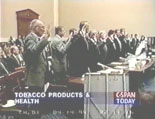
But do you recall that video of the seven tobacco companies' executives being sworn in
before a congressional committee 14 years ago, April 14, 1994, when they all -- having been sworn to tell the truth -- each denied in turn that nicotine was addictive? (The video; the transcript (about 1/3 down the screen).) [Credit: WhyQuit.com.]

None of this progress has been thanks to the tobacco lobby, which opposed it every step of the way.

Lobbyists, like bank robbers, simply go "where the money is."

Yes, as Part II noted, "the ties between business and government are tight -- whether in the halls of Washington, Des Moines or the City Council chambers of Iowa City."

Which brings us to one of Bob Patton's editorial cartoons. Patton is one of our nation's most insightful and talented editorial cartoonists. (The link on his name takes you to his blog/Web site, Patton's Pad, and an archive of samples of his work that will "illustrate" the reasons for my judgment about him.) The Press-Citizen is lucky to have his impact on the paper's graphics generally, but especially its editorial page.

To introduce this cartoon and its relevance to our topic: The Iowa City City Council, which has seldom seen a TIF (tax forgiveness to for-profit enterprises) it didn't like, and is quite prepared to give taxpayers' public money to for-profit enterprises, passed an ordinance in response to pressure from downtown businesses that forbids individuals to ask for private funds if they are within a designated forbidden area around a business' entrance. Here's how Patton pointed up the contrast:


Bob Patton, "Brother, Can You Spare a TIF?" Iowa City Press-Citizen, March 22, 2008, p. A15, posted March 27, 2008, 4:28 p.m.

[If you have difficulty reading the text: The fellow who's down on his luck has a sign that reads, "Need Help. Any money you can spare? Thank you. God bless." The caption reads, "Panhandling around City Hall, however, will still be permitted," where we see "Big Biz" with a sign reading, "Need to set up shop. Any tax breaks you can spare. Thanks. Now shut up and step aside."]

Anatole France put the analogous thought, "The poor have to labour in the face of the majestic equality of the law, which forbids the rich as well as the poor to sleep under bridges, to beg in the streets, and to steal bread."

In short, as France and Patton see clearly, but most fear to even whisper, it is not just that in our infant fascism we rob poor taxpayers to further enrich the wealthy. It is the hypocrisy.

We cheer because "Stocks rallied Tuesday [March 11] as investors welcomed news that the Federal Reserve will lend up to $200 billion to banks and lenders as a means of loosening up tight credit markets." Alexandra Twin, "Dow's best day in 5-1/2 years; Stocks surge with the Dow soaring 417 points as investors cheer reports that the central bank is pumping an additional $200 billion into the banking system," CNNMoney.com, March 11, 2008, 4:34 p.m. ET.

Anyone who calls that "corporate welfare" is dismissed as fomenting "class warfare," a "liberal," a "radical" -- or worse.

And yet it's perfectly acceptable to chastise and cast moral aspersions on the single mothers who get, not $200 billion, but $200 in food stamps, as "welfare mothers."

If you'd like to know more about this political phenomenon, . . .

For my own explanation of a number of categories of reasons why TIFs and other business subsidies don't make any sense, see Nicholas Johnson, "Courage, Councilors," October 3, 2008.

For an entire Web site devoted to the abortive efforts to put public money (local, state, and a $50 million federal earmark from Senator Grassley) into an indoor rain forest in Iowa, see Nicholas Johnson, "Earthpark," 2004-2007, Jane Norman, "Grassley defends earmarks for Iowa as valid," Des Moines Register, April 7, 2008 ("Grassley has been harshly criticized in years past for his support of a $50 million earmark for . . . an indoor rain forest to Iowa. The money was yanked by Congress late last year. The nonpartisan group Citizens Against Government Waste issued a report Wednesday [April 2] showing that Iowa ranked 16th in the nation when it came to earmarks per capita in the 2008 budget . . .."), and "Earmarks" in Nicholas Johnson, "Obama Mason and Public Finance," March 21, 2008.

And for a positive analysis of what does work in economic development see, Nicholas Johnson, "Time to Learn From What Works," Iowa City Press-Citizen, January 20, 2006.
Parts VII and VIII will provide more examples of the problems of "Money and Lobbyists in Politics" right here in good old, Midwest-values Iowa.

P.S. For the best evaluation of last night's [April 16] debate, referenced in Part V, give a read to John Deeth's "Debate Screwed Up So Bad No One Can Play It," John Deeth Blog, April 17, 2008.

And here's what Senator Barack Obama had to say about it.


# # #

Wednesday, November 14, 2007

Of Straw and Strikes

November 14, 2007, 8:30 a.m.

The Writers' Strike and Media's Future

John Barleykorn, who has assumed the daunting task of trying to keep me honest in these blog entries, has now posed a question (in a comment added to yesterday's blog entry about Barbara and Bill Richardson at the JJ Dinner) regarding the Writers Guild strike:

John Barleykorn said...

What are your thoughts on the SWG strike? I think they are taking a risk here. My fear is that you will get a lot more "reality" TV shows, and when the strike ends, less work for writers. My advice to someone young is to write and produce it yourself over the internet.

11/13/2007 07:37:00 PM
I knew Ann Landers and her daughter, but I have not chosen to follow her example with this blog -- where I provide a virtually uncensored opportunity for readers' comments, but do not assume responsibility for responding to them.

Knowing something of the challenges confronting the Los Angeles creative community, however, and with appreciation for John's efforts as a one-man truth squad, I've decided to make an exception.

His question reminds me of an experience with an Iowa farmer, and the wisdom contained in an airline magazine ad.

While running for Congress in Iowa's old Third District some 30 years ago, I was living in a farmhouse in the Kesley, Iowa, suburbs during some cold north-Iowa months. Unfortunately, the warmth of the local residents was not matched by the warmth of the largely-uninsulated house. So I decided to put some straw bales around the outside. I borrowed a pickup truck and followed the directions to the farm where I'd been told I could buy some bales. When I asked the owner what he wanted for my truck load he allowed as how 75c a bale would be just fine. I pointed out that the market price was more like $1.25, and that 75c was not fair. He resisted, but we ultimately settled on $1.00 a bale.

I love that story and would sing it to the strains of John Lennon's "Imagine" if I could write lyrics -- and sing.

But the fact is that the commercial world is better represented by that airline magazine ad you must have seen if you've ever flown. The headline reads, "You get what you negotiate." Or perhaps we should have understood that, before we even reached the West Coast, from the country song's lyrics, "All the gold in California is in a bank in Beverly Hills in somebody else's name."

Few members of Writers Guild-West, or the Screen Actors Guild -- let alone their contract negotiators -- have ever confronted a producer, or studio representative, insisting that the actors or writers really ought to be paid more, given the importance of their role in the production.

The creative community has had to fight, to strike, to go without, for everything they've ever received. They've had to learn to take a share of the gross rather than the net, because after the accountants are through with the numbers there never is any net.

With everybody taking a share of their pay, one actor in a top-rated TV series told me that she often ended up with something on the order of 10% of what the fan magazines said she was being paid -- agents, managers, business managers, publicists, lawyers, accountants and others were the ones putting their share of her "gold in California" into "a bank in Beverly Hills" in their names, not hers. I knew of two actors whose business managers left California, each with over $100,000 of theirs that neither woman ever saw again. And don't get me started about the recording industry.

So what's the strike about this time? Both the actors and writers have more than once ended up one generation behind the technology curve. That's where they find themselves once again.

Here's an analogy. Suppose you write, and are paid for, a stage play. Much to your surprise, along comes something called motion pictures, and you find your play put to film -- creating a second profit for the producer, but no fair share of that second profit for you. So next time you contract for your play you include a provision that you will be paid an additional sum if it is used in a film. So far so good, but how could you have imagined the coming of something called television? Once again, you find your creative writing producing additional revenue for somebody -- but not for you. So the next contract includes reference to television -- but, alas, says nothing about your rights to a share of the profits from videotape. You get the picture.

So today's "next big thing" is whatever the Internet ends up becoming.

Nobody knows for sure. What's already apparent, however, is that technologically -- with or without another couple orders of magnitude increase in bandwidth -- a very large proportion of the "radio" and "CDs" you'd want to listen to, the "television" you'd want to watch, is available on any WiFi-connected laptop. Networks are streaming their programming -- giving you, in effect, a free TiVo service in the bargain (the ability to listen, or watch, whenever it fits into your schedule, not theirs). They are producing three-minute "programs" to be viewed on your cell phone. The possibilities are endless.

The potential revenue is not.

The writers, understandably in this "fool me once, shame on you" scenario, want to make sure it doesn't happen to them again. They want a fair price for those bales of straw they create, now that it turns out they can be sold five times instead of just once.

The producers and studios, on the other hand -- those five firms that control all the world's media -- want to make sure they don't promise to pay out to the writers a revenue stream that never ends up materializing.

John Barleykorn says, "My advice to someone young is to write and produce it yourself over the internet." "Someone young" is already taking that advice. It's called YouTube. But at this point in time, writing and producing it yourself over the Internet is going to require that the "someone young" get a day job parking cars or waiting on tables -- as young folks in LA have been doing for years -- if they intend to pay rent and eat.

The networks no longer share 95% of the television-watching audience as they did in pre-cable days. It's more like half that. But even at half that, the networks' ratings, and the box office revenue for American films -- around the world, not just in this country -- is proof that, reality shows or not, there remains a strong market demand for the American creative product of LA's professionals.

One of my actor friends, whose Motion Picture Academy card could get us into theaters anywhere, used to insist that as a matter of respect for the industry I stay and watch the credits role at the end of the film. It's a practice I've continued to this day -- even though the credits get longer every year. This is an extraordinary industry we have, only made possible with hundreds of skills and thousands of talented people (including, of course, that of the producers). One that, in addition to boosting our spirits and making us laugh and cry, also is one of the few industries that makes a positive contribution to our balance of payments.

So I'm not concerned that, at least ultimately, there will be "less work for writers."

Whose side am I on in this strike?

Take a guess, John, and thanks for the question.

# # #

Monday, November 12, 2007

Keep Separation of Local TV and Newspaper Ownership

November 12, 2007, 12:15 p.m.

At Long Last: Johnson Disagrees with Doak
Newspaper-TV Mergers Are Not in Democracy's Best Interest

I've finally found a reason to disagree with Richard Doak about something.

There is no one in American journalism I admire more than this Register former editor and (actually continuing) columnist, who's now lecturing at Iowa State for some very lucky students. (I just wish he was here in Iowa City.)

Not just for months or years, but for decades, I have been agreeing with virtually everything he's written. In fact, I've urged him to put some of those columns in a book for those who care about Iowa and who might just build a future for Iowa based on his blueprints. (He's so far been too modest to do it.)

So it was with a sense of relief, of sorts, that I found myself disagreeing with his column last Sunday. Richard Doak, "Get best of modern media world — allow newspaper, TV ownership," Des Moines Register, November 11, 2007. It's probably not a good idea to agree with anybody all the time.

Doak's column advocates that we'd all be better off if media corporations were permitted to own both newspapers and television stations in the same town.

For years this kind of media concentration has been prohibited by the FCC even though it has, over the last 30 years, continued to erode more and more of the specific regulations that once defined the Congressional licensing standard: "public interest, convenience and necessity." Now the current industry-dominated agency is proposing to do away with the prohibition. Doak thinks it would be a good thing if it did.

In order to respond to his arguments I must first set out excerpts from them in his own words rather than my characterization of them. I will number what I believe to be a rough breakdown of the categories.

1. More news. "the sum of the news it ["a combined newspaper-television newsroom"] could deliver to readers-viewers would be greater than either part could deliver alone.

The television broadcasts at 6 and 10 p.m. could carry more news because the station's small staff would be augmented by the reporting power of the newspaper's large staff.

The newspaper could broaden its news gathering even more if its reporters didn't have to staff the same events being covered by the TV reporters."

2. Better Web Sites. "Best of all, a combined newspaper-television station could produce a killer Web site.

A local Web site that had both comprehensive text and compelling visual presentation would be unbeatable. A merged TV-newspaper newsroom could create a site everyone in town would automatically log onto first, not only for news but also for community information, entertainment, discussions, weather and links to databases and government agencies.

It would be a convenient, indispensable, one-stop source for text and visual information. Every community should have one.

American communities never will, however, unless the Federal Communications Commission allows 'cross ownership' of newspapers and television stations."

3. Limit numbers, not co-ownership. "Opponents of allowing cross ownership raise the fear of media being concentrated in too few hands. If that's the problem, the way to address it is by limiting the total number of stations a company may own, not by prohibiting the natural convergence of print and broadcast news in local communities."

4. Promote convergence. "Convergence is the right word. It used to be a theoretical concept. Now it's here. The lines are blurring between print and electronic media as they converge onto one platform, the Internet.

* * *

But newspaper staffs aren't great at visuals, and TV staffs aren't great at text. Combined staffs could be, and a lot of unnecessary duplication of assignments could be eliminated in the process."

5. Make media more Wal-Mart-like. "Requiring newspapers and local television stations to remain separate would be like requiring hardware to be sold only in hardware stores and clothing to be sold only in clothing stores, thus denying Wal-Mart the ability to sell both in its supercenters.

The time has come for supercenters of another kind."

6. Blogs eliminate information monopolies. "Another argument against cross ownership is that it would allow one company to monopolize the news in a community. That's an obsolete concept. In an age when anyone with a computer can launch a blog, an information monopoly is impossible.

Having an information supercenter in your community would leave plenty of room for boutique information shops around town."

7. What's good for general media is good for the country. "Of course, it's possible that the motives of FCC commissioners who want to allow cross ownership are not entirely pure. Perhaps they are succumbing to the blandishments of media moguls who want to expand their empires.

If so, it would be an instance of self-interest coinciding with the public interest. A strong merged newspaper-TV newsroom in a community would serve the public better than two weak separate operations, even if media companies made more profit in the deal."
Here's my response to each of these arguments in turn.

1. More news. The track record so far, as A.J. Liebling once observed (in his book, The Press), is that newspapers are like bars. Bars used to offer the "blue plate special" -- reduced price food with the drink. But as monopoly or oligopoly bars took the place of competition, the first thing to go was the blue plate special. Similarly, he observed, the first thing to go, following the merger of newspapers into a local newspaper monopoly, was the news.

There are significant differences between today's five major multi-media owners and the early notion of local ownership of what were then AM radio stations, "integration of ownership and management" as the FCC called it in picking the winners in comparative hearings, or as it was sometimes called, "mom-and-pop" owners.

As many have bemoaned, it is no longer enough that a chain-owned newspaper make a profit. It must make increasingly greater profits each year in order to convince Wall Street that its stock price should increase. Newspapers making 20% and more profit are cutting back on the number of journalists in their overseas and domestic bureaus and becoming even more responsive to the interests of their advertisers and the demographics they want to reach.

Television stations owned by media conglomerates are, if anything, even worse in terms of their solid news coverage, investigative reporting, and community service.

When newspapers, or stations, are locally owned they may still have conflicts of interest, and third-generation owners may be more committed to profit than journalism, but the community at least knows who they are. The owners feel some pressure from their neighbors, country club colleagues, and others in the community to provide a constructive service. Once public ownership takes the place of human ownership those restraints disappear. Many multi-media CEOs -- hired guns all -- probably couldn't even name for you all the properties their corporation owns.

In short, I just don't believe that permitting multi-media conglomerate corporations to own newspaper-television combinations within a given community is going to increase the quantity or quality of local news and public service. (And, although of lesser concern to me, a decline in the number of local media owners has also proven to be bad for local merchants and advertisers who, historically, have found themselves paying much higher advertising rates as media competition declines.)

2. Better Web sites. Doak argues that America "never will [have the "killer Web sites" he desires], however, unless the Federal Communications Commission allows 'cross ownership' of newspapers and television stations."

Virtually every media outlet in the country has a Web presence, from the New York Times and Washington Post, and all the major television networks, to The Daily Iowan -- and, not incidentally, Dick Doak's Des Moines Register. Many, like the Register, already combine online reproductions of their hard copy content with video and still picture features, blogs from their own reporters and other publication-certified bloggers, along with spirited contributions from readers in comment sections for each story and opinion piece. As if this was not enough, the Register also offers an "e-mail newsletter," "news text alerts," RSS feeds, and a new "mobile site" that can provide news on your cell phone. Want to know what's next? The Register is "redesigning" all of this and now offers it for inspection on a beta site.

It's hard to argue that none of this will be possible without a merger of a community's newspapers and television stations -- especially given what the Register is already doing.

Moreover, where there is co-ownership, such as with one of Iowa's few remaining locally owned newspapers and television stations -- The Gazette and KCRG-TV9 in Cedar Rapids -- the owner wisely maintains separate news staffs, and Web sites, for each rather than combining them into one. There are advantages, in terms of quantity and quality of coverage and maintenance of a little more competition, to not merging the two.

3. Limit numbers, not co-ownership. I agree that it would be advantageous to reduce the numbers of stations any one owner could control. I just don't think that has anything to do with the evils of joint ownership within a community.

Initially, as mentioned above, the notion was that an owner would just hold a license to one station. Over the years the limits were raised to what they were when I was an FCC commissioner during the 1960s and '70s: 7 AM stations, 7 FM, and 7 TV -- only 5 of which could be VHF stations. Today, with the continuing erosion of FCC standards, at one time Clear Channel held licenses to something like 1200 radio stations.

There are several, distinguishable, problems associated with media ownership. Conglomerate ownership (owning media and other kinds of businesses in the same market) can influence the owner's coverage of issues affecting its other businesses. Regional concentration can create an undesirable amount of political power in a single media owner. Increasing the number of media outlets a single licensee can control nationally increases its national political power and reduces the number of media voices. Multiple-media owners (those owning book publishing, movie studios, TV networks, cable systems and cable program providers, DVD sales and rental, newspapers and magazines) can use their market power to cross-promote products, unfairly compete, and raise the barriers to entry of new firms and the creative community.

Joint ownership within a community -- whether of newspapers and television, or just multiple radio stations -- is a distinct problem. Ultimately, the only persons with meaningful First Amendment rights are media owners.

There is a distinction between "matters of grace" and "matters of right."

A newspaper may decide to publish virtually all letters to the editor -- whether because doing so helps increase circulation, or as a community service -- as a "matter of grace." But no one has a legally enforceable right to have their letter published -- or their paid advertisement accepted for publication for that matter.

The Supreme Court has ruled, in effect, that with a newspaper's First Amendment right to speak, to publish, goes its First Amendment right to censor all others from publishing in that paper.

Thus, as a practical matter, the fewer media owners in a community, the smaller is the likelihood that there will be a diversity of voices, a competition among those with the potential to do investigative reporting and to stand up to powerful advertisers.

At a minimum, local concentration of media ownership is a different issue, with different risks and compromises, than the issues surrounding the total number of media outlets nationally owned by any single licensee.

4. Promote convergence. Convergence is already here, as my description of the Register's Web site, above, illustrates: newspaper copy created with printer's ink and newsprint and also on computer screens, delivery by newspaper carriers and also by cell phones, bloggers commenting about newspapers' stories and newspapers providing outlets for bloggers.

Convergence has, and will continue to, occur regardless of ownership patterns -- though there will be more of it if the FCC fails to approve the newspaper-TV station merger proposal.

Doak argues that co-ownership will prevent the "unnecessary duplication of assignments" that exists today when a television crew and a newspaper reporter are both sent to cover the same story. But it's that "unnecessary duplication of assignments" that is an "essential duplication of assignments" if we are to maintain a distinction between our media and the Soviet-style single voice that is the preference of dictators.

It is that "duplication" that makes for a marketplace for any product. When it comes to news, it's all that makes possible a "marketplace of ideas."

5. Make media more Wal-Mart-like. Doak writes: "Requiring newspapers and local television stations to remain separate would be like requiring hardware to be sold only in hardware stores and clothing to be sold only in clothing stores, thus denying Wal-Mart the ability to sell both in its supercenters.

The time has come for supercenters of another kind."

I suspect there are a good number of Iowans who are already questioning the supercenters represented by Wal-Mart, let alone "supercenters of another kind." This was probably not Doak's best choice of analogy.

In the context of the news business, "hardware" and "clothing" are more like "sports news" and "city council news." The issue is not whether there should, or should not, be separate sources of each variety of news. The issue is whether their combinations in "supercenters" (called "newspapers" and "television stations") should be combined and then controlled by corporations with the power, and consequences, of a Wal-Mart supercenter's impact on local merchants or whether more, and smaller, locally owned "supercenters" would better serve the needs of citizens in a self-governing democracy.

6. Blogs eliminate information monopolies. Doak says, "Another argument against cross ownership is that it would allow one company to monopolize the news in a community. That's an obsolete concept. In an age when anyone with a computer can launch a blog, an information monopoly is impossible."

That fewer media outlets, and owners, reduce diversity in sources of news is far from an "obsolete concept." And to say that because "anyone with a computer can launch a blog, an information monopoly is impossible" would be laughable if it were not presented as a serious argument.

The Los Angeles Times is the dominant newspaper in what is about an 8000 square mile area with a population, and readership, in the millions. Anyone in the LA basin who disagrees with a position the paper has taken, and who is excluded from the paper's pages, has the option of going to a commercial copy center, running off millions of copies of an 8-1/2 x 11 flyer, and delivering them to every home in LA. Could anyone seriously argue that this option makes the LA Times any less of a dominant information source? (That it is not technically a "monopoly" -- either with or without the availability of blogs -- is really irrelevant to the point that it is clearly disproportionately influential when it comes to LA news and opinion.)

The same goes for blogs. As a blogger myself, I can assure you of that.

7. What's good for general media is good for the country. Doak argues: "Of course, it's possible that the motives of FCC commissioners who want to allow cross ownership are not entirely pure. Perhaps they are succumbing to the blandishments of media moguls who want to expand their empires.

If so, it would be an instance of self-interest coinciding with the public interest. A strong merged newspaper-TV newsroom in a community would serve the public better than two weak separate operations, even if media companies made more profit in the deal."

Doak has it right when he suggests that FCC commissioners are "succumbing to the blandishments of media moguls who what to expand their empires." But I believe he is dead wrong when he argues that "A strong merged newspaper-TV newsroom in a community would serve the public better than two weak separate operations, even if media companies made more profit in the deal" -- for all the reasons I've set forth above. It is precisely the financial community's pressure for the merged, publicly-held company to make "more profit in the deal" (made easier by the elimination of competition) that results in the problem.

Given the media moguls' adoption of the kind of arguments that Doak puts forth, the unwillingness of either members of Congress or of the FCC to argue back, or otherwise stand up to these firms, their lawyers, lobbyists and campaign contributions, and the expected failure of the mainstream mass media to present the issues to the public, it is likely this outrageous change in policy will probably come to pass.

But one cannot help but hear the voice of the ghost of Congressman Luther Johnson calling to us from the 1920s, when Congress was both more courageous and prescient, and reminding us of his warning from the floor of the House:

American thought and American politics will be largely at the mercy of those who operate these stations. For publicity is the most powerful weapon that can be wielded in a Republic, and when such a weapon is placed in the hands of one, or a single selfish group is permitted to either tacitly or otherwise acquire ownership and dominate these broadcasting stations throughout the country, then woe be to those who dare to differ with them. It will be impossible to compete with them in reaching the ears of the American people."
67 Cong. Rec. 5558 (1926).

Woe be to us, indeed.

# # #

Saturday, October 20, 2007

The Case for Bleeping Expletives

October 20, 2007, 7:40 a.m.

"Indecency" in Broadcasting

The Press-Citizen devoted most of its op ed page this morning (Oct. 20) to the subject of "indecency" in broadcasting. It asked that I respond to a column on that page by Dr. Loren Glass. My column is reproduced below -- with a link to an earlier dissenting opinion on the subject that I wrote when an FCC commissioner.

As will be seen from today's column, and the earlier dissenting opinion, there are two distinct subjects here.

One involves literary and artistic freedom generally in our country; the other relates to the FCC's responsibility to enforce laws regarding "indecency" in broadcasting. The differences between Dr. Glass and myself involve the second. What he is attacking, as his title suggests, are actions by the FCC; but what he argues by way of support are reasons for literary freedom generally (as to which we are in more agreement than disagreement).

I knew and supported Allen Ginsberg as well as George Carlin, and Pacifica's New York City station WBSI (a true "fair and balanced" practitioner of the First Amendment, often under attack at the FCC, and virtually never defended by the commercial broadcasting industry, even when Pacifica's Houston station was bombed off the air, twice). But since the Press-Citizen asked that I, like a good law professor, put together the best case I could for the FCC's position, that's what I've endeavored to do.

My column is an effort to bring to Dr. Glass' attack on the FCC the acts of Congress and Supreme Court decisions that impose on the FCC, and broadcasters, standards regarding the unacceptability of "indecency" in over-the-air radio and television broadcasts that virtually all (including members of the Supreme Court) would acknowledge to be unconstitutional if applied to other media.

In the course of doing so, I also raise the matter of what Justice William Brennan characterized in the Pacifica ["George Carlin"] case [FCC v. Pacifica Foundation, 438 U.S. 726 (1978)] as the "acute, ethnocentric myopia" of his colleagues -- though I don't, here, use his phrase. (Justice Brennan wrote in dissent, "in our land of cultural pluralism, there are many who think, act, and talk differently from the Members of this Court . . .. It is only an acute ethnocentric myopia that enables the Court to [disapprove] . . . communications solely because of the words they contain." 438 U.S. at 725.) That is to say, in a democracy we have at least some obligation to respect -- that's "respect" not "capitulate to" -- the different values of our neighbors, regardless of whether they be freer, or more restrictive, than our own.

Dr. Glass' column, and his additional comment in today's Press-Citizen replying to mine, on the same page today, are linked from this blog entry just below my column.

The Case for Deleting Expletives
Nicholas Johnson
October 16, 2007

What are we to make of Dr. Loren Glass’ “@#$% the FCC”?

Not the content. The title.

By deleting the expletive (ironically, one approved by the Supreme Court for public display in Cohen v. California [403 U.S. 15 (1971)] he refutes his very thesis. It is an example of his “pandering to a very small group with a very loud voice” -- his characterization -- for which he criticizes the FCC.

Don’t get me wrong. Among the 400 dissenting opinions I wrote as an FCC commissioner are a goodly number poking fun at a variety of FCC silliness. One dealing with the FCC’s punishment of little college station WUHY-FM for its “indecency” will be linked from the blog version of this column for your entertainment. [Here is that link.]

But the issues are a little more complicated than I then, or he now, reveal.

For starters, the “small group” forbidding indecency in broadcasting is called “Congress.” “Indecency” has been illegal since the FCC’s earliest days -– ironically in the very same section of the Act that forbids FCC “censorship.” In 1948 Congress moved it out of the Communications Act and into the Criminal Code, where it still resides as a crime punishable by fines and imprisonment [18 U.S.C. Sec. 1464 (2004)].

That doesn’t make “indecency” any less vague as guidance for broadcasters, but it does make the agency’s attention to the issue something more than mere “pandering” to “the core constituency of the Republican Party.”

Moreover, however well qualified Dr. Glass may be regarding the tastes and values of the Democrats of his personal acquaintance in Johnson County, I suspect there are a goodly number of registered Democrats in America among the Republicans in that “very small group” offended by indecency.

And therein lies the dilemma for which the discipline of anthropology provides more insightful guidance than either my training in law or Dr. Glass’ field of American literature.

Dr. Glass points out the availability of pornography on some cable channels and the Internet. He’s right. But the Supreme Court says he’s wrong to argue broadcasting should be as free.

For 70% of us TV comes by cable -– whether the Cedar Rapids stations or cable programming sources like Comedy Central. But there’s a difference -– one more easily explored in my Senior College class this month than this brief column. There’s a scarcity of over-the-air frequencies that doesn’t exist for cable. That’s one reason our local stations are licensed by the FCC to serve “the public interest” and Comedy Central is not (but bleeps expletives anyway).

Anyone who pays an extra premium to the cable company for a soft or hardcore pornography channel can’t reasonably complain when they get what they paid for. The same is true for cable generally to a lesser degree -– “lesser” because we can’t yet pick individual “basic cable” channels.

Rabbit ears and rooftop antennas still provide, for free, a wide range of public and commercial stations. We have a choice.

Personally, I prefer individuals’ “censorship” for themselves to FCC censorship for all. Don’t like the cable channel? Don’t pay for it. Worried about the Internet? Get a filter. TV? Get a “v-chip.”

But what of those who’ve done those things and must still live, and raise children, amidst societal values of which they disapprove? Aren’t they entitled to ask the FCC and Justice Department to enforce the criminal law? In a democracy, with an anthropologist’s sensitivity, we can’t simply offer them a poke in the eye with a sharp stick and a dismissive expletive, deleted or not.

We need not permit them to determine what the rest of us can read and watch. But we must honor the different values of their religious communities, their choice of home over public schooling, or their decision, like that of the Amish, to create entertainment from home rather than merely watch entertainment from Hollywood.

I suspect Dr. Loren Glass, like Comedy Central, chose to delete his expletive because he thought it a good idea to respect others’ values -- even though not legally obliged to do so. For broadcasters, respect for others’ values is not just a good idea, it’s the law.
__________
Former FCC commissioner Nicholas Johnson teaches at the University of Iowa College of Law, blogs at FromDC2Iowa.blogspot.com, authored the just published book, Your Second Priority, and is teaching a Senior College course on the media.

# # #


This op ed column was published as Nicholas Johnson, "'@#$%& the FCC' and the case for deleting expletives," Iowa City Press-Citizen, October 20, 2007, p. A17.

It was written as a response to another column on that same page, Loren Glass, "The Only Proper Response is to Say '@#$% the FCC,'" Iowa City Press-Citizen, October 20, 2007, p. A17.

The paper also published a response to my column by Dr. Glass, Loren Glass, "Glass Responds to Johnson," Iowa City Press-Citizen, October 20, 2007, p. A17 -- the introductory comments at the top of this blog entry are, in effect, my response to his response.

# # #

Friday, August 17, 2007

Cable, Coralville, Coal and Consultants

August 17, 2007, 8:15, 10:40 a.m.; 9:20 p.m.

Stories Worth a Read, a Comment -- And Keeping an Eye On

All's Fair in Athletics and Cable Television

Negotiations continue between the "Big Ten Network" (BTN) and Mediacom. Andy Hamilton, "BTN Increases Pressure on Mediacom for Deal; UI Officials Urge Hawk Fans to Push for Network," Iowa City Press-Citizen, August 17, 2007, p. A1.

At the outset, recognize that "there's no such thing as a 'free cable channel.'" When cable program suppliers raise their prices to cable distribution companies, or when a new channel is added the cable company must pay for, that additional cost is going to find its way into every cable subscriber's monthly bill -- unless it's a "pay channel" for which the cable company recoups its cost by charging those cable subscribers who choose to pay extra for it each month.

Also recognize -- as if it could have escaped anyone's attention -- that collegiate athletics are now a classic example of the corporatization of the academy. They are in the profit maximizing business as much as any Fortune 500 corporation. They're paying coaches multi-million-dollar salaries, undertaking $100 million refurbishing projects with their venues, selling off both skyboxes and advertising on scoreboards to the highest corporate bidders, and entering into partnerships with organized gambling. So that's the context in which this BTN was created and is engaging in negotiations with the cable industry -- over our money. They will continue to stick it to their fans with everything from compulsory "contributions" to their program as a requirement before one is entitled to buy tickets, to overpriced hot dogs as well as ticket prices, to raising our cable bills -- up to the point that their overreaching so irritates fans that it produces a decline in the athletics programs' revenue.

From my perspective the controversial choice -- make every cable subscriber pay for a channel many don't want (BTN) so those who do can have it for "free" (i.e., at a disproportionately small increased cost for expanded basic paid by all cable subscribers) ,or make those who want it pay the entire cost as a "pay channel" (like HBO) -- is but a sub-set of much larger issues.

If I had my way, cable would operate as a common carrier. That would still allow the cable company owners to continue to attain riches beyond their wildest dreams of avarice -- by sucking money out of both ends of the straw: charging both those who want the cable company to distribute their programming and those who wish to receive it. (Once you get a cable system built the money just keeps on rolling in every month and the primary capital investment is for the wheelbarrows to carry it all to the bank.)

Like the AT&T of old, cable companies would be required to run a cable past everyone's home, and to expand their cable carrying capacity as necessary so as to be able to handle the programming of every program suppliers who was willing to pay their carriage fees.

The cable customers would then pay on the basis of individual channels chosen. The cost per channel would vary, depending on the number of subscribers and what the cable company and program supplier wanted to charge -- in short, it would be set by the market (presumably to optimize profit, taking into account alternative sources of supply). (And I'm assuming, for purposes of this discussion, that the average, total monthly cost per subscriber would be the same, or less, than it is now; in other words, that the companies' total costs and profits would remain the same.)

This system would eliminate the self-dealing (cable companies that own cable programming suppliers tend to favor them) and censorship. It would create more opportunities and make for a more competitive economic marketplace for those in the program production business. It would create a much wider range of choice, a much more diverse "marketplace of ideas," for the audience. And it would also more fairly allocate costs with benefits and individuals' choice.

Sorry for the long introduction, but it helps put the BTN in perspective.

I short, in my ideal world there would be no need for negotiations. BTN, as a matter of legal right, could have its programming distributed by Mediacom. It would be available for anyone who wanted to pay the fixed price for it. But no one who did not think it worth the price would be required to subscribe.

An analogy? Go to Time, Inc.'s, magazine Web site. It provides links to 18 of Time's magazines. Requiring you to pay for the BTN -- which is what putting it on "expanded basic" does -- would be like Time saying in order to get Time, the news magazine, you have to subscribe to (and pay for) all 18.

Another? Imagine going to one of those cineplexes with 12 theaters and having to pay a flat fee based on the assumption you're going to watch all 12 movies when you only wanted to watch (and pay for) one.

Bottom line -- since we're not going to be re-organizing the cable industry and its regulation anytime soon? I think BTN should be a pay channel.

What is it About the UI and "24th"?

The reactions of colleges and universities to the U.S. News & World Report annual ranking of all of them would be amusing if it weren't so serious.

Anyhow, in this morning's story (the rankings are online this morning and will be in the magazine Monday) we discover that the university Sally Mason recently left is tied for 24th (among public universities), the university to which Mike Hogan will soon be departing is tied for 24th, and the university to which President Mason came is also tied for 24th.

Iowa often works from a benchmark of 25th (among the 50 states) -- e.g., we want to bring our teachers' salaries up to "average." I'm reminded of the lyrics:

Clowns to the left of me,
Jokers to the right, here I am,
Stuck in the middle with you.
"Stuck in the Middle With You."

Brian Morelli, "UI Moves Up One Spot in Annual Rankings,"
Iowa City Press-Citizen, August 17, 2007, p. A1.

Desperately Trying to Put a Good Face on TIFs

One of Coralville's more prominent TIFs, the Coralville City Council-Marriott Hotel is celebrating its first birthday. It was cause enough for the Press-Citizen to devote an editorial and page-three story to the accomplishment. Editorial, "So Far, City's Gamble Seems to be Paying Off," Iowa City Press-Citizen, August 17, 2007, p. A11; Kathryn Fiegen, "Coralville Marriott Celebrates 1 Year; Hotel Looks to Its Future Growth," Iowa City Press-Citizen, August 17, 2007, p. A3.

In fairness, the editorial did acknowledge some of the downside of this venture:

Many local residents had -- and continue to have -- some ideological and pragmatic concerns about the venture. Some local hoteliers, arguing that city governments never should be involved in economic development projects that compete with other businesses already in the marketplace, brought a suit against the city to block the construction. . . . Others saw -- and continue to see -- the project as another example of Coralville officials overusing Tax Increment Financing districts as a means to boost economic development.

It's true that the hotel is not expected to hit full stride -- more than 70 percent occupancy and nearly $17 million in annual sales -- until 2010. And the project itself won't be paid off until sometime in the next 20 to 35 years.
Before this section of this blog entry was even written and uploaded there was a comment taking issue with what the author presumed I was going to write if ever I got around to it. Talk about prescience; he was right.

Here's the comment:
Ben Richards said...

I will defend the use of TIF. In many cases, TIF goes to build a specific piece of infrastructure such as a road with storm sewer. It does not "take away" funding from other entities because the tax base in question was not there to begin with. Not only that, cities are able to access the tax base right away for their debt service levy, which means lowering the cost of police and fire vehicles and any other projects using that levy. TIF was also used to revitalize the Sycamore Mall area. It is an indespensible tool for cities in economic development.

I see a lot of ignorance over what TIF is and the economic development scene in general.

8/17/2007 09:01:00 AM
Well, I've often acknowledged my own ignorance when it comes to TIFs. All I've had to draw and rely upon are common sense, intuition -- and the analysis by economists who do understand TIFs and other forms of corporate welfare. Because I've already written here at such length about TIFs, I'll just provide links to some of what has gone before, rather than just repeat it. I doubt that it will persuade Ben Richards and other advocates (and beneficiaries) of TIFs, but for any who are curious it will tell you probably more than you care to know about the basis for my own positions on the practice.

Nicholas Johnson, "TIF-ing My Toolshed," September 2, 2006.

Nicholas Johnson, "Supervisor Sullivan Says TIF, TIF, Tsk, Tsk," September 16, 2006.

Nicholas Johnson, "Press-Citizen Says 'Tough TIF,'"
September 22, 2006.

Nicholas Johnson, "Why Do They Hate America?"
October 2, 2006.

Nicholas Johnson, "Understanding TIFs (Revised 10/06/06)," October 5, 2006.

Nicholas Johnson, "Call the Cops: $3.755 Million Robbery in Progress,"
October 18, 2006.

Nicholas Johnson, "More on Corporate Welfare from 'Hat's Off' Winner," October 22, 2006.

Nicholas Johnson, "It's Not About 'Taxes,'" October 24, 2006.

Nicholas Johnson, "Riverside's Deeper Gambling Debt," November 11, 2006.

Nicholas Johnson, "UI Held Hostage Day 490 - Search & Taxes," May 26, 2007.

Nicholas Johnson, "The Terrible TIFs,"
July 26, 2007.


- Continuing Saga of CEO Responsibility: Coal Mines, Shuttle Flights and Retirement Homes

- Johnson County's "Affordable Housing": Consultant Proposes 450-Bed Jail

. . . more to come

# # #