Showing posts with label tobacco. Show all posts

Sunday, June 07, 2015

The Price of Our Freedom to Waste

June 7, 2015, 8:00 a.m.

Note (from The Gazette): Members of the Writers Circle met in Iowa City last month to discuss the topic of “waste” — an issue proved to be more complex than it might have seemed at first blush.

The discussion kicked off with a handful of questions: What do we mean by waste? Where do we see waste in our lives and community?

What harm is there in wastefulness, and if it’s so bad, why does it continue to be a problem? What are some possible solutions?

Today, three members share their reflections about our discussion. [In addition to Nicholas Johnson's column, reproduced below, the other two are Bob Elliott, "Waste: It's Not Simple Anymore," p. C1, and Wilf Nixon, "Resources Looking for a Purpose," p. C4, all three currently available in The Gazette Online.]

_______________

Curbing Waste: Bad News, Good News

Nicholas Johnson, Writers Circle
The Gazette, June 7, 2015, p. C1


“Wasted” can refer to our money, health, food, building materials, garbage, last year’s fashions, lives of the most desperate of our fellow humans — or a binge drinking college student. [Iowa City Landfill; photo credit: Sujin Kim/IowaWatch)

Do corporations’ products built-in obsolescence, or their encouraging conspicuous consumption of “the latest thing,” create “waste”?

Rudyard Kipling advised us to “fill the unforgiving minute/With sixty seconds’ worth of distance run." Are minutes less filled a waste of time?

This column leaves those questions to others while focusing on next steps. Once there’s agreement on what “waste” is, what can we do about it? How, if at all, can Americans be motivated to change?

Here are some illustrations.

Last month we celebrated “Bike to Work Week.” Compared to car costs (running over 40 cents a mile), bicycling is virtually free. For short trips, with easier parking, they can be faster. They don’t require drilling in the Artic wilderness, or military protection of “our oil” under others’ sand. They don’t pollute or accelerate climate change. Biking keeps you trim, happy and healthy, reducing your (and our nation’s) health care costs.

One member of this Writers Circle walks, bikes, and seldom drives over 400 miles a year. The Sierra Club calculates that even far less — substituting a couple short bike rides for car trips each week — would save 2 billion gallons of gas, its impact on climate change, and billions of dollars.

Future wars will be fought over water. The best shower? Get wet. Turn off the water. Suds up. Rinse off. It’s both more effective and efficient than running water for 20 minutes. If millions would do it, billions of gallons would be saved.

The same can be said for turning off the lights when you leave a room, or throwing cans in a recycling basket rather than the wastebasket.

The literature is replete with hundreds more examples. We know what to do. And it takes little time or sacrifice to do it.

The problem? Americans don’t have to be Libertarians to believe the Constitution guarantees their right to act in ways a majority considers stupid — if they don’t harm others. As President Lyndon Johnson used to say, “I don’t shove worth a damn.” What we need is better understanding of how to motivate such people without criminalizing their behavior or denying them their choice.

But how?

Bad boys, for devilment, used to tie a tin can on a dog’s tail and watch it try to outrun the noise. It gave rise to one Writers Circle member’s insight: “tie your reform to the tail of greed, and watch it run off down the street.” Otherwise put, “You get what you measure,” or what you incentivize — whether the standards for faculty tenure, or the installation of seat belts once they’re mandated for the federal government’s cars.

We can be motivated by education, information, appeals by celebrities — whether public service announcements, such as anti-smoking TV spots, or programming. When the Harvard School of Public Health asked Hollywood producers to include shots of drivers fastening seat belts in their films, lives were saved as public compliance followed.

Informed discussions among those chosen as scientific polling samples produce more thoughtful responses. What’s called “deliberative democracy polling” could radically alter the public’s and politicians’ views on public policy.

The five-cent deposit on cans and bottles encourages recycling. Lower auto insurance rates for the accident-free encourages safer driving. “Cap and trade” pollution reduction (income for reduced pollution; choice to pay to pollute more) seems to work. A restaurateur’s smoke-free restaurant (before legally required) actually attracted more customers.

Some major corporations are discovering it’s profitable to move from a linear economy (raw materials to manufacturing, to sale and use, to landfill) to a circular economy (raw materials to manufacturing, to sale and use, to reuse of products’ raw materials through restoration and resale). This not only reduces waste of non-renewable resources. Unilever’s 240 factories in 67 countries now send zero waste to landfills. The sale of an electric car transportation service (rather than “a car”), for a monthly charge, with “new” rebuilt cars and batteries every three years, would be a win-win-win for manufacturers, dealers, drivers — and the planet.

No matter how we define “waste,” the bad news is there’s no groundswell of support to stop it, given the protests of those who profit from it. The good news is that we can be motivated to change.

_______________
• Nick Johnson is a former Federal Communications Commissioner and author of Test Pattern for Living, writes at www.nicholasjohnson.org and FromDC2Iowa.blogspot.com

# # #

Saturday, April 19, 2008

Golden Rules & Revolutions: A Series - VIII

April 19, 2008, 8:30 a.m.

Today is the eighth and final blog entry in the series, "Golden Rules & Revolutions." Here are the prior seven:

I - Income Disparity & Revolution
, April 12, 2008
. "Series Introduction," "Increasing income disparity, despair. . .," ". . . and Revolution"

II - Golden Rules & Fascism, April 13, 2008
. "The Golden Rule," "Fascism"

III - Money and Lobbyists in Politics: Washington, April 14, 2008

IV - Presidential Candidates and Lobbyists: McCain, April 15, 2008

V - Presidential Candidates and Lobbyists: Clinton, April 16, 2008

VI - Money and Lobbyists in Politics: Iowa, April 17, 2008

VII - Money and Lobbyists in Iowa: Hormel's Pork
, April 18, 2008

# # #

Money and Lobbyists in Iowa: Smoke and Mirrors

Part I of this series noted not just the gap in income between the rich and the poor, but the fact that this gap is continuing to grow ever wider, and that history -- as well as the daily news -- provides ample warning that this condition often produces revolution.

Part II began the exploration of the forces that may be shaping these potentially dangerous conditions -- including the ties between business and government eerily reminiscent of the early stages of what we used to call "fascism."

Part III took us to Washington for some general descriptions of how the system works, what campaign contributors get for their money, the role of lobbyists, and a columnist's description of one case study.

Part IV dealt with how the role of lobbyists extends beyond their manipulation of government into the pre-governing phase: presidential campaigns -- beginning with Senator John McCain.

Part V examined Senator Hillary Clinton's campaign from this perspective -- and tried to figure out who is the biggest "elitist."

Part VI returns to an application of the subject of Part II: "the ties between business and government eerily reminiscent of the early stages of what we used to call 'fascism.'" Although this time, instead of looking down the road to Washington for the consequences of "Money and Lobbyists in Politics" we take a shorter drive -- to Des Moines and Iowa City.

Part VII offers one example, from among dozens that could be mentioned, of "Money and Lobbyists in Iowa" -- the tax breaks, cash and infrastructure offered to Hormel.

Part VIII wraps up this series with an example of the impact of money on Iowa's legislative process and some concluding thoughts.
_______________

Former Governor Tom Vilsack took "campaign contributions" from the nursing home industry. Iowa's present Governor, Chet Culver, received $15,500 from the nursing home industry during the last two years -- at a time when lax state inspections of nursing homes have been criticized. I don't mean to suggest a connection, and neither did the Des Moines Register story, but the governors' responses to these observations remind me of the Queen's line from William Shakespeare's Hamlet: "The lady doth protest too much, methinks."

A former Iowa legislator, Democrat John Tapscott, a critic of the industry, asked both Culver and his predecessor, Tom Vilsack (both Democrats) to return the payments.

Vilsack wrote to Tapscott and said: "[I]f you believe that the taking of this contribution in some way affects my ability to do that job, I can assure you it does not." . . .

Culver spokesman Brad Anderson said, . . . "The idea that contributions have affected in any way the regulation of the nursing home industry by the Department of Inspections and Appeals under this administration is patently false . . .."
Clark Kauffman, "Culver won't part with nursing home industry's donations," Des Moines Register, April 7, 2008.

Unfortunately, this kind of investigative reporting of money in Iowa politics and governing is all too rare. Occasionally there will be stories regarding which legislators have raised how much money. There may even be a reference to where some of that money came from. Very rarely is there an effort to investigate the extent to which there is a relationship between the sources of campaign funds and the votes of the recipients -- let alone a routine reporting of these relationships for every single member of the Iowa legislature.

Nor has there been much reporting about the use of money as legislative power inside the legislature. To what extent is "leadership" purchased? What of those legislators who raise "campaign funds" far in excess of reasonable need in order to pass them along to the leadership, their relevant state parties -- or to their less prosperous colleagues. Is there any correlation between their "generosity" and the fact they end up chairing committees?

Understand, I'm only raising questions, not providing answers. Indeed, my point, my complaint, is that we don't have the answers, answers I think are necessary in a democracy, answers we can rightfully expect the media to provide for us. Iowa's springtime legislature pure as Iowa's wintertime snow. But it is possible -- just barely possible -- that they may share some of the practices that have been a part of American politics during the past century in the other 49 states and Washington.

For example, where are the current news stories tying campaign contributions and lobbying expenses to the otherwise rather bizarre votes of Iowa legislators banning smoking throughout the entire state of Iowa -- except for gambling casinos?

As Rekha Basu reports, "The result came out of political deal making, not logic. The exemption was put in after hard lobbying by the casino industry." Rekha Basu, "Logic takes detour with smoking-ban exemptions," Des Moines Register, April 11, 2008.

When I say "where are the stories" I don't mean to suggest there are no such stories -- with the details of dates (over time as well as last 12 months), amounts ("in-kind," trips and entertainment as well as cash), names of donors (gambling and tobacco industry individuals as well as PACs) and recipients (political parties as well as legislators and their leadership), Nevada and other out of state money, and so forth. I just mean the question literally: if you've seen them please put a comment on this blog entry as to where they are so I can make reference to them.

Can those legislators who insisted on the casino exemption give us equal, governor-quality assertive assurances that their votes were not in any way influenced by campaign contributions, lobbyist pressure and favors, or other benefits?

Once again, as in Part VI, Bob Patton is on top of it:


Bob Patton, "Well, 99 out of 100 ain't bad, I guess" Iowa City Press-Citizen, April 12, 2008, p. A12, posted April 11, 2008, 4:33 p.m.

[The text, if the drawing is not clear on your screen: An unsavory guy labeled "Gambling Lobby," with a cigar in his left hand holds a sign in his right: "Casino Exemption" signed "XXXOOO Iowa Legislature." He's flicking the ashes through a hole his cigar has burned in a tent top labeled "State Smoking Ban" where they fall on "Casino Employees" standing next to "99% of the Rest of Iowa's Workers" who are protected by the "State Smoking Ban." The caption reads, "Hey, if youse casino workers don't like it, den next time git youse own lobby!" This is, of course, a reference to the fact that those who suffer the most from the cancer-causing consequences of second hand smoke -- and similarly benefit the most from smoking bans -- are those who must spend full work days in their employers' smoke-filled rooms.]

Concluding remarks.
State 29 went after me yesterday for my "cluelessness" and his belief that "It's a shame when 'classical' liberals like Johnson lose their critical marbles" -- a reference to my failure to go after Senator Obama with the enthusiasm brought to the task by ABC's Charlie Gibson and George Stephanopoulos during the first 45 minutes of the so-called ABC-sponsored "debate" the evening of April 16. State29, "Sawed-Off Support for Obama," April 18, 2008.

These comments of State29 reflect my apparent failure to make clear the purpose and scope of this blog series -- to, at a minimum, at least this one reader.

The purpose has not been to evaluate the presidential candidates. I have done that elsewhere, early and often, throughout the primary season. See, e.g., Nicholas Johnson, "Politics: Assessing Candidates' 'Experience,'" The Gazette, March 30, 2008, p. A9, reprinted as "Gazette Op Ed: Candidates' 'Experience,'" March 30, 31, 2008. In that piece, not incidentally, I was fully as critical of Senator Obama's lack of experience as I was of the comparable lack of presidentially-relevant experience on the part of Senators Clinton and McCain.

This "Golden Rules & Revolutions" series was focused on a much different and broader topic.

It began with the "Golden Rule" definition that "those who have the gold make the rules" and the observation from history, as well as our daily news, that when the rules are designed to, and do result -- as they do -- in ever-increasing disparities in income between rich and poor the destination at the end of this yellow brick road of gold most often turns out to be a revolution as harmful to the rich as the poor.

How it gets this way is in large measure a matter of "campaign contributions" (the quotes because of the slim difference from "bribes") and the role of lobbyists -- in Des Moines and Iowa City as well as Washington, up to and including our current presidential campaign.

(The reason, incidentally, that Senator Obama was not discussed at length with regard to money and lobbyists in presidential campaigns is that he isn't a very good illustration. Senators Clinton and McCain are surrounded by lobbyists, and unapologetically awash in money from special interests and the wealthy. They were both good examples of the point I was trying to make at that stage of the discussion. Senator Obama, with 1.3 million contributors, although he has raised the most money, has obtained far more of it from those donating under $200 than have the other two, does not take money from PACs, and so far as I know does not have special interest lobbyists as top campaign advisers. That may or may not make him a "better" candidate or potential president in your eyes; but for my purposes in this discussion it merely made him not very relevant or useful.)

So what can we do about all this -- a government that's up for sale to the highest bidder, the role of campaign contributions and lobbyists, and the resulting 1000-to-one return to the special interests of taxpayers' money in the form of subsidies, earmarks, bailouts, TIFs, and other tax breaks?

The story is told of the pollster who asked a scientific sample of the citizens of his lackluster community, "What do you think is the worst problem about the people in this town, ignorance or apathy?" The majority answered him simply, "I don't know and I don't care."

So we can begin by caring, move on to knowing, and end up participating.

Whether they lie or really believe what they're saying, politicians who tell you what they are going to do for you, or to you, are not talking about democracy. Democracy isn't a top-down idea; it's a bottom-up idea.

That means, as the old saying has it, "If you're not a part of the solution, you're a part of the problem."

This series may or may not have been successful. I may have failed to explain sufficiently clearly what its purpose was intended to be. I would even concede that my analysis may be wrong -- or at least not widely held by others.

But it was an example of my little efforts to be a part of a solution.

# # #


Thursday, April 17, 2008

Golden Rules & Revolutions: A Series - VI

April 17, 2008, 7:00 a.m.

Today is the sixth in a series, "Golden Rules & Revolutions." Here are the prior entries:

I - Income Disparity & Revolution
, April 12, 2008
. "Series Introduction," "Increasing income disparity, despair. . .," ". . . and Revolution"

II - Golden Rules & Fascism, April 13, 2008
. "The Golden Rule," "Fascism"

III - Money and Lobbyists in Politics: Washington, April 14, 2008

IV - Presidential Candidates and Lobbyists: McCain, April 15, 2008

V - Presidential Candidates and Lobbyists: Clinton, April 16, 2008

# # #

Money and Lobbyists in Politics: Iowa

Part I of this series noted not just the gap in income between the rich and the poor, but the fact that this gap is continuing to grow ever wider, and that history -- as well as the daily news -- provides ample warning that this condition often produces revolution.

Part II began the exploration of the forces that may be shaping these potentially dangerous conditions -- including the ties between business and government eerily reminiscent of the early stages of what we used to call "fascism."

Part III took us to Washington for some general descriptions of how the system works, what campaign contributors get for their money, the role of lobbyists, and a columnist's description of one case study.

Part IV dealt with how the role of lobbyists extends beyond their manipulation of government into the pre-governing phase: presidential campaigns -- beginning with Senator John McCain.

Part V examines Senator Hillary Clinton's campaign from this perspective -- and tries to figure out who is the biggest "elitist."

Part VI returns to an application of the subject of Part II: "the ties between business and government eerily reminiscent of the early stages of what we used to call 'fascism.'" Although this time, instead of looking down the road to Washington for the consequences of "Money and Lobbyists in Politics" we take a shorter drive -- to Des Moines and Iowa City.
_______________

Part III began the discussion of "Money and Lobbyists in Politics" noting the "$2.79 billion that the special interests spend on lobbyists, and the the millions and billions of dollars the special interests 'invest' in 'campaign contributions'" -- primarily in Washington.

But it added, parenthetically, "in state legislatures as well as Congress, and among the best investments these businesses ever make."

Bear in mind, lobbyists don't head to Washington just because they like the restaurants -- though they do. They go for the same reason Willie Sutton once offered for why he robbed banks. "Because that's where the money is."

When the money is elsewhere they'll go there.

There are a couple of anecdotes from my personal experience that make the point.

Business leaders and their lobbyists sometimes say, "get the government off my back." But it's a little disingenuous. Because "regulation," often as not, comes about because of a request by business -- many times in an effort to use the power of government to limit competition, permit the growth of oligopolies and monopolies, and the resulting greater profits for companies -- and pay for the CEOs. Such was the case with some industries I've had experience with: airlines, broadcasting, cement, shipping, ship building, and steel -- among others.

(1) Cable Television. Consider the story of cable television regulation.

In the early days, when no one much understood or cared about cable, its regulation was left entirely to local communities. Local council members, who could know little of its future implications, or their potential bargaining power, could be easily bamboozled by "the cable guys" -- and they were.

If there was any resistance, the companies would simply offer ownership shares to leading local citizens (called "rent-a-citizen"), sell the community on the notion that this was now a "local" company, and then let their rented citizens sell back their shares at substantially increased prices, while all declared that these were simply "profits" not "bribes."

"Keep the government off our backs," cable cried to its friends in congress and the FCC.

Then the Ford Foundation created the Cable Television Information Office that began educating local communities about cable's potential -- and their bargaining power. Soon marketplace forces began to work their way; cities would see which companies would make the best offer: number of channels, 100% coverage of the city, local public access channels, and franchise fees.

Business representatives will give "free private enterprise" a standing ovation at Rotary, but panic at the prospect of its moving next door.

So the cable industry lobbyists left the cities in droves and came to Washington, pleading that we would please put the government on their backs, regulate the cable industry, and ameliorate the pain they were feeling from cities insisting they be given a fair deal.

Why Washington? Think about it. It's so much easier to work your will in one city than in 10,000. There were then only seven commissioners (now five), and a couple of congressional committees with any meaningful jurisdiction.

And so today cities have little or no ability to regulate what programs are carried on their cable systems, the rates charged by the companies, or whether their franchises will be renewed for lengthy terms.

(2) Tobacco. When Richard Remmington asked me to serve as his co-director of Iowa's Institute for Health, Behavior and Environmental Policy, one of our first tasks was to determine where we could get the biggest bang for our very limited bucks.

Smoking and other consequences of tobacco seemed a good place to focus. After all, as the Centers for Disease Control and Prevention note, "Cigarette smoking is the single most preventable cause of premature death in the United States. Each year, more than 400,000 Americans die from cigarette smoking." CDC, "Cigarette Smoking-Related Mortality" (September 2006).

This still left us with an analytical problem analogous to triage ("the process of sorting victims, as of a battle or disaster, to determine medical priority in order to increase the number of survivors"). Among all the aspects of smoking, all the strategies one could adopt to try to reduce it, which would be the most efficient and effective for a small group such as ours?

We finally settled on the matter of the 3000 "replacement smokers" the tobacco industry addicts each day -- given the industry's rather self-defeating challenge of being in a business where profit could only come by killing off one's customer base. What were the causes of, and most effective programs for reducing, young persons' taking up the habit?

Because I knew some of the folks in congress who might be of help, I paid them a visit on one of my trips to Washington. A top staffer explained to me that he would love to hold another hearing but for the reality that whenever he had done so in the past the power of the tobacco lobby was such that he never could get a majority of his committee's members to vote for any legislation opposed by the industry.

But he had helpful advice for me: "Nick, given the control the tobacco lobbyists seem to have over Washington, why don't you see what you can do with the states' legislatures."

So I started to investigate that possibility.

I discovered that the tobacco lobby already had 40 -- count them, 40 -- lobbyists working the Pennsylvania legislature alone. And things weren't much better in Iowa. The industry was beating us to the punch, anticipating our every move. Lobbying Washington, state legislatures, and city councils (when they couldn't get state legislatures to "preempt" cities imposing tougher regulation than those the lobbyists could get out of the legislatures).

Times have changed. Smoking isn't as "cool" as it once was for teens. More adults are aware of the health hazards. The tobacco companies have become conglomerates, with plenty of cash flow from other businesses to keep them going after they've killed off their customer base for tobacco and the "replacement smokers" have stopped coming in adequate numbers.

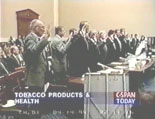
But do you recall that video of the seven tobacco companies' executives being sworn in
before a congressional committee 14 years ago, April 14, 1994, when they all -- having been sworn to tell the truth -- each denied in turn that nicotine was addictive? (The video; the transcript (about 1/3 down the screen).) [Credit: WhyQuit.com.]

None of this progress has been thanks to the tobacco lobby, which opposed it every step of the way.

Lobbyists, like bank robbers, simply go "where the money is."

Yes, as Part II noted, "the ties between business and government are tight -- whether in the halls of Washington, Des Moines or the City Council chambers of Iowa City."

Which brings us to one of Bob Patton's editorial cartoons. Patton is one of our nation's most insightful and talented editorial cartoonists. (The link on his name takes you to his blog/Web site, Patton's Pad, and an archive of samples of his work that will "illustrate" the reasons for my judgment about him.) The Press-Citizen is lucky to have his impact on the paper's graphics generally, but especially its editorial page.

To introduce this cartoon and its relevance to our topic: The Iowa City City Council, which has seldom seen a TIF (tax forgiveness to for-profit enterprises) it didn't like, and is quite prepared to give taxpayers' public money to for-profit enterprises, passed an ordinance in response to pressure from downtown businesses that forbids individuals to ask for private funds if they are within a designated forbidden area around a business' entrance. Here's how Patton pointed up the contrast:


Bob Patton, "Brother, Can You Spare a TIF?" Iowa City Press-Citizen, March 22, 2008, p. A15, posted March 27, 2008, 4:28 p.m.

[If you have difficulty reading the text: The fellow who's down on his luck has a sign that reads, "Need Help. Any money you can spare? Thank you. God bless." The caption reads, "Panhandling around City Hall, however, will still be permitted," where we see "Big Biz" with a sign reading, "Need to set up shop. Any tax breaks you can spare. Thanks. Now shut up and step aside."]

Anatole France put the analogous thought, "The poor have to labour in the face of the majestic equality of the law, which forbids the rich as well as the poor to sleep under bridges, to beg in the streets, and to steal bread."

In short, as France and Patton see clearly, but most fear to even whisper, it is not just that in our infant fascism we rob poor taxpayers to further enrich the wealthy. It is the hypocrisy.

We cheer because "Stocks rallied Tuesday [March 11] as investors welcomed news that the Federal Reserve will lend up to $200 billion to banks and lenders as a means of loosening up tight credit markets." Alexandra Twin, "Dow's best day in 5-1/2 years; Stocks surge with the Dow soaring 417 points as investors cheer reports that the central bank is pumping an additional $200 billion into the banking system," CNNMoney.com, March 11, 2008, 4:34 p.m. ET.

Anyone who calls that "corporate welfare" is dismissed as fomenting "class warfare," a "liberal," a "radical" -- or worse.

And yet it's perfectly acceptable to chastise and cast moral aspersions on the single mothers who get, not $200 billion, but $200 in food stamps, as "welfare mothers."

If you'd like to know more about this political phenomenon, . . .

For my own explanation of a number of categories of reasons why TIFs and other business subsidies don't make any sense, see Nicholas Johnson, "Courage, Councilors," October 3, 2008.

For an entire Web site devoted to the abortive efforts to put public money (local, state, and a $50 million federal earmark from Senator Grassley) into an indoor rain forest in Iowa, see Nicholas Johnson, "Earthpark," 2004-2007, Jane Norman, "Grassley defends earmarks for Iowa as valid," Des Moines Register, April 7, 2008 ("Grassley has been harshly criticized in years past for his support of a $50 million earmark for . . . an indoor rain forest to Iowa. The money was yanked by Congress late last year. The nonpartisan group Citizens Against Government Waste issued a report Wednesday [April 2] showing that Iowa ranked 16th in the nation when it came to earmarks per capita in the 2008 budget . . .."), and "Earmarks" in Nicholas Johnson, "Obama Mason and Public Finance," March 21, 2008.

And for a positive analysis of what does work in economic development see, Nicholas Johnson, "Time to Learn From What Works," Iowa City Press-Citizen, January 20, 2006.
Parts VII and VIII will provide more examples of the problems of "Money and Lobbyists in Politics" right here in good old, Midwest-values Iowa.

P.S. For the best evaluation of last night's [April 16] debate, referenced in Part V, give a read to John Deeth's "Debate Screwed Up So Bad No One Can Play It," John Deeth Blog, April 17, 2008.

And here's what Senator Barack Obama had to say about it.


# # #

Friday, February 15, 2008

UI and the ATF II

February 15, 2008, 10:15, 11:15 a.m.

I first wrote about the Bureau of Alcohol, Tobacco, Firearms and Explosives -- as it's now called -- last September, when the UI's primary focus was on alcohol (for underage binge drinkers) and firearms (for campus police).
Nicholas Johnson, "Alcohol, Tobacco and Firearms" in "Iowa City's 'Alcohol, Tobacco and Firearms,'" September 22 and 23, 2007. Those issues are still with us, but to them we have now added tobacco.

Alcohol

Alcohol abuse is still in the news, creating its easily predictable consequences. (And note how many of these stories were all in one day's paper!).

A patron, so drunk that even an Iowa City bar owner wouldn't let him buy more is turned out on the street and is now an alleged murderer. Brian Morelli, "Mandatory bartender training suggested; Possibility exists of charges against bar," Iowa City Press-Citizen, February 12, 2008; Brian Morelli, "Jakes refused entry to alleged murderer," Iowa City Press-Citizen, February 13, 2008.

A student is so drunk that he either falls or lies down in ice and snow overnight, still smells of alcohol when he's discovered by workmen in the morning, could easily have lost his life but thankfully looses only fingers and toes. Brian Morelli, "Student loses fingers, toes after passing out in alley," Iowa City Press-Citizen, February 13, 2008.

In my September entry I noted the captions on a Bob Patton cartoon cartoon depicting two guys at a bar. One says, "I can't wait for Iowa City bars to go 21-only! This will be such a boon to my business!" To which the other inquires, "What are you, a bar owner?" and the first responds, "No, I run a fake I.D. mill!" In the latest illustration of life imitating art, a student has been arrested for running just such a business -- selling fake IDs for $200 apiece. Lee Hermiston, "Police shut down fake ID business; seize drugs, guns," Iowa City Press-Citizen, February 9, 2008.

A local bar owner stiffs the Fire Department, refuses to fix a firetrap problem, then bellyaches when he's politely asked a second time, but is permitted to stay open. Editorial, "Council right to support fire official on bar license," Iowa City Press-Citizen, February 9, 2008.

Another bar, in violation of law, holds an "Extreme Midget Wrestling" contest. Lee Hermiston, "Local bar going to court over event; Paperwork is missing from 'Extreme Midget Wrestling' event," Iowa City Press-Citizen, February 13, 2008.

And a local bank vice president, by embezzling over a half-million dollars, comes up with an alternative to alcohol abuse: $150,000 worth of powdered cocaine. (We haven't heard much more about the fraternity that was recently closed because of the drug dealing going on from there.) Lee Hermiston, "Former Hills Bank VP indicted," Iowa City Press-Citizen, February 13, 2008.


Tobacco

To alcohol, the University has now added the matter of tobacco -- a substance which, while a leading cause of death -- causes much less general societal havoc than alcohol. See Harold Harker, Jr., "Alcohol Has Done More Damage Than Smoke," Des Moines Register, February 15, 2008 ("It's the ironic nature of the ad that created my chuckle. Here we see pictured an individual [a bartender standing in front of rows of liquor bottles] who is a purveyor of the legal drug in America that has single-handedly caused more personal heartache, death, destruction and suffering than any substance known to man -- not to mention related health problems, lower worker productivity, property damage and a host of other social ills . . . and he is complaining about breathing secondhand smoke?"). That's kind of my point.

Alcohol abuse gets a wink and a nod, and tobacco gets a total ban.
Erin Jordan and Mason Kerns, "U of I to ban smoking on campus next year," Des Moines Register, February 5, 2008. It's an interesting juxtaposition. (However, like alcohol, local businesses also profit from its sale to those under-age customers to whom sales are illegal. Lee Hermiston, "Three Coralville businesses fail tobacco checks," Iowa City Press-Citizen, February 13, 2008.

Don't get me wrong. I'm all for discouraging smoking. Epidemiologists have told me that they can still see in the statistics the impact of the 1960s anti-smoking commercials I encouraged when an FCC commissioner. As co-director of Iowa's Institute for Health, Behavior and Environmental Policy I helped select anti-tobacco efforts as our number one priority -- the most effective single thing we could do to promote public health.

But I do think that an academic institution of intellectuals has an obligation to at least recognize a distinction between the underlying rationale for various anti-smoking policies.

Smoke is a health hazard, whether from burnt toast, a bonfire or cigarettes. For a flight attendant in a plane, a waitress in a bar, a co-worker in a building, or a student in a classroom, there's little they can do to avoid that hazard. To prohibit smoking in such places is simply an application of the old adage that "your freedom to swing your arm stops where my nose begins."

The second-hand smoke prohibition is directed not so much at the harm the smoker is doing to him or herself, but rather to the harm they are doing to others (although a beneficial by-product of the policy may be the encouragement to quit it provides smokers).

However, to ban smoking anywhere on campus, irrespective of any harm it is doing to others (beyond de minimis), cannot claim that rationale. That's not to say such a policy cannot be justified. It's just to say that it's difficult to justify without acknowledging that it contains an element of paternalism (i.e., "we know better than you do what is good for you"). Now the fact of the matter is that we do know better than the smoker what is good for him or her -- indeed, there are a good many smokers who would agree that we do. It's only to say that you can't sneak the policy in under the "harm to others from secondhand smoke" tent.

A campus-wide ban has an element of social ostracism, a punitive quality, about it. That may be OK, but it at least needs to be acknowledged.

Firearms

Regarding the arming of campus police, in the September blog entry I wrote,

Very little (if any) evidence and data have been offered to support the notion that even if campus police were armed that they would have many (if any) occasions to use guns, or otherwise put, that their being armed would actually prevent acts of violence that, but for their possessing guns, would otherwise have occurred.
And so it is this morning that we read of yet another incident of inexplicable random gun deaths in a classroom at the near-neighbor Northern Illinois University. Ted Gregory, "NIU Gunman Identified," Chicago Tribune, February 15, 2008, 11:34 a.m. It's tragic; it's sad; but whether NIU has armed campus security or not, their guns would not have prevented this tragedy -- nor would the guns of our campus police should, God forbid, a similar incident occur here. As the Trib quotes NIU President Peters as saying, ""I don't know if any plan can prevent this kind of tragedy." And see Erin Jordan, "Regent: Steps to Protect Students Carry No Guarantees," Des Moines Register, December 15, 2008 ("[A] member of the Iowa Board of Regents [Craig Lang of Brooklyn] said there are no guarantees the steps [taken by the Regents and university administrators] are adequate [to guarantee student safety]. 'Unfortunately, that [the procedure put in place] doesn't mean we can protect everybody from someone like that who wants to kill.'")

I noted elsewhere,

There is no basis for the belief that guns on campus won't create the same risks as they do elsewhere -- including the risk that a campus police officer's gun will be stolen in a scuffle and then used on him or her, or someone else.
Nicholas Johnson, "Weaponry on Campus: Wrong Reasons, Wrong Result" in "Peace Through War; Security Through Weaponry," September 6, 2007.

Now, sadly, we've seen that prediction come true as well. A police officer in New Orleans, following a scuffle, was killed with her own gun by her assailant. It remains a real risk on the UI campus as well -- that armed police end up making a campus more dangerous rather than less.
Leslie Eaton, "Officer's Slaying Leaves New Orleans Asking Why," New York Times, January 31, 2008

But in some ways the most baffling aspect of arming our campus police -- hilarious if it weren't so serious and expensive -- involves the purchase of the guns. Lee Hermiston, "UI Police getting new guns," Iowa City Press-Citizen, February 4, 2008; Melanie Kucera, "UI police switch guns," The Daily Iowan, February 5, 2008.

Hermiston reports,

Since then [November 2007], officers have been carrying their black .40 caliber SIG Sauer P229s with them everywhere they go.

However, beginning in April, the officers will carry a new handgun, the .40 caliber Smith & Wesson M & P.
And the cost of this switch?

The department will order about 40 guns, Visin said, at the cost of about $430 per gun. Visin said that price is about $170 less per gun than the cost of the SIG Sauers. Also, Visin said that the department will be able to trade in their old guns to the provider and the credit officers receive will go towards the purchase of the new handguns.

“It’s costing us about $3,000 and some change,” Visin said.
OK, $430, plus the $170 additional for the P229s, is $600, times 40 guns is $24,000. Now we're going to pay an additional $3000 for the cheaper guns? What a deal we're getting on that trade-in, huh? The bottom line? Looks like we're going to be paying $27,000 for 40 $430 guns which, had we purchased them in the first place would have cost $17,200 rather than $27,000.

Of course, they get a lot of use so it's probably worth it, right? Kucera reports,

Since Nov. 22, 2007, when the UI police were officially armed, no instances of weapon use have occurred, Visin said. In the year and a half that state troopers have been using the guns, Paradise can only recall two times in which the trigger was pulled.

But wait, it gets worse.

Remember the call for armed campus police? One of the arguments was that they should be similarly equipped as the Iowa City Police. Well, they were. They won't be any longer. As Kucera reports, "The Iowa City police still use older guns, Glocks" -- the ones the campus police apparently had before they decided to "step up."

Someone calling himself "623" posted the following comment to Hermiston's Press-Citizen story,

It is misleading and foolish to call this weapon a "step up" from the weapons carried by other departments. While the M & P has sold very well since its inception, that has been strongly augmented by aggressive marketing and promotion. Despite good sales, there have been a number of issues with the guns and many "upgrades" to address those issues. The most recent of which involves melting of the frame after sustained firing. Smith and Wesson seems commited to the platform, but that doesn't make it better than anybody else's product.

The "step down" Glock pistols carried by other agencies (something like 75% or more agencies nationwide) are based on a design that is both simple and proven. A Glock pistol disassembles in to less than forty pieces and is perhaps one of the easiest weapons platforms on the market to maintain. Add to that near infinite industry support (holsters, parts, etc) and the fact that it has existed in virtually the same form for more than 20 years, and you simply may not call it a "step down."

The Sig handguns that the department of public safety is getting rid of are considered to be very "high end" guns.
"Posted by: 623 on Mon Feb 04, 2008 5:40 pm."

I have no idea who this is, and I claim no comparable knowledge about guns. But whoever he or she is they at least sound like they know what they're talking about.

Whatever else you may think about arming campus police, I don't think we're off to a very reassuring start.

# # #

Saturday, September 22, 2007

Iowa City's "Alcohol, Tobacco and Firearms"

September 22, 2007, 4:20 p.m.; September 23, 2007, 4:30 p.m.

Alcohol, Tobacco and Firearms

Iowa City is currently dealing with issues of alcohol, tobacco and firearms. It's a combination we come by honestly with solid historic precedent.

It was 1789, during the very first Congress, that the first federal legislation taxing alcohol was enacted -- in one sense the beginning of today's ATF.
By 1863 three enforcement officers -- presumably armed -- were added to its ranks. (The agency had found that not all moonshiners were enthusiastic about paying taxes.) Once a part of the Treasury Department, in January 2003 the ATF was transferred to the Justice Department as a part of the creation of Homeland Security. Its full name is the Bureau of Alcohol, Tobacco, Firearms and Explosives.

Nor has there been a shortage of guns.

The ATF publishes an annual report of U.S. handgun manufacturing. The agency is either woefully shorthanded or overly pressured by secrecy advocates among gun lobbyists and White House personnel, because the last "annual" report is for 2004. (Its website expresses the hope that the 2005 report may be ready sometime this month -- "mid-September 2007.")

Anyhow, in 2004 there were essentially four firms that accounted for half of the 728,511 new pistols (Sturm Ruger, Arizona; Bryco Arms, California; Smith & Wesson, Massachusetts; Beretta, Maryland), and two that were the source of half of the 294,099 revolvers (Sturm Ruger and Smith & Wesson). Bureau of Alcohol, Tobacco, Firearms and Explosives, "Annual Firearms Manufacturing and Export Report," 2004.

Firearms Beget Firearms

At the outset, let me repeat that my primary concern has been, not the ultimate decision regarding the arming (or not) of our campus police. It is the process by which we arrived at it. It was not, to borrow the line from Fox News, "fair and balanced." It was a presentation by advocates for arming, not an academic, analytical evaluation of the data. And such arguments as were made were not very persuasive, such as, "everybody else is doing it," and "but we're properly trained" -- neither of which address the central issue: Is there a genuine need for more weapons on the UI campus?

As Regent Rose Vasquez noted, "There was no situation that sort of rose up or elevated itself to a level that but for a gun, things would have been different."

Very little (if any) evidence and data have been offered to support the notion that even if campus police were armed that they would have many (if any) occasions to use guns, or otherwise put, that their being armed would actually prevent acts of violence that, but for their possessing guns, would otherwise have occurred. (Even less analysis was provided regarding exactly what it is campus police do; how student safety is allocated between them and City police; how the required numbers of both might be altered by exploring other options in the allocation of those responsibilities.)

But let's put that aside. Let's assume that they would have occasions to use them.

There seems to be at least some basis for concern that "guns beget guns;" that is to say, if someone is thinking about bringing a gun onto campus anyway they may well be more rather than less inclined to do so knowing that they may have occasion to deal with an armed campus police officer.

Here are three items that would seem to support that concern.

State29, who takes me to task for my position on the weapons issue, State29, "What Makes You So Special?" September 20, 2007, concludes, "Actually, I'm in favor of allowing students to conceal carry while on campus. That would freak out the ivory tower crowd even more, even though students having weapons available to them have saved lives."

Apparently at least a couple of UI students have already followed up on State29's suggestion. Kelsey Beltramea, "Some Live the 2nd Amendment; Two UI Students -- An Aspiring Police Officer and Former Marine -- are Both Licensed to Carry Concealed Weapons, and Support Arming UI Police," The Daily Iowan, September 18, 2007, p. 4A.

How many other students are licensed to "conceal carry"? How many more will be as a result of the campus police being armed? How many will carry guns even if they are not licensed to do so?

This morning's Press-Citizen has a Letter to the Editor suggesting that they all should. It reads in its entirety,

In response to your Sept. 15 story, "I can't walk home alone," I say, "You could if there was just one gun law: Everybody carries one."
Robert G. Dostal, "Carrying Guns Could Improve Safety," Iowa City Press-Citizen, September 22, 2007, p. 16A.

When Bob Patton had his editorial cartoon depicting President Sally Mason announcing "I think we should give armed campus police a shot -- perhaps I need to rephrase that" a reader named "airship" posted the comment, "Great idea, but I'm concerned that it might not go far enough. After all, what are the odds that a campus security officer will be right there when an incident occurs? Just to be extra safe and secure, I think we should arm all the students, too. With automatic weapons. And grenades." September 20, 2007, 1:52 p.m.
There's a certain superficial logic to these positions.

This is an age in which we do more and more for ourselves. We used to have to rely on a telephone employee to place our long distance calls. Now we can "dial" even internationally ourselves. Instead of elevator operators, we press the buttons. Grocery store employees used to get our groceries for us and then "ring them up." Now we get, bar-code-scan, and process our own credit card payments for them. The "service stations" of old are now but a pump and a credit card reader. Bank tellers have been replaced by ATMs -- a deprivation for which we pay, for the privilege of operating them ourselves. Not only have these changes shifted costs from businesses to their customers, radically increasing unemployment while employing us at something well under even slave wages, but they have imbued us with a do-it-yourself sense of responsibility and possibility.

The enthusiasm that university administrators across the nation bring to giving their campus police more deadly weapons teaches as lesson even more forcefully than if it were taught in a classroom: Safety and security in our society (or within other countries) can best be provided through the use of deadly weapons.

That being the case, why not -- as with the other aspects of our lives formerly provided by institutions -- carry the weapons ourselves, rather than rely on the institutional police? It appears the idea is catching on in some quarters, thus further increasing the weaponry on campus beyond the guns provided campus police.

This can be just one more way in which we can contribute to economic growth, with the increased gun sales, especially if the manufacturers see the potential in the academic gun market and ultimately offer us Microsoft-like "academic discounts" through the University Bookstore outlets and Iowa Book.

Alcohol

Once again we have a wonderful Press-Citizen juxtapositioning of a very well researched and written Rachel Gallegos page-one story with a delightfully incisive Bob Patton editorial cartoon. Rachel Gallegos, "Proposal Concerns Downtown Leaders; Businesses Worry Limit Would Hurt Profits, Vibrant Downtown Life," Iowa City Press-Citizen, September 22, 2007, p. A1.

(Unfortunately, the cartoon is not yet posted. It depicts two guys at a bar. One says, "I can't wait for Iowa City bars to go 21-only! This will be such a boon to my business!" To which the other inquires, "What are you, a bar owner?" and the first responds, "No, I run a fake I.D. mill!")

This whole thing would be hilarious if it weren't so serious -- what it's doing to young peoples' lives, the quality of downtown, the reputation of the city, the demands on (and costs to taxpayers of) the police.

"21-only." For starters, to call the proposal "21-only" is like naming an act of Congress that gives major campaign contributors the right to increase pollution "The Clean Air Act." Everybody gets to stay in the bars until 10:00 p.m. I don't know when these bars open in the mornings, but for at least 12 hours every day they're wide open.

I'm not going to get into the sleeping habits of undergraduates, and I'm certainly not going to advocate laws and regulations imposing curfews (although universities -- including Iowa -- certainly had them for fraternity and dorm residents years ago). And see the Gazette story, Alison Gowans, "It's the Law; Whether It's a City or Parental Curfew, Teens Know Time to be Home," The Gazette, September 23, 2007, p. L1.

But it does seem to me that leaving bars before 10:00 p.m. might be a good idea for those few undergraduates who are actually attending college for purposes of getting an education (if, indeed, they would be wanting to binge drink more than once a week in bars at all). By the time you get your things together and leave the bar, stand outside for some last minute visiting with friends and saying goodbye, walk to your residence, wind down and relax, get ready for bed, and actually fall asleep, 10:00 is about as late as you ought to be staying in bars anyway -- especially if you know the relationship between good health and mental alertness on the one hand and going to bed at the same time every night and regularly getting an adequate night's sleep on the other.

And even that's meaningless. As Patton's cartoon suggests, young college students tell me, national studies and polls report, and this morning's story repeats, what with fake IDs, half-hearted enforcement by bar owners (who operate with the inherent conflict of interest that the more willing they are to ignore the law the richer they become), and the ease with which underage patrons can order alcohol for themselves or have someone order for them, there are simply no meaningful restraints on under-age drinking in Iowa City.

As Jim Clayton, vice chairman of the Iowa Alcoholic Beverages Commission, and executive committee chairman of the Stepping Up Coalition is quoted in the story as saying, "They make money on that drink whether you drink it yourself, you give it to a friend or you stumble and spill it."

Prohibition??!! That anyone could characterize this profit-maximizing "compromise" as something "similar to Prohibition" is simply stunning. And yet the story quotes a local business person as saying just that.

Then comes, of course, the old canard from him: "Prohibition doesn't work -- never has never will."

(a) In point of fact, from a public health perspective the epidemiological data documents that Prohibition very effectively did work (in reducing alcohol-related illness and disease).

(b) Gallegos' story immediately continues to report that "Iowa City has a 69 percent binge drinking rate compared with the 42 percent binge drinking rate in Ames -- where there is a 21-and-over ordinance." So if "prohibition" seems to be working at another of the Iowa Regents' universities won't you please explain to me once again just why it is it won't work at the UI?

(c) A recent Gallup poll reports that during the 1940s the percentage of Americans who were regular smokers was in the low to mid-40% range. As recently as the late 1980s the percentages ranged from 31-38%. The percentage in July of this year (2007) was 21% -- the lowest ever recorded by the Gallup organization. There are of course many variables affecting these numbers, but clearly the "prohibition" of smoking in UI buildings -- along with thousands of other restaurants and buildings around the country -- has had its impact.
Besides, the "prohibition," such as it is, is already in the Iowa law. There is a legal "prohibition" on bars selling alcohol to anyone under 21 -- raising some question as to why the local bar owners (and their advocates on the City Council) are fearful of less revenue, since presumably they would assert they're not selling to under-age patrons now anyway -- either before or after 10:00 p.m.

Iowa City's version of "21-only" doesn't even go so far as to enforce the laws already on the books in a rational way -- as is done in Ames! It leaves open the opportunity bar owners have to sell as much alcohol to under-age drinkers as they can possibly get away with up until 10:00 p.m.!

And you call that "prohibition"??!! Give me a break.

Our "vibrant downtown life." Another argument put forward by those advocating continuing the violations of the "spirit" and letter of Iowa's liquor laws is that to comply with the law, discourage binge drinking, and minimize the illness, violence and sexual abuse that accompanies it, would interfere with the "vibrant downtown life" of Iowa City.

My dictionary offers many definitions of "vibrant" but vomiting, fist fights, falling-down drunk, and sexual assaults aren't among them.

Sailing to riches on a sea of beer. What was that old drinking song?

"75 million gallons of beer on the wall
75 million gallons of beer . . .."

That's how much beer was consumed in Iowa last year -- a good bit of it in Iowa City.

At 8 16-ounce-pint glasses per gallon, that's 600 million glasses, and . . . Oh, you can do the math. We're talking billions, not millions, of dollars.

Bar owners are making more money sailing on this sea of beer than Columbus ever made sailing on "the ocean blue."

So we're back once again to "revenue is needed." ("Once 'revenue is needed' is the Polestar for a university's financial decisions its moral compass begins to spin as if it was located on the North Pole." Nicholas Johnson, "UI Loves Gambling" in "UI Held Hostage Day 410 - March 7," March 7, 2007.) Although, in this instance, the revenue that is needed is coming from sales that are expressly in violation of Iowa law.

Change the law. State29 has what he thinks is a better idea: Just change the law to permit 18-year-olds to drink. State29, "The Publican Campaign," September 22, 2007.

The least one can say for such a proposal is that it would contribute to greater respect for the legal system generally -- a goal I have as a result of my legal training. Any law that is routinely violated, whatever the subject, only further erodes respect for all legal standards.

I have always held out the possible advantages of an "over-18" standard being substituted for the "over-21" -- though I would like to see the data, others' "best practices," and make sure that in our time and place (when and where alcohol abuse is not only rampant but thought "cute" as a rite and right of passage) that it really would be a safe and wise choice. Lowering the drinking age would at least remove the current attraction of "getting away with something; beating the system" as a reason for binge drinking.

I've actually proposed that we at least explore the possible advantages of going further: encourage parents to introduce children to alcohol European style (in very small quantities, or watered down), as a responsible, family-oriented, thing to do at meals. My guess (though I'd obviously want to base such a proposal on much more than a guess) is that it would go a long way to removing the association of binge drinking with rebelliousness (and, ironically, "maturity") in the minds of young college students.
Until we're able to get to more of the root causes of the UI's binge drinking problem, however, I'm not confident that telling bar owners and those too young to drink (according to Iowa law) that they are only free to violate the law before 10:00 p.m. is going to solve very much.

# # #