Showing posts with label fascism. Show all posts

Tuesday, July 15, 2014

From Earmarks (D.C.) to TIFs (I.C.): America's Fascist Economy

July 15, 2014, 3:55 p.m.
TIFs -- Therrre Back!!
"The people who own the country ought to govern it."

-- John Jay; Frank Monaghan, John Jay, chapter 15, p. 323 (1935).

I like Marc Moen -- including many of his architectural and other ideas for Iowa City.

What I don't like is the City Council's infiltration of the efforts of Iowa City's entrepreneurs, start-ups, established businesses, and capitalism generally by picking and choosing which for-profit enterprises they will infuse with taxpayers' money.

Today's Press-Citizen reports that the Council's latest give-away is going to Marc Moen in the amount of $14 million!! That's a little rich even for the members of Iowa City's City Council. Mitchell Schmidt, "Committee Approves Chauncey Funding Model; Recommends That City Council Back $14.1M TIF Request, Iowa City Press-Citizen, July 15, 2014, p. A1 [Credit for photo of proposed building: Iowa City Press-Citizen.]
Here are some relevant numbers. According to the 2010 census Iowa City contains 67,862 people, 27,657 households, and 11,743 families. Divide $14 million by those numbers and you get: $206.30 per person, $506.20 per household, or $1192.20 per family. Is there the remotest possibility that if the question of making those gifts to Moen from every Iowa City resident was put to a vote that it would ever muster a majority of support?
For nearly a decade I have been writing in newspaper articles and blog essays about the problems with TIFs, providing lists of the categories of their objectionable consequences -- why these transfers are bad for taxpayers, consumers, competitors of the recipients, the general economy, neighboring communities and governments, among other reasons. One column, from this past April, may be a useful summary: "Tussling Over TIFs: Pros and Cons."

A list of 39 of those prior columns and essays can be found in "TIFs: Links to Blog Essays."

Earlier this year I wrote a tongue-in-cheek column essentially throwing in the towel, revealing my misunderstanding regarding transfers of taxpayers' money to for-profit enterprises from earmarks in Washington to TIFs in Iowa City:
"Like 'Amazing Grace,' I was blind, but now I see: We don’t have a capitalist system. We probably never did. So how should we describe our economy? The word 'fascism' carries too much baggage from World War II -- dictators, suppression of opposition, aggressive nationalism, and even racism. 'Fascism' doesn’t describe America today. But from Washington, D.C., to cities, counties and states all across America, in terms of an economy, ours is the economy of fascism."
"TIF Apology."

Whether in Washington, Des Moines, or Iowa City, our elected officials, like Italy's Benito Mussolini 70 years ago, love to intertwine government and business into a kind of fascist economic whole within which, in our time, they can give our money to for-profit businesses. Who wouldn't like to get the credit (plus campaign contributions, and the virtually guaranteed re-election they make possible) for spending other people's money?

And the citizens, taxpayers and voters go along. They may support the idea of TIFs, they may not be paying attention, they may understand and oppose them but figure it's fruitless to protest, that the deck is stacked against them. The net result is the same: the officials are re-elected, and taxpayers' money continues to flow to the relatively wealthy and for-profit businesses.

To make matters worse, Iowa City's TIF-lovers now propose to add disrespectful insult to economic injury, by raising the sales tax (disproportionately borne by the poor and working poor), and shifting most of the income from this sales tax increase to property owners in the form of reduced property taxes -- thereby softening any possible political opposition from them to the TIF giveaways.

Council members' governing principle is similar to that of John Jay (1745-1829), as expressed in the quotation with which this blog summary began: "The people who own the country ought to govern it." Delete the "ought to" from that line and it pretty well describes governing in America today, whether nation, state -- or Iowa City. And those who own Iowa City are the members of the business community and, as in John Jay's time, the property owners.

But until the Council exercises the candor to place Jay's quote over the entrance to the City Hall, openly and candidly acknowledging what they are doing, I will continue to protest the hypocrisy of the community's TIF-funded fascism.
# # #

Sunday, April 13, 2014

Tussling Over TIFs: Pros and Cons

April 13, 2014, 8:25 a.m.

NOTE: For 40+ additional discussions of these issues, 2006-2015, see "TIFs: Links to Blog Essays."

Tough TIF Talk
Introduction: For years, TIFs have been controversial. ("Tax Increment Financing," by reducing a developer's property taxes, or directing them solely to his or her project, has the effect of transferring taxpayers' money to the bottom line of private, for-profit ventures.) Proponents cite a "benefit" -- essentially the existence of the developer's project -- while skeptics list a rather substantial list of the costs and burdens they believe more than outweigh any such benefit under any rational benefit-cost analysis.

The Gazette for Sunday, April 13, 2014, led its "Insight & Books" section (editorials, guest columns) with two guest columns taking opposite sides regarding the merits of TIFs: "Weighing the Pros and Cons of Tax Increment Financing; Talking TIF" -- found on the Opinion Page of The Gazette's Web site, and in hard copy as: Nicholas Johnson, "Costs Outweigh Possible Benefits," pp. A9, A12, and Chad Heiman, "TIF a Necessary Tool for Growth" pp. A9, A12.

Talking TIF: Costs Outweigh Possible Benefits

Nicholas Johnson
The Gazette
April 13, 2014, pp. A9, A12
http://thegazette.com/costs-outweigh-possible-benefits-20140413
[Submitted as: TIFs’ Multiple Costs Outweigh Any Possible Benefit]

There are many reasons why further enriching the backers of for-profit, private ventures with taxpayers’ money is a really bad idea. [Photo credit: Patrick McDonough.]

In 2006 I began a blog. Dozens of its 1000 essays deal with reasons to oppose TIFs. See “TIFs: List of Blog Essays,” http://fromdc2iowa.blogspot.com/2014/03/tifs-links-to-blog-essays.html.

Any one of them is reason enough to reject a TIF. To approve it, proponents need to show why none applies.

The issue is not whether a TIF has a single benefit. Benefit-cost analysis requires we total all the costs and burdens of that TIF and weigh them against its individual benefit.

Few if any can pass that test.

Ideological hypocrisy. How can those supporting free private enterprise, capitalism, and marketplace forces, who think “government is the problem” and want it “off their back,” justify taking money from the public collection plate?

Anti-democratic. City councils need voters’ approval of bonds for legitimate government projects. Yet they can give our money to their friends’ private projects on a whim.

Lowered credit rating. TIFs can impact credit ratings. Coralville went from a Moody Aaa credit rating, the highest, to a “lower medium grade” Baa2 in two years.

Opportunity costs. Spending money on one thing costs the lost opportunity to spend it elsewhere. Johnson County Supervisor Rod Sullivan once found a diversion of $700 million of property off the tax rolls. As a result, either we pay more taxes or Supervisors cut needed programs.

Unfairness to neighbors. The TIF-granting body’s neighbors often lose out as well – other communities and school districts with less money in their budgets.

Unfairness to competitors. TIFs tilt the playing field. They unfairly upset a free market, punishing honest competitors and benefitting no one except the TIF recipient.

Risky business. Money’s always available for good deals. If an entrepreneur, family, friends, investors, venture capitalists, and banks aren’t willing to fund a project, maybe taxpayers shouldn’t either.

TIFs complicate taxes. We don’t deserve more tax complexity and even less transparency.

“Money can’t buy love.” Why compete with bribes? A business that needs port access to the Pacific Ocean isn't coming to Iowa. If it did, it would leave for a bigger bribe. Maytag, offered $100 million to stay, left anyway.

TIFs are unnecessary. The Corridor is one of the fastest growing, lowest unemployment areas of Iowa. We already have what businesses want: skilled labor, transportation and communication infrastructure, quality education, cultural attractions and outdoor recreation.

TIF grantors’ poor skills, record. The subsidy-grantors' record is not great. Elected officials are more skilled at keeping contributors and constituents happy than at evaluating taxpayer-funded business proposals. TIFed projects have gone belly up, missed deadlines, and new jobs goals. With reasonable follow-up and transparency we’d know about many more. But TIFs in Iowa have more lenient provisions, and less oversight, than in most other states.

“Need” is unknowable. Many projects will go ahead without subsidy. If tax breaks are available, of course developers will say they need them. Maybe this is blackmail. Maybe they need to look harder for funding. There’s no way to know.

At a minimum, here are questions to ask before approving TIFs:

What is this government’s past record, when we compare promised results with ultimate return or loss?

Why is this project needed?

Why does that need exceed all conventional needs for public funds?

What will other government units lose? How much more will their taxpayers have to pay?

Of all possible TIF projects, why is this one a top priority?

Who benefits: all citizens, a small segment or primarily the recipient?

How much money is involved?

Why are those who will profit unwilling to invest what is needed? Are their reasons equally applicable to taxpayer funding?

Does the business plan indicate financial success, or reveal risks of failure?

If and when the recipient fails, skips town, goes bankrupt, or misses deadlines, how will taxpayers be protected?

What relationships are there between the potential recipient and the officials approving the funding?

How will the recipient’s unfunded private competitors be harmed?

TIFs shouldn’t be used at all. If used anyway, let’s do the wrong thing better:

Leave the tax code alone. Taxes are taxes, gifts are gifts – through appropriations, fully disclosed and audited.

Don’t privatize profits and socialize losses. It’s our money. Don’t give it. Loan it or invest it. Earn us some interest – with a City or State Bank. Invest our tax money; take an ownership share. Give us at least a gambler’s chance at occasional profit. Publicize the details.

We don’t have a fascist state, just a fascist economy, government and private enterprise blended to more resemble a purée than a stew with identifiable ingredients.

In Washington, D.C., it’s billions of tax dollars; in Des Moines hundreds of millions; in Iowa’s cities, TIFs. Without a taxpayer revolt, it’s unlikely to change.
_______________
Nicholas Johnson of Iowa City maintains www.nicholasjohnson.org and http://FromDC2Iowa.blogspot.com.

# # #

TIF a necessary tool for growth

Chad Heiman
The Gazette
April 13, 2014, pp. A9, A12
http://thegazette.com/tif-a-necessary-tool-for-growth-20140413

The 21st century global economy we live and work in is consistently evolving. The rapid pace by which business owners must adapt to meet market demands has never been more challenging.

As a community and region it is critical that we promote public policy that allows companies the option to not only operate their business under the status quo, but create an environment that promotes capital investment, company expansion and job creation.

MISINFORMATION

On the local level, the key tool to aid in doing this is Tax Increment Financing (TIF). There has been misinformation about TIF; specifically, how it works and the side effects of the tool being used. Marion has chosen to be forward thinking and responsible in using TIF as an incentive for companies to do business in our community.

It has been written that TIF incentives are awarded by a City Council without any public approval process; this would violate Iowa Code. A public hearing before the City Council is required for any new TIF project before it gets approval.

An additional public hearing must take place before an amendment to the Urban Renewal Area (designated area in which TIF project occurs) is approved. The process is public and allows for citizen involvement.

How do cities protect their investment? TIF incentives are financed through new property taxes that are generated by the development; current public funds are not used to finance the TIF incentive. An estimate is provided in the development agreement, but the actual TIF award is determined by the assessor. Taxpayers are protected because whoever has title to the property will be subject to pay the associated property taxes. With new development, no existing revenues are lost because of TIF.

ESCO GROUP’S TIF

The ESCO Group in Marion was awarded a TIF incentive package for construction of its new corporate headquarters in Marion’s Tower Terrace Road corridor. The ESCO Group is a Marion-based company that provides plant automation, electrical construction, power engineering, testing and safety training. The City of Marion provided ESCO with a $200,000 grant and an annual 60 percent rebate on their property taxes starting in 2013 and expiring in 2022, The total rebate will not exceed $1 million, per the agreement.

Because of this incentive package, ESCO chose to locate in Marion and brought a capital investment of $5.8 million for the community. The expansion is leading to the creation of 25 new, highly technical, quality jobs in the corridor. A law of economics states that people respond to incentives. The ESCO Group responded by building in a newly developing region in Marion and the commercial property tax base is expanding because of it. Many projects would not have happened without the economic development tool of TIF.

Before the development of the ESCO headquarters, the 2.85-acre piece of ag-land that ESCO now sits on would bring an estimated $4,000 in property taxes. Following development of this land, the estimated property tax bill will stand at an estimated $130,000 annually. I think we can all agree that a 1,315 percent increase in assessed value is a quality return on investment for Marion, our schools and our citizens.

The return on investment is magnified when one considers that new employees in the community will need places to live, stores to shop and restaurants in which to dine. Existing private business benefits because of TIF. The positive impact of this economic development tool is felt well beyond the brick and mortar involved with new construction.

ESCO CEO Ray Brown told us: “By opening up this valuable development area, Marion has great opportunity to expand its tax base to more commercial-light industrial, helping ease the tax burden of residential while also creating quality of life opportunities within this development.”

FAIR PLAY DEALS

Positive community development is everyone’s goal. One recent opinion was that “trying to move businesses from one community to another with competing TIF bribes is a lose-lose game,” and I would agree with that assessment.

That is why the communities in the Cedar Rapids metro area have signed fair-play agreements with each other establishing guidelines for communities when creating TIF incentive packages in the Corridor. When Marion experiences expansion, the Corridor as a whole benefits; the same can be said about business growth in the entire Cedar Rapids metro area.

Marion is one of the fastest-growing communities in Iowa, and that presents challenges, but we are growing our commercial and industrial tax base in a responsible manner. Making policy decisions or sweeping generalizations about TIF without facts, and based on one occurrence or anecdotal evidence, is dangerous.

TIF is anything but a lose-lose tool — it is the tool that allows private enterprise to flourish while giving communities the opportunity to realize its true economic potential. It’s a win-win for everyone.
_______________
Chad Heiman is Communications Manager for Marion Economic Development Company. Comments: chad@medcoiowa.org

# # #

Tuesday, March 25, 2014

TIFs: Too Many Negatives

March 25, 2014, 9:25 a.m.

Introduction: There has been a little spurt of TIF (tax incremental financing) stories and comments recently.

On March 18 an op ed column of mine was published by the Press-Citizen: Nicholas Johnson, "TIF: If You Can't Beat 'Em, Insist on More Transparency," Iowa City Press-Citizen, March 18, 2014, p. A7, embedded in "TIF Apology," March 18, 2014. Its assertions regarding the categories of reasons to oppose TIFs were supported by the earlier, "TIFs: Links to Blog Essays," March 16, 2014. [Photo credit: Patrick McDonough.]

The point of the March 18 blog essay/column was that TIFs are merely a natural instrument within a fascist economy. The reason they are the wrong thing to do lies within the nature of our economy rather than the nature of TIFs. Like other mixes of government and private money, however, they can better protect the interests of taxpayers (whose money it is that funds grants to business) if the money is loaned and invested rather than gifted -- thereby producing a return of interest and dividends, like any other conventional transaction.

The Gazette continued with articles that, in part, were efforts to justify TIFs and tax breaks to for-profit buinesses as a legitimate part of a capitalist economy. Chelsea Keenan, “The Benefits of Tax Breaks,” The Gazette, March 23, 2014, p. D1, online as “Are Tax Incentives an Effective Economic Development Tool?.” Rick Smith, "The Upside of TIFs," The Gazette, March 15, 2014; online as "TIF Incentives Can Bring Happy Endings; New Jobs, Infrastructure Improvements, Advancement in Shovel-Ready Sites Grow with Help of Incentive Programs."

I continued to take issue with those arguments for TIFs in the following letter to the editor:


Too Many Negatives, Too Little Upside to TIFs
Nicholas Johnson
The Gazette
March 25, 2014, p. A6

Your “The upside of TIFs” (March 15) needed what Paul Harvey used to call “the rest of the story.” No one I know argues there has never been any benefit from any tax increment financing deal, anywhere, at any time.

But that’s not the issue in a rational benefit-cost analysis.

There are 10 to 20 categories of reasons why all TIFs are a bad idea (See http://fromdc2iowa.blogspot.com/2014/03/tifs-links-to-blog-essays.html). And I have yet to see any TIFs benefit that could begin to outweigh all of those categories of disadvantages.

Here’s an example:

There would be “a benefit” to letting elementary school students simply roam freely throughout the community without parental supervision or need to attend school. They might better develop their natural curiosity and sense of self-reliance.

But the costs of that proposal — lack of student safety and education among them — would so heavily outweigh its potential benefit that no one seriously would propose it.

So it is with TIFs. An occasional “upside?” Of course. But hardly ever enough to outweigh the multiple downsides.

Nicholas Johnson
Iowa City

# # #

Sunday, March 16, 2014

TIFs: Links to Blog Essays

From the time this blog began, in 2006, a recurring topic of the blog essays has involved the variety of ways in which governments transfer taxpayers' money to the bottom line profit of various businesses.

Categories of reasons why these transfers are bad for taxpayers, consumers, competitors of the recipients, the general economy, neighboring communities and governments have been repeatedly identified and illustrated -- all with about as much impact as an oak leaf in October, falling upon a lake, and slowly drifting to the bottom. Nonetheless, it seems worthwhile to maintain this single site of titles and links for any who share the author's concern. -- Nicholas Johnson, March 16, 2014.


2015

"Chauncey's TIF," June 8, 2015

"TIFs -- Chauncey -- For the Record," May 25, 2015

2014

"Sycamore TIF Unnecessary," Iowa City Press-Citizen, November 23, 2014, p. A5, embedded in "Lucky's Gets Lucky: $1.7 Million of Taxpayer's Money," November 23, 2014

"From Earmarks (D.C.) to TIFs (I.C.): America's Fascist Economy; TIFs -- Therrre Back!," July 15, 2014

Nicholas Johnson, "Talking TIF: Costs Outweigh Possible Benefits," The Gazette, April 13, 2014, pp. A9, A12 [submitted as "TIFs' Multiple Costs Outweigh Any Possible Benefit," and embedded in "Tussling Over TIFs: Pros and Cons; Tough TIF Talk," April 13, 2014

"TIFs: Too Many Negatives," March 25, 2014

"TIF Apology," March 18, 2014

2013

"A TIF Discussion; Evolution of a Family's TIF Policy Position," June 9, 2013

"TIF Towers; Giving TIFs the Sniff Test," April 9, 2013

"Crony Capitalism's Failures: Iowa City Style; Gone With the Wind," April 8, 2013

"First Step to Reducing National Debt; Sunlight is the Best Disinfectant," April 4, 2013,

"Repealing Corporate Welfare: Step One; The Journey of a Trillion Dollars," March 25, 2013

2012

"Big Boxes, Little Bookstores and Taxpayers; We'll Leave the Prairie Lights on For You," June 6, 2012,

2011

"TIFs Wealthy Relatives; $7 Trillion Secret Giveaways to Banks; Marlins' Stadium," December 6, 2011

"TIF Impact Statements; The Questions We Should Insist Officials Ask First," November 29, 2011


"SSMIDs, Taxes and TIFs: The Lessons; Say 'No' to Tax Increases, 'Yes' to SSMIDs?!"
November 3, 2011

"The True Price of TIFs," October 1, 2011

"The Religious Indictment of Republicanism; Catholic University Professors Say Republican Budget Violates Basic Catholic Moral Teachings," May 14, 2011,

"Brother, Can You Spare a TIF? TIF Helps the Rich Get Richer," April 25, 2011

2010

None.

2009

None.

2008

"Taxpayer Rescue; The Way Free Private Enterprise is Supposed to Work: Thinking and Acting Globally and Locally," September 15, 2008

"Growing Iowa's Economy the Right Way," April 27, 2008

"Bush and Giveaways to Sheraton; Who's Best Bush? And, Raising Taxes to Increase Corporate Profits," April 25, 2008

"Call the Cops, Robbery in Progress," April 24, 2008

"Golden Rules & Revolutions: A Series - VIII," April 19, 2008 (with links to prior 7)

"Football, Skating and Corporate Welfare," January 25, 2008

2007

"Understanding TIFs," October 5, 2007

"Courage, Councilors," October 3, 2007

"TIFing Your Doctor," September 12, 2007 (with TIF lyrics for "Folsom Prison Blues")

"Public Money, Private Profits," August 24, 2007

"Cable, Coralville, Coal and Consultants, August 17, 2007 (subsection headed "Desperately Trying to Put a Good Face on TIFs")

"The Terrible TIFs; They're Back: The Terrible TIFs," July 26, 2007,

2006

"Riverside's Deeper Gambling Debt," November 11, 2006

"Riverside's Tax to Nowhere," October 31, 2006

"It's Not About 'Taxes,'" October 24, 2006

"More on Corporate Welfare from 'Hat's Off' Winner," October 22, 2006

"Call the Cops: $3.755 Million Robbery in Progress," October 18, 2006

"Why Do They Hate America?" October 4, 2006

"Press-Citizen Says 'Tough TIF,'" September 22, 2006

"Supervisor Sullivan Says 'TIF, TIF, Tsk, Tsk,'" September 16, 2006

"TIF-ing My Toolshed," September 2, 2006

"Coralville's Hotel: 'Trust But Verify,'" August 16, 2006

"Are TIFs 'Corporate Welfare'?" July 22, 2006

"More: Justifying Corporate Welfare," July 13, 2006

"Neutral Principles, Anyone? Justifying Corporate Welfare," July 12, 2006

# # #

Monday, June 11, 2012

E-Commerce Challenges Businesses, Governments, Taxpayers

June 11, 2012, 6:40 a.m. p.m.

Brief Intro:

Businesses, governments and taxpayers across Iowa's 99 counties and hundreds of cities and towns (indeed throughout America) are confronting three challenges from e-commerce in a global economy.

(1) Iowa's nationally and locally owned retail outlets, newspapers, and bookstores are struggling to find business models that will carry them from small town virtual monopoly storefronts into the highly competitive global marketplace of Web pages and social media.

(2) State, county and local governments are trying to figure out what they can best do to help the economies and communities of constituents for which they feel some responsibility.

(3) Taxpayers are questioning the wisdom of a "solution" that involves transferring their tax dollars from legitimate government projects to the bottom line of a handful of politically favored for-profit enterprises. Especially do they question the transfers when the money is used for business plans that appear to be pretty unimaginative responses to "e-commerce."

These issues were recently explored in depth here in "Big Boxes, Little Bookstores and Taxpayers; We'll Leave the Prairie Lights on For You," June 6, 2012.

That blog entry provided the research and source material, with links, for what ultimately became a column in this morning's Press-Citizen, below. If this is a subject that interests you that earlier blog entry is worth your exploration. Otherwise, this lighthearted 644-word column will provide a quick-read, summary view of these deadly serious issues.

Maybe Taxpayers Should Buy Wal-Mart a Gift Shop
Nicholas Johnson
Iowa City Press-Citizen
June 11, 2012, p. A7

The Iowa City Council, at least three members, recently leapfrogged over their colleagues to rule that local taxpayers should pay for a local business’s “museum quality gift shop” and café.

To “speed things up a little bit” they delegated the matter to the discretion of the city manager.

The grant is not even a TIF. It’s a $27,500 gift, plus a possible $15,000 1 percent loan.

Why do it? They want to “educate the public about eCommerce.”

The lucky beneficiary of this largesse? Iowa City’s Prairie Lights — widely beloved, and by no one more than me. But our love is not the issue.

The issue? Whether taxpayers really support the council handing over taxpayers’ money, without their approval, to favored for-profit businesses.

Clearly, the council is not interested in the answer.

Confronted with a petition to put public review of one of its latest controversial TIFs on the ballot, the council’s response is to suggest using a legal technicality to make the payment anyway, using a bond that citizens’ petitions can’t challenge.

This council switch would cost taxpayers an additional $300,000. The council thinks it’s worth the money to keep citizens at bay.

If it’s legally required we vote on the bonds to fund legitimate governmental projects, like the proposed county justice center, isn’t it even more appropriate the public be involved in taxpayer funding of private, for-profit businesses?

Capitalism means owners provide the capital, sometimes profit handsomely, but also bear all risks.

Socialism means governments own and provide traditional governmental services like police, fire, parks, schools, roads, libraries — and smoldering landfills.

What we’re doing — in Washington, Des Moines and Iowa City — is corporatism, the intertwining of business power and government largesse.

During World War II, in Benito Mussolini’s Italy, we called it fascism. Owners take the profits; taxpayers take the risks.

If that’s what local taxpayers truly want, there’s probably a way it can be provided constitutionally. But is that really what we want?

E-commerce? Aside from the café and gift shop, the city says this is the store’s “attempt to adapt to the ever-changing traditional and electronic market.”

That raises some issues.

According to the store’s website, it’s already in that business. Moreover, the owner concedes, “there’s no overhead.”

Every business confronts the “ever-changing traditional and electronic market,” including this newspaper.

Change can put a business out of business. However, this is the capitalist’s challenge, not the taxpayer’s responsibility.

Swiss watchmakers respond to digital watches, slide rule firms to calculators, mainframe computers to desktops, cellphones to smartphones — the examples are endless.

Bookstores are challenged with online sales, e-books, online self-publishing, Wal-Mart (40 percent of all best-seller sales), the cornucopia of Internet resources, the decline in discretionary time for reading.

Convenience, as well as savings, motivates e-book readers. If they can download a book to their Kindle while in bed and get advice from the Internet, why would they get out of bed and come to Prairie Lights for “a staff member to assist customers in e-book sales”?

Moreover, the city’s solution, adding a gift shop, is a way of getting out of the book business, it’s not a creative 21st-century e-commerce business model for staying in it. It’s like a pharmacist — also online and Wal-Mart challenged — adding groceries to the drug store merchandise.

In the greater Iowa City-Coralville area, every retail outlet must respond to the opportunities as well as the challenges offered by change.

Does the council intend to give our tax money to all of them? If not, why Prairie Lights?

Want to know which stores are suffering the greatest e-commerce impact? The Big Box stores, like Best Buy, Sears and Wal-Mart. Shoppers come to look, then order online from elsewhere. The companies are closing stores; their common stocks have declined.

Want to save those jobs, council?

Maybe local taxpayers should buy Wal-Mart a “museum quality gift shop.”
__________
Nicholas Johnson, another satisfied Prairie Lights customer, teaches at the University of Iowa College of Law and maintains http://FromDC2Iowa.blogspot.com.

# # #

Wednesday, May 26, 2010

Big Oil: Calling Shots, Corrupting Government

May 26, 2010, 7:00 a.m.
[For BP disaster see, "Obama As Finger-Pointer-In-Chief," May 18, 2010; "Big Oil + Big Corruption = Big Mess," May 10, 2010; "P&L: Public Loss From Private Profit," May 3, 2010.]

Hey, Hey, Ho, Ho
Salazar Has Got to Go!

(bought to you by FromDC2Iowa.blogspot.com*)

All systems of government are capable of being bent and twisted beyond recognition, compared with their initial theoretical promise and potential -- democratic capitalism, communism, socialism, fascism.

The only limits on the pejoratives thrown by President Obama's opponents are the limits of human imagination. But one of their favorites is that he is a "socialist." That is so far off the mark as to be funnier than the best from Jon Stewart. Were that he were! To watch our democratic capitalism morph into democratic socialism -- a highly unlikely prospect at any time -- would cause me far less concern that what I see happening.

The real risk is that we have already allowed our democracy to morph into corporatism, rule by major corporations, unchecked by democratic institutions -- a form of fascism. (Although even fascism at least typically allows for a stronger role for government than what we seem to have today in a corporate-government ruling partnership.)

Consider this report from the New York Times: "In the days since President Obama announced a moratorium on permits for drilling new offshore oil wells and a halt to a controversial type of environmental waiver that was given to the Deepwater Horizon rig, at least seven new permits for various types of drilling and five environmental waivers have been granted, according to records." Ian Urbina, "Despite Moratorium, Drilling Projects Move Ahead," New York Times, May 24, 2010, p. A1.

The story gets worse, as I'll lay out in a moment; but for now just re-read that lead. This was not a call for a moratorium by the executive director of some environmental group. (There were those as well.) This was the President of the United States ordering a moratorium on drilling permits and environmental waivers.

Note that it was not even a order to stop pumping oil from offshore Gulf of Mexico wells -- as reasonable and understandable as such an order would be at this time. It was only a prohibition on more drilling in violation of the nation's environmental laws.

And how did his Secretary of the Interior, Ken Salazar, and his corrupt Minerals Management Service, respond? Did they, as Oliver North once characterized as the appropriate response, "salute smartly and charge up the hill," canceling all pending applications for additional drilling? No. They totally ignored it, and continued business as usual with their powerful buddies in the oil industry, risking additional pollution of the Gulf from others utilizing BP's approach.

So what are we left with? The pollution in the Minerals Management Service has continued to spread just as BP's continuing pollution of the Gulf increasingly destroys the human and animal life from the depths of the ocean to the nation's southern coast.

And who has President Obama -- who as late as April 2 of this year was still functioning as cheerleader for the offshore drilling gang -- decided can best clean up these messes? Ken Salazar -- who has presided over the MMS mess for over a year, and either knew, should have known, or actually made worse, what was going on there -- is the fox in charge of cleaning up that chicken coop. And who's in charge of cleaning up the ongoing pollution? Why BP, of course; the very folks who got the waivers from the MMS that permitted them to drill without an environmental plan in the first place.

Here are some excerpts from "the rest of the story":

[S]ince the April 20 explosion on the rig, federal regulators have granted at least 19 environmental waivers for gulf drilling projects and at least 17 drilling permits, most of which were for types of work like that on the Deepwater Horizon shortly before it exploded . . ..

Asked about the permits and waivers, officials . . . pointed to public statements by Interior Secretary Ken Salazar, reiterating that the agency had no intention of stopping all new oil and gas production in the gulf. . . .

[C]ritics say the moratorium has been violated or too narrowly defined to prevent another disaster. . . .

Since the explosion, federal regulators have been harshly criticized for giving BP’s Deepwater Horizon and hundreds of other drilling projects waivers from full environmental review and for failing to provide rigorous oversight of these projects. . . .

Mr. Obama announced on May 14 a moratorium on drilling new wells and the granting of environmental waivers.

“It seems as if permits were too often issued based on little more than assurances of safety from the oil companies,” Mr. Obama said. “That cannot and will not happen anymore.”

“We’re also closing the loophole that has allowed some oil companies to bypass some critical environmental reviews,” he added in reference to the environmental waivers.

But records indicated that regulators continued granting the environmental waivers and permits for types of work like that occurring on the Deepwater Horizon. . . .

At least six of the drilling projects that have been given waivers in the past four weeks are for waters that are deeper — and therefore more difficult and dangerous — than where Deepwater Horizon was operating. While that rig, which was drilling at a depth just shy of 5,000 feet, was classified as a deep-water operation, many of the wells in the six projects are classified as “ultra” deep water, including four new wells at over 9,100 feet. . . .

[O]one of the main justifications of the moratorium on new drilling was safety. . . .

And yet, the federal Occupational Safety and Health Administration has classified some of the drilling types that have been allowed to continue as being . . . hazardous . . .. [T]here have been at least three major accidents involving spills, leaks or explosions on rigs in the gulf since 2002 caused by the drilling procedures still being permitted. . . .

Mr. Salazar, when pressed to explain why new drilling was being allowed, testified on May 18 that “there is no deep-water well in the O.C.S. that has been spudded — that means started — after April 20,” referring to the gulf’s outer continental shelf.

However, Newfield Exploration Company has confirmed that it began drilling a deep-water well in 2,095 feet of water after April 20. . . .

Among the types of drilling permits that the minerals agency is still granting are called bypass permits. These allow an operator to drill around a mechanical problem in the original hole to the original target from the existing wellbore.

Five days before the explosion, the Deepwater Horizon requested and received a revised bypass permit, which was the last drilling permit the rig received from the minerals agency before the explosion. The bore was created and it was the faulty cementing or plugging of that hole that has been cited as one of the causes of the explosion. . . .

Even before the Deepwater Horizon disaster, the use of environmental waivers was a source of concern. In September 2009, the Government Accountability Office released a report concluding that the waivers were being illegally granted to onshore drilling projects.

This month, the Interior Department announced plans to restrict the use of the waivers onshore, though not offshore. . . .

The investigation, however, is likely to take months, and in the meantime the waivers are continuing to be issued. There is also a 60-day statute of limitations on contesting the waivers, which reduces the chances that they will be reversed if problems are found with the projects or the Obama administration’s review finds fault in the exemption process.

At least three lawsuits to strike down the waivers have been filed by environmental groups this month. The lawsuits argue that the waivers are overly broad and that they undermine the spirit of laws like the National Environmental Policy Act and the Endangered Species Act, which forbid drilling projects from moving forward unless they produce detailed environmental studies about minimizing potential risks.
Ian Urbina, "Despite Moratorium, Drilling Projects Move Ahead," New York Times, May 24, 2010, p. A1.

Even the most inattentive, blind and hardhearted of institutional executives usually respond to massive bad publicity in the mainstream media. The major problems involve matters that do not receive such public attention, and thus can be ignored -- often to the profit of the institution, even if to the loss of its customers and employees.

In this instance, it's not even clear that the otherwise sophisticated Obama Administration has even responded as one would expect from a public relations disaster.

But as tragic as are the consequences of America's most serious ecological disaster in history, there is an even more serious problem.

What has President Obama done during the last year-plus with regard to other abuses of the public trust that may be going on in the federal government? What has he done proactively, preemptively, to avoid the corruption and agency capture by industry elsewhere than at the MMS? To what extent does he care; and how has that care been manifest -- beyond running through the playbook after the disasters occur?

I can't begin to list all the possible places to look, but here are a few: President Eisenhower's "military-industrial complex" (the Defense Department-defense contractor revolving door; Congressional pressure for weapons systems the military don't want or need); the "cozy relationship" (to use Obama's characterization) between the industry that is supposed to be regulated and, say, the FAA, FDA, OSHA, MSHA (Mine Safety and Health Administration; think Massey Coal and 29 dead), SEC, agricultural and other subsidy and price support programs. The list is endless.

Has President Obama initiated any inquiries into general Washington "coziness"? Has he provided any, specific, instructions to his appointees on this score? Is he aware that he is the CEO of an organization with hundreds of otherwise-hidden agencies, any one of which is a potential political weapon of mass destruction?

I recall a companion once commenting as the driver of the car in front of him was seemingly unable to bring himself to proceed beyond a "Yield" sign: "Hey, it says 'yield,' not capitulate completely!"

I fear that we as a nation have also passed beyond merely yielding to corporate control to the place where we have capitulated completely. We're not even running a reputable fascist state anymore.

The first step on the road to reform is to get rid of Secretary Salazar. The second is to acknowledge that the problem is systemic and that the removal of one cabinet officer isn't going to clean up either corruption in government or oil pollution in the Gulf.
_______________

* Why do I put this blog ID at the top of the entry, when you know full well what blog you're reading? Because there are a number of Internet sites that, for whatever reason, simply take the blog entries of others and reproduce them as their own without crediting the source. I don't mind the flattering attention, but would appreciate acknowledgment as the source -- even if I have to embed it myself.
-- Nicholas Johnson
# # #

Friday, April 18, 2008

Golden Rules & Revolutions: A Series - VII

April 18, 2008, 7:30 a.m.

Today is the seventh in a series, "Golden Rules & Revolutions." Here are the prior entries:

I - Income Disparity & Revolution
, April 12, 2008
. "Series Introduction," "Increasing income disparity, despair. . .," ". . . and Revolution"

II - Golden Rules & Fascism, April 13, 2008
. "The Golden Rule," "Fascism"

III - Money and Lobbyists in Politics: Washington, April 14, 2008

IV - Presidential Candidates and Lobbyists: McCain, April 15, 2008

V - Presidential Candidates and Lobbyists: Clinton, April 16, 2008

VI - Money and Lobbyists in Politics: Iowa, April 17, 2008

# # #

Money and Lobbyists in Iowa: Hormel's Pork

Part I of this series noted not just the gap in income between the rich and the poor, but the fact that this gap is continuing to grow ever wider, and that history -- as well as the daily news -- provides ample warning that this condition often produces revolution.

Part II began the exploration of the forces that may be shaping these potentially dangerous conditions -- including the ties between business and government eerily reminiscent of the early stages of what we used to call "fascism."

Part III took us to Washington for some general descriptions of how the system works, what campaign contributors get for their money, the role of lobbyists, and a columnist's description of one case study.

Part IV dealt with how the role of lobbyists extends beyond their manipulation of government into the pre-governing phase: presidential campaigns -- beginning with Senator John McCain.

Part V examined Senator Hillary Clinton's campaign from this perspective -- and tried to figure out who is the biggest "elitist."

Part VI returns to an application of the subject of Part II: "the ties between business and government eerily reminiscent of the early stages of what we used to call 'fascism.'" Although this time, instead of looking down the road to Washington for the consequences of "Money and Lobbyists in Politics" we take a shorter drive -- to Des Moines and Iowa City.

Part VII offers one example, from among dozens that could be mentioned, of "Money and Lobbyists in Iowa" -- the tax breaks, cash and infrastructure offered to Hormel.
_______________

Since the opening of the introduction to Part VI is equally applicable to Part VII, it's repeated here for those for whom Part VII is their first exposure to this series:

Part III began the discussion of "Money and Lobbyists in Politics" noting the "$2.79 billion that the special interests spend on lobbyists, and the the millions and billions of dollars the special interests 'invest' in 'campaign contributions'" -- primarily in Washington.

But it added, parenthetically, "in state legislatures as well as Congress, and among the best investments these businesses ever make."

Bear in mind, lobbyists don't head to Washington just because they like the restaurants -- though they do. They go for the same reason Willie Sutton once offered for why he robbed banks. "Because that's where the money is."

When the money is elsewhere they'll go there.
But what if they're already "there" -- in this case, in Iowa? How can public officials -- state or local -- justify transferring the tax dollars of poor taxpayers onto the bottom line of for-profit businesses (and into the pockets of their super rich CEOs)?

Inevitably, these cash transfers (and cost avoidance, such as tax breaks) are advertised as "jobs programs." But of course this is nonsense. There may be very few jobs involved. They may pay only average salaries. There's little follow-up to see if they're actually created. There's usually no payback when the company decides to leave vacant facilities behind and move on in response to a bigger bribe elsewhere -- or simply goes bankrupt because the business plan wasn't well thought through. And how can anyone ever know if they would have been created anyway even without the bribes?

Do these payments sometimes come about, even in part, because of personal friendships, or even "campaign contributions," from the beneficiary of such governmental largess to the public officials and political candidates responsible for the gifts? You have to wonder.

All of which brings us to . . .

Hormel's pork. I was reminded of all this once again the other day, reminded that "the beat (-ing up of the American citizen-taxpayer) goes on," with the news of the cash transferred from the people to the Hormel Corporation.

Hormel Foods' project to build a new food plant in Dubuque landed $444,791 in additional state incentives Tuesday.

The Iowa Transportation Commission awarded a $444,791 RISE immediate opportunity grant to the City of Dubuque for construction of new roadway in the Dubuque Industrial Center East. The one-third mile stretch of pavement south of Chavenelle Road will provide access to the plant site.

Hormel was earlier awarded $6,115,980 in state tax incentives through the High Quality Job Creation Program by the Iowa Department of Economic Development Board for the project.

Hormel is developing the plant to produce single-serving shelf-stable meals that do not require refrigeration. That product line, Hormel Compleats, are a rapid growth area for the Austin, Minn., company. . . .

Hormel said its choice of Dubuque for the plant was due partly to its proximity to the company's grocery products distribution center in Eldridge.
David DeWitte, "Dubuque Hormel plant lands more state incentives," GazetteOnline, April 9, 2008, 5:50 p.m.; The Gazette, April 10, 2008, p. B7.

Why should Iowa's taxpayers have put over $6.5 million of their money into this for-profit project that will primarily benefit Hormel's executives and shareholders? Roads that Hormel would otherwise need to pay to build? Taxes Hormel would otherwise have to pay -- as a result of which either programs will need to be curtailed or someone else will have to pay Hormel's share?

Was this taxpayer generosity needed to develop some new agricultural, bio-fuel, or energy-creating product -- or other great contribution to humankind? No. The free private enterprise system was fully up to the task of coming up with this new artificial food. These "single-serving shelf-stable meals that do not require refrigeration . . . Hormel Compleats" are already on the market.

Does the company need a hand with the promotion of an innovative product that has not yet caught on in the market? No. The product is already a "rapid growth area" for the company.

Was it necessary to give the company these bribes to get it to locate the plant in Iowa (accepting for the moment the erroneous assertion that such bribery would ever make good economic sense for Iowans)? No. "Hormel said its choice of Dubuque for the plant was due partly to its proximity to the company's grocery products distribution center in Eldridge."

Indeed, companies' choices of location are somewhere between often and always significantly affected by factors other than bribes: access to raw materials, an educated labor force, customers, "quality of life" factors attractive to professionals, or as in this case access to transportation systems and "distribution centers."

In Part VI there was reference to a Press-Citizen column of mine dealing with these issues. Here now are some excerpts from that column, identifying not just reasons but some of the categories of reasons why what I call this "infant fascism" (a government-corporate financial axis) doesn't make sense for anyone -- especially taxpayers:

"Corporate subsidies make no sense for Iowa City both because of the multiple categories of reasons they’re foolish for any community, and the additional reasons they’re especially silly for Iowa City.

The "opportunity costs" are enormous. County Supervisor Rod Sullivan estimates nearly $700 million of property value has been diverted from normal taxation – resulting in either more taxes for the rest of us or cuts in needed programs.

They reek of hypocrisy. How can a business simultaneously say, “Get the government off my back,” while holding out a tin cup?

Corporate welfare tilts the playing field. It’s fundamentally unfair to ask businesses to compete against a favored few funded by government. It upsets a smoothly working free market to no one’s benefit – except the lucky recipient.

If the market won’t back a project, why should the public? If private sector money isn’t forthcoming that’s a pretty persuasive indication it’s not appropriate for the public's money either.

It doesn’t work. Governor Tom Vilsack offered Maytag $100 million not to leave Newton. It left anyway. Should he have offered $200 million? I don't think so.

“Money can’t buy love.” It may buy sex – but we have another word for that. Why compete for businesses that won’t come without bribes? Let ‘em go elsewhere. Besides, a firm that likes San Diego's climate and needs port access to the Pacific probably isn't going to come here for any amount of money.

The subsidy-grantors' record’s not great. Public officials are skilled at keeping constituents and contributors happy, getting re-elected, and moving to higher office. They’re less skilled at evaluating taxpayer-funded business proposals – a lot of which go belly up, miss construction deadlines, or new job goals even with our money.

Alternative approaches do work. Businesses look for more than taxpayers’ bribes; things like an educated and skilled workforce, transportation and communication infrastructure, and quality of life – schools, parks, theaters, neighborhoods, restaurants and natural settings. Those investments will both attract business and benefit the public.

Try “seed funds.” There’s nothing to keep the business community from creating group venture capital efforts called community seed funds – as it has. Those are investments of private money, not gifts of public money.

“Need” is impossible to know. Many projects will go ahead without subsidy. If tax breaks are available, of course entrepreneurs will say they won’t act without them. But how can we know when that’s just blackmail?

Lack of transparency. It’s virtually impossible for the public and media to follow the shell-and-pea game of cheap land, tax abatements, cash grants, and other transfers of their money. Few projects would be funded if all benefits were translated into public cash on the table for voters to approve.

That’s why business subsidies don’t make sense for any city.

Why are they especially inappropriate for Iowa City? We don’t need them. We’re not in a 1930s depression with boarded-up store fronts and 40% unemployment. Our economic growth is satisfactorily driven by entrepreneurs, investors, venture capitalists and banks – plus the University.

We’re one of America’s top ranked cities by virtually any measure.

Have a little self-confidence, City Council candidates. It makes us less attractive, not more, to tell the world we, too, have to offer bribes."

Nicholas Johnson, "Courage, Councilors," Iowa City Press-Citizen, October 3, 2008, p. A12.

Think about these categories. Then think about Hormel. Isn't it a classic case study?

Hormel buys pork by the ton in the marketplace and seems perfectly capable of profiting handsomely by doing so. How do Iowa's taxpayers benefit by going into business with the company -- assuming some of the costs of its business, giving it "pork" for free, while reaping none of the profits?

# # #

Thursday, April 17, 2008

Golden Rules & Revolutions: A Series - VI

April 17, 2008, 7:00 a.m.

Today is the sixth in a series, "Golden Rules & Revolutions." Here are the prior entries:

I - Income Disparity & Revolution
, April 12, 2008
. "Series Introduction," "Increasing income disparity, despair. . .," ". . . and Revolution"

II - Golden Rules & Fascism, April 13, 2008
. "The Golden Rule," "Fascism"

III - Money and Lobbyists in Politics: Washington, April 14, 2008

IV - Presidential Candidates and Lobbyists: McCain, April 15, 2008

V - Presidential Candidates and Lobbyists: Clinton, April 16, 2008

# # #

Money and Lobbyists in Politics: Iowa

Part I of this series noted not just the gap in income between the rich and the poor, but the fact that this gap is continuing to grow ever wider, and that history -- as well as the daily news -- provides ample warning that this condition often produces revolution.

Part II began the exploration of the forces that may be shaping these potentially dangerous conditions -- including the ties between business and government eerily reminiscent of the early stages of what we used to call "fascism."

Part III took us to Washington for some general descriptions of how the system works, what campaign contributors get for their money, the role of lobbyists, and a columnist's description of one case study.

Part IV dealt with how the role of lobbyists extends beyond their manipulation of government into the pre-governing phase: presidential campaigns -- beginning with Senator John McCain.

Part V examines Senator Hillary Clinton's campaign from this perspective -- and tries to figure out who is the biggest "elitist."

Part VI returns to an application of the subject of Part II: "the ties between business and government eerily reminiscent of the early stages of what we used to call 'fascism.'" Although this time, instead of looking down the road to Washington for the consequences of "Money and Lobbyists in Politics" we take a shorter drive -- to Des Moines and Iowa City.
_______________

Part III began the discussion of "Money and Lobbyists in Politics" noting the "$2.79 billion that the special interests spend on lobbyists, and the the millions and billions of dollars the special interests 'invest' in 'campaign contributions'" -- primarily in Washington.

But it added, parenthetically, "in state legislatures as well as Congress, and among the best investments these businesses ever make."

Bear in mind, lobbyists don't head to Washington just because they like the restaurants -- though they do. They go for the same reason Willie Sutton once offered for why he robbed banks. "Because that's where the money is."

When the money is elsewhere they'll go there.

There are a couple of anecdotes from my personal experience that make the point.

Business leaders and their lobbyists sometimes say, "get the government off my back." But it's a little disingenuous. Because "regulation," often as not, comes about because of a request by business -- many times in an effort to use the power of government to limit competition, permit the growth of oligopolies and monopolies, and the resulting greater profits for companies -- and pay for the CEOs. Such was the case with some industries I've had experience with: airlines, broadcasting, cement, shipping, ship building, and steel -- among others.

(1) Cable Television. Consider the story of cable television regulation.

In the early days, when no one much understood or cared about cable, its regulation was left entirely to local communities. Local council members, who could know little of its future implications, or their potential bargaining power, could be easily bamboozled by "the cable guys" -- and they were.

If there was any resistance, the companies would simply offer ownership shares to leading local citizens (called "rent-a-citizen"), sell the community on the notion that this was now a "local" company, and then let their rented citizens sell back their shares at substantially increased prices, while all declared that these were simply "profits" not "bribes."

"Keep the government off our backs," cable cried to its friends in congress and the FCC.

Then the Ford Foundation created the Cable Television Information Office that began educating local communities about cable's potential -- and their bargaining power. Soon marketplace forces began to work their way; cities would see which companies would make the best offer: number of channels, 100% coverage of the city, local public access channels, and franchise fees.

Business representatives will give "free private enterprise" a standing ovation at Rotary, but panic at the prospect of its moving next door.

So the cable industry lobbyists left the cities in droves and came to Washington, pleading that we would please put the government on their backs, regulate the cable industry, and ameliorate the pain they were feeling from cities insisting they be given a fair deal.

Why Washington? Think about it. It's so much easier to work your will in one city than in 10,000. There were then only seven commissioners (now five), and a couple of congressional committees with any meaningful jurisdiction.

And so today cities have little or no ability to regulate what programs are carried on their cable systems, the rates charged by the companies, or whether their franchises will be renewed for lengthy terms.

(2) Tobacco. When Richard Remmington asked me to serve as his co-director of Iowa's Institute for Health, Behavior and Environmental Policy, one of our first tasks was to determine where we could get the biggest bang for our very limited bucks.

Smoking and other consequences of tobacco seemed a good place to focus. After all, as the Centers for Disease Control and Prevention note, "Cigarette smoking is the single most preventable cause of premature death in the United States. Each year, more than 400,000 Americans die from cigarette smoking." CDC, "Cigarette Smoking-Related Mortality" (September 2006).

This still left us with an analytical problem analogous to triage ("the process of sorting victims, as of a battle or disaster, to determine medical priority in order to increase the number of survivors"). Among all the aspects of smoking, all the strategies one could adopt to try to reduce it, which would be the most efficient and effective for a small group such as ours?

We finally settled on the matter of the 3000 "replacement smokers" the tobacco industry addicts each day -- given the industry's rather self-defeating challenge of being in a business where profit could only come by killing off one's customer base. What were the causes of, and most effective programs for reducing, young persons' taking up the habit?

Because I knew some of the folks in congress who might be of help, I paid them a visit on one of my trips to Washington. A top staffer explained to me that he would love to hold another hearing but for the reality that whenever he had done so in the past the power of the tobacco lobby was such that he never could get a majority of his committee's members to vote for any legislation opposed by the industry.

But he had helpful advice for me: "Nick, given the control the tobacco lobbyists seem to have over Washington, why don't you see what you can do with the states' legislatures."

So I started to investigate that possibility.

I discovered that the tobacco lobby already had 40 -- count them, 40 -- lobbyists working the Pennsylvania legislature alone. And things weren't much better in Iowa. The industry was beating us to the punch, anticipating our every move. Lobbying Washington, state legislatures, and city councils (when they couldn't get state legislatures to "preempt" cities imposing tougher regulation than those the lobbyists could get out of the legislatures).

Times have changed. Smoking isn't as "cool" as it once was for teens. More adults are aware of the health hazards. The tobacco companies have become conglomerates, with plenty of cash flow from other businesses to keep them going after they've killed off their customer base for tobacco and the "replacement smokers" have stopped coming in adequate numbers.

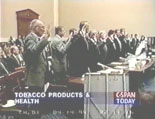
But do you recall that video of the seven tobacco companies' executives being sworn in
before a congressional committee 14 years ago, April 14, 1994, when they all -- having been sworn to tell the truth -- each denied in turn that nicotine was addictive? (The video; the transcript (about 1/3 down the screen).) [Credit: WhyQuit.com.]

None of this progress has been thanks to the tobacco lobby, which opposed it every step of the way.

Lobbyists, like bank robbers, simply go "where the money is."

Yes, as Part II noted, "the ties between business and government are tight -- whether in the halls of Washington, Des Moines or the City Council chambers of Iowa City."

Which brings us to one of Bob Patton's editorial cartoons. Patton is one of our nation's most insightful and talented editorial cartoonists. (The link on his name takes you to his blog/Web site, Patton's Pad, and an archive of samples of his work that will "illustrate" the reasons for my judgment about him.) The Press-Citizen is lucky to have his impact on the paper's graphics generally, but especially its editorial page.

To introduce this cartoon and its relevance to our topic: The Iowa City City Council, which has seldom seen a TIF (tax forgiveness to for-profit enterprises) it didn't like, and is quite prepared to give taxpayers' public money to for-profit enterprises, passed an ordinance in response to pressure from downtown businesses that forbids individuals to ask for private funds if they are within a designated forbidden area around a business' entrance. Here's how Patton pointed up the contrast:


Bob Patton, "Brother, Can You Spare a TIF?" Iowa City Press-Citizen, March 22, 2008, p. A15, posted March 27, 2008, 4:28 p.m.

[If you have difficulty reading the text: The fellow who's down on his luck has a sign that reads, "Need Help. Any money you can spare? Thank you. God bless." The caption reads, "Panhandling around City Hall, however, will still be permitted," where we see "Big Biz" with a sign reading, "Need to set up shop. Any tax breaks you can spare. Thanks. Now shut up and step aside."]

Anatole France put the analogous thought, "The poor have to labour in the face of the majestic equality of the law, which forbids the rich as well as the poor to sleep under bridges, to beg in the streets, and to steal bread."

In short, as France and Patton see clearly, but most fear to even whisper, it is not just that in our infant fascism we rob poor taxpayers to further enrich the wealthy. It is the hypocrisy.

We cheer because "Stocks rallied Tuesday [March 11] as investors welcomed news that the Federal Reserve will lend up to $200 billion to banks and lenders as a means of loosening up tight credit markets." Alexandra Twin, "Dow's best day in 5-1/2 years; Stocks surge with the Dow soaring 417 points as investors cheer reports that the central bank is pumping an additional $200 billion into the banking system," CNNMoney.com, March 11, 2008, 4:34 p.m. ET.

Anyone who calls that "corporate welfare" is dismissed as fomenting "class warfare," a "liberal," a "radical" -- or worse.

And yet it's perfectly acceptable to chastise and cast moral aspersions on the single mothers who get, not $200 billion, but $200 in food stamps, as "welfare mothers."

If you'd like to know more about this political phenomenon, . . .

For my own explanation of a number of categories of reasons why TIFs and other business subsidies don't make any sense, see Nicholas Johnson, "Courage, Councilors," October 3, 2008.

For an entire Web site devoted to the abortive efforts to put public money (local, state, and a $50 million federal earmark from Senator Grassley) into an indoor rain forest in Iowa, see Nicholas Johnson, "Earthpark," 2004-2007, Jane Norman, "Grassley defends earmarks for Iowa as valid," Des Moines Register, April 7, 2008 ("Grassley has been harshly criticized in years past for his support of a $50 million earmark for . . . an indoor rain forest to Iowa. The money was yanked by Congress late last year. The nonpartisan group Citizens Against Government Waste issued a report Wednesday [April 2] showing that Iowa ranked 16th in the nation when it came to earmarks per capita in the 2008 budget . . .."), and "Earmarks" in Nicholas Johnson, "Obama Mason and Public Finance," March 21, 2008.

And for a positive analysis of what does work in economic development see, Nicholas Johnson, "Time to Learn From What Works," Iowa City Press-Citizen, January 20, 2006.
Parts VII and VIII will provide more examples of the problems of "Money and Lobbyists in Politics" right here in good old, Midwest-values Iowa.

P.S. For the best evaluation of last night's [April 16] debate, referenced in Part V, give a read to John Deeth's "Debate Screwed Up So Bad No One Can Play It," John Deeth Blog, April 17, 2008.

And here's what Senator Barack Obama had to say about it.


# # #

Monday, April 14, 2008

Golden Rules & Revolutions: A Series - III

April 14, 2008, 7:00 a.m.

Today is the third in a series, "Golden Rules & Revolutions." Here are the prior entries:

I - Income Disparity & Revolution
, April 12, 2008
. "Series Introduction," "Increasing income disparity, despair. . .," ". . . and Revolution"

II - Golden Rules & Fascism, April 13, 2008
. "The Golden Rule," "Fascism"

# # #

Money and Lobbyists in Politics: Washington.

Part I of this series noted not just the gap in income between the rich and the poor, but the fact that this gap is continuing to grow ever wider, and that history -- as well as the daily news -- provides ample warning that this condition often produces revolution.

Part II began the exploration of the forces that may be shaping these potentially dangerous conditions -- including the ties between business and government eerily reminiscent of the early stages of what we used to call "fascism."

Part III takes us to Washington for some general observations and a columnist's description of one case study.
_______________

There are many ways that government can enrich business generally -- and its corporate leaders personally -- not all of which involve taxpayers' money, though the most dramatic do. Earmarks, subsidies, contracts, bailouts and cost-avoidance programs such as tax breaks or radically reduced costs for grazing, drilling or timber cutting on "public lands" -- to name a few. But there are also ways the government can further enrich the wealthy by increasing what we pay as consumers rather than what we pay as taxpayers: price supports, tariffs and "anti-dumping" prohibitions, government-approved monopolies and oligopolies (and exercising the discretion not to enforce the antitrust laws), licensing, standards-setting -- the list is seemingly endless. Put it all together and we're talking trillions -- not merely millions or billions of dollars.

That being the case, money spent by special interests to obtain such largess can earn one of the highest "returns on investment" to be found anywhere in the marketplace. I once ran the numbers that seemed to document that in exchange for campaign contributions in the $100,000-to-$1,000,000 category the donor usually gets something in the range of a 1000-to-one to 2000-to-one return on "investment." Give a million, get a billion in return. (For backup data on the 1000-to-1 or 2000-to-1 payback on contributions see Nicholas Johnson, "Campaigns: You Pay $4 or $4,000," Des Moines Register, July 21, 1996.)

In addition to the legalized bribery called "campaign contributions" there's another expense: the cost of lobbyists (plus, of course, lawyers, publicists and others).

The special interests' lobbyists were paid some $2.79 billion last year. "Kevin Drawbaugh, "Washington lobbying sets record in 2007," Reuters, April 10, 2008, 5:45 p.m. EDT.

When, of that $2.79 billion, "Drug and health care product companies spent $227 million on lobbyists" it gives you a little sense of what we are up against in trying to get the "universal, single payer" health care President Harry Truman was talking about over 50 years ago.

Did you ever stop to wonder why all those so-called "liberals" running for office seem fearful of even whispering that such an approach should be explored as one of our options -- the option that has been choice of all the other major industrialized nations in the world? (Or why, with the most expensive health care in the world we have 40 million uninsured and among the worst statistics regarding infant mortality and life expectancy?) Think about it.

Why can't our government negotiate pharmaceutical prices with drug companies like other countries' governments do? Because our Congress voted to forbid such cost savings (and reduction in pharmaceutical companies' profits).

And don't get me started on the deafening silence out of Washington regarding the increase in oil prices from $25 to $110 a barrel. (Not to mention the $3 trillion we will have spent trying to get "our oil" out from under the Iraqis' sand.)

Now consider, for example, these excerpts from Robyn Blumner's description of Washington's approach to the recent mortgage crisis.

If you had any doubts that our nation’s financial overseers are working for those with wealth, the evidence was on full display when the Federal Reserve rode to the rescue of Wall Street. While American families facing foreclosure are told by Washington (and John McCain) to try to renegotiate terms with their mortgage holder — if they can figure out who that is — those in the private investment world who raked in wild riches by taking irresponsible risks are being bailed out of their liquidity crisis by the taxpayer. . . .

[W]hat a sweet gig it is to be a member of the master-of-the-universe class. First, you are awash in money created by risk-laden investments that disregard all warning signs; meanwhile, the rest of working America lives with stagnating wages even as the economy expands. Then, when all those investments collapse, you are considered too big to fail and the government swoops in to keep you afloat.

Socialized risk is what this is called. Heads they win, tails we lose.

If this credit crunch and the pain to come teaches us anything, it is that when the market is allowed to operate without supervision and regulation, insuperable greed will overcome rational, prudent behavior. Josef Ackermann, chief executive of Deutsche Bank, said it straight out in a speech this month: “I no longer believe in the market’s self-healing power.” He’s in good company. . ..

What I can’t get out of my head is the way we’ve been suckered again into believing the malarkey sold by Milton Friedman, Ronald Reagan, Alan Greenspan and a long list of conservative think tanks, that the market is our savior. It is so convenient to make government the bad guy, the one who interferes with everyone’s pot of gold, and make open markets the answer to what ails, as Reagan did so often. But the historical reality is that the free market has a dark side that causes social displacement and instability, and by its nature it is an uncaring thing.

The free market does not raise an eyebrow when investor obsession with short-term profits results in outsourcing for cheap, exploitable labor overseas and the abandonment of health benefits or pensions for whatever American employees remain. Rather it cheers. . . .

The market wouldn’t have . . . provided free public education. It wouldn’t have guaranteed minimum wages or insisted on safe workplaces. . . . And without the government’s backstop of depositor money, we would still have bank runs.

But somewhere along the way, we started to buy Reagan’s line that the 10 most dangerous words are, “Hi, I’m from the government, and I’m here to help.” Funny, Goldman Sachs and Lehman Brothers didn’t think those words were so scary.
Reagan and his ideological partners steered us wrong.

They persuaded the middle class to mistrust the only friend it has that is bigger than the free market bully. . . .

When the government stopped helping the middle class, the prosperity of this land stopped getting shared.

So after the government’s done rescuing Wall Street, the rest of us could use some kind attention too. But we’d need a different government for that — a very different government.
Robyn Blumner, "Socialism Bails Out a Big Bank," St. Petersburg Times, March 30, 2008, p. P6; reprinted as "Socialized risk for Wall Street: Heads it wins, tails we lose," The Gazette, April 5, 2008, p. A4 (and copy available from Salt Lake Tribune).

Part IV will begin an exploration of the extent to which lobbyists not only rule Washington, but -- hopefully to no one's surprise -- presidential candidates' campaigns as well.

# # #

Sunday, April 13, 2008

Golden Rules & Revolutions: A Series - II

April 13, 2008, 8:00 a.m.

Today is the second in a series, "Golden Rules & Revolutions." Here's the prior entry:

I - Income Disparity & Revolution
, April 12, 2008
. "Series Introduction," "Increasing income disparity, despair. . .," ". . . and Revolution"

# # #

Golden Rules & Fascism

Part I of this series noted not just the gap in income between the rich and the poor, but the fact that this gap is continuing to grow ever wider, and that history -- as well as the daily news -- provides ample warning that this condition often produces revolution. Part II begins the exploration of the forces that may be shaping these potentially dangerous conditions.

The Golden Rule. The Golden Rule used to be, "Do unto others as you would have them do unto you." It's now become -- with the help of government -- "Those who have the gold make the rules." (Or, "Do unto others as much as you can get away with without going to prison.") In today's parlance, "the Golden Rule" has become, simply, "Gold Rules." (And it might be noted, with the collapse of the dollar producing $900-an-ounce gold the saying has taken on a whole new meaning.)

As I used to say when in government, "The problem is not that the special interests violate the law. The problem is that they make the law. They don't have to violate the law." (Since that time we've had a little problem with their violating the law as well.)

In future Parts there will be more effort to figure out the details of how gold influences rules. For now, here's one way of describing the relationship between government and business that the gold has created. There is, after all, a word for it, and that word is . . .

Fascism. Whether you call it "socialism for the rich and free private enterprise for the poor," or recognize its similarities to fascism, the ties between business and government are tight -- whether in the halls of Washington, Des Moines or the City Council chambers of Iowa City.

This is not a use of the word "fascism" in its colloquial, pejorative sense -- a sort of forceful, but excessively vague, label for a person or policy you really don't like a lot. It's simply a factual, value and emotion-free, description of what's going on.

Benito Mussolini, a prominent theoretician and practitioner of fascism, described fascism as "State intervention in economic production . . . [that] may take the form of control, assistance or direct management." Benito Mussolini, Fascism: Doctrine and Institutions (Rome: Ardita Publishers, 1935), pp. 135-136.

Others have noted the extent to which fascism involves "a regulated, state-integrated economic sector" and that "fascism in Italy combined elements of corporatism." And "corporatism," in turn, refers to "the promotion of the interests of private corporations [and] government over the interests of the public." [See Wikipedia's entries on Fascism and Corporatism, with numerous links to more academic sources.]

The use of tax breaks, subsidies, earmarks and TIFs -- the various forms of "corporate welfare" that put taxpayers' money into for-profit businesses -- necessarily creates a variation of "corporatism" and the "state intervention" Mussolini was writing about, and practicing.

Fascism. Isn't that pretty much what's been going on?

Tomorrow there will be some exploration of the form this takes in Washington.

# # #