. . . because much of the content relates both to Washington, D.C., and "outside the beltway" -- the heartland, specifically Iowa -- and because after going from Iowa to Washington via Texas and California I subsequently returned, From DC 2 Iowa.
December 8, 2008, 6:40 a.m., plus other changes throughout the day; a revision of and numerous updates to the entry of December 7, 2008, 12:10 p.m.
Gannett's Disastrous Decisions (A Blog Entry of FromDC2Iowa.blogspot.com)
A CEO's gotta do what a CEO's gotta do.
But there's a right way and a wrong way to go about it. Given the choice between the two Gannett has chosen the wrong way.
These are tough times for the newspaper industry -- along with everybody else.
"Venerable newspaper chain Knight Ridder was swallowed in June 2006 by rival chain McClatchy Co., which has since watched its stock price lose 90 percent of its value. Over the same period, shares of The New York Times Co. are down more than 60 percent, while shares of The Washington Post Co. are down more than 40 percent." So the Washington Post reported in the body of its story about what appears to be the Tribune's impending bankruptcy. Frank Ahrens, "Debt-Ridden Tribune Co. Considers Bankruptcy,"Washington Post, December 8, 2008, p. A1. ("The Chicago-based company owns a coast-to-coast empire with television stations and newspapers in most of the nation's largest cities. Its holdings include the Los Angeles Times; cable television super-station WGN in Chicago; the Baltimore Sun; and WDCW-50 in Washington, the CW affiliate. The company even owns the Chicago Cubs.")
Gannett, which owns the Des Moines Register and Iowa City Press-Citizen newspapers in Iowa as a part of its media empire, has not been immune from Wall Street's pressure for newspapers to show ever-increasing profits in a downward-spiraling economy, with rapidly declining advertising revenues, along with declining readership, and the lack of a successful business model for making sufficient profit from the online editions that make the companies' multi-million-dollar content available for free. Gannett's third quarter earnings per share were down from $1.01 in 2007 to $0.69 this year, although operating revenues for the quarter only declined from $1.8 to $1.64 billion. Broadcasting revenues were actually up 3.9% for the quarter (from $189.5 million in 2007 to $197 million this year).
Gannett's response has been to apply an across-the-board 10% layoff policy to over 80 newspapers including our Des Moines Register and Iowa City Press-Citizen. OK, I understand why some cost cutting might be preferable to Tribune's choice for how to deal with $13 billion in debt. And I understand that you can't really sell off printing presses and stay in the newspaper business -- at least not without a business model for economic survival online. So you have to let some folks go. But who you pick, and how you go about the layoffs, not only tells volumes about your character, but also about your business smarts.
The corporation's first mistake was its choice of who does, and does not, get laid off -- as the Press-Citizen's Bob Patton illustrates:
[Credit: The Press-Citizen's nationally recognized, distinguished graphics artist and editorial cartoonist Bob Patton, December 2, 2008.]
Judging by the absence of a Patton editorial cartoon in yesterday's [Saturday, November 6] paper, I fear that he may be among the 11 said to have been laid off at the Press-Citizen.
Hopefully not, because if so it's just one more classic example of big business shooting itself in the foot, getting rid of irreplaceable top quality professionals in times of economic downturn while hanging on to easily replaceable mediocre executives -- like Detroit's shrinking "Big Three" have done, bringing about their own demise.
Dubow has lived inside America's premier example of the commercial riches created by graphics in the marketplace -- television. He started his career by selling TV commercials and worked his way up through the broadcast side of Gannett. He is now the chair of a corporation that made itself famous as well as rich by creating the first newspaper that epitomizes color and graphics surrounding paragraph-long stories (and is purchased from a box that looks like a television set) -- USA Today. You would think that Dubow, more than most corporate executives, would see the necessity of retaining the corporation's best graphics and editorial cartoon professionals.
Editorial cartoonists and graphics designers are on the front lines of the newspaper's hope for winning back readers. They should be the last to go in a newspaper's restructuring.
What scares me is that the precipitous, forceful, crude and rude removal from the Des Moines Register of beloved Iowa icon and 25-year Gannett employee Brian Duffy is now a matter of public record as a result of the KCCI-TV report last evening [December 6] and gives further reason to believe Patton may be gone as well. I understand that corporate executives are sometimes as boorish and cruel as they apparently were in this case in man handling Duffy (it's often just in their nature and training), but I've never been able to understand how they can be so stupid. ("[Duffy] has been working as a cartoonist and illustrator for more than 30 years. He has received two Best of Gannett awards, two World Hunger Media awards and was a finalist for the prestigious John Fischetti Award for editorial cartooning. His two books are A Decade of Duffy and More of Duffy, published in 1995. His cartoons are syndicated by King Features Syndicate.")
Here's video of the WHO-TV interview with Duffy December 6:
If Patton is in fact also gone it is a great tragedy for this community, Iowa, Gannett and the newspaper industry -- though hopefully, given his rich talents and job opportunity elsewhere, not for him.
The case takes on national significance because Iowa stands on the threshold of becoming only the fourth state in the United States to recognize gay marriage, and the first in the Midwest.
Recognizing this, the Iowa Supreme Court, to its credit, is making special arrangements to handle this national interest. General Information about the oral argument, including how you can get access on your laptop to live streaming of the lawyers' presentations, is available on the Iowa Supreme Court's special site.
Obviously Americans' attitudes and arguments about gay marriage are shaped by many factors and come from many directions. But among those approaches are the ones of relevance to the Court: the legal arguments. If you're curious as to what they are, the Court has made available for you the legal briefs filed with the Court by the parties on both sides.
I began my commentary two weeks ago,
That gay and lesbian couples should be permitted to enjoy the status of "marriage" has always seemed such a no-brainer to me -- whether as a matter of constitutional law, public and social policy, basic fairness, or even economic policy -- that I've not bothered to comment about it.
Now that the Iowa Supreme Court case is putting the issue back in the local news -- including Editorial, "A Case of Civil Rights," The Gazette, November 23, 2008, p. A9, and Jeff Charis Carlson, "Don't Listen to Straw Men," Iowa City Press-Citizen, November 23, 2008, p. A9 -- it's probably appropriate to remove any possible ambiguity as to my position.
And see also the Register's page one story this morning, Grant Schulte, "Gay marriage goes before Iowa high court this week," Des Moines Register, December 7, 2008.
Of course, these issues don't always go the way of the GLBT community, as they recently discovered in California with Proposition 8. But, being Californians how did they respond? Why with a musical, of course:
Well, Linda Lantor Fandel and the Register have done it again.
It was only a couple of weeks ago I was writing in praise of the paper's presentation of Finland's educational system, Linda Lantor Fandel, "An academic star: Finland's focus on education translates into top achievement,"Des Moines Register, November 23, 2008, p. OP1 -- with links to the 15 or more additional stories on the subject in the special section. Nicholas Johnson, "Satisfactions of Lively Learning," November 23, 2008, a blog entry about what we can learn K-12 education generally from "alternative education" and showcasing Mary Vasey's Gazette column, "Why Involve At-Risk Students With Theater?" The Gazette, November 23, 2008, p. A10.
These have been wonderful contributions to Iowa's efforts to recapture its once proud status as one of America's best K-12 systems -- if only school board members, superintendents and teachers will read and act on them, or better yet write the equivalent for themselves.
What do I mean by that? As I have often said, "With 15,000 school districts in the United States there is virtually no challenge confronting any one of them that has not presented itself to another district, which identified, addressed, solved and then wrote it up and put it on the Internet for others to use." In addition, of course, are the reports and research from the U.S. Department of Education, Presidential task forces and commissions, Congressional committees, national foundations and research centers, the NEA, and 50 state departments of education, as well as the education "trade press."
We don't need to hire consultants, go to winter conferences in sunny climes, or even read the Register to find out how to improve Iowa's educational system. It's all out there, available to all. Three hours on the Internet by an educator who is proficient with Google will produce more ideas than three days at a conference or with a consultant.
But given the results the Register reports from the global "Program for International Student Assessment" we need to look to other countries as well -- as the Register has been encouraging us to do.
In 2003 Finland scored first in science and reading, and second in math. Canada scored 3rd in science and reading and 7th in math. The U.S.? We were 29th in science, 18th in reading, and 35th in math.
When I was writing bi-weekly columns on K-12 education as a school board member I would occasionally write about what was going on in other countries, e.g. Bulgaria ("Much is Accomplished with Little,"Iowa City Press-Citizen, September 28, 1999), Germany ("A Good Model for Education,"Iowa City Press-Citizen, February 29, 2000, p. 11A), Switzerland ("Swiss Education Runs On Time,"Iowa City Press-Citizen, June 5, 2001, p. 9A).
The Register has provided Iowa educators, students, parents, legislators, local leaders, and the business community that depends on an educated work force a running start at educational improvement with its continual drumbeat about education -- including these two special sections on Finland and Alberta. But with all the Register does, even if we read it, that will no more solve our problems than buying a diet book at the bookstore will result in our sheding pounds.
Now it's up to us to act, in the realization that the rich rewards from improvement make "the pain of change" seem petty by comparison.
November 11, 2008, 8:15 a.m.; November 12, 2008, 7:25 a.m.; November 18, 2008, 7:00 a.m., 10:00 a.m. (Robert Dana's op ed column; comment on Daily Iowan story); November 20, 2008, 6:30 a.m. (The Gazette editorial); November 21, 2008, 11:30 a.m. (shock and awe from UN support)
"Dead From Prairie Lights" -- The Sequel
[Editorial cartoon credit: The Press-Citizen's talented Bob Patton; "Prairie Lights, Unplugged," Posted November 11, 2008, 4:05 p.m. CST, published November 12, 2008, p. A18.]
November 21: "Shock and Awe": The IPI terrorists have dug in and show no signs of being moved by the surge of support for "Live From Prairie Lights."
"The United Nations Educational, Scientific and Cultural Organization, or UNESCO, has designated Iowa City as the world's third City of Literature. It is the first American city to be awarded with the distinction. It also becomes part of UNESCO's Creative Cities Network, which includes major world cities like Berlin, Buenos Aires, Seville and Montreal."
If this UN bunker-buster isn't enough to shake some sense into Iowa Public Radio, I've been told the "Live From Prairie Lights" supporters have already received some positive response from the feelers they've sent out to the Vatican regarding possible intercession by the Pope. (And see, Mary Harrington, "Iowa City Named World's Third City of Literature,"The Daily Iowan, November 21, 2008, p. A1 [headlined in the print edition as, "IC Officially Literary; Iowa City is now a City of Literature, Joining Just Two Others Areas Globally"].
Hopefully the IPI "senior team" will come to recognize the distinction, eventually pressed upon our President and his approach to his unprovoked invasion of Iraq, between steadfastness of purpose and dumb-stubborn.
IPI Senior Team: Bring back "Live From Prairie Lights" and this blog will award you a "Hats Off Award" for maturity. Otherwise, if you won't respond to the United Nations you're going to be confronting God Herself.
November 20: The "coalition of the willing" expands, and "the surge" presses on against the terrorists of IPI, with The Gazette's editorial this morning:
They told us this could happen, but it hurt when Iowa Public Radio announced last week it had canceled “Live from Prairie Lights” after an 18-year run. It’s just the kind of change listeners feared when state regents announced the merger of Iowa’s university radio stations a few years ago.
We understand programming changes will continue as Iowa Public Radio works to serve a statewide audience, but we want public radio decision-makers to remember it’s the local content that makes the public’s stations special. . . .
“Live from Prairie Lights” was uniquely Iowa City and uniquely Iowa — the kind of show we can’t buy on syndication and the kind of show that can only be supported by a public station.
IPR can’t base all its programming decisions on bringing 100,000 listeners to any given show. It also must support shows that can’t exist anywhere else. . . .
November 18: Like Treasury Secretary Paulson's bailout plans, the loss of "Live From Prairie Lights" is the theft that keeps on giving -- faceless, bean-counting bureaucrats, without consultation, steal our valuable, local, public radio program, but thereby stimulate a vigorous community discussion and re-commitment to our literary traditions. So, for the latest in the saga of "How many IPR Executives does it take to screw 'Prairie Lights,'" Robert Dana joins the team of Iowa's Poet Laureates who are modifying Eleanor Roosevelt's advice and lighting candles while cursing the darkness. Robert Dana, "Nothing else like 'Prairie Lights,'"Iowa City Press-Citizen, November 18, 2008, p. 9A ("[C]anceling this historic, intelligent show in favor of lighter fare with more listenership seems to be just one more step in the commercialization and general dumbing down of Iowa Public Radio. . . . Put simply, the present brain trust of IPR has no real sense of the literary value of Iowa City, of the University of Iowa and its writing programs or of 'Live from Prairie Lights." Nor of its pervasive influence in Iowa and elsewhere in the world. Or IPR knows and really doesn't care, preferring to believe in dollar signs and statistics.").
And, speaking of lighting candles, the following comment appeared this morning on The Daily Iowan's site in connection with its earlier story about the cancellation:
"posted 11/18/08 @ 1:24 AM CST
"This is really unfortunate. I first caught Live from Prairie Lights back in the mid-90s when I was living in Arkansas - the show used to be syndicated in a handful of markets around the country, and I never missed it. I ended up living in Iowa City for about 5 years, and attended maybe 50 or 60 readings live. Since leaving, I catch the show almost every week via the Internet.
"I can only hope that this isn't some harbinger of the end of Prairie Lights as well (I still wear my now very faded T-shirt proudly). I'll light a candle tonight for the independent book sellers everywhere."
November 12: Yesterday's blog entry, below, inspired by Iowa Public Radio's cancellation of "Live From Prairie Lights," dealt with the history of educational radio in general and WSUI in particular, the original mission of these stations, and what I believe to be the unfortunate consequences of decades of deviation from that mission -- for which the death of "Live From Prairie Lights" is only the latest example.
Given the rather substantial amount of interest in the subject, including the number of hits on the blog yesterday, I'm going to retain it as today's entry as well.
Since then, in addition to Bob Patton's editorial cartoon, above, the Press-Citizen has entered the fray, again, with a lengthy and thoughtful evaluation of its own: Editorial, "A chance to do more with Iowa City's strong literary relationships,"Iowa City Press-Citizen, November 12, 2008, p. A18, noting, among other things, the irony of the literary program's cancellation "At a time when UNESCO is almost ready to designate Iowa City as a 'City of Literature.'" (And see this morning's letter, Judy Hendershot, "IPR No Longer Serving Our Needs,"Iowa City Press-Citizen, November 12, 2008, p. A18.)
It might also have mentioned in this connection the local "Stories Project." I (and the Project's leaders themselves) have serious questions about it. Nicholas Johnson, "Tell Me a Story: The Stories Project," August 30, 2008. So I don't mean this reference to be either "endorsement" or "opposition." But it is further evidence of the extent to which local residents think of themselves as a literary community, and would like others to think of them that way as well.
Yesterday's blog entry focused on Iowa Public Radio's Jonathan Ahl (check out his blog at http://ahlthingsconsidered.blogspot.com/) simply because his was the name associated with the cancellation in the press. At 12:07 p.m. yesterday he added a comment, below, explaining that the decision was, in fact, made by the "unanimous IPR senior team." It's not clear to me whether that makes the program's death sentence better or worse in terms of the concerns I and others have raised, but it's certainly understandable why he would not want to take Ahl of the responsibility for it.
At 2:32 p.m. he added another comment, below, saying, "To be clear, I agree with most of the philosophies and positions that you lay out in this blog."
As the Press-Citizen reports, however, agreement with "philosophies" is unlikely to be translated into a reassessment of IPR's pragmatic dilemmas or program preferences.
I am not a radio program creator or producer, but as a listener it seems to me there is a distinction between what I will call the category of "magazine programming," such as NPR's "Morning Edition" and the afternoon "All Things Considered," and IPR's "The Exchange" and "Talk @ 12," on the one hand, and what I will call "subject specific programming," such as "On the Media," "Car Talk," and "Speaking of Faith." It is noteworthy that, after a quick look at the WSUI schedule I don't see any subject specific programming being produced by IPR -- except for "Live From Prairie Lights." And now that is to be cancelled. If this is more than a coincidence it might be something the "IPR senior team" would want to rethink some time.
As mentioned in yesterday's entry, below, the BBC runs circles around American radio -- NPR as well as commercial -- by any and all measures, so it may not be totally useful to choose it as a benchmark. But it's nonetheless both fair and relevant to note that among the BBC World Service's 58 programs listened to by citizens around the world on all continents is its literary program, "World Book Club."
Coming up with a program format that is both sufficiently substantive to avoid embarrassment for an "educational" radio station, and sufficiently interesting to hold an audience, is not easy. I don't mean to pretend that it is.
But it is inconceivable to me, given Iowa City's resources, that it would be impossible to come up with a successful program with a literary focus.
Distinguished writers from around the world are in residence as part of the UI "International Writing Program" -- indeed some of them are on the Press-Citizen's op ed page this very morning. More writers are here for the "Iowa Writers Workshop" two-year residency program. There are other writers who make Iowa City their home. There are the professors who work with these programs. There are the authors whom the book publishers are happy to send here to speak, sign, and sell books -- formerly as a part of "Live From Prairie Lights." Most of the heavy hitter lecturers who are brought to campus are also authors. There are innovative programs teaching writing -- a need throughout Iowa's schools -- in our K-12 schools, and university (including our law school). There would be reports on the progress of the "Stories Project."
As I say, it is inconceivable that there is not somehow, some way, to draw upon all of these resources (and the more creative ideas from those whose profession it is to come up with creative programming ideas) to come up with a successful literary program from one of the world's few, and great, "cities of literature."
In the 1930s most radio programs were broadcast before live audiences -- as are some videotaped situation comedy TV shows today. "A Prairie Home Companion" and "Michael Feldman's 'Whad'ya Know?'" are two examples of that old model carried by IPR. The only locally produced audience radio shows that immediately come to mind are Ben Kieffer's "Java Blend" -- and "Live From Prairie Lights." So that's another reason why killing "Live From Prairie Lights" will be a significant loss in the IPR offering.
Here is the blog entry as it appeared yesterday morning, November 11:
__________
Jonathan Ahl, Iowa Public Radio's News Director, arrived in Iowa from out of state less than four months ago. However, he feels he already knows enough about Iowa, Iowa City, and the University of Iowa's role in the history of broadcasting, to kill one of the most uniquely creative and educational radio programs to come out of this literary community: "Live From Prairie Lights." Peter Gustin, "IPR kills 'Live from Prairie Lights,'"Daily Iowan, November 10, 2008, A1.
"Live From Prairie Lights" was a community event -- whether you went to the talk while it was being broadcast, or listened from home. It got folks into an independent bookstore (as distinguished from Wal-Mart's book selection or those of the chains). It gave authors and publishers a little more of a chance to make it in this electronic age. It gave readers a chance to meet the authors, buy their books, and get their autograph, in a social setting where they could visit with neighbors with similar interests.
Of course, once the likes of Jonathan Ahl decided that a program that included "live" in its name could just as well be taped and broadcast at off-peak times, needless to say the program lost some of its allure and role in the community and in the world of books.
Its recently announced death is reminiscent of the fate of the news anchor, in Paddy Chayefsky's 1976 movie "Network": "Howard Beale, the first person in the history of television to be killed for bad ratings."
WSUI-AM was not only one of the nation's first educational radio stations, it was one of the country's first radio stations, period. ("WSUI had its beginning in 1919 in the basement of the University of Iowa Physics Building. Starting with the operation of a 10-watt transmitter under the call sign 9YA, the station is the oldest educational broadcasting station west of the Mississippi River, making the University of Iowa a pioneer in public broadcasting.") Not incidentally, the University of Iowa also played a major role in the early development of television.
Educational AM radio stations, and subsequently those located on the FM frequencies we set aside for "educational" FM stations (such as KSUI-FM) were to have four characteristics:
1. An extension of the educational mission of the university, providing educational programming for Iowans who are not, as well as those who are, enrolled as students
2. Local programming, drawing from, and designed to serve, the needs, tastes and interests of its community of license
3. Stations operated under the supervision of, and financially supported by, their licensees: a university or other educational institution
4. Programming and announcements devoid of ties to commercial institutions or commercialism
This Friday, November 14, will mark the 86th anniversary of the first broadcast from the BBC. The man who set its tone, and served as its director-general from 1922 to 1938, Lord John Reith, "envisaged an independent British broadcaster able to educate, inform and entertain the whole nation, free from political interference and commercial pressure." "History of the BBC."
The BBC has, for the most part, held fast to that mission over the years. Its "World Service" radio remains, today, not only one of the best but sometimes the only, source for American listeners looking for in-depth reporting of the really important stories not only from Europe, Asia, and Africa, but from America as well. From "Global Business" to "From Our Own Correspondent" the BBC really has no equal.
WSUI, or rather 9YA as it then was, was already on the air when Lord Reith's BBC began broadcasting.
During the 1920s Iowa's own Herbert Hoover, then Secretary of Commerce, called a series of "radio conferences" in Washington that laid the foundation for what became the standards applied by the Radio Commission of 1927 -- ultimately to become the Federal Communications Commission in 1934.
Of course we went about the structuring and regulation of the broadcasting industry, and the ultimate creation of "educational broadcasting," in our own uniquely American way. But there was a remarkable level of agreement around the world as to the potential, and responsibility, of broadcasters.
Take the matter of commercialization.
Then-Secretary of Commerce Herbert Hoover's oft-quoted objection was, "It is inconceivable that we should allow so great a possibility for service [for news, for entertainment, for education] to be drowned in advertising chatter." Herbert Hoover, The Memoirs of Herbert Hoover: The Cabinet and the Presidency 140 (1952), quoted in Erik Barnouw, A Tower in Babel: A History of Broadcasting in the United States 96 (1966). Apparently the broadcasters and other members of the first Radio Conference agreed. Their Recommendation III.E. provided, "It is recommended that direct advertising in radio broadcasting service be absolutely prohibited . . .." Report of Department of Commerce Conference on Radio Telephony, Rad. Serv. Bull., May 1, 1922. See Nicholas Johnson, "Forty Years of Wandering in the Wasteland," Federal Communications Law Journal, May 2003, p. 521, 527-28, n. 17.
WSUI once broadcast classes, live from lecture halls on campus (including my father's popular "general semantics" course). Such use of WSUI was, presumably, considered a part of the University's mission of providing education, for free, to those well beyond its campus.
WSUI's operations were financed by the Iowa Legislature and University of Iowa -- not commercials ("corporate underwriting"). As legislators and university administrators increasingly failed to see the value of this asset, they cut its funding (and, not incidentally, later sold off WOI-TV in Ames). With no alternative, programs were increasingly interrupted to pitch products and services -- not to mention "week-long commercials" ("pledge drives") begging for funds.
Before the arrival of National Public Radio the programs were in large measure of necessity, as well as by design, "local." Now the distinctive local qualities of WSUI, WOI and KUNI, and their sister stations, have been deliberately destroyed with the creation of something called "Iowa Public Radio" run by faceless and heartless bureaucrats who know little of these stations' history, mission, and contribution -- and seemingly care less.
Killing "Live From Prairie Lights" is only the latest evidence of the extent to which those entrusted with responsibility for the protection, preservation and healthy growth of this precious if fragile institution have increasingly failed it over the years.
(As evidence that we're not doing much better with today's technology, the ability to deliver education "online" -- an idea I pushed to no avail 25 years ago for the UI -- see Erin Jordan, "Professors collect big bucks for online classes,"Des Moines Register, November 9, 2008. I fear the "solution" now in place carries with it as many difficulties as the supposed "problem.")
Ratings
"Ratings" are an appropriate metric for commercial broadcasting, stations in the business of selling their audience (the product) to the advertiser (the consumer) at a cost-per-thousand (audience members) in an effort to maximize profit.
They are not an appropriate metric for educational, expressly "non-commercial," radio.
Public access cable television programming had to deal with the same issue. Some programmers in the early days, not to mention city and cable company administrators, wanted to create network-entertainment-style programming and measure its contribution by ratings. They came to see that there were other values from community-members-created video programming than mere audience numbers -- including such things as conversations among retirement home residents at various locations around an urban area, church services thereby available to shut-ins, the ability of the fire chief to hold remote "staff meetings" with all of a community's fire houses, or even smoke detectors in cable subscribers' homes connected by cable television (that could, not incidentally, reduce fire insurance rates for a community by as much as 50%).
Should C-SPAN be canceled because its ratings are less than those for ABC's "Dancing With the Stars"? Of course not. It serves an entirely different purpose. So it is with educational radio stations. They're not in the business of selling their audiences to advertisers and their programming should not be evaluated by administrators as if they were.
I have two major points to make about ratings -- illustrated, you will not be surprised to discover, with two stories.
CBS' "60 Minutes." Early in its history CBS executives wanted to cancel "60 Minutes." Why? Well, of course: "bad ratings." As an FCC commissioner I had no right or power to be dictating network programming. But I knew a hit when I saw one, and encouraged the network to stick with it, give it time. What happened? Here's how the program's executives relate the history today:
60 Minutes, the most successful broadcast in television history, celebrates its 40th anniversary in September 2008. Offering hard-hitting investigative reports, interviews, feature segments and profiles of people in the news, the CBS News magazine has been the number-one program a record five times. It also finished among Nielsen's annual top-10 list for 23 consecutive seasons - a record never even approached by another program. 60 Minutes finished the 2007-08 season as the most-watched news broadcast, making Nielsen's weekly top-10 list 16 times over 33 telecasts.
The program has won more Emmy Awards than any other primetime broadcast, including a special Lifetime Achievement Emmy. It has also won virtually every other broadcast journalism award, plus 15 Peabody awards for excellence in television broadcasting. In the last year, 60 Minutes has won all of the major awards: four Emmys, a DuPont-Columbia University Silver Baton, a Peabody, an RTNDA Edward R. Murrow award, an RFK Journalism Award and a Sigma Delta Chi award from the Society of Professional Journalists.
60 Minutes was created in 1968 by Don Hewitt and premiered on CBS September 24th of that year.
My point is obviously not that if only we'll stick with "Live From Prairie Lights" long enough it will someday have ratings equivalent to "60 Minutes." So what is my point?
The moral of this story is simply that hasty executive decisions to cancel shows (or murder Howard Beale) for "bad ratings" often become self-inflicted wounds. And if that is sometimes true for commercial broadcasting it is certainly true for educational broadcasting.
I never had that many conversations with Richard Nixon. He was not my favorite president. But I recall, in connection with this "Live From Prairie Lights" flap, an insight of his that stuck with me over the years. We were talking about media power in general, and public broadcasting in particular, when he said, "Do you realize that I can reach more people from the smallest radio station in Mississippi than if I were to speak in the local stadium?"
It influenced my accepting invitations to appear as a guest on what were then the TV networks' late night talk shows. In order to reach as many people as would see one of those shows, I calculated, I'd need to speak to a room-full of people at 8:00 a.m., 9:00 a.m., and every hour throughout the day, five days a week, 52 weeks a year -- for three hundred years!
The Daily Iowan, linked above, reports that "Live From Prairie Lights" has an audience of 1600. As Marvin Bell writes this morning, linked above, it may be far more than that. Audience measurement is a notoriously inexact science, especially when dealing with listeners in fairly small markets. But put that aside.
Jonathan Ahl told Jeff Charis-Carlson, also linked above, that another of the reasons for the program's cancellation was the cost of its staff. This is a staff, I should note, of primarily one: Julie Englander.
OK. Now for the comparison.
I am a big fan of the UI Lecture Committee's efforts in bringing headliners to our campus. (Disclosure: I used to do a lot of public lecturing myself through the Leigh Lecture Bureau in New York and Princeton.)
We often get audiences of 1000, 1500, or more to attend these lectures in the IMU ballroom. The lectures are free to the audience, but not cheap for the committee. Lecture fees of $10,000 to $25,000 are common. We paid, I believe, $35,000 for Karl Rove.
You get my point, right?
I don't know what we're paying Julie Englander, but I can't imagine it's many multiples of a single lecture fee. And how many people are we reaching? Roughly what we reach with a public lecture. And what do we have to pay these "lecturers"? Zilch, nada, zero.
How many professors do we have who are lecturing to 1600 students at a time?
Utilizing another technology, we are apparently paying them $280 per online student.
If Julie were paid $280 for every member of her 1600 audience for whom she is "teaching literature," she would be pulling down $448,000 per semester.
By university standards for class enrollment -- or even public lectures -- 1600 is an enormous audience.
Any way you look at it -- by the numbers, from the perspective of history, or with the application of a little common sense -- canceling "Live From Prairie Lights" is a dumb move from what Marvin Bell calls "a dim bulb." "And that's all she wrote."
Got Questions? Like: Who's the latest addition to the football team's criminal record? Who said, "[I don't] care how many women the football team rapes, as long as it keeps winning"? What's the answer to "Guess who's not coming to dinner"? Which UI prof went toe-to-toe with President Sally Mason in the Press-Citizen's op ed pages? Should we really advocate for victim advocates? Congress decides the future of global financial collapse and "The Great Fountain Pen Robbery" on Wednesday, the first presidential debate is Friday, Homecoming is Saturday -- so what's happening Thursday? You'll find the answers on this morning's updated "University of Iowa Sexual Assault Controversy -- 2007-08," July 19-present.
Mattresses Enter Commodities Markets Mattress futures must be climbing about now. At least that's Bob Patton's view of our present financial dilemma: The headlines on the newpapers in the rack read "U.S. Near Financial Chaos" and "Where is our money safe?" One of the "Mattress Store" workers is saying, "Call me an alarmist, but I still say they know something we don't" as four customers are running down the street with mattresses on their heads. [Credit: Bob Patton, "Economic 'Down'turn?" Posted September 16, 2008; and Iowa City Press-Citizen.]
What they may know is that Treasury Secretary Henry Paulson has declared that his $1.3 trillion remedy must be enacted by Congress immediately, as he says, "Clean and quick."
Why have I always associated that phrase with a killing -- whether by the mafia, or the military, or of domestic animals?
Here we have another sense of a killing -- a killing being made, a killing being made by the bankers. The only folks actually being killed are us. And I don't think those killings are going to be "clean and quick." I have a sense they'll be messy and slow, perhaps going on for years and years. (See, Nicholas Johnson, "Global Finance: The Great Fountain Pen Robbery," September 21, 2008.)
On the other hand, as the Maverick episode put it, "If you can't trust your banker, whom can you trust?"
I'm not an economist -- "but I play one on this blog." So it's always reassuring when, after relying on gut instinct to think through a problem and present the results here as a blog entry, a couple of days later the "experts" in whatever area may be involved seem to be engaging in an analysis either identical to, or at least consistent with, my own.
Paul Krugman is a distinguished academic economist as well as a New York Times columnist. He is currently a Professor of Economics and International Affairs in the Woodrow Wilson School at Princeton, and was formerly Ford International Professor of International Economics at the Massachusetts Institute of Technology (from which he received his Ph.D.). He has also served on the U.S. Council of Economic Advisers. That may not mean he's "right," but it at least means he's well informed.
So take a look at his column from last Sunday: Paul Krugman, "Cash for Trash,"New York Times, September 21, 2008 ("[Secretary of the Treasury Henry] Paulson is demanding extraordinary power for himself — and for his successor — to deploy taxpayers’ money on behalf of a plan that, as far as I can see, doesn’t make sense. . . . [His plan] will be crippled by inadequate capital unless the federal government hugely overpays for the assets it buys, giving financial firms — and their stockholders and executives — a giant windfall at taxpayer expense. Did I mention that I’m not happy with this plan? . . . [T]he financial system needs more capital. And if the government is going to provide capital to financial firms, it should get what people who provide capital are entitled to — a share in ownership, so that all the gains if the rescue plan works don’t go to the people who made the mess in the first place."). There's more to his analysis. The column is definitely worth reading.
I don't know Krugman's politics, but I do know former Speaker Newt Gingrich's politics, so for the benefit of those who might be more persuaded by an avid Republican spokesperson, this former Speaker of the House of Representatives and author of the "contract on America" thinks "what they're doing is just wrong. And I think that it's likely to fail, and it's likely to make the situation worse over time. And I think that [U.S. Treasury] Secretary [Henry] Paulson has shown almost no understanding of how a democracy operates. His initial draft would have given him $700 billion of your tax money with no oversight, no judicial review, no accountability. I mean, we're not a dictatorship." For more along the same lines see the transcript of his NPR interview and his National Review article. "Gingrich on Why Bailout Plan is 'Just Wrong,'" All Things Considered, National Public Radiio, September 22, 2008, Newt Gingrich, "Before D.C. Gets Our Money, It Owes Us Some Answers," The Corner, National Review, September 21, 2008 ("Congress has an obligation to protect the taxpayer. Congress has an obligation to limit the executive branch to the rule of law. Congress has an obligation to perform oversight. Congress was designed by the Founding Fathers to move slowly, precisely to avoid the sudden panic of a one-week solution that becomes a 20-year mess.").
Senator John McCain is coming to Iowa tomorrow (Thursday, May 1). With increasingly angry Clinton and Obama supporters threatening to vote for McCain if their favored candidate is not nominated at the Democratic National Convention, it's time this blog gives a little more attention to the Republicans' choice before he lands in Des Moines.
Once again the Press-Citizen's Bob Patton has saved me from having to write, and you from having to read, hundreds of words to make a point he can put in a single editorial cartoon.
In case the reproduced text is too small to make out, over the caption "Extremist Speech: A Study in Black and White," there is a small black panel and a much larger white panel. In the black panel is "Jeremiah Wright" carrying a sign reading "After Hiroshima and Nagasaki, 'America's chickens are coming home to roost.'" In the white panel are, from left to right, Jerry Falwell, Pat Robertson, John Hagee and Rush Limbaugh -- each with an "OK" ribbon awarded them. Their signs read, in the same order (Hagee has two): "9-11 was caused by 'the pagans, and the abortionists, and the feminists and the gays and the lesbians," "I totally concur," "Jewish 'disobedience' caused the Holocaust . . . Those who live by the Islamic Qur'an are mandated to kill Christians" and "Hurricane Katrina was God's punishment against New Orleans for gays and sin," "There should be riots at the Dems' convention in Denver."
_______________
Meanwhile, while Senator Obama is spending much of his time and skill evading these knives thrown by the media and Senators Clinton and McCain, Senator McCain -- with no remaining primary opponents -- seems to have little to dodge except his own statements, including those expressed with a seemingly uncontrollable anger. Michael Leahy, "McCain: A Question of Temperment,"Washington Post, April 20, 2008, p. A1; Michael Gerson,"McCain's Anger Management,"Washington Post, April 23, 2008, p. A21.
Sensing this vacuum, the MoveOn.org staff decided to begin the task of filling it. (And don't forget to check out State29, "10 Things You Should Know About John McCain," April 30, 2008, in his effort to do MoveOn.org one better.) And thus was created MoveOn.org's . . .
10 things you should know about John McCain (but probably don't)
. . . complete with footnotes.
1. John McCain voted against establishing a national holiday in honor of Dr. Martin Luther King, Jr. Now he says his position has "evolved," yet he's continued to oppose key civil rights laws.1
2. According to Bloomberg News, McCain is more hawkish than Bush on Iraq, Russia and China. Conservative columnist Pat Buchanan says McCain "will make Cheney look like Gandhi."2
3. His reputation is built on his opposition to torture, but McCain voted against a bill to ban waterboarding, and then applauded President Bush for vetoing that ban.3
4. McCain opposes a woman's right to choose. He said, "I do not support Roe versus Wade. It should be overturned."4
5. The Children's Defense Fund rated McCain as the worst senator in Congress for children. He voted against the children's health care bill last year, then defended Bush's veto of the bill.5
6. He's one of the richest people in a Senate filled with millionaires. The Associated Press reports he and his wife own at least eight homes! Yet McCain says the solution to the housing crisis is for people facing foreclosure to get a "second job" and skip their vacations.6
7. Many of McCain's fellow Republican senators say he's too reckless to be commander in chief. One Republican senator said: "The thought of his being president sends a cold chill down my spine. He's erratic. He's hotheaded. He loses his temper and he worries me."7
8. McCain talks a lot about taking on special interests, but his campaign manager and top advisers are actually lobbyists. The government watchdog group Public Citizen says McCain has 59 lobbyists raising money for his campaign, more than any of the other presidential candidates.8
9. McCain has sought closer ties to the extreme religious right in recent years. The pastor McCain calls his "spiritual guide," Rod Parsley, believes America's founding mission is to destroy Islam, which he calls a "false religion." McCain sought the political support of right-wing preacher John Hagee, who believes Hurricane Katrina was God's punishment for gay rights and called the Catholic Church "the Antichrist" and a "false cult."9
10. He positions himself as pro-environment, but he scored a 0—yes, zero—from the League of Conservation Voters last year.10
John McCain is not who the Washington press corps make him out to be.
Please help get the word out—forward this email to your personal network. And if you want us to keep you posted on MoveOn's work to get the truth out about John McCain, sign up here: http://pol.moveon.org/mccaintruth/ ?id=12407-8126720-pcACZw&t=232 Thank you for all you do.
–Eli, Justin, Noah, Laura, and the MoveOn.org Political Action Team
Now here are some excerpts from commentary about Senator McCain's own words . . .
It is 3 a.m., and the stillness of the White House night is shattered by the ringing of the red phone. President John McCain, rousing himself from a deep sleep, turns on the light and picks up the receiver. A U.S. embassy in a Middle Eastern country, he is told, has been blown up, and al-Qaeda is taking credit.
McCain takes a deep breath. "Character counts, my friend," he says. "Bomb Iran. Bomb, bomb Iran."
There is a rustling of blankets, and, brushing aside Cindy McCain, a concerned Joe Lieberman rises from the bed. "Not Iran, Mr. President," he says. "They hate al-Qaeda."
"That's right," the president says. "I remember now." He sighs with relief. "Good thing you're here every night, Joe."
But suppose, dear reader, that John McCain becomes president and Joe Lieberman doesn't bunk with the McCains on a nightly basis. How easily should the rest of us sleep? It's anything but an academic question after McCain's bizarre performance in Jordan last week.
There, he told reporters that he was "concerned about Iranian [operatives] taking al-Qaeda into Iran, training them and sending them back" to Iraq. "That's well known," he continued -- at which point Lieberman whispered a correction in his ear. "I'm sorry," McCain then said. "The Iranians are training extremists, not al-Qaeda."
What are we to make of this moment? Was it a senior moment? A jet-lagged moment? Or, worse, was it really a moment at all? After all, the evening before, McCain had told listeners of Hugh Hewitt's radio talk show that "there are al-Qaeda operatives that are taken back into Iran, given training as leaders, and they're moving back into Iraq."
So the al-Qaeda-Iran alliance wasn't just a passing thought. It was a thought that had taken up residence in McCain's brain for at least a day, possibly longer. Whether it was a simple mistake, a neoconservative delusion or a habit of mind that lumps together all of America's enemies (either sincerely or calculatedly, to build public support for military action), we cannot say. What we can say is that the idea of any or all of these options is profoundly disquieting. The very thought of a president who deliberately conflates or erroneously confuses our adversaries with each other is appalling, though not without precedent. We're mired in a war that has its roots in George W. Bush's both imagining and fabricating an alliance between Saddam Hussein and Osama bin Laden. Do we really want to perpetuate these habits of mind in the next administration? . . .
As early as 1999, McCain was recommending "rogue state rollback" as our policy toward such nations as Iraq. He remains an unabashed advocate of preventive war, as his comments on bombing Iran have made clear, and of permanent war, as his comments on remaining in Iraq have made clear. . . .
Hard to say what's more dangerous -- McCain's approach to the economy or McCain's approach to the world. The thought of him answering the red phone at 3 a.m. fills me with foreboding. Hell, I don't want him answering the red phone at 3 p.m.
So what do you think? However appealing the option may seem to them in April and May, come next November are 25% or more of the Clinton, or Obama, supporters really going to end up voting for Senator McCain if their candidate doesn't get the nomination? I doubt it.
In part, of course, it will turn on how the process unfolds.
If by early June Senator Obama is still the candidate who has won the most elected delegates, most popular votes, most states, and nearly as many super delegates as Senator Clinton -- and Clinton is perceived to have "stolen" the nomination by unfairly beating up on Obama with a the-ends-justify-the-means, mean spirited, win-at-any-cost, race-tinged campaign, with the suspicion that she wants him to be a nominee who loses to McCain so she can run in 2012, regardless of what it may do to the Party -- there will be hostile Obama supporters for sure.
They may not vote for McCain. They may vote for Ralph Nader or some other candidate. They may stay home. Some might even hold their noses and vote for Clinton -- but they're sure not going to go out and work for her as they have been, and would continue to, for Obama.
The better she does between now and June 3 the more this reaction will be softened: if she continues to win primary after primary by double digits, exceeds Obama's popular vote totals, comes closer to him in elected delegates.
And if the polls continue to indicate (as the AP poll did yesterday) that she runs stronger against McCain than Obama does. But the significance of even that, of course, turns on a state-by-state analysis of a McCain-Clinton and McCain-Obama match up, and the resulting electoral vote totals. (For example, if polls indicate that Clinton would win California by a larger margin than Obama, but that he would also beat McCain, and that Obama would also win more electoral votes than Clinton because of the smaller states he could win that she could not, then her national margins and vote totals mean much less.) See, Nicholas Johnson, "It's the Electoral College, Stupid!" April 22, 2008.
I hear the constant refrain from the Clinton and Obama campaigns that John McCain can't be allowed to win, because that will be just 4 more years of the Bush Administration. It's not an implausible argument, given that McCain has started to repudiate some of his past views on taxes, for example.
However . . . this is focusing purely on political issues. Now, I'm not downplaying the importance of issues, since for many people, such things as Supreme Court appointments, tax policy, Iraq, and so on are key points. But I can't escape feeling that on a procedural level, the candidate who would represent 4 more years of the Bush Administration is . . . Hillary Clinton."
He persuasively develops this assertion.
In effect, what Professor Yin is telling us is that there are two considerations here.
(1) One, for Obama supporters, is whether they are willing to forgive Bill and Hillary Clinton, and their staff members and supporters, for the tactics and character they've displayed during the campaign in the event Senator Clinton were, in the end, to get the nomination. Would they vote for Clinton in the general election anyway, "come together as Democrats," and "let bygones be bygones." Or, would they be so "bitter" (to use Senator Obama's ill-fated word) that they would be willing to "punish" her (and many would say, "themselves") by staying home, or voting for Senator McCain (or some other candidate)?
(2) But there is now another and much more significant issue. If Professor Yin is right, all voters -- Democrats (whether supporters of Clinton or Obama), Republicans and Independents alike -- need to at least think about (whether it affects their ultimate vote or not) the qualities of character attributed by him to Senator Clinton, and the weight they as voters would assign to them, in evaluating who they wish to vote for in November. This is not a matter of retribution or anger, or judgment about what tactics are, or are not, acceptable and to be expected in a campaign. This is not about the effect of her "high negatives" on her ability to win an election. This is a judgment to be made as to the qualities of character one wishes to have in a president -- in light of what we've all learned about their relevance from 8 years of George Bush.
Growing Iowa's Economy Without Corporate Welfare: Bob Patton & David Miles
Iowa City's pride, Bob Patton, has put pen to paper to portray, as no mere words can do, Sheraton's request for Iowa City taxpayers' money.
Bob Patton, "Share and Sheraton Alike,"Iowa City Press-Citizen, April 26, 2008, p. A12; posted April 25, 2008, 3:14 p.m. (Elephant with "Sheraton" on its rear is carrying a sign reading, "This white elephant is now under new ownership." A street cleaner with "RBD LLC" (the new owner) on his sleeve and "TIF Request" on his wheeled container -- presumably cleaning up after the elephant -- is handing a street broom to an unnamed woman labeled "City of Iowa City.")
I guess the City Council is concerned that if it didn't bribe RBD LLC with enough taxpayers' cash RBD might just move the Sheraton to Chicago or somewhere.
And what's this "new parking agreement" deal? All we get from the Press-Citizen's report is that the demands "included asking for a new parking agreement in the Dubuque Street Parking Ramp, taking out the public access point through the center of the hotel and tax incentives to make repairs." Kathryn Fiegen, "Sheraton's case presented to city; Economic committee asks for more information on TIF,"Iowa City Press-Citizen, April 23, 2008. It's RBD's and the City's responsibility, not the Press-Citizen's, but what are the details? Will Iowa City's taxpayers be paying not only the Sheraton's property taxes, but the parking fees for its employees and guests as well? Aren't citizens entitled to know that?
As for the "public access point through the center of the hotel," that was embodied in the physical structure of the building as well as the contractual agreements surrounding the removal of Dubuque Street (one presumes). One of the best proposals I've seen -- on the assumption that anything needs be done -- is in a comment on the Press-Citizen's editorial,
I think the best option with the Sheraton walkway would be to tear out the doors on either side [of the walkway, north and south] and make it an outside covered breezeway. Drunks would have little incentive to congregate there and it would still provide access between the hotel and the restaurant/bar and the public wouldn't feel put-off when passing through.
Nor is this the only giveaway in Iowa City these days. Although the Sheraton robbery has overshadowed the story, the City is also in the process of selling off public land near the local airport -- with no obvious benefits to local residents. Kathryn Fiegen, "City in Talks to Sell Land Near the Airport; Nearby Business Worried About Looks,"Iowa City Press-Citizen, April 18, 2008, p. A1 ("Jay Honeck, who owns the nearby Alexis Park Inn & Suites, told the council Monday he thought the rezoning to make the land suitable for heavy commercial use would be a "catastrophe." He said the proposed facility could make the area even more unattractive with exposed storage areas and heavy equipment everywhere. . . . Honeck told the council he didn't think the city was monitoring the condition of its south entrance. "I want them to be held to the same high standards we are when it comes to handling their property," he said. "Just look at the city-owned land next to us -- are they following their own rules?").
In my op ed column, Nicholas Johnson, "Courage, Councilors,"Iowa City Press-Citizen, October 3, 2007, p. A12, I itemized a number of categories of reasons why corporate subsidy, including TIFs and other forms of tax breaks, simply don't make practical sense -- regardless of what you think of the hypocrisy of the get-the-government-off-my-back crowd's asking for them. One of the 11 categories was,
Alternative approaches do work. Businesses look for more than taxpayers’ bribes; things like an educated and skilled workforce, transportation and communication infrastructure, and quality of life – schools, parks, theaters, neighborhoods, restaurants and natural settings. Those investments will both attract business and benefit the public.
So I was especially pleased to hear Iowa's pride in its new Board of Regents' President, David Miles, express a comparable view yesterday in Iowa City:
"We need to make the case that there is a very real public good for Iowa, the nation and the world to have an educated citizenry," [Iowa Board of Regents President David] Miles said. The way to attract businesses to the state is not through tax credits, but through having educated workers, he said.
And note that Miles is not some "ivory tower Liberal." (I don't know whether he drinks lattes.) He's a business person -- in addition to his Board of Regents responsibilities he is the managing director of the Miles Group (investment business) and the former CEO of Countryside Renewable Energy (consolidating ethanol plants). So he knows what he's talking about when he says "the way to attract businesses to the state is not through tax credits."
I'd be inclined to give a lot more weight to his opinions on the subject than those of an Iowa legislator or city council member.
But wait, there's more.
We can't gamble our way to riches. I've often expressed here my skepticism regarding the wisdom of Iowa's legalization and promotion of gambling as a component of economic development. Recently there was a little confirmation in the report on 2007 gambling revenues: "Overall, revenue increases at the state's 17 racetracks and casinos fell 1 percent to 3 percent last year. . . . Some [casino managers] . . . said they planned to build more hotels and restaurants, or improve entertainment." Associated Press, "Gaming Revenues in Iowa Grow Little in 2007,"The Gazette, April 19, 2008, p. B7.
"Build it and they will come" really works -- in the movies. There were many missing links in the chain of reasoning regarding the proposed indoor rain forest project. See Nicholas Johnson, Earthpark (2001-2007). Among them was the myopic focus on the costs of construction (for which not one dime was raised) to the exclusion of the challenge of creating and maintaining a cash flow adequate to keep it going. It's a common oversight when a community permits local booster enthusiasm to blind citizens' ability to see the need for basic business plans.
Now that perspective has been picked up by another author in another context -- the proposed Coralville venue:
Many communities build a performing arts center and then grow frustrated when it can't pay for itself. These centers can improve the quality of life, they can attract new businesses, they can provide both art and entertainment, but they can't turn a profit. . . . Like the race for new stadiums, communities often fail to factor the long-term costs required to make these projects successful. . . . If the people of Johnson Country want Coralville's proposed center to succeed, they will need to support it -- not just through its build, but also in every year of its operation.
And taxpayers continue to fund for-profit businesses.
HUSCO International was awarded incentives to renovate, expand and equip an existing building in Maquoketa in an action by the Iowa Department of Economic Development board in Des Moines. . . .
The incentives included $800,000 from the Economic Development Set-Aside program and Enterprise Zone benefits.
The IDED board separately approved incentives for plants to produce wind turbine components, decorative metal containers, structural steel assemblies, ethanol and seed corn. They include:
-- Tax benefits and direct incentives to Trinity Structural Towers to convert a 300,000square-foot manufacturing building in Newton for assembly of wind turbine towers. Trinity is expected to qualify for $649,100 in state tax credits for the project under the High Quality Jobs Creation program, in addition to a $630,000 forgivable loan from the Physical Infrastructure Assistance Program. . . .
-- Tax benefits and direct incentives to Independent Can Co. for building and equipping a $5 million plant in Fort Madison to expand production of decorative metal containers. The IDED board approved $100,000 from the Community Economic Betterment Account program, tax benefits to expand in an Enterprise Zone, and the Targeted Jobs Withholding Tax Credit. . . .
-- Tax benefits and direct incentives to Pioneer Hi-Bred, a DuPont subsidiary, for multiple projects. They include a $4 million investment in a warehouse expansion and a new dryer at the Durant seed plant. The project is expected to create one job . . ..
-- Tax benefits and direct incentives to Golden Grain Energy in Mason City for a facility to produce biodiesel from corn oil byproducts of ethanol production. . . .
Does this kind of corporate welfare pay? The answer is, at best, not clear:
One of the incentives used by Iowa . . . is the Research Activities Credit. . . . designed to offset some . . . research and development [expenses] . . ..
Even if the research tax credit amounts to more than a company’s state income tax liability, the state pays back — “refunds” — the difference. And the tax credit may be doubled (supplemental credit) if the business meets standards for high-quality job creation.
That seems like a generous incentive. . . .
Trouble is, we don’t know the true impact.
The Iowa Department of Revenue can tell you the total research tax credits awarded. From 2000 through 2005, there was an average of $29.7 million in annual claims. Most of it, $27.2 million per year, was paid out in “refunds.” However, by law, the specific amount each company receives is confidential . . .. Also, there appears to be no requirement to document whether the research tax credit actually works — as any public subsidy policy should.
The Department of Revenue . . . recently attempted to study the impact of the research tax credit in Iowa.
The analysis found no conclusive evidence that it increased research expenditures, research-related employment or patent activity.
[T]he Iowa Fiscal Partnership . . . noted this week that 85 percent of the tax credits went to just 10 companies in 2005. . . . Rockwell Collins of Cedar Rapids could be receiving an annual research tax credit of $8 million, the most of any company in the state, while its income tax liability may be less than that amount. . . .
[T]he program’s lack of transparency is troubling. So is the dearth of information verifying whether this subsidy is justified at present levels. The Legislature should review and consider changes that are more accountable to taxpayers.
Nor, of course, is this disparity in government's response to the needs of the poor and of the wealthy limited to cities and states -- as we've recently seen with the disparate response by the Congress and Federal Reserve to the plight of the Wall Street financial community on the one hand and that of homeowners being foreclosed against on the other . . .
If you are unable to read the text, there are two panels, "The Prodigal Son" and "The Not-So-Prodigal Son." The Prodigal Son is saying, "Father! I got filthy rich in risky loans and then the real estate market tanked." The father replies, "My son has returned! I'll kill the fatted calf and bail you out!" "The Not-So-Prodigal Son" is saying, "Father! I defaulted on one of those risky loans and lost my house!" To which the father replies, "Life's unfair, Kid. Deal with it."
Today is the sixth in a series, "Golden Rules & Revolutions." Here are the prior entries: I - Income Disparity & Revolution, April 12, 2008 . "Series Introduction," "Increasing income disparity, despair. . .," ". . . and Revolution"
Part I of this series noted not just the gap in income between the rich and the poor, but the fact that this gap is continuing to grow ever wider, and that history -- as well as the daily news -- provides ample warning that this condition often produces revolution.
Part II began the exploration of the forces that may be shaping these potentially dangerous conditions -- including the ties between business and government eerily reminiscent of the early stages of what we used to call "fascism."
Part III took us to Washington for some general descriptions of how the system works, what campaign contributors get for their money, the role of lobbyists, and a columnist's description of one case study.
Part IV dealt with how the role of lobbyists extends beyond their manipulation of government into the pre-governing phase: presidential campaigns -- beginning with Senator John McCain.
Part V examines Senator Hillary Clinton's campaign from this perspective -- and tries to figure out who is the biggest "elitist."
Part VI returns to an application of the subject of Part II: "the ties between business and government eerily reminiscent of the early stages of what we used to call 'fascism.'" Although this time, instead of looking down the road to Washington for the consequences of "Money and Lobbyists in Politics" we take a shorter drive -- to Des Moines and Iowa City.
_______________
Part III began the discussion of "Money and Lobbyists in Politics" noting the "$2.79 billion that the special interests spend on lobbyists, and the the millions and billions of dollars the special interests 'invest' in 'campaign contributions'" -- primarily in Washington.
But it added, parenthetically, "in state legislatures as well as Congress, and among the best investments these businesses ever make."
Bear in mind, lobbyists don't head to Washington just because they like the restaurants -- though they do. They go for the same reason Willie Sutton once offered for why he robbed banks. "Because that's where the money is."
When the money is elsewhere they'll go there.
There are a couple of anecdotes from my personal experience that make the point.
Business leaders and their lobbyists sometimes say, "get the government off my back." But it's a little disingenuous. Because "regulation," often as not, comes about because of a request by business -- many times in an effort to use the power of government to limit competition, permit the growth of oligopolies and monopolies, and the resulting greater profits for companies -- and pay for the CEOs. Such was the case with some industries I've had experience with: airlines, broadcasting, cement, shipping, ship building, and steel -- among others.
(1) Cable Television. Consider the story of cable television regulation.
In the early days, when no one much understood or cared about cable, its regulation was left entirely to local communities. Local council members, who could know little of its future implications, or their potential bargaining power, could be easily bamboozled by "the cable guys" -- and they were.
If there was any resistance, the companies would simply offer ownership shares to leading local citizens (called "rent-a-citizen"), sell the community on the notion that this was now a "local" company, and then let their rented citizens sell back their shares at substantially increased prices, while all declared that these were simply "profits" not "bribes."
"Keep the government off our backs," cable cried to its friends in congress and the FCC.
Then the Ford Foundation created the Cable Television Information Office that began educating local communities about cable's potential -- and their bargaining power. Soon marketplace forces began to work their way; cities would see which companies would make the best offer: number of channels, 100% coverage of the city, local public access channels, and franchise fees.
Business representatives will give "free private enterprise" a standing ovation at Rotary, but panic at the prospect of its moving next door.
So the cable industry lobbyists left the cities in droves and came to Washington, pleading that we would please put the government on their backs, regulate the cable industry, and ameliorate the pain they were feeling from cities insisting they be given a fair deal.
Why Washington? Think about it. It's so much easier to work your will in one city than in 10,000. There were then only seven commissioners (now five), and a couple of congressional committees with any meaningful jurisdiction.
And so today cities have little or no ability to regulate what programs are carried on their cable systems, the rates charged by the companies, or whether their franchises will be renewed for lengthy terms.
(2) Tobacco. When Richard Remmington asked me to serve as his co-director of Iowa's Institute for Health, Behavior and Environmental Policy, one of our first tasks was to determine where we could get the biggest bang for our very limited bucks.
Smoking and other consequences of tobacco seemed a good place to focus. After all, as the Centers for Disease Control and Prevention note, "Cigarette smoking is the single most preventable cause of premature death in the United States. Each year, more than 400,000 Americans die from cigarette smoking." CDC, "Cigarette Smoking-Related Mortality" (September 2006).
We finally settled on the matter of the 3000 "replacement smokers" the tobacco industry addicts each day -- given the industry's rather self-defeating challenge of being in a business where profit could only come by killing off one's customer base. What were the causes of, and most effective programs for reducing, young persons' taking up the habit?
Because I knew some of the folks in congress who might be of help, I paid them a visit on one of my trips to Washington. A top staffer explained to me that he would love to hold another hearing but for the reality that whenever he had done so in the past the power of the tobacco lobby was such that he never could get a majority of his committee's members to vote for any legislation opposed by the industry.
But he had helpful advice for me: "Nick, given the control the tobacco lobbyists seem to have over Washington, why don't you see what you can do with the states' legislatures."
So I started to investigate that possibility.
I discovered that the tobacco lobby already had 40 -- count them, 40 -- lobbyists working the Pennsylvania legislature alone. And things weren't much better in Iowa. The industry was beating us to the punch, anticipating our every move. Lobbying Washington, state legislatures, and city councils (when they couldn't get state legislatures to "preempt" cities imposing tougher regulation than those the lobbyists could get out of the legislatures).
Times have changed. Smoking isn't as "cool" as it once was for teens. More adults are aware of the health hazards. The tobacco companies have become conglomerates, with plenty of cash flow from other businesses to keep them going after they've killed off their customer base for tobacco and the "replacement smokers" have stopped coming in adequate numbers.
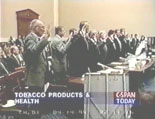
But do you recall that video of the seven tobacco companies' executives being sworn in before a congressional committee 14 years ago, April 14, 1994, when they all -- having been sworn to tell the truth -- each denied in turn that nicotine was addictive? (The video; the transcript (about 1/3 down the screen).) [Credit: WhyQuit.com.]
None of this progress has been thanks to the tobacco lobby, which opposed it every step of the way.
Lobbyists, like bank robbers, simply go "where the money is."
Yes, as Part II noted, "the ties between business and government are tight -- whether in the halls of Washington, Des Moines or the City Council chambers of Iowa City."
Which brings us to one of Bob Patton's editorial cartoons. Patton is one of our nation's most insightful and talented editorial cartoonists. (The link on his name takes you to his blog/Web site, Patton's Pad, and an archive of samples of his work that will "illustrate" the reasons for my judgment about him.) The Press-Citizen is lucky to have his impact on the paper's graphics generally, but especially its editorial page.
To introduce this cartoon and its relevance to our topic: The Iowa City City Council, which has seldom seen a TIF (tax forgiveness to for-profit enterprises) it didn't like, and is quite prepared to give taxpayers' public money to for-profit enterprises, passed an ordinance in response to pressure from downtown businesses that forbids individuals to ask for private funds if they are within a designated forbidden area around a business' entrance. Here's how Patton pointed up the contrast:
[If you have difficulty reading the text: The fellow who's down on his luck has a sign that reads, "Need Help. Any money you can spare? Thank you. God bless." The caption reads, "Panhandling around City Hall, however, will still be permitted," where we see "Big Biz" with a sign reading, "Need to set up shop. Any tax breaks you can spare. Thanks. Now shut up and step aside."]
Anatole France put the analogous thought, "The poor have to labour in the face of the majestic equality of the law, which forbids the rich as well as the poor to sleep under bridges, to beg in the streets, and to steal bread."
In short, as France and Patton see clearly, but most fear to even whisper, it is not just that in our infant fascism we rob poor taxpayers to further enrich the wealthy. It is the hypocrisy.
Anyone who calls that "corporate welfare" is dismissed as fomenting "class warfare," a "liberal," a "radical" -- or worse.
And yet it's perfectly acceptable to chastise and cast moral aspersions on the single mothers who get, not $200 billion, but $200 in food stamps, as "welfare mothers."
If you'd like to know more about this political phenomenon, . . .
For my own explanation of a number of categories of reasons why TIFs and other business subsidies don't make any sense, see Nicholas Johnson, "Courage, Councilors," October 3, 2008.
For an entire Web site devoted to the abortive efforts to put public money (local, state, and a $50 million federal earmark from Senator Grassley) into an indoor rain forest in Iowa, see Nicholas Johnson, "Earthpark," 2004-2007, Jane Norman, "Grassley defends earmarks for Iowa as valid,"Des Moines Register, April 7, 2008 ("Grassley has been harshly criticized in years past for his support of a $50 million earmark for . . . an indoor rain forest to Iowa. The money was yanked by Congress late last year. The nonpartisan group Citizens Against Government Waste issued a report Wednesday [April 2] showing that Iowa ranked 16th in the nation when it came to earmarks per capita in the 2008 budget . . .."), and "Earmarks" in Nicholas Johnson, "Obama Mason and Public Finance," March 21, 2008.
 Craig A. Dubow, Chairman, President and CEO of Gannett, who even looks a little bit like Robert Morse (see "How to Succeed" video, below), has been chair for seven years. You will probably not be surprised to discover that while Mr. Dubow has been laying off workers by the thousands this Holiday Season, he has also seen to it that he will get the lion's share of some $79 million worth of golden parachutes when the day comes that he gets laid off. (See former Gannett editor Jim Hopkins' "Gannett blog, "Golden Parachutes? The Answer is $79 Million", July 20, 2008, and "Bulletin: Gannett laying off 10% of newspaper staff; Dickey warns in memo: 'fiscal crisis is deepening,'" October 28, 2008.)
 [Credit: The Press-Citizen's nationally recognized, distinguished graphics artist and editorial cartoonist Bob Patton, December 2, 2008.]
 Editorial cartoonists and graphics designers are on the front lines of the newspaper's hope for winning back readers. They should be the last to go in a newspaper's restructuring.