July 30, 2011, 7:00 p.m.
There Are Many Ways to Bring Down a Government
In an [October 2010] interview with the National Journal [the Republican U.S. Senate Majority Leader] Senator [Mitch] McConnell was asked what "the job" of Republicans will be if they gain a majority in Congress. McConnell's response was,
"The single most important thing we want to achieve is for President Obama to be a one-term president."
McConnell could have mentioned any one of a number of other priorities . . . Helping the country recover from the worst economic downturn since the Great Depression; Protecting the country from another terrorist attack; [or] Ensuring the success of the United States' missions in Iraq and Afghanistan. Instead, McConnell made clear that the Republicans will be thinking about 2012 as soon as the 2010 midterm elections are over. [emphasis supplied]
Ryan Witt, "Republican leader says GOP's number one goal is defeating Obama in 2012," Examiner.com, October 25, 2010.
 This was scarcely a casual slip of the tongue. "N2K Top 10: Let Me Repeat; Regrets? Not a One," National Journal, November 4, 2010 ("Senate Minority Leader Mitch McConnell will deliver a speech at the Heritage Foundation that reiterates why making President Obama a one-term president is the GOP’s top priority.").
Although the National Journal article containing the initial interview with McConnell does not appear to be available to the public on the magazine's Web site, the quote has been widely reported -- including in subsequent National Journal articles. Matthew Cooper, "Kaine, Axelrod Fire Back After McConnell's NJ Comments," National Journal, October 26, 2010 ("My colleague, Major Garrett, made news with his interview with Senate Minority Leader Mitch McConnell, in which the Kentuckian said that making Obama a one-term president was his highest priority. Now Democrats are firing back. DNC Chairman Tim Kaine has issued a statement saying: '. . . the very man who set his Republican colleagues on a course of politically motivated obstruction even before the President was sworn into office -- is promising two more years of politics as usual . . ..'"); see also the related, Major Garrett, "After the Wave; Mitch McConnell wants to learn from history, but his new recruits will not be easily led," National Journal, October 23, 2010; Peter Baker, "Obama Forces Showdown With G.O.P. on Arms Pact," New York Times, November 19, 2010, p. A12 ("Senator Mitch McConnell of Kentucky, the Republican leader, has said his top priority is to deny Mr. Obama a second term.").
Nor is the mission limited to this one Republican leader. The campaign of one of the Republicans' leading presidential candidates, Congresswoman Michelle Backman, has declared "Rep. Bachmann looks forward to working with the Governor [of Alaska, Sarah Palin] for the common goal of making sure President Obama is a one-term President." Elspeth Reeve, "Palin Rivalry Becomes Bachmann Campaign Strategy," National Journal, June 10, 2011.
Now I do not question the right of what the British call "the loyal opposition" to disagree with whomever happens to be the President of the United States regarding particular legislative and other proposals and programs -- including wars. That's politics, that's democracy, that's governing.
But when the opposition, the party that does not control the White House, declares that "the single most important thing we want to achieve" is for the President's administration to fail, for him to be a one-term president, this risks crossing the line from politics as usual into potentially treasonous territory. When one's "most important" goal is to cause someone to fail, however unseemly if focused on any fellow human, but that someone happens to be the President of the United States, it is in effect a goal to bring on the failure of the United States itself -- as we have seen during the last couple of weeks with regard to the debt ceiling. Not incidentally, President Reagan raised the debt ceiling 18 times, and President George Bush seven times, with very little if any hoopla from Democrats.
At a minimum, the Republicans' acknowledgement of their "most important thing" calls into question every statement made by the Republican leadership, every legislative proposal, every vote they call for, every filibuster they threaten, every meeting they walk out of, and every charge they level at President Obama. Is it driven by the substance involved, or is it just another tactic in their strategy of presidential failure?
Am I charging some Republicans with a literal violation of our prohibitions of "treason"? No, of course not. Why "of course"? Because Article III, Section 3, of our Constitution was deliberately drafted to define "treason" much more narrowly than its dictionary definition. The Constitution declares that "Treason against the United States shall consist only in levying war against them [the United States], or in adhering to their enemies, giving them aid and comfort." From inside the White House, the Republicans' shelling may sound and feel like "war," but it's not what the Constitution's drafters had in mind.
No, I am speaking of "treason" in its more general dictionary usage:
"1. the offense of acting to overthrow one's government or to harm or kill its sovereign.
2. a violation of allegiance to one's sovereign or to one's state.
3. the betrayal of a trust or confidence; breach of faith; treachery.
Synonyms 1. Treason, sedition mean disloyalty or treachery to one's country or its government. Treason is any attempt to overthrow the government or impair the well-being of a state to which one owes allegiance; the crime of giving aid or comfort to the enemies of one's government. Sedition is any act, writing, speech, etc., directed unlawfully against state authority, the government, or constitution, or calculated to bring it into contempt or to incite others to hostility, ill will or disaffection; it does not amount to treason and therefore is not a capital offense."
"Treason," Dictionary.com.
 At the outset, there is something troubling about candidates for federal office running against "government" -- as Grover Norquist puts it, "I don't want to abolish government. I simply want to reduce it to the size where I can drag it into the bathroom and drown it in the bathtub." [Photo credit: Wikipedia.org.]
I certainly support efforts to review government expenditures -- as I did as U.S. Maritime Administrator. Let us challenge what we're spending through the Defense Department (given that there have been retired admirals and generals who say more defense budget cuts could actually improve our national security), earmarks, the shockingly low tax rates for America's wealthiest 1% (who have more wealth than the bottom 90%), hidden corporate tax breaks and subsidies, and so forth.
But to refuse to provide a clean increase in the debt ceiling, as we've routinely done dozens of times before, to insist on cutting food, medical and other benefits for the poor, to refuse to ask for a dime's worth of increased revenue from the wealthy, and to be willing to bring down the global economy and the full faith and credit of the United States for the first time in over 200 years -- all in the cause of defeating an incumbent president -- does qualify, it seems to me, under the dictionary (though not the constitutional) definition of treason.
Why? Consider:
It is "acting to . . . harm . . . its sovereign [the president]," "a violation of allegiance," "the betrayal of a trust" [to "uphold the Constitution," to serve the American people and "the public interest"], "disloyalty to one's . . . government," an "attempt to . . . impair the well-being of a state," and it has certainly involved "speech . . . calculated to bring [the government and its president] into contempt or to incite others to hostility, ill will or disaffection." Indeed, that would seem to be the laser focus of the drumbeat of attack provided by the Republicans' television and radio propaganda arms (Fox "News," Rush Limbaugh, et al).
Hopefully, the American people will reflect on the Republicans' behavior this past two and one-half years, and we'll be rid of the lot by November of 2012. But given the number of voters who are seemingly willing to give higher priority to "social issues" over even their own best economic interests, the outcome remains to be seen.
# # #
July 28, 2011, 7:15 p.m.
Hierarchy is Dead; Long Live Stakeholder Participation
Michael Gartner has enjoyed a long, varied and sometimes turbulent career. "Michael Gartner," Wikipedia.org. What Iowans will best remember, in addition to his ownership of the Iowa Cubs baseball team (and hopefully his skilled writing ability and Pulitzer Prize), is his term as a member, and president, of the Iowa Board of Regents. The Board has responsibility for Iowa's three Regents universities: University of Iowa, Iowa State University, and the University of Northern Iowa.
Although no longer a member of the Board of Regents, his chttp://www.blogger.com/img/blank.gifhttp://www.blogger.com/img/blank.gifreative mind recently drew upon his experience and imagination to lay out a to-do list for his former charges. Because it is a long list, it was necessarily a long article -- by 600-word op-ed column standards -- about 3,000 words.
Asked by a local paper to respond in 400 words, it was necessary to pick a single proposal. I chose "governance" of universities, and Gartner's insistence that involving the faculty in "shared governance" should be abolished. I disagreed.
[For background, see American Association of University Professors, "Statement on Government of Colleges and Universities" (1966), and related information.]
However, as noted among the 400 words, there is a great deal more that Gartner wrote about with which I not only agree, but about which I have written myself, both here in this blog and elsewhere.
The brief response to his article is immediately below.
It is followed by Gartner's full presentation. This is done primarily in fairness to Michael Gartner, rather than leave the impression that 400 words adequately dispose of everything he had to say. But his piece is also included because it is an important contribution to ongoing discussion about the universities and the Regents. Having disappeared from the Des Moines Register's online site, it will at least be searchable and retrievable here. Of course, if Gartner, or the Register, object to its republication and request it be removed from this blog, it will be.
_______________
Shared Governance Still Needed
Nicholas Johnson
Iowa City Press-Citizen
(initially available online)
July 20, 2011, p. A9
In Sunday's Des Moines Register, former Regent Michael Gartner offered up a smörgåsbord of commands for Iowa's universities.
Demanding that "universities must change dramatically -- and quickly," as he did, is no more effective than it is specific. It's like telling the captain of the 1,132-foot Queen Mary 2 that he must turn her around "dramatically and quickly" without designating a reason, direction or destination.
Some of Gartner's ideas need better facts and serious rebuttal. Others you've heard before -- even from me.
But this time he had nearly 3,000 words; and I don't. Limited to one issue, I've chosen his assault on governance.
Gartner wrote, "The pleasant-sounding concept of 'shared governance' should be scuttled. ... (F)aculty political leaders insist they should help manage the institution -- but ... the concept has outlived its usefulness and is a roadblock to planning, to change and to effective administration. It institutionalizes mediocrity, stymies change and intimidates presidents, and it is a misuse of faculty time and energy."
As the student told the professor, "I have only one question."
"And what is that,?" the professor asked.
"What on earth are you talking about?" the student replied.
What does Gartner mean and how does he know? What does he mean by "scuttled," "faculty political leaders," "manage," "roadblock." What evidence does he have of "institutionalized mediocrity" or "intimidated presidents"?
Gartner owns the Iowa Cubs. Does his organization not take into account the wishes of fans and players? That's "shared governance," a 20th-century recognition that organizations have stakeholders as well as shareholders.
School boards and their superintendents have "shared governance" with administrators, teachers, parents, students and taxpayers. Why shouldn't the Iowa state Board of Regents and universities' presidents have shared governance with students, deans, faculty, staff, parents, students and taxpayers?
You want examples from business? Shared governance is a major component of most successful corporations. Involving customers through social media is just one example.
It's understandable Gartner didn't like the University of Iowa faculty's vote of "no confidence" in his regents. The NFL owners didn't like it when the players voted no confidence in them either.
But if the corporate CEOs Gartner wants as university presidents are good ones, they will be insisting on shared governance.
Shared governance in higher education began in 1920. There are even more reasons for it today, 91 years later.
__________
Nicholas Johnson teaches at the University of Iowa College of Law and maintains the website www.nicholasjohnson.org and blog FromDC2Iowa.blogspot.com.
_______________
Gartner says Iowa's state universities need to change quickly
Michael Gartner
Des Moines Register and Altoona Herald-Index
July 17, 2011
Iowa's three state universities must change dramatically -- and quickly. The system has problems -- money and non-money -- that can no longer be addressed by raising tuition and lobbying legislators. Those remedies are played out.
On top of systemic problems, each university has unique challenges.
There is a management problem in Iowa City -- where faculty politicians in effect run the University of Iowa. There is a looming leadership problem in Ames -- where the visionary Greg Geoffroy is stepping down as president of Iowa State University. And there is a money problem in Cedar Falls -- where legislators short-change the University of Northern Iowa by about $50 million a year.
All this comes at a time of strife and partisanship on the nine-member Board of Regents, where president David Miles and president pro tem Jack Evans on Tuesday stepped down from their leadership roles under pressure to make room for Gov. Terry Branstad's financial backer Bruce Rastetter and loyal supporter Craig Lang.
I was a regent for a little over six years, until April 30 of this year. For nearly three years, I was president. I dealt with the men and women who officially run the schools -- and those who unofficially run them. I spent time with presidents and legislators and faculty members and shop stewards and students. I learned a lot, and I left with clear opinions.
State aid to universities needs to be redirected
All three universities are very good at many things. And the University of Iowa medical complex is very good at almost everything. It is well-run, understands its mission, produces first-rate doctors and first-rate research, and generally pays its own way. One reason: It's run by those who are paid to run it, not by the doctors or the nurses or the patients or the help.
But change is needed elsewhere in the $4 billion-a-year regents enterprise.
Perhaps most important, the dwindling state aid must be redirected. Now, graduate schools, which should be self-sufficient, drain away money that should be used for in-state undergraduates. One yet-unpublished study says Iowa's dental students receive $1,171 in subsidy per student credit hour -- in contrast to $71.90 per credit hour for liberal arts students. That is not the intent of state appropriations.
The most cherished tenets of academe, particularly "shared governance," need to be challenged -- and probably thrown out. Assets need to be redeployed into education and out of ancillary activities. Course offerings and majors need to be slashed, the teaching load needs to be increased, more courses need to be taught by professors instead of graduate students, and the number of academic "centers" needs to be reduced. Athletics needs to be reined in and restructured. The relationships among the three universities need to be refigured. New partnerships need to be explored. And the increase in tuition for undergraduate youths from Iowa has to be slowed or stopped.
Those should be the elements of a 10-year strategic plan. The "givens": We must keep three fine universities. We must expect state aid to continue to decline, as it has in seven of the past 11 years. And we cannot offset that decline by continuous tuition increases.
Faculty members have too much clout
Most of all, the universities and the regents need focused, firm, fair -- and united -- leadership.
The pleasant-sounding concept of "shared governance" should be scuttled. Shared governance once meant that faculty ran curricular matters and administrators ran management matters. Now, faculty political leaders insist they should help manage the institution -- but woe to the administrator or regent who wants to have a say in the classroom.
The concept has outlived its usefulness and is a roadblock to planning, to change and to effective administration. It institutionalizes mediocrity, stymies change and intimidates presidents, and it is a misuse of faculty time and energy. Professors should teach or do their research. Presidents and provosts and deans should manage. Regents should govern.
When I was confirmed for the board, then Senate Majority Leader Stew Iverson called me aside. "Find out for me," he said, "whether the regents run the University of Iowa or the University of Iowa runs the Board of Regents."
I found out.
Example: The University of Iowa is a complex, $2.5 billion-a-year institution where the president -- like most presidents -- must spend nearly half her time raising money and most of the rest dealing with legal and financial and athletic and alumni and real-estate and political and housing and student and parent and other issues. Yet when a committee was named to find a successor to David Skorton in 2006, the faculty members made clear they would block any candidate who wasn't a full-fledged academic -- and they had that power through "shared governance."
Thus, Jim Leach, a member of the U.S. House of Representatives for 30 years, was laughed off the prospect list by the academics because he was not one of them. Forget that he was a graduate of Princeton with a master's degree in Soviet politics from Johns Hopkins and further study at the London School of Economics. He didn't pass muster -- so he ended up first on the faculty of Princeton, then head of an institute at Harvard and now chair of the National Endowment for the Humanities. And Iowa got as president an accomplished academic -- the provost from Purdue -- who has had to learn to be a broad-based manager through on-the-job training.
Similarly, faculty members at Iowa State have made it clear they want an academic to succeed Geoffroy. The search committee will see to that; it has nine academics among its 18 members along with two doctors, two students, two regents, and three business people. It has no union representative. Jim Leaches need not apply. (Or Tom Vilsack. Republican leaders on and off the regents are paranoid about Vilsack, amazingly believing he would leave a Cabinet post he loves for Iowa State -- a thought that sends shivers down their spines. And probably down his.)
Schools waste money on search committees
Search committees are costly and, often, a waste of time -- or a sham. A board should have in mind one or two possible successors for each president, and a president should know whom he wants as his next lawyer or provost or finance person without having to go through a search.
Jean Robillard, the outstanding vice president for medical affairs at the University of Iowa, was not picked by a search committee but simply was tapped by Gary Fethke, who in 18 months as acting president of Iowa accomplished more than his predecessor or successor. "There was no search committee formed to pick Jean Robillard, just a few great conversations with a bunch of people who were on the same page," says Fethke, who had been dean of the business school.
That's how good executives operate.
Similarly, when Robillard wanted a dean of the medical school, he named Paul Rothman. "I didn't want to do a formal search since I knew Paul and could probably not have found someone better in the country," Robillard says. So why waste time and money? He did, however, use a search to find Ken Kates, the equally competent head of the hospital.
Sally Mason, Iowa's president, knew she would appoint Carroll Reasoner last fall to move from acting general counsel to general counsel, which she told the Board of Regents. In the next breath, she said she intended to appoint a search committee -- wasting time and resources and misleading any person who would be on it and any "candidate" other than Reasoner. After questioning by regents, she waived the process.
"Academia can learn a lot from private industry," Robillard says. That's one reason business-school deans -- Gary Fethke, Ben Allen -- often make good presidents.
Professors are not in classrooms enough
One thing academics could learn is to concentrate on their strengths and shed weaknesses and "businesses" that aren't central to their mission. The mission is teaching and research at Iowa and Iowa State and just teaching at UNI.
Thus, it's strategic and financial folly for the University of Iowa to own a $150 million painting (which hasn't been on campus for three years and probably won't be for another three) when that money could be redeployed into full-tuition scholarships for about 1,000 Iowa undergraduates each year till the end of time. Similarly, why do universities own golf courses?
There are hundreds of academic and research "centers" in the regents system - the University of Iowa alone has nearly 300. They proliferate like rabbits -- and have the longevity of elephants. Each should be looked at every two or three years to determine if it is central to the mission of the school and economically justifiable. Iowa alone has around 150 majors and programs for undergraduates, from Sanskrit to microbiology, from "informatics" to theater arts. All of this must be streamlined; the universities can no longer be all things to all people.
At the same time, the teaching load -- six hours or less of classroom teaching per week (up to nine at UNI) -- must be increased. "We went too far in reducing teaching loads," a professor at Ohio University wrote the other day. "Faculty members preferred research or leisure to teaching, and believed the path to vocational success was through publication, not teaching and counseling young students."
The three Iowa universities employ around 7,500 faculty members, some 5,300 of whom are full-time. Yet, at Iowa the full-time faculty spends just a third of their time in teaching-related activities (the figures are 40 percent at Iowa State and 58 percent at UNI), and only 46 percent of undergraduate student credit hours are taught by tenured or tenure-track faculty. The rest are taught by graduate assistants (22 percent) and adjuncts and the like. The figures are only somewhat better at ISU and are considerably higher at UNI, where research is not emphasized.
Research is vital, but so is teaching.
The work load must go up and the workforce down if the universities are to have a future providing effective and affordable education to Iowa high-school graduates. More than half of those 5,300 faculty members are tenured and all but guaranteed lifetime jobs.
Once a noble concept to ensure academic freedom, tenure now is another practice that stifles change, discourages innovative teaching and reinforces the status quo. It has outlived its usefulness, says Jim Lubker, the retired provost at UNI, who thinks about such issues.
More oversight needed for athletic programs
Athletics, too, has to be examined. Iowa has and Iowa State soon will have an athletic department that pays its own way, at least by some calculations. That's good, but beside the point. Athletic revenue is not part of the universities' general funds -- it is looked upon the way dormitory funds and hospital charges are accounted for -- but it should be considered the property of the institution, not the athletic department.
All university revenue should come into one pot, and every department should have to justify its spending. The University of Iowa takes in $66 million in athletic revenue, but that doesn't mean the department should have the unsupervised right to spend that. How can it justify paying the women's basketball coach a sum more than three times the revenue of the sport? Why shouldn't it return $10 million to $15 million to the general fund? Is it right that the four highest-paid state employees are coaches at Iowa and Iowa State? (One way of looking at it: The Iowa athletic department spends about $100,000 per athlete every year.)
In this era, no institution -- university, business, city -- can go it alone. Partnerships and alliances are everything. Iowa, Iowa State and UNI are good at forming partnerships with one another and with outsiders. But efforts must increase. Universities must eliminate duplication. Are two journalism schools necessary? Is there unnecessary duplication in engineering and business schools? Why shouldn't every class be available over the Internet to every student at each school? (Some ideas aren't so great. I suggested to then-Gov. Vilsack that students be admitted to the system, not to any one school. "Who would get the football players?" he asked.)
Rising tuition costs must be dealt with
Most of all, the universities must not keep raising tuition. Ten years ago, tuition and fees at the universities were around $3,100 a year; today, they are around $7,500. If you figure the value of a college degree goes up 11 percent annually throughout life, as compared to the earnings of a person without a degree, $7,500 is still a steal -- but only for those who can afford it.
The cost of education, including room and board and books and travel, now is around $20,000 a year. To be sure, the universities set aside as much as 20 percent of tuition income for student aid -- but that's not all for the needy or in-state students. Students graduate with so much debt it will take as long as 20 years to pay it off. Others simply can't afford college. What's more, it now is cheaper for some students to attend private colleges, where the chances are a student will graduate in four years. At regents schools, only 42 percent graduate within four years.
There are many reasons.
At Iowa, one reason is the culture. Nationwide, about 34 percent of college students are binge drinkers -- persons who have five or more drinks at least every couple of weeks. At Iowa, where weekends often start on Thursday noon, the figure is 64 percent -- down 6 points in a year but still nearly twice the national average. Iowa ranks ninth among "top party schools," according to The Princeton Review. That is not a good thing. One solution: schedule required courses for Friday afternoons and Saturday mornings.
If culture is the unique problem at Iowa, money is at UNI. The main purpose of state aid is to subsidize the education of undergraduates from the state, and UNI is woefully shortchanged. State aid is divided roughly 40-40-20 among Iowa, ISU and UNI, for reasons lost in history. Iowa receives $17,628 for each state undergraduate, Iowa State gets $10,802, and UNI gets $7,502. If the money were allocated fairly, $48.5 million would be redirected to UNI, mainly at the expense of Iowa.
This just adds to woes of UNI, a fine and well-led school. It must spend millions a year subsidizing athletics -- or else drop athletics entirely -- because it gets little or no television or bowl money but still has the expenses of intercollegiate competition. With Iowans comprising 93 percent of its student body, it gets little out-of-state tuition -- out-of-state students by law must pay more than the cost of their education -- to subsidize the in-state students. And it has a small base for fund-raising. The Legislature should change the formula.
Politicization of regents is not a good thing
But most change does not need legislative approval. The regents and presidents simply need to take back the reins of governance from governors, legislators and, especially, faculty members who have grabbed many levers of control. You can't change things if you're not in charge, and the regents and the presidents aren't always in charge.
The faculty senate basically runs the University of Iowa, the faculty union has an outsize voice at the University of Northern Iowa, the Legislature has begun meddling too much, and the two most recent governors -- Democrat Chet Culver and Republican Terry Branstad -- have wanted a say in the governance that they are not entitled to under the law. This has led to a politicization of the board for the first time.
The power of the board is clear. It shall "make rules for admission to and for the government of said institutions, not inconsistent with law," the Iowa Code says, as well as "manage and control the property, both real and personal, belonging to the institutions." It also hires and fires presidents and officers of the schools, hires all employees, and sets all salaries. It's hard to imagine any board with broader powers.
But a couple of years ago the board allowed Culver and Sen. Bob Dvorsky, D-Coralville, to talk it into putting a partisan labor issue on the agenda -- a labor agreement for university construction -- and the result was a predictable 5-4 vote along party lines, the first time in memory there was a party-line vote on anything. (The regents can have no more than five members of any one party. At the time, there were five Democrats. Now, there are five Republicans, three Democrats and a no-party member.) Branstad was elected and badgered Dave Miles out of the board presidency. This meddling is a bad thing.
Yet none of these issues -- money, structure, leadership -- is unsolvable. A determined board, strong presidents, and a watchful but non-meddling legislature and governor can work together on a blueprint for success.
The goal is simple: make the universities as good as they think they are.
# # #
July 18, 2011, 9:35 a.m.
Murdoch's Violations Small Part of Loss of Privacy
I have often said, "the problem is not that corporations violate the laws, it is that they write the laws."
I have often been wrong -- at least partially so.
Because, of course, the problem is also that corporations corrupt or otherwise violate the laws as well as writing them. BP and Massey Coal did both, and workers died. Murdoch's worldwide media monopoly hacked cell phones, published stories based on the conversations, and hundreds of citizens and celebrities alike suffered in a variety of ways.
There's no way to minimize or justify what the editors and reporters of Murdoch's News of the World did. It's awful. From the perspective of college classrooms it's a subject for studies of journalism, technology, and law. It's a global media story, an example of how technological "advances" gnaw away at our neglige of privacy, and thereby create Rubik's-cube-like challenges of legal analysis for legislators and lawyers.
If you haven't been following the events, here is a sampling from the New York Times of the thousands of stories the worlds' media have provided: Sarah Lyall, "Scandal Shifts Britain’s Media and Political Landscape," New York Times, July 8, 2011, p. A1; John F. Burns and Alan Cowell, "Former Aide to [Prime Minister] Cameron Is Arrested in Tabloid Scandal," New York Times, July 9, 2011, p. A8; Don Van Natta Jr. and Ravi Somaiya, "British Tabloid Sought Phone Data of Investigators," New York Times, July 12, 2011, p. A1; and Sarah Lyall and Graham Bowley, "Connections to Murdoch Start to Chafe British Leader," New York Times, July 13, 2011, p. A1.
But this is more than a story about the fall of one of the world's largest media barons. It should also be a teachable moment for all of us regarding our privacy.
Consider all of today's technological and other assaults on the standards of privacy accepted and expected by our great-grandparents. From that perspective, as awful as the Murdoch invasions appear to have been, they are but a very small part of what we need fear.
Like the insight of Walt Kelly's cartoon figure, Pogo -- "We have found the enemy, and he is us" -- or Winnie the Pooh's discovery that the tracks he was following were his own, most of the assaults on our privacy are self inflicted.
(1) Much of our lost privacy we have voluntarily abandoned. Take Facebook, for example. Our names, addresses, birth dates, family members -- all identified with "tags" in their photos -- and our network of "friends," are available for the databases of Facebook, criminals or law enforcement. We may keep unencrypted passwords on a thumb drive, smart phone, or laptop, available to whoever gets our lost or stolen equipment. I recently saw a desktop in a business with a Post-It note stuck to the screen, revealing to anyone who glanced that way the username and password. Once a voice mail hacker knows that 75% of users choose "1-2-3-4" as their password it makes it a whole lot easier to listen in. Now that the FBI (and anyone else) can search our trash without a warrant, we may still think we're destroying documents with credit card numbers or other valuable data because we took them out to the curb for trash pickup, rather than shredding them.
(2) Professor Jonathan Zittrain speaks of what he calls "privacy 2.0" ("The Future of the Internet -- And How to Stop It").
As technology progresses through the decline in price that I call "the 99.9%-off sale" (not incidentally, with improved capacity and quality, and reduction in size and weight), it spreads, it becomes ubiquitous. The video recording capability that once cost tens of thousands of dollars is now merely hundreds of dollars or less.
Our actions are being recorded by the scanning video cameras in government buildings, banks, convenience stores and other private businesses. They monitor and bill those who run red lights. The Webcams in our laptops may take video of us without our knowledge.
But that's not the major problem.
Still and video camera capability is built into our smart, and even dumb, cell phones.
Couple this with the ease of uploading videos to YouTube, Facebook, or attaching them to emails. Anyone's embarrassing, or illegal, moment can suddenly go viral globally.
That's not the result of government, Big Brother snooping on us, or evil corporations. It's us; millions if not billions of us, recording and distributing information about each other -- usually for reasons somewhere between friendly and helpful, or at least benign.
(3) We gratuitously give our private information to Facebook, expecting little or nothing in return.
But we also trade off our privacy, our secrets, our personal identifying data, for perceived benefits. We give the bank our financial data, including how much cash we took out from which ATM machine, the day and time. We let the credit card company record where we went, what stores or other businesses we entered, what we bought, what we paid for it, where and when. The cell phone company tracks our every move, knows where we are, who we called, how long we talked -- and if they care to know, what we talked about. The airlines know where we flew and when; the rental car companies also.
I'm not saying these and comparable gifts of privacy to corporate America are irrational choices. It would be hard to function in today's world without, say, credit cards and phones. I'm just saying that we can't voluntarily turn over vast amounts of information about ourselves to government and merchants and then complain that they possess this information about us.
(4) This third-party possession of our most intimate information raises other problems.
The Fourth Amendment asserts a "right of the people to be secure in their persons, houses, papers, and effects" -- seemingly a kind of place-based security. So what about tapping phone lines from a place away from home? In the Supreme Court's 1967 Katz decision, involving law enforcement's recording of a conversation by means of a device attached to a public phone booth, the Court expanded the protection to include those things as to which we have (1) "an expectation of privacy" that most people would consider to be (2) "reasonable" -- the "reasonable expectation of privacy" standard.
So far so good. But in the 1976 U.S. v. Miller case the Court explained that once you've shared information with another, even though you did so in confidence and for very limited purposes, you no longer have an expectation of privacy in that information, let alone an expectation that courts will consider "reasonable." In the Miller case the defendant, Miller, attempted to claim a Fourth Amendment right of privacy in the cancelled checks and other records and documents maintained by his bank. The Court decided those were the bank's records as much, indeed more, than Miller's. Thus, he had no "reasonable expectation of privacy" and law enforcement could get access to those records from the bank, without providing Miller the protections he would have received under the Fourth Amendment had law enforcement come to his home for "papers."
So it turns out that, not only have we turned over a vast amount of information about ourselves to private corporations, we have, thereby, essentially turned it over to the government as well (in many instances) and lost the rights of privacy we have in information never shared.
(5) Once we go to work it only gets worse. Employers can listen in on their employees' phone conversations, read their email, know what Web pages they've visited, track how many keystrokes they contribute per hour or day, and install video monitors throughout the workplace. Even if the employer pledges you have personal privacy with regard to any of the above, courts may reject an employee's reliance on that assurance.
(6) Are there instances in which a hacker acquires information they had no authorization to access, or for which they exceeded their authorization? Of course. The Defense Department gets millions of such hits. There was a recent example of exceeding authority at the University Hospital. One can imagine many more driven by simple curiosity, or a desire to help a friend (such as a bank employee providing a woman contemplating divorce information about suspicious regular checks drawn on the errant husband's separate account).
The Murdoch reporters, and the editors to whom they reported, had no business getting access to the voice mail of 9/11 victims' families, or those of British soldiers killed in action, celebrities, or the murdered young girl. It's not only boorish behavior and a violation of journalistic ethics, it also happens to be a violation of the criminal law.
But if we really care about maintaining some little bit of our remaining privacy regarding our images, speech, writing, movements, actions, circle of friends, financial transactions, medical records -- among other things -- we need to look well beyond the Murdoch Empire, however vast and evil it may be.
And we need to begin with the person we see in our bathroom mirror.
# # #
July 1, 2011, 7:00 p.m. (with additions July 2, 3, 4, 5 and 6, 2011, including resolution of alleged UI football players' sexual assault, 2007)
[And as evidence that (a) the problems on college campuses continue, and (b) have been exacerbated by the predicted Strauss-Kahn outcome, here's an exchange on July 6, 2011, during Tom Ashbrook's "On Point" program:
Tom Ashbrook (TA): Andrew in [city]. Thanks for calling. You're on the air.
Andrew (A): Hi, Tom
TA: Hi.
A: Thanks for taking my call.
TA: Yes, sir.
A: The topic is relevant to my family at this time, and I have an inquiry for Professor Brenner, if she's able to assist.
TA: OK.
A: My daughter, a few weeks ago, was assaulted sexually by a prominent basketball player at one of the two state universities here, . . .
TA: I'm sorry.
A: . . . who had been removed from another state university and was able to transfer in. But my concern is, the university has closed its investigation based on a he-said-she-said type of scenario, which is very frustrating for our family. It obviously raises some concerns about the integrity of the university process. Being both involved with a state university and highly educated on matters of this type, I was wondering if the professor [guest, Professor Hannah Brenner, Michigan State University College of Law] has a suggestion on how we may proceed. My daughter is disinclined to go to law enforcement. Obviously, she does not want to become the maid in the New York City story.
TA: Right. . . .
Tom Ashbrook, "What Does the Dominique Strauss-Kahn Case Mean?" "On Point," WBUR-FM 90.9/NPR, July 6, 2011; Audio, 30:28-31:35.]
Dominique Strauss-Kahn's "mess on both sides"
 The media that were so quick to, seemingly, accept the guilt-before-trial of Dominique Strauss-Kahn (then IMF Managing Director, alleged to have raped a New York Sofitel Hotel maid in his $3000-a-day room), now seem equally ferocious in their attack on the credibility of his accuser. And just as they said little about the accuser when judging him, they now make little to no reference to his own past record of sexual assaults, and therefore the credibility of his denials, while disparaging her accusations. [Photo credit: Andrew Harrer/Bloomberg News.]
[The Times' assault on her credibility continued in the July 2 edition, Jim Dwyer and Michael Wilson, "Strauss-Kahn Accuser’s Call Alarmed Prosecutors," New York Times, July 2, 2011, p. A1. By Sunday, the story was still headlining page one, above the fold, in the hard copy edition (although at the bottom of the heap online), but its focus had shifted once again. This time the criticism was not of Strauss-Kahn or his accuser, but of District Attorney Cy Vance, Jr.: "[T]he second-guessing of Mr. Vance’s leadership has intensified in the wake of a string of courtroom losses that culminated in the startling events last week, when prosecutors revealed their concerns about the honesty of the hotel housekeeper . . .. Even a member of the [DA's] finance committee . . . questioned how the case had been handled. . . .Some of the most pointed complaints about Mr. Vance are emanating from the district attorney’s office itself," Alan Feuer, John Eligon and William K. Rashbaum, "Strauss-Kahn Case Adds to Doubts on Prosecutor," New York Times (online), July 3, 2011 (nat'l ed.; headlined, "Crumbled Case Adds to Doubts On Prosecutor; Issues Were Seen Even Before Strauss-Kahn," p. A1).
For a contrasting view, see Joe Nocera, "The D.A. Did the Right Thing," New York Times, July 5, 2011, p. A21 ("For the life of me . . . I can’t see what Vance did wrong. . . . The woman alleged rape, . . . backed up by physical (and other) evidence. She had no criminal record. Her employer vouched for her. The quick decision to indict made a lot of sense, both for legal and practical reasons. Then, as the victim’s credibility crumbled, Vance . . . acknowledged the problems.").]
As a result, as the Times quoted an unnamed official, "It is a mess, a mess on both sides." Jim Dwyer, William K. Rashbaum and John Eligon, "Strauss-Kahn Prosecution Said to be Near Collapse," New York Times, July 1, 2011, p. A1 (New York edition).
[ By July 4 there was yet one more rape allegation -- this one in France. Steven Erlanger, "Strauss-Kahn to Face New Sex Complaint in France," New York Times, July 4, 2011 ("Dominique Strauss-Kahn will face another complaint alleging attempted rape, this one in France, the lawyer for a French novelist announced Monday. The novelist, Tristane Banon, 32, claims that Mr. Strauss-Kahn tried to rape her [and she] offered a graphic account of her alleged encounter with Mr. Strauss-Kahn in 2003, saying he grabbed her in a nearly empty apartment as she was interviewing him and dragged her to the floor, pulling off some of her clothes and forcing his hand into her underwear. She said she escaped by kicking him desperately." Her lawyer says her testimony is “solid and well prepared.”) Banon photo credit: Charles Platiau/Reuters.]
By July 5 the Times possessed, and reported, the contents of the hospital counselor's report of the accuser's statement. John Eligon, “In Hospital Report, Housekeeper’s Graphic Account of Attack,” July 5, 2011, p. A16 (“[T]his is the most direct account of the housekeeper’s version of events to be offered so far. It comes from a report prepared by a counselor at St. Luke’s-Roosevelt Hospital Center, where the housekeeper was treated just hours after she said she was attacked, and where she related for one of the first times what happened in the hotel suite. . . . [The] account is suggestive of a serious sexual assault . . ..”)
It makes one at least want to learn more about, if not encourage the U.S. emulation of, the British courts' limitations on the media's coverage of criminal matters. See, e.g., the British 1981 Contempt of Court Act.
In addition to the adverse impact on a "fair and impartial" trial, premature media coverage has an extraordinarily intrusive impact on parties' right to privacy -- the accused as well as the accuser. Clearly the public has an interest in knowing significant changes in the locations and statistics regarding various crimes, or whether a serial killer or rapist is at large. And it has an interest in knowing the outcome, and ultimate jury verdict, in criminal cases -- after the trial is over. But I think the news media has a much tougher case to prove when it comes to their assertion of a public's need to know revelations of the intimate details of an alleged sexual assault before a jury verdict, when the sources of those details are nothing more than the allegations of very interested parties and their lawyers.
And the prosecutors in this case seem little better than the media -- as they are the cause and source of much of what the media is passing along to the public.
At Strauss-Kahn's arraignment, May 16, Assistant District Attorney Artie McConnell, said,
The victim provided very powerful details consistent with violent sexual assault committed by the defendant, which establishes all the necessary elements of the crime he is charged with. She made outcries to multiple witnesses immediately after the incident, both to hotel staff and law enforcement. She was then taken to the hospital and was given a full sexual assault forensic examination. The observations and findings during that exam corroborate her accounts.
His statement at the May 19 bail hearing was consistent:
The complainant in this case has offered a compelling and unwavering story about what occurred in the defendant’s room. She made immediate outcries to multiple witnesses, both to hotel staff and to police. The victim was given a complete and expert forensic examination and the findings from that examination are consistent with her account. The Crime Scene Unit processed the hotel room and the scene, and while those scientific tests have not been completed, the preliminary indications are that forensic evidence that supports the victim’s version of events may be found.
Yesterday [June 30], McConnell and another assistant district attorney provided Strauss-Kahn's defense lawyers a letter setting forth a number of past instances in which the accuser had not been truthful, such as tax returns and her application for asylum. Other law officers revealed she once had a phone conversation with someone in prison for dealing marijuana.
However, with one easily explained exception, none of the incidents contained in the letter has any relevance whatsoever to her version of what occurred during her encounter with Strauss-Kahn on May 14! (The exception has to do with what she did immediately after the attack -- wait for him to descend in the elevator, or go clean another room. Neither is inconsistent with what, if the attack occurred, could have been her state of shock at that time.)
The Times reported that at today's [July 1] hearing,
Prosecutors said they still believed Mr. Strauss-Kahn had forced the woman into sex, but that inconsistencies in her past and account of the moments following the incident could make it hard for jurors to believe her. . . .
Mr. Kenneth Thompson, the woman’s lawyer, . . . insisted that she was still the victim of an attack, saying that her version of events has never wavered. He said some evidence, like bruising she had sustained, was consistent with a nonconsensual encounter. And he said her decision to clean a room was consistent with someone who was confused and upset in the wake of an attack.
John Eligon, "Strauss-Kahn Is Released as Case Teeters," New York Times (online), July 1, 2011, 3:35 p.m. EDT.
My reading of the accounts is that everyone, including Strauss-Kahn and his attorneys, acknowledge that a sexual attack or encounter of some kind occurred. Their version of events is that the accuser's bruises and vaginal tears were "consensual."
I'm willing to accept the assistant district attorneys' assertion that New York's Criminal Procedure Law, 240.20, required at least some of the disclosures in their letter be made to defense counsel. But I also accept Assistant District Attorney McConnell's judgment on May 16th that, "The victim provided very powerful details consistent with violent sexual assault committed by the defendant, which establishes all the necessary elements of the crime he is charged with."
Apparently there are years' old instances in which she did not tell the truth about events in no way related to those on May 14th. But it seems to me the issue of whether that will, in the words of the assistant district attorney, "make it hard for jurors to believe her," is a matter which our legal system has delegated to those very jurors, not assistant district attorneys.
The only issue, the only fact questions, in this case are what happened between the housekeeper and Strauss-Kahn on May 14.
It is irrelevant that numerous women have come forward, or are alleged, to acknowledge affairs, unwanted sexual advances, and sexual violence with Strauss-Kahn -- including a hotel maid in Mexico. Fay Schlesinger, "He was like a gorilla. . . actress's sex claim against former IMF chief as new affair is revealed with Italian widow," London Daily Mail, May 19, 2011. It is equally irrelevant that his accuser may have mentioned in a phone conversation with her boyfriend (in prison) a couple days later something about Strauss-Kahn's wealth. (What may perhaps be relevant are that (a) in the course of that conversation, one she likely presumed was private, her account of the alleged assault squares perfectly with what she had earlier told New York police, and (b) questions as to how that conversation happened to have been recorded, by whom, where a translator of the accuser's language (a “unique dialect of Fulani”) was found, and whether this operation was a violation of law.)
(Another process and privacy issue is raised by "Paul" in a comment on the Times' story regarding the hospital counselor's report of the maid's statement, linked above, "Who leaked this report? I hope my medical records remain more confidential than this." Paul, Plattsburgh, July 5, 2011, 8:22 a.m., http://community.nytimes.com/comments/www.nytimes.com/2011/07/05/nyregion/housekeeper-detailed-strauss-kahn-attack-in-hospital-notes.html?permid=11#comment11.)
Strauss-Kahn could be a serial rapist and his accuser a serial killer. The question still remains: what happened between them on May 14? If her past misrepresentations make her trial testimony about those events less trustworthy, then the prosecution will have to provide additional evidence -- the forensic evidence from the hotel room, the medical experts and their records , her contemporaneous statements to hotel personnel and police, and especially her wiretapped "confidential" description to the prison inmate.
Undoubtedly, other facts will unfold with time. But for now, I tend to share many of the reactions of another lawyer who commented on the New York Times's site, a "Scott F." of Atlantic Beach, Florida:
I do not know if he [Strauss-Kahn] raped the housekeeper. I do not know what went on in DSK's hotel suite at the Sofitel on that morning/afternoon. But I am more than a little suspicious at how quickly the prosecution's case is supposedly unraveling. The anonymous law enforcement officials quoted in the NYT seem to be cheerleaders for DSK.
I am not familiar with any other criminal case where the prosecution did such a gigantic flip-flop about the accused's guilt or innocence under anything close to similar circumstances.
What in the world is going on with this case? . . .
It makes me more than a little uncomfortable . . . that the prosecution is selling its witness/victim down the river so blatantly. I have not yet read about any "lies" that strongly suggest that she was lying about the attack itself.
If the prosecutor is going to wait for a blemish-free victim before it prosecutes another case, he may be sitting idle for quite some time. Seems to me that some strings are being pulled by some very powerful fingers.
http://community.nytimes.com/comments/www.nytimes.com/2011/07/02/nyregion/new-yorkers-and-french-await-latest-dominique-strauss-kahn-legal-turn.html?permid=29#comment29
Meanwhile, I am left with the memory of what a local football player declared on his Facebook page to be his "favorite quote":
"She can't say no if her mouth is taped shut."
(Quoted in "Abu Ghraib, Rumsfeld, and Athletes' Facebook Photos; What Do Abu Ghraib and Athletes' Facebooks Have in Common?" August 23, 2007, from Brian Morelli, "Alcohol Abundant on Players' Sites; Review Shows Questionable Material," Iowa City Press-Citizen, August 23, 2007, no longer available online.)
Of course, she is equally inhibited from saying no if she has passed out.
An Iowa football player "was accused of sexually assaulting a female UI swimmer while she was passed out in a dorm room on Oct. 14, 2007. [His] teammate . . . was charged with second- and third-degree sex abuse in the case, based on allegations the men worked together to assault the woman." Erin Jordan, "Former UI Football Player to Serve 7 Days for Assault," The Gazette, June 25, 2011, p. A3. What transpired during the year following October 2007 is collected in "University of Iowa Sexual Assault Controversy -- 2007-08," September 25, 2008.
Now, after numerous postponements, the cases have finally been concluded nearly four years later.
One player, charged with the felony of third-degree sex abuse (up to 10 years in prison and sex offender registry listing) ended up with seven days in the local jail for simple assault. The other took a plea deal, pleaded guilty to assault with intent to commit serious injury, and received no prison time; just a suspended sentence, probation, a fine and victim restitution.
This was Iowa's version of a high-profile sexual assault case. As Jordan reports, "The UI’s handling of the sex abuse case was criticized in an independent investigation ordered by the Iowa Board of Regents. The case resulted in the firing of two senior-level administrators and redrafting of UI policies for dealing with sexual assault allegations."
Of course, IMF directors and football players aren't the only ones who often end up "getting away with it." But the high profile cases are a teachable moment, or should be, for all of us.
Somehow, some way, someday, we are going to have to figure out a way for the legal system to make it possible for a victim of sexual assault to bring a legitimate accusation against her accused without being subjected to the second assault of the legal system itself -- as multiplied by the media's coverage -- and with a reasonable probability of something more than a suspended sentence or seven days in the county jail. Of course, the law must also protect those accused from any false accusations motivated by vindictiveness or an effort at blackmail. And hopefully, it will protect the privacy of all parties -- at least until the trial and appeals have concluded.
At a time when rape is being used as a military strategy by some countries' armies, and often seems to be treated less seriously by some of our prosecutors and judges than other forms of deliberate physical assault, we obviously still have a very, very long way to go before this problem is solved.
# # #
June 26, 2011, 3:00 p.m.
Jon Huntsman . . . Better than "Least Worst Republican"
Every four years about this time I begin taking a look at the Republican field of presidential candidates.
There are two reasons why I'd probably never end up voting for any of them, and at least one reason why I engage in this exercise anyway.
Although I've become increasingly non-partisan over the years, and increasingly willing to give serious consideration to thoughtful ideas from anywhere on the political spectrum, my political activity, such as it has been, has been based in the Democratic Party. I've been registered as a Democrat, a Precinct Co-Chair for the Democrats, a member of the Party's county central committee, ran for Congress in a Democratic primary, and received three presidential appointments from Democratic presidents.
Secondly, no matter how wonderful a presidential candidate of either party might be, he or she brings with them a cast of thousands to which at least some deference must be paid. (Although, as President Obama has shown the Democratic Wing of the Democratic Party that got him the nomination and much of the election, it need not be all that much deference.) I'm not thrilled with the national and Iowa leadership of either party. But given what the Republicans have shown me in the House of Representatives in Washington, and Des Moines, I think I'd rather have the Democratic Party's gang of party members, contributors, political consultants, staffers, lobbyists and elected officials than theirs.
So why do I bother evaluating the Republican candidates for president?
Because, given our system, the president is virtually guaranteed to be either a Democrat or Republican. One of them is going to win, and govern us for better or worse. That's why I'm not interested in promoting the Republican candidate least likely to win. I'm interested in promoting the Republican candidate who, if she or he wins, will do the best job. ("Promoting" may be a bit strong; I'm not going to contribute money to, or time to "campaigning" for, Huntsman. But every American's water cooler, and family dinner table, conversations contribute something to the national dialogue first reflected in public opinion polls, and ultimately in election results. So do blog entries, comments on call-in radio programs, letters to the editor in newspapers, and the other ways we express ourselves.)
The one thing that does unite Democrats and Republicans every election year is their fear and hatred of third parties. Third parties have been the source of many of the most progressive legislative solutions to our nation's challenges, such as child labor laws, wages and hours legislation, and Social Security. Everyone, even the two major parties, would be aided by innovative approaches such as instant runoff election, and fusion tickets. The two parties unite in stopping such innovations, because they would also showcase the popular support the third parties would have. The two parties tightly control the presidential debates, setting the bar to entry so high as to almost always eliminate popular third party candidates from their primary means of reaching the American voters with their message. The net result is that business, the wealthy -- the plutocracy -- continue to control both parties with campaign contributions. As New York's Boss Tweed used to say, "I don't care who does the electing, just so long as I do the nominating." They are the ones who are doing the nominating for both parties.
Whatever the reasons for, and consequences of, our two party system, the fact is that every American, including especially those who don't even bother to vote in the general election, has a stake the candidates offered us every four years for the presidency.
This year my first Republican favorite was Indiana Governor Mitch Daniels. (See IN.gov/gov, and Mitch Daniels, wikipedia.org.) That was when, like roughly a third of Republicans still today, I'd never heard of Huntsman. Once Daniels made it clear he was not running, I started looking elsewhere.
Iowans are used to not only meeting, but conversing with, the presidential candidates -- and more than once -- before (literally) standing with their choice at the precinct caucus. Given that Huntsman has chosen to skip Iowa -- a publicized, if only temporary, disastrous choice of Hillary Clinton in 2007-08 -- I will probably never have the opportunity to talk with him.
Nor have I done all the research on Huntsman I will have done by the time the caucuses are held. So you have access to the same information I do from the Internet.
 (Ambassador Huntsman in Beijing, riding his bike to meetings rather than taking the long, black limo. Photo credit: Huntsman Web page.)
Here are some obvious sources:
There are at least three steps into his personal Web site, http://www.jon2012.com/. That link opens on "the daily video." (Today it shows him at a quick-draw shooting range. Given his positions on "God, guns and gays," it's about his only opportunity to rally some Republican support.) Click "skip" and you're on the U.S. map of his Facebook followers: http://www.jon2012.com/user/facebook. That gives you the choice to "Connect with Facebook" or "Sign up without Facebook." Scroll to the very bottom and you can click on "Skip Sign Up." Click on that (the URL will change from day to day) and you've reached what amounts to the opening Web page.
The Web resources are certainly up to today's voters' technological expectations. He has the "daily videos," a daily Twitter comment, Facebook discussions, blog, speeches, press Web page, background information about his positions on issues and career. (Wikipedia offers a summary: "Jon Huntsman, Jr.," wikipedia.org.)
We don't really have a training program, or conventional career track, for presidents, similar to that in parliamentary systems (i.e., member, minister, prime minister). The closest we come is former governors (e.g., Carter, Reagan, Clinton, and Bush). Goodness knows, time as a governor -- managing multiple departments, balancing budgets, partisanship and special interests -- is helpful. But the presidency requires so much more -- an understanding of diverse cultures and the resulting international relations, creating and overseeing the world's largest (and most expensive) military (with bases in 150 countries and multiple wars), personal familiarity with the inner workings of the House and Senate, federal-state relations, the life and role of cabinet officers. The list goes on.
Governor Bill Richardson had the most thorough resume among the Democratic Party candidates in 2007-08, but in the end the significance of his experience (e.g., member of Congress; governor; UN Ambassador; cabinet officer) never registered with the voters.
Among the electorate are some who seem to be judging candidates more on their race and religion, appearance and hair style, whether they'd be a good person to drink beer with, or their position on gay marriage, than on their relevant knowledge, experience, record of accomplishment, and ability to govern our nation. Thus, Huntsman's qualifications may be of no more relevance than were those of Richardson.
Jon Huntsman (he's a "Jr.," and there's now a Jon III) came from great wealth. But it seems to have inspired a life more focused on public service than that of a playboy (though he's kept his high school keyboarding talent) -- in the spirit of the Rockefeller and Kennedy children. Huntsman started early, from Eagle Scout, to his two-year missionary tour in Taiwan, to working for Senator Orin Hatch, and then President Reagan, by the time he was 22. At 32 he had already held three presidential appointments: Deputy Assistant Secretary for the Trade Development Bureau of the Commerce Department; Deputy Assistant Secretary of commerce for East Asia and the Pacific; and U.S. ambassador to Singapore (the youngest head of a U.S. diplomatic mission in a century).
His knowledge of China (including fluency in Mandarin) is a major asset for any U.S. president in the 21st Century.
And his comment that "I can't say I am overly religious. I get satisfaction from many different types of religions and philosophies," obviously appeals to the Unitarian in me -- given that the Unitarians provide extra points, rather than excommunication, for visiting other churches. Statement quoted in, Kirk Johnson, "Two G.O.P. Hopefuls Divide the Voters in Deep-Pocketed Utah," New York Times, June 26, 2011, p. 17.
He has had substantive experience running the family business, including its international expansion. There are reasons why the Pew Center on the States ranked Utah as the best-managed state in the nation, and why he was re-elected in 2008 with 78% of the vote (including -- understandably, it's not now on his Web site -- 36% of those registered as Democrats).
Clearly, his major hurdle will be getting the support of his Party's ultra-conservatives and religious right. (Business, the wealthy, and professionals who are Republicans should flock to him.)
If the Republicans were smart enough to give him the nomination, and the economy continues to stagnate or worse, he could very well win the election against Obama. But, as Matt Bai notes in today's [June 26] New York Times Magazine ("'Is It Always Like This?'", p. MM36) "Of those [Republican voters] who said they had heard of him, 36 percent said there was no chance he'd win their vote." (If you're interested in Huntsman, that piece also has some insightful information you'll want to know about one of Huntsman's top political advisers, John Weaver.)
Bai asserts that "Huntsman believes in the science of climate change, and he favors civil unions for gay couples and leniency for the children of illegal immigrants." I would support other things he's done, and positions he's taken (though of course not all), but I'm especially attracted to Bai's report that Huntsman "refused, bizarrely, to describe himself as a conservative. Huntsman said he didn’t like political labels, but if he had to pick one, he considered himself a 'pragmatic problem-solver.'" It's the ideologues who seem to be creating the roadblocks to progress in Washington (and Des Moines). We could do with more "pragmatic problem-solvers."
Clearly, as a conservative, Huntsman shares Huckabee's feeling that "he's just not angry about it."
There has already been a lot written by others about Huntsman. There will be much more. It will inevitably at least revise some of the particulars in my judgments about Huntsman. But based on what I now know, and the current field of Reublican candidates for their Party's presidential nomination, he's this Democrat's favorite Republican for 2011 and 2012.
And see Stanley Fish's comparable conclusions the next day, "Handicapping Huntsman," Opinionator/New York Times, June 27, 2011, 8:30 p.m.
# # #
Here, for the record, are the results of my analysis four years ago:
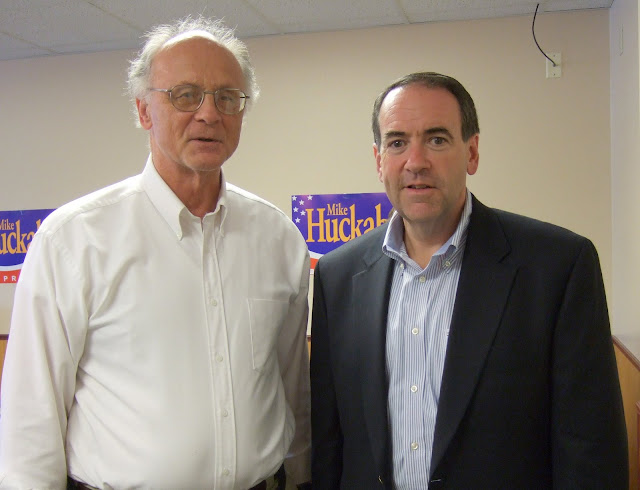 In 2008 my choice from among the Republicans was Mike Huckabee. "It's Huckabee; My Republican Pick: Governor Mike Huckabee," July 24, 2007.
Needless to say, I didn't pick him for his positions on the issues or his religious convictions. We would have disagreed about virtually everything -- up to and including evolution and the origins of the universe. What I liked was his experience (and record) as a governor, what seemed to be a kind of basic decency, and a sense of humor.
What first caught my ear was his rejoinder to being questioned about his conservative credentials. He responded something like, "Oh, I'm a conservative all right, I'm just not angry about it."
Asked if he was "pro-life," he responded something along these lines: "Of course, I believe in right to life. I just don't think the right to life stops at the end of the birth canal. I think a right to life has to include a right to nutrition, housing, health care and education."
When I first met him he expressed the same thought in another context: national security. National security, he said, requires a nation's ability to provide its citizens food and fuel, a better educational system and health care for all Americans. It was reminiscent of one of Dennis Kucinich' chants about "weapons of mass destruction": "poverty is a weapon of mass destruction," "lack of health care is a weapon of mass destruction." At worst, Huckabee's comment demonstrated a comprehension of how social programs have to be packaged to be sold; at best, it provided a clue as to what he'd really like to see government do.
He said we need both a global perspective and a focus on our internal needs, using as an analogy the way he inspects a plane before he boards: "I'm not just interested in the left wing or the right wing; I'd kind of like for both of them to be there."
My feelings about Huckabee were similar to my feelings about the last Pope. John Paul was Catholic. I was not. We disagreed about a number of issues -- including the role of women in the church, contraception, and the propriety of government mandated laws prohibiting abortion. But he was just about the only world leader then speaking out on issues of war, peace and poverty. It seemed to me you had to give him credit for that.
There was a soft side to Huckabee. He met people easily. He came across as friendly, comfortable, relaxed and genuine -- as well as often genuinely funny.
He told of being asked if he was "one of those narrow minded Baptists who thinks only Baptists are going to heaven." He replied, "No. I'm even more narrow minded than that. I even know a good many Baptists who aren't going to heaven."
He can use self-deprecating humor: "I'm leading in New Hampshire," he said. "The biggest percentage favors 'None of the above.' And that's me; I'm 'none of the above.'" At another point he referred to feeling like "a fireplug in a neighborhood of dogs" -- though, alas, I can't now remember the context.
So that was some of what led me to Huckabee four years ago -- while working to get Obama nominated and elected.
# # #
June 17, 2011, 12:06 p.m.; with added critique June 18, 2011, 8:30 a.m., and June 19, 2011, 9:15 p.m.
[NOTE, June 18: Since posting this blog entry, I requested and received a critique from someone with more inside knowledge than I possess. (She/he wishes to remain unidentified.) Excerpts from her/his comments have now been embedded throughout the blog entry -- within brackets, quotes, and in this font.
It might have been less embarrassing to simply revise what I had written, but I have almost always been more interested in letting curiosity propel inquiry wherever it may lead than in being "proven right." Besides, it's both more honest and also more interesting reading to share with you both my text and the critique as written.]
A Primer
The hacker community -- Lulz Security and Anonymous, among others -- have had a good couple of weeks.
["Your first error is in referring to 'the hacking community.' There isn't one. Non-hackers tend to view hackers as a community due to the fact we have shared technical skills and some grossly similar social features. The reality is that if the 'hacking community' exists, it's an anarchist mob that's defined by temporary alliances, shifting loyalties, cults of personality and people whose fads have briefly aligned. Enduring long-term associations and friendships do exist, but they're much more rare than people think. We generally do not socialize very much outside our circles. Our few social mavens are rare birds, and prized for their abilities to make magic happen just by putting the right people together and standing well clear of the result.
"The 'hacking community,' to the extent it exists at all, is more a pool of diverse skills, philosophies and capabilities, which self-organizes in response to events. Consider the Iranian protests of a few months ago: there were contingents of pro-democracy hackers who were putting together anonymous relays to help get a trickle of uncensored communications into/from Iran, there were contingents of pro-regime hackers who were trying to shut down the pro-democracy types, and there were even jackasses who were exploiting the entire thing for juvenile sophomoric jokes ('the lulz'). Take any significant, serious event in the world and the 'hacking community' will within hours develop at least three or four responses to it, many of which are in open conflict with the others."]
Their targets have ranged from PBS and Sony, to Citibank and Lockhead, Google, the IMF, CIA, FBI, White House and U.S. Senate.
It has not been without cost. Sunday [June 12] Turkish police detained 32 members of the Anonymous cyberactivism collective on suspicion of planning attacks on a number of websites, after Anonymous took down the Website of Turkey's Directorate of Telecommunications. And Spanish authorities arrested three of the Anons group two days earlier on suspicion on organizing the cyber attacks against Sony, banks and governments.
["Second, the Turkish police didn't arrest 32 members of the Anonymous collective. There is no collective. It isn't as if these people carry membership cards and hang out in a clubhouse. Even the most hardcore Anonymouser wouldn't consider herself to be a 'member of Anonymous' or a 'part of Anonymous'. She might say that she /is/ Anonymous, which means she has adopted their political platform and is an autonomous agent spontaneously organizing with other like-minded people to perform acts.
"The hacking community, as it were, is *radically decentralized* -- decentralized to such a degree that most people can't imagine it functions at all. (And hackers grit our teeth and mumble, 'well, now that you mention it, it really *doesn't*.') It would be more accurate to say the Turks arrested 32 people who they allege have acted in concert under the banner of Anonymous -- but in the same breath you should say there is no guarantee these 32 people represented the beliefs of Anonymous as a whole, *because there is no such whole*.
"Compare to, e.g., if you said the Turkish police arrested 32 people from the freedom of religion collective. There really is no 'freedom of religion collective': freedom of religion is a philosophy which has many adherents, most practitioners of which want to murder the others who are believing in the wrong god and using their freedom poorly.
"And that's exactly what Anonymous is. Anonymous is a philosophical banner beneath which different people self-organize to perform acts in accordance with the ideals of Anonymous (to the extent it has any, and the jury's still out on that). What are the ideals of Anonymous? Well, Anonymous has been in a constant state of civil war in order to determine just that...[[My source subsequently [June 19] provided me with additional evidence of his/her judgment that "the hacker 'community' [is caught up in] fractious, internecine conflict, cults of personality, fads, etc. Case in point. LulzSec and Anomyous are, as near as I can tell, identical in philosophy, goals and methods, and yet they're still engaged in a hatefest." She/he cites Matthew Lynley, "Hit the deck: LulzSec and Anonymous start trading blows," Venture Beat, June 15, 2011 ("Hacker group LulzSec has begun publicly attacking hacker group Anonymous, an action that could lead to a civil war of sorts between the two hacker groups that have similar origins.").]]
"The associations within a freedom-of-religion-collective would be rather permanent: people rarely wake up one day and decide, 'today I think I'll be a Buddhist.' The associations within Anonymous are in a constant state of flux as internal power battles play out."]
The Internet has grown faster than Kudzu; in fact, it is the largest and fastest growing anything in the history of the world -- and there's nobody in charge. If a part of the backbone goes down, the traffic routes itself around it and follows another path. That was a deliberate part of the Defense Department's plan in creating the Internet's predecessors: it wanted a communications system that could not be knocked out with a single bomb on "headquarters."
["Third, the DoD did not plan for the internet to survive nuclear strikes. Urban myth. The DoD didn't want the internet at all. The DoD was, through the Advanced Research Projects Agency, funding a lot of different scientists in a lot of different places. These scientists said, 'hey, can we spend some of our research grants to build a better way for us to collaborate?' ARPA said yes. In those days communication channels were unreliable and expensive, so ARPA's scientists developed a network that could work even if large parts of it went down. The rest, as they say, is history. The DoD has never trusted the internet to handle national-defense data: rather than trust the internet, DoD much prefers to trust MILNET (its own version of the internet)."]
Whether the global hacking community deliberately modeled its organizational structure and governance on that of the Internet, or did so as a matter of necessity, it is equally resilient. Whatever may happen to the 32 in Turkey and the three in Spain, the organizations and the hacking by their members will continue.
What's going on is serious enough that, without getting into the jargon and details of hacking techniques, each of us needs to have at least some basic understanding of what's happening. And that understanding requires that we recognize the enormous variation in the sophistication of hackers' techniques, their motives, and the consequences of their actions.
Let's consider these variations in turn.
Sophistication of techniques.
It helps to begin with the variations in sophistication of those doing mischief in what the cyberati refer to as the "brick and mortar" world in which the rest of us live. Consider the range. A burglar may see three days of newspapers in a driveway with no cars in sight, try each of the exterior doors, find one that opens (or a key under the door mat), walk in and walk out with the new HD wall screen TV. A company's bookkeeper or accountant may design accounts and transactions that can cover for years their embezzlement of thousands of dollars. Art thieves may figure out how to disable, or otherwise get around, heat sensors, motion detectors, and video cameras, to make off with a multi-million-dollar painting. Or our military may design fighter planes that fly with no pilots, send video recordings thousands of miles back to control centers, and fire missiles at designated targets.
Just as there is unsophisticated brick-and-mortar crime, there is also unsophisticated virtual world, electronic crime. It doesn't require much sophistication to find a credit card in the parking lot of a big box store, pick it up, and use it to make some purchases there. It doesn't require much more to get into a computer network if an employee's user name and password are displayed on a Post-It note stuck to the monitor's screen. Information that ought to have been encrypted, and kept behind more than one firewall, may have been inadvertently left on a public Web site or made equally vulnerable. In fact, an awful lot of what's characterized as "hacking" involves little more than asking -- a current, or former, employee may provide the necessary information, perhaps even one who designed the security system. The credit card information may be obtained from a receipt found in a dumpster. A hidden camera may record users' ATM pin number key strokes.
A Google search for "denial of service attack tools" (software) produces nearly a million hits. Some of what Lulz Sec and Anonymous members have been doing involve denial of service attacks. They send so many requests to a Web site that its servers slow down or stop, preventing legitimate users from gaining access. Such attacks are a nuisance, a big nuisance, but they need not do any harm to infrastructure or physical property, and do not provide the attacker access to the contents of the site, or its network. It's something experienced teenagers can do, if so inclined.
Similarly, while designing malicious software programs may require some sophistication, getting them onto a computer inside a secure location may involve little more than putting them on a thumb drive, leaving it in the building's parking lot, and hoping some employee will find it, put it in their computer to see what's on it, and thereby unwittingly load the hidden software onto the institution's "secure" computer network.
At the other extreme, what has been described as "the most sophisticated cyberweapon ever deployed," a complex computer program called "Stuxnet," is suspected to have been the creation of some of the most brilliant computer programmers in the West. It was specifically designed to attack the centrifuges in Iran's weapons grade uranium facility, causing them to spin at speeds ultimately producing their self-destruction. This destruction, under the watchful eyes of Iran's trained scientists, was made possible by the program's additional ability to simultaneously take over the recording and reporting facilities, which continued to display to the facility's guardians that everything was operating normally when it was not.
This is the kind of sophisticated attack that could be waged by an enemy against our infrastructure, such as the electric grid -- turning off the traffic, as well as the house, lights, shutting down air traffic control, the stock market, banks and financial transactions, turning off the natural gas and gasoline pipelines, and filing stations' gas pumps, and so forth. Except, of course, such a strike would be far, far easier than what the Stuxnet was designed to do -- and accomplished.
["Fourth, under 'Sophistication of techniques,' you should also put 'velocity' of techniques. If a particular criminal offense nets you only $0.001 per attempt it's clearly more worthwhile to you to flip burgers at McDonald's. If you can do a million attempts per second, though, you're now raking in $1000 /per second/ and you're going to be sipping mai-tais on a beach somewhere. Network crime doesn't have to be particularly efficient or effective, because the network allows you to do so damn much of it.
"Velocity -- the ability to scale up your efforts -- is a big deal. One real mark of sophistication is velocity. A well-designed computer virus can infect 95% of all susceptible computers on the internet in about fifteen minutes. Quite often, by the time you know you're under attack it's too late and you've already lost. Against an unsophisticated teenager, reactive security measures work pretty well. Against a sophisticated operator, reactive security measures are pretty much useless."]
Could it happen? It could, according to the Director of the CIA, soon to be Secretary of Defense, Leon Panetta, who told Congress last week, "The next Pearl Harbor we confront could very well be a cyber attack that cripples our power systems, our grid, our security systems, our financial systems, our governmental systems."
Motives
The motives of hackers vary as much as the sophistication of their methods.
Some attacks, like Stuxnet, appear to be acts against one nation by another -- in that case literally, the history shows, an alternative to dropping bunker buster bombs on the facility (an option considered and rejected).
The Defense Department has recently declared that when a cyber attack on U.S. infrastructure, or defense installations, can be traced to another nation's government, it will be considered an act of war justifying our response with conventional military weaponry.
["Fifth, under 'Motives'" you're misquoting DoD badly. DoD has never said cyberattack *will* be considered an act of war. DoD has said that *depending on the consequences, it could be considered* an act of war. This is a pretty sensible policy. Your other points are quite accurate, though.
[[NJ: For more on the content, context, and challenges of this DOD declaration, see David E. Sanger and Elisabeth Bumiller, "Pentagon to Consider Cyberattacks Acts of War," New York Times, June 1, 2011, p. A10.]]
"Further, under 'Motives' you declare the hack of PBS was a protest about how they handled a Wikileaks story. The question becomes, why are you taking felons at their word for why they're committing their offenses? I suspect the real motive was because PBS is high profile and gets noticed -- the motive the attackers gave is just a rationalization and/or public-relations theory. 'We're engaged in political protest!' goes over in the public eye a lot better than 'we did it all for the lulz!'"]
There are a number of problems with this declaration. (1) Since our government is engaged in cyber attacks on other countries, presumably those countries could rationally justify dropping bombs on the United States. (2) It is often very difficult to know where cyber attacks are coming from. (3) Many involve multiple global operatives. For example, the computer theft of $10 million from banks was run out of 49 cities on multiple continents. (4) When a single country can be identified beyond a reasonable doubt, it's still not clear who is behind the attack: that country's government, its organized crime operatives, or just its precocious teenagers. If our government cannot know, let alone control, everything our mafia and teenage cyber gangs are up to, it's neither reasonable nor fair to expect that other countries are able to control what their criminals and teens do. (5) Indeed, a country ("country A") intent on harming another ("country B") could fairly easily construct a cyber attack on the U.S. in such a way as to make it appear that the attack on the U.S. came from country B, thereby causing the U.S. to launch a retaliatory attack on country B rather than country A. There are many potential examples, such as Pakistan and India, Israel and Palestine, North Korea and South Korea.
Shy of the devastation brought on by cyber warriors are the individuals engaged in serious, organized crime -- mass scale identity and credit card theft and resale, or movements of money (including that of banks and their clients).
Then there are those who do a little of the former, but are mostly just up to devilment -- a form of electronic vandalism. For example, the hack of PBS was a protest against a Frontline program about Wikileaks.
For those just beginning hacking -- eight of the Turkish 32 were minors -- hacking is often little more than a challenge, a hobby, and a way to earn the respect of one's hacking contemporaries and elders.
(Of course, there are also the white hats: those who are hired by the hacked company to try to break in, to test the adequacy of the company's security measures.)
Consequences
The consequences can vary from unsuccessful and unnoticed attempts at unauthorized entry, to little more than a minor nuisance (denial of service attacks), to taking over personal computers and using them to circulate harmful viruses or other malware, loss of national security secrets, or closing down vital infrastructure (such as the electric power grid).
Any unauthorized impact on a computer is something we need to know about and try to prevent. All are, not incidentally, already illegal. But in our efforts at prevention and enforcement it's important for us to be able to distinguish between that which could bring down our country's infrastructure, and that which is kids' play.
["Sixth, under 'Consequences': it is not strictly speaking necessarily illegal for someone to attempt to exceed their granted authority to a system (although a naive reading of the Computer Fraud and Abuse Act could make one think otherwise). C.f. the Lori Drew case, where Drew was accused of violating CFAA because she violated a website's terms of service. The government's rationale was the ToS was the grant of authority, she violated the ToS, therefore she exceeded her authority and violated CFAA. The judge in the case threw out Drew's conviction."]
Obviously, if the computer systems of governments and major corporations are vulnerable, so are yours and mine. What can we do to protect ourselves?
Self-defense
There is probably little or nothing we can do to protect ourselves from the kind of sophisticated attack that could be imagined and implemented by hackers with the skills of those able to create something like the Stuxnet worm. Fortunately, such individuals are few and far between and those that exist are not likely to waste their professional time trying to read our Microsoft Word documents.
["Seventh, under 'Self-defense.' When you say there is little to nothing regular people can do to defend themselves against serious attackers, you're being both too optimistic and too pessimistic. A very important concept is *target specificity*. If a highly trained cyberwarfare operator with a few years of dirty tricks experience decides to target you, and you specifically, then there is literally nothing you can do about it -- not even unplugging your PC will work, since so many of the vital records in your life exist on computer systems beyond your control. At the same time, though, if you are not a specific target, there's a lot you can do. Keep a well-honed sense of skepticism. Check with your OS vendor regularly for security updates. Don't open random things people send you in email. Browse the Web with Firefox or Google, and not Internet Explorer. Etc., etc. There's not much you can do about a bullet with your name on it, but there's a /lot/ you can do about all the hot lead flying around addressed 'To Whom It May Concern.'"]
But there are a good many basic and obvious things we can do to protect ourselves from the electronic devilment, vandalism, and theft to which we may be vulnerable. Use common sense (and a locking cable) to prevent theft of the entire laptop. Create more complex passwords than "password." Don't write user names and passwords on paper kept within easy access from the laptop. Use encryption for documents that warrant it. Get good quality virus protection software and keep it up to date. If you have a home Wi-Fi signal others could access, make it a locked, password protected signal.
And while we're at it, recall the observation that every hard drive will, someday, crash; we just don't know when. So make regular backups (or offloads) of any documents you care about onto an external hard drive (or two; one stored somewhere away from home or office). That way, if the laptop self-destructs from an attack, is lost or stolen, or is otherwise destroyed (or the time comes for your hard drive to crash) you will at least have retained the computer's contents -- which may be much more valuable to you than the computer itself.
I will close with one final observation regarding the extent to which we, and our friends, are our own worst enemies when it comes to protecting our privacy and identity. Most of the privacy and identity we have "lost" we have willingly given away in exchange for what we've perceived as benefits.
The credit card company knows what cities and stores we have been in, at what hour of what days, what we purchased and what we paid. The bank has all our loan and checking account records (legally considered their records, not ours). It knows where and when we've visited ATM machines, and how much cash we withdrew. Our cell phone carrier knows where we've been, and when, whom we've called, and how long we've talked. The airlines know where we've flown and when. Some have as well our Social Security numbers, birthday, address and phone numbers.
They haven't hacked or otherwise stolen this information from us. We've voluntarily given it to them. We believe that the use of checks, credit cards, ATMs, cell phones and airlines is well worth the loss of privacy.
What we may not be aware of is that the Supreme Court says once we voluntarily give information about ourselves to third parties, (a) we no longer have a "reasonable expectation of privacy" with regard to that information, and (b) the third parties are free to hand it over to law enforcement, or others, without letting us know they have done so. And the government has not violated our Fourth Amendment rights to be protected from governmental "search or seizure" if it was third parties, rather than the government, that obtained the information in the first place and simply handed it over to the government when asked.
Walt Kelly, the creator of the comic strip character Pogo, once had him say, in the context of environmental issues, “We have found the enemy, and he is us.” So it is with our loss of privacy. Much of the problem is not that George Orwell’s 1984 Big Brother is watching us (and digging through our trash, as the FBI is now permitted to do without a warrant).
The problem is that we and our Facebook friends are the “enemy,” watching us, recording us, photographing and videoing us, writing and commenting about us, circulating all of the above, and filing it all away, in public (on Facebook; and on Facebook’s servers forever), where Big Brother can come and just download it all. The government can then include and save it with all the other databases that include records and information about us (school, medical, military, vehicle and criminal, credit card, bank, real estate, etc.). It can then “data mine” all of this information to its black heart’s content. Facebook's latest invasion -- face recognition, plus "tagging" of individuals in photos -- added to the rest, now makes potentially available to the FBI, CIA and NSA everything a criminal record would contain but our fingerprints. (And with fingerprint ID gaining in popularity for check cashing and door opening, they may soon have that as well.)
If none of this bothers you, if it's worth the services you get in return, fine. No problem. Just make sure it's really what you want.
It is a whole new jumbled jungle of two worlds out there. One is a virtual world of blue smoke, reflective mirrors, electrons and no parachutes. The other is a world of crumbling brick and mortar. Both offer wonderful opportunities from which we benefit. Both also present risks which we ignore at our peril.
Have a nice day.
# # #
 At the outset, there is something troubling about candidates for federal office running against "government" -- as Grover Norquist puts it, "I don't want to abolish government. I simply want to reduce it to the size where I can drag it into the bathroom and drown it in the bathtub." [Photo credit: Wikipedia.org.]


