. . . because much of the content relates both to Washington, D.C., and "outside the beltway" -- the heartland, specifically Iowa -- and because after going from Iowa to Washington via Texas and California I subsequently returned, From DC 2 Iowa.
Murdoch's Violations Small Part of Loss of Privacy
I have often said, "the problem is not that corporations violate the laws, it is that they write the laws."
I have often been wrong -- at least partially so.
Because, of course, the problem is also that corporations corrupt or otherwise violate the laws as well as writing them. BP and Massey Coal did both, and workers died. Murdoch's worldwide media monopoly hacked cell phones, published stories based on the conversations, and hundreds of citizens and celebrities alike suffered in a variety of ways.
There's no way to minimize or justify what the editors and reporters of Murdoch's News of the World did. It's awful. From the perspective of college classrooms it's a subject for studies of journalism, technology, and law. It's a global media story, an example of how technological "advances" gnaw away at our neglige of privacy, and thereby create Rubik's-cube-like challenges of legal analysis for legislators and lawyers.
But this is more than a story about the fall of one of the world's largest media barons. It should also be a teachable moment for all of us regarding our privacy.
Consider all of today's technological and other assaults on the standards of privacy accepted and expected by our great-grandparents. From that perspective, as awful as the Murdoch invasions appear to have been, they are but a very small part of what we need fear.
Like the insight of Walt Kelly's cartoon figure, Pogo -- "We have found the enemy, and he is us" -- or Winnie the Pooh's discovery that the tracks he was following were his own, most of the assaults on our privacy are self inflicted.
(1) Much of our lost privacy we have voluntarily abandoned. Take Facebook, for example. Our names, addresses, birth dates, family members -- all identified with "tags" in their photos -- and our network of "friends," are available for the databases of Facebook, criminals or law enforcement. We may keep unencrypted passwords on a thumb drive, smart phone, or laptop, available to whoever gets our lost or stolen equipment. I recently saw a desktop in a business with a Post-It note stuck to the screen, revealing to anyone who glanced that way the username and password. Once a voice mail hacker knows that 75% of users choose "1-2-3-4" as their password it makes it a whole lot easier to listen in. Now that the FBI (and anyone else) can search our trash without a warrant, we may still think we're destroying documents with credit card numbers or other valuable data because we took them out to the curb for trash pickup, rather than shredding them.
(2) Professor Jonathan Zittrain speaks of what he calls "privacy 2.0" ("The Future of the Internet -- And How to Stop It").
As technology progresses through the decline in price that I call "the 99.9%-off sale" (not incidentally, with improved capacity and quality, and reduction in size and weight), it spreads, it becomes ubiquitous. The video recording capability that once cost tens of thousands of dollars is now merely hundreds of dollars or less.
Our actions are being recorded by the scanning video cameras in government buildings, banks, convenience stores and other private businesses. They monitor and bill those who run red lights. The Webcams in our laptops may take video of us without our knowledge.
But that's not the major problem.
Still and video camera capability is built into our smart, and even dumb, cell phones.
Couple this with the ease of uploading videos to YouTube, Facebook, or attaching them to emails. Anyone's embarrassing, or illegal, moment can suddenly go viral globally.
That's not the result of government, Big Brother snooping on us, or evil corporations. It's us; millions if not billions of us, recording and distributing information about each other -- usually for reasons somewhere between friendly and helpful, or at least benign.
(3) We gratuitously give our private information to Facebook, expecting little or nothing in return.
But we also trade off our privacy, our secrets, our personal identifying data, for perceived benefits. We give the bank our financial data, including how much cash we took out from which ATM machine, the day and time. We let the credit card company record where we went, what stores or other businesses we entered, what we bought, what we paid for it, where and when. The cell phone company tracks our every move, knows where we are, who we called, how long we talked -- and if they care to know, what we talked about. The airlines know where we flew and when; the rental car companies also.
I'm not saying these and comparable gifts of privacy to corporate America are irrational choices. It would be hard to function in today's world without, say, credit cards and phones. I'm just saying that we can't voluntarily turn over vast amounts of information about ourselves to government and merchants and then complain that they possess this information about us.
(4) This third-party possession of our most intimate information raises other problems.
The Fourth Amendment asserts a "right of the people to be secure in their persons, houses, papers, and effects" -- seemingly a kind of place-based security. So what about tapping phone lines from a place away from home? In the Supreme Court's 1967 Katz decision, involving law enforcement's recording of a conversation by means of a device attached to a public phone booth, the Court expanded the protection to include those things as to which we have (1) "an expectation of privacy" that most people would consider to be (2) "reasonable" -- the "reasonable expectation of privacy" standard.
So far so good. But in the 1976 U.S. v. Miller case the Court explained that once you've shared information with another, even though you did so in confidence and for very limited purposes, you no longer have an expectation of privacy in that information, let alone an expectation that courts will consider "reasonable." In the Miller case the defendant, Miller, attempted to claim a Fourth Amendment right of privacy in the cancelled checks and other records and documents maintained by his bank. The Court decided those were the bank's records as much, indeed more, than Miller's. Thus, he had no "reasonable expectation of privacy" and law enforcement could get access to those records from the bank, without providing Miller the protections he would have received under the Fourth Amendment had law enforcement come to his home for "papers."
So it turns out that, not only have we turned over a vast amount of information about ourselves to private corporations, we have, thereby, essentially turned it over to the government as well (in many instances) and lost the rights of privacy we have in information never shared.
(5) Once we go to work it only gets worse. Employers can listen in on their employees' phone conversations, read their email, know what Web pages they've visited, track how many keystrokes they contribute per hour or day, and install video monitors throughout the workplace. Even if the employer pledges you have personal privacy with regard to any of the above, courts may reject an employee's reliance on that assurance.
(6) Are there instances in which a hacker acquires information they had no authorization to access, or for which they exceeded their authorization? Of course. The Defense Department gets millions of such hits. There was a recent example of exceeding authority at the University Hospital. One can imagine many more driven by simple curiosity, or a desire to help a friend (such as a bank employee providing a woman contemplating divorce information about suspicious regular checks drawn on the errant husband's separate account).
The Murdoch reporters, and the editors to whom they reported, had no business getting access to the voice mail of 9/11 victims' families, or those of British soldiers killed in action, celebrities, or the murdered young girl. It's not only boorish behavior and a violation of journalistic ethics, it also happens to be a violation of the criminal law.
But if we really care about maintaining some little bit of our remaining privacy regarding our images, speech, writing, movements, actions, circle of friends, financial transactions, medical records -- among other things -- we need to look well beyond the Murdoch Empire, however vast and evil it may be.
And we need to begin with the person we see in our bathroom mirror.
Externalities: Football; Murdoch and Obama's Safety (brought to you by FromDC2Iowa.blogspot.com*)
externality -- an external effect, often unforeseen or unintended, accompanying a process or activity: to eliminate externalities such as air pollution through government regulation.Dictionary.com
Football's Externalities
If you live near the Kinnick Stadium you know that leaves are not the only things that fall on your yard in the fall.
(1) When I was a lad I was trained by my parents and other adults to deposit trash in receptacles -- and not just when they were close at hand. On wilderness hiking trips, the rule was "if you carry it in, you pack out the trash." I've never grasped the "drop-it-anywhere" philosophy, especially when trash cans are only seconds or minutes away. (The philosophy also applies, apparently, to dropping one's pants anywhere, notwithstanding the availability of port-a-johns within a block or two walk, as urination on private lawns continues to be a problem.)
(2) But that's not my complaint. Thank goodness for the bottle and can deposit law, and those who believe it's worth a nickel to bend over and pick up cans, put them in large trash bags, and bike or carry them to redemption centers. Those folks clean up much of my lawn between the sidewalk and the street.
At 3:00 a.m. I feel like the father in the Cheerios ad whose kid is concerned about the father's heart condition and brings him a bowl of Cheerios at 6:00 a.m. The father responds, "That was very thoughtful of you. Very early, but very thoughtful." For I know I'll always start the day early on the Sunday mornings following the Saturday football afternoons when the street sweepers come rumbling down the street and back again at 3:00 a.m. That someone would be willing to get up even earlier than I in order to clean my street before dawn is also, "Very thoughtful. Very early, but very thoughtful." Besides, I've been fascinated with street sweeping equipment for most of my life.
(3) Indeed, if the bumblebees and their offspring would just drop their trash, I wouldn't like having to pick it up rather than their doing so, but it would at least be a relatively easy task and things would soon be back to normal. But they don't. They throw it in and under bushes. Maybe they think they're doing me a favor, so their trash won't be so visible on my yard. But they're not. They are necessitating my crawling under some rather uncomfortable growth to drag out goodness knows what.
This is a picture of what I found under one bush following one football game (yesterday). Because not even the can and bottle redeemers consider a nickel a worthwhile reward for such effort, it's left to me. Beer cans and bottles, cups, snack sacks, a condom -- thankfully unused, presumably by someone who doesn't yet know where they need to go to prevent pregnancy and STDs. (Research data and best practices advise that merely putting them on the ground, unopened, before you put down the blanket and lie down provides virtually no protection.) Also note that Budweiser's effort to sell even more beer to college students by using schools' colors on the beer cans is successfully proceeding apace, notwithstanding the UI's professed objections, if my sample of black and gold Bud is representative. [Photo credit: Me.]
And for a participant-observer's more detailed, but consistent and candid descriptions of football Saturdays in the Melrose neighborhood, see Michael Dale-Stein, "Quintessential Iowa Tradition,"The Daily Iowan, September 21, 2009, p. 4A. For a blogger's comment about (disgust with) that DI column, see Dawn, "Growing Up Sober,"For the Love of . . . Eloquence," September 21, 2009.
Rupert Murdoch's Externalities: President Obama's Safety
"Congress shall make . . . no law abridging the freedom of speech, or of the press; . . .." So reads the First Amendment to the Constitution of the United States.
"What part of 'no' do our judges not understand?" Justice Hugo Black, for whom I clerked, took the view that because the drafters knew how to use qualifiers, such as "unreasonable searches and seizures" in the Fourth Amendment, we should assume when they said "no law" they meant "no law."
When the FCC exacts substantial fines for relatively trivial "indecency" (which, unlike "obscenity," is constitutionally protected speech), when the post office sets postal rates for newspapers on the basis of the quantity of advertising they contain, when the airport security rules forbid humor near the metal detector machines, when corporations are required to put revelations in a stock prospectus they would rather keep to themselves, when the FTC finds advertising "false and misleading," when cigarette makers are required to tell potential customers that their product will kill them -- each constitutes an "abridgment" of speech the judges say is consistent with the "no law" prohibition.
Sometimes the judges just say the speech in question isn't "speech." Obscenity, defamation (until the Sullivan case), "fighting words," speech that might lead to "imminent lawless action," commercial speech (for the first half of the 20th Century), military secrets in time of war, and child pornography are simply defined as "non-speech" outside of the First Amendment's protection.
(To remove any possible ambiguity, I am not voicing objection to the ultimate result in these cases. I'm certainly not making the case for the social benefits of child pornography or, as in the next paragraph, visual depictions of animal cruelty. All I'm saying is that coming to these results as an interpretation of a constitutional provision that there shall be "no law" abridging free speech really does require three years in a law school.)
On October 6th the Supreme Court will consider adding another category of speech to this long list of exemptions: dog fight videos (under a 1999 federal law that forbids trafficking in “depictions of animal cruelty”). Adam Liptak, "A Free Speech Battle Arises From Videos of Fighting Dogs,"New York Times, September 19, 2009, p. A1.
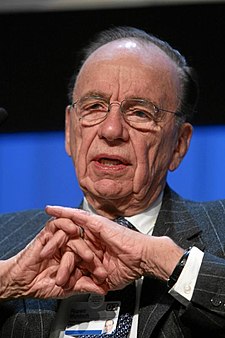
I recently came upon a letter from a citizen to Rupert Murdoch [Photo credit: Wikipedia.org], owner of the Fox broadcasting enterprise, in which she expresses her concern about the impact of Fox's programming on our nation, including the potential physical risk to our President from those
who actually believe President Obama is the equivalent of Adolph Hitler . . . someone to be feared. They get these ideas from your media organizations.
And it makes them dangerous and sick . . ..
[Y]ou are hurting people in our country, and I would like you and your stations to start showing some restraint before one of these individuals thinks they are doing the right thing by actually committing an act of violence.
A part of what I omitted (the entire letter is reproduced below) is, "Maybe you have the right to do whatever you want . . .."
And indeed Murdoch does. Because hate speech -- especially political hate speech -- including that which reflects inaccurate sources of information, is protected speech under our courts' interpretations of the First Amendment. The Court may find that "animal cruelty" is outside the protection of the First Amendment. But depictions of, and incitement to, human cruelty are protected. Unless the "lawless action" from speech is "imminent" it's OK.
It was not always thus. In 1932 a court upheld the old Radio Commission (predecessor to the FCC in 1934) in its denial of a license renewal to Reverend Dr. Shuler of the Trinty Church in Los Angeles, licensee of station KGEF. Based on the record in the case it would seem that his speech was no more inaccurate, mean spirited and hateful than what passes for talk shows on Fox. The court, while upholding Shuler's First Amendment rights to hold and speak his views elsewhere, drew a distinction in terms of his right to use a station licensed to serve "the public interest" for such purposes. Judge Groner wrote:
[If broadcasters are permitted to] use these facilities, reaching out, as they do, from one corner of the country to the other, to obstruct the administration of justice, offend the religious susceptibilities of thousands, inspire political distrust and civic discord . . . and be answerable for slander only at the instance of the one offended, then this great science [of radio broadcasting], instead of a boon, will become a scourge, and the nation a theater for the display of individual passions and the collision of personal interests. This [restriction on a broadcaster's speech, in this case resulting in the Commission's refusal to renew Shuler's license] is neither censorship nor previous restraint, nor is it a whittling away of the rights guaranteed by the First Amendment, or an impairment of their free exercise.
Appellant may continue to indulge his strictures upon the characters of men in public office. He may just as freely as ever criticize religious practices of which he does not approve [which were Roman Catholicism].
He may even indulge private malice or personal slander -- subject, of course, to be required to answer for the abuse thereof -- but he may not, as we think, demand, of right, the continued use of an instrumentality of commerce for such purposes, or any other, except in subordination to all reasonable rules and regulations Congress, acting through the Commission, may prescribe.
Trinity Methodist Church, South v. Federal Radio Commission, 62 F.2d 850, 852-53 (C.A.D.C. 1932).
Suffice it to say, Trinity is no longer the law either at the FCC or among the judges of the U.S. Court of Appeals, D.C. Circuit.
Rupert Murdoch, this Australian-born, 78-year-old media mogul, and 132nd richest person in the world, controls the News Corporation, which owns Fox. And today, unlike 1932, he can legally use his media to spew forth hatred-for-ratings of a sort that would have resulted in the loss of his licenses in the Commission's early days.
When I was an FCC commissioner, major media operations were owned and controlled by, and identified with, individual human beings. Bill Paley was the one to give the credit, or blame, for CBS' programming; as was David Sarnoff for NBC. Today, all too often, media corporations are run by hired hands (albeit very well compensated hired hands) and controlled by Wall Street.
But in the case of Fox we still have a person, Rupert Murdoch.
So in the absence of any prospect for action from Congress, the FCC, or the courts, Ms. Trish Nelson wrote directly to Rupert Murdoch:
Rupert Murdoch Chairman and Chief Executive News Corporation 1211 Avenue of Americas 8th Floor New York NY 10036-8701
Dear Mr. Murdoch:
I am writing to you because I understand you own and control a large number of newspapers, television stations and other kinds of media outlets.
I have been sickened and saddened by the choices your news organizations have made to show, over and over, on TV, horrible, hate inspired images against President Obama, and people carrying signs with messages of violence.
You are taking advantage of a few sad, ignorant people, who don't know any better, because they believe Fox and people like Glenn Beck and Bill O'Reilly care about them and are telling them the truth. They don't understand that these people are just doing what they do because they are TV and radio personalities. The people in those crowds don't understand that they are being used, and that the ideas they are supporting are actually harmful to them. This is not right.
Do you do this for the money? How much money do you and yours need? Are you trying to start full-blown civil unrest so that you can make even more money?
Do you have any idea what it is like out here, having to live and work alongside people who are so horribly misinformed about how the world works? Who actually believe Obama was not born in this country, who actually believe in death panels, who actually believe President Obama is the equivalent of Adolph Hitler, and is someone to be feared? They get these ideas from your media organizations.
And it makes them dangerous and sick on an individual level.
Maybe you have the right to do whatever you want, but you are hurting people in our country, and I would like you and your stations to start showing some restraint before one of these individuals thinks they are doing the right thing by actually committing an act of violence.
Trish Nelson Iowa City, Iowa
Murdoch's address is at the top of the letter. You might want to consider writing him, as I will -- making reference to Ms. Nelson's letter, or not, as you choose. Given our Constitution and courts -- and corporate control of Congress -- Murdoch is these days about the only power to which you can appeal.
Blog Entry Makes "Saturday Night Live"
A week ago I had a blog entry suggesting that Congressman Joe Wilson's shout out at President Obama during a Joint Session of Congress was the result of a prior plan among Republicans that they would all shout "You lie!" in chorus -- a chorus in which Wilson would ultimately become the only member. Nicholas Johnson, "Republicans' Practical Joke . . .; 'You lie!'" September 11, 2009.
Imagine my surprise when "Saturday Night Live" developed the idea into one of the show's openings.
You're welcome, SNL. Great job with the video! And special thanks to Jason Grubbe. ____________
* Why do I put this blog ID at the top of the entry, when you know full well what blog you're reading? Because there are a number of Internet sites that, for whatever reason, simply take the blog entries of others and reproduce them as their own without crediting the source. I don't mind the flattering attention, but would appreciate acknowledgment as the source, even if I have to embed it myself. -- Nicholas Johnson