(brought to you by FromDC2Iowa.blogspot.com*)
externality -- an external effect, often unforeseen or unintended, accompanying a process or activity: to eliminate externalities such as air pollution through government regulation. Dictionary.comFootball's Externalities
If you live near the Kinnick Stadium you know that leaves are not the only things that fall on your yard in the fall.
(1) When I was a lad I was trained by my parents and other adults to deposit trash in receptacles -- and not just when they were close at hand. On wilderness hiking trips, the rule was "if you carry it in, you pack out the trash." I've never grasped the "drop-it-anywhere" philosophy, especially when trash cans are only seconds or minutes away. (The philosophy also applies, apparently, to dropping one's pants anywhere, notwithstanding the availability of port-a-johns within a block or two walk, as urination on private lawns continues to be a problem.)
(2) But that's not my complaint. Thank goodness for the bottle and can deposit law, and those who believe it's worth a nickel to bend over and pick up cans, put them in large trash bags, and bike or carry them to redemption centers. Those folks clean up much of my lawn between the sidewalk and the street.
At 3:00 a.m. I feel like the father in the Cheerios ad
whose kid is concerned about the father's heart condition and brings him a bowl of Cheerios at 6:00 a.m. The father responds, "That was very thoughtful of you. Very early, but very thoughtful." For I know I'll always start the day early on the Sunday mornings following the Saturday football afternoons when the street sweepers come rumbling down the street and back again at 3:00 a.m. That someone would be willing to get up even earlier than I in order to clean my street before dawn is also, "Very thoughtful. Very early, but very thoughtful." Besides, I've been fascinated with street sweeping equipment for most of my life.
(3) Indeed, if the bumblebees and their offspring would just drop their trash, I wouldn't like having to pick it up rather than their doing so, but it would at least be a relatively easy task and things would soon be back to normal. But they don't. They throw it in and under bushes. Maybe they think they're doing me a favor, so their trash won't be so visible on my yard. But they're not. They are necessitating my crawling under some rather uncomfortable growth to drag out goodness knows what.
 This is a picture of what I found under one bush following one football game (yesterday). Because not even the can and bottle redeemers consider a nickel a worthwhile reward for such effort, it's left to me. Beer cans and bottles, cups, snack sacks, a condom -- thankfully unused, presumably by someone who doesn't yet know where they need to go to prevent pregnancy and STDs. (Research data and best practices advise that merely putting them on the ground, unopened, before you put down the blanket and lie down provides virtually no protection.) Also note that Budweiser's effort to sell even more beer to college students by using schools' colors on the beer cans is successfully proceeding apace, notwithstanding the UI's professed objections, if my sample of black and gold Bud is representative. [Photo credit: Me.]
Needless to say, I don't go around taking pictures at every football game, but if you're interested in more here are some on Picasa from a Kinnick neighborhood from a couple years ago. See -- and especially read the comments on -- Nicholas Johnson, "Hawkeye Football's Externalities," September 9, 2007.
And for a participant-observer's more detailed, but consistent and candid descriptions of football Saturdays in the Melrose neighborhood, see Michael Dale-Stein, "Quintessential Iowa Tradition," The Daily Iowan, September 21, 2009, p. 4A. For a blogger's comment about (disgust with) that DI column, see Dawn, "Growing Up Sober," For the Love of . . . Eloquence," September 21, 2009.
Rupert Murdoch's Externalities: President Obama's Safety
"Congress shall make . . . no law abridging the freedom of speech, or of the press; . . .." So reads the First Amendment to the Constitution of the United States.
"What part of 'no' do our judges not understand?" Justice Hugo Black, for whom I clerked, took the view that because the drafters knew how to use qualifiers, such as "unreasonable searches and seizures" in the Fourth Amendment, we should assume when they said "no law" they meant "no law."
When the FCC exacts substantial fines for relatively trivial "indecency" (which, unlike "obscenity," is constitutionally protected speech), when the post office sets postal rates for newspapers on the basis of the quantity of advertising they contain, when the airport security rules forbid humor near the metal detector machines, when corporations are required to put revelations in a stock prospectus they would rather keep to themselves, when the FTC finds advertising "false and misleading," when cigarette makers are required to tell potential customers that their product will kill them -- each constitutes an "abridgment" of speech the judges say is consistent with the "no law" prohibition.
Sometimes the judges just say the speech in question isn't "speech." Obscenity, defamation (until the Sullivan case), "fighting words," speech that might lead to "imminent lawless action," commercial speech (for the first half of the 20th Century), military secrets in time of war, and child pornography are simply defined as "non-speech" outside of the First Amendment's protection.
(To remove any possible ambiguity, I am not voicing objection to the ultimate result in these cases. I'm certainly not making the case for the social benefits of child pornography or, as in the next paragraph, visual depictions of animal cruelty. All I'm saying is that coming to these results as an interpretation of a constitutional provision that there shall be "no law" abridging free speech really does require three years in a law school.)
On October 6th the Supreme Court will consider adding another category of speech to this long list of exemptions: dog fight videos (under a 1999 federal law that forbids trafficking in “depictions of animal cruelty”). Adam Liptak, "A Free Speech Battle Arises From Videos of Fighting Dogs," New York Times, September 19, 2009, p. A1.
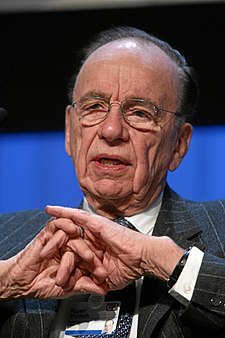 I recently came upon a letter from a citizen to Rupert Murdoch [Photo credit: Wikipedia.org], owner of the Fox broadcasting enterprise, in which she expresses her concern about the impact of Fox's programming on our nation, including the potential physical risk to our President from those
who actually believe President Obama is the equivalent of Adolph Hitler . . . someone to be feared. They get these ideas from your media organizations.For a more detailed documentation of similar serious concerns and their connection to the media, see Larry Keller, "The Second Wave; Evidence Grows of Far-Right Militia Resurgence," Intellegence Report, Southern Poverty Law Center, Issue 135, Fall 2009, p. 30.
And it makes them dangerous and sick . . ..
[Y]ou are hurting people in our country, and I would like you and your stations to start showing some restraint before one of these individuals thinks they are doing the right thing by actually committing an act of violence.
A part of what I omitted (the entire letter is reproduced below) is, "Maybe you have the right to do whatever you want . . .."
And indeed Murdoch does. Because hate speech -- especially political hate speech -- including that which reflects inaccurate sources of information, is protected speech under our courts' interpretations of the First Amendment. The Court may find that "animal cruelty" is outside the protection of the First Amendment. But depictions of, and incitement to, human cruelty are protected. Unless the "lawless action" from speech is "imminent" it's OK.
It was not always thus. In 1932 a court upheld the old Radio Commission (predecessor to the FCC in 1934) in its denial of a license renewal to Reverend Dr. Shuler of the Trinty Church in Los Angeles, licensee of station KGEF. Based on the record in the case it would seem that his speech was no more inaccurate, mean spirited and hateful than what passes for talk shows on Fox. The court, while upholding Shuler's First Amendment rights to hold and speak his views elsewhere, drew a distinction in terms of his right to use a station licensed to serve "the public interest" for such purposes. Judge Groner wrote:
[If broadcasters are permitted to] use these facilities, reaching out, as they do, from one corner of the country to the other, to obstruct the administration of justice, offend the religious susceptibilities of thousands, inspire political distrust and civic discord . . . and be answerable for slander only at the instance of the one offended, then this great science [of radio broadcasting], instead of a boon, will become a scourge, and the nation a theater for the display of individual passions and the collision of personal interests. This [restriction on a broadcaster's speech, in this case resulting in the Commission's refusal to renew Shuler's license] is neither censorship nor previous restraint, nor is it a whittling away of the rights guaranteed by the First Amendment, or an impairment of their free exercise.Trinity Methodist Church, South v. Federal Radio Commission, 62 F.2d 850, 852-53 (C.A.D.C. 1932).
Appellant may continue to indulge his strictures upon the characters of men in public office. He may just as freely as ever criticize religious practices of which he does not approve [which were Roman Catholicism].
He may even indulge private malice or personal slander -- subject, of course, to be required to answer for the abuse thereof -- but he may not, as we think, demand, of right, the continued use of an instrumentality of commerce for such purposes, or any other, except in subordination to all reasonable rules and regulations Congress, acting through the Commission, may prescribe.
Suffice it to say, Trinity is no longer the law either at the FCC or among the judges of the U.S. Court of Appeals, D.C. Circuit.
Rupert Murdoch, this Australian-born, 78-year-old media mogul, and 132nd richest person in the world, controls the News Corporation, which owns Fox. And today, unlike 1932, he can legally use his media to spew forth hatred-for-ratings of a sort that would have resulted in the loss of his licenses in the Commission's early days.
When I was an FCC commissioner, major media operations were owned and controlled by, and identified with, individual human beings. Bill Paley was the one to give the credit, or blame, for CBS' programming; as was David Sarnoff for NBC. Today, all too often, media corporations are run by hired hands (albeit very well compensated hired hands) and controlled by Wall Street.
But in the case of Fox we still have a person, Rupert Murdoch.
So in the absence of any prospect for action from Congress, the FCC, or the courts, Ms. Trish Nelson wrote directly to Rupert Murdoch:
Rupert MurdochMurdoch's address is at the top of the letter. You might want to consider writing him, as I will -- making reference to Ms. Nelson's letter, or not, as you choose. Given our Constitution and courts -- and corporate control of Congress -- Murdoch is these days about the only power to which you can appeal.
Chairman and Chief Executive
News Corporation
1211 Avenue of Americas
8th Floor
New York NY 10036-8701
Dear Mr. Murdoch:
I am writing to you because I understand you own and control a large number of newspapers, television stations and other kinds of media outlets.
I have been sickened and saddened by the choices your news organizations have made to show, over and over, on TV, horrible, hate inspired images against President Obama, and people carrying signs with messages of violence.
You are taking advantage of a few sad, ignorant people, who don't know any better, because they believe Fox and people like Glenn Beck and Bill O'Reilly care about them and are telling them the truth. They don't understand that these people are just doing what they do because they are TV and radio personalities. The people in those crowds don't understand that they are being used, and that the ideas they are supporting are actually harmful to them. This is not right.
Do you do this for the money? How much money do you and yours need? Are you trying to start full-blown civil unrest so that you can make even more money?
Do you have any idea what it is like out here, having to live and work alongside people who are so horribly misinformed about how the world works? Who actually believe Obama was not born in this country, who actually believe in death panels, who actually believe President Obama is the equivalent of Adolph Hitler, and is someone to be feared? They get these ideas from your media organizations.
And it makes them dangerous and sick on an individual level.
Maybe you have the right to do whatever you want, but you are hurting people in our country, and I would like you and your stations to start showing some restraint before one of these individuals thinks they are doing the right thing by actually committing an act of violence.
Trish Nelson
Iowa City, Iowa
Blog Entry Makes "Saturday Night Live"
A week ago I had a blog entry suggesting that Congressman Joe Wilson's shout out at President Obama during a Joint Session of Congress was the result of a prior plan among Republicans that they would all shout "You lie!" in chorus -- a chorus in which Wilson would ultimately become the only member. Nicholas Johnson, "Republicans' Practical Joke . . .; 'You lie!'" September 11, 2009.
Imagine my surprise when "Saturday Night Live" developed the idea into one of the show's openings.
["Update Thursday, Part I," Saturday Night Live Web site.]
You're welcome, SNL. Great job with the video! And special thanks to Jason Grubbe.
____________
* Why do I put this blog ID at the top of the entry, when you know full well what blog you're reading? Because there are a number of Internet sites that, for whatever reason, simply take the blog entries of others and reproduce them as their own without crediting the source. I don't mind the flattering attention, but would appreciate acknowledgment as the source, even if I have to embed it myself. -- Nicholas Johnson


