Friday, October 14, 2011

Occupy: When Will It Stop?

October 14, 2011, 8:15 a.m.

[And see the related,
“Why ‘Occupy”? What Do ‘Those People’ Want?,”
“Those Kinds of Riots Here,”
and
"Economic Recovery? It's Simple and Obvious; Recovery Requires Consumers, and Consumers Require Jobs"]


It will not stop until . . .

It will not stop until there is an end to the corporate abuse of the poor, the working class, the elderly, the sick, children, those being slaughtered in our imperial wars and tortured in our black sites. It will not stop until foreclosures and bank repossessions stop. It will not stop until students no longer have to go into debt to be educated, and families no longer have to plunge into bankruptcy to pay medical bills. It will not stop until the corporate destruction of the ecosystem stops, and our relationships with each other and the planet are radically reconfigured. And that is why the elites, and the rotted and degenerate system of corporate power they sustain, are in trouble. That is why they keep asking what the demands are. They don’t understand what is happening. They are deaf, dumb and blind.
Excerpt from, Chris Hedges, "Why the Elites Are in Trouble," TruthDig.com/CommonDreams.com, October 10, 2011.
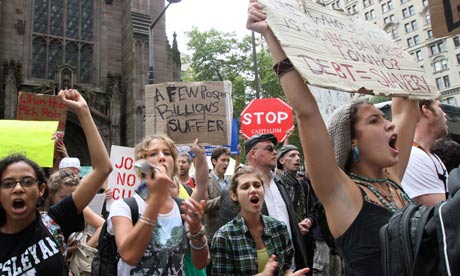
[Photo credit: The Guardian.]

Freedom, justice, dignity and equity have seldom, if ever, been beneficently granted. They have almost always required a struggle, and too often required bloodshed. And they take time. It took us awhile, and the Civil War, to begin the process of releasing African-Americans from the bonds of slavery -- longer still to grant women the right to vote, and provide African-Americans the benefits of the Civil Rights, Voting Rights, and Public Accommodations Acts. There are gains, and there are setbacks. There are swells of popular participation, and retreats into apathy, resignation, despair and depression.

No one can know, can predict, where Occupy will go and when. It could fizzle. It could grow into marching millions. It could become a third party.

And, of course, there is always the possibility that not every participant will always react to police and national guard tanks, excessive brutality, pepper spray, tasers -- or Kent-State-style shootings and deaths -- with the near-universal non-violence we have seen from Occupy participants so far.
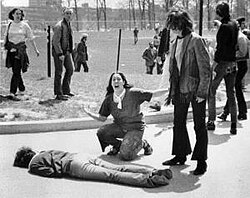
[John Filo's iconic Pulitzer Prize-winning photograph of Mary Ann Vecchio, a 14-year-old runaway, kneeling in anguish over the body of Jeffrey Miller minutes after he was shot by the Ohio National Guard; from Wikipedia "Kent State Shootings" link, above.]

How likely is violence?

As Chris Hedges has written elsewhere,
The death of liberal institutions that once made incremental and piecemeal reform possible, which once could respond to the suffering of the poor, the unemployed and working men and women, which once sought to protect the Earth on which we depend for life, means the last thin hope for reform is embodied in acts of civil disobedience. There are no established institutions that will help us. The press ignores the cries of the underclass and the poor. The labor movement is atrophied and dying. Public education is degraded and being rapidly dismantled. Our religious institutions no longer engage in the core issues of justice. And the Democratic Party is on its knees before Wall Street. The most basic government services designed to ameliorate the pain, including Head Start and Social Security, are targeted by our corporate overlords for destruction. The Kyoto Protocol, which was not nearly ambitious enough to prevent environmental collapse, has been gutted so companies like Exxon Mobil can continue to amass the largest profits in history. . . .

Those of us who demand a return to the rule of law and remain steadfast to nonviolence will find ourselves cast aside—the useful idiots Lenin so despised. I watched this happen in the social and political implosions in El Salvador, Guatemala, the Palestinian territories, Algeria, Bosnia and Kosovo. I watched the same cocktail of despair, economic collapse and callousness from a corrupt power elite mix itself into potent brews of civil strife. I watched the same untiring efforts by those who detested the violence and cruelty of the state, and the nascent violence and intolerance of the radical opposition. I covered as a reporter the disintegration that tore these societies apart. Those who held fast to moral imperatives, including Archbishop Oscar Romero in El Salvador and Ibrahim Rugova in Kosovo, were thrust aside and replaced with killers on both sides of the divide who embraced violence.
Chris Hedges, "Ralph Nader is Tired of Running for President," TruthDig.com/CommonDreams.org, July 4, 2011.

Let us, please, do more than just hope and pray this will not become America's path. Let us act to assure it. For although Occupy's ranks may decline and grow again, perhaps even with a different name and generation of participants, it will not stop. Ultimately, the legitimate grievances born of greed will be addressed, whether with brutality and bullets, or compassion and creativity.

Each of us can choose our favored option; ultimately, each of us will have to. The question we must answer, as the old labor song put it is, "Which side are you on?"


# # #

Thursday, October 13, 2011

Economic Recovery? It's Simple and Obvious

October 13, 2011, 1:45 p.m.

Recovery Requires Consumers, and Consumers Require Jobs

Yesterday [Oct. 12, 2011] the Senate refused to even debate, let alone pass, President Obama's jobs bill. As the New York Times editorialized:

[Photo credit: Pete Souza, White House.]

It was all predicted, but the unanimous decision by Senate Republicans on Tuesday to filibuster and thus kill President Obama’s jobs bill was still a breathtaking act of economic vandalism. There are 14 million people out of work, wages are falling, poverty is rising, and a second recession may be blowing in, but not a single Republican would even allow debate on a sound plan to cut middle-class taxes and increase public-works spending.
Editorial, "No Jobs Bill, and No Ideas," New York Times, October 13, 2011, p. A28.

For at least the past three years I have been repeatedly blogging here on a similar theme, for example:
You can't improve business (profits, returns to shareholders, executive compensation) without improving retail sales; you can't improve retail sales without putting money in the hands, and confidence in the heads, of potential consumers; and unemployed consumers don't have money unless they are provided either unemployment compensation or wages from a public sector job (in an economy with a shrinking private sector).

Given our rotting, unattended, infrastructure (roads, bridges, pipelines, schools) resulting from the last 30 years of "tax cuts" it seems to me, given the same amount of money, that using it to create "jobs" makes more sense than providing it for "unemployment compensation."

But either makes more sense than trying to turn an economy around with "trickle down" -- whether tax cuts for the rich, or bailouts for the rich.
"Jobs, Not Unemployment, Key to Recovery," November 8, 2008.

I may be naive, and I claim no credentials as an economist, but to me the solution to our economic doldrums has always seemed quite simple and obvious.

My son, Gregory, when providing computer consulting service, likes to respond to customers' frustration and confusion with, "There are three steps," which he then proceeds to set forth.

I'm not sure I can keep this to a three-step analytical progression, but it's not much more complex than that.

1. We have an economy that is driven -- for good or for ill, in boom times and bad -- overwhelmingly (say, 70% or more) by consumer spending.

2. We now have 25% or more of the workforce that is unemployed, significantly underemployed, or has given up trying to find work (for African-American, male, high school dropouts, between 18 and 25, it's well over 50%). Those who are in the workforce are, understandably, concerned that they might become unemployed. At best they are, again understandably, confused and worried about the future of our global economy, and America's role in it.

3. As a result, and as a variation on "the tragedy of the commons," while we would all be better off as members of an inter-dependent community if we would all spend more, the most rational thing for every individual to do, as an individual, is to save more and spend less.

4. Similarly, providing cash, tax breaks, and other incentives to business to increase hiring, and banks to increase lending, has not worked and will never work. Why? Because a corporate CEO would be nuts, and deserve being fired, if he or she were to borrow more money, to hire more workers, to increase production, at a time when their company is unable to sell what it already has in warehouses, on the shelves, or in showrooms. As evidence, we are told that business is now sitting on something like $2 trillion in cash. Clearly, it is a lack of demand, not a lack of capital, that is the problem. The private sector has repeatedly, and again recently, made clear that it is incapable of turning around a plummeting economy all by itself.

5. So what do I think is so "simple and obvious"?

We have a short term, immediate problem, and a longer range problem.

Longer range, to become globally competitive during the 21st Century we need to provide more education and training to more people, and provide incentives for entrepreneurial activity. (As someone has said, "There has never been a more difficult time to find a job; and never been an easier time to create a job.")

But short term, the way to bring ourselves out of the economic doldrums, to give a boost to our economy, to increase consumer spending, is to create more consumers, with greater confidence in their future prospects for employment. That means a full-employment economy; jobs for all; provided by the private sector when it's rational for business to do so, and provided by the federal government when it is not.

Don't start by talking about private sector jobs, or even "infrastructure." Start by talking about full employment -- or as near "full" as practicable.

In January of 2009, had we taken all the money we lavished on the banks, auto and insurance industries, and other large corporations, and used it for wages for all, our economy would have turned around by the fall of 2009 at the latest, and be humming along right now.

With the increase in consumer spending would have come the confidence of business. Once there is the prospect of continuing, dependable demand, smart business people are perfectly capable of providing the supply. And as the economy continued to spiral up, the federal payrolls would have contracted as better paying jobs would be created -- rationally created -- in the private sector marketplace.

Our unwillingness to take that path has hurt us all -- up to and including that "1%."

Can I put this in three steps?

1. If you have a downward spiraling economy, 70% of which represents consumer spending, you need to increase consumer spending.

2. If you have excessive unemployment and underemployment, you increase consumer spending by creating more consumers, with more money to spend.

3. If the private sector cannot create the jobs that create additional consumers, you must either (a) have the federal government become the "employer of last resort," or (b) resign yourself to the unnecessary prolonging of a grossly under-performing economy -- which has been our choice.

And that's what, to me, seems "simple and obvious."

# # #

Monday, October 10, 2011

Why 'Occupy'?

October 10, 2011, 7:30 a.m.

[And see also, "Those Kinds of Riots Here," September 18, 2011.]

What Do "Those People" Want?

[Photo credit: Elvira Bakalbasic.]

There was a lot of newspaper commentary about the "Occupy" movement once the local media finally recognized that the story could no longer be ignored. (The New York City version of "Occupy Wall Street" quickly morphed into "Occupy" places all across the country, including Iowa and Iowa City -- plus Des Moines, Mason City, and Fairfield, among other cities in Iowa.)

Many of those reader comments were critical of Occupy, from wild rants and charges of "Communist!" to critiques regarding the lack of specific demands and leadership. (This from critics who failed to recognize that the existence of movement "leaders" and "specific demands" in a movement's beginning often contribute to its downfall.)

Senator Grassley elaborated on Donald Trump's line, saying these protesters are "just a bunch of unemployed college students looking for dates" -- a disparagement he may come to regret.
[Arrests at Occupy Des Moines; thanks to BlogForIowa.com.]

A common question, seemingly reflecting genuine bewilderment on the part of the relatively well off, was a variant of "What do these people want?"

My response, in newspaper comments, was a variation on "if you have to ask you haven't been paying attention":
More and more Americans over the past 30 years have come to the realization that, as the "silent majority" bumper sticker had it, "The Majority is not Silent, the Government is Deaf." They come from all regions of the country, slices of the political spectrum, religions (and no religions), ages, and occupations.

There is a perception that when corporations and the ultra rich are not getting away with violating the law it is because they have written the law, that the ever-escalating gap in income between the 1% and the 99% is at least in part the result of money in politics (not just differences in enterprise, intellectual and entrepreneurial ability), and that ours has become a "government of the 1%, by the 1%, for the 1%" -- a government that has for the most part rebuffed and ignored our polite requests.

Historically, when those perceptions begin to register with the people, they take to the streets. That's how our nation began -- as the Declaration of Independence put it, "The history of the present King of Great Britain is a history of repeated injuries and usurpations . . .." It's how women got the right to vote, and African-Americans got civil rights. It's what it took to get the right to unionize, and bring the Viet Nam war to an end.

"This is what democracy looks like." Get used to it. Support it. Nothing could be more "American."

See, "Those Kinds of Riots Here," September 18, 2011,
http://fromdc2iowa.blogspot.com/2011/09/those-kinds-of-riots-here.html
So I was especially pleased to see the New York Times' editorial yesterday striking a similar theme. [I am taking the unusual step of reproducing here the entire editorial. I encourage you to subscribe to the Times, as I do: http://www.nytimes.com; they offer a special deal on a combination Sunday edition in Iowa City plus unlimited online access. But if they would like me to remove the editorial from this blog entry, along with my personal endorsement, I am quite willing to do so.]

Editorial: Protesters Against Wall Street
New York Times
October 9, 2011, p. SR 10
As the Occupy Wall Street protests spread from Lower Manhattan to Washington and other cities, the chattering classes keep complaining that the marchers lack a clear message and specific policy prescriptions. The message — and the solutions — should be obvious to anyone who has been paying attention since the economy went into a recession that continues to sock the middle class while the rich have recovered and prospered. The problem is that no one in Washington has been listening.

At this point, protest is the message: income inequality is grinding down that middle class, increasing the ranks of the poor, and threatening to create a permanent underclass of able, willing but jobless people. On one level, the protesters, most of them young, are giving voice to a generation of lost opportunity.

The jobless rate for college graduates under age 25 has averaged 9.6 percent over the past year; for young high school graduates, the average is 21.6 percent. Those figures do not reflect graduates who are working but in low-paying jobs that do not even require diplomas. Such poor prospects in the early years of a career portend a lifetime of diminished prospects and lower earnings — the very definition of downward mobility.

The protests, though, are more than a youth uprising. The protesters’ own problems are only one illustration of the ways in which the economy is not working for most Americans. They are exactly right when they say that the financial sector, with regulators and elected officials in collusion, inflated and profited from a credit bubble that burst, costing millions of Americans their jobs, incomes, savings and home equity. As the bad times have endured, Americans have also lost their belief in redress and recovery.

The initial outrage has been compounded by bailouts and by elected officials’ hunger for campaign cash from Wall Street, a toxic combination that has reaffirmed the economic and political power of banks and bankers, while ordinary Americans suffer.

Extreme inequality is the hallmark of a dysfunctional economy, dominated by a financial sector that is driven as much by speculation, gouging and government backing as by productive investment.

When the protesters say they represent 99 percent of Americans, they are referring to the concentration of income in today’s deeply unequal society. Before the recession, the share of income held by those in the top 1 percent of households was 23.5 percent, the highest since 1928 and more than double the 10 percent level of the late 1970s.

That share declined slightly as financial markets tanked in 2008, and updated data is not yet available, but inequality has almost certainly resurged. In the last few years, for instance, corporate profits (which flow largely to the wealthy) have reached their highest level as a share of the economy since 1950, while worker pay as a share of the economy is at its lowest point since the mid-1950s.

Income gains at the top would not be as worrisome as they are if the middle class and the poor were also gaining. But working-age households saw their real income decline in the first decade of this century. The recession and its aftermath have only accelerated the decline.

Research shows that such extreme inequality correlates to a host of ills, including lower levels of educational attainment, poorer health and less public investment. It also skews political power, because policy almost invariably reflects the views of upper-income Americans versus those of lower-income Americans.

No wonder then that Occupy Wall Street has become a magnet for discontent. There are plenty of policy goals to address the grievances of the protesters — including lasting foreclosure relief, a financial transactions tax, greater legal protection for workers’ rights, and more progressive taxation. The country needs a shift in the emphasis of public policy from protecting the banks to fostering full employment, including public spending for job creation and development of a strong, long-term strategy to increase domestic manufacturing.

It is not the job of the protesters to draft legislation. That’s the job of the nation’s leaders, and if they had been doing it all along there might not be a need for these marches and rallies. Because they have not, the public airing of grievances is a legitimate and important end in itself. It is also the first line of defense against a return to the Wall Street ways that plunged the nation into an economic crisis from which it has yet to emerge.
# # #

Saturday, October 01, 2011

The True Price of TIFs

October 1, 2011, 7:20 a.m.

Thank You Press-Citizen and Emily Schettler . . . but that's not all

With two stories about TIFs in Saturday's paper, the Iowa City Press-Citizen, and its reporter, Emily Schettler, have made a significant contribution to the people of Iowa in general, and Johnson County in particular. This is reporting in the best spirit of "civic journalism." Emily Schettler, "The Many Faces of TIF; Districts Offer Incentives as Well as Drawbacks," Iowa City Press-Citizen, October 1, 2011, p. A1; Emily Schettler, "What Impact Do TIFs Have on County, Schools?" Iowa City Press-Citizen, October 1, 2011, p. A1.

There are 13 categories of reasons why TIFs are usually, if not always, a bad idea that do significant harm to business, government, elected public officials -- and, of course, taxpayers. [Photo credit: Benjamin Roberts/Iowa City Press-Citizen]

One of those categories is the subject of this two-story presentation: how TIFs can tie the hands of the governmental unit that creates them (and otherwise exact high "opportunity costs"), lower its credit rating for government bonds, deprive neighboring governmental units of needed tax revenues, and related consequences.

Here is a summary presentation of another 12 categories of reasons why they should be avoided:
TIFs are not necessary for Iowa City and surrounding communities. We're not exactly going through a depression, with store fronts boarded up, unemployment around 40%, or other justifications for early New Deal-type programs.

Their "opportunity costs" are enormous for local property taxpayers and local governments. County Supervisor Rod Sullivan estimates they are currently taking some $700 million worth of business property off the tax rolls. That means both more taxes for the rest of us and cuts in needed programs.

TIFs tilt the playing field, are unfair to business, and cause imbalance in the free market. Why the business community doesn't rise up in righteous wrath over TIFs has always amazed me. It's tough enough out there in that free market jungle, what with competition from the likes of Wal-Mart and comparably advantaged businesses, government regulations that sometimes seem a wee bit irrational, and the unforeseeable challenges. It just seems so fundamentally unfair that, on top of all that, a business person should have to compete with someone who is handed the kind of competitive advantage represented by a TIF or other government subsidy. Talk about a "level playing field"! TIFs really upset a smoothly working free market -- and to no one's real advantage except for the lucky recipient of the taxpayers' largess.

There's no evidence that Iowa City's economy and development won't continue to expand at a satisfactory rate driven by nothing more than the forces of the marketplace -- entrepreneurs, investors, venture capitalists, banks and other loaning institutions.

TIFs (and other shifts of taxpayers' money to for-profit enterprises) don't work. Governor Vilsack offered Maytag $100 million in taxpayers' money not to leave Newton. It went to Michigan anyway. Should he have offered $200 million? I don't think so.

Business comes to an area for other reasons than TIFs: available skilled workforce, transportation, communications, and other infrastructure elements -- plus "quality of life" assets such as schools, parks, libraries, theaters, trails, entertainment venues, restaurants, and natural settings such as mountains, beaches, woods, rivers and lakes. (A business that came to an Iowa Mississippi River town recently explained that it didn't choose the location because of state subsidies, it chose the location because it needed access to barge transportation on the river.)

Transferring taxpayers' money to for-profit ventures in the name of "free private enterprise" carries so much hypocrisy that City Councilors who talk that way ought to hide in the shadows with their shame. Where's the ideological purity of these "greed is good," privatization, "let the marketplace do it all" pro-business advocates when they're holding out (or filling) a tin cup? Business proposals that make sense have no trouble getting funding; owners, investors, venture capitalists, and creditors are looking for places to put their money and will respond to well-crafted business plans. Free private enterprise ventures can make sense for a community. So can socialist ventures such as roads, schools, libraries and parks. However, the more they are kept distinct the better it is for both.

If free private enterprise can't fund a project with private sector money, that just might be a sign that it's not a very good place to be putting the public's money either.

How can one possibly judge with accuracy whether, if the TIF were not available, the project would not go ahead? When free public money is available to a for-profit venture the temptation to become a tough negotiator, and to just slightly misrepresent the facts, is overwhelming. And there's virtually no way to test the blackmail.

The TIF-granters' record ain't great. For the most part, the public officials handing out our tax dollars to the wealthy are more professionally skilled at keeping constituents (and campaign contributors) happy, getting re-elected, and moving up to higher office, than they are at evaluating business proposals. There is a long list of TIFed (or otherwise publicly subsidized) private projects that have gone belly up, or failed to meet their promised construction schedules, or goals for new employees at designated pay levels.

Will we lose some businesses if we don't offer TIFs? Maybe. Let other towns give away their taxpayers' money. We don't need to play their game. As one of the top-rated towns in the nation by any one of a number of measures we'll get our share of new businesses without offering TIFs. Have a little self-confidence. Vilsack's $100 million couldn't keep Maytag here. A firm that likes San Diego's climate, or port access to the Pacific Ocean, probably isn't going to come to Iowa City for a TIF. A firm that believes it needs a location giving it rapid access to the O'Hare airport in Chicago (whether for moving persons or cargo) probably can't be talked into using the Iowa City-Cedar Rapids "Eastern Iowa Airport" no matter how big the TIF.

Step up to the plate councilors and business community. If City Council members, or members of the business community, think we need more economic growth and development than the marketplace can provide on its own there's nothing to stop them taking up a collection or offering personal economic incentives to new businesses. Iowa City's banks could offer new businesses, or proposals for business expansion, reduced-rate loans. The business community could create its own venture capital fund to invest in, or loan to, business developments they thought worthy. And I'm sure they'd be more than happy to accept every dollar from a City councilor who would like to help out.
Excerpt from "The Terrible TIFs," July 26, 2011. And see also, "Brother, Can You Spare a TIF?" April 25, 2011; "Understanding TIFs," October 5, 2006.

And see especially the 41 citizen comments (as of now) on yesterday's Press-Citizen story, Josh O'Leary, "Hampton Inn eyes I.C. spot; Hotel could be first piece of Riverfront Crossings," Iowa City Press-Citizen, September 30, 2011.

Reconsidering the Proposition That "All TIFs Are Evil"

Is it possible that describing all TIFs as "evil" is a bit of a stretch -- depending on your sense of evil? Would "all TIFs are outrageous" be a little more restrained?

Is it even possible, like being "just a little bit pregnant," that there are some very modest, or at least very precise, uses of TIFs that make sense for everyone?

Never before has that possibility come from my lips. But recent conversations with experienced and knowledgeable, independent individuals whose wisdom and judgment I value -- and who are opposed to TIFs in general -- have caused me to rethink it. I'm not convinced, mind you; I don't yet have enough information to even reject the idea, let alone accept it; all I'm saying is that my mind is open to considering the possibility.

So far, the conversations have been relatively superficial (only because we haven't had the time to pursue the issue in greater depth).

The general idea, if I understand it, is that TIFs can sometimes produce a public benefit in a for-profit venture that, but for the TIF, would not exist. I haven't yet been given specific examples, but my guess would be this might include such things as a greater set-back creating more open, green space, or intermixed low income housing, or more parking spaces.

The theory might be that this is but piggybacking a public goal on top of a private undertaking -- a public goal that would otherwise require the governmental unit to undertake the entire cost of the project. This would thus be somewhat akin to the government contracting with a private trash pickup service, or a private road builder to fill potholes -- public money may be going to help enrich a for-profit business, but that money is purchasing a public benefit that would otherwise have cost more.

(Note the emphasis on public benefit. Public schools, libraries, parks, and trails may help attract business to a community; after the business arrives, its employees will benefit. The point is, so will everyone else in the community. On the other hand, providing TIFs and subsidies, water and sewer lines to a new manufacturing plant -- or roads traveled almost exclusively only by the plant's employees -- do not have as direct a benefit to every taxpayer and citizen in the community.)

My first reaction to this argument is one of the 12 categories above: "How can one possibly judge with accuracy whether, if the TIF were not available, the project would not go ahead?" It may be no government intervention of any kind is required to get the benefit.

Second, if there were a way of definitively proving that is not the case, state, county and municipal governments have rather substantial regulatory power in the form of statutes, ordinances, agency regulations, fire and building codes, and zoning. So far as I know, it is not common for governments to subsidize, or provide tax breaks, to gain the public good of building materials and electric wiring less likely to burst into flame, restaurants' kitchens less likely to house rats and cockroaches, or rental housing fit for healthy living.

At a minimum, when governments are in pursuit of the public good in for-profit enterprise, I would like to see them totally exhaust all other possibilities for bringing about the end they desire before paying for it with taxpayers' money in the form of TIFs, other tax forgiveness, subsidies, and cash payments.

One of my trusted advisers tells me that, while my rule would certainly be preferable, it is often impossible to get the votes of legislators or city council members for that approach. I am quite willing to have conversations about political reality and corruption, but it does not seem to me that such considerations bear upon the inherent virtues and vices of TIFs as such. And I'd like to get the theoretical understanding of TIFs straight first, before getting into debate about necessary political compromises.

Third, so if (a) a desirable public benefit can be identified that is viewed by the public as a top priority, and (b) it can somehow be proven beyond a reasonable doubt that the marketplace won't create it without taxpayer money, and (c) the governmental unit has no legislative or regulatory way to insist on the benefit without paying for it, and (d) it doesn't make sense for the governmental unit to undertake the entire benefit-producing project on its own (government planned, constructed, managed and operated), then (d) before pledging any public money to the project (TIF or other tax forgiveness, subsidy or cash) what I am looking for is some predictable, analytical,check list of questions, benefit-cost, structured way to evaluate which projects clearly do, and do not, qualify for public financing, and why.

A somewhat analogous approach, in an entirely different context, is what's called "the Powell doctrine," the questions one needs to address before concluding that involving the military in a matter of our foreign relations will be more constructive than destructive of our national interests. See, e.g., "War in Libya, the Unanswered Questions," March 23, 2011.

So that's it for now. I've yet to see a TIF I thought made sense, a TIF for which none of the 13 categories of objections was applicable. I am impressed with the overwhelming majority of my fellow citizens (who have expressed views in comments on the Press-Citizen stories and other TIF projects earlier) who seem to share not only my general conclusions, but the precise arguments (categories) I have put forth. My mind is open to considering data and arguments regarding a small category of exceptions. But I have yet to see the standards that would be used to qualify those applications.

# # #

Tuesday, September 27, 2011

Equalizing K-12 Class Size

September 27, 2011, 8:20 a.m.

Many Advantages of Cluster Schools

The Press-Citizen reports this morning that class sizes in the Iowa City Community School District's elementary schools vary from 13 to 33 students. That is a needless irritant for students, parents, teachers, and principals alike. Rob Daniel, "Area schools adjusting to varying class sizes; District still able to provide adequate instruction," Iowa City Press-Citizen, September 27, 2011, p. A1.

When it comes to unequal class sizes, as this story illustrates, the District’s central administration, principals and teachers have been extraordinarily creative and constructive given the hand they’ve been dealt by the Board.

There are simple solutions that could create almost precisely equal class sizes throughout the District.

Large classes involve two separate issues.

One is the District’s “average” class size – a number that’s determined by the simple math of dividing the total number of elementary school students in the District by the total number of elementary school teachers. The only way to reduce that average number is to hire more teachers.

The other involves the disparity in class sizes between classrooms in different schools (or within a school) illustrated in this article.

One solution to that problem is cluster schools. That’s an approach that can only be undertaken by the School Board, with its new membership.

Cluster schools have a number of additional advantages in addition to equalizing class sizes across the District. As I have summarized elsewhere, they could:
• Be politically feasible, minimize family disruption, and maximize developers' and realtors' advance notice, by implementing them gradually over, say, three to six years.

• Reduce busing costs.

• Cut administrative costs by two-thirds.

• Equalize grades' class size.

• Reduce overcrowding and equalize percentage occupancy of schools.

• Provide central administration flexibility in assigning students to schools.

• Maintain present schools while minimizing taxpayers' burden for costly new ones.

• More nearly equalize each school's percentage of free-and-reduced-lunch students.
For more explanation and details see, Nicholas Johnson, "District needs cluster schools," Iowa City Press-Citizen, June 3, 2009, embedded in "Cluster Schools: Potential for IC District?" June 3, 2009; and "Disparity in Class Sizes: Simple Solution Rejected; Community's Choice is 'Patch and Mend,'" October 13, 2010.

As the heading on that last blog entry indicates, the idea was not even given enough consideration to be rejected by the last Board. And I won't be stunned if it's ignored by the "new Board" as well.

But the point is not so much the value of the precise details of this particular cluster schools approach. It is that, with 15,000 school districts throughout America out there, there are few problems that the ICCSD confronts that have not been experienced, addressed, resolved and reported on by at least one other Board, somewhere, at some time.

It's the Board members' job to make a regular investment of time -- as individuals and as a Board -- researching, reading, reporting, discussing, and trying out as pilot projects the innovative ideas and programs that other Districts are adding to the growing list of "what works."

# # #

Saturday, September 24, 2011

Execution of Troy Davis

September 24, 2011, 11:00 a.m.

Don't Blame the Courts

Troy Davis has been executed, notwithstanding the protests of thousands of citizens around the world, with and without name recognition or celebrity status. [Photo credit: Erik S. Lesser/AFP/Getty Images/Time.]

Kim Severson, "Davis is Executed in Georgia," New York Times, September 22, 2011, p. A1 ("Proclaiming his innocence, Troy Davis was put to death by lethal injection on Wednesday night, his life — and the hopes of supporters worldwide — prolonged by several hours while the Supreme Court reviewed but then declined to act on a petition from his lawyers to stay the execution.").

Although I claim no expertise with respect to criminal law, or criminal procedure, it is a case worth reflection by all of us. Especially is this so as we mourn the loss of my colleague, personal friend, and internationally recognized true death penalty expert, David Baldus, and prepare for a conference and memorial service this next month to honor his lifetime achievements.

Some object to the death penalty as a punishment in any criminal case. Others were objecting to its use in this case, either because they were convinced he was the wrong defendant, that he had done no wrong, or because they believed there was sufficient doubt about his guilt to be troublesome.

Actually, I think my wife, Mary Vasey -- who is vigorously opposed to the death penalty in any case -- has this one right: if you, too, are troubled by the prospect of future Troy Davis cases, and the possibility of additional state-sanctioned killings of innocent men and women, what needs to change are not so much reviews of individual death penalty cases prior to executions, but repeal of the laws permitting the death penalty in the first place.

I have no firsthand knowledge of the events, did not serve on the jury, was not present at the trial, and have not read the transcript, judicial opinions, and other documents related to the case. Whatever I may suspect the facts might have been, I do not -- indeed I could not possibly -- "know."

So what was "the truth" in the Troy Davis case?

There are many definitions of “truth.” A scientific discovery -- such as this week's revelation that scientists at CERN may have propelled a particle at speeds in excess of the speed of light -- only becomes a scientific truth once carefully recorded experimental data has been peer reviewed and found to be capable of duplication. On the other hand, a religious truth may be whatever a religious leader proclaims it to be. An athletic truth is measured in strokes of a golf club, or the minutes and seconds -- even one-hundredths of seconds -- it takes the winner to run around a track, or ski down a hill.

On the other hand, the legal truth is whatever a jury's verdict proclaims it to be, whatever the jury says it is.

What is the truth regarding the allegations that O.J. Simpson murdered his former wife Nicole Brown Simpson and her friend Ronald Goldman? Whatever the real-world space-time-events, or "facts" in that sense, may have been, the legal truth, according to the jury verdict in his 1995 criminal trial, was that he was "not guilty." (Of course, that's not the same as saying "he didn't do it;" it's just saying that during this criminal trial the prosecutor failed to meet his or her "burden of proof" that he did it. Indeed, subsequently in the 1997 civil trial for "wrongful death," the plaintiffs' burden of proof was less, was met, and the "legal truth" for purposes of that trial was that "he did do it.")

Once the jury has rendered its verdict, and no executive (the president, or a governor) has intervened, the decision to execute a defendant rests with the appellate courts. And thus to criticize the execution of Troy Davis is to appear to criticize the appellate courts’ (including the Supreme Court’s) handling of the case.

However, if you want to avoid –- to use the popular characterization -– “judges legislating from the bench,” it’s hard to criticize them for following the law.

What can appellate courts do in death penalty cases? New trials can be ordered if the defendant did not have competent representation by counsel, if evidence was admitted that was prejudicial and should have been excluded, if defense counsel was prevented from striking a prejudiced juror when the jury was selected, if the judge’s instructions to the jury were not proper, among other examples. But if everything proceeded as the law provides, the appellate courts are largely bound by the findings of the jury and the sentencing by the trial judge.

Indeed, that’s precisely what those who wrote the Constitution and Bill of Rights sought to accomplish. If the appellate courts can overturn a jury’s “guilty” verdict merely because, had they been jurors, they wouldn't have voted that way, they can also overturn a jury’s “not guilty” verdict, and impose the death penalty, as "super jurors." However inadequate a jury system may be, the drafters felt that for all its faults they would rather trust their fate to “a jury of their peers” than a potentially arbitrary, tyrannical, unelected judge.

Thus, much of what we do and don’t like about the judicial system can be, and should be (up to when Constitutional provisions intervene), resolved by legislative bodies (Congress for the federal courts, and state legislatures for state courts).

The death penalty is something many countries have long since abolished, consider barbaric, criticize America for, find a violation of basic human rights, and as the Innocence Project has repeatedly documented, is often wrongly applied (and may well have been in the case of Troy Davis).

If you believe Troy Davis was not guilty of the crime for which he was executed, and you live in a state that still has the death penalty, do something about it. Write your elected officials and tell them to abolish it. Join with others and the organizations that are working to bring our country into compliance with the standards of civilized nations.

On the other hand, if you think the death penalty is an appropriate punishment -– at least in some circumstances -– just hope and pray that you, your family members and friends never find yourselves wrongly accused.

Although if you do, probably you can at least count on the anti-death-penalty folks to petition on behalf of saving your life as well.

# # #

Sunday, September 18, 2011

Those Kinds of Riots Here

September 18, 2011, 11:45 a.m.

The Language of the Unheard

“You have a lot of kids graduating college can’t find jobs. That’s what happened in Cairo. That’s what happened in Madrid. You don’t want those kinds of riots here.”

-- New York City Mayor Michael Bloomberg, quoted in Kate Taylor, "Bloomberg, on Radio, Raises Specter of Riots by Jobless," New York Times, September 17, 2011, p. A19. [Photo credit: Craig Ruttle/Associated Press]

Internal Links Within This Blog Entry

Poor People's Movements

Iowa Citizens for Community Improvement and Iowa Democratic Party

Golden Rules and Revolutions

Reich Robert Reich and "The Truth About the Economy"

Trudeau Garry Trudeau's "Doonesbury"

Bloomberg In 2011 our media have enabled us to focus upon, and cheer on, the rising tsunami of mass protest movements in Tunisia, Egypt, Libya, and elsewhere. We have seen that, while messy and usually disorganized, the ability of such movements to bring about change.
"The Arab Spring (Arabic: الربيع العربي‎; also known as the Arabic Rebellions or the Arab Revolutions) is a revolutionary wave of demonstrations and protests occurring in the Arab world. Since 18 December 2010 there have been revolutions in Tunisia[2] and Egypt;[3] a civil war in Libya resulting in the fall of its regime;[4] civil uprisings in Bahrain,[5] Syria,[6] and Yemen;[7] major protests in Israel,[8] Algeria,[9] Iraq,[10] Jordan,[11] Morocco,[12] and Oman,[13] and minor protests in Kuwait,[14] Lebanon,[15] Mauritania,[16] Saudi Arabia,[17] Sudan,[18] and Western Sahara.[19] Clashes at the borders of Israel in May 2011 have also been inspired by the regional Arab Spring.[20] The protests have shared techniques of civil resistance in sustained campaigns involving strikes, demonstrations, marches and rallies, as well as the use of social media to organize, communicate, and raise awareness in the face of state attempts at repression and internet censorship.[21]" "Arab Spring," Wikipedia.org.
For this week's update see, Laura Kasinof, "Fighting Erupts for Second Day in Yemeni Capital," New York Times, September 19, 2011.

Although Michael Bloomberg did not expand on his comment, he provided a pin prick of a reminder that such things could happen here -- although he limited the protesters to unemployed college graduates, and one senses he clearly views it as an option to be avoided. Not incidentally, if the Mayor hasn't noticed, "Occupy Wall Street" is already active. It's not one of "those kinds of riots" -- yet -- but it is getting close, very unambiguous in word and deed, and being subjected to a similar form of oppression, in this instance by New York City police:


And meanwhile, . . .

[Photo credit: Indigene editions La Voix de l'Enfant and NPR.] . . . WWII hero Stephane Hessel has titled his book Time for Outrage. See Eleanor Beardsley, "WWII Survivor Stirs Literary World With 'Outrage,'" NPR, September 22, 2011 (now two million copies in 30 languages) ("'If you want to be a real human being — a real woman, a real man — you cannot tolerate things which put you to indignation, to outrage. You must stand up. I always say to people, 'Look around; look at what makes you unhappy, what makes you furious, and then engage yourself in some action.''").

Poor People's Movements Had Bloomberg continued to speak on the subject it would have been necessary for him to acknowledge that such mass protest movements not only could happen here, they have happened here. And when they have happened here they have often proven to be very similar in effect to those we have cheered in the Arab spring -- a messy, disorganized way to produce change.

But they have been not just a way to produce change, for the working class and poor, many observers have concluded they are the only way to create progress.

Among such observers are Frances Fox Piven and Richard A. Cloward, authors of Poor People's Movements (New York: Random House/Vintage, 1977, paperback 1979). Tim Haight and I used it as one of the readings in a course we co-taught at the University of Wisconsin, Madison, in the spring of 1980. Piven and Cloward challenge many of the assumptions of America's Left as a result of their study of what is embodied in chapters titled, "The Unemployed Workers' Movement," "The Industrial Workers' Movement," "The Civil Rights movement," and "The Welfare Rights Movement."

They argue, for example, that efforts to "organize" the working poor actually tend to be self-defeating, for a variety of reasons, and what they say is "the obvious fact that whatever the people won was a response to their turbulence and not to their organized members." Introduction, first edition, p. xxiii. In the introduction to the paperback edition they take on their critics:
Some critics were dissatisfied, for example, with the various expressions of the post-World War II black movement: with the civil rights struggle in the South, or the riots in the North, or the surging demand for public welfare benefits that produced a welfare explosion in the 1960s. . . . But popular insurgency does not proceed by someone else's rules or hopes: it has its own logic and direction. It flows from historically specific circumstances: it is a reaction against those circumstances, and it is also limited by them.
Introduction, paperback, p. xi.

(Not incidentally, since welfare is mentioned, the authors observe, "Nor did the participants in the relief movement of the 1960s prefer welfare; together with Harrington, they plainly preferred decent jobs at decent wages. But they understood the political facts of their lives rather more clearly than Harrington: the unemployed poor in this period lacked the power to force programs of full employment." pp. xiii-xiv.)

Please understand, if it is not obvious, that I am not advocating "those kinds of riots here." What I am advocating is that those in a position to respond to legitimate demands from the unemployed and working poor not leave them with no option but the only one they have found to work in the past.

Iowa Citizens for Community Improvement and the Iowa Democratic Party Recently we have even seen leaders of the Iowa Democratic Party complain about citizen action that, by all accounts, fell far short of "those kinds of riots." Matt Kearney and Sarah Clark, "CCI's Tactics Are Appropriate," Iowa City Press-Citizen, September 15, 2011. For more detail see, Trish Nelson, "Brouhaha Over Grassley Town Hall," Blog for Iowa, September 6, 2011.

Let me make clear, I am not taking sides in this fight. There are reasons why the Iowa Democratic Party would want to distance itself from any group's behavior that was characterized as something other than "Iowa nice" -- however valid, or invalid, you might think its reasons. But in the context of this blog entry, the point is that there are also reasons why citizens who have been consistently ignored or rebuffed in their efforts to politely exercise their First Amendment right "to petition the government for a redress of grievances" might ultimately choose other tactics rather than give up entirely on what they consider legitimate, reasonable demands.

Here is an excerpt from the opinion piece:

Recent strong criticisms of Iowa Citizens for Community Improvement by Sue Dvorsky (the chairwoman of the Iowa Democratic Party) and John Deeth (a local Democrat and blogger) warrant a reply.

Both Dvorsky and Deeth take ICCI members to task for their confrontational conduct at a recent town hall meeting with Sen. Chuck Grassley in Carroll -- an event where neither Dvorsky or Deeth was present. Although a video record of the event is on the Internet, both seem to base their version of events on reportage from Douglas Burns of the Daily Times Herald, who claims CCI members "hurled insults" during the forum, then became "a mob" blocking Grassley from a subsequent media interview, and finally, used "physicality" to prevent the senator's clear passage to his car.

Watch the video and judge for yourself if any of this took place.

Deeth finds all of this "shameful, hateful and dangerous" -- especially considering Grassley is such a "venerable public servant and exceedingly decent man," as Burns put it. As a partisan Democrat, Deeth says that the only real way to change Grassley's vote is by beating him in an election and then chastises CCI members for not working for Democrat Roxanne Conlin.

There's only one problem with this. CCI is not a partisan political party. It is an issue-oriented, grassroots community organization working for change. Our members are Democrats, Republicans, Greens, Libertarians and independents. We don't have any political litmus test for participation in CCI.

A lot of the frustration people are feeling in this country is with a two-party "system" that seems to constantly shape-shift to serve the interests of corporations rather than people. People elect candidates who promise "change" then get no change at all.

Former Gov. Chet Culver [a Democrat] promised local control of hog lots and promptly changed his tune after the election. He promised his strong supporters in the union movement improvements to Iowa's collective bargaining process and then vetoed the bill. Is it any wonder that people get angry and discouraged?

Deeth and Dvorsky are unhappy with the way thousands of CCI members express this anger. They ridicule our "trite chants" and "demands" and ask that we abide by their version of civility. But history teaches us something different.

Women did not receive equal rights or suffrage by being nice. The civil rights struggle was not won by sitting quietly in the back of the bus. And the many victories of the labor movement were not won without noisy and sometimes bloody -- picket lines and strike actions.
As you see, ICCI is learning from, and applying, the lessons Piven and Cloward passed along in Poor People's Movements -- albeit with tactics (and dare I say, results) far less than those the authors examine.

Golden Rules and Revolutions Two and one-half years ago I wrote an eight-part blog entry series here on this theme, "Golden Rules and Revolutions." (That link goes to Part VIII, which opens with links to the prior seven in the series.)

The reference to "Golden Rules," of course, is to both the Biblical reference and the take-off, "S/he who has the gold makes the rules."

A European lecturer at the law school the other day took questions following a talk on controlling health care costs. In the course of the talk he blithely mentioned that, of course, all the EU countries have universal, single-payer health care systems. I asked,"How do you explain that European countries accept as a matter of course that citizens should be taxed to provide health care for all, while we're not even debating the issue any longer in the U.S.?" He replied, "I guess we just have more of a sense of solidarity."

He's right. The problem, of course, is that as the gap between our rich and poor continues to widen, as increasing hostility is driven by lack of jobs and social services, so long as we refuse to institute federal-government-as-employer-of-last-resort jobs programs and as a result our consumer-driven economy fails to recover, we are increasing the risk of "those kinds of riots here."

Here is an excerpt from the opening blog essay in that eight-part series, "Income Disparity & Revolution":

Increasing income disparity, despair. . . I am not a conspiratorial theorist, nor am I charging that anyone truly desires to turn the United States into a third world country, in which the top 1% of super rich rule over a 90% in abject poverty. All I would observe is that what is happening -- as a result of what will be spelled out in this series -- is not that different from what would be happening if that were the goal of government officials and the ruling elite.

[F]rom the late 1980s to the mid-2000s . . . inequality increased across the country. . . . No state has seen a significant decline in inequality during this period. . . .

On average, incomes have declined by 2.5 percent among the bottom fifth of families since the late 1990s, while increasing by 9.1 percent among the top fifth.
Pulling Apart: A State-by-State Analysis of Income Trends, Center on Budget and Policy Priorities, April 9, 2008.

And see, for Iowa data, David DeWitte, "Report finds income gap growing in Iowa," GazetteOnline, April 9, 2008, 11:40 a.m. ("The income gap between rich and poor is growing faster in Iowa than in most other states, according to a new report, which found a 49.3 percent average income growth in the wealthiest Iowa households over the past two decades. . . .")

. . . and Revolution. I recall reading many years ago -- where it was I would have no way of recalling now -- that there is a rough mathematical formula for predicting the point at which a growing income disparity will ultimately produce a revolution.

No, I don't think we're yet there in the United States.

But I am one of those who thinks Senator Obama was right when he said, "Lately, there has been a little, typical sort of political flare-up because I said something that everybody knows is true, which is that there are a whole bunch of folks in small towns in Pennsylvania, in towns right here in Indiana, in my home town in Illinois who are bitter. . . . They are angry. They feel like they have been left behind. They feel like nobody is paying attention to what they're going through." Perry Bacon Jr. and Shailagh Murray,"'Bitter' Is a Hard Pill For Obama to Swallow; He Stands by Sentiment as Clinton Pounces," Washington Post, April 13, 2008, p. A6. . . .

It's reminiscent of Ben Stein's story about his visit with Warren Buffett.

It turned out that Mr. Buffett, with immense income from dividends and capital gains, paid far, far less as a fraction of his income than the secretaries or the clerks or anyone else in his office. . . . “How can this be fair?” he asked . . ..

Even though I agreed with him, I warned that whenever someone tried to raise the issue, he or she was accused of fomenting class warfare.

“There’s class warfare, all right,” Mr. Buffett said, “but it’s my class, the rich class, that’s making war, and we’re winning.”
Ben Stein, "In Class Warfare, Guess Which Class Is Winning," New York Times, November 26, 2006.

Those who refuse to acknowledge what's happening in America can charge those who do with being "elitist," or fomenting "class warfare." But that does little to assuage the anger of those on the losing side of this warfare.

And when that anger is permitted to seethe long enough the news from elsewhere can serve as a reminder of the limits that ultimately come to constrain the greed of oppressive governments and the super rich elite.

Barbara J. Fraser, "As Economy Grows, Income Disparity in Latin America Widens," Catholic News Service, August 3, 2007 ("a two-day general strike in the region was called to protest government economic policies. . . . The incident was one of many around Peru in mid-July, as teachers, farmers and others took their discontent to the streets . . .. ")

Thu-Trang Tran, "A new peasant revolution – is China learning from its past?" Inside Asia, June 1, 2006 (". . . The government is concerned about the simmering social tension resulting from the widening wealth gap as the giant economy powers its way to the top spot.")

Associated Press, "Egypt: American freelance photojournalist and translator detained while covering riots," International Herald Tribune, April 10, 2008 ("Thousands of Egyptians angry over high food prices and low wages have been rioting this week in Mahallah . . . in Egypt, a U.S. ally where 40 percent of the people live in or near poverty.")
No, I don't think we need fear imminent revolution in America.

And no, I don't think the declining dollar, the $40 trillion in unfunded federal debt we're leaving to our great-grandchildren, our multi-billion-dollar negative trade balance, and recession mean we're on the precipice of third-world status.

But I do think we need to take the impact of our economy and governmental policies on ordinary Americans much more seriously than I sense our leaders and media are willing to do. Why? For starters, because I think it is the decent, just and humane thing to do.

But also for all the reasons I have laid out here and will in the rest of the series to come.
"Golden Rules & Revolutions: A Series - I," April 12, 2008.

Robert Reich and "The Truth About the Economy" In a recent blog entry, in another context, I had occasion to share Robert Reich's two-minute explanation of the problem, "The Truth About the Economy." "Why Iowa? Chase Garrett and Robert Reich," September 8, 2011. It is even more relevant here:


We usually find ourselves in agreement, and certainly did on that one.

See also "Robert Reich Debunks 6 Big GOP Lies about the Economy" video, for related material:


Garry Trudeau's "Doonesbury" Finally, I conclude (did you think I never would?), with this morning's Doonesbury, from Garry Trudeau:

[With credit, and daily thanks and applause, to Garry B. Trudeau, Doonesbury.]

When you find Michael Bloomberg, Stephane Hessel, Frances Fox Piven & Richard A. Cloward, Iowa Citizens for Community Improvement, Robert Reich, and Garry Trudeau in agreement, it might just be a good time to rethink where we are going with America and why.

# # #

Saturday, September 10, 2011

Terrorism, War, 9/11 and Looking Within

September 10, 2011, 11:30

Reflections September 10, 2011, About Terrorism September 11, 2001

On the eve of 9/11's tenth anniversary, and all the reflecting that date triggers, it's useful to put it in context -- as we wait to see the outcome of the threatened truck bomb attack. Eric Schmitt and Scott Shane, "Hearing Rumors of a Plot, Cities Make Their Security Forces Seen," New York Times, September 10, 2011, p. A9

Given that milestone, this semester's Cyber and Electronic Law has led off with a focus on national security and the legal issues surrounding the role of technology as a weapon of war, a defensive shield, and a force eroding our civil liberties and privacy.

So the students and I naturally tend to keep an eye out for the new developments that seem to pop up on a daily basis, and informally share news stories with each other.

Thus, this morning's [Sept. 10] Associated Press story on the Gazette's front page, "An Intel Q&A: How the U.S. Gets It, Where It Goes," caused me to seek out the original and full story online. Kimberly Dozier and Calvin Woodward, "An intel Q&A: How the US gets it, where it goes," Associated Press/Panama City [Florida] News Herald, September 10, 2011.

It turned out to be a partial and not too detailed overview, mostly material we've already discussed in class, but useful basic information if you haven't been tracking what's going on.

What caught my eye, however, was an accompanying interactive document, "Government Targeted: Nine charged in radical U.S. Christian militia plot."

The only opening text is brief: "People who have attacked the government range from neo-Nazis and other racist and religious radicals to members of armed militias. A look at some of the most notorious attacks or plots the last 15 years."

What follows, as you scroll right, are descriptions of various anti-government attacks, with dates, pictures of the perpetrators, and the scenes of their damage.

Here are some of the first few:

It begins with April 19, 1995, and a picture of the Oklahoma City federal building after the bombing by "militia movement sympathizer Timothy McVeigh and assistant Terry Nichols."

Next is a deliberate derailment of an Amtrak train in Arizona six months later by the "Sons of Gestapo" (never caught).

Two months after that, December 18, 1995, "Tax protester Josephy Martin Baillie" is arrested when a "plastic drum packed with ammonium nitrate and fuel" is found behind the Reno, Nevada, IRS building.

"Seven members of Mountainer Militia are arrested in a plot to blow up the FBI's national fingerprint records center in West Virginia" the following year.

In 1997, "anti-government extremists" in what is "believed to be a protest against taxes" set fire to a Colorado Springs, Colorado, IRS office.

"Armed anti-government activists" near Fort Hood, Texas, chose July 4th of that year to attempt "an alleged planned invasion of an army base."

"Materials to make the deadly poison ricin" were found in the home of James Kenneth Gluck following his "10-page letter to judges in Colorado threatening to 'wage biological warfare' on a county justice center." That was 1999.

The list goes on: a plot to assassinate the governor of Washington, someone trying to buy sarin nerve gas and C-4 explosives who says "it would be a 'good thing' if somebody could detonate a weapon of mass destruction in Washington, D.C.," the discovery of "stockpiles of weapons allegedly intended for attacks on government officials," a "white supremacist, shoots a security guard to death at the U.S. Holocaust Memorial Museum," an IRS dispute "and a hatred of the government" led to injury and death when a private plane was deliberately flown into an IRS building, someone "fascinated with conspiracy theories, libertarian ideas and the science of warfare" shot Pentagon police.

Obviously, there are many more -- and probably far more than what the AP interactive feature describes -- up to and including last year:
"March 28, 2010

Nine alleged members of a Christian militia group that was girding for battle with the Antichrist were charged with plotting to kill a police officer and slaughter scores more by bombing the funeral - all in hopes of touching off an uprising against the U.S. government. The Hutaree militia members were arrested in raids in Michigan, Indiana and Ohio."
What are we to make of this history?

1. "Crime" often involves a theft of property, or aggression toward another arising out of a personal encounter. That is not what these incidents represent. All of the cases cited by the AP, however criminal, and whatever the mental health of the perpetrators, are in one degree or another politically or ideologically driven -- in this case, often by a hatred of the American government in general or a specific agency (such as the IRS) in particular.

The Southern Poverty Law Center reports a variety of additional ideological and hatred-driven attacks -- primarily representing racial and religious, rather than anti-government, hatred -- in its Hate Map, Intelligence Files, Intelligence Report, and Hate Incidents.

2. None of the anti-American-government terrorists mentioned above were of the Muslim faith, let alone driven, or even influenced, by Muslim beliefs.

Some were overtly "Christian" (as was the recent Norwegian terrorist, Anders Behring Breivik, "described as a right-wing fundamentalist Christian" -- notwithstanding some media's early assertions he must have been Muslim).

The Daily Show With Jon StewartMon - Thurs 11p / 10c
In the Name of the Fodder
www.thedailyshow.com
Daily Show Full EpisodesPolitical Humor & Satire BlogThe Daily Show on Facebook

Virtually all of the individuals involved in the AP examples, one suspects, would self-identify as either Christian or non-religious. [The one possible exception, which the AP mentions and I did not include above, is "Nidal Malik Hasan, an Army major, allegedly opens fire at Fort Hood military base in Texas, killing 13 people and wounding many others. The motive behind the shooting is unclear. Hasan was in contact with a radical American-Yemeni cleric before the attack."]

3. We still confront real threats. Most responsible public officials, and American citizens, have made a genuine effort to distinguish between "anti-American radical Islamic fundamentalist jihadists" (or some similar phrase) and the peaceful American citizens who are their own neighbors, colleagues and friends of the Muslim faith.

We do this as naturally as we distinguish between members of the "Christian Hutaree Militia" and the Congregationalists and Catholics of our acquaintance.

Yet make no mistake, the evil motives of all responsible for the thousands of deaths, and subsequent consequences, of the attacks on September 11, 2001, in New York, Washington, and Pennsylvania, are among the worst in the trail of incidents of unspeakable cruelty throughout human history. I join all who continue to grieve over the loss of life on that day -- and the continuous loss of life, and $4 trillion in treasure, that have continued until the present day.

That kind of threat continues, despite our efforts.

The old line is still valid: "You're not paranoid, you've got real enemies."

America has real enemies. Eric Schmitt and Scott Shane, "Hearing Rumors of a Plot, Cities Make Their Security Forces Seen," New York Times, September 10, 2011, p. A9.

But if we are truly concerned about "terrorism," and seek to preserve our "homeland security," we need to look within as well as without. We need to recognize that by all odds the greatest source of terrorism in America -- criminal acts driven by political ideology and hatred -- comes from those who look like us and attend our churches.

As I have written elsewhere on this subject:
President Bush at one time said that those who finance, or “harbor” terrorists and their training camps, are as much our enemy as those who attack us.

OK, but surely we don't want to argue that it is only "terrorism" when others do it to us. And yet, if not, how do we justify "harboring" -- to use President Bush's word – the American Catholics who were financing terrorist acts of the IRA against Protestants in Ireland?

What about the "harboring" of our former "School of the Americas" (“SOA”) training camp in Georgia? It's trained those we've called "freedom fighters," and others might call “terrorists,” in Central and South America.

School of the Americas Watch charges that, "Graduates of the SOA are responsible for some of the worst human rights abuses in Latin America.” Does that make the former School of the Americas a terrorist training camp?

Apparently our government thinks not. At least there was no known plan to bomb the State of Georgia -- to be distinguished from our military forces sent to the Republic of Georgia.

Should we have bombed the State of Idaho [Timothy McVeigh's home] after the Oklahoma City bombing?
Nicholas Johnson, "General Semantics, Terrorism and War," Fordham University (speech text), New York City, September 8, 2006 (with endnotes of sources).

4. Rhetoric is relevant. Do I think right-wing, hate-spewing, haranguing talk shows are the sole motivating force responsible for the incidents itemized by the AP, or Jared Lee Loughner's shooting Arizona Rep. Gabrielle Giffords on January 8th of this year? No; of course not. Nicholas Johnson, "Glenn Beck: 'Shoot Them in the Head;' Beck Says 'Progressives' Are Radical, Revolutionary Communists Who May Shoot You," January 24, 2011.

On the other hand, there is a distressing similarity between what was said or espoused by some of those involved in the AP's cases, and some of the rhetoric coming from politicians, talk show hosts, and TV's chattering classes as they repeat their talking points.

With "freedom of speech" should go a certain "responsibility of speech," especially from those enjoying the awesome power and reach of our mass media.

Just some thoughts as we show our respect for our military, those who have survived as well as those who did not, patriotically following orders fashioned by others than themselves, and those civilians who also lost their lives ten years ago tomorrow.*
_____
* Chris Matthews just used [September 10, 5:00 p.m.] the following numbers: 6000 U.S. military killed (two times U.S. civilians on 9/11), 250,000 civilians killed in Iraq and Afghanistan, 100,000 U.S. military injured and requiring care (some, for life), and a cost of $4 trillion.

# # #

Thursday, September 08, 2011

Why Iowa? Chase Garrett and Robert Reich

September 8, 2011, 3:00 p.m. (with some edits and additions September 9, 2011, 9:30 a.m.)

Just Your Everyday Walk Around a Small Iowa Town

I was lucky to have been born and raised in Iowa City, and schooled in the University's experimental elementary and high school (now North Hall). The next 30 years I spent elsewhere -- Texas, California, but mostly Washington, D.C. When I returned home, some friends and former colleagues on the east and west coasts would ask, "Iowa, Nick? Why Iowa?"

As those of us who live here know, there are hundreds of responses to those questions. Last evening provided yet one more.

Walking along downtown Iowa City's Washington Street, following a reception at a restaurant that can match many of those on the coasts, we came upon an amazing piano player, 22-year-old Chase Garrett. He was sitting at a piano kindly placed on the sidewalk by those who thought it would be a nice addition to this community of literature (one of three so designated by the United Nations), theater, music, and creative arts generally.


Here is a direct link to the YouTube location of my video, and a link to Chase's Web site: http://chasegarrett.com//.

It turns out I'm far from the first person to discover this guy and upload his music to YouTube. Put "Chase Garrett" (in quotes) into YouTube search, and you'll see over 100 more.

From there we wandered down the hill to the Iowa Memorial Union (about three blocks). (Another nice thing about Iowa City is that an easy walk can get you to many of the places you want to go. If you're in a hurry you can bike. With time to spare, you can even drive.)

What we found in the main lounge of the IMU was a standing room only crowd, packed to the walls, waiting to hear a free lecture by Robert Reich, http://robertreich.org, once Secretary of Labor and now University of California, Berkeley, professor of public policy.

Yet another advantage of life in an intellectual, research and cultural environment, Robert Reich's appearance was the University of Iowa Lecture Committee's Distinguished Lecture for 2010-2011, and one in the Public Policy Center's Forkenbrock Series, under the joint sponsorship of the University Lecture Committee, and the Public Policy Center (Peter C. Damiano, director).

He had the audience in the palm of his hand, roaming the stage with a hand held mike, no notes, incisive comment, humor, and a Jack-Benny-like sense of timing and the pause -- necessary last evening because of the audience's tendency to interrupt him with applause throughout, and a couple standing ovations. All in all a great evening.

It was nice to have a chance to visit with him before and after the event, recalling his campaigning in Iowa City for presidential candidate Senator Bill Bradley. Reich and I write on similar subjects and come to similar conclusions. The primary difference between us being (1) he knows what he's talking about, and I rely on gut instinct in coming to the same conclusions, and (2) people read what he writes and come to listen to what he has to say. (I am always surprised and delighted to discover that at least one of my close family members has actually read one of these blog entries. There was even one day last year when two had done so on the same day.) I told him that I got all my best ideas from him, and he was polite enough to instantly respond with the lie that he got all his best ideas from me.

I won't bother to repeat what he had to say in his lecture and Q and A; but here is his own truncated video version of some of his themes in 2:33 minutes.


Drake University, where he spoke the following evening, has a video of his Drake speech, albeit with less than adequate audio (apparently from a source other than his mike).

If you are a regular reader of this blog (there's bound to be one somewhere), you've encountered most of the themes here during the last three years or so. But I will refer you to a story in the local press in which Diane Heldt nicely captured the gist of Wednesday evening's presentation.

Diane Heldt, "Reich: Nation must stimulate economy, address wealth inequity," The Gazette/SourceMedia Group News, September 8, 2011

In his planned speech to the nation Thursday night about the economy, President Obama must be bold and ambitious, and relay the message of “priming the pump” with robust government stimulus and spending, former Secretary of Labor Robert Reich said Wednesday night at the University of Iowa.

Government stimulus to boost consumer spending, loans to the states to perk up their flagging budgets and stop job cuts and the re-creation of such programs as the WPA to add jobs are what’s needed to revive the economy — steps far beyond just extending unemployment and the tax cuts, Reich said.

“It is more important now than deficit reduction,” he told a standing-room only crowd at the Iowa Memorial Union. “The debt, the deficit issue, although real, is manageable. What needs to be addressed now is jobs and growth.”

About 500 people turned out Wednesday to see Reich speak, the UI’s 2011-12 Distinguished Lecture event. Reich served in three presidential administrations, most recently as the Secretary of Labor for President Bill Clinton. Reich has authored 13 books; his most recent is “Aftershock: The Next Economy and America’s Future.”

Reich said he’s not suggesting the way out of our economic morass is to consume more things and fill our homes. Rather than blind consumerism, he advocates a broader notion of consumption — consuming better health care, a better environment, better arts and all the benefits of living a better life.

Government can only get so far priming the pump with stimulus when there’s not enough water in the well to begin with, Reich said. The issue of wealth inequality in the United States has to be addressed to produce long-term economic solutions, he said.

The wealthiest people control so much of the income that the vast middle class doesn’t have enough purchasing power to keep the economy going without going into debt, he said. Without reversing this trend of inequality, the country will come up against this issue again and again, Reich said.

“My fear is there is not much of a dialogue going on about any of this,” he said.
Why Iowa?

Chase Garrett, Robert Reich, and a lovely, short September evening's walk. That's one reason why Iowa.

There are hundreds more.

# # #

Tuesday, September 06, 2011

Governance: School Board Job No. 1

September 6, 2011, 7:45 a.m.

There's been a lot of confusion around town regarding the "Carver governance model." Here is a brief, 500-word effort to explain why and how it empowers, rather than restrains in any way, school boards and their stakeholders. Additional resources on this and other K-12 topics is below the column.

(Mis)understanding Carver
Nicholas Johnson
Iowa City Press-Citizen
September 6, 2011, p. A7
[temporary Press-Citizen link:
http://www.press-citizen.com/article/20110906/OPINION02/109060303/-Mis-understanding-Carver]


A blazing sunset filled the Grand Canyon. But as I was taking it in from the canyon's rim, the photographer next to me swore at his expensive Nikon camera.

"What's the matter?" I asked.

"My camera doesn't work," he said.

"The lens cover's on," I observed.

"Again?!" he exclaimed. "That's the trouble with these (expletive) Nikons."

And that's been our community's trouble with the Carver governance model. We're confusing the idea with its execution.

Carver works for Fortune 500 corporations, large and small non-profits -- and other districts' school boards.

It even worked for ours at one time.

"Plan your work, and work your plan" is good advice for any effort. But if the plan doesn't come off the shelf, the results are no more satisfying than when the lens cover doesn't come off the camera.

The basics of Carver are common sense, and the common practices of anyone who achieves their goals, including everyone reading this paper. A teenager plans to be a doctor. A couple plans a wedding. Iowa City's Combined Efforts Theater goes from script writing to opening night. Coach Kirk Ferentz goes from recruiting to a winning football season. The Powell Doctrine's evaluation of when you do, and don't, go to war and how. Every budding entrepreneur with a business plan.

We all know, "if you don't know where you're going, the odds are very good you'll never get there." It's great to plan, but if you're not clear whether you're planning a wedding or a waterfall in the backyard it's unlikely you'll end up with either.

It's the same with planning a school district's future.

School administrators and teachers need to be involved in planning, but they are overworked as it is. They don't have time for sitting around thinking about the future of the district.

Carver says that's board members' No. 1 job. Identifying and then transforming the district's highest priority ideals into specific dates, measurable goals and regular reports -- with constant monitoring. It's not like a one-time vaccination. It's continuous, hard work. Their job.

That, and drafting job descriptions -- their own, not an easy task, and the superintendent's. Much of the latter can be his accomplishment of board goals.

Carver is not about how boards conduct meetings. Nor how or whether board members answer their email, visit schools or welcome citizen input.

Carver simply reminds them that, whatever else they choose to do, they must first answer the question, "How would we know if we were ever 'successful'?"

Carver's suggestions are like an exercise routine. Make the commitment, work the plan, you'll get results. But as we all know, because there are more exercise books purchased than read, and more read than followed, is not a reason to curse the books.

Iowa City has abundant human resources. Once our board determines and reveals precisely where the district is going, we can get there.

But the picture will remain cloudy if we continue to curse the camera and refuse to remove the lens cover.
_______________
Nicholas Johnson, a former member of the Iowa City Community School Board, maintains www.nicholasjohnson.org and teaches at the University of Iowa College of Law.

__________

Resources

Nicholas Johnson served as a member of the Iowa City Community School District school board 1998-2001. Published material during that term, including the 75 or so bi-weekly Press-Citizen columns on K-12 issues, can be found here.

For more on governance and Carver in general, and what the school board did in particular, see Nicholas Johnson, "Board Governance: Theory and Practice" (last updated April 24, 2001).

For an update on what's been written since, go to the main Web page, http://www.nicholasjohnson.org, look for the Google search icon in the left column, put "governance" in the search panel, click the dot in front of "FromDC2Iowa Blog," and click on "Google Search." As of this morning that produced 249 hits.

This week two public meetings with school board candidates (tonight and Thursday) will focus on school finance, and school boundaries.

School finance. The former is addressed in a five-part series of Press-Citizen columns, numbers 6, 7, 8, 9 and 10 (Dec. 22, 1998 through Feb. 16, 1999), available here.

School boundaries. Within the limits of federal and state law, school boards can design school boundaries however they'd like. A way of thinking about that task is laid out in
Nicholas Johnson, "District needs cluster schools," Iowa City Press-Citizen, June 3, 2009, reprinted in the blog entry "Cluster Schools Potential for IC District?" June 3, 2009. This source also contains the lively exchange of comments the column inspired.

Note, as with Carver's approach to governance, that the "cluster schools" approach to boundaries does not limit a school board in any way. It can make schools as roughly equal, or as different, as it likes with regard to say, comparative class sizes, distribution of "free-and-reduced-lunch" children, distances students travel by bus, and other variables. It simply provides a way of looking at, thinking and discussing, district-wide school boundary plans that have enough guiding principles and flexibility to last 10 or 20 years.

# # #