Saturday, March 14, 2026

Welcome to FromDC2Iowa: Contents & Guide

Over 1,500 blog posts on a variety of topics since 2006.

What to do?

1. Old friend of the blog and repeat visitor? You already know what you want to do and how to do it.

2. First time visitor? Here are some choices:

(a) "I'm just looking." Look to right-hand column listing years. Clicking on the little triangle in front of a year will display the months of that year. Clicking on the little triangle in front of any of the displayed months will display the titles on blogs posted that month. Clicking on a blog post's title will take you to the text of that blog post.

(b) Researching a Topic? Scroll down the right-hand column to "Search;" enter key words to search on, select "FromDC2Iowa blog" or "Nicholas Johnson Web Site" and follow directions. Want ideas? Visit "Key Word Searches."

(c) Searching by Date? Scroll down right-hand column to "Blog Archive." As explained in (a), above, click on triangle in front of year to display months, month to display posts.

3. Who is this blog's author? Nicholas Johnson.

_________________________

Checklist for War

Wars Have Checklists. The U.S. Should Use Them
Nicholas Johnson
The Gazette, March 11, 2026, p. A6

If you mow your lawn with a push mower your checklist is short: (1) find mower, (2) push it through the grass.

If you’re planning a vacation, wedding, or Thanksgiving dinner, the checklist becomes longer. AI Gemini created for me an overwhelming, six-phase, multi-dates, times and dishes checklist for that meal.

What’s this got to do with our war with Iran? Simply that wars also have checklists, and it’s not clear whether we’re using them.

For starters, you can’t just have a war anywhere.

As Maritime Administrator in the mid ‘60s, I needed to travel to Vietnam. The White House asked that, while there I gather and share my thoughts about the war. My conclusion: “You can’t play basketball on a football field.”

That is, there are circumstances when war’s not an easy option (e.g., you can’t speak the language; don’t know the culture, history or territory; you wear uniforms, the enemy doesn’t; there’s no front line).

My analysis had no impact – except for the White House decision I’d do better as FCC commissioner than Maritime Administrator. Oh, and the Iowa women’s team showed it could play basketball on the Kinnick Stadium football field.

This month, as I’ve watched our military efforts spread from Iran to varieties of chaos for 15-middle-eastern-countries and beyond, it brought to mind a 34-year-old checklist proposed by Secretary of Defense Casper Weinberger and his senior military assistant, General Colin Powell (referred to as the Weinberger, or Powell, “Doctrine”). It was a list of the considerations and questions they felt should be resolved before a war.

Was this working checklist known to, or used by, those civilians who are dictating to the military a variety of strategies and reasons for our latest war? Or did the White House assume there was no more need for checklists and planning than when pushing a mower through the grass?

For starters, my summaries of the Powell Doctrine do not assume war; they begin by asking:

Clear Objective: Do we have a precisely defined, attainable goal?
Goal: Is it sufficiently important, clearly defined, and understood?
Vital Interests: Is a key national security interest at stake?
Alternatives: Have all non-violent means been tried and failed?
Military: Will military air operations contribute, or impede, our goal?
Requirements: What will our goal require in troops, materiel, and lives?
Success: What will constitute “success”?
Risks & Costs: Is “success” worth the possible impacts, risks and costs?
Knowledge: Do we know the language, history, and terrain of the people?
Support: Will Americans, Congress and allies support a war? How long?
Exit: How can we leave without Vietnam or Afghanistan-like scenes?
Future: After we’ve left will the people be better or worse off, or the same?
Consistency: Will that be consistent with our original mission?

In the 1983 movie War Games, a computer counting down to a real “Global Thermonuclear War” is switched to tic-tac-toe. We might just conclude, as the computer did, that “The only winning move is not to play.”

Nicholas Johnson can be reached at mailbox@nicholasjohnson.org


Sources

“Around nine-in-ten Americans (91%) celebrate Thanksgiving.” John Gramlich, Chip Rotolo and Laura Silver, “The vast majority of Americans celebrate Thanksgiving, but their traditions and activities vary widely,” Pew Research Center, Nov. 21, 2024, https://www.pewresearch.org/short-reads/2024/11/21/the-vast-majority-of-americans-celebrate-thanksgiving-but-their-traditions-and-activities-vary-widely/

Nicholas Johnson, GENERAL SEMANTICS, TERRORISM AND WAR ETC: A Review of General Semantics Vol. 64, No. 1 (January 2007), pp. 45-64 (20 pages) https://www.jstor.org/stable/42578697

Wikipedia, Powell Doctrine The "Powell Doctrine" is a term named after General Colin Powell, for a military doctrine that Powell created in the run-up to the 1990–1991 Gulf War. The doctrine poses questions emphasizing national security interests, overwhelming strike capabilities with an emphasis on ground forces, and widespread public support,[1] all of which have to be answered affirmatively before military action is taken. Powell's doctrine is based in large part on the Weinberger Doctrine, devised by Caspar Weinberger during his tenure as Secretary of Defense (at which time Powell was Weinberger's senior military assistant). The Powell Doctrine states that a list of questions all have to be answered affirmatively before military action is taken by the United States:[2][3] https://en.wikipedia.org/wiki/Powell_Doctrine#:~:text=5.1%20Primary%20sources-,Summary,been%20fully%20and%20frankly%20analyzed%3F

Caspar Weinberger, “The Uses of Military Power," National Press Club, Washington, D.C., Nov. 28, 1984, https://en.wikipedia.org/wiki/Weinberger_Doctrine ; also The Historian of the U.S. Department of State, https://history.state.gov/historicaldocuments/frus1981-88v01/d219

“Maj. Gen. Colin Powell was [Secretary of Defense] Caspar Weinberger’s recently appointed military assistant when I met him in the fall of 1983.” Dov S. Zakheim,” Colin Powell believed in leadership — and he was a smart, popular leader,” The Hill, Oct. 29, 2021, https://thehill.com/opinion/national-security/577333-colin-powell-believed-in-leadership-and-he-was-a-smart-popular/

Best source for the text of "The Powell Doctrine," https://www.google.com/search?sourceid=chrome&udm=50&aep=42&source=chrome.crn.rb&q=Best+source+for+the+text+of+%22The+Powell+Doctrine%22&mstk=AUtExfDMvkn9zMGRd0WCultfqnCLjL3MYLg_5Z2mfRnsc68FXmWS0FYHv5FGKEJV5sTcoUi8CC5_-DS2gf8Zk3MLv7AJJSn_LtioLUjX6E1Xxe1XO0QmOcP520d6GebaamsAfMoTDToWEHK3pTnsOEfmPoM5WF3Ya4UJXsxggq4RgCGGt2fPcMWYchZbgHfNAt6K6IOHnpTuy5f08nTAJK9QZKU3E0fUlRKmSPS_VTpTMBpG6gxsoKnNElFPr2ftxIjasQG0PSRz2RPqEMD855Mh_zpSQVYWcsZ2F0w4PqcydYVnhtE4eG6jWTs_SeLTuRY27jSZRMn-HWkY0Q&csuir=1&mtid=mlSsaZ_vKMDtptQPm5XemQo

The "Powell Doctrine" is not a single, signed legislative document but rather a set of principles derived from General Colin Powell's writings and military strategy. The most authoritative "text" for the doctrine is found in his 1992 article "U.S. Forces: Challenges Ahead" published in Foreign Affairs.

Primary Sources

"U.S. Forces: Challenges Ahead" (Foreign Affairs, Winter 1992): This is the definitive essay where Powell articulated the "relevant questions" that must be answered before committing force.

The National Military Strategy (1992): As Chairman of the Joint Chiefs of Staff, Powell authored this official Department of Defense document that codified the "Base Force" concept and the strategic shift to post-Cold War regional contingencies.

"The Uses of Military Power" (1984): While technically the Weinberger Doctrine, this speech by then-Secretary of Defense Caspar Weinberger is the direct precursor to Powell's ideas. Powell served as Weinberger's senior military assistant when these six tests were developed. [Access to Foreign Affairs requires a subscription.]

NATIONAL MILITARY STRATEGY OF THE UNITED STATES https://history.defense.gov/Portals/70/Documents/nms/nms1992.pdf

# # #

Wednesday, February 11, 2026

We Have Work to Do

We Have Work to Do
Nicholas Johnson
The Gazette, February 7, 2026, p. A6

Unless you are listed on one of the tribal rolls of our 574 Indian Tribes, you are either an immigrant or the beneficiary of an immigrating ancestor. In short, when we talk about “immigrants” we are talking about ourselves.

One list of “Famous U.S. Immigrants” lists about 100 (including the president’s wife) whose names and “American accomplishments” you’ll recognize.

The less famous are equally essential to our economy. Last year the total number called “immigrants” was 53.3 million foreignborn residents. Jobs with the highest percentage of “immigrants” include agriculture, construction, cleaning and maintenance, food preparation and personal care (80 percent of all manicurists and pedicurists).

For me, diversity makes a more interesting city: 60 languages in Iowa City schools, the variety of birthplaces of Uber drivers, those I encounter during neighborhood walks, and the range of our restaurants’ cuisine. All for much less than the $5,000 or more it would cost for a round trip to even one of their countries.

Of course, speaking of painted fingernails, some Americans have preferences of skin color and foreign accents that suppresses their interest in “immigrants.”

Given that we are all immigrants, and given their essential role in our economy, it is odd that some individuals still emphasize, without evidence, immigrants’ criminal records. More than one study has found that “undocumented immigrants are arrested at less than … a quarter the rate of native-born citizens for property crimes.”

Crime rates have been declining. But even if some states and federal agencies select fighting crime as their top priority, what’s the rationale for putting more emphasis on immigrants than on those responsible for most crime?

Moreover, the U.S. power to welcome, or exclude, potential immigrants has limits. The Constitution’s 14th Amendment requirements of “due process” and “equal protection of the laws” apply to “any person,” not just citizens.

For those fleeing persecution, and can prove it, international and U.S. law provide they are entitled to seek “asylum” — requiring the U.S. accept them.

Maybe the issue should be, not who is coming but how many. How many immigrants per year is the right number? As America’s most popular comedian, Nate Bargatze, might say, “Nobody knows.”

Or should our question be, not how many knock on our door, but how many leave home and why. For example, it may cost more to abandon the USAID program than to increase it.

I don’t often dig around in the Hoover Institution’s files, but while John Cochrane’s analysis may not be surprising it is intriguing. With only a half-tongue in cheek he explains why we can handle up to at least one billion more immigrants, and that “quotas” are a “calamitous waste.” “For every objection to open immigration, it’s easy enough to find terms of the deal to resolve the matter. The right terms will allow the optimal amount of immigration to settle itself.”

“Give me your tired, your poor, your huddled masses yearning to breathe free” We have work to do.

Nicholas Johnson can be reached at mailbox@nicholasjohnson.org


Sources

The 574 Federally Recognized Indian Tribes in the United States CRS PRODUCT (LIBRARY OF CONGRESS) Hide Overview https://www.congress.gov/crs-product/R47414

“Famous U.S. Immigrants,” Hudson County Community College, https://library.hccc.edu/c.php?g=366161

“Immigration to the United States,” Wikipedia, https://en.wikipedia.org/wiki/Immigration_to_the_United_States

“Immigrants in the Low-Wage Workforce,” Work Rise Network, August 25, 2025, https://workrisenetwork.org/feature/immigrants-low-wage-workforce

“Undocumented Immigrant Offending Rate Lower Than U.S.-Born Citizen Rate; Analysis of Texas arrest records indicates a consistent trend across violent, drug, property, and traffic offenses between 2012 and 2018,” September, 12, 2024, chrome-extension://efaidnbmnnnibpcajpcglclefindmkaj/https://docs.house.gov/meetings/JU/JU01/20250122/117827/HHRG-119-JU01-20250122-SD004.pdf

“From Henry Cabot Lodge in the late 19th century to Donald Trump, anti-immigration politicians have repeatedly tried to link immigrants to crime, but our research confirms that this is a myth and not based on fact,” says Abramitzky, whose 2022 book, Streets of Gold: America’s Untold Story of Immigrant Success, examines the many misconceptions around immigration.” Krysten Crawford, “The mythical tie between immigration and crime,” July 21, 2023, https://siepr.stanford.edu/news/mythical-tie-between-immigration-and-crime

“Crime Trends in U.S. Cities; Year-End 2025 Update,” Council on Criminal Justice,” January 2026, https://counciloncj.org/crime-trends-in-u-s-cities-year-end-2025-update/

‘’Asylum Seeker,” Wikipedia, https://en.wikipedia.org/wiki/Asylum_seeker; “Right of Asylum,” Wikipedia, https://en.wikipedia.org/wiki/Right_of_asylum (“The right of asylum, sometimes called right of political asylum (asylum from Ancient Greek ἄσυλον (ásulon) 'sanctuary'),[1][2] is a juridical concept, under which people persecuted by their own rulers might be protected by another sovereign authority, such as a second country or another entity which in medieval times could offer sanctuary. This right was recognized by the Ancient Egyptians, the Greeks, and the Hebrews, from whom it was adopted into Western tradition.”)

“Everyone has the right to seek and to enjoy in other countries asylum from persecution.” “Universal Declaration of Human Rights,” Article 14, Wikipedia, https://en.wikipedia.org/wiki/Universal_Declaration_of_Human_Rights

“Asylum in the United States; Fact Sheet,” American Immigration Council, May 9, 2025, https://www.americanimmigrationcouncil.org/fact-sheet/asylum-united-states/ “Asylum is a protection grantable to foreign nationals already in the United States or arriving at the border who meet the international law definition of a “refugee.” The United Nations’ 1951 Convention Relating to the Status of Refugees and 1967 Protocol Relating to the Status of Refugees define a refugee as a person who is unable or unwilling to return to their home country, and cannot obtain protection in that country, due to past persecution or a well-founded fear of being persecuted in the future “on account of race, religion, nationality, membership in a particular social group, or political opinion.” Congress incorporated this definition into U.S. immigration law in the Refugee Act of 1980.”

U.S. Constitution, Amendment XIV.

Nate Bargatze, “Washington’s Dream,” Saturday Night Live Opening, October 29, 2023, YouTube, https://www.youtube.com/watch?v=JYqfVE-fykk (“How many liters are there in a gallon, Sir?” “Nobody knows.”)

https://www.hoover.org/research/what-optimal-number-immigrants-us

John H. Cochrane, “Peregrine: What is the Optimal Number of Immigrants to the US? Two billion, two million, fifty-two thousand and thirty-five (2,002,052,035). Seriously. The United States is made up of three and a half million square miles, with 84 people per square mile...,” Hoover Institution, June 24, 2014, https://www.hoover.org/research/what-optimal-number-immigrants-us

# # #

Friday, October 24, 2025

Animal Rights and Human Rights

Animal Rights and the Needs of Humans
Nicholas Johnson
The Gazette, October 24, 2025, p. A6

[Because The Gazette has switched from a daily hard copy paper to a Sunday, Wednesday, and Saturday hard copy paper plus a daily online version, this column on a Friday is only available in the online paper at https://digitaledition.thegazette.com/?token=101a022986f858f9d0335ad246799c19_68fb8858_4937_0 ]

A remarkably small percentage of Gazette readers look forward to sleeping while cuddling a chimpanzee. Not humans behaving like chimpanzees. That’s another column. I mean an actual chimpanzee.

If you are above a certain age this thought may have occurred to you as your eyes grew wet at the news of Jane Goodall’s death Oct. 1.

She taught us — and doubting scientists — that “it isn’t only human beings who have personality, who are capable of rational thought (and) emotions like joy and sorrow,” as well as behavior such as hugs, kisses, pats on the back, and even tickling.

Think Homo sapiens are superior? Race a 70-mph cheetah. Navigate by Earth’s magnetic field — while flying nonstop over the Pacific Ocean with no food. Regenerate a lost limb. Change your color. Match your geometry and material knowledge with an eagle’s treetop nest in high winds.

Few Gazette readers search Africa for a pet chimpanzee. But two-thirds of American households have welcomed some animal into their family. Of those, 50 percent chose dogs, 35 percent cats. (If you recall Jane Goodall, you may also recall when Metro High School fielded the Metro Ferrets.)

It’s not cheap. America’s pet owners put their money where their pets’ mouths are: annually averaging $1,200-$1,700 per household, totaling around $150 billion a year. Plus, if “time is money,” the value of owners’ time walking dogs and cleaning cats’ litter boxes.

Our pets may just lie around much of the day, but when they enter the courtroom they have “standing” (an entity that can sue or be sued). Standing is not limited to adult humans. Lawyers create imaginary things like “corporations” and “trusts” and give them standing.

New Zealand has granted standing to the Te Uruwera forest, Whanganui River, and Mount Taranaki.

Moreover, the 2024 Iowa Code provides legislative protection of animals’ legal rights to the benefits of food, potable water, sanitation, shelter (from weather; bedding), grooming, and medical care. Animal abuse is news.

This gave me an idea (to which my critics respond, “Treat it kindly, it’s in a strange place”): How do these standards, and numbers, compare for the world’s animals called “Homo sapiens” (otherwise called “us”)?

About 30 percent of the world’s “us” are moderately or severely food insecure, two billion lack potable water, one third don’t have adequate housing, and over half lack medical care.

The U.N.’s Universal Declaration of Human Rights, like the Iowa Code for animals, includes “food, clothing, housing and medical care.” The Bible’s Matthew 25:35 speaks of providing food, drink, shelter, clothes, medical care — even visits to those in prison. At least 16 global religions contain a version of the Bible’s “Golden Rule.”

These standards are the norms we lovingly apply to our pets and other animal species. Is it asking too much to suggest it’s long past time we insist the rights we accord our pets should protect our fellow Homo sapiens as well?

Thank you, Jane Goodall.

Nicholas Johnson is the author of Columns of Democracy; mailbox@nicholasjohnson.org.


SOURCES

Jane Goodall.
Vanessa Miller, “Jane Goodall: We are not the only beings with personalities,” The Gazette, March 10, 2014, https://www.thegazette.com/news/jane-goodall-we-are-not-the-only-beings-with-personalities/

Hallie Golden, “Jane Goodall, conservationist renowned for chimpanzee research and environmental advocacy, has died,” October 1, 2025, https://www.thegazette.com/news/jane-goodall-conservationist-renowned-for-chimpanzee-research-and-environmental-advocacy-has-died/

“Jane Goodall,” Wikipedia, https://en.wikipedia.org/wiki/Jane_Goodall "it isn't only human beings who have personality, who are capable of rational thought [and] emotions like joy and sorrow."[30] She also observed behaviors considered human, such as hugs, kisses, pats on the back, and even tickling.”

Think Homo Sapiens are superior? Race a 70-mph cheetah. Navigate by Earth’s magnetic field – while flying nonstop over the Pacific Ocean with no food. Regenerate a lost limb. Change your color. Match your geometry and material knowledge with an eagle’s tree-top nest in high winds.

Cheetah. “12 Most Unusual Animal Friendships That Defy Nature,” Animals Around the Globe, October 21, 2025, https://www.animalsaroundtheglobe.com/

“How Cheetahs Achieve Record-Breaking Speeds,” September 13, 2025, https://www.animalsaroundtheglobe.com/how-cheetahs-achieve-record-breaking-speeds-3-333618/

“Migratory Birds Use Earth’s Magnetic Field as an Aid to Navigation,” August 22, 2025, https://www.animalsaroundtheglobe.com/migratory-birds-use-earths-magnetic-field-as-an-aid-to-7-137243/

“18 Animals That Can Regenerate Lost Body Parts,” October 11, 2025, https://www.animalsaroundtheglobe.com/18-animals-that-can-regenerate-lost-body-parts-3-340197/

“15 Animals That Can Change Color to Blend In,” September 15, 2025, https://www.animalsaroundtheglobe.com/15-animals-that-can-change-colour-to-blend-in-5-280918/

“Brain Power in the Wild: Problem Solving in Nature,” October 21, 2025, Tree-top nests. “While humans have long considered themselves the pinnacle of intellectual evolution, research increasingly reveals that many species possess sophisticated mental capacities that blur the lines between human and animal cognition.” https://www.animalsaroundtheglobe.com/brain-power-in-the-wild-problem-solving-in-nature-2-360040/

Americans’ Pets.

Americans are projected to spend $150.6 billion on their pets in 2024, or an estimated $1,733 per pet household. Nearly 2 in 3 (66.0%) U.S. households have at least one pet. About half (49.4%) have a dog and more than a third (35.3%) have a cat.” Maggie Davis, “Average Spending per Pet Household Estimated to Be $1,733 in 2024, Led by Vet Costs,” Value Penguin, June 24, 2024, https://www.valuepenguin.com/pet-spending-study

66% of U.S. households (86.9 million homes) own a pet.[1] Dogs are the most popular pet in the U.S. (65.1 million U.S. households own a dog), followed by cats (46.5 million households) and freshwater fish (11.1 million households).[1]

Millennials make up the largest percentage of current pet owners (33%), followed by Gen X (25%) and baby boomers (24%).[1] In 2022, Americans spent $136.8 billion on their pets, up nearly 11% from 2021 ($123.6 billion).[1]

Essential dog expenses cost an average of $1,533 annually.[10] 42% of dog owners and 43% of cat owners got their pets from a store, while 38% of dog owners and 40% of cat owners got their pets from an animal shelter or rescue.[2]

More than half of pet owners (51%) consider their pets to be as much a part of their family as a human family member. [12]

The most popular pets in the U.S. are:

Dogs (65.1 million households)
Cats (46.5 million households)
Freshwater fish (11.1 million households)
Small animals such as hamsters, gerbils, rabbits, guinea pigs, chinchillas, mice and ferrets (6.7 million households)
Birds (6.1 million households)

Americans spent $136.8 billion on their pets in 2022, up 10.68% from 2021 ($123.6 billion).[1]

Nearly all pet owners (97%) consider their pets to be a part of their family.[12] And a Forbes Advisor survey of 10,000 dog owners found that dog owners make professional, financial and lifestyle sacrifices for their canine companions. [7]

The top lifestyle sacrifices made by dog owners include:

39.29% lived on a tighter budget to afford their dogs’ expenses.
13.96% moved from an apartment to a house so their dog would have a yard.
7.47% stayed at a job they disliked because it allowed them to work remotely or had a dog-friendly office.
6.78% broke up with a significant other who didn’t like their dog.
5.25% took a pay cut or accepted a position with fewer benefits to work remotely or have access to a dog-friendly office.
4.57% left a job they liked because another company let them work from home or had a dog-friendly office.
36% of dog owners reported that they would spend $4,000 or more out-of-pocket on life-saving medical care for their dogs.

Pet Ownership Statistics 2025, Forbes, Jan. 2, 2025, https://www.forbes.com/advisor/pet-insurance/pet-ownership-statistics/

Standing.

“In law, standing or locus standi is a condition that a party seeking a legal remedy must show they have, by demonstrating to the court, sufficient connection to and harm from the law or action challenged to support that party's participation in the case.” “Standing (law),” Wikipedia, https://en.wikipedia.org/wiki/Standing_(law)

“New Zealand granted legal personhood to the Te Uruwera forest in 2014, and to the Whanganui river and Mount Taranaki in 2017. An Indian court granted legal personhood to the Ganges and Yamuna rivers in 2017, citing the Whanganui Act, and soon after Colombia awarded rights to the Atrato river.”

Jane Gleeson-White, “It's only natural: the push to give rivers, mountains and forests legal rights; It seems logical to grant protection to nature by treating it as a living entity. And the law might be catching up,” The Guardian, March 31, 2018 https://www.theguardian.com/australia-news/2018/apr/01/its-only-natural-the-push-to-give-rivers-mountains-and-forests-legal-rights

The Iowa Code.

2024 Iowa Code Title XVI - CRIMINAL LAW AND PROCEDURE Chapter 717B - MISTREATMENT OF ANIMALS https://law.justia.com/codes/iowa/title-xvi/chapter-717b/

Section 717B.1 - Definitions.

Section 717B.2 - Animal abuse — penalties.

Section 717B.3 - Animal neglect — penalties.
Section 717B.3A - Animal torture — penalties.
Section 717B.3B - Animal mistreatment — court order — evaluation and treatment.
Section 717B.4 - Dispositional proceedings.
Section 717B.5 - Rescue of threatened animals.
Section 717B.6 - Destruction and disposition of wild animals.
Section 717B.7 Section 717B.8 - Abandonment of cats and dogs — penalties. Section 717B.9 - Injury or interference with a police service dog.

717B.3 Animal neglect — penalties. 1. A person commits animal neglect when the person owns or has custody of an animal, confines that animal, and fails to provide the animal with any of the following conditions for the animal’s welfare: a. Access to food in an amount and quality reasonably sufficient to satisfy the animal’s basic nutrition level to the extent that the animal’s health or life is endangered. b. Access to a supply of potable water in an amount reasonably sufficient to satisfy the animal’s basic hydration level to the extent that the animal’s health or life is endangered. Access to snow or ice does not satisfy this requirement. c. Sanitary conditions free from excessive animal waste or the overcrowding of animals to the extent that the animal’s health or life is endangered. d. Ventilated shelter reasonably sufficient to provide adequate protection from the elements and weather conditions suitable for the age, species, and physical condition of the animal so as to maintain the animal in a state of good health to the extent that the animal’s health or life is endangered. The shelter must protect the animal from wind, rain, snow, or sun and have adequate bedding to provide reasonable protection against cold and dampness. A shelter may include a residence, garage, barn, shed, or doghouse. e. Grooming, to the extent it is reasonably necessary to prevent adverse health effects or suffering. f. Veterinary care deemed necessary by a reasonably prudent person to relieve an animal’s distress from any of the following: (1) A condition caused by failing to provide for the animal’s welfare as described in this subsection. (2) An injury or illness suffered by the animal causing the animal to suffer prolonged pain and suffering.

Food, water, housing, medical care.

“Around 2.3 billion people in the world (29.3%) were moderately or severely food insecure in 2021,” “UN Report: Global hunger numbers rose to as many as 828 million in 2021; The latest State of Food Security and Nutrition report shows the world is moving backwards in efforts to eliminate hunger and malnutrition,” World Health Organization, July 6, 2022, https://www.who.int/news/item/06-07-2022-un-report--global-hunger-numbers-rose-to-as-many-as-828-million-in-2021

Haruna Kashiwase & Tony Fujs, “World Water Day: Two billion people still lack access to safely managed water,” World Bank Blogs, March 22, 2023 https://blogs.worldbank.org/en/opendata/world-water-day-two-billion-people-still-lack-access-safely-managed-water

“The world is facing an unprecedented housing crisis. According to the latest UN-Habitat estimates, 318 million people are homeless, while 2.8 billion people—over a third of the global population—lack access to adequate housing. Behind these stark figures lie deep inequalities that undermine social progress and human dignity.” “Around 300 Million People Are Homeless Worldwide, and Nearly 2.8 Billion Lack Adequate Housing,” World Social Summit under the title Second World Summit for Social Development, 4 - 6 November 2025, United Nations, https://social.desa.un.org/world-summit-2025/blog/300million-people-homeless-worldwide

“In 2021, about 4.5 billion people, more than half of the global population, were not fully covered by essential health services.” “Billions left behind on the path to universal health coverage,” World Health Organization,” September 18, 2023, https://www.who.int/news/item/18-09-2023-billions-left-behind-on-the-path-to-universal-health-coverage

Other supporting sources.

Religion.

“For I was hungered, and ye gave me meat: I was thirsty, and ye gave me drink: I was a stranger, and ye took me in: 36Naked, and ye clothed me: I was sick, and ye visited me: I was in prison, and ye came unto me.” Matthew 25:35, King James Bible Online, https://www.kingjamesbibleonline.org/Matthew-25-35/

The Bahai Universal House of Justice cites 16 major religions espousing the Golden Rule. “The Golden Rule,” Universal House of Justice, http://www.uhj.net/the-golden-rule.html

Founding documents.

"We hold these truths to be self-evident, that all men are created equal, that they are endowed by their Creator with certain unalienable Rights, that among these are Life, Liberty and the pursuit of Happiness." Declaration of Independence, July 4, 1776, National Archives, https://www.archives.gov/founding-docs/declaration-transcript

“Everyone has the right to a standard of living adequate for the health and well-being of himself and of his family, including food, clothing, housing and medical care and necessary social services, and the right to security in the event of unemployment, sickness, disability, widowhood, old age or other lack of livelihood in circumstances beyond his control.”

United Nations Universal Declaration of Human Rights, Article 25 (1), December 10, 1948, https://www.un.org/en/about-us/universal-declaration-of-human-rights


# # #

Tuesday, September 16, 2025

It Takes a Carpenter to Build a Barn
Nicholas Johnson
The Gazette, Insight, Community Letters, April 27, 2025, p.10C

At least two presidents (Harry Truman, Lyndon Johnson) and one Speaker (Sam Rayburn) have used the line, “It takes a carpenter to build a barn, but any (fill in the blank) can kick it down.”

Our TV screens nightly portray the literal truth of that observation, rising from the smoking rubble in Ukraine, Gaza and Israel among others.

It can take years to build their buildings, homes, hospitals and schools, but only seconds to destroy them.

And so it is with America. It’s taken roughly 80 years to build the compassionate good neighbor and world leader America became during, and following, World War II.

Yes, 80 years to build it, but only 80 days for any (fill in the blank) to kick it down.

Nicholas Johnson
Iowa City
# # #

Tuesday, January 21, 2025

Systems Analysis of Democracy

A Systems Analysis of Democracy
Nicholas Johnson
The Gazette, January 21, 2025, p. A5

A hotel manager, overwhelmed with guests’ complaints about slow elevators, turned to elevator companies for expertise. The experts tweaked the elevators, but the slow elevator complaints continued.

A systems analyst staying there got wind of the complaints and told the manager, “You don’t have an elevator problem.” “I think I do, smart guy. If not elevators, what is it?” “You have a complaints problem. I’ll think about it and give you a solution tomorrow.”

His solution? Put full length mirrors next to every elevator. The manager reluctantly agreed to try it. The complaints stopped once guests could admire themselves in mirrors until the elevators arrived.

That’s an example of systems analysis – an alternative to knee-jerk problem solving. Might it help us save democracy and newspapers?

Newspapers are so much more than newsprint. Like a library one walks by but never enters, they are a valuable potential resource for every business, organization, profession, home, school, and individual – as the Gazette’s 2024 “Impact Report” detailed.

So why are there 3200 fewer papers than 10 years ago? Lack of cash? That’s a slow elevators approach.

Where else to look? How about Madison Avenue’s ad agencies?

Men were the primary consumers of cigarettes in the early 1920s. Women who smoked were considered vulgar, immoral, promiscuous, “fallen” women” -- even given police warnings. One half of the potential market!

How to respond? Tell women about the quality of the tobacco? The industry’s contribution to North Carolina’s economy?

No, the ads said less about tobacco than today’s car ads explain engines. A goal for many women was appearing “thin.” So Lucky Strike advised women to “Reach for a Lucky instead of a sweet” – and watched its market share double. Women seeking the right to vote responded to “Women! Light another torch of freedom! Fight another sex taboo!”

Tobacco’s targeting children with an addictive product assured years of profit -- like a medicine you’re told to take for the rest of your life.

Starting young makes a difference. Tiger Woods first swung a club when he was 18 months old. A five-year-old Caitlyn Clark was already playing basketball.

Newspapers may not be addictive, but they are habit forming. Children growing up in homes and schools with newspapers are more likely to be lifelong subscribers.

To maintain a democracy, and its newspapers, we need to recall advocates’ rationale for public schools: civics education is democracy’s required course. It helps if students have studied the Constitution. But all talk with neither action nor rewards won’t sustain democracy.

Did kids buy torn jeans because their legs were too warm -- or was it a way to buy group acceptance?

What do school children want that reading newspapers, and participating in democratic action – within their schools and neighborhoods -- might bring them? Better lunch? Later start time? Popularity? Leadership?

Within the answers to those questions lies the future – or extinction – of our democracy and its newspapers.

Nicholas Johnson is the author of Columns of Democracy. mailbox@nicholasjohnson.org, website: nicholasjohnson.org


SOURCES

Google search on “slow elevator problem” (or other variations) for numerous hits – and varying details. My description is consistent with these descriptions.

Nicholas Johnson, “Newspapers and Libraries Outgrow Names,” The Gazette, March 21, 2023, p. A5 https://www.blogger.com/blog/post/edit/30130444/3279023592221737308

“The Gazette Impact Report, 2024 [I have hard copy; could not find on The Gazette website, or with Google]

Statista, “Number of local daily and non-daily newspapers in publication in the United States from 2004 to 2024,” https://www.statista.com/statistics/944134/number-closed-merged-newspapers/ (“A report on local news in the United States revealed that 3,200 weekly publications closed or merged with other papers between 2004 and 2024, with the number of non-daily papers falling from over 7.4 thousand to less than 4.6 thousand in that period.”)

“Women and smoking share checkered history,” Chicago Tribune, August 22, 2021, https://www.chicagotribune.com/2008/03/12/women-and-smoking-share-checkered-history/ (“Until the late 1920s, a woman who smoked in public was not only considered vulgar, she risked a warning from the police.”)

Marya Hornbacher, “Why Do We Smoke?” DAME, November 9, 2017, https://www.damemagazine.com/2017/11/09/why-do-we-smoke/ - “immoral, promiscuous, ‘fallen’ women” - Lucky Strike advised women to “Reach for a Lucky instead of a sweet” – and watched its market share double. - Smoking was “emancipation,” with ads urging, “Women! Light another torch of freedom! Fight another sex taboo!”

Tobacco industry targeting children. Numerous sources. Google “tobacco advertising to youth”

“Tiger Woods,” Britannica Kids, https://kids.britannica.com/kids/article/Tiger-Woods/390263 (“Woods first picked up a golf club at the age of 18 months. He won more than 30 junior tournaments before becoming a teenager. At age 15, Woods won his first of three U.S. Junior Amateur titles. He then won three U.S. Men’s Amateur titles.”)

“Caitlin Clark,” Wikipedia, “Caitlin grew up in the city.[2][3][4] She began playing basketball at age five and competed in boys' recreational leagues, because her father could not find a girls' league for her age group.[2][5]”

Michael Robb, “Our New Research Shows Where Kids Get Their News and How They Feel About It; In a world where information literacy is critical, Common Sense's research explores kids' relationship to the news -- and how adults can help kids thrive as 21st-century citizens,” Common Sense, March 7, 2017, https://www.commonsensemedia.org/kids-action/articles/our-new-research-shows-where-kids-get-their-news-and-how-they-feel-about-it (“Many children say following the news is important to them and that they feel smarter when they get the news.”)

See generally, a Google search on “are children who grow up in homes and schools with newspapers more likely to become subscribers when older?”


# # #

Tuesday, February 13, 2024

Tiny Forests' Big Benefits

Tiny Forests Can Have Big Benefits
Nicholas Johnson
The Gazette, February 13, 2024, p. A6

Cedar Rapids and Iowa City have been honored Arbor Day Foundation “Tree City USA” communities for over 40 years.

We know the benefits tree projects provide – air quality, cooling, community cohesion, improved health.

The Cedar Rapids derecho on Aug. 20, 2020, made national headlines after gusts up to 140 mph destroyed or seriously damaged nearly 700,000 trees.

Current news is our share of the $1 billion Forest Service grant for local trees, ReLeaf’s plan to replace nearly 50,000 of the former trees, NOAA’s identification of our “heat islands,” and near universal community support for these projects.

We are aware that it’s getting warmer. Many days this month have been 30 degrees or more above average. We may not be aware that The Lut Desert (Iran) and Sonoran Desert (Mexico) have recorded temperatures over 175 degrees. That workers in Kuwait City and Basra, Iraq, need to start in the middle of the night and quit at 7:20 am for breakfast and home to avoid excessive heat. Or that the Sun is 16 million degrees at its core.

When Dean Martin sang that he was “praying for rain in California” it was “so the grapes will grow and they can make more wine.” If it didn’t rain he could always go back to his favorite Old Fashioned.

When Iowa farmers pray for rain no alcohol is a viable substitute. And when the hot, dry, cracked soil no longer gives birth to corn and beans, Iowa’s economy crashes along with farmers’ dreams.

Fortunately, like a new fashion industry design (think torn jeans), just when we need a comfortable breeze of good news, along comes a new approach to trees.

It’s called “tiny forests.” In 2006 Japanese botanist Akira Miyawaki was honored for this contribution. In addition to Japan, they’re now popular in Europe, Asia, South America, Africa, India, Russia and the Middle East.

Here are the highlights.

Tiny forests are, well, tiny. No rigid rules on size, so think tennis court.

How do they differ from trees planted between the sidewalk and road along a city street? Tiny forests are an effort to recreate a crowded plot with naturally enriched soil, and none but indigenous shrubs, groundcover and trees fighting for the sunlight. Like a small piece of our western vacation lands.

I hear you asking – as my doctor queried when I proudly told him I’d lost five pounds – “Why would you want to do that?”

Used in urban heat islands, parks and developments as a supplement, not substitute, for other tree planting projects, they have those projects’ advantages plus many more.


With three-to-six times the tree density of a young forest they grow faster – 5 to 10 feet a year. Density creates microclimates, attracting a greater variety of birds and pollinators. Rapid growth creates more carbon dioxide capture sooner. Greater cooling. Soil that reduces erosion and runoff while refilling aquifers. Weed suppression. Low or no maintenance. Need less land than scattered trees. [Photo credit: wikimedia commons; Tiny Forest 9 months after planting!]

Sometimes major challenges have tiny solutions.

Nicholas Johnson will email you his “tiny forest” sources if you email a request to mailbox@nicholasjohnson.org

SOURCES
Cedar Rapids trees. “Forestry,” Cedar Rapids, https://www.cedar-rapids.org/residents/resident_resources/forestry.php (“Tree City USA Recognition The City of Cedar Rapids has been recognized as a Tree City USA by the Arbor Day Foundation for more than 40 consecutive years. We have the longest consecutive record of any city in the state of Iowa.”)

Iowa City trees. “Forestry,” Iowa City, https://www.icgov.org/government/departments-and-divisions/parks-and-recreation/forestry “Tree City, USA Iowa City is proud to have been named a Tree City USA annually since 1979. Only one city in Iowa, Cedar Rapids, has been a recipient over a longer period of time than Iowa City.”)

Benefits of trees. “22 Benefits of Trees,” TreePeople, https://www.treepeople.org/22-benefits-of-trees/ (sample selections: climate change, cleaner air, oxygen source, heat reduction, water control, erosion protection, noise reduction, soil improvement, beautification, physical and mental health.)

Cedar Rapids derecho. “Derecho,” Cedar Rapids, https://www.cedar-rapids.org/derecho/review.php (“On August 10, 2020, Cedar Rapids was confronted with an unprecedented disaster that impacted the entire community. . . . Recognized as the most destructive severe thunderstorm in the United States history, the derecho damaged thousands of homes and businesses. The derecho also destroyed 669,000 trees causing an enormous amount of debris.”)

Examples of national coverage:

Bryan Pietsch, Aimee Ortiz and John Schwartz, “In Derecho’s Wake, More Than 250,000 in Midwest Struggle Without Power; Residents in Iowa, Illinois and surrounding states were still without electricity days after Monday’s storms brought hurricane-force winds,” New York Times, August 13, 2020, https://www.nytimes.com/2020/08/13/us/derecho-iowa-storm.html

Bob Henson, “Iowa derecho in August was most costly thunderstorm disaster in U.S. history; NOAA estimates damage at $7.5 billion, higher than many hurricanes,” The Washington Post, Oct. 17, 2020, https://www.washingtonpost.com/weather/2020/10/17/iowa-derecho-damage-cost/ (“Numerous locations clocked gusts over 110 mph. The winds laid waste to millions of acres of crops, severely damaged or destroyed hundreds of homes, and brought down many thousands of trees. “One could make a strong case that this is the most destructive individual thunderstorm cluster on record in terms of damage cost,” said Steve Bowen, head of catastrophe insight at the insurance broker Aon, in an email. Aon released an initial damage estimate of $5 billion for the derecho, not yet including agricultural impacts. . . . The highest estimated gust, based on the partial destruction of an apartment complex in Cedar Rapids, was 140 mph. Gusts that strong are comparable to the peak that one would expect in an EF3 tornado or major hurricane. Parts of five Iowa counties were struck by wind gusts estimated at 110 to 140 mph.”)

Forest Service grant; ReLeaf plans. Marissa Payne, “In USDA’s $1.1 billion investment in tree planting, Cedar Rapids’ ReLeaf reforestation effort awarded $6 million; Iowa communities, Department of Natural Resources receive $15.7 million through Forest Service grants,” The Gazette, Sep. 14, 2023, https://www.thegazette.com/federal-government/in-usdas-1-1-billion-investment-in-tree-planting-cedar-rapids-releaf-reforestation-effort-awarde/ (“In a move to expand equitable access to trees and green spaces nationwide, U.S. Agriculture Secretary Tom Vilsack on Thursday announced an award of $6 million toward Cedar Rapids’ effort to reforest the city after the 2020 derecho toppled most of the city’s tree canopy. Gathered at Greene Square in the heart of Cedar Rapids, federal officials shared Cedar Rapids is among 385 recipients of $1.13 billion in U.S. Forest Service grants that will help communities grow tree cover in urban spaces and provide Americans with the health benefits that trees offer. . . . The funding . . . is intended to expand equitable access to nature while making communities more resilient to extreme heat, storm-induced flooding and other effects of the human-caused climate crisis. Locally, Thursday’s announcement moved the city of Cedar Rapids and Trees Forever closer to the $37 million needed to fund their ReLeaf partnership to replenish the trees downed in the derecho, ReLeaf partnership to replenish the trees downed in the derecho, the costliest thunderstorm in U.S. history. The unprecedented storm wiped out more than two-thirds of Cedar Rapids’ tree canopy, about 669,000 trees. . . . Specifically, the ReLeaf plan calls for planting about 42,000 trees on public parks and rights of way over 10 years with a focus on place-making and equitably restoring tree cover in vulnerable neighborhoods. The plan envisions trees as a means of strengthening social bonds in the community by promoting volunteerism.”)

NOAA’s heat islands. “Spot the Hot,” The Hot-Heat Mapping Campaign, Cedar Rapids, https://www.cedar-rapids.org/local_government/sustainability/SpotTheHot.php (“Residents in Cedar Rapids and Iowa City had the opportunity to serve as community scientists to gather temperature data I hottest parts of our Corridor communities as part of a National Oceanic and Atmospheric Administration (NOAA) heat island project. The City of Cedar Rapids, along with Iowa City, recently was named one of 18 communities in the U.S. to participate in the NOAA Urban Heat Island (UHI) mapping campaign, and we received grant funding from NOAA for this project. UHIs are areas with fewer trees and more pavement to absorb heat and create heat pockets in communities, in contrast with areas that feature more trees, green spaces, and less asphalt. UHIs are detrimental to public health because of these created heat pockets. The NOAA UHI mapping campaign engaged community volunteers to help collect data in their neighborhoods by utilizing provided sensors mounted on their vehicles; the sensors recorded temperature, humidity, time, and location.”)

Near universal community support. Marissa Payne, “In USDA’s $1.1 billion investment in tree planting, Cedar Rapids’ ReLeaf reforestation effort awarded $6 million; Iowa communities, Department of Natural Resources receive $15.7 million through Forest Service grants,” The Gazette, Sep. 14, 2023, https://www.thegazette.com/federal-government/in-usdas-1-1-billion-investment-in-tree-planting-cedar-rapids-releaf-reforestation-effort-awarde/ (“Vilsack told reporters the combination of community leadership, nonprofit organizations, faith-based organizations and other partnerships behind ReLeaf Cedar Rapids made it a compelling application within the state of Iowa and a fitting location to spotlight in unveiling the grants. ‘What really struck me was how comprehensive and how excited and how passionate people are for this program in Cedar Rapids,’ . . . The city has committed at least $1 million annually toward ReLeaf for 10 years . . .. ReLeaf has secured about $3.5 million in private support so far . . ..”)

30 degrees warmer this year. Corey Thompson, “Exceptional warmth continues, before rain and storm chance brings change,” KCRG, Feb. 6, 2024, https://www.kcrg.com/2024/02/06/exceptional-warmth-continues-before-rain-storm-chance-brings-change/ (“A warming trend continues into Wednesday and Thursday, owing to an increase in southeasterly winds. These will help to pull in those warmer highs, which head toward the upper 50s on Wednesday, and likely break through the 60-degree mark on Thursday. More records are possible on Wednesday, and we will likely wipe out records area-wide on Wednesday as highs surge toward 30 degrees or more above normal. Cedar Rapids has never seen such warmth for so long this early in the year . . ..”)

Alan Halaly, “West’s ‘hot drought’ is unprecedented in more than 500 years,” Las Vegas Review-Journal, Feb. 1, 2024, https://www.reviewjournal.com/news/science-and-technology/wests-hot-drought-is-unprecedented-in-more-than-500-years-2991687/ Also, The Gazette, Feb. 3, 2024, p 6: (LAS VEGAS — There’s no precedent in at least five centuries for how hot and dry the West has been in the last two decades, new research asserts using analysis of tree rings. The study, published in late January, adds to an ever-growing slew of research that suggests human-caused climate change is warming the earth in ways never seen before. It furthers other research like one study, published last year, that showed the West’s conditions over the last 20 years are the driest in 1,200 years because of climate change.”)

Ian Livingston, "Central, eastern U.S. bask in record winter warmth; At least 350 warm-weather records have been set this week alone," Washington Post, Feb. 9, 2024, https://www.washingtonpost.com/weather/2024/02/09/record-high-temperatures-midwest-greatlakes-climate/ ("Abnormally warm weather has [set] hundreds of records. Now some of this warmth is oozing toward the East Coast. Already, at least 350 warm-weather records have fallen, and two more days of springlike warmth are on the way from the Great Lakes to the Mid-Atlantic. . . . Since the beginning of February, temperatures in the nation’s northern tier have climbed to nearly 40 degrees above normal at times. . . . So far, February is the warmest or second-warmest on record for most of the Midwest and Great Lakes regions, according to Weather Service data.")

Lut & Sonoran deserts. Richard Stone, “Move over, Death Valley: These are the two hottest spots on Earth; Two places hold the record for highest surface temperatures on the planet,” Science, May 19, 2021, https://www.science.org/content/article/move-over-death-valley-these-are-two-hottest-spots-earth (“Death Valley holds the record for the highest air temperature on the planet: On 10 July 1913, temperatures at the aptly named Furnace Creek area in the California desert reached a blistering 56.7°C (134.1°F). Average summer temperatures, meanwhile, often rise above 45°C (113°F).

But when it comes to surface temperature, two spots have Death Valley beat. A new analysis of high-resolution satellite data finds the Lut Desert in Iran and the Sonoran Desert along the Mexican-U.S. border have recently reached a sizzling 80.8°C (177.4°F).

Kuwait and Basra. “Extreme Heat Will Change Us; Half the world could soon face dangerous heat. We measured the daily toll it is already taking,” New York Times, Nov. 18, 2022, https://www.nytimes.com/interactive/2022/11/18/world/middleeast/extreme-heat.html (Basra and Kuwait: "By 7:22 a.m., it was too hot to keep going on the roof, so they ate breakfast in the shade and switched to indoor tasks. At 9 a.m., they quit for the day.")

Sun temperature. “Sun,” Wikipedia, https://en.wikipedia.org/wiki/ (“Sun Sun’s diameter. 864,600 miles Sun’s distance from Earth. 93,000,000 miles Sun’s temperature on surface; at core. Surface atmosphere 9,000,000 oF [8,999,540 oF] Core 16,000,000 oF [15,700,000 oF] A sphere that size could hold 1.3 million Earths. “Image of 1 Million Earths Inside the Sun,” Business Insider, Jan. 30, 2015, https://www.businessinsider.com/image-of-1-million-earths-inside-the-sun-2015-1)

Dean Martin song. “Little Old Wine Drinker Me,” MOJIM, https://mojim.com/usy123185x45x6.htm (“Little Old Wine Drinker Me”

I’m praying for rain in California, So the grapes can grow And they can make more wine”)

Dean Martin’s favorite drinks. Johathan Wells, “Here’s how to drink like the Rat Pack; From Frank Sinatra’s favorite Scotch whisky to Dean Martin’s cocktail of choice, here’s how to drink like the famous entertainers,” Gentleman’s Journal, Feb. 5, 2024, https://www.thegentlemansjournal.com/article/heres-how-to-drink-like-the-rat-pack/ (“He [Dean Martin] enjoyed a frequent glass of Jack Daniel’s over ice — and even launched his own bourbon, Dino’s, in 1959 (part of a liquor line that also included a vodka and a Scotch whisky). Curiously, however, Martin preferred his Old Fashioned — a cocktail traditionally mixed with bourbon — made with Scotch.”)

Agriculture in Iowa’s economy. Caitlyn Lamm, “Ag is vital to Iowa’s economy,” Iowa Farm Bureau, March 30, 2022, https://www.iowafarmbureau.com/Article/Ag-is-vital-to-Iowas-economy (“Iowa agriculture is responsible for a direct economic output of $88.3 billion and more than 315,000 jobs contributing $17.57 billion in wages, according to the sixth annual Feeding the Economy report. . . . Iowa agriculture supports 801,000 jobs and a $204 billion economic output. Iowa agriculture also has an export value of $6.56 billion.”)

“Iowa,” Sheppard Software, https://www.sheppardsoftware.com/usaweb/snapshot/Iowa.htm (“Economy Farms make up about 92 percent of Iowa’s land; only Nebraska has a higher percentage of farmland. About one-third of the best farmland in the United States is located in Iowa. Most of the state’s residents are in some way dependent upon Iowa’s fertile soil and many crops.”)

“Study Measures Significance of Agriculture to Iowa Economy,” Iowa State University, Extension and Outreach, 2009, https://www.extension.iastate.edu/news/2009/oct/161501.htm (Though a little dated, still ballpark indicators. “Production agriculture and ag-related industries directly and indirectly employ one of every six Iowans (or 17 percent of the state’s workforce), based on 2007 Census of Agriculture data. They also are responsible for adding $72.1 billion to the state’s economy, or 27 percent of the state’s total. This represents a 2 percent increase over a previous analysis . . ..”)

Tiny forests – description and benefits. See generally, "Pocket Forests," Wikipedia, https://en.wikipedia.org/wiki/Pocket_forest

Cara Buckley, “Tiny Forests With Big Benefits; Native plants crowded onto postage-stamp-size plots have been delivering environmental benefits around the world — and, increasingly, in the U.S., New York Times, Aug. 26, 2023, https://www.nytimes.com/2023/08/24/climate/tiny-forests-climate-miyawaki.html (“The tiny forest . . . is . . . already acting quite a bit older than its actual age, which is just shy of 2. Its aspens are growing at twice the speed normally expected, with fragrant sumac and tulip trees racing to catch up. It has absorbed storm water without washing out, suppressed many weeds and stayed lush throughout last year’s drought. The little forest managed all this because of its enriched soil and density, and despite its diminutive size: 1,400 native shrubs and saplings, thriving in an area roughly the size of a basketball court.

Tiny forests have been planted across Europe, in Africa, throughout Asia and in South America, Russia and the Middle East. India has hundreds, and Japan, where it all began, has thousands. . . .

Healthy woodlands absorb carbon dioxide, clean the air and provide for wildlife. But these tiny forests promise even more. They can grow as quickly as ten times the speed of conventional tree plantations, enabling them to support more birds, animals and insects, and to sequester more carbon, while requiring no weeding or watering after the first three years, their creators said. Perhaps more important for urban areas, tiny forests can help lower temperatures in places where pavement, buildings and concrete surfaces absorb and retain heat from the sun. ‘This isn’t just a simple tree-planting method,’ said Katherine Pakradouni, a native plant horticulturist . . .. ‘This is about a whole system of ecology that supports all manner of life, both above and below ground.’

[T]iny forests . . . trace their lineage to the Japanese botanist and plant ecologist Akira Miyawaki, who in 2006 won the Blue Planet Prize, considered the environmental equivalent of a Nobel award, for his method of creating fast-growing native forests. . . .

Dr. Miyawaki’s prescription involves intense soil restoration and planting many native flora close together. Multiple layers are sown — from shrub to canopy — in a dense arrangement of about three to five plantings per square meter. The plants compete for resources as they race toward the sun, while underground bacteria and fungal communities thrive. Where a natural forest could take at least a century to mature, Miyawaki forests take just a few decades, proponents say. . . .

The [Cambridge MA] Danehy Park forest cost $18,000 for the plants and soil amendments, Mr. Putnam said, while the pocket forest company, SUGi, covered the forest creators’ consulting fees of roughly $9,500. By way of comparison, a Cambridge street tree costs $1,800. . . .

The initial density is crucial to stimulating rapid growth, said Hannah Lewis, the author of “Mini-Forest Revolution. ‘It quickly creates a canopy that shades out weeds, and shelters the microclimate underneath from wind and direct sun, she said.’”)

Shubhendu Sharma, “An engineer’s vision for tiny forests, everywhere,” Ted Talks, March 2014, https://www.ted.com/talks/shubhendu_sharma_an_engineer_s_vision_for_tiny_forests_everywhere?language=en

Tennis courts. “Tennis Court Dimensions & Size,” Harrod Sport, March 27, 2020, https://www.harrodsport.com/advice-and-guides/tennis-court-dimensions (“Tennis Court Dimensions A tennis court is 78ft (23.77m) in length. The courts used for singles matches are 27ft (8.23m) wide, while doubles courts are 36ft (10.97m) wide. The court’s service line is 21ft (6.4m) from the net. . . .

What is the total area of a tennis court? The total area of a tennis court is usually 260.87m² –the total playing area of a doubles court. A singles court, which is often marked within the doubles court has a total playing area of 195.65m². [Math – difference 65.22 – ½ = 32.61 - + 195.65 = 228.26 228.26 sq meters = 2456.970192 sq feet = 0.056404 acre

Basketball courts. M Campbell, “Diagrams of Basketball Courts,” https://www.recunlimited.com/blog/diagrams-basketball-courts/ (“Court Dimensions:

Professional NBA and College Basketball court is 94 feet (29 m) by 50 feet (15 m). [4700 square feet])

# # #

Tuesday, January 30, 2024

Cards, Courts and Congress

Court Got It Right on Chevron
Nicholas Johnson
The Gazette, January 30, 2024, p. A6

Ever heard of Bryan Berg? Me neither.

Iowa State graduate and faculty member, Brian Berg, collects world records for number of playing cards in a house of cards. In 2010 he spent 44 days constructing a replica of the Venetian Macao with 218,000 cards.

Now imagine you created that playing card replica and pranksters think it cool to smash it and watch all 218,000 cards flutter down.

Why do I ask you to imagine?


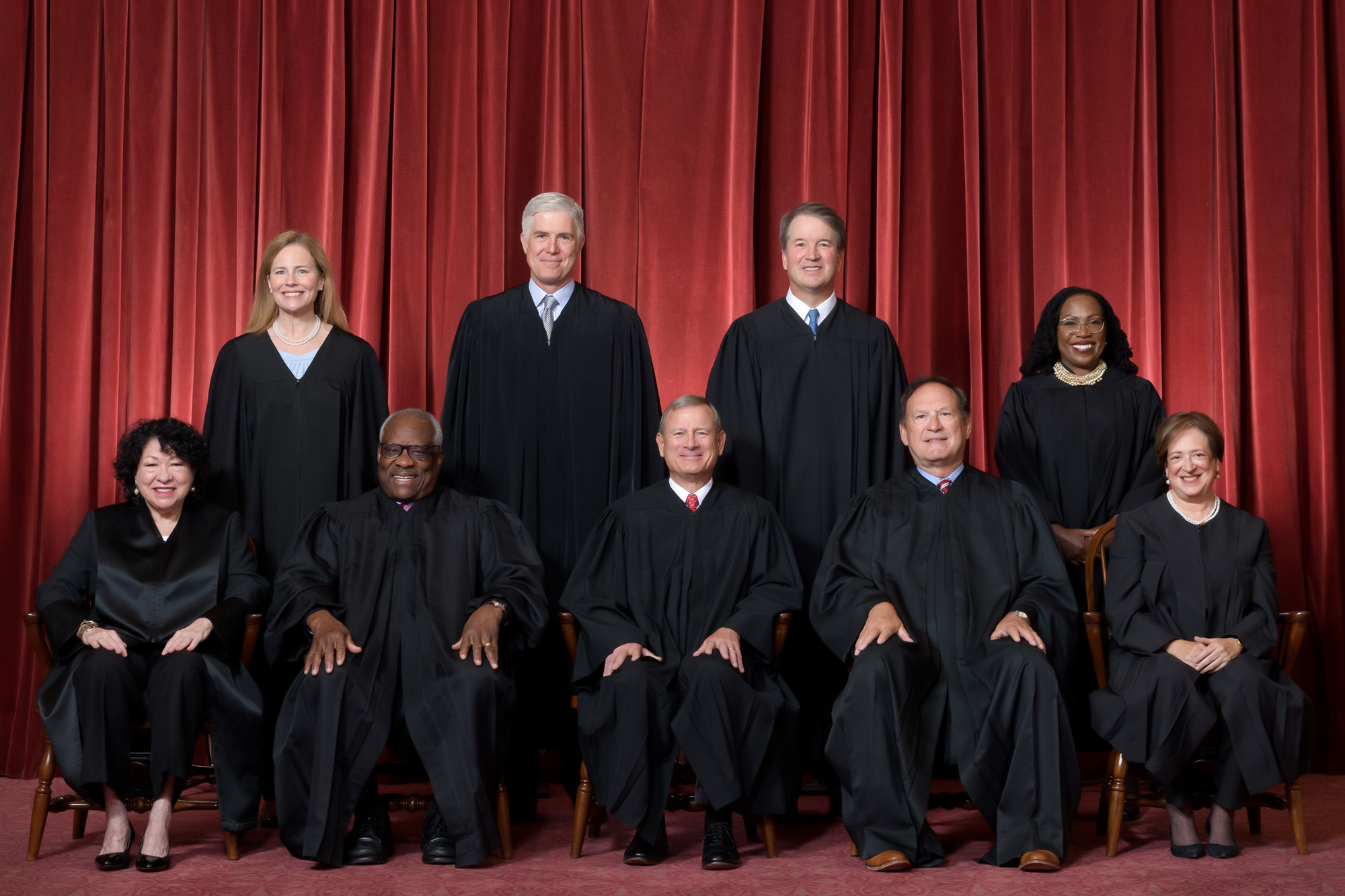
Because that’s the best analogy I can think of for the Supreme Court’s stretching its long arm of the law into matters the Constitution considers political. Stirring this poisonous stew, bubbling on the back burner behind the curtain, that will forever change our lives. [Photo credit: Supreme Court Historical Society. See, "SOURCES," below for names of current Justices.]

The Constitution leads with, “All legislative Powers herein granted shall be vested in a Congress of the United States, which shall consist of a Senate and House of Representatives.” Art. I, Sec. 1.

For the last 40 years the Court has followed its unanimous holding in the Chevron case, giving deference to “reasonable” agency interpretations of laws. (“Policy arguments . . . should be addressed to legislators or administrators, not to judges. The EPA's interpretation of the statute . . . represents a reasonable accommodation . . . and is entitled to deference.”)

Congress publishes its laws in the 60,000-page U.S. Code. Few Representatives and Senators have the time to read all of them, let alone enforce their daily administration. What do they do? They create agencies with the power to administer the laws, to write and enforce nearly 200,000 detailed regulations in 242 volumes – under Congress’ watchful eye.

This column is not a legal opinion. But it does draw on experience: Supreme Court law clerk, associate at corporate law firm, head of executive branch agency (MARAD), commissioner of regulatory commission (FCC), presidential advisor, reformer. To borrow from Joni Mitchell, “I’ve looked at Chevron from all sides now.”

My conclusion? Chevron got it right.

In 2022 four percent of the House and Senate candidates received $1 billion in political contributions. Four billion was spent on 12,000 lobbyists. Big corporations need not violate the law because they help write the law – and help select the heads of agencies. Employees move from companies to agencies and back again. Business neither deserves nor needs the Court’s help.

There are already plenty of checks on agencies’ abuses of their power. Congress writes the laws and shapes the agencies’ powers. It hears the complaints of big business – and too often yields. Congress can always change any law or agency regulation. Each agency gets annual congressional oversight by budget and oversight sub-committees.

Big corporations already have too much control over what the Constitution and prior Supreme Courts have ruled is the sole responsibility of Congress. That business keeps knocking on the Supreme Court’s door to grub for more would be as hilarious as a Kathleen Madigan stand-up routine if it were not so outrageous, dangerous, unconstitutional – and costly.

Nicholas Johnson believes, with Winston Churchill, that a constitutional democracy is the least-worst form of government. mailbox@nicholasjohnson.org

SOURCES
Justices' photos "The Supreme Court -- Current Justices," Supreme Court Historical Society, "Collection of the Supreme Court of the United States," https://supremecourthistory.org/supreme-court-justices/

(Names:

"Front row, left to right — Associate Justices Sonia Sotomayor, Clarence Thomas, Chief Justice John G. Roberts, Jr., Associate Justices Samuel A. Alito, Jr. and Elena Kagan.

Back row — Associate Justices Amy Coney Barrett, Neil M. Gorsuch, Brett M. Kavanaugh and Ketanji Brown Jackson.")

Bryan Berg “Bryan Berg,” Wikipedia, https://en.wikipedia.org/wiki/Bryan_Berg (“In 2010, Berg exceeded his own record by using over 218,000 cards to construct a replica of the Venetian Macao, which took 44 days.”)

Constitution and Congress U.S Constitution, Art. I, Sec. 1, “The Constitution of the United States: A Transcription,” America’s Founding Documents, National Archives, https://www.archives.gov/founding-docs/constitution-transcript (“All legislative Powers herein granted shall be vested in a Congress of the United States, which shall consist of a Senate and House of Representatives.” Art. I, Sec. 1.)

Art. I, Sec. 8 contains 18 clauses; e.g., General Welfare; Spending and Commerce; Post Offices; Copyright; Maritime, Military and War Powers

“Art. I, Sec. 8: The Congress shall have Power [Clause 1] . . .. To make all Laws which shall be necessary and proper for carrying into Execution the foregoing Powers, and all other Powers vested by this Constitution in the Government of the United States, or in any Department or Officer thereof.” [Clause 18.])

Chevron Chevron U.S.A., Inc. v. NRDC, 467 U.S. 837 (June 25, 1984), Justia, U.S. Supreme Court, https://supreme.justia.com/cases/federal/us/467/837/ (“Annotation, Primary Holding: A government agency must conform to any clear legislative statements when interpreting and applying a law, but courts will give the agency deference in ambiguous situations as long as its interpretation is reasonable.”) (pp. 859-866. “Parsing the general terms in the text of the amended Clean Air Act -- particularly the provisions of §§ 302(j) and 111(a)(3) pertaining to the definition of "source" -- does not reveal any actual intent of Congress as to the issue in these cases. To the extent any congressional "intent" can be discerned from the statutory language, it would appear that the listing of overlapping, illustrative terms was intended to enlarge, rather than to confine, the scope of the EPA's power to regulate particular sources in order to effectuate the policies of the Clean Air Act. Similarly, the legislative history is consistent with the view that the EPA should have broad discretion in implementing the policies of the 1977 Amendments. The plantwide definition is fully consistent with the policy of allowing reasonable economic growth, and the EPA has advanced a reasonable explanation for its conclusion that the regulations serve environmental objectives as well. The fact that the EPA has from time to time changed its interpretation of the term "source" does not lead to the conclusion that no deference should be accorded the EPA's interpretation of the statute. An agency, to engage in informed rulemaking, must consider varying interpretations and the wisdom of its policy on a continuing basis. Policy arguments concerning the "bubble concept" should be addressed to legislators or administrators, not to judges. The EPA's interpretation of the statute here represents a reasonable accommodation of manifestly competing interests, and is entitled to deference.”)

No authoritative list Clyde Wayne Crews Jr., “How Many Federal Agencies Exist? We Can't Drain The Swamp Until We Know,” Forbes, July 5, 2017, https://www.forbes.com/sites/waynecrews/2017/07/05/how-many-federal-agencies-exist-we-cant-drain-the-swamp-until-we-know/?sh=61f82b281aa2 (“[The] recent Sourcebook of United States Executive Agencies -- had the following to say: ‘[T]here is no authoritative list of government agencies. For example, FOIA.gov [maintained by the Department of Justice] lists 78 independent executive agencies and 174 components of the executive departments as units that comply with the Freedom of Information Act requirements imposed on every federal agency. This appears to be on the conservative end of the range of possible agency definitions. The United States Government Manual lists 96 independent executive units and 220 components of the executive departments. An even more inclusive listing comes from USA.gov, which lists 137 independent executive agencies and 268 units in the Cabinet.’ That's right: There is ‘no authoritative list of government agencies.’")

“A-Z index of U.S. government departments and agencies; Find contact information for U.S. federal government departments and agencies including websites, emails, phone numbers, addresses, and more,” USA.gov, https://www.usa.gov/agency-index .

U.S. Code United States Code,” House of Representatives, https://uscode.house.gov/detailed_guide.xhtml (“The United States Code ("Code") contains the general and permanent laws of the United States, arranged into 54 broad titles according to subject matter. The organization of the Code was originally established by Congress in 1926 with the enactment of the act of June 30, 1926, chapter 712.”)

60,000 Pages in US Code “GPO Produces U.S. Code with New Digital Publishing Technology,” GovInfo, https://www.govinfo.gov/features/uscode-2018 (“The U.S. Code is a consolidation and codification by subject matter of the general and permanent laws of the United States, and is produced in a Main Edition every six years. The 2018 Main Edition is approximately 60,000 pages encompassing 54 volumes, and is prepared by the Office of the Law Revision Counsel.”)

Code of Federal Regulations Clyde Wayne Crews, “Tens of Thousands of Pages and Rules in the Federal Register,” Competitive Enterprise Institute, June 30, 2021, https://cei.org/publication/tens-of-thousands-of-pages-and-rules-in-the-federal-register-2/ (“The Expanding Code of Federal Regulations The page count for final rules in the Code of Federal Regulations (CFR) is not as dramatic as the yearly count of tens of thousands of pages in the Federal Register, but it is still considerable. In 1960, the CFR contained 22,877 pages. Since 1975 until the end of 2019, its total page count had grown from 71,224 to 185,984, including the index—a 161 percent increase. The number of CFR bound volumes stands at 242 for the past four years, compared with 133 in 1975.”)

Nicholas Johnson experience See, “Nicholas Johnson,” Website, nicholasjohnson.org, https://www.nicholasjohnson.org/about/njbio04.html and “Nicholas Johnson, Retired Adjunct Faculty Member,” University of Iowa College of Law, “People,” https://law.uiowa.edu/people/nicholas-johnson

Joni Mitchell Joni Mitchell, “Both Sides, Now,” incredible rendition by Joni Mitchell at 2022 Newport Folk Festival, https://www.youtube.com/watch?v=9evpH6yjxrI

“Both Sides, Now,” Wikipedia, https://en.wikipedia.org/wiki/Both_Sides,_Now

Campaign Contributions; federal, 2022 “Fundraising Totals: Who Raised the Most?” Open Secrets, https://www.opensecrets.org/elections-overview/fundraising-totals (Top 10 House Members, Top 10 (of 33 Senators running) Senators; the total raised by each, when totaled for all 20: $940,895,001). House 435, Senate 100 (one third run every two years). 435 + 33 = 468. Top 20 fundraisers represented 4.273504 percent of 468.)

Registered lobbyists; spending Taylor Giorno, “Federal lobbying spending reaches $4.1 billion in 2022 — the highest since 2010,” Open Secrets, Jan. 26, 2023, https://www.opensecrets.org/news/2023/01/federal-lobbying-spending-reaches-4-1-billion-in-2022-the-highest-since-2010/ (“At least 13,784 organizations deployed 12,609 federal lobbyists throughout 2022. . . . Total federal lobbying skyrocketed to $4.1 billion in 2022, a new OpenSecrets analysis of federal lobbying disclosures found.”)

Winston Churchill “The worst form of Government,” International Churchill Society, Feb. 25, 2016, https://winstonchurchill.org/resources/quotes/the-worst-form-of-government/ (“Many forms of Government have been tried, and will be tried in this world of sin and woe. No one pretends that democracy is perfect or all-wise. Indeed it has been said that democracy is the worst form of Government except for all those other forms that have been tried from time to time.…” Winston S Churchill, 11 November 1947)

# # #