Monday, August 15, 2011

Republicans' Iowa Straw Poll

August 15, 2011, 5:30 p.m.

Winning's Not "The Only Thing" In Politics or Golf

There were two major contests within the last 72 hours. Both resulted in someone being proclaimed "the winner."

First was the Iowa Republicans' "straw poll" Saturday [August 13] afternoon.

The headline proclaimed, ""Michele Bachmann wins Iowa Straw Poll." Jennifer Jacobs, "Michele Bachmann wins Iowa Straw Poll," Des Moines Register, August 14, 2011. (Other quotes from the story: "Michele Bachmann, the first woman to win the Iowa straw poll, is now the official front-runner in Iowa . . .. With 16,892 Iowans casting ballots, Bachmann won with 4,823 votes. . . . Bachmann’s win . . ..) [Photo credit: Charles Dharapak, Associated Press.]

What does "win" mean in this context?

Even if one candidate got 50% or more of the vote, they still wouldn't have won enough to buy deep fat fried butter on a stick at the Iowa State Fair.

Moreover, on this occasion (a) Bachmann only got 28% of the vote, and (b) Ron Paul virtually tied her with 27%. They were separated by only 152 votes out of 16,891. Does it make any sense to proclaim one a "winner" and the other a "loser," given those numbers out of 55 million registered Republicans?

Here is Jon Stewart's take on the mainstream media's virtual total dismissal of second place finisher Ron Paul:

The Daily Show With Jon StewartMon - Thurs 11p / 10c
Indecision 2012 - Corn Polled Edition - Ron Paul & the Top Tier
www.thedailyshow.com
Daily Show Full EpisodesPolitical Humor & Satire BlogThe Daily Show on Facebook

"Indecision 2012 - Corn Polled Edition - Ron Paul & the Top Tier," August 15, 2011.

I have a lot more problems with that straw poll.

For starters, two of the Party's frontrunners -- Mitt Romney and Rick Perry -- weren't even on the ballot. Jon Huntsman was, but made no effort to garner votes. What does it mean to "win" a vote in which the two leaders haven't participated?

The straw poll is about as far as one can get from scientific polling. It's a fund raiser; it's a poll tax on steroids. It's Chicago politics with no holds barred.

To vote you first have to pay the $30 poll tax -- except that "you" don't have to pay, because the candidate will pay you to vote. Moreover, candidates can bus in voters from anywhere -- and do. Last time Romney paid $10 million to bus in and turn out straw poll voters. (This time he wisely chose to save the money.) [Thanks to "baune" for Aug. 17 blog correction/comment, below, "Not that it matters that much, but Mitt Romney's name was on the ballot for the straw poll." Thus, the first sentence, two paragraphs above, should have read: "For starters, two of the Party's frontrunners -- Mitt Romney and Rick Perry -- weren't even campaigning for votes."]

Maybe the vote is a measure of how much money candidates were able to raise, and willing to spend, on staff, organization, buses and poll tax tickets, but it's not much indication of Republican voters' preferences at this point.

Indeed, there is a suspicion that some voters "refused to stay bought." They went to the tent of the candidate with the best food and entertainment, accepted their $30 ticket, and then voted for whomever they pleased.

Finally, there's the matter of Republicans' judgment, to the extent the results were a measure of their genuine choice. Not that there aren't Democrats equally capable of snatching defeat out of the jaws of victory, mind you, but it does say something about Iowa Republicans that less than 1/2 of 1% of them are willing to support the one candidate actually capable of attracting enough independents and even Democrats to defeat Obama in a head-to-head general election once it is heavily covered by the media. That candidate? Jon Huntsman.
_____

The other contest finished up on Sunday, August 14. It was the 2011 PGA Championship at the Atlanta Athletic Club in Johns Creek, Georgia.

Golf has always been more honorable than politics. Players' actual, and reported, numbers of strokes are far less likely to have been manipulated or distorted than a straw poll's number of votes.

And so it is that we know Keegan Bradley took one less stroke to finish a three-hole playoff than Jason Dufner required.[Photo credit: Kohjiro Kinno, Sports Illustrated.]

Thus, the headline proclaims that Bradley "wins PGA Championship." Gary Van Sickle, "First time's a charm for Bradley as he wins PGA Championship in a playoff," Sports Illustrated, August 15, 2011.

He deserved to win. He played spectacular golf throughout. I tend to agree with SI that "Bradley just might be that new golf star America so badly needs" -- though I may not be as confident as SI that America "badly needs" a golf star, as much as, say, to bring some of our wars to a close, create a few million jobs, and get our economy back on a growth curve.

How any human is capable of hitting a little golf ball with a stick some 200 to 300 yards and have it land within 15 feet of a flag is beyond me -- especially when most of that distance is over a lake. In fact, the only thing Bradley's game had in common with mine was his triple bogey on the 15th (where he did leave one in the lake).

The difference in ultimate outcome was that he was able to recover and Dufner was not, which is what sent them into a three-hole playoff which Bradley managed to finish with one stroke less than Dufner.

I understand about winning in sports. A baseball team can have better hitting and batting than their opponent for eight innings and still lose the game in the bottom of the ninth. A 1/100th of a second can make the difference between the gold and silver medals in swimming or downhill skiing. And some of the world's best golfers may be separated by no more than one to three strokes at the end of a tournament.

But after a sporting contest between the world's finest is over, it often seems to me that more needs to be said about the accomplishments of all the participants, not just the final score, or "winner's" time. I know that's not what some of the participants think. They want to "win." But it's what I think, as I review in my mind the unbelievable catch in the football game, the golfer's 30-foot putt, or approach shot that comes within a half inch of a hole in one.

Bradley and Dufner were no Fred Astaire and Ginger Rogers, of whom it was said, he was great, but she did everything he did, backwards and in high heels.

Neither Keegan Bradley nor Jason Dufner were were wearing high heels or walking backwards; both were playing on the same golf course.

But before the playoff, don't forget that out of all the championship golfers who made the cut for this tournament, it was only Jason Dufner who was able to tie the tournament score of America's new young golfing superstar -- who won the first major championship in which he played -- "that new golf star America so badly needs."

In my book Dufner's accomplishment is worthy of a little more recognition and respect than the characterization of Bradley as the "winner" and Dufner the "loser" of that championship. Clearly, Dufner is also a "golf star America needs."

And I'd say the same for Ron Paul's accomplishment in the straw poll -- brought about, I suspect, more from the wild enthusiasm from his Libertarian supporters than with busloads of strangers and lots of money.
# # #

Here's how the 16,892 straw poll votes ended up:

1st Michele Bachmann 4823 28.551977%
2nd Ron Paul 4671 27.652143%
3rd Tim Pawlenty 2293
4th Rick Santorum, 1657
5th Herman Cin 1456
6th Newt Gingrich 385
7th Jon Huntsman 69
8th Thaddeus McCotter 35

Tuesday, August 09, 2011

The Last One to Die . . .

August 9, 2011, 1:50 p.m.

. . . for a mistake


Every Sunday toward the end of ABC News' "This Week with Christiane Amanpour," she says (as she does 45 seconds into the excerpt above, from the August 7, 2011, show's "Lives of Note" segment), "And we remember all of those who died in war this week."

It is, for me, a very somber moment; a Sunday church service of sorts. No more multi-tasking. I stop whatever else I am doing to focus on the name, rank and young age of each. I think of their families, loved ones, parents.

Last Sunday Amanpour continued, "The Pentagon has yet to release the identities of the Americans who were killed yesterday in the single deadliest attack of the war in Afghanistan, but we have learned the names of seventeen soldiers and Marines who were killed the days before."

With the soldiers' names, their home towns scrolled by: Edmond, Oklahoma; Broken Arrow, Oklahoma; Daly City, California; Columbus, Georgia; Wilson, North Carolina; Moscow, Pennsylvania; Brecksville, Ohio; Dallastown, Pennsylvania; Sapulpa, Oklahoma; Sliver Spring, Maryland; Holton, Kansas; Jacksonville, Florida; Red Bay, Alabama; Chelsea, Oklahoma; Chatsworth, California; Vernal, Utah; Warner Robins, Georgia.

They are not all well known American towns. Some are little more than a stop for gas when you take a trip along one of America's scenic "blue highways." But this week, each of those 17 towns is filled with grieving Americans.

The men and women in today's military were not drafted. They volunteered. We need a military, and all of us owe thanks and more to those willing to serve.

But we, and our elected officials, also owe them common sense, and more restraint in our willingness to risk their lives.

If there were hostile armed forces entering the United States from Canada, Mexico, or either coast by sea, I would be willing to take up arms myself, even in my advanced age, to help protect my country.

But the war into which we sent these 17 soldiers, and the 38 who died last Saturday, is not that kind of war.

The likelihood of the Afghan Taliban doing harm to Americans residing in the United States is somewhere between slim and none at all. Even in 2001, the individuals who attacked us on 9/11, and their funding, primarily came from Saudi Arabia not Afghanistan; and our decade-long goal since then -- to capture or kill bin Laden -- now truly is, "mission accomplished." The only Americans who are at risk of harm from the Taliban are those who have been sent into Afghanistan -- over the objections of many Afghans -- and whose presence is now fueling Afghan hostility and Taliban recruiting efforts.

The bumper sticker says, "Whatever is the question, war is not the answer." That's not, strictly speaking, always true in every instance. I'm not confident there was any meaningful answer besides war to Hitler's advance through Europe. War is sometimes not only an answer, it is the only answer.

But as I have written about the Viet Nam war, and in comparable ways about Iraq and Afghanistan, war is not a very sensible option when and if,
1. given the history of the country, you will be perceived as only the latest in a centuries-long string of invaders (which prior to us in Viet Nam were the French),

2. you can’t speak or understand the native language,

3. you know little or nothing of the history, religion, culture and customs of the people, and have little grasp of the territory in which you’re fighting,

4. you are easily identified by your “enemy,” and to make sure you will be, you wear uniforms

5. your enemy, on the other hand, looks almost identical to your allies and the locals you employ, and refuses to wear a uniform,

6. since there is no “front line,” as such, territory is repeatedly lost, and gained, only to be lost again,

7. during which battles, your troops are given the impossible choice between (a) killing disproportionately large numbers of innocent civilians, or (b) being killed by enemy fighters who look like innocent civilians,

8. with the consequence that an internal inconsistency exists between the strategy of “winning hearts and minds,” and the tactic of “burning down the village to save it,” such that the longer the fighting continues the more counterproductive it becomes

9. up to and including the possibility of exacerbating, rather than reducing, chaos and civil war
Nicholas Johnson, "General Semantics, Terrorism and War" (2006).

That piece also contains my own version of what's credited to former General Colin Powell as the "Powell Doctrine" -- questions the military leaders (and we citizens and taxpayers) need to ask our politicians before sending our sons, daughters and dollars to war:
* What, specifically, is the goal you’re trying to accomplish?
* Why do you think a military operation will contribute to (rather than impede) its accomplishment?
* What will it require in troops, materiel, lives and treasure to achieve that goal?
* Are you prepared to provide those resources and pay those costs?
* Will the American people support this effort for as long as it takes -- and how long will that be?
* How will we know if we’ve ever been “successful”?
* What, then, will be our exit strategy?
* What will happen when we leave?
* Will that be consistent with our original mission?
Given the conditions under which war is, and is not, a viable option, and given the questions that need to be at least asked, and hopefully answered, before engaging in war, my own view is that we ought to get our military personnel out of Afghanistan before even more will die.

In reflecting on the 30 more American dead in one helicopter (38 counting Afghans, whom I think should and do count), I hear an echo of the words of Senator John Kerry -- then a 27 year old Navy veteran of Vietnam -- in testimony before the Senate Foreign Relations Committee on April 23, 1971:
How do you ask a man to be the last man to die in Vietnam? How do you ask a man to be the last man to die for a mistake?
Kerry's entire moving presentation is very much worth reading, the video excerpt worth watching, in the context of Afghanistan today. Deborah White, "John Kerry's Famed 1971 Testimony to Congress on Vietnam," About.com.


A cynic might respond, "Don't be worrying about the last military man or woman to die in Afghanistan, Nick. The last person to die in Afghanistan hasn't yet been born."

We can only hope and pray that's not true.

Yet from what I read and hear in the media, we have troops in 150 countries, SOCOM (United States Special Operations Command) forces in 75, headed toward 100 by the end of this year, plus the CIA personnel and the private sector warriors. SOCOM has increased its numbers by four-fold or more since 9/11, and shows no signs of slowing down. (See/hear, e.g., Tom Ashbrook, "Special Operations Forces In Afghanistan," On Point, August 9, 2011.)

So, sadly, the cynic is probably right.

Nor are our military adventures unrelated to the global financial troubles, and the riots in London. The best estimates are that when everything is totaled up, the cost of Iraq and Afghanistan, including the lifelong care of the wounded, will run something like the $2-3 trillion we currently need to balance a budget.

Given that, in Afghanistan, even defining "success" seems almost as difficult as achieving it, one is not reassured by President Obama's insistence that "We will press on and we will succeed. Our troops will continue the hard work . . .." "President Obama Pledges to Press on in Afghan War," Reuters, August 8, 2011.

One is reminded of more of the commentary regarding the Viet Nam war, so effectively embedded into the anti-war protest songs that played a role in ultimately bringing that failed effort to an end.

Press on?

How about "push on"?

Here's Pete Seeger's Viet Nam era "Waist Deep in the Big Muddy ("and the big fool said to push on"):


While we're at it, here are a couple more from that war:

Edwin Starr singing his song "War (What is it good for? Absolutely nothing)" (1969)


An excerpt from the lyrics:
"War, what's it good for?/Absolutely nothing."
War..huh...look out...
What is it good for?
Absolutely nothing...listen to me ohhhhh
WAR! I despise,
'cause it means destruction of innocent lives,
War means tears to thousands of mother's eyes,
When their sons gone to fight and lose their lives.
I said WAR!...huh...good God y'all,
What is it good for?
Absolutely nothing
And . . .

Country Joe & The Fish, "Feel Like I'm Fixing to Die Rag"


with an excerpt from those lyrics:
Well, come on all of you, big strong men,
Uncle Sam needs your help again.
He's got himself in a terrible jam
Way down yonder in Vietnam
So put down your books and pick up a gun,
We're gonna have a whole lotta fun.

And it's one, two, three,
What are we fighting for ?
Don't ask me, I don't give a damn,
Next stop is Vietnam;
And it's five, six, seven,
Open up the pearly gates,
Well there ain't no time to wonder why,
Whoopee! we're all gonna die.

Come on Wall Street, don't be slow,
Why man, this is war au-go-go
There's plenty good money to be made
By supplying the Army with the tools of its trade,
But just hope and pray that if they drop the bomb,
They drop it on the Viet Cong.
Why aren't we out in the streets? Why aren't there songs protesting the Afghan war?

Because those who favor war, even when it is counterproductive, learned a lesson from Viet Nam. To keep the American people from demanding an end to foreign and military policies of perpetual war, you need only provide the illusion that it is war without sacrifice.

(1) War costs nothing -- except for those few Americans (as a percentage of 325 million) who die or are wounded. We don't have to pay the costs of war. There are no war taxes. We simply put it on our Chinese credit card; we borrow the money -- plus a little more for tax breaks for the wealthy.

(2) We've abolished the draft. No one has to go to war; just the ones who want to. What could be more American than that?

As a strategy for perpetual war, it seems to have worked.

The last one to die for this mistake? She's yet to be born.

# # #

Saturday, August 06, 2011

Here's Another Nice Mess

August 6, 2011, 8:30 a.m.

Congress as Laurel and Hardy

Stan Laurel and Oliver Hardy created one of the most popular two-man comedy teams ever, "Laurel and Hardy." Together they made some 100 films from the 1920s to 1950s. See, "Laurel and Hardy," Wikipedia.org. Somewhere in each film, or stage routine, "Ollie" would inevitably deliver the line, "Well, here's another nice mess you've gotten me into."


The behavior of our Congress, especially the House, calls to mind that line of Ollie's.

In "When Obstruction Becomes Treason," July 30, I referred to our waiting for "the other boot to fall."

Well, there it now is, right on our neck.

"Standard & Poor’s removed the United States government from its list of risk-free borrowers for the first time on Friday night [August 5, 2011] . . .." Binyamin Appelbaum and Eric Dash, "S.&P. Downgrades Debt Rating of U.S. For the First Time," New York Times, August 6, 2011, p. A1.

Let me repeat that, while you think about it: "Standard & Poor’s removed the United States government from its list of risk-free borrowers for the first time . . .."

What does "for the first time" refer to? It is a reference to the beginning of the United States of America's government on March 4, 1789. See "United States Constitution," Wikipedia.org.

That's right. For the first time in the history of our country we have a Congress so partisan, so selfish, so childish, so stupid, so irresponsible, so ideologically constrained, as to be willing to bring down the credit rating of our country.

Indeed, the only good news seems to be that the performance has attracted both the attention and the basic good sense of the American people: "A record 82 percent of Americans now disapprove of the way Congress is handling its job — the most since The Times first began asking the question in 1977 . . .." Michael Cooper and Megan Thee-Brenan, "Disapproval Rate for Congress at Record 82% After Debt Talks," New York Times, August 5, 2011, p. A1.

Now it may be that the sky is not falling -- although the global stock markets are. The other two ratings services, Moody's and Fitch, have not, at least not yet, lowered our credit rating. But it's very hard to argue with S&P's analysis, even if one wishes to argue with its conclusion. As Appelbaum and Dash report:
The company . . . said it was cutting its rating of long-term federal debt to AA+, one notch below the top grade of AAA. It described the decision as a judgment about the nation’s leaders, writing that “the gulf between the political parties” had reduced its confidence in the government’s ability to manage its finances.

“The downgrade reflects our view that the effectiveness, stability, and predictability of American policymaking and political institutions have weakened at a time of ongoing fiscal and economic challenge,” the company said in a statement.
Isn't that what you think, too?

As further evidence of Congress' role playing Laurel and Hardy with very, very serious business, China is getting nervous.

Imagine you had loaned $1.2 trillion to your brother-in-law, only to discover that he's not quite as reliable, competent and trustworthy in managing a big business as you originally thought. Wouldn't you be a little nervous, too?
China, the largest foreign holder of United States debt, said Saturday [August 6, 2011] that Washington needed to “cure its addiction to debts” and “live within its means,” just hours after the rating agency Standard & Poor’s downgraded America’s long-term debt.

The harshly worded commentary, which was released by China’s official Xinhua news agency, was Beijing’s latest attempt to express its displeasure with Washington. . . .

Chinese officials are clearly concerned that China’s substantial holdings of American debt, worth at least $1.1 trillion, is being devalued.

“The U.S. government has to come to terms with the painful fact that the good old days when it could just borrow its way out of messes of its own making are finally gone,” read the commentary . . ..

Beijing, which did not release any other official statement on the downgrade, called on Washington to make substantial cuts to its “gigantic military expenditure” . . ..

The commentary serves as a sharp illustration of how America’s standing in the world is sliding and that China now views itself as ascendant. . . .

China is sitting on the world’s largest foreign exchange holdings and its economy is growing at close to 9 percent. The country is also once again racking up huge trade surpluses with the rest of the world. . . . [For another example of a country that is enjoying the benefits of a government more intelligent, rational and functional than ours, see "What Brazil Can Teach America," August 4, 2011.]

Beijing policy makers are discussing ways to diversify the country’s foreign exchange holdings away from dollars and also how to encourage Chinese companies to invest some of the foreign reserves overseas. . . .

China has about $3 trillion in foreign exchange reserves . . ..

Analysts say that if China pulls back from purchasing Treasuries, the dollar would weaken and America’s borrowing costs would rise sharply . . ..

[G]overnment leaders here increasingly sound like they are losing confidence.

“International supervision over the issue of U.S. dollars should be introduced and a new stable and secured global reserve currency may also be an option to avert a catastrophe caused by any single country,” the Xinhua commentary said."

"China, a Big Creditor, Says U.S. Has Only Itself to Blame," Reuters/New York Times, August 6, 2011.

The messes that Laural and Hardy got into were fiction, and funny.

The messes that many members of Congress repeatedly get us into are neither fiction nor funny. They're tragedy, not comedy; reality, not fiction.

They keep offering us further proof, if any were needed, that there comes a point at which obstruction is treason. A point Congress has now gone far beyond.

# # #

Thursday, August 04, 2011

What Brazil Can Teach America

August 4, 2011, 10:00 a.m.

America, There Is Another Way

Things aren't looking really good for America right now. And, frankly, I don't see a way out.

Our answers are obvious. What appears to be even more obvious is that we're apparently not going to choose any of them.

If we can't learn from our mistakes, or from others' success, at least it may be psychologically palliative to know about, and watch, other countries' progress and know that darkness is not covering the entire world.

As I have written here repeatedly, it seems so obvious that in an economy 70% driven by consumer spending it does little good to ask CEOs to build more plant and hire more workers when consumers aren't prepared to buy what's already stored in warehouses. With true un- and under-employment running closer to 20% than 9%, and some population sectors (e.g., black, male, high school dropouts) running over 50%, even those with jobs fear they may lose them, and those with job security are still shaky about their financial future (e.g., galloping inflation; global depression).

What we should have done three years ago was apply a lesson from the New Deal depression recovery: make the federal government the employer of last resort (e.g., WPA and CCC). That would have put money in the pockets of those who would have spent it, and helped restore the confidence of the rest of us as well. Gradually, as they spent, and the rest of us followed, it would have become rational for CEOs to increase production -- and hiring, moving the employed from federal to private payrolls.

Of course, now that the trillions have been given to Goldman Sachs' and other executives among the over-privileged employed, those who fear that we really can't go on spending billions and trillions on additional "stimulus" programs have a point.

That's why I don't see a way out -- especially given the financial problems confronting Greece, Spain and Italy, among others, as well. It's now impacting even China, since the rest of us have less with which to buy even China's production.

Many of our public officials have proven themselves to be either ignorant, incompetent, or venal. Clearly they can't either govern or be governed. (One is reminded of the adage "Lead, follow, or get out of the way" -- given that none of those options seem acceptable to them.) They seem prepared to see American fall further rather than "compromise" an emotionally held ideological mantra. See, e.g., "When Obstruction Becomes Treason," July 30, 2011.

So while we sit and wait for the final boot to fall, I find some satisfaction in Brazil, and its example that there is another way.

Here are some relevant fair use excerpts from a segment on last Sunday's [July 31, 2011] CBS' "60 Minutes" program -- "Brazil: The World's Next Economic Superpower?" -- followed by some comments from me.
While most of the world is consumed with debt and unemployment, Brazil is trying to figure out how to manage an economic boom. As we first reported last December, it was the last country to enter the Great Recession, the first to leave it, and is now poised to overtake France and Britain as the world's fifth largest economy. . . .

Brazilian tycoons like Eike Batista, who has . . . a net worth of $27 billion . . . said, "GDP-wise, we are bigger than all the other countries [in South America] together. . . .."

With most of the world's economies stagnant, Brazil's grew at 7 percent last year, three times faster than America. It is a huge country, slightly larger than the continental U.S., with vast expanses of arable farmland, an abundance of natural resources, and 14 percent of the world's fresh water.

Eighty percent of its electricity comes from hydropower, it has the most sophisticated bio fuels industry in the world, and for its size, the world's greenest economy. Brazil is already the largest producer of iron ore in the world, and the world's leading exporter of beef, chicken, orange juice, sugar, coffee and tobacco -- much of it bound for China, which has replaced the U.S. as Brazil's leading trade partner. . . .

Batista, who has interests in mining, transportation, oil and gas, is building a huge super-port complex north of Rio with Chinese investment. The complex will accommodate the world's largest tankers and speed delivery of iron ore and other resources to Asia.

But it's not just commodities that are driving the Brazilian boom. The country has a substantial manufacturing base and a large auto industry. Aviation giant Embraer is the world's third-largest aircraft manufacturer, behind Boeing and Airbus and a main supplier of regional jets to the U.S. market. . . .

"We have to create more engineers," he told Kroft. "In my oil company, I'm importing Americans to weld our platforms, just to give you an, an idea."

"To weld the platforms?" Kroft asked.

"Yes," Batista said. "There's a lack of welders. We are walking into a phase of almost full employment. Already we have created this year 1.5 million jobs. It's unbelievable." . . .

President Luiz Inácio Lula da Silva walked into the president's office. . . .

When he was elected eight years ago on his fourth try, Lula was a firebrand labor leader with socialist tendencies. Some predicted another Hugo Chavez.

But he left office at the end of last year with an 87 percent approval rating and much of the credit for turning the country around. . . .

Lula [said], "Look, every once in awhile I joke that a metal worker with a socialist background had to become president of Brazil to make capitalism work here. . . .."

He added, "If you look at the banks' balance sheets for this year, you will see that the banks have never made so much money in Brazil as they have during my government. The big companies have never sold as many cars as they have during my government, but the workers have also made money."

So how has he managed to do that?

Lula told Kroft he has "found out something amazing."

"The success of an elected official is in the art of doing what is obvious," Lula said. "It is what everyone knows needs to be done but some insist on doing differently."

One thing obvious to Lula was the social and economic chasm separating Brazil's rich and poor. He gave the poor families a monthly stipend of $115, just for sending their children to school and taking them to doctors.

The infusion of cash helped lift 21 million people out of poverty and into the lower middle class, creating an untapped market for first-time buyers of refrigerators and cars.

But he was also far friendlier to business than anyone expected. Lula encouraged growth and development, and maintained conservative fiscal policies and tight banking regulations that left Brazil unscathed by the world financial crisis. . . .

[E]conomists from Goldman Sachs no less are predicting that Brazil - along with Russia, China and India - will dominate the world economy in the 21st century.

If it happens, Brazil would be a different kind of superpower, one that would rather make love not war. It has no nuclear arsenal, and aside from contributing a small number of troops to the allied cause in 1944, Brazil hasn't fought a war since 1870.

"Why fight?" Batista asked. "With all the pleasures, beach and sun. War? Forget it. Soccer? Let's watch a soccer game. Let's go to the beach. Let's drink a beer."
So what lessons does Brazil offer America? Here are a few from my perspective.

How can we explain why Brazil is enjoying an "economic boom" and was "the last country to enter the Great Recession, the first to leave it, and is now poised to overtake France and Britain as the world's fifth largest economy" -- and we were not?

Why was it that Brazil's economy "grew at 7 percent last year, three times faster than America"?

Environmental initiatives. Did you notice the line that, "Eighty percent of its electricity comes from hydropower, it has the most sophisticated bio fuels industry in the world, and for its size, the world's greenest economy"? Our public officials, responsive to the campaign contributions, lobbying and other pressures from special interests, such as the oil industry, have failed to seize our opportunity to wean ourselves from fossil fuels. Brazil has figured out a way to fuel its cars with ethanol while still producing food for export.

Manufacturing base. Note that, Brazil "has a substantial manufacturing base and a large auto industry. Aviation giant Embraer is the world's third-largest aircraft manufacturer, behind Boeing and Airbus and a main supplier of regional jets to the U.S. market. . . ." We've largely abandoned our manufacturing, and the jobs it provided, letting American corporations profit by outsourcing and building plants overseas. As a result, Brazil has "created this year 1.5 million jobs" and is "walking into a phase of almost full employment." Meanwhile our government, while turning its back on the obvious solution of creating federal jobs for the unemployed, is bemoaning our 20% actual unemployment.

Economic recovery means supporting the poor. Some of our political leaders have as their primary mission (after making sure President Obama fails as a president and is limited to one term) the reduction or elimination of government itself, and everyone seemingly runs and hides at the mere whisper of the word "socialism." By contrast, Brazilians were not only willing to elect an confessed socialist, they -- including most of the Brazilian business community -- now give him 87% approval ratings.
"The success of an elected official is in the art of doing what is obvious," Lula said. "It is what everyone knows needs to be done but some insist on doing differently."

One thing obvious to Lula was the social and economic chasm separating Brazil's rich and poor. He gave the poor families a monthly stipend of $115, just for sending their children to school and taking them to doctors.

The infusion of cash helped lift 21 million people out of poverty and into the lower middle class, creating an untapped market for first-time buyers of refrigerators and cars.
This approach appeals to me, of course, because it demonstrates the success of precisely what I have been arguing; the solutions to our problems are available, we just need to be "doing what is obvious" that our majority "insist on dong differently."

Henry Ford, no socialist, knew that his success depended on his pricing his cars, and paying his workers, such that the workers could afford to buy the cars they were building.

Like Lula's Brazil we, too, need to recognize, and do something about, "the social and economic chasm separating [our] rich and poor." To stimulate an economy you need to give more money to the poor, not to the rich. Brazil proves it. By lifting "million[s of] people out of poverty and into the lower middle class, [we, too, could create] an untapped market for first-time buyers of refrigerators and cars" and pull our economy out of economic malaise in short order. That it is also a humane thing to do is an added benefit for those who care about such things.

Government regulation can be our friend. One of the consequences of our "best government that money can buy" is that workers die on offshore oil rigs that pollute the Gulf, and in coal mines that have been documented as unsafe, and Wall Street is permitted to profit while bringing down the global economy.

How did Lulu deal with that phenomenon? Was he hostile to business? Not at all. "[H]e was also far friendlier to business than anyone expected. Lula encouraged growth and development . . .." However, and this is the big difference, he also "maintained conservative fiscal policies and tight banking regulations that left Brazil unscathed by the world financial crisis. . . ." When we permit special interests to buy a substitution of "self-regulation" in place of rational regulation, as we do, people die and economies collapse. Lulu knew better than to permit that to happen. Why don't we?

As a result, now even the "masters of the universe," "[E]conomists from Goldman Sachs no less are predicting that Brazil - along with Russia, China and India - will dominate the world economy in the 21st century."

The true cost of military budgets. Finally, it is no accident that Switzerland and Brazil are among the most solid economies in the world. What am I talking about? We pay a price, an enormous and debilitating price, for our insistence on being, not only the strongest military power in the world, but one that spends more than the next ten nations combined.

What does Brazil do?

"Brazil . . . would rather make love not war. It has no nuclear arsenal, and aside from contributing a small number of troops to the allied cause in 1944, Brazil hasn't fought a war since 1870. "Why fight?" Batista asked. "With all the pleasures, beach and sun. War? Forget it. Soccer? Let's watch a soccer game. Let's go to the beach. Let's drink a beer."

Some final words. You see? That's what we could have been doing. We knowingly and deliberately chose not to. We chose to borrow 40% of what we spend. We chose to maintain three ongoing wars, and a military presence in 150 countries. We chose not to create a level playing field for third parties, or provide public financing of campaigns. We chose to run from anything that might be labeled socialism. We chose not to tax ourselves, and especially not our wealthiest.

We chose to become a third world country in which the richest 1% control 90% of the wealth. We chose to watch video games, computer screens, smart phones and TV rather than march in the streets in protest.

Finding ourselves in a hole, we chose to go on digging.

Rather than sucking it up and doing what needs to be done, we're still kicking the can down the road.

It's been fun. But it's no fun anymore.

Have a nice day.

Like to watch the entire segment? Here it is:


# # #

Saturday, July 30, 2011

When Obstruction Becomes Treason

July 30, 2011, 7:00 p.m.

There Are Many Ways to Bring Down a Government

In an [October 2010] interview with the National Journal [the Republican U.S. Senate Majority Leader] Senator [Mitch] McConnell was asked what "the job" of Republicans will be if they gain a majority in Congress. McConnell's response was,

"The single most important thing we want to achieve is for President Obama to be a one-term president."

McConnell could have mentioned any one of a number of other priorities . . . Helping the country recover from the worst economic downturn since the Great Depression; Protecting the country from another terrorist attack; [or] Ensuring the success of the United States' missions in Iraq and Afghanistan. Instead, McConnell made clear that the Republicans will be thinking about 2012 as soon as the 2010 midterm elections are over. [emphasis supplied]
Ryan Witt, "Republican leader says GOP's number one goal is defeating Obama in 2012," Examiner.com, October 25, 2010.

This was scarcely a casual slip of the tongue. "N2K Top 10: Let Me Repeat; Regrets? Not a One," National Journal, November 4, 2010 ("Senate Minority Leader Mitch McConnell will deliver a speech at the Heritage Foundation that reiterates why making President Obama a one-term president is the GOP’s top priority.").

Although the National Journal article containing the initial interview with McConnell does not appear to be available to the public on the magazine's Web site, the quote has been widely reported -- including in subsequent National Journal articles. Matthew Cooper, "Kaine, Axelrod Fire Back After McConnell's NJ Comments," National Journal, October 26, 2010 ("My colleague, Major Garrett, made news with his interview with Senate Minority Leader Mitch McConnell, in which the Kentuckian said that making Obama a one-term president was his highest priority. Now Democrats are firing back. DNC Chairman Tim Kaine has issued a statement saying: '. . . the very man who set his Republican colleagues on a course of politically motivated obstruction even before the President was sworn into office -- is promising two more years of politics as usual . . ..'"); see also the related, Major Garrett, "After the Wave; Mitch McConnell wants to learn from history, but his new recruits will not be easily led," National Journal, October 23, 2010; Peter Baker, "Obama Forces Showdown With G.O.P. on Arms Pact," New York Times, November 19, 2010, p. A12 ("Senator Mitch McConnell of Kentucky, the Republican leader, has said his top priority is to deny Mr. Obama a second term.").

Nor is the mission limited to this one Republican leader. The campaign of one of the Republicans' leading presidential candidates, Congresswoman Michelle Backman, has declared "Rep. Bachmann looks forward to working with the Governor [of Alaska, Sarah Palin] for the common goal of making sure President Obama is a one-term President." Elspeth Reeve, "Palin Rivalry Becomes Bachmann Campaign Strategy," National Journal, June 10, 2011.

Now I do not question the right of what the British call "the loyal opposition" to disagree with whomever happens to be the President of the United States regarding particular legislative and other proposals and programs -- including wars. That's politics, that's democracy, that's governing.

But when the opposition, the party that does not control the White House, declares that "the single most important thing we want to achieve" is for the President's administration to fail, for him to be a one-term president, this risks crossing the line from politics as usual into potentially treasonous territory. When one's "most important" goal is to cause someone to fail, however unseemly if focused on any fellow human, but that someone happens to be the President of the United States, it is in effect a goal to bring on the failure of the United States itself -- as we have seen during the last couple of weeks with regard to the debt ceiling. Not incidentally, President Reagan raised the debt ceiling 18 times, and President George Bush seven times, with very little if any hoopla from Democrats.

At a minimum, the Republicans' acknowledgement of their "most important thing" calls into question every statement made by the Republican leadership, every legislative proposal, every vote they call for, every filibuster they threaten, every meeting they walk out of, and every charge they level at President Obama. Is it driven by the substance involved, or is it just another tactic in their strategy of presidential failure?

Am I charging some Republicans with a literal violation of our prohibitions of "treason"? No, of course not. Why "of course"? Because Article III, Section 3, of our Constitution was deliberately drafted to define "treason" much more narrowly than its dictionary definition. The Constitution declares that "Treason against the United States shall consist only in levying war against them [the United States], or in adhering to their enemies, giving them aid and comfort." From inside the White House, the Republicans' shelling may sound and feel like "war," but it's not what the Constitution's drafters had in mind.

No, I am speaking of "treason" in its more general dictionary usage:

"1. the offense of acting to overthrow one's government or to harm or kill its sovereign.
2. a violation of allegiance to one's sovereign or to one's state.
3. the betrayal of a trust or confidence; breach of faith; treachery.

Synonyms 1. Treason, sedition mean disloyalty or treachery to one's country or its government. Treason is any attempt to overthrow the government or impair the well-being of a state to which one owes allegiance; the crime of giving aid or comfort to the enemies of one's government. Sedition is any act, writing, speech, etc., directed unlawfully against state authority, the government, or constitution, or calculated to bring it into contempt or to incite others to hostility, ill will or disaffection; it does not amount to treason and therefore is not a capital offense."
"Treason," Dictionary.com.

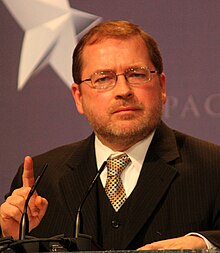
At the outset, there is something troubling about candidates for federal office running against "government" -- as Grover Norquist puts it, "I don't want to abolish government. I simply want to reduce it to the size where I can drag it into the bathroom and drown it in the bathtub." [Photo credit: Wikipedia.org.]

I certainly support efforts to review government expenditures -- as I did as U.S. Maritime Administrator. Let us challenge what we're spending through the Defense Department (given that there have been retired admirals and generals who say more defense budget cuts could actually improve our national security), earmarks, the shockingly low tax rates for America's wealthiest 1% (who have more wealth than the bottom 90%), hidden corporate tax breaks and subsidies, and so forth.

But to refuse to provide a clean increase in the debt ceiling, as we've routinely done dozens of times before, to insist on cutting food, medical and other benefits for the poor, to refuse to ask for a dime's worth of increased revenue from the wealthy, and to be willing to bring down the global economy and the full faith and credit of the United States for the first time in over 200 years -- all in the cause of defeating an incumbent president -- does qualify, it seems to me, under the dictionary (though not the constitutional) definition of treason.

Why? Consider:

It is "acting to . . . harm . . . its sovereign [the president]," "a violation of allegiance," "the betrayal of a trust" [to "uphold the Constitution," to serve the American people and "the public interest"], "disloyalty to one's . . . government," an "attempt to . . . impair the well-being of a state," and it has certainly involved "speech . . . calculated to bring [the government and its president] into contempt or to incite others to hostility, ill will or disaffection." Indeed, that would seem to be the laser focus of the drumbeat of attack provided by the Republicans' television and radio propaganda arms (Fox "News," Rush Limbaugh, et al).

Hopefully, the American people will reflect on the Republicans' behavior this past two and one-half years, and we'll be rid of the lot by November of 2012. But given the number of voters who are seemingly willing to give higher priority to "social issues" over even their own best economic interests, the outcome remains to be seen.

# # #

Thursday, July 28, 2011

Should Faculty Share in University Governance?

July 28, 2011, 7:15 p.m.

Hierarchy is Dead; Long Live Stakeholder Participation

Michael Gartner has enjoyed a long, varied and sometimes turbulent career. "Michael Gartner," Wikipedia.org. What Iowans will best remember, in addition to his ownership of the Iowa Cubs baseball team (and hopefully his skilled writing ability and Pulitzer Prize), is his term as a member, and president, of the Iowa Board of Regents. The Board has responsibility for Iowa's three Regents universities: University of Iowa, Iowa State University, and the University of Northern Iowa.

Although no longer a member of the Board of Regents, his chttp://www.blogger.com/img/blank.gifhttp://www.blogger.com/img/blank.gifreative mind recently drew upon his experience and imagination to lay out a to-do list for his former charges. Because it is a long list, it was necessarily a long article -- by 600-word op-ed column standards -- about 3,000 words.

Asked by a local paper to respond in 400 words, it was necessary to pick a single proposal. I chose "governance" of universities, and Gartner's insistence that involving the faculty in "shared governance" should be abolished. I disagreed.

[For background, see American Association of University Professors, "Statement on Government of Colleges and Universities" (1966), and related information.]

However, as noted among the 400 words, there is a great deal more that Gartner wrote about with which I not only agree, but about which I have written myself, both here in this blog and elsewhere.

The brief response to his article is immediately below.

It is followed by Gartner's full presentation. This is done primarily in fairness to Michael Gartner, rather than leave the impression that 400 words adequately dispose of everything he had to say. But his piece is also included because it is an important contribution to ongoing discussion about the universities and the Regents. Having disappeared from the Des Moines Register's online site, it will at least be searchable and retrievable here. Of course, if Gartner, or the Register, object to its republication and request it be removed from this blog, it will be.
_______________

Shared Governance Still Needed
Nicholas Johnson
Iowa City Press-Citizen
(initially available online)
July 20, 2011, p. A9

In Sunday's Des Moines Register, former Regent Michael Gartner offered up a smörgåsbord of commands for Iowa's universities.

Demanding that "universities must change dramatically -- and quickly," as he did, is no more effective than it is specific. It's like telling the captain of the 1,132-foot Queen Mary 2 that he must turn her around "dramatically and quickly" without designating a reason, direction or destination.

Some of Gartner's ideas need better facts and serious rebuttal. Others you've heard before -- even from me.

But this time he had nearly 3,000 words; and I don't. Limited to one issue, I've chosen his assault on governance.

Gartner wrote, "The pleasant-sounding concept of 'shared governance' should be scuttled. ... (F)aculty political leaders insist they should help manage the institution -- but ... the concept has outlived its usefulness and is a roadblock to planning, to change and to effective administration. It institutionalizes mediocrity, stymies change and intimidates presidents, and it is a misuse of faculty time and energy."

As the student told the professor, "I have only one question."

"And what is that,?" the professor asked.

"What on earth are you talking about?" the student replied.

What does Gartner mean and how does he know? What does he mean by "scuttled," "faculty political leaders," "manage," "roadblock." What evidence does he have of "institutionalized mediocrity" or "intimidated presidents"?

Gartner owns the Iowa Cubs. Does his organization not take into account the wishes of fans and players? That's "shared governance," a 20th-century recognition that organizations have stakeholders as well as shareholders.

School boards and their superintendents have "shared governance" with administrators, teachers, parents, students and taxpayers. Why shouldn't the Iowa state Board of Regents and universities' presidents have shared governance with students, deans, faculty, staff, parents, students and taxpayers?

You want examples from business? Shared governance is a major component of most successful corporations. Involving customers through social media is just one example.

It's understandable Gartner didn't like the University of Iowa faculty's vote of "no confidence" in his regents. The NFL owners didn't like it when the players voted no confidence in them either.

But if the corporate CEOs Gartner wants as university presidents are good ones, they will be insisting on shared governance.

Shared governance in higher education began in 1920. There are even more reasons for it today, 91 years later.
__________
Nicholas Johnson teaches at the University of Iowa College of Law and maintains the website www.nicholasjohnson.org and blog FromDC2Iowa.blogspot.com.
_______________

Gartner says Iowa's state universities need to change quickly
Michael Gartner
Des Moines Register and Altoona Herald-Index
July 17, 2011

Iowa's three state universities must change dramatically -- and quickly. The system has problems -- money and non-money -- that can no longer be addressed by raising tuition and lobbying legislators. Those remedies are played out.

On top of systemic problems, each university has unique challenges.

There is a management problem in Iowa City -- where faculty politicians in effect run the University of Iowa. There is a looming leadership problem in Ames -- where the visionary Greg Geoffroy is stepping down as president of Iowa State University. And there is a money problem in Cedar Falls -- where legislators short-change the University of Northern Iowa by about $50 million a year.

All this comes at a time of strife and partisanship on the nine-member Board of Regents, where president David Miles and president pro tem Jack Evans on Tuesday stepped down from their leadership roles under pressure to make room for Gov. Terry Branstad's financial backer Bruce Rastetter and loyal supporter Craig Lang.

I was a regent for a little over six years, until April 30 of this year. For nearly three years, I was president. I dealt with the men and women who officially run the schools -- and those who unofficially run them. I spent time with presidents and legislators and faculty members and shop stewards and students. I learned a lot, and I left with clear opinions.

State aid to universities needs to be redirected

All three universities are very good at many things. And the University of Iowa medical complex is very good at almost everything. It is well-run, understands its mission, produces first-rate doctors and first-rate research, and generally pays its own way. One reason: It's run by those who are paid to run it, not by the doctors or the nurses or the patients or the help.

But change is needed elsewhere in the $4 billion-a-year regents enterprise.

Perhaps most important, the dwindling state aid must be redirected. Now, graduate schools, which should be self-sufficient, drain away money that should be used for in-state undergraduates. One yet-unpublished study says Iowa's dental students receive $1,171 in subsidy per student credit hour -- in contrast to $71.90 per credit hour for liberal arts students. That is not the intent of state appropriations.

The most cherished tenets of academe, particularly "shared governance," need to be challenged -- and probably thrown out. Assets need to be redeployed into education and out of ancillary activities. Course offerings and majors need to be slashed, the teaching load needs to be increased, more courses need to be taught by professors instead of graduate students, and the number of academic "centers" needs to be reduced. Athletics needs to be reined in and restructured. The relationships among the three universities need to be refigured. New partnerships need to be explored. And the increase in tuition for undergraduate youths from Iowa has to be slowed or stopped.

Those should be the elements of a 10-year strategic plan. The "givens": We must keep three fine universities. We must expect state aid to continue to decline, as it has in seven of the past 11 years. And we cannot offset that decline by continuous tuition increases.

Faculty members have too much clout

Most of all, the universities and the regents need focused, firm, fair -- and united -- leadership.

The pleasant-sounding concept of "shared governance" should be scuttled. Shared governance once meant that faculty ran curricular matters and administrators ran management matters. Now, faculty political leaders insist they should help manage the institution -- but woe to the administrator or regent who wants to have a say in the classroom.

The concept has outlived its usefulness and is a roadblock to planning, to change and to effective administration. It institutionalizes mediocrity, stymies change and intimidates presidents, and it is a misuse of faculty time and energy. Professors should teach or do their research. Presidents and provosts and deans should manage. Regents should govern.

When I was confirmed for the board, then Senate Majority Leader Stew Iverson called me aside. "Find out for me," he said, "whether the regents run the University of Iowa or the University of Iowa runs the Board of Regents."

I found out.

Example: The University of Iowa is a complex, $2.5 billion-a-year institution where the president -- like most presidents -- must spend nearly half her time raising money and most of the rest dealing with legal and financial and athletic and alumni and real-estate and political and housing and student and parent and other issues. Yet when a committee was named to find a successor to David Skorton in 2006, the faculty members made clear they would block any candidate who wasn't a full-fledged academic -- and they had that power through "shared governance."

Thus, Jim Leach, a member of the U.S. House of Representatives for 30 years, was laughed off the prospect list by the academics because he was not one of them. Forget that he was a graduate of Princeton with a master's degree in Soviet politics from Johns Hopkins and further study at the London School of Economics. He didn't pass muster -- so he ended up first on the faculty of Princeton, then head of an institute at Harvard and now chair of the National Endowment for the Humanities. And Iowa got as president an accomplished academic -- the provost from Purdue -- who has had to learn to be a broad-based manager through on-the-job training.

Similarly, faculty members at Iowa State have made it clear they want an academic to succeed Geoffroy. The search committee will see to that; it has nine academics among its 18 members along with two doctors, two students, two regents, and three business people. It has no union representative. Jim Leaches need not apply. (Or Tom Vilsack. Republican leaders on and off the regents are paranoid about Vilsack, amazingly believing he would leave a Cabinet post he loves for Iowa State -- a thought that sends shivers down their spines. And probably down his.)

Schools waste money on search committees

Search committees are costly and, often, a waste of time -- or a sham. A board should have in mind one or two possible successors for each president, and a president should know whom he wants as his next lawyer or provost or finance person without having to go through a search.

Jean Robillard, the outstanding vice president for medical affairs at the University of Iowa, was not picked by a search committee but simply was tapped by Gary Fethke, who in 18 months as acting president of Iowa accomplished more than his predecessor or successor. "There was no search committee formed to pick Jean Robillard, just a few great conversations with a bunch of people who were on the same page," says Fethke, who had been dean of the business school.

That's how good executives operate.

Similarly, when Robillard wanted a dean of the medical school, he named Paul Rothman. "I didn't want to do a formal search since I knew Paul and could probably not have found someone better in the country," Robillard says. So why waste time and money? He did, however, use a search to find Ken Kates, the equally competent head of the hospital.

Sally Mason, Iowa's president, knew she would appoint Carroll Reasoner last fall to move from acting general counsel to general counsel, which she told the Board of Regents. In the next breath, she said she intended to appoint a search committee -- wasting time and resources and misleading any person who would be on it and any "candidate" other than Reasoner. After questioning by regents, she waived the process.

"Academia can learn a lot from private industry," Robillard says. That's one reason business-school deans -- Gary Fethke, Ben Allen -- often make good presidents.

Professors are not in classrooms enough

One thing academics could learn is to concentrate on their strengths and shed weaknesses and "businesses" that aren't central to their mission. The mission is teaching and research at Iowa and Iowa State and just teaching at UNI.

Thus, it's strategic and financial folly for the University of Iowa to own a $150 million painting (which hasn't been on campus for three years and probably won't be for another three) when that money could be redeployed into full-tuition scholarships for about 1,000 Iowa undergraduates each year till the end of time. Similarly, why do universities own golf courses?

There are hundreds of academic and research "centers" in the regents system - the University of Iowa alone has nearly 300. They proliferate like rabbits -- and have the longevity of elephants. Each should be looked at every two or three years to determine if it is central to the mission of the school and economically justifiable. Iowa alone has around 150 majors and programs for undergraduates, from Sanskrit to microbiology, from "informatics" to theater arts. All of this must be streamlined; the universities can no longer be all things to all people.

At the same time, the teaching load -- six hours or less of classroom teaching per week (up to nine at UNI) -- must be increased. "We went too far in reducing teaching loads," a professor at Ohio University wrote the other day. "Faculty members preferred research or leisure to teaching, and believed the path to vocational success was through publication, not teaching and counseling young students."

The three Iowa universities employ around 7,500 faculty members, some 5,300 of whom are full-time. Yet, at Iowa the full-time faculty spends just a third of their time in teaching-related activities (the figures are 40 percent at Iowa State and 58 percent at UNI), and only 46 percent of undergraduate student credit hours are taught by tenured or tenure-track faculty. The rest are taught by graduate assistants (22 percent) and adjuncts and the like. The figures are only somewhat better at ISU and are considerably higher at UNI, where research is not emphasized.

Research is vital, but so is teaching.

The work load must go up and the workforce down if the universities are to have a future providing effective and affordable education to Iowa high-school graduates. More than half of those 5,300 faculty members are tenured and all but guaranteed lifetime jobs.

Once a noble concept to ensure academic freedom, tenure now is another practice that stifles change, discourages innovative teaching and reinforces the status quo. It has outlived its usefulness, says Jim Lubker, the retired provost at UNI, who thinks about such issues.

More oversight needed for athletic programs

Athletics, too, has to be examined. Iowa has and Iowa State soon will have an athletic department that pays its own way, at least by some calculations. That's good, but beside the point. Athletic revenue is not part of the universities' general funds -- it is looked upon the way dormitory funds and hospital charges are accounted for -- but it should be considered the property of the institution, not the athletic department.

All university revenue should come into one pot, and every department should have to justify its spending. The University of Iowa takes in $66 million in athletic revenue, but that doesn't mean the department should have the unsupervised right to spend that. How can it justify paying the women's basketball coach a sum more than three times the revenue of the sport? Why shouldn't it return $10 million to $15 million to the general fund? Is it right that the four highest-paid state employees are coaches at Iowa and Iowa State? (One way of looking at it: The Iowa athletic department spends about $100,000 per athlete every year.)

In this era, no institution -- university, business, city -- can go it alone. Partnerships and alliances are everything. Iowa, Iowa State and UNI are good at forming partnerships with one another and with outsiders. But efforts must increase. Universities must eliminate duplication. Are two journalism schools necessary? Is there unnecessary duplication in engineering and business schools? Why shouldn't every class be available over the Internet to every student at each school? (Some ideas aren't so great. I suggested to then-Gov. Vilsack that students be admitted to the system, not to any one school. "Who would get the football players?" he asked.)

Rising tuition costs must be dealt with

Most of all, the universities must not keep raising tuition. Ten years ago, tuition and fees at the universities were around $3,100 a year; today, they are around $7,500. If you figure the value of a college degree goes up 11 percent annually throughout life, as compared to the earnings of a person without a degree, $7,500 is still a steal -- but only for those who can afford it.

The cost of education, including room and board and books and travel, now is around $20,000 a year. To be sure, the universities set aside as much as 20 percent of tuition income for student aid -- but that's not all for the needy or in-state students. Students graduate with so much debt it will take as long as 20 years to pay it off. Others simply can't afford college. What's more, it now is cheaper for some students to attend private colleges, where the chances are a student will graduate in four years. At regents schools, only 42 percent graduate within four years.

There are many reasons.

At Iowa, one reason is the culture. Nationwide, about 34 percent of college students are binge drinkers -- persons who have five or more drinks at least every couple of weeks. At Iowa, where weekends often start on Thursday noon, the figure is 64 percent -- down 6 points in a year but still nearly twice the national average. Iowa ranks ninth among "top party schools," according to The Princeton Review. That is not a good thing. One solution: schedule required courses for Friday afternoons and Saturday mornings.

If culture is the unique problem at Iowa, money is at UNI. The main purpose of state aid is to subsidize the education of undergraduates from the state, and UNI is woefully shortchanged. State aid is divided roughly 40-40-20 among Iowa, ISU and UNI, for reasons lost in history. Iowa receives $17,628 for each state undergraduate, Iowa State gets $10,802, and UNI gets $7,502. If the money were allocated fairly, $48.5 million would be redirected to UNI, mainly at the expense of Iowa.

This just adds to woes of UNI, a fine and well-led school. It must spend millions a year subsidizing athletics -- or else drop athletics entirely -- because it gets little or no television or bowl money but still has the expenses of intercollegiate competition. With Iowans comprising 93 percent of its student body, it gets little out-of-state tuition -- out-of-state students by law must pay more than the cost of their education -- to subsidize the in-state students. And it has a small base for fund-raising. The Legislature should change the formula.

Politicization of regents is not a good thing

But most change does not need legislative approval. The regents and presidents simply need to take back the reins of governance from governors, legislators and, especially, faculty members who have grabbed many levers of control. You can't change things if you're not in charge, and the regents and the presidents aren't always in charge.

The faculty senate basically runs the University of Iowa, the faculty union has an outsize voice at the University of Northern Iowa, the Legislature has begun meddling too much, and the two most recent governors -- Democrat Chet Culver and Republican Terry Branstad -- have wanted a say in the governance that they are not entitled to under the law. This has led to a politicization of the board for the first time.

The power of the board is clear. It shall "make rules for admission to and for the government of said institutions, not inconsistent with law," the Iowa Code says, as well as "manage and control the property, both real and personal, belonging to the institutions." It also hires and fires presidents and officers of the schools, hires all employees, and sets all salaries. It's hard to imagine any board with broader powers.

But a couple of years ago the board allowed Culver and Sen. Bob Dvorsky, D-Coralville, to talk it into putting a partisan labor issue on the agenda -- a labor agreement for university construction -- and the result was a predictable 5-4 vote along party lines, the first time in memory there was a party-line vote on anything. (The regents can have no more than five members of any one party. At the time, there were five Democrats. Now, there are five Republicans, three Democrats and a no-party member.) Branstad was elected and badgered Dave Miles out of the board presidency. This meddling is a bad thing.

Yet none of these issues -- money, structure, leadership -- is unsolvable. A determined board, strong presidents, and a watchful but non-meddling legislature and governor can work together on a blueprint for success.

The goal is simple: make the universities as good as they think they are.

# # #

Monday, July 18, 2011

Weekly World News, Weakly World Privacy

July 18, 2011, 9:35 a.m.

Murdoch's Violations Small Part of Loss of Privacy

I have often said, "the problem is not that corporations violate the laws, it is that they write the laws."

I have often been wrong -- at least partially so.

Because, of course, the problem is also that corporations corrupt or otherwise violate the laws as well as writing them. BP and Massey Coal did both, and workers died. Murdoch's worldwide media monopoly hacked cell phones, published stories based on the conversations, and hundreds of citizens and celebrities alike suffered in a variety of ways.

There's no way to minimize or justify what the editors and reporters of Murdoch's News of the World did. It's awful. From the perspective of college classrooms it's a subject for studies of journalism, technology, and law. It's a global media story, an example of how technological "advances" gnaw away at our neglige of privacy, and thereby create Rubik's-cube-like challenges of legal analysis for legislators and lawyers.

If you haven't been following the events, here is a sampling from the New York Times of the thousands of stories the worlds' media have provided: Sarah Lyall, "Scandal Shifts Britain’s Media and Political Landscape," New York Times, July 8, 2011, p. A1; John F. Burns and Alan Cowell, "Former Aide to [Prime Minister] Cameron Is Arrested in Tabloid Scandal," New York Times, July 9, 2011, p. A8; Don Van Natta Jr. and Ravi Somaiya, "British Tabloid Sought Phone Data of Investigators," New York Times, July 12, 2011, p. A1; and Sarah Lyall and Graham Bowley, "Connections to Murdoch Start to Chafe British Leader," New York Times, July 13, 2011, p. A1.

But this is more than a story about the fall of one of the world's largest media barons. It should also be a teachable moment for all of us regarding our privacy.

Consider all of today's technological and other assaults on the standards of privacy accepted and expected by our great-grandparents. From that perspective, as awful as the Murdoch invasions appear to have been, they are but a very small part of what we need fear.

Like the insight of Walt Kelly's cartoon figure, Pogo -- "We have found the enemy, and he is us" -- or Winnie the Pooh's discovery that the tracks he was following were his own, most of the assaults on our privacy are self inflicted.

(1) Much of our lost privacy we have voluntarily abandoned. Take Facebook, for example. Our names, addresses, birth dates, family members -- all identified with "tags" in their photos -- and our network of "friends," are available for the databases of Facebook, criminals or law enforcement. We may keep unencrypted passwords on a thumb drive, smart phone, or laptop, available to whoever gets our lost or stolen equipment. I recently saw a desktop in a business with a Post-It note stuck to the screen, revealing to anyone who glanced that way the username and password. Once a voice mail hacker knows that 75% of users choose "1-2-3-4" as their password it makes it a whole lot easier to listen in. Now that the FBI (and anyone else) can search our trash without a warrant, we may still think we're destroying documents with credit card numbers or other valuable data because we took them out to the curb for trash pickup, rather than shredding them.

(2) Professor Jonathan Zittrain speaks of what he calls "privacy 2.0" ("The Future of the Internet -- And How to Stop It").

As technology progresses through the decline in price that I call "the 99.9%-off sale" (not incidentally, with improved capacity and quality, and reduction in size and weight), it spreads, it becomes ubiquitous. The video recording capability that once cost tens of thousands of dollars is now merely hundreds of dollars or less.

Our actions are being recorded by the scanning video cameras in government buildings, banks, convenience stores and other private businesses. They monitor and bill those who run red lights. The Webcams in our laptops may take video of us without our knowledge.

But that's not the major problem.

Still and video camera capability is built into our smart, and even dumb, cell phones.

Couple this with the ease of uploading videos to YouTube, Facebook, or attaching them to emails. Anyone's embarrassing, or illegal, moment can suddenly go viral globally.

That's not the result of government, Big Brother snooping on us, or evil corporations. It's us; millions if not billions of us, recording and distributing information about each other -- usually for reasons somewhere between friendly and helpful, or at least benign.

(3) We gratuitously give our private information to Facebook, expecting little or nothing in return.

But we also trade off our privacy, our secrets, our personal identifying data, for perceived benefits. We give the bank our financial data, including how much cash we took out from which ATM machine, the day and time. We let the credit card company record where we went, what stores or other businesses we entered, what we bought, what we paid for it, where and when. The cell phone company tracks our every move, knows where we are, who we called, how long we talked -- and if they care to know, what we talked about. The airlines know where we flew and when; the rental car companies also.

I'm not saying these and comparable gifts of privacy to corporate America are irrational choices. It would be hard to function in today's world without, say, credit cards and phones. I'm just saying that we can't voluntarily turn over vast amounts of information about ourselves to government and merchants and then complain that they possess this information about us.

(4) This third-party possession of our most intimate information raises other problems.

The Fourth Amendment asserts a "right of the people to be secure in their persons, houses, papers, and effects" -- seemingly a kind of place-based security. So what about tapping phone lines from a place away from home? In the Supreme Court's 1967 Katz decision, involving law enforcement's recording of a conversation by means of a device attached to a public phone booth, the Court expanded the protection to include those things as to which we have (1) "an expectation of privacy" that most people would consider to be (2) "reasonable" -- the "reasonable expectation of privacy" standard.

So far so good. But in the 1976 U.S. v. Miller case the Court explained that once you've shared information with another, even though you did so in confidence and for very limited purposes, you no longer have an expectation of privacy in that information, let alone an expectation that courts will consider "reasonable." In the Miller case the defendant, Miller, attempted to claim a Fourth Amendment right of privacy in the cancelled checks and other records and documents maintained by his bank. The Court decided those were the bank's records as much, indeed more, than Miller's. Thus, he had no "reasonable expectation of privacy" and law enforcement could get access to those records from the bank, without providing Miller the protections he would have received under the Fourth Amendment had law enforcement come to his home for "papers."

So it turns out that, not only have we turned over a vast amount of information about ourselves to private corporations, we have, thereby, essentially turned it over to the government as well (in many instances) and lost the rights of privacy we have in information never shared.

(5) Once we go to work it only gets worse. Employers can listen in on their employees' phone conversations, read their email, know what Web pages they've visited, track how many keystrokes they contribute per hour or day, and install video monitors throughout the workplace. Even if the employer pledges you have personal privacy with regard to any of the above, courts may reject an employee's reliance on that assurance.

(6) Are there instances in which a hacker acquires information they had no authorization to access, or for which they exceeded their authorization? Of course. The Defense Department gets millions of such hits. There was a recent example of exceeding authority at the University Hospital. One can imagine many more driven by simple curiosity, or a desire to help a friend (such as a bank employee providing a woman contemplating divorce information about suspicious regular checks drawn on the errant husband's separate account).

The Murdoch reporters, and the editors to whom they reported, had no business getting access to the voice mail of 9/11 victims' families, or those of British soldiers killed in action, celebrities, or the murdered young girl. It's not only boorish behavior and a violation of journalistic ethics, it also happens to be a violation of the criminal law.

But if we really care about maintaining some little bit of our remaining privacy regarding our images, speech, writing, movements, actions, circle of friends, financial transactions, medical records -- among other things -- we need to look well beyond the Murdoch Empire, however vast and evil it may be.

And we need to begin with the person we see in our bathroom mirror.

# # #

Friday, July 01, 2011

Dominique's Dominos: Strauss-Kahn and Sexual Assault

July 1, 2011, 7:00 p.m. (with additions July 2, 3, 4, 5 and 6, 2011, including resolution of alleged UI football players' sexual assault, 2007)

[And as evidence that (a) the problems on college campuses continue, and (b) have been exacerbated by the predicted Strauss-Kahn outcome, here's an exchange on July 6, 2011, during Tom Ashbrook's "On Point" program:
Tom Ashbrook (TA): Andrew in [city]. Thanks for calling. You're on the air.
Andrew (A): Hi, Tom
TA: Hi.
A: Thanks for taking my call.
TA: Yes, sir.
A: The topic is relevant to my family at this time, and I have an inquiry for Professor Brenner, if she's able to assist.
TA: OK.
A: My daughter, a few weeks ago, was assaulted sexually by a prominent basketball player at one of the two state universities here, . . .
TA: I'm sorry.
A: . . . who had been removed from another state university and was able to transfer in. But my concern is, the university has closed its investigation based on a he-said-she-said type of scenario, which is very frustrating for our family. It obviously raises some concerns about the integrity of the university process. Being both involved with a state university and highly educated on matters of this type, I was wondering if the professor [guest, Professor Hannah Brenner, Michigan State University College of Law] has a suggestion on how we may proceed. My daughter is disinclined to go to law enforcement. Obviously, she does not want to become the maid in the New York City story.
TA: Right. . . .
Tom Ashbrook, "What Does the Dominique Strauss-Kahn Case Mean?" "On Point," WBUR-FM 90.9/NPR, July 6, 2011; Audio, 30:28-31:35.]


Dominique Strauss-Kahn's "mess on both sides"

The media that were so quick to, seemingly, accept the guilt-before-trial of Dominique Strauss-Kahn (then IMF Managing Director, alleged to have raped a New York Sofitel Hotel maid in his $3000-a-day room), now seem equally ferocious in their attack on the credibility of his accuser. And just as they said little about the accuser when judging him, they now make little to no reference to his own past record of sexual assaults, and therefore the credibility of his denials, while disparaging her accusations. [Photo credit: Andrew Harrer/Bloomberg News.]
[The Times' assault on her credibility continued in the July 2 edition, Jim Dwyer and Michael Wilson, "Strauss-Kahn Accuser’s Call Alarmed Prosecutors," New York Times, July 2, 2011, p. A1. By Sunday, the story was still headlining page one, above the fold, in the hard copy edition (although at the bottom of the heap online), but its focus had shifted once again. This time the criticism was not of Strauss-Kahn or his accuser, but of District Attorney Cy Vance, Jr.: "[T]he second-guessing of Mr. Vance’s leadership has intensified in the wake of a string of courtroom losses that culminated in the startling events last week, when prosecutors revealed their concerns about the honesty of the hotel housekeeper . . .. Even a member of the [DA's] finance committee . . . questioned how the case had been handled. . . .Some of the most pointed complaints about Mr. Vance are emanating from the district attorney’s office itself," Alan Feuer, John Eligon and William K. Rashbaum, "Strauss-Kahn Case Adds to Doubts on Prosecutor," New York Times (online), July 3, 2011 (nat'l ed.; headlined, "Crumbled Case Adds to Doubts On Prosecutor; Issues Were Seen Even Before Strauss-Kahn," p. A1).

For a contrasting view, see Joe Nocera, "The D.A. Did the Right Thing," New York Times, July 5, 2011, p. A21 ("For the life of me . . . I can’t see what Vance did wrong. . . . The woman alleged rape, . . . backed up by physical (and other) evidence. She had no criminal record. Her employer vouched for her. The quick decision to indict made a lot of sense, both for legal and practical reasons. Then, as the victim’s credibility crumbled, Vance . . . acknowledged the problems.").]
As a result, as the Times quoted an unnamed official, "It is a mess, a mess on both sides." Jim Dwyer, William K. Rashbaum and John Eligon, "Strauss-Kahn Prosecution Said to be Near Collapse," New York Times, July 1, 2011, p. A1 (New York edition).
[By July 4 there was yet one more rape allegation -- this one in France. Steven Erlanger, "Strauss-Kahn to Face New Sex Complaint in France," New York Times, July 4, 2011 ("Dominique Strauss-Kahn will face another complaint alleging attempted rape, this one in France, the lawyer for a French novelist announced Monday. The novelist, Tristane Banon, 32, claims that Mr. Strauss-Kahn tried to rape her [and she] offered a graphic account of her alleged encounter with Mr. Strauss-Kahn in 2003, saying he grabbed her in a nearly empty apartment as she was interviewing him and dragged her to the floor, pulling off some of her clothes and forcing his hand into her underwear. She said she escaped by kicking him desperately." Her lawyer says her testimony is “solid and well prepared.”) Banon photo credit: Charles Platiau/Reuters.]
By July 5 the Times possessed, and reported, the contents of the hospital counselor's report of the accuser's statement. John Eligon, “In Hospital Report, Housekeeper’s Graphic Account of Attack,” July 5, 2011, p. A16 (“[T]his is the most direct account of the housekeeper’s version of events to be offered so far. It comes from a report prepared by a counselor at St. Luke’s-Roosevelt Hospital Center, where the housekeeper was treated just hours after she said she was attacked, and where she related for one of the first times what happened in the hotel suite. . . . [The] account is suggestive of a serious sexual assault . . ..”)

It makes one at least want to learn more about, if not encourage the U.S. emulation of, the British courts' limitations on the media's coverage of criminal matters. See, e.g., the British 1981 Contempt of Court Act.

In addition to the adverse impact on a "fair and impartial" trial, premature media coverage has an extraordinarily intrusive impact on parties' right to privacy -- the accused as well as the accuser. Clearly the public has an interest in knowing significant changes in the locations and statistics regarding various crimes, or whether a serial killer or rapist is at large. And it has an interest in knowing the outcome, and ultimate jury verdict, in criminal cases -- after the trial is over. But I think the news media has a much tougher case to prove when it comes to their assertion of a public's need to know revelations of the intimate details of an alleged sexual assault before a jury verdict, when the sources of those details are nothing more than the allegations of very interested parties and their lawyers.

And the prosecutors in this case seem little better than the media -- as they are the cause and source of much of what the media is passing along to the public.

At Strauss-Kahn's arraignment, May 16, Assistant District Attorney Artie McConnell, said,
The victim provided very powerful details consistent with violent sexual assault committed by the defendant, which establishes all the necessary elements of the crime he is charged with. She made outcries to multiple witnesses immediately after the incident, both to hotel staff and law enforcement. She was then taken to the hospital and was given a full sexual assault forensic examination. The observations and findings during that exam corroborate her accounts.
His statement at the May 19 bail hearing was consistent:
The complainant in this case has offered a compelling and unwavering story about what occurred in the defendant’s room. She made immediate outcries to multiple witnesses, both to hotel staff and to police. The victim was given a complete and expert forensic examination and the findings from that examination are consistent with her account. The Crime Scene Unit processed the hotel room and the scene, and while those scientific tests have not been completed, the preliminary indications are that forensic evidence that supports the victim’s version of events may be found.
Yesterday [June 30], McConnell and another assistant district attorney provided Strauss-Kahn's defense lawyers a letter setting forth a number of past instances in which the accuser had not been truthful, such as tax returns and her application for asylum. Other law officers revealed she once had a phone conversation with someone in prison for dealing marijuana.

However, with one easily explained exception, none of the incidents contained in the letter has any relevance whatsoever to her version of what occurred during her encounter with Strauss-Kahn on May 14! (The exception has to do with what she did immediately after the attack -- wait for him to descend in the elevator, or go clean another room. Neither is inconsistent with what, if the attack occurred, could have been her state of shock at that time.)

The Times reported that at today's [July 1] hearing,
Prosecutors said they still believed Mr. Strauss-Kahn had forced the woman into sex, but that inconsistencies in her past and account of the moments following the incident could make it hard for jurors to believe her. . . .

Mr. Kenneth Thompson, the woman’s lawyer, . . . insisted that she was still the victim of an attack, saying that her version of events has never wavered. He said some evidence, like bruising she had sustained, was consistent with a nonconsensual encounter. And he said her decision to clean a room was consistent with someone who was confused and upset in the wake of an attack.
John Eligon, "Strauss-Kahn Is Released as Case Teeters," New York Times (online), July 1, 2011, 3:35 p.m. EDT.

My reading of the accounts is that everyone, including Strauss-Kahn and his attorneys, acknowledge that a sexual attack or encounter of some kind occurred. Their version of events is that the accuser's bruises and vaginal tears were "consensual."

I'm willing to accept the assistant district attorneys' assertion that New York's Criminal Procedure Law, 240.20, required at least some of the disclosures in their letter be made to defense counsel. But I also accept Assistant District Attorney McConnell's judgment on May 16th that, "The victim provided very powerful details consistent with violent sexual assault committed by the defendant, which establishes all the necessary elements of the crime he is charged with."

Apparently there are years' old instances in which she did not tell the truth about events in no way related to those on May 14th. But it seems to me the issue of whether that will, in the words of the assistant district attorney, "make it hard for jurors to believe her," is a matter which our legal system has delegated to those very jurors, not assistant district attorneys.

The only issue, the only fact questions, in this case are what happened between the housekeeper and Strauss-Kahn on May 14.

It is irrelevant that numerous women have come forward, or are alleged, to acknowledge affairs, unwanted sexual advances, and sexual violence with Strauss-Kahn -- including a hotel maid in Mexico. Fay Schlesinger, "He was like a gorilla. . . actress's sex claim against former IMF chief as new affair is revealed with Italian widow," London Daily Mail, May 19, 2011. It is equally irrelevant that his accuser may have mentioned in a phone conversation with her boyfriend (in prison) a couple days later something about Strauss-Kahn's wealth. (What may perhaps be relevant are that (a) in the course of that conversation, one she likely presumed was private, her account of the alleged assault squares perfectly with what she had earlier told New York police, and (b) questions as to how that conversation happened to have been recorded, by whom, where a translator of the accuser's language (a “unique dialect of Fulani”) was found, and whether this operation was a violation of law.)

(Another process and privacy issue is raised by "Paul" in a comment on the Times' story regarding the hospital counselor's report of the maid's statement, linked above, "Who leaked this report? I hope my medical records remain more confidential than this." Paul, Plattsburgh, July 5, 2011, 8:22 a.m., http://community.nytimes.com/comments/www.nytimes.com/2011/07/05/nyregion/housekeeper-detailed-strauss-kahn-attack-in-hospital-notes.html?permid=11#comment11.)

Strauss-Kahn could be a serial rapist and his accuser a serial killer. The question still remains: what happened between them on May 14? If her past misrepresentations make her trial testimony about those events less trustworthy, then the prosecution will have to provide additional evidence -- the forensic evidence from the hotel room, the medical experts and their records , her contemporaneous statements to hotel personnel and police, and especially her wiretapped "confidential" description to the prison inmate.

Undoubtedly, other facts will unfold with time. But for now, I tend to share many of the reactions of another lawyer who commented on the New York Times's site, a "Scott F." of Atlantic Beach, Florida:
I do not know if he [Strauss-Kahn] raped the housekeeper. I do not know what went on in DSK's hotel suite at the Sofitel on that morning/afternoon. But I am more than a little suspicious at how quickly the prosecution's case is supposedly unraveling. The anonymous law enforcement officials quoted in the NYT seem to be cheerleaders for DSK.

I am not familiar with any other criminal case where the prosecution did such a gigantic flip-flop about the accused's guilt or innocence under anything close to similar circumstances.

What in the world is going on with this case? . . .

It makes me more than a little uncomfortable . . . that the prosecution is selling its witness/victim down the river so blatantly. I have not yet read about any "lies" that strongly suggest that she was lying about the attack itself.

If the prosecutor is going to wait for a blemish-free victim before it prosecutes another case, he may be sitting idle for quite some time. Seems to me that some strings are being pulled by some very powerful fingers.
http://community.nytimes.com/comments/www.nytimes.com/2011/07/02/nyregion/new-yorkers-and-french-await-latest-dominique-strauss-kahn-legal-turn.html?permid=29#comment29

Meanwhile, I am left with the memory of what a local football player declared on his Facebook page to be his "favorite quote":
"She can't say no if her mouth is taped shut."

(Quoted in "Abu Ghraib, Rumsfeld, and Athletes' Facebook Photos; What Do Abu Ghraib and Athletes' Facebooks Have in Common?" August 23, 2007, from Brian Morelli, "Alcohol Abundant on Players' Sites; Review Shows Questionable Material," Iowa City Press-Citizen, August 23, 2007, no longer available online.)

Of course, she is equally inhibited from saying no if she has passed out.

An Iowa football player "was accused of sexually assaulting a female UI swimmer while she was passed out in a dorm room on Oct. 14, 2007. [His] teammate . . . was charged with second- and third-degree sex abuse in the case, based on allegations the men worked together to assault the woman." Erin Jordan, "Former UI Football Player to Serve 7 Days for Assault," The Gazette, June 25, 2011, p. A3. What transpired during the year following October 2007 is collected in "University of Iowa Sexual Assault Controversy -- 2007-08," September 25, 2008.

Now, after numerous postponements, the cases have finally been concluded nearly four years later.

One player, charged with the felony of third-degree sex abuse (up to 10 years in prison and sex offender registry listing) ended up with seven days in the local jail for simple assault. The other took a plea deal, pleaded guilty to assault with intent to commit serious injury, and received no prison time; just a suspended sentence, probation, a fine and victim restitution.

This was Iowa's version of a high-profile sexual assault case. As Jordan reports, "The UI’s handling of the sex abuse case was criticized in an independent investigation ordered by the Iowa Board of Regents. The case resulted in the firing of two senior-level administrators and redrafting of UI policies for dealing with sexual assault allegations."

Of course, IMF directors and football players aren't the only ones who often end up "getting away with it." But the high profile cases are a teachable moment, or should be, for all of us.

Somehow, some way, someday, we are going to have to figure out a way for the legal system to make it possible for a victim of sexual assault to bring a legitimate accusation against her accused without being subjected to the second assault of the legal system itself -- as multiplied by the media's coverage -- and with a reasonable probability of something more than a suspended sentence or seven days in the county jail. Of course, the law must also protect those accused from any false accusations motivated by vindictiveness or an effort at blackmail. And hopefully, it will protect the privacy of all parties -- at least until the trial and appeals have concluded.

At a time when rape is being used as a military strategy by some countries' armies, and often seems to be treated less seriously by some of our prosecutors and judges than other forms of deliberate physical assault, we obviously still have a very, very long way to go before this problem is solved.

# # #