Monday, May 14, 2012

Bicycles As Problem Solvers

May 14, 2012, 9:10 a.m.

Bike a Week, Bike for Life

As the Press-Citizen reminds us, "Bike to Work Week" has rolled around on its two wheels again this year. Editorial, "Try Biking to Work This Week, Month," Iowa City Press-Citizen, May 14, 2012, p. A 7 ("As we have during past Bike to Work weeks, we urge area residents to try biking at least part of their commutes or errand-running this week."). For local resources see "Think Bicycles" (and thanks to Rod Sullivan for that link).

Just as dutifully, here's my annual essay on the subject. These ideas were first advanced 40 years ago as a section of an article in the Saturday Review, Nicholas Johnson, "Test Pattern for Living; How About Trying to Find Out What You Would Do and Be and Think and Create if There Weren't Some Corporation Trying to Sell You on Doing Everything Its Way," Saturday Review, May 29, 1971, which was modified into a chapter in a subsequent book with the same title, "Antidote to Automobiles," Nicholas Johnson, Test Pattern for Living (Bantam, 1972), ch. 7, pp. 110-117, and later in the New York Times, Nicholas Johnson, "Bicycles are Model Citizens; The Bicycle -- It's Like Giving Up Smoking," New York Times, August 2, 1973, p. 35, col. 2 -- reprinted at the bottom of this blog entry.
_______________

Iowa City is once again devoting a week to reflecting upon, and riding upon, bicycles as a preferred system of small town transportation.

The week has often involved some data gathering regarding the comparative virtues of three transportation modes: automobile, bus, and bicycle. The conclusion from the bike, car, and bus race across town last year, from the Coralville Library to the Iowa City Library? "[T]he commute takes about the same amount of time, no matter what mode of transportation." As Emily Schlettler quoted Coralville City Council member Tom Gill as saying, "'Why burn the gas? The commute by bike is more convenient and quicker.'" Emily Schlettler, "Bike to Work Week Celebrated," Iowa City Press-Citizen, May 17, 2011, p. A3.

Of course, there are many more reasons than efficiency and comparable speed for biking. Here are some of them:

Costs. Even without $3 or $5 gas, operating a car is extraordinarily expensive -- and even more in time than in money. Years ago, when the average mileage was 7500 miles a year, I calculated (a) the total costs of car ownership: amortization of the purchase price, gas and oil, repairs, insurance and license fees, parking fees, tolls, and so forth. (b) The amount of time it would take the average car owner to earn the money to pay these costs -- plus the time it takes to drive the car, take the car to the mechanic and pick it up, pump the gas, look for parking, and similar non-transportation, car-related time consumption. (c) The total time totaled 1500 hours a year. (d) To take 1500 hours to go 7500 miles is an average of 5 miles an hour -- something you can do without an automobile in a very brisk walk. (e) Can't get from Iowa City to Des Moines that way? Think again. You start working, I'll start walking. I'll be there before you. And that's walking! A biker who's in shape ought to be able to average 20 miles an hour and get there days before you do. This may not be a reason to never own, rent, or otherwise operate an automobile. But unless you are so wealthy that "money is no object," it is certainly something to think about for trips around town when a bike would do as well, or better than, a car. You can acquire, operate, maintain and insure a bicycle for roughly 1% of the cost of a car.

Time Saving, Convenience. Parking in an urban area can be a real hassle, as well as an added cost, whether navigating a parking garage or looking for street parking. My rule of thumb when looking for street parking in the Georgetown area of Washington was to pick the first parking space I could find within one mile of my destination. The 15-minute walk would take less time than driving around and around looking for a closer place to park. Iowa City's not that bad, but you can no longer pull up in front of your downtown destination (and not have to deal with parking meters!), as was the case when I was a boy. And don't talk to me about parking garages! The ticket often turns into nothing more than a hunting license, as you drive around and around, ever upward, until you end up parking on the roof. And allow plenty of time to exit, especially if you're coming from an event where numerous other attendees are in line ahead of you trying to pay for the pain of parking and exit.

You don't have to warm up your bike in the winter. You don't have to search for your car keys (if you have a combination lock for the bike). The odds are good there will be either a bike rack, or something else to lock your bike to, right outside the front door of your destination. And you will be taking up about 1/30th the space required for a car when you do so.

War for Oil. We send our brave soldiers off to war around the world in search of an answer to the perplexing question: "How did our oil get under their sand?" It costs us taxpayers trillions of dollars to provide this military protection for our oil companies -- not to mention tens of thousands of lives, and hundreds of thousands of wounded, Americans and others, military and civilian. Bicycles do require a little lubricant for the chain from time to time, but aside from that their only demands for energy involve peddling with your leg muscles.

And Speaking of Muscles -- and Obesity. You can bike outdoors all over town for a month for far less than what your favorite fitness center will charge you to bike in one place indoors. And if you're interested in firming up, and losing a little weight -- and who isn't -- biking just may be your answer. It's cheaper than Lipitor and better for your heart -- as well as a positive for prevention of diabetes and cancer. In fact, virtually every bit of advice about our health, regardless of the disease or injury in question, ends up coming back to "diet and exercise."

Multitasking. "Don't move your thumbs while I'm talking." Students sit in class with their laptops, managing their Facebook pages. Couples sit in restaurants, each on their cell phone. Kids think they can do their homework while watching TV, talking on the phone to one person, while texting another. Whatever you think about those kids of electronic multitasking, bicycling offers another that is in no way socially offensive. You have to go to work, or shop for groceries. If you drive, maybe you'll listen to the radio, music, or engage in the risky behavior of talking on a cell phone or texting. But if you hop on your bike, instead of hopping into the car, for those trips (or even portions of them; drive to cheap parking, with a bike rack and your bike; bike the rest of the way) you're multitasking: building exercise into your day in a way that takes no additional time (or money!) whatsoever. Bike baskets can carry many of the items you formerly drove to the store to get; and if you want to do more, the relatively cheap bike trailers will enable you to carry almost anything -- up to and including your small child.

Stress Reduction. Driving can be noisy, aggravating and stressful. Biking makes virtually no noise and is more calming and peaceful; the additional oxygen to the brain makes you more creative. You are closer to nature and know you're doing something that uses no fuel, is non-polluting, and healthier for both you and the Planet. And that's just for the commuting and shopping trips. With 80 miles of bike trails locally, there's also safe recreational riding -- such as the Clear Creek trail from Iowa City to the Coral Ridge Mall, or the Iowa River Corridor Trail from the City Park to the new Terry Trueblood Recreation Area and lake along Sand Road. That will really clear your mind.

The list could go on and on, but as a concession to the necessary shortness of a blog entry, and life itself, it will stop here.

Finally, for old time's sake, a republication of a column I wrote on the subject for the New York Times about 40 years ago. A little background: I was then working as an FCC Commissioner in downtown Washington, D.C., living in Maryland, and commuting by bicycle each day along the C&O Canal towpath. The facts it contains are from 1973, and the theme of the column is as much an anti-automobile and petroleum-based transportation system tirade as pro-bicycle -- as befits the early '70s. But many of the points are still valid. Chapter 7 ["Antidote for Automobiles"] in Test Pattern for Living, published by Bantam Books a year earlier (and now available for free download), strikes a similar theme.

"Bicycles are Model Citizens"
The Bicycle -- It's Like Giving Up Smoking
New York Times
August 2, 1973, p. 35, col. 2

I ride a bicycle. Not because I hate General Motors but haven't the courage to bomb an auto plant. I don't do it as a gesture of great stoicism and personal sacrifice.

I am not even engaged, necessarily, in an act of political protest over that company's responsibility for most of the air pollution tonnage in the United States.

It's like finally giving up cigarettes. You just wake up one morning and realize you don't want to start the day with another automobile.

Cigarette smoking is not a pleasure, it's a business. In the same way, you finally come to realize that you don't need General Motors, they need you. They need you to drive their cars for them. You are working for Detroit and paying them to do it. Automobiles are just a part of your life that's over, that's all.

No hard feelings. You've just moved on to something else. From now on, you just use their buses, taxis, and rental cars when they suit your convenience. You don't keep one for them that you have to house, feed and water, insure and care for.

You ride a bicycle because it feels good. The air feels good on your body; even the rain feels good. The blood starts moving around your body, and pretty soon it gets to your head, and, glory be, your head feels good.

You start noticing things. You look until you really see. You hear things, and smell smells you never knew were there. You start whistling nice little original tunes to suit the moment. Words start getting caught in the web of poetry in your mind.

And there's a nice feeling, too, in knowing you're doing a fundamental life thing for yourself: transportation. You got a little bit of your life back! And the thing you use is simple, functional, and relatively cheap.

You want one that fits you and rides smoothly, but with proper care and a few parts, it should last almost forever.

Your satisfaction comes from within you, and not from the envy or jealousy of others. (Although you are entitled to feel a little smug during rush hours, knowing you are also making better time than most of the people in cars.)

On those occasions when I am not able to cycle through the parks or along the [C&O] canal -- because the paths are rough with ice or muddy from rain or melting snow -- bicycling enables me to keep closer to the street people, folks waiting for buses or to cross streets, street sweepers, policemen, school "patrol," men unloading trucks.

Needless to say, you cannot claim any depth of understanding as a result of such momentary and chance encounters but by the time I get to the office I do somehow have the sense that I have a much better feeling for the mood of the city that day than if I had come to my office in a chauffeur-driven government limousine.

Although I am willing to brave the traffic and exhaust, I am aware it is dangerous. I think bicycles ought to be accorded a preferred position in the city's transportation system. At the very least, they deserve an even break.

Notice that bicycle riding also has some significant social advantages over the automobile. Cars unnecessarily kill sixty thousand people every year, permanently maim another one hundred and seventy thousand, and injure three and a half million more.

The automobile accounts for at least 66 percent of the total air pollution in the United States by tonnage -- as high as 85 percent in some urban areas -- and 91 percent of all-carbon monoxide pollution; it creates about nine hundred pounds of pollution for every person every year.

One million acres of land are paved each years, there is now a mile of road for each square mile of land. The concrete used in our Interstate Highway System would build six sidewalks to the moon.

Even so, everyone is familiar with the clogged streets and parking problems -- not to mention the unconscionable rates charged by the parking garages.

Automobile transportation is the largest single consumer of the resources used in our nation's total annual output of energy. It is an economic drain on consumers -- in no way aided by auto companies that deliberately build bumpers weaker than they were fifty years ago in order to contribute to an unnecessary bumper repair bill in excess of one billion dollars annually.

The bicycle is a model citizen, by comparison.
__________

Happy biking -- not just for "Bike to Work Week," but the other 51 weeks as well.

# # #

Saturday, May 12, 2012

From Precinct to President

May 12, 2012, 11:40 a.m.

Maintaining Democracy
with the Johnson County Democrats Hall of Fame

As we encourage the creation of the institutions of a "civil society" in other countries, and watch the emergence of democracies during "the Arab spring," it's appropriate to take the pulse of our own political system. ("Civil society is the arena outside of the family, the state, and the market where people associate to advance common interests." "Civil Society," Wikipedia.org.)

It's come a long way -- and not necessarily for the good -- from the days of ward bosses who provided jobs for constituents in exchange for their votes on election day, or the fundraising during Adlai Stevenson's campaigns for president that took the form of $1 contributions during door-to-door solicitations of "Dollars for Democrats."

Voting in Elections. It was early in my life, and interest in politics and government, that the importance of participation in political party activities firmly registered. The number of Americans who don't even vote is discouraging, and possibly dangerous -- sometimes as many as 90 percent or more of registered voters don't vote in city council or school board elections.

Voting in Primaries. What was particularly worthy of reflection was the 19th Century, New York City Tammany Hall political Boss Tweed's saying, "I don't care who does the electing, so long as I do the nominating." (Quoted in Susan Welch, Understanding American Government (2003); "William M. Tweed," Wikiquote.org.)

If not everyone chooses to vote in elections, fewer still vote in primaries -- a process that, for the most part, requires membership in a party. As a result, those who do vote in primaries -- and thereby participate in the selection of the parties' nominees -- have at least a couple orders of magnitude (100 times) the political power and influence of those who only vote in elections.

Working in Primaries and Elections. Finally, those who actually work in campaigns, party headquarters, and their local precincts -- as distinguished from just voting in their party's primary -- increase their political power by another couple of orders of magnitude. That can be increased further by holding office within the local party, from precinct co-chair and central committee member to county chair; to state or national delegate to party conventions; to state or federal office holder.

But to sustain this system we need a constant influx of enthusiastic youngsters too young to vote, but not to work, new voters, and others with the energy needed to fuel our democracy.

One of the ways to bring that about is for the adults who have been there to look for opportunities to tell their story, to make the case why young people will find friends and fun as well as deep satisfaction from "getting involved in politics."

A week ago today [May 5], Mary Vasey and I were among those inducted into the Johnson County [Iowa] Democrats "Hall of Fame." Although well attended, it would have been better had more of those young people been present. Nonetheless, I used the occasion to tell a part of the story of my own political involvement, involving a chance opportunity to visit with President Harry Truman at the White House, and why all of us should do what we can to encourage today's young people as he did on that occasion in 1952.

Here is a transcript of those remarks:

From Precinct to President
Nicholas Johnson
On the Occasion of Being Inducted Into the Johnson County (Iowa) Democrats Hall of Fame
Marriott Hotel, Coralville, Iowa
May 5, 2012

My thanks to whoever it is who thought us worthy of this honor, and to Brian Flaherty – one of Iowa law school’s finest – for that introduction.

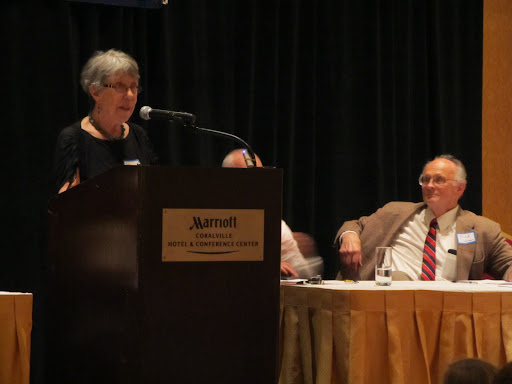
Mary has acknowledged those of our children who are able to be here [Julie; Greg, with Makur; Joel, Jason and Karl]. I want to mention the grandchildren who are present: granddaughter Laura, who speaks Spanish fluently and helps Spanish-speaking people get access to services in Des Moines; her daughter, and our great granddaughter, Nia, who is headed toward a career in science; Jason’s son and our grandson, Alec, a graduate of West High, who is a member of the Iowa City treasure that goes by the name of the Combined Efforts Theater; and Shinji Uozumi, our friend and a distinguished visiting scholar from Japan, whom we consider a member of our family whenever he and his family are here in Iowa City. [It was Shinji who prepared the professional video of our presentations, and the still pictures, one of which is embedded in this blog entry.]

Because I do not have a reputation as a man of very few words, with so many articulate people here this evening I thought I should limit myself to but one relatively short story -– at least short by my standards.

We had an organization called Hi-Y when I was attending University High School, U. High. Hi-Y was a high school organization within the national YMCA. How I came to be the national president of Hi-Y is a story for another day -- indeed, a day, you will be relieved to know, that need not ever come.

The point of this evening’s story is that, as national Hi-Y president, I was invited to attend an event in Washington, D.C., called the “YMCA Youth in Government Assembly.”

One of the featured events of our Assembly was a visit to the White House to meet President Harry Truman, where he addressed us in the Rose Garden.

Although I knew his remarks had a great impact on me, years later I couldn’t recall exactly what he said and did not have a copy. I didn’t even know if a copy existed anywhere. Nor could I recall the exact date, necessary to track it down if it did exist.

Then, 17 years ago, going through some old files, I came upon a brochure from that Washington Assembly, and was eventually able to find Truman’s remarks among his presidential papers.

I won’t read the entire talk to you. These brief excerpts will make my point.

He said, quote,

“Now this one person before you here has been from precinct to President all along the line. I have been in elective public office for 30 years. . . . I am going to continue to serve the country, understand, but I will do it in a little freer way than I do now.

“Learning about government is absolutely essential to people your age,” he continued, “because it is going to be your responsibility now, in a few years – you will be responsible for the operation of the Government,” unquote.
(President Harry S. Truman, "Remarks to the Members of the National YMCA and Government Assembly," June 26, 1952, Harry S. Truman Library & Museum.)

We refer to the “take-away” from a speech, or a meeting; what you think is most important; what you recall days or even years later.

And what I heard from President Truman, my take away from that afternoon at the White House, was (1) the fact that he had started with precinct work, and thought it worth mentioning, (2) the importance of learning about government, and (3) that high school students my age would someday be responsible for the operation of the government.

It was his reference to precinct work that encouraged me to become a precinct captain in my college town.

It was his insistence on studying government that prompted me to become a political science major, and later a law student.

And when he said that, quote, "in a few years you will be responsible for the operation of the Government," well, I guess I must have decided right then that I was going to set out to prove him right.

Ultimately, in the 1980s, I came back home to Iowa City, where I was born, the family home in which I lived during the 1940s, and which I now occupy once again, with Mary.

I had by then visited with two presidents in the Oval Office, a fourth in the Rose Garden, and held three presidential appointments during the administrations of all four of them, with the exception of the President, Harry Truman, who started me on this path.

And for much of the 1980s and beyond I served as co-chair for what was then Precinct One in Iowa City, going door-to-door to get out the vote.

I have been flattered to have been asked to run for the U.S. Senate and Congress from Iowa, and the local School Board -– two of which I actually did undertake -– and even asked to be the presidential candidate for a third party, which you will be relieved to hear I did not do.

But in many ways I am most proud, and rewarded, by the work I’ve done in the precincts, in candidates’ campaign headquarters, and in a variety of roles within the Johnson County Democrats organization. Why? Because, ultimately, that is the work that makes our democracy possible, and the foundation upon which it builds in each of America’s 3100-plus counties.

I hope you will find two take-aways from these remarks.

(1) The importance and dignity of precinct work in the lives of each of us -- as well as in the life of a great Democrat, President Harry Truman.

(2) The role that each of us can play, and must play, in encouraging our young people to participate in the nuts and bolts of democracy, in campaigns and at the precinct level – as President Truman did for me, and I try to do for those in the generations which will follow us.

Thank you again for this honor, and the honor of knowing and working with you through the years.
_______________

Other Johnson County Democrats' Hall of Fame
Inductees Honored May 5, 2012

J. Patrick White, former Johnson County Attorney
Jeanette Carter, long-time, all-purpose, hard-working precinct and Party activist
Mary Larew, multifaceted participant in numerous local organizations
# # #

Thursday, May 10, 2012

Institution of Marriage

May 10, 2012, 8:15 a.m.

Who, What, Threatens "The Institution of Marriage"?

Two days ago this blog addressed the basic human decency and respect owed everyone with regard to those suffering from problems of overweight and obesity. "Speaking of Obesity."

Today [May 8], following on the culmination of President Obama's "evolving" thoughts on gay marriage, here are the long-ago-evolved thoughts of another heterosexual about the basic human decency and respect owed all of our fellow humans in the GLBT community.

Last evening PBS' Newshour, as a part of its coverage of the president's "personal" position on the issue, included a debate of sorts in its story "Obama Supports Same-Sex Marriage: Now What?" (with transcript and video). Judy Woodruff hosted the segment, interviewing author Kerry Eleveld, and then questioning Evan Wolfson, president and founder of Freedom to Marry, and the Rev. Harry Jackson (not the Rev. Jesse Jackson), senior pastor of Hope Christian Church in Beltsville, Maryland, and presiding bishop of the International Communion of Evangelical Churches -- an outspoken opponent of gay marriage.

Unfortunately, the two did not really join issue. Wolfson hammered away on his assertion (kind of self-evident on the surface) that individual straight couples suffer no harm as a result of the marriage of gay couples ("you're not able to point to a single, actual, real consequence"). Rev. Jackson was saying, "It [gay marriage] may change the institution [of marriage], though. That's the issue."

My point is that, with regard to "the institution of marriage" both are right. How can I say that?

There are many issues involving gay marriage. (1) Central, I think, given the role of religion in the arguments of many gay marriage opponents, is the fact that the legalization of gay marriage has no effect, none, on the ability of any given religious organization to refuse to perform, or recognize, gay marriage. There are two parallel tracks here: what the state can (and many, including myself, would argue, constitutionally must do) and what individual religious organizations can do with regard to "marriage." There is a significant body of constitutional law declaring, put most simplistically, that the state should stay out of our bedrooms. (2) However, the president and Mitt Romney both agree that states should be free to define civil (not religious) "marriage" as limited to a man and a woman -- and 30 states have decided to do just that (including North Carolina this week). (3) At the same time, polls seem to indicate that 50% of Americans, give or take, and especially younger persons, are totally untroubled by the idea.

I leave discussion of those, and other gay marriage issues, to another day.

What I want to address are Rev. Jackson's assertions regarding the changes in "the institution of marriage" brought about by permitting gays and lesbians to marry.

I think he's right. Gay marriage does change "the institution of marriage." It's just that the change it brings about is insignificant compared with other changes.

Title IX has changed "the institution of college athletics." Prohibitions on "sexual harassment" have changed "the institution of courtship."

The real and very, very significant changes in "the institution of marriage," however, have come from the heterosexual, not the homosexual, community.

At its inception, marriage in a patriarchal society treated women as chattels, "owned" (and certainly controlled) by their husbands (as they still are in some countries today). Children born of unmarried parents created a significant problem for a community. There were more than moral reasons to prohibit sex outside of marriage (still punished by death, at least of the woman, in some countries today). Children were necessary for the perpetuation of the species. (As late as 1600 the world's population was about 500 million, compared with today's 7, and soon to be 9, billion. World Population Estimates, Wikipedia.org.) As recently as the 19th and early 20th Century children were needed to do their share of the unending work involved in a married couple's operation of a farm. Infant mortality rates were such that a couple needed many births to be assured of enough survivors. Divorce was theoretically possible, but thoroughly discouraged socially, legally -- and economically (given the many ways in which women were oppressed, and economically dependent upon their husbands).

That "institution of marriage" has certainly changed.

Today's (at least potential) economic and other independence of women, coupled with multiple forms of birth control, means that their sexuality no longer either requires, nor is restrained by, marriage. (E.g., when I entered law school in 1956 there were but two women among the 700 or so students; today's UI Law School entering classes are roughly 50% women.) Access to abortion, an abhorrence to many Americans and unavailable in most of geographic America (of 3100-plus counties in the U.S., among non-metropolitan counties only 3% offer access to abortion) is another major change. There are good reasons for being married, and monogamous within marriage; but today those reasons are more self-discovered and lived by as a matter of choice than externally imposed. This has been an enormous "change in the institution of marriage" for both heterosexual men as well as women (as we are reminded daily by the media).

Divorce rates are up, in part, because (at least many) women are not economically compelled to stay in "bad marriages" (sometimes including domestic violence). Most people would consider that a net plus for society. But it also makes divorce possible for somewhat more frivolous reasons. In any case, the easier access to the termination of marriage has to have been the cause of significant "change in the institution of marriage."

Procreation is no longer a societal necessity, either to tame Planet Earth or to have access to an adequate workforce on the farm. Indeed, one of our species' most urgent needs is to curtail births, not increase them. We seem to be approaching (if not exceeding) the maximum number of humans our Planet can sustain. Infant mortality rates, still too high in many countries, are radically below what they were. Super-sized farms and farm equipment have reduced the farm population from roughly 80% of all Americans in 1800 to 3% today.

So, is Rev. Jackson correct? Yes, the legalization of gay marriage is "a change in the institution of marriage."
But to truly understand these changes, and keep them in perspective, we need to recall the observations of Edward R. Murrow and Walt Kelly.

In explaining the Senator Joseph McCarthy anti-communist phenomenon, Murrow concluded his famous "See It Now" McCarthy program with the line from Shakespeare, "'The fault, dear Brutus, is not in our stars, but in ourselves.'" "Edward R. Morrow," En*Cyclopedia, State Library of North Carolina; the quote is from Shakespeare, Julius Caesar, Act I, Scene ii.

Walt Kelly, creator of the "Pogo" comic strip, is perhaps best remembered for his comparable line regarding environmental degradation on a 1971 Earth Day poster: "we have met the enemy and he is us." "Pogo (comics)," Wikipedia.

If Rev. Jackson, and other heterosexuals, are fearful of any "changes in the institution of marriage," and feel the necessity of a "Defense of Marriage Act," they should begin with a good long look in the mirror. It is not the gays they need fear, but themselves.


Rush Limbaugh, May 9, 2012
# # #

Tuesday, May 08, 2012

Speaking of Obesity

May 8, 2012, 10:40 a.m.

Decency and Obesity

This morning [May 8] brings us more news of a kind of growth America could do without: the "epidemic" of overweight and obesity. This time it was highlighted by a gathering of 1200 experts at the latest Centers for Disease Control and Prevention "Weight of the Nation" conference in Washington yesterday. Melissa Healey, "42% of American adults will be obese by 2030, study says; Though the rate of the last 30 years has slowed, it's far from leveling off, and it's going to get expensive, say experts at the Weight of the Nation conference in Washington," Los Angeles Times, May 8, 2012.

There's more below regarding how those experts define "overweight" and "obesity," how you can find yourself on their continuum, their projections regarding where our scales will tip in 2030, the causes, best strategies for cure, and long-term costs -- in our individual health and sense of well-being, the nation's public health, the costs to business of accommodation, and the multi-hundred-billion-dollar increase in the nation's healthcare costs.

But first . . .

As Joan Rivers used to say, "Can we talk?"

Because we have an accompanying problem associated with obesity, and that's how we talk about it -- to each other, to ourselves, and especially to those suffering from this condition.

It was illustrated in Iowa City recently with what turns out to be standard practice at a local bar catering to University of Iowa students, both under-age and legal.

Jordan Ramos, a third-year UI undergrad, paid the cover charge to enter the Union Bar the evening of March 3, 2012, and subsequently, and wanted to dance on a platform with the other girls. On both occasions she was forbidden to do so by employees on the grounds that she "was not pretty enough" (from photos, she has a pretty face by my standards) and was pregnant. (Somewhat overweight, she was not pregnant.)

Rosa Parks, pictured here with Dr. Martin Luther King in 1955, wanted to sit on the Montgomery buses wherever she chose. On December 1 of that year she refused a bus driver's order that she get up and give her seat to a white person. It was a major milestone in what became the civil rights movement, and eventually, with President Lyndon Johnson's leadership, a series of civil rights laws in 1964 and 1965.

Rosa Parks refused to be stereotyped, to know, and stay in, "her place." She wanted to sit, not stand.

Jordan Ramos also did not want to be stereotyped or kept in her place. Just as Rosa Parks didn't want to be forced to stand because of her appearance, Jordan Ramos didn't want to be forced to sit because of her appearance. She wanted to dance, not start a revolution. But she soon came to echo Emma Goldman's feeling that, once a revolution is requesting her membership, "If I can't dance, I don't want to be part of your revolution."

It wasn't quite a revolution, but it has been a series of demonstrations by students of all shapes, sizes and ages, protesting the policies of Union Bar owner George Wittgraf, and their execution by his employees. See, e.g., Emily Schettler, "Student: Bar Discriminates by Weight; Union Owner Says He Hadn't Heard About Situation, but He Wouldn't Condone Such Behavior," Iowa City Press-Citizen, April 28, 2012, p. A1; Logan Edwards, "Rally Will Accuse Union Bar of Size Bias," The Daily Iowan, April 30, 2012, p. A1; Emily Schlettler, "Bar owner wants to apologize; Protest over alleged discrimination at Union Bar planned for Friday," Iowa City Press-Citizen, May 1, 2012, p. A1; Editorial, "Let's Redirect All This Energy, Indignation," Iowa City Press-Citizen, May 3, 2012, p. A7; Mitchell Schmidt, "Union Bar Dance Platform Will be Torn Down; City Officials: Platform is a Safety Hazard and Doesn't Meet City Code," Iowa City Press-Citizen, May 3, 2012, p. A1; Alesha L. Crews, "Group uses gathering to bring attention to sizeism; UI student wants to shift attention away from bar incident to bigger issue," Iowa City Press-Citizen, May 5, 2012; Luke Voelz, "Rally Condemns Size Bias; Around 30 People Participated in Friday's Rally," The Daily Iowan, May 7, 2012, p. A1.

On May 3 the Press-Citizen trivialized Ms. Ramos concerns in an editorial headlined, "Let's Redirect All This Energy, Indignation," Iowa City Press-Citizen, May 3, 2012, p. A7. First, the editorial gives a half-hearted nod in her direction: "all establishments in the Iowa City area should be providing equal access and equal service for all their customers, regardless of external appearance."

Why? Because "even when that's not required by law, it's still just good business."

Good business?! Well, yes. But that's not really what this controversy is about. Ms. Ramos was not complaining about Wittgraf's failure to maximize his profits, his failure to recognize what is "good business." It was his failure to recognize what is good sense, his failure to treat all persons with dignity and respect, when and whether it will increase his profits or not.

It's not good business to have policies that create hostile demonstrations in front of your bar, anymore than it was good business for the Montgomery bus company to bring on a bus boycott. But Ms. Ramos is no more concerned about the business of the Union Bar than Rosa Parks was concerned about the business of the Montgomery buses.

The editorial continues with,
Ramos has been focusing her time, energy, passion and organizational skills on a goal unworthy of them: being able to dance on a platform overlooking the dance floor at The Union Bar. . . .

Because neither the state's civil rights law nor the city's civil rights ordinance includes body size as a protected category, there's little the Human Rights Commission could have done about the situation even if the commissioners had wanted to. And if Ramos had been complaining about something more significant -- if, say, a bar refused to serve her because of her size, or denied her a job, or paid her less than skinnier employees -- then we, along with many others in the community, would be more open to supporting her attempts to move forward with a civil rights claim.

But . . . [such] Commissions shouldn't be in the business of making sure more people of all shapes and sizes have equal opportunity to break their face after . . . falling off a beer-soaked bar platform. . . .

Now that everyone in The Union Bar has been consigned to the dance floor only, we hope that Ramos -- along with the people inspired by her -- will find a cause more worthy of all their indignation and creative energy.
What the Press-Citizen's usually sensitive and insightful Editorial Board missed on this one, I think, is that this controversy was, at base, no more about dancing on platforms in bars than Rosa Park's controversy was, at base, about sitting on buses. As UI grad student Mara Determan was quoted as observing, it was about "the root causes of prejudice against women" the "objectification of women." As Ramos said, "No wonder women feel they have to put on so much makeup and lose so much weight in order to feel valued in society." Luke Voelz, Daily Iowan, above. For an earlier blog entry addressing what we all lose out on when judging women by such standards, in that case a spectacular singing voice, see "Susan Boyle as General Semantics Lesson," April 20, 2009.

Notwithstanding Wittgraf's protestations that it "has never been our policy" to discriminate based on size, from news reports it appears Ramos' experience was the result of an overt policy, not an aberration. (Picking up on the Press-Citizen's editorial approach, he was quoted as saying, "We can't be mean to people. It's bad business.") Ramos said "others have told her about their own experiences of discrimination at the Union based on size, race and sexual orientation." "Austin Fell . . . said he witnessed the discrimination firsthand when he worked as a bouncer at the bar . . .. [H]e was told by owners to 'keep the fat and ugly girls away from the stage . . ..' Others who worked there told Fall, 'We usually let girls dance on the bar if they're skinny, but if they're fat, we just don't want that image.' . . . [O]ver the course of one month, he said he probably told about 20 'heavy-set' girls that they couldn't dance on the platform . . .." Emily Schettler, Press-Citizen, May 1, above.

It's as if these folks are still taking their ethical values from the obnoxious cigarette commercial aimed at women in the 1950s and '60s: "Cigarettes are like women. The best ones are thin and rich. Silva Thins are thin and rich."

Obesity:
How the experts define "overweight" and "obesity," how you can find yourself on their continuum, their projections regarding where our scales will tip in 2030, the causes, best strategies for cure, and long-term costs -- in our individual health and sense of well-being, the nation's public health, the costs to business of accommodation, and the multi-hundred-billion-dollar increase in the nation's healthcare costs
Governor Mike Huckabee, questioned regarding his conservative credentials, responded: "I'm a conservative. I'm just not angry about it."

Similarly, one can be concerned about the "obesity epidemic" and its consequences without disparaging others regarding their body type and size -- regardless of whether they're trying to do something about it or not. See Perry Beeman, "Iowa, U.S. Expected to Pack On the Pounds," Des Moines Register, May 8, 2012.

Jordan Ramos is the first to acknowledge this. She's fully capable of distinguishing between the range of problems associated with obesity and non-discriminatory human decency: "I'm not condoning obesity. That was never my intention. I just . . . don't think anybody's size should impact the way they are treated." Emily Schettler, Press-Citizen, May 1, above. "She said some people misinterpreted her story and thought she was trying to promote obesity, which she is not. She said she is trying to raise awareness about discrimination based on size. 'We are all humans and we all deserve to be treated equally and nobody should be denied access or the right to do things because of their outward appearance,' Ramos said." Alesha L. Crews, Press-Citizen, May 5, above.

If data regarding Americans' overweight and obesity is to be useful we need to define our terms. That has been done, and the definitions involve something called Body Mass Index or BMI. Don't worry about the math. Just use the calculator provided by the NIH's National Heart Lung and Blood Institute. (The actual metric formula is weight in kilograms divided by the square of height in meters. The calculator speaks feet, inches and pounds.)

Once you get that BMI number from the calculator, here are the categories:

Underweight = <18.5
Normal weight = 18.5–24.9
Overweight = 25–29.9
Obesity = BMI of 30 or greater (>40 = "severely, or super obese")

By these standards, today 36% of adult Americans are obese -- a number that is projected to increase to 42% by 2030. (If past trends were to continue it would be over 50%. The severely obese are expected to increase from 5% to 11% of the population.) These trends are hard to turn around, but the experts at Monday's conference point to such things as "more effective weight-loss drugs, public health campaigns to encourage exercise and more-healthful eating, or workplace health promotion policies" (such as the UI's "LiveWell" program). As with nicotine addiction and alcoholism, one of the most cost-effective approaches is to prevent obesity in young children: 77% of obese children become obese adults; only 7% of non-obese children have the problem as they grow older.

Experts acknowledge the insuperable political hurdles: "For weight gain to be averted — let alone reversed — policymakers would have to move beyond politically palatable initiatives such as removing sugary sodas from schools . . .. Very likely, junk food would have to be taxed to discourage consumption, and advertising for those products would have to be prohibited . . ." said one.

Overweight and obesity contribute to many diseases and disabilities, including arthritis, cancer, diabetes, heart disease. The costs of treatment are a significant part of our nation's healthcare bill. Estimates are that the additional costs from the additional number of obese persons between now and 2030 could be as much as 550 billion (over one-half trillion) dollars. There are also added costs for public and private employers in addition to health insurance costs, from the increased number of sick days to the redesign of airline and theater seats, wheelchairs, and buildings. ("U.S. hospitals are ripping out wall-mounted toilets and replacing them with floor models to better support obese patients. The Federal Transit Administration wants buses to be tested for the impact of heavier riders on steering and braking. Cars are burning nearly a billion gallons of gasoline more a year than if passengers weighed what they did in 1960." Sharon Begley, "As America's waistline expands, costs soar," Reuters, April 30, 2012.

(The above is drawn, in part, from Melissa Healey, "42% of American adults will be obese by 2030, study says; Though the rate of the last 30 years has slowed, it's far from leveling off, and it's going to get expensive, say experts at the Weight of the Nation conference in Washington," Los Angeles Times, May 8, 2012.) For Iowa statistics see Iowa Department of Public Health, "Obesity in Iowa: A Statewide Epidemic," undated (with 2006-07 data).

There are few among us who would not be better off for ourselves, and our nation, if we ate better, exercised more, and shed a few pounds. I am one of the fortunate ones who has never had to struggle with obesity. I have sympathy for those who do. But neither am I of "normal weight" by the standards of the BMI chart, being more in the low to mid-range of the "overweight" category, weighing every morning, graphing the results alongside my goal for the week.

We need to talk about obesity. We need to do what we can to improve the public policies that support public health rather than diminish it. But when we are "speaking of obesity" we need to recognize the human need to do so in a way that respects the feelings of those with a problem. While we try to promote sensitivity, and the elimination of racism, antisemitism, sexism, homophobia, and discrimination or ridicule of those with disabilities or special needs, we need to add a similar respect for the feelings of those who suffer in a society in which all too many apparently still believe that "the best women are thin and rich."
# # #

Wednesday, May 02, 2012

Nicholas Johnson's Mike Wallace Memories

May 2, 2012, 7:50 p.m.
Mike Wallace: May 9, 1918 – April 7, 2012

"I can't let the life, and now death, of Mike Wallace go without comment," Tim Weiner, "Mike Wallace, CBS Pioneer of 60 Minutes, Dies at 93," New York Times, April 9, 2012, p. A1; see also "Mike Wallace (journalist)," Wikipedia.org. (Photo credit: Wikimedia commons)

Mike Wallace was both a significant part of my television viewing experience since the 1950s, and of my professional experience during the 1960s and 1970s -- during which at least two interviews have been recalled. Excerpts from the transcript of our exchanges during my "Face the Nation" guest appearance on September 14, 1969, and my legal assistant, Tracy Westen's memory of a Mike Wallace interview in my FCC office, are reproduced below.

CBS, I can now confess almost 40 years after leaving the FCC, was kind of my favorite family network. It featured Dad in its Peabody Award-Winning interview show, "The Search." In fact, I think it was that program that convinced Dad -- after I'd left for college -- to buy a TV set; apparently that experience finally brought him to the insight that there might be at least some programs worth watching on television.

Like many Americans, I was a fan of CBS' Edward R. Murrow, and his then-partner Fred Friendly -- whom I came to know when Fred served as CBS News President, professor at Columbia University, and at the Ford Foundation. "Harvest of Shame" (about migrant workers) and their presentation of Senator Joseph McCarthy (that played a major role in his downfall) are both major milestones in American broadcasting, history.

My sister, Kate, got an early start on her broadcasting career. While in high school her proposal for a "Teen Talk" radio program won a local contest, and gained her the role of its host on local radio station KXIC-AM, where she also hosted the "Breakfast Club." She created two TV shows for WMT-TV in Cedar Rapids: "It's Fun to Find Out" (a science program for kids) and "Hobby Hunt" (either while still in high school or during summers when in college). After college, in Europe, she fed stories to NBC's "Monitor" radio program, and the Canadian Broadcasting Corporation (where she worked with a TV predecessor to CBS' "60 Minutes," "This Hour Has Seven Days").

She began at CBS with, among other assignments, Mike Wallace's radio program, "Mike Wallace at Large." She ultimately worked for CBS Television News for a few years, including Walter Cronkite's "CBS Evening News," where she continued occasional assignments with Mike Wallace.

I found watching the in-studio creation of Cronkite's Evening News -- with directors barking orders, and film (as it then was) arriving, and being processed, only minutes before the show, more exciting than any sports match. As improbable as it seemed during the countdown to air, somehow it always came together. And to my delight Cronkite extended a standing offer to come by anytime I was in New York, or they were doing the show from Washington, at the CBS offices just a block or two down the street from the FCC building.

My next door neighbor and one of my best friends at the time, Bob Pierpoint, had been one of "Murrow's boys," and was then working as the CBS White House correspondent. Although I never met Murrow, I do remember a dinner party at Bob's that Murrow's widow, Janet, attended.

In the midst of Washington's lobbying pressure, and good old boys' use of raw power as an alternative to rational persuasion, I used to say, sarcastically and dramatically to make the point, that most industries had at least one CEO who had attended college and has some sense of the public interest. When Maritime Administrator my memory is that Mærsk McKinney Møller and Jakob Isbrandtsen (of Isbrandtsen Lines) helped show the way to ship operations without government subsidy, and that my interests in cutting down port costs (often 90% of the cost of trans-ocean shipping), as well as the subsequent rail and truck costs, were substantially accelerated by Malcolm McLean, a former trucking company owner, who created Sea-Land and the containerization revolution I was advocating.

Anyhow, in broadcasting the one network CEO who was head and shoulders above the rest was CBS' Frank Stanton, often chosen (wisely) by the other broadcasters to be their spokesperson -- and who, among other things, got the Corporation for Public Broadcasting (which had no congressional appropriation) off the ground with his own $1 million contribution. (Among group station owners it was Don McGannon, of Westinghouse, who led the way by removing cigarette commercials, and creating his own "family viewing hour," before being ordered to do so.)

When CBS started "60 Minutes," it got off to a slow start. In fact, the network was considering canceling the program almost before it got off the ground. I had been encouraging broadcasters to provide more substantive programming in general, and supported "60 Minutes" in particular. I can't recall the format it took – whether it was a speech, article, or just a conversation – but I do recall encouraging the network to stick with it, confident as I was that if they'd give the program a chance it would ultimately build an audience. Reflecting back, it turned out to be one of, if not the, longest running programs in television history.

When news of Mike Wallace's death reached him, one of my brilliant, creative, charming and personable former FCC legal assistants, Tracy Westen, emailed me the following:
I saw the news this morning that Mike Wallace just died, which is certainly a shame, but it reminded me of a story involving you . . ..I remember the time Wallace interviewed you in your office (probably some time in 1970). He already had a reputation as a fearsome interviewer, so we were all a little apprehensive. His crew came in and set up a one-camera setup, with the camera focused on you in your desk chair. The interview proceeded; he asked tough questions; your answers were great.Then they reversed the camera to get reaction shots of Wallace, shooting over your shoulder. They said just "make conversation" while Wallace nodded, as if he were listening to your answers. (Was that a form of news staging?)Then, you started asking Wallace tough questions. I don't remember what you said, so I'll make it up, it was something like this:"Isn't it true, Mike, that you're really just a corporate shill for CBS, and that your news stories are just designed to sell your sponsor's products?" (Something like that.) Poor Mike, he had to sit there, and nod, as though he was listening to one of your answers -- but the hilarious part was that you were forcing him to "agree" (nod in assent) to all your critical questions.He left shortly after that, seemed a bit disgruntled, but, as I recall, gave you a good interview when it aired.I still remember that and will always associate it with Mike Wallace, and your undaunted wit in the face of a notoriously tough reporter.
There are a number of stories regarding the "Face the Nation" program from which the transcript excerpts of my exchanges with Mike Wallace are reproduced below.

One of the producers of the program, whom I had met but never dated, told me the following amusing story. Apparently someone with CBS in New York wanted to use as a backdrop on the "Face the Nation" set in Washington a large graphic including my face, and made a very early call to the Washington producer. Assuming she and I had a relationship of some sort, he asked her, "Does Nick Johnson still have his mustache?" (It was subsequently featured on the cover of the Rolling Stone.) Flummoxed, irritated at being awakened and at her caller's assumption, she told me she replied, "Just a minute, I'll roll over and look."

We received in my FCC office something like 7000 letters regarding the program. The network informed me that they got more mail for that particular "Face the Nation" than for any other.

This was especially noteworthy, since I had noticed TV Guide listed the program for the wrong time. Thus, anyone who watched it saw it by accident. Indeed, one woman wrote me how pleased she was to have caught it. She was dusting her TV set when it accidentally went on, and there I was.

When I commented about this to one of the show's producers, she explained, "What you have to realize, Nick, is that you're not paranoid; you have real enemies." So I did.

So here are the excerpts from that program that involve the exchanges between Mike Wallace and myself (plus an opening and closing with CBS moderator, George Herman). (The third reporter was Richard Burgheim, of Time magazine.)

FACE THE NATION
CBS Television and Radio Networks
Sunday, September 14, 1969 -- 12:30-1:00 PM EDT
Washington, D.C.

Mr. Herman: Commissioner Johnson, you are noted for some very critical views about the television industry. Your organization, the Federal Communications Commission, is far older than television. It presided over the birth and growth of the industry. It licensed and regulated the television stations. If there is something wrong with television, what is wrong with the FCC?

Commissioner Johnson: I think the FCC suffers from the problems that confront many of what we call sub-governments in Washington DC: the virtual domination of its day-to-day activities by the very industries that it is supposed to regulate. The political power of the broadcasting industry is, in my judgment, unsurpassed by that of any other industry in America today. * * *

Mr. Herman: Commissioner Johnson, if the FCC is dominated by the industry, is there something wrong with the members of the FCC, or is it the setup?

Commissioner Johnson: No, I think it's a not uncommon phenomenon in this town. The concept of a sub-government Is very important to an understanding of how its decisions are really made in Washington. In most areas of decision-making, the power is really outside the domain of Congress or the president. It rests with a very small group of individuals who have an economic interest in the outcome. This would apply to areas of subsidy, of government contracts, with bestowal of monopoly rights as in broadcasting, setting of rates; any matter of that kind that involves tremendous economic interests.

And in that area of decision-making, generally the decisions are dominated by a group made up of the trade magazines; the trade associations; that segment of the Washington bar which represents the industry involved; the principal spokesman for the industry, those from the major companies making up the industry; the government agency that is involved in dispensing the economic largess; and the subcommittees and staff within Congress that is responsible for this area.

And this group tends to enjoy a symbiotic relationship: the members of the various components of the sub-government end up working for one another at one time or another. And, it's a long, long way from democratic control of political decision-making.* * *


Mr. Wallace: You were persuaded to stay, and now Dean Burch, who worked for Barry Goldwater during the 1964 campaign, Dean Burch, it is said, is going to be the new chairman of the FCC. And Nick Johnson, those who know him best say, is very unhappy about that. Why?

Commissioner Johnson: Well, I would make every effort to assume the best about any new appointee to the FCC, and endeavor to work well with him to the extent possible.

Mr. Wallace: But what's wrong with the Burch appointment, if indeed it comes, Commissioner Johnson?

Commissioner Johnson: Well, I wouldn't really comment on that. The president hasn't nominated anyone yet, and I'm not sure it would be appropriate then for me to comment on it. I think that the thing that everyone will be watching on whomever president Nixon does ultimately decide to choose, is once again, just how far the political power of the broadcasting industry has gone. Surely, President Nixon is very much aware of the kinds of problems that president Eisenhower got into during the 1950s with his FCC and the ex-party scandals at that time. He's very mindful of the, really, the outrage on the part of many Americans at the seeming business domination of the regulatory commissions. So that, if he ends up making appointments that principally serve the interests of the broadcasting industry, I think we can assume that he is doing so knowingly and fully mindful of the tremendous political price that he will pay for such an appointment, and that he is presumably doing so only because of a tremendous political power that this industry does have, not only over Congress but over the presidency itself.

For he is, after all, in the same position of any other elected official. The only way he can reach his constituency, the only way any elected official can reach his constituency, is by knocking on the broadcaster’s door and begging him for a little time. It is the broadcaster, after all, who controls what information the American people will receive, what candidates they will be permitted to view and to hear from, what issues they will be permitted to know about. And every elected official is very mindful of this power. The question is, to what extent is it also a power applicable to the presidency itself. And as I say, I think that will be tested as these appointments come up.* * *


Mr. Wallace: Have you never helped out, Commissioner, been consulted by or offered encouragement to any specific group that was trying to replace the current licensee of any station across the country?

Commissioner Johnson: In my judgment, it would be inappropriate for a Commissioner to, I don't know what your words were, but to represent in the way a lawyer might, any party before the commission during a hearing. We have express rules on this, and once a case is set, it's up to the parties to get counsel and take care of themselves. Prior to that time, my door is open as is that of other Commissioners. I try to answer my mail and answer my phone calls and see people who request an opportunity to visit with me. I talk with representatives of the broadcasting industry and the telephone company; I talk with representatives of public groups. I try to see as broad a cross spectrum of those people who want to see me at times when it is appropriate and it is possible.

Mr. Wallace: My words were "helped out, been consulted by or offered encouragement to" any specific group. In other words, did you help any group? For instance, at KRON-TV; did you talk – people are trying to get their license. Or KNBC in Los Angeles, or WMAL-TV here in Washington. There are specific groups that are trying to get those licenses. Have you offered any encouragement to or specific help to any of those groups at any time?

Commissioner Johnson: I think the fair answer to your question is no, to the extent that you are asking have I done anything more than I would have done or have done in the past for industry representatives or any other American citizen, and the answer to that clearly is no, I have not.* * *

Mr. Wallace: Would you like to see the FCC regulate or somebody regulate the prices that are paid for political broadcasts?

Commissioner Johnson: Well, that rather assumes, Mr. Wallace, that a price ought to be paid. In my judgment it is absolutely preposterous that in an industry that is earning, many stations well in excess of 100% return on depreciated capital investment, an industry that is using public property, the airwaves, an industry that is permitted to make private profit from the use of public property only in exchange for the use of that public property in the public interest, an industry that has an obligation to put on some public service programming and is doing very little of it, for that industry to hold up the elected public officials and make them pay to get time from public property in order to permit the people of this country to hear from their elected officials, it's – you know, the rationing of the time and then charging for them, it's kind of like a criminal stealing a woman's wedding band after he's raped her, you know. * * * [D]uring election time, I think this one-third of the time ought to be devoted to a discussion of public issues and candidates, yes.

Mr. Wallace: By both networks and local stations?

Commissioner Johnson: Yes. Now, you raised the question of what about the splinter parties. This has been adequately handled by every other civilized nation in the world. It's not impossible of solution here. In Great Britain, the proportion given to splinter candidates is roughly apportioned in terms of their vote. Broadcasters in this country complain that because of the equal time rule they are compelled to give all candidates time, and if only we'd suspend the equal time rule, they'd be willing to give more free time. The fact of the matter is that well over fifty percent of the broadcasters, as many as two-thirds in many areas, have not given free time when there were only two candidates.* * *

Mr. Wallace: Let's get to censorship, if we may, Commissioner. Recently you wrote – you said virtually the same thing again here today – you wrote in TV Guide that network officials are “keeping off the television screens anything,” your word, "they find inconsistent with their corporate profits or their personal philosophies." And you talk about "corporate tampering with the product of honest and capable journalists." "Sometimes," you say, "there is a deliberate alteration of content." Do you at genuinely believe that?

Commissioner Johnson: Yes, I genuinely believe that.

Mr. Wallace: What you're saying really, is that –

Commissioner Johnson: As do most former network newscasters who bothered to write books about the matter genuinely believe it. Edward R. Murrow said that the final and most crucial decisions in network news are made by top corporate management.

Mr. Wallace: Well, now, wait –

Commissioner Johnson: Fred friendly, who was former president of CBS news, said very much the same thing in Due To Circumstances Beyond Our Control. Robin McNeal, who was with NBC, in his book, People Machines, documented very much the same story. These are not imaginings of mine, Mr. Wallace. My only source of information, necessarily, is from those who are now in this business and are willing to talk, not for attribution, or those who have been in the business in the past and have written books about it.

Mr. Wallace: Well, Commissioner, you say, again, "Network officials keep off the screen anything they find inconsistent with their corporate profits or personal philosophies." You wrote it in TV Guide, next week's TV Guide. And I believe you have a copy of Dick Salant, who is the president of CBS News, his statement says, "in the eleven years I was corporate officer and the six years I've been president of CBS news, to my knowledge," and he is not an unknowledgeable man I think you'll agree, "there is no issue, no topic, no story that CBS News has ever been forbidden or instructed, directly or indirectly, to cover or not to cover by corporate management." Now –

Commissioner Johnson: Well, are you familiar with the inner-office memorandum that was published in Variety from CBS management to the news department on how coverage of the New York Yankees, a ball club owned by CBS, was to be handled by the news department?

Mr. Wallace: Candidly, I am not. But the word "anything"? And let's say that you were right one percent or five percent –

Commissioner Johnson: Edward R. Murrow said it. He said look at prime time television. He said 8:00 to 11:00; I think you could extend that time a little bit. He said, see how much you see there of relevance to what is going on in our society today. He quoted Stonewall Jackson as saying, "When the war breaks out, you draw your sword and throw away your scabbard." And here is television, rusting in its scabbard.

Mr. Wallace: Mr. Johnson –

Commissioner Johnson: It's a sign of crisis.

Mr. Wallace: – aside from the New York Yankees, what are the issues that you think are in – have not been covered on television, on CBS news? How many times have George Herman or I, for instance, on CBS news, because I don't want to talk about the – been instructed to tamper with our product? You know what you're calling us when you say that?

Commissioner Johnson: I didn't call you anything. If you read the article carefully, you will see that I said that I would far rather leave the judgment as to what is going to be in America's marketplace of ideas to the creative writers and performers and journalists in this business, individuals from all sections of the United States, than to leave these decisions to committees of frightened financiers in New York City. * * *I would much rather, Mr. Wallace, that you were making those decisions on your own. I would much rather that you were deciding, Mr. Wallace, how much time in the evening schedule of CBS was going to be devoted to something that matters.

Mr. Wallace: You're not talking about timing in your article, Mr. Johnson; you're saying –

Commissioner Johnson: I am talking about time. I'm saying that one of the ways that you censor is by putting on so much tasteless gruel, by keeping America asleep, when important issues need to be discussed, when the people need to have information, and they watch television. Notice that – I think it was a week and a half before the ABM Senate vote, a Gallup poll revealed that sixty percent of the American people had either never heard of the ABM or didn't know enough about it to have a position on the issue.

Mr. Wallace: Commissioner –

Commissioner Johnson: I think it's rather interesting, if I can finish this point, that sixty percent of the American people also tell Elmer Roper that they get most of their information and opinion from television. Now, whether this happened to be the same sixty percent that was watching television that didn't know enough about the ABM to form an issue on it or not, I don't know. But I do know that the American people are woefully uninformed if they are dependent solely upon television news. Walter Cronkite said as much. And if you cannot find authority in Edward R. Murrow and Fred Friendly, who was Dick Salant’s predecessor, and Walter Cronkite, who’s now anchoring your evening news show, I don't know what authorities I can cite to you, although I can find them from other networks as well. The ABC executive who says we censor ourselves was also quoted in the pages of TV Guide.

Mr. Wallace: . . . You say, "Network officials are keeping off the television screens anything they find inconsistent with their corporate profits or personal philosophies." Now, those are your words.

Commissioner Johnson: Well, this was in part based upon CBS's experience with the Smothers Brothers, where I think it's demonstrable, in that instance, that they were not acting in terms of corporate profit, because the shareholders of CBS have suffered as a result of the cancellation of the Smothers Brother's Show. That was nothing but personal predilection.* * *

Mr. Herman: . . . In your article you complained about several different things that we've kept off the air. Information about cigarettes, cyclomates, black lung –

Commissioner Johnson: You want to talk about cigarettes?

Mr. Herman: I just want to say that I've done several stories on the air on each of those things, and I'm a little troubled to find in the twenty seconds we have left what I did wrong.

Commissioner Johnson: Well, I'll be happy to discuss the cigarette story with you in gruesome detail. There is a prime example of this industry's effort to take all the way to the Supreme Court of the United States the argument that they have the constitutional right to keep from the American people information about the health hazards of cigarettes. The only reason those anti-smoking spots are on the air is because they were ordered to be put on the air by the FCC over the protests of the broadcast industry.

# # #

Addendum, May 4: After writing this, I listened to a repeat of Diane Rehm's interview of Dan Rather. He’s just published a book, Rather Outspoken. He describes what happened, even to CBS News, after the years when I was complaining about corporate control of the networks in the 1960-70s (see "Face the Nation" excerpts, above), and after Paddy Chayefsky’s 1976 film, “Network.” Rather's take is, on the whole, not only totally confirming of what Chayefsky and I had predicted, described and complained about 30-40 years earlier, it also explains how concentration of control of mass media led to an acceleration of the abuses. See also, "Dan Rather," New York Times Topics; "Dan Rather," Wikipedia.org; and Dan Rather Reports on Facebook.

Monday, April 09, 2012

TIF Towers

April 9, 2012, 4:30 a.m., plus April 18, 2012, Addendum

Giving TIFs the Sniff Test

The following op ed column appeared in this morning's [April 9, 2012] Iowa City Press-Citizen. Its reproduction in this blog enables the addition of the supporting source material in the form of endnotes,, plus a sampling of prior blog entries about TIFs.

[April 18: For some subsequent developments regarding this TIF, sufficiently off-putting to cause two members of the "I've never seen a TIF I didn't like" City Council to vote against it, see "Addendum," below.]

"Moen TIF Proposal Just Doesn't Pass the 'Sniff Test'"
Nicholas Johnson
Iowa City Press-Citizen
April 5, 2012, p. A7

As Ronald Reagan would say, “There you go again.”[1]

Sadly, our seven recovering TIF-aholic[2] City Councilors have fallen off the wagon.

Fifty years ago tax increment financing, or TIFs, were designed to encourage urban renewal of blighted areas.[3] Is that how you’d describe the Ped Mall? Should they be used to enrich the developers of millionaires’ high-rise condos?[4]

My sources regarding the latest TIF shenanigans? Like the 1930s Will Rogers, “All I know is what I read in the papers.”[5]

The stories indicate this Mark Moen deal is even worse than a TIF. Like other TIFs, it shifts tax revenue away from schools and Johnson County,[6] and it’s unfair to the competing landlords without TIFs.[7]

So why worse? It’s a direct payment to Moen before construction of his $10 million, 14-story tower; a “forgivable loan.”[8] Forgive a $2.5 million loan?! It’s reminiscent of MidAmerican Energy’s demand ratepayers pay in advance for a nuclear power plant.[9]

Why no bank loan? Banks charge high interest and don’t recite the Lord’s Prayer about loan forgiveness.[10] You can’t blame Moen for preferring the Municipal Bank of Iowa City.

Where’s the money coming from? The City will sell municipal bonds. Because bondholders’ interest isn’t taxable, cities can pay them low interest. Even so, 18 years from now, we taxpayers will have paid $3.8 million (including interest) for our Council’s generosity.[11]

Iowa bankers complain about credit unions’ unfair competitive advantage.[12] (Banks pay taxes; credit unions don’t.) Why the bankers’ silence about this tax-free competitor?

Iowa legislators, like most Americans, are focused on “the economy,” special interests’ abuses, and the wisest use of taxpayers’ dollars. Bailouts, subsidies, corporate welfare, earmarks – and TIFs – are not in favor.

It turns out Iowa’s TIF practices are among the nation’s worst.[13] Reforms have been proposed and debated.[14] The ugly facts about TIFs and abuses are being revealed by ever-increasing numbers of legislators, economists, academics and journalists.[15]

So why does our City Council pick this of all moments to spit in their eye, rather than join the reform movement? How did the most urgent need for its next $3.8 million become a gift to Moen for his latest development?

Most Council members are likeable and even admirable, as is Mark Moen. All are creatively thoughtful about our downtown. But I have neither been asked nor volunteered to invest in his personal projects, and don’t appreciate the City Council forcing me to do so.

Why is this a good investment for taxpayers? Apparently it wasn’t a good investment for the combined resources of Moen, family and friends, bankers, and other potential investors sitting on cash and looking for returns.[16] And if it was a good investment for them, why do they need the TIF?[17] Just because he says so?[18]

Why doesn’t he build a 10- instead of 14-story tower, structurally strong enough to add the top floors later, when and if it produces the necessary profits? Or, since we’re paying for one-fourth of the tower, have the City own those floors?

Recipients of TIFs understandably think they are a nifty idea.[19] They argue TIFs pay for themselves with increased taxes later. But in this case the City has agreed the $10 million building may be assessed for property taxes as low as $5.76 million.[20]

Can the Council guarantee the tower’s economic success? That it wouldn’t be built without the TIF?[21] That taxpayers’ interests are protected if it fails, or Moen becomes bankrupt?

So far, this use of taxpayers’ money offers more questions than answers.
_______________
Nicholas Johnson teaches at the University of Iowa College of Law. For more TIF commentary and resources see FromDC2Iowa.blogspot.com.
__________

ENDNOTES

1. "There You Go Again," wikipedia.com.

2. Editorial, "Rein In Speculative TIFs," The Gazette, April 1, 2012 (hereafter "Editorial") ("Iowa's addiction to TIFs has 'seriously distorted' the property tax system" (emphasis supplied)); Jennifer Hemmingsen, "Time to Rein In TIF Shell Game," The Gazette, April 1, 2012 (hereafter "Hemmingsen") ("This TIF addiction puts the squeeze on taxpayers outside TIF districts, and on county governments and school districts frozen out of the revenue stream.")

3. "The Iowa Picture: Tax Increment Financing; Overdue for Reform After All These Years,"Iowa Fiscal Partnership, March 29, 2012 (hereafter "The Iowa Picture") ("What is TIF? Originally a product of the push for urban renewal in the 1950s and ’60s, tax-increment financing (TIF) was designed to facilitate redevelopment of blighted areas in cities.")

4. Tara Bannow, "Committee recommends approval of Moen tower; 14-story development on Wells Fargo site would raise property's value from about $569,500 to an expected $9.8M," Iowa City Press-Citizen, March 14, 2012 (hereafter "Bannow") ("Plans call for a glass-lined, mixed-used building with the first four floors as retail/office space and the remaining 10 floors composed of 26 condos, including two luxury units on the top floor."); Josh O'Leary, "Marc Moen seeks TIF for 14-story tower downtown," Iowa City Press-Citizen, March 10, 2012 (hereafter "O'Leary") ("Plans for the new tower call for 16 one-bedroom, 662-square-foot condos; eight one-bedroom, 1,039-square-foot condos; and two luxury units, each about 2,000 square feet.")

5. "Will Rogers," wikipedia.com. Hopefully, these Endnotes will at least provide some sense of when, where, and in which papers I came to "know" what's in this op ed column.

6. "Why We Need Serious TIF Reform, an Iowa Fiscal Partnership Backgrounder," March 29, 2012 (hereafter "Backgrounder") ("Tax shifting is an integral part of TIF. When cities are allowed to divert taxes from overlying entities — school districts, community colleges, transit authorities, the county — those entities are forced to raise taxes to make up for the lost revenue from the increment. Residents of those broader jurisdictions — inside and outside the city — thus pay higher taxes."); Peter Fisher, "Tax Increment Financing: A Case Study of Johnson County," Iowa Fiscal Partnership, November 21, 2011 (hereafter "Fisher"); "Hemmingsen" ("This TIF addiction puts the squeeze on taxpayers outside TIF districts, and on county governments and school districts frozen out of the revenue stream. It’s a growing burden: In 2002, the impact of TIF on state school aid was $5.2 million, according to [Iowa State economist David] Swenson. In 2012, it was $46.8 million.").

7. For a compelling example of the impact of TIFs on the competitors who don't receive them, see the comments of the owners of Iowa City's Alexis Park Inn, contained in "Call the Cops, Robbery in Progress," April 24, 2008.

8. "Bannow" ("Tax increment financing usually provides property tax abatement after development has occurred. However, in this case, the TIF will be given in the form of an upfront, forgivable loan."); Gregg Hennigan, "Iowa City Approves $2.5 Million Loan for High-Rise Building; The $10.7 Million Building is to Have Retail Space, Offices, condominiums and Apartments," The Gazette, April 4, 2012, p. A2 (hereafter "Hennigan") ("The City Council voted 6-0 Tuesday night to approve a $2.5 million tax increment financing agreement with developer Marc Moen for a 14-story structure he plans to build on the Pedestrian Mall. . . . The $2.5 million will be given as a forgivable loan at the start of the project.")

9. Perry Beeman, "Heated battle over nuclear plant nears critical mass," Des Moines Register, March 21, 2012 ("House File 561 would allow the investor-owned utility to do something it has not done with any other power plant: charge ratepayers for a plant before it’s constructed.")

10. Matthew 6:9-13, New International Version of the Bible, BibleGateway.com:
9 “This, then, is how you should pray:
‘Our Father in heaven,
hallowed be your name,
10 your kingdom come,
your will be done,
on earth as it is in heaven.
11 Give us today our daily bread.
12 And forgive us our debts,
as we also have forgiven our debtors.
13 And lead us not into temptation,[a]
but deliver us from the evil one.'"
11. "Hennigan" ("The city will sell bonds to cover the cost, which Finance Director Kevin O’Malley estimated at closer to $3.8 million when interest is included. It will take an estimated 18 years to repay the debt."), and "Municipal Bonds," wikipedia.org ("In the United States, interest income received by holders of municipal bonds is often exempt from the federal income tax and from the income tax of the state in which they are issued . . ..").

12. “Credit Union Regulation,” American Bankers Association (within ABA Issues Index/Credit Unions (“Credit unions are a $951 billion industry. Over the next five years, the credit union tax exemption will cost the federal government nearly $8 billion.”)

13. Rod Boshart, "Working group hopeful of TIF reform; Coralville Von Maur deal sparked legislative look," The Gazette, March 28, 2012 (hereafter "Boshart") ("Rep. Tom Sands, R-Wapello, chairman of the House Ways and Means Committee, said there have been mounting concerns that Iowa has some of the nation’s most lenient TIF provisions with less oversight than other parts of the country. . . . 'TIF has got to be addressed,' he said. 'There are some that are wanting to do very little, but it’s real hard for them to defend the abuses of TIF that some cities are using right now. I think if we don’t get it under control, the abuses will continue to grow . . .."); "The Iowa Picture: Tax-Increment Financing; Overdue for Reform After All These Years, Iowa Fiscal Partnership, Updated March 29, 2012 ("[I]n the 1980s, when Iowa cities were allowed to start using TIF for economic development, broadly defined [no] longer did there need to be a finding of blight or decline to implement a TIF district. Rather, city officials could determine it was necessary for economic development. Even then, the presumption remained that a public subsidy of a project under TIF would only be used if a worthy development, carrying a public benefit, could not be expected to occur without it. It was to be a true incentive. Loosely written law has permitted these standards to lapse. The use of TIF in Iowa has expanded well beyond its intended purposes, often going against the principles that are meant to justify it.").

14. "Editorial" ("a bipartisan House-Senate working group is studying Iowa’s tax increment financing rules"); "Boshart" ("A bipartisan House-Senate working group is hoping to craft reforms to the state’s tax increment financing system that can win legislative approval this session, group leaders said Monday [March 26, 2012].").

15. Lee Hermiston, "Residents speak out at forum on TIF practices; Suggestions include giving schools voice in the process," Iowa City Press-Citizen, January 22, 2012 (hereafter "Hermiston") ("State Sen. Joe Bolkcom arrived at a community discussion on fixing the problems with tax increment financing with 15 ideas for TIF reform."); "The Iowa Picture: Tax-Increment Financing; Overdue for Reform After All These Years, Iowa Fiscal Partnership, Updated March 29, 2012.

16. "O'Leary" ("The developer is asking for $2.5 million in TIF assistance in the form of a forgivable loan provided by the city before the project starts. Moen would use the money to leverage private financing . . ..").

17. "Hennigan" ("Critics . . . argue a TIF is often unnecessary for a project to move forward — and if it is needed, then the project is not viable on its own.").

18. "O'Leary" ("Moen said the city’s financial assistance is 'absolutely critical' for the new project."); "Hennigan" ("Moen has said the project would not happen without the financial assistance . . ..").

19. "O'Leary" ("'I think Iowa City’s use of TIF is a model of how TIF is intended to use, and has been applauded by everybody,' Moen said."); "Bannow" ("Although Moen has been critical of Coralville’s use of TIF, he said this project [his new tower proposal] represents responsible use, as was the $6 million in TIF that was given to Plaza Towers."); "Hermiston" ("Local developers Marc Moen and Kevin Digmann said TIF, when used responsibly, is a valuable tool, pointing to the Plaza Tower . . . made possible through TIF use.").

20. "Hennigan" ("The agreement also requires the property . . . to have [a] minimum assessed [value] of $5.76 million . . ..").

21. "Hennigan" ("Critics also argue a TIF is often unnecessary for a project to move forward . . .."); "Editorial" ("[M]ost of the state's TIF activity has been use[d] to underwrite commercial and retail development, according to Iowa State University economist David Swenson's research. Much of that development would have happened anyway, Swenson said."); "Backgrounder" ("TIF Reforms . . . State law also should require that TIF funds be used only when necessary"); "Hermiston" ("Many also spoke in favor of requiring TIF projects to undergo a 'but-for analysis' that would prove the project could not go forward without TIF funding.'The but-for measure is the key,' [Johnson County] Supervisor Rod Sullivan said. 'We obviously haven’t been able to get folks to do that analysis locally. I think we need, somehow, we need somebody to play referee. There has to be some kind of but-for analysis.'").
__________

Sampling of Prior TIF Op Ed Columns and Blog Entries
From 2011

"TIFs Wealthy Relatives," December 6, 2011

"TIF Impact Statements," November 29, 2011

"SSMIDs, Taxes and TIFs: The Lessons,"
November 3, 2011

"The True Price of TIFs," October 1, 2011

"Brother, Can You Spare a TIF," April 25, 2011

And a sampling from some of the earliest ones, 2006-07

"Understanding TIFs," October 5, 2007

"Courage, Councilors," October 3, 2007

"TIFing Your Doctor," September 12, 2007 (with TIF lyrics for "Folsom Prison Blues")

"Public Money, Private Profits," August 24, 2007

"The Terrible TIFs," July 26, 2007

"Why Do They Hate America?" October 4, 2006

"Press-Citizen Says 'Tough TIF,'" September 22, 2006

"TIF-ing My Toolshed," September 2, 2006

"Coralville's Hotel: 'Trust But Verify,'" August 16, 2006

"Are TIFs 'Corporate Welfare'?" July 22, 2006

"More: Justifying Corporate Welfare," July 13, 2006

"Neutral Principles, Anyone? Justifying Corporate Welfare," July 12, 2006

__________
Addendum
April 18, 2012

Remember the old line, "Gravity. It's not just a good idea, it's the law"? On April 17 Chris Gordon reminded us that "Limiting TIFs to precise public purposes is not just a good idea, that also is the law." Chris Gordon, "No Reason for City to Pitch In On New Downtown Tower," Iowa City Press-Citizen," April 17, 2012, p. A7.

He notes that, among many other Iowa Code provisions that appear to be violated by this TIF (some violating the letter of the law, all violating its spirit), "First, Iowa Code 403.5.4 (1) provides that local urban renewal plans that propose residential redevelopment must show that there is a shortage of housing, that existing housing is so deficient as to be a threat to the public welfare, or that land is needed for low-income housing. The City-University Urban Renewal Plan does none of this. Indeed, the detailed objectives for the sub-areas of the plan make no mention of the need for residential development."

I offer no independent "legal opinion" regarding the validity of Gordon's assertions, for a variety of reasons, not the least of which because I haven't done the legal research into the statutory language, the legislative history, and the court interpretations. But it does seem to me there is enough smoke billowing from his campfire that it warrants some lawyer doing so.

Today [the next day, April 18] we learn that Moen would like to change his plans for the building -- two weeks after the Council approved his first proposal -- and that a majority of the City Council sees no problem with permitting him to do so. Mitchell Schmidt, "Council OKs New Moen Tower; Alteration Will Allow a Cantilever Design and Add About 5,600 Square Feet to the 14-Story Building," Iowa City Press-Citizen, April 18, 2012, p. A1:
The Iowa City Council has approved a revision to developer Marc Moen’s 14-story building that would include inserted balconies and an overhanging cantilever design [-- a revision] that “substantially deviates” from the concept presented in the original agreement . . . a cantilever design that would include a 4-foot overhang . . . for the top 13 floors. Inverted balconies would begin on the fifth floor. The roughly 5,600 square feet that would be added [the equivalent of two or three additional houses] . . . would increase the assessed taxable value of the structure by an estimated $1.5 million . . .. Moen noted that . . . the new design would include additional costs . . ..
Why is this not proof that he never needed the TIF in the first place -- even if it was legal, which Gordon suggests it wasn't -- and even if the Council had explained why it fails to trigger any of the dozen categories of reasons why TIFs are a bad idea -- which the Council refused to do (because, of course, it couldn't)? (I am assuming the Council has not provided Moen even more taxpayers' money to cover the "additional costs" of these revisions.) It looks to me like he had enough money available to build the building he first proposed, but wanted what would be (to his aesthetic tastes) a more attractive building that would require, that's right, a $2.5 million TIF. (Given that the City may tax him on approximately half the value of the building, it is not unreasonable to project that the "$1.5 million" in additional assessed value represents about $2.5 million in additional actual value.)

Mayor Matt Hayek and Council Member Jim Throgmorton voted against the revision. Why? It turns out that this little "revision" also involves, in effect, a gift of public property (use of a "public right of way") to Moen that was not originally contemplated, and will stand as a precedent for future developers -- kind of like giving downtown restaurant owners the opportunity to put tables and chairs on the public sidewalk to personally profit from more customers. "Hayek and Councilor Rick Dobyns questioned whether approving the use of the overhang, which would encroach over the Dubuque Street and Black Hawk Mini-Park sides of the tower, would create a precedent for future developers to request the same. 'If we do this, the council’s got to be comfortable with what could be requests to cantilevers in the public right of way on other buildings,' Hayek said . . .."

So far as the newspaper story reveals, the Council made no effort to put a dollar value on this additional gift of public property -- a little bonus on top of the taxpayers' future re-payment of $3.8 million already committed.

# # #