Showing posts with label Mary Vasey. Show all posts

Saturday, February 09, 2019

Joel Grubbe

JOEL GRUBBE
May 5, 1958-February 4, 2019
Memorial Gathering March 3, 2019
Note: Joel's mother, Mary Vasey, made substantial contributions to this post.

Joel Grubbe, of Iowa City and San Jose, Calif., died Feb. 4, 2019, at Mercy Iowa City Hospital Hospice.

He will be missed by family, friends and many care givers for his humor, perseverance and genuine concern for others.

He was uniquely gifted with numerous, wide-ranging interests. Even his musical choices ranged from Mozart and Beatles to punk and dark metal.

Joel was born in Colorado Springs, Colo., May 5, 1958, to Mary Vasey and Bill Grubbe. He traveled the country and lived in Colorado, Utah, Iowa (Cedar Rapids) and California. He worked at the Santa Clara Medical Center while living in San Jose, Calif., for 20 years. Following a serious brain injury in 2010, he returned with his cat, Mindy, to family in Iowa (Iowa City) and its university hospital.

He is survived by his mother, Mary Vasey and her dozens of cousins; stepfather, Nicholas Johnson and Nick's sister Kate; brothers, Jason Grubbe, Karl Grubbe and Karl's wife, Carol; nephew Alec Grubbe and niece, Claire Schuerman; aunt Dora Lee Larson and Donna Sims; uncle Dan Vasey and wife Greer (daughter Natasha Vasey Ellis and husband, Timothy Vasey-Ellis, and grandchildren Celeste, Sebastian, and Hugo; and son Gregory Alex-Vasey and wife, Effie Alex-Vasey). Joel's surviving stepsiblings are Julie Johnson (and daughters Laura and her husband Francisco, Sara, and grandchildren Nia, Adrian and Isaac); Sherman Johnson and wife Pati; Greg Johnson and wife Makur; and Alex Johnson Lavidge. Joel's much-beloved cat, Mindy, is also a survivor.

Joel was preceded in death by his father, Bill Grubbe, sister, Robin Grubbe, and uncle Steve Vasey.

There will be a celebration of Joel's life on March 3; details below.

In remembrance of Joel, the family suggests donations to Iowa City Hospice, Mercy Hospice Care Unit, Brain Injury Alliance of Iowa or your favorite charity.

[See two more pictures, plus comments from Karl Grubbe and Jason Grubbe, below.]
_______________

Notes:

1. Memorial Gathering, Sunday, March 3, 2019, Uptown Bill's, 730 South Dubuque St., Iowa City, Iowa.
Uptown Bill’s was a place where Joel participated in support groups, enjoyed concerts, art activities, and trying exotic soda pop or Jason's famous milk shakes in the coffee house. Because Uptown Bill's was so important to Joel, as it is for many others, the family feels it is a good place to celebrate his life.

There will be a memorial service at 2:00 p.m.. Friends are also invited to drop by any time between 3:00 and 4:30 to spend time with friends and family and remember Joel.

Sunday parking is available across the street from Uptown Bill's in a University parking lot.

2. Mary Vasey prepared and submitted the obituary that appeared in The Gazette online and in the print edition February 8, 2019, p. A9. The version above is a slightly altered version of the one in The Gazette. The following week her shorter version appeared in the Iowa City Press-Citizen and is reproduced in Note 4, immediately below.

3. A tribute to Joel's father, Bill Grubbe, also appears in this blog: "In Memoriam: Bill Grubbe," October 3, 2006.

4. The Iowa City Press-Citizen Joel Grubbe obituary.

Joel Grubbe

Iowa City. Joel Grubbe died Feb. 4, 2019, at Mercy Iowa City Hospital Hospice.

He will be missed by family, friends and many care givers for his humor, perseverance and genuine concern for others.

Joel was born in Colorado Springs, Colo., May 5, 1958, to Mary Vasey and Bill Grubbe. He is survived by his mother, Mary Vasey, Stepfather, Nicholas Johnson and brothers Jason and Karl Grubbe.

For details email maryvasey@yahoo.com
_______________
Source: Joel Grubbe, Iowa City Press-Citizen online, Feb. 13, 2019 (click on "Read More"), with link to Legacy.com (which includes The Gazette obituary), and Press-Citizen print edition February 13, 2019, p. A2, .

_______________


# # #

Saturday, May 12, 2012

From Precinct to President

May 12, 2012, 11:40 a.m.

Maintaining Democracy
with the Johnson County Democrats Hall of Fame

As we encourage the creation of the institutions of a "civil society" in other countries, and watch the emergence of democracies during "the Arab spring," it's appropriate to take the pulse of our own political system. ("Civil society is the arena outside of the family, the state, and the market where people associate to advance common interests." "Civil Society," Wikipedia.org.)

It's come a long way -- and not necessarily for the good -- from the days of ward bosses who provided jobs for constituents in exchange for their votes on election day, or the fundraising during Adlai Stevenson's campaigns for president that took the form of $1 contributions during door-to-door solicitations of "Dollars for Democrats."

Voting in Elections. It was early in my life, and interest in politics and government, that the importance of participation in political party activities firmly registered. The number of Americans who don't even vote is discouraging, and possibly dangerous -- sometimes as many as 90 percent or more of registered voters don't vote in city council or school board elections.

Voting in Primaries. What was particularly worthy of reflection was the 19th Century, New York City Tammany Hall political Boss Tweed's saying, "I don't care who does the electing, so long as I do the nominating." (Quoted in Susan Welch, Understanding American Government (2003); "William M. Tweed," Wikiquote.org.)

If not everyone chooses to vote in elections, fewer still vote in primaries -- a process that, for the most part, requires membership in a party. As a result, those who do vote in primaries -- and thereby participate in the selection of the parties' nominees -- have at least a couple orders of magnitude (100 times) the political power and influence of those who only vote in elections.

Working in Primaries and Elections. Finally, those who actually work in campaigns, party headquarters, and their local precincts -- as distinguished from just voting in their party's primary -- increase their political power by another couple of orders of magnitude. That can be increased further by holding office within the local party, from precinct co-chair and central committee member to county chair; to state or national delegate to party conventions; to state or federal office holder.

But to sustain this system we need a constant influx of enthusiastic youngsters too young to vote, but not to work, new voters, and others with the energy needed to fuel our democracy.

One of the ways to bring that about is for the adults who have been there to look for opportunities to tell their story, to make the case why young people will find friends and fun as well as deep satisfaction from "getting involved in politics."

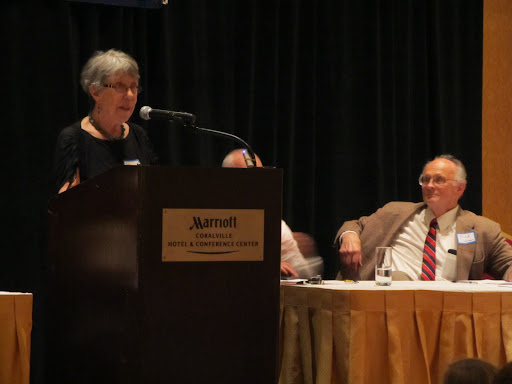
A week ago today [May 5], Mary Vasey and I were among those inducted into the Johnson County [Iowa] Democrats "Hall of Fame." Although well attended, it would have been better had more of those young people been present. Nonetheless, I used the occasion to tell a part of the story of my own political involvement, involving a chance opportunity to visit with President Harry Truman at the White House, and why all of us should do what we can to encourage today's young people as he did on that occasion in 1952.

Here is a transcript of those remarks:

From Precinct to President
Nicholas Johnson
On the Occasion of Being Inducted Into the Johnson County (Iowa) Democrats Hall of Fame
Marriott Hotel, Coralville, Iowa
May 5, 2012

My thanks to whoever it is who thought us worthy of this honor, and to Brian Flaherty – one of Iowa law school’s finest – for that introduction.

Mary has acknowledged those of our children who are able to be here [Julie; Greg, with Makur; Joel, Jason and Karl]. I want to mention the grandchildren who are present: granddaughter Laura, who speaks Spanish fluently and helps Spanish-speaking people get access to services in Des Moines; her daughter, and our great granddaughter, Nia, who is headed toward a career in science; Jason’s son and our grandson, Alec, a graduate of West High, who is a member of the Iowa City treasure that goes by the name of the Combined Efforts Theater; and Shinji Uozumi, our friend and a distinguished visiting scholar from Japan, whom we consider a member of our family whenever he and his family are here in Iowa City. [It was Shinji who prepared the professional video of our presentations, and the still pictures, one of which is embedded in this blog entry.]

Because I do not have a reputation as a man of very few words, with so many articulate people here this evening I thought I should limit myself to but one relatively short story -– at least short by my standards.

We had an organization called Hi-Y when I was attending University High School, U. High. Hi-Y was a high school organization within the national YMCA. How I came to be the national president of Hi-Y is a story for another day -- indeed, a day, you will be relieved to know, that need not ever come.

The point of this evening’s story is that, as national Hi-Y president, I was invited to attend an event in Washington, D.C., called the “YMCA Youth in Government Assembly.”

One of the featured events of our Assembly was a visit to the White House to meet President Harry Truman, where he addressed us in the Rose Garden.

Although I knew his remarks had a great impact on me, years later I couldn’t recall exactly what he said and did not have a copy. I didn’t even know if a copy existed anywhere. Nor could I recall the exact date, necessary to track it down if it did exist.

Then, 17 years ago, going through some old files, I came upon a brochure from that Washington Assembly, and was eventually able to find Truman’s remarks among his presidential papers.

I won’t read the entire talk to you. These brief excerpts will make my point.

He said, quote,

“Now this one person before you here has been from precinct to President all along the line. I have been in elective public office for 30 years. . . . I am going to continue to serve the country, understand, but I will do it in a little freer way than I do now.

“Learning about government is absolutely essential to people your age,” he continued, “because it is going to be your responsibility now, in a few years – you will be responsible for the operation of the Government,” unquote.
(President Harry S. Truman, "Remarks to the Members of the National YMCA and Government Assembly," June 26, 1952, Harry S. Truman Library & Museum.)

We refer to the “take-away” from a speech, or a meeting; what you think is most important; what you recall days or even years later.

And what I heard from President Truman, my take away from that afternoon at the White House, was (1) the fact that he had started with precinct work, and thought it worth mentioning, (2) the importance of learning about government, and (3) that high school students my age would someday be responsible for the operation of the government.

It was his reference to precinct work that encouraged me to become a precinct captain in my college town.

It was his insistence on studying government that prompted me to become a political science major, and later a law student.

And when he said that, quote, "in a few years you will be responsible for the operation of the Government," well, I guess I must have decided right then that I was going to set out to prove him right.

Ultimately, in the 1980s, I came back home to Iowa City, where I was born, the family home in which I lived during the 1940s, and which I now occupy once again, with Mary.

I had by then visited with two presidents in the Oval Office, a fourth in the Rose Garden, and held three presidential appointments during the administrations of all four of them, with the exception of the President, Harry Truman, who started me on this path.

And for much of the 1980s and beyond I served as co-chair for what was then Precinct One in Iowa City, going door-to-door to get out the vote.

I have been flattered to have been asked to run for the U.S. Senate and Congress from Iowa, and the local School Board -– two of which I actually did undertake -– and even asked to be the presidential candidate for a third party, which you will be relieved to hear I did not do.

But in many ways I am most proud, and rewarded, by the work I’ve done in the precincts, in candidates’ campaign headquarters, and in a variety of roles within the Johnson County Democrats organization. Why? Because, ultimately, that is the work that makes our democracy possible, and the foundation upon which it builds in each of America’s 3100-plus counties.

I hope you will find two take-aways from these remarks.

(1) The importance and dignity of precinct work in the lives of each of us -- as well as in the life of a great Democrat, President Harry Truman.

(2) The role that each of us can play, and must play, in encouraging our young people to participate in the nuts and bolts of democracy, in campaigns and at the precinct level – as President Truman did for me, and I try to do for those in the generations which will follow us.

Thank you again for this honor, and the honor of knowing and working with you through the years.
_______________

Other Johnson County Democrats' Hall of Fame
Inductees Honored May 5, 2012

J. Patrick White, former Johnson County Attorney
Jeanette Carter, long-time, all-purpose, hard-working precinct and Party activist
Mary Larew, multifaceted participant in numerous local organizations
# # #

Saturday, December 19, 2009

Best Show in Town

December 19, 2009, 8:30 a.m.

Tonight's the Last Night
(brought to you by FromDC2Iowa.blogspot.com*)

Iowa City's recognized as a "City of Literature."

It's also a "City of Theater," companies and venues -- City Circle, Community Theater, Dreamwell, Englert, Hancher, Riverside, University Theater, and our three high schools, City, Tate and West.

In many ways one of the most innovative and interesting is "Combined Efforts Community Theater."

The theater a creative idea of Janet Schlapkohl that lives up to its name. She's the gifted playwright and director. The actors and support staff are volunteers from throughout the community, with and without special needs, of all ages, from a range of grade and high schools (including recent graduates) -- using City High's Little Theater, generously provided as a venue.

Their winter performance is an adaptation of the Scrooge story: "A Carol for Our Time," with Alec Grubbe, left, as Scrooge.

In addition to the quality of the show, and the moving way in which those with and without special needs support each other, at $5.00 it's Iowa City's best entertainment bargain this evening.

Understandably, it's enjoyed sell-out crowds Thursday and Friday nights (December 17 and 18), and will undoubtedly be a sell-out tonight as well. It starts at 7:30 p.m. Tickets at the door. So if you plan on going it's best to get there by 7:00. Better still, call 319-321-7926, and leave a voice message if necessary, to reserve tickets ahead of time.

Here's co-director Mary Vasey's letter to the editor describing the project and its latest show. Mary Vasey, "Theater Can be Model for Other Groups," Iowa City Press-Citizen, December 15, 2009.

Theater can be model for other groups

Let me introduce you to one more of our theatrical treasures: Combined Efforts Community Drama.

Its members are children, youth and adults with and without special needs. It was started five years ago at City High by Janet Schlapkohl and a small group of students and parents. Since then, it has grown to include, in addition to students, many community members. This year the group added summer stock and produced an original play with music called "Zombie Hotel."

On Thursday, Friday and Saturday, the presentation at the City High Little Theatre is an adaptation of Dickens' "A Christmas Carol" titled "A Carol for Our Time." The cast of 40 actors, singers and dancers present scenes from the original plus a glimpse of a possible future that we, like Scrooge, can change for the better.

This is a unique group. I learned about it last summer and became involved almost immediately. I have worked with drama in alternative schools for years so I appreciate what it can do to foster everyone's self confidence, cooperation and mutual respect.

The degree to which the members of the Combined Efforts Community Drama troupe show respect for one another is awe inspiring. These young people are willing to make time to share their talents in spite of the fact that many have incredibly busy schedules. The result is a quality performance that features and challenges every participant in addition to thoroughly entertaining the audience.

Because it involves actors and crew with and without special needs it can be a model for other groups who see value in diversity and just plain good theater.
There are a number of reasons why Iowa City is often ranked as one of the best American cities for quality of life. "Combined Efforts Community Theater" is yet one more very powerful example.

[Full disclosure: Although I have no personal connection with this project, co-director Mary Vasey is my wife; the acting coach is our professional actor/director son, Jason; Scrooge was played by his son, Alec; and the project photographer, Andi, is known in our ever growing "bigger and stranger family" as my "sister-in-law for life." I'm proud of them all.]
_______________
* Why do I put this blog ID at the top of the entry, when you know full well what blog you're reading? Because there are a number of Internet sites that, for whatever reason, simply take the blog entries of others and reproduce them as their own without crediting the source. I don't mind the flattering attention, but would appreciate acknowledgment as the source, even if I have to embed it myself. -- Nicholas Johnson
# # #

Sunday, November 23, 2008

Satisfactions of Lively Learning

November 23, 2008, 9:15 a.m.

In Praise of Alternative Education

I learned something of "alternative education" while serving as a school board member and K-12 education newspaper columnist for three years -- but mostly as the husband of someone who has played a national role, helped create and taught at one for 25 years in Cedar Rapids, and then helped plan one for Iowa City ("Tate") where she continues to volunteer after having retired from the Cedar Rapids' payroll.

This morning's Gazette contains an op ed column of hers that you, too, may find both moving and informative regarding alternative education. I've reproduced it, below.

"Alternative education" has no universally agreed upon definition. Here's are some excerpts from a column I wrote in 2001 regarding why we needed an alternative high school in Iowa City (since provided) that give a sense of my own definition:

“Alternative,” or “non-traditional,” just tells us what the school is not.

And since “traditional” also evades precision it doesn’t even tell us that. . . .

In one sense, every high school student is a unique blend of experiences, abilities, interests, needs, goals and ways of learning – an “alternative.” . . . .

[W]ith 1500 students in each of our high schools . . . most students survive four years in traditional high schools. Many thrive. They work at their studies and aspire to college. They demonstrate ability in organized athletic, music or other activities; they have supportive homes and friendships. They are the examples we cite as evidence of the quality of our schools.

Unfortunately, there are others who not only don’t thrive, they don’t even survive.

They drop out, either literally or figuratively. Some are among our brightest and most talented. Others are not.

Some are the children of upper socioeconomic parents. Others have no parents, or abusive parents. Some are parents. Some may be the target of school bullies, or simply shunned as loners.

They may never have read Paul Goodman’s Growing Up Absurd or Jonathan Kozol’s Death at an Early Age, but they could tell you the equivalent.

Look past the green spiked hair and pierced body parts. Listen to what these kids have to say. . . .

We sometimes confuse learning with deportment. But among our most creative and intellectually accomplished students are at least some of those who are not in their seats -- self-motivated learners bored with the lesson, those who ask embarrassing questions and organize student protests of irrational rules, the disruptive clowns who enliven the day. . . .

There is a subset of education’s many “alternatives” that is a sensitive, and successful, response to the opportunity these kids offer. These alternative high schools are what “alternative” means to me.

Cedar Rapids’ Metro High School is one. It’s been recognized twice by the President, and is visited by educators from as far away as Singapore and Latvia. . . .

Alternative schools have their own diplomas, their own buildings -- but they needn’t be elaborate. Metro started in an abandoned fire house.

Schools that are more manageable [mean that] with fewer students each can have . . . home visits by teachers – for students with homes. Each student is known by name and feels valued. There are fewer rigid rules about dress and hair style; fewer absences; and virtually no violence. Students want to be there. . . .

We [in Iowa City] lose track of our dropouts. Metros’ teachers [in Cedar Rapids] scour the malls, parks and bridges looking for theirs. . . .
Nicholas Johnson, "We Need Alternative High School," April 10, 2001, p. A9; and see Nicholas Johnson, "Learn From Alternative Schools," Iowa City Press-Citizen, May 22, 2001, p. A9 ("Alternative schools’ lower enrollments are central to their success. The buildings are more manageable for students and teachers. The Carnegie Task Force, Coalition of Essential Schools, National Association of Secondary School Principals, and former Secretary of Education Richard Riley agree. Most recommend high schools under 600.").

Coincidentally, after I wrote this I discovered in the Des Moines Register this morning an entire section largely devoted to how one country -- Finland -- has applied many of the qualities I associate with "alternative education" throughout its entire K-12 system -- something I was advocating for the U.S. in the 2001 column, "Learn From Alternative Schools," linked above. See, Linda Lantor Fandel, "An academic star: Finland's focus on education translates into top achievement," Des Moines Register, November 23, 2008, p. OP1 -- with links to the 15 or more additional stories on the subject in the special section. The section provides considerable insight into why our miserable comparisons with the educational results in other industrialized nations bears some relationship to our failure to apply the lessons from our alternative schools.

Mary succeeds in putting a human face on these comments about "alternative education," with her exploration of the brains and hearts that can make "no child left behind" a reality, rather than just a fight over text scores:

Why Involve At-Risk Students With Theater?

Mary Vasey

The Gazette, November 23, 2008, p. A10

Why do it? Why theater with so-called at-risk students?

Here, with fictional names, but real-life events, is a composite answer drawn from one teacher’s 25 years of experience.

Imagine you are working with alternative school students. You are putting together a play, a performance. There is no stage or auditorium in their building, so you arrange to have the performance in a local professional venue.

You take the bright, the tough, the sad, the turned off, the uncontrollably creative and find they are really interested in being in a play.

You find parts for 15 actors and you suffer through weeks of frustration. The drama in their lives sometimes gets in the way of the drama on the stage.

They complain about having to memorize so much and find fault with the script. Pete, the male lead, is sent to a detention center and you have to negotiate with the probation officer to let him stay after school to rehearse.

Jen and Al fall in love, then break up. They refuse to occupy the stage at the same time. The problem is that they are playing a loving brother and sister. Cindy calls Jen a “ho” and they come close to fighting.

The space for construction and painting of the set is shared with the bicycle shop so you have to move large flats out of the way every other day. The new lighting board hasn’t arrived, and it looks like the old one will have to do.

Two weeks before the play opens, they all have their lines memorized and the blocking down. It is beginning to look like a real production. One week later, they are stumbling over their lines and turning their backs on the audience.

Jen and Al fall in love again. Pete gets out of detention.

You bring wigs and costumes to rehearsal. They go crazy.

The boys dress up in girls clothing and wigs. They ask if they can take their bows in drag.

The stage is available the day before the performance.

You order pizza and hope they will all show up. They all do. The dress rehearsal is a disaster. Pete forgets two full pages of dialogue and they all freeze and just stare at one another.

The flats have just been painted and Al backs into one. Somebody eats the stale potato chips from the prop table, thereby ruining Jen’s potato chip scene.

The people who run the theater look worried. You vow never to do this again.

After the dress rehearsal, you hear the students planning to get together. You pray no one gets drunk, takes drugs or gets arrested.

You are sure someone will.

Instead, they gather at Jen’s house and practice.

The night of the performance they all show up. They look clear-eyed. They look excited. They look like kids.

Pete remembers his lines and delivers them as if they are second nature. The chips are crisp and available. The old lighting board works and the paint on the flats is dry and bright. It is better than anything you might have imagined.

The boys take their bows in drag and all the actors bask in the approval and attention of the audience. They laugh and hug and smell the roses somebody got them. The tough, the used, the abused, the worldly, the sad are transformed.

They are kids, teenagers.

They are silly, giggly and happy.

It is beautiful. They are beautiful.

They know how it feels to be young, innocent and proud and they deserve that feeling.

Years later, when you run into the actors, they tell you that their play was the highlight of their high school experience. They wonder if you can get a copy of the video for them.

And that is why we do it.
_______________
Mary Vasey of Iowa City was a teacher of language arts and theater and has been active locally and nationally in alternative education for more than 30 years, including 25-plus years at the Cedar Rapids School District’s award-winning alternative high school, Metro. She volunteers with the theater program at Tate High School in Iowa City.

# # #