Showing posts with label Johnson County. Show all posts

Monday, May 17, 2021

Freedom Has Responsibilities

We Are Responsible for Saving Democracy
Nicholas Johnson
The Gazette, May 17, 2021, p. 5A

Fans of the Seinfeld TV show may remember when Jerry discovered the rental car company had no cars.

Clerk: “Unfortunately, we ran out of cars.”

Jerry: “But the reservation keeps the car here. That’s why you have reservations.”

“I know why we have reservations.”

“I don’t think you do. If you did, I’d have a car. See, you know how to take the reservation. You just don’t know how to hold the reservation. And that’s really the most important part of the reservation.”

Freedom is like rental car reservations. It comes with responsibilities -- sometimes the most important part of the freedom.

As in, “Your freedom to swing your fist stops where my nose begins.”

Visiting my uncle’s farm for the first time as a young boy, I followed him out of the cow pasture but failed to close the gate. He kindly explained, “When the cattle get out they’re hard to catch.” That made sense to me. My freedom to wander the farm required my responsibility to close the gates.

Jim Jefferies, an Australian stand-up comedian, compares Americans’ and Australians’ response to mass shootings. As he tells it, during a 10-year stretch there were 10 mass shootings. The next year, 1996, was the worst one. Since then there have been none. Why? The government announced, “That’s it. No more guns.” To which, Jeffrey says, Australians responded, “Yeah, well, all right then, that seems fair enough.” An exaggeration? Of course. It’s not easy to get a laugh out of mass murder.

But it makes a point. Like my closing gates, because restricting guns made sense to Australians they were willing to accept it.

The people in many countries responded that way to their leadership’s COVID global pandemic mandates.

Their leaders said, in effect, “There’s a global pandemic; already one or two cases here. If we do nothing thousands will die. You will all be tested. Those positive will be isolated. Those they have contacted will be quarantined. Everyone will wear masks and keep their distance.”

And their people responded, like the Australians, “Yeah, well, all right then, that seems fair enough.” Thousands of lives were saved.

In America, our leaders did not take that path, in part because many of our people rejected it. “You’re taking away my freedoms,” they cried. “What freedoms?” we asked. “My freedoms to refuse to be vaccinated, to not wear a mask, to go wherever I want while spreading a life-threatening disease.”

The results? With 4 percent of the world’s population our “freedoms” produced 18 percent of the world’s COVID deaths. Nearly 600,000 Americans died needlessly for others’ “freedoms.”

Similarly, if we are to retain our representative democracy we must accept our responsibility to strengthen the institutions and follow the norms that make it possible. [Photo credit: Johnson County Democrats Facebook page, https://www.facebook.com/jcdemsiowa/. A few of the 300+ folks at the Nominating Convention (Democratic candidate for County Supervisor), May 11, 2021, Johnson County, Iowa, Fairgrounds.]

As many countries have discovered, the “freedoms” to storm the Capitol, make it harder to vote, gerrymander districts, promote the big lie and the oligarchy’s wealth while ignoring public needs, are road signs on the path to authoritarian dictatorships. [Photo credit: Mary Vasey.]
__________
Nicholas Johnson, Iowa City, is the author of Columns of Democracy. Contact: mailbox@nicholasjohnson.org
# # #

Sources

Jerry Seinfeld’s car reservation. https://subslikescript.com/series/Seinfeld-98904/season-3/episode-11-The_Alternate_Side SEINFELD (1989–1998): SEASON 3, EPISODE 11 - THE ALTERNATE SIDE - FULL TRANSCRIPT

Jim Jefferies on guns. YouTube video, https://www.youtube.com/watch?v=0rR9IaXH1M0 (first 00:01:07)

Countries with effective response. https://www.abc.net.au/news/2021-01-30/seven-countries-with-better-coronavirus-response-than-australia/13102988 (see New Zealand, Vietnam, Iceland)

https://www.bbc.com/news/uk-56455030 (South Korea)

https://www.nature.com/articles/d41586-020-01248-1 (current research on containment measures effectiveness; Hong Kong; Germany and Austria); see also https://www.nature.com/articles/s41562-020-01009-0 (research)

US 4% population, 18% deaths (May 11, 2021). https://www.worldometers.info/coronavirus/country/us/; https://www.worldometers.info/coronavirus/ US COVID deaths May 11, 2021: 596,181, World deaths 3,320,104 = 18% (17.956%)
Google search:
US population: 328,000,000 (US Census Bureau, Eurostat, World Bank) World population: 7,674,000,000 (World Bank) = 4% (4.274%)

# # #

Saturday, July 11, 2020

Biggest Thrill in Johnson County


What's "the Biggest Thrill of All" in Johnson County?

According to Merle Haggard ("Okie From Muskogee") Muskogee is:

A place where even squares can have a ball.
We still wave Old Glory down at the courthouse,
And white lightning's still the biggest thrill of all.
In Muskogee, Oklahoma, USA.
[I'm Proud to be an] "Okie From Muskogee"

To which, of course, the west coast hippies felt they had to responded with:

We don't throw our beer cans on the highway
We don't slight a man because he's black
We don't spill our oil out in the ocean
'Cause we love birds and fish too much for that

And I'm proud to be a hippie from Olema
Where we're friendly to the squares and all the straights
We still take in strangers if they're Haggard
In Olema, California, Planet Earth
"Hippie from Olema"

I've always found just being in the Olema area kind of thrilling. Apparently the hippie lyricists either assumed that was so obvious to everyone it didn't require mention, or whatever thrilled Okies probably would be more disruptive than supportive of Olema's aura of peace, love and bliss.

All of which brings us back to The People's Republic of Johnson County, and what might I be thinking is its "greatest thrill of all."

Want to guess?

Give up?

Why it's the outflow from the Coralville Reservoir after heavy rains. Take it from an old, retired former U.S. Maritime Administrator, this is our landlocked equivalent of taking a ship through the North Atlantic in the wintertime, as pictured.

Exhibit #1, which I'm about to show you, is a video taken yesterday, July 10. Why is the date relevant? Because if you're the kind of Johnson County citizen who recognizes her or his responsibility for knowing how much water the Iowa River is bringing through Iowa City, and how fast it is coming, you check the United States Geological Survey report each morning to find out. You know that number can change daily, even hourly within a day.

And what was the number yesterday? 9,000. Nine thousand what you ask? It's 9,000 cubic feet a second, I reply. And just how much is that, you persist?

As you can imagine, it is difficult to keep and measure water that is cube-shaped. But that's why, as with COVID-19, we must rely on the scientists at the USGS for our answer. And if you would ask one of them they would be happy to tell you that if you had their powers to make a one-foot by one-foot by one-foot cube of water you would discover, when you measured it, that you had 7.49 gallons of water.

Thus, if you had the patience to create 9,000 cubic feet of water you would have (quickly multiplying 7.49 by 9,000) 67,410 gallons. And how much is that, you ask? Well, if you and those living with you use about 100 gallons a day (check your water bill, it's probably around that much each month) that would be 36,500 gallons a year.

In other words, every second yesterday the amount of water flowing out of the Coralville Reservoir into the Iowa River was almost twice the amount of water you use in a year.


Here is a video of what that looked like yesterday afternoon for 38 seconds chosen at random. So how many gallons was that. Right!!! See, I told you it wasn't complicated. It was 2,561,580 gallons. That's what you got, didn't you? Isn't this fun? Doesn't it remind you of your cruise in the North Atlantic last winter? Isn't it exciting? Don't you have to agree it really is Johnson County's "greatest thrill of all"?

# # #

Monday, August 12, 2013

Attorney General Holder's Lessons for Johnson County

August 12, 2013, 8:10 a.m.

“[T]too many Americans go to too many prisons for far too long and for no good law enforcement reason . . .. [W]idespread incarceration at the federal, state and local levels . . . imposes a significant economic burden — totaling $80 billion in 2010 alone — and it comes with human and moral costs that are impossible to calculate.”

-- U.S. Attorney General Eric H. Holder Jr., American Bar Association annual meeting, San Francisco, August 12, 2013; Charlie Savage, "Justice Dept. Seeks to Curtail Stiff Drug Sentences," New York Times, August 12, 2013, p. A1.

Since 1980 the U.S. population has increased by 33%; the prison population by 800%. With 5% of the world's population we have 25% of the world's incarcerated prisoners. Half of those in federal prisons are there for drug offenses. [Photo credit: ReformingArts.org.]

Holder recognizes that building more prison cells makes no sense -- economically, criminalogically, or morally.

As the Johnson County, Iowa, Board of Supervisors, reconsiders the strategy -- and hopefully substance -- of its approach to its criminal system (building more jail cells in a "Justice Center"), it could do worse than follow the lead of Attorney General Eric Holder.

Especially is this so, given Charlie Savage's report in this morning's Times (linked above) that Holder's "liberal" reforms have been supported by the likes of Republicans Jeb Bush, Edwin R. Meese III, and Newt Gingrich, in their "conservative case for reform." They've been adopted in Arkansas and Texas, with resulting savings of "hundreds of millions of dollars." Last year alone Texas cut its prison population by 5,000; Arkansas by 1,400; Kentucky is on track to move out 3,000 inmates. "[S]tate-level reductions have led to three consecutive years of decline in America’s overall prison population – including, in 2012, the largest drop ever experienced in a single year," Holder said. "From Georgia, North Carolina, and Ohio, to Pennsylvania, Hawaii, and far beyond – reinvestment and serious reform are improving public safety and saving precious resources. Let me be clear: these measures have not compromised public safety. In fact, many states have seen drops in recidivism rates at the same time their prison populations were declining."

Of course, all agree they are only talking about inmates who pose no threat of violence to others. Drug users who are non-violent, and not members of gangs or dealing cartels.

Savage cites two examples of reforms from Holder's speech: "increase the use of drug-treatment programs as alternatives to incarceration, and expand a program of 'compassionate release' for 'elderly inmates who did not commit violent crimes and have served significant portions of their sentences.'” There are many more. When the full text of Holder's speech is available, a link will be provided from this blog essay. Here it is: "Attorney General Eric Holder Delivers Remarks at the Annual Meeting of the American Bar Association's House of Delegates,"San Francisco, Monday, August 12, 2013. [Photo credit: multiple sources.]


[Video credit: Produced by AFP (L'Agence France-Presse, Paris), powered by Newslook, provided by Des Moines Register.]

Essentially, Holder and the conservatives are focusing on the factors that have caused our excessive incarceration rates, with their adverse economic and other consequences. It's not rocket science. We can reconsider, and reduce, the number of non-violent human behaviors now legislated as "crimes;" have more lax law enforcement of such laws still on the books, focusing law enforcement efforts on the most serious and violent crimes; prosecute fewer of those arrested; speed the process for those booked and awaiting court proceedings; punish with alternatives to incarceration, such as drug and mental health courts, monitoring with ankle bracelets, community service; shorten the terms of those who are imprisoned; and "compassionate release" of the harmless elderly.

During a time of partisan bickering over seemingly everything, these reforms are something Democrats and Republicans, red states and blue states, conservatives and liberals, Libertarians and Greens, can all agree on.

I'd like to see Johnson County -- and Iowa -- be even more progressive and innovative with its penal policies. But at a minimum, can't we at least aspire to be the equal of Texas and the "conservative case for reform"?

So has Holder outlined a recipe for Johnson County, the details along our path to the rational reforms that will reduce our jail population? Of course not. As the nation's Attorney General he needs to have a little broader focus -- although many of his proposals are directly and specifically applicable to us.

What Holder definitely can teach us is a much more universally applicable lesson. It is his willingness to "take it from the top," to put "everything on the table" and explore best practices (whether from other states, or nations), to use "the literature" and experience of others, to apply the analytical intellectual ability and willingness to see that our "prison problem" is not that we have too few cells but that we unnecessarily have too many prisoners, to say with one of his predecessors "Some see things as they are and ask 'why'? I dream of things that never were and ask 'why not'?" The fact that he can't pass laws, he has to get Congress to do that, was treated not as an impenetrable barrier, a reason to always say "No" to innovation, but rather as just a challenge, a reason to search for alternative ways up the mountain. As the SeaBees' motto had it during World War II, "The difficult we'll do right now, the impossible will take a little longer."

Like the U.S. Attorney General, our Johnson County Supervisors, County Attorney, and Sheriff don't have infinite flexibility to change things either. Some County reforms will require action by Congress or the Iowa Legislature. Some will require consensus building among the City Councils and police departments within Johnson County, as well as the University of Iowa.

But we can model our approach on his.

Thankfully, an early effort of the Supervisors and County Attorney to produce such a document already exists. "Jail Alternatives: Prevention, Diversion, Expediting, and Recidivism Reduction Efforts," April 2013. It deserves further research, imagination, organization, and presentation -- exploring best practices from countries with both less crime and less incarceration than the U.S., as well as other American states and counties. A document focused solely on what's being done, and will be done, to reduce the jail population, a document stripped of defensive language or arguments addressed to a specific structure and its location (which could be laid out in other documents if the proponents think it advantageous to do so). For those reforms beyond the power of the Supervisors to impose unilaterally, they should pledge to make specific and measurable efforts to do what's necessary to bring them about by working with others.

Such a document will have to be, as well as appear to be, a sincere, genuine effort to reduce the number of incarcerated individuals in Johnson County to the bare, essential minimum. Convince the voters that the Supervisors have done absolutely everything in their power to minimize the jail population, and that they are pledged to work with others to do more, and such a document would not only be a monumental contribution to the creation of the best criminal justice system of which we are capable, it might also be just enough to tip the next vote to the necessary 60% approval by the voters.

# # #

Friday, March 08, 2013

Johnson County Can Lead Incarceration Reform

March 8, 2013, 8:00 a.m.
"If not now, when? If not us, who?"
-- Rabbi Hillel
“We’re using prisons and coercion as a way of substituting for the failures of other institutions in our society — the schools, the fact that we’ve got large concentrations of minorities in the center of the city, and the fact that we’re waging a war or drugs that is really a reflection of deep problems in the society . . .."

-- Professor Glenn Loury, National Academy of Sciences Committee on Causes and Consequences of High Rates of Incarceration
LINKS TO SECTIONS
Introduction

Failure of U.S. Penal Policy

Our Opportunity

The Human Costs

The Financial Costs

The Opportunity Costs

Social Costs and Racial Bias

Causes: Unnecessarily Long Prison Terms

Causes: War on Drugs

Follow the Money: The Prison Industrial Complex

Reform Proposals

Johnson County's Challenge


INTRODUCTION

Johnson County, Iowa, residents have both the opportunity and the necessity to take the lead in reforming U.S. jail and prison policy and practice. [Photo credit: multiple sources.]

We have the opportunity because the county wants a $40 million-plus "Justice Center" -- for which read, among other things, more jail cells. (Rejected by the voters once, it will be coming back for another vote.) We have the necessity because what America, and Johnson County, are now doing isn't working. Like our approach to health care, we are spending more and getting less than almost any other country on earth.

FAILURE OF U.S. PENAL POLICY

As the quote from Professor Loury, above, points out, we are using jails and prisons to serve a variety of purposes and house a variety of people -- to protect the public from those with a propensity to violence that threatens others and themselves; to house those whose primary "crime" is unemployment, homelessness, illiteracy, alcohol and drug addiction, or mental illness; to punish those whose crimes do not involve violence in the past and are likely to do so in the future; those who just need to sober up overnight; and those awaiting trial.

Admittedly, the policy issues and challenges involving federal prisons differ in some respects from those involving city and county jails. But what all have in common is use of the one-size-fits-all option of incarceration, building more prisons and jail cells, spending more than we need to spend, in return for less than we -- and those locked up -- need and deserve. Creative, alternative approaches anywhere within this system can help encourage better practices elsewhere.

The statistics are stark.

America leads the world in the percentage of its citizens who are incarcerated -- 743 or more per 100,000. This is a rate six times that of our otherwise comparable neighbor to the north (Canada, at 117 per 100,000, is 123rd in the world), and Communist China, at 120 per 100,000. (Japan -- which also has a zero tolerance policy toward illegal drugs -- is 59 per 100,000.) The rates are even higher in some states; Louisiana imprisons something between 800 and 1500 per 100,000. (
Others put Louisiana's numbers at 1,619 per 100,000. Maine, by contrast, is closer to 150 -- one-tenth that of Louisiana.)

That's right. "We're Number One! We're Number One!" But it's nothing to brag about. Are Americans really six times more criminal than people living in comparable countries or China -- let alone those subject to some of the world's most repressive dictators? What explanations are there for these gross disparities?

Whatever the reasons, the response needs to be a variation of the bumper sticker, "Whatever is the question, war is not the answer." "Whatever is the question, additional prisons are not the answer." We've tried that. We're already "Number One!"

OUR OPPORTUNITY

Johnson County citizens and public officials now have the opportunity to set a new path, an example for the nation -- a major new direction in our approach to the populations we're now housing in jails and prisons all across this country.

Make no mistake, I sure give Johnson County Sheriff Lonny Pulkrabek credit for trying to promote the alternatives.
Nicholas Johnson, "Shooting Our Messengers," Iowa City Press-Citizen, March 3, 2006 ("we're lucky Pulkrabek has the smarts and political courage he does. His increased use of electronic monitoring saved the county 882 jail days. Mental health and substance diversion programs also help."). But he can't do it alone.

Some county, some time, has to draw a line in the sand and say, "Enough. No more jail cells." Will it be tough? You bet. But as the opening quote from Rabbi Hillel put it, "If not now, when? If not us, who?" So long as there is always the option of just building more jail cells and prisons there's a radically reduced incentive, let alone pressure, to innovate and improve how we handle those now living there.

THE HUMAN COSTS

The human costs of our misallocation of priorities and resources is our greatest loss. The mentally ill, alcoholics and drug addicts who need and would benefit from treatment, do not receive it and are housed in prisons. The first offenders who once had a chance at rehabilitation, now come out as hardened criminals. The non-violent offenders who could be making a contribution to society are spending decades locked up. Prisons are the rug under which we sweep these folks, as well as many who are homeless, unemployed, or illiterate.

THE FINANCIAL COSTS

Those are the greatest costs. But the financial impact of this, our largest public housing program, is far from chump change. At well over $60 billion a year, it approaches the size of the recently feared "sequester." Indeed, at our present costs of roughly $25,000-to-$50,000 per inmate per year [
"The cost of a nation of incarceration," CBS Sunday Morning, April 22, 2012], we could be putting these two-million-plus inmates through college for what we're spending to keep them locked up. (There are a near quarter-million in federal prisons, near-million in state prisons, and million-plus in county and local jails -- for a 2.3 million total, which, with our 5% of the world's population is 25% of the world's inmates. If you count those on probation or parole the numbers are three times that.) In fact, given our trends to longer sentences, if these inmates could finish college in four or five years we'd save billions by sending them to school rather than to prison. And we could use the $5 billion or more we spend building new prisons on schools. (In Costa Rica I visited a former prison that had been converted into a children's museum.) And see "The Price of Prisons; What Incarceration Costs Taxpayers," Public Safety Performance Project, The Pew Charitable Trusts' State and Consumer Initiatives, March 20, 2012 (with a link to the full report of the additional costs of the jail and prison system that are often not reported).

THE OPPORTUNITY COSTS

Then there's what we call "opportunity cost" (one expenditure may eliminate the opportunity to do something else with the money). You can build schools, or you can build prisons, but you can't build both. We seem to be living that truth here in Johnson County, with a postponed proposal for a $40 million high school and a $40 million defeated "Justice Center" proposal.

Of course, I'm not seriously suggesting we empty the prisons and fill the college dorms with criminals. But expenditures on the two institutions -- education and incarceration -- are not unrelated. The more of that $60 billion we would allocate to educating our youngsters on the front end of life, the less we would need to spend on prisons during the back end of life. (As the bumper sticker has it, "If you think education is expensive, try ignorance.")

SOCIAL COSTS AND RACIAL BIAS

The numbers and percentages vary somewhat, based on source and year, but it is not an exaggeration to say that almost all of those we lock up were convicted of non-violent crimes (roughly 50% of those in state prisons and 91% in federal; individuals probably not likely to be a physical danger to society), or did not graduate from high school, or are suffering from some form of mental illness, or from addiction to alcohol or other drugs, or all of the above.

In short, as Dr. Glenn Loury puts it in the quote that heads this blog entry, "“We’re using prisons and coercion as a way of substituting for the failures of other institutions in our society . . .."

There's another failure in our society that is reflected in the fact that the U.S. "imprisons a larger percentage of its black population than South Africa did at the height of apartheid." Michelle Alexander, The New Jim Crow: Mass Incarceration in the Age of Colorblindness (2010), p. 7. (
"United States Incarceration Rate," n. 17, Wikipedia.org. African Americans are imprisoned at a rate over six times that for whites. (In 2010 this was 4347 per 100,000 of the same race and gender for African Americans, and 678 for white males.) Alexander also notes that "there are more African Americans under correctional control -- in prison or jail, on probation or parole -- than were enslaved in 1850, a decade before the Civil War began." And see, Alfredo Parrish, "Iowa View: State needs to face up to prison disparities,", Des Moines Register, February 9, 2013.

CAUSES: UNNECESSARILY LONG PRISON TERMS

One of the reasons we have such a disproportionate number of our citizens in prison is the length the sentences. The mandatory federal court sentence for a first-time drug offender is five to ten years. In the rest of the industrialized world the sentence would more likely be something like six months. Our "three-strikes-you're out" laws (actually, "three strikes you're in") in many states require a 25 year sentence. The average sentence for burglary in the U.S. is sixteen months; in Canada 5 months, in England 7. "
[From 1990 to 2009] drug offenders served 36 percent longer in 2009 than those released in 1990 . . .. Almost all states increased length of stay over the last two decades . . .. In Florida, for example, where time served rose most rapidly, prison terms grew by 166 percent and cost an extra $1.4 billion in 2009. A companion analysis . . . found that many non-violent offenders in Florida, Maryland and Michigan could have served significantly shorter prison terms with little or no public safety consequences.
"Time Served; The High Cost, Low Return of Longer Prison Terms," Public Safety Performance Project, The Pew Charitable Trusts' State and Consumer Initiatives, June 6, 2012.

CAUSES: WAR ON DRUGS

Our so-called "War on Drugs," which has even less to show for its efforts than our War on Afghanistan, has accelerated imprisonment for drug offenses from 40,000 in 1981 to roughly 500,000 in 2010 -- the cause of about two-thirds of the increase in federal prisons since 1985.

FOLLOW THE MONEY: THE PRISON-INDUSTRIAL COMPLEX

When the Washington Post's
Bob Woodward and Carl Bernstein were investigating the Watergate story, the source they dubbed "Deep Throat" advised them, "Follow the money." It may be good advice on the prison story as well.

Are there individuals who are personally profiting from locking up the mentally ill and addicts, increasing both the numbers in prison and the length of sentences for non-violent offenders? You bet there are: those who contract to reduce their labor costs by using prison labor, construction companies building the prisons, those who sell the furniture, transportation, food, clothes and medical services for prisons. This is sometimes characterized as "the prison-industrial complex," defined by Eric Schlosser as "a set of bureaucratic, political, and economic interests that encourage increased spending on imprisonment, regardless of the actual need." "Prison-industrial_complex," Wikipedia.org.

And let us not forget the prisons-for-profit industry, and the sheriffs who make extra money with payments from the state for housing prisoners -- as in Louisiana. The New Orleans Times-Picayune ran a very thorough and well-researched eight-part series a year ago on the problems within Louisiana's prison operations that make up much of the driving force behind their highest rate of incarceration in the U.S. Louisiana Incarcerated: How we built the world's prison capital; Sheriffs and politicians have financial incentives to keep people locked up, May 13-20, 2012. Here are some excerpts:
"We realized that prisons are like nursing homes. You need occupancy to be high. You have to . . . run it like a business, watch food costs, employee costs," said [Louisiana's LaSalle Corrections' executive] Clay McConnell, 37. . . .

More than half of the state's 40,000 inmates are housed in local prisons run by sheriffs or private companies like LaSalle for the express purpose of making a buck. . . .

Prison operators, who depend on the world's highest incarceration rate to survive, are a hidden driver behind the harsh sentencing laws that put so many people away for long periods. . . .

The state spends $182 million a year to house inmates in local prisons. [R]ural sheriffs and private investors reap the benefits . . ..

Annual profits in good years range from about $200,000 for an average-sized operation to as much as $1 million for parishes with several prisons. . . .

In the past decade, LaSalle and the McConnells have donated about $31,000 to campaigns, including $10,000 to Gov. Bobby Jindal and numerous contributions to north Louisiana state legislators. LCS and its owners have thrown much more cash at politicians -- about $120,000 since 1999.
Cindy Chang, "North Louisiana family is a major force in the state's vast prison industry," The Times-Picayune, May 14, 2012.

The Louisiana legislature addressed the state's high rates of incarceration with some
"bills aimed at tackling some of the key factors driving the increase, including long sentences for nonviolent crimes and large numbers of offenders being sent back to prison for violations of parole or probation. [But they were passed and signed] only after the most important parts -- the ones that would have actually reduced prison sentences -- were removed under pressure from sheriffs and district attorneys. . . . Louisiana sheriffs now house more than half of inmates serving state time -- by far the nation's highest percentage in local prisons. Their financial stake in the prison system means they will lose money if sentences are shortened."
Jan Moller, "Prison sentence reform efforts face tough opposition in the Legislature," The Times-Picayune, May 16, 2012.

REFORM PROPOSALS

It's not like there aren't ideas for reform out there, including many in place. There are. See, e.g.,
Alfredo Parrish, "Iowa View: State needs to face up to prison disparities,", Des Moines Register, February 9, 2013; "Prison Population," The Pew Charitable Trusts' State and Consumer Initiatives; "Causes and Consequences of High Rates of Incarceration," Division of Behavioral and Social Sciences and Education, National Academy of Sciences; "Iowa Prison Population Forecast: FY 2011-2021," Division of Criminal and Juvenile Justice Planning, Iowa Department of Human Rights, November 18, 2011; "Iowa Prison Reform," Iowa Public Television, January 18, 2008 ("We want the legislature to consider several things before they consider expanding capacity, and some of those things are what we’ve been talking about: the community-based corrections; the drug courts; other alternatives to long-term incarceration, mental health treatment, mental health counseling, and focus on that; as well as education."); and this morning's Orlan Love, "Remote prison camp again on budget chopping block; Supporters: Closing Luster Heights a disservice to state," The Gazette, March 8, 2013, p. A1.

JOHNSON COUNTY'S CHALLENGE

If our beautiful, historic architectural gem of a courthouse needs some renovation, fine. Do it. I'll help pay for it. But let's not confuse that need with the proposed additional jail cells.

Those who see more jail cells in Johnson County as the only solution point out that we're spending something like $1 million a year housing inmates elsewhere. Assume that's true. But doesn't that mean the $40 million-plus they'd spend today (plus possibly increased staffing costs over the years) would be enough to cover the costs of moving and housing our jail inmates elsewhere for another 40 years? Is there not rational hope and possibility that by then America will have come to its senses and, like Costa Rica, have empty prisons and jails converted to other purposes? How many alternative solutions might be funded with that $40 million?

During World War II, the Navy's Construction Battalions (dubbed "Seabees") expressed the pride they had in their creative approaches to problem solving with the motto, "The difficult we'll do right now; the impossible will take a little longer."

Whether coming up with adequate alternative approaches to additional jail cells is "impossible" or merely "difficult," are we really saying that progressive Iowa City, located in the "creative corridor," "city of literature," home of one of the world's great research universities, inventions and entrepreneurial success stories, has no one who is capable of coming up with creative alternatives to expansion of America's "prison-industrial complex"? I certainly hope that won't be our response.

# # #

Monday, October 15, 2012

Prisons: The Costs and Challenges of Crime

October 15, 2012, 9:10 a.m.

November 8, 2012, 9:00 a.m. -- POST-ELECTION, BOND DEFEAT UPDATE:

The Johnson County Justice Center bond proposal on Tuesday's [Nov. 6] ballot went down to defeat. That is, although a majority (56%) of those voting on it voted "Yes," that was not enough to clear the 60% hurdle required by Iowa law.

So the County Supervisors and allied supporters of the proposal have been meeting to decide what to do next. Lee Hermiston, "Justice Center Group Plans Next Move; Deciding Whether to Go Back to Voters; Critics Vow Same Plan Will Not Pass," Iowa City Press-Citizen, November 8, 2012, p. A1. [And see also, Gregg Hennigan, "Johnson County leaders discuss possibility of another justice center vote; Another vote would have to wait at least six months," The Gazette, November 8, 2012, p. A2; and Cassidy Riley, "Johnson County officials say justice-center battle is not over," The Daily Iowan, November 8, 2012, p. A1.]

As I commented on the online version of Lee Hermiston's story, "Many of the proposed Justice Center's opponents acknowledged that 'something' was needed, and that they'd support it. Many of the supporters had serious concerns. A chance to revisit these issues may prove to be the best outcome for Johnson County. Unlike Washington, compromise is a real possibility."

Some supporters are advocating physically pushing through the proposal in a subsequent vote just as soon as possible. Presumably, this means they would simply raise more money, to repeat their failed talking points with greater volume and quantity.

Frankly, I think this would be a mistake, whether opponents prove to be right or wrong in their prediction that, "This will not pass, I guarantee you" (as Hermiston quoted Sean Curtin). The comments from both supporters and opponents have left a lot of possibilities for compromise on the table. Johnson County citizens have a substantial reservoir of civility and compromise that this exercise in democracy could draw upon -- to everyone's credit.

Supervisor Terrence Neuzil thinks "the proposed center [could] use some changes." He's said, "I’m not interested in putting the same proposal in front of the voters that just voted it down." Hermiston also reports, "[S]upervisor Janelle Rettig said some issues still need to be addressed, such as the racial disparity of those who stay in jail for longer than a week;" and that "[Johnson County Attorney Janet] Lyness . . . suggested that members of the opposition be involved with those [future] discussions" of the committee of supporters.

These folks are setting the right tone and strategy. Otherwise it's going to reek of the City Council's recent effort to cut the public out entirely on a bond vote regarding grants of taxpayers' money, not for a public, traditional governmental project (such as jails), but for a private entrepreneur's profit-making venture.

There is no need here to outsource our design and decision to expensive out-of-town consultants, meaningless surveys, and endless discussions that never reach conclusions -- except an agreement to have yet another discussion. We can work this out.

I would make one more very specific suggestion that seemed to work for the School Board when creating its somewhat contentious governance policies. Come up with one person who is willing to do the writing, someone who either voted "No," but sees the need for some improvement, or someone who voted "Yes," but sees real problems with the failed proposal -- or possibly one of each. Task them with coming up with, first, as complete, factually accurate, and neutral a paper as they can create putting forth every one of the advocates' assertions for, and opponents' assertions against, the current proposal. Second, have he/she/them work -- separately -- with selected groups of supporters and opponents whose job it will be to come up with the best responses they can provide to the others' arguments. Revise the paper accordingly (including both assertions and responses). Third, select representatives of both camps who seem to be the most inclined to rational, analytical, data-driven, civil discourse on these issues to see what kind of a compromise proposal, if any, can be created.

An illustration of a possible contribution to the latter comes from Supervisor Rettig, as reported by Gregg Hennigan in this morning's Gazette: "Supervisor Janelle Rettig said . . . she’d support the county paying more for the project up front to reduce the amount bonded and not fully building out the facility at the start." Gregg Hennigan, "Johnson County leaders discuss possibility of another justice center vote; Another vote would have to wait at least six months," The Gazette, November 8, 2012, p. A2.

Discussion can be constructive; it is also essential. But my experience has taught me that it is multiples more efficient, effective, and speedy if it is focused on a written document at the outset. As the discussion progresses, the document is revised. This produces both a tangible product from the discussion, greater likelihood of agreement, and a record of the the process.

Just a thought. You're welcome.

What follows is the blog entry entered here October 15, 2012:

Humankind has struggled with virtually every aspect of crime and punishment since we came down out of the trees. See, e.g., "Criminology," Wikipedia.org.

The economic and human cost of the "solution" called incarceration have created both a multi-billion-dollar industry and human failures. "With more than 2.3 million people locked up, the U.S. has the highest incarceration rate in the world. One out of 100 American adults is behind bars -- while a stunning one out of 32 is on probation, parole or in prison [NJ: a grossly disproportionate percentage of which are minorities and the poor]. This reliance on mass incarceration has created a thriving prison economy. The states and the federal government spend about $74 billion a year on corrections, and nearly 800,000 people work in the industry." "Billions Behind Bars; Inside America's Prison Industry; CNBC Goes Behind the Razor Wires to Investigate the Profits and Inner-Workings of the Multi-Billion Dollar Corrections Industry," CNBC, October 2012.

Prisons have now become America's most fully occupied, and expensive, public housing program.

Nor have Iowa, and Iowa City, remained outside these challenges. Johnson County's supervisors, and sheriff, are recommending local residents approve a near-$50-million bond burden on top of their current property taxes to provide a substantial expansion to our local contribution to the prison industry and our own public housing.

Here is my own effort, in this morning's [Oct. 15] Press-Citizen, to keep to the requested 500-word limit on my own thoughts about the challenge:
_______________

Voting "Yes, but. . ." for the Justice Center
Iowa City Press-Citizen
October 15, 2012, p. A7
Nicholas Johnson

I’ll be voting for the justice center. Some increase in jail cells and courtrooms seems warranted, notwithstanding dispute about numbers.

But questions, concerns and unused opportunities remain.

• Big picture, big debt. Iowa taxpayers’ debt service obligations are about $2 billion. We’ve just promised $250 million to a foreign corporation: jobs for Iowans, profits for Egyptians. Our local school district is eyeing its $281 million borrowing capacity. Downtown development takes millions in TIFs. The justice center adds $48 million-plus. There’s no central rationalization of priorities on taxpayers’ behalf.

• Regional centers. For 100 years — the 1830s to 1930s — Iowa’s horse-and-buggy 99 county governments made sense. They don’t anymore. Politically, counties can’t be abolished. But mental health services now are transferring from counties to “regions.”

Why not regional jails — the low-cost alternative to 99 jails designed for peak occupancy?

Our $1 million a year sending inmates elsewhere compares favorably with the jail’s share of $48 million. Why not continue it for those serving week, month or longer sentences? Wouldn’t that reduce the cells needed for the football drunks and those awaiting trials?

Why are neighboring counties’ jails not full? Is it possible future policy and funding changes with mental health and dependency populations, social and political attitudes, technological and other innovations will further reduce the need for jail cells? Won’t rationalizing our continued, though reduced, use of others’ jails give us more future flexibility?

What would a peak load analysis suggest as our optimum number of additional cells?

• Criminal consolidation. How about a standalone criminal structure — courtrooms, meeting and class rooms, along with jail cells? It would improve efficiency, consolidation and eliminate courthouse security concerns. Potential, adjacent, full city block locations are available southeast, south, and west.

Our courthouse is one of Iowa’s greatest early, Romanesque structures. More than 110 years old, it deserves, and should continue to be, maintained in its original setting — like Old Capitol. That was the wise choice when moving courthouse offices to the current County Administration Building five blocks away. It’s the wisest, win-win choice now.

Moreover, this would enable limiting a refurbished, more secure courthouse to civil cases.

• Holistic approach. A significant proportion of the criminal population suffers from the mental health and chemical dependency challenges that make them repeat visitors. Jails are neither their answer nor ours. Johnson County has made commendable progress transferring these individuals from jails to specialized courts and programs. But might it not be cheaper, more effective and humane, to budget as well as administer to this population’s total needs with a single program? Can we do even more to reduce the need for jails?

We need some additions to our criminal justice capabilities. That’s why I’m voting “yes.” But that doesn’t mean additional thought, and modification of what’s now on the drawing board, couldn’t serve us even better.
_______________
Nicholas Johnson, Iowa City native and former school board member, teaches at the Iowa College of Law and maintains www.nicholasjohnson.org and FromDC2Iowa.blogspot.org.

# # #

Saturday, May 12, 2012

From Precinct to President

May 12, 2012, 11:40 a.m.

Maintaining Democracy
with the Johnson County Democrats Hall of Fame

As we encourage the creation of the institutions of a "civil society" in other countries, and watch the emergence of democracies during "the Arab spring," it's appropriate to take the pulse of our own political system. ("Civil society is the arena outside of the family, the state, and the market where people associate to advance common interests." "Civil Society," Wikipedia.org.)

It's come a long way -- and not necessarily for the good -- from the days of ward bosses who provided jobs for constituents in exchange for their votes on election day, or the fundraising during Adlai Stevenson's campaigns for president that took the form of $1 contributions during door-to-door solicitations of "Dollars for Democrats."

Voting in Elections. It was early in my life, and interest in politics and government, that the importance of participation in political party activities firmly registered. The number of Americans who don't even vote is discouraging, and possibly dangerous -- sometimes as many as 90 percent or more of registered voters don't vote in city council or school board elections.

Voting in Primaries. What was particularly worthy of reflection was the 19th Century, New York City Tammany Hall political Boss Tweed's saying, "I don't care who does the electing, so long as I do the nominating." (Quoted in Susan Welch, Understanding American Government (2003); "William M. Tweed," Wikiquote.org.)

If not everyone chooses to vote in elections, fewer still vote in primaries -- a process that, for the most part, requires membership in a party. As a result, those who do vote in primaries -- and thereby participate in the selection of the parties' nominees -- have at least a couple orders of magnitude (100 times) the political power and influence of those who only vote in elections.

Working in Primaries and Elections. Finally, those who actually work in campaigns, party headquarters, and their local precincts -- as distinguished from just voting in their party's primary -- increase their political power by another couple of orders of magnitude. That can be increased further by holding office within the local party, from precinct co-chair and central committee member to county chair; to state or national delegate to party conventions; to state or federal office holder.

But to sustain this system we need a constant influx of enthusiastic youngsters too young to vote, but not to work, new voters, and others with the energy needed to fuel our democracy.

One of the ways to bring that about is for the adults who have been there to look for opportunities to tell their story, to make the case why young people will find friends and fun as well as deep satisfaction from "getting involved in politics."

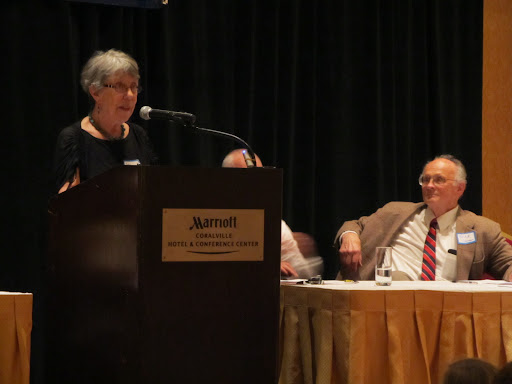
A week ago today [May 5], Mary Vasey and I were among those inducted into the Johnson County [Iowa] Democrats "Hall of Fame." Although well attended, it would have been better had more of those young people been present. Nonetheless, I used the occasion to tell a part of the story of my own political involvement, involving a chance opportunity to visit with President Harry Truman at the White House, and why all of us should do what we can to encourage today's young people as he did on that occasion in 1952.

Here is a transcript of those remarks:

From Precinct to President
Nicholas Johnson
On the Occasion of Being Inducted Into the Johnson County (Iowa) Democrats Hall of Fame
Marriott Hotel, Coralville, Iowa
May 5, 2012

My thanks to whoever it is who thought us worthy of this honor, and to Brian Flaherty – one of Iowa law school’s finest – for that introduction.

Mary has acknowledged those of our children who are able to be here [Julie; Greg, with Makur; Joel, Jason and Karl]. I want to mention the grandchildren who are present: granddaughter Laura, who speaks Spanish fluently and helps Spanish-speaking people get access to services in Des Moines; her daughter, and our great granddaughter, Nia, who is headed toward a career in science; Jason’s son and our grandson, Alec, a graduate of West High, who is a member of the Iowa City treasure that goes by the name of the Combined Efforts Theater; and Shinji Uozumi, our friend and a distinguished visiting scholar from Japan, whom we consider a member of our family whenever he and his family are here in Iowa City. [It was Shinji who prepared the professional video of our presentations, and the still pictures, one of which is embedded in this blog entry.]

Because I do not have a reputation as a man of very few words, with so many articulate people here this evening I thought I should limit myself to but one relatively short story -– at least short by my standards.

We had an organization called Hi-Y when I was attending University High School, U. High. Hi-Y was a high school organization within the national YMCA. How I came to be the national president of Hi-Y is a story for another day -- indeed, a day, you will be relieved to know, that need not ever come.

The point of this evening’s story is that, as national Hi-Y president, I was invited to attend an event in Washington, D.C., called the “YMCA Youth in Government Assembly.”

One of the featured events of our Assembly was a visit to the White House to meet President Harry Truman, where he addressed us in the Rose Garden.

Although I knew his remarks had a great impact on me, years later I couldn’t recall exactly what he said and did not have a copy. I didn’t even know if a copy existed anywhere. Nor could I recall the exact date, necessary to track it down if it did exist.

Then, 17 years ago, going through some old files, I came upon a brochure from that Washington Assembly, and was eventually able to find Truman’s remarks among his presidential papers.

I won’t read the entire talk to you. These brief excerpts will make my point.

He said, quote,

“Now this one person before you here has been from precinct to President all along the line. I have been in elective public office for 30 years. . . . I am going to continue to serve the country, understand, but I will do it in a little freer way than I do now.

“Learning about government is absolutely essential to people your age,” he continued, “because it is going to be your responsibility now, in a few years – you will be responsible for the operation of the Government,” unquote.
(President Harry S. Truman, "Remarks to the Members of the National YMCA and Government Assembly," June 26, 1952, Harry S. Truman Library & Museum.)

We refer to the “take-away” from a speech, or a meeting; what you think is most important; what you recall days or even years later.

And what I heard from President Truman, my take away from that afternoon at the White House, was (1) the fact that he had started with precinct work, and thought it worth mentioning, (2) the importance of learning about government, and (3) that high school students my age would someday be responsible for the operation of the government.

It was his reference to precinct work that encouraged me to become a precinct captain in my college town.

It was his insistence on studying government that prompted me to become a political science major, and later a law student.

And when he said that, quote, "in a few years you will be responsible for the operation of the Government," well, I guess I must have decided right then that I was going to set out to prove him right.

Ultimately, in the 1980s, I came back home to Iowa City, where I was born, the family home in which I lived during the 1940s, and which I now occupy once again, with Mary.

I had by then visited with two presidents in the Oval Office, a fourth in the Rose Garden, and held three presidential appointments during the administrations of all four of them, with the exception of the President, Harry Truman, who started me on this path.

And for much of the 1980s and beyond I served as co-chair for what was then Precinct One in Iowa City, going door-to-door to get out the vote.

I have been flattered to have been asked to run for the U.S. Senate and Congress from Iowa, and the local School Board -– two of which I actually did undertake -– and even asked to be the presidential candidate for a third party, which you will be relieved to hear I did not do.

But in many ways I am most proud, and rewarded, by the work I’ve done in the precincts, in candidates’ campaign headquarters, and in a variety of roles within the Johnson County Democrats organization. Why? Because, ultimately, that is the work that makes our democracy possible, and the foundation upon which it builds in each of America’s 3100-plus counties.

I hope you will find two take-aways from these remarks.

(1) The importance and dignity of precinct work in the lives of each of us -- as well as in the life of a great Democrat, President Harry Truman.

(2) The role that each of us can play, and must play, in encouraging our young people to participate in the nuts and bolts of democracy, in campaigns and at the precinct level – as President Truman did for me, and I try to do for those in the generations which will follow us.

Thank you again for this honor, and the honor of knowing and working with you through the years.
_______________

Other Johnson County Democrats' Hall of Fame
Inductees Honored May 5, 2012

J. Patrick White, former Johnson County Attorney
Jeanette Carter, long-time, all-purpose, hard-working precinct and Party activist
Mary Larew, multifaceted participant in numerous local organizations
# # #