May 8, 2012, 10:40 a.m.
Decency and Obesity
This morning [May 8] brings us more news of a kind of growth America could do without: the "epidemic" of overweight and obesity. This time it was highlighted by a gathering of 1200 experts at the latest Centers for Disease Control and Prevention "Weight of the Nation" conference in Washington yesterday. Melissa Healey, "42% of American adults will be obese by 2030, study says; Though the rate of the last 30 years has slowed, it's far from leveling off, and it's going to get expensive, say experts at the Weight of the Nation conference in Washington," Los Angeles Times, May 8, 2012.
There's more below regarding how those experts define "overweight" and "obesity," how you can find yourself on their continuum, their projections regarding where our scales will tip in 2030, the causes, best strategies for cure, and long-term costs -- in our individual health and sense of well-being, the nation's public health, the costs to business of accommodation, and the multi-hundred-billion-dollar increase in the nation's healthcare costs.
But first . . .
As Joan Rivers used to say, "Can we talk?"
 Because we have an accompanying problem associated with obesity, and that's how we talk about it -- to each other, to ourselves, and especially to those suffering from this condition.
It was illustrated in Iowa City recently with what turns out to be standard practice at a local bar catering to University of Iowa students, both under-age and legal.
Jordan Ramos, a third-year UI undergrad, paid the cover charge to enter the Union Bar the evening of March 3, 2012, and subsequently, and wanted to dance on a platform with the other girls. On both occasions she was forbidden to do so by employees on the grounds that she "was not pretty enough" (from photos, she has a pretty face by my standards) and was pregnant. (Somewhat overweight, she was not pregnant.)
 Rosa Parks, pictured here with Dr. Martin Luther King in 1955, wanted to sit on the Montgomery buses wherever she chose. On December 1 of that year she refused a bus driver's order that she get up and give her seat to a white person. It was a major milestone in what became the civil rights movement, and eventually, with President Lyndon Johnson's leadership, a series of civil rights laws in 1964 and 1965.
Rosa Parks refused to be stereotyped, to know, and stay in, "her place." She wanted to sit, not stand.
Jordan Ramos also did not want to be stereotyped or kept in her place. Just as Rosa Parks didn't want to be forced to stand because of her appearance, Jordan Ramos didn't want to be forced to sit because of her appearance. She wanted to dance, not start a revolution. But she soon came to echo Emma Goldman's feeling that, once a revolution is requesting her membership, "If I can't dance, I don't want to be part of your revolution."
It wasn't quite a revolution, but it has been a series of demonstrations by students of all shapes, sizes and ages, protesting the policies of Union Bar owner George Wittgraf, and their execution by his employees. See, e.g., Emily Schettler, "Student: Bar Discriminates by Weight; Union Owner Says He Hadn't Heard About Situation, but He Wouldn't Condone Such Behavior," Iowa City Press-Citizen, April 28, 2012, p. A1; Logan Edwards, "Rally Will Accuse Union Bar of Size Bias," The Daily Iowan, April 30, 2012, p. A1; Emily Schlettler, "Bar owner wants to apologize; Protest over alleged discrimination at Union Bar planned for Friday," Iowa City Press-Citizen, May 1, 2012, p. A1; Editorial, "Let's Redirect All This Energy, Indignation," Iowa City Press-Citizen, May 3, 2012, p. A7; Mitchell Schmidt, "Union Bar Dance Platform Will be Torn Down; City Officials: Platform is a Safety Hazard and Doesn't Meet City Code," Iowa City Press-Citizen, May 3, 2012, p. A1; Alesha L. Crews, "Group uses gathering to bring attention to sizeism; UI student wants to shift attention away from bar incident to bigger issue," Iowa City Press-Citizen, May 5, 2012; Luke Voelz, "Rally Condemns Size Bias; Around 30 People Participated in Friday's Rally," The Daily Iowan, May 7, 2012, p. A1.
On May 3 the Press-Citizen trivialized Ms. Ramos concerns in an editorial headlined, "Let's Redirect All This Energy, Indignation," Iowa City Press-Citizen, May 3, 2012, p. A7. First, the editorial gives a half-hearted nod in her direction: "all establishments in the Iowa City area should be providing equal access and equal service for all their customers, regardless of external appearance."
Why? Because "even when that's not required by law, it's still just good business."
Good business?! Well, yes. But that's not really what this controversy is about. Ms. Ramos was not complaining about Wittgraf's failure to maximize his profits, his failure to recognize what is "good business." It was his failure to recognize what is good sense, his failure to treat all persons with dignity and respect, when and whether it will increase his profits or not.
It's not good business to have policies that create hostile demonstrations in front of your bar, anymore than it was good business for the Montgomery bus company to bring on a bus boycott. But Ms. Ramos is no more concerned about the business of the Union Bar than Rosa Parks was concerned about the business of the Montgomery buses.
The editorial continues with,
Ramos has been focusing her time, energy, passion and organizational skills on a goal unworthy of them: being able to dance on a platform overlooking the dance floor at The Union Bar. . . .
Because neither the state's civil rights law nor the city's civil rights ordinance includes body size as a protected category, there's little the Human Rights Commission could have done about the situation even if the commissioners had wanted to. And if Ramos had been complaining about something more significant -- if, say, a bar refused to serve her because of her size, or denied her a job, or paid her less than skinnier employees -- then we, along with many others in the community, would be more open to supporting her attempts to move forward with a civil rights claim.
But . . . [such] Commissions shouldn't be in the business of making sure more people of all shapes and sizes have equal opportunity to break their face after . . . falling off a beer-soaked bar platform. . . .
Now that everyone in The Union Bar has been consigned to the dance floor only, we hope that Ramos -- along with the people inspired by her -- will find a cause more worthy of all their indignation and creative energy.
What the Press-Citizen's usually sensitive and insightful Editorial Board missed on this one, I think, is that this controversy was, at base, no more about dancing on platforms in bars than Rosa Park's controversy was, at base, about sitting on buses. As UI grad student Mara Determan was quoted as observing, it was about "the root causes of prejudice against women" the "objectification of women." As Ramos said, "No wonder women feel they have to put on so much makeup and lose so much weight in order to feel valued in society." Luke Voelz, Daily Iowan, above. For an earlier blog entry addressing what we all lose out on when judging women by such standards, in that case a spectacular singing voice, see "Susan Boyle as General Semantics Lesson," April 20, 2009.
 Notwithstanding Wittgraf's protestations that it "has never been our policy" to discriminate based on size, from news reports it appears Ramos' experience was the result of an overt policy, not an aberration. (Picking up on the Press-Citizen's editorial approach, he was quoted as saying, "We can't be mean to people. It's bad business.") Ramos said "others have told her about their own experiences of discrimination at the Union based on size, race and sexual orientation." "Austin Fell . . . said he witnessed the discrimination firsthand when he worked as a bouncer at the bar . . .. [H]e was told by owners to 'keep the fat and ugly girls away from the stage . . ..' Others who worked there told Fall, 'We usually let girls dance on the bar if they're skinny, but if they're fat, we just don't want that image.' . . . [O]ver the course of one month, he said he probably told about 20 'heavy-set' girls that they couldn't dance on the platform . . .." Emily Schettler, Press-Citizen, May 1, above.
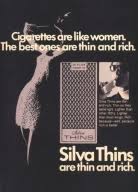
It's as if these folks are still taking their ethical values from the obnoxious cigarette commercial aimed at women in the 1950s and '60s: "Cigarettes are like women. The best ones are thin and rich. Silva Thins are thin and rich."
Obesity:How the experts define "overweight" and "obesity," how you can find yourself on their continuum, their projections regarding where our scales will tip in 2030, the causes, best strategies for cure, and long-term costs -- in our individual health and sense of well-being, the nation's public health, the costs to business of accommodation, and the multi-hundred-billion-dollar increase in the nation's healthcare costs
Governor Mike Huckabee, questioned regarding his conservative credentials, responded: "I'm a conservative. I'm just not angry about it."
Similarly, one can be concerned about the "obesity epidemic" and its consequences without disparaging others regarding their body type and size -- regardless of whether they're trying to do something about it or not. See Perry Beeman, "Iowa, U.S. Expected to Pack On the Pounds," Des Moines Register, May 8, 2012.
Jordan Ramos is the first to acknowledge this. She's fully capable of distinguishing between the range of problems associated with obesity and non-discriminatory human decency: "I'm not condoning obesity. That was never my intention. I just . . . don't think anybody's size should impact the way they are treated." Emily Schettler, Press-Citizen, May 1, above. "She said some people misinterpreted her story and thought she was trying to promote obesity, which she is not. She said she is trying to raise awareness about discrimination based on size. 'We are all humans and we all deserve to be treated equally and nobody should be denied access or the right to do things because of their outward appearance,' Ramos said." Alesha L. Crews, Press-Citizen, May 5, above.
If data regarding Americans' overweight and obesity is to be useful we need to define our terms. That has been done, and the definitions involve something called Body Mass Index or BMI. Don't worry about the math. Just use the calculator provided by the NIH's National Heart Lung and Blood Institute. (The actual metric formula is weight in kilograms divided by the square of height in meters. The calculator speaks feet, inches and pounds.)
Once you get that BMI number from the calculator, here are the categories:
Underweight = <18.5
Normal weight = 18.5–24.9
Overweight = 25–29.9
Obesity = BMI of 30 or greater (>40 = "severely, or super obese")
By these standards, today 36% of adult Americans are obese -- a number that is projected to increase to 42% by 2030. (If past trends were to continue it would be over 50%. The severely obese are expected to increase from 5% to 11% of the population.) These trends are hard to turn around, but the experts at Monday's conference point to such things as "more effective weight-loss drugs, public health campaigns to encourage exercise and more-healthful eating, or workplace health promotion policies" (such as the UI's "LiveWell" program). As with nicotine addiction and alcoholism, one of the most cost-effective approaches is to prevent obesity in young children: 77% of obese children become obese adults; only 7% of non-obese children have the problem as they grow older.
Experts acknowledge the insuperable political hurdles: "For weight gain to be averted — let alone reversed — policymakers would have to move beyond politically palatable initiatives such as removing sugary sodas from schools . . .. Very likely, junk food would have to be taxed to discourage consumption, and advertising for those products would have to be prohibited . . ." said one.
Overweight and obesity contribute to many diseases and disabilities, including arthritis, cancer, diabetes, heart disease. The costs of treatment are a significant part of our nation's healthcare bill. Estimates are that the additional costs from the additional number of obese persons between now and 2030 could be as much as 550 billion (over one-half trillion) dollars. There are also added costs for public and private employers in addition to health insurance costs, from the increased number of sick days to the redesign of airline and theater seats, wheelchairs, and buildings. ("U.S. hospitals are ripping out wall-mounted toilets and replacing them with floor models to better support obese patients. The Federal Transit Administration wants buses to be tested for the impact of heavier riders on steering and braking. Cars are burning nearly a billion gallons of gasoline more a year than if passengers weighed what they did in 1960." Sharon Begley, "As America's waistline expands, costs soar," Reuters, April 30, 2012.
(The above is drawn, in part, from Melissa Healey, "42% of American adults will be obese by 2030, study says; Though the rate of the last 30 years has slowed, it's far from leveling off, and it's going to get expensive, say experts at the Weight of the Nation conference in Washington," Los Angeles Times, May 8, 2012.) For Iowa statistics see Iowa Department of Public Health, "Obesity in Iowa: A Statewide Epidemic," undated (with 2006-07 data).
There are few among us who would not be better off for ourselves, and our nation, if we ate better, exercised more, and shed a few pounds. I am one of the fortunate ones who has never had to struggle with obesity. I have sympathy for those who do. But neither am I of "normal weight" by the standards of the BMI chart, being more in the low to mid-range of the "overweight" category, weighing every morning, graphing the results alongside my goal for the week.
We need to talk about obesity. We need to do what we can to improve the public policies that support public health rather than diminish it. But when we are "speaking of obesity" we need to recognize the human need to do so in a way that respects the feelings of those with a problem. While we try to promote sensitivity, and the elimination of racism, antisemitism, sexism, homophobia, and discrimination or ridicule of those with disabilities or special needs, we need to add a similar respect for the feelings of those who suffer in a society in which all too many apparently still believe that "the best women are thin and rich."
# # #
May 5, 2010, 5:00 a.m.
Obesity: Causes, Cures, and National Defense
(brought to you by FromDC2Iowa.blogspot.com*)
In Monday's blog entry, "P&L: Public Loss From Private Profit; Capitalism Pours More Than Oil on Troubled Waters," May 3, 2010, I wrote,
Two generals who were former chairs of the Joint Chiefs of Staff are now telling us that Americans' obesity has reached not only epidemic proportions, it has become a threat to our national security. John M. Shalikashvili and Hugh Shelton, "The Latest National Security Threat: Obesity," Washington Post, April 30, 2010 ("Are we becoming a nation too fat to defend ourselves? It seems incredible, but these are the facts: As of 2005, at least 9 million young adults -- 27 percent of all Americans ages 17 to 24 -- were too overweight to serve in the military, according to the Army's analysis of national data. And since then, these high numbers have remained largely unchanged").
Our local papers cut a wide swath when it comes to picking topics for editorials.
And so it was yesterday when The Gazette flexed its opinion muscles over the topic of obesity. Editorial, "Obesity: No One-Size Fits All," The Gazette, May 4, 2010.
There is no question that childhood obesity is a serious problem in Iowa and across the country.
So it’s easy to see why . . . [the] push for tougher nutritional standards for schools as a way to fight that collective weight gain.
But it’s going to take more than a tighter federal grip on school menus to eradicate this complex problem.
We also must educate young people about diet, exercise and the costs of neglecting their health.
It will take local solutions and local attention to reduce obesity and help raise healthier kids. . . .
[A] state-by-state study performed by Military: Readiness, an organization of retired military officers . . . found nearly 40 percent of Iowa’s 18- to 24-year-olds are too fat to fight in the armed forces. Nationwide, 27 percent of young adults . . . were too fat . . ..
Those numbers led Retired U.S. Air Force Lt. Gen. Norman Seip to recently tell reporters that obesity is becoming a threat to our national security.
“Too Fat to Fight” targets school cafeterias and vending machines — . . . as much as 40 percent of children’s’ daily calorie intake occurs at school. . . .
Healthier, more nutritious food at school may well be one part of that solution.
But so are a host of physical activity and lifestyle choices. States and school districts would do well to take a more holistic view . . ..
It's hard to disagree with any of that.
Indeed, I've often been impressed with how much in the way of public projects and social programs can make their way through a Congress as "national defense" efforts when that same Congress might otherwise have talked them into a slow and irreversible death.
How did the multi-billion-dollar network of wide, multi-lane, divided highways of uniform design come to be built? It was the result of the Defense Highway Act of 1956 (sometimes called the Federal-Aid Highway Act, or National Interstate and Defense Highways Act).
And what was one of our government's greatest boosts to education? It was the National Defense Education Act of 1958, passed in part because of its name. Larry Abramson, "Sputnik Left Legacy for U.S. Science Education," NPR, September 30, 2007 ("When [the USSR's] Sputnik's 'beep' first reached Earth on Oct. 4, 1957 . . . [it] created both paranoia and concern that sparked a much-needed revolution in scientific education in the U.S.").
It works for post-war programs as well: "The G.I. Bill . . . provided college or vocational education for returning World War II veterans . . . as well as one year of unemployment compensation. It also provided many different types of loans for returning veterans to buy homes and start businesses." "G.I. Bill," wikipedia.org.
Given the ability of "defense" to mesmerize the American people, and their representatives, into supporting the damnedest things (up to and including wars of choice that are endless, cost trillions, and result in weakening rather than strengthening our national security), I've often, only half-jokingly, suggested Congress use the rationale more often. It should enact such things as a Defense Dental Care Act, Defense Daycare Act, Defense Passenger Rail Act, Defense Universal Single-Payer Healthcare Act, or Defense Full Employment Act. So why not a Defense Obesity Reduction Act? The reason it's only half-joking is because each of those programs would, in fact, contribute to our national defense as well as Americans' "life, liberty and the pursuit of happiness."
But while it's hard to disagree with the thrust of the Gazette's editorial, it's not hard to note its omissions and then expand upon them. There are three I will touch on: adults, the food industry, and community support.
Adults Children may get 40% of their nutrition from school, but that just means they are getting 60% of it somewhere else. Children eat what's served them (unless they're refusing to eat anything at all). Children value foods used as bribes or rewards. They get their idea of what people should and do eat from the example adults set. If you've seen the movie "Super Size Me," you have some idea of what happens to people (adults as well as children) who eat too much at McDonalds, other sweet-grease-salty-grease, high-calorie fast food outlets, or bring equivalent industrially produced "foods" home from the supermarket. Believe it or not, there are children who've never been fed anything but healthy diets, including lots of fresh fruits and vegetables, and seem to do just fine. (I find it also works for my cats: pick a good cat foot, never give them anything else, and they're fine with it -- and live long, healthy lives.)
The Food Industry Which are the most popular pharmaceutical products, cigarettes, and sugared soft drinks? The ones most heavily advertised. How much does Coca Cola spend to get us to drop something between 50 cents and $1.25 into a vending machine? It's $2.5 billion!
As a frustrated mother once told me, referring to the advertising directed at her children, "I try to get my kids to want more healthy foods, but I just can't make my fruits and vegetables sing and dance."
Those who advertise industrialized foods to children get a double return on their money. They implant the brand name in the child's mind for the day when the kid has some money of her own to buy stuff. Meanwhile, they benefit from unpaid child labor, as children go to work for the company, nagging their parents to buy the advertised foods, both at home and when they throw tantrums in the supermarkets.
Beer companies advertise to get teens and college students to lock on to their brand early in life and stick with it until they die. Ditto for the cigarette companies' advertising directed at their younger brothers and sisters, the "replacement smokers" who must be addicted each year to take the place of the 400,000 the industry kills off. (Youngsters' favorite brand of cigarettes is the one most heavily advertised.)
Our children (and adults) are surrounded with fast food outlets wherever they go in the real world, and advertising for those outlets (plus candy, sugared cereals and soda) during the increasingly longer time they spend in the virtual worlds of television and the Internet.
This is not the time, place or sufficient space to launch into an itemization of all they ways we might be able to modify this obesity-inducing industry's practices -- for example, when sales lag the sure fire solution is to just add cheese and bacon. See the description of David Kessler, The End of Overeating: Taking Control of the Insatiable American Appetite (New York: Rodale, 2009), in "Fat People, Fat Profits; Need to Shed a Few Pounds? Target the Right Enemy," September 28, 2009.
The thesis of this former FDA Administrator, backed by data, is that the sweet-grease-salty-grease formula of the fast food obesity industry is actually deliberately modifying the human brain in ways that increase caloric consumption -- and corporate profits. Since I'm always up for participation as a human guinea pig in a little scientific experiment -- not necessarily because I needed or wanted to lose weight -- I tried radically reducing-to-eliminating the sweet-grease-salty grease in my own diet, while otherwise eating all I wanted. The result: I lost 30 pounds in a couple months, my appetite declined and then stabilized at that reduced level, and I haven't (at least not yet) regained the weight.
We ignore at our peril this very, very fat elephant of the food industry that is stomping around the kitchen.
Community Support Assume for the moment that America's epidemic of obesity is, at least in large part, the result of the deliberately constructed real and virtual environments that manipulate, or at least encourage and reinforce, the eating behavior that creates both an epidemic of obesity and the multi-billion-dollar profits of the food industry.
Whether or not that is the case, but especially if it is true, any successful effort to reduce obesity will have to involve a variety of forms of community support as some kind of counter force, a resistance, to that powerful industry pressure. The rates of increase in the percentages of obese individuals (of all ages) indicate how difficult it is for individuals to change eating and exercise behavior patterns when surrounded by vending machines, supermarket aisles, fast food establishments -- and their multi-billion-dollar investment in virtually all forms of advertising -- all pushing them, psychologically and physiologically, to consume more and more of the sweet-grease-salty-grease diet.
Very early in the day of "New Age" notions of "wellness," and preventive medicine, Wendell Johnson posed the question, if we can have the towers of illness and disease we call hospitals, why could we not also have "towers of health?" Wendell Johnson, "Rehabilitation As It Seems To Be And As It Might Be," ETC: A Review of General Semantics, vol. 20, pp. 203, 211-212 (July 1963), discussed in Nicholas Johnson, "General Semantics: The Next Generation," General Semantics Bulletin, 1996, No. 63, pp. 22, 39, n. 45 (the 1995 Alfred Korzybski Memorial Lecture).
If Iowa City can aspire to be a "City of Literature," and the University to become "The Writing University," how might we go about becoming a city, and university, of health? We have a nationally recognized College of Medicine and UIHC, a College of Public Health, a variety of recreational and sports facilities and organizations (City, K-12, University, volunteer and for-profit).
I haven't even begun to flesh this out. But it wouldn't take much group brainstorming to come up with a wide ranging collection of ideas that could be conceived, implemented and promoted as a coordinated program. There's not much a local outlet of a sweet-grease-salty-grease national chain can do; its menu is pretty tightly controlled from headquarters. But there may be a little more willingness and ability to collaborate with some local supermarkets and restaurants. We could do more to promote the local "farmers' markets." There could be a public effort to supplement the for-profit exercise facilities with free or very inexpensive options -- certainly more walking, jogging and bicycling paths. We could have a cumulative community lost weight project -- so long as it emphasized eating the right foods, rather than the yo-yo fad diets that ultimately produce an overall weight gain. We could encourage more personal vegetable gardens and fruit trees, similar to the V-shaped "Victory Gardens" during World War II. The local papers could feature healthy recipes as a regular feature. We could even do some urban planning with an eye to, over time, increasing the integration of housing and work places sufficiently to encourage more people walking and biking to work.
Some of these things are already being done, of course. What I'm suggesting is that we add to them, and integrate them into an interrelated, unified, identifiable single program supported by the City, University and other community institutions.
Obesity's Health Effects The reduction in the number of Americans fit for military duty is not the only impact of obesity. The range of its adverse effect on our health is truly frightening:
Obesity can contribute to the creation of the following conditions:
* Blood (fat) lipid abnormalities
* Cancer, including cancer of the uterus, cervix, ovaries, breast, colon, rectum and prostate
* Depression
* Gallbladder disease
* Gynecological problems, such as infertility and irregular periods
* Heart disease
* High blood pressure
* Metabolic syndrome
* Nonalcoholic fatty liver disease
* Osteoarthritis
* Skin problems, such as intertrigo and impaired wound healing
* Sleep apnea
* Stroke
* Type 2 diabetes
Mayo Clinic Staff, "Obesity: Complications," MayoClinic.com.
From recruits for wars of choice, to fighting the battle of the bulge, our war on obesity has many fronts, flanks and rears.
_______________
* Why do I put this blog ID at the top of the entry, when you know full well what blog you're reading? Because there are a number of Internet sites that, for whatever reason, simply take the blog entries of others and reproduce them as their own without crediting the source. I don't mind the flattering attention, but would appreciate acknowledgment as the source -- even if I have to embed it myself.
-- Nicholas Johnson
# # #
 Rosa Parks, pictured here with Dr. Martin Luther King in 1955, wanted to sit on the Montgomery buses wherever she chose. On December 1 of that year she refused a bus driver's order that she get up and give her seat to a white person. It was a major milestone in what became the civil rights movement, and eventually, with President Lyndon Johnson's leadership, a series of civil rights laws in 1964 and 1965.

