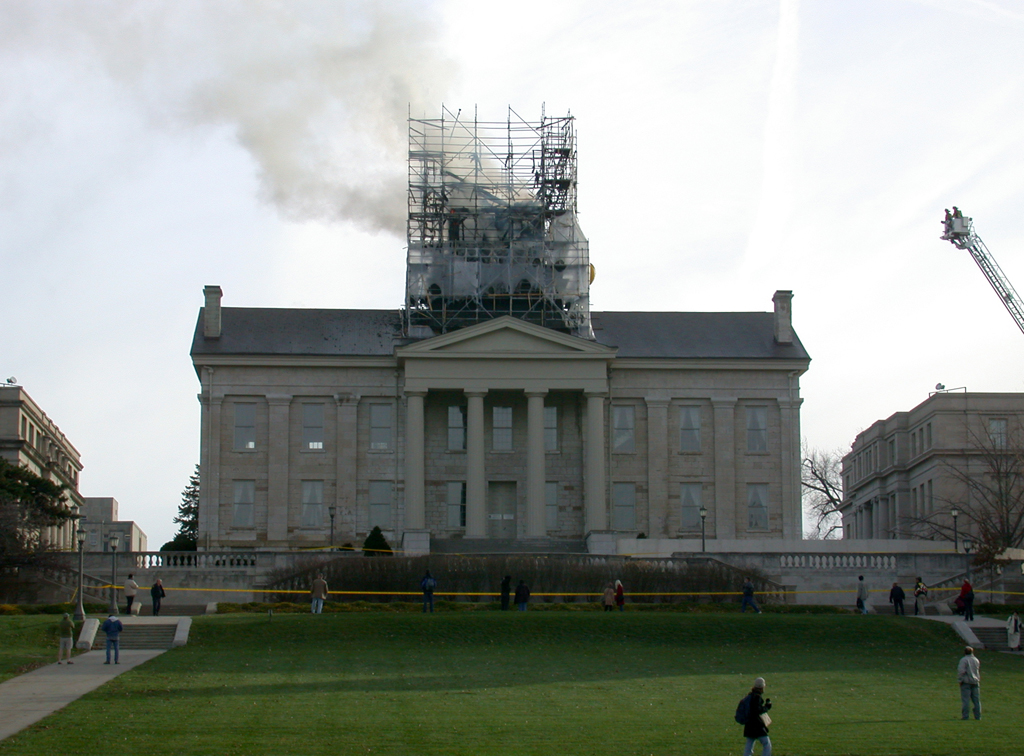
June 6, 2007, 7:05 a.m., 8:50 a.m., 1:40 p.m.
UI Presidential Search Saga Continues
Following the University of Iowa presidential search saga? Curious to know just what the hell is going on?
1. Read the June 5 blog entry, Nicholas Johnson, "Deeply Disappointed But Not Stunned," in "UI Held Hostage Day 500 -- "Whaaa?" June 5, 2007.
2. Even more significant in some ways, read the Comments readers have attached to that blog entry (use the direct link, above, and scroll down to the bottom of the entry). There are 19 comments as of 7:00 a.m. this morning. Some reflect either (a) a prize-winning storyteller's imagination to rival that of a John Grisham, or (b) information from some very knowledgeable inside sources. Why the media has not followed up on some of the allegations these comments contain baffles me. If even half of what is alleged is true, there is more than one Pulitzer Prize embedded there, just waiting to be investigated and written up.
3. Like to have even more background, and know the 500+ day history of this saga? Look for the links provided under the heading, in bold: "[Note: If you're new to this blog, and interested in the whole UI President Search story . . . (They will lead you, ultimately, to links to many of the basic documents and news stories.)
4. I'll have a little more to say later in the day, but those are the leads to your basic sources as of now.
_______________
Today's stories include:
Erin Jordan, "U of I Provost Hogan Not a Finalist; Interviews Planned with 5 Contenders for Presidency," Des Moines Register, June 6, 2007.
Brian Morelli, "Regent Interview Sessions to be Open," Iowa City Press-Citizen, June 6, 2007, p. 1A.
Ashton Shurson, "Regents to Interview Finalists Next Week," The Daily Iowan, June 6, 2007.
Gregg Hennigan, "Prior Commitments Affected Schedule for UI Interviews," The Gazette, June 6, 2007, p. B3. [During June 6 go to the online newspaper, and use dropdown menu to go to page B3. In future days, use dropdown menu to go to the June 6 issue.]
A Letter to the Editor from Regents President Gartner, with some interesting implications (to be addressed later today) is short enough to reproduce in full:
There is one vote to each regent
Aw, c'mon! Your story says, "Gartner has said" the finalists from the first search for president of the University of Iowa were rejected because they "lacked sufficient health-care experience, which he said would be necessary to oversee University Hospitals." And then you add, "However, many disputed that reason, saying in fact Gartner nixed the search when his preferred candidate, former Syracuse University provost Deborah Freund, did not make the list of finalists."
As you noted, the vote to reject the finalists was 6 to 2, and as you didn't note, all four regents on the Search Committee were among the six "no" votes. As your reporters well know, each regent has one vote; no regent has the power to "nix" anything.
Michael Gartner
president
Iowa state Board of Regents
Michael Gartner, "There is One Vote to Each Regent," Iowa City Press-Citizen, June 6, 2007.
# # #
Erin Jordan has done sufficient investigation to contribute the most by what of who is, and is not, among the finalists. She reports that, "Purdue University Provost Sally Mason apparently is one of those finalists," and "mentioned in academic circles in connection with the U of I search are Nancy Zimpher, president of the University of Cincinnati, and Larry Penley, president of Colorado State University." By checking with other possible candidates she has managed to exclude "Richard Lariviere, provost at the University of Kansas. Other provosts who said Tuesday they are not U of I candidates are Rodney Erickson of Penn State University; Linda Katehi, University of Illinois; E. Thomas Sullivan, University of Minnesota; and M. Duane Nellis, Kansas State University."
Gregg Hennigan reports on the scheduling. "Regents Executive Director Gary Steinke said . . . three of the nine regents had unbreakable personal commitments on the preferred meeting dates of June 16 and 17, . . . 'And because this is one of the most important decisions that the regents will make, all regents wanted to be, and certainly should be, present during the interviews.'"
So if "the regents’ interviews . . . will begin the afternoon of Tuesday, June 12, and continue through the next day," but "Steinke said the regents will not make any decisions before the on-campus visits are finished and the search committee has submitted its report," and (as Morelli reports) "the committee plans to hand off that report on the morning of June 16," and the Regents can't meet on the 16th or 17th, just when are they going to meet to make their decision?
"He [Steinke] said the regents would meet 'very soon' after the campus visits to discuss candidate qualifications, though he did not know when."
And just when might that be? How much improvement can we expect to find in the Regents' schedules during the, say, two weeks following the interviews next week? For this information we have to turn to Ashton Shurson's story this morning. She reports, "Gary Steinke, the executive director of the regents, said June 12 and 13 are the only consecutive days the regents can meet until the end of July."
Commentary
1. June 13th. I have to take some responsibility for this June 13th interview session. In discussing the Regents' desperate need to focus on a governance model, I noted, among other things, Michael Gartner's unilateral announcement to the Regents that its agenda for the previously scheduled June 13th meeting was to be "strategic planning." I politely reminded the Regents that they had a decision to make before July 1 regarding the next president of the University of Iowa, and that unless they had a lot of other meeting days blocked out during the end of June that they might want to give a little attention to that agenda item as well. Nicholas Johnson, "Regents, Governance, PR Firms, Strategic Planning, Presidential Selection, and June 13," in "UI Held Hostage Day 487 - Governance Regents Number One Priority," May 23, 2007.
In fairness (to myself), when I wrote that I simply assumed that Search Committee II, knowing of the Regents' scheduled meeting, would have its finalists selected by May 25 -- or June 1 at the latest -- in order that the campus visits (if they were to be held) could be scheduled for this week (June 4-8), the Committee's report could be prepared over the weekend (so as to process campus input), presented to the Regents on Monday, the Regents interviews could be held Tuesday and Wednesday (June 12 and 13 -- as, indeed, they are to be), and the Regents' selection could be known that Wednesday evening after their meeting.
So now I am left with some questions.
2. Why was there not more coordination between Search Committee II and the Regents? Following my May 23 blog entry at 11:55 a.m. suggesting the Regents best give some attention to their schedules, Gary Steinke emailed the Board members at 1:58 p.m. Presumably they answered him relatively promptly. Was that information not immediately shared with Search Committee II? What integration of scheduling was undertaken at that point? Why are we in this unprecedented mess after 500 days of searching for a president?
3. When, precisely, do the Regents plan to make this decision -- for the past six months scheduled to be completed by July 1? Since it is not to be made by the weekend of June 16-17, but it has to be scheduled for sometime, what is the rush about crashing Search Committee II's party next week? What is the necessity for destroying the carefully negotiated procedure? Why not have the Regents interview such candidates as they wish during a day or so prior to whatever meeting they schedule for making the decision?
Consider the discussion in Nicholas Johnson, "UI President Search: Campus Visits Details," in "UI Held Hostage Day 487 - Search Schedule," June 2, 2007, regarding the candidates' needs not only for pre-visit secrecy but for extremely short visits. I don't buy it, but responsible folks tell me it's true. So let's take it as a given for this discussion.
The candidates' names are going to be known next week. Indeed, with the Regents crashing the party, their names will be known before they arrive on campus, and for a longer period thereafter. But even if the Regents hadn't come next week, all the names would have been known by Thursday night.
My point is, the names will continue to be known -- the candidates and their home institutions will continue to be kept in limbo -- until such time as the Regents make their final choice. That being the case, what conceivable benefit is it to the candidates (aside from the avoidance of one additional trip -- which they had probably assumed was in the cards anyway) that they see the Regents next week rather than at a subsequent, less chaotic interview prior to the Regents' decision?
In other words, in benefit-cost terms, I understand the downside, the cost, the negative impact of the Regents' crashing the party. What I don't understand is the "benefit" of their doing so.
4. "How does this mess things up? Let me count the ways." I have never been a big fan of Search Committee II's approach to secrecy, or its withholding the names until the night before the candidate arrives, or the five times in succession 24-hour campus visits. But the point is, it was an integrated plan. It had been thought through. It served purposes thought by committee members to be important. And it is a plan totally disrupted by the Regents' presence. Candidates whose names would not have been revealed until Wednesday or Thursday night will be known earlier in the week. Those scheduled to participate in small closed meetings with the candidates whose campus visits were scheduled for Tuesday and Wednesday -- or who had planned on attending their open, public sessions during the afternoon -- will now need to choose between attending the Regents' interviews of all candidates and what they'd originally intended to do. What will be the impact -- from the standpoint of both the Tuesday and Wednesday candidates and the campus community -- of these conflicts? At a minimum there will be less time for members of the University community to prepare and submit their input.
5. Responsibility and technology. In the nature of things, the kinds of people appointed to the Board of Regents are the kinds of people with very full schedules. In addition to their jobs, it's highly unlikely service on the Regents is the only contribution of their time to community service. It is a job, as I used to describe my service on the local school board, that "may not pay anything, but at least you get a lot of grief." So I am both really grateful for Regents' willingness to service, and I'm somewhat understanding of the pressures they confront.
But . . .
(a) If one is going to take on this additional time consuming burden, I think that carries the responsibility to make the time, to cancel other commitments if necessary, such that one can attend meetings. Especially is this so at the beginning of one's term, and with regard to one of the most significant tasks the job entails. And doubly is this so when this is "UI Held Hostage Day 501." This is not just another boring agenda item. This is the primary, major effort to regain some of the prestige and respect formerly accorded the State of Iowa and its universities. I am disappointed.
(b) Driving across the state is a drag. I don't look forward to driving to Des Moines, and for me it is a straight shot down Interstate 80. And I know it's tough to find dates when 9 busy people can get together. We had a similar problem when President Carter appointed me as a White House Advisor to help put on the White House Conference on Libraries and Information Sciences in 1979. That group of White House Advisors ended up getting a bunch of early portable computers with built-in printers, the TI-765s, and keeping in touch by email. If we could do that 28 years ago members of the Iowa Board of Regents ought to be able to use the much more sophisticated telecommunications technology available to them today. Video conferencing is cheap and easy today. It's widely used in corporate America for interviews, and increasingly in the judicial system for, among other things, depositions. Shy of that, the Regents have used conference calling for meetings before. Sure, it's not as satisfactory as being physically present. But it's a lot more satisfactory than busting up a well planned and scheduled week of campus interviews, or further postponing the selection of a University of Iowa president -- a decision that is already a year overdue.
_______________
UICCU and "Optiva"
The UICCU-Optiva story is essentially behind us. There may be occasional additions "for the record," but for the most part the last major entry, with links to the prior material from October 2006 through March 2007, is "UICCU and 'Optiva'" in Nicholas Johnson, "UI Held Hostage Day 406 - March 3 - Optiva," March 3, 2007. Since then there have been two major additions: Nicholas Johnson, "Open Letter to UICCU Board" in "UI Held Hostage Day 423 - March 20 - UICCU," March 20, 2007, and "'Open Letter': Confirmation from World Council of Credit Unions" in "UI Held Hostage Day 424 - March 21 UICCU," March 21, 2007.
# # #
[Note: If you're new to this blog, and interested in the whole UI President Search story . . .
These blog entries begin with Nicholas Johnson, "UI President Search I," November 18, 2006.
Wondering where the "UI Held Hostage" came from? Click here. (As of January 25 the count has run from January 21, 2006, rather than last November.)
For any given entry, links to the prior 10 will be found in the left-most column. Going directly to FromDC2Iowa.Blogspot.com will take you to the latest. Each contains links to the full text of virtually all known media stories and commentary, including mine, since the last blog entry. Together they represent what The Chronicle of Higher Education has called "one of the most comprehensive analyses of the controversy." The last time there was an entry containing the summary of prior entries' commentary (with the heading "This Blog's Focus on Regents' Presidential Search") is Nicholas Johnson, "UI President Search XIII -- Last Week," December 11, 2006.
My early proposed solution to the conflict is provided in Nicholas Johnson, "UI President Search VII: The Answer," November 26, 2006.
Searching: the fullest collection of basic documents related to the search is contained in Nicholas Johnson, "UI President Search - Dec. 21-25," December 21, 2006 (and updated thereafter), at the bottom of that blog entry under "References." A Blog Index of entries on all subjects since June 2006 is also available. And note that if you know (or can guess at) a word to search on, the "Blogger" bar near the top of your browser has a blank, followed by "SEARCH THIS BLOG," that enables you to search all entries in this Blog since June 2006.]
# # #
Media Stories and Commentary
See above.
_______________
Technorati tags: football, athletics, academics, high school, college, University of Iowa, education, K-12, leadership, university president, Michael Gartner, Iowa Board of Regents, UI president search, Nicholas Johnson, FromDC2Iowa
# # #
June 5, 2007, 6:50, 7:45, 8:15, and 11:40 a.m.
Deeply Disappointed But Not Stunned
Folks, this is Day 500.
Ever since writing Nicholas Johnson, "UI President Search: Campus Details," in "UI Held Hostage Day 497 - Search Schedule," June 2, 2007, a controversy has swirled around why Search Committee II would choose to keep candidates' names secret until the evening before they day they were to arrive for campus visits. There are, as of this morning, some 15 comments from readers attached to that blog entry -- some predicting exactly what's happened, and others speculating as to why. None are expressing much happiness about it all. (Comments are now coming into this blog entry as well, and don't miss State29, "Day 500," June 5, 2007.)
I, too, am deeply disappointed by what is going on but, given past performance, I cannot honestly claim to be stunned. It would, however, require someone with a much better imagination than mine to have predicted what's happened.
What might have been. It has been 500 days since the Iowa Board of Regents has known that those who desired the departure of one of America's preeminent university presidents had achieved their wish. Much beloved, multi-talented superstar David Skorton, who once said he was at Iowa for life, and thought a $300,000-a-year salary was "very generous" in a state where the average family income was in the $40,000 range, announced 500 days ago that he was going to become president at Cornell University. He left in a characteristically classy fashion, with no public criticism of the Regents. Cornell held him in a little higher esteem than did our Regents, and paid him a package roughly three times what our Regents thought he was worth.
Could we have had a smooth transition a full year ago, putting a new UI president in place the day Skorton left, at the end of the 2006 spring semester? Absolutely. Search Committee II, which first met in January of this year, and has scheduled on-campus interviews with finalists next week, has just demonstrated that one spring semester is enough to conduct and conclude a search.
At the end of Search Committee I's work, four finalists emerged. Among them was UI Provost Mike Hogan. Hogan is another educational administrator who has demonstrated his abilities locally -- and attracted quite a local following of admirers in the process (including me) -- and is highly regarded nationally and considered for university presidencies elsewhere. Indeed, as Brian Morelli reports this morning, following Search Committee I's work "Hogan was one of four finalists -- and by some accounts the favorite . . .." Brian Morelli, Hogan Not a Finalist for UI Post," Press-Citizen, June 5, 2007, p. 1A. [Morelli adds, "Hogan has been popular on campus. During the initial search, many on campus rallied around his presidential bid, including the students who created a Facebook group called Hogan's Heroes."]
Had he been selected one full year ago not only would we have avoided the national and international embarrassment of the past 500 days, we would have had a very smooth transition indeed from June 30 to July 1 of 2006.
"What were they thinking?" So what has Search Committee II decided to do? In spite of its number one priority on secrecy, the papers have been able to report that its final five include two sitting presidents and three sitting provosts.
Roughly six months ago, at the end of an extensive nationwide search of all available top flight educational administrators in the United States, Mike Hogan was deemed to be one of the four most highly qualified potential UI presidents in America. Think about that.
Now, a mere six months later, Search Committee II includes three provosts among its final five (not four), and Hogan -- one of four finalists last time, "and by some accounts the favorite" -- is not among them? To paraphrase the TV public service announcement, "What were they thinking?"
An understanding of the logic of including Hogan in the mix is not something limited to me and the UI students calling themselves "Hogan's Heros."
Morilli quotes Professor Steve Collins, a member of the Committee on the Selection of Central Academic Officials, as saying in response to the news that Hogan was excluded, "I am terribly disappointed to hear that. I think (Hogan) would have made a terrific president . . .."
Morelli continues, "State Sen. Robert Dvorsky, D-Coralville, said it seemed unusual that Hogan wasn't a finalist, particularly because the slate includes three provosts and two sitting presidents.
"'I hope people who were involved in the first process aren't being penalized in the second,' Dvorsky said. 'How much involvement did regents have in the process that wasn't public ? There were all the questions in the first search, now questions in the second. Is there regent involvement we are unaware of?'
"Rep. Dave Jacoby, D-Coralville, said he found it surprising that Hogan is not a finalist . . .. 'I think Mike is a very viable candidate. I would expect someone with his background would make the finalists," Jacoby said. "After the process is over, I would be really curious as to what the criteria were for him not to be a finalist. Mr. Hogan is a very capable administrator."
And see Ashton Shurson, "Panel Passes on Hogan," The Daily Iowan, June 5, 2007 ("UI Faculty Senate President Victoria Sharp said . . . 'I think he would have made a fine president. He's a wonderful man'").
Here come the Regents. Meanwhile, as if this brutal rejection of Hogan was not enough, the Regents, having bungled Search I at the eleventh hour, is about to do the same with Search II.
They have decided they are going to arrive in Iowa City on the second day of a week-long Search Committee-arranged set of on-campus visits and interviews by five finalists. Brian Morelli, "Regents to Interview Finalists Next Week; Change in Plans Shifts Meeting to Iowa City," Iowa City Press-Citizen, June 5, 2007, p. 1A. They are, apparently, planning on conducting their interviews simultaneously along with the on-campus interviews. They may very well conclude their selection before those interviews are even over and Search Committee II presents them its report. This process will, at a minimum, significantly curtail (if not eliminate) the opportunity for any meaningful public input.
Here are some excerpts from what The Gazette reports this morning,
The regents will wait to select the president until the on-campus interviews are complete and the search committee, which is led by UI faculty and staff, submits its report to the regents, the source said. [NJ: This is a correction to what I hinted earler might happen.]
. . .
[T]he regents interview schedule might bring one more controversy. The dual interview process apparently would be a first in UI's history.
``It raises questions of who's setting the agenda for the interviews,'' said Steve McGuire, a professor of curriculum and instruction and secretary of the Faculty Senate.
The regents were criticized by many on campus after an initial regent-led UI presidential search last year was shrouded in secrecy and failed to choose a president.
``Given what happened in Phase 1 of the search, ... I think most of us are hoping we'll have a normal process in this stage,'' said Michael O'Hara, a professor of psychology and vice president of the Faculty Senate.
Also, the search committee had planned to release the name of each finalist the day before their visit. The regents' plan would mean at least two of those names would be made public earlier.
. . .
David Johnsen, chairman of the search committee and dean of the College of Dentistry, said he was not sure of the final schedule for the regents interviews. He would not say whether he thought public interviews with the regents during the same time frame as the on-campus visits would give some finalists second thoughts about the job.
``There's so many details that have to be worked out ... that I think it might be a little premature to speculate on this might happen or that might happen,'' he said.
Gregg Hennigan, "Regents, On-Campus Interviews Set Next Week," Gazette Online, June 4, 2007, 10:55 p.m.
[The matter of candidates' "second thoughts," to which Dean Johnsen refers, is serious from both sides. What kind of a person, already a sitting president or provost of a university, would want to leave where they are and take a job at which they would be governed by this Board of Regents? And from the perspective of the University community, why on earth would we want someone as president who either (a) is so unable, or disinclined, to do basic Internet research that they are unaware of what they are walking into, or (b) does know, but is so desperate that they are willing to take the job anyway?]
I hope the Regents don't try to tell us (as one has hinted) that this unprecedented simutaneous interview process is because of a scheduling problem. They've had 500 days to set up this meeting. They ought to have been able to arrange it by now.
No, I suspect something else is going on, but who will know before they decide to send the little puff of white smoke out the Old Capitol dome?
 Even as originally proposed by Search Committee II it was weird enough: the University and Iowa City communities were for some inexplicable reason to be kept in the dark as to the identity of the candidates until the night before the day of their visit (with one candidate per day for five days).
Look, legally the Regents are empowered by the Code of Iowa to do damn near anything they want in any way they want -- as they demonstrate from time to time. (The only exception is their inability to brazenly violate other provisions of the Code of Iowa, such as the open meetings and public records requirements, now in litigation.) This is not about the common law, it's about common sense.
They are not legally required to use a search committee process. They would be foolish not to, but mere foolishness does not seem to be for them a concern of decisional significance. The point is, if they are going to use a search committee, to intervene and truncate its efforts during the final week of its six-month process is not only substantively serious, it makes them look really silly.
Hopefully, Jon Stewart won't get wind of all this or he'd be tempted to lead Comedy Central's "Daily Show" with the kind of publicity Iowa doesn't need.
Both Search Committee II and the Board of Regents have a lot of explaining to do. Whether they will show the public the decent respect of doing so between now and Monday remains to be seen.
UICCU and "Optiva"
The UICCU-Optiva story is essentially behind us. There may be occasional additions "for the record," but for the most part the last major entry, with links to the prior material from October 2006 through March 2007, is "UICCU and 'Optiva'" in Nicholas Johnson, "UI Held Hostage Day 406 - March 3 - Optiva," March 3, 2007. Since then there have been two major additions: Nicholas Johnson, "Open Letter to UICCU Board" in "UI Held Hostage Day 423 - March 20 - UICCU," March 20, 2007, and "'Open Letter': Confirmation from World Council of Credit Unions" in "UI Held Hostage Day 424 - March 21 UICCU," March 21, 2007.
# # #
[Note: If you're new to this blog, and interested in the whole UI President Search story . . .
These blog entries begin with Nicholas Johnson, "UI President Search I," November 18, 2006.
Wondering where the "UI Held Hostage" came from? Click here. (As of January 25 the count has run from January 21, 2006, rather than last November.)
For any given entry, links to the prior 10 will be found in the left-most column. Going directly to FromDC2Iowa.Blogspot.com will take you to the latest. Each contains links to the full text of virtually all known media stories and commentary, including mine, since the last blog entry. Together they represent what The Chronicle of Higher Education has called "one of the most comprehensive analyses of the controversy." The last time there was an entry containing the summary of prior entries' commentary (with the heading "This Blog's Focus on Regents' Presidential Search") is Nicholas Johnson, "UI President Search XIII -- Last Week," December 11, 2006.
My early proposed solution to the conflict is provided in Nicholas Johnson, "UI President Search VII: The Answer," November 26, 2006.
Searching: the fullest collection of basic documents related to the search is contained in Nicholas Johnson, "UI President Search - Dec. 21-25," December 21, 2006 (and updated thereafter), at the bottom of that blog entry under "References." A Blog Index of entries on all subjects since June 2006 is also available. And note that if you know (or can guess at) a word to search on, the "Blogger" bar near the top of your browser has a blank, followed by "SEARCH THIS BLOG," that enables you to search all entries in this Blog since June 2006.]
# # #
Media Stories and Commentary
See above.
_______________
Technorati tags: football, athletics, academics, high school, college, University of Iowa, education, K-12, leadership, university president, Michael Gartner, Iowa Board of Regents, UI president search, Nicholas Johnson, FromDC2Iowa
June 4, 2007, 10:20 a.m., 9:00 p.m.
EXTRA: You can bet I'll have plenty to say tomorrow about Search Committee II's inexplicable rejection of Provost Mike Hogan -- whom Search Committee I considered to be one of the four most highly qualified candidates in the entire United States a mere six months ago!!
Rain Forests in Iowa?!
Last Friday I was a little too brief in noting the latest news out of Pella regarding the proposed Iowa Rain Forest Project. Here's what I wrote:
Earthpark, or as State29 calls it, "Earthpork," is back in the news. We've heard virtually nothing for nearly six months from what was once the output of a regular public relations machine. I'm indebted to Brad Franzwa for bringing to my attention that the Pella Town Crier is bringing us up to date. Don't worry, the rain forest in a tulip bed still doesn't yet have a lock on the $50 million they need to pick up Senator Grassley's earmark on their behalf. But they're clearly not throwing in the towel. After all, would you, if a Senator would dangle $50 million in front of you? "What's Happening With the Earthpark Project? Gov. Culver line item vetoes Vision Iowa funds...," Pella Town Crier, May 31, 2007. Governor Culver is pretty much on record opposing the project, and has tightened down the screws a bit on the State money the rain forest promoters were hoping to grab. Jason Clayworth, "Earthpark weathers Culver's rejection; The decision to not increase tourism grant limits won't be fatal, backers say," Des Moines Register, May 31, 2007.
[Nicholas Johnson, "Earthpark" in "UI Held Hostage Day 496 - Rain Forest, Cable, Bars, Search," June 1, 2007.]
I have been tracking this project for six and a half years during which I have created 14 op ed columns, the texts of 15 speeches and other documents, and a 100-plus-page Web site, http://nicholasjohnson.org/politics/IaChild/, with links to an uncounted (but probably at least 500) full texts of newspaper articles and other sources. For much of that time the Web site was updated on a weekly basis. Since late last year, as the promoters finally had to settle on Pella after being rejected by numerous Iowa cities up and down Interstate 80 (some more than once), there has been so little information about it that there has been little if anything about which to report or comment.
Although I've characterized myself as "neither booster nor basher" -- since I've mostly just pushed for answers (seldom if ever forthcoming) to what I (and others) view as essential questions -- little of what I've written could be confused with public relations pap on behalf of the project.
The only reason I'm writing now is because David Oman is apparently back again with his tin cup, in search of public money. And after I went back and re-read this morning Jason Clayworth's story in the Register last week, linked above, I realized that many Iowans may have by now forgotten the history of this project.
What follows is not intended to be critical of Clayworth. I assume he is an excellent reporter or he wouldn't be working for the Register. It is more a commentary about what I view as the shortcomings in the treatment of this project by public officials and media alike over the past 10 years.
If you're personally interested in this project, working on it in Pella, or thinking of investing in it one way or another, I really urge you to spend some time with the materials accessible through my rain forest Web site, linked above, before you do. Even ignore my commentary, if you must, but at least familiarize yourself with a balanced assessment from the data and comments of experts.
Many public officials and media have simply accepted project CEO David Oman's assertions and public relations as fact. The depth of their analyses of the issues extends little further than, "This is just the kind of big thinking Iowa needs; anyone opposing this project is an example of what's wrong with Iowans, they're just lacking in vision." There has been little to none of the questioning that any one of them would demand as a matter of course of someone asking them to put their own money into a for-profit venture, or a non-profit community institution.
Some observers question the value of the project regardless of cost. They would oppose it even if some wealthy benefactor offered the $300 million to build it, and a comparably sized endowment to help support its operation. What they've called "a rain forest in a corn field" doesn't make any sense to them. They think the National Mississippi River Museum and Aquarium, on the banks of the Mississippi River in Dubuque, is more related to and suitable for Iowa. Or a prairie. Or the Living History Farms near Des Moines. Or the Herbert Hoover Presidential Library in his home town of West Branch.
Others have expressed concern about the negative environmental impact of keeping such a structure cooled in the summer and heated in the winter.
These are largely matters of personal values and choice -- although a meaningful local tie apparently does tend to contribute to the economic success of attractions.
But matters of personal taste have not been my primary focus. I've been more concerned with what might be called the basic, Business 101, factors.
To the extent the media has expressed any apprehension about this project at all it has focused on the ability of its promoters to raise the construction funds. Given that they have not raised one dime in 10 years of trying, that is not an insignificant issue.
However, the media tends to accept and repeat what is now described as the project's $155 (or $150) million price tag. But the project's own consultants told the promoters early on that the only way it would have a prayer of making it would be if it could legitimately market itself as "the world's largest." That's when it was a $300 million project, cut to $225 million, and the promoters, unable to raise money, wanted to lower their sights further.
Given the promoters' demonstrated, decade-long failure at fund raising, it is certainly not going to be a "slam dunk" for them to raise the $50 million necessary to match, and thereby get access to, the $50 million earmark Senator Grassley slipped through the Senate for them -- especially by the December 2007 drop dead date.
Moreover, once they get the $50 million, plus Senator Grassley's $50 million, where is the additional $50 million (or $125 million, if the consultants are to be believed) going to come from?
But as difficult as raising the construction money may be, it is as child's play compared with figuring out how the operation will be sustained.
For starters, the conception has been shifting over the past decade -- K-5 school, world class research facility, IMAX theater, indoor jungle overnight camp ground, teacher training institution, corporate products display showcase, tourist facility, potted trees on plastic stumps vs. real trees, with animals vs. without, and so forth. So it's never been totally clear exactly what it is we're talking about.
If and when one figures out just what all this "vision" truly envisions, you're then left with the need for a business plan. What is a realistic projection of operating costs -- which, of course, are wildly different based on what is going on inside that shell? Once that's determined, one can then address the question of where that cash flow is coming from, and just how realistic those income projections are.
For example, if it is to be a tourist facility, most projections of needed revenue would require that every Iowan -- from new born babes to the terminally ill elderly -- visit the rain forest and pay the full admission price every two years for the entirety of their lives. Call me a pessimist if you must, but that seems to me a little unrealistic.
There are dozens more concerns laid out and addressed on my rain forest Web site, linked above, that I won't take the time and space to repeat here.
Based on these kinds of concerns, here are some quotes from Jason Clayworth's story that I would think might require some balance:
"a proposed $155 million environmental attraction,"
"Gov. Chet Culver's veto of legislation to extend a tourism grant program is not a death blow,"
"an interactive environmental museum-like attraction with a 12-story Amazon-style rain forest, a 575,000-gallon aquarium and an environmental and ecological educational center,"
"Earthpark has obtained a $50 million federal grant,"
"'There are many combinations of sources that could unlock the federal grant, and we're working on those fronts,' Oman said,"
"The project will attract a million visitors a year, create 760 jobs and have an annual economic impact of $140 million,"
"Advocates had also hoped to apply, in partnership with the city of Pella, for grants from Iowa's Community Attraction and Tourism program, totalling between $25 million and $35 million,"
"Sen. Dennis Black, a Grinnell Democrat who is a board member of Earthpark, said the veto . . . has not killed the Pella-area project. Advocates will seek private contributions and other public grants," and
"Earthpark is modeled after the Eden Project in Cornwall, England, which attracted more than 8 million visitors in the past five years."
The Pella Town Crier News (linked above), by contrast, quotes Mike Nardini, Pella City Administrator, as saying "There has been nothing submitted to the city, no formal application, no formal commitments on the part of the city." The project is "still in the state funding process. . . . If the project receives Vision Iowa money and continues to move forward, then the city will go through the normal process it would with any other development project."
The Town Crier continues, "He suggested there would be zoning issues, the subdivision process, site plan review - all public processes, open for public attendance. He reiterated that there has been no financial commitment on the part of the city. 'Once the project moves forward, the city will explore all options, just as it would for any project. Any additional costs generated by the development will be paid for by the developers and by the revenue generated by the project itself.'"
And apparently even the $155 million has now been reduced to $150 million and is going to be stretched to cover a lot more than construction: "With a price tag of $150 million (which includes building, furnishing, hiring, training and populating the project), raising capital continues . . .."
It provides a little different view of the situation than the Register's story, doesn't it?
Anyhow, since this project is once again rearing its head, and its promoters will obviously be desperate in their efforts to beg, borrow or steal $50 million from somewhere during the next six months, I'm just reminding any who may be approached -- and who are reading this blog entry -- that there is information you need to read, and that is freely available to you, at http://nicholasjohnson.org/politics/IaChild/.
You may very well come to other conclusions than I have after reading what's out there. Or you may conclude my questions and concerns have been long since resolved -- at least to your satisfaction. But whatever you decide, better an hour or two of getting informed now than limiting yourself to public relations assertions, and the enthusiasm of boosters, only to regret your loss of money later.
UICCU and "Optiva"
The UICCU-Optiva story is essentially behind us. There may be occasional additions "for the record," but for the most part the last major entry, with links to the prior material from October 2006 through March 2007, is "UICCU and 'Optiva'" in Nicholas Johnson, "UI Held Hostage Day 406 - March 3 - Optiva," March 3, 2007. Since then there have been two major additions: Nicholas Johnson, "Open Letter to UICCU Board" in "UI Held Hostage Day 423 - March 20 - UICCU," March 20, 2007, and "'Open Letter': Confirmation from World Council of Credit Unions" in "UI Held Hostage Day 424 - March 21 UICCU," March 21, 2007.
# # #
[Note: If you're new to this blog, and interested in the whole UI President Search story . . .
These blog entries begin with Nicholas Johnson, "UI President Search I," November 18, 2006.
Wondering where the "UI Held Hostage" came from? Click here. (As of January 25 the count has run from January 21, 2006, rather than last November.)
For any given entry, links to the prior 10 will be found in the left-most column. Going directly to FromDC2Iowa.Blogspot.com will take you to the latest. Each contains links to the full text of virtually all known media stories and commentary, including mine, since the last blog entry. Together they represent what The Chronicle of Higher Education has called "one of the most comprehensive analyses of the controversy." The last time there was an entry containing the summary of prior entries' commentary (with the heading "This Blog's Focus on Regents' Presidential Search") is Nicholas Johnson, "UI President Search XIII -- Last Week," December 11, 2006.
My early proposed solution to the conflict is provided in Nicholas Johnson, "UI President Search VII: The Answer," November 26, 2006.
Searching: the fullest collection of basic documents related to the search is contained in Nicholas Johnson, "UI President Search - Dec. 21-25," December 21, 2006 (and updated thereafter), at the bottom of that blog entry under "References." A Blog Index of entries on all subjects since June 2006 is also available. And note that if you know (or can guess at) a word to search on, the "Blogger" bar near the top of your browser has a blank, followed by "SEARCH THIS BLOG," that enables you to search all entries in this Blog since June 2006.]
# # #
Media Stories and Commentary
See above.
_______________
Technorati tags: football, athletics, academics, high school, college, University of Iowa, education, K-12, leadership, university president, Michael Gartner, Iowa Board of Regents, UI president search, Nicholas Johnson, FromDC2Iowa
June 3, 2007, 8:15 a.m., 12:30 p.m.
Governor Bill Richardson and the Natural Superiority of Women
It's not the data, it's just my sense, that men have a greater propensity to arrogance than women. At least I've not often seen a lot of women getting drunk and staggering down the street shouting, "We're Number One! We're Number One!" Not only do we behave as if we are superior to all the other animals, men have for centuries deluded themselves into believing they are superior to women as well.
Both arrogant assumptions are wrong.
The natural superiority of squirrels.I purchased another bird feeder the day before yesterday. One of my favorites has once again come under squirrel attack. It sits on a pole, cannot be assaulted from below, and is located sufficiently far from any tree limbs that for a year or so it was free from attack. We've yet to figure out how a squirrel can get into it, but a new squirrel in our neighborhood has now been spotted in it a couple of times.
[Cartoon credit ("Outwit squirrels getting to bird feeders"): Wiley Miller, "Non Sequitur," May 20, 2015.]
The conclusions one must draw from the decades-long conflict between squirrels on the one hand, and those of us who like to feed wild birds on the other, are not flattering to our species. With our self-proclaimed intellectual superiority, all the resources of our scientific and engineering geniuses, our industrial and military power and might, "Yankee ingenuity," and a range of materials and tools unknown to prior generations, the results of our war on squirrels really does make our prospects for victory in Iraq look like a "slam dunk" by comparison.
Much as we may squirm to avoid admitting it, an honest evaluation of the data compels the conclusion that squirrels do, in fact, have a superior intelligence to humans. They also have more patience and determination. More willingness to work at, and stick with, problem solving. More commitment to scientific experimentation. And, not incidentally, an athletic prowess -- not to mention courage -- that puts our Olympic athletes to shame by comparison.
As the clerk put it to me with commendable candor when I asked about a squirrel-proof bird feeder, "Look, mister, there ain't no squirrel-proof bird feeders. There are just squirrel-resistant bird feeders."
So I now have a squirrel-resistant bird feeder. And at least for the first 24 hours I haven't seen any evidence that squirrels have already figured it out. But I see them looking at it, and drawing diagrams in the dirt underneath it, and I while I don't know what they're thinking I do know what they're thinking about.
The natural superiority of women. While I have always had great respect for the major contributions of the women I have known -- contributions to our society in general as well as our families -- it was only about 15 years ago that I came to an insight I've characterized as "the natural superiority of women."
Not only has this insight helped me to understand what's going on in the world around me, it has also been a profound stress reducer. No longer am I responsible for solving all the world's problems. No longer do I have to make all the big decisions. I just leave it to the women, secure in the confidence they'll probably do a better job of it than I would anyway.
So what I did at Governor Bill Richardson's reception prior to the five candidates' speeches to Iowa's Democrats in Cedar Rapids last evening will not surprise you. After visiting with the Governor briefly, and taking some of the pictures I'll link to momentarily, I left him to the crowds hanging on his every word and spent much of my time visiting with his wife, Barbara.
I commented that it has often been my experience that the wives of presidents, or presidential candidates, are individuals of great qualities and strengths which often includes a superiority to their husbands. Given the challenges of being the spouse of an office holder or candidate it requires a superior person.
In Barbara Richardson's case she's been a leader in significant accomplishments with regard to -- among a great many other things -- domestic violence projects, an immunization program that produced remarkable improvements in a state (New Mexico) that had been last in the nation, and a successful literacy program (also a challenge in New Mexico). (It's not irrelevant to note that she mentioned none of this to me; I've picked it up elsewhere.)
Barbara Flavin Richardson graduated magna cum laude from Wheaton College in Norton, Massachusetts, and married her high school classmate, Bill Richardson, in 1972. They've held that marriage together for 35 years -- itself a significant accomplishment given the lives they've both led.
In fact, her college magazine reported in 2005,
Just before Bill Richardson was sworn in as governor in 2003, a reporter asked her about media reports speculating that the governor would run for president in 2008.
"I'll tell you what I tell him," she said. "'That's another life and another wife.' Honest to God. Not my bag. It's just not something that I even want to contemplate."
Jayne M. Iafrate, "The Power of One," Wheaton Quarterly, Winter 2005.
(That was essentially what my first wife, now deceased, told me when I was asked to be a third party candidate for president, and later became a candidate in a congressional primary. But in our case, by the time of the congressional primary we were divorced and, unlike Barbara, she was not campaigning with me. Although in fairness I should note that, notwithstanding her view of the matter and the divorce, she did offer to come to Iowa to campaign for me if the divorce ever became an issue. It did not.)
No politician's wife can be expected to have enthusiasm for any campaign, let alone a presidential campaign. But, given that, Barbara Richardson has clearly decided not only to "contemplate" her husband's race, she is still married to him and participating in the campaign.
She's bright, charming, down-to-earth, relaxed, with an infectious smile and sense of humor -- a real asset to Bill Richardson, as governor, as a presidential candidate, or as America's First Lady.
(If you're interested in more, besides the Wheaton Quarterly story, linked above, you might want to look at her New Mexico First Lady Web page, her page on the Governor's presidential campaign site, or her Wikipedia entry.)
Oh, yeah, and that guy she was with is not too shabby either. I think past experience counts -- and that, while there are many senators whom I admire, the U.S. Senate doesn't provide much of a test of one's abilities as a responsible administrator of a large enterprise. Being a governor is about as close as we get. (On the other hand, one should note that George Bush senior had a resume approaching that of Bill Richardson, and George Bush junior had experience as governor of a larger state than New Mexico. So it's not a rule with no exceptions.)
Nor are Governor Richardson's resume entries -- which seemingly go on forever -- all the result of a series of short term hop-skip-and-jumps from one job to another. He served in the U.S. Congress for 14 years, and as New Mexico's governor since 2003 -- to which he was re-elected with an unprecedented 60+ percent. (I can't find the exact percentage at the moment.) There are dozens of other jobs and experiences that he's had that are relevant to the presidency. I don't have time or space to relate all of them here, nor is there a need to. If you're seriously evaluating the field of candidates you ought to read them for yourself. There's no shortage of material about him on the Internet, but you can always start with his Wikipedia entry and his campaign Web page, "Bill Richardson for President."
Governor Richardson's moving up.
More and more Iowans are coming to realize (in part, as a result of his commercials) that in terms of relevant experience he is head and shoulders above the rest of the pack.
After starting late compared to the three poll leaders (in Iowa) Edwards, Obama and Clinton, his first quarter fund raising put him at fourth (or fifth) largest nationally, and he's already moved from what he characterizes with a smile as "within the margin of error" to a solid 10% in the Iowa Poll. Jonathan Roos, "Democrats Prefer Edwards in New Poll," Des Moines Register, May 19, 2007.
His humorous, somewhat self-deprecating TV commercials have been characterized by George Stephanopoulos (and most Iowans I know) as the best so far this year (a judgment shared by those present last evening).
David Broder, dean of the political pack, has written, "The liveliest pair of candidates in the large fields of Democratic and Republican long shots, Bill Richardson and Mike Huckabee, are also -- not coincidentally -- the likeliest to break through into the top ranks of their parties if anyone ever does." David S. Broder, "Two Long Shots Liven Up a Race," The Washington Post, May 24, 2007, Page A31.
A lot can happen between June 2007 and January 2008 (when the Iowa caucuses take place) -- just ask the Republican candidates now looking at the entry of Fred Thompson. And the higher Richardson rises in the polls the greater will be the desire of the media, and his opponents, to find any scrap of scandal they can uncover.
Candidates will go up and down in the polls. Anyone can stumble with an answer to a reporter's question, or in one of the debates. No one can predict what may be dragged up from out of these candidates' pasts that may radically change their standing -- whether legitimately or not. Nor can we predict the news (such as this morning's report of the foiled plot to blow up the JFK Airport and a goodly portion of New York along with it), and how it, and the candidates' response to it, will affect them. Candidates may drop out. Others may enter.
But, for now, Barbara Richardson and her tag-along are going to be worth keeping an eye on.
Oh, and here are the pictures from last evening.
UICCU and "Optiva"
The UICCU-Optiva story is essentially behind us. There may be occasional additions "for the record," but for the most part the last major entry, with links to the prior material from October 2006 through March 2007, is "UICCU and 'Optiva'" in Nicholas Johnson, "UI Held Hostage Day 406 - March 3 - Optiva," March 3, 2007. Since then there have been two major additions: Nicholas Johnson, "Open Letter to UICCU Board" in "UI Held Hostage Day 423 - March 20 - UICCU," March 20, 2007, and "'Open Letter': Confirmation from World Council of Credit Unions" in "UI Held Hostage Day 424 - March 21 UICCU," March 21, 2007.
# # #
[Note: If you're new to this blog, and interested in the whole UI President Search story . . .
These blog entries begin with Nicholas Johnson, "UI President Search I," November 18, 2006.
Wondering where the "UI Held Hostage" came from? Click here. (As of January 25 the count has run from January 21, 2006, rather than last November.)
For any given entry, links to the prior 10 will be found in the left-most column. Going directly to FromDC2Iowa.Blogspot.com will take you to the latest. Each contains links to the full text of virtually all known media stories and commentary, including mine, since the last blog entry. Together they represent what The Chronicle of Higher Education has called "one of the most comprehensive analyses of the controversy." The last time there was an entry containing the summary of prior entries' commentary (with the heading "This Blog's Focus on Regents' Presidential Search") is Nicholas Johnson, "UI President Search XIII -- Last Week," December 11, 2006.
My early proposed solution to the conflict is provided in Nicholas Johnson, "UI President Search VII: The Answer," November 26, 2006.
Searching: the fullest collection of basic documents related to the search is contained in Nicholas Johnson, "UI President Search - Dec. 21-25," December 21, 2006 (and updated thereafter), at the bottom of that blog entry under "References." A Blog Index of entries on all subjects since June 2006 is also available. And note that if you know (or can guess at) a word to search on, the "Blogger" bar near the top of your browser has a blank, followed by "SEARCH THIS BLOG," that enables you to search all entries in this Blog since June 2006.]
# # #
Media Stories and Commentary
See above.
_______________
Technorati tags: football, athletics, academics, high school, college, University of Iowa, education, K-12, leadership, university president, Michael Gartner, Iowa Board of Regents, UI president search, Nicholas Johnson, FromDC2Iowa
June 2, 2007, 7:30 a.m., 8:25 a.m., 9:45 a.m., 2:20 p.m. (response to comment on Search involving Provost Hogan, and link to Erin Jordan's story; addition of UI Budget and Sullivan on Sales Taxes)
As reported here yesterday, there will be on-campus interviews of the UI presidential candidate finalists the week of June 11. Today's stories reveal some more details of those visits -- along with a couple of significant quotes from Regents President Michael Gartner.
Meanwhile, the Press-Citizen's suit against the Regents for their alleged violations of Iowa's open meetings law during Search I has raised a significant issue for the judge.
The UI's budget from the Regents for next year appears to be exactly as Regents COO Gary Steinke has characterized it: "complicated."
And we may add an excerpt from Johnson County Board of Supervisors member Rod Sullivan regarding sales tax issues, and possibly a report and photos from a gathering yesterday of and for the prestigeous Iowa Policy Project.
Links and commentary will be added throughout the morning.
UI President Search: Campus Visits Details
The present plan is that Monday through Friday the week of June 10 each of five finalists will spend one day, in turn, on campus. They'll arrive the evening before their day, spend the day visiting with, mostly, university administrators, have an open public session from 3:45-4:45, one-half hour of which will be devoted to their "vision" for research universities, and depart the morning of the next day.
What happens next is not clear. The Regents may be around on the 15th and 16th, and may not. Even if they are, would this mean that whoever is interviewed on Monday, and returns home Tuesday, would fly back on Saturday? Those details are yet to come. Gartner has said they don't want to "rush." Given that they will be well beyond "UI Held Hostage Day 500" there's little risk of that.
Gartner says "I certainly want them [Regents' interviews of candidates] open and public." Most significant, he preceded that statement with, "I'm just one vote, but . . .." That is a major, major change from his speaking as if he were the entire Board of Regents. I think the guy is entitled to a lot of credit for both statements.
The candidates' names have not been, and will not be, revealed until their arrival -- although The Gazette has learned and passed along to its readers that two are university presidents and three are provosts. Gartner and Steinke have volunteered that even they don't know the names. Apparently no reporter has asked Search Committee II Chair, Dean David Johnsen, why he is refusing to reveal their names now, and he has not volunteered an explanation. As I've discussed recently in this blog, that makes no sense to me whatsoever.
The net result of this approach is that the Regents, University and Iowa City communities, the media, and Search Committee II itself, will have access to significantly less information about these five finalists. There are severe limitations to how much information any individual can gather about a candidate -- from the Internet, friends and acquaintances around the world -- during five 24-hour periods one right after the other. There will be virtually no time for comparing notes with others. This is especially so if one is gainfully employed during that week, or has other things to do than devote each full day to research while also attending meetings. And even if that kind of time is available it will be no small task to try to keep all of this straight in one's head.
Search Committee II is welcoming input from those in the University, and Iowa City community, who participate in this process. (As Erin Jordan reports this morning, "The search committee plans to post an online evaluation form for people to give input on the candidates." See link below.)
But most of that input -- which could have been truly informative and useful had we been told the candidates names today and had time to do some meaningful investigation -- will necessarily consist of little more than the most superficial responses on the basis of scripted interviews and responses and the candidates' appearance and demeanor while on their best behavior.
And for what? Search Committee II has represented that the reason for secrecy is that it would be a devastating blow to the reputation of a sitting university president or provost if it were to become known that they would willingly stoop to consider becoming president of the University of Iowa. I not only disagree with that judgment, I find it insulting. But accepting it as true, of what conceivable benefit could it be to a candidate -- whose name will become public a week from now anyway -- that their name continue to be a matter of such national security classification until then?
The cost of this additional week's clandestine operation is clear: We will all know far less about each of these candidates than what we would have come to know had the media, bloggers and all interested parties had this additional week to do some research, investigation, and interviewing of knowledgeable sources.
In any reasonable benefit-cost analysis one must consider both benefits and costs. We know the costs. What are the benefits? And what is the basis for believing that those benefits will exceed, and be well worth, those costs? I guess we are never to be told.
See, Diane Heldt, "Finalists Visit UI the Week of June 11; Open Forums Planned for 5 Who Are Vying to be UI President," The Gazette, June 2, 2007, p. 1A; Brian Morelli, "5 UI search finalists to visit campus; Committee to keep identities secret until candidates arrive," Iowa City Press-Citizen, June 2, 2007, p. 1A; Erin Jordan, "U of I to Name Top Candidates Prior to Visits," Des Moines Register, June 2, 2007.
ADDED ITEM: Normally I don't respond to the comments others attach to this blog. That's not out of disrespect (though it's sometimes as a result of lack of time); quite the contrary: I just think folks have a right to say what they want in response to my blog entries (within the outer ranges of decency) without having to deal with my constant rebuttals. But there is one that is attached to this blog entry that I am about to embed here. It's from an "Anonymous," so I haven't a clue who wrote it. And, while I share Anonymous' enthusiasm regarding Mike Hogan (in fact, I put the case last fall that the Regents should simply have picked him to start last July 1), I am equally clueless as to the merits of Anonymous' concerns and theories regarding Search Committee II members' motives. My rule of thumb is that speculating about others' motives is often neither fair nor fruitful -- though I occasionally fail to heed my own advice on that score.
Thus, as is sometimes the case in entering evidence in a trial, I offer the followng Anonymous comment not as evidence of the truth of its author's speculation (some of which is challenged by the very next comment (also Anonymous) which follows it), but as evidence of another downside from Search Committee II's continuing to hold the names secret. It is something that had not, frankly, occurred to me this morning. It turns out that an additional consequence of Search Committee II's not revealing the five names at this time not only could contribute to, but as this Anonymous comment indicates has contributed to, rumors and speculation (at least from this Anonymous) regarding the Committee's motives:Why would the committee not want to reveal the identities of the finalists in advance of the interviews? Imagine that a rumor now circulating is true: that a very popular internal candidate, Provost Michael Hogan, is NOT among the five finalists!!!! Unbelievable!!! With the committee's approach to not releasing the finalists' names, the truth of that rumor (which indeed seems to have "legs") cannot be confirmed,nor officially publicly revealed, until the evening prior to the fifth day of interviews, when the last candidate's name finally will be revealed under the committee's current approach. To confirm only at that late date that Hogan is indeed not among the finalists leaves precious little time for a wildly supportive campus to recover from shock and then mobilize opposition to yet another tainted search. What possible reason could the committee have to include three provosts from other universities but NOT to include the UI's number two administrator from this campus? Hogan is the most popular and competent provost the UI has had in years, and he has an intimate understanding of the issues facing the UI today! He could hit the ground running, after an all too long and detrimental interim without a permanent president. Does the committee again have ulterior motives? Have people again been bought off--this time at the search committee level? Is the committee afraid of allowing Hogan to interview on campus because of the strength and power of the campus support for Hogan? Do they fear that Hogan, who was the top candidate by a huge margin the first time around, would soar to the top again, and at that point, due to the force of popular support, his candidacy could no longer be blocked? Blocked in favor of whom? What are individual members of this committee after? What is behind this travesty? Whose personal interests are being served? This process stinks to high heaven. The campus and its provost have a right to some measure of fairness of process. Regardless of the quality of the other candidates (who may be highly qualified) this campus has a right to hear Hogan interview publicly, and to evaluate him on equal terms with the committee's other finalists. Not to include him at this stage forever taints this process and its outcome, to the detriment of everyone concerned. The only way to legitimize this process is for the committee to revisit its decision and include Hogan as one of the finalists to be interviewed during the week of June 11. Barring such action, the Regents indeed need to intervene and review the files to assure this campus and themselves that the process was fair.
Press-Citizen vs. The Regents
The Press-Citizen is suing the Board of Regents for what it alleges was the Board's violation of Iowa's open meetings law. One aspect of that violation is the charge that the Board went into closed meeting for one reason and then, in violation of the open meetings law, discussed matters that (a) the law does not authorize for closed meeting discussion, and (b) were not -- as the law requires -- identified when it stated its reasons for the closed meeting.
The law requires there to be a tape recording of closed sessions. One of the reasons for that requirement is precisely what now confronts the litigants, their lawyers, and the judge. Obviously, there would be no way of resolving disputes like this one if there was no record of a closed meeting that was suspected of violating the law.
Apparently, the recordings exist. The question is whether the lawyers for the Press-Citizen will be permitted to listen to them, or whether the judge will be the only, or at least the first, person to do so. Judge Pille has not yet indicated when he will rule on the request.
See, Lee Hermiston, "Attorneys for P-C, regents meet," Iowa City Press-Citizen, June 2, 2007, p. A3.
UI Budget
I'm not even going to try to figure out the Regents' budget process and how it will impact the University of Iowa this next year. I don't always agree with Regents COO Gary Steinke, but on this one I do. He's quoted as saying, simply, "TIhe process, it is very complicated." If you doubt me, or are interested in pursuing such matters further, see Brian Morelli, "UI waiting on final amount of money; Regents have yet to approve FY 2008 budget," Iowa City Press-Citizen, June 2, 2007, p. A3.
Of course, why public finance matters have to be so complicated (e.g., the K-12 funding formula is no better) is another matter entirely.
Johnson County Supervisor Rod Sullivan's "Salvo" on Sales Taxes
Rod Sullivan is a member of the Johnson County Board of Supervisors. As a free service to his constituents, Rod provides a weekly email update on local issues -- with some personal items thrown in. This one, from May 29, will give you a sense of his compassion -- and politics. If you're interested in getting on his list, E-mail him at rodsullivan@mchsi.com with "subscribe" in the subject line.
Remember “trickle-down economics”? President George H.W. Bush decried it as “voodoo economics.” Most economists agree that it is a flawed theory. It has few proven results. Yet our local governments continue to embrace this philosophy.
The most recent local example is Iowa City’s planned discussion of a Local Option Sales Tax.
In a Gazette article, City Manager Steve Atkins is quoted as saying that Iowa City needs another revenue source to “curtail property tax increases.” In other words, “taxes are going up on those with money, and we plan to shift the tax burden to those with less.”
I am positive that Mr. Atkins would never intentionally hurt the poor. But that is the direct effect. He can spin it any way he wants to spin it, but he is advocating that the rich pay less, and the poor pay more.
I have to do this every damned time, so let me go ahead and dispel a couple myths:
Who are the poor? 31% (215,855) of the children in Iowa live in low-income families. 10% (70,857) of the children in Iowa live in poor families. Most of the people living in poverty in Iowa and elsewhere are children. There are more poor women than poor men. Plus we are talking poverty here, which is incredibly poor. A family of three making 200% of poverty is still very poor.
Doesn’t Iowa City do a lot for the poor? Compared to most cities, yes. That makes this proposal all the more frustrating. I will quote one of my favorite authors, Jonathon Kozol: “Charity is no substitute for economic justice.”
Governmental agencies cannot improve their budget situations on the backs of the poorest of the poor. The needs of the poor will outpace any and all services that they have helped to fund.
Don’t exemptions for food, etc. make sales taxes less regressive? Sales taxes are still more regressive than property taxes. In 2003, a person with an income of $90,000 paid 3.2% of her income in taxes. A person earning $19,500 paid 11.1% of her income in taxes.
Relative to income, the poor pay twice what the middle class pay, and nearly 5 times the amount the wealthy pay. Even with exemptions, sales taxes hit the poor hardest.
The services of accountants, attorneys, and stockbrokers are not subject to sales taxes. These and many other services (advertising, consulting, etc.) used primarily by the wealthy and by large corporations go untaxed.
In addition, mortgage interest is deductible, while sales taxes are not. There are also Homestead Tax Credits. This matters, to the tune of millions of dollars per year in Iowa.
People who deny this reality are akin to those that deny global warming – they are simply not facing the truth.
If property taxes go up, won’t the cost be passed straight to renters? FALSE. Any economist will tell you, rents are a function of supply and demand. If there are too many available units, rents will remain flat. If there is a scarcity of rental units, rents will rise. Landlords will raise rents as high as they can and still keep the units rented, regardless of taxes.
Programs that use relative wealth as a measure of eligibility (such as Medicaid) always include resources (property). It is not enough to have low income; you must also lack other resources, such as property. This is because the net worth of a property owner far exceeds that of a renter. Renters have less real assets. Under a sales tax, renters pay the same as their counterparts with real assets.
What about “outsiders”? Won’t they help pay? People who live outside of Johnson County will pay about 20-25% of the taxes collected. These are by and large not people from suburban Chicago, however, but commuters who purchase goods on the way home.
I cannot, in good conscience, support a shift of the tax burden to people who have less money. What's more, I have trouble saying that a person earning $25,000 should pay more tax just because she lives in Williamsburg, Riverside, West Branch, Mount Vernon, Tipton, etc. Especially when the local wealthy would be let off the hook at her expense. And it isn’t just local wealthy. Wal-Mart will get a big tax break. They don’t even bank here.
Plus, you are now shifting the taxes from absentee landlords to regional shoppers. The guy in Naperville who inherited his grandfather’s building gets a tax break; the UI janitor who commutes from Kalona gets soaked.
It has been mentioned that we must be good neighbors. It is critically important that we think of our middle and low-income neighbors who commute to this County.
Theological arguments. I just happen to buy into a worldview that those who are able need to help those who are not. It is a basic organizing principle of any society, for one thing. Most major world religions subscribe to the idea of helping the poor.
I hold to a viewpoint (heavily-influenced by Christian doctrine) that says, “The last shall be first and the first shall be last”; “Do unto others”; “To whom much is given, much is expected”; “That which you do to the least among you, you do to me”; and “A rich man has a better chance of putting a camel through the eye of a needle than getting into Heaven.”
I prefer to follow this lead rather than doing more to comfort the comfortable.
Iowa City COULD raise property taxes. The city is not at the top allowable levy rate. So if Iowa City needed the money badly enough, they could just raise property taxes. They don’t want to do that, because property owners call City Hall and raise hell. Renters and the poor do not. So economic justice does not matter in this equation.
Iowa City is making a POLITICAL CHOICE to keep tax rates where they are. If they felt the needs justified it, they could raise property taxes.
In addition, unlike the SILO, this penny will NOT be imposed by the State should we fail to support it.
Iowa City is not on record in the Governor’s Office as having written to request any new and different methods of funding City government. Can we really complain when we have made no official attempts to change the status quo?
I recently had a buddy send me the spreadsheet on his investment property. Property taxes DO play a big role; he is not making much money off his single building. He works hard and saves, and deserves to make a buck. While I empathize, my friend still has the ability to deduct his mortgage interest, and he can always sell. He could move his investment to Cds, stocks, or bonds. I don’t wish this on him, but he has options. People who rent have no such options.
Sales versus property taxes is a red herring. The point is not which is worse, sales taxes or property taxes. The point is that BOTH hurt the poor unfairly. We need to create a more fair system of taxation, and we need to do so creatively. Sales & property taxes are not the only two options available.
Are property taxes too high? Probably so. But we CANNOT and MUST NOT remedy that problem by increasing taxes on the poor. Please contact the Iowa City City Council and ask them to scrap the idea of a sales tax.
Then let’s go one step further, and make this a campaign issue. Let’s marshal our resources, and get candidates to commit in writing to using the least regressive methods of taxation they have available.
UICCU and "Optiva"
The UICCU-Optiva story is essentially behind us. There may be occasional additions "for the record," but for the most part the last major entry, with links to the prior material from October 2006 through March 2007, is "UICCU and 'Optiva'" in Nicholas Johnson, "UI Held Hostage Day 406 - March 3 - Optiva," March 3, 2007. Since then there have been two major additions: Nicholas Johnson, "Open Letter to UICCU Board" in "UI Held Hostage Day 423 - March 20 - UICCU," March 20, 2007, and "'Open Letter': Confirmation from World Council of Credit Unions" in "UI Held Hostage Day 424 - March 21 UICCU," March 21, 2007.
# # #
[Note: If you're new to this blog, and interested in the whole UI President Search story . . .
These blog entries begin with Nicholas Johnson, "UI President Search I," November 18, 2006.
Wondering where the "UI Held Hostage" came from? Click here. (As of January 25 the count has run from January 21, 2006, rather than last November.)
For any given entry, links to the prior 10 will be found in the left-most column. Going directly to FromDC2Iowa.Blogspot.com will take you to the latest. Each contains links to the full text of virtually all known media stories and commentary, including mine, since the last blog entry. Together they represent what The Chronicle of Higher Education has called "one of the most comprehensive analyses of the controversy." The last time there was an entry containing the summary of prior entries' commentary (with the heading "This Blog's Focus on Regents' Presidential Search") is Nicholas Johnson, "UI President Search XIII -- Last Week," December 11, 2006.
My early proposed solution to the conflict is provided in Nicholas Johnson, "UI President Search VII: The Answer," November 26, 2006.
Searching: the fullest collection of basic documents related to the search is contained in Nicholas Johnson, "UI President Search - Dec. 21-25," December 21, 2006 (and updated thereafter), at the bottom of that blog entry under "References." A Blog Index of entries on all subjects since June 2006 is also available. And note that if you know (or can guess at) a word to search on, the "Blogger" bar near the top of your browser has a blank, followed by "SEARCH THIS BLOG," that enables you to search all entries in this Blog since June 2006.]
# # #
Media Stories and Commentary
See above.
_______________
Technorati tags: football, athletics, academics, high school, college, University of Iowa, education, K-12, leadership, university president, Michael Gartner, Iowa Board of Regents, UI president search, Nicholas Johnson, FromDC2Iowa
June 1, 2007, 7:25 a.m., 9:30 a.m., 3:45 p.m.
EXTRA: Brian Morelli, "UI president finalists to visit June 11-15," Iowa City Press-Citizen Online, June 1, 2007, 1:52 p.m.:The finalists for the University of Iowa presidency will visit campus, one each day, from June 11-15, the presidential search committee said today.
The candidates won’t be revealed until they are on campus. They will come into town the night before and have dinner at the president’s mansion. The following day, candidates will tour campus.
A public forum will be held each day from 3:45 to 4:45 p.m. in the Old Capitol Senate Chambers, during which the public will be able to ask questions of the candidate.
And see, Diane Heldt, "Five Will Vie for UI President," The Gazette Online, June 1, 2007, 7:33 a.m.
# # #
Lots of topics today. We'll start with the summaries and links and maybe add some comments as the day's schedule permits.
Earthpark, or as State29 calls it, "Earthpork," is back in the news. We've heard virtually nothing for nearly six months from what was once the output of a regular public relations machine. I'm indebted to Brad Franzwa for bringing to my attention that the Pella Town Crier is bringing us up to date. Don't worry, the rain forest in a tulip bed still doesn't yet have a lock on the $50 million they need to pick up Senator Grassley's earmark on their behalf. But they're clearly not throwing in the towel. After all, would you, if a Senator would dangle $50 million in front of you? "What's Happening With the Earthpark Project? Gov. Culver line item vetoes Vision Iowa funds...," Pella Town Crier, May 31, 2007. Governor Culver is pretty much on record opposing the project, and has tightened down the screws a bit on the State money the rain forest promoters were hoping to grab. Jason Clayworth, "Earthpark weathers Culver's rejection; The decision to not increase tourism grant limits won't be fatal, backers say," Des Moines Register, May 31, 2007.
Cable. But "the Lord giveth and the Lord taketh away." At a time when Governor Culver was demonstrating his ability to veto bills contrary to the public interest, I am deeply disappointed that he chose to sign the "Qwest corporate welfare, tilt the playing field, and screw the consumer cable bill." I appreciate that it's not easy to stand up to your Party's legislative leadership after a major corporation has spread $165,000 over the Legislature. But really, Governor! What a God awful bill to put your name to! Nor am I alone; virtually every city government in the State opposed this bill -- and for good reasons that will soon become obvious to Iowa's cable subscribers. The Governor may end up paying a significant political price for his signature on that one. But only time will tell. He has, so far, been quite successful in damping down any media coverage of his Qwest for support.
Here' are the Sioux City Journal's story on his signing, and my take on the issues in an op ed I wrote for the Des Moines Register: Dan Gearino, "Culver signs cable television expansion bill; Governor vetoes Missouri River panel changes," Sioux City Journal, May 30, 2007;
Nicholas Johnson, "Rein in prices by keeping tough local regulation," Des Moines Register, April 12, 2007.
Bars. The fight is on, literally as well as figuratively, over the future of Iowa City's bar culture. There were a number of comments on yesterday's blog entry about the subject, all well worth reading. And last evening the City Council addressed the issues. Lee Hermiston, "Council sounds off on 21-only; Councilors, bar owners have mixed thoughts on ordinance," Iowa City Press-Citizen, June 1, 2007, p. A1. As predicted, the City Council stayed true to form vis-a-vis the influential bar owners, and courageously voted: "Let's you and him fight; we'll hold your coats; and so long as the citizens of Iowa City are going to vote anyway I guess we don't have to."
But as if there weren't enough bar fights already, one local bar is using unregulated fights among amateurs as an added lure to potential profits; just a little "boys-will-be-boys" entertainment for their drunken patrons. Hieu Pham, "City May Knock Out Fight Night," Iowa City Press-Citizen, June 1, 2007, p. A1; Gregg Hennigan, "I.C. Council to Discuss Fight Nights; City Attorney Favors Total Ban Rather Than Regulating Contests," The Gazette, June 1, 2007, p. B1.
Hieu Pham's story contains this report: "City attorney Eleanor Dilkes has advised council members that a total ban of amateur fighting in businesses with alcohol licenses is preferable to regulation. An attempt to regulate is more complicated, requiring physicals, referees and other components, she said."
That's a good point. But with all respect to the City Council, isn't it an equally valid argument with regard to enforcing the 21-and-older-only law as well? That is, to paraphrase, "a total ban of underage patrons in businesses with alcohol licenses is preferable to regulation. An attempt to regulate is more complicated . . .."
As State29 writes today, as he continues his support of lowering the drinking age to 18, but notes: "I don't understand the idea of allowing people under the age of 21 into a bar and then kicking them out at 10pm. That seems like a really weird compromise and a large part of the problem." State29, "Let's Treat 20 Year Old Adults Like the Children They Really Are," June 1, 2007. Amen to that.
I really don't want to churn up all the old arguments all over again, but I will address one. A standard argument put forward by the pro-bar lobby is that if you were to enforce the law in an administratively feasible way (namely, by keeping those too young to legally drink out of establishments the primary purpose of which is to sell alcohol) they will just do even more dangerous drinking elsewhere. I have essentially two responses.
(1) A legal system requires that you either enforce laws or repeal them. Otherwise ordered liberty erodes. Why not argue: (a) You shouldn't forbid kids to bring knives and guns to school. As long as they're in school you can keep an eye on them. Forbid them to bring weapons to school and you'll just force them into drive-by shootings in the residential neighborhoods. Or (b), to use another school example: "Don't force those who like to speed to slow down to 15 mph in school zones. That's ridiculously slow, and besides, it will just encourage speeders to drive even faster elsewhere."
(2) Mick Starcevich has been one of Iowa's most competent and creative educational administrators. Now President of Kirkwood Community College, when he was Superintendent of the College Community District he kept a sign on his wall: "In God we trust. All others bring data." I have not seen -- but would like to, and would certainly take into account -- data from other college towns regarding this issue. It would need to be data from professionals not on the alcohol industry's payroll. There is, after all, a lot of money to be made from alcohol abusers and underage binge drinkers, and individuals can be found who will let their data be molded by money. Have there been other college towns with underage drinking in bars and residential areas, where the law was suddenly effectively enforced in bars, and data is available as to what that did to residential drinking? Not just the one best, or worst, case (depending on your point of view), but all the data. What was done next; what have proven to be the best practices for minimizing the adverse consequences of underage drinking (regardless of where it occurs)? I assume such data is available -- it may even be known by individuals in Iowa City (both the pro-bar and 21-only crowds).
Such data doesn't address the need to retain respect for law, but it would add a lot more to a reasoned dialogue about a major social problem than mere assertions and opinions.
UI President Search. Search Committee II is continuing to dole out little scraps of information with the skill of David Oman promoting the rain forest. Brian Morelli, "UI Interview Dates Coming," Iowa City Press-Citizen, June 1, 2007, p. A3; Erin Jordan, "Panel to Say Today When Candidates Will Visit U of I," Des Moines Register, June 1, 2007. We have now been promised that we won't know today when candidates will be coming, whether they will all be in and out of here in a week or longer, how many there will be, who they will be, whether they will all be recommended to the Regents, or whether additional persons may be. All we will know for sure is that (a) some of the candidates have agreed to suffer the incredible harm to their reputations as a result of their names being made public, and their colleagues coming to know that they have agreed to actually being considered as a possible president of the University of Iowa, and (b) that we will have but 24 hours to contact all the people we know in the world who might possibly have anything to tell us that would be useful in evaluating their candidacy.
____________
UICCU and "Optiva"
The UICCU-Optiva story is essentially behind us. There may be occasional additions "for the record," but for the most part the last major entry, with links to the prior material from October 2006 through March 2007, is "UICCU and 'Optiva'" in Nicholas Johnson, "UI Held Hostage Day 406 - March 3 - Optiva," March 3, 2007. Since then there have been two major additions: Nicholas Johnson, "Open Letter to UICCU Board" in "UI Held Hostage Day 423 - March 20 - UICCU," March 20, 2007, and "'Open Letter': Confirmation from World Council of Credit Unions" in "UI Held Hostage Day 424 - March 21 UICCU," March 21, 2007.
# # #
[Note: If you're new to this blog, and interested in the whole UI President Search story . . .
These blog entries begin with Nicholas Johnson, "UI President Search I," November 18, 2006.
Wondering where the "UI Held Hostage" came from? Click here. (As of January 25 the count has run from January 21, 2006, rather than last November.)
For any given entry, links to the prior 10 will be found in the left-most column. Going directly to FromDC2Iowa.Blogspot.com will take you to the latest. Each contains links to the full text of virtually all known media stories and commentary, including mine, since the last blog entry. Together they represent what The Chronicle of Higher Education has called "one of the most comprehensive analyses of the controversy." The last time there was an entry containing the summary of prior entries' commentary (with the heading "This Blog's Focus on Regents' Presidential Search") is Nicholas Johnson, "UI President Search XIII -- Last Week," December 11, 2006.
My early proposed solution to the conflict is provided in Nicholas Johnson, "UI President Search VII: The Answer," November 26, 2006.
Searching: the fullest collection of basic documents related to the search is contained in Nicholas Johnson, "UI President Search - Dec. 21-25," December 21, 2006 (and updated thereafter), at the bottom of that blog entry under "References." A Blog Index of entries on all subjects since June 2006 is also available. And note that if you know (or can guess at) a word to search on, the "Blogger" bar near the top of your browser has a blank, followed by "SEARCH THIS BLOG," that enables you to search all entries in this Blog since June 2006.]
# # #
Media Stories and Commentary
See above.
_______________
Technorati tags: football, athletics, academics, high school, college, University of Iowa, education, K-12, leadership, university president, Michael Gartner, Iowa Board of Regents, UI president search, Nicholas Johnson, FromDC2Iowa
# # #