Update, 2:30 p.m. CT: For one more reason why Senator Biden was a good choice, check out the Obama-Biden Rally in Springfield today, available from C-SPAN.org.
It's Senator Joe Biden
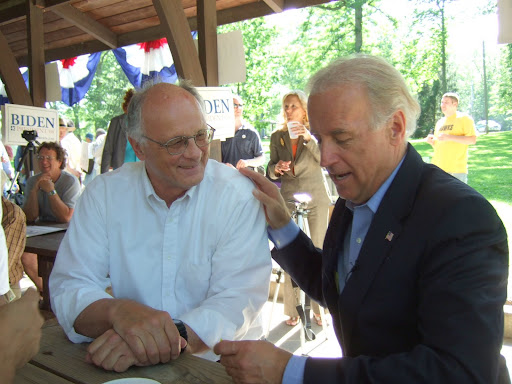 The big secret -- predicted by most knowledgeable observers and scheduled to be announced by "text message" to supporters later today -- was somehow leaked about 11:00 p.m. CT last evening, urgently text messaged at 2:00 a.m. this morning, and I was listening to the news coverage shortly thereafter.
Senator Biden is in my view a solid contribution to the ticket, someone I greatly respect and personally like, someone who could handle the presidency with skill if need be -- the last of which could be said of a number of the nine candidates in the very, very impressive Democratic Primary field this year.
Not incidentally, the timing really threw a curve ball to the conventional media, left to respond with little more than online editions and blogs. See, e.g., Chris Cillizza, "Obama Picks Biden as V.P.," Washington Post/The Fix Politics Blog, August 23, 2008, 6:17 a.m., and The Gazette's hard copy headline on the McClatchy story, "Obama keeps VP pick under wraps," August 23, 2008, p. A3.
Scheduling a major news release for 2:00 a.m. Saturday morning makes about as much sense as holding a presidential nominee's acceptance speech at 2:45 a.m. -- something I assume the Obama campaign is also hoping to avoid, though the parallels are spooky. Timothy Noah, "McGovern Redux," New York Times, November 11, 2007 ("Most regrettably, feminists’ spontaneous nomination of the Texas state legislator Sissy Farenthold for vice president forced a roll call that helped delay McGovern’s nomination acceptance speech until 2:45 a.m., thereby ensuring that almost no one would see it on television.").
Experience
A very strong argument can be made that "experience" is a neutral-to-negative when evaluating potential presidents (or vice presidents). And many of those taking this position note they need go no further for "Exhibit A" than our current president, George W. Bush (formerly a governor) -- and especially his Vice President Dick Cheney (President Ford's White House Chief of Staff; 6-term member of Congress and minority Whip; President George H.W. Bush's Secretary of Defense; CEO of Halliburton), and former Secretary of Defense Don Rumsfeld (President Ford's White House Chief of Staff; Secretary of Defense (1975-77); Ambassador to NATO; Member of Congress; Captain in U.S. Navy).
I disagree. I believe a breadth of experience -- as distinguished from what is sometimes described as the difference between "30 years experience, and one year's experience 30 times" -- can contribute to one's performance for a variety of reasons.
But when the very narrow "experience" of two persons, neither of whom has that breadth of experience, is being compared I think it's kind of silly to focus on "experience" at all.
Which is what I thought during the primary, think now when comparing Senators Obama and McCain, and when considering what the selection of Senator Joe Biden adds to Senator Obama's side of the balance scale of experience when it's weighed along side that of Senator McCain.
The following is an excerpt from my new book, Are We There Yet? Reflections on Politics in America, primarily focused on the contrast between the "experience" of Senators Clinton (who made it a major element of her qualifications) and Obama (who did not), but now of relevance to Senator Obama's choice of Senator Biden as well:
There’s little significant difference between Sens. Barack Obama and Hillary Clinton as lawyers who are well educated, thoughtful, widely informed and fully capable of formulating proposals on numerous topics. Both are articulate, though Obama has the charisma advantage.To repeat, I don't think a breadth of experience is a prerequisite to being president (or vice president). Someone can be perfectly well qualified to be president without it. Few of our presidents have had the breadth of experience of, say, President George H.W. Bush (the current president's father), or New Mexico Governor Bill Richardson. And many have done quite well without it.
But the experience qualifying someone to be president requires a lot more than having been married to one, proposing good ideas or world travel.
As someone who has served during the administrations of three presidents, I believe the presidency is one of the most complex administrative jobs imaginable.
There’s no perfect, qualifying “experience.” But two things can help.One is experience at administering large institutions: a federal cabinet-level department, a state government, military branch, major university or corporation.By these standards both Democrats and Sen. John McCain are unimpressive.
The other is the understanding and rapport earned by having worked in institutions with which a president must relate: city, county and state government; the federal executive, legislative, judicial and administrative branches; international organizations and embassies; labor unions and Wall Street, among others.
None has served as mayor or governor; none has headed a cabinet department; none has helped administer the Pentagon or CIA; none has worked for international organizations, been ambassador to the United Nations or a foreign country; none has been a union officer or corporate CEO. None has headed delegations negotiating with foreign governments over trade agreements, release of hostages or treaties.
Each has the “legislative experience” of making speeches and signing bills, though none as House speaker or Senate leader. McCain has 25 years in the U.S. House and Senate, Obama 12 years in the Illinois and U.S. senates and Clinton the least with eight years in the U.S. Senate.
McCain and Obama have little to no administrative experience, and Clinton’s record is spare and negative.
All I am saying is that if all (or most of) what one has ever done is to be a member of the United States Senate, given the range of experience that would be helpful for a president to have had, it's a little silly to talk about how "qualified" they are for the job based on that very narrow and limited experience, regardless of how long they've done it.
Clearly, Senator Biden brings "foreign policy" experience, with emphasis on "policy." He certainly has established relationships among many of the world's leaders. He's brighter, has better judgment, and is far more knowledgeable than Senator McCain on such matters. It's just that it's not the equivalent of having had responsibility for making the decisions, and administering the follow up, as Secretary of State or Defense, or even National Security Adviser to the President.
There were many reasons for President Lyndon Johnson's spectacular legislative accomplishments in 1964 -- among them the emotional impetus for the Congress and nation of President Kennedy's death and legacy. But a major factor was Johnson's having been majority leader of the Senate, from which position he had orchestrated that institution like a philharmonic conductor. He knew each of the senators well, and the culture and procedures of the institution even better.
Senator Biden has not been leader, but he has been a well-regarded member for some 35 years, ever since he was 29 years old. The nuances of legislative judgment he can bring to a President Obama Administration will be an enormous contribution, in some ways similar to those possessed by Lyndon Johnson.
So I think Senator Biden was a great choice for vice president. He will bring a lot to an Obama Administration. I just wish the campaigns and the commentators would stop talking about the relative "experience" of senators, none of whom have much breadth of experience to offer.
Defamation of Public Figures: Rethinking New York Times v. Sullivan
"Coast to Coast" is an all-night radio talk show on hundreds of stations (including 11 in Iowa alone), the preferred subjects for which somewhat resemble those of the now-defunct supermarket tabloid, Weekly World News.
For example, its Web site suggests listeners might be interested in the following . . .
Hot Stories for Sat., August 23, 2008Last evening the host devoted the first two opening hours of the show to what the Web site "Recap" (where the audio can be downloaded or streamed) reports as follows:
* Has Couple Found Formula To Win Lottery?
Husband, wife have each claimed $350,000 check this week. --WNBC
* Black hole star mystery 'solved'
Astronomers have shed light on how stars can form around a massive black hole, defying conventional wisdom. --BBC News
* Getting inside the minds of moviegoers
Brain scans can help Hollywood figure out how to make and market films. --LiveScience
* A Ghost in the White House!
Could the mysterious figure in a photo taken by Abbie Rowe of construction work in the White House be a ghost? --Mysterytopia
* Bigfoot tricksters blame hoax on promoter
Middleman has filed theft complaint against the men. --Atlanta Journal-Constitution
Berg vs. Obama LawsuitI don't mean to suggest that the host, and none of those who called the show, never challenged these assertions because rarely they did, but clearly Berg was given the bulk of the two hours to repeat and try to validate them.
Filling in for George [Noory], Ian Punnett welcomed Philip J. Berg, an attorney and self-professed Hillary Clinton supporter who has filed a lawsuit against Barack Obama, the Democratic National Committee, and several other parties. Berg contends that Sen. Obama is not a natural born U.S. citizen and, therefore, is not constitutionally eligible to run for the office of president.
According to Berg, Obama was born in Kenya and then a week later flown back to Hawaii where a certificate of live birth was filed (view certificate). Berg claims the birth record initially posted on the Obama campaign website is a forgery based on his half-sister's certificate. Berg also noted that Obama would have lost any American citizenship status he had when he moved to Indonesia with his mother and was adopted by his step-father.
Those who already are confident that Obama is a Muslim, and that the bulk of his contributions have come, illegally, from unidentified citizens of other countries, will undoubtedly be equally careless in sending emails to all of their friends with this "confirmation" that Obama is not even an American citizen.
Even I felt it necessary to check, going first to my all-purpose online urban legend fact-check site, http://snopes.com. "True or False"? Snopes says, and documents, "False." As it points out, anyone born in the United States is an American citizen, according to the Fourteenth Amendment to the Constitution ("all persons born . . . in the United States . . . are citizens of the United States."). Snopes also includes a link to the official Hawaii "Certification of Live Birth" ("prima facie evidence of the fact of birth in any court proceeding") that Obama was born in Honolulu, Oahu, Hawaii -- added to the United States as a state two years before Obama's birth ("21 August 1959 for statehood vs. 4 August 1961 for Obama's birthdate").
At common law, it was enough to win a defamation suit that the defendant's statement was false and resulted in harm to the plaintiff's reputation. It was not necessary to show that the defendant knew the statement was false, or intended to do the plaintiff harm. Indeed, newspaper stories merely repeating the statements of others could result in liability on the theory that, as the saying had it, "the repetition of a libel is a libel."
This all changed with the U.S. Supreme Court's decision in New York Times v. Sullivan, 376 U.S. 254 (1964) and its aftermath. Much has been, and can be, analyzed and written about that decision, but I'll save that for the classroom.
For our purposes it's enough to note that the Court approached the case as a First Amendment case rather than as a defamation case. Insofar as public officials are the plaintiffs, there is a risk of a "chilling effect" on the media's willingness to cover public officials, and government in general -- a central purpose of the First Amendment being the media's "checking value" and oversight of the worst of government's mistakes and corruption -- if they are fearful of multi-million-dollar defamation verdicts from juries not all that fond of the media anyway.
So public officials (and subsequently "public figures") must show more in a defamation case than you and I. They must show something called "actual malice" -- which, in the wondrous mystery of the law's vocabulary, has almost nothing to do with "malice" as we generally think of it. "Actual malice," as the Court used it, means that the public official plaintiff must show that the newspaper (or other speaker) either (1) knew that what they were saying was false, or (2) exhibited "reckless disregard" in pursuing ahead of time whether what they were communicating was, in fact, true or false.
This heightened "burden of proof," coupled with the disinclination of a public official to bring further media attention to false charges that harm his or her reputation, have contributed to the production of shows such as that with Philip J. Berg last evening, and the "negative campaign ads" that will only be accelerating between now and election day.
The question I pose is what, if anything, can and should be done about this phenomenon?
The most thorough and long-term solution would be to have an educational system such that anyone graduating from high school would reflexively ask the two basic questions regarding any assertion: "What do you mean?" and "How do you know?" The public would protest when newspapers publish mere criminal or other charges against someone before a trial or other proceeding is concluded or settled. Individuals would have far less interest in even hearing, let alone repeating, mere gossip; they would thoroughly check on the Internet and elsewhere before sending out by email or otherwise stories and assertions that will be harmful -- and almost impossible to effectively retract if false.
I don't hold out much hope that day will be arriving anytime soon.
Meanwhile, some newspapers and other media organizations do investigate, prepare and distribute a kind of truth check about negative campaign ads.
Snopes helps.
Campaigns can answer; I believe the Obama campaign has come out with both a Web site reponding to attacks, and a 40-page document responding to Jerome R. Corsi's screed, The Obama Nation.
But as others have noted as well, "Media damage, once done, can almost never be repaired; truth is a notoriously slow runner in its race with defamation."
Which brings me to at least ask, if not answer, the question: Do the rise and babble of cable television's shouting "chattering classes" repetition of politicians' "talking points," the increasing and increasingly sophisticated negative campaign ads, the unsupervised blogosphere and opportunity for anonymous over-the-top mean-spirited comments on newspapers' online stories as well, mass emails and posts to list-servs, text messaging and the other ways that defamation and other unhelpful untruths can be offered to everyone and spread at the speed of light, require a re-thinking of New York Times v. Sullivan?
To offer but one possibility: Might there be a value in either creating, or elevating the public's awareness of a pre-existing, institution charged with responding to public officials' (and candidates') concerns and complaints regarding what they believe to be defamatory, or otherwise false, charges? This would not involve the potentially "chilling" multi-million-dollar defamation suits against the mass media from which the Sullivan Court wished to protect the mass media. It would simply involve a Snopes-type investigation and widely publicized relatively authoritative findings as to where the truth lies. The effectiveness, and "enforcement," would simply be the social opprobrium heaped upon those engaged in reckless charges, or "swift-boating" their opponents.
Just an idea.


