Note: To put this piece in context, it is a response to an article in the Iowa City Press-Citizen: Holly Hines, "School Officials' Emails Raise Free Speech Concerns; First Amendment Experts Say Legal Threats May Amount to Intimidation," Iowa City Press-Citizen, June 24, 2017, p. A1. The story reported and discussed, among other things, that citizens were concerned that they might be sued if they criticized the Iowa City Community School District superintendent. (And see also, Holly Hines, "External Reviewer Sought for School District; Culture Concerning Whistleblowers is Under Investigation," Iowa City Press-Citizen, September 1, 2016, p. A1.)
Without expressing a view regarding the justification for the criticism, I thought a brief statement of the law of defamation might be useful -- as set forth below. Following Holly Hines story, and my explanation of defamation, the Press-Citizen editorial board published the following editorial: "Alter Culture of Fear in School District," Iowa City Press-Citizen, July 1, 2017, p. 7A (the Press-Citizen only publishes an opinion page on Wednesdays and Saturdays.) Here is my brief explanation on June 28th:
Is Superintendent Criticism 'Defamation'?
Nicholas Johnson
Iowa City Press-Citizen, June 28, 2017, p. 7A
There’s a local issue regarding limits on citizens’ criticism of school superintendents. Can the critics be sued for defamation?
I won’t take sides on whether the criticism is warranted. Moreover, social norms may be more relevant than “the law.” In either case, one’s reputation is a thing of value. [Citizen Julie VanDyke speaking to ICCSD School Board members; photo credit: Sandhya Dirks/Iowa Public Radio]
Not all criticism is defamatory. There must be an unambiguous, clearly false, factual statement (not just opinion), that causes measurable harm to one’s reputation among a relevant group (such as potential employers or customers).
The false assertion that a superintendent stole $97,000 from the schools’ playground fund could be defamation. Saying, “I think he’s doing a lousy job” would not be.
Moreover, the Supreme Court has ruled that while citizens need only show falsity, public officials must prove “that the statement was made ... with knowledge that it was false or with reckless disregard of whether it was false or not.” Why? Because protection of political speech lies at the heart of First Amendment guarantees.
As Justice Brenan wrote in New York Times v. Sullivan, “[we have] a profound national commitment to the principle that debate on public issues should be uninhibited, robust, and wide-open, and that it may well include vehement, caustic, and sometimes unpleasantly sharp attacks on government and public officials.”
This is for newspaper readers only, not legal advice. If you’re involved in a defamation case, get a lawyer.
Nicholas Johnson
Iowa City
# # #
November 6, 2008, 7:30 a.m.
OK, Now What?
Why I Did, and Will, Support President Obama
My enthusiasm about President-Elect Obama's victory is as great as anyone's -- with the possible exception of those African-Americans who are my age or older. My seven years in Austin, Houston, and traveling throughout the deep south during the 1950s were far from their lifetimes of oppression, but the environment and what I witnessed of the ravages of segregation and discrimination were enough to open this white Iowa boy's eyes and heart, and provide a little more meaning and force to my singing of "we shall overcome some day" during the 1960s. We haven't yet reached Dr. Martin Luther King's mountaintop, but at least it's now a lot closer than it's ever been.
Besides, law professors tend to favor as presidents former law review editors -- even if what they edited was the Harvard Law Review. I just hadn't thought there were enough law professors to get Senator Obama elected, but delighted to find out just how wrong I was.
Finally, I noted yesterday ("Global Election Results: 'The Whole World is Watching,'" November 5) the importance of our elections to the citizens throughout the world who will be affected by it, and the beginning of end of the harm that the last administration's rhetoric and actions have done to our standing in the world. (See, e.g., The Kenya Times' stories; and see bottom of blog entry for a very moving first-hand report.)
Every world citizen's best interests are served by hoping for President Obama's success and doing what they can to bring it about -- but that is multiples more true for those of us in this country who are in the best position to be supportive and helpful.
Having said all of the above, however, there is a difference between "supportive and helpful" and "unthinking cheerleading."
The Citizen's Duty to Criticize Government
The case of New York Times v. Sullivan, 376 U.S. 254 (1964), established the standard that public officials must meet in suing for defamation (that the defendant either knew his or her statement was false, or exhibited reckless disregard in ascertaining its truth). Justice Brennan, writing for the Supreme Court, noted the protection given public officials when they are sued for defamation (for example, for something said by a U.S. senator during a debate in the Senate). He continued, "Analogous considerations support the privilege for the citizen-critic of government. It is as much his duty to criticize as it is the official's duty to administer . . .."
Note that Justice Brennan is not just saying that we American citizens have a privilege to criticize government -- though of course we do -- he says that those who live in a country that was designed and is devoted to be governed by its citizens ("self-governing") have a duty to criticize their government.
Hopefully, this will be what we call "constructive criticism." Hopefully the critics will have learned somewhere along their educational path the difference between data, facts and the scientific method on the one hand, and opinion, inference, rumor, and ideology on the other. Hopefully they know that when obscenities or mean-spirited misrepresentations are hurled at officials they only reveal what is going on inside the speaker's head, rather than anything about the world outside.
That New York Times v. Sullivan protects some pretty awful political speech from defamation suits doesn't make it commendable citizenship.
President Obama as National Community Organizer-in-Chief
Don't get me wrong. My clear inclination is to believe that a President Obama will be speaking and acting out of a love of country, a superior intelligence, and desire to do what he believes to be in the best national interest. I believe that President Obama at his worst will be better than President George W. Bush at his best.
But my dream, my hope, is that he will be even better than that.
Based on the very first conversation I had with him, plus a number of his speeches since, my hope is that he will use us -- the 3.2 million contributors, the millions more of supporters whose email addresses he has, and such of the 64+ million who voted for him whom he can contact or otherwise motivate -- as the "community" for whom he is the "national community organizer." As the saying has it, "When the people lead their leaders will follow." Or, as President Roosevelt is said to have urged public interest advocates, "I totally agree with you; now you go out there and make me do it."
Part of what makes Washington "broken" (as even Senator John McCain would say), part of the reason Wall Street and K Street seem to have their way with the federal government, is that we -- you and I -- aren't "at the table" with the lobbyists and special interests to whom our local representatives and senators, as well as the White House, are too often beholden.
Without Us There is an Improbability of "Change"
Without a president who will encourage and enable our meaningful and effective participation it's not clear to me how we get from here to there, how "change" can be possible. "Reaching across the aisle," reaching for compromise, sounds good -- and is certainly better than Democrats and Republicans, or the legislative and executive branches, throwing rotten eggs at each other. But if the senator doing the reaching is heavily funded by, say, Big Pharma, and the hand he grabs is that of another senator heavily funded by Big Pharma, the result may improve legislative harmony but is unlikely to improve our access to health care.
So long as Big Pharma and Big Oil are drafting the legislation, and making the campaign contributions necessary to get it passed, on economic issues the next four years are going to look an awful lot like the last eight years.
As Common Cause finally learned after 30 years of trying, campaign finance reform legislation has to be passed by incumbents. And incumbents have little enthusiasm for changing a system that virtually guarantees the re-election of those incumbents who want to be re-elected. I see no indication that incumbents attitudes about this are going to change -- especially after witnessing the success of a presidential candidate who reversed course, rejected public financing, and sailed on to a $600 million victory.
So the only hope I see for meaningful change in the way Washington does business is for "the people to lead" -- hopefully with the encouragement, rather than the resistance, of the president who could be our "national community organizer."
When "Centrist" Becomes "Continuity" -- and Early Appointments
President Obama never promised to be, and has given us no indication of being, a populist or progressive. He offered little to no rhetoric of the Robert Kennedy variety regarding the needs of the poor (as distinguished from "the middle class"). He reversed his position on trade, and immunity for the telephone companies than illegally wiretapped their own American customers. He voted for the first $700 billion flawed bailout of Wall Street -- the source of much of his financial support. His healthcare proposal bears little similarity to the "universal, single-payer" systems of most industrialized nations; it retains the high administrative costs, CEO compensation, and corporate profits of the insurance and healthcare "industry."
I appreciate that there is a case to be made for continuity and against "change."
But to the extent you personally favor the notion of change one thing to keep an eye on are the early appointments. To the extent Bush's cabinet officers are kept on (Secretary of Defense Robert Gates has been mentioned in that connection along with keeping General General David Petraeus in place), or former Clinton officials are brought back (former Clinton Secretary of the Treasury Larry Summers has been mentioned for Treasury Secretary), that tends to suggest relatively more emphasis on continuity and less on change.
"Can't Tell the Players Without a Program": Clues From the Transition Team
Here are some names from the Washington Post of transition team members at this point to help you follow news from the personnel front as it unfolds (as many-to-most of them will presumably find their way into positions in the Administration after January 20).
Obama spent most of the day ensconced in a downtown office building where he held discussions with Vice President-elect Joseph R. Biden Jr.; John D. Podesta, who was President Bill Clinton's chief of staff; Rep. Rahm Emanuel (Ill.); and senior campaign advisers. . . .
Leading the Obama-Biden Transition Project are Podesta; Valerie Jarrett, a close friend of Obama's; and Pete Rouse, Obama's former Senate chief of staff. . . . Obama . . . is expected to name his chief of staff, most likely Emanuel, this week. . . .
After weeks of speculation about who might fill the Treasury post, financial industry and Obama sources said the list includes Timothy F. Geithner, president of the Federal Reserve Bank of New York, and Lawrence H. Summers, who was Treasury secretary at the end of the Clinton administration and has been a close adviser to Obama on the economy.
Geithner has been deeply involved in the government's response to the nation's economic crisis since it began in September. While he has extensive knowledge of the financial system, he is not as well known to Obama as is Summers.
Obama could also draw from his core economic team, which includes former Treasury secretary Robert E. Rubin, former Federal Reserve chairman Paul A. Volcker, and Laura D'Andrea Tyson, who chaired Clinton's Council of Economic Advisers. . . .
Others suggested the possibility of a less conventional pick, perhaps a Wall Street name such as Jamie Dimon, chief executive of J.P. Morgan Chase. . . .
Beyond the Podesta-led troika, a separate team, headed by Mark Gitenstein and Ted Kaufman, will guide the transition process for Biden.
A senior transition staff will oversee day-to-day activities: Chris Lu, Obama's legislative director, will serve as executive director. Campaign communications director Dan Pfeiffer will move into the same role for the transition. Stephanie Cutter, Michelle Obama's chief of staff, will serve as chief spokesperson. Obama friend and think tank executive Cassandra Q. Butts will serve as general counsel, a job that will include vetting job candidates for ethical conflicts. Campaign chief of staff Jim Messina will become personnel director. Phil Schiliro, a Capitol Hill veteran, will run congressional relations.
The transition team advisory committee includes numerous Clinton veterans and allies of Obama and Biden. One member key to the economic planning is Michael Froman, a former chief of staff to Rubin at the Treasury Department during the Clinton years and an Obama classmate at Harvard Law School.
Anne E. Kornblut and David Cho, "Obama Team Shifts to Transition Mode; Bush Extends Invitation, Calls Historic Election 'Uplifting,'" Washington Post, November 6, 2008, p. A1.
And see, Jim McElhatton, "Big-time Obama fundraisers to aid transition," Washington Times, November 6, 2008 (e.g., "Donald Gips, a former top aide to Vice President Al Gore who helped the Obama campaign raise at least $500,000, will serve on an advisory board overseeing the Obama transition" -- along with the names of many more, including Valerie Jarrett).
_____
Here is a letter from someone I do not know, shared with me by a friend, that reveals a good deal of what the election of President Obama is doing to improve our image abroad:
My dear friends,
Today I have had to travel from the island of Borneo...from SABAH and the town of Kota Kinabalu. Then to Kualam Lumpur where I had a 5 hour lay over and finally arriving very late at night in Bangkok. The election has already begun....
Today, in honor of the election, I am wearing an Obama '08 button on my lapel. If the treatment and reaction throughout my day is any indication of what our world might become....I am overwhelmed with optimism. First, every single place I went, someone noticed the button and called out, "OBAMA!". There were international administrators from across the region at the Hotel. Many of them nodded and smiled, and even the non-Americans who reacted with huge enthusiasm. One man from Australia stopped me to talk politics for 10 minutes. The crew working behind the desk all gave a thumbs up...the taxi driver did not charge me for taking me to the airport.
I must explain that, once at the airport, I am one of very few Americans among Asians from all over this region. I might possibly be the only blond in either airport I have been in so far today, and won't see many if any Americans until Bangkok. I do not speak the language...thank goodness they speak English.
Upon seeing my button, everyone, without exception, smiles. I have received preferential treatment all day long. They didn't make me pay extra for a heavy bag, they treated me in short, like royalty. The stewardess told the pilot, who stood up in the cock pit to give me a thumbs up. Even the immigration official barely looked at my passport. He was much more interested in knowing an Obama supporter and what I thought would happen today.
When I was buying dinner at a very American McDonalds (the only place to get something to eat), the entire crew behind the counter (not one American) came to say kind words to me. The man who exchanged my money asked how I could do anything so far away from the USA. I told him, with some amount of pride, that I had voted by absentee ballot. He took my hand and said, "thank you so much for voting for Mr. Obama." There were actual tears in his eyes.
While waiting at the airport in Kota Kinabalu and girl about 9 years old saw my button. She smiled broadly. I said hello and she asked if I wanted Obama to win because she did and her whole family did and that that morning they said a prayer that he would. I told her that I thought Barack would like that a girl all the way in Kota Kinabalu said a prayer for him. She asked could I tell him that they were praying for him and I said I would send an email to his headquarters. She was so excited that she ran to tell her parents. Her father came over and asked me if I knew Obama. I told him I had seen him speak, but never met him. He said that his whole community was praying for Obama and that he appreciated that I would write an email to tell him. He took my hand and said, we are praying for all of the American people too. This was the second stranger to take my hand today. It was my turn to have tears in my eyes, because this man, who I didn't know, was completely sincere. I thanked him. He said, "all of us, together...do you understand?" I said, "All of us together." We parted...smiling!
I write this as I sit in the airport at Kuala Lumpur waiting for hours for the plane. The women who guard the doors have on muslim headdresses, orange pants outfits and lime green jerseys. They are shy and reserved, yet they give me the thumbs up, and quietly whisper, "Obama" as I walk by. There are Thai and Chinese, and Indonesians and Indians surrounding me...The languages, dress, foods are all interesting. And sitting right next to me is a Buddhist monk, in just his orangish/yellow robes and shaved head. He smiles broadly when I look at him. He says frankly, "I like Obama."
The man behind the counter is Malaysian. He asks if I voted and when I confirm I have he laughs really loud and says something to the other official sitting next to him. This man laughs too. They both look at me intently. The one, fighting to find the right english begins, "This is (something in Malay). I smile saying I don't understand. He looks at his colleague and rattles something in Malay...The man says just a minute. He gets out a book. It is an english translation book. He says something to the man and hands him the book...pointing to a line on the page. The 1st man turns back to me and says..."this is fan/tas/a/tic...fan-tas-aahhh-tic...how do you say?" I tell him, yes, he is right "Fantastic". They laugh again at their attempts. I laugh too. He stamps everything forcefully, "wham! wham! wham!" And then he says something none of these officials ever take time to say, "We hope you will come back and visit our country!" "Of course, I say, of course." I don't quite know how to explain the full meaning of his invitation. Americans haven't been at the top of the list for quite awhile and traveling around, it isn't hard to sense.
Our leaders reflect who we are as a country/nation. I have always been proud of my family and Oregon. I have not always been proud of our leaders and the choices they make. Today I am proud...I am proud of our country and I was tearful watching a top French official trying to explain to the BBC reporter why the whole world is watching this election and praying that Obama will become our president.
Well, thank you for letting me share. Tomorrow at 7am we head to the American Embassy gathering to watch the election results come in. We are attending with world leaders and diplomats. We are to dress "smart casual". It should be quite the experience...one I hope brings new hope to our country and the world.
# # #
August 23, 2008, 6:00, 10:00 a.m.
Update, 2:30 p.m. CT: For one more reason why Senator Biden was a good choice, check out the Obama-Biden Rally in Springfield today, available from C-SPAN.org.
It's Senator Joe Biden
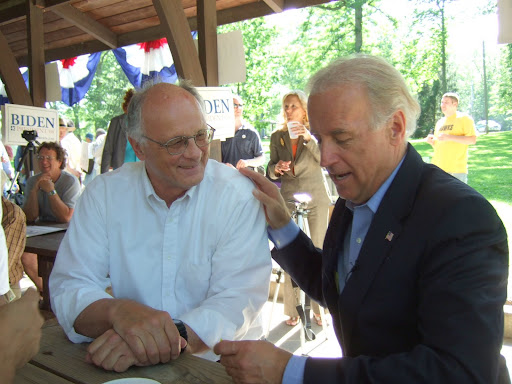 The big secret -- predicted by most knowledgeable observers and scheduled to be announced by "text message" to supporters later today -- was somehow leaked about 11:00 p.m. CT last evening, urgently text messaged at 2:00 a.m. this morning, and I was listening to the news coverage shortly thereafter.
Senator Biden is in my view a solid contribution to the ticket, someone I greatly respect and personally like, someone who could handle the presidency with skill if need be -- the last of which could be said of a number of the nine candidates in the very, very impressive Democratic Primary field this year.
Not incidentally, the timing really threw a curve ball to the conventional media, left to respond with little more than online editions and blogs. See, e.g., Chris Cillizza, "Obama Picks Biden as V.P.," Washington Post/The Fix Politics Blog, August 23, 2008, 6:17 a.m., and The Gazette's hard copy headline on the McClatchy story, "Obama keeps VP pick under wraps," August 23, 2008, p. A3.
Scheduling a major news release for 2:00 a.m. Saturday morning makes about as much sense as holding a presidential nominee's acceptance speech at 2:45 a.m. -- something I assume the Obama campaign is also hoping to avoid, though the parallels are spooky. Timothy Noah, "McGovern Redux," New York Times, November 11, 2007 ("Most regrettably, feminists’ spontaneous nomination of the Texas state legislator Sissy Farenthold for vice president forced a roll call that helped delay McGovern’s nomination acceptance speech until 2:45 a.m., thereby ensuring that almost no one would see it on television.").
Experience
A very strong argument can be made that "experience" is a neutral-to-negative when evaluating potential presidents (or vice presidents). And many of those taking this position note they need go no further for "Exhibit A" than our current president, George W. Bush (formerly a governor) -- and especially his Vice President Dick Cheney (President Ford's White House Chief of Staff; 6-term member of Congress and minority Whip; President George H.W. Bush's Secretary of Defense; CEO of Halliburton), and former Secretary of Defense Don Rumsfeld (President Ford's White House Chief of Staff; Secretary of Defense (1975-77); Ambassador to NATO; Member of Congress; Captain in U.S. Navy).
I disagree. I believe a breadth of experience -- as distinguished from what is sometimes described as the difference between "30 years experience, and one year's experience 30 times" -- can contribute to one's performance for a variety of reasons.
But when the very narrow "experience" of two persons, neither of whom has that breadth of experience, is being compared I think it's kind of silly to focus on "experience" at all.
Which is what I thought during the primary, think now when comparing Senators Obama and McCain, and when considering what the selection of Senator Joe Biden adds to Senator Obama's side of the balance scale of experience when it's weighed along side that of Senator McCain.
The following is an excerpt from my new book, Are We There Yet? Reflections on Politics in America, primarily focused on the contrast between the "experience" of Senators Clinton (who made it a major element of her qualifications) and Obama (who did not), but now of relevance to Senator Obama's choice of Senator Biden as well:
There’s little significant difference between Sens. Barack Obama and Hillary Clinton as lawyers who are well educated, thoughtful, widely informed and fully capable of formulating proposals on numerous topics. Both are articulate, though Obama has the charisma advantage.
But the experience qualifying someone to be president requires a lot more than having been married to one, proposing good ideas or world travel.
As someone who has served during the administrations of three presidents, I believe the presidency is one of the most complex administrative jobs imaginable.
There’s no perfect, qualifying “experience.” But two things can help.
One is experience at administering large institutions: a federal cabinet-level department, a state government, military branch, major university or corporation.
The other is the understanding and rapport earned by having worked in institutions with which a president must relate: city, county and state government; the federal executive, legislative, judicial and administrative branches; international organizations and embassies; labor unions and Wall Street, among others.
By these standards both Democrats and Sen. John McCain are unimpressive.
None has served as mayor or governor; none has headed a cabinet department; none has helped administer the Pentagon or CIA; none has worked for international organizations, been ambassador to the United Nations or a foreign country; none has been a union officer or corporate CEO. None has headed delegations negotiating with foreign governments over trade agreements, release of hostages or treaties.
Each has the “legislative experience” of making speeches and signing bills, though none as House speaker or Senate leader. McCain has 25 years in the U.S. House and Senate, Obama 12 years in the Illinois and U.S. senates and Clinton the least with eight years in the U.S. Senate.
McCain and Obama have little to no administrative experience, and Clinton’s record is spare and negative.
To repeat, I don't think a breadth of experience is a prerequisite to being president (or vice president). Someone can be perfectly well qualified to be president without it. Few of our presidents have had the breadth of experience of, say, President George H.W. Bush (the current president's father), or New Mexico Governor Bill Richardson. And many have done quite well without it.
All I am saying is that if all (or most of) what one has ever done is to be a member of the United States Senate, given the range of experience that would be helpful for a president to have had, it's a little silly to talk about how "qualified" they are for the job based on that very narrow and limited experience, regardless of how long they've done it.
Clearly, Senator Biden brings "foreign policy" experience, with emphasis on "policy." He certainly has established relationships among many of the world's leaders. He's brighter, has better judgment, and is far more knowledgeable than Senator McCain on such matters. It's just that it's not the equivalent of having had responsibility for making the decisions, and administering the follow up, as Secretary of State or Defense, or even National Security Adviser to the President.
There were many reasons for President Lyndon Johnson's spectacular legislative accomplishments in 1964 -- among them the emotional impetus for the Congress and nation of President Kennedy's death and legacy. But a major factor was Johnson's having been majority leader of the Senate, from which position he had orchestrated that institution like a philharmonic conductor. He knew each of the senators well, and the culture and procedures of the institution even better.
Senator Biden has not been leader, but he has been a well-regarded member for some 35 years, ever since he was 29 years old. The nuances of legislative judgment he can bring to a President Obama Administration will be an enormous contribution, in some ways similar to those possessed by Lyndon Johnson.
So I think Senator Biden was a great choice for vice president. He will bring a lot to an Obama Administration. I just wish the campaigns and the commentators would stop talking about the relative "experience" of senators, none of whom have much breadth of experience to offer.
Defamation of Public Figures: Rethinking New York Times v. Sullivan
"Coast to Coast" is an all-night radio talk show on hundreds of stations (including 11 in Iowa alone), the preferred subjects for which somewhat resemble those of the now-defunct supermarket tabloid, Weekly World News.
For example, its Web site suggests listeners might be interested in the following . . .
Hot Stories for Sat., August 23, 2008
* Has Couple Found Formula To Win Lottery?
Husband, wife have each claimed $350,000 check this week. --WNBC
* Black hole star mystery 'solved'
Astronomers have shed light on how stars can form around a massive black hole, defying conventional wisdom. --BBC News
* Getting inside the minds of moviegoers
Brain scans can help Hollywood figure out how to make and market films. --LiveScience
* A Ghost in the White House!
Could the mysterious figure in a photo taken by Abbie Rowe of construction work in the White House be a ghost? --Mysterytopia
* Bigfoot tricksters blame hoax on promoter
Middleman has filed theft complaint against the men. --Atlanta Journal-Constitution
Last evening the host devoted the first two opening hours of the show to what the Web site "Recap" (where the audio can be downloaded or streamed) reports as follows:
Berg vs. Obama Lawsuit
Filling in for George [Noory], Ian Punnett welcomed Philip J. Berg, an attorney and self-professed Hillary Clinton supporter who has filed a lawsuit against Barack Obama, the Democratic National Committee, and several other parties. Berg contends that Sen. Obama is not a natural born U.S. citizen and, therefore, is not constitutionally eligible to run for the office of president.
According to Berg, Obama was born in Kenya and then a week later flown back to Hawaii where a certificate of live birth was filed (view certificate). Berg claims the birth record initially posted on the Obama campaign website is a forgery based on his half-sister's certificate. Berg also noted that Obama would have lost any American citizenship status he had when he moved to Indonesia with his mother and was adopted by his step-father.
I don't mean to suggest that the host, and none of those who called the show, never challenged these assertions because rarely they did, but clearly Berg was given the bulk of the two hours to repeat and try to validate them.
Those who already are confident that Obama is a Muslim, and that the bulk of his contributions have come, illegally, from unidentified citizens of other countries, will undoubtedly be equally careless in sending emails to all of their friends with this "confirmation" that Obama is not even an American citizen.
Even I felt it necessary to check, going first to my all-purpose online urban legend fact-check site, http://snopes.com. "True or False"? Snopes says, and documents, "False." As it points out, anyone born in the United States is an American citizen, according to the Fourteenth Amendment to the Constitution ("all persons born . . . in the United States . . . are citizens of the United States."). Snopes also includes a link to the official Hawaii "Certification of Live Birth" ("prima facie evidence of the fact of birth in any court proceeding") that Obama was born in Honolulu, Oahu, Hawaii -- added to the United States as a state two years before Obama's birth ("21 August 1959 for statehood vs. 4 August 1961 for Obama's birthdate").
At common law, it was enough to win a defamation suit that the defendant's statement was false and resulted in harm to the plaintiff's reputation. It was not necessary to show that the defendant knew the statement was false, or intended to do the plaintiff harm. Indeed, newspaper stories merely repeating the statements of others could result in liability on the theory that, as the saying had it, "the repetition of a libel is a libel."
This all changed with the U.S. Supreme Court's decision in New York Times v. Sullivan, 376 U.S. 254 (1964) and its aftermath. Much has been, and can be, analyzed and written about that decision, but I'll save that for the classroom.
For our purposes it's enough to note that the Court approached the case as a First Amendment case rather than as a defamation case. Insofar as public officials are the plaintiffs, there is a risk of a "chilling effect" on the media's willingness to cover public officials, and government in general -- a central purpose of the First Amendment being the media's "checking value" and oversight of the worst of government's mistakes and corruption -- if they are fearful of multi-million-dollar defamation verdicts from juries not all that fond of the media anyway.
So public officials (and subsequently "public figures") must show more in a defamation case than you and I. They must show something called "actual malice" -- which, in the wondrous mystery of the law's vocabulary, has almost nothing to do with "malice" as we generally think of it. "Actual malice," as the Court used it, means that the public official plaintiff must show that the newspaper (or other speaker) either (1) knew that what they were saying was false, or (2) exhibited "reckless disregard" in pursuing ahead of time whether what they were communicating was, in fact, true or false.
This heightened "burden of proof," coupled with the disinclination of a public official to bring further media attention to false charges that harm his or her reputation, have contributed to the production of shows such as that with Philip J. Berg last evening, and the "negative campaign ads" that will only be accelerating between now and election day.
The question I pose is what, if anything, can and should be done about this phenomenon?
The most thorough and long-term solution would be to have an educational system such that anyone graduating from high school would reflexively ask the two basic questions regarding any assertion: "What do you mean?" and "How do you know?" The public would protest when newspapers publish mere criminal or other charges against someone before a trial or other proceeding is concluded or settled. Individuals would have far less interest in even hearing, let alone repeating, mere gossip; they would thoroughly check on the Internet and elsewhere before sending out by email or otherwise stories and assertions that will be harmful -- and almost impossible to effectively retract if false.
I don't hold out much hope that day will be arriving anytime soon.
Meanwhile, some newspapers and other media organizations do investigate, prepare and distribute a kind of truth check about negative campaign ads.
Snopes helps.
Campaigns can answer; I believe the Obama campaign has come out with both a Web site reponding to attacks, and a 40-page document responding to Jerome R. Corsi's screed, The Obama Nation.
But as others have noted as well, "Media damage, once done, can almost never be repaired; truth is a notoriously slow runner in its race with defamation."
Which brings me to at least ask, if not answer, the question: Do the rise and babble of cable television's shouting "chattering classes" repetition of politicians' "talking points," the increasing and increasingly sophisticated negative campaign ads, the unsupervised blogosphere and opportunity for anonymous over-the-top mean-spirited comments on newspapers' online stories as well, mass emails and posts to list-servs, text messaging and the other ways that defamation and other unhelpful untruths can be offered to everyone and spread at the speed of light, require a re-thinking of New York Times v. Sullivan?
To offer but one possibility: Might there be a value in either creating, or elevating the public's awareness of a pre-existing, institution charged with responding to public officials' (and candidates') concerns and complaints regarding what they believe to be defamatory, or otherwise false, charges? This would not involve the potentially "chilling" multi-million-dollar defamation suits against the mass media from which the Sullivan Court wished to protect the mass media. It would simply involve a Snopes-type investigation and widely publicized relatively authoritative findings as to where the truth lies. The effectiveness, and "enforcement," would simply be the social opprobrium heaped upon those engaged in reckless charges, or "swift-boating" their opponents.
Just an idea.
# # #


