Tuesday, September 26, 2023

Paving Paradise

Paving Paradise at the Expense of Trees
Nicholas Johnson
The Gazette, September 26, 2023, p. A6

“They paved paradise
And put up a parking lot”
If you’re close to my age you’ll remember those lines from Joni Mitchell’s 1970 song, “Big Yellow Taxi.”

They came to me recently during my morning walk past a recently significantly expanded University of Iowa parking lot in what used to be a neighborhood of families, trees and wilderness enjoyed by all.


When it comes to the changes, as with so many other decisions, “it’s all about the money.” The rental income from a house full of students totals more than what a family can afford. And apparently somebody thought the income from 130 additional parking spaces would be well worth the loss of 30 trees (roughly four parking spaces per tree). [Photo source: Nicholas Johnson]
"They took all the trees
Put 'em in a tree museum”
And so it came to pass that, without notice to neighbors (of which I’m aware), 30 trees were sawed into pieces, dug out, carried away and replaced with cars.

Those of us living in Cedar Rapids and Iowa City, our public officials and local organizations, have long been recognized for our understanding of trees’ importance. Cedar Rapids’ well-deserved recent $6 million federal grant is evidence of national recognition of our accomplishments.

The more we continue to learn about trees, like other seeming miracles of Nature (such as Brittney Miller’s recent page one turtles story), the humbler we should become.

Trees ancestry goes back 400 million years when ferns developed a vascular system enabling water and minerals to go up from the roots to the leaves, and food to go down from the leaves to the roots. From 200 to 56 million years ago there appeared ginkgo and pine, and ultimately maple and oak.

Trees can’t talk, but apparently they can communicate with, and care for, each other, sometimes over long distances, sending warnings of threats and sharing food (with mother trees favoring their offspring). If only Congress could do as well.

During World War II there was a saying, “Don’t just stand there, do pushups or something.” Well, trees don’t “just stand there.” They are a major ally in fighting climate change, each absorbing about 350 pounds of CO2 annually.

I have to monitor the Air Quality Index. Trees improve it by trapping particulate pollution on leaves and bark.

They produce oxygen. They help cool in summer and warm in winter by as much as 30 to 40 degrees, reducing air conditioning and heating bills. They improve our physical and mental health. They can reduce flooding, capturing 5,000 gallons a year.

And for those who still think “it’s all about the money,” trees can help attract businesses and tourists, and increase your property’s value by up to 15 percent.

For now, keep your eye on the expanding “tiny forest” movement.

Clearly, more parking spaces and fewer trees are not the answer.
“Don't it always seem to go
That you don't know what you've got
Till it's gone”
Nicholas Johnson enjoys living under a large canopy of trees. Contact: mailbox@nicholasjohnson.org

SOURCES
Joni Mitchell. Joni Mitchell, “Big Yellow Taxi” lyrics,” Jan. 7, 1970, https://jonimitchell.com/music/song.cfm?id=13 (“They paved paradise/And put up a parking lot/. . . They took all the trees/Put 'em in a tree museum/. . . Don't it always seem to go/That you don't know what you've got/Till it's gone”)

More rental from students than families. Karen Black, “The Role Student Housing Plays in Communities; Off-campus housing for college students has grown extensively over the last decade, and communities across the country are hoping to gain control over its spread and potential negative impact on neighborhoods and available affordable housing,” Shelterforce, Sept. 6, 2019, https://shelterforce.org/2019/09/06/the-role-student-housing-plays-in-communities/ (“For landlords, student rentals are an incredibly lucrative real estate opportunity as students pay by the room, allowing landlords to charge more per square foot as there are several roommates paying a monthly rent. As a website for real estate investors recently noted, “a home that might rent for $1,000 a month to a single family could be rented by the room for nearly twice that.” In addition students sign one-year leases so rents can be raised each year if the market allows. For neighbors, student housing can be disruptive as students keep different hours and enjoy different activities than their neighbors, such as late-night parties. And for real estate markets near college campuses, student housing can be transformative as investor capital competes with homeowners, making it so sale prices and rents increase. Local governments in college towns across the country are adopting proactive strategies to gain a measure of control over the spread of student housing and limit any negative impact on real estate markets and affordable housing stock supply near college and university campuses.”)

30 Trees, 130 parking spaces. These numbers are from my own counts and confirming re-counts.

Cedar Rapids/Iowa City awards for trees. “City of Cedar Rapids: Tree City USA Recipient,” Cedar-Rapids.org, April 19, 2023, https://www.cedar-rapids.org/news_detail_T6_R1936.php (“The City of Cedar Rapids was recently honored with the 2022 Tree City USA Award at the 32nd Annual Community Forestry Awards Luncheon in Ankeny. The award was presented by the Arbor Day Foundation and the Iowa Department of Natural Resources April 12 at the FFA Enrichment Center in Ankeny. Cedar Rapids has been a Tree City USA award winner for the past 45 years, longer than any other city in the state.

"Native Tree Restoration Initiative," Monarch Research, Marion, Iowa, "Planting Forward 2021-23 Participation Overview 092023.pdf (180 woodlands, 96 schools, 49 organizations, 5 municipalities, 4 colleges)

“Iowa City Named Tree City USA Once Again,” ICGov.org, April 23, 2023, https://www.icgov.org/Home/Components/News/News/301/390, (“Iowa City has once again been named a Tree City USA by the Arbor Day Foundation in honor of its commitment to effective urban forest management.

The Arbor Day Foundation is a million-member nonprofit conservation and education organization with the mission to inspire people to plant, nurture, and celebrate trees.

Iowa City achieved its 43rd Tree City USA recognition by meeting the program's four requirements: a tree board or department, a tree care ordinance, an annual community forestry budget of at least $2 per capita, and an Arbor Day observance and proclamation.

The City also received a Tree City USA Growth Award for demonstrating environmental improvement and an outstanding level of tree care.

Tyler Baird, Iowa City Forestry Superintendent, said: “Iowa City Forestry staff are committed to providing a healthy and sustainable urban forest for the benefit and enjoyment of all residents and visitors. The Tree City USA designation highlights this commitment to planting and caring for trees in our community.”)

Cedar Rapids federal tree grant. Marissa Payne, “In USDA’s $1.1 billion investment in tree planting, Cedar Rapids’ ReLeaf reforestation effort awarded $6 million; Iowa communities, Department of Natural Resources receive $15.7 million through Forest Service grants,” The Gazette, Sept. 15, 2023, https://www.thegazette.com/federal-government/in-usdas-1-1-billion-investment-in-tree-planting-cedar-rapids-releaf-reforestation-effort-awarde/ (“In a move to expand equitable access to trees and green spaces nationwide, U.S. Agriculture Secretary Tom Vilsack on Thursday announced an award of $6 million toward Cedar Rapids’ effort to reforest the city after the 2020 derecho toppled most of the city’s tree canopy.”)

Brittney Miller’s turtles. Brittney J. Miller, “”Turtles Have Personalities – Which Could Help Them Survive; Coe Study Shows Ornate Box Turtles Behave Differently,” The Gazette, Sept. 14, 2023, p. 1, https://www.thegazette.com/environment-nature/a-threatened-turtle-species-has-personality-knowing-that-could-help-them-survive/

Trees’ history. “A Brief History of Trees,” Trees Charlotte, April 20, 2021, https://treescharlotte.org/tree-education/a-brief-history-of-trees/ (“400 million years ago: Fossil records of the first tree-like plants appear, such as lycophytes, ferns, and horsetails. These types of plants did not have seeds yet, but were the first to have vascular systems, . . .. 200 million years ago: Evidence of the first ginkgo trees. 150 million years ago: Evidence of the first pine trees. . . . 67 million years: Evidence of the first maple trees. 56 million years ago: Evidence of the first oak trees.”

“Phloem and xylem: Difference in a plant’s vascular system, explained,” Britannica, https://www.britannica.com/video/152186/components-plant-vascular-system

Talking Trees. Richard Grant, “Do Trees Talk to Each Other? A controversial German forester says yes, and his ideas are shaking up the scientific world,” Smithsonian Magazine, March 2018, https://www.smithsonianmag.com/science-nature/the-whispering-trees-180968084/ (“I’m walking in the Eifel Mountains in western Germany, through cathedral-like groves of oak and beech, and there’s a strange unmoored feeling of entering a fairy tale. The trees have become vibrantly alive and charged with wonder. They’re communicating with one another, for starters. They’re involved in tremendous struggles and death-defying dramas. To reach enormousness, they depend on a complicated web of relationships, alliances and kinship networks.

Wise old mother trees feed their saplings with liquid sugar and warn the neighbors when danger approaches. Reckless youngsters take foolhardy risks with leaf-shedding, light-chasing and excessive drinking, and usually pay with their lives. Crown princes wait for the old monarchs to fall, so they can take their place in the full glory of sunlight. It’s all happening in the ultra-slow motion that is tree time, so that what we see is a freeze-frame of the action.

My guide here is a kind of tree whisperer. Peter Wohlleben, a German forester and author, has a rare understanding of the inner life of trees, and is able to describe it in accessible, evocative language. . . . Now, at the age of 53, he has become an unlikely publishing sensation. His book The Hidden Life of Trees: What They Feel, How They Communicate, written at his wife’s insistence, sold more than 800,000 copies in Germany, and has now hit the best-seller lists in 11 other countries, including the United States and Canada. . . .

A revolution has been taking place in the scientific understanding of trees, and Wohlleben is the first writer to convey its amazements to a general audience. The latest scientific studies . . . confirm . . .: Trees are far more alert, social, sophisticated—and even intelligent—than we thought.

[A] substantial body of scientific evidence . . . shows . . . that trees of the same species are communal, and will often form alliances with trees of other species. Forest trees have evolved to live in cooperative, interdependent relationships, maintained by communication and a collective intelligence similar to an insect colony.

Wohlleben [says], “All the trees here . . . are connected to each other through underground fungal networks. Trees share water and nutrients through the networks, and also use them to communicate. They send distress signals about drought and disease, for example, or insect attacks, and other trees alter their behavior when they receive these messages.” . . . To communicate through the network, trees send chemical, hormonal and slow-pulsing electrical signals, which scientists are just beginning to decipher. . . .

When a giraffe starts chewing acacia leaves, the tree notices the injury and emits a distress signal in the form of ethylene gas. Upon detecting this gas, neighboring acacias start pumping tannins into their leaves. In large enough quantities these compounds can sicken or even kill large herbivores.”)

Do pushups or something. Google can find no source for the saying, so I guess the default source is going to have to be “just a memory from childhood.”

Benefits of trees. “We Need Trees and here’s why . . .,” Forestry & Natural Resources, Purdue University, (no date), https://www.purdue.edu/fnr/extension/we-need-trees-and-heres-why/ (“Here are some easy ways in which urban trees and woodlots contribute to making cities more environmentally sustainable and livable:

• Trees can contribute to the increase of local food and nutrition security, providing food such as fruits and nuts for wildlife and human consumption.
• Trees play an important role in increasing urban biodiversity, providing plants and animals with a proper habitat, food and protection.
• A mature tree can absorb up to 350 lbs. of CO2 per year. As a result, trees play an important role in climate change mitigation. In cities with high levels of pollution, trees can improve air quality making cities healthier places to live in.
• Strategic placement of trees in cities can help to cool the air between 30-40o F, thus reducing the urban “heat island” effect, helping reduce extreme heat conditions in summer weather.
• Large trees are great biological filters for urban pollutants and particulate pollution. They absorb pollutant gases (such as carbon monoxide, nitrogen oxides, ozone and Sulphur oxides) and filter fine particulates such as dust, dirt, or smoke out of the air by trapping them on leaves and bark.
• Research shows that living in close proximity of urban green spaces and having access to them, can improve physical and mental health, for example by decreasing high blood pressure and stress. Also, research indicates greatly improved neo-natal health as well. This, in turn, contributes to the well-being of urban communities.
• Mature trees regulate water flow and play a key role in preventing floods and reducing the risk of sewer overflow. Stormwater management is a crucial city infrastructure issue and trees help. A mature tree, for instance, can intercept more than 5,000 gallons of water per year and without trees, every rain would contribute floods.
• Trees also help to reduce carbon emissions by helping to conserve energy. For example, the correct placement of trees around buildings can reduce the need for air conditioning by 30 percent and reduce winter heating bills by 20-50 percent.
• Planning urban landscapes with trees can increase property value, by up to 15 percent, and attract tourism and business.

“Arbor Day Foundation Announces Planting Locations for 20 Million Trees Jan. 10, 2020; After YouTube's largest-ever crowdfunding campaign raised $20 million in just 56 days, the Arbor Day Foundation is kicking off tree planting around the globe,” T&D World, Jan. 10, 2020, https://www.tdworld.com/vegetation-management/article/21120273/arbor-day-foundation-announces-planting-locations-for-20-million-trees (“T&D=Transmission and Distribution -- “Dan Lambe, president of the Arbor Day Foundation. "Now, the Arbor Day Foundation will do what we do best: ensure that 21.5 million trees are planted in the right places and at the right time." With more than 500,000 unique #TeamTrees donors from at least 200 countries, the first wave of planting was designed to ensure that every continent except Antarctica was supported.” Graphuc: #TeamTrees Thank you for helping to plant 20 million trees! Based on a U.S. Forest Service analysis, these trees will: • Remove 115,000 tons of chemical air pollution, enough gaseous pollution to fill 14,000 Goodyear blimps. • Absorb and store 1.6 million tons of carbon, the equivalent of taking 1.24 million cars off the road for a year. • Result in 1.5 billion cubic meters (400 billion gallons) of avoided water runoff, the equivalent of filling the water bottle of every person on Earth every day for a year.

[One cubic meter is 35.3147 cubic feet; 7.48052 gallons in a cubic foot = 396,258,479,000 gallons c. 400 billion gallons] Arbor Day Foundation, https://www.arborday.org

“Biden-Harris Administration announces historic funding to expand access to trees and green spaces in disadvantaged urban communities,” USDA Press Release, Newark, NJ, April 12, 2023, https://www.fs.usda.gov/news/releases/biden-harris-administration-announces-historic-funding-expand-access-trees-and-green (“Research shows that trees and green spaces improve physical and mental health outcomes and create new economic opportunities,” said USDA Undersecretary for Natural Resources and the Environment Dr. Homer Wilkes. “They also enhance community green spaces and support lasting community relationships and engagements. These funds will enable us to bring these benefits to disadvantaged communities across the nation, and to support new partnerships with a diverse array of organizations.”” “John Podesta, Senior Advisor to the President for Clean Energy Innovation and Implementation. “It’s about cleaning up the air we breathe, keeping city streets cool during sweltering summers, and creating safer, healthier neighborhoods for our kids.” “Since my days as Mayor of Newark, I have seen the transformative impact that planting trees can have for urban communities,” said Sen. Booker. “Studies have shown that trees save families money in heating and cooling costs, reduce air and water pollution, decrease the risk of respiratory illnesses like asthma, reduce flooding, and protect people from extreme heat.” “Investing in our urban forests is investing in the health and wellness of our communities,” said Forest Service Chief Randy Moore. “Trees provide numerous benefits, like improving air quality, reducing stormwater runoff, providing shade, creating safe outdoor spaces for recreation, and stimulating other kinds of investments.”)

“Throwing Shade: Exploring the Benefits of Trees,” U.S. Environmental Protection Agency, May 6, 2020, https://www.epa.gov/sciencematters/throwing-shade-exploring-benefits-trees (“Corvallis, Oregon. Impacts included reductions in four air pollutants, (O3, NO2, SO2, PM10), carbon sequestration, decreased stormwater runoff, building energy savings due to shading, and (thanks to city trees), increased real estate values.”)

Trees Forever, https://treesforever.org/ and https://treesforever.org/resources/ and https://treesforever.org/document/why-trees-matter/ (“Benefits such as energy conservation, improved air and water quality, increased property values and economic vitality, improved health and well-being, habitat improvement and more!”) (“Trees Are Our Hardest Working Residents” stormwater reduction, property value increase, energy savings, air quality improvement, CO2 reduction)

Dustin Renwick, “How one city plans to recover from losing most of its trees; Tens of thousands of trees in Cedar Rapids, Iowa, were destroyed by a devastating summer windstorm. That has meant heartache for city residents, but also opportunity to replant stronger,” National Geographic, Dec. 10, 2020, https://www.nationalgeographic.com/environment/article/how-one-city-plans-to-recover-from-losing-all-of-its-trees (80,000 trees; “Estimates of how much trees save in U.S. electricity costs range from $1 billion to $4.7 billion. The more conservative number comes from a study by Rob McDonald, lead scientist for nature-based solutions at The Nature Conservancy.” “Urban forests don’t just block sun, they also intercept rain -- it’s why the sidewalk under a sprawling hickory remains dry during a light shower. Tree roots prevent soil from moving as rainwater rushes across it, and leaves and branches keep rainfall from slamming into unprotected hillsides or impervious surfaces like parking lots and streets. When rain batters those areas, it erodes soil and often collects a mix of toxins, carrying them into streams and rivers. With so many trees gone, millions more gallons of polluted stormwater will enter the Cedar Rapids watershed.”)

Trees increase property values. “We Need Trees and here’s why . . .,” Forestry & Natural Resources, Purdue University, (no date), https://www.purdue.edu/fnr/extension/we-need-trees-and-heres-why/ (“Planning urban landscapes with trees can increase property value, by up to 15 percent, and attract tourism and business.”)

Tiny Forests. Cara Buckley, “Tiny Forests With Big Benefits; Native plants crowded onto postage-stamp-size plots have been delivering environmental benefits around the world — and, increasingly, in the U.S.,” New York Times, Aug. 26, 2023, https://www.nytimes.com/2023/08/24/climate/tiny-forests-climate-miyawaki.html (“[“Tiny forests” are] a sweeping movement that is transforming dusty highway shoulders, parking lots, schoolyards and junkyards worldwide. Tiny forests have been planted across Europe, in Africa, throughout Asia and in South America, Russia and the Middle East. India has hundreds, and Japan, where it all began, has thousands.

Now tiny forests are slowly but steadily appearing in the United States. In recent years, they’ve been planted alongside a corrections facility on the Yakama reservation in Washington, in Los Angeles’s Griffith Park and in Cambridge, where the forest is one of the first of its kind in the Northeast.”)

# # #

Tuesday, September 12, 2023

Football Solutions

A Win-Win Plan for College Football
Nicholas Johnson
The Gazette, September 12, 2023, p. A6

College football began with problems. Excessive injuries prompted President Teddy Roosevelt to insist coaches require helmets – and the NCAA was born.

By 1939, University of Chicago President Robert Hutchins abolished football. Another university president told me: “I have always considered football an anomaly.”


The Hawkeyes have had their share of football-related challenges. Senator Chuck Grassley thought football shouldn’t have a non-profit charity’s tax-exempt status. A strength assistant coach overdid it and players were hospitalized. Suggesting Iowa’s taxpayers pay half the settlement to Black players alleging coaches’ racism. Letting nepotism send the Hawkeye’s offensive team to the national basement. Early ties to the gambling casino in Riverside. This year’s players betting on sports and the Big Ten roster going to 18, as teams share $7 billion from TV. [Photo credit: Nicholas Johnson. Electronic "billboard" inside Kinnick Stadium advertising/promoting the Riverside gambling casino.]

Football coaches are the highest paid public employees in 40 states. The total for Iowa’s top six assistant coaches’ salaries is $5,075,000. Second highest is the head coach’s son. Dad gets $7 million. Academic salaries? Name me a UI college where the dean gets $7 million and the department heads earn between $500,000 and one million plus. Which academic among them can walk into the UI president’s office, ask for a loan, and walk out with $50 million?

Conflicts of interest abound. University presidents weigh courage against capitulation. Athletic directors must consider both profits and propriety when offered alcohol or gambling industry dollars. Coaches must encourage players’ academics while coaches’ salaries reflect players’ on-field performance. Non-tenured professors fear retribution for flunking players. Players who do seek education may have to choose between lab time or scheduled practice.

No, the reality is college football has become a multi-billion-dollar industry, the NFL’s farm clubs. Some players dream of a big-bucks future, though only 1.6 percent will make the NFL -- while suppressing the nightmares of an average 3.3-year career and lifetime injuries.


So long as parents and players accept the injury risks, and fans accept football’s cost in time and money, there will be football. Like the pig in the parlor, it just needs to be moved. [Photo source unknown.]

Here is a win-win solution. Recognize football as the big money entertainment industry it is. Let "Hawkeyes" lease the Kinnick Stadium, related land and structures, housing, the “Hawkeyes” name, and associated assets at going commercial rates.

The university would be freed of conflicts of interest and embarrassments, and the for-profit team would be freed of academic restrictions. Its board of directors could hire and pay its coaches and players whatever they negotiated.

Stop insisting players pretend to be students. Offer a spring-semester-only option.

Would the University need more money? Maybe. But “revenue is needed” should never rule decisions. It’s a sign your moral compass is spinning as if at the North Pole.

Iowa’s not the only football-challenged school. Now that college conferences are expanding nationally other schools may consider this move.

Any lesser separation of academy and football will only perpetuate the frustrations, conflicts, restrictions and embarrassments for teams and schools alike.

Nicholas Johnson watches football games and formerly taught sports law. Contact: mailbox@nicholasjohnson.org

SOURCES
President Teddy Roosevelt. Weiler, et al, Sports and the Law, 4th ed., 1993, p. 747. (“The NCAA was formed in 1906, when a former Harvard college football player, President Theodore Roosevelt, summoned leading university presidents to the White House and told them that unless they made that game safe – it was annually killing 15 to 20 players and permanently disabling another 150 or so – he was going to have to use the law to shut the game down. The schools reluctantly agreed to create a forum to reshape football, by placing helmets on the players and eliminating such dangerous tactics as the ‘flying wedge.’ The organization they formed became the NCAA.”)

Robert Hutchins. “Robert Maynard Hutchins, 1929-1951,” University of Chicago, https://president.uchicago.edu/about-the-office/history/robert-maynard-hutchins (“The one thing which drew more attention than any other, of course, was his [Hutchins’] elimination of varsity football. Hutchins heaped scorn upon schools which received more press coverage for their sports teams than for their educational programs, and a run of disastrous seasons gave him the trustee support he needed to drop football in 1939. The decision was hailed by many, but few other schools followed Chicago's lead.)

Senator Grassley. Dean Treftz, “Sports Donors Under Review,” The Daily Iowan, Jan. 29, 2007, https://www.nicholasjohnson.org/BlogStuf/regents/dtdi0129.html (“Prompted by high-profile stories of lucrative salaries for collegiate coaches as tuition continues to rise nationwide, Sen. Charles Grassley, R-Iowa, is investigating the role that tax-deductible contributions play in university athletics.

Specifically, Grassley - the ranking Republican on the Senate Finance Committee - is taking a look at tax-exempt donations that give donors higher priority for such perks as luxury seats and game-day parking spots.

‘I worry that these tax breaks may be eaten away by universities that raise tuition all the time,’ he told The Daily Iowan. ‘I want to know, what does it contribute to the educational purposes of the university?’

For instance, he pointed to new Alabama football coach Nick Saban, who is slated to earn $32 million over the next eight years. Those salaries, Grassley said, concerned him that universities and their athletics departments were losing sight of their scholastic mission.”)

Hospitalized players. Danielle Parenteau, “Iowa Football: What Landed 13 Players in the Hospital?” Bleacher Report, Jan. 27, 2011, https://bleacherreport.com/articles/586596-iowa-football-what-landed-13-players-in-the-hospital (“Thirteen University of Iowa football players were recently hospitalized with rhabdomyolysis, a muscle disorder. . . . The cause is reportedly strenuous exercise, though this has not been officially confirmed. …

Most of the players have not been identified. One who has been named is Jim Poggi, a first-year linebacker.

Before Poggi's problems started, he had undergone a workout ‘that involved performing 100 squats in a certain amount of time and pulling a sled 100 yards,’ writes Foley.

Another hospitalized player, Shane DiBona, described his workout and reaction on Facebook, according to a report on ESPN.com.

‘I had to squat 240 pounds 100 times and it was timed. I can't walk and I fell down the stairs...’”)

Racial discrimination settlement. Stephen Gruber-Miller, “University of Iowa athletics will repay state $2M for football discrimination settlement,” Des Moines Register, March 9, 2023, https://www.desmoinesregister.com/story/news/politics/2023/03/09/university-of-iowa-reimburse-state-2-million-football-discrimination-lawsuit-settlement/69989184007 (“The University of Iowa athletics department will repay $2 million to the state to cover the costs of a recent legal settlement over racial discrimination in the university's football program.

The $4.2 million settlement was announced Monday between 12 Black former football players and the university. As part of the agreement, it was negotiated that the Iowa athletics department would pay $2.175 million of the costs, with the state paying the remaining $2 million.

The agreement drew immediate criticism, with State Auditor Rob Sand, a Democrat, saying he did not support using taxpayer funds for the deal unless Iowa athletics director Gary Barta was ousted.”)

Nepotism results. Mike Hlas, “Catastrophic Offensive Repair Needs? Everyone’s eyeballing Brian-O-Meter; The quest for Brian Ferentz’s offense to average 25 points a game got off to a slow start, which hasn’t gone unnoticed far beyond River City,” The Gazette, Aug. 6, 2023, https://www.thegazette.com/iowa-football/catastrophic-offensive-repair-needs-everyones-eyeballing-brian-o-meter/ (“The most-famous stipulation in College Sports 2023 is Iowa needing to win seven games and average 25 points this season or Ferentz’s contract will “terminate” on June 30, 2024. Many assume that would mean getting fired, but it’s also possible a new contract or position would be negotiated.”)

Max Laughton, “‘Scandal unfolding in plain sight’: A bad coach, an ‘insane’ contract and why he’ll never be sacked,” Fox Sports, Feb. 8, 2023, https://www.foxsports.com.au/nfl/college-football-2023-brian-ferentz-bizarre-contract-extenson-iowa-hawkeyes-problems-nepotism-dad-kirk-ferentz-wont-fire-him/news-story/fb099a664151d099a165352480c886f9 (“The bizarre new contract handed to Iowa offensive coordinator Brian Ferentz has shone a spotlight on perhaps the strangest - and worst - coaching situation in college football. . . .

Iowa had an absolutely incredible defense in 2022; according to ESPN’s respected SP+ metric, the best in the entire country . . .. Oh, and they had the fifth-best special teams, to boot. . . .

[Head coach’s son, Brian] Ferentz’s offence was a simply horrendous 118th out of 131 schools in the Football Bowl Subdivision (FBS). . . . They averaged 251.6 yards per game, 130st in the country and the lowest for a Big Ten conference team this century. . . . But the concerns around Ferentz aren’t purely surrounding his coaching ability. In 2020, he was cited in complaints by multiple former players, when Iowa dealt with a racial reckoning of sorts. . . .

The University of Iowa has rules around nepotism - understandably, because a situation like this one can easily develop - except they’re not exactly watertight.

When Ferentz was elevated from offensive line coach to offensive coordinator in 2012, it was claimed his father did not hire him . . .. Instead Iowa athletic director Gary Barta officially said he hired Ferentz, and that Ferentz reports directly to him . . .. College football writer and podcaster Alex Kirshner put it best in response to the latest twist in the Ferentz tale. ‘This is just an insane situation. Iowa football doesn’t belong to Iowa anymore. It’s a family small business,’ he tweeted.”)

Chad Leistikow and Steve Berkowitz, “Iowa football coaches' salaries for 2023 season: Phil Parker's pay bumps to $1.4 million,” Hawk Central, Des Moines Register, July 13, 2023, https://www.hawkcentral.com/story/sports/college/iowa/football/2023/07/13/iowa-football-coach-salaries-revealed-for-2023-phil-parker-levar-woods-brian-ferentz/70409682007/ (“Meanwhile, Iowa offensive coordinator Brian Ferentz – the head coach’s oldest son – had his $50,000 pay cut reflected in the public-records request. Ferentz’s contract was amended this offseason by outgoing athletics director Gary Barta, his direct supervisor, after Iowa compiled the worst yards-per-game output of any Power Five school since Wake Forest in 2014 and the Hawkeye program's lowest since 1978. Brian Ferentz’s offense must average at least 25 points in 2023 and Iowa must win seven games for him to earn a raise and a two-year contract extension; otherwise, his contract is unlikely to be renewed.”)

Football’s promotion of Riverside gambling casino. See lengthy list of items, discussion and itemization of sources, in Nicholas Johnson, “Does Herky Have a Gambling Problem,” Jan. 25, 2012, first entry, https://fromdc2iowa.blogspot.com/2012/01/

Alcohol. Although omitted for space reasons, the ties between the athletic program and students’ alcohol consumption are also relevant. Here is a passage from an earlier blog post:

“Football Trash Talk” (a little over half-way into the post), FromDC2Iowa, Sept. 12, 2012, https://fromdc2iowa.blogspot.com/2012/09/football-trash-talk.html (“In fairness, it's tough for a university administration to simultaneously try to (1) carry out programs designed to discourage college students from binge drinking and other forms of alcohol abuse and its consequences, while (2) (a) engaging in a lucrative joint-marketing agreement designed to increase the sale of Anheuser-Busch products, and (b) engaging in a gambling bet between the presidents of Iowa and Iowa State in which the winner gets -- that's right, a bottle of booze. (The UI administration has reassured critics of this last seeming conflict by noting that it advises that hard liquor as well as beer should also be consumed "responsibly.")

“Iowa State, Iowa university presidents settle up on college football bet," Des Moines Register/Iowa City Press-Citizen, September 13, 2012 ("On the line was a bottle of Templeton Rye, a drink sold by an Iowa-based company and billed as 'Prohibition-era whiskey.' . . . [D]oes wagering alcohol while the university works to curb problem drinking send a mixed message? University officials say no.")

Iowa football student athletes’ sports betting. John Steppe, “ Records: Iowa players bet on 14 of their own football games; Regulators reiterate they have no evidence Hawkeye games compromised,” The Gazette, Aug. 11, 2023, https://www.thegazette.com/iowa-football/which-iowa-football-games-did-players-allegedly-bet-on-during-2021-2022-seasons/ (“Hawkeye football players made illegal wagers on at least 14 of their 27 games over the last two seasons, court documents show, . . .. The list of 14 Hawkeye games — seven in 2021 and seven in 2022 — that court records show were involved could potentially grow as the investigation from the Iowa Division of Criminal Investigation into sports betting . . . continues. . . . In the last two weeks, 15 people affiliated with the campus’ [Iowa and Iowa State athletic] departments have been charged with tampering with records, an aggravated misdemeanor punished by up to two years in prison.

When the investigation was first announced, the UI indicated that 26 current athletes could be involved . . .. Court records allege all five used sports wagering accounts set up by adults even though they were too young to bet under Iowa law — not only a crime, but a violation of NCAA rules against student athletes gambling on sports. . . . [If] the allegations are proven true, the athletes charged may have played their last snap of college football. The NCAA's reinstatement guidelines suggest athletes who bet on their own team ‘will potentially face permanent loss of collegiate eligibility in all sports.’”)

Erin Murphy, “5 charged in Iowa sports betting probe plead guilty to lesser charges; The 5 current and former Iowa and Iowa State athletes have pleaded guilty to underage betting, which carries only a fine and no jail time,” The Gazette, Aug. 6, 2023, https://www.thegazette.com/state-government/5-charged-in-iowa-sports-betting-probe-plead-guilty-to-lesser-charges/ (“Under NCAA rules, student-athletes who wager on a game in which they compete or on any competition involving their school could potentially face permanent loss of collegiate eligibility in all sports. Dekkers, Sauser and Blom each placed bets on their respective teams, and Christensen placed bets on other Iowa athletics events, according to court documents.”)

See also: https://www.thegazette.com/sports/what-you-need-to-know-about-sports-betting-in-iowa/
https://www.thegazette.com/state-government/hawkeye-and-cyclone-sports-bets-leave-question-mark-on-integrity/
https://www.thegazette.com/news/competitiveness-may-drive-players-to-bet-on-own-teams/ (AP)
https://www.thegazette.com/iowa-football/why-iowa-seems-to-be-chosen-ones-in-ncaas-enforcement-of-sports-wagering-rules/
https://www.thegazette.com/iowa-basketball/iowa-mens-basketball-manager-evan-schuster-accused-of-betting-on-own-teams-games/

The “Big 18.” Andy Patton, “The Big Ten is now up to 18 schools, so now what? Locked on Big 10; The Big Ten stopped at 18 schools, leaving out Cal and Stanford. Are they waiting for something bigger?” CBS, Aug. 7, 2023, https://www.cbs8.com/article/sports/locked-on/lo-national/big-10-show/big-ten-now-up-18-schools-now-what-pac-12-conference-realignment/535-df4bdd79-1b33-4100-be16-3d2a540f1333 (“The Big Ten is now the Big 18 after adding Oregon and Washington on top of USC and UCLA to create another mega conference, which gutted the Pac-12 and eliminated a Power-5 conference from the sport.

The moves helped ensure the conference stays among the top dogs after the SEC added Texas and Oklahoma from the Big 12 and the Big 12 responded by adding Houston, BYU, Cincinnati, and Central Florida for 2023-24 and then Colorado, Arizona, Arizona State, and Utah for 2024 and onward.”)

$7 billion TV revenue. Josh Helmer, “What will every Iowa football coach earn in 2023?” Hawkeyes Wire, July 15, 2023, https://hawkeyeswire.
AP, “Big Ten lands $7 billion, NFL-style TV contracts,” The Gazette, Aug. 18, 2022, https://www.thegazette.com/iowa-football/big-ten-lands-7-billion-nfl-style-tv-contracts/ (“The Big Ten's new $7 billion media rights deal will string the conference's top football games across three major networks each week, creating an NFL-style television schedule on Saturdays.

The Big Ten announced Thursday it has reached seven-year agreements with Fox, CBS and NBC to share the rights to the conference's football and basketball games.

The deals go into effect in 2023, expire in 2030 and eventually will allow the conference's soon-to-be 16 member universities to share more than $1 billion per year, a person familiar with the terms told The Associated Press.”)

Coaches highest paid in 40 states. David Evans, “Complete List Of The Highest-Paid State Employees: College Coaches Dominate Top Earning Public Sector Workers,” The Sports Daily, July 20, 2023, https://thesportsdaily.com/news/complete-list-of-the-highest-paid-state-employees-college-coaches-dominate-top-earning-public-sector-workers/ (“. . . the highest-earning state employees. The list is dominated by college coaches with 40 of the 50 states’ top-earners in the public sector holding the job title of ‘College Football Head Coach’ or ‘College Basketball Head Coach.’”)

Iowa coaches’ salaries. Adam Wells, “Kirk Ferentz, Iowa Agree to New Contract Through 2029 Valued at $7M per Year,” BleacherReport, Jan 14, 2022, https://bleacherreport.com/articles/10023859-kirk-ferentz-iowa-agree-to-new-contract-through-2029-valued-at-7m-per-year

Josh Helmer, “What will every Iowa football coach earn in 2023?” Hawkeyes Wire, July 15, 2023, https://hawkeyeswire.usatoday.com/lists/iowa-hawkeyes-2023-college-football-coaching-salaries-kirk-ferentz-brian-phil-parker-levar-woods-seth-wallace/ (“The Big Ten had reportedly signed a $7 billion TV deal in August of 2022 . . .. Kirk Ferentz, Head Coach 2023 salary: $7 million”)

Chad Leistikow and Steve Berkowitz, “Iowa football coaches' salaries for 2023 season: Phil Parker's pay bumps to $1.4 million,” Hawk Central, Des Moines Register, July 13, 2023, https://www.hawkcentral.com/story/sports/college/iowa/football/2023/07/13/iowa-football-coach-salaries-revealed-for-2023-phil-parker-levar-woods-brian-ferentz/70409682007/ (“Here is the summary of the 11 new salaries for Iowa football in 2023, sorted by dollar amount, before performance bonuses:

Phil Parker, defensive coordinator/defensive backs, $1.4 million (up from $1.3 million, a 7.7% increase)

Brian Ferentz, offensive coordinator/quarterbacks, $850,000 (down from $900,000, a 5.6% decrease)

Seth Wallace, assistant defensive coordinator/linebackers, $755,000 (up from $700,000, a 7.9% increase)

Raimond Braithwaite, strength and conditioning, $725,000 (up from $675,000, a 7.4% increase)

LeVar Woods, special teams coordinator, $700,000 (up from $625,000, a 12% increase)

George Barnett, offensive line, $645,000 (up from $600,000, a 7.5% increase)

Kelvin Bell, defensive line, $620,000 (up from $575,000, a 7.8% increase)

Kelton Copeland, wide receivers, $495,000 (up from $460,000, a 7.6% increase) Jay Niemann, assistant defensive line/recruiting, $495,000 (up from $460,000, a 7.6% increase) Ladell Betts, running backs/recruiting, $410,000 (up from $380,000, a 7.9% increase) Abdul Hodge, tight ends, $325,000 (up from $275,000, a 15.4% increase”)

$50 million loan. Vanessa Miller, “University of Iowa gives athletics $50 million ’loan’” The Gazette, April 5, 2021, https://www.thegazette.com/education/university-of-iowa-gives-athletics-50-million-loan/ (“[O]utgoing UI President Bruce Harreld has agreed to permanently end an earlier deal requiring athletics to contribute $2 million a year in direct support to the main campus.

Additionally, the UI main campus — facing budget cuts and tens of millions in pandemic-propelled losses of its own — is nonetheless shipping $50 million to the typically self-sustaining athletics department this budget year.

That money, according to UI spokeswoman Anne Bassett, will come from the university's cash reserves and come 'in the form of an internal loan that will be repaid over the next 10 to 15 years.’”)

Conflicts of interest abound. Sources for this paragraph come from multiple sources: other sources listed here, personal experiences, confirmed conversations with participants, coaches’ contracts.

College football revenue. Whatever one counts, it’s millions and billions; it’s a big industry. There are numbers for top teams, conferences, some total revenue, some revenue less expenses, some for a year, some for length of contract, some for total athletic program, some just for football, some including TV revenue, others not. While a “national annual total” is hard to find, here are some statistics.

Doug Robinson, “College football: The business that’s like no other; When it comes to the bottom line, college football seems to have it all figured out,” Deseret News, July 29, 2023, https://www.deseret.com/2023/7/29/23801644/college-football-the-business-thats-like-no-other (“Imagine you have been offered the opportunity to buy a business that offers the following inducements:

• The business generates billions of dollars annually — an average of more than $30 million in revenues per franchise, according to Business Insider, with some reaching more than $200 million. There are 131 major franchises nationally. According to Forbes, 25 of them combined to earn an average of $1.5 billion in profit on annual revenues of $2.7 billion.

• The business is recession proof. There is no downturn in the economy that is so bad that people won’t pay for your product. And it never ever goes out of style. The only thing that can slow it down is a once-in-century pandemic.

• The business receives endless, nationwide advertising — and it’s all FREE!! Someone else does it for you. Some businesses actually pay you for the privilege! TV outlets pay zillions just to show your business on their screens almost every day of the week. It’s a seasonal business, and yet newspapers, radio programs, magazines and TV shows devote hours and hours to discussing your product day and night, year-round, which is just another free marketing/advertising tool, as far as you’re concerned. And it just keeps coming. There are entire businesses devoted to betting on the outcome of your business each week, and there are video games that mimic what your business does every Saturday in the fall.

• The business has more than 100 young, physically fit employees at the various franchises to provide a highly valued form of entertainment for the public. Sounds expensive? Well, the average employee works for peanuts — expenses, tuition waivers, free shoes, food, etc. Most of them would do it for nothing. The stars of the business can demand money these days, but, guess what! A third party pays for them under a program called NIL — name, image and likeness!

• There is some overhead, but much of the equipment is provided free by companies eager to have your business market their uniforms, other apparel, shoes, equipment and other products. And — get this — most states kick in tax money and student fees to subsidize the business.

• There is an unlimited supply of customers who will patronize your business. The customer base grows every year. It’s like compounding interest, with customers as the currency. Every year, a new graduating class emerges from universities and they instantly become paying customers, and they marry and produce offspring/future customers. Last year a near-record 37.3 million customers bought tickets to patronize your business, making it the largest year-over-year increase since 1982.

• This business has major, highly recognizable brands all over the country that bring in millions from people wanting to buy merchandise with your name and logos emblazoned on them — hats, apparel, mugs — which of course also means more free advertising.

• The “CEO” of each franchise is often the highest paid employee in the state. That’s how valuable your business is. And part of his salary is paid for by equipment companies and radio/TV stations and a group called boosters, who donate hundreds of millions of dollars to help pay the boss and support the company he oversees.

Universities used to be in the business of education with a side interest in football; now they are football franchises with a side interest in education. If the top 32 college football teams decided to do it, they could form a professional league that could challenge the NFL for revenues and customers, all under the guise of — try not to laugh — institutions of higher learning.”)

Dean Straka, “Big Ten leads Power Five conferences with $845.6 million in revenue in 2022 fiscal year, per report; Power Five conferences combined to bring in $3.3 billion in revenue last year,” CBS, May 19, 2023, https://www.cbssports.com/college-football/news/big-ten-leads-power-five-conferences-with-845-6-million-in-revenue-in-2022-fiscal-year-per-report/ (“Power Five conferences combined for more than $3.3 billion in total revenue during the 2022 fiscal year, according to USA Today. The Big Ten led the pack at $845.6 million.

Big Ten $845.6 million SEC $802 million ACC $617 million Pac-12 $580.9 million Big 12 $480.6 million)

“Top 20 Most Profitable College Football Programs,” Athnet, https://www.athleticscholarships.net/profitable-college-football-programs.htm (“The 20 most profitable college football programs made an eye-popping $925 million combined after expenses. The SEC is the leading conference on the field and on the balance sheet, as it has nine schools in the top 20. Of the remaining 11 most profitable programs, there are four from the Big Ten, three from Pac-12, two from the Big-12 and one from the ACC. Here’s the complete list:”)

Christina Gough, “Revenue of the NCAA from television broadcast payments and licensing rights from 2012 to 2027(in million U.S. dollars),” Statista, March 23, 2023, https://www.statista.com/statistics/219608/ncaa-revenue-from-television-rights-agreement/ (“In its 2022 fiscal year, the NCAA generated 870 million U.S. dollars in revenue from television broadcast payments and licensing rights. Over the term of the contract the multimedia and marketing rights payments will reach a total of almost 10.55 billion U.S. dollars.”)

College players percentage in NFL. Kern Campbell, “How Many College Football Players Make It To The NFL?” Gameday Culture, Aug. 16, 2023, https://gamedayculture.com/how-many-college-football-players-make-it-to-the-nfl/ (“The percentage of college football players that make it to the NFL is 1.6 percent. . . . Just to put it into perspective, only the top 8% of the top 1% of the top 1% of high school football players will make it into the NFL.”)

Career of NFL player. Jeffrey May, “How long is the average career of an NFL player? The NFL is one of the toughest, most physically demanding sports on the planet, leading to players having the shortest playing careers on average,” https://en.as.com/nfl/how-long-is-the-average-career-of-an-nfl-player-n/ (“The average career length of an NFL player is 3.3 years.”)

NFL Injuries. For a variety of statistics see, “NFL Injuries Statistics and Trends in 2023,” GitnuxMarketData, Sept. 5, 2023, https://blog.gitnux.com/nfl-injuries-statistics

Win-win solution. As this is a personal proposed solution there are no “sources” in the usual sense.

# # #


Tuesday, August 29, 2023

Our Democracy’s Public Schools

Democracy Relies on Public Schools
Nicholas Johnson
The Gazette, August 29, 2023, p. A6

OK, I’ll just say it, “I don’t object to the existence of religious and other private schools. I just don’t want them funded with taxpayers’ dollars.”

As Ed Wasserman pointed out in a letter earlier this year, neither did Republicans – in 1876. Republicans who search for “original intent” ought to be required to chew on their party’s platform plank from that year:

“The public school system . . . is the bulwark of the American republic . . .. [W]e recommend an amendment to the constitution . . . forbidding the application of any public funds . . . for the benefit of any school . . . under sectarian control.”

We shouldn’t be surprised with this Republican sleight of hand. This is the same political party that demanded Trump-appointed U.S. attorney David Weiss investigate Hunter Biden. And then responded with outrage when Attorney General Merrick Garland made Weiss the special counsel to do so.

As former Secretary of Defense Donald Rumsfeld might have said, “You don’t govern with the opposing party you wish you had, you govern with the opposing party you’ve got.”

In that spirit, let’s imagine how Republicans might expand private funding for those rejecting public programs.

A family or business preferring private protection services could forgo access to the police in exchange for some money toward their security service.

A golfer might say, “I’ll agree to stay off the public golf courses in exchange for some taxpayer dollars to help with my country club dues.”

A citizen who has never entered the public library might prefer televised media and request a contribution toward a larger TV screen to watch Fox News.

The possibilities are as endless as they are a mind-numbing misunderstanding of democracies.


[Photo credit: Iowa Department of Education, https://educateiowa.gov/walk-through-iowa-s-one-room-schoolhouses (“Here is the original well of an 1800s school house located near Shellsburg in Benton County.”) And see, Tom Morain, “One-Room Schools,” Iowa Pathways, Iowa PBS, undated, https://www.iowapbs.org/iowapathways/mypath/one-room-schools (“The first schoolhouse in Iowa was built in 1830 in Lee County.”)
“Historically, Iowans’ enthusiasm and generosity for education has been overwhelming. . . In the 1800s they paid for 12,000 one-room schoolhouses for their kids. In the 1900s they were rightfully proud of funding a K-12 system ranked among the nation’s best. . . . The University of Iowa, 1847, and University of Northern Iowa, 1876, were primarily built with Iowans’ dollars . . .. “ “How to Save Higher Ed,” The Gazette, March 19, 2017; https://fromdc2iowa.blogspot.com/2017/03/how-to-save-higher-ed.html]

One of the central benefits of democracies born of communities is their provision of the rules and tools for creating majority agreement on programs of such benefit to everyone they should be funded by everyone.

Those who came before us realized that for the vast landmass called the United States to become a “community” required many connecting networks. So they built them – a postal system, roads, railroads, telegraph, telephone, and ultimately international radio, television and Internet.

They also were sufficiently convinced of the public benefit from public libraries, parks, and wilderness reserves for everyone to pay for them, too.

Even if you drive the back country “blue highways” on vacation, you still benefit from what our 49,000-mile Interstate Highway System brings you. Few complained of its cost, let alone sought reimbursement because of how little they’d use it.

Boston’s first school was established April 23, 1635 – 141 years before there was a “United States.” How sad that of all the democratically created public programs today’s Republicans could dismantle, they picked the oldest: public education.

The 1876 Republicans knew public education’s standards were essential to have store clerks who know math, doctors who know medicine – and citizens who know civics. It’s no less true today.

Nicholas Johnson is a former Iowa City School Board member. Contact:mailbox@nicholasjohnson.org

SOURCES
Ed Wasserman. Ed Wasserman, “GOP has strayed from its original position on public ed,” The Gazette, July 13, 2023, https://www.thegazette.com/letters-to-the-editor/gop-has-strayed-from-its-original-position-on-public-ed/ (“Iowans should be interested in the so-called conservative values of its Republican Party. Here is the text of one of its presidential platform planks from 1876: “The public school system of the several states is the bulwark of the American republic; and, with a view to its security and permanence, we recommend an amendment to the constitution of the United States, forbidding the application of any public funds or property for the benefit of any school or institution under sectarian control.”)

Republicans and David Weiss. Luke Broadwater and Maggie Haberman, “Republicans Wanted a Special Counsel Investigation of Hunter Biden. Now Many Oppose It; Although some G.O.P. lawmakers see the appointment of David C. Weiss as a vindication of their strategy, others criticize the now-scuttled plea deal he struck with Mr. Biden,” New York Times, Aug. 12, 2023, https://www.nytimes.com/2023/08/12/us/politics/republicans-hunter-biden-special-counsel.html (“Congressional Republicans have for months repeatedly written to Attorney General Merrick B. Garland demanding he appoint a special counsel to investigate Hunter Biden, the president’s son, over his business dealings.

Some even demanded that a specific man be named to lead the inquiry: David C. Weiss, the Trump-appointed Delaware U.S. attorney who has long investigated the case.

But on Friday, after Mr. Garland elevated Mr. Weiss to special counsel status, Republicans in Congress reacted publicly not with triumph, but with outrage. “David Weiss can’t be trusted and this is just a new way to whitewash the Biden family’s corruption,” Republicans on the House Judiciary Committee wrote on X, the social media platform formerly known as Twitter.”)

Secretary Rumsfeld. Thomas E. Ricks, “Rumsfeld Gets Earful From Troops,” Washington Post, Dec. 9, 2004, https://www.washingtonpost.com/archive/politics/2004/12/09/rumsfeld-gets-earful-from-troops/ec74b055-5090-496b-a66c-145d37a79473/ (“Rumsfeld replied: ‘As you know, you go to war with the Army you have. They're not the Army you might want or wish to have at a later time.’")

“Blue highways.” “Blue Highways,” Wikipedia, https://en.wikipedia.org/wiki/Blue_Highways (“In 1978, after separating from his wife and losing his job as a teacher, Heat-Moon, 38 at the time, took an extended road trip in a circular route around the United States, sticking to only the ‘Blue Highways.’ He had coined the term to refer to small, forgotten, out-of-the-way roads connecting rural America (which were drawn in blue on the old style Rand McNally road atlas).”)

Interstate highway system. “Interstate Highway System,” Wikipedia, https://en.wikipedia.org/wiki/Interstate_Highway_System (“Following the passage of the Federal Aid Highway Act of 1956, use of the railroad system for moving passengers and freight declined sharply, but the trucking industry expanded dramatically and the cost of shipping and travel fell sharply. . . . The Interstate Highway System was being constructed at the same time as the intermodal shipping container made its debut. These containers could be placed on trailers behind trucks and shipped across the country with ease. A new road network and shipping containers that could be easily moved from ship to train to truck, meant that overseas manufacturers and domestic startups could get their products to market quicker than ever, allowing for accelerated economic growth. . . . As of 2020, about one-quarter of all vehicle miles driven in the country used the Interstate Highway System,[3] which had a total length of 48,756 miles (78,465 km).”)

Earliest public school. “Apr 23, 1635 CE: First Public School in America; On April 23, 1635, the first public school in what would become the United States was established in Boston, Massachusetts,” Education, National Geographic, https://education.nationalgeographic.org/resource/first-public-school-america/ .

# # #

Tuesday, August 15, 2023

What Governors Do

This, Children, is What Governors Do
Nicholas Johnson
The Gazette, August 15, 2023, p. A5

When very young my first introduction to the people, rivers, and ducks of China came from “The Story of Ping.” It became one of my favorites.

My dad used to say that children’s constant questions are their 400 little tugs each day, trying to get the world inside their heads. But some of his responses to my stream of questions was just, “That’s the way ducks do.”

I always associated his line with Ping. Though I looked, I can’t find it there now. But it’s still useful.

When a little older my definition of “president” was Franklin Roosevelt. “The way presidents do” was, for me, what FDR did.

For Iowa’s children in their early teens, their definition of “governor” is Governor Kim Reynolds. For them, whatever she says or does becomes, “That’s the way governors do.”

No, it’s not.

And her critics might be more successful showing Iowans what other governors can and are doing than focusing on what she shouldn’t be doing.


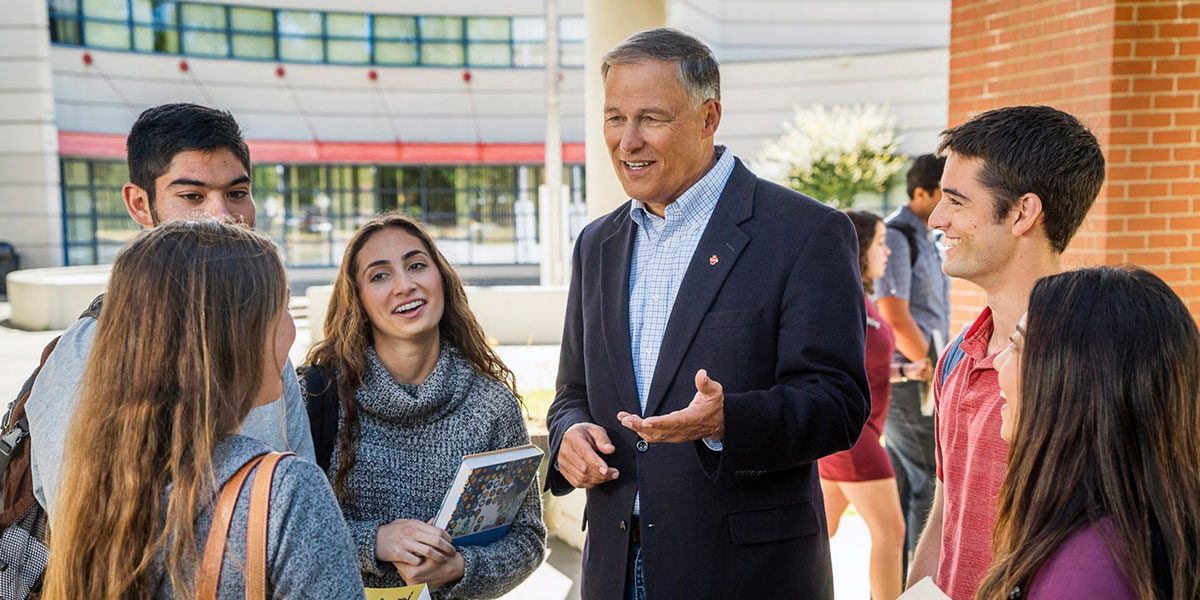
My exhibit: Washington State’s Governor Jay Inslee. [Photo from: https://www.jayinslee.com/top-priorities/health-care.]

His impressive experience includes an economics major, law degree and practice, city government (city prosecutor), Washington legislature (four years), U.S. House (13 years), national government (regional director, U.S. Department of Health and Human Services), country’s longest serving governor (11 years), chair, Democratic Governors Association.

His latest “state of the state” address makes no mention of restrictions on how doctors can practice medicine, professional teachers can teach or the books librarians can provide. No efforts to make life more difficult for LGBTQ people. No increases in his executive power. No curtailing of access to public information for media and other Washingtonians. No refusal to hold press conferences. No cuts in support of the poor. No taxpayer-funded private and religious schools. [No headline-grabbing trip south for Washington’s law officers to stop immigrants.]

What has he accomplished or proposed? Some examples:

Human rights. “Housing is a Human Right” campaign (construction; zoning; $1 billion for homeless and affordable housing); public transportation. More access to healthcare; including immigrants’ and women’s rights. Reduced racial disparities. Marriage equality. Protection of LGBTQ rights. Paid family and medical leave.

Early childhood education and care. Schools provide students mental and educational support, and programs for those with special needs. Reformed criminal justice system. Suspension of executions. Marijuana single misdemeanor offenders pardoned.

Environment. Leading climate change action advocate. Conservation of wildlife habitat; protection for endangered species. Cleaner water and air. [Sustainable agriculture and forestry. Ban on fracking. One hundred percent clean energy goal.]

Economy. Need-related college financial aid (boosted state’s economy). Increased minimum wage. Record low unemployment; 500,000 new jobs. A “Working Families Tax Credit” – rather than tax cuts for Washington’s wealthiest.

The result?

Washington has been ranked the best state in the U.S., second best for business and third best for workers and teachers. Similar to what Iowa’s ranking sometimes was under both Republican and Democratic former governors.

And that, dear Iowa children, “Is the way governors do”!

Nicholas Johnson wonders what Governor Inslee will do next; it won’t be reelection. Contact: mailbox@nicholasjohnson.org

NOTE: Text [within brackets] was deleted by the editors for space reasons.

SOURCES

Jay Inslee, General. Note: Most of the assertions and items listed in the column are from the following general sources:

Wikipedia: Jay Inslee, Wikipedia, https://en.wikipedia.org/wiki/Jay_Inslee

“Washington Governor Jay Inslee,” https://governor.wa.gov/

“Jay Inslee Governor,” https://www.jayinslee.com/ (campaign website)

Jay Inslee, “Building a Washington That Works for Everyone,” https://www.facebook.com/WaStateGov

The Seattle Times, use The Times Search feature, enter: Jay Inslee, https://www.seattletimes.com/

Results from Google search for, “Governor Jay Inslee”

Inslee’s experience. See, Jay Inslee, Wikipedia, https://en.wikipedia.org/wiki/Jay_Inslee

Nation’s longest serving governor. “List of Current United States Governors, Wikipedia, https://en.wikipedia.org/wiki/List_of_current_United_States_governors (“Currently, the longest serving incumbent U.S. governor is Jay Inslee of Washington, having served since January 2013 . . ..”)

State of the state. Jay Inslee, “2023 State of the State Address: Bold actions for building a stronger Washington,” Jan. 10, 2023, https://governor.wa.gov/news/speeches/2023-state-state-address-bold-actions-building-stronger-washington

Accomplishments. Gene Johnson and Ed Komenda, “Democratic Washington Gov. Jay Inslee won’t seek 4th term,” Associated Press, May 1, 2023, https://apnews.com/article/inslee-democrat-2024-climate-450cb6ef6347f0ac04022f079c3c0e13 (“Among his accomplishments he lists a cap-and-trade system for carbon emissions in the state and a trio of gun violence prevention measures that he signed into law last month, including a ban on semi-automatic assault rifles that is already being challenged in court by gun rights advocates.

Early this year the state Supreme Court upheld a capital gains tax Inslee promoted as a way to address what was considered the nation’s most regressive tax system.

He also vowed to protect gay rights and abortion access as conservative states constrained them, and he bought the state a three-year stockpile of a popular abortion drug in anticipation of court rulings that could limit its availability.

Inslee said he still has work to do before his exit, including collaborating with legislators and community leaders to address Washington’s homelessness crisis and speeding efforts to broaden behavioral health services.”)

Terra Sokol, “Gov. Jay Inslee Approves Salary Increases for Teachers,” News Radio, 560 KPQ, April 22, 2023, https://kpq.com/gov-jay-inslee-approves-salary-increases-for-teachers/ (“Program supervisors and instructors would make a minimum of $72,728 a year, administration $107,955 a year, and classified staff (paras, office staff, custodians) would receive $52,173 a year. . . . Salary increases total to approximately $1 billion and will go into effect in the 2024-25 school year.”)

Katherine Long, “Could you go to college tuition-free in Washington? Here’s how to find out,” Seattle Times, May 28, 2019, https://www.seattletimes.com/education-lab/could-you-go-to-college-tuition-free-in-washington-heres-how-to-find-out/ (“Last week, Gov. Jay Inslee signed into law a sweeping higher-education bill that will cut the cost of tuition, or make it free, for low- and median-income students. In a tweet, he described it as creating “a statewide #freecollege plan for eligible students.” Nationally, the bill has been hailed as a progressive approach to making college more affordable, and it’s expected to reach up to 110,000 students. . . . The Workforce Education Investment Act replaces the State Need Grant with a new program, the Washington College Grant (WCG), and makes the money an entitlement. Grants can cover up to 100% of tuition plus service and activity fees, and do not need to be paid back. It’s not a so-called “last-dollar” program — a student who qualifies for WCG could also receive a federal Pell grant, for example.

The legislation is built on the idea that Washington’s economy already employs a lot of college graduates, many of whom move here to chase opportunity — yet only about 31% of Washington’s own high-school graduates have earned a degree or credential by the age of 26, according to one study.

Being clear and upfront about who qualifies, and guaranteeing the money, removes the uncertainty surrounding financial aid. That, in turn, should make it easier for school districts and colleges to encourage kids to think about earning a certificate or a two- or four-year college degree, or becoming trained through a registered apprenticeship (also covered) . . ..[Chart indicates declining dollar support as family income increases above $69,000. $10,748 available up to incomes $46,000 or below. Declines to $5374 at $64,000 and $0 at $69,000 and above.]

Claire Withycombe, “Gov. Inslee signs bills to increase housing in WA,” Seattle Times, May 8, 2023, https://www.seattletimes.com/seattle-news/politics/gov-inslee-signs-wa-affordable-housing-bills/ (“Many of the bills are aimed at boosting the supply of homes in a state where it’s expensive and sorely needed.

Washington will now allow multifamily housing in many more neighborhoods, encourage people to develop accessory dwelling units, and streamline development regulations, among other policies. The overarching effort to smooth regulatory barriers, like zoning and permits, to building housing garnered bipartisan support.

“We are attacking this problem at its root, which is the lack of housing in the state of Washington,” Inslee said.

The Washington Department of Commerce estimates the state will need about 1 million more homes in the next 20 years.

This year, lawmakers also passed a budget with a $400 million investment in the state’s Housing Trust Fund, which finances affordable housing projects. That money will pay for about 3,000 new rental homes, and help about 250 to 400 households with homeownership, according to the department. . . .

Inslee signed nine bills about 1 p.m. Monday in Seattle at SEIU 775, and signed a 10th bill in a separate ceremony later that afternoon at the Northwest African American Museum, in a nod to the lengthy and harmful legacy of racist policies that kept many Black people from buying homes in certain neighborhoods and from building generational wealth.

House Bill 1474, which sponsors say is the first statewide policy of its kind, will help people who were affected by racist housing covenants designed to keep ethnic and religious minorities out of certain neighborhoods, as well as their descendants, with down payments and closing costs. . . .

Inslee signed nine bills about 1 p.m. Monday in Seattle at SEIU 775, and signed a 10th bill in a separate ceremony later that afternoon at the Northwest African American Museum, in a nod to the lengthy and harmful legacy of racist policies that kept many Black people from buying homes in certain neighborhoods and from building generational wealth.”)

New York Times. Reid J. Epstein, “Jay Inslee Sees Greener Pastures Ahead; After nearly 30 years in elected office, Washington’s governor plans to shift his focus to climate solutions and clean energy, underscoring the need for ‘a sense of optimism and confidence,’” New York Times, May 2, 2023, https://www.nytimes.com/2023/05/02/us/politics/jay-inslee-climate.html (“. . . [O]ne of America’s leading climate hawks.

Mr. Inslee ran for the 2020 Democratic presidential nomination by arguing that the country would have to radically reshape its relationship with fossil fuels and promote renewable energy. . . . [H]is goals later became the blueprint for the climate spending in the Inflation Reduction Act, which President Biden signed into law last year. . . .

In 2007, I [Inslee] said we’re going to be driving electric cars. People thought I was smoking the cheap stuff. Well, now we’re buying them so fast that production can’t even keep up.”]

Reid J. Epstein, “Gov. Jay Inslee of Washington, Climate Champion, Won’t Seek Re-Election; Mr. Inslee, 72, a former presidential candidate and a leading Democratic proponent of policies to slow climate change, said he would not seek a fourth term,” New York Times, May 1, 2023, . https://www.nytimes.com/2023/05/01/us/politics/jay-inslee-washington-governor.html (“Mr. Inslee and the Washington State attorney general, Bob Ferguson, filed a series of lawsuits against Mr. Trump’s administration, challenging policies on its ban on travel from several predominantly Muslim countries, its separation of migrant children from their parents and its unwinding of climate regulations.”)

David Wallace-Wells, “Gov. Jay Inslee Is Taking a Well-Earned Climate Victory Lap,” New York Times, Aug. 31, 2022, https://www.nytimes.com/2022/08/31/opinion/environment/jay-inslee-ira-climate-change.html (“[C]limate has become one of the issues that really holds the Democratic coalition together.

I think the reason for that is because it is such a powerful job creator — a good-paying-job creator. I mean, I can’t turn over a rock in my state where I can’t point to good jobs being created, in Moses Lake, where battery companies are coming in and Lind, Washington, where a solar plant went in and Arlington, where there’s electric planes that are in development. It’s just an explosion and it’s a welcome one. . . .

[In] 2009 or 2010, I brought a Chevy Volt, the prototype for the hybrid electric, to Capitol Hill because I wanted to show my colleagues, “Look what’s coming. Electric cars are coming.” . . . I was just being teased mercilessly by my friends . . .. Now people have a waiting list for the F-150, the Lightning, 10 miles long. . . .

I looked at the Alpine Meadows and thought about how they are at such risk right now. . . . [W]e’ve lost 45 percent of our glaciers — Olympic National Park, and the same thing’s happening on Rainier. It’s just great to see action today, knowing that Alpine Meadows might have a chance for my grandkids.”)

Best state and top priorities:

Best state. Levi Pulkkinen, "Education, Energy and Economy Lead Washington to Top Spot in Best States Ranking; The Evergreen State takes the top spot again in the U.S. News Best States ranking on the strength of its tech sector and other industries," U.S. News, March 9, 2021, https://www.usnews.com/news/best-states/articles/2021-03-09/why-washington-is-the-best-state-in-america ("For the second time, Washington has been named No. 1 in the U.S. News Best States ranking and is the first state to earn the top spot twice in a row.")

Economic Recovery. “Jay Inslee Governor, Top Priorities, Economic Recovery,” https://www.jayinslee.com/top-priorities/economic-recovery

(“During Jay’s tenure, Washington has made historic steps to improve the lives of Washingtonians. In his first term, Jay led Washington out of the Great Recession. By his second term, he brought Washington together to create what CNBC rated the top state for businesses and Oxfam declared the best state for workers.”

https://www.jayinslee.com/about - “Under his clear leadership, Washington helped build an economy that is ranked number one for both businesses and workers.”)

Healthcare. https://www.jayinslee.com/top-priorities/health-care

(“Jay has protected and expanded access to health care under the Affordable Care Act (ACA) to nearly 800,000 additional Washingtonians, driving uninsured rates to record lows. . . . • Expanded the Affordable Care Act to nearly 800,000 Washingtonians
• Protected those with pre-existing conditions and women’s reproductive rights
• Signed first public health care option in the country
• Passed historic long-term care benefit program so seniors can receive the care they need
. . . Jay has made Washington state a leader in reproductive health care. He helped to pass and sign the Reproductive Parity Act, which requires health plans that include maternity care services to also cover abortion services and for all health plans to cover over the counter contraceptives without a prescription.

We must change how we take care of people who suffer from mental illness in Washington state. That’s why Jay championed and signed legislation to integrate physical services and behavioral health services by significantly transforming the state’s mental health system and reshaping how and where patients receive care.”)

Education. https://www.jayinslee.com/top-priorities/education

(“[He] invested billions in our education system.

These important investments have resulted in increased access to early learning, including all-day kindergarten so that children can start building a foundation at an early age for success. For children with the most need, he pushed to secure $130 million for direct special education services and expand Breakfast After the Bell program to ensure Washington’s kids are focused on learning, not hunger.

Jay values our teachers and he’s worked to increase educator pay more than any other state and to lower class sizes so our educators can focus on giving our children the best possible education. He has also made a commitment to recruit and retain more diverse educators in our schools.”

• Enacted all-day kindergarten
• Raised teacher pay and lowered class sizes
• Funded full and partial college tuition assistance for working and middle-class Washingtonians
• Launched Career Connect to give 100,000 students career-ready apprenticeships and technical training


[The] Workforce Education Investment Act, which ensures full and partial college tuition scholarships are available to working and middle-class Washingtonians. . . . [And the] Career Connect Washington. This program connects 100,000 Washington students with career-ready education like apprenticeships and technical education.”)

Climate; Clean Energy. https://www.jayinslee.com/top-priorities/climate-and-clean-energy

(“Known as the “greenest governor in the country,” he has made Washington state a leader in both the fight against climate change and growing clean energy jobs — something he knows will be vital to our economic comeback post-COVID.

, , , Jay set the state on a pathway to a carbon neutral electrical grid by 2030 and to be powered by 100 percent clean electricity by 2045. We have built the cleanest energy grid in the nation and a $6 billion wind energy industry, while also increasing the use of solar energy and electric vehicles.

• Committed Washington to have a carbon neutral electrical grid by 2030 and 100% clean energy electricity by 2045
• Built cleanest energy grid in nation and helped build a $6 billion wind energy industry
• Signed orca and salmon protections

He led the passage of the greenest transportation package in our state’s history to create an estimated 200,000 jobs.”)

Justice and Safety. https://www.jayinslee.com/top-priorities/justice-and-safety

(“Jay wants to rethink public safety and eradicate systemic racism not just in law enforcement, but in education, healthcare, housing, and other areas of inequality. . . . He issued a moratorium on the death penalty . . .. offered pardons to individuals with misdemeanor marijuana convictions . . .. [and] helped pass bipartisan de-escalation and deadly force standards to ensure there is accountability for police violence.

Jay . . . is working to eliminate Washington’s rape kit backlog.

He has fought . . . gun violence, banning dangerous mass-killing tools like bump stocks, made sure guns are kept out of the hands of high-risk individuals, and supported the passage of voter-approved universal background checks.”)

# # #


Tuesday, August 01, 2023

Quality Housing for All

Quality Housing for All is Possible
Nicholas Johnson
The Gazette, August 1, 2023, p. A 6

“Everyone has the right to a standard of living adequate for [their] health and well-being . . . including . . . housing . . .” declares the U.N.’s Universal Declaration of Human Rights. If you find the Bible more persuasive, many versions include in Matthew 25, “I was homeless and you gave me a room.”

The Iowa Code provides equivalent rights for farm animals. And yet 1.6 billion people not only don’t have the housing Jesus called for and the U.N. considers a human right, they’re lacking the housing rights of Iowa’s animals.

Two million U.S. housing units were judged to be “extremely inadequate.” There are around 500,000 homeless people each evening.

U.S. agencies and organizations also measure “housing insecurity” (e.g., high costs, poor quality, unstable neighborhoods or overcrowding). For renters the percentages with housing insecurity range from 30 percent (Florida) to 17 percent (Wyoming). In Iowa it’s 23 percent.

It’s not like Iowa’s doing nothing. The state, county and city governments have programs. Vouchers, affordable housing in new developments (mixed income, inclusionary zoning), rezoning, housing trust funds, government owned and operated and “housing first” for the homeless.

But a conflict of goals is bound to occur when housing programs look to profit-maximizing capitalist landlords to provide housing for all at prices that leave everyone with enough left over for nutrition, healthcare, transportation and other basic needs.

Where might we look for alternatives?

When I served on the Iowa City School Board, we wanted new ideas. With 16,000 U.S. school districts, we set aside meeting time to discuss what Education Week was reporting and other countries were doing.

Iowa’s governmental units could do the same, researching others’ housing solutions. Take Vienna for example.


The focus of Vienna’s “social housing” is not on giving money to the poor, passed through to landlords. It’s on construction of a livable, lovable city and society – connected with cheap, frequent, fast public transportation. The Viennese believe such a city requires upscale, architecturally attractive cheap housing for everyone. Housing that mixes middle class with the poor. Housing conveniently located in neighborhoods with a range of facilities and services, such as a community center, swimming pool, dental clinic, library, post office, restaurant. [Photo credit: wikimedia.org/commons]

Anyone earning under about $80,000 (U.S.) can apply if they’ve had a single Vienna address for two years. The financial requirements are such that 80 percent of Vienna’s residents choose to rent. The U.S. defines “affordable” as 30 percent of before-tax income. (Landlords extract more from nearly half of all renters.) Vienna defines “affordable” as closer to 20 percent of after-tax income. No one’s excluded, and no one’s evicted if their income increases. The homeless are provided “housing first” facilities.

When people pay less, but get quality, inclusive housing they have less finance-related stress – and more money left over to live life and boost the local economy.

We could do it here. In fact, we’ve tried in California, Maryland and Washington.

Why not Iowa?

Nicholas Johnson believes the U.N. and Jesus would like Vienna’s housing. Contact: mailbox@nicholasjohnson.org

SOURCES
Universal Declaration of Human Rights, United Nations, Dec. 10, 1948, Article 25, https://www.un.org/en/about-us/universal-declaration-of-human-rights (“Everyone has the right to a standard of living adequate for the health and well-being of himself and of his family, including food, clothing, housing and medical care and necessary social services, and the right to security in the event of unemployment, sickness, disability, widowhood, old age or other lack of livelihood in circumstances beyond his control.”)

Matthew 25. Numerous sources from Google search: “Which versions of the Bible include ‘I was homeless and you gave me a room’ in Matthew 25?” For example, “Matthew 25:35-40,” You Version, Bible.com, https://www.bible.com/bible/97/MAT.25.34,35,36 (“I was homeless and you gave me a room”)

Animal rights. Code of Iowa, Sec. 717B.3(1)(d), https://www.legis.iowa.gov/docs/ico/chapter/717B.pdf (“1. A person commits animal neglect when the person owns or has custody of an animal, confines that animal, and fails to provide the animal with any of the following conditions for the animal’s welfare: . . .

d. Ventilated shelter reasonably sufficient to provide adequate protection from the elements and weather conditions suitable for the . . . animal so as to maintain the animal in a state of good health . . . . The shelter must protect the animal from wind, rain, snow, or sun and have adequate bedding to provide reasonable protection against cold and dampness. . ..”)

1.6 billion without adequate housing. “First-ever United Nations Resolution on Homelessness,” Department of Economic and Social Affairs, United Nations, March 9, 2020, https://www.un.org/development/desa/dspd/2020/03/resolution-homelessness/ (“A serious violation of human dignity, homelessness has become a global problem. It is affecting people of all ages from all walks of life, in both developed and developing countries.

Globally, 1.6 billion people worldwide live in inadequate housing conditions, with about 15 million forcefully evicted every year, according to UN-Habitat, which has noted an alarming rise in homelessness in the last 10 years. Young people are the age group with the highest risk of becoming homeless.”)

Adequate housing in U.S. Housing insecurity in the United States https://en.wikipedia.org/wiki/Housing_insecurity_in_the_United_States (Chart: “Rented households facing housing insecurity (%)” High: Florida (30%), low: Wyoming (17%). Iowa (23%). “The American Housing Survey, using a standard of “extremely inadequate” housing, found (averaging numbers from 2005, 2007 and 2009) 2 million units to be “extremely inadequate” (1,896,890 units).”

U.S. Homelessness. “How many homeless people are in the US? What does the data miss?” USA Facts, May 23, 2023, https://usafacts.org/articles/how-many-homeless-people-are-in-the-us-what-does-the-data-miss/ (“More than half a million people experienced homelessness in America last year. The Department of Housing and Urban Development (HUD) counted around 582,000 Americans experiencing homelessness in 2022. That’s about 18 per 10,000 people in the US, up about 2,000 people from 2020.”)

U.S. school districts. Imed Bouchrika, “101 American School Statistics: 2023; Data, Trends & Predictions,” https://research.com/education/american-school-statistics (“The U.S. is currently home to 16,800 school districts.”)

Vienna. Homelessness. “Homelessness in Austria,” Policies & Strategies, Feantsa Country Fiche, 2017, https://www.feantsa.org/download/austria-20178599194934673684360.pdf (“Vienna and Upper Austria have adopted an integrated program on homelessness, covering prevention, accommodation and reintegration. The program in Vienna is known as the Vienna Integration Program for Homeless People (Vienna Multi-Stage Scheme). Housing First approaches are being implemented.”)

Viennese incomes. "Average Salary in Vienna, Austria," SalaryExpert, undated, https://www.salaryexpert.com/salary/area/austria/vienna ("51,823" -- $57,347 US)

"The average salary and minimum wage in Austria," Expatica, March 4, 2023, https://www.expatica.com/at/working/employment-law/minimum-wage-austria-89338/ ("The median salary in Austria is about €2,182 per month. However, the median income for full-time employees working all year round in 2020 was €40,415 [$44,723 U.S.] for women and €46,292 [$51,227 U.S.] for men. Normally, this includes the basic salary, bonuses, annual leave payments, and sick pay.")

"Cost of Living in Vienna," Numbeo, 2023, https://www.numbeo.com/cost-of-living/in/Vienna • ("A family of four estimated monthly costs are 3,483.6$ (3,153.1€) without rent (using our estimator). • A single person estimated monthly costs are 1,008.7$ (913.0€) without rent. • Vienna is 33.7% less expensive than New York (without rent, see our cost of living index). • Rent in Vienna is, on average, 75.1% lower than in New York.")

Transportation. “The Public Transport System,” Visiting Vienna, https://www.visitingvienna.com/transport/public/ (“The public transport system is definitely one of Vienna’s good points. Cheap, frequent, fast, clean, efficient, and rarely overcrowded.”)

Vienna; Excerpts from Francesca Mari, “It Might Look Like Vienna; Soaring real estate markets have created a worldwide housing crisis. What can we learn from a city that has largely avoided it?” Magazine, New York Times, May 26, 2023, https://www.nytimes.com/2023/05/23/magazine/vienna-social-housing.html

Note: I found this to be one of the best sources regarding the Vienna social housing program. Rather than trying to link each of these excerpts to the precise language in two of the column’s paragraphs they are simply listed in the order in which they appear in this New York Times Magazine article – thereby making them easier to find.

Questions the reader may have about any of my assertions should be answered by one or more of them.

Conversion from Austria Euros to U.S. dollars with ExchangeRate.com, https://www.exchangerate.com/currency-exchange-rate-cities/vienna.html


Viennese law dictates that rents in public housing can increase only with inflation, and only when the year’s inflation exceeds 5 percent. By the time she retired in 2007, Eva’s rent was only 8 percent of her income. Because her husband was earning 4,000 euros a month, their rent amounted to 3.6 percent of their incomes combined.

# # #

In Vienna, a whopping 80 percent of residents qualify for public housing, and once you have a contract, it never expires, even if you get richer. Housing experts believe that this approach leads to greater economic diversity within public housing — and better outcomes for the people living in it.

# # #

49 percent of American renters — 21.6 million people — are cost-burdened, paying landlords more than 30 percent of their pretax income, and the percentage can be even higher in expensive cities. In New York City, the median renter household spends a staggering 36 percent of its pretax income on rent.

# # #

In Vienna, 43 percent of all housing is insulated from the market, meaning the rental prices reflect costs or rates set by law — not “what the market will bear” or what a person with no other options will pay.

# # #

The mean gross household income in Vienna is 57,700 euros [$63,151 US] a year, but any person who makes under 70,000 euros [$77,462 US] qualifies for a [social housing] unit. Once in, you never have to leave. It doesn’t matter if you start earning more.

# # #

80 percent of all households in Vienna choose to rent.

# # #

Vienna prioritizes subsidizing construction, while the United States prioritizes subsidizing people, with things like housing vouchers. One model focuses on supply, the other on demand. Vienna’s choice illustrates a fundamental economic reality, which is that a large-enough supply of social housing offers a market alternative that improves housing for all.

# # #

[T]he average waiting time to get a [social housing unit] is about two years (at any given moment there are 12,000 or so people on the waiting list, and each year about 10,000 or more people are housed). Vienna residents — anyone who has had a fixed address for two years, whether they are a citizen or not — may apply, and applications are evaluated based on need.

# # #

City housing officials point out that having wealthier tenants in ["social housing"] helps thwart the problems that accompany concentrated poverty, creating a more stable, healthier environment for everyone. Unlike in the United States, where public housing is only for the poorest . . . the relative integration of ["social housing"] means that they are not stigmatized.

# # #

[One social housing project] housed 5,000 people in 1,400 apartments. These apartments were coveted. “It had two central laundries, two communal bathing facilities with tubs and showers, a dental clinic, maternity clinic, a health-insurance office, library, youth hostel, post office, and a pharmacy and 25 other commercial premises, including a restaurant and the offices and showroom of the BEST, the city-run furnishing and interior-design advice center,” Blau writes. Now fewer than 3,000 tenants live [there] — not because it’s undesirable but because living standards have improved and, in response, Vienna has allotted tenants more space . . . [combining] some of the units to create larger ones.

# # #

Vienna has succeeded in curbing the craving to own. It has done it by driving down the price of land through rezoning and rent control.

# # #

Living in Alt-Erlaa, Willie enjoyed access to seven rooftop swimming pools, seven indoor swimming pools, tennis courts, gyms and acclaimed art. When the rest of the delegation joined us, he led us toward one of his favorite aspects of the buildings: two murals in the lobby of the second building meditating on the role of the news media and labor in society.

# # #

The spiral of overvaluation in housing, which makes the housing-haves rich and the have-nots desperately poor, has brought us to a point where only something radical can solve it. The problem with housing in the United States is that it has been locked in as a means of building wealth, and building wealth is irreconcilable with affordability. The housing crisis in the United States is proof. Even in 2017, before the pandemic, around 113 million Americans — some 35 percent of the nation’s population — were living with a serious housing problem, such as physically deficient housing, burdensome costs or no housing at all, notes Alex F. Schwartz, an urban-studies professor at the New School.

# # #

The United States government intervenes heavily in the housing market. It’s just a two-tiered system, as Gail Radford, the historian, argues. There’s generous support for affluent homeowners and deliberately insufficient support for the lowest-income households. In 2017, the United States spent $155 billion on tax breaks to homeowners and investors in rental housing and mortgage-revenue bonds, more than three times the $50 billion spent on affordable housing.

# # #

Though “social housing” represented a large initial government outlay, Vienna’s social housing is now self-sustaining. Guess how much of the residents’ salary goes toward the program. One percent. Social housing drives down rents in the private market by as much as 5 percent. Vouchers may appear cheaper in the short term, but directly financing well-regulated public and limited-profit construction is the only way to mitigate speculation and hedge against ever-increasing housing costs. In 2020, New York and California spent $377 and $248 per capita, respectively, in housing development, while Vienna spent just $124 — and approximately half of Vienna’s spending is on low-interest financing that will be repaid and then re-lent.

# # #

Local social-housing programs, many of them inspired by Vienna, are underway in Montgomery County, Md.; Seattle; and California. And they have a long legacy in New York, which built 66,000 affordable apartments and 69,000 limited-profit co-op apartment units from 1955 to 1981.

# # #

Seattle. “A place to live, a place to grow; Providing housing and supportive services for people with low incomes,” Seattle Housing Authority, 2023, https://www.seattlehousing.org/

Montgomery County, Maryland. “Housing,” Montgomery Planning, July 19, 2023, https://montgomeryplanning.org/planning/housing/

California. “Five More Jurisdictions Designated Prohousing,” California Department of Housing and Development, 2023, https://www.hcd.ca.gov/

# # #