. . . because much of the content relates both to Washington, D.C., and "outside the beltway" -- the heartland, specifically Iowa -- and because after going from Iowa to Washington via Texas and California I subsequently returned, From DC 2 Iowa.
March 18, 2011, 10:00 a.m. [March 19: Addition of new paragraph 5, "Predicting the Unpredictable," and, following the blog entry, responses to some blog readers' comments.]
Iowans' "Absolute Safety" from Nuclear Disaster Impossible to Achieve
["[W]e need to be willing to invest [in energy]. But if the investment is in nuclear energy, it must be absolutely safe." Editorial, "Nuclear Energy in Iowa Must be Used Safely,"Iowa City Press-Citizen, March 19, 2011, p. A13.]
What is, what should be, America's and Iowa's nuclear power plant future?
The blog essay I'd like to write on the subject will take more time, over time, than I have to devote to it this morning.
So here are some bullet points that, with luck, I'll be able to expand upon over time.
1. Conservation and Population. Our greatest source of the very cheapest energy is conservation. To focus solely on the energy supply side is like earning and borrowing ever more money each year in the futile effort to satisfy all of one's escalating wants, manipulated by a consumerist culture and economy, rather than budgeting and evaluating one's values and true needs. Conservation examples: encouraging more walking and use of bicycles, where feasible, rather than cars; relying proportionately more on urban and cross-country rail, rather than trucks and cars; transferring the tens of billions of dollars earmarked for the nuclear industry to an aggressive home insulation program.
Even less politically popular than conservation would be zero growth population policies. But, of course, the grim reality is that the world's population has gone from 300 million 2000 years ago, to one billion in 1800, 2 billion by 1927, 3 billion by 1960, 4 billion by 1974, 5 billion by 1987, 6 billion by 1999 -- on to a projected 9 billion by 2050. That's 1800 years to add 700 million, 127 years to add the second billion, 33 years to add the third, 14 years to add the fourth billion, 13 years to add the fifth, and 12 years to reach 6 billion.
There has been a three-fold increase in population just during my lifetime. But of course the increase in energy demand grows even faster than population. As a reader wrote me, "World population continues to increase at an alarming rate. Even if we could completely stop population growth tomorrow, people in India and China want our quality of life. They want cars, big houses, appliances, and lots of fancy electronic things. The need for energy will continue to skyrocket." Even if the world's people continued to use energy, per person, at the rates they do today, imagine the difference it would make if there were only half as many people to use (and waste) energy as there are now.
2. No Utopias. There is no single, perfect answer to our energy needs. No matter what we do, there will continue to be climate change, death and injury to civilian populations, and obviously the workers (e.g., the Japanese nuclear plant workers who are dying and will die as I write; those who died on BP's offshore drilling rig, and in the Massey coal mines, last year; those whose health is affected by polluted air and water; those who will suffer property damage, injury and death from exploding natural gas pipelines).
3. The Mix. We will undoubtedly continue to draw upon a mix of sources. Were we to put a multiple of present resources behind wind, solar, biomass, and hydro (which are not devoid of downsides) they could contribute a great deal more than they do now. But for the foreseeable future we are going to continue to have a significant reliance on coal, oil, natural gas -- and nuclear (now providing about 20% of our electric energy).
4. Risk Assessment. Assessing the risk of any event, from falling downstairs to a nuclear disaster, involves, among others, at least two factors: (a) What are the odds, the likelihood, that the event will occur? (b) If it does occur, how serious (i.e., costly in property damage and human life and health) would it be?
There are about 442 operating nuclear reactors in the world; four failed in the Fukushima Daiichi Plant. That is one percent of the world's reactors. Individuals will differ as to how likely a risk that is. But few would differ on the potential seriousness of the consequences should it occur. Coal mining and offshore oil drilling also pose risks to the environment and human life; the likelihood of their occurring are greater than for a nuclear disaster; but the quantity of the impact on human life and health is much less than a nuclear disaster when they do occur.
5. Predicting the Unpredictable. Whether dealing with possible terrorist threats to our airline industry, or the next big thing to threaten the safety of a nuclear reactor, it's much easier to respond to the last threat than to anticipate the next. One airline passenger puts a bomb in his shoe, and the next two million passengers have to take their shoes off before boarding. It's like the southern folktale, "The Story of Epaminondas and His Auntie." (E.g., Epaminondas brings home cake in his hand, turning it to crumbs, and is told he should have put it under his hat. The next day he's sent for butter, brings it home under his hat, where it melts down his face. The pattern continues.)
We're always working on the last threat, rather than preparing for the next. Was a nuclear power plant built to withstand a 7.2 magnitude earthquake "safe"? Sure -- until it's hit with a magnitude 9 earthquake, followed by a tsunami. We can build nuclear reactors to withstand the threats we have either dealt with before, or those we can imagine. But ironically, the very fact there have been so few nuclear reactor disasters means that it is even more difficult to predict what may trigger the next one. All we can know with certainty is that it will probably involve an event that no one predicted.
6. Decommissioning. Like natural gas pipelines that can corrode or otherwise increase the risk of ruinous explosions and fires with the passage of time, so do nuclear reactors. Among other things, the bombarding nuclear activity and heat can weaken the safety structures. Some engineers are suggesting the Fukushima reactors either were scheduled for decommissioning, or should have been, before now. Apparently, a forty-year operating life (which these had) is close to the outer reaches of safe operation. That would mean that the reactors in the U.S. that were constructed prior to 1971, which is a goodly number of them, are due to be decommissioned -- or, as in Germany, at least shut down and subjected to a very, very thorough stress and safety check (an approach rejected by the President and nuclear industry). Not incidentally, decommissioning is a lengthy and costly process, which is but one of the reasons the profit-driven nuclear and electric utility industries have a motive for pushing their luck.
7. Corruption and Capture. Warnings tend to be ignored. Massey's safety record was well known by government and within the industry. Ditto for BP. Ditto for nuclear. In the 1960s, GE's Mark I -- the reactor built at Daiichi -- was touted as a more economical source of nuclear power. Engineers inside and outside the company warned that the cost savings increased safety hazards. Some predicted years ago the precise scenario we have been witnessing over the last ten days in Japan.
In the case of BP, the "regulatory" agency employees were literally sleeping with the industry, while accepting on faith BP's representations regarding the safety of its operations. As a rough rule of thumb, major companies and industries get a return of 1000-to-one on their campaign contributions; give a million, get a billion. One form of that return is watered down, or non-existent, regulation as a result of Congressional, or Presidential intervention.
Unfortunately, this can also take the form of public officials essentially echoing industry propaganda. It was only days before the BP loss of life and ecological disaster that President Obama was assuring Americans that, because of technological improvements, any harm from offshore drilling was virtually impossible. More recently, the President and his Administration have been touting both the necessity and safety of his multi-billion-dollar push for more nuclear power plants. Not incidentally, he has recently appointed the CEO of GE -- the company that stands to gain the most from increased nuclear power plant construction (and whose officers were major Obama campaign contributors, not to mention the executives of MSNBC) -- to a top White House position, while essentially ignoring the ongoing, and unresolved, problems associated with nuclear waste disposal.
8. Increased Nuclear Safety Possible, but Unlikely. There is much that can be done to decrease -- not eliminate, but decrease -- the risk of nuclear disaster. Examples might include stronger containment vessels, removing (or at least not putting new) reactors that are close to major urban centers, drinking water supplies, or seismic fault lines. Unfortunately, for the reasons set forth above (7. "Corruption and Capture") such measures are unlikely to be as vigorously pursued as good science and rational policy would dictate.
9. Who pays? Not incidentally, it is we, as utility ratepayers and taxpayers, who pay for nuclear generated power plants. They are essentially a freebee for shareholders. Sometimes ratepayers must pay in advance of construction; always they will pay eventually in higher rates; and always they will pay as taxpayers following a major disaster. It's another example of "free private enterprise for the poor and socialism for the rich."
Moreover, there's a lesson to be learned from the lack of "free market" response to the nuclear "opportunity," even with billions of dollars from Washington. The relatively low price of domestic natural gas, the enormous (multi-billion-dollar) cost per reactor, the unsolved problem of nuclear waste, and the enormous safety concerns (even if taxpayers pick up most of the economic costs of disasters) have discouraged potential investors from building nuclear power plants over the past couple decades. Sometimes, as citizens, we need to listen to the marketplace in shaping public policy -- even if, as ratepayers and taxpayers, we are willing to be snookered by the utilities and their kept public officials.
_____
[The author of an anonymous comment on this blog says, in part, "To verify my sincerity I can tell you that I live within 10 miles of a plant similar to the ones in Japan except for a few important facts. 1. It is not on a fault line. . . ."
Now I'm not about to predict an earthquake in Iowa, or that if one were to occur Iowa's nuclear power plants would be at risk. After all, how could I know? Besides, the 1811 earthquake epicenter was somewhat south of Iowa, between Missouri and Illinois. But I do note that three months ago FEMA thought an earthquake in this region is "a significant risk today."
The [1811] earthquake took place in the New Madrid Seismic Zone (NMSZ), which is the site of several of the largest historical earthquakes to ever strike the continental U.S. and remains a significant risk today. . . . The earthquake caused strong shaking throughout the central U.S. . . . its impacts were felt as far away as Washington and Ohio . . . [and] caused large areas to be uplifted or dropped down in elevation.
Since then, the regions along the NMSZ have experienced explosive growth in both population and infrastructure. Another series of earthquakes with the magnitude of the 1811 earthquakes could prove catastrophic to the region.
The same comment author says, "The biggest difference [between the nuclear power plant in Fukushima, Japan, and the one in Palo, Iowa] is that in the U.S. we NEVER put 6 reactors in one place. When this is done you just end up with a problem waiting to happen." However, the March 19, 2011, Gazette reports that Palo, where there is already a 37-year-old reactor, is at least one of the possible sites for a second reactor. The story details some of the advantages of putting a new one there, but omits to mention the increased risks noted by the comment author. Rick Smith, "MidAmerican downplays mention of Palo as nuke site, but some say it makes good sense,"The Gazette, March 19, 2011, p. A1.]
Congressman King Poses Threat to National Security
Senator Joseph McCarthy (R-Wisc.; 1908-1957) "was noted for making claims that there were large numbers of Communists and Soviet spies and sympathizers inside the United States federal government and elsewhere. Ultimately, McCarthy's tactics and his inability to substantiate his claims led him to be censured by the United States Senate. . . . Today the term ["McCarthyism"] is used more generally in reference to demagogic, reckless, and unsubstantiated accusations, as well as public attacks on the character or patriotism of political opponents." "Joseph McCarthy," wikipedia.org.
Concern for our country's national security is not only appropriate for members of Congress, it is one of their highest responsibilities.
But doing so by focusing on the members of a single ethnic group or religion has the appearance of a pursuit fueled more by prejudice at best, or political strategy uber alles without regard to consequences at worst, than thoughtful protection of Americans.
Let's take a look at security, terrorism, and other threats to Americans in context.
President Bush at one time said that those who finance, or “harbor” terrorists and their training camps, are as much our enemy as those who attack us.
OK, but surely we don't want to argue that it is only "terrorism" when others do it to us. And yet, if not, how do we justify "harboring" -- to use President Bush's word – the American Catholics who were financing terrorist acts of the IRA against Protestants in Ireland?
What about the "harboring" of our former "School of the Americas" (“SOA”) training camp in Georgia? It's trained those we've called "freedom fighters," and others might call “terrorists,” in Central and South America.
School of the Americas Watch charges that, "Graduates of the SOA are responsible for some of the worst human rights abuses in Latin America.” Does that make the former School of the Americas a terrorist training camp?
Apparently our government thinks not. At least there was no known plan to bomb the State of Georgia -- to be distinguished from our military forces sent to the Republic of Georgia.
Should we have bombed the State of Idaho [Timothy McVeigh's residence] after the Oklahoma City bombing?
And speaking of those supporting the IRA, as an ironic additional example, Congressman King has himself been a supporter of what can legitimately (and has been) designated as a "terrorist organization" -- the IRA. Scott Shane, "For Lawmaker Examining Terror, a Pro-I.R.A. Past,"New York Times, March 9, 2011, p. A1 ("For Representative Peter T. King, as he seizes the national spotlight this week with a hearing on the radicalization of American Muslims, it is the most awkward of résumé entries. Long before he became an outspoken voice in Congress about the threat from terrorism, he was a fervent supporter of a terrorist group, the Irish Republican Army.").
"Terrorism" is not the only, or even the worst, threat to our security and well being. Just ask the Japanese. "March 11 Earthquake and Tsunami," March 11, 2011. No terrorists were involved in that disaster.
As noted in that blog entry, one of the most useful inquiries Congress might undertake is a study of what we can learn from the Japanese preparation for, and response to, such disasters. Why, and in what ways, are they seemingly so much better organized and responsive than we were in our response to, say, Katrina? Alan Greenblatt, "Japanese Preparedness Likely Saved Thousands," NPR, March 13, 2011.
What is our government doing, for example, in the face of the U.S. chemical industry's resistance to security measures designed to prevent, or at least minimize, the consequences of spills of toxic chemicals or gases? "DHS eager to start monitoring chemical plant safety," DHS, Homeland Security Newswire, February 23, 2006 ("We have been critical of the chemical industry’s evasion of responsibility for the public welfare, and its stubborn resistance, until very recently, to any meaningful security measures in its more than 15,000 U.S. plants, including the 400 or so which pose the highest risk of mass-casualty catastrophes. . . . The problem now is that Congress has not yet passed legislation to extend DHS regulatory authority over chemical plants.").
It was a mite ironic that, at the same time Rep. King was attacking Muslims, the President and Mrs. Obama were hosting a conference at the White House on bullying. Jackie Calmes, "Obamas Focus on Antibullying Efforts,"New York Times, March 11, 2011, p. A18. Terrorism? Make no mistake, to a young child it is -- as the occasional suicide makes clear. (Not incidentally, "[Timothy] McVeigh claimed to have been a target of bullying at school and that he took refuge in a fantasy world where he retaliated against those bullies." Timothy McVeigh, wikipedia.org.)
And to the extent that, what let us call "extremists," engage in bombing or other use of force in attacking civilians at random, any rational and fair look at the problem requires a much broader view than King's focus on one religious group -- as R.J. Matson so colorfully explains:
If you can't read the text, Matson shows "Chairman Peter King" connecting the dots that spell "Muslims," while saying "All of those other dots don't need connecting" -- the dots related to "Anti-abortion zealots" (some of whom advocate assassinating abortion doctors), "Right-wing militias," "IRS haters," "Neo-Nazis" and "Al-Qaida."
An organization that has for years tracked homegrown terrorism is the Southern Poverty Law Center. As one of its recent reports notes, notwithstanding "historic Republican gains, the early signs suggest that even as the more mainstream political right strengthens, the radical right has remained highly energized. In an 11-day period this January, a neo-Nazi was arrested headed for the Arizona border with a dozen homemade grenades; a terrorist bomb attack on a Martin Luther King Jr. Day parade in Spokane, Wash., was averted after police dismantled a sophisticated anti-personnel weapon; and a man who officials said had a long history of antigovernment activities was arrested outside a packed mosque in Dearborn, Mich., and charged with possessing explosives with unlawful intent. That’s in addition, the same month, to the shooting of U.S. Rep. Gabrielle Giffords in Arizona, an attack that left six dead and may have had a political dimension." Mark Potok, "The Year in Hate & Extremism, 2010," Southern Poverty Law Center, Intelligence Report, Issue Number 141, Spring 2011.
Nor are things getting better. As the Southern Poverty Law Center reports,
"Hate groups topped 1,000 for the first time since the Southern Poverty Law Center began counting such groups in the 1980s. Anti-immigrant vigilante groups, despite having some of the political wind taken out of their sails by the adoption of hard-line anti-immigration laws around the country, continued to rise slowly. But by far the most dramatic growth came in the antigovernment 'Patriot' movement — conspiracy-minded organizations that see the federal government as their primary enemy — which gained more than 300 new groups, a jump of over 60%."
A genuine, honest, look at the range of threats confronting Americans might be useful, depending on how it was done. Focusing on a single religion -- especially in a way that only strengthens Al Qaida, and any extremists tempted to join them -- is not.
My heart goes out to friends, indeed all, in Japan and the Pacific Rim
This video from NHK provides some sense of the damage wrought by the 10-meter waves as they hit one of Japan's cities, Sendai (in Miyagi Prefecture), following the 8.9 earthquake -- the worst in all of Japan's recorded history (and fifth worst in the history of the world).
Thanks to BBC World Service, I was able to follow the news on radio throughout the night, almost from the first reports.
Miraculously and thankfully, there appears to have been radically less damage (and death toll) from the earthquake than would be expected, with apparently almost all of Tokyo's high rise buildings still standing -- as a result of Japanese architecture,engineering, building codes, and lack of corruption among those charged with their enforcement.
While our thoughts are with the dead, injured, their families, and all caught up in this natural disaster, there are also lessons here for America's response to disasters, and the agencies charged with that responsibility, such as the Department of Homeland Security, and FEMA. How Japan has responded today is a case study that those agencies should study closely and embed in their planning and training programs: the advance preparation, the almost instantaneous response and seemingly well organized and smooth coming together and working together of all conceivably relevant institutions and individuals, the relative calm and cooperation of the population, and the transparency and fulsome reporting by means of a variety of technology of what information sources knew when they knew it.
There is now, and will continue to be, no shortage of the still unfolding global news services' coverage in video, still pictures, on-scene reports, and mounting death toll. (I'm currently watching the live feed from the English language NHK World, carried by MSNBC.) So there's no real purpose or need to my trying to provide a running report and commentary here.
We're Number Two! We're Number Two! (bought to you by FromDC2Iowa.blogspot.com*)
Sports Illustrated and CBS News have once again brought some national attention to the Hawkeye football program -- publicity we could have just as well done without. Jeff Benedict and Armen Keteyian, "College Football and Crime,"Sports Illustrated, March 2, 2011.
Last time it was the hospitalization of 13 players following a workout, when neither the Athletic Director nor the Coach had much to say initially. "Crisis Communications 101; There Are Three Steps," February 14, 2011.
As the report characterizes the highlights of its findings:
Story Highlights
A six-month SI/CBS News investigation ran criminal background checks on Top 25
Of 2,837 players, 7% had criminal records; 8.1% of scholarship players in trouble
Only two of Top 25 schools did background checks; none checked juvenile records
Thankfully, the University of Pittsburgh, not Iowa, was number 1. Iowa was actually tied for second place with Arkansas.
The SI/CBS report is chilling in its revelations of the serious crimes committed by athletes before as well as after arriving on campus: "Of the 277 incidents uncovered, nearly 40 percent involved serious offenses, including 56 violent crimes such as assault and battery (25 cases), domestic violence (6), aggravated assault (4), robbery (4) and sex offenses (3). In addition there were 41 charges for property crimes, including burglary and theft and larceny."
And note that in its chart the report only counts the number of players, not offenses. Moreover, it does not include players cut from the team because of their criminal behavior. Nor does it provide a report of the school's criminal record over a period of years.
Three years ago, when Iowa's football program was also singled out for its players' criminal records, I wrote in this blog,
I've suggested in blog entries here before, but it bears repeating that in addition to whatever else the Athletic Department may be doing to improve its criminal record, it might give a little more attention to who it's recruiting.
And, No, I don't mean that a teenage athlete's single indiscretion should bar his or her entering our program. And I don't mean we should be probing in depth the private lives of potential recruits. And I understand that juvenile court records are not always available. And, Yes, I agree that living in a community like Iowa City, the added maturity of a couple of years, and a strong and positive relationship with the right coach can sometimes turn lives around.
But I do think it might be appropriate to make at least some greater effort to find out, before we bring them here, if those we are recruiting have already established patterns of anti-social and criminal behavior, and a disrespect for law, such that the data indicates the mathematical odds are it is likely to continue.
Today's SI/CBS report reveals that the failure to investigate recruits' criminal records, which I highlighted three years ago, is in fact a central cause of the problem.
Among the 25 schools in the investigation, only two -- TCU and Oklahoma -- perform any type of regular criminal background searches on recruits. But even TCU and Oklahoma don't look at juvenile records. No school does, even though football and basketball players are among the most high-profile representatives of a university. (Of the 25 schools, only Virginia Tech did any type of background checks on admitted students, and admissions questionnaires at more than half the other universities ask applicants if they have ever been arrested.)
Yet it wouldn't take much for schools to access this information. Take Florida, for example. The Sunshine State is not only one of the nation's largest football hotbeds, it also has the nation's most open public records law. Through the Florida Department of Law Enforcement, anyone can check a person's complete criminal history -- including many juvenile arrests -- for $24.
Using this service, SI and CBS News checked all 318 Florida-based players in our sample. Thirty-one players (9.5%) had a criminal record. Twenty-two of those players had a juvenile record. Their juvenile offenses included felonies such as armed robbery, assault, domestic violence and possession of cocaine with intent to distribute.
Despite the easy access to this information, not a single school contacted by SI uses the Florida Department of Law Enforcement to check the criminal backgrounds of the players recruited from the state of Florida -- not even Florida, Florida State and Miami.
The report goes on to provide an illustration of what such a simple check could have revealed about one player.
On March 22, 2010, Darling [Antwan Darling, a Miami native and now a freshman linebacker at Cincinnati] was arrested for burglarizing a residence in Miami. That day, 17-year-old Kimberly Lewis was home alone from school sick when she heard two men prowling around the outside of her house, locked herself in a room and called 911 . . .. Miami police responded quickly and Darling was arrested at gunpoint and charged with felony burglary of an occupied dwelling. He subsequently entered a pretrial intervention program and the charge was dropped, clearing the way for him to accept a scholarship to Cincinnati.
But the burglary wasn't Darling's first run-in with the law. In 2006 he was charged with a felony count of firing a weapon in Dade County (which was disposed in juvenile court) and in 2008 he pleaded no contest to possession of marijuana after being arrested by police in Orlando.
When SI contacted Cincinnati for comment on Darling, a football spokesman said he was unaware of the player's arrest in the burglary case. Bearcats coach Butch Jones declined to comment specifically on Darling but said in a statement: "When recruiting a prospective student-athlete, we do our due diligence in exhausting all avenues looking into an individual's background."
Perhaps we need to redefine "due diligence" to the higher level that would require the effort to make a couple clicks on a laptop computer.
Additional commentary:
1. I think both the Iowa AD and Coach are to be congratulated for getting out front on this one, and for avoiding the natural inclination to "blame the media" for the University's bad public relations (something Barta did on the earlier SI criticism of the Hawkeyes handling of the hospitalized players).
2. Witoskey (linked above) reports, "Asked if the university had been treated unfairly by the report, Barta said, 'We are being lumped in and there is no differentiation between a misdemeanor or something more serious on the felony level"; and earlier, "Iowa officials pointed out that 15 of the 18 players were charged with alcohol related infractions, particularly underage consumption."
I think this is a valid criticism of the SI/CBS report -- but without more precise data from all schools one can't say whether or not Iowa was comparatively disadvantaged. And if Barta is including drunk driving as a mere "alcohol related infraction" that may be stretching the point.
When the Press-Citizen listed the violations of football players three years ago, see "Hawkeyes' Legal Troubles," February 25, 2008, below (embedded in "Hawkeyes' Criminal Record Lengthens," February 25, 2008), the list included some underage drinking. But it also included multiple examples of: interference with official acts; public intoxication and disorderly conduct; unauthorized use of a credit card; domestic assault; credit card fraud; shoplifting; drunken driving (at least three); second offense of underage possession of alcohol; public urination; driving with suspended license; failure to show at scheduled court appearance; possession of marijuana in dorm room; running from Coralville police; unlawful possession of prescription drug (oxycodone and carisoprodol) in dorm room and tax stamp violation.
These were from a prior time. They were not what Barta was talking about. But they did exist at one time, and they clearly include offenses more serious (not that underage possession of alcohol is not serious) than mere "alcohol related infractions."
3. The report can also be criticized, I think, for not providing statistics on the comparable criminal arrest statistics for (a) the student population generally at the football teams' schools, as well as (b) the general population within some standard distance from the campus in that community. (Otherwise it's kind of like the media reporting on the stock market stats by revealing the number of points the Dow Jones and S&P have moved, rather than the percentages, when the former is 10 times the points of the latter). When Iowa is ranked the ninth best party school (i.e., alcohol accessibility and quantity consumed) university in the country, it's likely the entire student population may have a higher percent arrest record than some other schools.
4. On the other hand, I think the DI's report of Barta's response to the idea of background checks leaves a good deal to be desired. I cannot imagine anyone who had read the SI/CBS report coming to his conclusions. The DI reports,
But Barta said he has some reservations about the idea, noting that screening potential recruits and conducting background checks might not be the most effective way to keep athletes out of legal trouble.
“Maybe this will provide us another opportunity to open the discussions,” Barta told The Daily Iowan in a phone interview. “If it would help guarantee us that we wouldn’t have student-athletes making bad decisions, I certainly would consider it. I don’t know whether it would accomplish that, however.”
Not "the most effective"? He'll only consider improvements if they will "guarantee us that we wouldn't have student-athletes making bad decisions"? Which of his present approaches to the problem are "the most effective"? What does he have in mind that would "guarantee" no more "bad decisions"? How has his current approach to these problems been working for him? Why would you not want to consider advance information that is easily available to you before bringing a recruit on campus? Even if you do decide to go ahead and recruit with scholarship a player with a number of serious felony convictions, wouldn't it be helpful to know of that record ahead of time in arranging for the support and additional attention that might benefit the player (not to mention other students and the community)?
Feb. 27: And see, Editorial, "Football Team's Legal Troubles Need to Stop,"Iowa City Press-Citizen, February 27, 2008, p. A12; and John Gray, "Maybe we should change football chant," Iowa City Press-Citizen, February 27, 2008, p. A12 ("With the two recent additions to the long list of Hawkeye football players arrested, perhaps the football fans should change the 'Go Hawks!' chant to 'Make bail!'")
I've suggested in blog entries here before, but it bears repeating that in addition to whatever else the Athletic Department may be doing to improve its criminal record, it might give a little more attention to who it's recruiting.
And, No, I don't mean that a teenage athlete's single indiscretion should bar his or her entering our program. And I don't mean we should be probing in depth the private lives of potential recruits. And I understand that juvenile court records are not always available. And, Yes, I agree that living in a community like Iowa City, the added maturity of a couple of years, and a strong and positive relationship with the right coach can sometimes turn lives around.
But I do think it might be appropriate to make at least some greater effort to find out, before we bring them here, if those we are recruiting have already established patterns of anti-social and criminal behavior, and a disrespect for law, such that the data indicates the mathematical odds are it is likely to continue.
Shame on us, if a part of the reason they have become that way is because the adults in their lives have contributed to these young men's belief that skilled athletes are entitled to special treatment; a culture and law of their own; second, third, fourth and fifth chances; a wink and a nod from coaches, high school principals, and judges -- so long as they can contribute to winning teams.
That doesn't excuse college athletes' behavior, but it does require us to think about the extent to which it is we who have at least contributed to the creation of the problem we confront -- from Little League through professional sports -- including right here in Hawkeye land.
We -- the responsible adults in Iowa City -- can't solve it all by ourselves, but perhaps we could give a little closer look at who we're bringing to town.
Meanwhile, here's the Press-Citizen's list of the football team's record so far:
A list of Hawkeye football players who have had legal trouble since 2007.
Ryan Bain, DL: The 19-year-old junior-to-be was charged with interference with official acts, public intoxication and disorderly conduct April 15, 2007. Bain transferred to Akron before the 2007 football season because he wanted to improve his chance of starting.
Anthony Bowman, WR: The 19-year-old sophomore was charged with unauthorized use of a credit card, a Class D felony, on Aug. 18, 2007. On Dec. 26, 2007, he pleaded guilty to the lesser charge of credit card fraud, an aggravated misdemeanor, and was granted deferred judgment. Bowman was suspended for the 2007 season, but he has rejoined the team and will have three years of eligibility remaining.
Dana Brown, RB: The 20-year-old sophomore was charged with domestic assault on Oct. 16, 2007. He was dismissed from the football team.
Dominique Douglas, WR: The 19-year-old sophomore was charged with unauthorized use of a credit card, a Class D felony, on Aug. 18, 2007. On Dec. 4, 2007, Douglas pleaded guilty to the lesser charge of credit card fraud, an aggravated misdemeanor, and was granted deferred judgment. He also was charged with stealing $30 worth of DVDs from Wal-Mart, which he pleaded guilty to in November 2007. The judge ordered Douglas to serve two years probation as well as pay $221.53 in restitution, a $625 civil penalty and other court costs. He was removed from the team. Douglas returned to his hometown of Detroit and is attending community college.
Ben Evans, WR: The 19-year-old red-shirt freshman was charged with drunken driving on July 30, 2007.
Tyler Gerstandt, TE: The 20-year-old walk-on football player was cited for underage possession of alcohol on May 18, 2007. The simple misdemeanor carried a $200 fine for a second offense. Gerstandt was cited for underage possession of alcohol in January 2006, according to Iowa online court records.
Clint Huntrods, long-snapper: The 22-year-old senior was charged with public urination, interference with official acts and public intoxication Sept. 6, 2007 after a police officer caught him urinating on a sidewalk. He was dismissed from the team. He issued a written guilty plea Oct. 24, 2007.
Bradley Fletcher, CB: The 21-year-old junior was charged with drunken driving on July 15, 2007. He was suspended for one game.
Arvell Nelson, QB: The 19-year-old red-shirt freshman was charged July 2, 2007, with driving with a suspended license and was scheduled to have his initial court appearance Aug. 16, 2007, but didn’t show. A warrant was issued that day for failure to appear, but Nelson turned himself in to authorities and posted a $545 cash bond Aug. 21, 2007. Nelson was arrested Saturday for possession of marijuana after police found the drug in plain view on top of the desk in his dorm room.
Ricky Stanzi, QB: The 20-year-old red-shirt freshman was charged with underage possession of alcohol on May 5, 2007.
Lance Tillison, S: The 20-year-old red-shirt freshman was arrested Sept. 15, 2007, for drunken driving. Tillison pleaded guilty to the charge in Jan. 4, 2008, in a plea deal. Under the arrangement, Tillison received a deferred judgment with unsupervised probation provided his participation in a substance abuse evaluation within 30 days, attendance of a weekend drunken driving program within 120 days and payment of $625 in fines and court costs. He was suspended for two games.
Ryan Donahue, P/PK: The 19-year-old red-shirt freshman was charged with underage possession of alcohol on Feb. 15, 2008.
Brandon Myers, TE: The 22-year-old junior was arrested Dec. 23, 2007, and was charged with public intoxication and interference with official acts after running from Coralville police. Court records show Myers pleaded guilty to the charges the same day he was arrested and was charged $350 for the two offenses.
James Cleveland, WR: The 19-year-old was arrested Saturday for two counts of unlawful possession of a prescription drug and a tax stamp violation after police allegedly found 21 doses of oxycodone and 24 doses of carisoprodol in his dorm room desk.
# # #
_______________
* Why do I put this blog ID at the top of the entry, when you know full well what blog you're reading? Because there are a number of Internet sites that, for whatever reason, simply take the blog entries of others and reproduce them as their own without crediting the source. I don't mind the flattering attention, but would appreciate acknowledgment as the source -- even if I have to embed it myself. -- Nicholas Johnson
Putting Side Effects in Context (bought to you by FromDC2Iowa.blogspot.com*)
Have you ever listened carefully to the lists of side effects included in the drug commercials on TV?
The horrible possible consequences from the use of these products seem to go on forever. It makes you wonder why anyone watching the ad would ever follow the suggestion that they ask their doctor if the pharmaceutical is right for them.
I suspect the reason the ads work is that most of us are sufficiently distracted by the commercials' pretty pictures of happy people that we never really focus on the warnings.
If these side effects weren't so serious their itemization would be hilarious. But they are serious.
So to lighten our load a bit, I'm going to close out this blog entry with one set of warnings that is intended to be hilarious but is actually also quite serious.
But first, give these possible side effects for Pfizer's Chantix a slow and focused read:
CHANTIX is a prescription medicine to help adults 18 and over stop smoking. You may benefit from quit-smoking support programs and/or counseling during your quit attempt. It's possible that you might slip up and smoke while taking CHANTIX. If you do, you can stay on CHANTIX and keep trying to quit.
Important Safety Information
Some people have had changes in behavior, hostility, agitation, depressed mood, suicidal thoughts or actions while using CHANTIX to help them quit smoking. Some people had these symptoms when they began taking CHANTIX, and others developed them after several weeks of treatment or after stopping CHANTIX. If you, your family, or caregiver notice agitation, hostility, depression, or changes in behavior, thinking, or mood that are not typical for you, or you develop suicidal thoughts or actions, anxiety, panic, aggression, anger, mania, abnormal sensations, hallucinations, paranoia, or confusion, stop taking CHANTIX and call your doctor right away. Also tell your doctor about any history of depression or other mental health problems before taking CHANTIX, as these symptoms may worsen while taking CHANTIX.
Do not take CHANTIX if you have had a serious allergic or skin reaction to CHANTIX. Some people can have serious skin reactions while taking CHANTIX, some of which can become life-threatening. These can include rash, swelling, redness, and peeling of the skin. Some people can have allergic reactions to CHANTIX, some of which can be life-threatening and include: swelling of the face, mouth, and throat that can cause trouble breathing. If you have these symptoms or have a rash with peeling skin or blisters in your mouth, stop taking CHANTIX and get medical attention right away.
The most common side effects include nausea (30%), sleep problems, constipation, gas and/or vomiting. If you have side effects that bother you or don't go away, tell your doctor. You may have trouble sleeping, vivid, unusual or strange dreams while taking CHANTIX. Use caution driving or operating machinery until you know how CHANTIX may affect you.
CHANTIX should not be taken with other quit-smoking products. You may need a lower dose of CHANTIX if you have kidney problems or get dialysis.
Before starting CHANTIX, tell your doctor if you are pregnant, plan to become pregnant, or if you take insulin, asthma medicines, or blood thinners. Medicines like these may work differently when you quit smoking.
So now let me make sure I understand. If I buy and use this product in accordance with the manufacturer's and my doctor's directions, I may experience the symptoms of serious mental illness (paranoia or hallucinations), an inclination to commit suicide, outbursts of hostility and anger, panic attacks, and a life-threatening swelling of my throat that prevents breathing. My skin may start peeling off my body, while I'm suffering constipation, vomiting, and an inability to sleep (understandable given those other symptoms), plus a three-in-ten chance of serious nausea. I'm sure I missed some of the warnings, but that at least touches on the highlights, right?
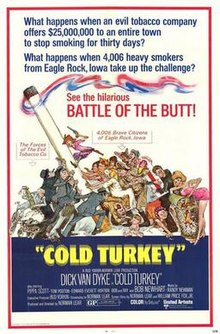
Have you seen Norman Lear's 1971 film, Cold Turkey? Put it on your Netflix' list.
And then tell me, why is it the Chantix symptoms are an improvement over the crankiness that giving up smoking cold turkey seems to produce in some smokers?
(Cold turkey was my father's approach to kicking the habit. He just woke up one morning not wanting another cigarette -- and wasn't even cranky about it as I recall. Unfortunately, it was a decision made too late in what turned out to be a 59-year life. But the lesson was not lost on me. I have never smoked a single cigarette -- although years ago I had occasional, brief encounters with other forms of tobacco use.)
Tobacco contributes to the causes of death for some 400,000 Americans a year. Clearly it contains dangerous drugs. But is it really any more risky than using Chantix? Yes -- given the probable percentages of people using Chantix who suffer from one or more of those side effects -- there's little doubt that the odds of serious, ultimately fatal consequences of using tobacco are greater than the odds of serious consequences from Chantix.
So consider . . . "Tequila."
The fact is, like much humor, many of these enumerated tequila side effects hit very close to the truth. Over consumption of alcohol, what is sometimes called binge drinking (especially by teenagers and college students), is no more a laughing matter than the consequences of tobacco use.
With proper care -- diet, exercise, stress reduction, weight control -- our bodies can serve us well for many years. Avoiding things that impede normal functioning, such as tobacco and excessive alcohol (as well as highly advertised, often unnecessary, high-cost designer pharmaceuticals with serious side effects) can provide a big assist. If a little humor can help us see that, it can be a positive public health contribution.
[Notes: (1) Thanks to Sherman Johnson for bringing the tequila "commercial" to my attention. (2) Unfortunately (as he agrees), the video includes one use of an insensitive and politically incorrect reference to those persons professionals currently describe as people with "intellectual and developmental disabilities." See discussion in "Mental Retardation," wikipedia.org.] _______________
* Why do I put this blog ID at the top of the entry, when you know full well what blog you're reading? Because there are a number of Internet sites that, for whatever reason, simply take the blog entries of others and reproduce them as their own without crediting the source. I don't mind the flattering attention, but would appreciate acknowledgment as the source -- even if I have to embed it myself. -- Nicholas Johnson
"ONE world, ONE pain, ONE humanity, ONE hope!" (bought to you by FromDC2Iowa.blogspot.com*)
This evening I want to share with you a message from Cairo that you need to see, but may not run across elsewhere.
It is from a young Egyptian engineer who does not precisely identify himself. He runs a WordPress blog he calls "Politirature." As he explains it, "Politirature is a word invented by Me, it’s the mix of Politics and Literature. Me is an Egyptian young man, engineering student & activist seeking freedom and fighting oppression everywhere." But he goes on to provide an email address (politirature@hotmail.com), and adds, "You can also follow me on Twitter: M_Nusair."
Dear activists, protesters & workers from Wisconsin, Ohio and other states,
I was truly touched by your hundreds of thoughts and comments on my photos from Tahrir holding that sign. I thank each and everyone of you, even those who thought the photos were shopped, but I have few things to say.
I’m an Egyptian ordinary young man, activist and Engineering student. I turned 21 years old last December, I love to read and write using both Arabic and English (although my English is kind of weak). and like other thousands, or even millions of Egyptians, I was very busy since Jan25 with our revolution in Tahrir square and all Egypt. we spent very hard days in that square waiting for death to come anytime from air or ground. anyway, what happened in Tahrir is not our subject now, everyone knows what happened there. the point is that I was too busy to know full details of what’s going on in other parts of the world. I knew that people protested in Wisconsin for their rights but didn’t know more details till Thursday, the 17th of February and it was by luck through a wall post of an American friend on Facebook, then I immediately began to search it and read more, then I decided to show support! decided to make the sign and take it with me to Tahrir next morning (Friday).
Many people thought it’s something extraordinary or something that stands out. but I really want to say that me, and many other people, were raised this way. were taught that all human beings are brothers and sisters, were taught that we live in ONE world and under the same sky, so I don’t see what I did as something “abnormal” or “super cool”.
again, as I told many of you, we are all human beings. we shouldn’t let borders and differences separate us, we were made different to complete each other, to integrate and live together. If a human being doesn’t feel the pain of his fellow human beings then everything man created and established since the very beginning of his existence is in great danger.
So…again & again . . . ONE world, ONE pain, ONE humanity, ONE hope!
Now I will leave you with this SUPER FUNNY video
[The song (but not the video) is a creation of the famously hilarious "Capitol Steps" group in Washington, D.C. Here's a link to the group's Web page, where you'll be able to find the way to order their albums and learn about their forthcoming concerts near you. Unfortunately, the video has been taken down from our Egyptian engineer's Web site. I hope my posting of it will remain -- because if not, I'll need to take down this ad for the Capitol Steps as well, and I'd really like for you to become more familiar with them.]
Three years ago I saw revolution coming. I blogged here about it in an eight-part series, "Golden Rules & Revolutions: A Series." The final entry, part VIII, has links to each entry. In that final blog I summarized the others, including, "Part I of this series noted not just the gap in income between the rich and the poor, but the fact that this gap is continuing to grow ever wider, and that history -- as well as the daily news -- provides ample warning that this condition often produces revolution." "Golden Rules & Revolutions: A Series - VIII," April 19, 2008.
As this young engineer reminds all of us, the oppression, and the ultimate popular resistance, know no national boundaries -- from Cairo to Madison.
We are, as he reminds us, "ONE world, ONE pain, ONE humanity, ONE hope!"
[My thanks to my colleague Burns Weston for alerting me to this story.] _______________
* Why do I put this blog ID at the top of the entry, when you know full well what blog you're reading? Because there are a number of Internet sites that, for whatever reason, simply take the blog entries of others and reproduce them as their own without crediting the source. I don't mind the flattering attention, but would appreciate acknowledgment as the source -- even if I have to embed it myself. -- Nicholas Johnson
Legislators Selling Pollock Thinking Too Small (bought to you by FromDC2Iowa.blogspot.com*)
"Elections have consequences," it is said.
One of those consequences for Iowans, it appears, is the Republicans' proposal to sell off the University of Iowa's Jackson Pollock painting (a 1951 gift from Peggy Guggenheim). William Petroski, "House Panel Favors Selling Pollock Art,"Des Moines Register, February 16, 2011 ("An Iowa House subcommittee Wednesday supported the sale of a famed Jackson Pollock painting in the University of Iowa's art collection, saying the proceeds could fund thousands of student scholarships. Rep. Ralph Watts, R-Adel, who was chairman of the three-member panel, said an amended bill requiring the Iowa Board of Regents to sell the world-class Pollock painting, 'Mural,' will set a minimum price, probably about $120 million. The painting had an estimated value of $150 million in 2008.")
Critics of the suggestion point out a number of problems with the sale, including the lost trust (and money) from formerly potential donors, and the UI Art Museum's loss of accreditation.
The more serious problem is that legislators and their critics alike are thinking too small.
It's like their counterparts in Washington, attacking a $14 trillion debt by eliminating $60 billion worth of social programs while increasing the near-$1 trillion Defense Department budget.
Iowa's economic and budget challenges, like those of other states, require the most creative ideas from all its citizens -- not just the little bit produced by selling a painting. Besides, one of my ideas is a win-win, where we virtually double what the Pollock can produce while retaining title -- sort of.
(1) Naming Rights. We have sold off naming rights for most of our buildings and colleges. Once named for academics, scholars and scientific researchers, they now reflect our basic values through the names of their wealthy donors. But the one opportunity we've held in reserve is naming rights for the University itself.
Larry Flynt is rumored to be interested in this possibility. Plus, he's more flexible than some potential donors, both as to the name and the amount. While I've heard $100 million mentioned, my understanding is that's just for starters, and that he might be willing to go as much as twice that. He's apparently even willing for us to keep Iowa in the name. That is, he would be willing for us to be called "The Larry Flynt University of Iowa," or "The Hustler Magazine University of Iowa" (not just "Larry Flynt University" or "Hustler University").
This sort of thing is not unprecedented. "Duke University" -- certainly a respected institution (ranked 9th nationally by U.S.News) -- is named for a benefactor whose money came from the tobacco sales that today contribute to some 400,000 deaths annually, James Buchanan "Buck" Duke. Not only that, but his business practices were so illegal that his company was ultimately busted up as an antitrust violation in 1906 into the three companies American Tobacco Company, Liggett and Myers, and the P. Lorillard Company. I don't see Duke taking a lot of heat these days for that association, and I don't see why we should be concerned about Hustler Magazine. Hustler may not be my taste in magazines, but so far as I know, no one ever died from reading it (which is more than you can say for Duke's product).
(2) Iowa's Most Valuable Asset. As long as we're looking around for state assets that we might auction off, why start with something that will produce so little revenue as a Pollock painting?
What's our most valuable physical asset? Think about it. Right. Our topsoil. OK, I know that most of it is by now in Louisiana. And how much money did we get for that? Nada, zero. We just flushed it down the river. Gave it away. How much sense does that make when we need a way to fund the Legislature's proposed 20% tax cut for Iowa's wealthy? William Petroski, "Iowa House Passes 20% Tax Cut in All Brackets,"Des Moines Register, February 16, 2011.
Moreover, I think I've found a buyer. Who owns the most land in the United States, almost all of which is devoid of Iowa-quality topsoil? That's right, Ted Turner. I don't know Ted well, but I've met with him on a number of occasions and I think we have a mutual respect for one another.
With approximately two million acres of personal and ranch land, Ted Turner is the largest individual landholder in North America. Turner lands are innovatively managed and work to partner economic viability with ecological sustainability. All Turner ranches operate as working businesses, relying on bison and outfitting as principal enterprises. In addition, Turner ranches support many progressive environmental projects including water resource management, reforestation and the reintroduction of native species to the land.
Here's a public spirited guy who can sit down and write a check for $1billion to help fund the United Nations, who's clearly interested in the land, but hasn't really been involved in agriculture as such at a time when the world's people are confronting an impending food crisis.
Right now we're just paving over what remains of this largely eroded valuable asset, with suburban housing, malls, highways, and industrial parks. How much sense does that make? Let's remove our most valuable asset first, sell it to the highest bidder, and then build on top of the clay that makes for a better foundation anyway.
You'll be the first to know if I get an offer from him.
(3) Most Innovative, Most Remunerative. Unfortunately, I can't give you the name of the next source of budget money for the State Legislature (and University), because he wishes to remain anonymous for now. But there are some Las Vegas individuals who have expressed an interest in the Old Capitol.
I once had a friend whose father bought a European castle for her, brought it back to America stone-by-stone, and reassembled it here. It really was quite grand.
That's the idea. The Old Capitol would be very carefully taken down, with each stone carefully preserved, and shipped to Vegas, where the building would be reassembled and incorporated into a new casino complex that will be the largest and grandest in the city.
There are variants on this idea that are still on the table.
Because the investors are also interested in the Pollock, and understand the University's reluctance in selling it, they have approached the Nevada governor and legislative leaders with this idea. Just as an American embassy in a foreign country is treated as "U.S. territory," so the land on which the reconstructed Old Capitol would stand would be declared to be property of the State of Iowa (requiring, of course, Iowa Legislative approval). One of the advantages of this approach is that the Pollock could hang in the Old Capitol, which would continue to be a part of the University of Iowa, thus complying with the donor's conditions.
Apparently an Iowa alum, who is also a part of the Vegas group and a big Hawkeyes fan, has proposed that the Nile Kinnick statue also be included in the deal.
It's a win-win, where the whole is much greater than the sum of the parts. By making a package of the Old Capitol, with the Pollock, with the Kinnick statue, the Legislature will have access to far more revenue than anyone ever dreamed of getting for the Pollock alone.
Oh, yes, and they're also willing to pay for the construction of a gambling casino on the Pentacrest where the Old Capitol now stands that would be called "The Old Capitol Casino."
Of course, that's far from a done deal because the Riverside Casino fears the competition and is strongly opposed. Given the revenue the gambling industry provides the athletic program with advertising on the football scoreboard, transporting fans to the games, and its skybox, among other things, that is obviously something that would have to be considered.
We can make it through these financial times, fellow Iowans. All we need is just a little more creative thought. _______________
* Why do I put this blog ID at the top of the entry, when you know full well what blog you're reading? Because there are a number of Internet sites that, for whatever reason, simply take the blog entries of others and reproduce them as their own without crediting the source. I don't mind the flattering attention, but would appreciate acknowledgment as the source -- even if I have to embed it myself. -- Nicholas Johnson
February 14, 2011, 8:00 a.m.; February 23, 2011, 7:30 a.m.
There Are Three Steps (bought to you by FromDC2Iowa.blogspot.com*)
[Update, Feb. 23: An important addition to this Feb. 14 blog commentary regarding the University's overlooking the lessons in the "crisis communications playbook" when handling the hospitalization of 13 Hawkeye football players on Jan. 25, headlines all the local papers this morning [Feb. 23].
I closed the Feb. 14 commentary with:
It's UI President Sally Mason's call as to how, when, and with whom to draw on what I call the "crisis communications playbook." But Heldt reports that "When asked if athletics crisis communications might be moved to the office of the UI's vice president for strategic communications, Tysen Kendig, Mason said it doesn't matter who reports to whom."
That's one call for which I'd recommend a challenge and instant replay.
It now turns out I was right to call for an instant replay. What the replay shows is that "who reports to whom" was a major part of the problem.
The Des Moines Register got hold of the emails that were flying around the campus in late January -- they are "public records" under Iowa law -- and all the papers are reporting on what those emails reveal about the Iowa's "chaos in crisis communications."
Last Wednesday [Feb. 9] The Daily Iowan's Alison Sullivan reported the University of Iowa's Athletic Director, Gary Barta's analysis of the University's recent bad national press over the hospitalization of 13 football players -- the "negative attention directed at the University of Iowa football program."
"He [said] the national media and the public reacted too quickly to the recent hospitalization of 13 football players. The instant negative publicity resulted from what he described as the media’s mentality of getting information fast in the Internet era, even if 'facts be damned.'” Alison Sullivan, "Barta: Football media attention has been difficult,"The Daily Iowan, February 9, 2011.
The paper maintains an online edition where readers can post comments. I contributed the following:
"The national media and the public reacted too quickly to the recent hospitalization." The other possibility? Maybe the AD [Athletic Director Gary Barta] and [football] Coach [Kirk Ferentz] reacted too slowly.
There's a public relations playbook for "crisis management" that's seldom read and less often followed -- whether any president's White House, corporate CEO, or athletic team -- and was ignored in this crisis as well.
As Ferentz acknowledged: "Ferentz . . . acknowledged he erred by leaving campus to recruit while the players were hospitalized." HawkCentral, Feb. 2. [Andy Hamilton, "Ferentz Says He Erred, but Defends Program,"HawkCentral, February 2, 2011.]
Had he briefly returned, expressed the concern, announced an investigation, and made the statements he made later, that "negative attention directed at the University of Iowa football program" would not have been eliminated, but it sure would have been significantly balanced and softened.
Admittedly, some journalists jumped without facts. I've deliberately not blogged about the hospitalization because I don't have the facts either.
But focusing on the media's faults may not be the most constructive or efficient way to identify, and respond to, "the problem."
This morning [Feb. 14], The Gazette's Diane Heldt reports the University may now be digging out and dusting off that "crisis management" playbook. Diane Heldt, "UI considers changes to crisis communication; experts offer tips,"The Gazette, February 14, 2011, p. A1: "University of Iowa officials are discussing ways to improve how they communicate in a crisis, after the university’s response to the recent hospitalization of football players garnered bad press across the nation."
My son, Gregory, calms his computer customers' frayed nerves by beginning virtually every instruction for them with the line, "There are three steps" -- which he then proceeds to reveal.
So it is with Crisis Communications 101. Heldt reports, "Experts in image consulting and communications say immediacy, transparency, honesty and empathy are key when an organization is hit with a crisis and the public and media are demanding information. 'When you let there be a lag time, that can be perceived as lack of concern or avoidance,' said Kate Loor, vice president with Frank Magid Associates, speaking about crisis communication in general."
OK, four steps. But it's pretty much what I was saying in my little comment on the DI's story. It's not rocket science. It's kind of common sense.
According to Heldt, Barta is still focused on medical details instead of PR basics. "UI Athletics Director Gary Barta said when news first broke of the 13 hospitalized football players, UI officials didn’t have a lot of information and their No. 1 concern was for the players’ safety. 'We felt that was all the information we had at the time,' Barta said of the initial UI response. 'In hindsight, maybe I would have done things differently, but we went with what we knew at the time.'”
So, you don't know the medical details. OK. The "four steps" -- immediacy, transparency, honesty and empathy -- still leave you with a lot of things you can say and do (rather than saying nothing while playing golf in Florida).
Heldt reminds readers that Coach Ferentz acknowledged on Feb. 2 that "it was 'bad judgment on my part' to not return immediately to Iowa City to be with his hospitalized players or take part in the news conference" (which neither he nor Barta attended). (Coach Ferentz was tending to one of his top priority responsibilities: recruiting players for next season's team, with national "signing day" looming before him in 10 days.) That's the confession of someone who "gets it." That's class. We all make mistakes; we don't all acknowledge and take personal responsibility for them, without excuses and blaming others. (He's displayed equal character on occasion when blaming himself, rather than his players, for the loss of a game.)
It's UI President Sally Mason's call as to how, when, and with whom to draw on what I call the "crisis communications playbook." But Heldt reports that "When asked if athletics crisis communications might be moved to the office of the UI's vice president for strategic communications, Tysen Kendig, Mason said it doesn't matter who reports to whom."
That's one call for which I'd recommend a challenge and instant replay.
# # #
Addendum, For the Record.
I subsequently elaborated on my first comment on the DI's page.
Following my original comment, an "Ed S" said, "Nick 52 is right on the money with his comments. If the AD does not understand the problem he has created than who in the world does? . . .."
This prompted an "FlSven" to come to the AD's defense. In the spirit of the FCC's repealed "Fairness Doctrine," I reproduce his comment in its entirety:
All way off base, this truely is the result of the "instant news, screw the facts, just tell me something, anything" culture and mentality we've slipped into.
Can you imagine the 'outrage' by these analyzing experts if quick, inaccurate statements were made by Coack Ferentz .. omg!!
All these University individuals are very honorable Gentlemen and this has been validated by the new recruits and their families who didn't waver in their committments and the existing players who are all looking forward to more HAWKEYE football.
I'd suggest getting over yourselves and recognizing the hype and exaggeration that the media and some fans of other teams have blown up over this accidental event that was handled professionaly by the University.
Please let go of the jealousy that surrounds the monies made by successful individuals discussed, it's not very attractive and is often the vehicle of the wannabies and unsuccessful.
In response, I commented:
Seldom would I respond to a comment here. Such 'tis-'tain't exchanges too often escalate into dialogues neither constructive nor civil. And I'm not even sure FISven had my earlier comment in mind. But to remove any possible ambiguity as to what I was trying to say:
- I also noted "some journalists jumped without facts" and that "I've deliberately not blogged about the hospitalization." Of course the media bears much of the blame for how the media handled the hospitalization.
- No one's suggesting that Ferentz should have, or would have, made "quick, inaccurate statements." What I suggested was that had he "expressed the concern, announced an investigation, and made the statements he made later" the "outrage" FISven (and I) wish to avoid "would have been significantly balanced and softened." His choices were not limited to (1) delaying saying anything, and (2) making "quick, inaccurate statements."
- I absolutely agree with FISven that "all these University individuals are very honorable Gentlemen." I've described Coach Ferentz as perhaps the best coach in the country -- pro and intercollegiate -- who runs a class program.
- However, both Coach Ferentz and I seem to disagree with FISven's characterization that the public relations and media relations aspects of this event were "handled professionally by the University." He's publicly acknowledged as much -- being the classy guy that he is. I agree; and because of my affection for the University of Iowa, offered the suggestion that it might be institutionally advantageous for the University -- and its major programs in the spotlight, UIHC and athletics -- to anticipate, and give a little more attention to, what I called the "public relations playbook for 'crisis management.'"
_______________
* Why do I put this blog ID at the top of the entry, when you know full well what blog you're reading? Because there are a number of Internet sites that, for whatever reason, simply take the blog entries of others and reproduce them as their own without crediting the source. I don't mind the flattering attention, but would appreciate acknowledgment as the source -- even if I have to embed it myself. -- Nicholas Johnson
February 9, 2011, 9:00 a.m. [As you may have noticed, while I'm teaching Sports Law, the blogging has had to be cut back to something more like once a week than once a day. But there may be occasional exceptions. This is one.]
Progressives and Conservatives Take Note: Palin's Going Populist (bought to you by FromDC2Iowa.blogspot.com*)
Sarah Palin had some things to say at the President Reagan Tribute the other day that deserve more attention and reflection than they've received so far -- by those of every political persuasion in America, whether Palin normally causes them to swoon or to sputter incoherently.
New York's Boss Tweed used to say, "I don't care who does the electing, just so long as I do the nominating." It ought to be a motivator to your active participation in the caucuses and primaries of your party of choice.
In my case, it causes me to think carefully about the least worst candidates of both major political parties. One will win. If it's not going to be my favorite, I can at least hope, and work to ensure, that both of the nominees are competent enough to function as President.
To remove any possible question in your mind, Sarah Palin is not now my first choice among the possible Republican nominees. Most of her positions I disagree with, many I find uninformed, and -- as many conservatives also believe -- I don't think she now has what it takes to function effectively as President.
But I hope it is true that I have never been one to dismiss entirely all of anyone's views with ad hominem comments. I find life more interesting and rewarding when I look for agreements with, and new ideas from, those individuals my acquaintances and colleagues may be rejecting out of hand.
And so it was that when I heard a quote from Sarah Palin the other day I made a mental note to try to track down the source sometime. It wasn't easy to find, but I came upon it this morning.
It was from a talk she gave at a dinner tribute to President Reagan at the Reagan Ranch Center museum in Santa Barbara, Friday evening [Feb. 4, 2011], sponsored by Young America’s Foundation (unaffiliated with the Reagan Presidential Library in Simi Valley). Jeff Zeleny, "Palin Keeps Position Clear and Intentions Vague,"The Caucus/New York Times, February 5, 2011. (The date marks the occasion of what would have been Reagan's 100th birthday.) And see, Jeff Zeny, "Palin, Rallying Base, Paints Dark Picture of Obama’s Policies," February 6, 2011, p. A19.
Her speech contained much with which I would disagree, expressions I would not have used, and conclusions that I might think don't logically follow. But that does not surprise me, and should not surprise you.
What did surprise me was what she said with which I totally agree.
By way of introduction, background and glossary, here are my definitions of some relevant terms:
Words like "socialism," "communism" and "fascism" are seldom used anymore in their original, technical, literal sense. They are swear words, words of derision carelessly thrown at anything one does not like.
That's too bad.
"From each according to ability; to each according to need" [Karl Marx, "Critique of the Gotha Program" (1875)] -- "communism" -- can be applied to professional sports' revenue-sharing schemes designed to keep the teams more or less competitive, and the games more interesting. It also applies to the "negative income tax" proposals of conservative economist Milton Friedman and conservative President Richard Nixon.
"Socialism" -- government owned and operated enterprises, such as the Interstate Highway system, public schools, libraries and parks (among other things) -- also works pretty well for us.
"Capitalism" -- free private enterprise, the marketplace -- rewards the successful entrepreneur (sometimes, as with a Bill Gates, overwhelmingly so), and leaves those who fail to the bankruptcy courts, with nothing but the opportunity to start all over again.
What do you call a system of joint government-corporate partnerships -- "heads I win, tails you lose;" "If I make a profit I get to keep it; if I have big losses the taxpayers will give me a bailout"? Subsidies, tax breaks, government contracts, tariffs, bailouts, price supports are often just rewards for major campaign contributions. Those who remember World War II will identify government by interlocking relationships between corporate and government interests as what we then called "fascism." (If the government owns and operates an automobile manufacturing company that's "socialism"; if it provides a private, for-profit car company a "bailout," that's "fascism.")
Enough of the definitions.
The point is, I am a fan of both capitalism and socialism -- as I have defined both, above. I am not a fan of fascism.
More significant for purposes of this blog entry, it turns out that Sarah Palin is not a fan of fascism either. So on that proposition we agree.
This is not an economic policy. . . . It is the road to ruin. It’s crony capitalism, too, on steroids. The corporatist agenda — big government, big business collaboration, with powerful friends in DC who can afford to hire the lobbyists to grease the wheels of government in their favor for these investments.
In the interest of certain special interests, the government invests our money in technologies, in industries that venture capitalists tell us ‘no, those are nonstarters.’ but they’ll provide lucrative returns for favored corporate interests with major stakes in these areas. . . .
This collusion, this isn’t competition. It’s crony capitalism and it stifles our economy. It stifles the free market . . .. Government makes it increasingly impossible for anyone but cronies to get ahead. . . .
And ["the little guy"] that’s who is left out in the cold today. Big business, big labor, big finance — they have seats at the table. The little guy doesn’t. But we’re the ones left holding the tab. We’re paying the bill. This is not the way it’s supposed to be. This is not the way that it must be. American exceptionalism is not exceptionally big government with a command and control industrial policy. . . .
History has proven again and again when government picks the winners and losers, we are stuck with the losers. And we the taxpayers subsidize the failures. . . .
Do we still believe in . . . free-market capitalism?
Or do we surrender to big government and a corporatism agenda?. . .
We must be as motivated and optimistic as our parents and our grandparents were, many of whom started off with nothing and yet they were able to build a fulfilled life by the sweat of their brow. . . .
So why are these excerpts from this transcript of her talk of vital importance to what I described, above, as "those of every political persuasion in America, whether Palin normally causes them to swoon or to sputter incoherently"?
Thomas Frank, What's the Matter with Kansas? How Conservatives Won the Heart of America (2004), posits the thesis that the big business wing of the conservatives (those who advocate and practice what I have defined, above, as "fascism") have managed to bring along millions of voters, willing to vote against their own best interests (the funding of social programs and regulations designed to protect them), by talking about (while doing little or nothing about) "God, guns and gays" (opposition to abortion, gay marriage, immigration, and handgun control).
This has been accomplished, in part, by attacking "big government" and "taxation" while remaining eerily silent about the very linkage that big business has with that "big government," and the cash transfers it receives from the taxpayers who pay that "taxation."
So the big business, big money, funders of the conservative coalition should be (and probably are already, as they watch the events in Cairo unfold) a trifle concerned about Palin's turn toward an anti-fascism populism.
Similarly, the Palin-haters -- and progressives concerned about the rest of what she says, and might do in office -- should be wary of the consequences that might flow from a Palin-as-Populist campaign. It wouldn't take that much to expand the Tea Party's appeal to those who ought to have been a solid part of the Democratic Party's base (e.g., the poor, working poor, working class) -- and were, until the Party turned its back on them in its own search for corporate dollars.
It's something to think about. _______________
* Why do I put this blog ID at the top of the entry, when you know full well what blog you're reading? Because there are a number of Internet sites that, for whatever reason, simply take the blog entries of others and reproduce them as their own without crediting the source. I don't mind the flattering attention, but would appreciate acknowledgment as the source -- even if I have to embed it myself. -- Nicholas Johnson
Champions' Wins Can Be Taxpayers' Losses; Lessons for Iowa (bought to you by FromDC2Iowa.blogspot.com*)
There is at least one significant way in which Super Bowls are far less super than the claims in its super boosters' hype.
Sunday's [Feb. 6, 2011] game between the Pittsburgh Steelers and the community-owned Green Bay Packers was by many measures a truly "super" bowl game. It was a great game to watch; which a record 111 million did in front of TV screens and an almost-record 110 thousand did in the Texas-sized and styled super stadium in Arlington. Whether the TV commercials will have a super impact on increasing sales remains to be seen, but they produced some super laughs for the audience, potential super awards for the creators, and at $3 million for each 30 seconds some super revenue for the broadcasters.
The two-year-old Dallas Cowboys' stadium used for the event, Cowboys owner Jerry Jones' three-million-square-foot "Palace in Dallas," the world's largest domed stadium, cost $1.15 billion to build -- of which the taxpayers of Arlington contributed $325 million.
However, its likely impact on the economy of Arlington, Texas (and its Dallas-Ft.Worth environs), is going to be far less super than Super Bowl boosters and promoters routinely claim when their billionaire owners approach local taxpayers, hat in hand, begging for their equivalent of public housing.
With no pro teams in Iowa, and open stadiums during Iowa winters, it's unlikely there will ever be a Super Bowl game played in an Iowa town. Nonetheless, there are still lessons here for Iowans -- for the Iowa City City Council's love affair with the corporate benefits from local taxpayers called "TIFs," and Governor Branstad's apparent belief that transferring taxpayers' money to the bottom line of for-profit corporations (and campaign contributors) is ideologically consistent with "free private enterprise" and an efficient way to "create jobs."
The Super Bowl host committee commissioned a report that says the region will see a $611-million windfall as a result of Sunday’s game. . . . Robert Baade, a sports economist at Lake Forest College, . . . says host committees forget to factor in things like tourists and convention goers who are crowded out during mega-events like the Super Bowl, money that goes home with the players, team owners, and national hotel chains, and costs the city bears in clean-up and safety. 'If you move that decimal point one place to the left, you’re much closer to reality,' Baade says. '[T]he $60 million figure is likely to be far more representative of what we’ll see.' And, Baade says, the real figure might be closer to $30 million. . . . [Do pro teams and Super Bowls bring new businesses to town?] Professor Baade says, corporate sponsors and business executives have much more tangible things to think about . . .. '[T]hey’re going to consider things like: "Is there a skilled labor force?," Baade said. ' . . . the tax environment . . . the school system. . . . [O]ther factors . . . are far, far more important for the bottom line than a Super Bowl or even the presence of a pro sports team.'
The $600 million benefit claimed this year is 50% more than last year's NFL estimate of $400 million -- when economists found the League's math equally flawed.
"'All they do is add and multiply,' [University of South Florida economist Phil] Porter said. 'They never subtract and divide.' . . .
Economists say the NFL-sponsored studies look at the 'gross' spending by Super Bowl visitors but not the 'net' effect.
Some tourists, economists say, may intend to visit South Florida for vacation, but will avoid the area because of the Super Bowl. Also, with Super Bowl attendees spending much of their money with national hotel and rental-car chains, most of the influx is going to corporations headquartered elsewhere, such as Hilton, Marriott, Hertz and Avis.
'The airfare being spent on American Airlines isn't ending up in Miami,' said Craig Depken of the University of North Carolina-Charlotte. 'A lot of it is being repatriated to Dallas.' . . .
'I'm estimating north of $400 million,' said Rodney Barreto, chairman of the host committee. 'This is a huge event.' . . .
But independent economists have tossed the challenge flag and demanded a closer look at what they consider the puffery behind the big game's economic effect.
'If you can move the decimal point one digit to the left, you would get a more realistic estimate,' said Andrew Zimbalist, a prominent sports economist at Smith College. 'If they were arguing $40 million, I would say that's a realistic impact; $400 million is not.'
Victor Matheson, an economist at the College of the Holy Cross, said Super Bowls generate a boost of $30 million to $90 million.
'Absolutely, you'll take it,' he said. 'But on the other hand, it's one-quarter to one-tenth of the figure the NFL is publicizing.'
Economists from the University of Chicago, the University of North Carolina-Charlotte and the University of South Florida have reached similar conclusions.
Phil Porter of the University of South Florida sees a link between the NFL's optimistic economic impact estimates and team owners' lobbying for public money for stadiums.
'The NFL is not in the business of giving us $400 million every year,' Porter said. 'They're in the business of telling us they're giving us $400 million every year so we'll give them things.' . . .
[I]t's unclear when the Super Bowl and Pro Bowl will come back to South Florida. NFL executives say the Super Bowl might not return for an 11th visit without $250 million in improvements to the Miami Gardens facility now known as Sun Life Stadium."
For years I wrote in a similar vein about Senator Grassley's belief that spending $50 million of federal taxpayers' money on an indoor rainforest in an Iowa cornfield could somehow pass the laugh test and make any economic sense. See, e.g., the entire Web site I devoted to the subject: "Earthpark."
More recently I've addressed the triumph of boosterism over economic analysis in some blog entries and Press-Citizen columns.
Nicholas Johnson, "Making 'Shop Locally' a Meaningful Suggestion," Iowa City Press-Citizen, December 3, 2010, p. A9, embeded in "Downtowns' Future: 'Shop Locally' Column & Dialogue; Making "Shop Locally" a Meaningful Suggestion," December 7, 2010 ("[T]he Press-Citizen Editorial Board is urging us to 'shop locally.' But what does 'buy local' mean? [Money spent here doesn't necessarily stay here.] To analyze in detail what happens to each portion of the dollars we spend in Johnson County establishments would require more data and degrees in economics than most of us would ever have or want. . . . [But without it, 'buy locally'] is just a rousing bumper sticker of a slogan, and, as Tom Joad says to the filling station attendant in Grapes of Wrath: 'You're jus' singin' a kinda song.'").
"The $100 Million Hawkeyes' Football Team; Hawks: "How Do I Love Thee? Let Me Count the Dollars," August 28, 2010 ("The Iowa City/Coralville Area Convention and Visitors Bureau says the Hawkeyes' Football Team is about to bring $100 million to Johnson County this fall. . . . Really? $100 million? . . . [T]he only sales that can fairly be attributed to football would be those above and beyond those that would have occurred without a football game. What is the average Iowa City/Coralville revenue for . . . weekends from September through November -- excluding the weekends when there are home football games? What is the average during weekends when there are football games? It is that difference, that 'incremental increase,' that is relevant. Otherwise you're counting revenue that would have gone to local businesses even without the games. Second, how much of that incremental income would never have been earned 'but for' the football game, and how much is merely 'time-shifting'? . . . [Coralridge Mall shoppers who do not attend football games may have] contributed to increased retail income when there was a football game in town, that's true; but they have not contributed more income to merchants for the year in question than they would have contributed anyway without that coincidence. It's not 'but-for' incremental income.").
Nicholas Johnson, "Flying Video Screens, Stories and Tourism," Iowa City Press-Citizen, August 30, 2008, p. A15, embedded in "Tell Me a Story; The Stories Project," August 30, 2008 ("[A]n Iowa City monument to stories is certainly more appealing than 'a rain forest in a cornfield' -- the earlier proposal for Coralville. But good ideas are a dime a dozen. The challenge? Finding the next dime. Something rain forest promoters never found. Whether Stories makes sense requires the same analysis to which I subjected the rain forest. . . . In fairness, Stories’ promoters acknowledge their details aren’t nailed down – ‘"flying video screens" and holographic projections,' school, bookstore, restaurant? But it’s hard to be 'for' or 'against' a thing not knowing what the 'thing' is – the rain forest’s persistent problem. ('It’s a floor wax, it’s a desert topping; it’s whatever they want it to be.') So all I can offer is an all-purpose sampling of issues for any attraction.").
"Chicago Wins Olympics Bid; Why Chicago Won the Olympics Bid," October 5, 2009 ("The fact is that, most of the time, winning an Olympics bid, like many other efforts at local boosterism, turns out to be a Pyrrhic victory. . . . [M]ost community cheerleaders, like modern day George Babbitts [Sinclair Lewis, Babbitt (1922)], with confidence and pride in their town truly believe that their idea -- whether an indoor rain forest, the world's largest ball of string, or hosting an Olympic event -- really will 'put their city on the map,' while bringing tourists and their tourists' dollars to town. Who needs a business plan when 'everyone knows' what a great idea it is? . . . All too often the construction money can't be found, or the project is built but it turns out that 'build it and they will come' only works in the movies. Or enough public debt is incurred that it is, with the declining revenues that could have been predicted but weren't, the death knell for the project and then -- like paying for a dead horse -- takes years, if ever, to pay off. But there is no effort at community promotion for which there is a greater disparity between the promised economic benefits and the ultimate disappointment than Olympic venues.").
For more on our excessive focus on sports reaching from pro to college to high school to junior high and elementary schools, see "Fandom; Super Bowl, Super Mystery," January 30, 2011.
And for more on use of taxpayers' money for campaign contributors, see Nicholas Johnson, "Branstad and Public Transparency," Iowa City Press-Citizen, January 5, 2011, p. A7, embedded in "Governor Branstad's 'Transparency;' Making 'Transparency' in Government Meaningful," January 5, 2011. Accord, see Donnelle Eller, "Study Questions Branstad's Economic Proposal,"Des Moines Register, February 2, 2011 ("States that have switched to public-private partnerships like the one Iowa Gov. Terry Branstad has proposed have experienced misuse of taxpayer money, excessive executive bonuses and questionable awards, a national group [Good Jobs First, a Washington, D.C., research group] says. . . . [S]tates like Iowa that are considering public-private partnerships should focus on improving existing economic development efforts rather than seek to create agencies. 'Turning economic development over to public-private partnerships is fool's gold,' said Greg LeRoy, Good Jobs First executive director. 'What really matters is business basics: strategic public investments in skills, infrastructure and innovation - not privatized smokestack chasing.'"). See the similar observation of sports economist Robert Baade in the first major blocked quote in this blog entry, "Professor Baade says, corporate sponsors and business executives have much more tangible things to think about . . .. '[T]hey’re going to consider things like: "Is there a skilled labor force?,"' Baade said. ' . . . the tax environment . . . the school system.'"
_______________
* Why do I put this blog ID at the top of the entry, when you know full well what blog you're reading? Because there are a number of Internet sites that, for whatever reason, simply take the blog entries of others and reproduce them as their own without crediting the source. I don't mind the flattering attention, but would appreciate acknowledgment as the source -- even if I have to embed it myself. -- Nicholas Johnson
 The same comment author says, "The biggest difference [between the nuclear power plant in Fukushima, Japan, and the one in Palo, Iowa] is that in the U.S. we NEVER put 6 reactors in one place. When this is done you just end up with a problem waiting to happen." However, the March 19, 2011, Gazette reports that Palo, where there is already a 37-year-old reactor, is at least one of the possible sites for a second reactor. The story details some of the advantages of putting a new one there, but omits to mention the increased risks noted by the comment author. Rick Smith, "MidAmerican downplays mention of Palo as nuke site, but some say it makes good sense," The Gazette, March 19, 2011, p. A1.]