May 18, 2010, 5:45 a.m.
[See the related "Big Oil + Big Corruption = Big Mess," May 10, 2010; "P&L: Public Loss From Private Profit," May 3, 2010.]
Whatever Happened to "The Buck Stops Here"?
(bought to you by FromDC2Iowa.blogspot.com*)
Normally when a large and embarrassing institutional error is revealed by the media, the head of that institution, whether called chair, CEO, executive director -- or "President of the United States" -- steps forward to take responsibility.
 President Harry Truman was associated with the constant reminder of that obligation he kept on his desk, the sign that read, "The Buck Stops Here" -- "buck" as in "passing the buck." [Photo credit: Harry S. Truman Library and Museum.]
It was not inappropriate for President Obama to chastise the BP, Transocean and Halliburton CEOs' performance before Congress -- seemingly passing responsibility for the Gulf disaster between themselves faster than the basketball at a college team's ball handling practice.
Fortunately for Obama, he went on to acknowledge, almost as an afterthought, "there is enough responsibility to go around. And all parties should be willing to accept it. That includes, by the way, the federal government."
Unfortunately for Obama, the national finger-pointer-in-chief stopped there, unable to move his arm and hand into a position where he could point at himself.
You had executives of BP and Transocean and Halliburton falling over each other to point the finger of blame at somebody else. The American people could not have been impressed with that display, and I certainly wasn’t.
I understand that there are legal and financial issues involved, and a full investigation will tell us exactly what happened. But it is pretty clear that the system failed, and it failed badly. And for that, there is enough responsibility to go around. And all parties should be willing to accept it.
That includes, by the way, the federal government. For too long, for a decade or more, there has been a cozy relationship between the oil companies and the federal agency that permits them to drill. It seems as if permits were too often issued based on little more than assurances of safety from the oil companies.
"Remarks by the President on the Ongoing Oil Spill Response," WhiteHouse.gov, May 14, 2010; John M. Broder and Helene Cooper, "Obama Vows End to 'Cozy' Oversight of Oil Industry," New York Times, May 15, 2010, p. A13.
Top executives often take responsibility for their institution's failures in an almost formal, ritualistic, theoretical sense -- failures for which they played no direct role, failures of which they could not even have been expected to have had advance knowledge.
Alas, President Obama's responsibility for the BP oil pollution was not such a failure.
After all, it was not the CEO of the historically disaster-ridden BP, or the head of the ineffective and corrupt Minerals Management Service, who said that offshore drilling could be done in a way to "protect communities and protect coastlines," "protect America's natural resources -- tourism, the environment," and in ways that are today "technologically advanced" and "guided by scientific evidence," "environmentally sound and not risky" with a "low risk environmentally." It was neither of them who asserted that "oil rigs today don't cause spills."
Those cheerleading assertions sound as if they were written by a BP publicist. Hopefully, they were not -- but the result is just the same -- in fact, far more powerful and influential when delivered and carried worldwide from the "bully pulpit" of the President of the United States.
For they were all the words of President Obama, in his personal effort to boost the oil industry's profitable offshore drilling, days before the BP disaster.
So today we’re announcing the expansion of offshore oil and gas exploration, but in ways that balance the need to harness domestic energy resources and the need to protect America’s natural resources. Under the leadership of Secretary Salazar, we’ll employ new technologies that reduce the impact of oil exploration. We’ll protect areas that are vital to tourism, the environment, and our national security. And we’ll be guided not by political ideology, but by scientific evidence.
"Remarks by The President on Energy Security at Andrews Air Force Base," WhiteHouse.gov, March 21, 2010.
 [Photo credit: White House] [W]e’ve got to look at our traditional energy sources and figure out how can we use those most effectively and in the most environmentally sound way. . . .
The decision around drilling -- same approach. What we did was we said we’re not going to have drilling a mile off the North Carolina coast or two miles off. But 50 miles off, 100 miles off, where it is appropriate and environmentally sound and not risky, we should allow exploration to begin taking place to see if there’s certain reserves. . . .
But what we did was we tried to look at the scientific evidence and figure out where are areas where low risk environmentally and a high potential upside. . . .
I don’t agree with the notion that we shouldn’t do anything. It turns out, by the way, that oil rigs today generally don’t cause spills. They are technologically very advanced. Even during Katrina, the spills didn’t come from the oil rigs, they came from the refineries onshore.
"Remarks by the President in a Discussion on Jobs and the Economy," Charlotte, North Carolina, WhiteHouse.gov, April 2, 2010.
It was President Obama who encouraged the reversal of policy to permit offshore drilling. It was President Obama who nominated Ken Salazar as his Secretary of Interior. It was President Obama who, presumably aware of big oil's political influence, seemingly cared not at all about the "cozy relationship" between the industry and the Minerals Management Service -- until the oil hit the fan.
The finger pointing should not stop, the buck does not stop, at the MMS; it stops at President Obama's desk, just as it stopped at President Truman's.
President Obama is a bright, sophisticated, well-informed, student of government. Surely he is knowledgeable regarding the phenomenon called "agency capture," or "regulatory capture." That's when an agency created to regulate an industry "in the public interest" ultimately ends up becoming that industry's advocate, its cheerleader, and a partner in its public-be-damned, employee-safety-be-damned, race to ever-increasing profitability and stock prices.
How could it be that he only discovered what he called this "cozy relationship between the oil companies and the federal agency that permits them to drill" after the BP Gulf disaster?
Had he not connected the dots between the results of agency capture (the failure of the Mine Safety and Health Administration to close the mine) and the deaths of 29 coal miners in the Massey Upper Big Branch disaster on April 5, one month before his "cozy relationship" speech? Ian Urbina, "No Survivors Found After West Virginia Mine Disaster," New York Times, April 10, 2010, p. A1 ("The blast at Upper Big Branch comes four years after a pair of other West Virginia mine disasters — an explosion that killed 12 miners at the Sago mine and a fire that killed two at the Aracoma Alma coal mine. . . . In 2008, the Aracoma Coal Company, a subsidiary of Massey, agreed to pay $4.2 million in criminal fines [for] several safety violations related to that fire. . . . This week’s blast comes after a year in which the Upper Big Branch mine had repeated problems with methane buildups [and had been] cited . . . eight times for 'substantial' violations . . ..")
Was he unaware of the 1989 Exxon Valdez spill?
Did he totally miss the 2008 story all over the media that, "Government officials in charge of collecting billions of dollars worth of royalties from oil and gas companies accepted gifts, steered contracts to favored clients and engaged in drug use and illicit sex with employees of the energy firms, federal investigators reported yesterday." Derek Kravitz and Mary Pat Flaherty, "Report Says Oil Agency Ran Amok; Interior Dept. Inquiry Finds Sex, Corruption," Washington Post, September 11, 2008; and see. Noelle Straub, "GAO Audit: MMS Withheld Offshore Drilling Data, Hindered Risk Analyses in Alaska," New York Times/Greenwire, April 7, 2010 -- roughly three weeks before the current disaster.
Had he not heard, specifically with regard to BP, of "the 2005 explosion at a refinery in Texas City" for which BP was fined "a record $87 million for neglecting to correct safety violations;" or that "only a year later, a leaky BP oil pipeline in Alaska" resulted in "$20 million in criminal penalties;" or that "last year, when the federal Minerals Management Service proposed a rule that would have required companies to have their safety and environmental management programs audited once every three years, BP and other companies objected"? Clifford Krauss, "Oil Spill’s Blow to BP’s Image May Eclipse Costs," New York Times, April 30, 2010; and see additional details and comparisons with other companies in Jad Mouawad, "BP Has a Record of Blasts and Oil Spills," New York Times, May 9, 2010, p. A22 ("BP, the nation’s biggest oil and gas producer, has a worse health, environment and safety record than many other major oil companies, according to Yulia Reuter, the head of the energy research team at RiskMetrics . . ..").
 When I received my first presidential appointment (U.S. Maritime Administrator), I sat in the oval office with the president, one-on-one, while he provided me instructions in no uncertain terms as to what he wanted done with regard to the "agency capture" in the agency I was about to head. Indeed, I have always assumed that one of the reasons for my unlikely selection, for this job -- a job for which I had not applied, and for which I expressed disinterest to the President when it was offered -- was that I did not have any association with the shipping or ship building industries.
That's a part of what concerns me about the number of former Goldman Sachs employees brought into the Obama Administration, including Secretary of Treasury Timothy Geithner, and the wisdom of appointing Ken Salazar Secretary of Interior given his ties to the energy industries.
(Goldman Sachs alums have infiltrated the government, from the Fed to the Treasury to the White House itself, and also influence Congress. See, e.g., the summary in Alex Floum, "Goldman Sachs alumni hold many of the top government positions," Economic Policy Examiner, May 6, 2010; Albert R. Hunt, "Scarlet Letter for the Greed Generation," New York Times, April 25, 2010 ("Goldman’s political action committee gave $290,500 to congressional candidates last month as Congress weighed the financial-regulation overhaul. Mr. Obama shook the Goldman Sachs money tree for almost $1 million in his presidential campaign.").)
Surely he has appointed someone, to head an agency somewhere in Washington, who is a true consumer advocate, someone who is challenging corporate abuses. But offhand, I must confess, no name immediately comes to mind.
Does President Obama provide explicit directions to his appointees regarding agency capture, like those President Johnson provided me? Or, from his behavior, and the absence of any instructions to the contrary, do agency heads' sensitive antennae pick up the sense that corporate interests should be accommodated rather than challenged?
Public relations firms' libraries are full of playbooks for handling an institution's screw ups after they reach the media. The top guy should issue a statement saying his thoughts and prayers are with the families of those killed (killed needlessly as a result of the institution's negligence and lack of management oversight). (E.g., "President Obama earlier on Friday [April 9] expressed his condolences to the families of those [29 coal miners] killed or injured in the [inadequately regulated Massey Upper Big Branch coal] mine explosion." Ian Urbina, "No Survivors Found After West Virginia Mine Disaster," New York Times, April 10, 2010, p. A1.)
A statement is issued reaffirming the institution's commitment to the highest standards of ethics and quality control. A commission is appointed to investigate the totally unpredictable disaster that occurred, "so that this will never happen again." We're all familiar with that process.
Indeed, many institutions leave one with the impression it is only the failures that make their way into the mainstream media that are of any concern at all. Employees' expressions of concern are at best ignored, and at worst lead to the complaining employee's dismissal. This seems to have been the case at the Minerals Management Service. Ian Urbina, "U.S. Said to Allow Drilling Without Needed Permits," May 14, 2010, p. A1 ("The . . . M.M.S. . . . routinely overruled its staff biologists and engineers who raised concerns about the safety and the environmental impact of certain drilling proposals in the gulf and in Alaska, according to a half-dozen current and former agency scientists.").
We need to judge the heads of major institutions -- including our presidents -- not on the basis of how they respond to the institutional public relations disasters after they reach the media and public, but how they hopefully prevent and respond to those that fall well below the media's radar.
When you choose foxes to protect the public's chickens you cannot fairly express surprise when the size of the flock begins to dwindle. Nor can you expect much from the report of a commission of foxes that does little to prevent future losses, and concludes that those losses are not the fault of the foxes. Nor does it solve the foxes' inherent conflicts of interest to ask the head fox to separate the single group of foxes into two groups of foxes -- or even to replace the head fox with a different fox. Juliet Eilperin, "Obama to create commission to investigate gulf oil spill," Washington Post, May 18, 2010; Juliet Eilperin, "Salazar to split MMS into two agencies," Washington Post, May 11, 2010 ("Interior Secretary Ken Salazar announced Tuesday he had commissioned an independent review of the BP oil spill and will split the Minerals Management Service into two parts"); Juliet Eilperin, "Interior Dept. official at MMS resigns," Washington Post, ("Chris Oynes, the top Interior Department official who oversees offshore oil and gas drilling for the Minerals Management Service, announced Monday that he will retire on May 31 . . ..").
I'm not suggesting that the Administration of President George Bush was better in terms of agency capture. If anything, it was probably worse. But the BP Gulf disaster can't be blamed on George Bush. Obama has been president for well over a year, and was planning his presidency at least since the election in November 2008.
We know he voted as a senator to grant immunity to the phone companies that had turned the private records of their customers over to the government in violation of law. We saw his early direction of millions of dollars of taxpayers' money to banks and other businesses -- rather than genuine jobs creation programs like the CCC and WPA that worked for President Roosevelt and would have been the quickest and cheapest way to actually create jobs. We watched as he refused to even consider universal single-payer health care, and then took a public option off the table. We know he held secret closed door meetings at the White House with representatives of Big Pharma that undercut patients' rights to more pharmaceutical options at lower prices. We recently witnessed the consequences of his failure to reform federal oversight of coal mine safety.
And now we're looking at what has been characterized as the most devastating environmental disaster in the history of America as a result of the "cozy relationship" between his MMS and the oil industry.
Barack Obama was my candidate. He is my only U.S. President. There is still a great deal about him that I like and admire. I want him to succeed.
But I don't think it helps him to succeed for his supporters to turn a blind eye to his turning a blind eye to corporations turning a blind eye to the public interest.
_______________
* Why do I put this blog ID at the top of the entry, when you know full well what blog you're reading? Because there are a number of Internet sites that, for whatever reason, simply take the blog entries of others and reproduce them as their own without crediting the source. I don't mind the flattering attention, but would appreciate acknowledgment as the source -- even if I have to embed it myself.
-- Nicholas Johnson
# # #
May 10, 2010, 8:45 a.m.
[If you're looking for the 12 prior blog entries about the ICCSD superintendent search see, "The Beat Goes On, But Music's Out of Tune," May 1, 2010, and 11 items linked from "Superintendent Murley's Calm Seas, Smooth Sailing," April 29, 2010. If you're interested in the ICCSD redrawing school boundary lines fiasco see, "School Boundaries: There Are Better Ways," April 16, 2010, with links to 23 related, prior blog entries and other writing.]
Connecting Those Slippery, Oily Dots
(brought to you by FromDC2Iowa.blogspot.com*)
Update: May 14: A couple of the most shocking stories yet (corporate-government silencing scientists, suppressing data): Justin Gillis, "Size of Oil Spill Underestimated, Scientists Say," New York Times, May 14, 2010, p. A1; Ian Urbina, "U.S. Said to Allow Drilling Without Needed Permits," New York Times, May 14, 2010, p. A1 ("The [MMS] gave permission to BP and dozens of other oil companies to drill in the Gulf of Mexico without first getting required permits . . . despite strong warnings . . . about the impact the drilling was likely to have . . . [and] routinely overruled its staff biologists and engineers who raised concerns . . ..").
Update: May 12: Editorial, "The Oil Industry Doesn't Step Up," New York Times, May 12, 2010, p. A24; John M. Broder, "U.S. to Split Up Agency Policing the Oil Industry," New York Times, May 12, 2010, p. A1; Editorial, "Raise Liability Cap for Oil Companies," Des Moines Register, May 12, 2010; Matthew L. Wald, "Live-Blogging the Senate Hearing on Offshore Drilling," New York Times/Green, May 11, 2010.
Update, May 11: "MMS Approved 27 Gulf Drilling Operations After BP Disaster; 26 Were Exempted From Environmental Review, Including Two to BP; Salazar's "Moratorium" on New Drilling Permits Allows Continuation of the Same Flawed Environmental Exemption Process that Allowed the BP Catastrophe," Center for Biological Diversity, May 7, 2010 ("Even as the BP drilling explosion which killed eleven people continues to gush hundreds of thousands of gallons of oil per day into the Gulf of Mexico, the U.S. Department of Interior’s Minerals Management Service (MMS) has continued to exempt dangerous new drilling operations from environmental review. Twenty-seven new offshore drilling projects have been approved since April 20, 2010; twenty-six under the same environmental review exemption used to approve the disastrous BP drilling that is fouling the Gulf and its wildlife. “The MMS has learned absolutely nothing from this national catastrophe,” said Kierán Suckling, executive director of the Center for Biological Diversity, “It is still illegally exempting dangerous offshore drilling projects in the Gulf of Mexico from all environmental review. It is outrageous and unacceptable.”).
And see the recent, related, "P&L: Public Loss From Private Profit," May 3, 2010.
__________
The details of one of the most devastating environmental disasters in American history on fish, wildlife and beaches is not the most important story.
The details of the technology that permits drilling for oil a mile beneath the ocean's surface -- and that fails us when that drilling goes awry -- is not the most important story.
The tragic sacrifice of workers' lives -- 11 on the Deepwater Horizon (plus 29 in the Massey Coal mine) -- to the profits of their corporate employers with "cost savings" on inadequate and malfunctioning safety technology is not the most important story.
The response of suddenly get-tough-on-oil senators and members of Congress, and what the investigations may ultimately reveal (or conceal), is not the most important story.
The newspaper and television coverage of the oil disaster is not the most important story.
All of the above are mere diversions from the most important story.
The most important story? The extent to which America's officials -- and the public, let it be noted -- have permitted major corporations' campaign contributions, lobbying, public relations, advertising, and other influence to corrupt our nation's ability to formulate, and enforce, policies that would best serve "the national interest."
We're generally aware of the extent to which Goldman Sachs alums have infiltrated the government, from the Fed to the Treasury to the White House itself, and how they influence Congress. See, e.g., the summary in Alex Floum, "Goldman Sachs alumni hold many of the top government positions," Economic Policy Examiner, May 6, 2010; Albert R. Hunt, "Scarlet Letter for the Greed Generation," New York Times, April 25, 2010 ("Goldman’s political action committee gave $290,500 to congressional candidates last month as Congress weighed the financial-regulation overhaul. Mr. Obama shook the Goldman Sachs money tree for almost $1 million in his presidential campaign.").
We are perhaps less well informed and aware of the extent to which many industries exert similar influence over governmental decision making as well.
So let us consider the case study of BP.
From the West Coast to the Gulf Coast
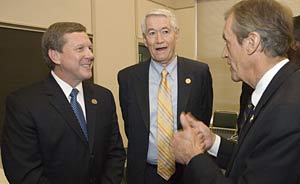
This picture is so revealing.  [Photo credit: UC Berkeley Media Relations] The caption reads, "Backstage before the announcement, UC President Robert Dynes (right) flashes 'thumbs up' to BP America chairman Robert Malone . . .."
"The announcement." "What announcement?" I hear you ask. The announcement that BP is going to give UC Berkeley (my first post-clerkship employer) $500 million.
Global energy firm BP announced today (Thursday, Feb. 1 [2007]) that it has selected the University of California, Berkeley, in partnership with Lawrence Berkeley National Laboratory (LBNL) . . . to lead an unprecedented $500 million research effort to develop new sources of energy and reduce the impact of energy consumption on the environment. . . .
"This partnership with BP will develop new, sustainable energy technologies that can transform the landscape," said Nobel Laureate Steven Chu, director of LBNL — a U.S. Department of Energy-funded lab — and UC Berkeley professor of physics and of molecular and cell biology.
Robert Sanders, "BP Selects UC Berkeley to Lead $500 Million Energy Research Consortium," UC Berkeley News, February 1, 2007.
Why is this story relevant? Well, for starters it is an illustration of the fact that the tentacles of a multi-billion-dollar corporation like BP extend into far more major American institutions than just the federal government -- especially the large, prestigious, research universities.
It also makes the point that when you're in a position to hand out money in $500 million bundles you tend to get a thumbs up from everyone you meet -- including presidents and members of Congress.
How can a company afford to make $500 million contributions? BP's first quarter profits were $5.6 billion; that's profits, not revenue, which is of course much greater; and not annual profits, but three months' worth of profits.
But there's more. Just as occasionally when you drill you strike oil, so occasionally when you pay $500 million for favorable public relations (BP was trying to sell the public on the idea that BP no longer stands for "British Petroleum," it now stands for "Beyond Petroleum") you strike another kind of oil.
And so it was with their beneficence spread upon Professor Chu. Do you know where he is now? That's right, President Obama decided he would make a great Secretary of Energy -- the guy who's supposed to be helping us overcome our oil addiction.
And what did he have to say recently about the BP oil spill disaster?
"U.S. Energy Secretary Steven Chu said Wednesday it was not a mistake for the administration to support more offshore drilling as part of comprehensive energy reform, despite the oil rig spill in the Gulf of Mexico that continues to threaten coastal areas." John Wihbey, "Energy Sec. Steven Chu: More Drilling Proposal 'Not a Mistake,'” "On Point with Tom Ashbrook"/WBUR/NPR, May 5, 2010.
Spreading Money Like Oil
But it's BP's generosity with members of Congress that may have even more to do with its disaster in the Gulf than its generosity with Energy Secretary Chu. After all, the pollution of the Gulf is primarily the responsibility of the Secretary of the Interior, not the Secretary of Energy.
Oil behemoth BP poured millions of dollars into lobbying and campaign contributions over the past two decades, courting allies in Congress and the White House. . . . BP paid $6.2 million in campaign contributions since 1990, landing on the list of 107 "heavy hitters" compiled by the Center for Responsive Politics.
The company's political action committee has helped the re-election efforts of many . . ..
And that's just part of BP's political spending.
Just in the past year, BP doled out nearly $16 million for influence efforts, using both its own lobbyists and those with eight other firms . . ..
Anne C. Mulkern, "Big Contributor BP Finds Itself Without a Friend on the Hill," New York Times/Greenwire, May 4, 2010; and see Bara Vaida, "K Street Paradox; Special Report: President Obama's fight against special interests boomerangs as lobbying firms just get richer," National Journal, March 13, 2010 (subscription service) ("President Obama continues to campaign against Washington's special interests, but to what effect? The more he tries to rein in lobbyists, the more K Street rakes in.").
OK, but what does that have to do with Interior Secretary Ken Salazar? Well, before he was a cabinet secretary it happens that he was a U.S. Senator -- a senator who served just shy of one term.
Having not yet been a senator for a full term, Ken Salazar (D-Colo.) [who] hasn't had much time to collect money from the industries that will take a special interest in him as Secretary of the Interior . . . . has collected a total of $321,800 from the energy and natural resources sector during his short time in the Senate . . ..
Lindsay Renick Mayer, "Interior Motives," Open Secrets, December 16, 2008.
And what was his record as a Senator? His Wikipedia entry reports that,
In 2005, Salazar voted against increasing fuel-efficiency standards (CAFE) for cars and trucks . . . [and] against an amendment to repeal tax breaks for ExxonMobil and other major petroleum companies. . . .
In 2006, Salazar voted to end protections that limit offshore oil drilling in Florida's Gulf Coast.
In 2007, Salazar was one of only a handful of Democrats to vote against a bill that would require the United States Army Corps of Engineers to consider global warming when planning water projects.
"Ken Salazar," Wikipedia.
So we shouldn't be surprised with Paul Krugman's reminder this morning that "environmentalists were bitterly disappointed when Mr. Obama chose Ken Salazar as secretary of the interior. They feared that he would be too friendly to mineral and agricultural interests, that his appointment meant that there wouldn’t be a sharp break with Bush-era policies — and in this one instance at least, they seem to have been right." Paul Krugman, "Sex and Drugs and the Spill," New York Times, May 10, 2010, p. A23.
Regulators Make Strange Bedfellows
And so what role did President Obama's Secretary of the Interior play in bringing on this Gulf disaster?
The Interior Department exempted BP's calamitous Gulf of Mexico drilling operation from a detailed environmental impact analysis last year, according to government documents . . . [as a result of] [t]he decision by the department's Minerals Management Service (MMS) to give BP's lease at Deepwater Horizon a "categorical exclusion" from the National Environmental Policy Act (NEPA) on April 6, 2009 -- and BP's lobbying efforts just 11 days before the explosion to expand those exemptions . . ..
"I'm of the opinion that boosterism breeds complacency and complacency breeds disaster," said Rep. Edward J. Markey (D-Mass.) on Tuesday. "That, in my opinion, is what happened." . . .
While the MMS assessed the environmental impact of drilling in the central and western Gulf of Mexico on three occasions in 2007 -- including a specific evaluation of BP's Lease 206 at Deepwater Horizon -- in each case it played down the prospect of a major blowout.
In one assessment, the agency estimated that "a large oil spill" from a platform would not exceed a total of 1,500 barrels and that a "deepwater spill," occurring "offshore of the inner Continental shelf," would not reach the coast. In another assessment, it defined the most likely large spill as totaling 4,600 barrels and forecast that it would largely dissipate within 10 days and would be unlikely to make landfall.
"They never did an analysis that took into account what turns out to be the very real possibility of a serious spill," said Holly Doremus, a law professor at the University of California at Berkeley who has reviewed the documents.
The MMS mandates that companies drilling in some areas identify under NEPA what could reduce a project's environmental impact. But Interior Department spokesman Matt Lee-Ashley said the service grants between 250 and 400 waivers a year for Gulf of Mexico projects. He added that Interior has now established the "first ever" board to examine safety procedures for offshore drilling. It will report back within 30 days on BP's oil spill and will conduct "a broader review of safety issues," Lee-Ashley said.
BP's exploration plan for Lease 206 [Deepwater Horizon], which calls the prospect of an oil spill "unlikely," stated that "no mitigation measures other than those required by regulation and BP policy will be employed to avoid, diminish or eliminate potential impacts on environmental resources."
[T]he plan . . . minimized the prospect of any serious damage associated with a spill, saying there would be only "sub-lethal" effects on fish and marine mammals, and "birds could become oiled. However it is unlikely that an accidental oil spill would occur from the proposed activities."
Kierán Suckling, executive director of the environmental group Center for Biological Diversity, said the federal waiver "put BP entirely in control" of the way it conducted its drilling.
Agency a 'rubber stamp'
"The agency's oversight role has devolved to little more than rubber-stamping British Petroleum's self-serving drilling plans," Suckling said.
BP has lobbied the White House Council on Environmental Quality -- which provides NEPA guidance for all federal agencies -- to provide categorical exemptions more often. In an April 9 letter, BP America's senior federal affairs director, Margaret D. Laney, wrote to the council that such exemptions should be used in situations where environmental damage is likely to be "minimal or non-existent." An expansion in these waivers would help "avoid unnecessary paperwork and time delays," she added.
Juliet Eilperin, "U.S. exempted BP's Gulf of Mexico drilling from environmental impact study," Washington Post, May 5, 2010.
The disaster was predictable. Why predictable? Consider the record:
The 2005 explosion at a refinery in Texas City, Tex., killed 15 workers and injured hundreds more. The Occupational Safety and Health Administration fined BP a record $87 million for neglecting to correct safety violations.
Only a year later, a leaky BP oil pipeline in Alaska forced the shutdown of one of the nation’s biggest oil fields. BP was fined $20 million in criminal penalties after prosecutors said the company had neglected corroding pipelines. . . .
Last year, when the federal Minerals Management Service proposed a rule that would have required companies to have their safety and environmental management programs audited once every three years, BP and other companies objected. The agency is also investigating charges by a whistle-blower that the company discarded important records from its Atlantis Gulf platform.
Clifford Krauss, "Oil Spill’s Blow to BP’s Image May Eclipse Costs," New York Times, April 30, 2010; and see additional details and comparisons with other companies in Jad Mouawad, "BP Has a Record of Blasts and Oil Spills," New York Times, May 9, 2010, p. A22 ("BP, the nation’s biggest oil and gas producer, has a worse health, environment and safety record than many other major oil companies, according to Yulia Reuter, the head of the energy research team at RiskMetrics . . ..").
There are no simple answers to how an agency becomes "captured" by the industry it is supposed to regulate. But here are a couple of insights.
Regulators make strange bedfellows. You do recall the Minerals Management Service don't you? "Government officials in charge of collecting billions of dollars worth of royalties from oil and gas companies accepted gifts, steered contracts to favored clients and engaged in drug use and illicit sex with employees of the energy firms, federal investigators reported yesterday." Derek Kravitz and Mary Pat Flaherty, "Report Says Oil Agency Ran Amok; Interior Dept. Inquiry Finds Sex, Corruption," Washington Post, September 11, 2008. Noelle Straub, "GAO Audit: MMS Withheld Offshore Drilling Data, Hindered Risk Analyses in Alaska," New York Times/Greenwire, April 7, 2010 -- roughly three weeks before the current disaster.
So what? So, "The [Department of the Interior] inspector general said that these relationships have cost taxpayers $4.4 million in lapsed collection fees, but due to the sloppy administration at MMS, the real cost may go undiscovered. In a separate report, the Government Accountability Office (GAO) found that MMS is plagued by inefficiency in collecting royalties, and that there is no way to backtrack and figure out how much has actually been lost. Currently, oil companies submit their own data and MMS simply takes them at their word, rather than independently confirming that the numbers are correct — what the inspector general has referred to in a letter to Secretary Dirk Kempthorne as a “Band-Aid approach to holding together one of the federal government's largest revenue producing operations.” A separate GAO report found that the United States is not collecting fair market price for royalties on public resources — which may be seriously limiting the amount of money taken in by MMS, and hence, the taxpayers." "Broken Government," Center for Public Integrity.
These consequences are reinforced as a result of what has come to be called the "revolving door."
In trying to understand why M.M.S. fails in its fiduciary and regulatory responsibilities to taxpayers, it’s impossible to ignore the revolving door between the agency and the industry that it oversees. Since leaving government service, Gale Norton, secretary of Interior under President Bush, became Shell’s general counsel, and J. Steven Griles, a deputy secretary of Interior, lobbied for numerous oil and gas industries — including BP — before he went to jail for obstructing a Senate investigation. Randall Luthi, the most recent director of M.M.S., is now president of the National Oceans Industries Association, whose mission is to secure a “favorable regulatory and economic environment for the companies that develop the nation’s valuable offshore energy resources.” . . .
Longstanding cozy ties with industry may help explain why M.M.S. failed to bolster safety requirements for equipment and processes used on the Deepwater Horizon rig — despite internal reports giving clear warnings about the risks of these devices and techniques.
At the end of the day, this spill should show Congress that there are real harms when government regulators consider the industry they oversee to be a partner or client (or future employer) rather than an entity that they should hold accountable.
Danielle Brian and Mandy Smithberger, "Our Government, Serving the Energy Business," in Editors, "Rules, Revolving Doors and the Oil Industry," New York Times, May 5, 2010.
Oil Seepage Into the White House
In fairness to the Obama Administration, it should be noted that this "self-regulation" of offshore drilling actually began during the Clinton Administration.
"We are not supportive of the extensive, prescriptive regulations as proposed in this rule," wrote Richard Morrison, BP's vice president for Gulf of Mexico production. "We believe industry's current safety and environmental statistics demonstrate that the voluntary programs implemented since the adoption of [voluntary standards] have been and continue to be very successful." . . . The voluntary approach was adopted in 1994 during the Clinton administration.
Mike Soraghan, "BP, Other Oil Companies Opposed Effort to Stiffen Environmental, Safety Rules for Offshore Drilling," Greenwire/New York Times, April 27, 2010.
Because ultimately this rot from within government, like an under-ocean oil spill, makes its way up to the White House and the President himself. President Obama is, from all indications, a bright guy, well informed, a quick study, not easily bamboozled. So when he starts mouthing oil industry propaganda it's hard to make excuses for him -- much as I'd like to believe he was simply relying too heavily on staff members, or industry spokespersons, he thought he could trust.
And yet, there he was on March 31, announcing from Andrews Air Force Base,
[A]s we transition to cleaner energy sources, we’ve still got to make some tough decisions about opening new offshore areas for oil and gas development in ways that protect communities and protect coastlines. . . .
[T]he bottom line is this: Given our energy needs, in order to sustain economic growth and produce jobs, and keep our businesses competitive, we are going to need to harness traditional sources of fuel even as we ramp up production of new sources of renewable, homegrown energy.
So today we’re announcing the expansion of offshore oil and gas exploration, but in ways that balance the need to harness domestic energy resources and the need to protect America’s natural resources. Under the leadership of Secretary Salazar, we’ll employ new technologies that reduce the impact of oil exploration. We’ll protect areas that are vital to tourism, the environment, and our national security. And we’ll be guided not by political ideology, but by scientific evidence.
"Remarks by The President on Energy Security at Andrews Air Force Base," March 21, 2010.
On April 2, 2010 -- 18 days before the BP disaster -- here is what the President had to say in Charlotte, North Carolina:
[Photo credit: White House] [W]e’ve got to look at our traditional energy sources and figure out how can we use those most effectively and in the most environmentally sound way. . . .
The decision around drilling -- same approach. What we did was we said we’re not going to have drilling a mile off the North Carolina coast or two miles off. But 50 miles off, 100 miles off, where it is appropriate and environmentally sound and not risky, we should allow exploration to begin taking place to see if there’s certain reserves. . . .
But what we did was we tried to look at the scientific evidence and figure out where are areas where low risk environmentally and a high potential upside. . . .
I don’t agree with the notion that we shouldn’t do anything. It turns out, by the way, that oil rigs today generally don’t cause spills. They are technologically very advanced. Even during Katrina, the spills didn’t come from the oil rigs, they came from the refineries onshore.
"Remarks by the President in a Discussion on Jobs and the Economy," Charlotte, North Carolina, April 2, 2010.
"Protect communities and protect coastlines"; "protect America's natural resources -- tourism, the environment -- guided by scientific evidence"; "environmentally sound and not risky"; "low risk environmentally"; "technologically advanced -- oil rigs today don't cause spills." It sounds as if it was written by a BP publicist. Hopefully, it was not -- but the result is just the same.
Wrapping Up With Democracy Now:
How is the Environmental Impact of Offshore Drilling Like a Forest Trail?
To wrap it up, here is the "Democracy Now" interview of Kieran Suckling, executive director of the Center for Biological Diversity:
SECRETARY KEN SALAZAR: Minerals Management Service will not be issuing any permits for the construction of new offshore wells [after] May the 28th. . . . But today is not really the day to deal with those issues. . . .
[Democracy Now reporter] JUAN GONZALEZ: Secretary Salazar added that the existing offshore oil and natural gas drilling will continue, . . ..
[Democracy Now anchor] AMY GOODMAN: Salazar’s announcement comes on the heels of a Washington Post exposé revealing that the Minerals Management Service had approved BP’s drilling plan in the Gulf of Mexico without any environmental review. The article notes that the agency under Secretary Salazar had quote “categorically excluded” BP’s drilling as well as hundreds of other offshore drilling permits from environmental review. The agency was able to do this using a loophole in the National Environmental Policy Act created for minimally intrusive actions like building outhouses and hiking trails. Well, for more on this story, we’re joined now from Tucson, Arizona by Kieran Suckling, executive director of the Center for Biological Diversity. Welcome to DEMOCRACY NOW!, Kieran. Explain this loophole, how you found it, and what it means for the Gulf.
KIERAN SUCKLING: Well, when a federal government is going to approve a project, it has to go through an environmental review. But for projects that have very, very little impact like building an outhouse or a hiking trail, they can use something called a categorical exclusion and say there’s no impact here at all so we don’t need to spend energy or time doing a review. Well, we looked at the oil drilling permits being issued by the Minerals Management Service in the Gulf, and we were shocked to find out that they were approving hundreds of massive oil drilling permits using this categorical exclusion instead of doing a full environmental impact study. And then, we found out that BP’s drilling permit—the very one that exploded—was done under this loophole and so it was never reviewed by the federal government at all. It was just rubber-stamped.
JUAN GONZALEZ: Well, according to the Washington Post article, in one of its assessments of the agency “estimated that a large oil spill from a deep platform like the Deepwater Horizon would not exceed a total of 1,500 barrels and that a deepwater spill occurring off the Intercontinental shelf would not reach the coast.” Obviously, both of those—both of those assessments have proven dramatically off the mark. As many as 250-400 waivers a year for drilling in the Gulf?
KIERAN SUCKLING: Yeah, yeah, absolutely. It’s also important to note that when the government says it’s very unlikely this spill will occur, it’s unlikely the spill will reach shore, those aren’t even the government’s own assessments. They’re just repeating what BP, Exxon, and other oil companies put in their drilling applications. And since there’s no environmental impact study, the government never actually does an independent review. So everyone is just repeating the industry’s statements as they rubber-stamp the approvals.
AMY GOODMAN: Reporters questioned White House press secretary Robert Gibbs on Wednesday about why BP’s Gulf of Mexico drilling operation was exempted from the detailed environmental impact analysis last year. . . .
KIERAN SUCKLING: The White House and the Department of Interior are really sort of ducking their heads on this issue right now because it’s an enormous problem. Especially since just a few months ago the Government Accountability Office came out with the report on MMS’s operations in Alaska, where they also have offshore drilling, and specifically said the agency is not doing these environmental studies properly. They’re avoiding doing them at all. And then they went ahead knowing that the GAO had just done this study and continued to put them out. So, this is not something new. MMS knew they had a problem. In fact, when Interior Secretary Salazar first came into office, he announced ‘There’s a new Sheriff in town, I’m going to clean up this corrupt agency,’ and instead of doing that, he’s pushed them to put out more offshore oil drilling permits while not cleaning up what is clearly a broken process of doing any environmental review at all.
JUAN GONZALEZ: I want to play a clip of President Obama where he says that oil spills don’t come from rigs, but from refineries. He was speaking on April 2nd, just over two weeks before the explosion of the Deepwater Horizon rig.
PRESIDENT BARACK OBAMA: I want to point out, by the way, that oil rigs today generally don’t cause spills. They are technologically very advanced. Even during Katrina, the spills didn’t come from the oil rigs, they came from the refineries onshore. . . .
KIERAN SUCKLING: Yeah, I mean, I think what the President has said here is actually just very, very critical, because he is repeating, and I suspect without even knowing it, the big lie of offshore oil drilling. For decades, the oil companies and the Minerals Management Service have told us, ‘Oil drilling is safe, it’s fine, that’s not where oil spills come from.’ In fact, that’s the basis of not doing any environmental review is, you simply assert it will never be a problem, therefore, you don’t even have to study it. While it’s true that they don’t leak often, but when they do leak, it’s absolutely catastrophic. It’s very similar to nuclear power plants. They don’t often fail, but when they fail it’s catastrophic. And, therefore, you have to plan for catastrophe. You have to do very intensive environmental analysis, not simply say, ’It’s rare, so we can ignore it.’
AMY GOODMAN: Kieran Suckling, what do think has to happen right now?
KIERAN SUCKLING: Well, first off, I think that the President should announce a complete moratorium on all new offshore oil drilling. This three-week time-out is really too little, too late. And it’s very important to do that now because the president, under the urging of Secretary of Interior Ken Salazar, has planned to open up new offshore oil drilling in Alaska, in the eastern Gulf of Mexico, and on the Atlantic coast. And that just needs to end. It’s not safe anywhere, anytime.
Secondly, the president should immediately revoke existing oil permits and especially in Alaska. Shell Oil, this July, . . . is going to start doing offshore oil drilling in the Chukchi Sea of Alaska. And if you think it’s difficult to clean up oil in the relatively warm, calm Gulf of Mexico, imagine trying to do this with icebergs and sea ice, twenty hours of darkness, in the Arctic oceans. It just cannot be done. If this spill had happened in Alaska, its magnitude would have been ten times worse than has happened in the Gulf.
Then, thirdly, the President should start an initiation of an investigation of Ken Salazar and his role in allowing this to happen.
Salazar has been a major proponent of the offshore oil drilling industry. He passed legislation as a senator in 2006 to open up the Gulf of Mexico in the first place to offshore oil drilling. He gets campaign contributions by British Petroleum. And then he walks into this agency he is supposed to reform, and instead of reforming it, pushes it to do even more offshore oil drilling. So Ken Salazar is part of the problem here, not the solution. He should not be doing the investigation of MMS. He should be under investigation for helping to cause this crisis.
"Government Exempted BP From Environmental Review," Democracy Now, May 7, 2010 (video and transcript).
Most institutions only respond to internal problems when they become serious or dramatic enough to create significant adverse media coverage. The response may be helpful, or may be counterproductive -- even to the institution's self-interest.
But even after the public relations disaster there's no assurance meaningful reform will ensue. Consider our financial collapse. As I pointed out in a recent blog entry, the first thing to do if the problem is "too big to fail" is to make the institutions smaller. And yet, when the Senate tried it was the Senate that was "too" something; it failed. The Goldman Sachs alums won again.
A move to break up major Wall Street banks failed Thursday night by a vote of 61 to 33.
Three Republicans, Richard Shelby of Alabama, Tom Coburn of Oklahoma and John Ensign of Nevada, voted with 30 Democrats, including Senate Majority Leader Harry Reid of Nevada, in support of the provision. The author of the pending overall financial reform bill in the Senate, Banking Committee Chairman Christopher Dodd, voted against it.
The amendment . . . would have required megabanks to be broken down in size and capped so that their individual failure would not bring down the entire system. . . .
In practice, the amendment required the six biggest banks -- Bank of America, JPMorgan Chase, Citigroup, Wells Fargo, Goldman Sachs and Morgan Stanley -- to significantly scale down their size. It was touted as a way to end Too Big To Fail.
Though top Obama administration officials have not publicly opposed the amendment, its leading economists have opposed ending Too Big To Fail simply by breaking up the nation's financial behemoths. Austan Goolsbee and Larry Summers have both fought back against this idea, as has Treasury Secretary Timothy Geithner.
"Senate Votes For Wall Street; Megabanks To Remain Behemoths," Huffington Post, May 6, 2010.
It remains to be seen whether even America's worst environmental disaster, getting worse by the day, will be enough to change the culture of Washington anymore than our financial collapse was able to do.
But now at least we can see how to connect those slippery, oily dots; now we understand "the rest of the story."
Will we do anything about it -- you and me? That also remains to be seen.
_______________
* Why do I put this blog ID at the top of the entry, when you know full well what blog you're reading? Because there are a number of Internet sites that, for whatever reason, simply take the blog entries of others and reproduce them as their own without crediting the source. I don't mind the flattering attention, but would appreciate acknowledgment as the source -- even if I have to embed it myself.
-- Nicholas Johnson
# # #
September 25, 2009, 8:00 a.m.
Trying to Make Sense of Why We're in Afghanistan
(brought to you by FromDC2Iowa.blogspot.com*)
Are we at war, once again, because of our need to control sources of oil, gas, pipeline and oil tanker routes and ports?
I don't know. How could I? I'm just a morning blogger. But as I try to think through what we're doing in Afghanistan, and why, it makes a lot more sense than anything else I can come up with.
Frankly, I think there might be more popular support for the Afghanistan war than there is now, a willingness to accept the loss of life and hundreds of billions of taxpayer dollars, if Presidents Bush and Obama had candidly sold the effort to the American people on that basis. But I can understand their reluctance to take the risk that explanation would be spun by their political opponents into "going to war for oil company profits."
Consider what they have been telling us.
"Mission shift and creep" is usually not the military's creation. The Powell Doctrine calls for a very precise articulation of what the problem is, why a military presence is appropriate to its solution, exactly what the military is being asked to do, what resources that requires, the metrics for knowing whether it has ever been "successful," and an exit strategy. When that process is not followed, when the explanations for a war continue to shift over time, I have to assume it's the result of something done by the civilians in the chain of command.
Wrong Country. At the outset, however irrational, Americans were told we were bombing Afghanistan because of the destruction of the Twin Towers on 9/11 -- something done with Saudi personnel and financial resources -- rather than going to war with Saudi Arabia. For awhile we were there to get Osama bin Laden. As the years went by less and less was said of that goal. At one time we were driving al Qaeda out of Afghanistan. If that's our purpose we can declare victory and come home, because both bin Laden and such al Qaeda as there may be in the region appear to be in Pakistan, not Afghanistan.
Safe Havens. More recently we're said to be there because we want to deny al Qaeda the "safe haven" of Afghanistan. There are at least three things wrong with this rationale. (1) To the extent al Qaeda has a safe haven in the region, it's in Pakistan not Afghanistan. (2) All al Qaeda needs to plan the next terrorist attack is a rented apartment in any city in the world. (3) Aside from Saudi Arabia, al Qaeda never has been a single nation's effort; the "war on terrorism" has never been a conventional war between "nations." al Qaeda is, or can be, everywhere and anywhere at any time. To the extent it wants or needs a territory to train terrorists there are a lot of countries available besides Afghanistan. So even if we could keep every last actual and potential member of al Qaeda out of Afghanistan we would not have denied them "safe havens." See, Michael Evans, "Al-Qaeda finds three safe havens for terror training," The Times (of London), July 2, 2008 ("Al-Qaeda, Osama bin Laden’s terrorist organisation, driven out of Afghanistan and defeated in Iraq, is re-emerging in strength in three alternative safe havens for training, operational planning and recruiting – Pakistan, Somalia and Algeria – according to Western intelligence and defence sources").
Drug War. There was a time when the military effort was said to be a part of our "war on drugs," as Afghanistan is the world's major source of the poppy that becomes heroin -- including America's supply. If that's our goal we should turn it over to the Taliban, because when they were in charge they pretty successfully dried up the drug trade; what we've doing has caused it to flourish.
Nation Building. We've sometimes said we are there to build a thriving economy and democracy for Afghanistan. But this is less a "country" than it is a collection of largely uneducated members of regional tribes and clans held together by war lords, riddled with corruption, with virtually no economy (aside from drugs), lacking basic infrastructure, and with a history of repression of women -- united in little more than their (understandable) opposition to invaders and occupying forces (formerly the Russians, and now us).
So how is that mission working for us? Not well -- as knowledgeable folks were predicting from the outset. Our most recent big effort at democracy-building, a national election, has resulted in revelations of corruption, thousands of apparently fraudulent votes, intimidation of voters, and war lords "delivering" votes based on deals -- thereby creating greater divisiveness than existed before, and greater American dissatisfaction with "our guy in Kabul," Hamid Karzai.
I could go on, but you get the point.
(Little) Benefit-(Enormous) Cost Analysis. None of the explanations for this "war effort" make much sense. And even if they did, the benefit-cost analysis fails. That is to say, given America's priorities at the moment -- or any other moment for that matter -- is whatever good we might get out of Afghanistan (and what might that be?) worth the hundreds of billions of dollars and thousands of coalition and Afghan lives it has, is and will cost us over the additional decades of what is already America's longest war? I don't think so, and I can't imagine anyone else honestly thinking so. See, "Safe Havens," Yglesias Think Progress, September 23, 2009 ("what I really haven’t seen is anyone attempt to seriously lay out some kind of cost-benefit analysis of how important this whole Afghanistan situation really is relative to what I’m being told it would take to 'win.'").
Which brings me to oil and gas.
Let me acknowledge at the outset, in case you haven't noticed, that this is a blog entry not a doctoral dissertation. Some of what I've picked up and refer to below -- especially when it involves generalized assertions -- may be untrue. On the other hand, when it involves specific historical or geological facts and appears in a number of sources much of it seems credible.
Let's start with some excerpts from "Pipelineistan," written in 2005. You may want to read the whole article; the source is linked below these passages.
War against terrorism? Not really. . . .
A quick look at the map is all it takes. It's no coincidence that the map of terror in the Middle East and Central Asia is practically interchangeable with the map of oil. . . .
Pipelineistan is the golden future: a paradise of opportunity in the form of US$5 trillion of oil and gas in the Caspian basin and the former Soviet republics of Central Asia. In Washington's global petrostrategy, this is supposed to be the end of America's oil dependence on [OPEC]. . . .
Afghanistan itself has some natural gas in the north of the country, near Turkmenistan. But above all it is ultra-strategic: positioned between the Middle East, Central Asia and South Asia, between Turkmenistan and the avid markets of the Indian subcontinent, China and Japan. Afghanistan is at the core of Pipelineistan.
The Caspian states hold at least 200 billion barrels of oil, and Central Asia has 6.6 trillion cubic meters of natural gas . . .. Uzbekistan and Turkmenistan are two major producers . . ..
The only export routes, for the moment, are through Russia. So most of the game consists of building alternative pipelines to Turkey and Western Europe, and to the east toward the Asian markets. India will be a key player. . . .
It's enlightening to note that all countries or regions which happen to be an impediment to Pipelineistan routes towards the West have been subjected either to a direct interference or to all-out war: Chechnya, Georgia, Kurdistan, Yugoslavia and Macedonia. To the east, the key problems are the Uighurs of China's far-western Xinjiang and, until recently, Afghanistan. . . .
In this geostrategic grand design, the Taliban were the proverbial fly in the ointment. The Afghan War was decided long before September 11. September 11 merely precipitated events. Plans to destroy the Taliban had been the subject of . . . discussions for months before September 11. There was a crucial meeting in Geneva in May 2001 . . .. The topic was raised again in full force at the Group of Eight (G-8) summit in Genoa, Italy, in July 2001 when India - an observer at the summit - also contributed its own plans.
Nor concidentally, Pipelineistan was the central topic in secret negotiations in a Berlin hotel a few days after the G-8 summit, between American, Russian, German and Pakistani officials. And Pakistani high officials, on condition of anonymity, have extensively described a plan set up by the end of July 2001 by American advisers, consisting of military strikes against the Taliban from bases in Tajikistan, to be launched before mid-October.
[O]nly nine days after Hamid Karzai's interim government took power in Kabul, Bush II appointed his special envoy to Afghanistan . . . Afghan-American Zalmay Khalilzad - a former aide to the Californian energy giant UNOCAL. . . . The so-called brand-new American "Afghan policy" is being conducted by people intimately connected to oil industry interests in Central Asia.
In 1997, UNOCAL led an international consortium - Centgas - that reached a memorandum of understanding to build a $2 billion, 1,275-kilometer-long, 1.5-meter-wide natural-gas pipeline from Dauletabad in southern Turkmenistan to Karachi in Pakistan, via the Afghan cities of Herat and Kandahar, crossing into Pakistan near Quetta. A $600 million extension to India was also being considered. The dealings with the Taliban were facilitated by the Clinton administration and the
Pakistani Inter Services Agency (ISI). But the civil war in Afghanistan would simply not go away. UNOCAL had to pull out.
American energy conglomerates, through the American Overseas Private Investment Corp (OPIC), are now resuscitating this and other projects. Already last October, the UNOCAL-led project was discussed in Islamabad between Pakistani Petroleum Minister Usman Aminuddin and American Ambassador Wendy Chamberlain. The exuberant official statement reads: "The pipeline opens up new avenues of multi-dimensional regional cooperation, particularly in view of the recent geopolitical developments in the region." . . .
UNOCAL also has a project to build the so-called Central Asian Oil Pipeline, almost 1,700km long, linking Chardzhou in Turkmenistan to Russian's existing Siberian oil pipelines and also to the Pakistani Arabian Sea coast. This pipeline will carry 1 million barrels of oil a day from different areas of former Soviet republics, and it will run parallel to the gas pipeline route through Afghanistan.
Khalilzad . . . was always a huge Taliban supporter [and] only abandoned the Taliban after Bill Clinton fired 58 cruise missiles into Afghanistan in August 1998 . . .. [O]ne day after the attack, UNOCAL put Centgas on hold - and two months later abandoned plans for the trans-Afghan pipeline.
A little more than a year ago, Khalilzad was reincarnated in print in The Washington Quarterly, now stressing his four main reason to get rid of the Taliban regime as soon as possible: Osama bin Laden, opium trafficking, oppression of the Afghan people and, last but not least, oil. . . .
He was a strident lobbyist for more US military aid to the mujahedeen during the anti-USSR jihad - campaigning for widespread distribution of Stinger missiles. . . .
But he was not rewarded with any promotions. The required Senate confirmation would raise extremely uncomfortable questions about his role as UNOCAL adviser and staunch Taliban defender. He was assigned instead to the National Security Council - no Senate confirmation required - where he reports to National Security Adviser Condoleezza Rice.
Rice herself is a former oil-company consultant. During Bush I, from 1989-92, she was on the board of directors of Chevron, and was its main expert on Kazakhstan. Chevron has invested more than $20 billion in Kazakhstan alone. . . .
All American secretaries of state since World War II have been connected with the oil industry - except two: one of them is Colin Powell, but in his case the president, vice president and national security adviser are all part of the oil industry anyway.
So everybody in the ruling plutocracy knows the rules of the ruthless game: Central Asia is crucial to Washington's worldwide petro-strategy. So is a "friendly" government in Afghanistan - now led by . . . Hamid Karzai. . . .
As for US . . . media - from TV networks to daily newspapers - they just exercise self-censorship and remain mute about all of these connections.
Pepe Escobar, "The War for Pipelineistan," Asia Times, January 26, 2005.
Here are excerpts from another account, unfortunately equally devoid of footnotes or other citations to sources:
As soon as the Soviets discovered the vast Caspian Sea oilfields in the late 1970's, they attempted to take control of Afghanistan to build a massive north-south pipeline system to allow the Soviets to send their oil directly through Afghanistan and Pakistan to the Indian Ocean seaport. The result was the decades long Soviet-Afghan war. The . . . U.S. government saw the danger of a Russian north-south pipeline and the CIA trained and funded armed terrorist groups, including Osama bin Laden, who defeated the Soviets in the late 1980's.
The Russians then tried to control the flow of oil and gas through its monopoly on pipelines. The Southern Asian Republics of the former Soviet Union--Turkmenistan, Kazakhstan, Uzbekistan, Tajikistan and Kyrgyzstan--saw through this Russian monopolistic ploy and began to consult with Western companies.
The . . . U.S. government now plans to thrust further along the 40th parallel from the Balkans through these Southern Asian Republics of the former Soviet Union. The U.S. military has already set up a permanent operations base in Uzbekistan. The so-called anti-terrorist strategy is clearly designed to simultaneously consolidate control over Middle Eastern and South Asian oil, and contain and neutralize the former Soviet Union. With that strategy, Afghanistan is exactly where they need to be. . . .
Afghanistan will now become the base of operations in destabilizing, isolating, and establishing control over the South Asian Republics and the Middle-East. After the conquest of this area is complete and the permanent military posts are set up, they will begin construction of a pipeline through Turkmenistan, Afghanistan, and Pakistan to deliver petroleum to the Asian market.
UNOCAL, the spearhead for Standard Oil interests, has been trying to build the north-south pipeline through Afghanistan and Pakistan to the Indian Ocean for several decades. . . . The pipeline was to stretch 1,271 km from Turkmenistan's Dauletabad fields to Multan in Pakistan at an estimated cost of $1.9 billion. An additional $600 million would have brought the pipeline to energy-hungry India. . . .
UNOCAL cut off its earlier agreement with the Taliban in 1998 when it became clear that the Taliban could not control all of Afghanistan and provide a stable political environment for a north-south pipeline construction project. It was likely at this juncture that a new "war against terrorism" ploy was conceived by the . . . U.S. government. The "war against terrorism" in Afghanistan has come to a hiatus, with war-lords once again ruling the country, and the Bush administration has put their own man, Karzai, in power to control Afghanistan.
Karzai was a top adviser to UNOCAL during the negotiations with the Taliban to construct a Central Asia Gas (CentGas) pipeline from Turkmenistan through western Afghanistan to Pakistan. Karzai is the leader of the southern Afghan Pashtun Durrani tribe. A member of the mujaheddin that fought the Soviets during the 1980s, Karzai was a top contact for the CIA, maintaining close relations with CIA Director William Casey, Vice President George Bush, and their Pakistani Inter Service Intelligence (ISI) Service go-between. After the Soviet Union left Afghanistan, the CIA sponsored the relocation of Karzai and a number of his brothers to the U.S.
The real motives for the Bush administration's war in Afghanistan are clear for all to see. The U.S. Ambassador to Pakistan, Wendy Chamberlain, met with Pakistan's oil minister, Usman Aminuddin, in January, 2002 to continue plans for the north-south pipeline, encouraging the construction of Pakistan's Arabian Sea oil terminus for the pipeline.
President Bush says our military will continue its presence in Afghanistan, which means that while the U.N. forces serve as a paramilitary police force, U.S. soldiers will be guarding the construction of the north-south pipeline.
To assure that the pipeline project will proceed apace, the Afghani-American Zalmay Khalilzad, a previous member of the CentGas project, became President Bush's Special National Security Assistant. Khalilzad has recently been named presidential Special Envoy for Afghanistan. Khalilzad is a Pashtun and the son of a former government official under King Mohammed Zahir Shah. [H]e was a special liaison between UNOCAL and the Taliban government. Khalilzad also worked on various risk analyses for the project under the direction of National Security Advisor Condoleezza Rice, a former member of the board of Chevron.
Norman D. Livergood, "The New U.S.-British Oil Imperialism," Part I.
And for what it's worth, here's a brief and somewhat updated entry from Wikipedia:
The Trans-Afghanistan Pipeline (TAP or TAPI) is a proposed natural gas pipeline being developed by the Asian Development Bank. The pipeline will transport Caspian Sea natural gas from Turkmenistan through Afghanistan into Pakistan and then to India. Proponents of the project see it as a modern continuation of the Silk Road. The Afghan government is expected to receive 8% of the project's revenue.
The original project started in March 1995 when an inaugural memorandum of understanding between the governments of Turkmenistan and Pakistan for a pipeline project was signed. In August 1996, the Central Asia Gas Pipeline, Ltd. (CentGas) consortium for construction of a pipeline, led by Unocal was formed. On 27 October 1997, CentGas was incorporated in formal signing ceremonies in Ashgabat, Turkmenistan by several international oil companies along with the Government of Turkmenistan. In January 1998, the Taliban, selecting CentGas over Argentinian competitor Bridas Corporation, signed an agreement that allowed the proposed project to proceed. In June 1998, Russian Gazprom relinquished its 10% stake in the project. Unocal withdrew from the consortium on 8 December 1998.
The new deal on the pipeline was signed on 27 December 2002 by the leaders of Turkmenistan, Afghanistan and Pakistan.[1] In 2005, the Asian Development Bank submitted the final version of a feasibility study designed by British company Penspen. Since the United States military overthrew the Taliban government, the project has essentially stalled; construction of the Turkmen part was supposed to start in 2006, but the overall feasibility is questionable since the southern part of the Afghan section runs through territory which continues to be under de facto Taliban control.
On 24 April 2008, Pakistan, India and Afghanistan signed a framework agreement to buy natural gas from Turkmenistan.[2]
The 1,680 kilometres (1,040 mi) pipeline will run from the Dauletabad gas field to Afghanistan. From there TAPI will be constructed alongside the highway running from Herat to Kandahar, and then via Quetta and Multan in Pakistan. The final destination of the pipeline will be the Indian town of Fazilka, near the border between Pakistan and India.[3]
"Trans-Afghanistan Pipeline," Wikipedia.
I don't know that I'm any happier about the war in Afghanistan now that I have some idea of what may be our real purpose for being there. But it's at least better than thinking we're taking all those lives, and spending hundreds of billions of dollars, for vague, shifting, unarticulated, irrational reasons designed to cover up what's really going on.
____________
* Why do I put this blog ID at the top of the entry, when you know full well what blog you're reading? Because there are a number of Internet sites that, for whatever reason, simply take the blog entries of others and reproduce them as their own without crediting the source. I don't mind the flattering attention, but would appreciate acknowledgment as the source, even if I have to embed it myself. -- Nicholas Johnson
# # #
 President Harry Truman was associated with the constant reminder of that obligation he kept on his desk, the sign that read, "The Buck Stops Here" -- "buck" as in "passing the buck." [Photo credit: Harry S. Truman Library and Museum.]
 When I received my first presidential appointment (U.S. Maritime Administrator), I sat in the oval office with the president, one-on-one, while he provided me instructions in no uncertain terms as to what he wanted done with regard to the "agency capture" in the agency I was about to head. Indeed, I have always assumed that one of the reasons for my unlikely selection, for this job -- a job for which I had not applied, and for which I expressed disinterest to the President when it was offered -- was that I did not have any association with the shipping or ship building industries.