October 5, 2009, 6:30 a.m.
Why Chicago Won the Olympics Bid
(brought to you by FromDC2Iowa.blogspot.com*)
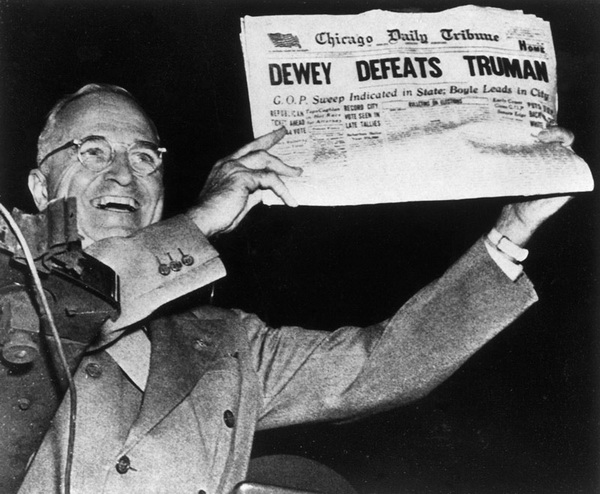
 Did you read today's blog headline as a typographical error, an Olympics equivalent of the Chicago Tribune's headline following the 1948 election, "Dewey Defeats Truman" -- a triumph of hope over reality?
Not at all. It is the reality.
The fact is that, most of the time, winning an Olympics bid, like many other efforts at local boosterism, turns out to be a Pyrrhic victory.
There may be the equivalent of a Bernie Madoff here and there, promoting various community projects in an effort to make a personal profit. But my assumption is that most community cheerleaders, like modern day George Babbitts [Sinclair Lewis, Babbitt (1922)], with confidence and pride in their town truly believe that their idea -- whether an indoor rain forest, the world's largest ball of string, or hosting an Olympic event -- really will "put their city on the map," while bringing tourists and their tourists' dollars to town. Who needs a business plan when "everyone knows" what a great idea it is?
We hear it now from the restaurant and bar owners in Iowa City -- and the elected officials who promote their causes -- who are proposing to shoehorn the Hancher Auditorium replacement into a downtown Iowa City laid out 170 years ago, in 1839.
All too often the construction money can't be found, or the project is built but it turns out that "build it and they will come" only works in the movies. Or enough public debt is incurred that it is, with the declining revenues that could have been predicted but weren't, the death knell for the project and then -- like paying for a dead horse -- takes years, if ever, to pay off.
 But there is no effort at community promotion for which there is a greater disparity between the promised economic benefits and the ultimate disappointment than Olympic venues (with the possible exception of the games held at this, the first venue for the games). Consider the following examples:
o The $2.7 billion debt following Montreal's 1976 Olympics was not paid off until 2005.
o Atlanta's 1996 hope of riches provided few if any increases in retail sales, hotel occupancy or airport traffic during the games. As economist Andrew Zimbalist reports, "The only variable that increased was hotel rates — and most of this money went to headquarters of chain hotels located in other cities."
o The excess costs in Sydney in 2000 were over $2 billion.
o Athens' budget in 2004 was $1.6 billion. The ultimate cost? $16 billion.
o An increase in tourism? As is often the case at Olympic events Athens suffered a 10% decline -- as those who would otherwise have visited at that time but wished to avoid Olympic crowds simply stayed away. A 2002 Utah survey indicated that 50% of the usual non-resident tourist skiers were planning to stay away during the winter games for that reason.
 o The newly built facilities not only cost billions to build, they take valuable real estate -- and may involve the removal of those left with no housing -- only to sit unused, or underutilized, after the lights dim and the athletes depart.
o Rio is already projecting a cost of $14.4 billion, and it will be another seven years, and uncounted millions or billions more, before anyone will be saying "let the games begin" in 2016.
It's kind of like second prize is that your city gets to spend billions of dollars hosting the Olympic games for a few days and first prize is that you don't have to.
Or, otherwise put, Chicago can spend billions on the Olympics and feed visitors for a few days, or it can have a sensible business plan to bring midwesterners to Chicago by rapid rail and feed them for a lifetime.
And that's why, I think, Chicago won the bidding in Copenhagen.
[Source for data: See Andrew Zimbalist, "Not a Rosy Picture," in "Room for Debate: Do Olympic Host Cities Ever Win?" New York Times, October 2, 2009, and Andrew Zimbalist, "Economic impact of Olympic Games rarely adds up to much gold," Street and Smith's Sports Business Journal, August 1, 2005, p. 21. For Athens' $16 billion estimate see also "Montrealers identify with Athens' challenges," Canadian Press, CTV, August 5, 2004.]
_______________
* Why do I put this blog ID at the top of the entry, when you know full well what blog you're reading? Because there are a number of Internet sites that, for whatever reason, simply take the blog entries of others and reproduce them as their own without crediting the source. I don't mind the flattering attention, but would appreciate acknowledgment as the source, even if I have to embed it myself. -- Nicholas Johnson
# # #
August 15, 2008, 10:25 a.m.
Currently Most Popular Blog Entries"UI Sexual Assault Update," July 19-August 9, and related Web page, "University of Iowa Sexual Assault Controversy -- 2007-08," July 19-present.
"Earthpark: 'Pretty Quiet Phase; No Timetable to Speak of,'" August 14, 2008.
"Media's Medicines," August 12, 2008.
"Public Transportation and Energy Policy," August 11, 2008.
"Random Thoughts on Law School Rankings," April 29, 2008."Police Accidental Shootings -- Of Themselves," May 9, 2008.
"Georgia on My Mind," August 13, 2008.
"Anonymous Electronic Speech," August 10, 2008.
And see, "500+ Posts Index"
Beatings Prove Ineffective in Resuscitating Dead Horses
Yesterday The Gazette reported the demise of Earthpark. See, Nicholas Johnson, "Earthpark: 'Pretty Quiet Phase; No Timetable to Speak of,'" August 14, 2008.
Today it's making an editorial effort to beat some life back into this dead horse. Editorial, "Earthpark's Fade is Lamentable," The Gazette, August 15, 2008, p. A4.
Here are some excerpts:
Visionary. Bold. Spectacular. . . . We don't enjoy the prospect of giving up on this idea [that] represented the type of forward thinking that the Vision Iowa Program was intended to generate . . . a world-class attraction that would provide a big economic boost to the state . . .. [Notwithstanding the reduction from a $350- to a $140-million project it is] still a grandiose endeavor. . . . [T]he [Senator Grassley $50-million earmark] grant was rescinded in December when the developers missed a deadline to provide matching support. . . . Earthpark's demise in Iowa . . . should be lamented. . . . We'll likely never know if it could have worked here. At the least, we hope . . . entrepreneurial Iowans won't be discouraged about dreaming and putting big ideas on the table again."
Where does one begin with this kind of boosterism, cheer leading "analysis"?
Before I start on that, there's a related matter worthy of comment.
Earthpark's online listing of its board of directors includes "Joe Hladky/Gazette Communications," now identified on The Gazette's editorial page as "Chairman of the Board" of Gazette Communications (having formerly been President and Chief Executive Officer).
To the best of my knowledge this association has never been revealed over the course of the last ten years in any article or editorial praising Earthpark.
Don't get me wrong; I had tremendous regard for this locally-owned newspaper-television media company as an FCC commissioner, and I still do. The civic leadership it offers eastern Iowa in general, and Cedar Rapids in particular, is remarkable -- as is its news coverage, especially for a paper with a subscription base of its size. It's been innovative technologically, as with its online version. KCRG-TV is my TV station of choice, and our family has long subscribed to the hard copy version of The Gazette. Obviously, much-to-all of this can fairly be credited to Mr. Hladky, the other executives, and editors.
But I do think an undisclosed association of a newspaper executive as a board member of a local project being reported on, and editorialized about, is at least mildly troublesome.
The Society of Professional Journalists' "Code of Ethics" provides, in part:
Journalists should:
— Avoid conflicts of interest, real or perceived.
— Remain free of associations and activities that may compromise integrity or damage credibility.
— [S]hun . . . service in community organizations if they compromise journalistic integrity.
— Disclose unavoidable conflicts.
I'm not going to pass judgment on whether what was done was technically "unethical." I'll leave that to The Gazette's ombudsperson, journalism professors, professionals, and others. Though I rather suspect the paper would not permit a reporter to cover a story about a controversial proposal of an organization while simultaneously serving as a board member of that very organization.
But I have and will comment about the analysis in this morning's editorial. Much of what I have to say about it can be found in my Earthpark/Iowa Child Web site, and the 30 or so publications of mine to which it links (along with the hundreds of news stories and commentaries of others), and yesterday's blog entry, Nicholas Johnson, "Earthpark: 'Pretty Quiet Phase; No Timetable to Speak of,'" August 14, 2008.
Much of what I've questioned about Earthpark's first ten years is illustrated in the editorial.
* The issue here is not whether something is "visionary. Bold. Spectacular" and "forward thinking." It's not about the desirability of encouraging "entrepreneurial Iowans" to dream and put "big ideas on the table." Of course we need "visionary" ideas -- at least those that can pass "the laugh test" (which the rain forest failed).
* The issue involves the next step: the evaluation of those ideas; are they economically, technologically, environmentally and politically feasible? Is there local support -- for the idea, and the provision of the necessary money? Is that money in hand to complete the project? Is there a clear focus of purpose? Is there a business plan, and if so is it realistic in its projections of a cash flow sufficient to keep the project in operation? Not only did the rain forest fail these tests as well, the cheer leaders and editorial writers (including this morning's) failed to even acknowledge that such issues were relevant. It was sort of, "Damn the torpedoes; it's visionary; full steam ahead; let's do it."
* To say that "the developers missed a deadline" is misleading at best; it sort of suggests that of course they had the $50 million match in the bank, but somehow overlooked filing some paperwork on time. More accurate would be to acknowledge that the developers were unable to find a single Iowan, or Iowa community, willing to contribute a single dime to this project over the course of ten years' of vigorous fund raising efforts (beyond the seed money from the guy with the idea, Ted Townsend).
* Similarly, to characterize this scaled back proposal as "still a grandiose endeavor" is also misleading. It fails to acknowledge that the project's own consultants advised the board that it would need to create "the world's largest" -- requiring about a $350-million structure -- to have a prayer of making a go of it. A $140-million indoor rain forest is virtually doomed to financial failure and is scarcely a "grandiose endeavor."
* Finally, there's the matter of the use of taxpayers' money. If an entertainment/educational venue can't make a go of it with marketplace forces, if owners, investors, venture capitalists and banks' loan officers aren't willing to put money into it, why should taxpayers? But I won't go on about that.
Boosterism and "vision" have their place. So do realism, analysis, detailed business plans, and a close watch over taxpayers' money. The mainstream media and public officials do no one a favor when they concentrate exclusively on the former while ridiculing those who insist on going through the latter.
# # #
 Did you read today's blog headline as a typographical error, an Olympics equivalent of the Chicago Tribune's headline following the 1948 election, "Dewey Defeats Truman" -- a triumph of hope over reality?
 But there is no effort at community promotion for which there is a greater disparity between the promised economic benefits and the ultimate disappointment than Olympic venues (with the possible exception of the games held at this, the first venue for the games). Consider the following examples: